Introduction to Reservoir Computing
From a Dynamical System Perspective
Chia-Hsiang Kao
Oct. 19, 2019 @Mozilla Community SpaceTaipei
Outline
• Introduction to the configuration of reservoir
• Introduction to chaotic system
• Prediction of chaotic system using reservoir computing
• Mechanism of reservoir computing
2
Introduction to
the configuration of reservoir
Main Reference
• Pathak, J., Hunt, B., Girvan, M., Lu, Z., & Ott, E. (2018). Model-free
prediction of large spatiotemporally chaotic systems from data: A
reservoir computing approach. Physical review letters, 120(2), 024102.
• Pathak, J., Lu, Z., Hunt, B. R., Girvan, M., & Ott, E. (2017). Using machine
learning to replicate chaotic attractors and calculate Lyapunov
exponents from data. Chaos: An Interdisciplinary Journal of Nonlinear
Science, 27(12), 121102.
• Jaideep Pathak. MACHINE LEARNING FOR ANALYSIS OF HIGH-
DIMENSIONAL CHAOTIC SPATIOTEMPORAL DYNAMICAL SYSTEMS.
Princeton Plasma Physics Laboratory Theory Semina. (6/12/18)
4
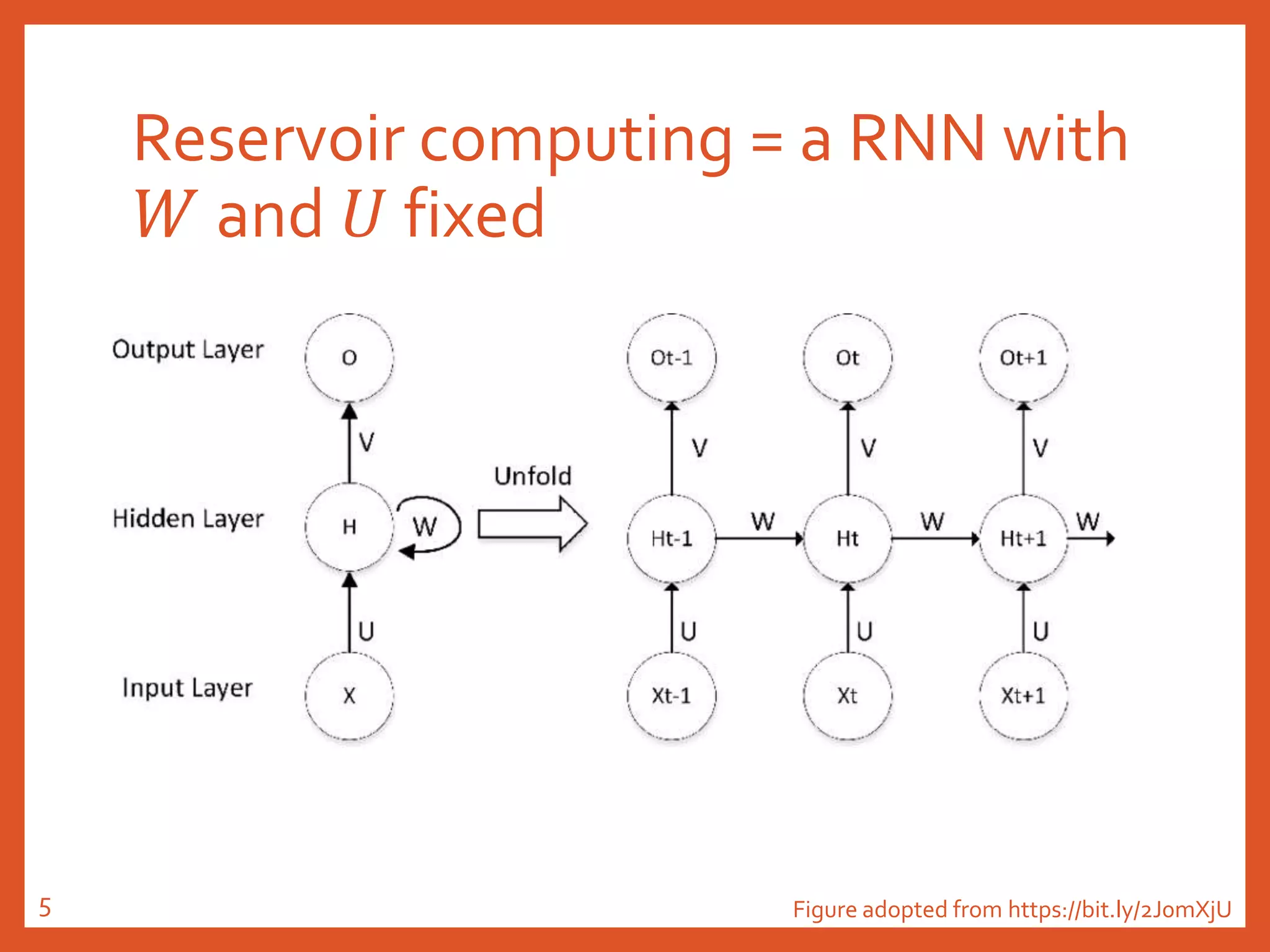
Reservoir computing = a RNN with
𝑊 and 𝑈 fixed
Figure adopted from https://bit.ly/2J0mXjU5
Configuration of the Reservoir
Input: 𝑢(𝑡)
Output: u(𝑡)
State of reservoir: r(𝑡)
𝒖(𝒕)
v(𝒕)
𝒓(𝒕)
𝑾 𝒓𝒓
𝑊𝑖𝑛 and 𝑊𝑟𝑟 are fixed.
𝑊𝑜𝑢𝑡 is trainable!
Wrr: large, low-degree, directed,
random adjacent matrix
Update 𝑟(𝑡):
r t + Δt = tanh[𝐖𝐫𝐫r t + 𝐖𝐢𝐧u(t)] ,r(t)我會稱之為「reservoir的狀態」
Refer to Skibinsky-Gitlin et al. (2018, June). Cyclic Reservoir Computing with FPGA Devices for Efficient Channel
Equalization. In InternationalConference on Artificial Intelligence andSoftComputing (pp. 226-234). Springer, Cham.6
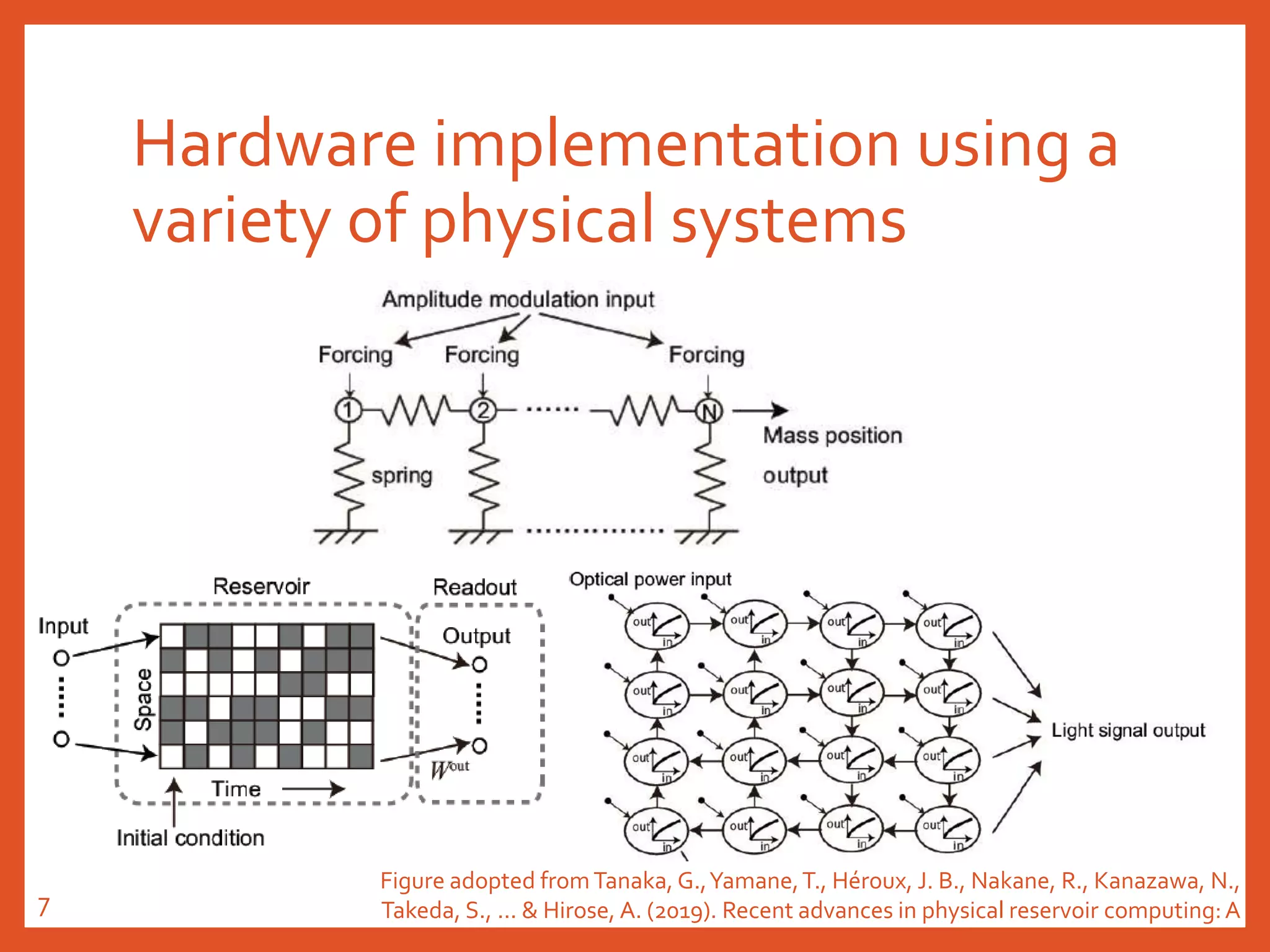
Hardware implementation using a
variety of physical systems
Figure adopted fromTanaka, G.,Yamane,T., Héroux, J. B., Nakane, R., Kanazawa, N.,
Takeda, S., ... & Hirose, A. (2019). Recent advances in physical reservoir computing:A
review. Neural Networks.
7
Introduction to chaotic
system
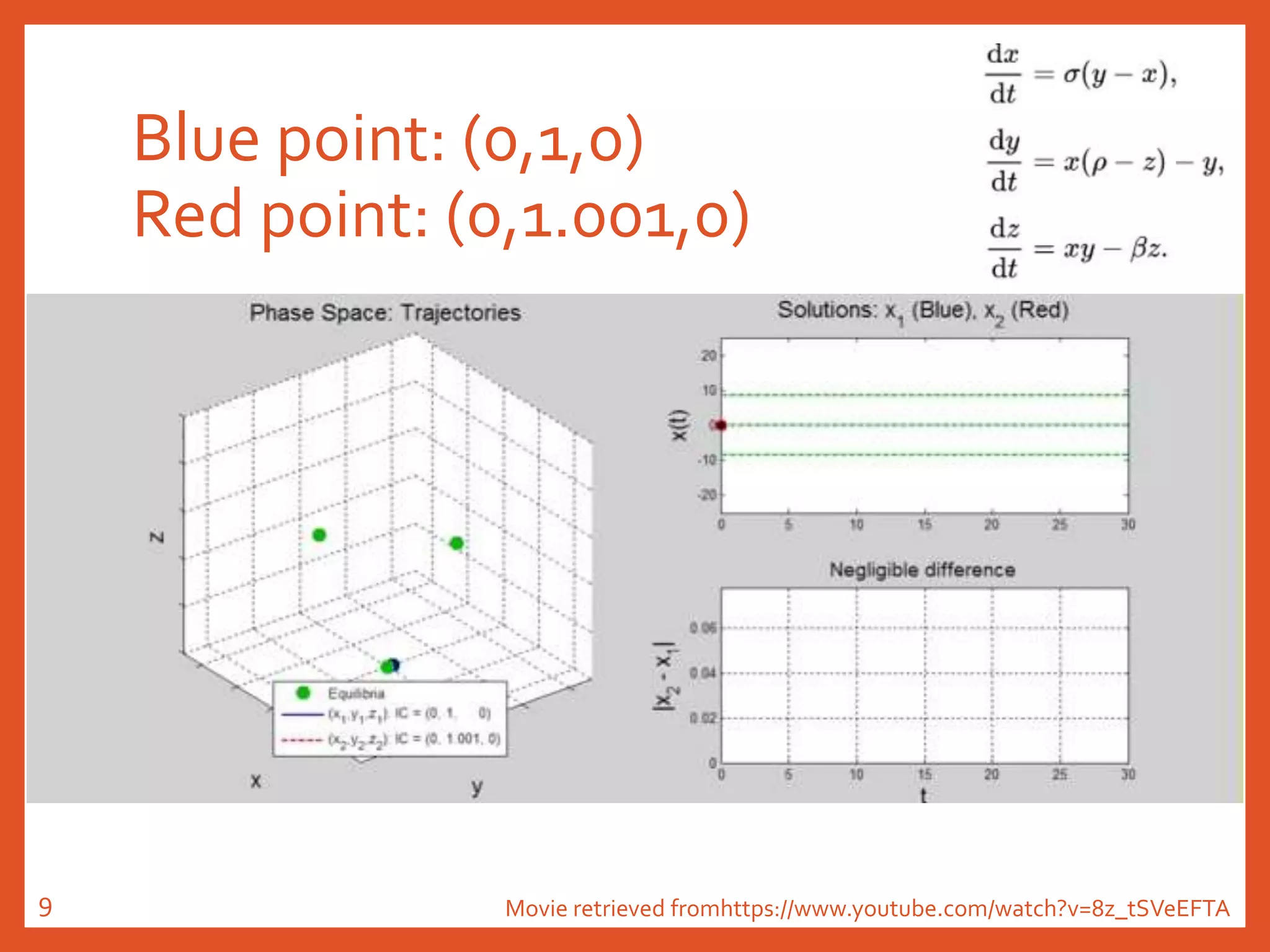
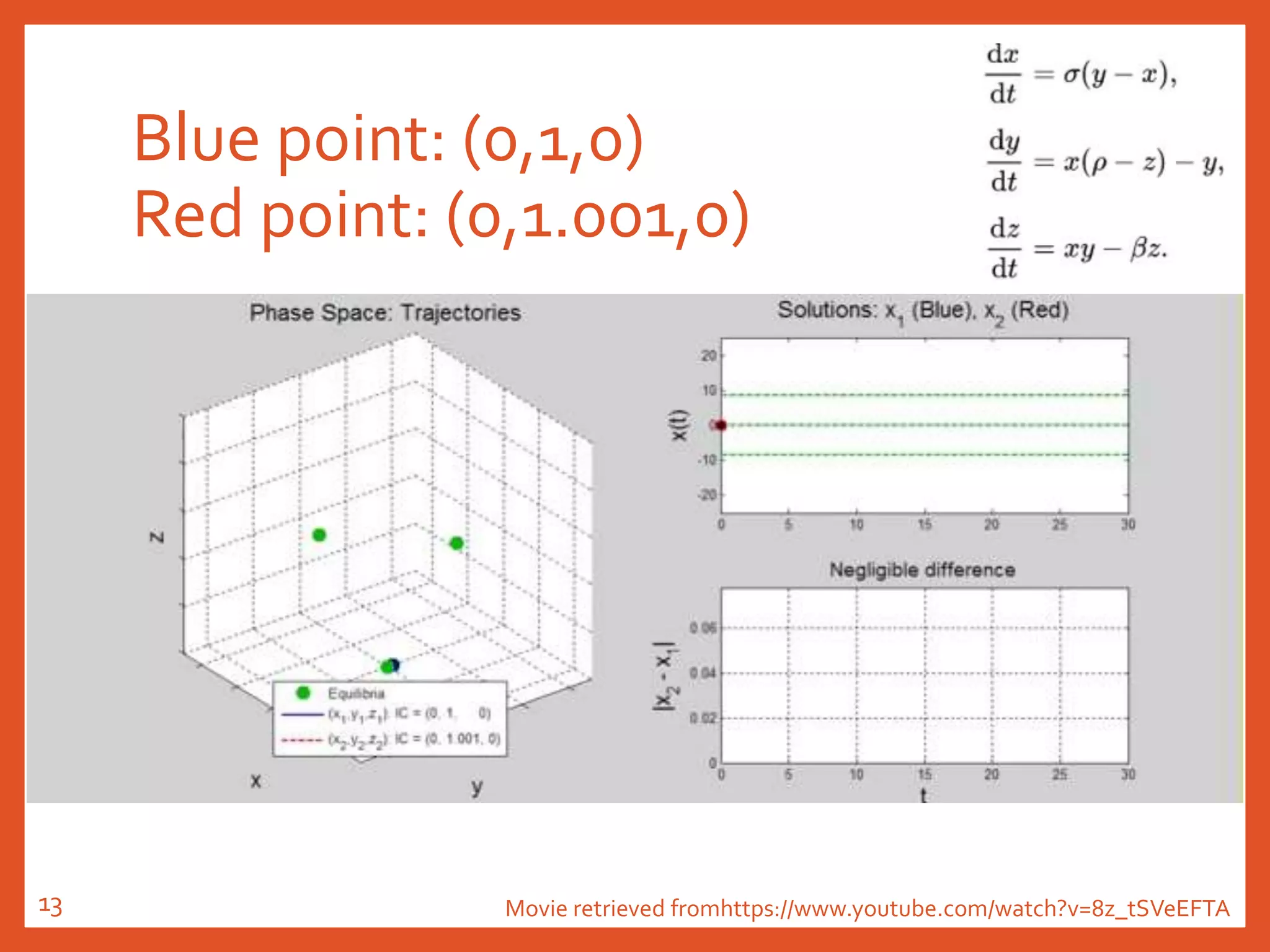
Blue point: (0,1,0)
Red point: (0,1.001,0)
Movie retrieved fromhttps://www.youtube.com/watch?v=8z_tSVeEFTA9
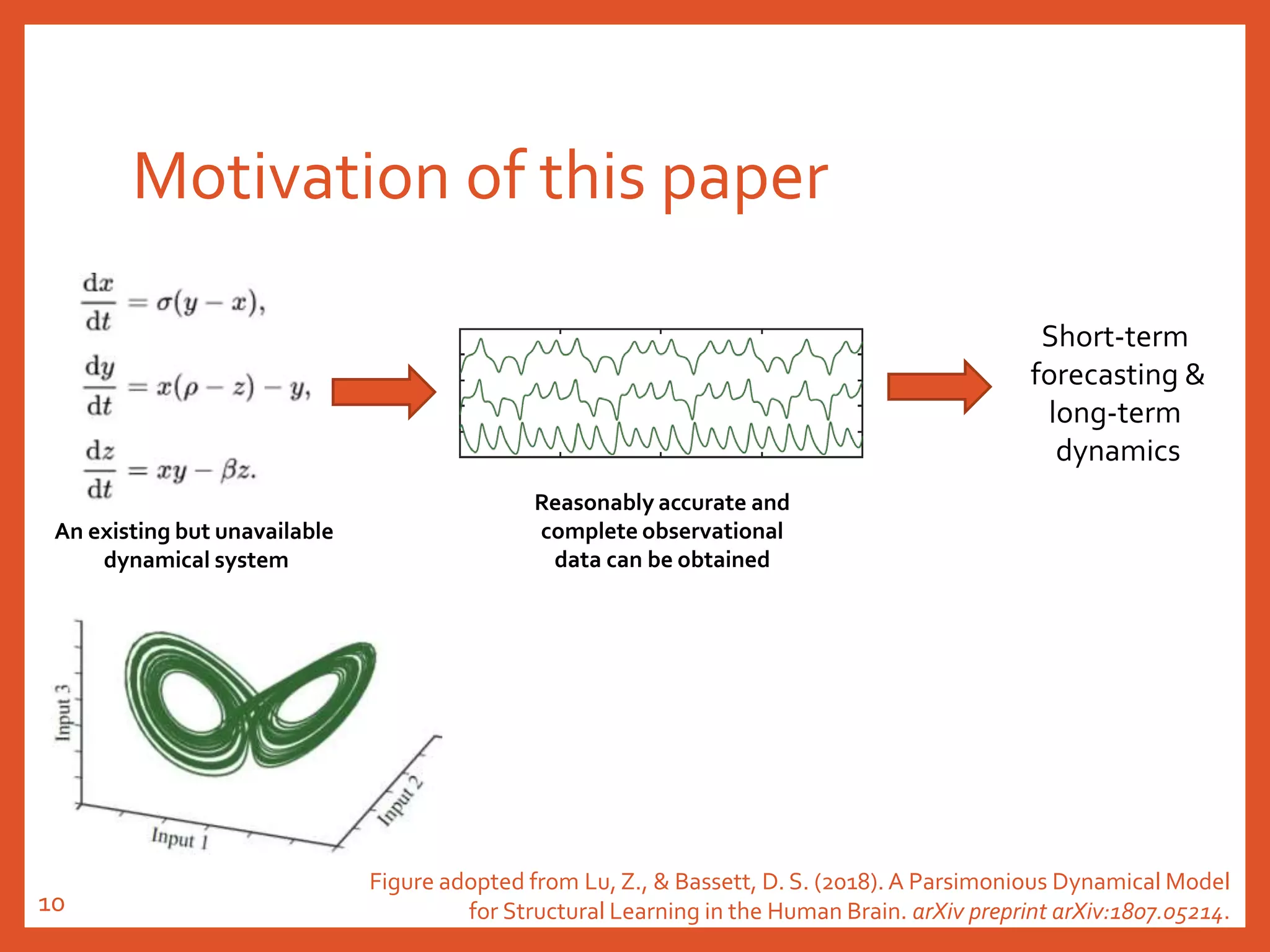
Motivation of this paper
An existing but unavailable
dynamical system
Short-term
forecasting &
long-term
dynamics
Reasonably accurate and
complete observational
data can be obtained
Figure adopted from Lu, Z., & Bassett, D. S. (2018). A Parsimonious Dynamical Model
for Structural Learning in the Human Brain. arXiv preprint arXiv:1807.05214.10
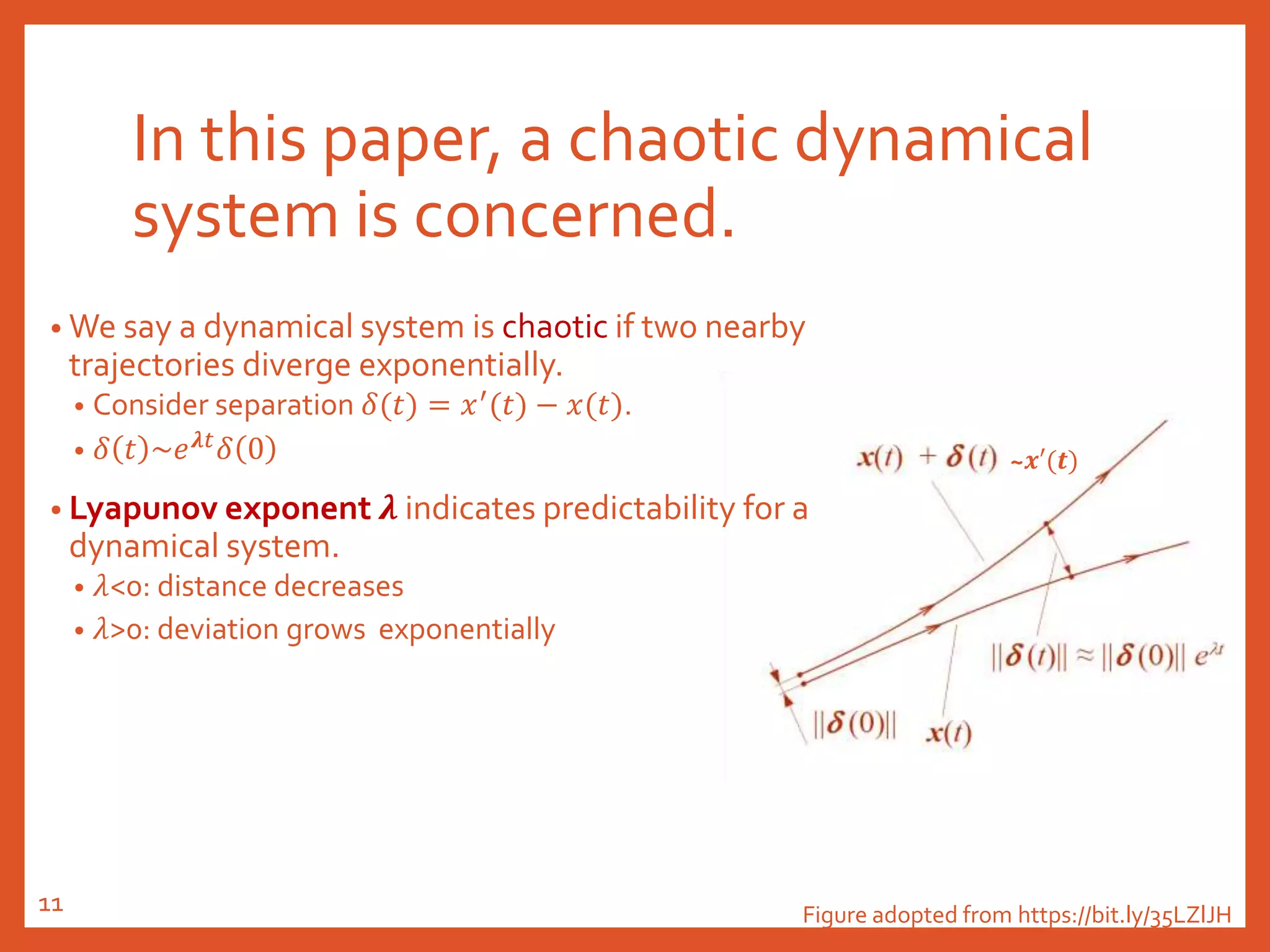
~𝒙′(𝒕)
In this paper, a chaotic dynamical
system is concerned.
• We say a dynamical system is chaotic if two nearby
trajectories diverge exponentially.
• Consider separation 𝛿(𝑡) = 𝑥′
(𝑡) − 𝑥(𝑡).
• 𝛿 𝑡 ~𝑒 𝝀𝑡
𝛿 0
• Lyapunov exponent 𝝀 indicates predictability for a
dynamical system.
• 𝜆<0: distance decreases
• 𝜆>0: deviation grows exponentially
Figure adopted from https://bit.ly/35LZlJH11
In this paper, a chaotic dynamical
system is concerned.
• We say a dynamical system is chaotic if two nearby
trajectories diverge exponentially.
• Consider separation 𝛿(𝑡) = 𝑥′
(𝑡) − 𝑥(𝑡).
• 𝛿 𝑡 ~𝑒 𝝀𝑡
𝛿 0
• Lyapunov exponent 𝝀 indicates predictability for a
dynamical system.
• 𝜆<0: distance decreases
• 𝜆>0: deviation grows exponentially
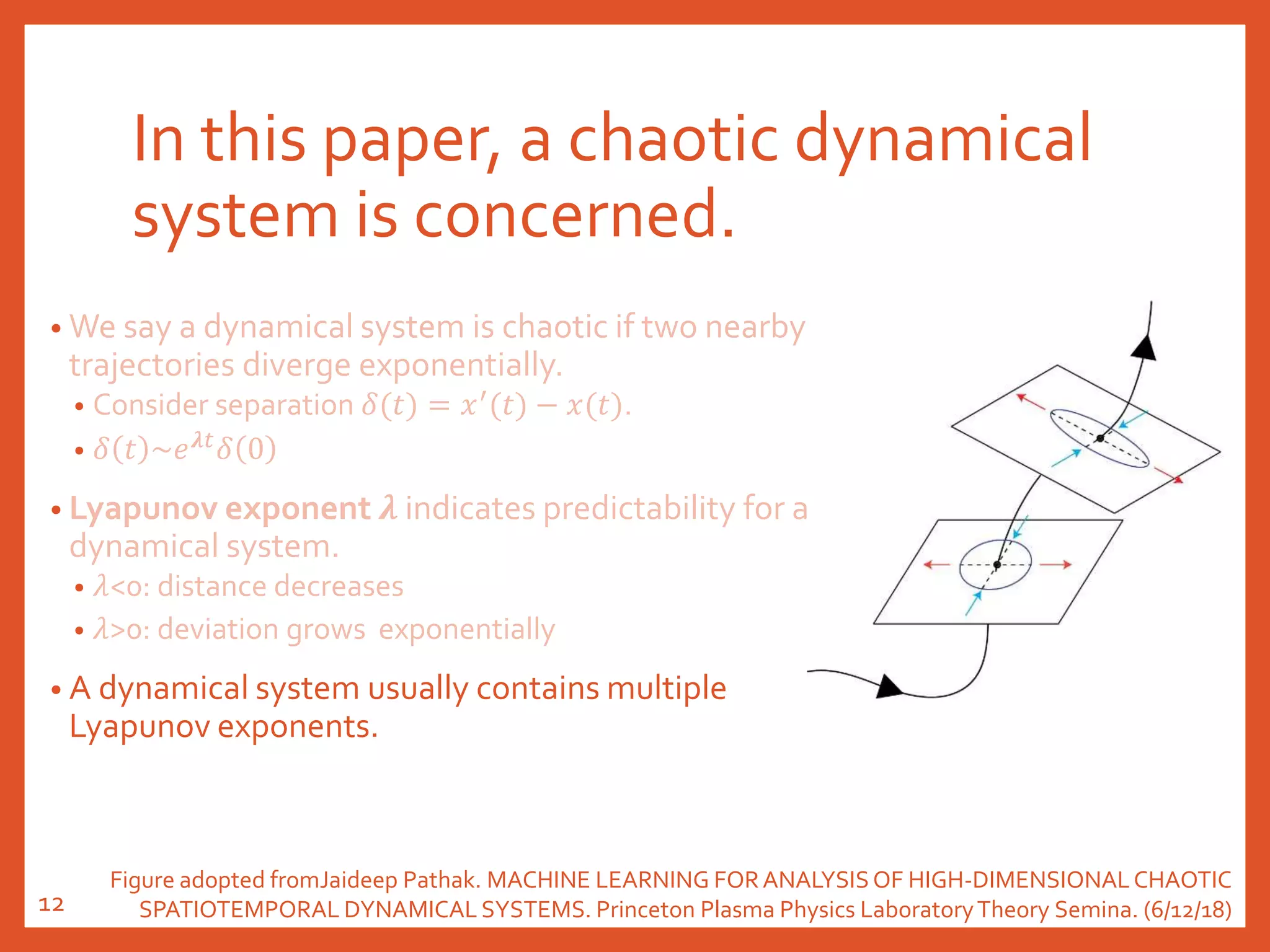
• A dynamical system usually contains multiple
Lyapunov exponents.
Figure adopted fromJaideep Pathak. MACHINE LEARNING FORANALYSISOF HIGH-DIMENSIONALCHAOTIC
SPATIOTEMPORAL DYNAMICAL SYSTEMS. Princeton Plasma Physics LaboratoryTheory Semina. (6/12/18)12
Blue point: (0,1,0)
Red point: (0,1.001,0)
Movie retrieved fromhttps://www.youtube.com/watch?v=8z_tSVeEFTA13
Q: Can a traditional RNN or LSTM
learn to predict the future state of a
Lorenz system?
• RNN and LSTM can of course forecast the behavior of the Lorenz
system in short-term.
• Why or How?
• How about reservoir computing?
• Why or How?
14
Prediction of chaotic system
using reservoir computing
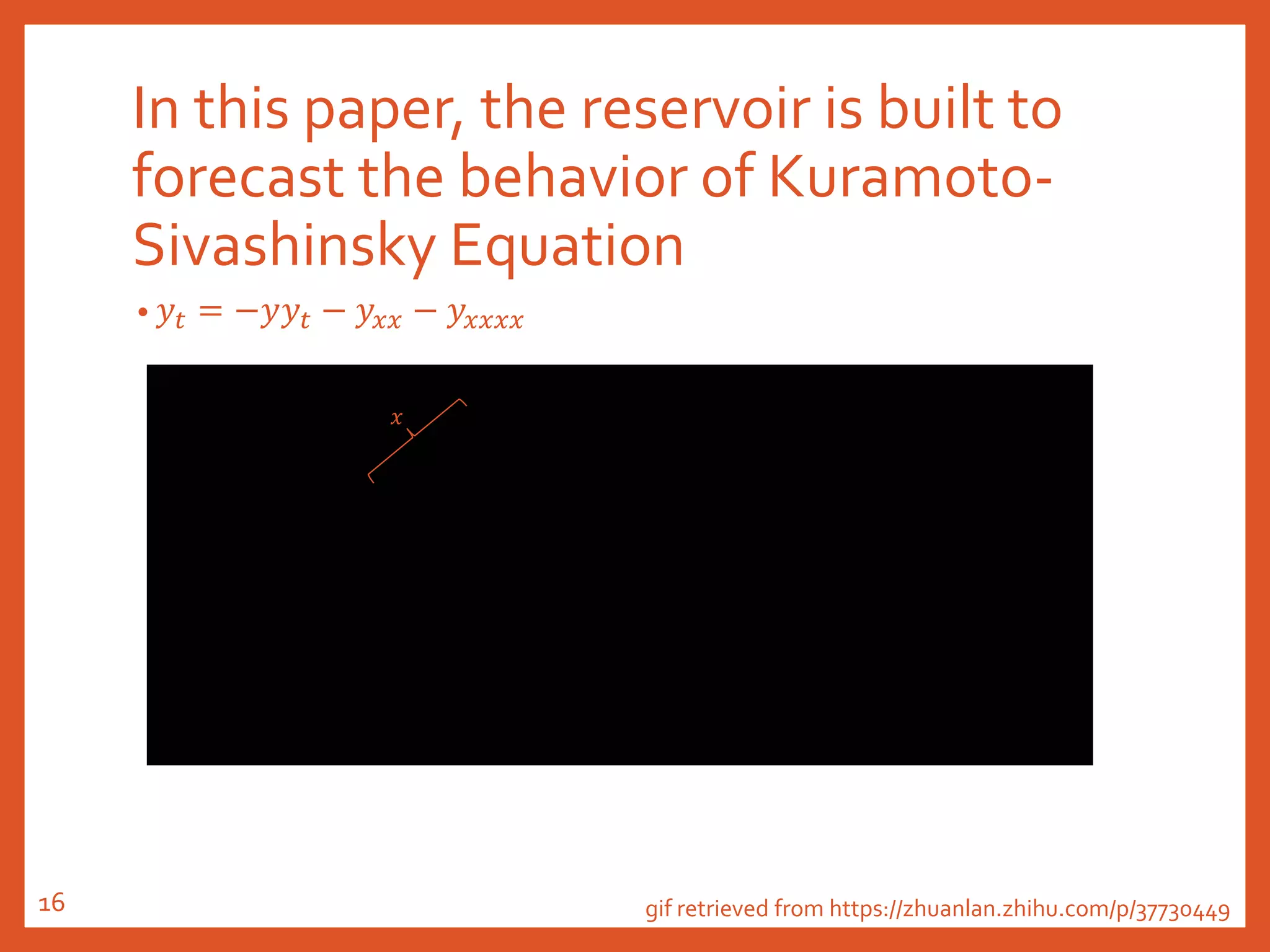
In this paper, the reservoir is built to
forecast the behavior of Kuramoto-
Sivashinsky Equation
• 𝑦𝑡 = −𝑦𝑦𝑡 − 𝑦𝑥𝑥 − 𝑦𝑥𝑥𝑥𝑥
gif retrieved from https://zhuanlan.zhihu.com/p/37730449
𝑥
16
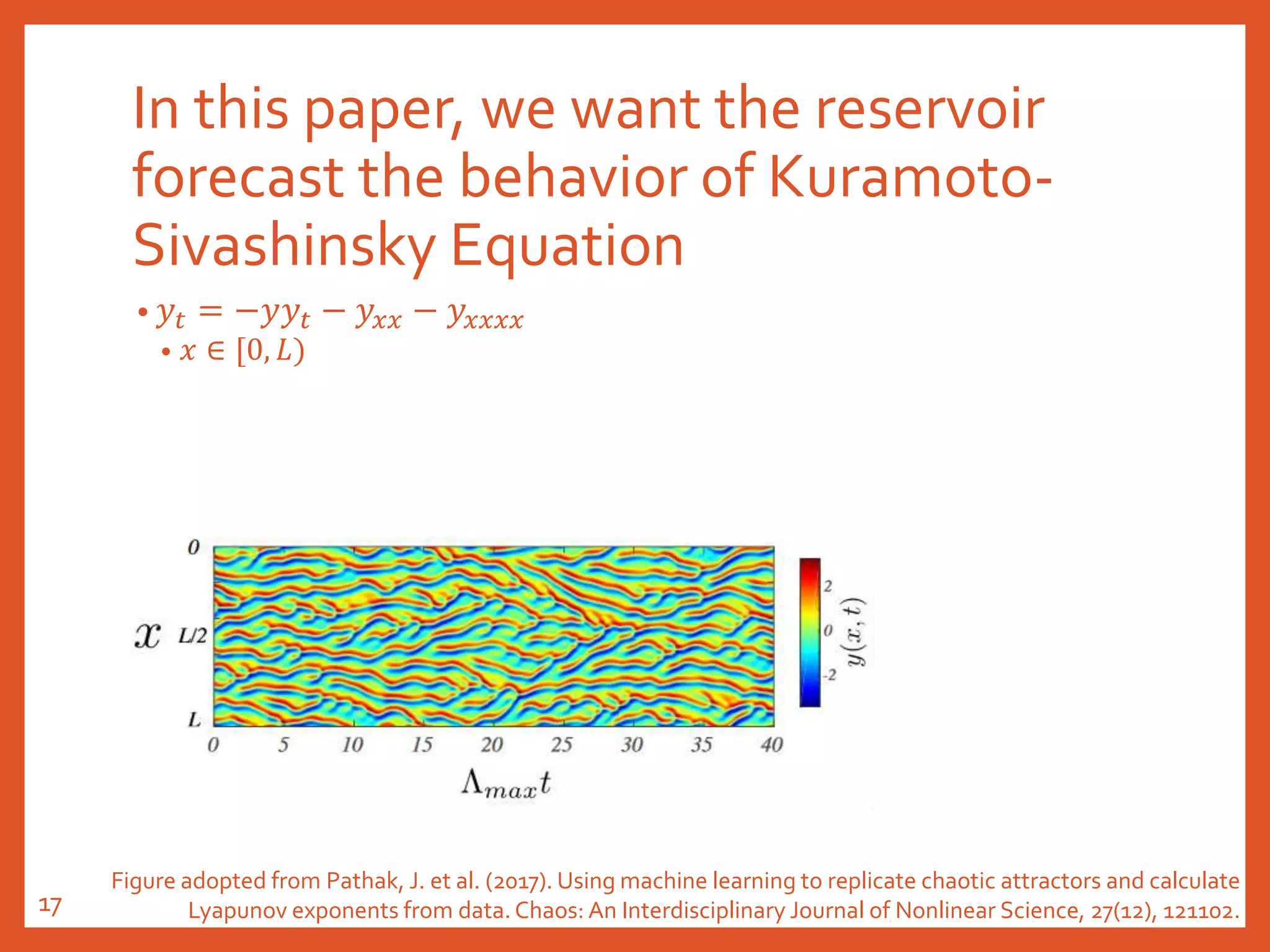
In this paper, we want the reservoir
forecast the behavior of Kuramoto-
Sivashinsky Equation
• 𝑦𝑡 = −𝑦𝑦𝑡 − 𝑦𝑥𝑥 − 𝑦𝑥𝑥𝑥𝑥
• 𝑥 ∈ [0, 𝐿)
Figure adopted from Pathak, J. et al. (2017). Using machine learning to replicate chaotic attractors and calculate
Lyapunov exponents from data. Chaos: An Interdisciplinary Journal of Nonlinear Science, 27(12), 121102.17
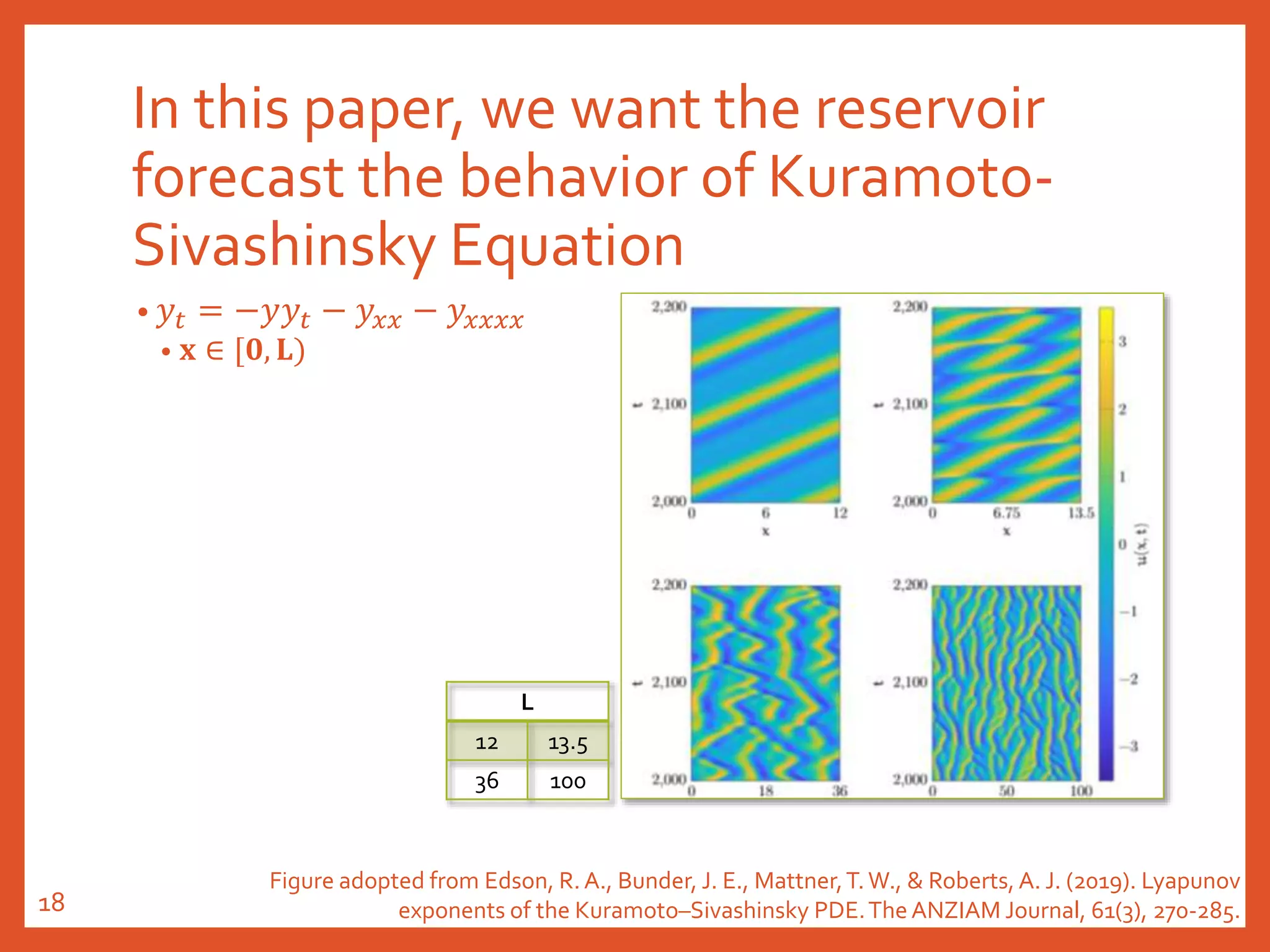
In this paper, we want the reservoir
forecast the behavior of Kuramoto-
Sivashinsky Equation
• 𝑦𝑡 = −𝑦𝑦𝑡 − 𝑦𝑥𝑥 − 𝑦𝑥𝑥𝑥𝑥
• 𝐱 ∈ [𝟎, 𝐋)
L
12 13.5
36 100
Figure adopted from Edson, R. A., Bunder, J. E., Mattner,T.W., & Roberts, A. J. (2019). Lyapunov
exponents of the Kuramoto–Sivashinsky PDE.TheANZIAM Journal, 61(3), 270-285.18
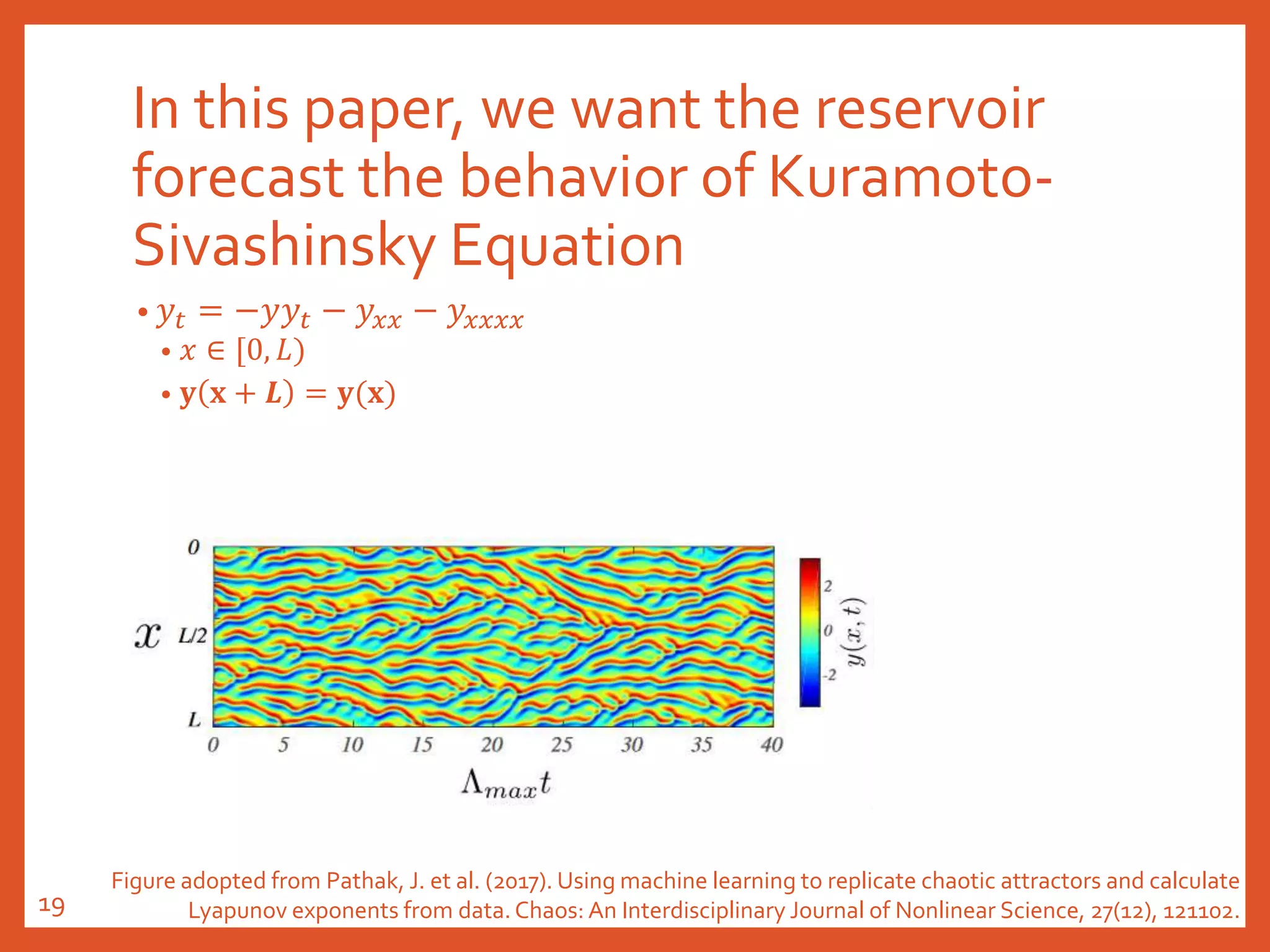
In this paper, we want the reservoir
forecast the behavior of Kuramoto-
Sivashinsky Equation
• 𝑦𝑡 = −𝑦𝑦𝑡 − 𝑦𝑥𝑥 − 𝑦𝑥𝑥𝑥𝑥
• 𝑥 ∈ [0, 𝐿)
• 𝐲 𝐱 + 𝑳 = 𝐲(𝐱)
Figure adopted from Pathak, J. et al. (2017). Using machine learning to replicate chaotic attractors and calculate
Lyapunov exponents from data. Chaos: An Interdisciplinary Journal of Nonlinear Science, 27(12), 121102.19
Predict the Behavior of
Kuramoto-Sivashinsky Equation (4)
• 𝑦𝑡 = −𝑦𝑦𝑡 − 𝑦𝑥𝑥 − 𝑦𝑥𝑥𝑥𝑥
• 𝑥 ∈ [0, 𝐿)
• 𝑦 𝑥 + 𝐿 = 𝑦(𝑥)
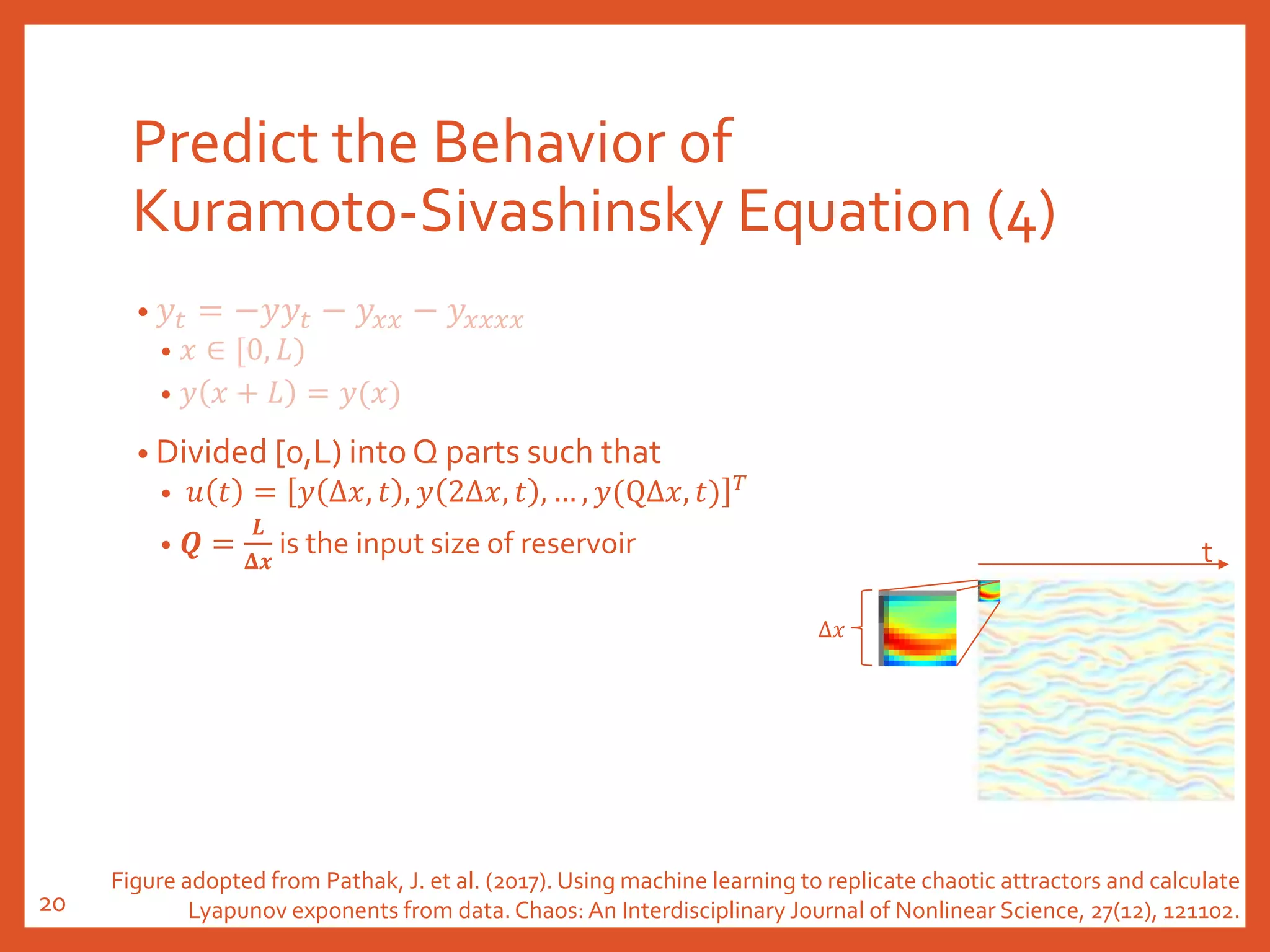
• Divided [0,L) into Q parts such that
• 𝑢 𝑡 = 𝑦 Δ𝑥, 𝑡 , 𝑦 2Δ𝑥, 𝑡 , … , 𝑦(QΔ𝑥, 𝑡) 𝑇
• 𝑸 =
𝑳
𝚫𝒙
is the input size of reservoir
Δ𝑥
t
Figure adopted from Pathak, J. et al. (2017). Using machine learning to replicate chaotic attractors and calculate
Lyapunov exponents from data. Chaos: An Interdisciplinary Journal of Nonlinear Science, 27(12), 121102.20
Configuration of the Reservoir in the Paper
𝐫 𝒕
r t + Δt = tanh[𝐖𝐫𝐫 ⋅ r t + 𝐖𝐢𝐧 ⋅ u(t)] ,
v t = 𝐖𝐨𝐮𝐭 ⋅ r t
𝐖𝐢𝐧
𝐖𝒐𝒖𝒕𝐖𝐫𝐫
v 𝑡
Figure adopted from Pathak, J. et al. (2018). Model-free prediction of large spatiotemporally chaotic
systems from data: A reservoir computing approach. Physical review letters, 120(2), 024102.21
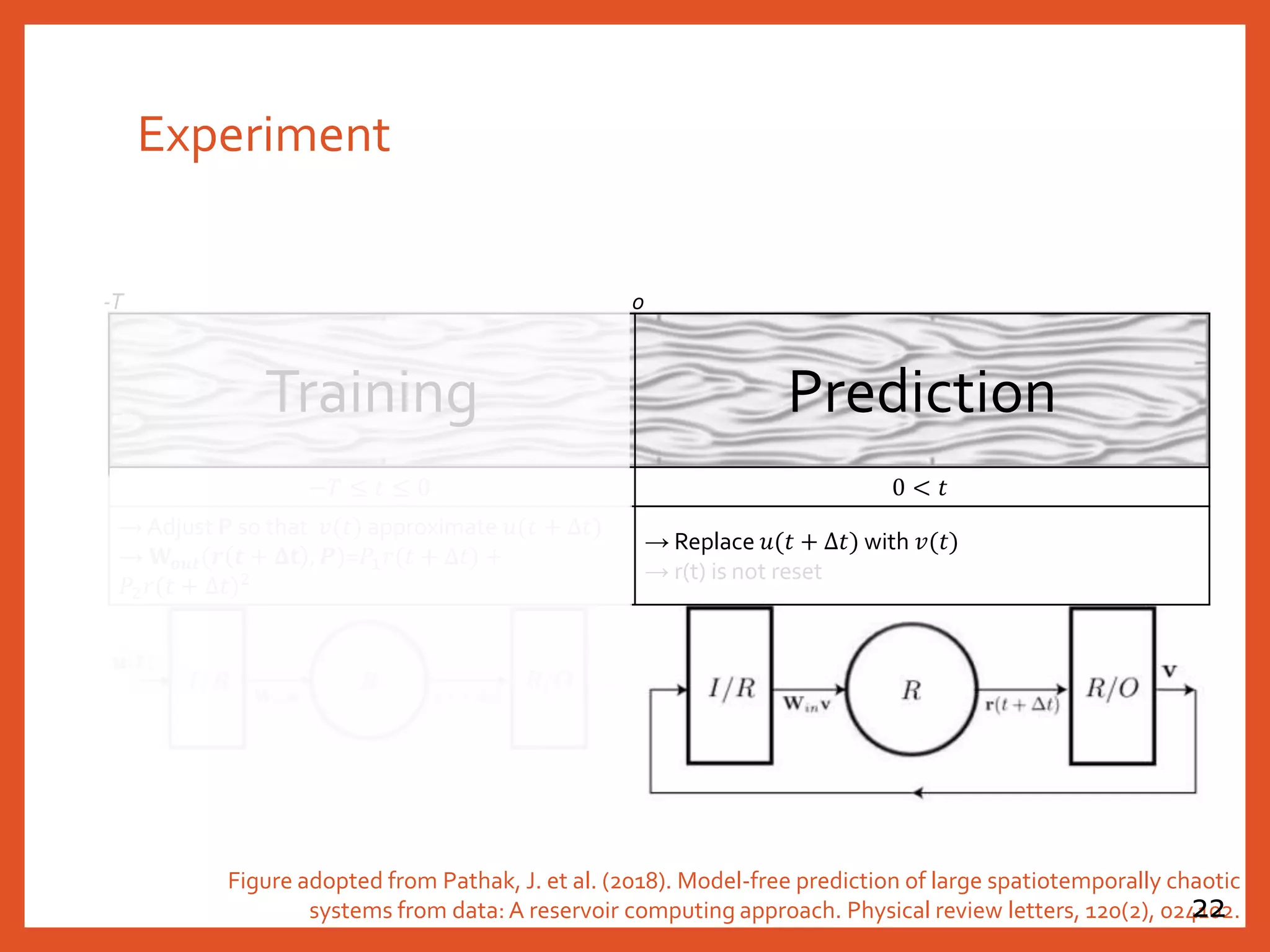
Experiment
Training Prediction
−𝑇 ≤ 𝑡 ≤ 0 0 < 𝑡
→Adjust P so that 𝑣(𝑡) approximate 𝑢(𝑡 + Δ𝑡)
→ 𝐖𝒐𝒖𝒕(𝒓 𝒕 + 𝚫𝐭 , 𝑷)=𝑃1 𝑟(𝑡 + Δ𝑡) +
𝑃2 𝑟(𝑡 + Δ𝑡)2
→ Replace 𝑢(𝑡 + Δ𝑡) with 𝑣(𝑡)
→ r(t) is not reset
0-T
Figure adopted from Pathak, J. et al. (2018). Model-free prediction of large spatiotemporally chaotic
systems from data: A reservoir computing approach. Physical review letters, 120(2), 024102.22
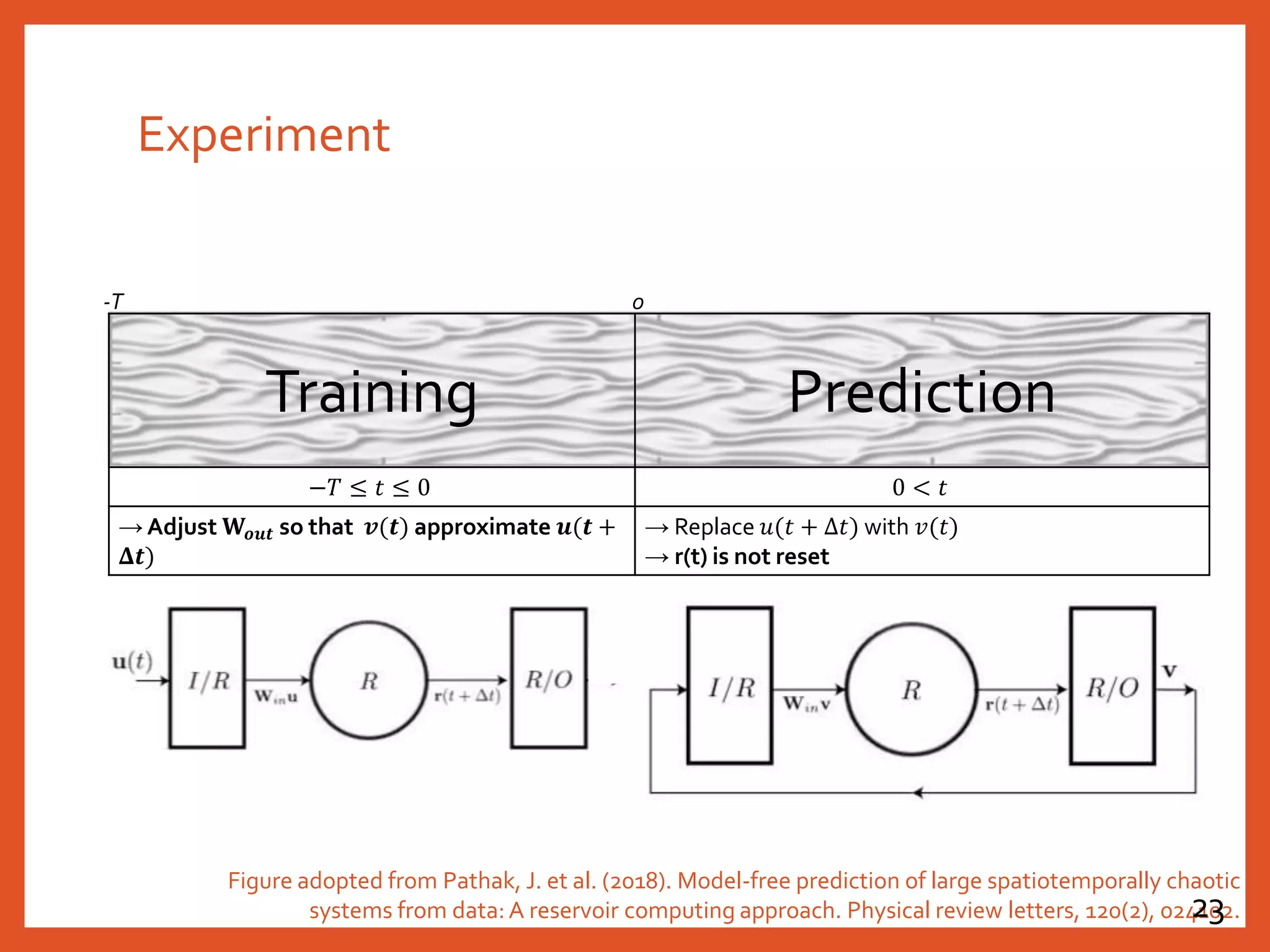
Experiment
Training Prediction
−𝑇 ≤ 𝑡 ≤ 0 0 < 𝑡
→ Adjust 𝐖𝒐𝒖𝒕 so that 𝒗(𝒕) approximate 𝒖(𝒕 +
𝚫𝒕)
→ Replace 𝑢(𝑡 + Δ𝑡) with 𝑣(𝑡)
→ r(t) is not reset
0-T
Figure adopted from Pathak, J. et al. (2018). Model-free prediction of large spatiotemporally chaotic
systems from data: A reservoir computing approach. Physical review letters, 120(2), 024102.23
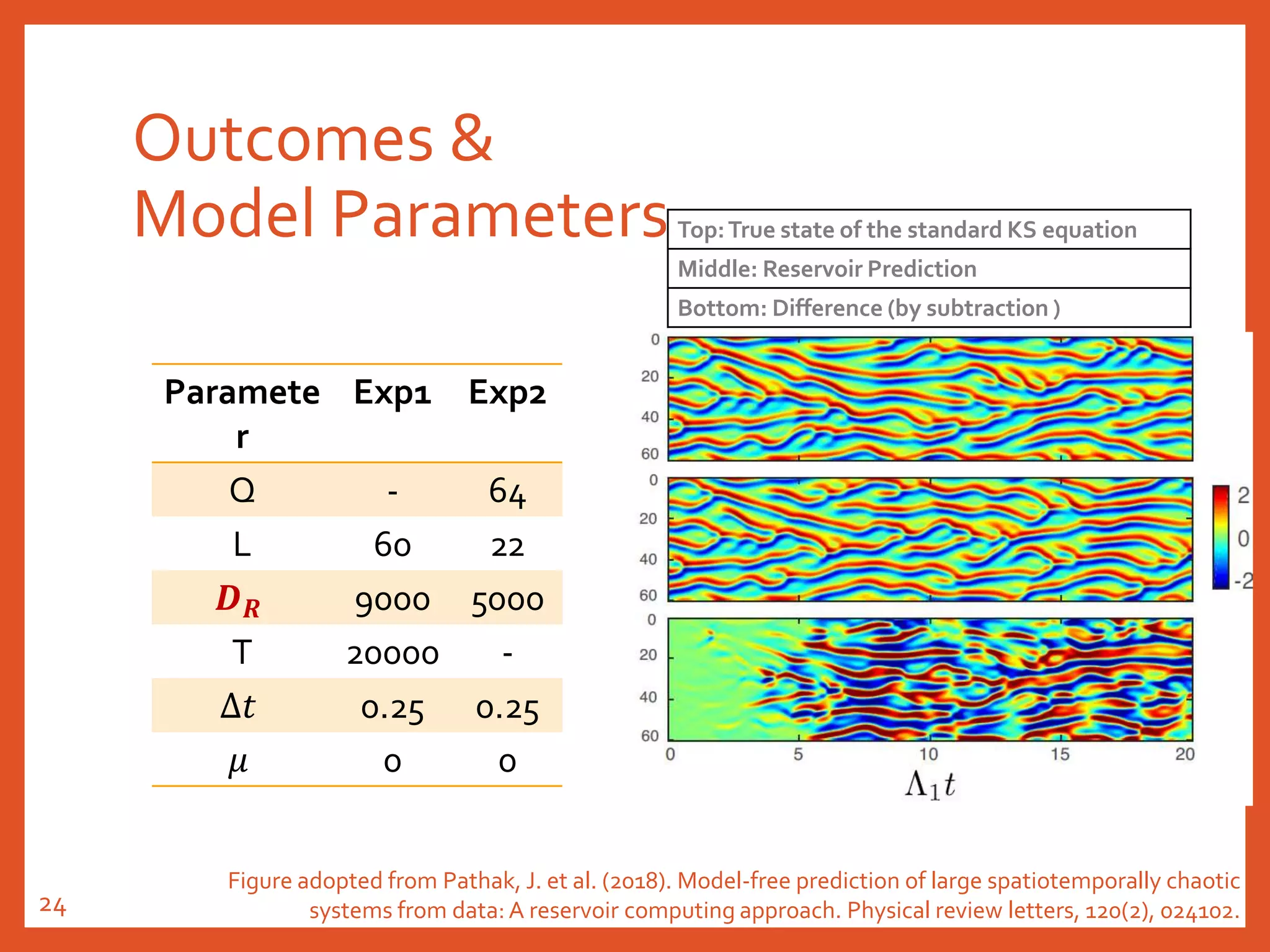
Outcomes &
Model ParametersTop:True state of the standard KS equation
Middle: Reservoir Prediction
Bottom: Difference (by subtraction )
Paramete
r
Exp1 Exp2
Q - 64
L 60 22
𝑫 𝑹 9000 5000
T 20000 -
Δ𝑡 0.25 0.25
𝜇 0 0
Figure adopted from Pathak, J. et al. (2018). Model-free prediction of large spatiotemporally chaotic
systems from data: A reservoir computing approach. Physical review letters, 120(2), 024102.24
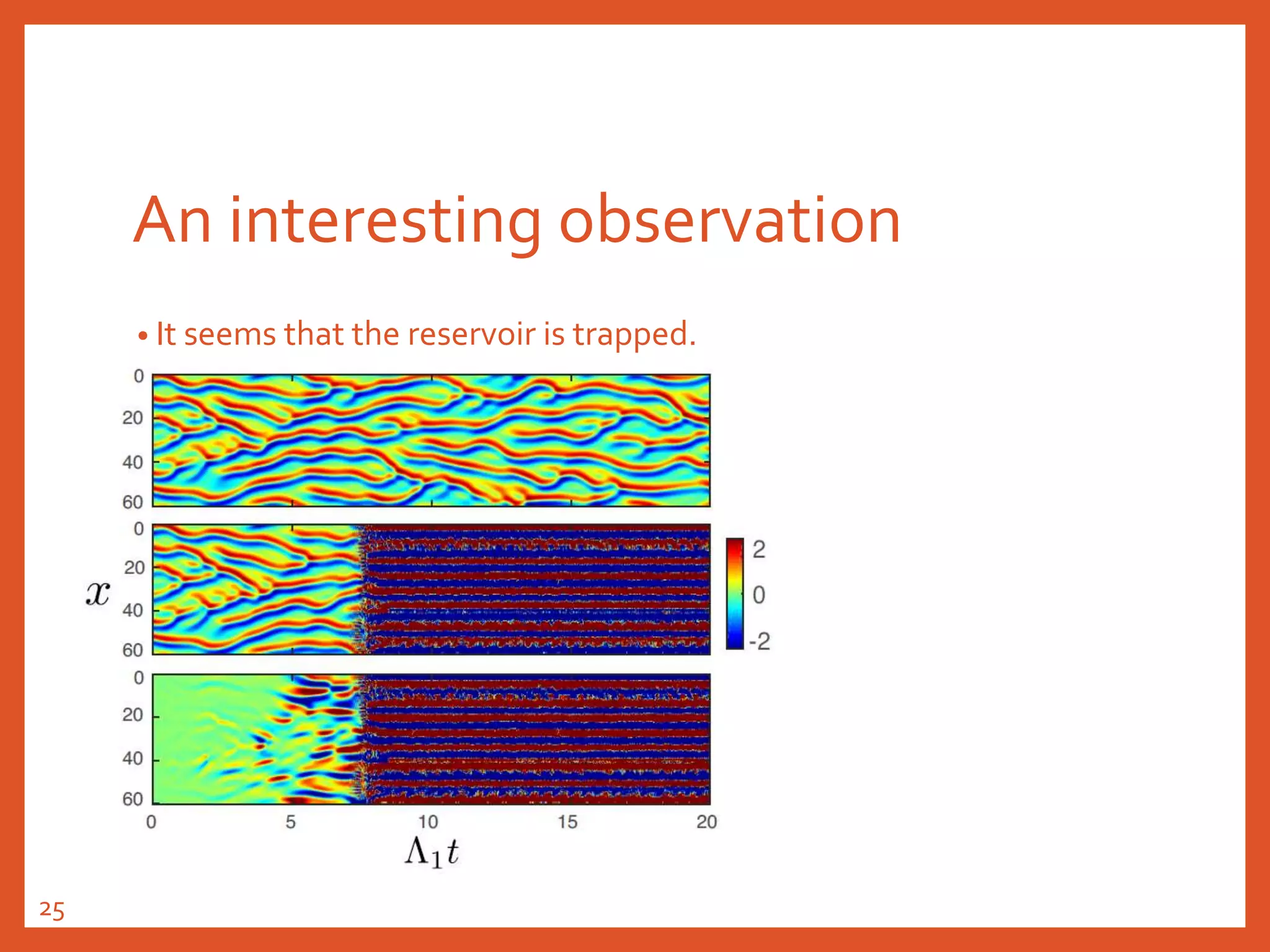
An interesting observation
• It seems that the reservoir is trapped.
25
Outpu
t
Extension – Parallelized Reservoir
Scheme
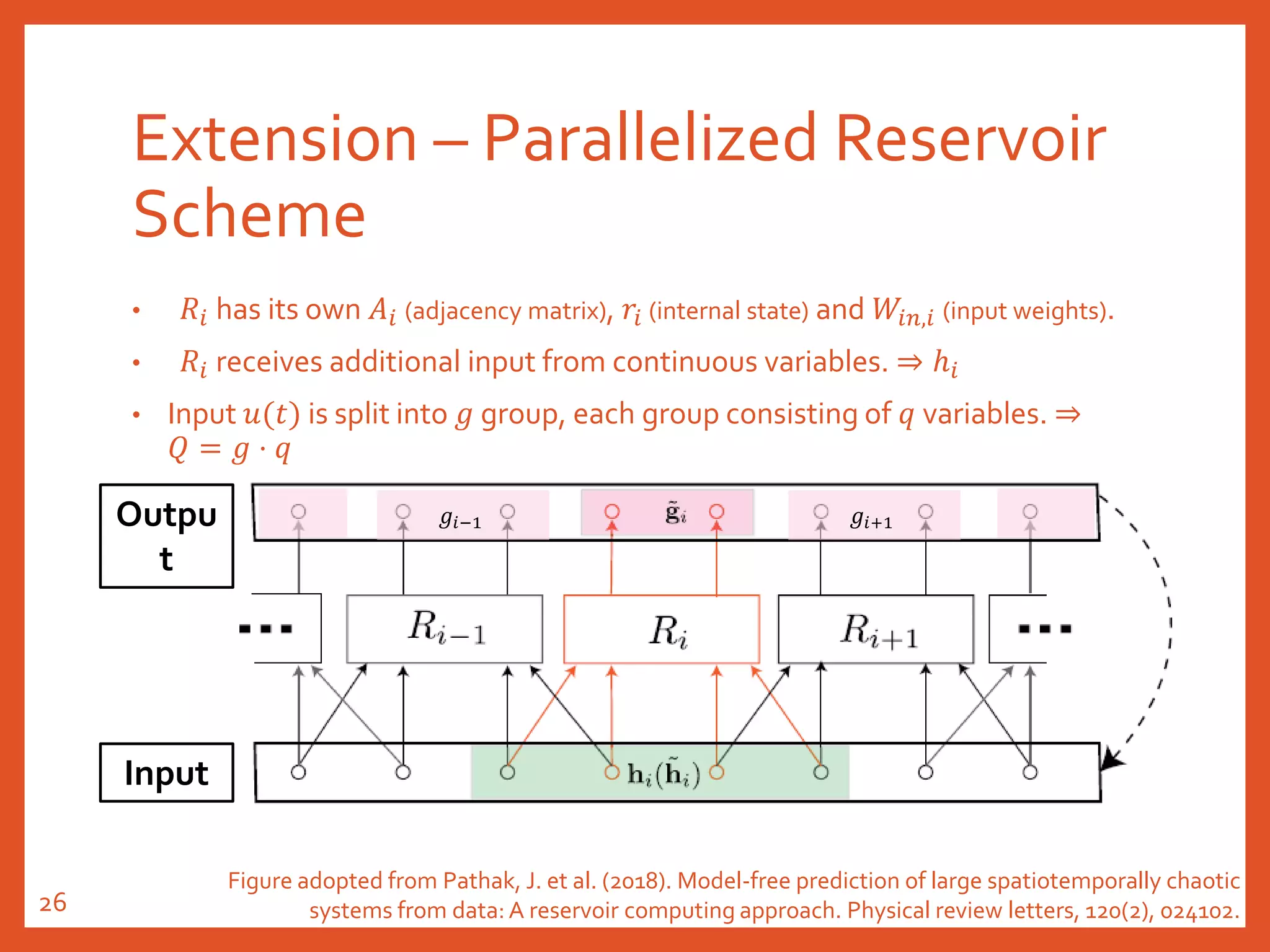
• 𝑅𝑖 has its own 𝐴𝑖 (adjacency matrix), 𝑟𝑖 (internal state) and 𝑊𝑖𝑛,𝑖 (input weights).
• 𝑅𝑖 receives additional input from continuous variables. ⇒ ℎ𝑖
• Input 𝑢(𝑡) is split into 𝑔 group, each group consisting of 𝑞 variables. ⇒
𝑄 = 𝑔 ⋅ 𝑞
Input
𝑔𝑖−1 𝑔𝑖+1
Figure adopted from Pathak, J. et al. (2018). Model-free prediction of large spatiotemporally chaotic
systems from data: A reservoir computing approach. Physical review letters, 120(2), 024102.26
Parallelized Reservoir Scheme
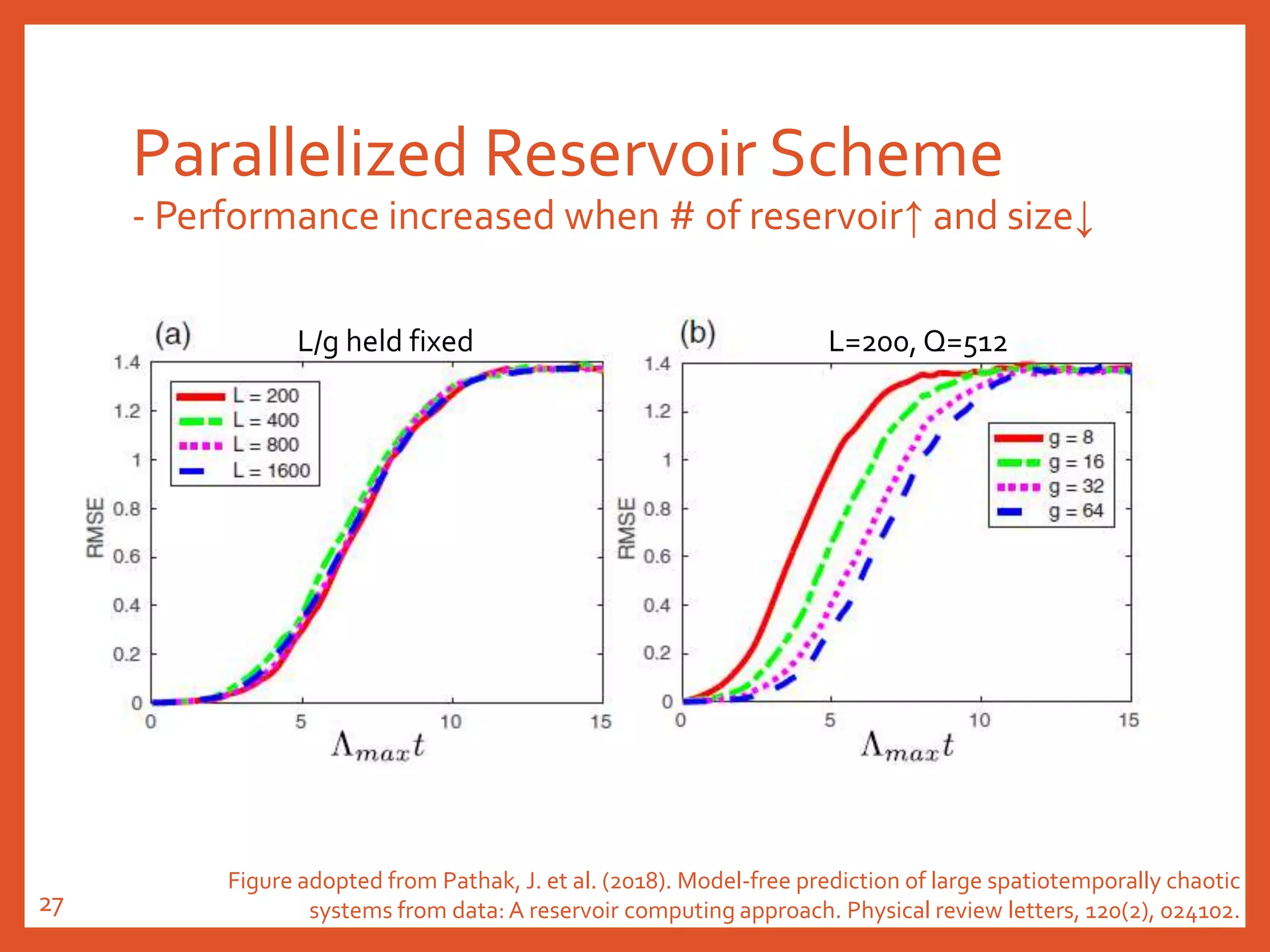
- Performance increased when # of reservoir↑ and size↓
L/g held fixed L=200, Q=512
Figure adopted from Pathak, J. et al. (2018). Model-free prediction of large spatiotemporally chaotic
systems from data: A reservoir computing approach. Physical review letters, 120(2), 024102.27
Explanation for
reservoir computing
Explanation 1
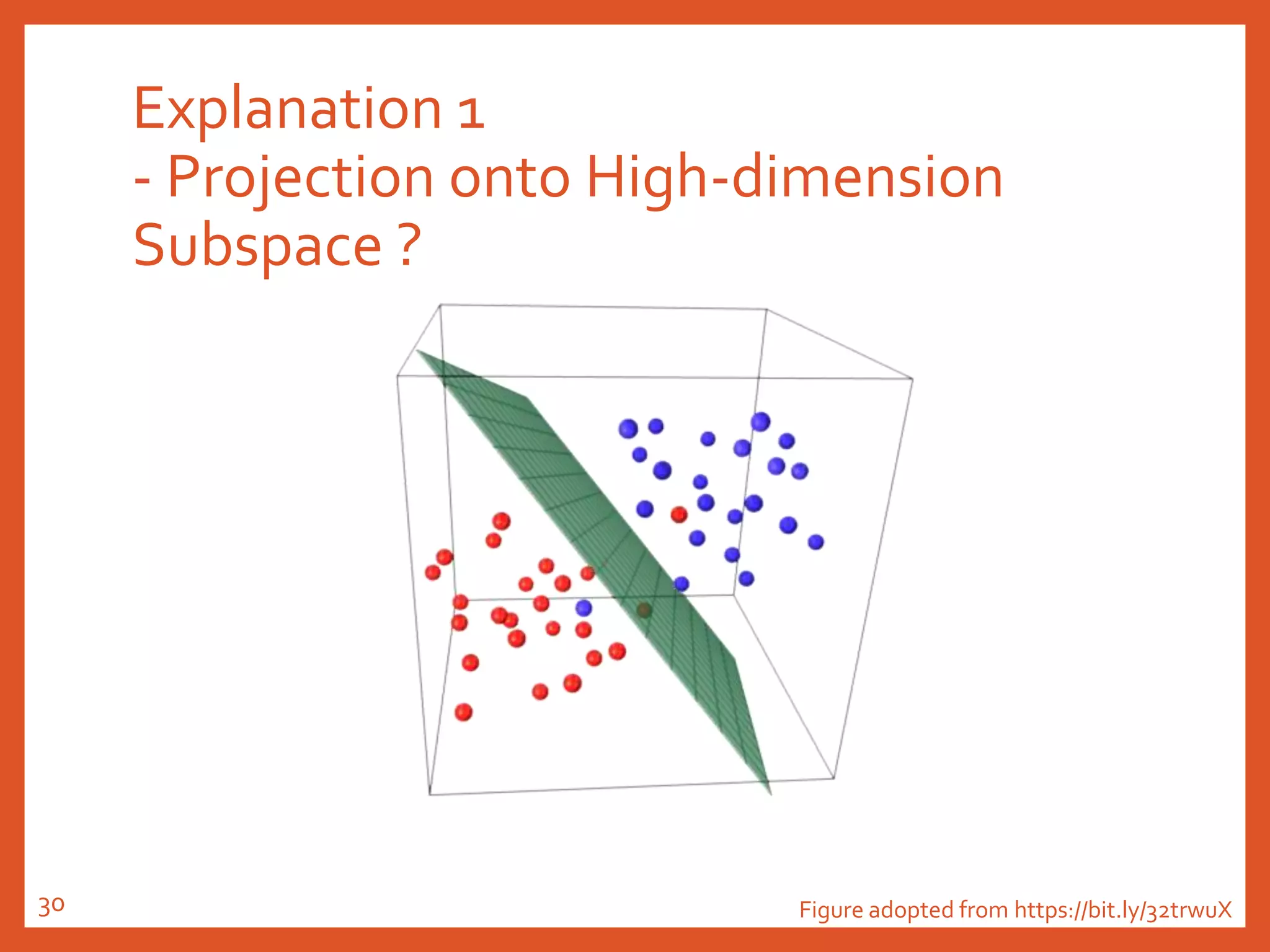
- Projection onto High-dimension
Subspace ?
Figure adopted from https://bit.ly/32trwuX30
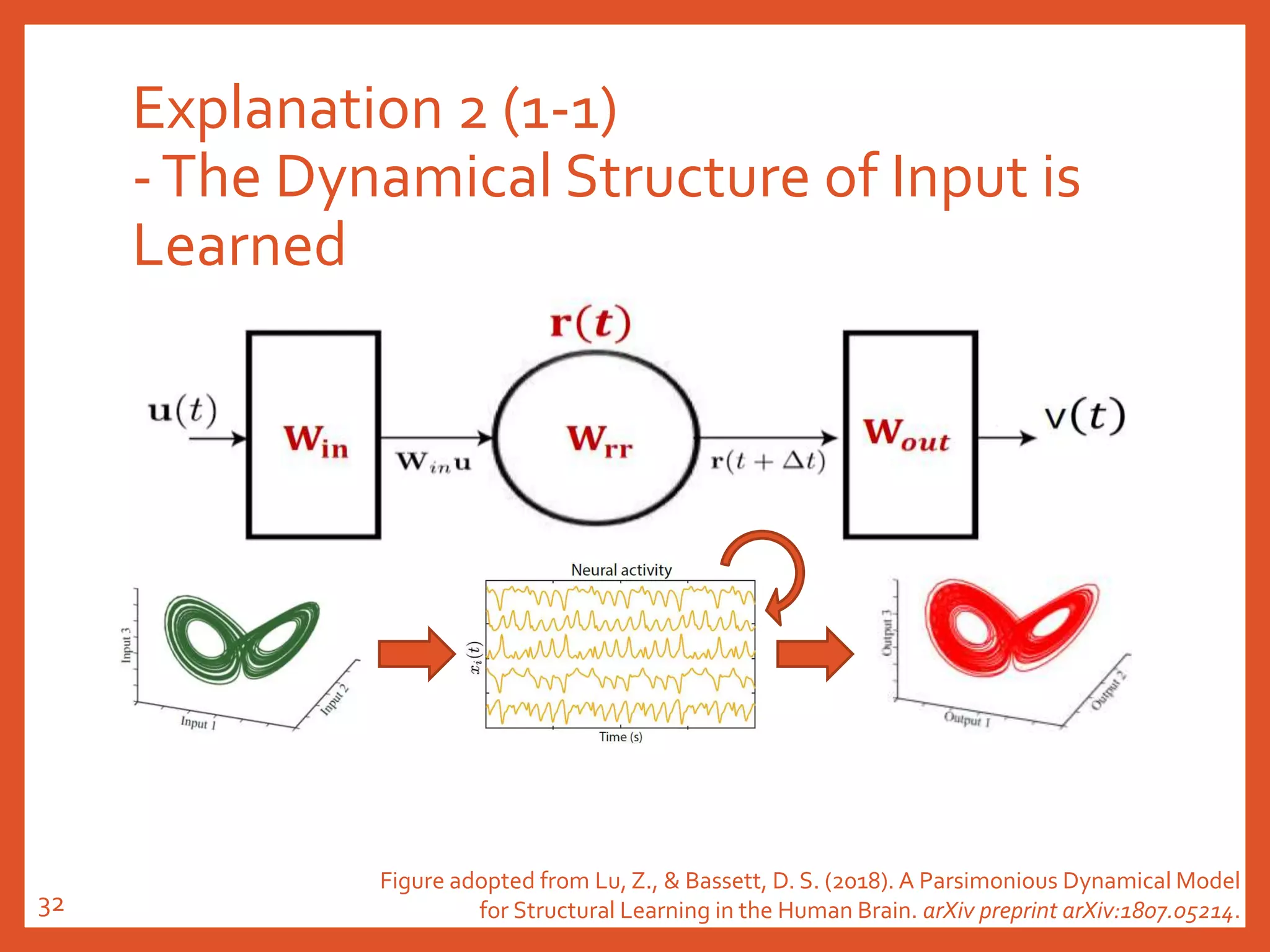
Explanation 2 (1-1)
-The Dynamical Structure of Input is
Learned
Figure adopted from Lu, Z., & Bassett, D. S. (2018). A Parsimonious Dynamical Model
for Structural Learning in the Human Brain. arXiv preprint arXiv:1807.05214.32
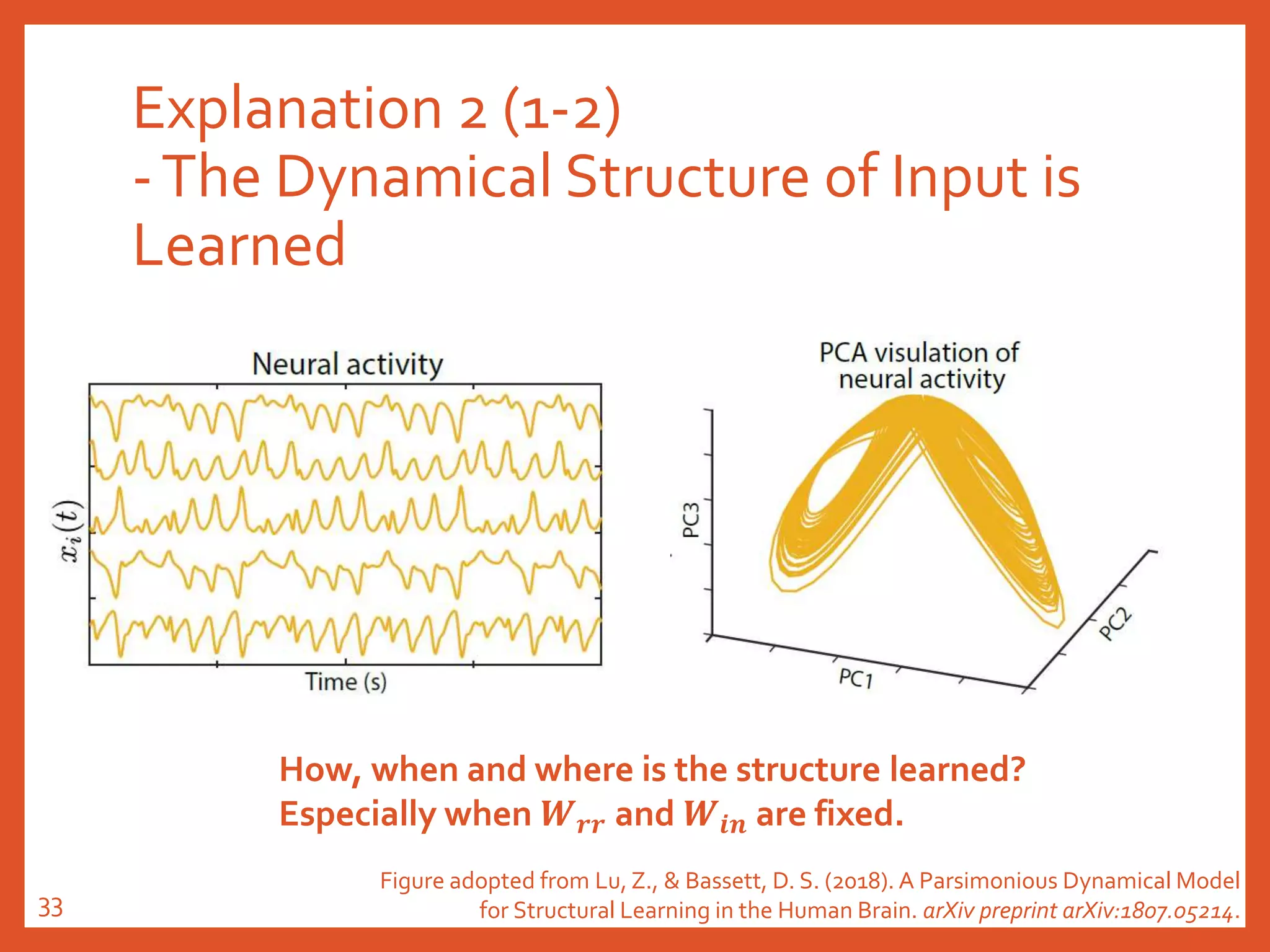
Explanation 2 (1-2)
-The Dynamical Structure of Input is
Learned
How, when and where is the structure learned?
Especially when 𝑾 𝒓𝒓 and 𝑾𝒊𝒏 are fixed.
Figure adopted from Lu, Z., & Bassett, D. S. (2018). A Parsimonious Dynamical Model
for Structural Learning in the Human Brain. arXiv preprint arXiv:1807.05214.33
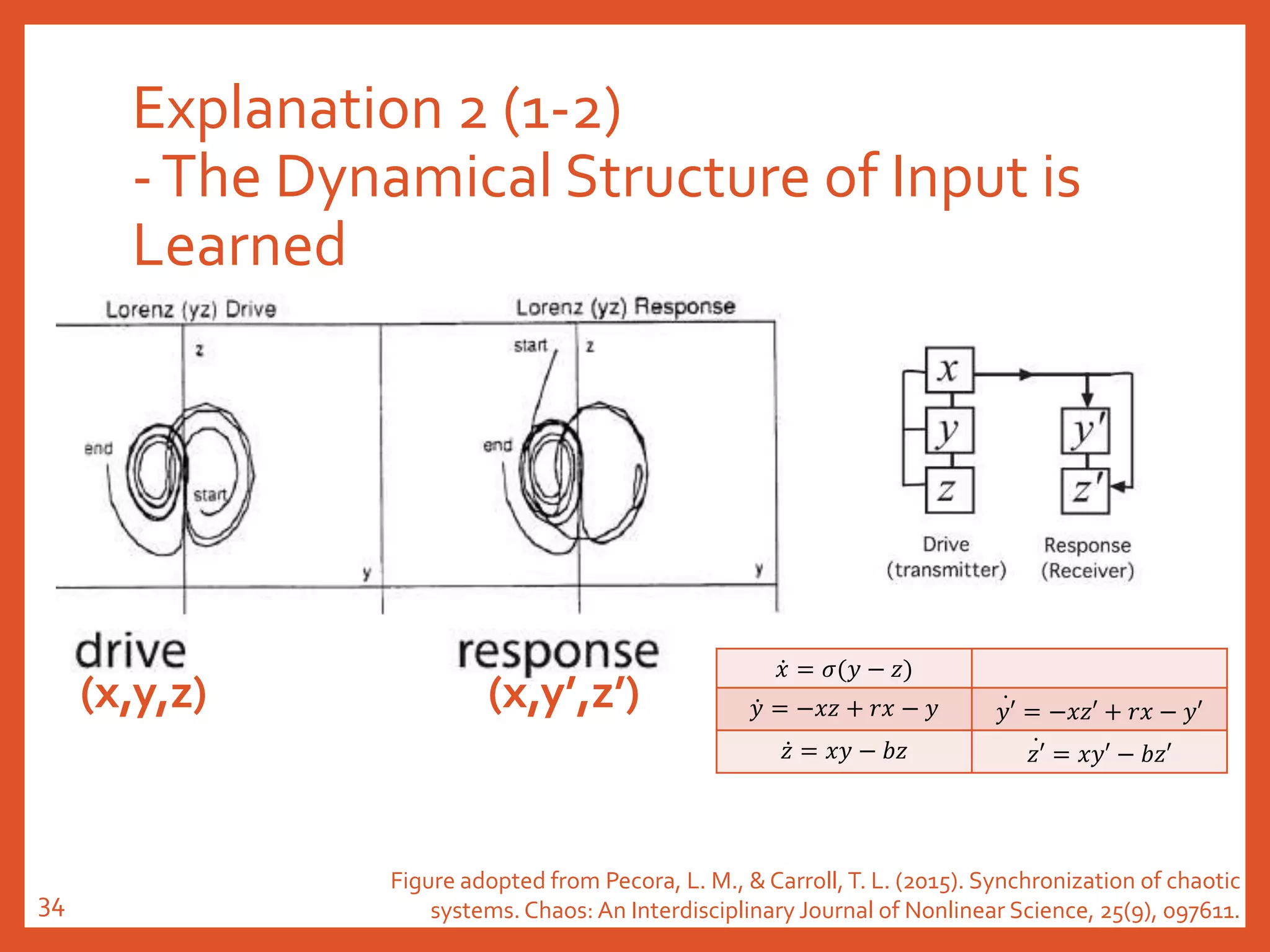
Explanation 2 (1-2)
-The Dynamical Structure of Input is
Learned
(x,y,z) (x,y’,z’)
𝑥 = 𝜎(𝑦 − 𝑧)
𝑦 = −𝑥𝑧 + 𝑟𝑥 − 𝑦 𝑦′ = −𝑥𝑧′ + 𝑟𝑥 − 𝑦′
𝑧 = 𝑥𝑦 − 𝑏𝑧 𝑧′ = 𝑥𝑦′ − 𝑏𝑧′
Figure adopted from Pecora, L. M., &Carroll, T. L. (2015). Synchronization of chaotic
systems. Chaos: An Interdisciplinary Journal of Nonlinear Science, 25(9), 097611.34
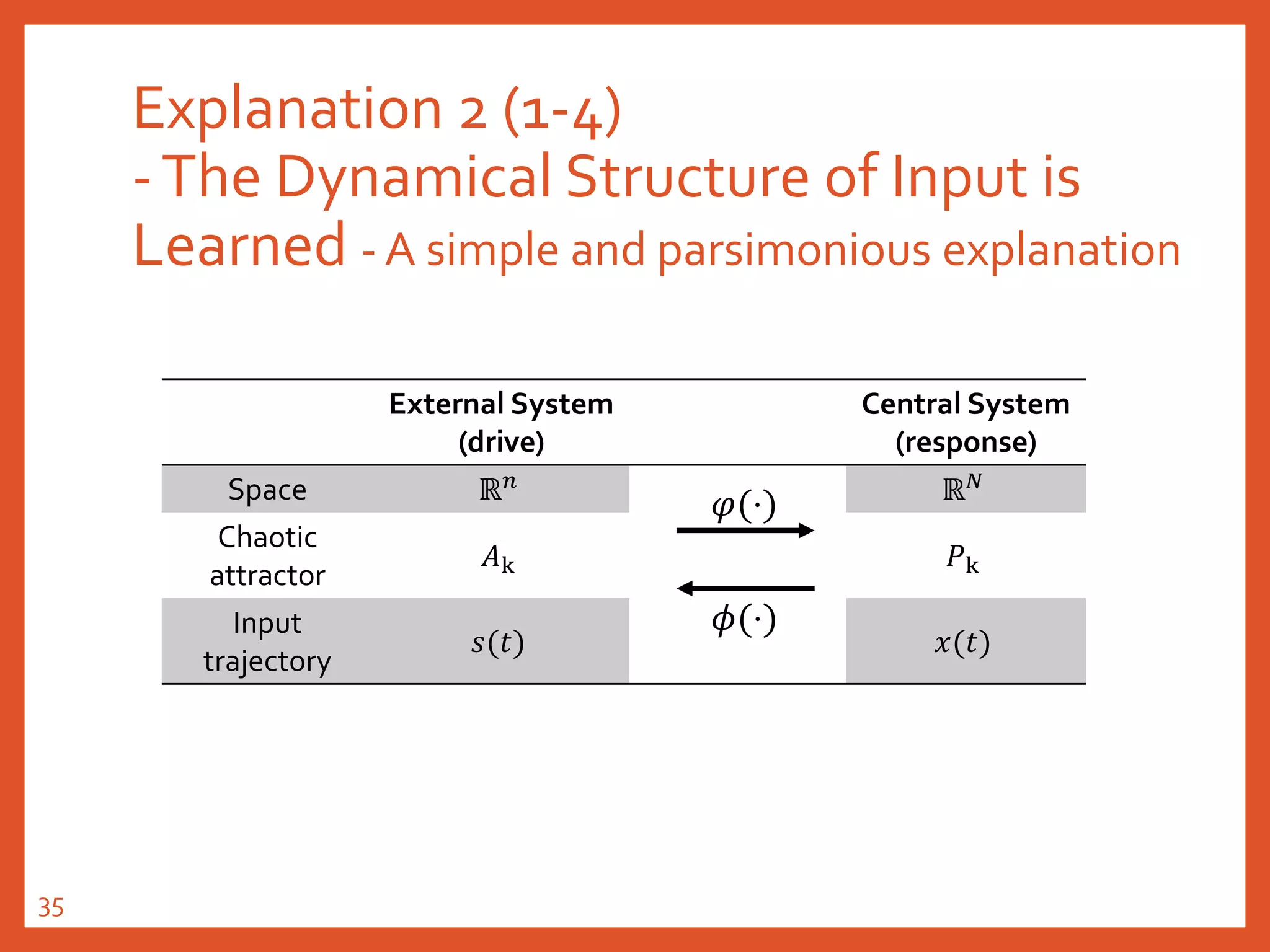
Explanation 2 (1-4)
-The Dynamical Structure of Input is
Learned - A simple and parsimonious explanation
External System
(drive)
Central System
(response)
Space ℝ 𝑛
ℝ 𝑁
Chaotic
attractor
𝐴k 𝑃k
Input
trajectory
𝑠(𝑡) 𝑥(𝑡)
𝜑(⋅)
𝜙(⋅)
35
Explanation 2 (2-1)
-The Dynamical Structure of Input is
Learned
• 蓄水池网络具有的一种能力是, 如果你给它一个复杂的时间序列输入
(I), 比如股市的变化, 它可以自动的抽取出这种变化背后的独立性
因子,并在一定程度模拟出真实过程的动力关系(因为其自身存在足
够丰富的动力关系, 以至于非常容易和真实的系统进行匹配)。 听着
有点像PCA,但是PCA是线性的不包含时间, 而这里是一个非线性时间
依赖的系统, 复杂性不可同日而语。
• 多么复杂的波动背后催生它的因素不一定很复杂, 比如洛伦茨吸引子
背后就仅仅是一个三维系统。当这个波动输入到蓄水池网络里以后,
蓄水池网络可以找寻到这种复杂背后的根基,并对这个信号的发展走
势进行预测。
作者:许铁-巡洋舰科技
網址:https://www.zhihu.com/question/265476523/answer/74765341537
Explanation 2 (2-2)
-The Dynamical Structure of Input is
Learned
• 在各类复杂的动力学形式里, 我们看到,无论是稳定定点, 极限环,
鞍点,还是线性吸引子,事实上都是对世界普遍存在的信息流动形式
的通用表达。
• 可以用它表达信息的提取和加工, 甚至某种程度的逻辑推理(决策),
那么只要我们能够掌握一种学习形式有效的改变这个随机网络的连接,
我们就有可能得到我们所需要的任何一种信息加工过程。
• 用几何语言说就是,在随机网络的周围, 存在着从毫无意义的运动到
通用智能的几乎所有可能性, 打开这些可能的过程如同[外在环境]对
随机网络进行一个微扰, 而这个微扰通常代表了某种网络和外在环境
的耦合过程(学习), 当网络的动力学在低维映射里包含了真实世界
的动力学本身, 通常学习就成功了。
作者:许铁-巡洋舰科技
網址:https://www.zhihu.com/question/265476523/answer/74765341538
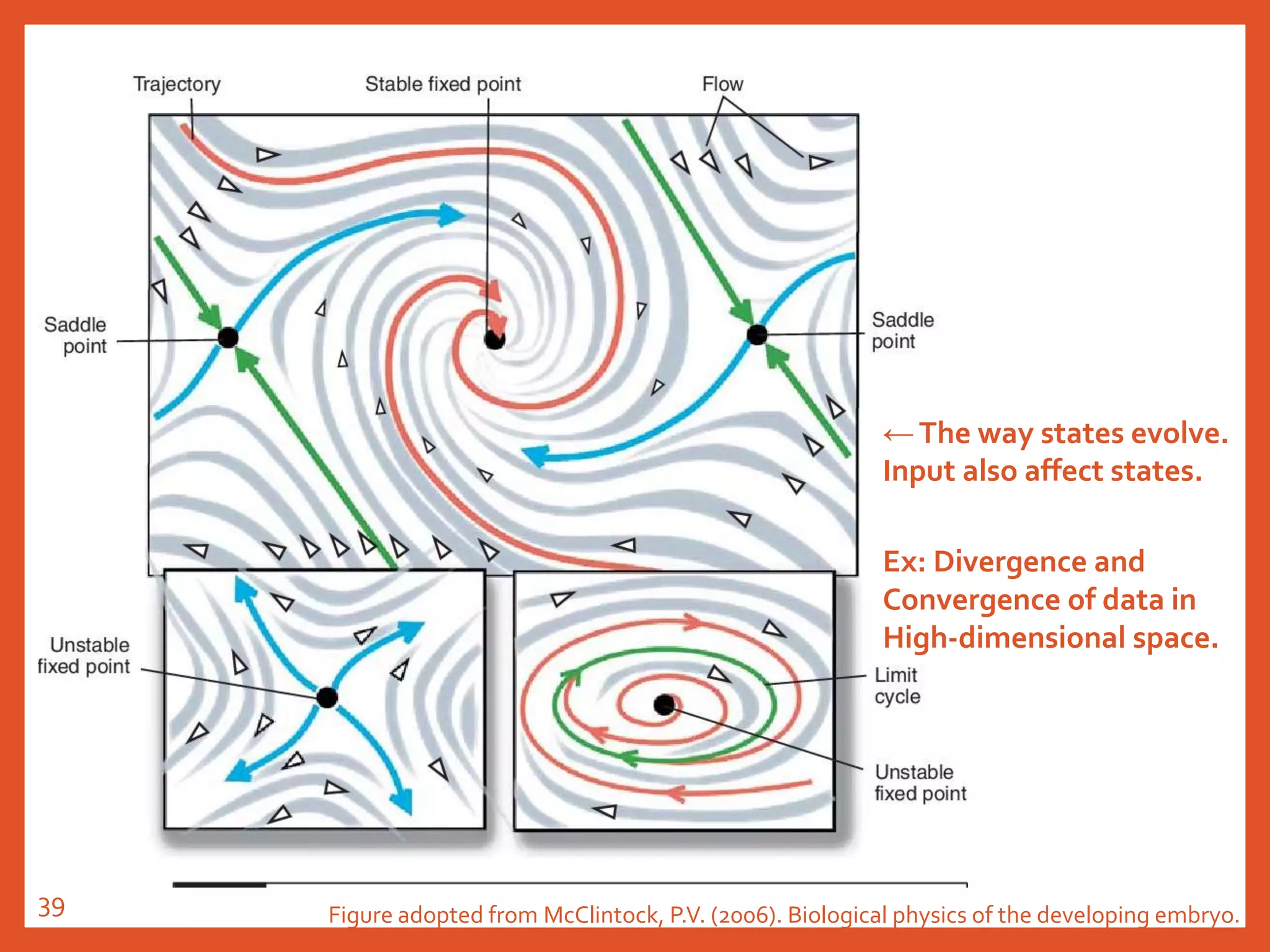
Figure adopted from McClintock, P.V. (2006). Biological physics of the developing embryo.
←The way states evolve.
Input also affect states.
Ex: Divergence and
Convergence of data in
High-dimensional space.
39
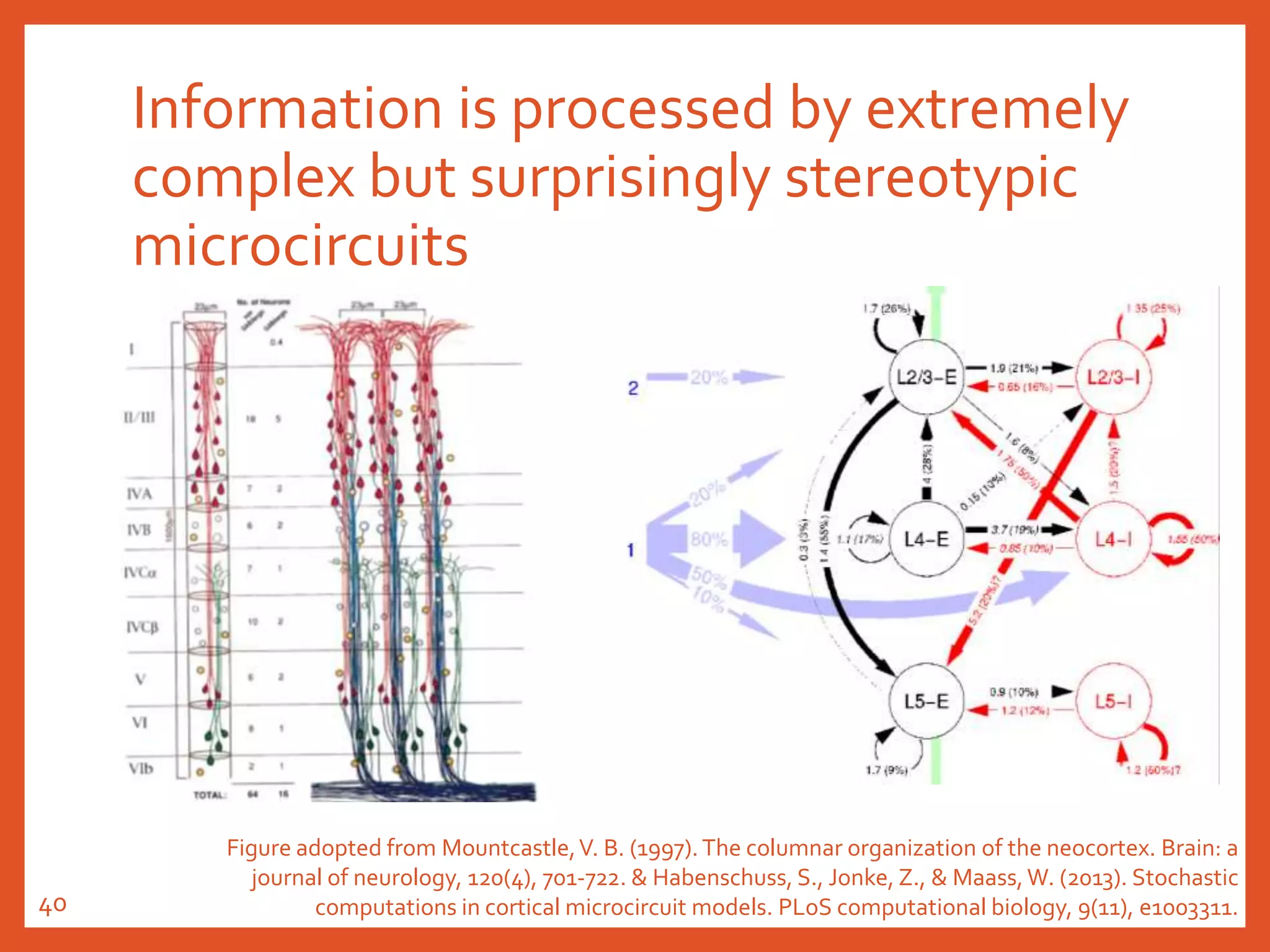
Information is processed by extremely
complex but surprisingly stereotypic
microcircuits
Figure adopted from Mountcastle,V. B. (1997).The columnar organization of the neocortex. Brain: a
journal of neurology, 120(4), 701-722. & Habenschuss, S., Jonke, Z., & Maass,W. (2013). Stochastic
computations in cortical microcircuit models. PLoS computational biology, 9(11), e1003311.40
Credits and Reference
• 【Template】SlidesCarnival
• Real-Time ComputingWithout Stable States: A New Framework for Neural Computation
Based on Perturbations
• Recent Advances in Physical Reservoir Computing: A Review
• Model-Free Prediction of Large Spatiotemporally Chaotic Systems from Data: A Reservoir
Computing Approach
• Using machine learning to replicate chaotic attractors and calculate Lyapunov exponents
from data
• 【Seminar】 Machine learning for analysis of high-dimensional chaotic statiotemporal
dynamical systems
• Lyapunov exponents of the Kuramoto–Sivashinsky PDE
• 【知乎】神经网络的参数都是随机的,有的效果很好,有的效果很差,这真的不是玄
学吗?, https://www.zhihu.com/question/265476523/answer/747653415
• A Parsimonious Dynamical Model for Structural Learning in the Human Brain.
• Pecora, L. M., & Carroll,T. L. (2015). Synchronization of chaotic systems. Chaos: An
Interdisciplinary Journal of Nonlinear Science, 25(9), 097611.
41
Figure
• Cyclic Reservoir Computing with FPGA Devices for Efficient Channel Equalization.
• http://ycpcs.github.io/cs360-spring2015/lectures/lecture15.html
• https://medium.com/ai-journal/lstm-gru-recurrent-neural-networks-81fe2bcdf1f9
• https://2e.mindsmachine.com/asf05.01.html
• The columnar organization of the neocortex.
• https://juliadynamics.github.io/DynamicalSystems.jl/latest/chaos/lyapunovs/
• https://www.youtube.com/watch?v=8z_tSVeEFTA
42
Thank you for your attention

20191018 reservoir computing

  • 1.
    Introduction to ReservoirComputing From a Dynamical System Perspective Chia-Hsiang Kao Oct. 19, 2019 @Mozilla Community SpaceTaipei
  • 2.
    Outline • Introduction tothe configuration of reservoir • Introduction to chaotic system • Prediction of chaotic system using reservoir computing • Mechanism of reservoir computing 2
  • 3.
  • 4.
    Main Reference • Pathak,J., Hunt, B., Girvan, M., Lu, Z., & Ott, E. (2018). Model-free prediction of large spatiotemporally chaotic systems from data: A reservoir computing approach. Physical review letters, 120(2), 024102. • Pathak, J., Lu, Z., Hunt, B. R., Girvan, M., & Ott, E. (2017). Using machine learning to replicate chaotic attractors and calculate Lyapunov exponents from data. Chaos: An Interdisciplinary Journal of Nonlinear Science, 27(12), 121102. • Jaideep Pathak. MACHINE LEARNING FOR ANALYSIS OF HIGH- DIMENSIONAL CHAOTIC SPATIOTEMPORAL DYNAMICAL SYSTEMS. Princeton Plasma Physics Laboratory Theory Semina. (6/12/18) 4
  • 5.
    Reservoir computing =a RNN with 𝑊 and 𝑈 fixed Figure adopted from https://bit.ly/2J0mXjU5
  • 6.
    Configuration of theReservoir Input: 𝑢(𝑡) Output: u(𝑡) State of reservoir: r(𝑡) 𝒖(𝒕) v(𝒕) 𝒓(𝒕) 𝑾 𝒓𝒓 𝑊𝑖𝑛 and 𝑊𝑟𝑟 are fixed. 𝑊𝑜𝑢𝑡 is trainable! Wrr: large, low-degree, directed, random adjacent matrix Update 𝑟(𝑡): r t + Δt = tanh[𝐖𝐫𝐫r t + 𝐖𝐢𝐧u(t)] ,r(t)我會稱之為「reservoir的狀態」 Refer to Skibinsky-Gitlin et al. (2018, June). Cyclic Reservoir Computing with FPGA Devices for Efficient Channel Equalization. In InternationalConference on Artificial Intelligence andSoftComputing (pp. 226-234). Springer, Cham.6
  • 7.
    Hardware implementation usinga variety of physical systems Figure adopted fromTanaka, G.,Yamane,T., Héroux, J. B., Nakane, R., Kanazawa, N., Takeda, S., ... & Hirose, A. (2019). Recent advances in physical reservoir computing:A review. Neural Networks. 7
  • 8.
  • 9.
    Blue point: (0,1,0) Redpoint: (0,1.001,0) Movie retrieved fromhttps://www.youtube.com/watch?v=8z_tSVeEFTA9
  • 10.
    Motivation of thispaper An existing but unavailable dynamical system Short-term forecasting & long-term dynamics Reasonably accurate and complete observational data can be obtained Figure adopted from Lu, Z., & Bassett, D. S. (2018). A Parsimonious Dynamical Model for Structural Learning in the Human Brain. arXiv preprint arXiv:1807.05214.10
  • 11.
    ~𝒙′(𝒕) In this paper,a chaotic dynamical system is concerned. • We say a dynamical system is chaotic if two nearby trajectories diverge exponentially. • Consider separation 𝛿(𝑡) = 𝑥′ (𝑡) − 𝑥(𝑡). • 𝛿 𝑡 ~𝑒 𝝀𝑡 𝛿 0 • Lyapunov exponent 𝝀 indicates predictability for a dynamical system. • 𝜆<0: distance decreases • 𝜆>0: deviation grows exponentially Figure adopted from https://bit.ly/35LZlJH11
  • 12.
    In this paper,a chaotic dynamical system is concerned. • We say a dynamical system is chaotic if two nearby trajectories diverge exponentially. • Consider separation 𝛿(𝑡) = 𝑥′ (𝑡) − 𝑥(𝑡). • 𝛿 𝑡 ~𝑒 𝝀𝑡 𝛿 0 • Lyapunov exponent 𝝀 indicates predictability for a dynamical system. • 𝜆<0: distance decreases • 𝜆>0: deviation grows exponentially • A dynamical system usually contains multiple Lyapunov exponents. Figure adopted fromJaideep Pathak. MACHINE LEARNING FORANALYSISOF HIGH-DIMENSIONALCHAOTIC SPATIOTEMPORAL DYNAMICAL SYSTEMS. Princeton Plasma Physics LaboratoryTheory Semina. (6/12/18)12
  • 13.
    Blue point: (0,1,0) Redpoint: (0,1.001,0) Movie retrieved fromhttps://www.youtube.com/watch?v=8z_tSVeEFTA13
  • 14.
    Q: Can atraditional RNN or LSTM learn to predict the future state of a Lorenz system? • RNN and LSTM can of course forecast the behavior of the Lorenz system in short-term. • Why or How? • How about reservoir computing? • Why or How? 14
  • 15.
    Prediction of chaoticsystem using reservoir computing
  • 16.
    In this paper,the reservoir is built to forecast the behavior of Kuramoto- Sivashinsky Equation • 𝑦𝑡 = −𝑦𝑦𝑡 − 𝑦𝑥𝑥 − 𝑦𝑥𝑥𝑥𝑥 gif retrieved from https://zhuanlan.zhihu.com/p/37730449 𝑥 16
  • 17.
    In this paper,we want the reservoir forecast the behavior of Kuramoto- Sivashinsky Equation • 𝑦𝑡 = −𝑦𝑦𝑡 − 𝑦𝑥𝑥 − 𝑦𝑥𝑥𝑥𝑥 • 𝑥 ∈ [0, 𝐿) Figure adopted from Pathak, J. et al. (2017). Using machine learning to replicate chaotic attractors and calculate Lyapunov exponents from data. Chaos: An Interdisciplinary Journal of Nonlinear Science, 27(12), 121102.17
  • 18.
    In this paper,we want the reservoir forecast the behavior of Kuramoto- Sivashinsky Equation • 𝑦𝑡 = −𝑦𝑦𝑡 − 𝑦𝑥𝑥 − 𝑦𝑥𝑥𝑥𝑥 • 𝐱 ∈ [𝟎, 𝐋) L 12 13.5 36 100 Figure adopted from Edson, R. A., Bunder, J. E., Mattner,T.W., & Roberts, A. J. (2019). Lyapunov exponents of the Kuramoto–Sivashinsky PDE.TheANZIAM Journal, 61(3), 270-285.18
  • 19.
    In this paper,we want the reservoir forecast the behavior of Kuramoto- Sivashinsky Equation • 𝑦𝑡 = −𝑦𝑦𝑡 − 𝑦𝑥𝑥 − 𝑦𝑥𝑥𝑥𝑥 • 𝑥 ∈ [0, 𝐿) • 𝐲 𝐱 + 𝑳 = 𝐲(𝐱) Figure adopted from Pathak, J. et al. (2017). Using machine learning to replicate chaotic attractors and calculate Lyapunov exponents from data. Chaos: An Interdisciplinary Journal of Nonlinear Science, 27(12), 121102.19
  • 20.
    Predict the Behaviorof Kuramoto-Sivashinsky Equation (4) • 𝑦𝑡 = −𝑦𝑦𝑡 − 𝑦𝑥𝑥 − 𝑦𝑥𝑥𝑥𝑥 • 𝑥 ∈ [0, 𝐿) • 𝑦 𝑥 + 𝐿 = 𝑦(𝑥) • Divided [0,L) into Q parts such that • 𝑢 𝑡 = 𝑦 Δ𝑥, 𝑡 , 𝑦 2Δ𝑥, 𝑡 , … , 𝑦(QΔ𝑥, 𝑡) 𝑇 • 𝑸 = 𝑳 𝚫𝒙 is the input size of reservoir Δ𝑥 t Figure adopted from Pathak, J. et al. (2017). Using machine learning to replicate chaotic attractors and calculate Lyapunov exponents from data. Chaos: An Interdisciplinary Journal of Nonlinear Science, 27(12), 121102.20
  • 21.
    Configuration of theReservoir in the Paper 𝐫 𝒕 r t + Δt = tanh[𝐖𝐫𝐫 ⋅ r t + 𝐖𝐢𝐧 ⋅ u(t)] , v t = 𝐖𝐨𝐮𝐭 ⋅ r t 𝐖𝐢𝐧 𝐖𝒐𝒖𝒕𝐖𝐫𝐫 v 𝑡 Figure adopted from Pathak, J. et al. (2018). Model-free prediction of large spatiotemporally chaotic systems from data: A reservoir computing approach. Physical review letters, 120(2), 024102.21
  • 22.
    Experiment Training Prediction −𝑇 ≤𝑡 ≤ 0 0 < 𝑡 →Adjust P so that 𝑣(𝑡) approximate 𝑢(𝑡 + Δ𝑡) → 𝐖𝒐𝒖𝒕(𝒓 𝒕 + 𝚫𝐭 , 𝑷)=𝑃1 𝑟(𝑡 + Δ𝑡) + 𝑃2 𝑟(𝑡 + Δ𝑡)2 → Replace 𝑢(𝑡 + Δ𝑡) with 𝑣(𝑡) → r(t) is not reset 0-T Figure adopted from Pathak, J. et al. (2018). Model-free prediction of large spatiotemporally chaotic systems from data: A reservoir computing approach. Physical review letters, 120(2), 024102.22
  • 23.
    Experiment Training Prediction −𝑇 ≤𝑡 ≤ 0 0 < 𝑡 → Adjust 𝐖𝒐𝒖𝒕 so that 𝒗(𝒕) approximate 𝒖(𝒕 + 𝚫𝒕) → Replace 𝑢(𝑡 + Δ𝑡) with 𝑣(𝑡) → r(t) is not reset 0-T Figure adopted from Pathak, J. et al. (2018). Model-free prediction of large spatiotemporally chaotic systems from data: A reservoir computing approach. Physical review letters, 120(2), 024102.23
  • 24.
    Outcomes & Model ParametersTop:Truestate of the standard KS equation Middle: Reservoir Prediction Bottom: Difference (by subtraction ) Paramete r Exp1 Exp2 Q - 64 L 60 22 𝑫 𝑹 9000 5000 T 20000 - Δ𝑡 0.25 0.25 𝜇 0 0 Figure adopted from Pathak, J. et al. (2018). Model-free prediction of large spatiotemporally chaotic systems from data: A reservoir computing approach. Physical review letters, 120(2), 024102.24
  • 25.
    An interesting observation •It seems that the reservoir is trapped. 25
  • 26.
    Outpu t Extension – ParallelizedReservoir Scheme • 𝑅𝑖 has its own 𝐴𝑖 (adjacency matrix), 𝑟𝑖 (internal state) and 𝑊𝑖𝑛,𝑖 (input weights). • 𝑅𝑖 receives additional input from continuous variables. ⇒ ℎ𝑖 • Input 𝑢(𝑡) is split into 𝑔 group, each group consisting of 𝑞 variables. ⇒ 𝑄 = 𝑔 ⋅ 𝑞 Input 𝑔𝑖−1 𝑔𝑖+1 Figure adopted from Pathak, J. et al. (2018). Model-free prediction of large spatiotemporally chaotic systems from data: A reservoir computing approach. Physical review letters, 120(2), 024102.26
  • 27.
    Parallelized Reservoir Scheme -Performance increased when # of reservoir↑ and size↓ L/g held fixed L=200, Q=512 Figure adopted from Pathak, J. et al. (2018). Model-free prediction of large spatiotemporally chaotic systems from data: A reservoir computing approach. Physical review letters, 120(2), 024102.27
  • 28.
  • 29.
    Explanation 1 - Projectiononto High-dimension Subspace ? Figure adopted from https://bit.ly/32trwuX30
  • 30.
    Explanation 2 (1-1) -TheDynamical Structure of Input is Learned Figure adopted from Lu, Z., & Bassett, D. S. (2018). A Parsimonious Dynamical Model for Structural Learning in the Human Brain. arXiv preprint arXiv:1807.05214.32
  • 31.
    Explanation 2 (1-2) -TheDynamical Structure of Input is Learned How, when and where is the structure learned? Especially when 𝑾 𝒓𝒓 and 𝑾𝒊𝒏 are fixed. Figure adopted from Lu, Z., & Bassett, D. S. (2018). A Parsimonious Dynamical Model for Structural Learning in the Human Brain. arXiv preprint arXiv:1807.05214.33
  • 32.
    Explanation 2 (1-2) -TheDynamical Structure of Input is Learned (x,y,z) (x,y’,z’) 𝑥 = 𝜎(𝑦 − 𝑧) 𝑦 = −𝑥𝑧 + 𝑟𝑥 − 𝑦 𝑦′ = −𝑥𝑧′ + 𝑟𝑥 − 𝑦′ 𝑧 = 𝑥𝑦 − 𝑏𝑧 𝑧′ = 𝑥𝑦′ − 𝑏𝑧′ Figure adopted from Pecora, L. M., &Carroll, T. L. (2015). Synchronization of chaotic systems. Chaos: An Interdisciplinary Journal of Nonlinear Science, 25(9), 097611.34
  • 33.
    Explanation 2 (1-4) -TheDynamical Structure of Input is Learned - A simple and parsimonious explanation External System (drive) Central System (response) Space ℝ 𝑛 ℝ 𝑁 Chaotic attractor 𝐴k 𝑃k Input trajectory 𝑠(𝑡) 𝑥(𝑡) 𝜑(⋅) 𝜙(⋅) 35
  • 34.
    Explanation 2 (2-1) -TheDynamical Structure of Input is Learned • 蓄水池网络具有的一种能力是, 如果你给它一个复杂的时间序列输入 (I), 比如股市的变化, 它可以自动的抽取出这种变化背后的独立性 因子,并在一定程度模拟出真实过程的动力关系(因为其自身存在足 够丰富的动力关系, 以至于非常容易和真实的系统进行匹配)。 听着 有点像PCA,但是PCA是线性的不包含时间, 而这里是一个非线性时间 依赖的系统, 复杂性不可同日而语。 • 多么复杂的波动背后催生它的因素不一定很复杂, 比如洛伦茨吸引子 背后就仅仅是一个三维系统。当这个波动输入到蓄水池网络里以后, 蓄水池网络可以找寻到这种复杂背后的根基,并对这个信号的发展走 势进行预测。 作者:许铁-巡洋舰科技 網址:https://www.zhihu.com/question/265476523/answer/74765341537
  • 35.
    Explanation 2 (2-2) -TheDynamical Structure of Input is Learned • 在各类复杂的动力学形式里, 我们看到,无论是稳定定点, 极限环, 鞍点,还是线性吸引子,事实上都是对世界普遍存在的信息流动形式 的通用表达。 • 可以用它表达信息的提取和加工, 甚至某种程度的逻辑推理(决策), 那么只要我们能够掌握一种学习形式有效的改变这个随机网络的连接, 我们就有可能得到我们所需要的任何一种信息加工过程。 • 用几何语言说就是,在随机网络的周围, 存在着从毫无意义的运动到 通用智能的几乎所有可能性, 打开这些可能的过程如同[外在环境]对 随机网络进行一个微扰, 而这个微扰通常代表了某种网络和外在环境 的耦合过程(学习), 当网络的动力学在低维映射里包含了真实世界 的动力学本身, 通常学习就成功了。 作者:许铁-巡洋舰科技 網址:https://www.zhihu.com/question/265476523/answer/74765341538
  • 36.
    Figure adopted fromMcClintock, P.V. (2006). Biological physics of the developing embryo. ←The way states evolve. Input also affect states. Ex: Divergence and Convergence of data in High-dimensional space. 39
  • 37.
    Information is processedby extremely complex but surprisingly stereotypic microcircuits Figure adopted from Mountcastle,V. B. (1997).The columnar organization of the neocortex. Brain: a journal of neurology, 120(4), 701-722. & Habenschuss, S., Jonke, Z., & Maass,W. (2013). Stochastic computations in cortical microcircuit models. PLoS computational biology, 9(11), e1003311.40
  • 38.
    Credits and Reference •【Template】SlidesCarnival • Real-Time ComputingWithout Stable States: A New Framework for Neural Computation Based on Perturbations • Recent Advances in Physical Reservoir Computing: A Review • Model-Free Prediction of Large Spatiotemporally Chaotic Systems from Data: A Reservoir Computing Approach • Using machine learning to replicate chaotic attractors and calculate Lyapunov exponents from data • 【Seminar】 Machine learning for analysis of high-dimensional chaotic statiotemporal dynamical systems • Lyapunov exponents of the Kuramoto–Sivashinsky PDE • 【知乎】神经网络的参数都是随机的,有的效果很好,有的效果很差,这真的不是玄 学吗?, https://www.zhihu.com/question/265476523/answer/747653415 • A Parsimonious Dynamical Model for Structural Learning in the Human Brain. • Pecora, L. M., & Carroll,T. L. (2015). Synchronization of chaotic systems. Chaos: An Interdisciplinary Journal of Nonlinear Science, 25(9), 097611. 41
  • 39.
    Figure • Cyclic ReservoirComputing with FPGA Devices for Efficient Channel Equalization. • http://ycpcs.github.io/cs360-spring2015/lectures/lecture15.html • https://medium.com/ai-journal/lstm-gru-recurrent-neural-networks-81fe2bcdf1f9 • https://2e.mindsmachine.com/asf05.01.html • The columnar organization of the neocortex. • https://juliadynamics.github.io/DynamicalSystems.jl/latest/chaos/lyapunovs/ • https://www.youtube.com/watch?v=8z_tSVeEFTA 42
  • 40.
    Thank you foryour attention

Editor's Notes

  • #2 大家好我是高家祥,醫學系五年級 很謝謝前一位講者,我是在今年寒假開始接觸SNN的,不過在實作上有很多細節和參數,所以一直未能實際進行計算。 我在去年暑假的時候開始對貨幣系統有興趣,在去年下半年的探索後,我發現原來我是對動態系統有關係。 在今年寒假,我和到PRL的一篇論文,講的是reservoir computing和混沌系統的關係。……
  • #6 這時候,大家覺得這個RNN的效果會好嗎? 先別看實務面(這裡在場很多人在新創或是公司工作) 當然我們應該要給予一些條件,例如H (hidden space)很大很高維呢? 例如U和W不會投射到null space呢? (也就是U和W是線性獨立的) https://www.researchgate.net/figure/The-structure-of-RNN-and-the-structure-after-unfolding-by-time-Ht-is-the-hidden-state-of_fig5_327966177
  • #7  最後提到:不只可以使用類神經網路來模擬。只要reservoir本身的每個子元件可以被視為小的動態系統,然後不同小元件之間相互連接(但是這個連接是局部的low degree的),那就可以了
  • #8 Recent Advances in Physical Reservoir Computing: A Review Fixed連接 微分方程描述每個子單元的變化方式 一個readout 可以被物理模型接受的輸入
  • #10 https://www.youtube.com/watch?v=8z_tSVeEFTA
  • #11 1.对一个动力学系统建立公式化的描述是困难的,但获得该系统长时间、高精度的观测数据却是容易的
  • #12 X 和 x’兩個點的運動軌跡 𝛿 𝑡 是某時間t時,兩個點的距離差
  • #13 現在,我們考慮一個單位圓在高維空間的動態系統,這個動態系統描述了這個圓的變化。
  • #14 https://www.youtube.com/watch?v=8z_tSVeEFTA
  • #15 LSTM的hidden layer的update matrix是可以調整的
  • #17 KS 模型,是一維的火焰隨時間變化的模型 Y是每一個位置的火焰的高度,
  • #18 首先呢,這個模型是有界的 橫軸是火焰演化的方向。縱軸是起始值。所以這個數值會影響到下個數值(比一下 我們也可以知道,
  • #19 Fig: Edson, R. A., Bunder, J. E., Mattner, T. W., & Roberts, A. J. (2019). Lyapunov exponents of the Kuramoto–Sivashinsky PDE. The ANZIAM Journal, 61(3), 270-285.
  • #21 [0,L)原本是連續的,但因為要模擬,我們需要把它離散化。這邊,我們將L切成Q個部分。也就是說,大寫Q是我們的
  • #22 Pathak, J., Lu, Z., Hunt, B. R., Girvan, M., & Ott, E. (2017). Using machine learning to replicate chaotic attractors and calculate Lyapunov exponents from data. Chaos: An Interdisciplinary Journal of Nonlinear Science, 27(12), 121102. 就像是一般的RNN
  • #23 在實驗設計上,我們的最終目標就是預測混沌系統。 那麼就像是預測天氣一樣,我們需要先預測比現在多Δ𝑡的時間的數值,例如,我們要先預測未來一秒的大氣狀態,再用未來一秒的大氣狀態去預測未來兩秒的大氣狀態。然後往復類推到一天,到一周。如此,在模擬上,我們會把未來一秒的輸入,當成是要預測第二秒狀態的輸入。 大家可想而知,假設,我在預測未來第5秒的時候,預測值和實際動態系統會出現的數值有了一個不可忽略的誤差,那麼這個誤差就會很大程度地在未來被放大。這其實就是蝴蝶效應的詮釋,也再一次說明混沌系統。 於是,我們的目標就是,讓這個模型可以更大概率地去逼近真實的data 那麼我們就要選擇訓練的方法
  • #24 訓練的方式也很簡單,
  • #26 對我而言,整個KS系統是在高維空間中亂動,可以想像成是一個高維度的lorenz系統
  • #28 左圖: L上升的時候,生成的資料有越趨近混亂的趨勢,這時候,若要保持錯誤率不便,g也要憶起上升 右圖: 當L和Q固定,而g上升時,代表每一個小的reservoir僅需要記憶或計算較小範圍的時空間變化,這也比較容易 → L/Q固定的時候,動態系統的變化複雜性就差不多,在這個情況下,增加g會…….
  • #31 https://appliedmachinelearning.blog/2017/03/09/understanding-support-vector-machines-a-primer/ ↓不要提 Maass原本提出的reservoir computing概念就是這個,他認為跟attractor based沒有關係
  • #32 Lu, Z., & Bassett, D. S. (2018). A Parsimonious Dynamical Model for Structural Learning in the Human Brain. arXiv preprint arXiv:1807.05214.
  • #35 先看rossler系統,drive和response X同時驅動了y,z和y‘,z’兩個系統 在這裡,看到yz,和y‘z’的結構一模一樣。我們稱這種同步行為為identical synchronization 而實際上,就算兩者結構有些許的布一樣,類似的同步狀態還是會誕生的。 那大家有感覺到了嗎? Pecora, L. M., & Carroll, T. L. (2015). Synchronization of chaotic systems. Chaos: An Interdisciplinary Journal of Nonlinear Science, 25(9), 097611.
  • #36 因為reservoir的元件數量很多,因此在reservoir中間,「很大概率地」存在局部跟lorenz系統很相近的結構。 可以不用解釋attractors
  • #37 1. 解釋圖表 2. Declare不是所有的drive-response都會成功,但目前我不清楚怎麼樣的drive-response設定之間才會成功 Pecora, L. M., & Carroll, T. L. (2015). Synchronization of chaotic systems. Chaos: An Interdisciplinary Journal of Nonlinear Science, 25(9), 097611.
  • #39 奇異吸引子 跟圖靈機
  • #40  在此處,我深刻地認知到reservoir computing的厲害 但我發現更厲害的是backpropagation的能力。他從更本質上的方式去變更了高維空間的結構。例如說,我把這個stable fixed point往左移動一些,把這個鞍點往東北角移動一些。透過這個方式,我找到一組最佳的空間結構,使得我可以適當地區分為小的差異,但是對於類似的輸入訊息的pattern予以保留。
  • #41 回到生物學