Small-scale deformation of active
volcanoes measured by
Synthetic Aperture Radar
Yosuke Aoki
Earthquake Research Institute, The University of Tokyo
Email: yaoki@eri.u-tokyo.ac.jp
with
Xiaowen Wang (Southwest Jiatong University, Sichuan, China)
Jie Chen (The Chinese University of Hong Kong)
Wang & Aoki (2019), J. Geophys. Res. Solid Earth, 124, 335-357, doi:10.1029/2018JB016729.
Wang, Aoki, & Chen, Earth Planet. Space, in revision.
2019年10月15日
地球計測セミナー
東京大学地震研究所
Small-scale deformation in volcanoes
Volcán de Colima, Mexico
(Salzer et al., EPSL, 2017)
Santiaguito, Guatemala
(Ebmeier et al., EPSL, 2012)
Wolf, Gálapagos
(Xu, Jónsson, Ruch, and Aoki, GRL, 2016)
SAR is capable of measuring small-scale deformation by
taking advantages of high spatial resolution.
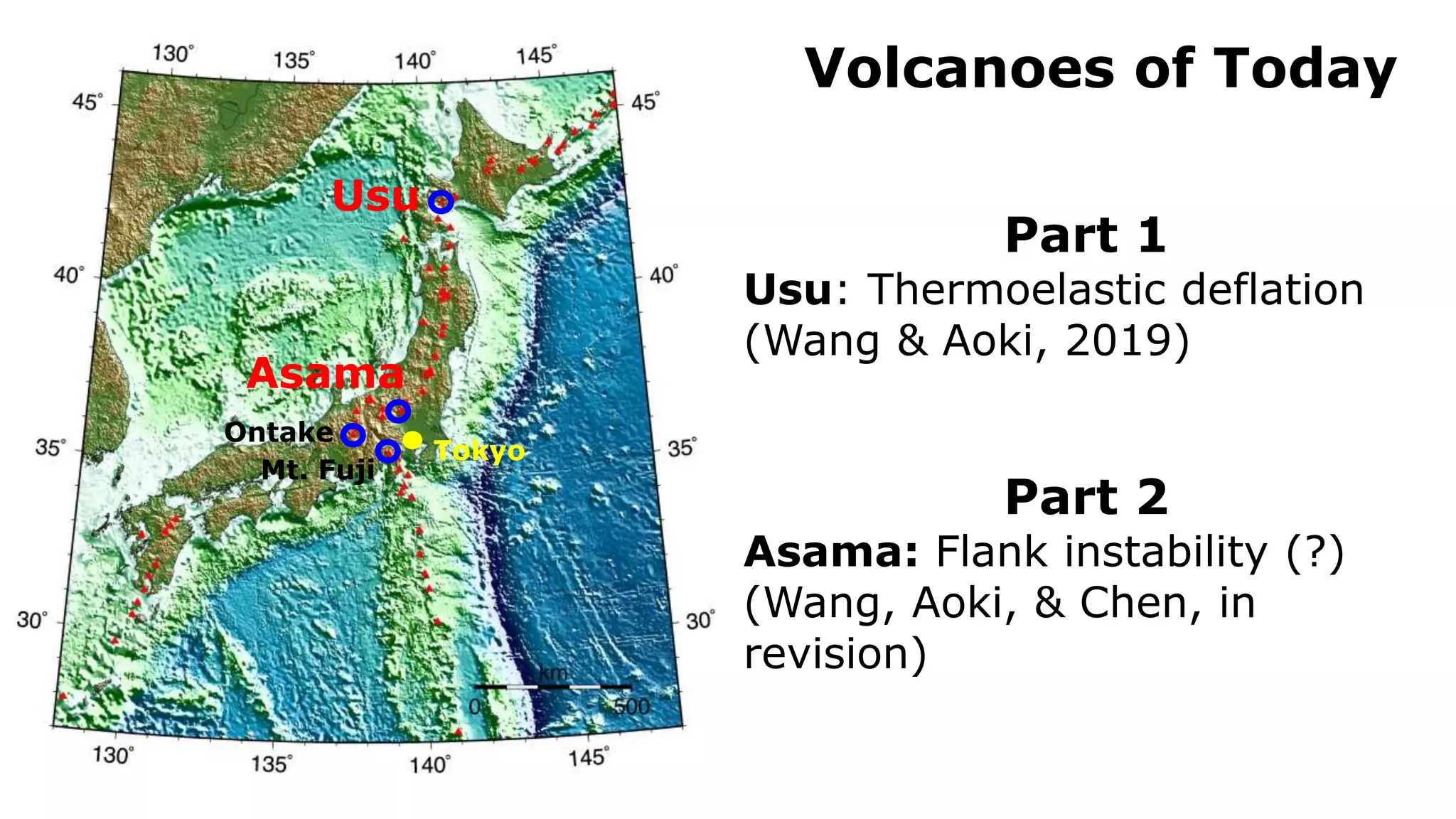
Volcanoes of Today
Tokyo
Ontake
Usu
Mt. Fuji
Part 1
Usu: Thermoelastic deflation
(Wang & Aoki, 2019)
Part 2
Asama: Flank instability (?)
(Wang, Aoki, & Chen, in
revision)
Asama
Inter-eruptive volcano deflation
Nabro, Eritrea
(Hamlyn et al.,
Prog. Earth Planet. Sci., 2018)
Asama, Japan
(Aoki et al., Geol. Soc. Lond. Spec. Publ., 2013)
Kutcharo, Japan
(Fujiwara et al.,
Earth Planet.
Space, 2017;
Yamasaki et al.,
JVGR, 2018)
Why studying volcano deflation?
Potential mechanisms of volcano deflation
 Viscoelastic relaxation (Hamlyn et al., 2018; Yamasaki et al.,
2018)
 Contraction of magma reservoir (e.g. Hamlyn et al., 2018)
 Cooling of emplaced lava (Wittmann et al., JGR Solid Earth,
2017)
Temporal evolution of volcano deflation could carry various
information such as rheology of intruded magma and host rock.
Toya caldera
 Usu volcano is located at the rim of
Toya caldera which ejected >100 km3
of magma ~114,000 years ago.
 Eruption of Usu volcano in historical
time:
1663: VEI=5
1769: VEI=4
1822: VEI=4
1853: VEI=4
1910: VEI=2
1944: VEI=2
1977: VEI=3
2000: VEI=2
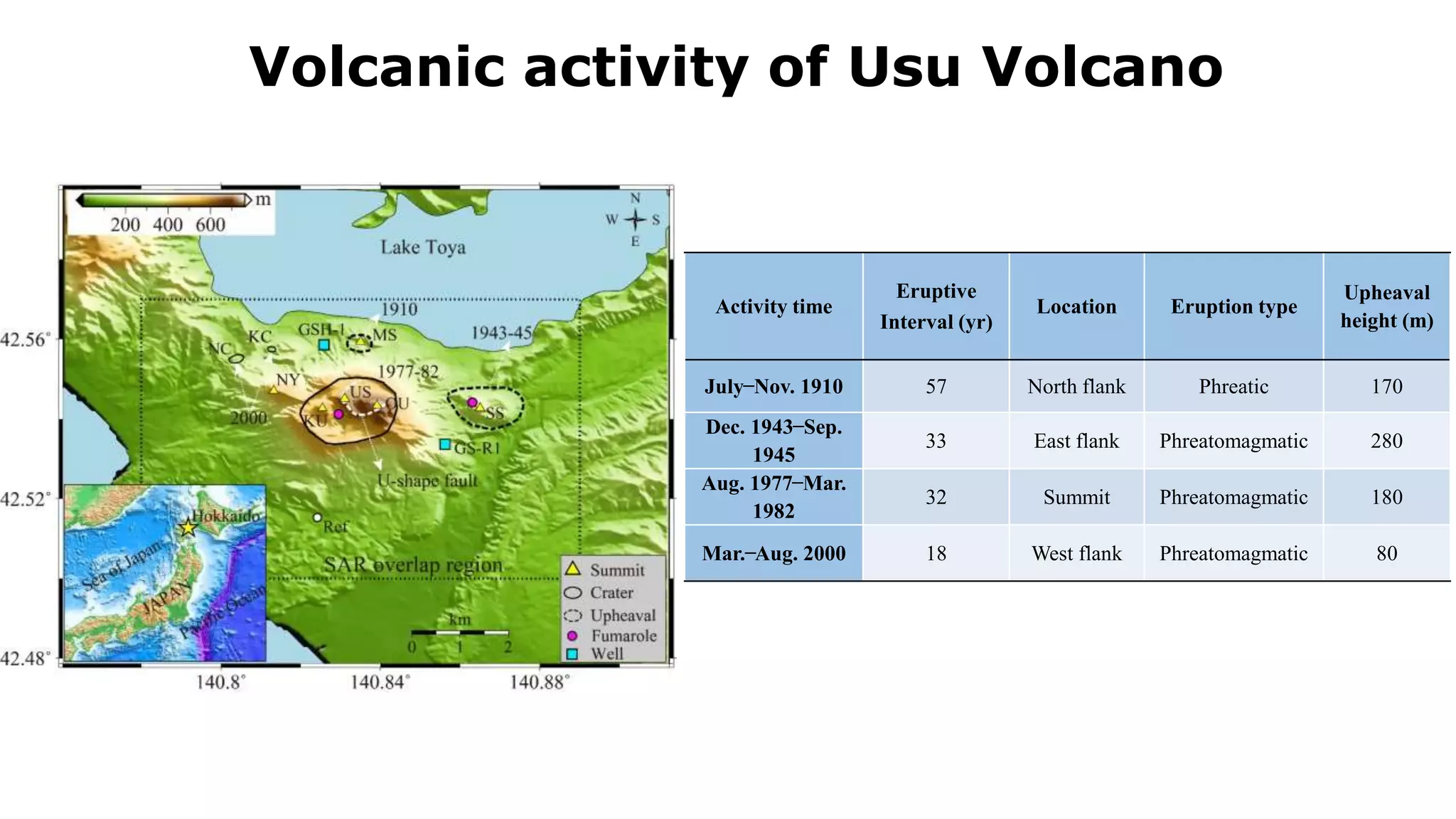
Volcanic activity of Usu Volcano
1910
Activity time
Eruptive
Interval (yr)
Location Eruption type
Upheaval
height (m)
July ̶ Nov. 1910 57 North flank Phreatic 170
Dec. 1943 ̶ Sep.
1945
33 East flank Phreatomagmatic 280
Aug. 1977 ̶ Mar.
1982
32 Summit Phreatomagmatic 180
Mar. ̶ Aug. 2000 18 West flank Phreatomagmatic 80
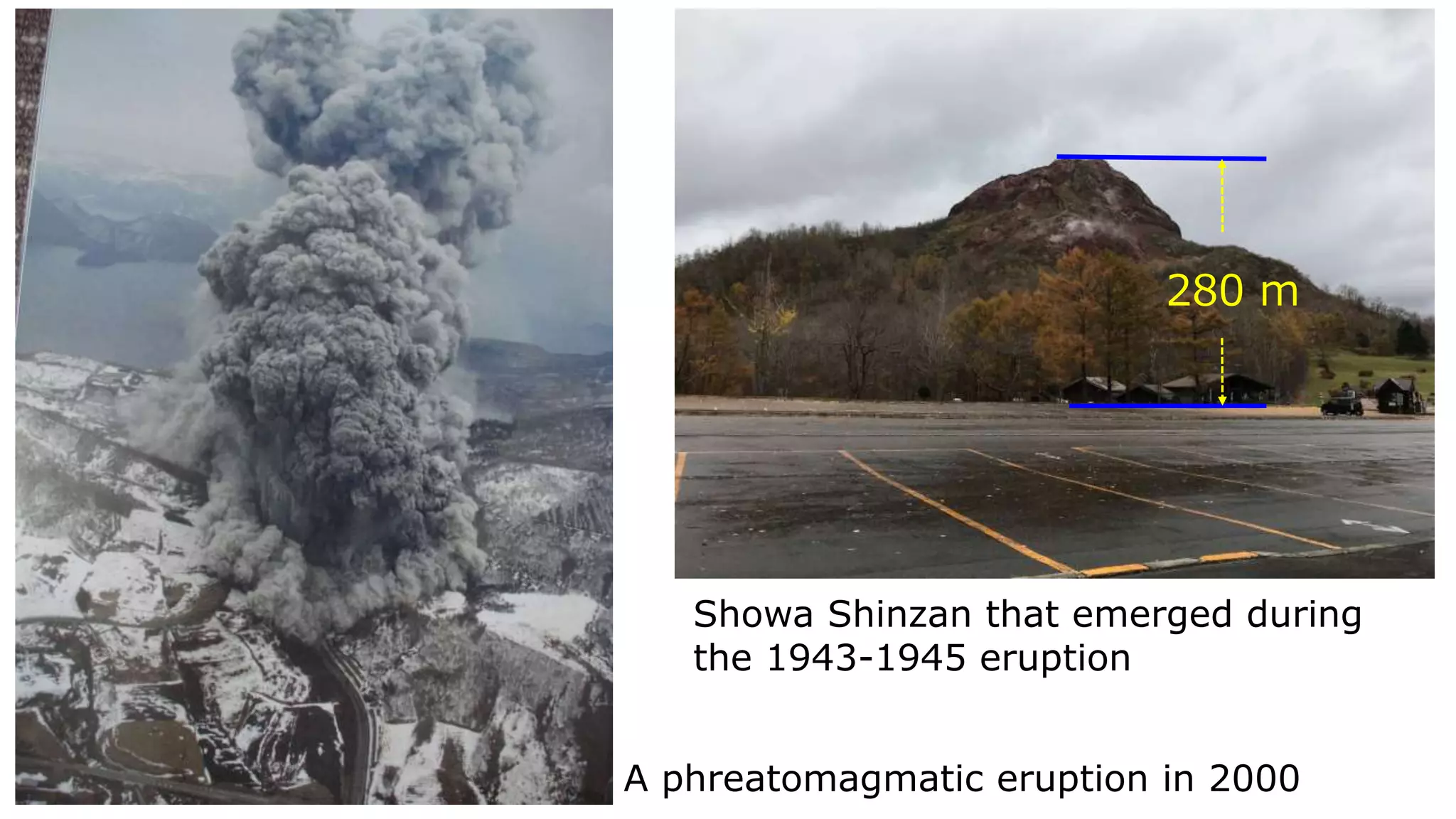
A phreatomagmatic eruption in 2000
Showa Shinzan that emerged during
the 1943-1945 eruption
280 m
Subsidence of the 1943 vent
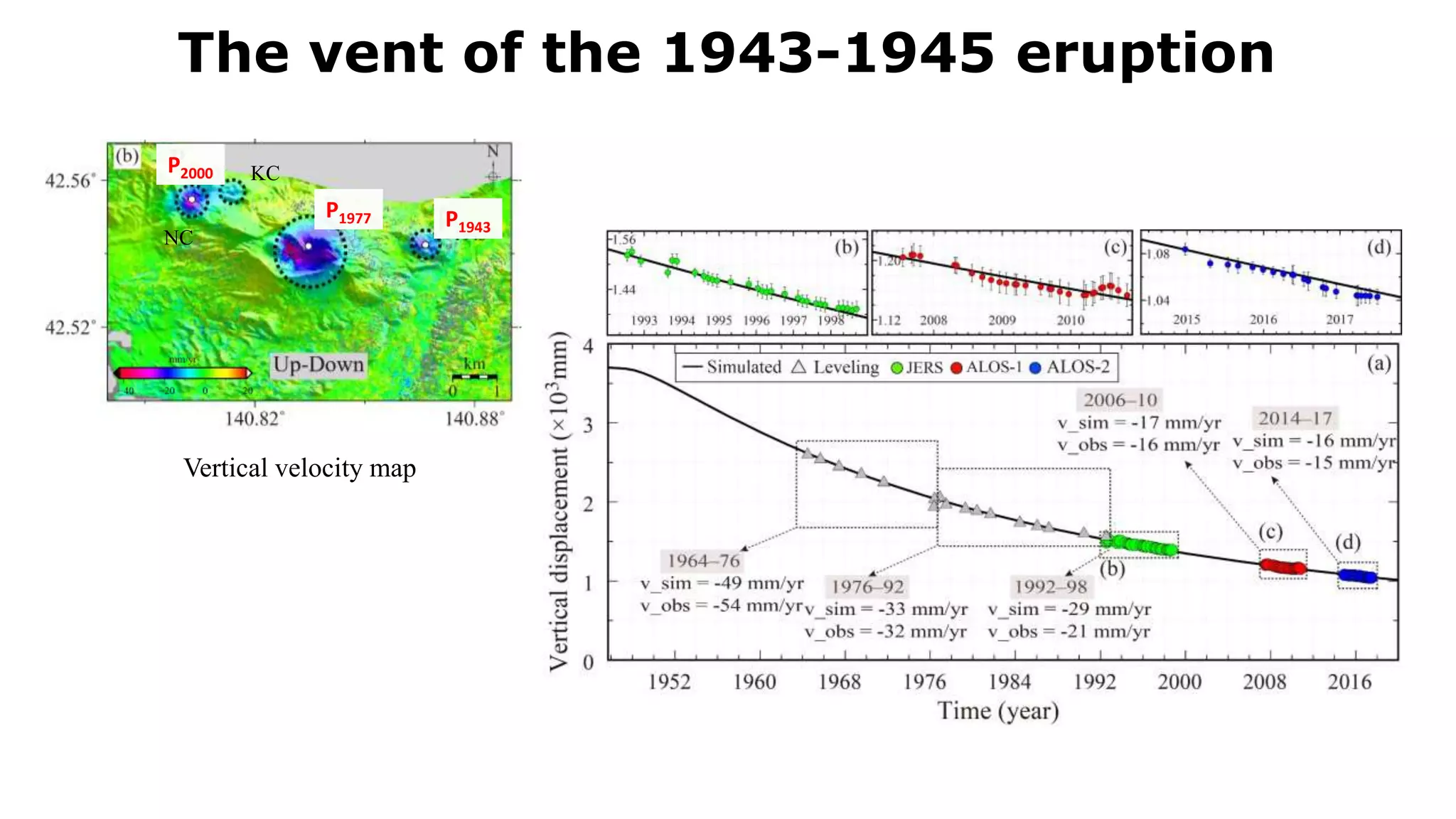
 Persistent subsidence observed by leveling survey.
 Subsidence of 54 mm/yr (1965-1975) and 32 mm/yr (1975-1990)
 Current deformation? Spatial variation?
Yokoyama & Seino
(EPS, 2000)
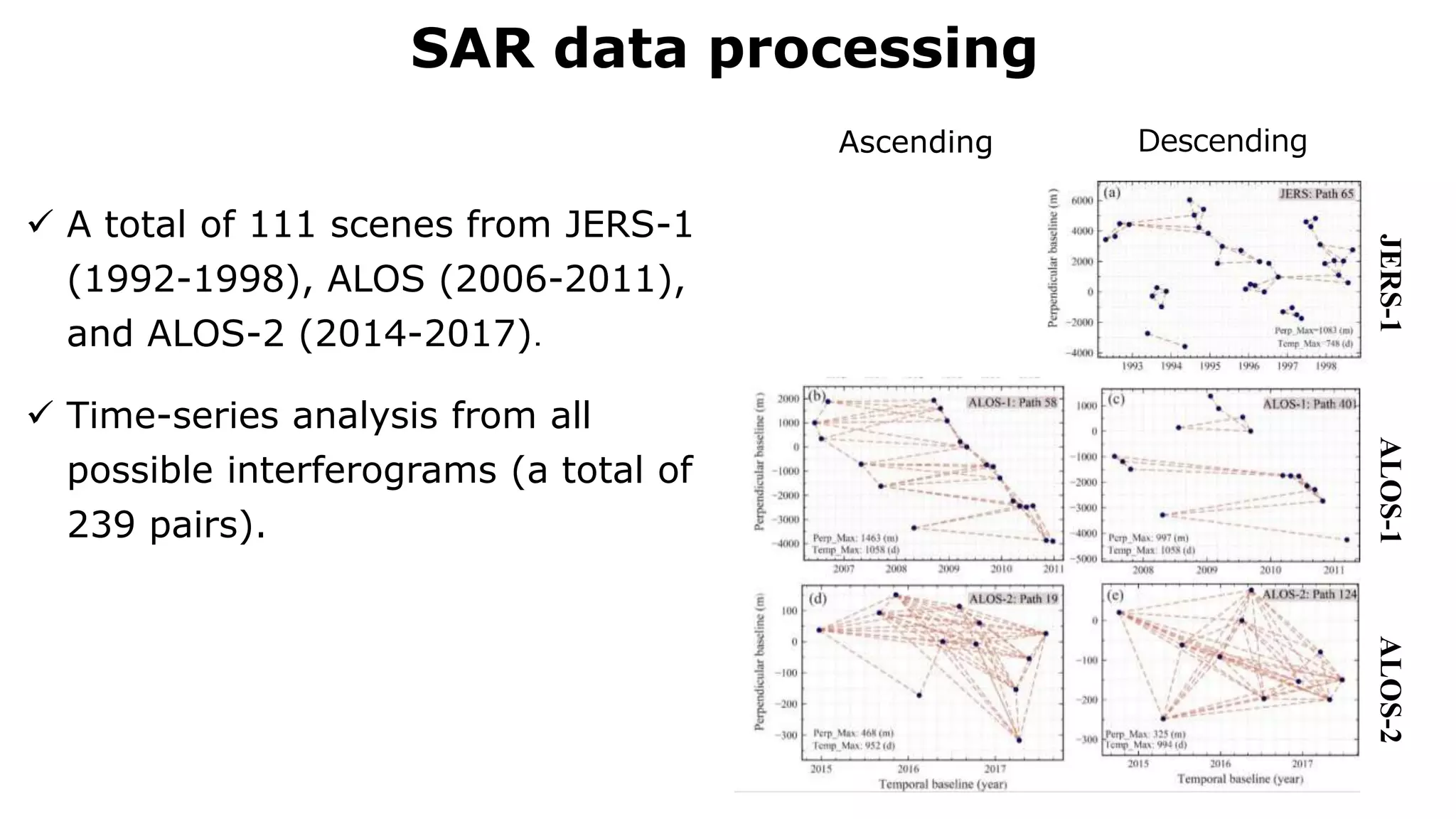
SAR data processing
JERS-1ALOS-1ALOS-2
Ascending Descending
 A total of 111 scenes from JERS-1
(1992-1998), ALOS (2006-2011),
and ALOS-2 (2014-2017).
 Time-series analysis from all
possible interferograms (a total of
239 pairs).
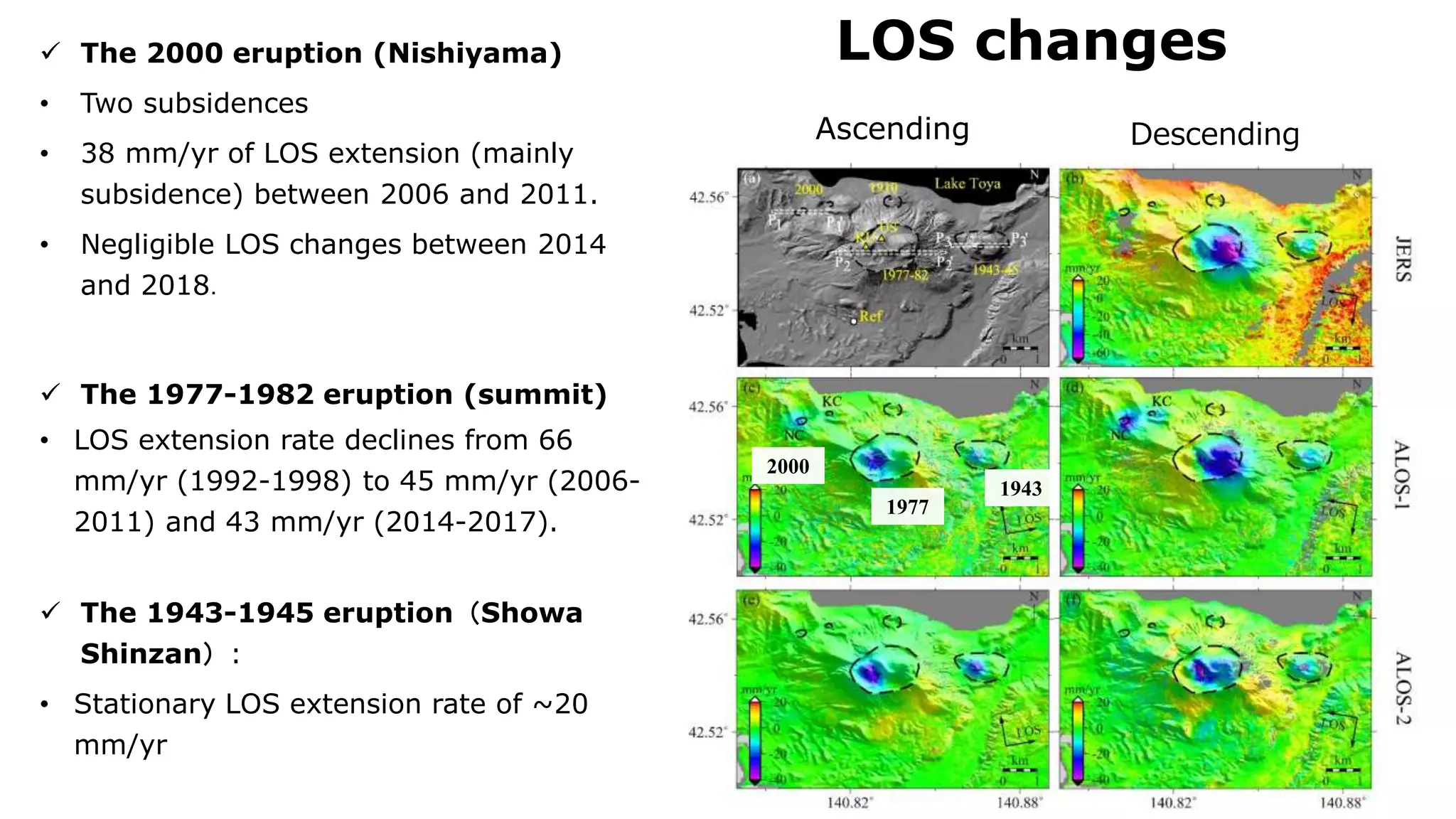
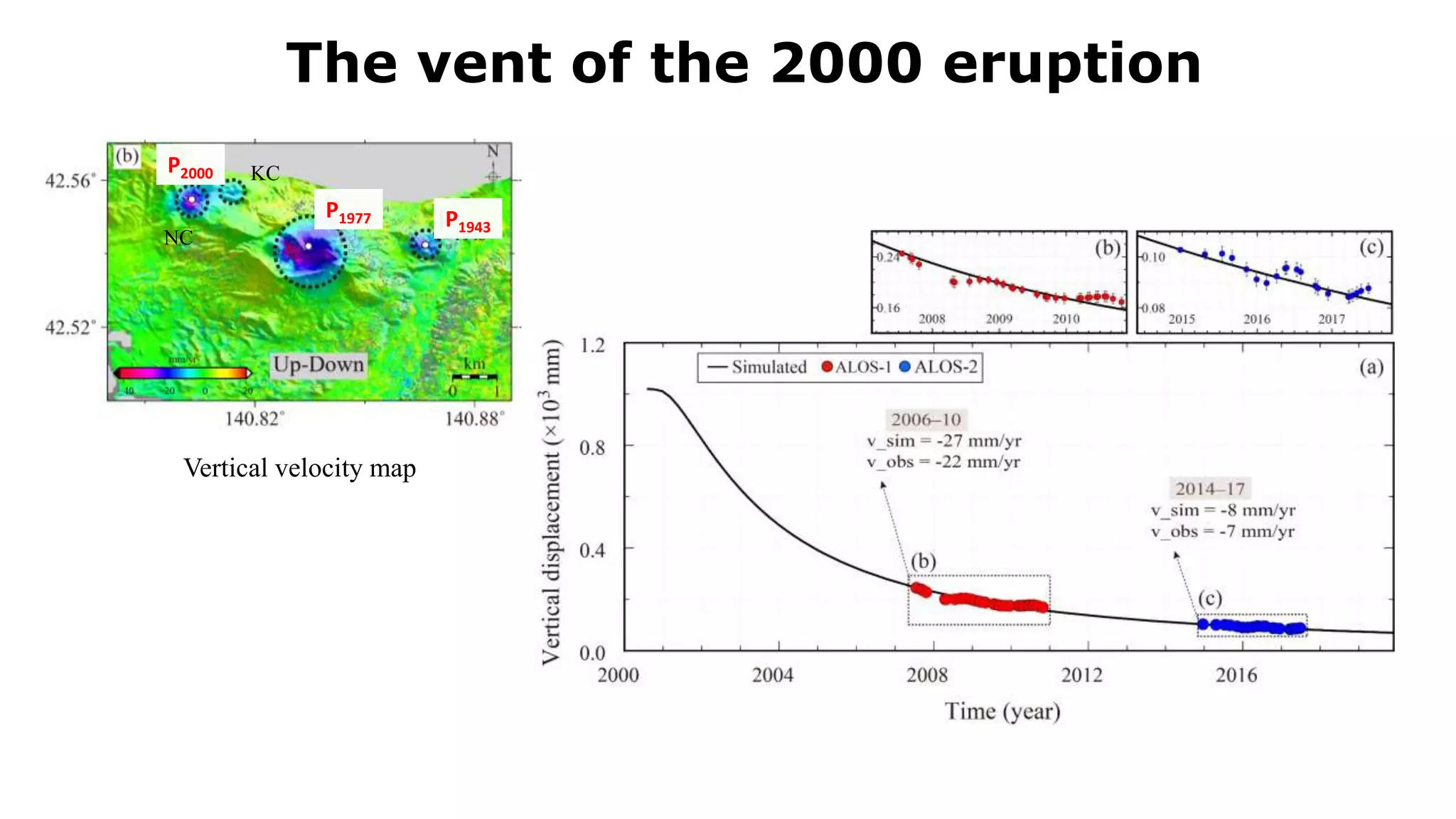
LOS changes The 2000 eruption (Nishiyama)
• Two subsidences
• 38 mm/yr of LOS extension (mainly
subsidence) between 2006 and 2011.
• Negligible LOS changes between 2014
and 2018.
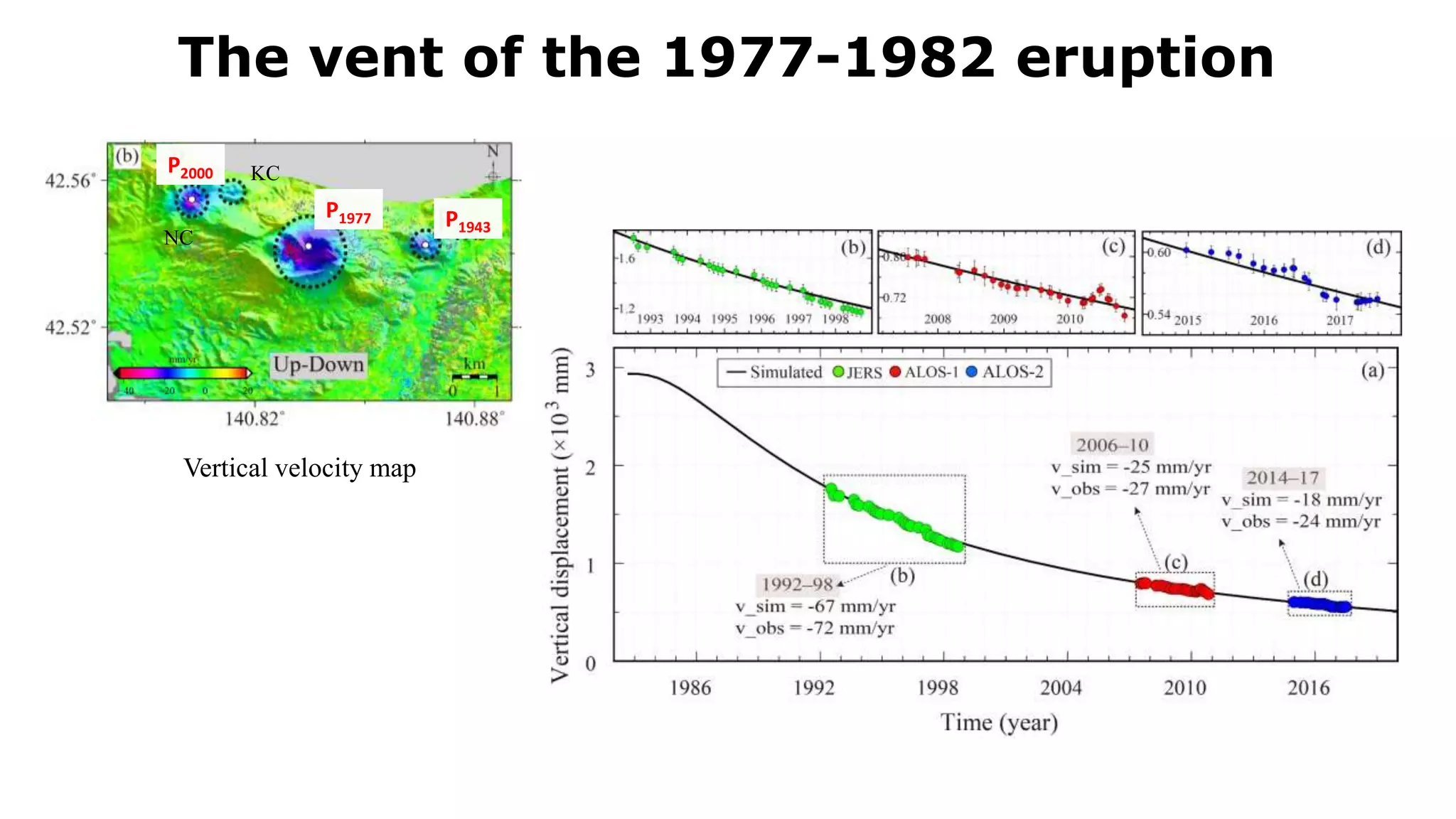
 The 1977-1982 eruption (summit)
• LOS extension rate declines from 66
mm/yr (1992-1998) to 45 mm/yr (2006-
2011) and 43 mm/yr (2014-2017).
 The 1943-1945 eruption(Showa
Shinzan):
• Stationary LOS extension rate of ~20
mm/yr
DescendingAscending
2000
1977
1943
Decomposing (quasi-)EW and vertical velocities
• EW contraction and
subsidence.
• The subsidence rate
is higher than the
contraction rate.
1977
19432000
1977
1943
NC KC
ALOS-1 (2006-2011) ALOS-2 (2014-2017)
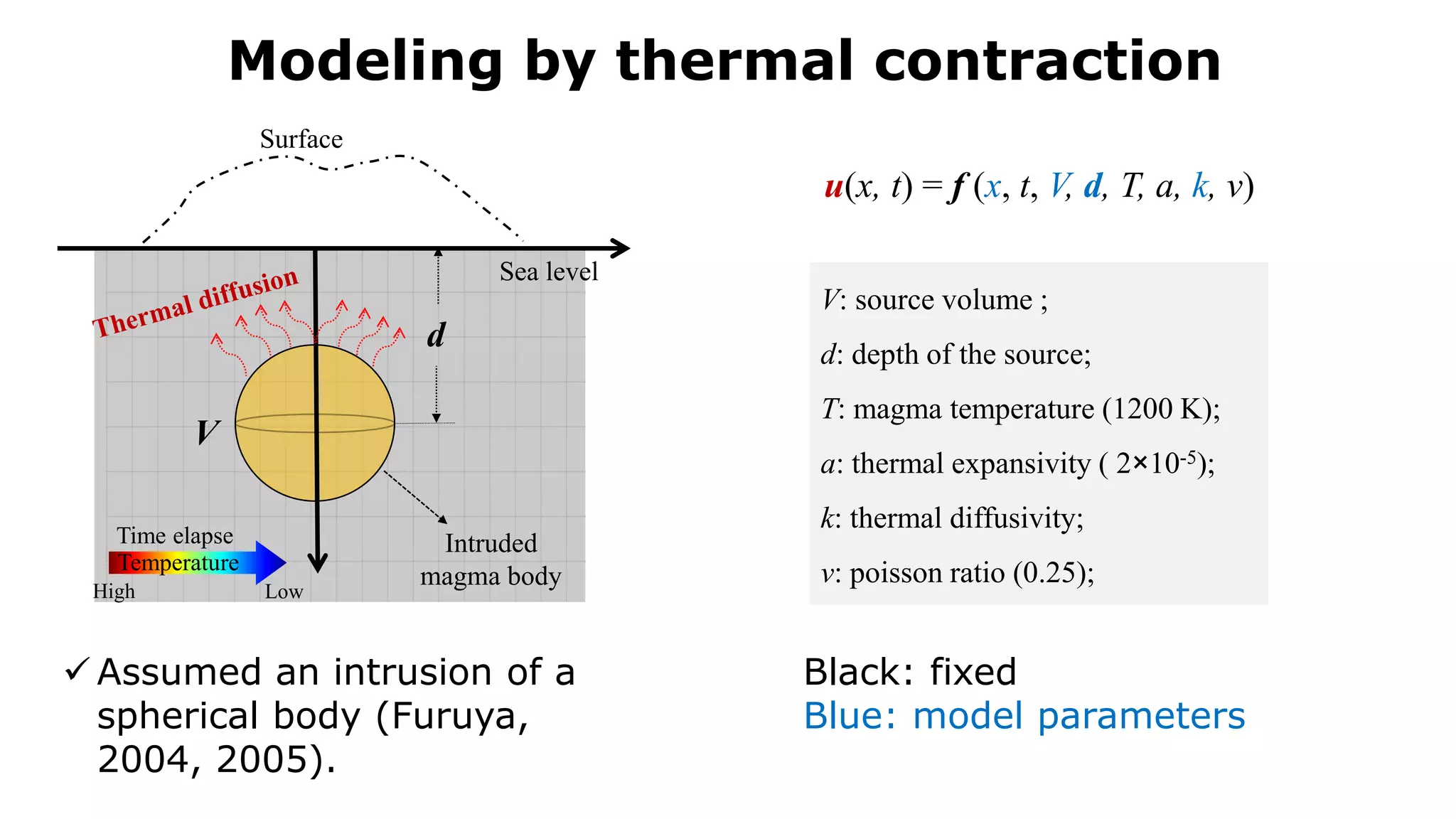
Modeling by thermal contraction
V
d
Sea level
Intruded
magma body
Surface
Temperature
Time elapse
High Low
V: source volume ;
d: depth of the source;
T: magma temperature (1200 K);
a: thermal expansivity ( 2×10⁻⁵);
k: thermal diffusivity;
v: poisson ratio (0.25);
u(x, t) = f (x, t, V, d, T, a, k, v)
 Assumed an intrusion of a
spherical body (Furuya,
2004, 2005).
Black: fixed
Blue: model parameters
Optimum parameters
 The depth of the intruded magma is shallower than 400 m bsl.
 The apparent thermal expansivity is an order higher than the
lab-derived value except for the 1943-1945 case.
Longitude
(°)
Latitude
(°)
Depth
( m b.s.l)
Volume
(×106 m3)
Thermal
diffusivity
(×10-5 m2/s)
Misfit Data source
2000 site
140.8034 42.5541 213±19 6.67±0.21 8.21±1.01 2.78 ALOS-1 (NC)
140.8118 42.5563 100±13 2.05±0.13 8.06±1.20 2.02 ALOS-1 (KC)
1977 site 140.8353 42.5416 396±29 132.18±5.21 10.05±1.09 5.06 JERS+ALOS-1+ALOS-2
1943 site 140.8662 42.5426 92±12 49.51±2.12 1.65±0.22 1.03 JERS+ALOS-1+ALOS-2
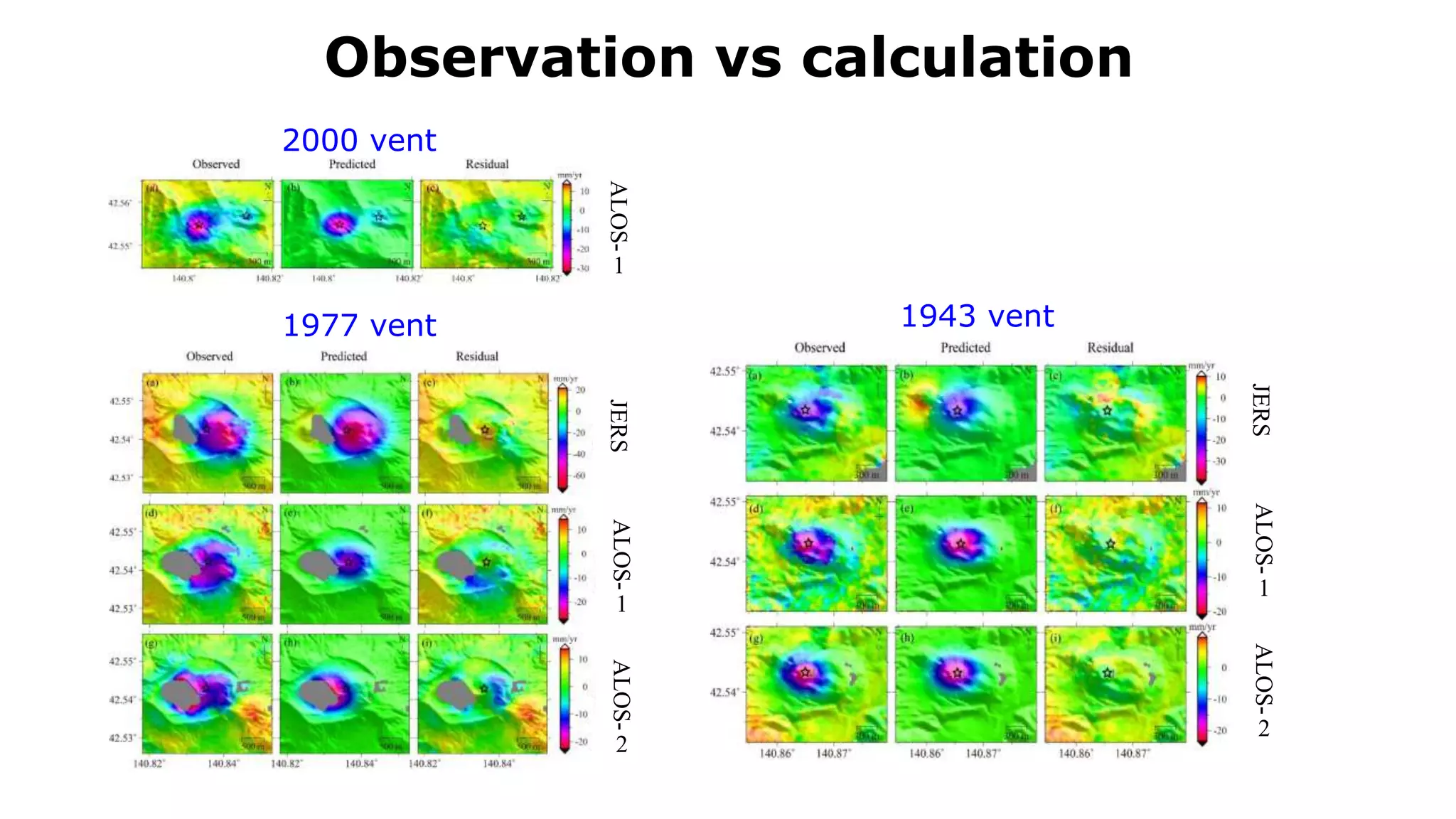
Observation vs calculation
2000 vent
1977 vent 1943 vent
ALOS-
1
JERSALOS-1ALOS-
2
JERSALOS-
1
ALOS-
2
The vent of the 1943-1945 eruption
KC
NC
Vertical velocity map
P1943
P1977
P2000
KC
NC
Vertical velocity map
P1943
P1977
P2000
The vent of the 1977-1982 eruption
KC
NC
Vertical velocity map
P1943
P1977
P2000
The vent of the 2000 eruption
Why is the apparent thermal diffusivity high?
Hydrothermal convection effectively release heat
from magma right after the intrusion?
 Lake Toya is right next to the volcano, providing groundwater.
 Frequent phreatomagmatic eruptions
Question:
Why is the apparent thermal diffusivity in the 1943 vent normal?
Possible collaboration with IPGP:
Reconstructing hydrothermal circulation beneath Usu volcano by
numerical simulation.
Usu Summary
 We measured ground deformation of Usu volcano by SAR images.
 Deformation is concentrated around lava domes that emerged during
previous eruptions.
 The observed deformation is explained by thermal contraction of the
intruded lava dome.
 The inferred apparent thermal diffusivity is larger than the lab-derived
value especially right after the intrusion.
 Hydrothermal circulation effectively cools the intruded magma?
Previous eruptions of Mt. Asama
 1108, 1783: Large (VEI=5) eruptions
 1900-60s: Intermittent explosive eruptions (VEI<=3)
 1973, 1982, 1983, 2004: Middle-sized (VEI=2) eruptions
 2008, 2009, 2015, 2019: Small and minor eruptions
15 Sep. 2004
15 Feb. 1973
30 Sep. 2004
Monitoring by seismometers and GNSS
Seismometer GNSS
Magma pathway of Asama
Eruptions in
Aug. 2008 and Feb. 2009
Enhanced seismicity
Summer 2008-
Shallow inflation
Summer-winter 2008
Nagaoka et al. (EPSL, 2012)
Aoki et al. (Geol. Soc. Lond. Spec. Publ., 2013)
Motivation
GPS stations
 Near-summit deformation?
 2 GNSS sites at the summit.
The next closest one is 4 km
from the summit.
 No deformation field observed
by SAR
GPS baseline variations
(Aoki et al., 2013)
KAHGKAWG
AVOG
Eruption EruptionEruption
Time span
Num. of
images
Path
number
Off-nadir
angle (°)
Azimuth
angle (°)
Resolution
(Rg.×Azi. m)
Num. of
interferogram
ALOS-2
20141028‒
20180814
20 19 36.2
-169.7
(D)
1.4×2.1 75
Sentinel-
1A
20150411‒
20180302
58 119 33.8
-166.8
(D)
2.3×14.0 187
Sentinel-
1B
20150430‒
20180303
62 39 33.8
-10.5
(A)
2.3×14.0 220
SAR images
 ALOS-2 and Sentinel-1 images between 2014 and 2018.
 We processed Sentinel-1 images to enhance the temporal
resolution.
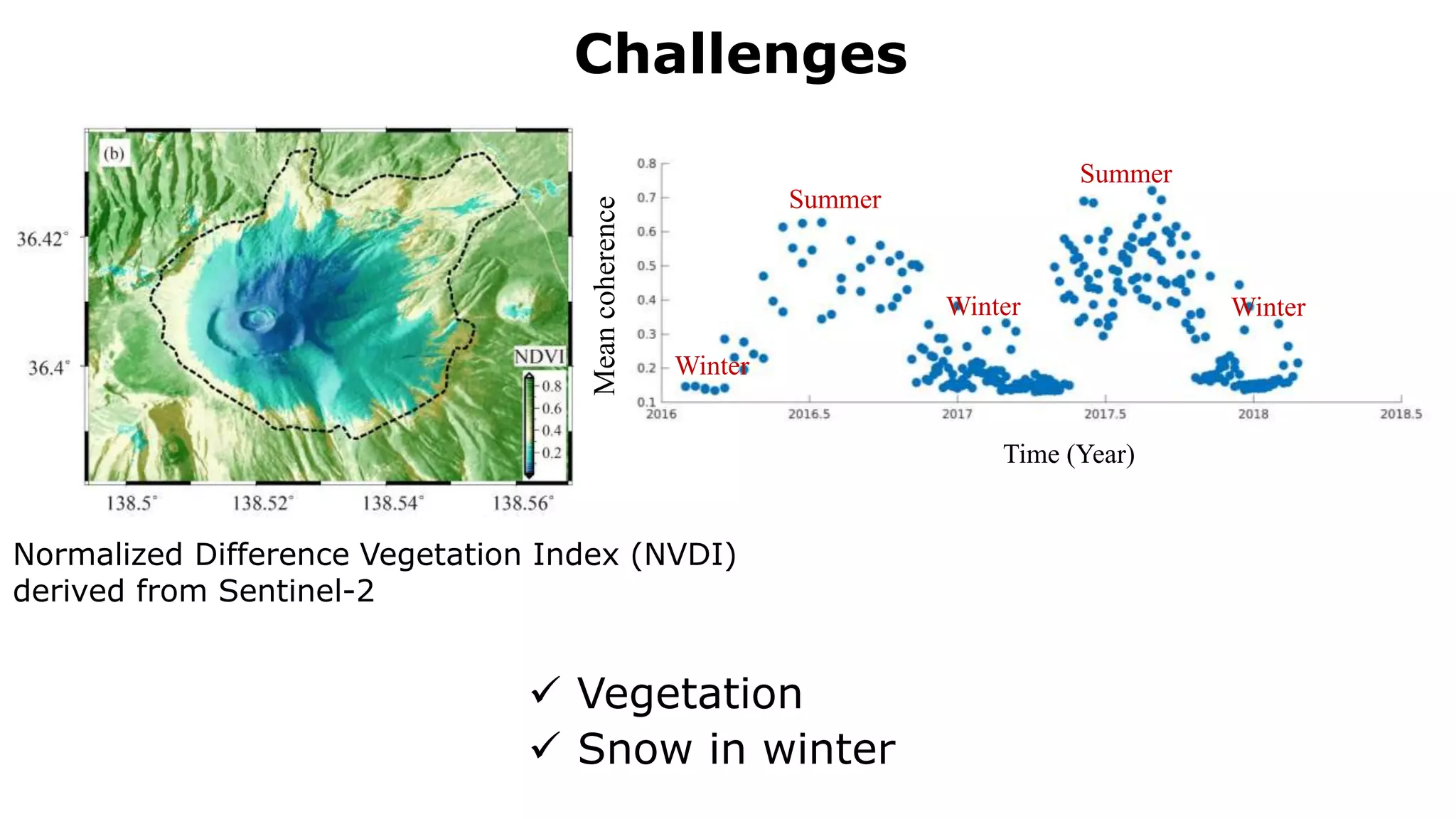
Challenges
Meancoherence
Time (Year)
Summer
Summer
WinterWinter
Winter
 Vegetation
 Snow in winter
Normalized Difference Vegetation Index (NVDI)
derived from Sentinel-2
Data processing
t0
tn
t3
t2
t4
…
Distributed ScatterersPersistent Scatterers
Data processing
(1) Select SAR interferograms with
small temporal and perpendicular
baselines.
(2) Combine both PS and DS targets
for the phase analysis.
(3) Apply the spatially adaptive phase
filtering to improve the phase
quality.
(4) Exclude temporally noisy pixels.
(5) 3D phase unwrapping (Hooper et
al., 2004).StaMPS
Average LOS velocities
 Deformation in NE and
SE flanks.
 NE flank dominated by
subsidence (6 mm/yr)
with negligible (<1
mm/yr) (quasi-)EW
motion.
 SE flank dominated by
(quasi-)eastward
motion (~7 mm/yr)
with smaller subsidence
(~2 mm/yr).
Path 39 Path 119
ALOS-2 Path 19
Sentinel-1ALOS-2
DescendingAscending
NEF
NEF NEF
SEFSEF
SEF
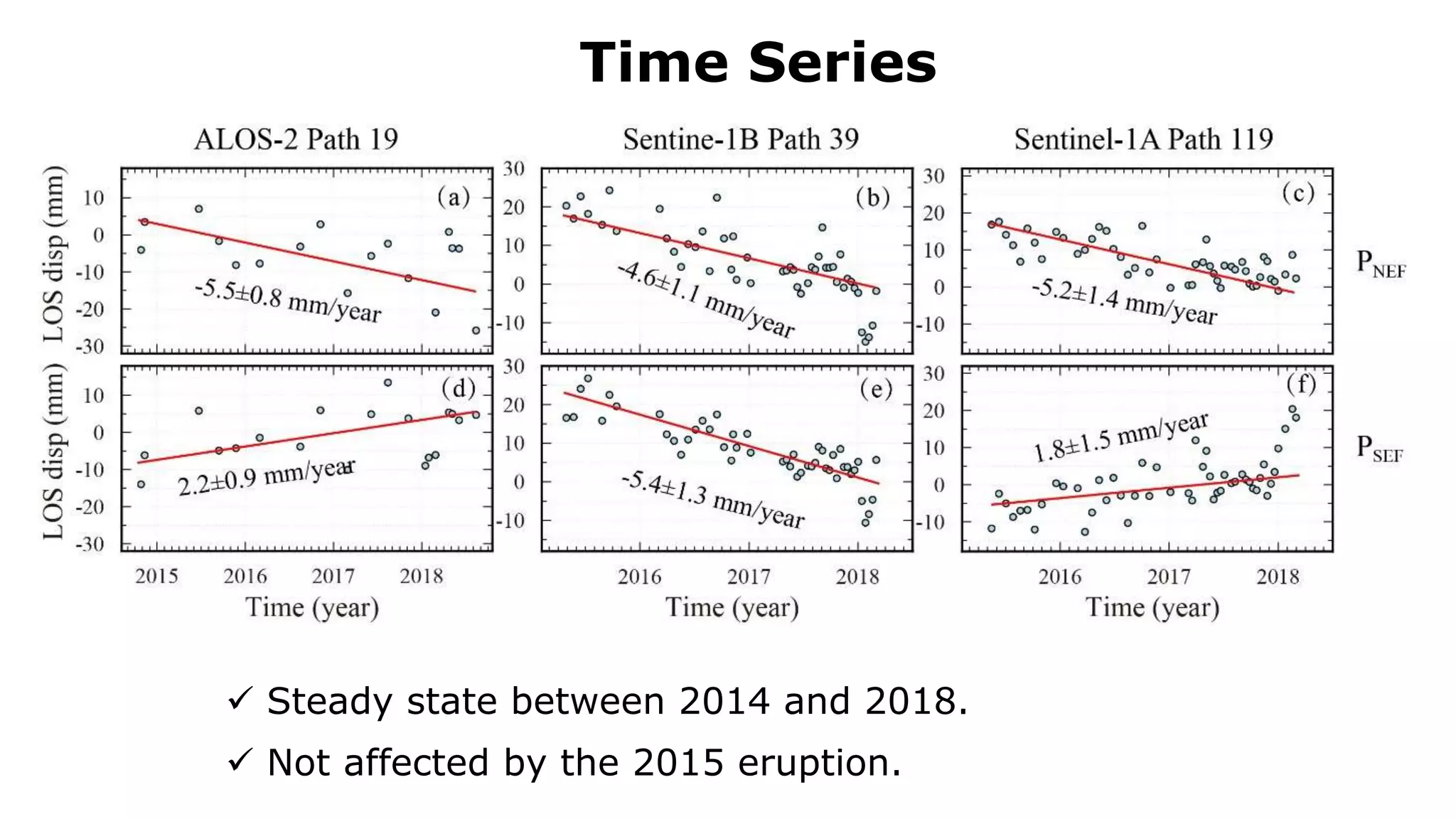
Time Series
 Steady state between 2014 and 2018.
 Not affected by the 2015 eruption.
SEF
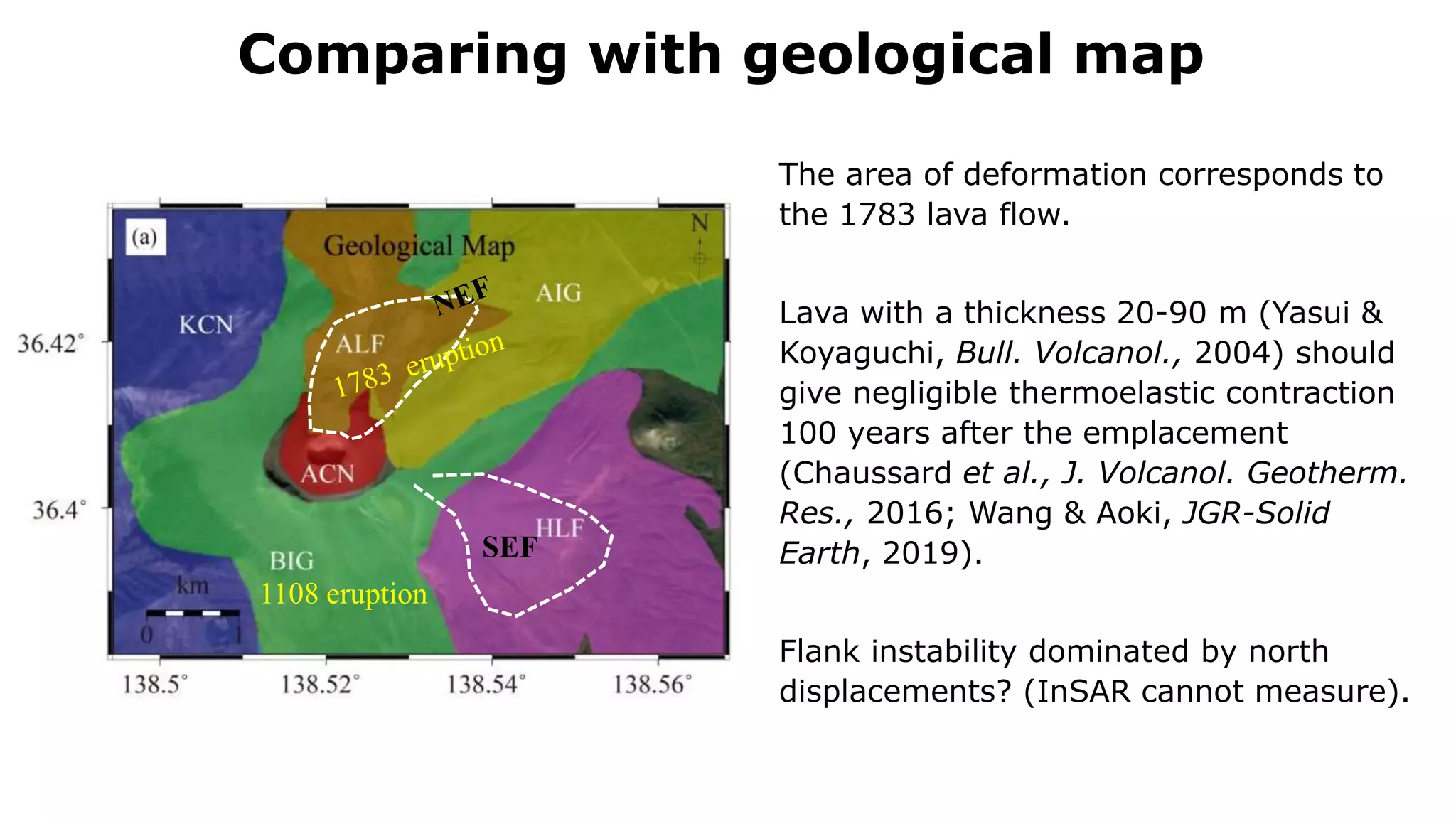
Comparing with geological map
The area of deformation corresponds to
the 1783 lava flow.
Lava with a thickness 20-90 m (Yasui &
Koyaguchi, Bull. Volcanol., 2004) should
give negligible thermoelastic contraction
100 years after the emplacement
(Chaussard et al., J. Volcanol. Geotherm.
Res., 2016; Wang & Aoki, JGR-Solid
Earth, 2019).
Flank instability dominated by north
displacements? (InSAR cannot measure).
1108 eruption
Deformation at SE flank
ALOS-2: Path 19
LOS velocity
NEF
SEF
KAHGKAWG
Flank instability?
If this region (~0.5 km3) generates a sector
collapse (a big assumption!), then the volume the
collapse will be up to 107 m3.
(24 ka Kurofu: 4x10⁹ m3,
1783 Lava flow: 1.7x10⁸ m3 )
Scaling laws between the area and volume of landslides
(Klair et al., JGR, 2011; Blahut et al., Landslides, 2019)
classification of remotely sensed imagery (e.g. Fiorucci et al. 2011) and
their derivatives such as high resolution digital elevation models (e.g.
Břežný and Pánek 2017) and SyntheticApertureRadar (e.g.Strozzi et al.
2018). The rapid preparation of more reliable and representative land-
slide inventories covering increasingly extensive regions is being facili-
tated by these advancing technologies coupled with data mining from
media reports (e.g. Battistini et al. 2013) or social networks (De
Longueville et al. 2010; Yin et al. 2012). Unfortunately, the mapping of
submarine landslides is limited by financial constraints and the time-
consuming nature of seafloor investigations. Therefore, there is a ten-
dency for submarinelandslideinventoriesto comefrom regionsof high
economic importance, including both continental margins (Chaytor
et al. 2009; Katz et al. 2015) and intraplate volcanic islands (e.g. Gee
et al. 2001). In this regard, it is notable that much of the information
about giant landslides on volcanic islands comes from economically
prosperous archipelagos such as the Canary Islands and the Hawaiian
Islands. To some extent, the global distribution of giant landslides on
volcanicislandsoutlined heremay bedistorted by thefact that so much
research focuses on these islands. In the future, it is expected that an
increasing number of giant landslides will be recognised in more re-
mote, lessprosperous islandssuch asthosein theSubantarctic.
Conclusions
In thisreport,aglobal databaseof giant landslideson volcanicislandshas
been presented. Onehundred and eighty-two recordsarelisted: seventy-
fivearehosted in theAtlantic Ocean, sixty-seven arehosted in thePacific
Fig. 4 Volume-area relationshipscalculated using theoutlined database and from
other literaturesourcesV = αAγ
. (1) Giant landslidesonvolcanicislands, α = 0.26,
γ = 1.29 (Blahůt et al., thisstudy); (2) Martian landslides, α = 2.53, γ = 1.23
(Crostaet al. 2018); (3) Martian landslides, α = 0.20, γ = 1.43(Legros2002); (4) all
landslides, α = 0.15, γ = 1.33(Larsen et al. 2010);(5) bedrocklandslides, α = 0.19,
IPL/WCoEactivities
Asama Summary
 We measure deformation around the summit of Asama Volcano
between 2014 and 2018 by SAR images.
 Deformation is temporally steady without any perturbations by
the 2015 eruption.
 Subsidence in the NE flank and eastward motion (with smaller
subsidence) in the SE flank.
 Deformation in the NE flank cannot be explained by thermal
contraction.
 Deformation in the SE flank is due to flank instability?
Grand Summary
 SAR images are powerful in extracting small-scale deformation.
 Volcano deforms for various reasons including thermoelastic deformation
and flank instability.
 ALOS and ALOS-2 (L-band) images work well even in vegetated regions,
but temporal resolution (>14 days) is not favorable.
 Sentinel-1 (C-band) images do not work everywhere, but the temporal
resolution (down to 6 days) is favorable.
 Future SAR missions (NISAR, ALOS-4, both L-band) will further enhance
temporal resolution.

2019-10-15 Small-scale deformation of active volcanoes measured by

  • 1.
    Small-scale deformation ofactive volcanoes measured by Synthetic Aperture Radar Yosuke Aoki Earthquake Research Institute, The University of Tokyo Email: yaoki@eri.u-tokyo.ac.jp with Xiaowen Wang (Southwest Jiatong University, Sichuan, China) Jie Chen (The Chinese University of Hong Kong) Wang & Aoki (2019), J. Geophys. Res. Solid Earth, 124, 335-357, doi:10.1029/2018JB016729. Wang, Aoki, & Chen, Earth Planet. Space, in revision. 2019年10月15日 地球計測セミナー 東京大学地震研究所
  • 2.
    Small-scale deformation involcanoes Volcán de Colima, Mexico (Salzer et al., EPSL, 2017) Santiaguito, Guatemala (Ebmeier et al., EPSL, 2012) Wolf, Gálapagos (Xu, Jónsson, Ruch, and Aoki, GRL, 2016) SAR is capable of measuring small-scale deformation by taking advantages of high spatial resolution.
  • 3.
    Volcanoes of Today Tokyo Ontake Usu Mt.Fuji Part 1 Usu: Thermoelastic deflation (Wang & Aoki, 2019) Part 2 Asama: Flank instability (?) (Wang, Aoki, & Chen, in revision) Asama
  • 4.
    Inter-eruptive volcano deflation Nabro,Eritrea (Hamlyn et al., Prog. Earth Planet. Sci., 2018) Asama, Japan (Aoki et al., Geol. Soc. Lond. Spec. Publ., 2013) Kutcharo, Japan (Fujiwara et al., Earth Planet. Space, 2017; Yamasaki et al., JVGR, 2018)
  • 5.
    Why studying volcanodeflation? Potential mechanisms of volcano deflation  Viscoelastic relaxation (Hamlyn et al., 2018; Yamasaki et al., 2018)  Contraction of magma reservoir (e.g. Hamlyn et al., 2018)  Cooling of emplaced lava (Wittmann et al., JGR Solid Earth, 2017) Temporal evolution of volcano deflation could carry various information such as rheology of intruded magma and host rock.
  • 6.
    Toya caldera  Usuvolcano is located at the rim of Toya caldera which ejected >100 km3 of magma ~114,000 years ago.  Eruption of Usu volcano in historical time: 1663: VEI=5 1769: VEI=4 1822: VEI=4 1853: VEI=4 1910: VEI=2 1944: VEI=2 1977: VEI=3 2000: VEI=2
  • 7.
    Volcanic activity ofUsu Volcano 1910 Activity time Eruptive Interval (yr) Location Eruption type Upheaval height (m) July ̶ Nov. 1910 57 North flank Phreatic 170 Dec. 1943 ̶ Sep. 1945 33 East flank Phreatomagmatic 280 Aug. 1977 ̶ Mar. 1982 32 Summit Phreatomagmatic 180 Mar. ̶ Aug. 2000 18 West flank Phreatomagmatic 80
  • 8.
    A phreatomagmatic eruptionin 2000 Showa Shinzan that emerged during the 1943-1945 eruption 280 m
  • 9.
    Subsidence of the1943 vent  Persistent subsidence observed by leveling survey.  Subsidence of 54 mm/yr (1965-1975) and 32 mm/yr (1975-1990)  Current deformation? Spatial variation? Yokoyama & Seino (EPS, 2000)
  • 10.
    SAR data processing JERS-1ALOS-1ALOS-2 AscendingDescending  A total of 111 scenes from JERS-1 (1992-1998), ALOS (2006-2011), and ALOS-2 (2014-2017).  Time-series analysis from all possible interferograms (a total of 239 pairs).
  • 11.
    LOS changes The2000 eruption (Nishiyama) • Two subsidences • 38 mm/yr of LOS extension (mainly subsidence) between 2006 and 2011. • Negligible LOS changes between 2014 and 2018.  The 1977-1982 eruption (summit) • LOS extension rate declines from 66 mm/yr (1992-1998) to 45 mm/yr (2006- 2011) and 43 mm/yr (2014-2017).  The 1943-1945 eruption(Showa Shinzan): • Stationary LOS extension rate of ~20 mm/yr DescendingAscending 2000 1977 1943
  • 12.
    Decomposing (quasi-)EW andvertical velocities • EW contraction and subsidence. • The subsidence rate is higher than the contraction rate. 1977 19432000 1977 1943 NC KC ALOS-1 (2006-2011) ALOS-2 (2014-2017)
  • 13.
    Modeling by thermalcontraction V d Sea level Intruded magma body Surface Temperature Time elapse High Low V: source volume ; d: depth of the source; T: magma temperature (1200 K); a: thermal expansivity ( 2×10⁻⁵); k: thermal diffusivity; v: poisson ratio (0.25); u(x, t) = f (x, t, V, d, T, a, k, v)  Assumed an intrusion of a spherical body (Furuya, 2004, 2005). Black: fixed Blue: model parameters
  • 14.
    Optimum parameters  Thedepth of the intruded magma is shallower than 400 m bsl.  The apparent thermal expansivity is an order higher than the lab-derived value except for the 1943-1945 case. Longitude (°) Latitude (°) Depth ( m b.s.l) Volume (×106 m3) Thermal diffusivity (×10-5 m2/s) Misfit Data source 2000 site 140.8034 42.5541 213±19 6.67±0.21 8.21±1.01 2.78 ALOS-1 (NC) 140.8118 42.5563 100±13 2.05±0.13 8.06±1.20 2.02 ALOS-1 (KC) 1977 site 140.8353 42.5416 396±29 132.18±5.21 10.05±1.09 5.06 JERS+ALOS-1+ALOS-2 1943 site 140.8662 42.5426 92±12 49.51±2.12 1.65±0.22 1.03 JERS+ALOS-1+ALOS-2
  • 15.
    Observation vs calculation 2000vent 1977 vent 1943 vent ALOS- 1 JERSALOS-1ALOS- 2 JERSALOS- 1 ALOS- 2
  • 16.
    The vent ofthe 1943-1945 eruption KC NC Vertical velocity map P1943 P1977 P2000
  • 17.
  • 18.
  • 19.
    Why is theapparent thermal diffusivity high? Hydrothermal convection effectively release heat from magma right after the intrusion?  Lake Toya is right next to the volcano, providing groundwater.  Frequent phreatomagmatic eruptions Question: Why is the apparent thermal diffusivity in the 1943 vent normal? Possible collaboration with IPGP: Reconstructing hydrothermal circulation beneath Usu volcano by numerical simulation.
  • 20.
    Usu Summary  Wemeasured ground deformation of Usu volcano by SAR images.  Deformation is concentrated around lava domes that emerged during previous eruptions.  The observed deformation is explained by thermal contraction of the intruded lava dome.  The inferred apparent thermal diffusivity is larger than the lab-derived value especially right after the intrusion.  Hydrothermal circulation effectively cools the intruded magma?
  • 21.
    Previous eruptions ofMt. Asama  1108, 1783: Large (VEI=5) eruptions  1900-60s: Intermittent explosive eruptions (VEI<=3)  1973, 1982, 1983, 2004: Middle-sized (VEI=2) eruptions  2008, 2009, 2015, 2019: Small and minor eruptions 15 Sep. 2004 15 Feb. 1973 30 Sep. 2004
  • 22.
    Monitoring by seismometersand GNSS Seismometer GNSS
  • 23.
    Magma pathway ofAsama Eruptions in Aug. 2008 and Feb. 2009 Enhanced seismicity Summer 2008- Shallow inflation Summer-winter 2008 Nagaoka et al. (EPSL, 2012) Aoki et al. (Geol. Soc. Lond. Spec. Publ., 2013)
  • 24.
    Motivation GPS stations  Near-summitdeformation?  2 GNSS sites at the summit. The next closest one is 4 km from the summit.  No deformation field observed by SAR GPS baseline variations (Aoki et al., 2013) KAHGKAWG AVOG Eruption EruptionEruption
  • 25.
    Time span Num. of images Path number Off-nadir angle(°) Azimuth angle (°) Resolution (Rg.×Azi. m) Num. of interferogram ALOS-2 20141028‒ 20180814 20 19 36.2 -169.7 (D) 1.4×2.1 75 Sentinel- 1A 20150411‒ 20180302 58 119 33.8 -166.8 (D) 2.3×14.0 187 Sentinel- 1B 20150430‒ 20180303 62 39 33.8 -10.5 (A) 2.3×14.0 220 SAR images  ALOS-2 and Sentinel-1 images between 2014 and 2018.  We processed Sentinel-1 images to enhance the temporal resolution.
  • 26.
    Challenges Meancoherence Time (Year) Summer Summer WinterWinter Winter  Vegetation Snow in winter Normalized Difference Vegetation Index (NVDI) derived from Sentinel-2
  • 27.
  • 28.
    Data processing (1) SelectSAR interferograms with small temporal and perpendicular baselines. (2) Combine both PS and DS targets for the phase analysis. (3) Apply the spatially adaptive phase filtering to improve the phase quality. (4) Exclude temporally noisy pixels. (5) 3D phase unwrapping (Hooper et al., 2004).StaMPS
  • 29.
    Average LOS velocities Deformation in NE and SE flanks.  NE flank dominated by subsidence (6 mm/yr) with negligible (<1 mm/yr) (quasi-)EW motion.  SE flank dominated by (quasi-)eastward motion (~7 mm/yr) with smaller subsidence (~2 mm/yr). Path 39 Path 119 ALOS-2 Path 19 Sentinel-1ALOS-2 DescendingAscending NEF NEF NEF SEFSEF SEF
  • 30.
    Time Series  Steadystate between 2014 and 2018.  Not affected by the 2015 eruption.
  • 31.
    SEF Comparing with geologicalmap The area of deformation corresponds to the 1783 lava flow. Lava with a thickness 20-90 m (Yasui & Koyaguchi, Bull. Volcanol., 2004) should give negligible thermoelastic contraction 100 years after the emplacement (Chaussard et al., J. Volcanol. Geotherm. Res., 2016; Wang & Aoki, JGR-Solid Earth, 2019). Flank instability dominated by north displacements? (InSAR cannot measure). 1108 eruption
  • 32.
    Deformation at SEflank ALOS-2: Path 19 LOS velocity NEF SEF KAHGKAWG Flank instability? If this region (~0.5 km3) generates a sector collapse (a big assumption!), then the volume the collapse will be up to 107 m3. (24 ka Kurofu: 4x10⁹ m3, 1783 Lava flow: 1.7x10⁸ m3 ) Scaling laws between the area and volume of landslides (Klair et al., JGR, 2011; Blahut et al., Landslides, 2019) classification of remotely sensed imagery (e.g. Fiorucci et al. 2011) and their derivatives such as high resolution digital elevation models (e.g. Břežný and Pánek 2017) and SyntheticApertureRadar (e.g.Strozzi et al. 2018). The rapid preparation of more reliable and representative land- slide inventories covering increasingly extensive regions is being facili- tated by these advancing technologies coupled with data mining from media reports (e.g. Battistini et al. 2013) or social networks (De Longueville et al. 2010; Yin et al. 2012). Unfortunately, the mapping of submarine landslides is limited by financial constraints and the time- consuming nature of seafloor investigations. Therefore, there is a ten- dency for submarinelandslideinventoriesto comefrom regionsof high economic importance, including both continental margins (Chaytor et al. 2009; Katz et al. 2015) and intraplate volcanic islands (e.g. Gee et al. 2001). In this regard, it is notable that much of the information about giant landslides on volcanic islands comes from economically prosperous archipelagos such as the Canary Islands and the Hawaiian Islands. To some extent, the global distribution of giant landslides on volcanicislandsoutlined heremay bedistorted by thefact that so much research focuses on these islands. In the future, it is expected that an increasing number of giant landslides will be recognised in more re- mote, lessprosperous islandssuch asthosein theSubantarctic. Conclusions In thisreport,aglobal databaseof giant landslideson volcanicislandshas been presented. Onehundred and eighty-two recordsarelisted: seventy- fivearehosted in theAtlantic Ocean, sixty-seven arehosted in thePacific Fig. 4 Volume-area relationshipscalculated using theoutlined database and from other literaturesourcesV = αAγ . (1) Giant landslidesonvolcanicislands, α = 0.26, γ = 1.29 (Blahůt et al., thisstudy); (2) Martian landslides, α = 2.53, γ = 1.23 (Crostaet al. 2018); (3) Martian landslides, α = 0.20, γ = 1.43(Legros2002); (4) all landslides, α = 0.15, γ = 1.33(Larsen et al. 2010);(5) bedrocklandslides, α = 0.19, IPL/WCoEactivities
  • 33.
    Asama Summary  Wemeasure deformation around the summit of Asama Volcano between 2014 and 2018 by SAR images.  Deformation is temporally steady without any perturbations by the 2015 eruption.  Subsidence in the NE flank and eastward motion (with smaller subsidence) in the SE flank.  Deformation in the NE flank cannot be explained by thermal contraction.  Deformation in the SE flank is due to flank instability?
  • 34.
    Grand Summary  SARimages are powerful in extracting small-scale deformation.  Volcano deforms for various reasons including thermoelastic deformation and flank instability.  ALOS and ALOS-2 (L-band) images work well even in vegetated regions, but temporal resolution (>14 days) is not favorable.  Sentinel-1 (C-band) images do not work everywhere, but the temporal resolution (down to 6 days) is favorable.  Future SAR missions (NISAR, ALOS-4, both L-band) will further enhance temporal resolution.

Editor's Notes

  • #3 Asama is one of the most active volcanoes in Japan with explosive eruptions in 12th and 18th centuries. Many rich people own their second house in the area of Asama volcano, 140 km from Tokyo, to avoid heat in summer, so the volcanic activity there has always been a interest for such rich people. The volcano was quite active with numerous explosive eruptions in early 20th century. Recently moderate eruptions with Volcano Explosivity Index of 2 occurred in 1973, 82, 83, and 2004. More recently, there were small eruptions last year and early this year. The eruption last year was small but attracted social interests because Tokyo got trace ashfall by the eruption. In fact I myself got trace ash while I was commuting on that day. This indicates that people in Tokyo metropolitan region with a population more than 10 million could potentially be in danger at the time of larger eruptions.
  • #4 Before moving to Usu volcano, I would like to start from talking something about volcanoes in Japan.
  • #5 Volcanologists are usually interested in eruptions or unrest of rather than the dormancy of volcanoes. Volcanologists are more excited about inflation of a volcano than deflation of a volcano because it is an evidence of unrest of a volcano or transport of magma to shallow depths. However, if you are in charge of volcano monitoring, you often see volcano deflating. These are just three example, two from Japanese volcanoes and one from a volcano in Eritrea, two from SAR images and one from GPS observation.
  • #24 Asama is one of the most active volcanoes in Japan with explosive eruptions in 12th and 18th centuries. Many rich people own their second house in the area of Asama volcano, 140 km from Tokyo, to avoid heat in summer, so the volcanic activity there has always been a interest for such rich people. The volcano was quite active with numerous explosive eruptions in early 20th century. Recently moderate eruptions with Volcano Explosivity Index of 2 occurred in 1973, 82, 83, and 2004. More recently, there were small eruptions last year and early this year. The eruption last year was small but attracted social interests because Tokyo got trace ashfall by the eruption. In fact I myself got trace ash while I was commuting on that day. This indicates that people in Tokyo metropolitan region with a population more than 10 million could potentially be in danger at the time of larger eruptions.
  • #25 The left panel shows the current seismic network. Actually we added one more broadband seismometer here… The right panel shows the distribution of continuous GPS sites. Actually we have more one at the summit here… Blue circles are continuous GPS sites operated by ERI and red stars are those by Geospatial Information Authority as a national infrastructure. You may notice that 20 km spacing of continuous GPS sites is not good enough for volcano monitoring. When I arrived eight years ago, there were only three continuous GPS sites run by ERI but now we have about 10 continuous GPS sites with a potential addition.
  • #30 Persistent Scatterers: a coherent radar target exhibiting high phase stability in the entire data stack Distributed Scatterers: -a pixel that contains lots of small scattering objects without one being dominant
  • #32 Persistent Scatterers: a coherent radar target exhibiting high phase stability in the entire data stack Distributed Scatterers: -a pixel that contains lots of small scattering objects without one being dominant
  • #33 Persistent Scatterers: a coherent radar target exhibiting high phase stability in the entire data stack Distributed Scatterers: -a pixel that contains lots of small scattering objects without one being dominant
  • #34 Persistent Scatterers: a coherent radar target exhibiting high phase stability in the entire data stack Distributed Scatterers: -a pixel that contains lots of small scattering objects without one being dominant