富士山の内部構造
Internal structure ofMt. Fuji
青木陽介(東京大学地震研究所)
Yosuke Aoki (Earthquake Research Institute,
The University of Tokyo)
Email: yaoki@eri.u-tokyo.ac.jp
8 October 2018
Mt. Fuji Int’l symposium
Fujiyoshida, Yamanashi, Japan
2.
富士山は何が特別なのか
What is uniqueabout Mt. Fuji?
景観 / Landscape
大きさ / Size
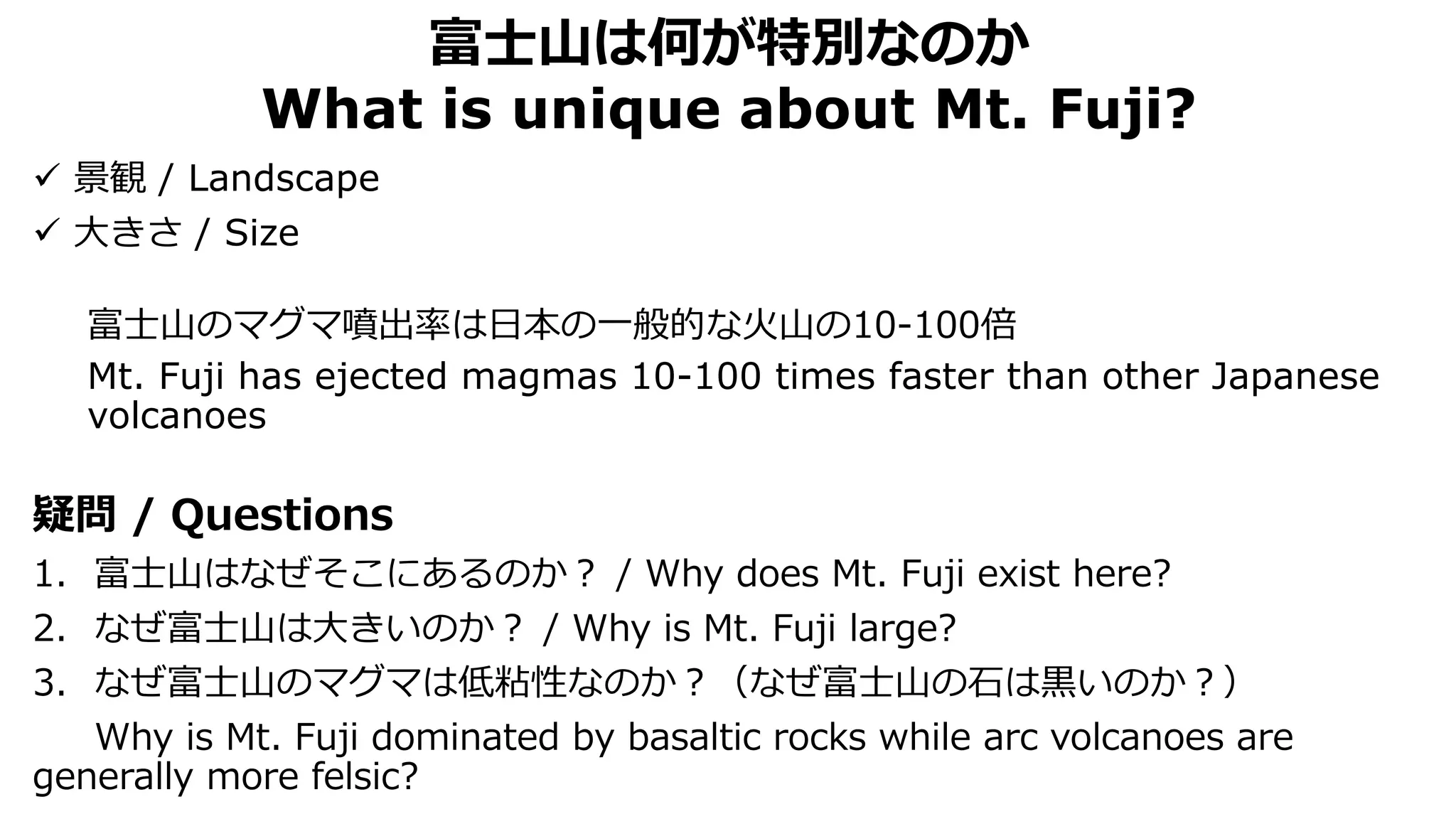
富士山のマグマ噴出率は日本の一般的な火山の10-100倍
Mt. Fuji has ejected magmas 10-100 times faster than other Japanese
volcanoes
疑問 / Questions
1. 富士山はなぜそこにあるのか? / Why does Mt. Fuji exist here?
2. なぜ富士山は大きいのか? / Why is Mt. Fuji large?
3. なぜ富士山のマグマは低粘性なのか?(なぜ富士山の石は黒いのか?)
Why is Mt. Fuji dominated by basaltic rocks while arc volcanoes are
generally more felsic?
3.
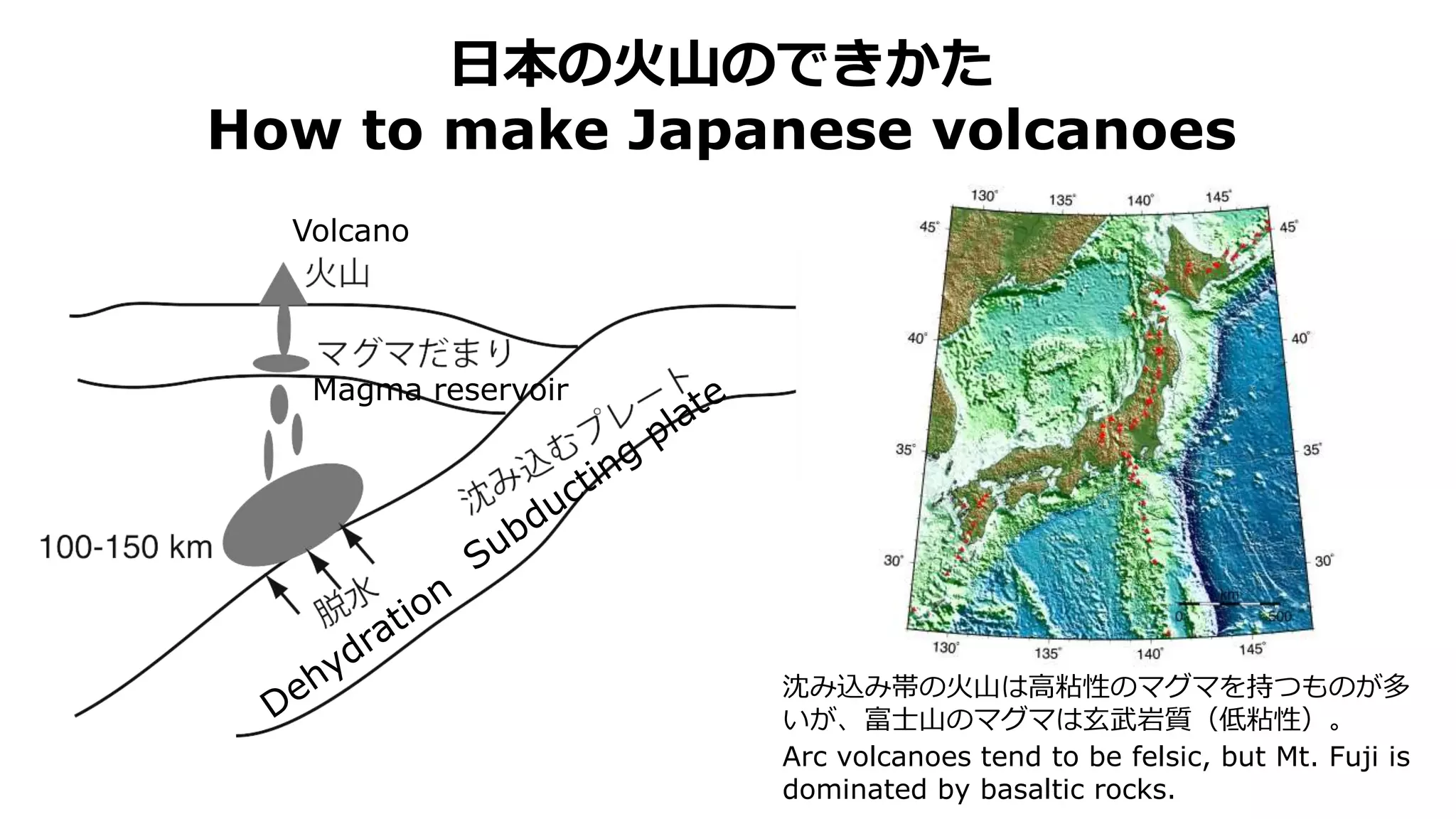
日本の火山のできかた
How to makeJapanese volcanoes
沈み込み帯の火山は高粘性のマグマを持つものが多
いが、富士山のマグマは玄武岩質(低粘性)。
Arc volcanoes tend to be felsic, but Mt. Fuji is
dominated by basaltic rocks.
Magma reservoir
Volcano
4.
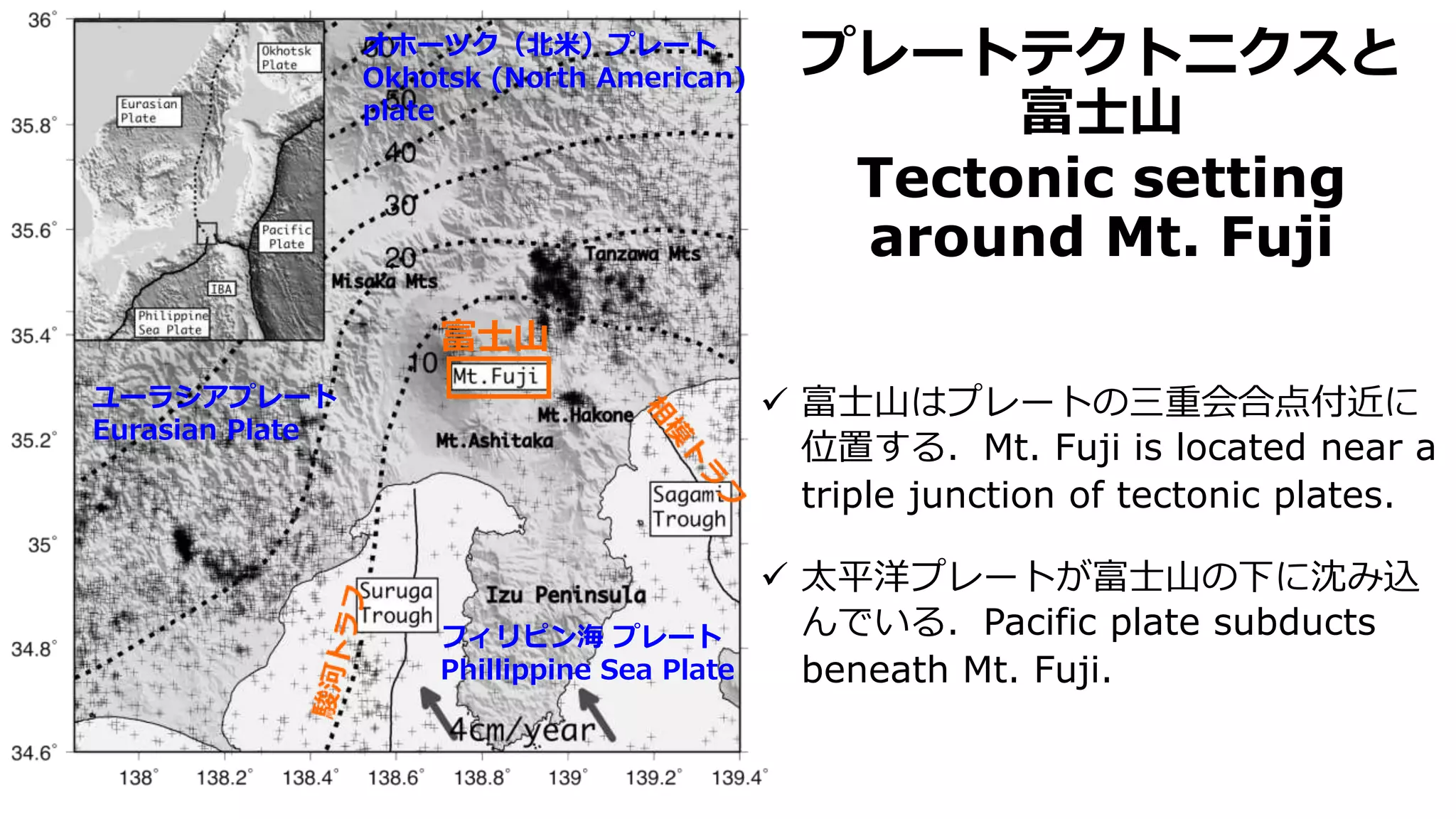
プレートテクトニクスと
富士山
Tectonic setting
around Mt.Fuji
ユーラシアプレート
Eurasian Plate
フィリピン海 プレート
Phillippine Sea Plate
オホーツク(北米)プレート
Okhotsk (North American)
plate
富士山
富士山はプレートの三重会合点付近に
位置する.Mt. Fuji is located near a
triple junction of tectonic plates.
太平洋プレートが富士山の下に沈み込
んでいる.Pacific plate subducts
beneath Mt. Fuji.
5.
富士山にかかる力
Stress field aroundMt. Fuji
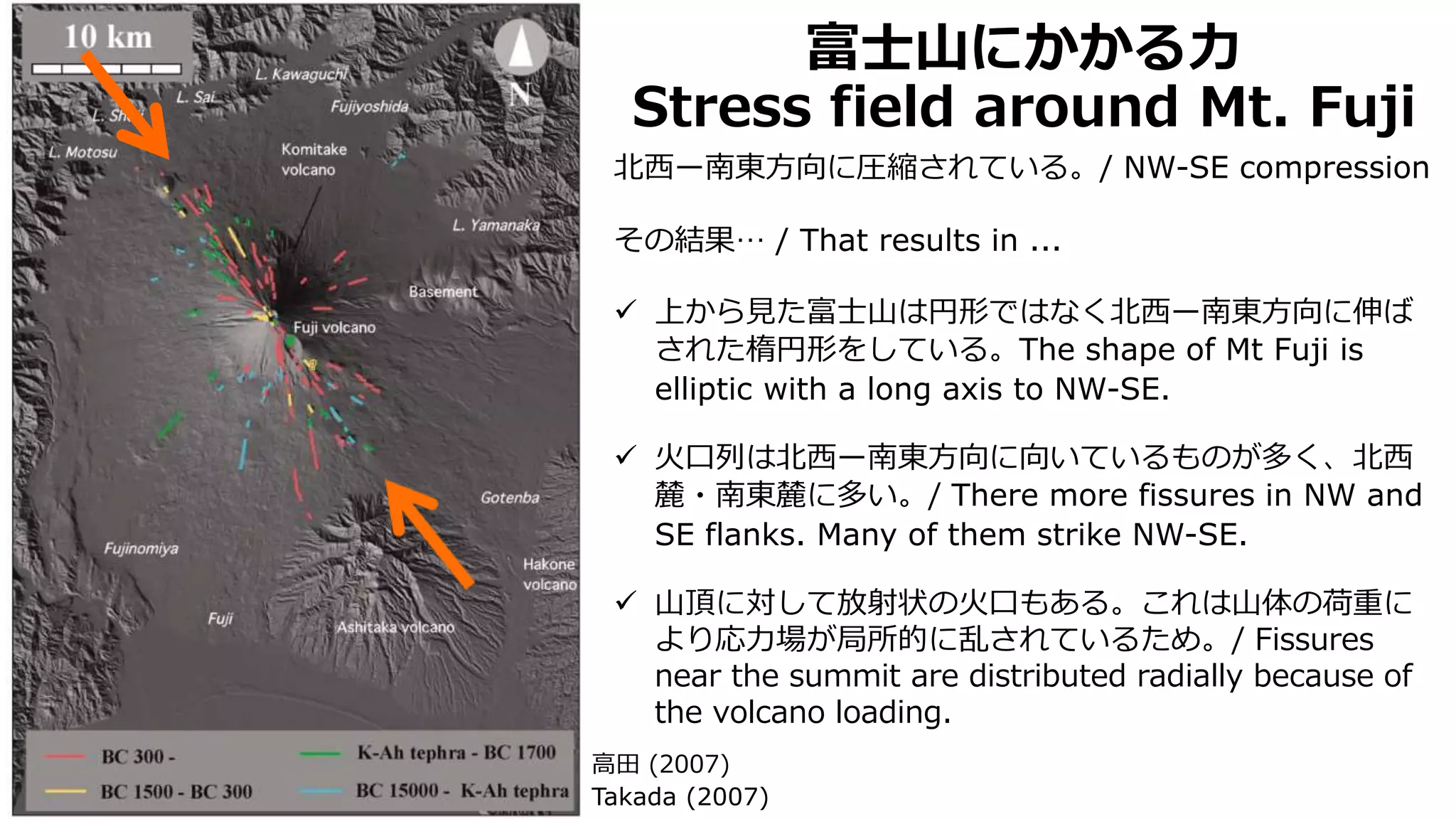
北西ー南東方向に圧縮されている。/ NW-SE compression
その結果… / That results in ...
上から見た富士山は円形ではなく北西ー南東方向に伸ば
された楕円形をしている。The shape of Mt Fuji is
elliptic with a long axis to NW-SE.
火口列は北西ー南東方向に向いているものが多く、北西
麓・南東麓に多い。/ There more fissures in NW and
SE flanks. Many of them strike NW-SE.
山頂に対して放射状の火口もある。これは山体の荷重に
より応力場が局所的に乱されているため。/ Fissures
near the summit are distributed radially because of
the volcano loading.
高田 (2007)
Takada (2007)
6.
富士山のマグマだまり
Magma reservoir ofMt. Fuji
富士山 伊豆諸島
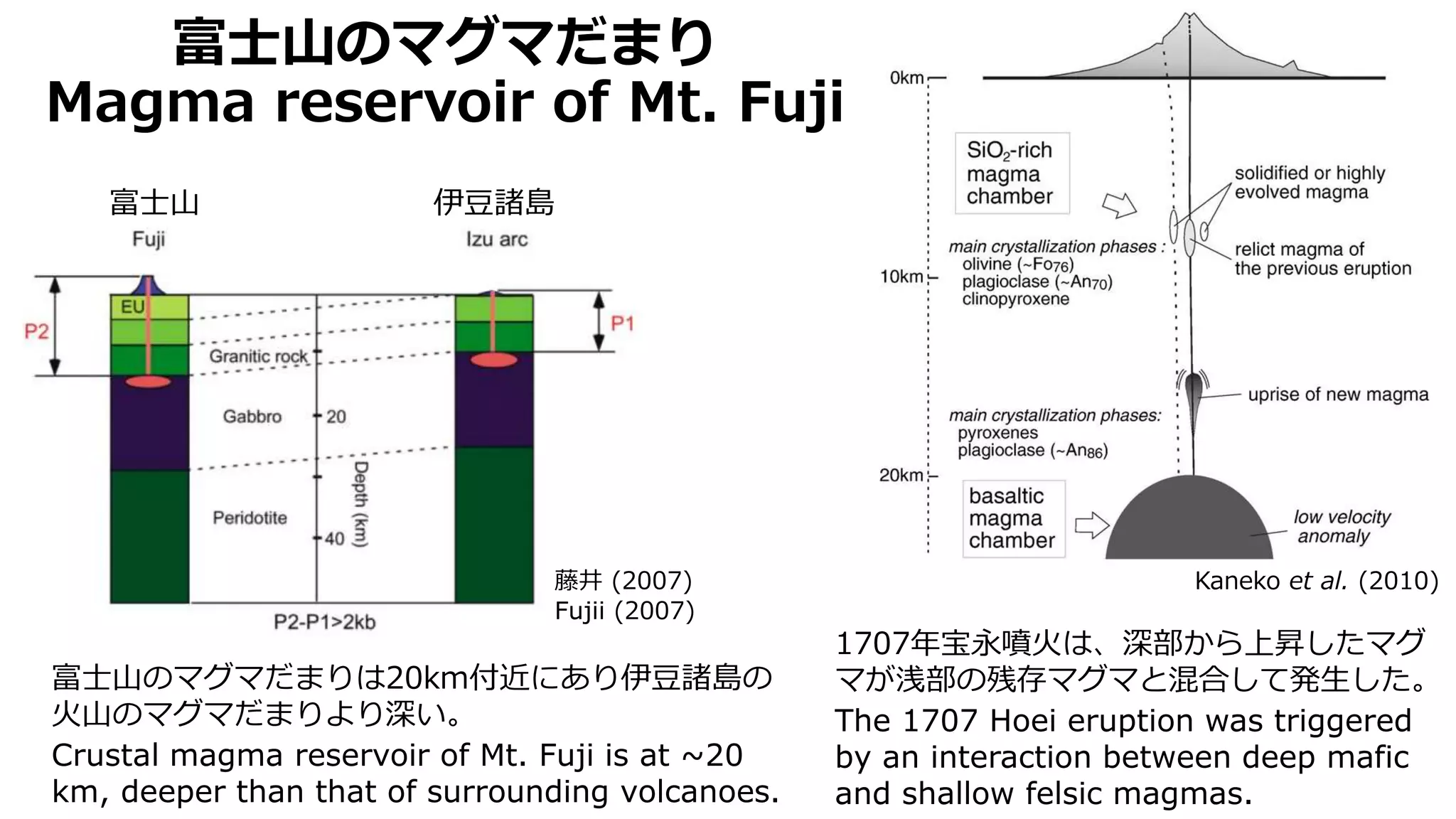
富士山のマグマだまりは20km付近にあり伊豆諸島の
火山のマグマだまりより深い。
Crustal magma reservoir of Mt. Fuji is at ~20
km, deeper than that of surrounding volcanoes.
1707年宝永噴火は、深部から上昇したマグ
マが浅部の残存マグマと混合して発生した。
The 1707 Hoei eruption was triggered
by an interaction between deep mafic
and shallow felsic magmas.
藤井 (2007)
Fujii (2007)
Kaneko et al. (2010)
7.
富士山の地下構造 / Mt.Fuji at depth
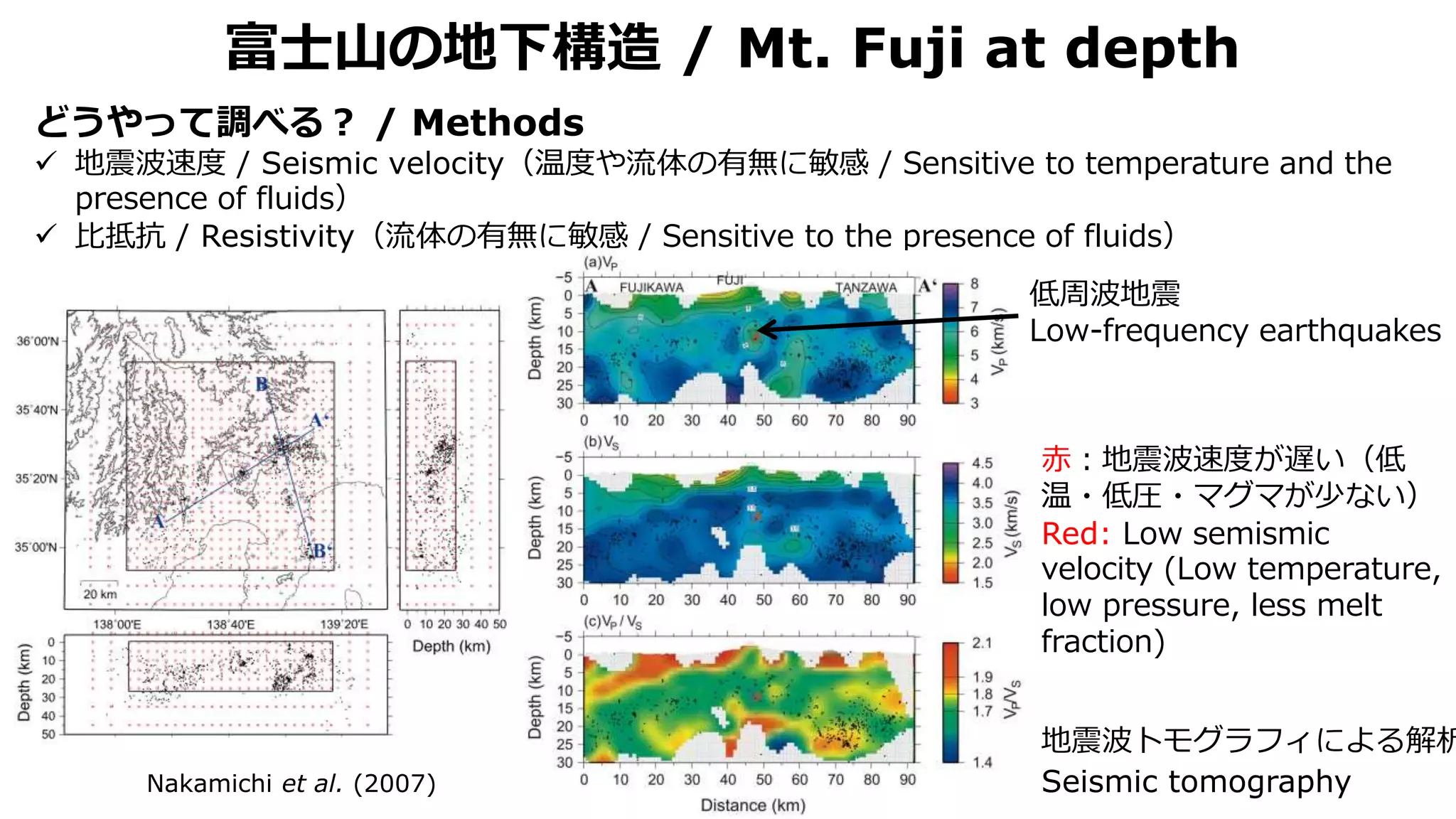
どうやって調べる? / Methods
地震波速度 / Seismic velocity(温度や流体の有無に敏感 / Sensitive to temperature and the
presence of fluids)
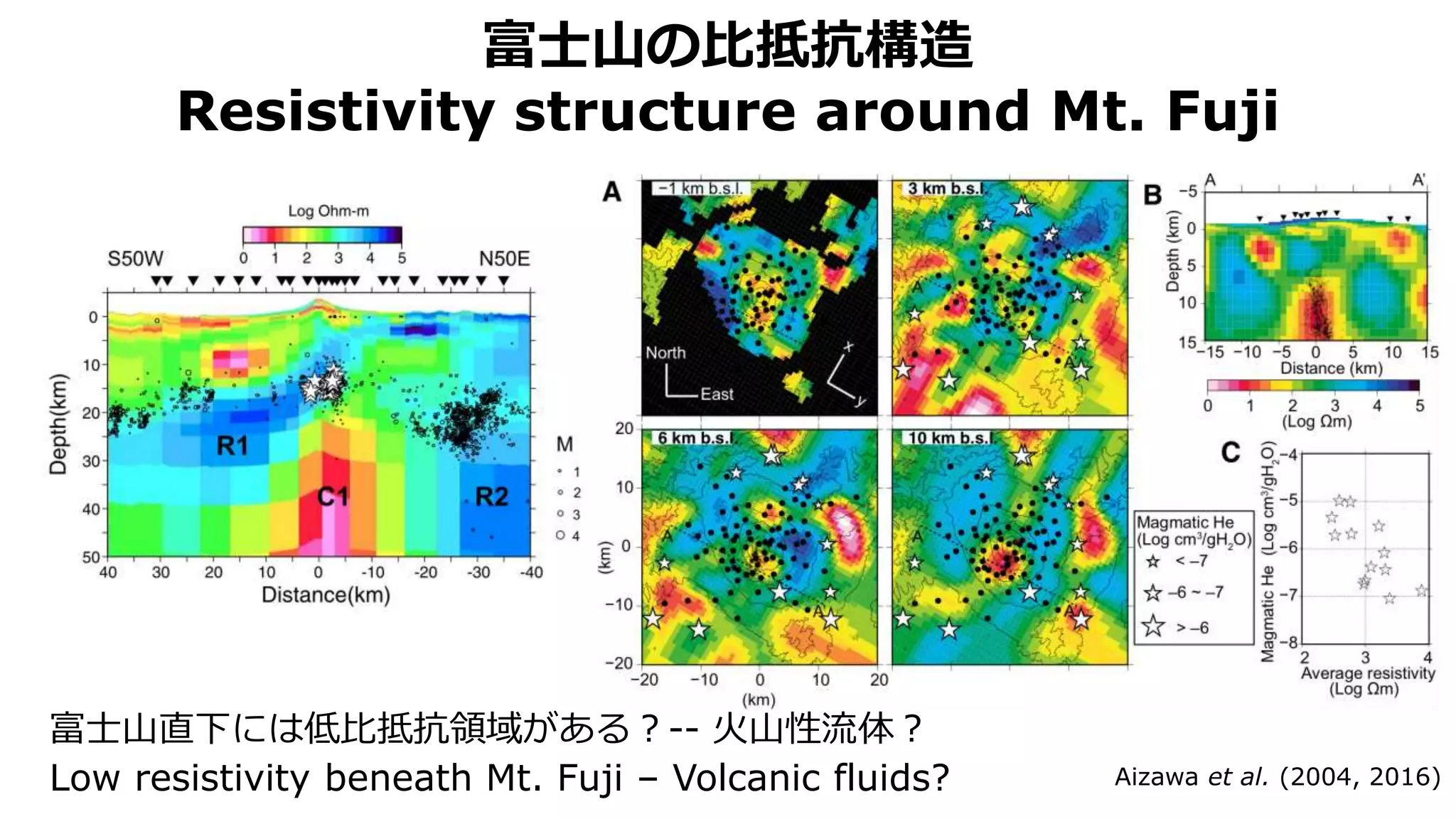
比抵抗 / Resistivity(流体の有無に敏感 / Sensitive to the presence of fluids)
Nakamichi et al. (2007)
地震波トモグラフィによる解析
Seismic tomography
赤:地震波速度が遅い(低
温・低圧・マグマが少ない)
Red: Low semismic
velocity (Low temperature,
low pressure, less melt
fraction)
低周波地震
Low-frequency earthquakes
8.
富士山の地下構造 / Mt.Fuji at depth
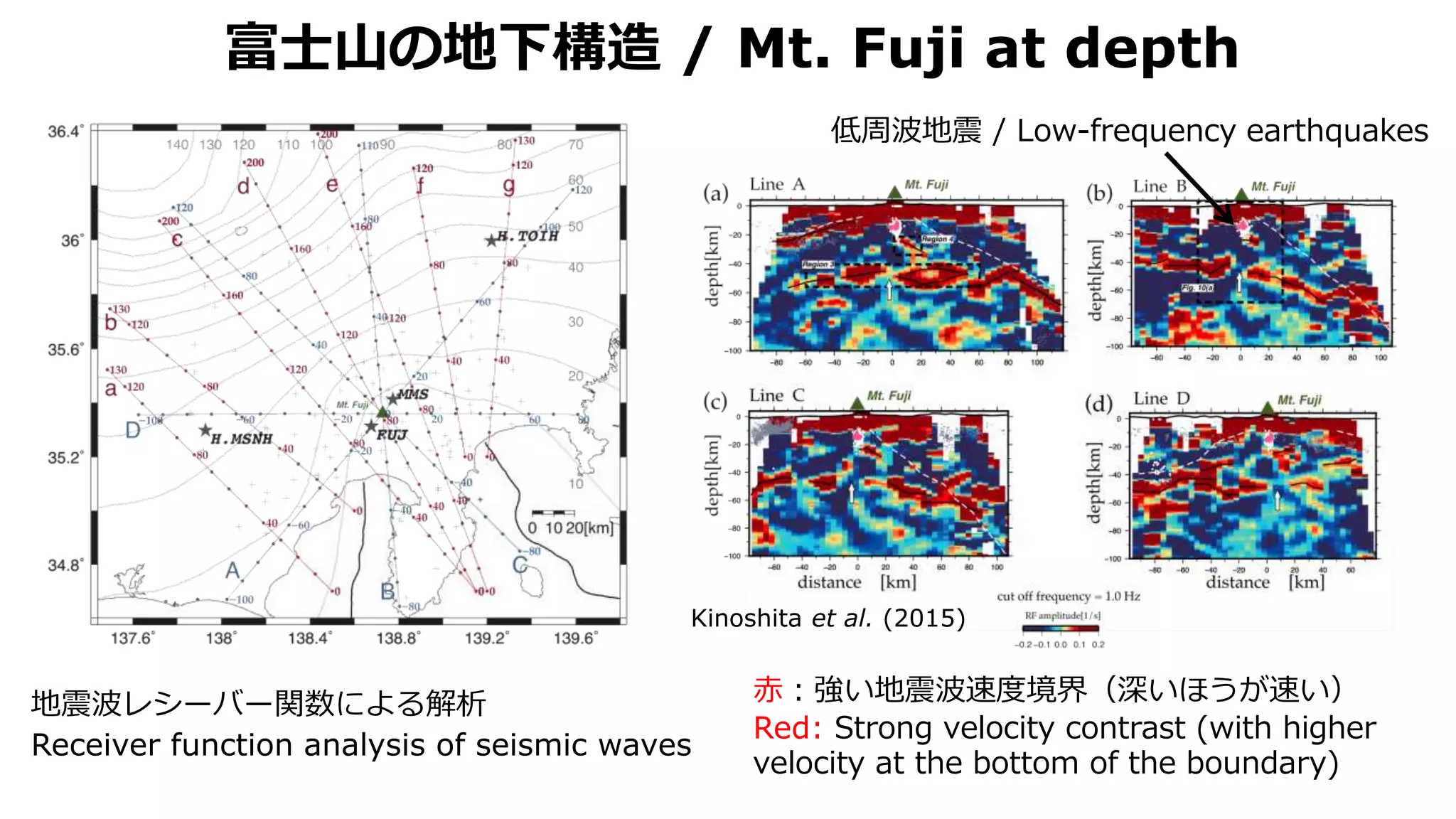
赤:強い地震波速度境界(深いほうが速い)
Red: Strong velocity contrast (with higher
velocity at the bottom of the boundary)
低周波地震 / Low-frequency earthquakes
Kinoshita et al. (2015)
地震波レシーバー関数による解析
Receiver function analysis of seismic waves
9.
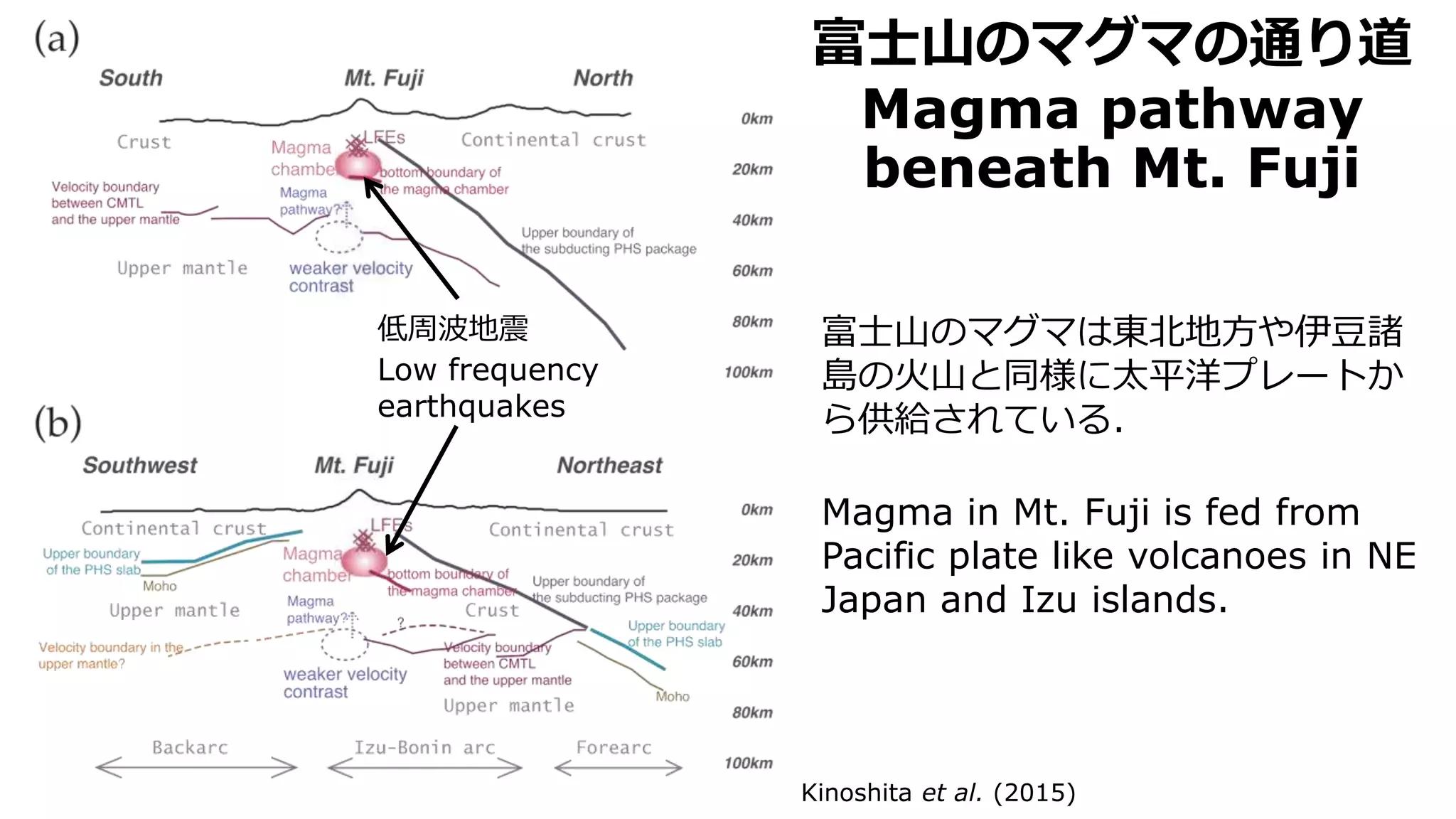
富士山のマグマの通り道
Magma pathway
beneath Mt.Fuji
Kinoshita et al. (2015)
低周波地震
Low frequency
earthquakes
富士山のマグマは東北地方や伊豆諸
島の火山と同様に太平洋プレートか
ら供給されている.
Magma in Mt. Fuji is fed from
Pacific plate like volcanoes in NE
Japan and Izu islands.
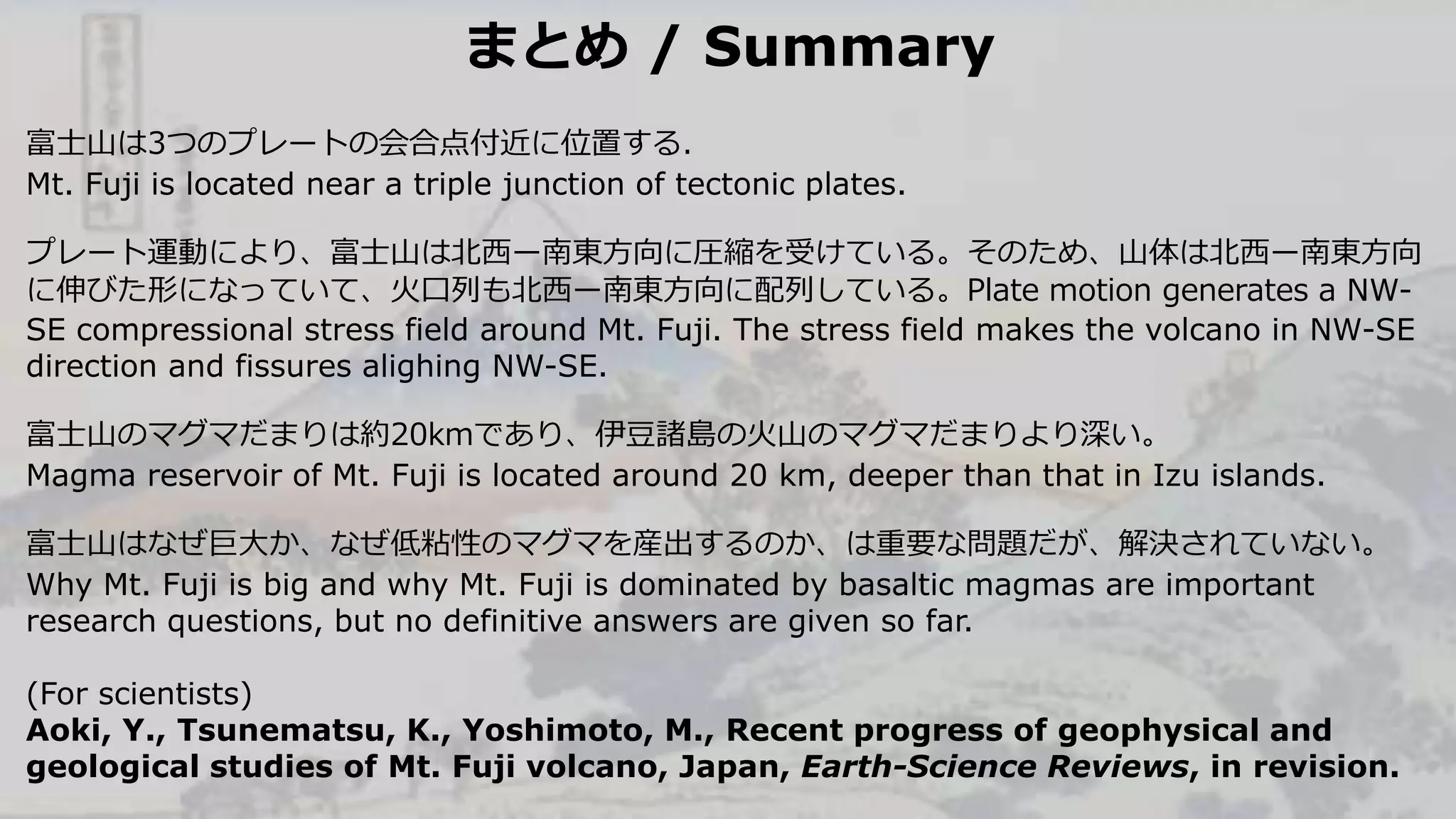
まとめ / Summary
富士山は3つのプレートの会合点付近に位置する.
Mt.Fuji is located near a triple junction of tectonic plates.
プレート運動により、富士山は北西ー南東方向に圧縮を受けている。そのため、山体は北西ー南東方向
に伸びた形になっていて、火口列も北西ー南東方向に配列している。Plate motion generates a NW-
SE compressional stress field around Mt. Fuji. The stress field makes the volcano in NW-SE
direction and fissures alighing NW-SE.
富士山のマグマだまりは約20kmであり、伊豆諸島の火山のマグマだまりより深い。
Magma reservoir of Mt. Fuji is located around 20 km, deeper than that in Izu islands.
富士山はなぜ巨大か、なぜ低粘性のマグマを産出するのか、は重要な問題だが、解決されていない。
Why Mt. Fuji is big and why Mt. Fuji is dominated by basaltic magmas are important
research questions, but no definitive answers are given so far.
(For scientists)
Aoki, Y., Tsunematsu, K., Yoshimoto, M., Recent progress of geophysical and
geological studies of Mt. Fuji volcano, Japan, Earth-Science Reviews, in revision.