WE PUT YOU ON SOLID GROUND
www.infratecheng.com
19th Southeast Asian Geotechnical Conference & 2nd AGSSEA Conference (19SEAGC &
2AGSSEA) Kuala Lumpur 31 May – 3 June 2016
The use of Non-Invasive Geophysical
Techniques to build 3-Dimensional ground
models and reduce the cost and risk of site
investigation
Sam Setchell, Muhammad Azrief bin Azahar,
Qusanssori Noor bin Rusli and Nick Lowe
Presentation Outline
 Site Investigations
 Geophysical Techniques
 Towards 3D models
 Case Studies
 Langat Sewer, KL
 Meru Landfill, Western Australia
 Cominco Phosphate Project, Republic of the Congo
Site Investigations
 Geotechnical Hazards present a major project
risk.
 Site Investigation – Relies on expensive drilling to gain
information on ground conditions
 ‘Point’ data means a conservative approach much
be taken
 More Data = Better geotechnical model = Lower
Risk
 Non-Invasive techniques – to reduce risk
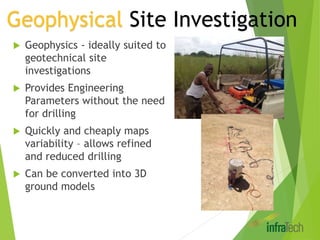
 Geophysics - ideally suited to
geotechnical site
investigations
 Provides Engineering
Parameters without the need
for drilling
 Quickly and cheaply maps
variability – allows refined
and reduced drilling
 Can be converted into 3D
ground models
Geophysical Site Investigation
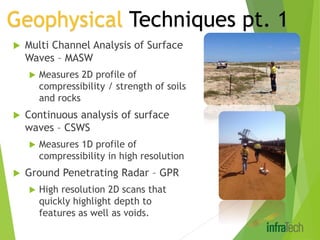
 Multi Channel Analysis of Surface
Waves – MASW
 Measures 2D profile of
compressibility / strength of soils
and rocks
 Continuous analysis of surface
waves – CSWS
 Measures 1D profile of
compressibility in high resolution
 Ground Penetrating Radar – GPR
 High resolution 2D scans that
quickly highlight depth to
features as well as voids.
Geophysical Techniques pt. 1
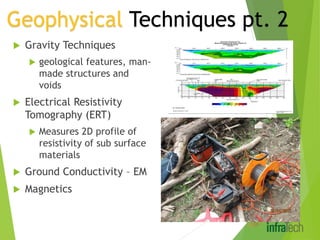
 Gravity Techniques
 geological features, man-
made structures and
voids
 Electrical Resistivity
Tomography (ERT)
 Measures 2D profile of
resistivity of sub surface
materials
 Ground Conductivity – EM
 Magnetics
Geophysical Techniques pt. 2
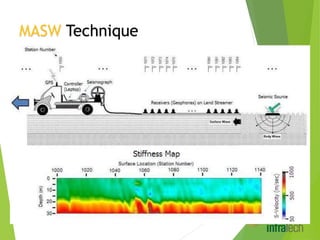
MASW Technique
 The MASW Technique utilises surface
waves elastic condition (stiffness) of the
ground for geotechnical engineering
purposes.
 A 2D Map of ground stiffness – in terms of
sear-wave velocity (Vs) is created
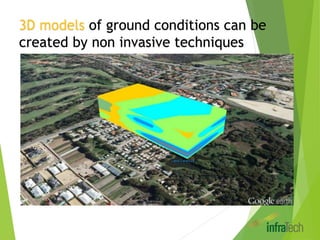
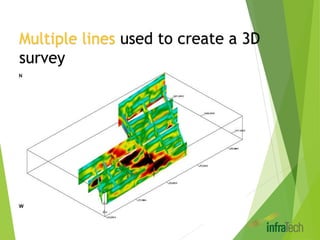
3D models of ground conditions can be
created by non invasive techniques
Multiple lines used to create a 3D
survey
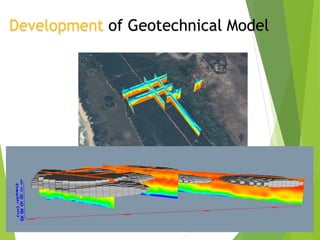
Development of Geotechnical Model
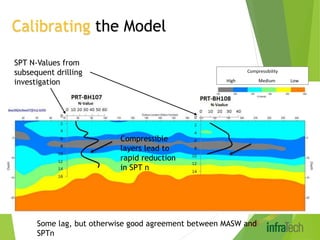
Calibrating the Model
Compressibility
High Medium Low
SPT N-Values from
subsequent drilling
investigation
Some lag, but otherwise good agreement between MASW and
SPTn
Compressible
layers lead to
rapid reduction
in SPT n
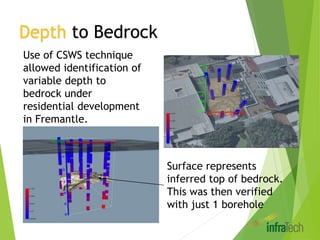
Depth to Bedrock
Use of CSWS technique
allowed identification of
variable depth to
bedrock under
residential development
in Fremantle.
Surface represents
inferred top of bedrock.
This was then verified
with just 1 borehole
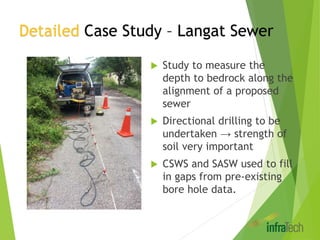
Detailed Case Study – Langat Sewer
 Study to measure the
depth to bedrock along the
alignment of a proposed
sewer
 Directional drilling to be
undertaken → strength of
soil very important
 CSWS and SASW used to fill
in gaps from pre-existing
bore hole data.
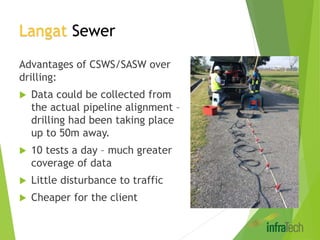
Langat Sewer
Advantages of CSWS/SASW over
drilling:
 Data could be collected from
the actual pipeline alignment –
drilling had been taking place
up to 50m away.
 10 tests a day – much greater
coverage of data
 Little disturbance to traffic
 Cheaper for the client
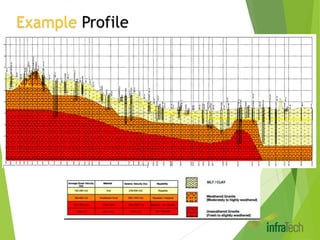
Example Profile
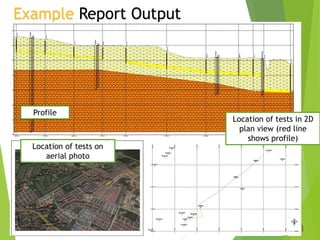
Example Report Output
Profile
Location of tests on
aerial photo
Location of tests in 2D
plan view (red line
shows profile)
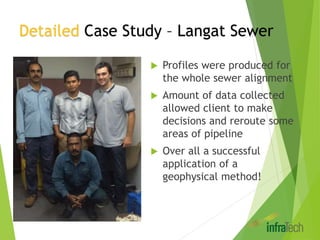
Detailed Case Study – Langat Sewer
 Profiles were produced for
the whole sewer alignment
 Amount of data collected
allowed client to make
decisions and reroute some
areas of pipeline
 Over all a successful
application of a
geophysical method!
Meru Landfill – Using
geophysics to plan location
 Limestone outcrops had been found on the site of proposed landfill
development
 The previous landfill cell encountered unforeseen rock at shallow levels,
resulting in a significant cost overrun (for excavation)
 A 4 month drilling campaign was proposed to identify the extent of this
limestone with an estimated budget of A$650,000.00 (~2 million ringgit)
- almost 3 times what was allowed.
 The critical aspect was to get complete (or close to complete) 3D
coverage across the site.
 The MASW technique (Multi Channel Analyses of Surface Waves) was
chosen by Infra Tech.
 Completed within a budget of A$75,000.00. (~232,000.00 ringgit)
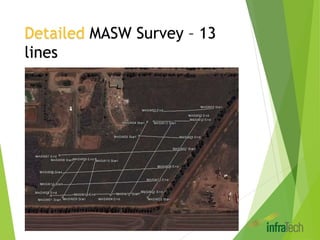
Detailed MASW Survey – 13
lines
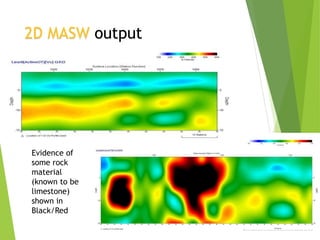
2D MASW output
Evidence of
some rock
material
(known to be
limestone)
shown in
Black/Red
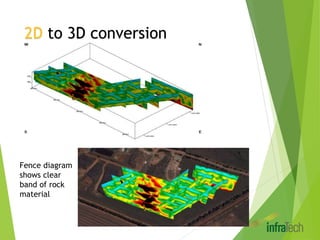
2D to 3D conversion
Fence diagram
shows clear
band of rock
material
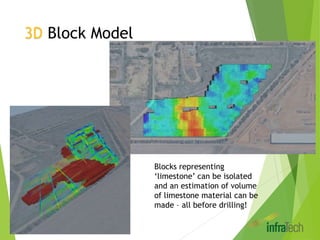
Blocks representing
‘limestone’ can be isolated
and an estimation of volume
of limestone material can be
made – all before drilling!
3D Block Model
Presentation Conclusions
 Inadequate site investigations can lead to project
failure (or worse)
 Geophysical techniques provide a cheep and quick
way to gather information
 Add value by:
 Reducing Risk – better site understanding
 Reducing drilling cost
 Creating more accurate ground models
THANK YOU
WE PUT YOU ON SOLID GROUND
FASTER, STRONGER, CHEAPER, SAFER, GREENER

20160602 Non-Invasive Geophysical Techniques

  • 1.
    WE PUT YOUON SOLID GROUND www.infratecheng.com 19th Southeast Asian Geotechnical Conference & 2nd AGSSEA Conference (19SEAGC & 2AGSSEA) Kuala Lumpur 31 May – 3 June 2016 The use of Non-Invasive Geophysical Techniques to build 3-Dimensional ground models and reduce the cost and risk of site investigation Sam Setchell, Muhammad Azrief bin Azahar, Qusanssori Noor bin Rusli and Nick Lowe
  • 2.
    Presentation Outline  SiteInvestigations  Geophysical Techniques  Towards 3D models  Case Studies  Langat Sewer, KL  Meru Landfill, Western Australia  Cominco Phosphate Project, Republic of the Congo
  • 3.
    Site Investigations  GeotechnicalHazards present a major project risk.  Site Investigation – Relies on expensive drilling to gain information on ground conditions  ‘Point’ data means a conservative approach much be taken  More Data = Better geotechnical model = Lower Risk  Non-Invasive techniques – to reduce risk
  • 4.
     Geophysics -ideally suited to geotechnical site investigations  Provides Engineering Parameters without the need for drilling  Quickly and cheaply maps variability – allows refined and reduced drilling  Can be converted into 3D ground models Geophysical Site Investigation
  • 5.
     Multi ChannelAnalysis of Surface Waves – MASW  Measures 2D profile of compressibility / strength of soils and rocks  Continuous analysis of surface waves – CSWS  Measures 1D profile of compressibility in high resolution  Ground Penetrating Radar – GPR  High resolution 2D scans that quickly highlight depth to features as well as voids. Geophysical Techniques pt. 1
  • 6.
     Gravity Techniques geological features, man- made structures and voids  Electrical Resistivity Tomography (ERT)  Measures 2D profile of resistivity of sub surface materials  Ground Conductivity – EM  Magnetics Geophysical Techniques pt. 2
  • 7.
    MASW Technique  TheMASW Technique utilises surface waves elastic condition (stiffness) of the ground for geotechnical engineering purposes.  A 2D Map of ground stiffness – in terms of sear-wave velocity (Vs) is created
  • 8.
    3D models ofground conditions can be created by non invasive techniques
  • 9.
    Multiple lines usedto create a 3D survey
  • 10.
  • 11.
    Calibrating the Model Compressibility HighMedium Low SPT N-Values from subsequent drilling investigation Some lag, but otherwise good agreement between MASW and SPTn Compressible layers lead to rapid reduction in SPT n
  • 12.
    Depth to Bedrock Useof CSWS technique allowed identification of variable depth to bedrock under residential development in Fremantle. Surface represents inferred top of bedrock. This was then verified with just 1 borehole
  • 13.
    Detailed Case Study– Langat Sewer  Study to measure the depth to bedrock along the alignment of a proposed sewer  Directional drilling to be undertaken → strength of soil very important  CSWS and SASW used to fill in gaps from pre-existing bore hole data.
  • 14.
    Langat Sewer Advantages ofCSWS/SASW over drilling:  Data could be collected from the actual pipeline alignment – drilling had been taking place up to 50m away.  10 tests a day – much greater coverage of data  Little disturbance to traffic  Cheaper for the client
  • 15.
  • 16.
    Example Report Output Profile Locationof tests on aerial photo Location of tests in 2D plan view (red line shows profile)
  • 17.
    Detailed Case Study– Langat Sewer  Profiles were produced for the whole sewer alignment  Amount of data collected allowed client to make decisions and reroute some areas of pipeline  Over all a successful application of a geophysical method!
  • 18.
    Meru Landfill –Using geophysics to plan location  Limestone outcrops had been found on the site of proposed landfill development  The previous landfill cell encountered unforeseen rock at shallow levels, resulting in a significant cost overrun (for excavation)  A 4 month drilling campaign was proposed to identify the extent of this limestone with an estimated budget of A$650,000.00 (~2 million ringgit) - almost 3 times what was allowed.  The critical aspect was to get complete (or close to complete) 3D coverage across the site.  The MASW technique (Multi Channel Analyses of Surface Waves) was chosen by Infra Tech.  Completed within a budget of A$75,000.00. (~232,000.00 ringgit)
  • 19.
  • 20.
    2D MASW output Evidenceof some rock material (known to be limestone) shown in Black/Red
  • 21.
    2D to 3Dconversion Fence diagram shows clear band of rock material
  • 22.
    Blocks representing ‘limestone’ canbe isolated and an estimation of volume of limestone material can be made – all before drilling! 3D Block Model
  • 23.
    Presentation Conclusions  Inadequatesite investigations can lead to project failure (or worse)  Geophysical techniques provide a cheep and quick way to gather information  Add value by:  Reducing Risk – better site understanding  Reducing drilling cost  Creating more accurate ground models
  • 24.
    THANK YOU WE PUTYOU ON SOLID GROUND FASTER, STRONGER, CHEAPER, SAFER, GREENER

Editor's Notes

  • #11 No firm identification or logo allowed on any sheet except the cover sheet (slide 1 of this template). Authors may choose either the horizontal or vertical format for their presentation.
  • #12 No firm identification or logo allowed on any sheet except the cover sheet (slide 1 of this template). Authors may choose either the horizontal or vertical format for their presentation.
  • #14 With the controlled surface wave system it is the element of control that is the main advance from sasw. An industrial vibrator that can be controlled in frequency to 0.1 Hz resolution.
  • #16 With the controlled surface wave system it is the element of control that is the main advance from sasw. An industrial vibrator that can be controlled in frequency to 0.1 Hz resolution.
  • #17 With the controlled surface wave system it is the element of control that is the main advance from sasw. An industrial vibrator that can be controlled in frequency to 0.1 Hz resolution.
  • #18 With the controlled surface wave system it is the element of control that is the main advance from sasw. An industrial vibrator that can be controlled in frequency to 0.1 Hz resolution.