The Toba super-eruption:
Micro-scale traces of a global-scale climate event?
Kim M. Cobb
Stacy Carolin, Jessica Moerman, Ellery Ingall, Luke Chambers, Amelia Longo
Georgia Inst. of Technology
Nele Meckler, Jess F. Adkins
Caltech
Lydia Finney
Argonne National Lab
Victoria Smith
Oxford
Syria Lejau, Jenny Malang, Brian Clark, Alison Pritchard
Gunung Mulu National Park
Andrew Tuen
University Sans Malaysia
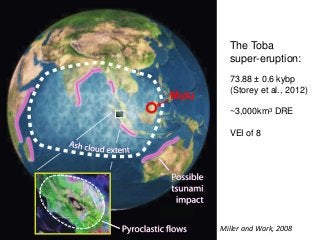
The Toba
super-eruption:
73.88 ± 0.6 kybp
(Storey et al., 2012)
~3,000km3 DRE
VEI of 8
Mulu
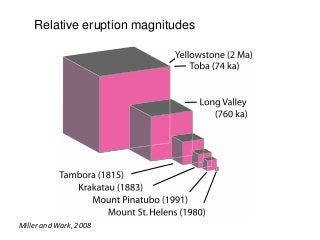
Miller and Wark, 2008
Relative eruption magnitudes
Did Toba play a role in an observed “bottleneck” in
human mitochondrial genetic diversity?
Maybe. [Ambrose 1998]
No. [Petraglia et al., 2007]
see review by Williams et al., 2012
NOTE: H. floresiensis
lived during this time,
discovered in cave
within Toba ash fall zone
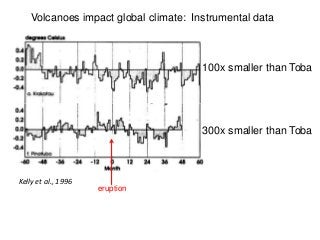
Volcanoes impact global climate: Instrumental data
100x smaller than Toba
300x smaller than Toba
Kelly et al., 1996
eruption
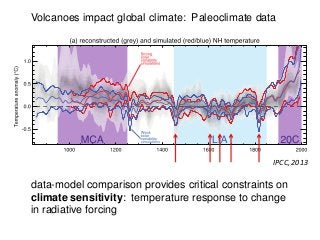
Volcanoes impact global climate: Paleoclimate data
IPCC, 2013
data-model comparison provides critical constraints on
climate sensitivity: temperature response to change
in radiative forcing
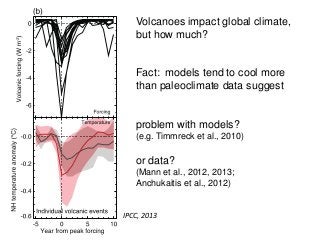
Volcanoes impact global climate,
but how much?
Fact: models tend to cool more
than paleoclimate data suggest
problem with models?
(e.g. Timmreck et al., 2010)
or data?
(Mann et al., 2012, 2013;
Anchukaitis et al., 2012)
IPCC, 2013
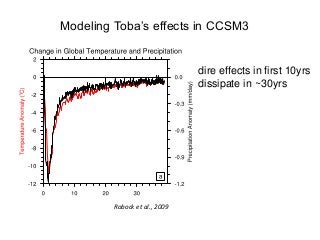
Robock et al., 2009
Modeling Toba’s effects in CCSM3
dire effects in first 10yrs
dissipate in ~30yrs
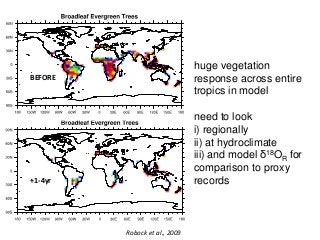
BEFORE
+1-4yr
Robock et al., 2009
huge vegetation
response across entire
tropics in model
need to look
i) regionally
ii) at hydroclimate
iii) and model δ18OR for
comparison to proxy
records
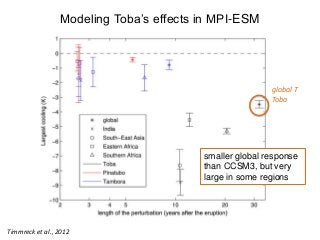
Modeling Toba’s effects in MPI-ESM
Timmreck et al., 2012
smaller global response
than CCSM3, but very
large in some regions
global T
Toba
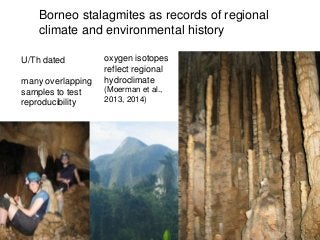
Borneo stalagmites as records of regional
climate and environmental history
U/Th dated
many overlapping
samples to test
reproducibility
oxygen isotopes
reflect regional
hydroclimate
(Moerman et al.,
2013, 2014)
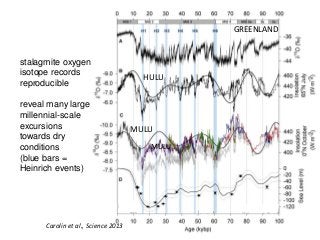
stalagmite oxygen
isotope records
reproducible
reveal many large
millennial-scale
excursions
towards dry
conditions
(blue bars =
Heinrich events)
Carolin et al., Science 2013
MULU
GREENLAND
HULU
MULU
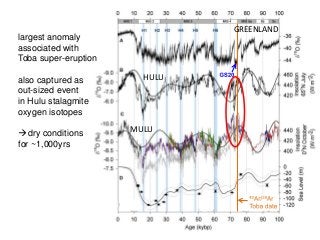
largest anomaly
associated with
Toba super-eruption
also captured as
out-sized event
in Hulu stalagmite
oxygen isotopes
dry conditions
for ~1,000yrs
GREENLAND
HULU
MULU
The
records of t
through the
oft-time co
regional cli
sediment c
shows no s
associated
even while
changes rec
Similarly, L
major clim
Toba ash la
(located ov
stalagmites
millennial-
samples tha
magnitude
mirrored in
d18
O record
(Figure 1).
proxy recor
sharp, prolo
2cm layer o
al., 2001).
Ear
sized erupt
on Earth’s
Timmreck
65 8077747168
65 8077747168
Age (kybp)
ice$core$$
sulfate$peaks$
40Ar/39Ar((
Toba(date(
-10
-9.5
-9
-8.5
δ18O(‰)
-8
-7
-6
δ18O(‰)
27.0
26.5
26.0
SST(°C)
-40
-42
-44
δ18O(‰)
-47
-48
-49
δ18O(‰)
Borneo
caves
Hulu/
Sanbao
South
China
Sea
NGRIP
EDML
wet
dry
warm
cold
warm
cold
warm
cold
wet
dry
GS20
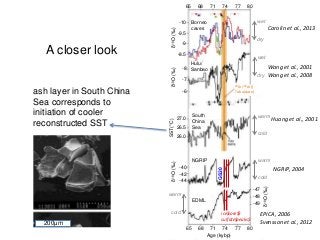
A closer look
Carolin et al., 2013
Wang et al., 2001
Wang et al., 2008
Huang et al., 2001
NGRIP, 2004
EPICA, 2006
Svensson et al., 2012
ash layer in South China
Sea corresponds to
initiation of cooler
reconstructed SST
of dark subhedral biotite and rarer hornblende crystal.
The gradational contacts of the tephra layer with host
sediments in the top and bottom are a total of 20 cm in
thickness. This suggests that the tephra had been
reworked by bottom current and biotubation, which
likely diffused the tephra within the host sediments.
Two size fractions (63–150 and 150 mm) were
separated and sampled for morphological and
geochemical analyses.
The morphology of the glass shards was studied by
the Riguku Scanning Electron Microscopy (SEM) at
the Department of Geology, National Taiwan Univer-
sity. The major element compositions of the glass
shards and mineral grains were determined using a
JEOL JXA-8900R Electron Micro-Probe Analyzer
(EPMA) at the Institute of Earth Sciences, Academia
Sinica, Taiwan. Operating conditions were 15 kV,
10 nA and were focused ( 1 mm) for accelerated
voltage, probe current and beam diameter. The data
were processed using the ZAF correction routine.
S.-R. Song et al. / Marine Geology 167 (2000) 303–312306
200µm
The
records of t
through the
oft-time co
regional cli
sediment c
shows no s
associated
even while
changes rec
Similarly, L
major clim
Toba ash la
(located ov
stalagmites
millennial-
samples tha
magnitude
mirrored in
d18
O record
(Figure 1).
proxy recor
sharp, prolo
2cm layer o
al., 2001).
Ear
sized erupt
on Earth’s
Timmreck
65 8077747168
65 8077747168
Age (kybp)
ice$core$$
sulfate$peaks$
40Ar/39Ar((
Toba(date(
-10
-9.5
-9
-8.5
δ18O(‰)
-8
-7
-6
δ18O(‰)
27.0
26.5
26.0
SST(°C)
-40
-42
-44
δ18O(‰)
-47
-48
-49
δ18O(‰)
Borneo
caves
Hulu/
Sanbao
South
China
Sea
NGRIP
EDML
wet
dry
warm
cold
warm
cold
warm
cold
wet
dry
GS20
Carolin et al., 2013
Wang et al., 2001
Wang et al., 2008
Huang et al., 2001
NGRIP, 2004
EPICA, 2006
Svensson et al., 2012
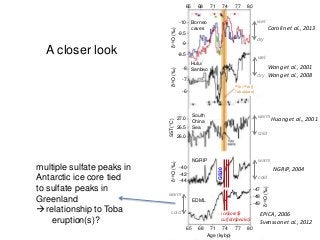
multiple sulfate peaks in
Antarctic ice core tied
to sulfate peaks in
Greenland
relationship to Toba
eruption(s)?
A closer look
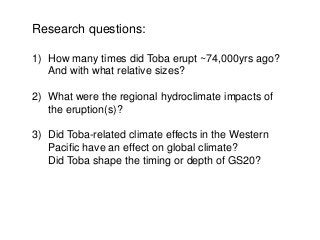
Research questions:
1) How many times did Toba erupt ~74,000yrs ago?
And with what relative sizes?
2) What were the regional hydroclimate impacts of
the eruption(s)?
3) Did Toba-related climate effects in the Western
Pacific have an effect on global climate?
Did Toba shape the timing or depth of GS20?
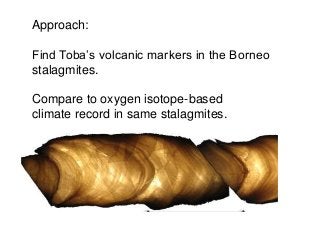
Approach:
Find Toba’s volcanic markers in the Borneo
stalagmites.
Compare to oxygen isotope-based
climate record in same stalagmites.
AB
18
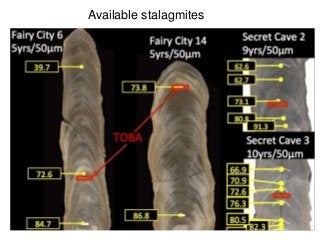
Available stalagmites
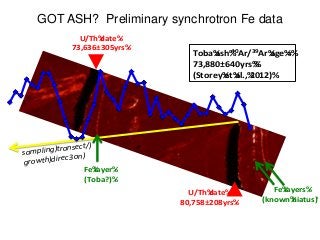
sampling)transect/)
growth)direc3on)
U/Th%date%
73,636±305yrs%
U/Th%date%
80,758±208yrs%
Fe%layer%
(Toba?)%
Fe%layers%
(known%hiatus)%
Toba%ash%40Ar/39Ar%age%=%
73,880±640yrs%%
(Storey%et%al.,%2012)%
GOT ASH? Preliminary synchrotron Fe data
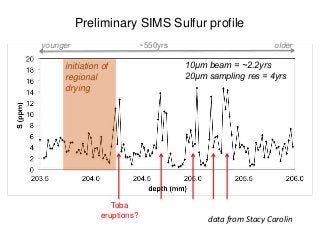
Preliminary SIMS Sulfur profile
10μm beam = ~2.2yrs
20μm sampling res = 4yrs
data from Stacy Carolin
initiation of
regional
drying
~550yrs
Toba
eruptions?
younger older
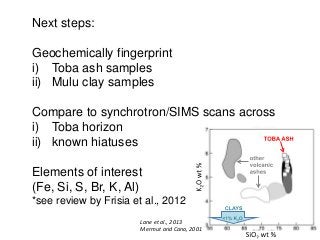
Next steps:
Geochemically fingerprint
i) Toba ash samples
ii) Mulu clay samples
Compare to synchrotron/SIMS scans across
i) Toba horizon
ii) known hiatuses
Elements of interest
(Fe, Si, S, Br, K, Al)
*see review by Frisia et al., 2012
Lane et al., 2013
Mermut and Cano, 2001

The Toba super-eruption: micro-scale traces of a global-scale climate event?

  • 1.
    The Toba super-eruption: Micro-scaletraces of a global-scale climate event? Kim M. Cobb Stacy Carolin, Jessica Moerman, Ellery Ingall, Luke Chambers, Amelia Longo Georgia Inst. of Technology Nele Meckler, Jess F. Adkins Caltech Lydia Finney Argonne National Lab Victoria Smith Oxford Syria Lejau, Jenny Malang, Brian Clark, Alison Pritchard Gunung Mulu National Park Andrew Tuen University Sans Malaysia
  • 2.
    The Toba super-eruption: 73.88 ±0.6 kybp (Storey et al., 2012) ~3,000km3 DRE VEI of 8 Mulu Miller and Wark, 2008
  • 3.
    Miller and Wark,2008 Relative eruption magnitudes
  • 4.
    Did Toba playa role in an observed “bottleneck” in human mitochondrial genetic diversity? Maybe. [Ambrose 1998] No. [Petraglia et al., 2007] see review by Williams et al., 2012 NOTE: H. floresiensis lived during this time, discovered in cave within Toba ash fall zone
  • 5.
    Volcanoes impact globalclimate: Instrumental data 100x smaller than Toba 300x smaller than Toba Kelly et al., 1996 eruption
  • 6.
    Volcanoes impact globalclimate: Paleoclimate data IPCC, 2013 data-model comparison provides critical constraints on climate sensitivity: temperature response to change in radiative forcing
  • 7.
    Volcanoes impact globalclimate, but how much? Fact: models tend to cool more than paleoclimate data suggest problem with models? (e.g. Timmreck et al., 2010) or data? (Mann et al., 2012, 2013; Anchukaitis et al., 2012) IPCC, 2013
  • 8.
    Robock et al.,2009 Modeling Toba’s effects in CCSM3 dire effects in first 10yrs dissipate in ~30yrs
  • 9.
    BEFORE +1-4yr Robock et al.,2009 huge vegetation response across entire tropics in model need to look i) regionally ii) at hydroclimate iii) and model δ18OR for comparison to proxy records
  • 10.
    Modeling Toba’s effectsin MPI-ESM Timmreck et al., 2012 smaller global response than CCSM3, but very large in some regions global T Toba
  • 11.
    Borneo stalagmites asrecords of regional climate and environmental history U/Th dated many overlapping samples to test reproducibility oxygen isotopes reflect regional hydroclimate (Moerman et al., 2013, 2014)
  • 12.
    stalagmite oxygen isotope records reproducible revealmany large millennial-scale excursions towards dry conditions (blue bars = Heinrich events) Carolin et al., Science 2013 MULU GREENLAND HULU MULU
  • 13.
    largest anomaly associated with Tobasuper-eruption also captured as out-sized event in Hulu stalagmite oxygen isotopes dry conditions for ~1,000yrs GREENLAND HULU MULU
  • 14.
    The records of t throughthe oft-time co regional cli sediment c shows no s associated even while changes rec Similarly, L major clim Toba ash la (located ov stalagmites millennial- samples tha magnitude mirrored in d18 O record (Figure 1). proxy recor sharp, prolo 2cm layer o al., 2001). Ear sized erupt on Earth’s Timmreck 65 8077747168 65 8077747168 Age (kybp) ice$core$$ sulfate$peaks$ 40Ar/39Ar(( Toba(date( -10 -9.5 -9 -8.5 δ18O(‰) -8 -7 -6 δ18O(‰) 27.0 26.5 26.0 SST(°C) -40 -42 -44 δ18O(‰) -47 -48 -49 δ18O(‰) Borneo caves Hulu/ Sanbao South China Sea NGRIP EDML wet dry warm cold warm cold warm cold wet dry GS20 A closer look Carolin et al., 2013 Wang et al., 2001 Wang et al., 2008 Huang et al., 2001 NGRIP, 2004 EPICA, 2006 Svensson et al., 2012 ash layer in South China Sea corresponds to initiation of cooler reconstructed SST of dark subhedral biotite and rarer hornblende crystal. The gradational contacts of the tephra layer with host sediments in the top and bottom are a total of 20 cm in thickness. This suggests that the tephra had been reworked by bottom current and biotubation, which likely diffused the tephra within the host sediments. Two size fractions (63–150 and 150 mm) were separated and sampled for morphological and geochemical analyses. The morphology of the glass shards was studied by the Riguku Scanning Electron Microscopy (SEM) at the Department of Geology, National Taiwan Univer- sity. The major element compositions of the glass shards and mineral grains were determined using a JEOL JXA-8900R Electron Micro-Probe Analyzer (EPMA) at the Institute of Earth Sciences, Academia Sinica, Taiwan. Operating conditions were 15 kV, 10 nA and were focused ( 1 mm) for accelerated voltage, probe current and beam diameter. The data were processed using the ZAF correction routine. S.-R. Song et al. / Marine Geology 167 (2000) 303–312306 200µm
  • 15.
    The records of t throughthe oft-time co regional cli sediment c shows no s associated even while changes rec Similarly, L major clim Toba ash la (located ov stalagmites millennial- samples tha magnitude mirrored in d18 O record (Figure 1). proxy recor sharp, prolo 2cm layer o al., 2001). Ear sized erupt on Earth’s Timmreck 65 8077747168 65 8077747168 Age (kybp) ice$core$$ sulfate$peaks$ 40Ar/39Ar(( Toba(date( -10 -9.5 -9 -8.5 δ18O(‰) -8 -7 -6 δ18O(‰) 27.0 26.5 26.0 SST(°C) -40 -42 -44 δ18O(‰) -47 -48 -49 δ18O(‰) Borneo caves Hulu/ Sanbao South China Sea NGRIP EDML wet dry warm cold warm cold warm cold wet dry GS20 Carolin et al., 2013 Wang et al., 2001 Wang et al., 2008 Huang et al., 2001 NGRIP, 2004 EPICA, 2006 Svensson et al., 2012 multiple sulfate peaks in Antarctic ice core tied to sulfate peaks in Greenland relationship to Toba eruption(s)? A closer look
  • 16.
    Research questions: 1) Howmany times did Toba erupt ~74,000yrs ago? And with what relative sizes? 2) What were the regional hydroclimate impacts of the eruption(s)? 3) Did Toba-related climate effects in the Western Pacific have an effect on global climate? Did Toba shape the timing or depth of GS20?
  • 17.
    Approach: Find Toba’s volcanicmarkers in the Borneo stalagmites. Compare to oxygen isotope-based climate record in same stalagmites. AB
  • 18.
  • 19.
  • 20.
    Preliminary SIMS Sulfurprofile 10μm beam = ~2.2yrs 20μm sampling res = 4yrs data from Stacy Carolin initiation of regional drying ~550yrs Toba eruptions? younger older
  • 21.
    Next steps: Geochemically fingerprint i)Toba ash samples ii) Mulu clay samples Compare to synchrotron/SIMS scans across i) Toba horizon ii) known hiatuses Elements of interest (Fe, Si, S, Br, K, Al) *see review by Frisia et al., 2012 Lane et al., 2013 Mermut and Cano, 2001