marcumllp.com
High Risk Compliance
Issues and How To Avoid
Them
How you can protect your Non-Profit…
Presenters:
Glenn Anstead, CPA. Raffa / Marcum
Dan Durst, Capital Edge Consulting
Sean O’Connor, Capital Edge Consulting
2
0914000N
INTRODUCTIONS
Who is in the room?
• Your name, organization, and role
• Current accounting system
• What do you hope to take away from today’s
seminar?
3
0914000N
Overview
 Uniform Guidance made significant changes to the following topics:
 Procurement
 Subrecipient Monitoring
 Time and Effort Reporting
 A review of FY 2017 Single Audit findings has shown that organizations
are still struggling to adapt to those changes and are dealing with the
effects of non-compliance.
 Legacy accounting systems used by many non-profit organizations
struggle to maintain Uniform Guidance compliance.
3
4
0914000N
Agenda
 Today we are going to review Compliance Issues you need to be aware of
around three key areas:
Procurement and new Regulatory Updates
Sub-Recipient Reporting
Time & Effort Reporting
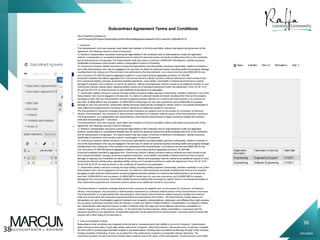
Examples of how your Accounting System can be
compliant with Uniform Guidance
4
Changing Procurement Landscape
and new Regulatory Updates
6
0914000N
Regulatory Updates - Procurement
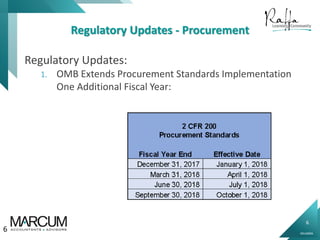
Regulatory Updates:
1. OMB Extends Procurement Standards Implementation
One Additional Fiscal Year:
6
7
0914000N
Regulatory Updates - Procurement
Regulatory Updates:
2. OMB Releases 2018 Compliance Supplement
• Includes language about the application of increased
procurement thresholds
 Includes updated Single Audit testing criteria to address
the Procurement Standards
3. OMB Issues Memorandum M-18-18
 Raises the threshold for micro-purchases under Federal
financial assistance awards to $10,000, and raises the
threshold for simplified acquisitions to $250,000 for all
recipients
7
8
0914000N
Regulatory Updates - Procurement
Most Common Pitfalls for Early Adopters:
1. The procurement is NOT supported by a contract file,
that documented the history of the procurement,
including the rationale for the method of procurement,
selection of contract type, basis for contractor
selection, and the basis for the contract price.
2. The procurement method used was NOT appropriate
based on the dollar amount and conditions specified in
2 CFR section 200.320.
8
9
0914000N
Regulatory Updates - Procurement
Most Common Pitfalls for Early Adopters:
3. The procurement was NOT supported by
documentation of justifiable rationale to limit
competition in those cases where competition was
limited [2 CFR sections 200.319 and 200.320(f) and 48
CFR section 52.244-5].
4. The procurement was NOT supported by a cost or price
analysis (for all procurement actions exceeding the
simplified acquisition threshold) (2 CFR section
200.323 and 48 CFR section 15.404-3).
9
10
0914000N
Regulatory Updates - Procurement
Most Common Pitfalls for Early Adopters:
5. Before entering into a covered transaction, the entity
had NOT followed its procedures for verifying that an
entity is not debarred, suspended, or otherwise
excluded.
10
Covered Transaction = Subaward or Contract > $25,000
11
0914000N
Regulatory Updates - Procurement
Best Practices for Compliance with the New
Procurement Standards:
1. Define Roles and Responsibilities
2. Design Operational Workflow
3. Staff Training (Conflicts of Interest, Cost and Price
Analysis, etc.)
4. Establish Documentation Requirements
11
12
0914000N
Regulatory Updates - Procurement
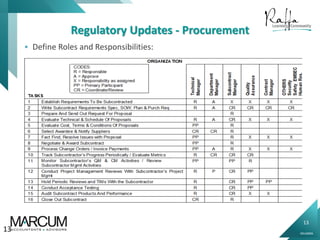
 Define Roles and Responsibilities:
Example Role:
“Buyer,” “Subcontract Administrator (SCA),” and
“Subcontract Manager (SCM)”
What are the duties of this role? subcontracts
upon satisfactory completion.
What are the responsibilities of this role?
12
13
0914000N
Regulatory Updates - Procurement
 Define Roles and Responsibilities:
13
14
0914000N
Regulatory Updates - Procurement
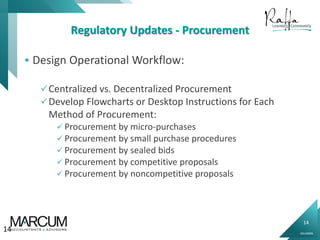
 Design Operational Workflow:
Centralized vs. Decentralized Procurement
Develop Flowcharts or Desktop Instructions for Each
Method of Procurement:
 Procurement by micro-purchases
 Procurement by small purchase procedures
 Procurement by sealed bids
 Procurement by competitive proposals
 Procurement by noncompetitive proposals
14
15
0914000N
Regulatory Updates - Procurement
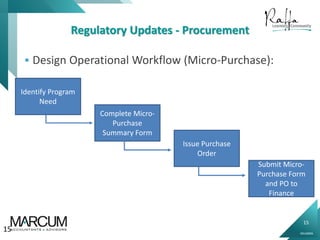
 Design Operational Workflow (Micro-Purchase):
15
Identify Program
Need
Complete Micro-
Purchase
Summary Form
Issue Purchase
Order
Submit Micro-
Purchase Form
and PO to
Finance
16
0914000N
Regulatory Updates - Procurement
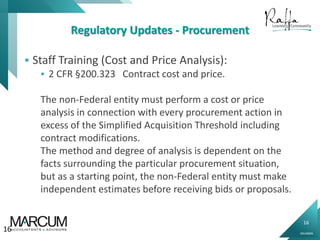
 Staff Training (Cost and Price Analysis):
 2 CFR §200.323 Contract cost and price.
The non-Federal entity must perform a cost or price
analysis in connection with every procurement action in
excess of the Simplified Acquisition Threshold including
contract modifications.
The method and degree of analysis is dependent on the
facts surrounding the particular procurement situation,
but as a starting point, the non-Federal entity must make
independent estimates before receiving bids or proposals.
16
17
0914000N
Regulatory Updates - Procurement
 Staff Training (Cost and Price Analysis):
 FAR 15.404-1(c)(1)
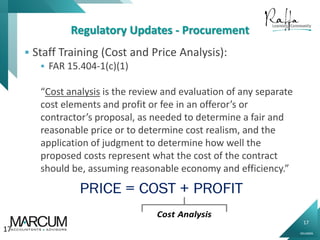
“Cost analysis is the review and evaluation of any separate
cost elements and profit or fee in an offeror’s or
contractor’s proposal, as needed to determine a fair and
reasonable price or to determine cost realism, and the
application of judgment to determine how well the
proposed costs represent what the cost of the contract
should be, assuming reasonable economy and efficiency.”
17
18
0914000N
Regulatory Updates - Procurement
 Staff Training (Cost and Price Analysis):
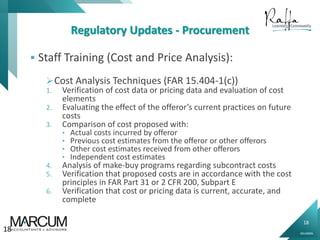
Cost Analysis Techniques (FAR 15.404-1(c))
1. Verification of cost data or pricing data and evaluation of cost
elements
2. Evaluating the effect of the offeror’s current practices on future
costs
3. Comparison of cost proposed with:
• Actual costs incurred by offeror
• Previous cost estimates from the offeror or other offerors
• Other cost estimates received from other offerors
• Independent cost estimates
4. Analysis of make-buy programs regarding subcontract costs
5. Verification that proposed costs are in accordance with the cost
principles in FAR Part 31 or 2 CFR 200, Subpart E
6. Verification that cost or pricing data is current, accurate, and
complete
18
19
0914000N
Regulatory Updates - Procurement
 Staff Training (Cost and Price Analysis):
 FAR 15.404-1(b)
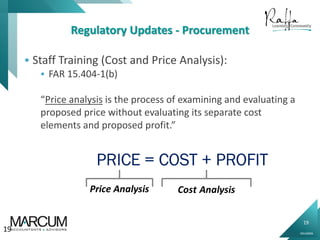
“Price analysis is the process of examining and evaluating a
proposed price without evaluating its separate cost
elements and proposed profit.”
19
20
0914000N
Regulatory Updates - Procurement
 Staff Training (Cost and Price Analysis):
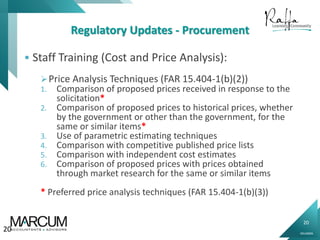
Price Analysis Techniques (FAR 15.404-1(b)(2))
1. Comparison of proposed prices received in response to the
solicitation*
2. Comparison of proposed prices to historical prices, whether
by the government or other than the government, for the
same or similar items*
3. Use of parametric estimating techniques
4. Comparison with competitive published price lists
5. Comparison with independent cost estimates
6. Comparison of proposed prices with prices obtained
through market research for the same or similar items
* Preferred price analysis techniques (FAR 15.404-1(b)(3))
20
21
0914000N
Regulatory Updates - Procurement
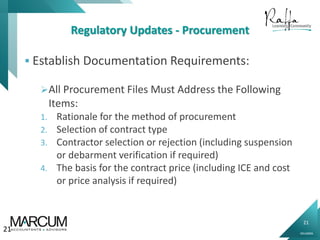
 Establish Documentation Requirements:
All Procurement Files Must Address the Following
Items:
1. Rationale for the method of procurement
2. Selection of contract type
3. Contractor selection or rejection (including suspension
or debarment verification if required)
4. The basis for the contract price (including ICE and cost
or price analysis if required)
21
22
• Requisition Management
• Purchasing Management
How can your ERP system support
Procurement Compliance
23
0914000N
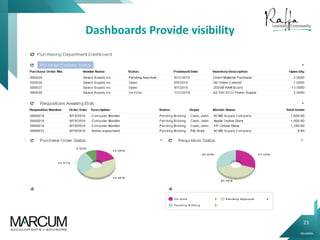
Dashboards Provide visibility
24
0914000N
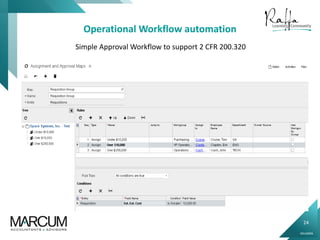
Operational Workflow automation
Simple Approval Workflow to support 2 CFR 200.320
25
0914000N
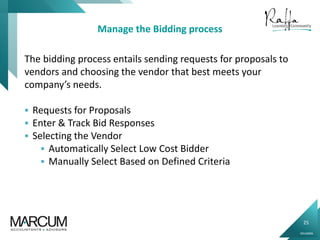
Manage the Bidding process
The bidding process entails sending requests for proposals to
vendors and choosing the vendor that best meets your
company’s needs.
 Requests for Proposals
 Enter & Track Bid Responses
 Selecting the Vendor
 Automatically Select Low Cost Bidder
 Manually Select Based on Defined Criteria
26
0914000N
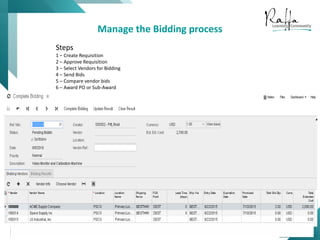
Manage the Bidding process
Steps
1 – Create Requisition
2 – Approve Requisition
3 – Select Vendors for Bidding
4 – Send Bids
5 – Compare vendor bids
6 – Award PO or Sub-Award
27
0914000N
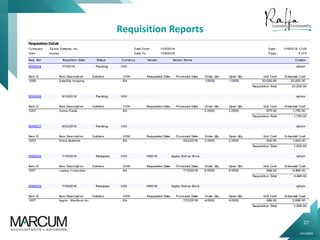
Requisition Reports
Sub-Recipient Monitoring
29
0914000N
Subrecipient Monitoring
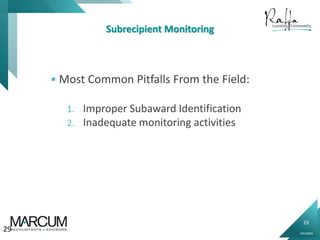
 Most Common Pitfalls From the Field:
1. Improper Subaward Identification
2. Inadequate monitoring activities
29
30
0914000N
Subrecipient Monitoring
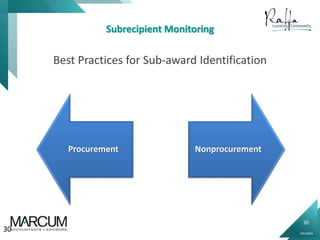
Best Practices for Sub-award Identification
30
Procurement Nonprocurement
31
0914000N
Subrecipient Monitoring
Best Practices for Subaward Identification
 Depending on the substance of an entity’s
agreement with the pass-through entity, it might
receive federal awards as a subrecipient or as a
contractor.
31
32
0914000N
Subrecipient Monitoring
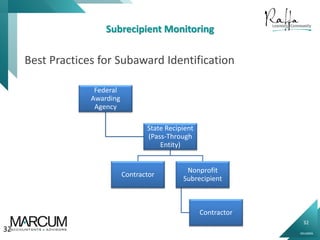
Best Practices for Subaward Identification
32
Federal
Awarding
Agency
State Recipient
(Pass-Through
Entity)
Contractor
Nonprofit
Subrecipient
Contractor
33
0914000N
Subrecipient Monitoring
Best Practices for Subaward Identification
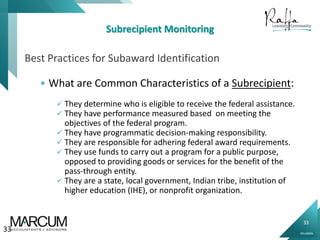
 What are Common Characteristics of a Subrecipient:
 They determine who is eligible to receive the federal assistance.
 They have performance measured based on meeting the
objectives of the federal program.
 They have programmatic decision-making responsibility.
 They are responsible for adhering federal award requirements.
 They use funds to carry out a program for a public purpose,
opposed to providing goods or services for the benefit of the
pass-through entity.
 They are a state, local government, Indian tribe, institution of
higher education (IHE), or nonprofit organization.
33
34
0914000N
Subrecipient Monitoring
Best Practices for Subaward Identification
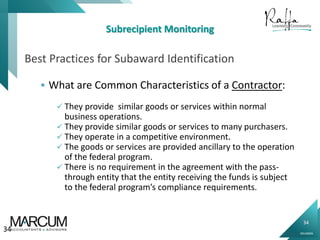
 What are Common Characteristics of a Contractor:
 They provide similar goods or services within normal
business operations.
 They provide similar goods or services to many purchasers.
 They operate in a competitive environment.
 The goods or services are provided ancillary to the operation
of the federal program.
 There is no requirement in the agreement with the pass-
through entity that the entity receiving the funds is subject
to the federal program’s compliance requirements.
34
35
0914000N
Subrecipient Monitoring
Best Practices for Subaward Identification
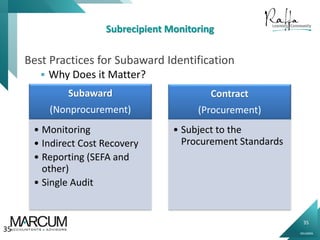
 Why Does it Matter?
35
Subaward
(Nonprocurement)
• Monitoring
• Indirect Cost Recovery
• Reporting (SEFA and
other)
• Single Audit
Contract
(Procurement)
• Subject to the
Procurement Standards
36
0914000N
Subrecipient Monitoring
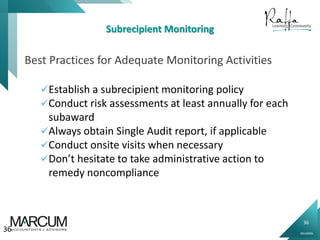
Best Practices for Adequate Monitoring Activities
Establish a subrecipient monitoring policy
Conduct risk assessments at least annually for each
subaward
Always obtain Single Audit report, if applicable
Conduct onsite visits when necessary
Don’t hesitate to take administrative action to
remedy noncompliance
36
37
How can your Systems support
Sub-Recipient Monitoring
38
0914000N
Subrecipient Monitoring
38
Time and Effort Reporting
40
0914000N
Time and Effort Reporting
Most Common Pitfalls From the Field:
1. Budgeted estimates are not supported by secondary
after-the-fact verification of valid labor allocation
2. PARs are not completed timely
3. Labor allocation is not in compliance with the cost
principles
40
41
0914000N
Time and Effort Reporting
Best Practices for Compliant Time and Effort Reporting:
Institute a formalized timesheet system
Establish a disciplinary policy for not fully complying with
time and attendance rules
Evaluate labor allocations to ensure that cost is chargeable
or assignable to that Federal award or cost objective in
accordance with relative benefits received
Reconcile “Gross-to-Net” between accounting system and
payroll system
41
42
How can your ERP system support Time
& Effort Reporting Compliance?
43
0914000N
Time and Effort Reporting
43
44
0914000N
Time and Effort Reporting
44
45
0914000N
Time and Effort Reporting
45
Mobile Apps
46
0914000N
Time and Effort Reporting
46
Identify Missing Timecards
47
0914000N
Time and Effort Reporting
47
48
0914000N
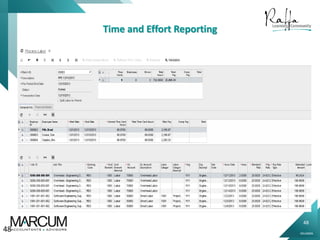
Time and Effort Reporting
48
49
0914000N
Time and Effort Reporting
49
50
0914000N
Helping Great Organizations Thrive
Glenn Anstead, CPA
Glenn.anstead@marcumllp.com
301.279.6503
Dan Durst
Capital Edge Consulting
ddurst@capitaledgeconsulting.com
855.227.3343 x134
Jeremy Taro
Jeremy.taro@marcumllp.com
301.279.6504
Questions & Answers
Did you remember to sign-in ?
We will use this to send you an evaluation survey &
CPE…

2018-11-15 Compliance Issues

  • 1.
    marcumllp.com High Risk Compliance Issuesand How To Avoid Them How you can protect your Non-Profit… Presenters: Glenn Anstead, CPA. Raffa / Marcum Dan Durst, Capital Edge Consulting Sean O’Connor, Capital Edge Consulting
  • 2.
    2 0914000N INTRODUCTIONS Who is inthe room? • Your name, organization, and role • Current accounting system • What do you hope to take away from today’s seminar?
  • 3.
    3 0914000N Overview  Uniform Guidancemade significant changes to the following topics:  Procurement  Subrecipient Monitoring  Time and Effort Reporting  A review of FY 2017 Single Audit findings has shown that organizations are still struggling to adapt to those changes and are dealing with the effects of non-compliance.  Legacy accounting systems used by many non-profit organizations struggle to maintain Uniform Guidance compliance. 3
  • 4.
    4 0914000N Agenda  Today weare going to review Compliance Issues you need to be aware of around three key areas: Procurement and new Regulatory Updates Sub-Recipient Reporting Time & Effort Reporting Examples of how your Accounting System can be compliant with Uniform Guidance 4
  • 5.
    Changing Procurement Landscape andnew Regulatory Updates
  • 6.
    6 0914000N Regulatory Updates -Procurement Regulatory Updates: 1. OMB Extends Procurement Standards Implementation One Additional Fiscal Year: 6
  • 7.
    7 0914000N Regulatory Updates -Procurement Regulatory Updates: 2. OMB Releases 2018 Compliance Supplement • Includes language about the application of increased procurement thresholds  Includes updated Single Audit testing criteria to address the Procurement Standards 3. OMB Issues Memorandum M-18-18  Raises the threshold for micro-purchases under Federal financial assistance awards to $10,000, and raises the threshold for simplified acquisitions to $250,000 for all recipients 7
  • 8.
    8 0914000N Regulatory Updates -Procurement Most Common Pitfalls for Early Adopters: 1. The procurement is NOT supported by a contract file, that documented the history of the procurement, including the rationale for the method of procurement, selection of contract type, basis for contractor selection, and the basis for the contract price. 2. The procurement method used was NOT appropriate based on the dollar amount and conditions specified in 2 CFR section 200.320. 8
  • 9.
    9 0914000N Regulatory Updates -Procurement Most Common Pitfalls for Early Adopters: 3. The procurement was NOT supported by documentation of justifiable rationale to limit competition in those cases where competition was limited [2 CFR sections 200.319 and 200.320(f) and 48 CFR section 52.244-5]. 4. The procurement was NOT supported by a cost or price analysis (for all procurement actions exceeding the simplified acquisition threshold) (2 CFR section 200.323 and 48 CFR section 15.404-3). 9
  • 10.
    10 0914000N Regulatory Updates -Procurement Most Common Pitfalls for Early Adopters: 5. Before entering into a covered transaction, the entity had NOT followed its procedures for verifying that an entity is not debarred, suspended, or otherwise excluded. 10 Covered Transaction = Subaward or Contract > $25,000
  • 11.
    11 0914000N Regulatory Updates -Procurement Best Practices for Compliance with the New Procurement Standards: 1. Define Roles and Responsibilities 2. Design Operational Workflow 3. Staff Training (Conflicts of Interest, Cost and Price Analysis, etc.) 4. Establish Documentation Requirements 11
  • 12.
    12 0914000N Regulatory Updates -Procurement  Define Roles and Responsibilities: Example Role: “Buyer,” “Subcontract Administrator (SCA),” and “Subcontract Manager (SCM)” What are the duties of this role? subcontracts upon satisfactory completion. What are the responsibilities of this role? 12
  • 13.
    13 0914000N Regulatory Updates -Procurement  Define Roles and Responsibilities: 13
  • 14.
    14 0914000N Regulatory Updates -Procurement  Design Operational Workflow: Centralized vs. Decentralized Procurement Develop Flowcharts or Desktop Instructions for Each Method of Procurement:  Procurement by micro-purchases  Procurement by small purchase procedures  Procurement by sealed bids  Procurement by competitive proposals  Procurement by noncompetitive proposals 14
  • 15.
    15 0914000N Regulatory Updates -Procurement  Design Operational Workflow (Micro-Purchase): 15 Identify Program Need Complete Micro- Purchase Summary Form Issue Purchase Order Submit Micro- Purchase Form and PO to Finance
  • 16.
    16 0914000N Regulatory Updates -Procurement  Staff Training (Cost and Price Analysis):  2 CFR §200.323 Contract cost and price. The non-Federal entity must perform a cost or price analysis in connection with every procurement action in excess of the Simplified Acquisition Threshold including contract modifications. The method and degree of analysis is dependent on the facts surrounding the particular procurement situation, but as a starting point, the non-Federal entity must make independent estimates before receiving bids or proposals. 16
  • 17.
    17 0914000N Regulatory Updates -Procurement  Staff Training (Cost and Price Analysis):  FAR 15.404-1(c)(1) “Cost analysis is the review and evaluation of any separate cost elements and profit or fee in an offeror’s or contractor’s proposal, as needed to determine a fair and reasonable price or to determine cost realism, and the application of judgment to determine how well the proposed costs represent what the cost of the contract should be, assuming reasonable economy and efficiency.” 17
  • 18.
    18 0914000N Regulatory Updates -Procurement  Staff Training (Cost and Price Analysis): Cost Analysis Techniques (FAR 15.404-1(c)) 1. Verification of cost data or pricing data and evaluation of cost elements 2. Evaluating the effect of the offeror’s current practices on future costs 3. Comparison of cost proposed with: • Actual costs incurred by offeror • Previous cost estimates from the offeror or other offerors • Other cost estimates received from other offerors • Independent cost estimates 4. Analysis of make-buy programs regarding subcontract costs 5. Verification that proposed costs are in accordance with the cost principles in FAR Part 31 or 2 CFR 200, Subpart E 6. Verification that cost or pricing data is current, accurate, and complete 18
  • 19.
    19 0914000N Regulatory Updates -Procurement  Staff Training (Cost and Price Analysis):  FAR 15.404-1(b) “Price analysis is the process of examining and evaluating a proposed price without evaluating its separate cost elements and proposed profit.” 19
  • 20.
    20 0914000N Regulatory Updates -Procurement  Staff Training (Cost and Price Analysis): Price Analysis Techniques (FAR 15.404-1(b)(2)) 1. Comparison of proposed prices received in response to the solicitation* 2. Comparison of proposed prices to historical prices, whether by the government or other than the government, for the same or similar items* 3. Use of parametric estimating techniques 4. Comparison with competitive published price lists 5. Comparison with independent cost estimates 6. Comparison of proposed prices with prices obtained through market research for the same or similar items * Preferred price analysis techniques (FAR 15.404-1(b)(3)) 20
  • 21.
    21 0914000N Regulatory Updates -Procurement  Establish Documentation Requirements: All Procurement Files Must Address the Following Items: 1. Rationale for the method of procurement 2. Selection of contract type 3. Contractor selection or rejection (including suspension or debarment verification if required) 4. The basis for the contract price (including ICE and cost or price analysis if required) 21
  • 22.
    22 • Requisition Management •Purchasing Management How can your ERP system support Procurement Compliance
  • 23.
  • 24.
    24 0914000N Operational Workflow automation SimpleApproval Workflow to support 2 CFR 200.320
  • 25.
    25 0914000N Manage the Biddingprocess The bidding process entails sending requests for proposals to vendors and choosing the vendor that best meets your company’s needs.  Requests for Proposals  Enter & Track Bid Responses  Selecting the Vendor  Automatically Select Low Cost Bidder  Manually Select Based on Defined Criteria
  • 26.
    26 0914000N Manage the Biddingprocess Steps 1 – Create Requisition 2 – Approve Requisition 3 – Select Vendors for Bidding 4 – Send Bids 5 – Compare vendor bids 6 – Award PO or Sub-Award
  • 27.
  • 28.
  • 29.
    29 0914000N Subrecipient Monitoring  MostCommon Pitfalls From the Field: 1. Improper Subaward Identification 2. Inadequate monitoring activities 29
  • 30.
    30 0914000N Subrecipient Monitoring Best Practicesfor Sub-award Identification 30 Procurement Nonprocurement
  • 31.
    31 0914000N Subrecipient Monitoring Best Practicesfor Subaward Identification  Depending on the substance of an entity’s agreement with the pass-through entity, it might receive federal awards as a subrecipient or as a contractor. 31
  • 32.
    32 0914000N Subrecipient Monitoring Best Practicesfor Subaward Identification 32 Federal Awarding Agency State Recipient (Pass-Through Entity) Contractor Nonprofit Subrecipient Contractor
  • 33.
    33 0914000N Subrecipient Monitoring Best Practicesfor Subaward Identification  What are Common Characteristics of a Subrecipient:  They determine who is eligible to receive the federal assistance.  They have performance measured based on meeting the objectives of the federal program.  They have programmatic decision-making responsibility.  They are responsible for adhering federal award requirements.  They use funds to carry out a program for a public purpose, opposed to providing goods or services for the benefit of the pass-through entity.  They are a state, local government, Indian tribe, institution of higher education (IHE), or nonprofit organization. 33
  • 34.
    34 0914000N Subrecipient Monitoring Best Practicesfor Subaward Identification  What are Common Characteristics of a Contractor:  They provide similar goods or services within normal business operations.  They provide similar goods or services to many purchasers.  They operate in a competitive environment.  The goods or services are provided ancillary to the operation of the federal program.  There is no requirement in the agreement with the pass- through entity that the entity receiving the funds is subject to the federal program’s compliance requirements. 34
  • 35.
    35 0914000N Subrecipient Monitoring Best Practicesfor Subaward Identification  Why Does it Matter? 35 Subaward (Nonprocurement) • Monitoring • Indirect Cost Recovery • Reporting (SEFA and other) • Single Audit Contract (Procurement) • Subject to the Procurement Standards
  • 36.
    36 0914000N Subrecipient Monitoring Best Practicesfor Adequate Monitoring Activities Establish a subrecipient monitoring policy Conduct risk assessments at least annually for each subaward Always obtain Single Audit report, if applicable Conduct onsite visits when necessary Don’t hesitate to take administrative action to remedy noncompliance 36
  • 37.
    37 How can yourSystems support Sub-Recipient Monitoring
  • 38.
  • 39.
    Time and EffortReporting
  • 40.
    40 0914000N Time and EffortReporting Most Common Pitfalls From the Field: 1. Budgeted estimates are not supported by secondary after-the-fact verification of valid labor allocation 2. PARs are not completed timely 3. Labor allocation is not in compliance with the cost principles 40
  • 41.
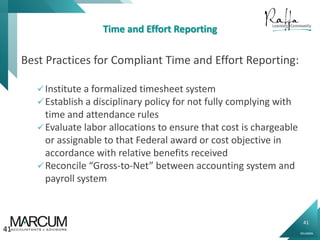
    41 0914000N Time and EffortReporting Best Practices for Compliant Time and Effort Reporting: Institute a formalized timesheet system Establish a disciplinary policy for not fully complying with time and attendance rules Evaluate labor allocations to ensure that cost is chargeable or assignable to that Federal award or cost objective in accordance with relative benefits received Reconcile “Gross-to-Net” between accounting system and payroll system 41
  • 42.
    42 How can yourERP system support Time & Effort Reporting Compliance?
  • 43.
  • 44.
  • 45.
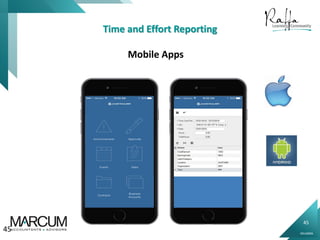
    45 0914000N Time and EffortReporting 45 Mobile Apps
  • 46.
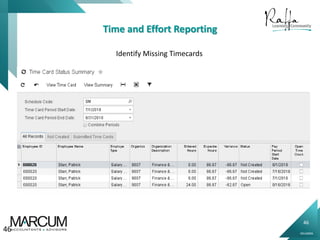
    46 0914000N Time and EffortReporting 46 Identify Missing Timecards
  • 47.
  • 48.
  • 49.
  • 50.
    50 0914000N Helping Great OrganizationsThrive Glenn Anstead, CPA Glenn.anstead@marcumllp.com 301.279.6503 Dan Durst Capital Edge Consulting ddurst@capitaledgeconsulting.com 855.227.3343 x134 Jeremy Taro Jeremy.taro@marcumllp.com 301.279.6504 Questions & Answers Did you remember to sign-in ? We will use this to send you an evaluation survey & CPE…