A New Look for
Nonprofits
Eric Glantz and Caroline Judy
May 31, 2018
Raffa Learning Community
Thrive. Grow. Achieve.
Presentation Title / Page 1
COURSE UPDATE DATE: __MAY 29, 2018___________
COURSE REVIEWED BY: __ERIC GLANTZ__________
COURSE REVIEW DATE: __ MAY 30, 2018 __________
NASBA FIELD OF STUDY: __ACCOUNTING__________
COURSE AGENDA
• Effective Date
• Net Asset Classes
• Investment Return
• Classification of Expenses
• Statement of Cash Flows
• Liquidity Disclosures
• Operating Measure Disclosures
• Transition Guidance
• Q&A
2
LEARNING OBJECTIVE
Financial Accounting Standards Board (FASB)
Accounting Standards Update (ASU) No. 2016-14,
Not-for-Profit Entities (Topic 958): Presentation of
Financial Statements of Not-for-Profit Entities.
• It has been more than two decades since the FASB
has significantly overhauled the financial statement
presentation of non profit organizations.
• Most of the changes do not significantly impact the
fundamental accounting utilized by nonprofits;
rather most changes impact how nonprofit financial
statements are being presented to the financial
statement user
• Course will discuss the timeline and significant
changes necessary for compliance (by financial
statement component)
3
ASU 2016-14 NFP ENTITIES (TOPIC958):
PRESENTATION OF FINANCIAL STATEMENTS
OF NFP’S
• Applies to NFPs including nongovernmental
entities such as charities, foundations, college
and universities, health chare providers, cultural
institutions, religious organizations, trade
associations and other NFPs
• FISCAL YEARS BEGINNING AFTER DECEMBER
15, 2017
• For most NFPs the new guidance will be effective for
FS’s with fiscal years ending December 31, 2018
4
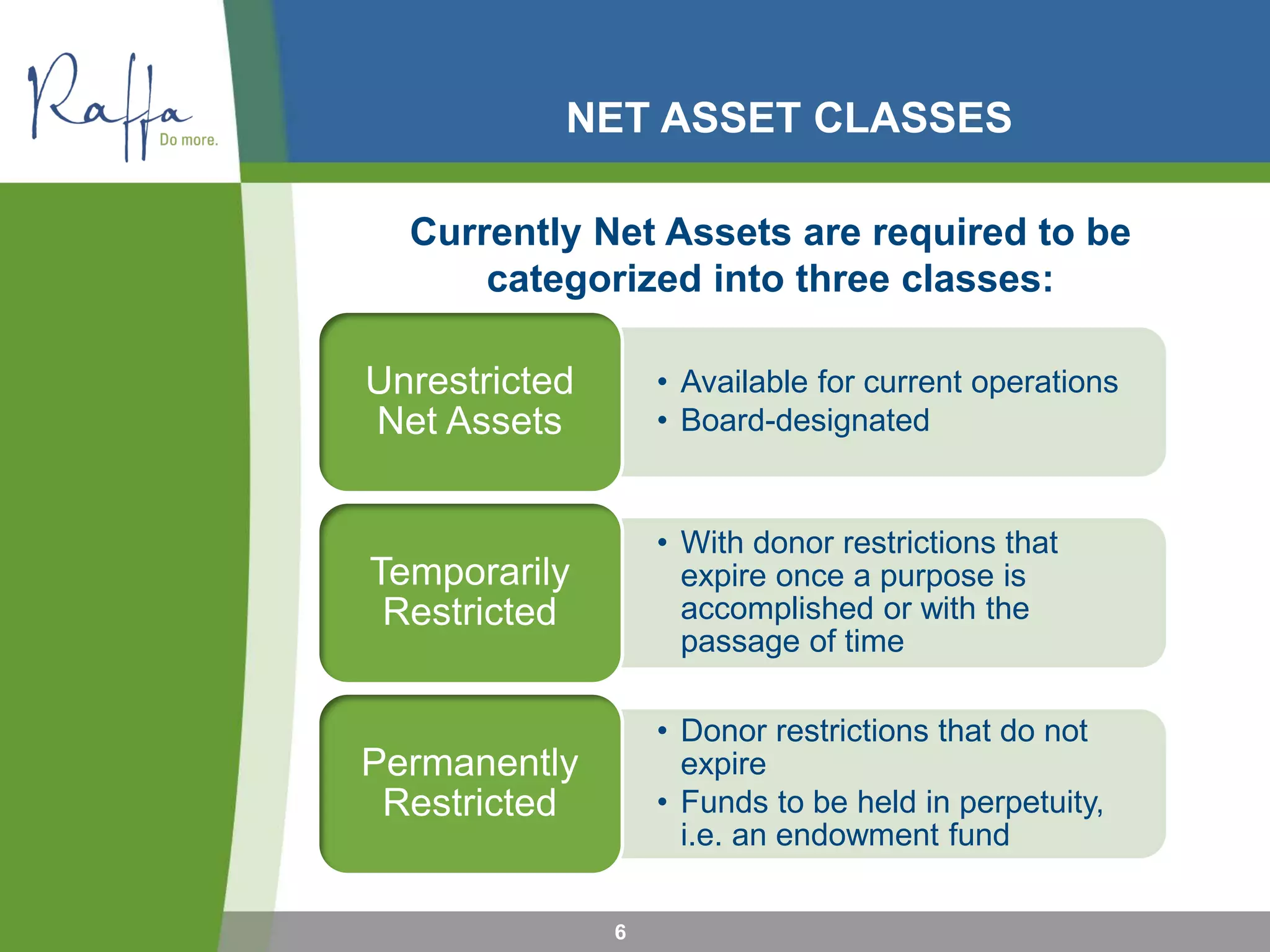
NET ASSET CLASSES
5
NET ASSET CLASSES
6
Currently Net Assets are required to be
categorized into three classes:
• Available for current operations
• Board-designated
Unrestricted
Net Assets
• With donor restrictions that
expire once a purpose is
accomplished or with the
passage of time
Temporarily
Restricted
• Donor restrictions that do not
expire
• Funds to be held in perpetuity,
i.e. an endowment fund
Permanently
Restricted
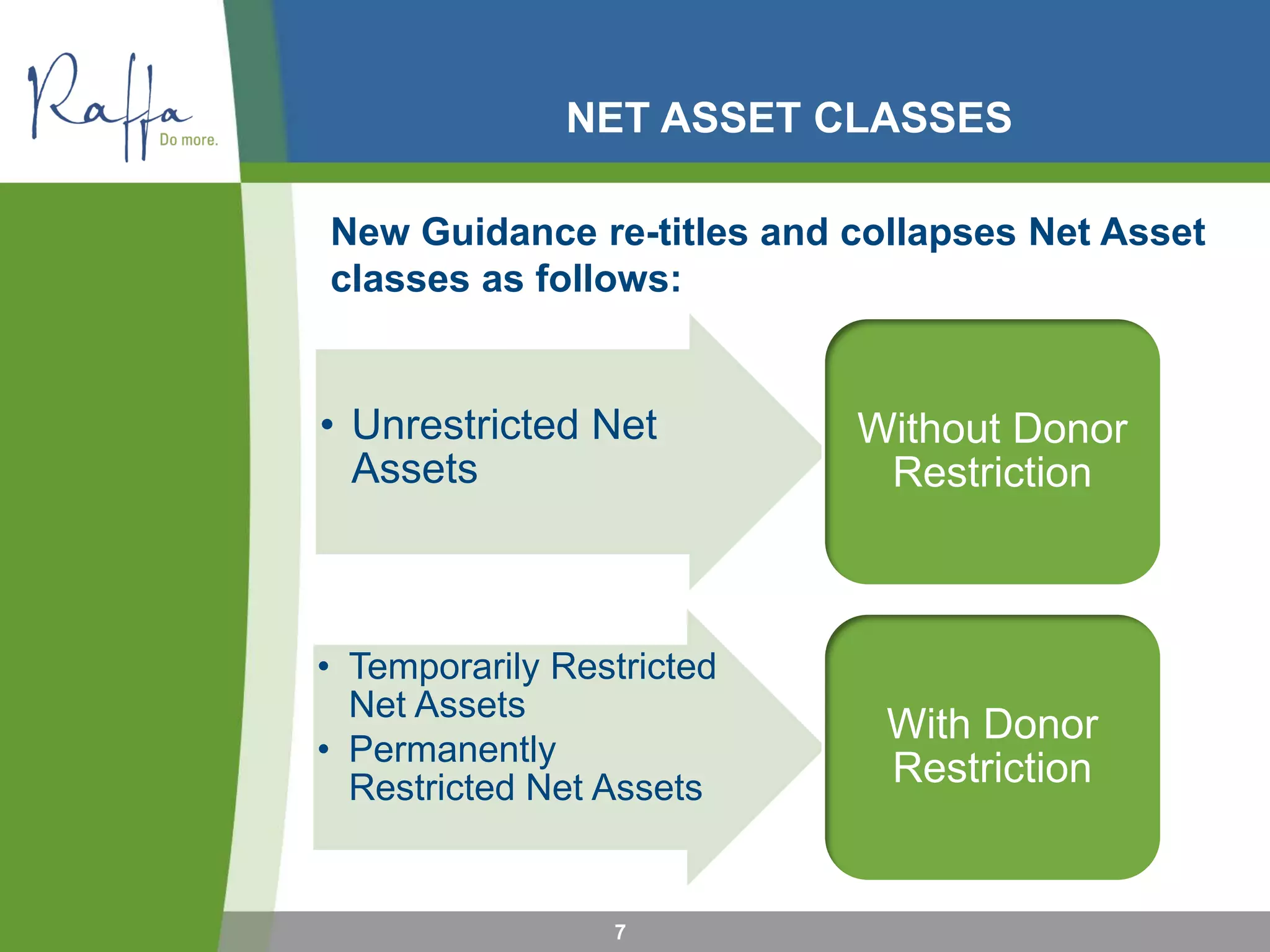
NET ASSET CLASSES
7
New Guidance re-titles and collapses Net Asset
classes as follows:
• Unrestricted Net
Assets
Without Donor
Restriction
• Temporarily Restricted
Net Assets
• Permanently
Restricted Net Assets
With Donor
Restriction
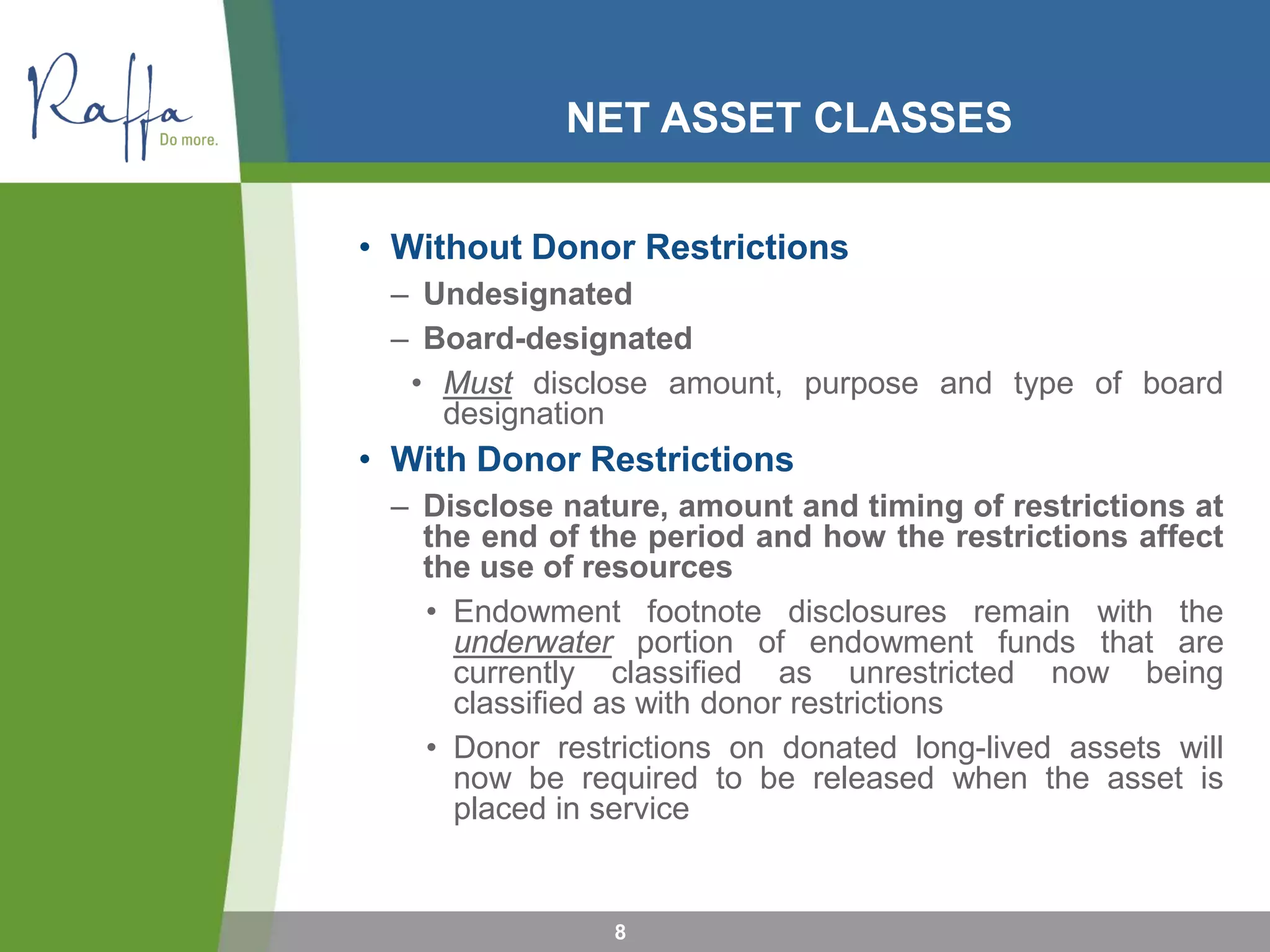
NET ASSET CLASSES
• Without Donor Restrictions
– Undesignated
– Board-designated
• Must disclose amount, purpose and type of board
designation
• With Donor Restrictions
– Disclose nature, amount and timing of restrictions at
the end of the period and how the restrictions affect
the use of resources
• Endowment footnote disclosures remain with the
underwater portion of endowment funds that are
currently classified as unrestricted now being
classified as with donor restrictions
• Donor restrictions on donated long-lived assets will
now be required to be released when the asset is
placed in service
8
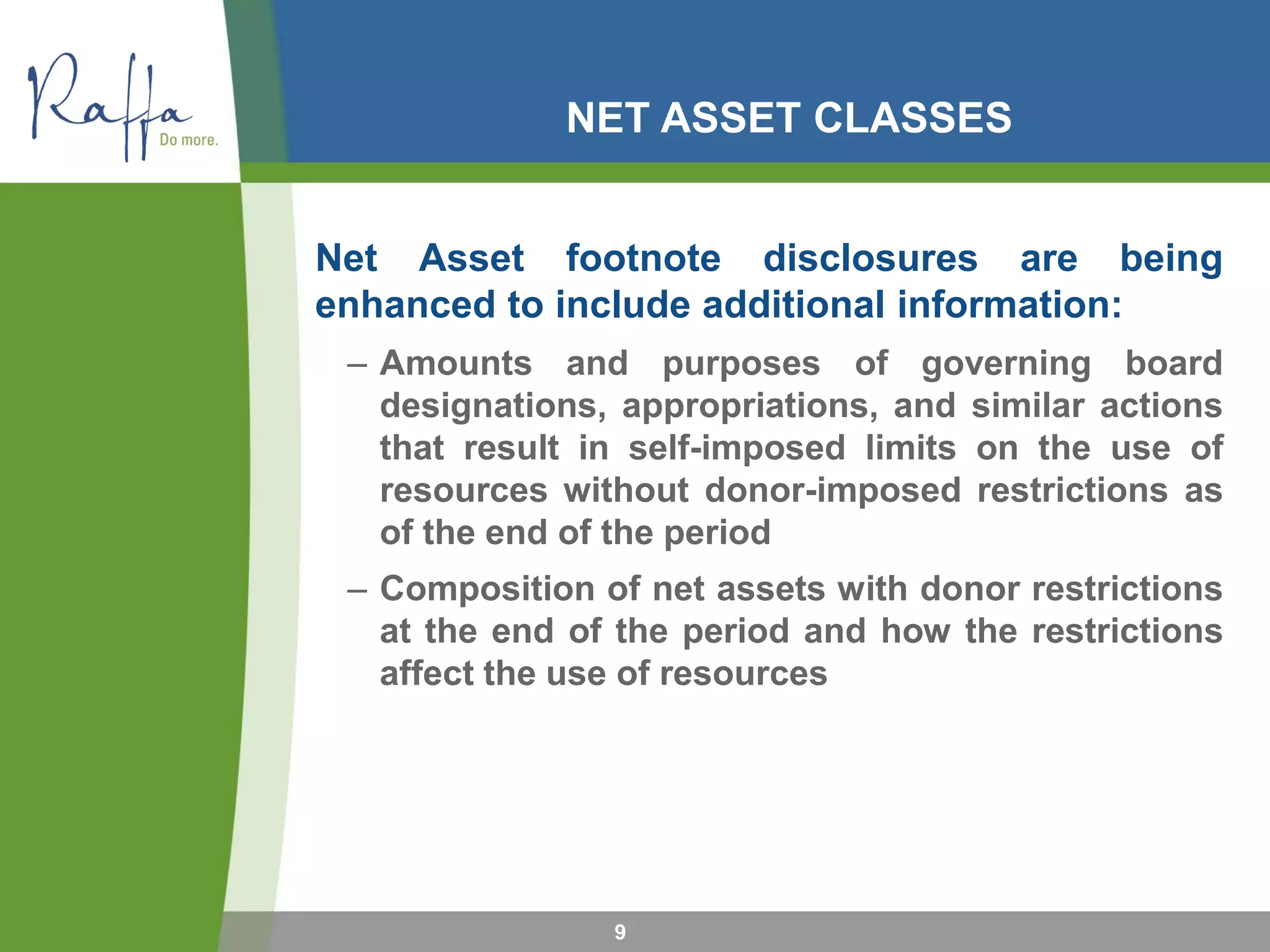
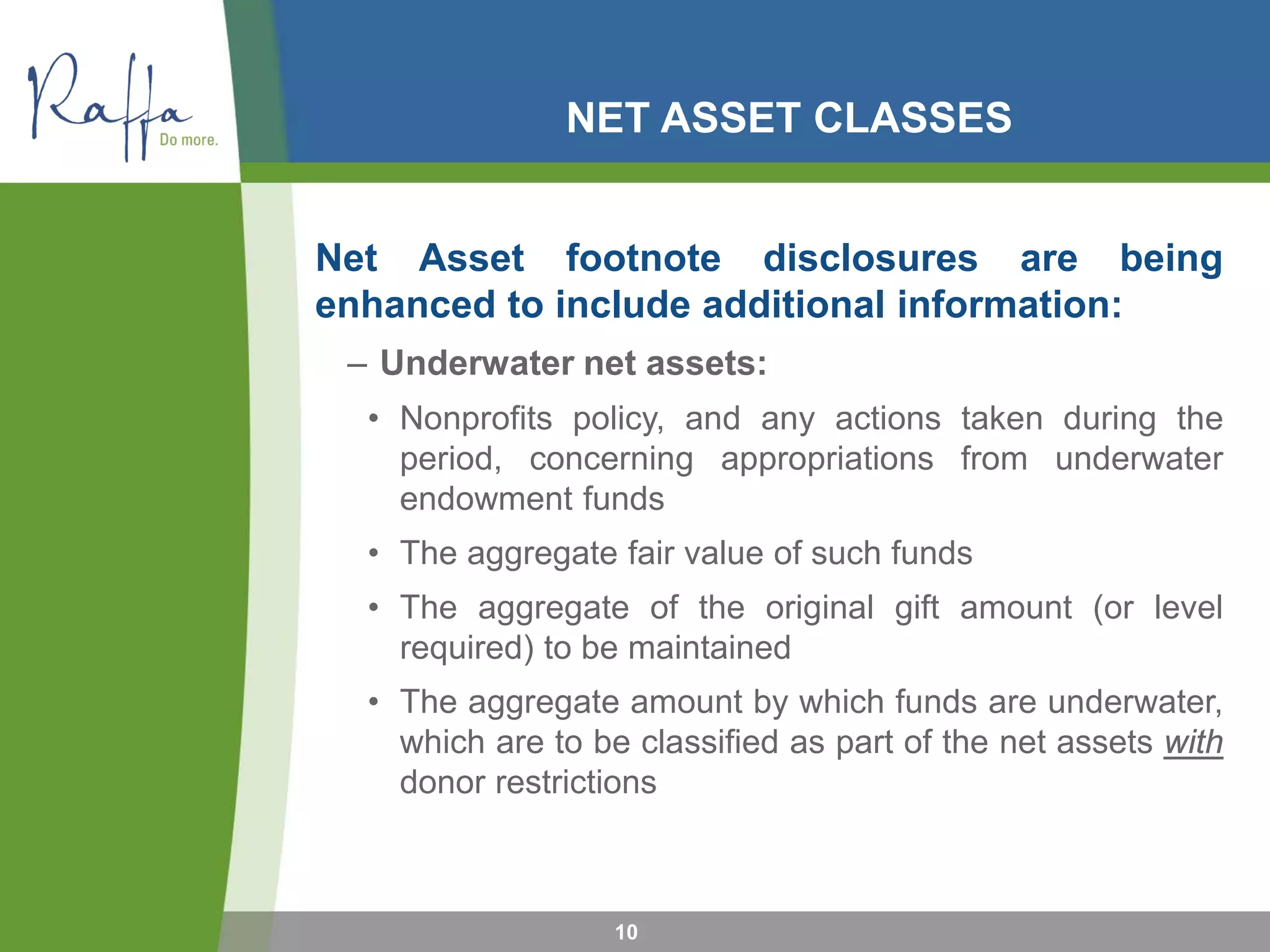
NET ASSET CLASSES
Net Asset footnote disclosures are being
enhanced to include additional information:
– Amounts and purposes of governing board
designations, appropriations, and similar actions
that result in self-imposed limits on the use of
resources without donor-imposed restrictions as
of the end of the period
– Composition of net assets with donor restrictions
at the end of the period and how the restrictions
affect the use of resources
9
NET ASSET CLASSES
Net Asset footnote disclosures are being
enhanced to include additional information:
– Underwater net assets:
• Nonprofits policy, and any actions taken during the
period, concerning appropriations from underwater
endowment funds
• The aggregate fair value of such funds
• The aggregate of the original gift amount (or level
required) to be maintained
• The aggregate amount by which funds are underwater,
which are to be classified as part of the net assets with
donor restrictions
10
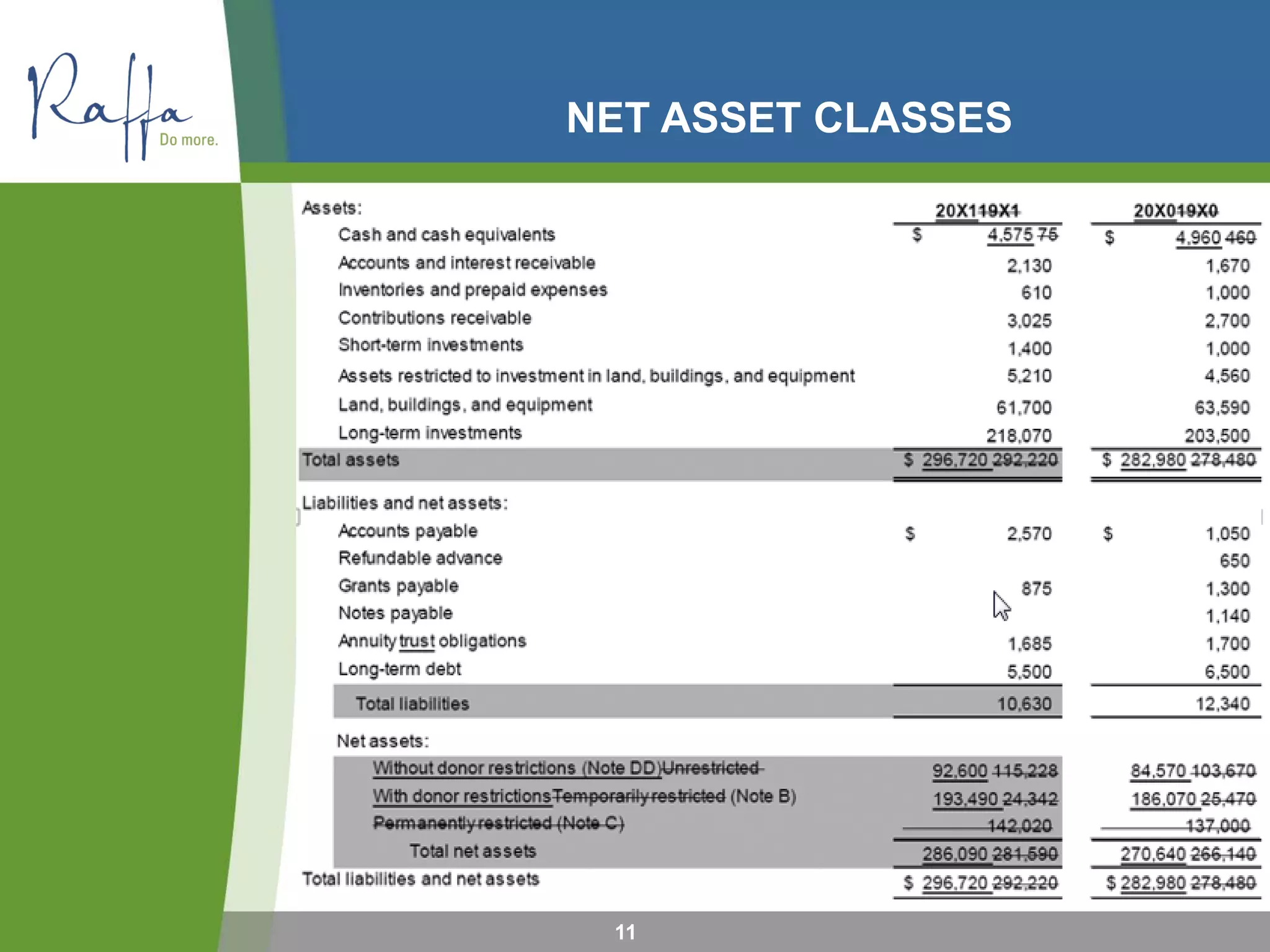
NET ASSET CLASSES
11
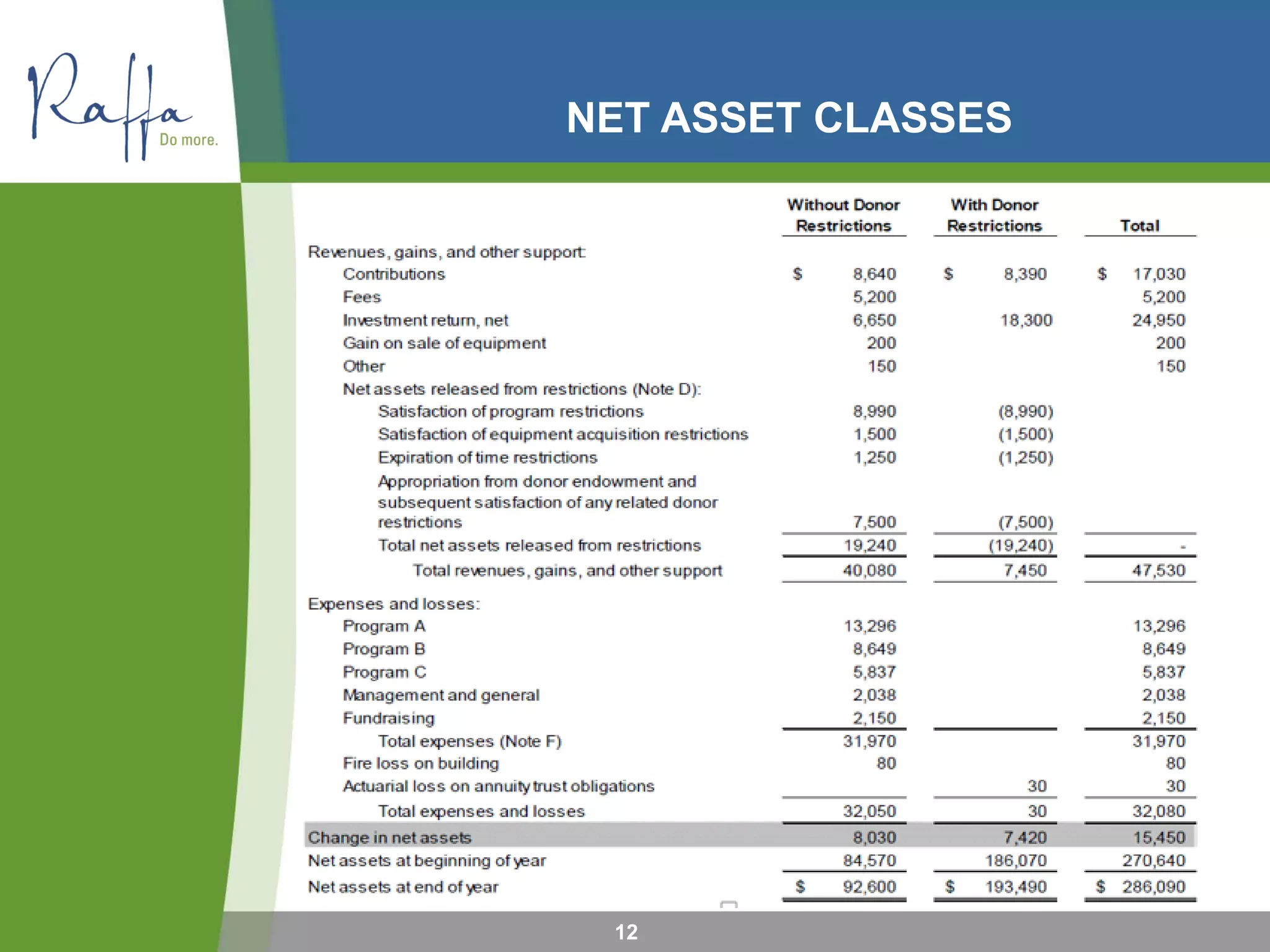
NET ASSET CLASSES
12
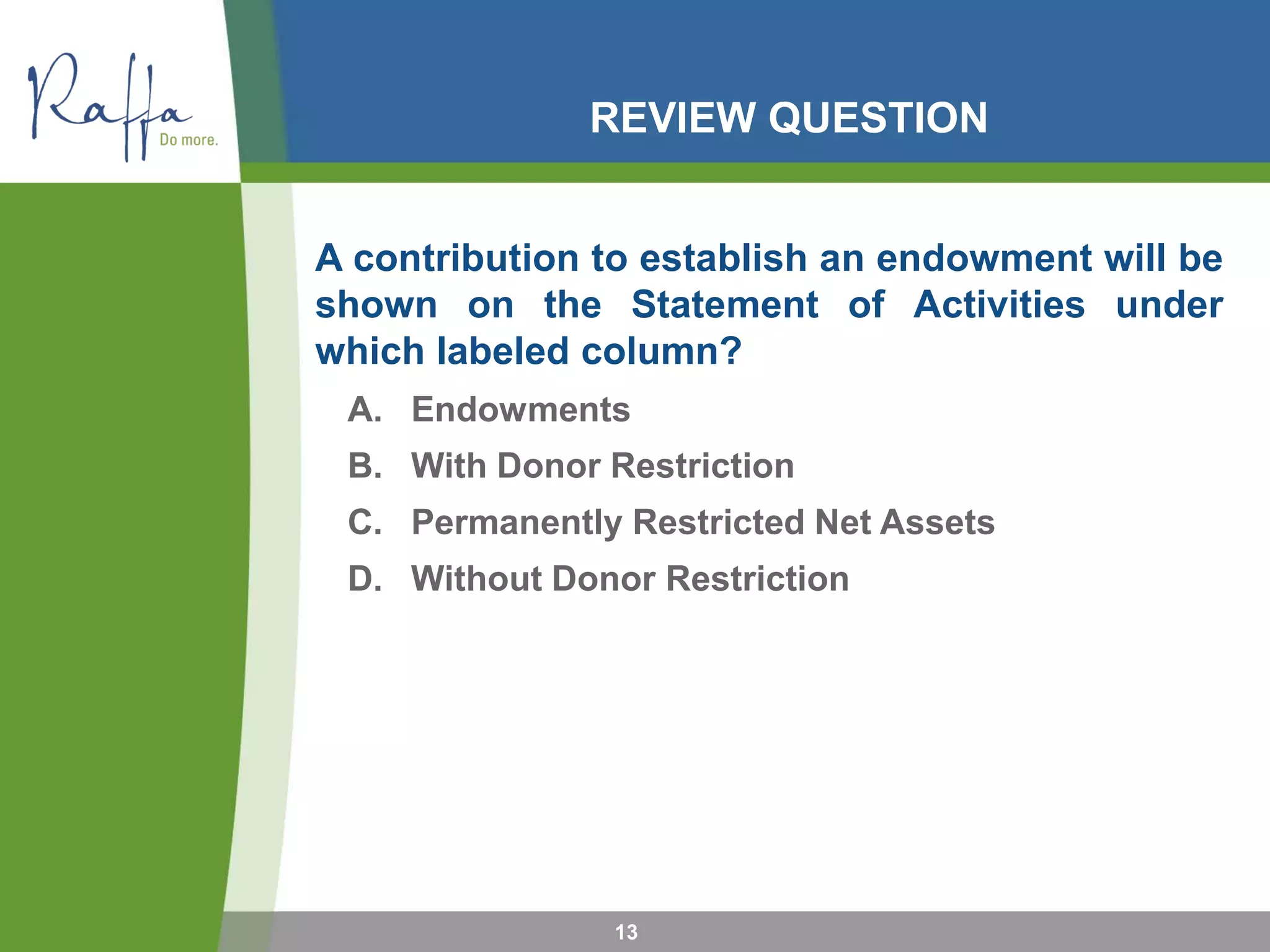
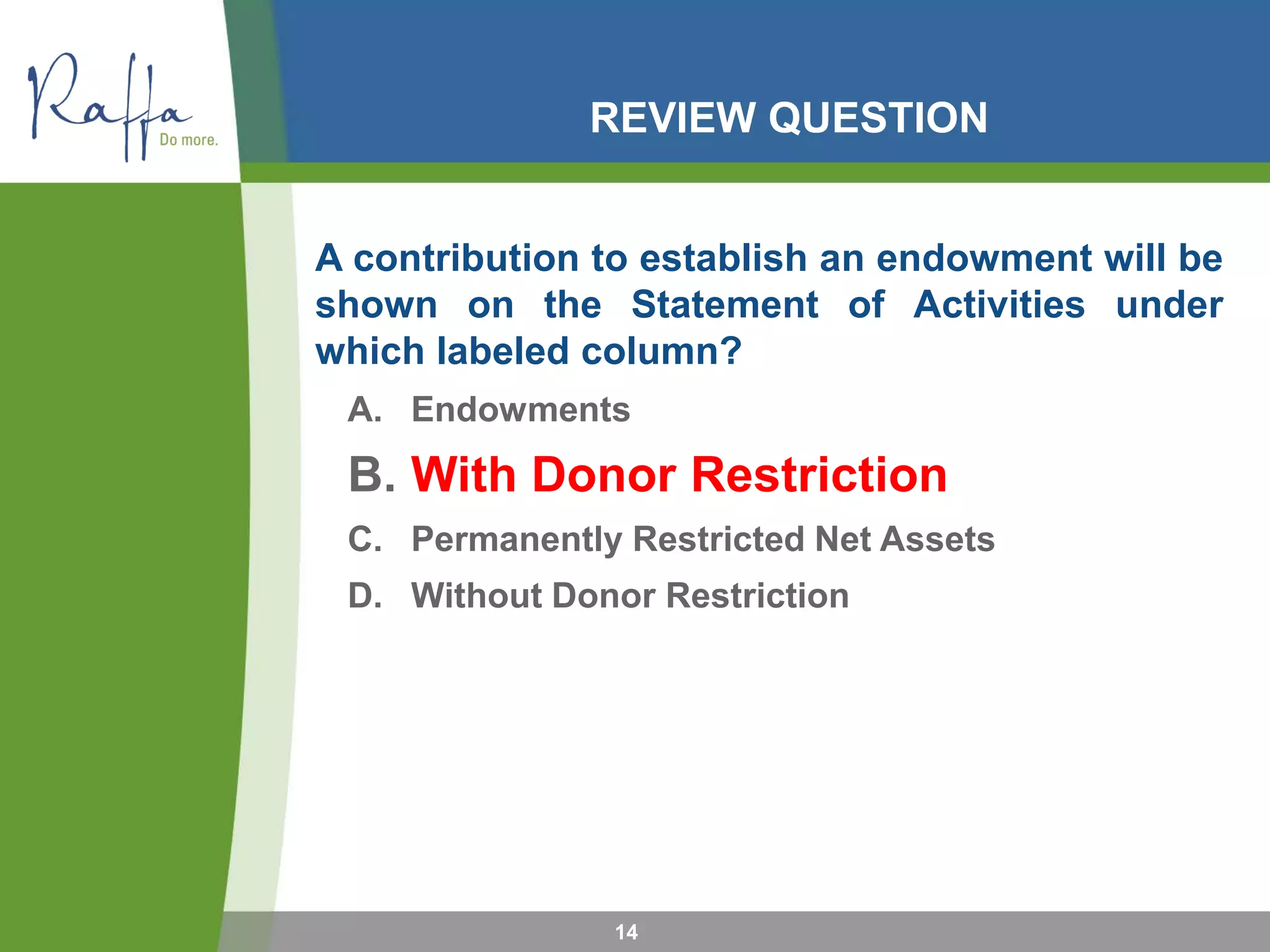
REVIEW QUESTION
A contribution to establish an endowment will be
shown on the Statement of Activities under
which labeled column?
A. Endowments
B. With Donor Restriction
C. Permanently Restricted Net Assets
D. Without Donor Restriction
13
REVIEW QUESTION
A contribution to establish an endowment will be
shown on the Statement of Activities under
which labeled column?
A. Endowments
B. With Donor Restriction
C. Permanently Restricted Net Assets
D. Without Donor Restriction
14
INVESTMENT RETURN
15
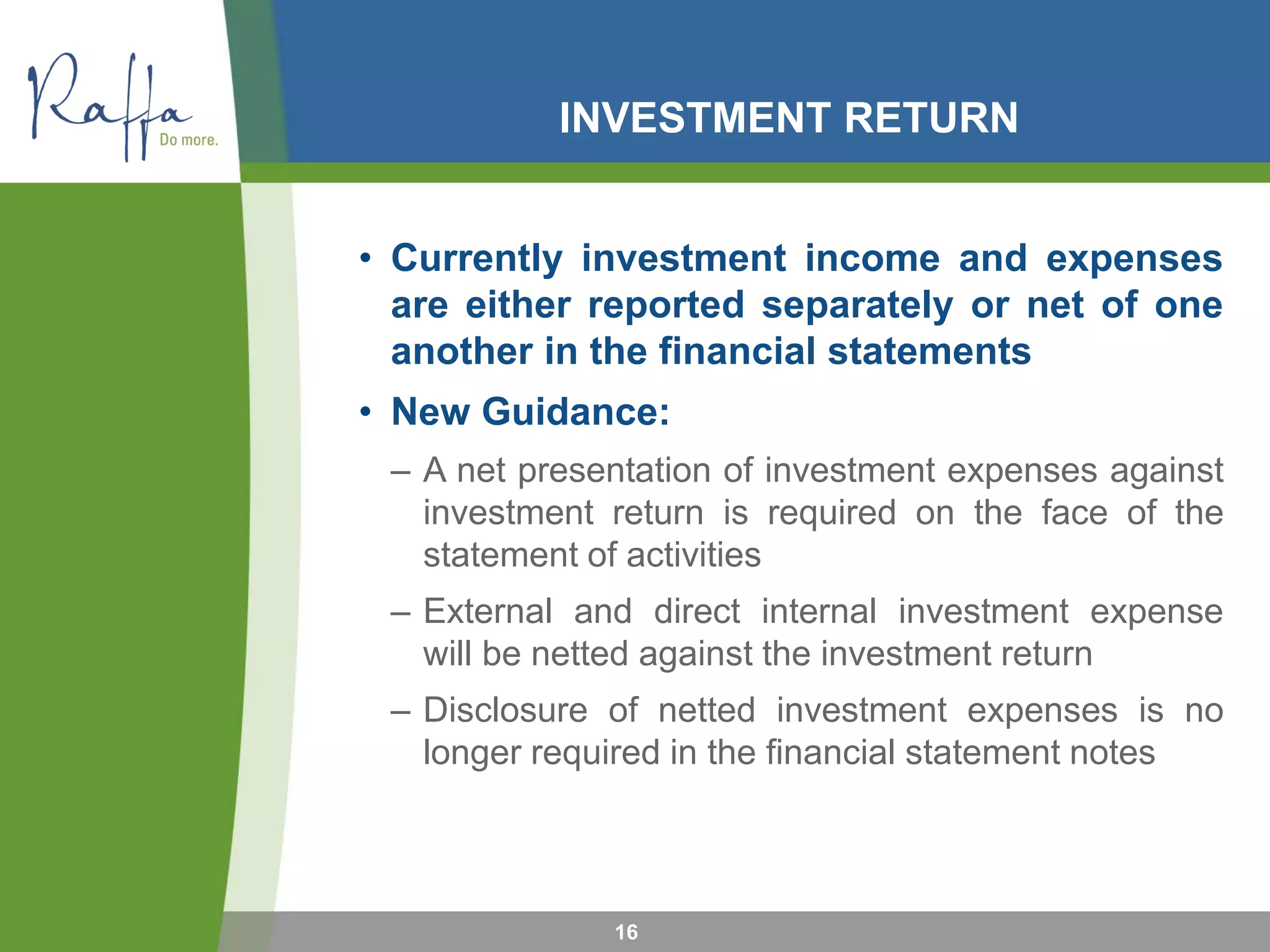
INVESTMENT RETURN
• Currently investment income and expenses
are either reported separately or net of one
another in the financial statements
• New Guidance:
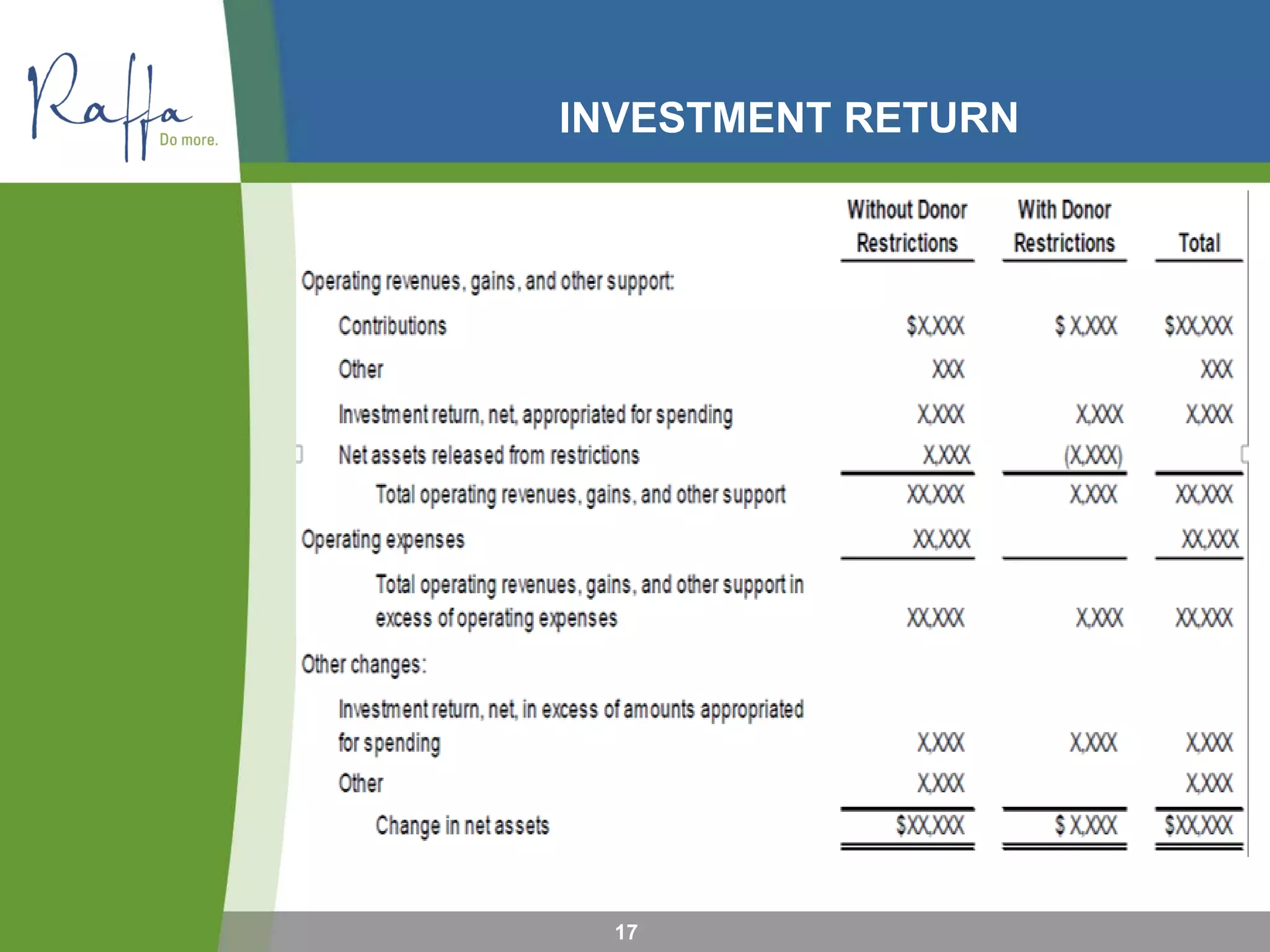
– A net presentation of investment expenses against
investment return is required on the face of the
statement of activities
– External and direct internal investment expense
will be netted against the investment return
– Disclosure of netted investment expenses is no
longer required in the financial statement notes
16
INVESTMENT RETURN
17
CLASSIFICATION OF EXPENSES
18
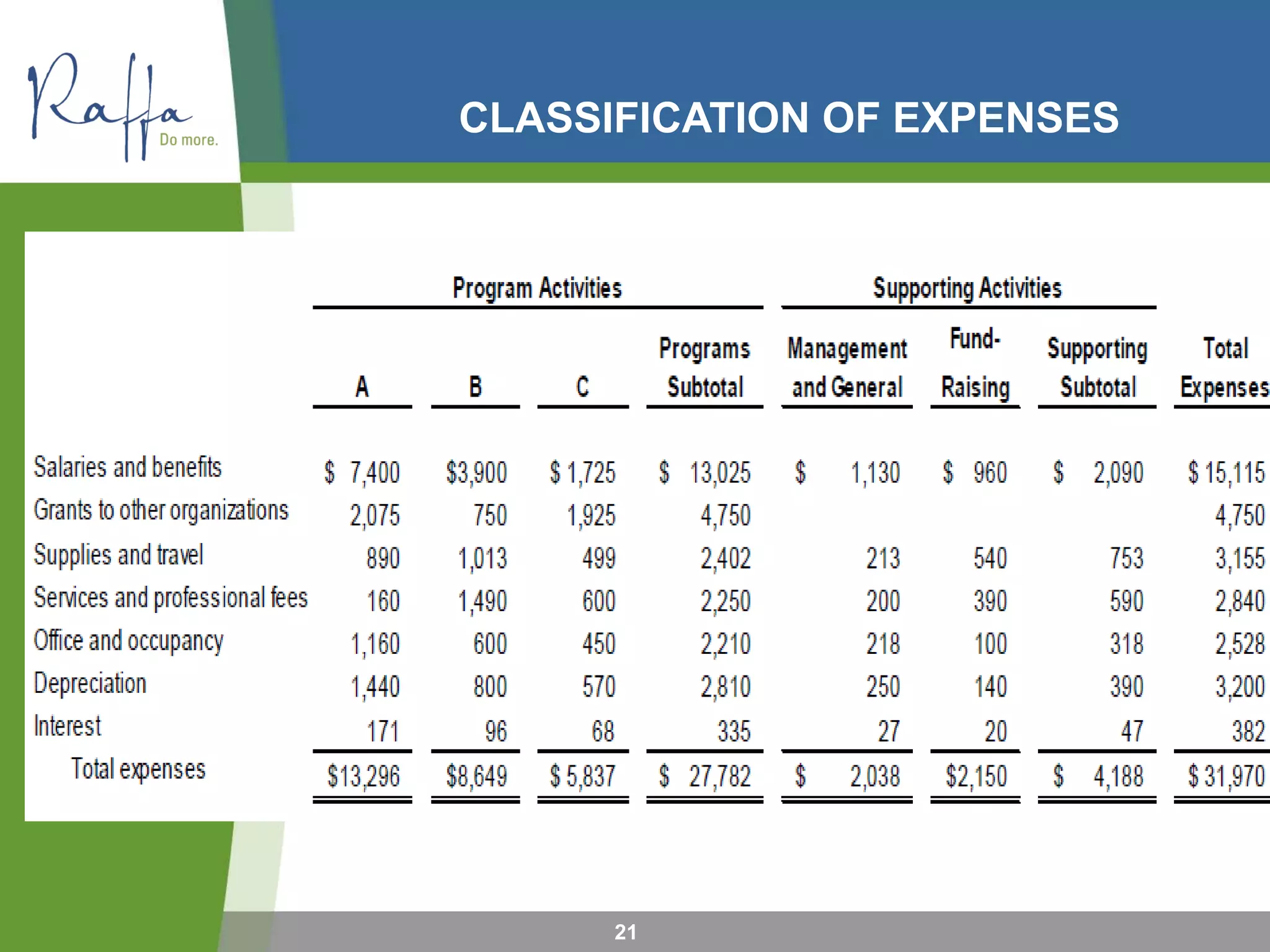
CLASSIFICATION OF EXPENSES
• All nonprofits will now be required to
present an analysis of expenses by both
nature and function in one location in the
financial statements, either as:
– A separate statement
• Already required for health and welfare
organizations
• Used as a supplemental schedule by many
nonprofits
• May be the most effective presentation option for
nonprofits with more than one program
– On the face of the statement of activities
– Disclosure in the notes to the financial
statements
19
CLASSIFICATION OF EXPENSES
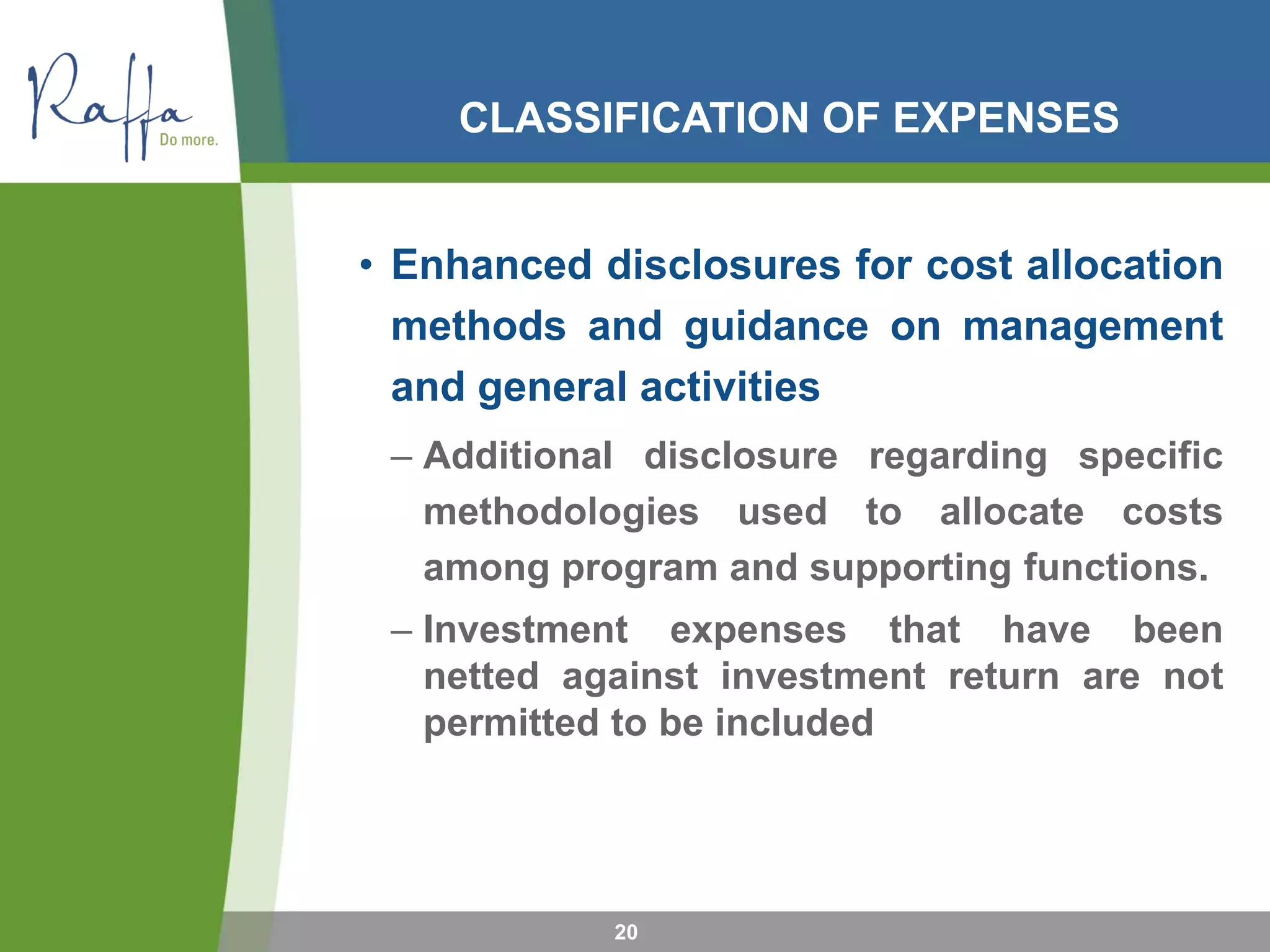
• Enhanced disclosures for cost allocation
methods and guidance on management
and general activities
– Additional disclosure regarding specific
methodologies used to allocate costs
among program and supporting functions.
– Investment expenses that have been
netted against investment return are not
permitted to be included
20
CLASSIFICATION OF EXPENSES
21
REVIEW QUESTION
All nonprofits are now required to present an
analysis of expenses by both nature and
function …
A. on the face of the Statement of Activities
B. as a disclosure in the notes to the Financial
Statements
C. As a separate Statement that is part of the basic
Financial Statements
D. All of the above
22
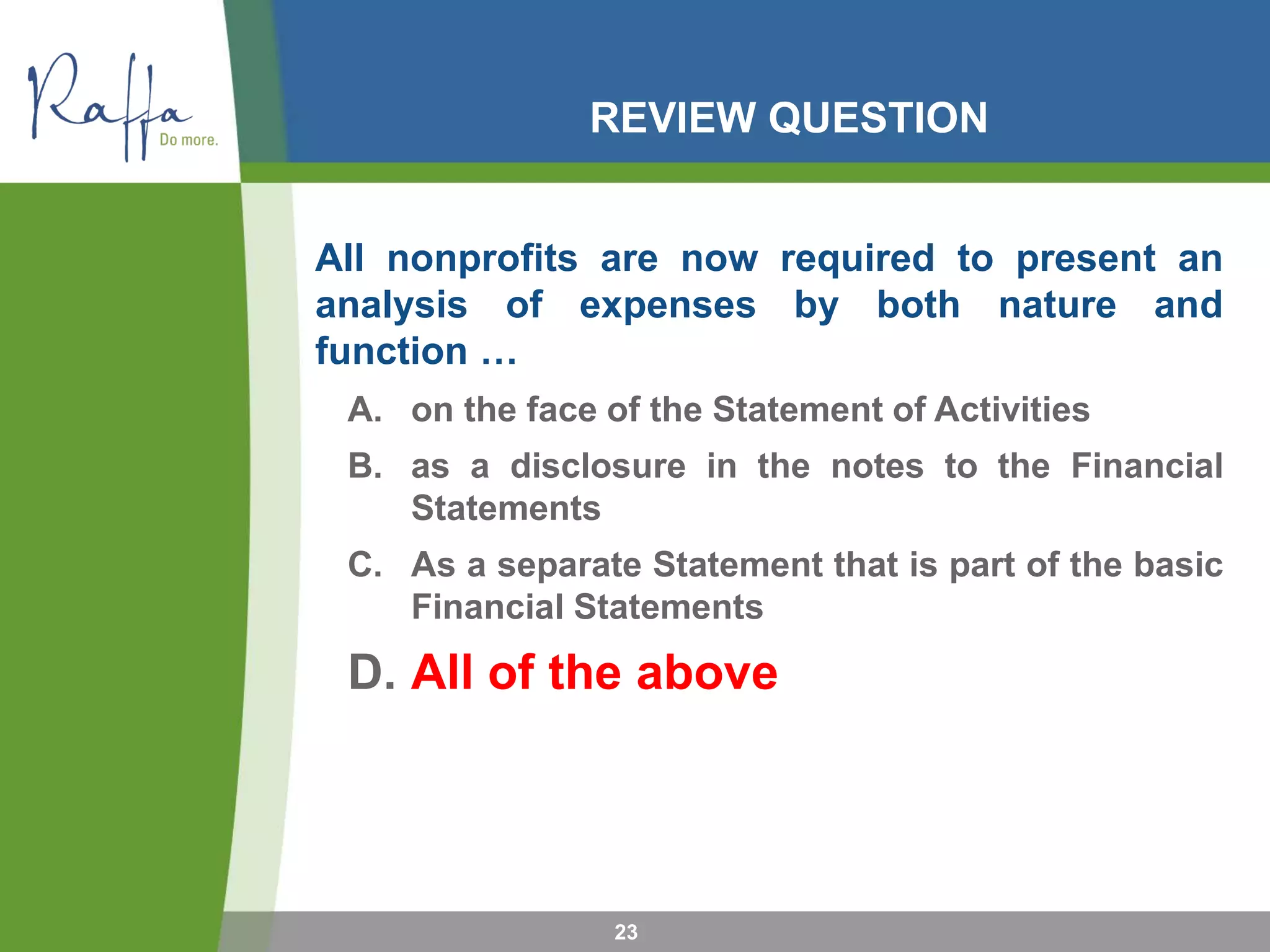
REVIEW QUESTION
All nonprofits are now required to present an
analysis of expenses by both nature and
function …
A. on the face of the Statement of Activities
B. as a disclosure in the notes to the Financial
Statements
C. As a separate Statement that is part of the basic
Financial Statements
D. All of the above
23
STATEMENT OF CASH FLOWS
24
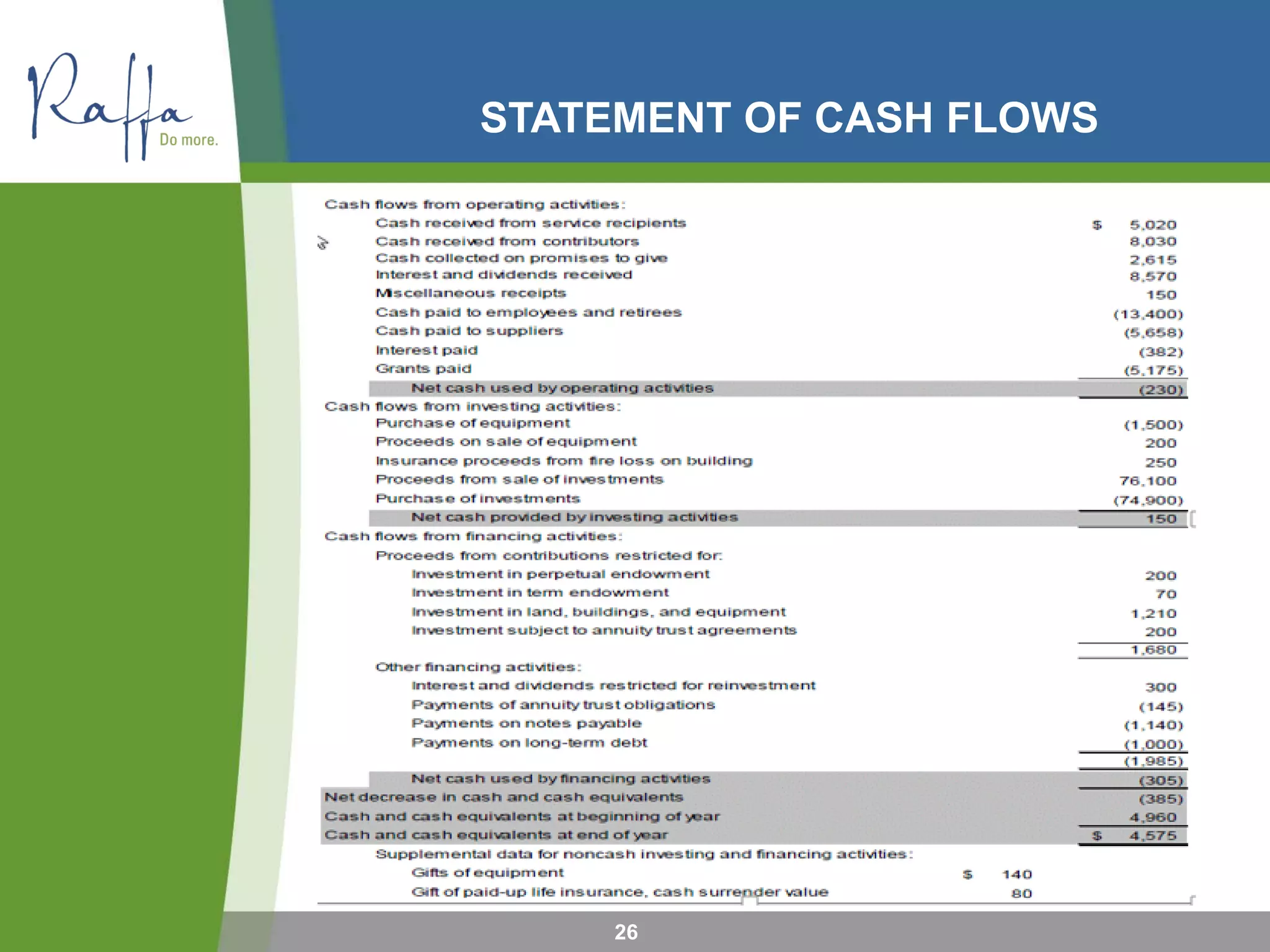
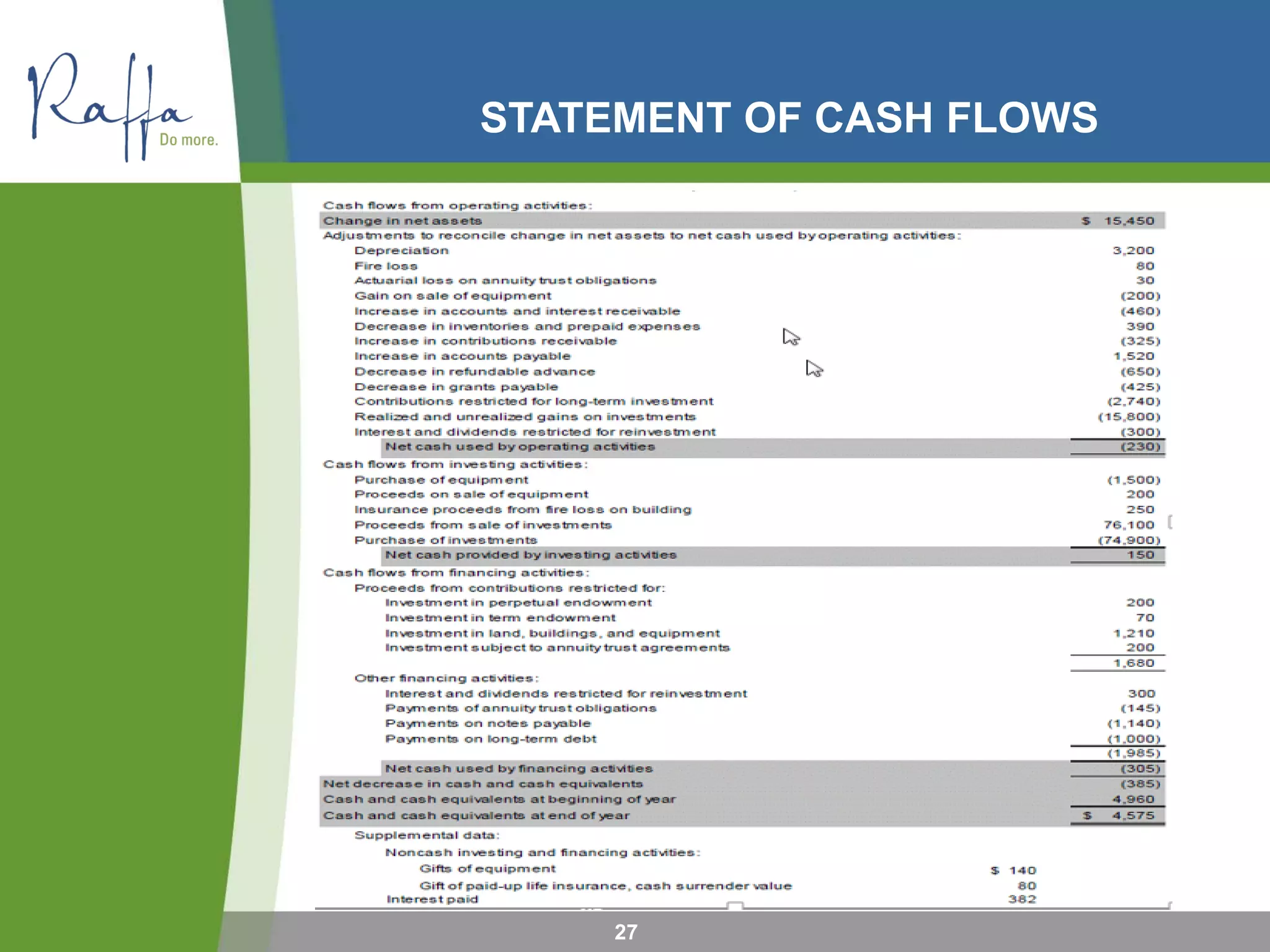
STATEMENT OF CASH FLOWS
• Preliminary deliberations by the FASB
nonprofit task force resulted in permitting
both the direct and indirect methods to be
presented
– The intent is to allow nonprofits to select the
presentation method that best serves their
needs by providing greater flexibility in
financial reporting
• Eliminates the indirect reconciliation
requirement if the direct method is elected
25
STATEMENT OF CASH FLOWS
26
STATEMENT OF CASH FLOWS
27
LIQUIDITY DISCLOSURES
28
LIQUIDITY DISCLOSURES
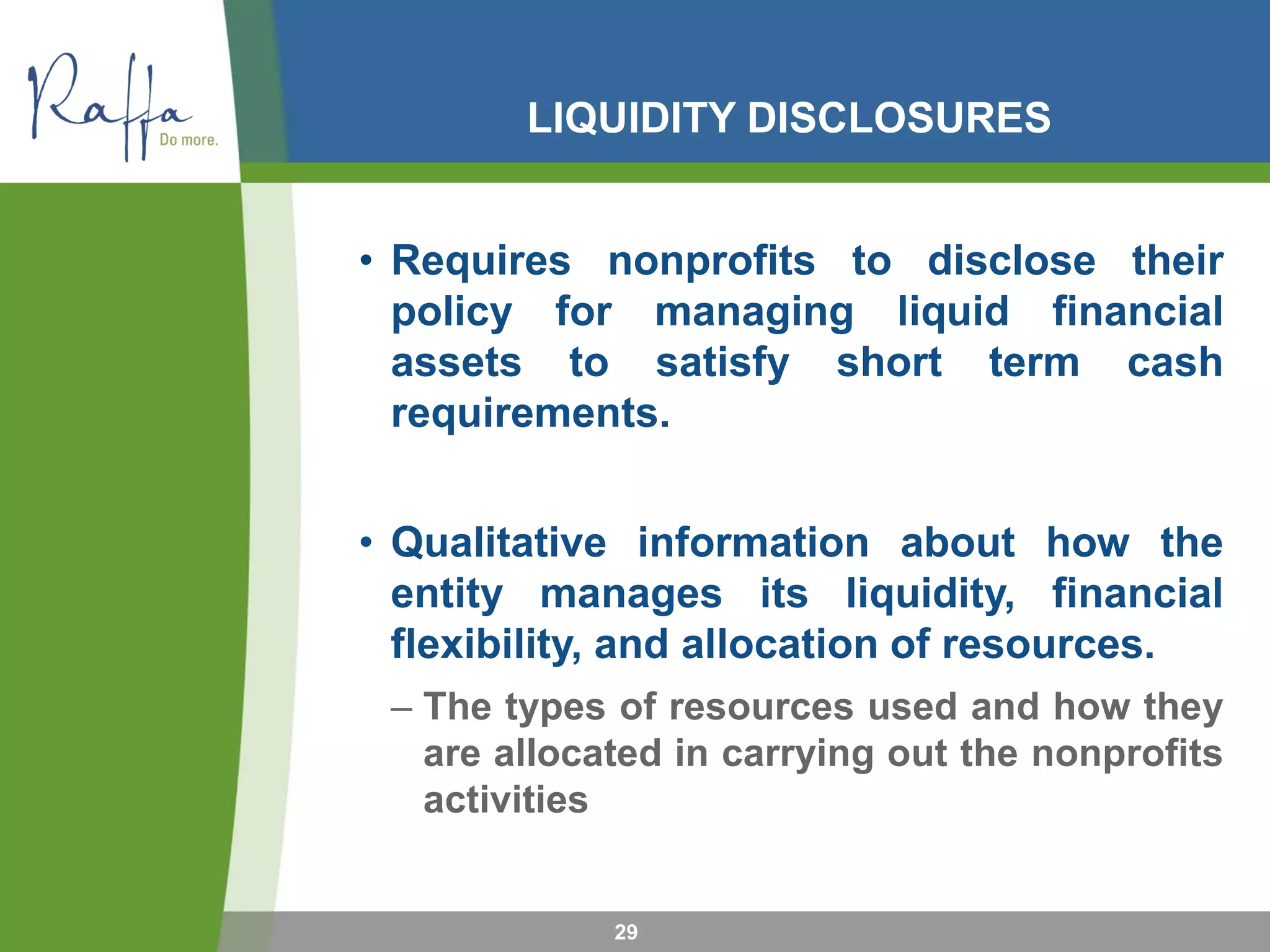
• Requires nonprofits to disclose their
policy for managing liquid financial
assets to satisfy short term cash
requirements.
• Qualitative information about how the
entity manages its liquidity, financial
flexibility, and allocation of resources.
– The types of resources used and how they
are allocated in carrying out the nonprofits
activities
29
LIQUIDITY DISCLOSURES
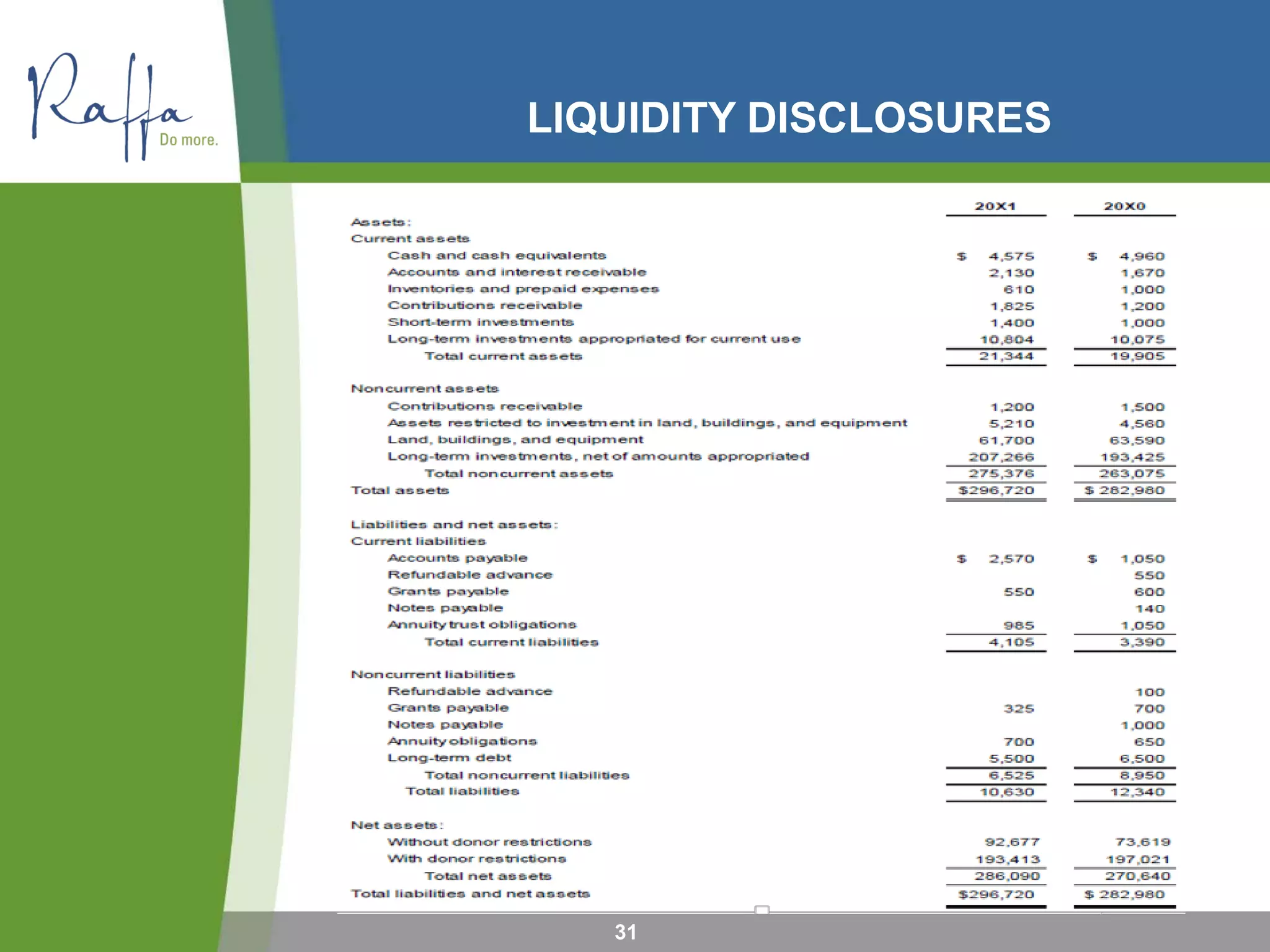
• Quantitative information that
communicates how the nonprofit
manages its liquid resources available to
meet cash needs for general expenditure
within one year.
– Availability could be affected by:
• The asset's nature
• External limits imposed by donors or others
• Internal actions of the governing board
30
LIQUIDITY DISCLOSURES
31
LIQUIDITY DISCLOSURES
32
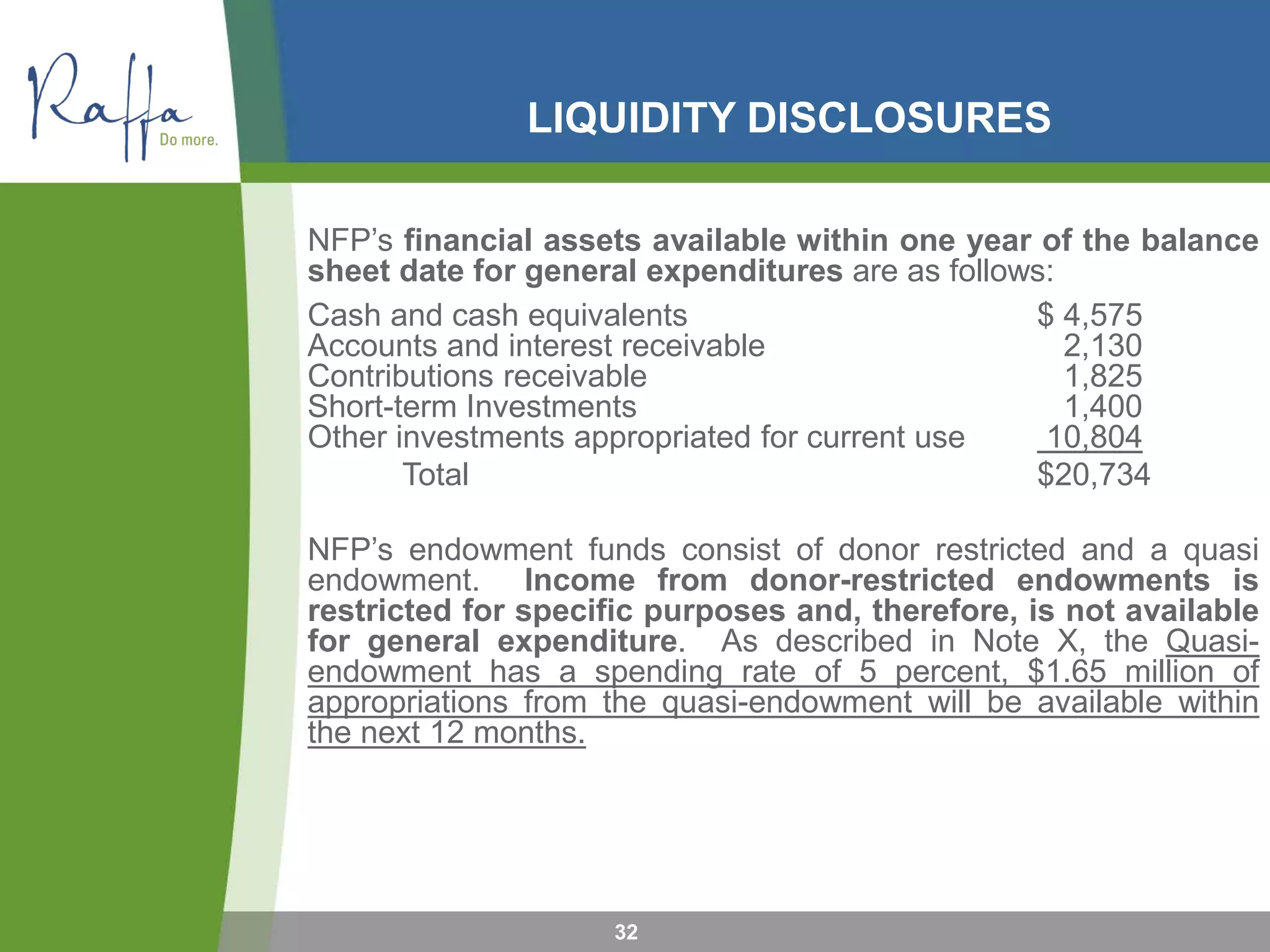
NFP’s financial assets available within one year of the balance
sheet date for general expenditures are as follows:
Cash and cash equivalents $ 4,575
Accounts and interest receivable 2,130
Contributions receivable 1,825
Short-term Investments 1,400
Other investments appropriated for current use 10,804
Total $20,734
NFP’s endowment funds consist of donor restricted and a quasi
endowment. Income from donor-restricted endowments is
restricted for specific purposes and, therefore, is not available
for general expenditure. As described in Note X, the Quasi-
endowment has a spending rate of 5 percent, $1.65 million of
appropriations from the quasi-endowment will be available within
the next 12 months.
LIQUIDITY DISCLOSURES
33
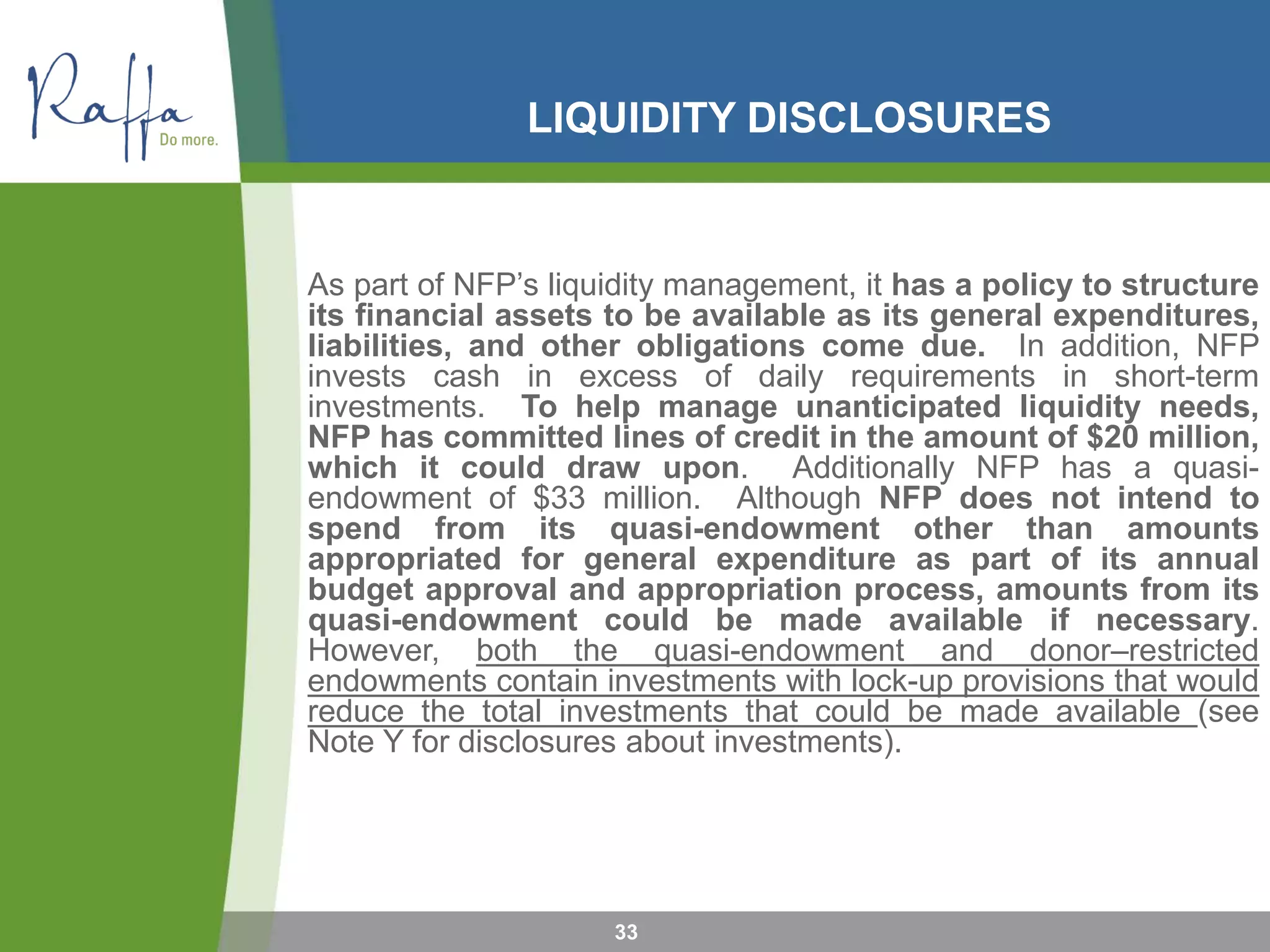
As part of NFP’s liquidity management, it has a policy to structure
its financial assets to be available as its general expenditures,
liabilities, and other obligations come due. In addition, NFP
invests cash in excess of daily requirements in short-term
investments. To help manage unanticipated liquidity needs,
NFP has committed lines of credit in the amount of $20 million,
which it could draw upon. Additionally NFP has a quasi-
endowment of $33 million. Although NFP does not intend to
spend from its quasi-endowment other than amounts
appropriated for general expenditure as part of its annual
budget approval and appropriation process, amounts from its
quasi-endowment could be made available if necessary.
However, both the quasi-endowment and donor–restricted
endowments contain investments with lock-up provisions that would
reduce the total investments that could be made available (see
Note Y for disclosures about investments).
LIQUIDITY EXERCISE
34
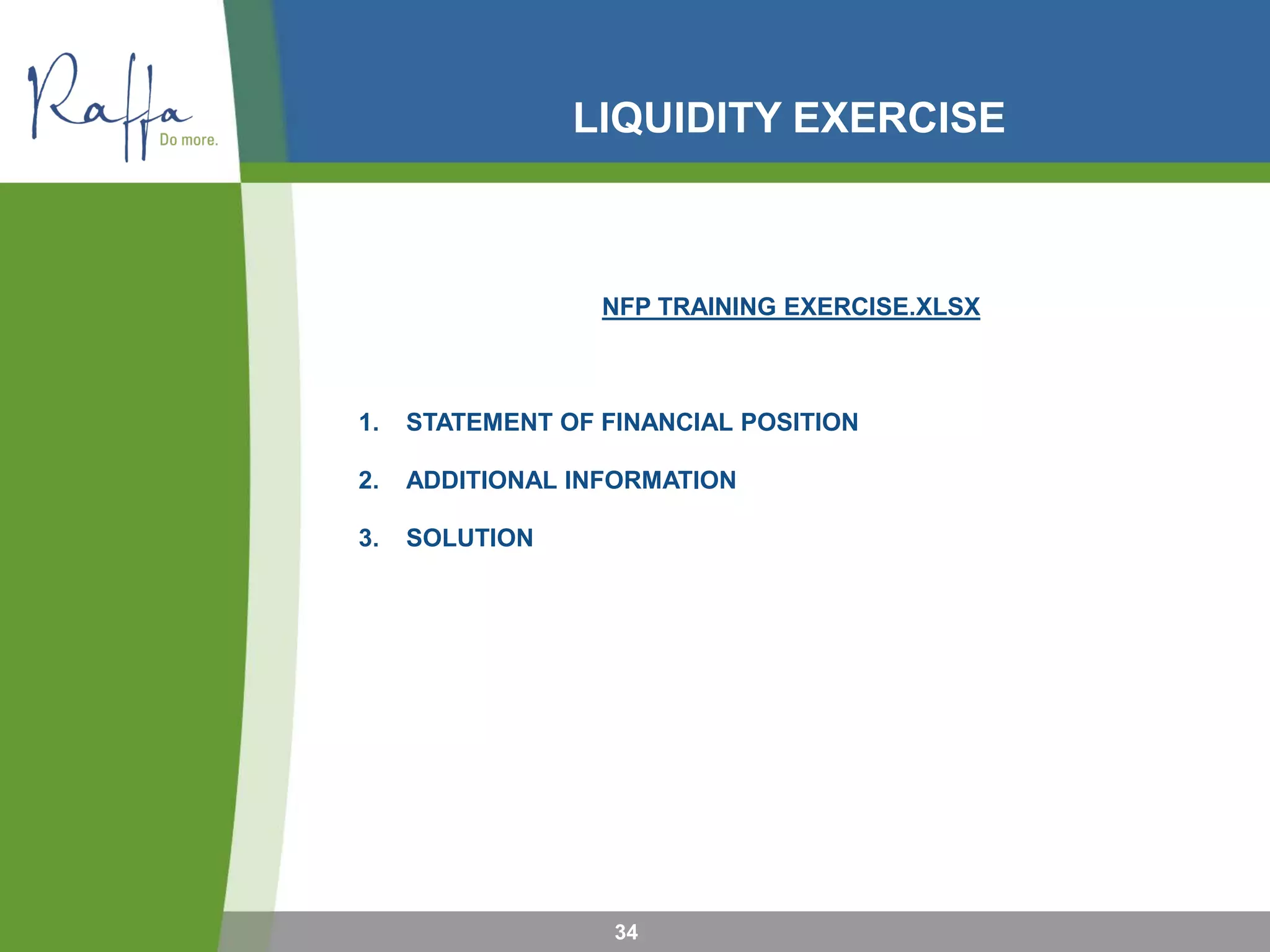
NFP TRAINING EXERCISE.XLSX
1. STATEMENT OF FINANCIAL POSITION
2. ADDITIONAL INFORMATION
3. SOLUTION
OPERATING MEASURE DISCLOSURE
35
OPERATING MEASURE DISCLOSURE
• Many nonprofits chose to make a
distinction between operating and non-
operating activities on the statement of
activities resulting in inconsistencies in
how nonprofits define a measure of
operations
• Presenting an intermediate measure of
operations is still allowable although
disclosures will be enhanced to provide
additional information about the items
included or excluded from the operating
measure
36
OPERATING MEASURE DISCLOSURE
• Phase 2 of the FASB’s project is
scheduled to address the following
additional issues:
–Whether to require intermediate
measure(s)
–Whether and how to define such
measure(s) and what items should be
included
–Alignment of measures of operations
in the statement of activities with
measures of operations in the
statement of cash flows
37
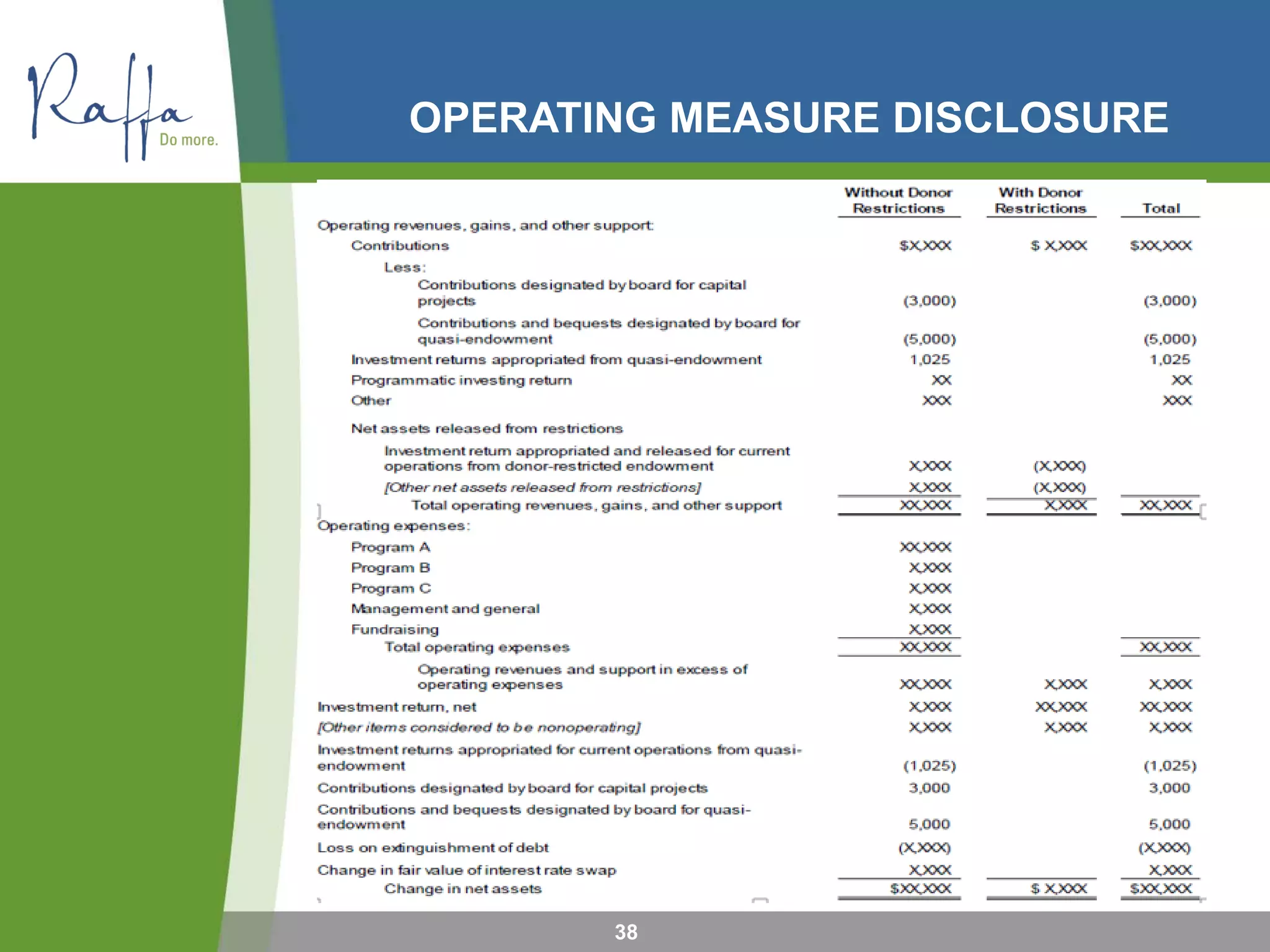
OPERATING MEASURE DISCLOSURE
38
OPERATING MEASURE DISCLOSURE
39
OPERATING MEASURE DISCLOSURE
40
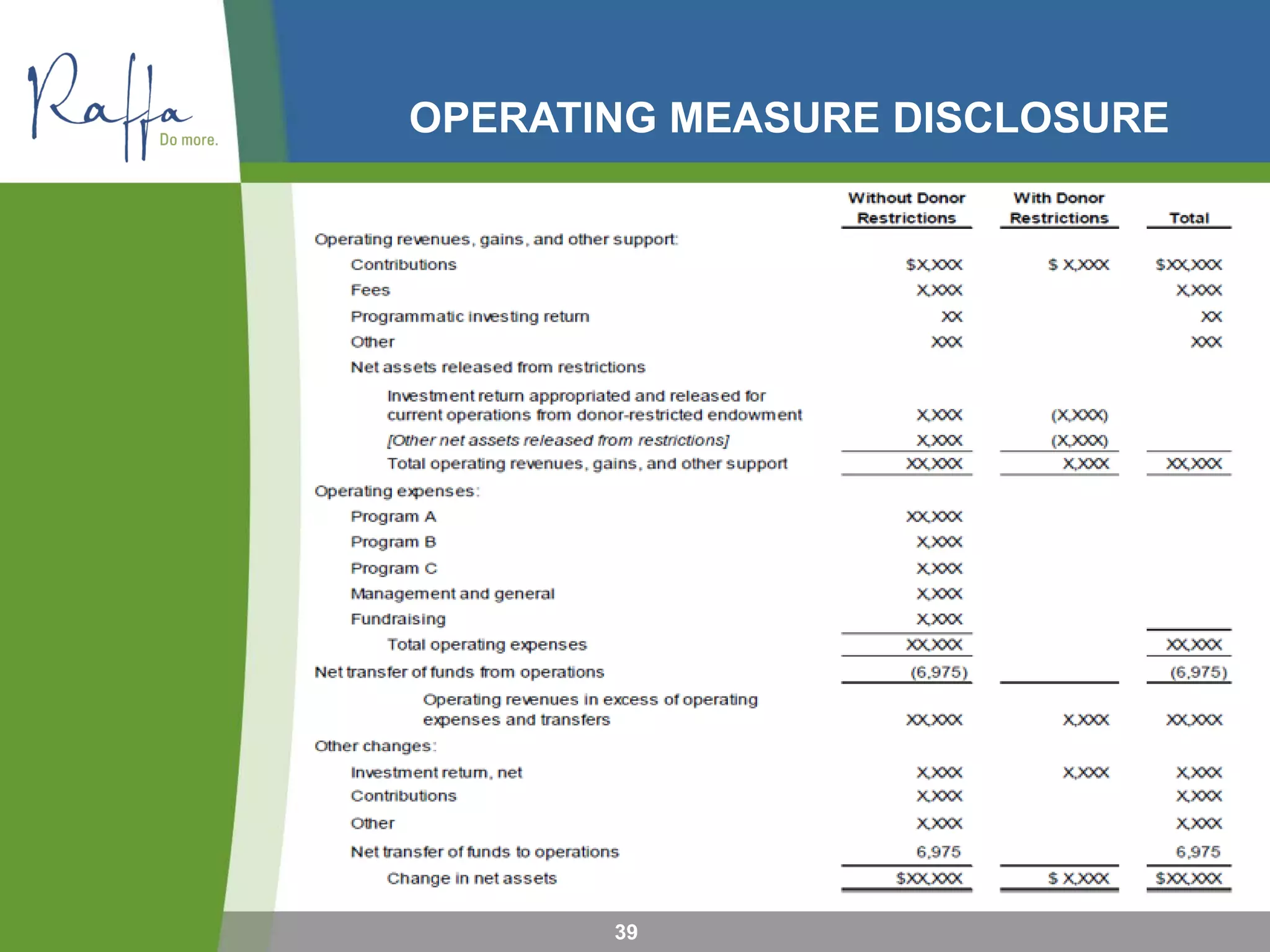
Measure of Operations
NFP’s operating revenues in excess of expenses and
transfers include all operating revenues and expenses that are
an integral part of its programs and supporting activities, net
assets released from donor restrictions to support operating
expenditures, and transfers from Board-designated and other
nonoperating funds to support current operating activities. The
measure of Operations includes support for Operating activities
from both donor restricted net assets and net assets without
donor restrictions designated for longer-term investment (the
donor-restricted and quasi-endowment) according to NFP’s
spending policy, which is detailed in Note X. The measure of
operations excludes investment return in excess of (less than)
amounts made available for current support, gains and losses on
extinguishment of debt, and changes in fair value of the interest
rate swap. Included in the line items net transfer of funds to
operations and net transfer of funds from operations is investment
return appropriated from quasi-endowment to operations of
$1,025, contributions designated by the Board of Trustees for
capital projects from operations of $3,000, and contributions and
bequests designated by the Board of Trustees for quasi-
endowment from operations of $5,000
TRANSITION GUIDANCE
41
TRANSITION GUIDANCE
• ASU 2016-14 NFP entities (topic958): Applies to NFPs
including nongovernmental entities such as charities,
foundations, college and universities, health chare
providers, cultural institutions, religious organizations,
trade associations and other NFPs
– Should be applied on a retrospective basis:
• Apply ALL provisions in year of adoption
• Comparative years – Apply all provisions but may elect
not to include:
– Disclosures regarding liquidity
– Expenses by nature and function
• Disclose the nature of any reclassifications or
restatements and their effects, if any, on changes in
net assets for each period presented
• Early adoption is permitted but must apply regular
transition provisions
42
QUESTIONS & ANSWERS
43
This information may not be reproduced without written permission from
Raffa, P.C., 1899 L Street, NW, Suite 850, Washington, DC 20036 (202) 822-5000
For information for and
about nonprofits visit
www.iknow.org
To become or find a nonprofit board
member visit
www.boardnetusa.org
CONTACT INFORMATION
Visit our Web Site at www.raffa.com
Eric Glantz, Audit Partner
Direct: 202-955-5412
e-mail: EGlantz@raffa.com
Caroline Judy, Audit Manager
Direct: 202-955-6717
e-mail: CJudy@raffa.com
44
45
THANK YOU!

2018-05-31 A New Look for Nonprofits

  • 1.
    A New Lookfor Nonprofits Eric Glantz and Caroline Judy May 31, 2018 Raffa Learning Community Thrive. Grow. Achieve.
  • 2.
    Presentation Title /Page 1 COURSE UPDATE DATE: __MAY 29, 2018___________ COURSE REVIEWED BY: __ERIC GLANTZ__________ COURSE REVIEW DATE: __ MAY 30, 2018 __________ NASBA FIELD OF STUDY: __ACCOUNTING__________
  • 3.
    COURSE AGENDA • EffectiveDate • Net Asset Classes • Investment Return • Classification of Expenses • Statement of Cash Flows • Liquidity Disclosures • Operating Measure Disclosures • Transition Guidance • Q&A 2
  • 4.
    LEARNING OBJECTIVE Financial AccountingStandards Board (FASB) Accounting Standards Update (ASU) No. 2016-14, Not-for-Profit Entities (Topic 958): Presentation of Financial Statements of Not-for-Profit Entities. • It has been more than two decades since the FASB has significantly overhauled the financial statement presentation of non profit organizations. • Most of the changes do not significantly impact the fundamental accounting utilized by nonprofits; rather most changes impact how nonprofit financial statements are being presented to the financial statement user • Course will discuss the timeline and significant changes necessary for compliance (by financial statement component) 3
  • 5.
    ASU 2016-14 NFPENTITIES (TOPIC958): PRESENTATION OF FINANCIAL STATEMENTS OF NFP’S • Applies to NFPs including nongovernmental entities such as charities, foundations, college and universities, health chare providers, cultural institutions, religious organizations, trade associations and other NFPs • FISCAL YEARS BEGINNING AFTER DECEMBER 15, 2017 • For most NFPs the new guidance will be effective for FS’s with fiscal years ending December 31, 2018 4
  • 6.
  • 7.
    NET ASSET CLASSES 6 CurrentlyNet Assets are required to be categorized into three classes: • Available for current operations • Board-designated Unrestricted Net Assets • With donor restrictions that expire once a purpose is accomplished or with the passage of time Temporarily Restricted • Donor restrictions that do not expire • Funds to be held in perpetuity, i.e. an endowment fund Permanently Restricted
  • 8.
    NET ASSET CLASSES 7 NewGuidance re-titles and collapses Net Asset classes as follows: • Unrestricted Net Assets Without Donor Restriction • Temporarily Restricted Net Assets • Permanently Restricted Net Assets With Donor Restriction
  • 9.
    NET ASSET CLASSES •Without Donor Restrictions – Undesignated – Board-designated • Must disclose amount, purpose and type of board designation • With Donor Restrictions – Disclose nature, amount and timing of restrictions at the end of the period and how the restrictions affect the use of resources • Endowment footnote disclosures remain with the underwater portion of endowment funds that are currently classified as unrestricted now being classified as with donor restrictions • Donor restrictions on donated long-lived assets will now be required to be released when the asset is placed in service 8
  • 10.
    NET ASSET CLASSES NetAsset footnote disclosures are being enhanced to include additional information: – Amounts and purposes of governing board designations, appropriations, and similar actions that result in self-imposed limits on the use of resources without donor-imposed restrictions as of the end of the period – Composition of net assets with donor restrictions at the end of the period and how the restrictions affect the use of resources 9
  • 11.
    NET ASSET CLASSES NetAsset footnote disclosures are being enhanced to include additional information: – Underwater net assets: • Nonprofits policy, and any actions taken during the period, concerning appropriations from underwater endowment funds • The aggregate fair value of such funds • The aggregate of the original gift amount (or level required) to be maintained • The aggregate amount by which funds are underwater, which are to be classified as part of the net assets with donor restrictions 10
  • 12.
  • 13.
  • 14.
    REVIEW QUESTION A contributionto establish an endowment will be shown on the Statement of Activities under which labeled column? A. Endowments B. With Donor Restriction C. Permanently Restricted Net Assets D. Without Donor Restriction 13
  • 15.
    REVIEW QUESTION A contributionto establish an endowment will be shown on the Statement of Activities under which labeled column? A. Endowments B. With Donor Restriction C. Permanently Restricted Net Assets D. Without Donor Restriction 14
  • 16.
  • 17.
    INVESTMENT RETURN • Currentlyinvestment income and expenses are either reported separately or net of one another in the financial statements • New Guidance: – A net presentation of investment expenses against investment return is required on the face of the statement of activities – External and direct internal investment expense will be netted against the investment return – Disclosure of netted investment expenses is no longer required in the financial statement notes 16
  • 18.
  • 19.
  • 20.
    CLASSIFICATION OF EXPENSES •All nonprofits will now be required to present an analysis of expenses by both nature and function in one location in the financial statements, either as: – A separate statement • Already required for health and welfare organizations • Used as a supplemental schedule by many nonprofits • May be the most effective presentation option for nonprofits with more than one program – On the face of the statement of activities – Disclosure in the notes to the financial statements 19
  • 21.
    CLASSIFICATION OF EXPENSES •Enhanced disclosures for cost allocation methods and guidance on management and general activities – Additional disclosure regarding specific methodologies used to allocate costs among program and supporting functions. – Investment expenses that have been netted against investment return are not permitted to be included 20
  • 22.
  • 23.
    REVIEW QUESTION All nonprofitsare now required to present an analysis of expenses by both nature and function … A. on the face of the Statement of Activities B. as a disclosure in the notes to the Financial Statements C. As a separate Statement that is part of the basic Financial Statements D. All of the above 22
  • 24.
    REVIEW QUESTION All nonprofitsare now required to present an analysis of expenses by both nature and function … A. on the face of the Statement of Activities B. as a disclosure in the notes to the Financial Statements C. As a separate Statement that is part of the basic Financial Statements D. All of the above 23
  • 25.
  • 26.
    STATEMENT OF CASHFLOWS • Preliminary deliberations by the FASB nonprofit task force resulted in permitting both the direct and indirect methods to be presented – The intent is to allow nonprofits to select the presentation method that best serves their needs by providing greater flexibility in financial reporting • Eliminates the indirect reconciliation requirement if the direct method is elected 25
  • 27.
  • 28.
  • 29.
  • 30.
    LIQUIDITY DISCLOSURES • Requiresnonprofits to disclose their policy for managing liquid financial assets to satisfy short term cash requirements. • Qualitative information about how the entity manages its liquidity, financial flexibility, and allocation of resources. – The types of resources used and how they are allocated in carrying out the nonprofits activities 29
  • 31.
    LIQUIDITY DISCLOSURES • Quantitativeinformation that communicates how the nonprofit manages its liquid resources available to meet cash needs for general expenditure within one year. – Availability could be affected by: • The asset's nature • External limits imposed by donors or others • Internal actions of the governing board 30
  • 32.
  • 33.
    LIQUIDITY DISCLOSURES 32 NFP’s financialassets available within one year of the balance sheet date for general expenditures are as follows: Cash and cash equivalents $ 4,575 Accounts and interest receivable 2,130 Contributions receivable 1,825 Short-term Investments 1,400 Other investments appropriated for current use 10,804 Total $20,734 NFP’s endowment funds consist of donor restricted and a quasi endowment. Income from donor-restricted endowments is restricted for specific purposes and, therefore, is not available for general expenditure. As described in Note X, the Quasi- endowment has a spending rate of 5 percent, $1.65 million of appropriations from the quasi-endowment will be available within the next 12 months.
  • 34.
    LIQUIDITY DISCLOSURES 33 As partof NFP’s liquidity management, it has a policy to structure its financial assets to be available as its general expenditures, liabilities, and other obligations come due. In addition, NFP invests cash in excess of daily requirements in short-term investments. To help manage unanticipated liquidity needs, NFP has committed lines of credit in the amount of $20 million, which it could draw upon. Additionally NFP has a quasi- endowment of $33 million. Although NFP does not intend to spend from its quasi-endowment other than amounts appropriated for general expenditure as part of its annual budget approval and appropriation process, amounts from its quasi-endowment could be made available if necessary. However, both the quasi-endowment and donor–restricted endowments contain investments with lock-up provisions that would reduce the total investments that could be made available (see Note Y for disclosures about investments).
  • 35.
    LIQUIDITY EXERCISE 34 NFP TRAININGEXERCISE.XLSX 1. STATEMENT OF FINANCIAL POSITION 2. ADDITIONAL INFORMATION 3. SOLUTION
  • 36.
  • 37.
    OPERATING MEASURE DISCLOSURE •Many nonprofits chose to make a distinction between operating and non- operating activities on the statement of activities resulting in inconsistencies in how nonprofits define a measure of operations • Presenting an intermediate measure of operations is still allowable although disclosures will be enhanced to provide additional information about the items included or excluded from the operating measure 36
  • 38.
    OPERATING MEASURE DISCLOSURE •Phase 2 of the FASB’s project is scheduled to address the following additional issues: –Whether to require intermediate measure(s) –Whether and how to define such measure(s) and what items should be included –Alignment of measures of operations in the statement of activities with measures of operations in the statement of cash flows 37
  • 39.
  • 40.
  • 41.
    OPERATING MEASURE DISCLOSURE 40 Measureof Operations NFP’s operating revenues in excess of expenses and transfers include all operating revenues and expenses that are an integral part of its programs and supporting activities, net assets released from donor restrictions to support operating expenditures, and transfers from Board-designated and other nonoperating funds to support current operating activities. The measure of Operations includes support for Operating activities from both donor restricted net assets and net assets without donor restrictions designated for longer-term investment (the donor-restricted and quasi-endowment) according to NFP’s spending policy, which is detailed in Note X. The measure of operations excludes investment return in excess of (less than) amounts made available for current support, gains and losses on extinguishment of debt, and changes in fair value of the interest rate swap. Included in the line items net transfer of funds to operations and net transfer of funds from operations is investment return appropriated from quasi-endowment to operations of $1,025, contributions designated by the Board of Trustees for capital projects from operations of $3,000, and contributions and bequests designated by the Board of Trustees for quasi- endowment from operations of $5,000
  • 42.
  • 43.
    TRANSITION GUIDANCE • ASU2016-14 NFP entities (topic958): Applies to NFPs including nongovernmental entities such as charities, foundations, college and universities, health chare providers, cultural institutions, religious organizations, trade associations and other NFPs – Should be applied on a retrospective basis: • Apply ALL provisions in year of adoption • Comparative years – Apply all provisions but may elect not to include: – Disclosures regarding liquidity – Expenses by nature and function • Disclose the nature of any reclassifications or restatements and their effects, if any, on changes in net assets for each period presented • Early adoption is permitted but must apply regular transition provisions 42
  • 44.
  • 45.
    This information maynot be reproduced without written permission from Raffa, P.C., 1899 L Street, NW, Suite 850, Washington, DC 20036 (202) 822-5000 For information for and about nonprofits visit www.iknow.org To become or find a nonprofit board member visit www.boardnetusa.org CONTACT INFORMATION Visit our Web Site at www.raffa.com Eric Glantz, Audit Partner Direct: 202-955-5412 e-mail: EGlantz@raffa.com Caroline Judy, Audit Manager Direct: 202-955-6717 e-mail: CJudy@raffa.com 44
  • 46.