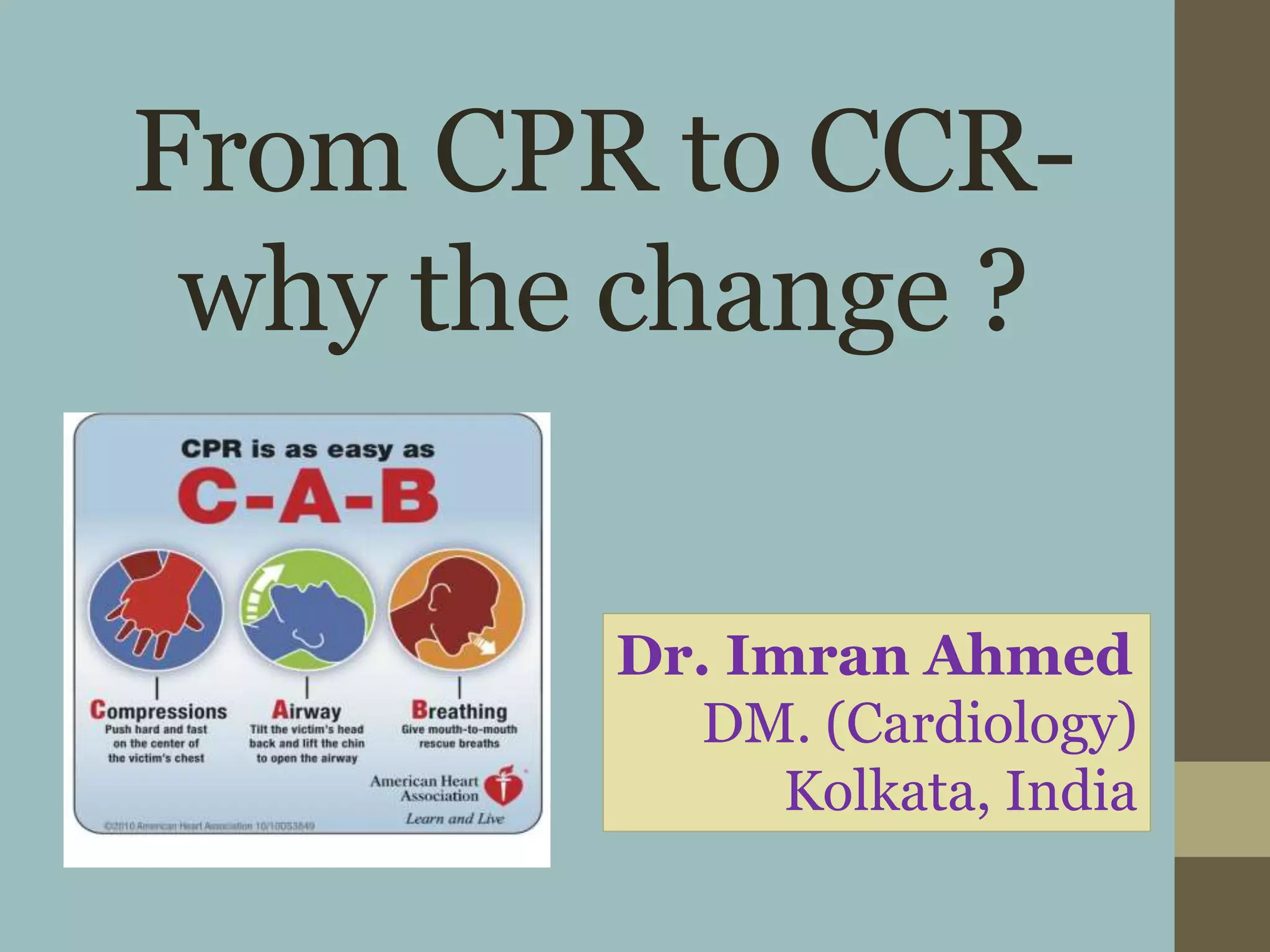
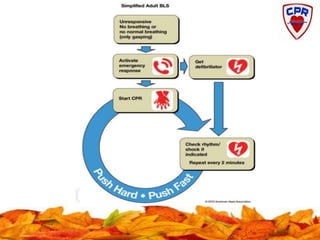
From CPR to CCR-
why the change ?
Dr. Imran Ahmed
DM. (Cardiology)
Kolkata, India
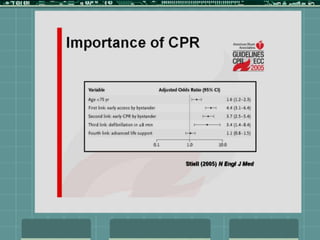
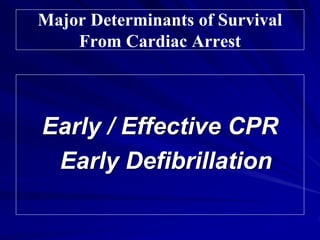
Major Determinants of Survival
From Cardiac Arrest
Early / Effective CPR
Early Defibrillation
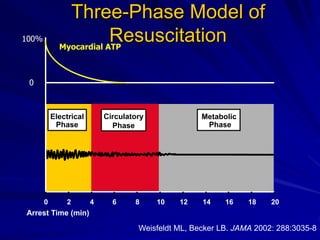
Three-Phase Model of
Resuscitation
0 2 4 6 8 10 12 14 16 18 20
Arrest Time (min)
Circulatory
Phase
Electrical
Phase
Metabolic
Phase
0
100%
Myocardial ATP
Weisfeldt ML, Becker LB. JAMA 2002: 288:3035-8
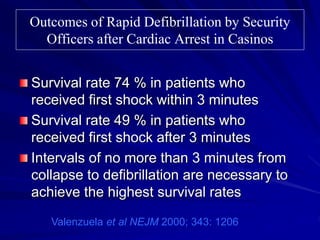
Outcomes of Rapid Defibrillation by Security
Officers after Cardiac Arrest in Casinos
Survival rate 74 % in patients who
received first shock within 3 minutes
Survival rate 49 % in patients who
received first shock after 3 minutes
Intervals of no more than 3 minutes from
collapse to defibrillation are necessary to
achieve the highest survival rates
Valenzuela et al NEJM 2000; 343: 1206
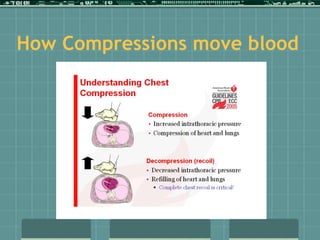
How Compressions move blood
5 sec
80
160
mmHg
Time (sec)
40
120
0
Standard CPR: 30:2
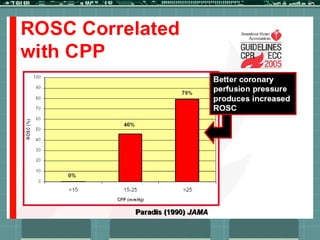
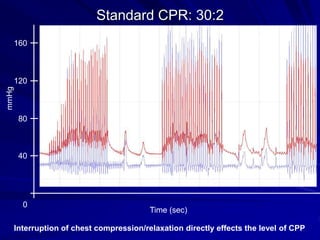
Interruption of chest compression/relaxation directly effects the level of CPP
From CPR to CCR-
why the change ?
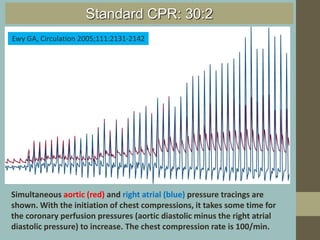
Simultaneous aortic (red) and right atrial (blue) pressure tracings are
shown. With the initiation of chest compressions, it takes some time for
the coronary perfusion pressures (aortic diastolic minus the right atrial
diastolic pressure) to increase. The chest compression rate is 100/min.
Standard CPR: 30:2
Ewy GA, Circulation 2005;111:2131-2142
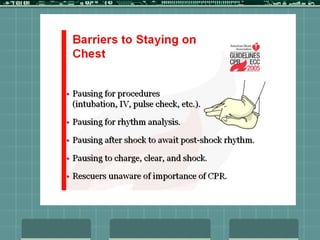
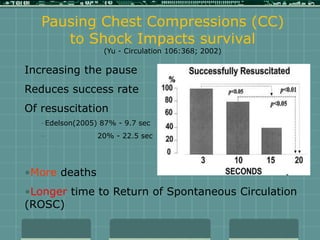
Pausing Chest Compressions (CC)
to Shock Impacts survival
(Yu - Circulation 106:368; 2002)
Increasing the pause
Reduces success rate
Of resuscitation
–Edelson(2005) 87% - 9.7 sec
– 20% - 22.5 sec
•More deaths
•Longer time to Return of Spontaneous Circulation
(ROSC)
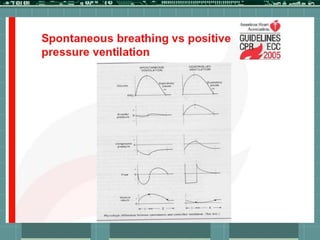
Drawbacks of mouth to mouth ventilations
• Bystanders not willing to perform mouth to mouth
• Long interruptions of chest compression
• Intrathoracic pressure is increased
• Can lead to gastric regurgitations
• Not necessary in those who are gasping initially –
CC suffices
Virkunnen I. J Int Med. 2010, 260:39-42
Summary of pathophysiology of Resuscitation
 Chest compressions are the single most important
intervention !!!!
Optimal QUALITY is essential
Interruptions are deadly → continuous
 Ventilation can be deadly
Don’t do when not needed
Do it without error when needed
 Interventions MUST be prioritized. Learn
What to do it
When to do it
How to do it as well as possible
Defibb is better than chest compressions only in the <4
mins
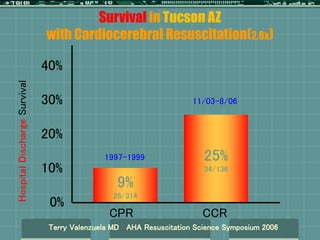
Survival in Tucson AZ
with Cardiocerebral Resuscitation(2.8x)
HospitalDischargeSurvival
40%
30%
20%
10%
0%
CPR CCR
9%
28/314
25%
34/136
Terry Valenzuela MD AHA Resuscitation Science Symposium 2006
11/03-8/06
1997-1999
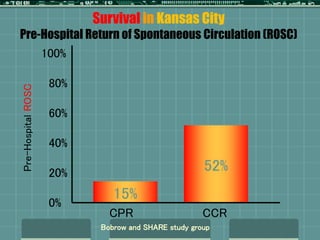
Survival in Kansas City
Pre-Hospital Return of Spontaneous Circulation (ROSC)
Pre-HospitalROSC
100%
80%
60%
40%
20%
0%
CPR CCR
15%
52%
Bobrow and SHARE study group
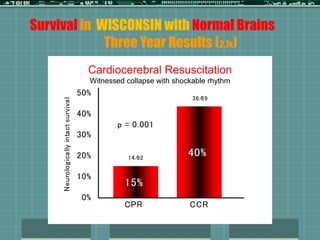
Survival in WISCONSIN with Normal Brains
Three Year Results (2.7x)
Cardiocerebral Resuscitation
Witnessed collapse with shockable rhythm
Neurologicallyintactsurvival
50%
40%
30%
20%
10%
0%
CPR CCR
15%
40%
p = 0.001
14/92
36/89
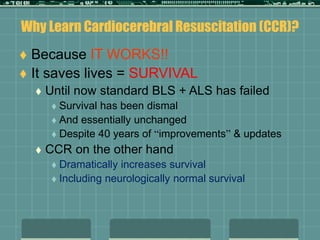
Why Learn Cardiocerebral Resuscitation (CCR)?
 Because IT WORKS!!
 It saves lives = SURVIVAL
 Until now standard BLS + ALS has failed
 Survival has been dismal
 And essentially unchanged
 Despite 40 years of “improvements” & updates
 CCR on the other hand
 Dramatically increases survival
 Including neurologically normal survival
Why is Cardiocerebral Resuscitation (CCR) better
than Cardiopulmonary Resuscitation (CPR)?
 “CPR” evolved as a single treatment for two totally
different disease processes:
Respiratory and Cardiac arrests
 They differ dramatically in how much oxygen exists in
their blood at the onset of arrest
Drowning or choking victims use up all available oxygen
before arresting.
They DO need early ventilation
 Cardiac arrest victims have normal oxygenation
Initially they do NOT need additional oxygen
Instead they need existing O2 pumped to the two
organs that determine survival – the heart and brain
CCR is REALLY SIMPLE stuff !
Continuous Chest Compressions
Quality Chest Compressions
Uninterrupted Chest Compressions
 Quality is crucial – MUST be monitored by the other
pumper
 Rate (use metronome) of 100 / min
 Depth adequate
 Recoil absolutely crucial
You can ONLY stop Chest Compressions (CC)
for
Switching pumpers (every minute) 2-3 seconds
 Analysis - Is shock indicated (every 200 CC)? 2-3
seconds
Shocking 5-7 sec
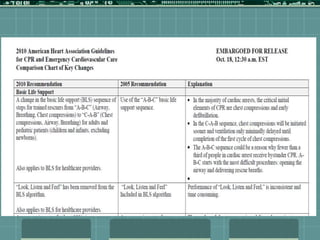
2005 AHA Guidelines
“For adult OHCA that is not
witnessed, rescuers may give a
period of CPR before checking
the rhythm and attempting
defibrillation” (Class IIb)
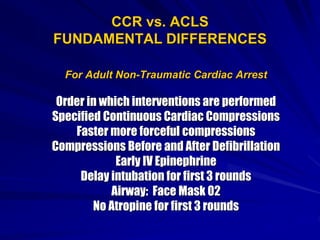
CCR vs. ACLS
FUNDAMENTAL DIFFERENCES
For Adult Non-Traumatic Cardiac Arrest
Order in which interventions are performed
Specified Continuous Cardiac Compressions
Faster more forceful compressions
Compressions Before and After Defibrillation
Early IV Epinephrine
Delay intubation for first 3 rounds
Airway: Face Mask 02
No Atropine for first 3 rounds
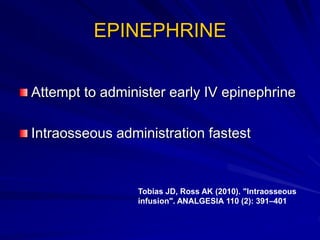
EPINEPHRINE
Attempt to administer early IV epinephrine
Intraosseous administration fastest
Tobias JD, Ross AK (2010). "Intraosseous
infusion". ANALGESIA 110 (2): 391–401
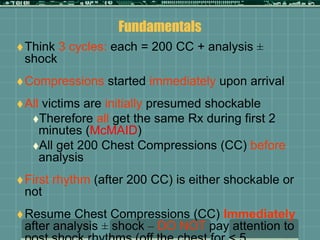
Fundamentals
Think 3 cycles: each = 200 CC + analysis ±
shock
Compressions started immediately upon arrival
All victims are initially presumed shockable
Therefore all get the same Rx during first 2
minutes (McMAID)
All get 200 Chest Compressions (CC) before
analysis
First rhythm (after 200 CC) is either shockable or
not
Resume Chest Compressions (CC) Immediately
after analysis ± shock – DO NOT pay attention to
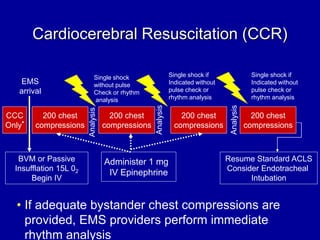
Cardiocerebral Resuscitation (CCR)
200 chest
compressions
200 chest
compressions
Single shock
without pulse
Check or rhythm
analysis
BVM or Passive
Insufflation 15L 02
Begin IV
Analysis
200 chest
compressions
Single shock if
Indicated without
pulse check or
rhythm analysis
Analysis
Single shock if
Indicated without
pulse check or
rhythm analysis
Resume Standard ACLS
Consider Endotracheal
Intubation
200 chest
compressions
CCC
Only•
EMS
arrival
Administer 1 mg
IV Epinephrine
Analysis
• If adequate bystander chest compressions are
provided, EMS providers perform immediate
rhythm analysis
Protocol
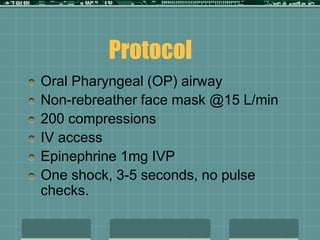
Oral Pharyngeal (OP) airway
Non-rebreather face mask @15 L/min
200 compressions
IV access
Epinephrine 1mg IVP
One shock, 3-5 seconds, no pulse
checks.
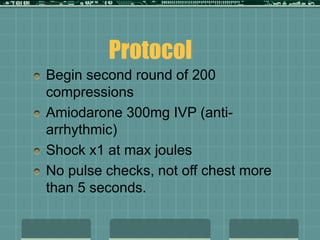
Begin second round of 200
compressions
Amiodarone 300mg IVP (anti-
arrhythmic)
Shock x1 at max joules
No pulse checks, not off chest more
than 5 seconds.
Protocol
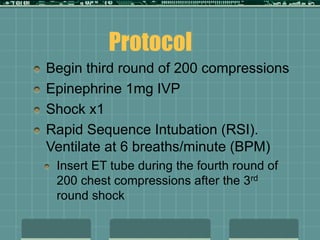
Begin third round of 200 compressions
Epinephrine 1mg IVP
Shock x1
Rapid Sequence Intubation (RSI).
Ventilate at 6 breaths/minute (BPM)
Insert ET tube during the fourth round of
200 chest compressions after the 3rd
round shock
Protocol
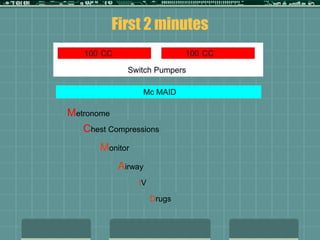
First 2 minutes
Monitor
Airway
IV
Drugs
Mc MAID
Metronome
Chest Compressions
First 2 minutes
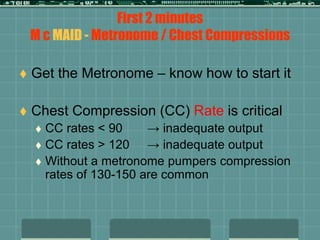
M c MAID - Metronome / Chest Compressions
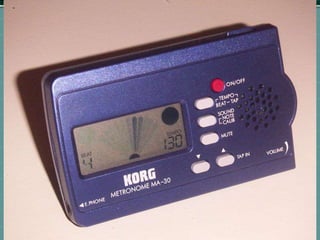
 Get the Metronome – know how to start it
 Chest Compression (CC) Rate is critical
 CC rates < 90 → inadequate output
 CC rates > 120 → inadequate output
 Without a metronome pumpers compression
rates of 130-150 are common
First 2 minutes
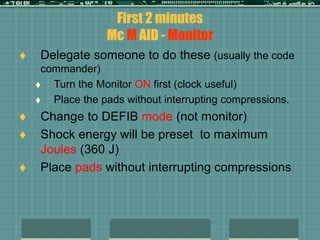
Mc M AID - Monitor
 Delegate someone to do these (usually the code
commander)
 Turn the Monitor ON first (clock useful)
 Place the pads without interrupting compressions.
 Change to DEFIB mode (not monitor)
 Shock energy will be preset to maximum
Joules (360 J)
 Place pads without interrupting compressions
First 2 minutes
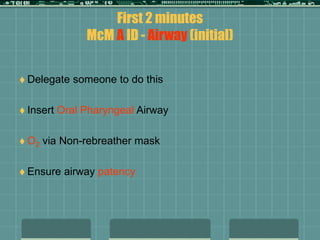
McM A ID - Airway (initial)
 Delegate someone to do this
 Insert Oral Pharyngeal Airway
 O2 via Non-rebreather mask
 Ensure airway patency
First 2 minutes
McMA I D - IV - vascular access
Use Interosseous (IO) whenever a delay is
anticipated
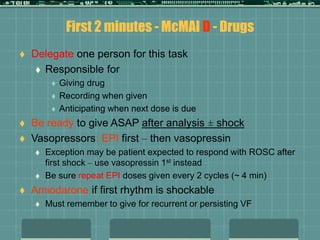
First 2 minutes - McMAI D - Drugs
 Delegate one person for this task
 Responsible for
 Giving drug
 Recording when given
 Anticipating when next dose is due
 Be ready to give ASAP after analysis ± shock
 Vasopressors: EPI first – then vasopressin
 Exception may be patient expected to respond with ROSC after
first shock – use vasopressin 1st instead
 Be sure repeat EPI doses given every 2 cycles (~ 4 min)
 Amiodarone if first rhythm is shockable
 Must remember to give for recurrent or persisting VF
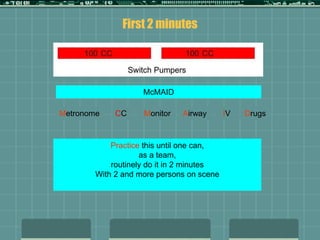
First 2 minutes
Metronome Monitor Airway IV Drugs
McMAID
Practice this until one can,
as a team,
routinely do it in 2 minutes
With 2 and more persons on scene
CC
Even seconds without
Chest Compressions
are deadly
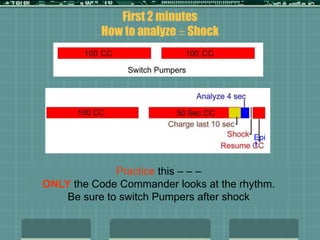
First 2 minutes
How to analyze ± Shock
Practice this – – –
ONLY the Code Commander looks at the rhythm.
Be sure to switch Pumpers after shock
Epi
Invasive Airway + Ventilations
 1 rescuer MUST be available to devote full-time attention
to this task
 Endotracheal (ET) insertion will always reduce the
quality of Chest Compressions (CC)
 Paramedics are directed to use a Combitube if they do
not get ET on the FIRST try
 Anticipate this and have a Combitube ready!
 Consider using Combitube in ALL initially shockable patients
 A 2nd person must ensure proper ventilation
 Time each individual ventilation (1 second)
 8-10 seconds between vents (6-8 ventilations / minute)
 Volume ~ 500 CC (about 1/2 of an Adult Bag Valve Mask)
 ** Volume given over 1 second **
 Attach EtCO2
When to Stop Chest Compressions (CC)?
 If the patient shows signs of brain function AND the
rhythm is non-shockable
 Clues to ROSC (Return of Spontaneous Circulation)
 Waking up
 Visualized carotid pulses
 Agonal gasps → regular respirations
 End tidal CO2 jumps to normal or supra-normal
 Pulse check ONLY during pause for analysis
 Correlate with rhythm
 DO NOT stop Chest Compressions for a good looking
rhythm without other clues that ROSC has occurred.
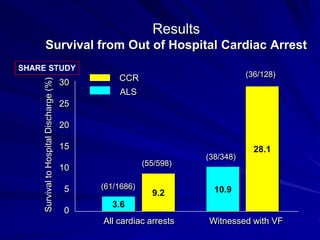
9.2
28.1
3.6
10.9
Results
Survival from Out of Hospital Cardiac ArrestSurvivaltoHospitalDischarge(%)
30
25
20
15
10
5
0
All cardiac arrests Witnessed with VF
(55/598)
(61/1686)
(36/128)
(38/348)
CCR
ALS
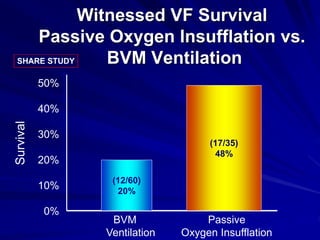
Witnessed VF Survival
Passive Oxygen Insufflation vs.
BVM Ventilation
(17/35)
48%
(12/60)
20%
50%
40%
30%
20%
10%
0%
Survival
BVM
Ventilation
Passive
Oxygen Insufflation
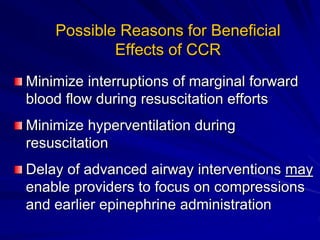
Possible Reasons for Beneficial
Effects of CCR
Minimize interruptions of marginal forward
blood flow during resuscitation efforts
Minimize hyperventilation during
resuscitation
Delay of advanced airway interventions may
enable providers to focus on compressions
and earlier epinephrine administration
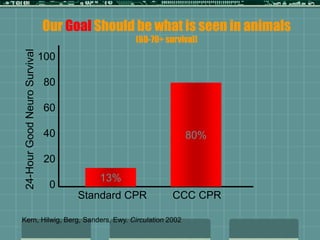
Our Goal Should be what is seen in animals
(60-70+ survival)
24-HourGoodNeuroSurvival
100
80
60
40
20
0
80%
13%
Standard CPR CCC CPR
Kern, Hilwig, Berg, Sanders, Ewy. Circulation 2002
Adult Basic Life Support
• Minimize the frequency
and duration of
interruptions in
compressions (Class IIa).
• Once chest compressions
have been started, a
trained rescuer should
deliver rescue breaths by
mouth-to-mouth or bag-
mask to provide
oxygenation and
ventilation.
Adult Basic Life Support
• Rescuer fatigue may lead to inadequate
compression rates or depth.
• When 2 or more rescuers are available it is
reasonable to switch chest compressors
approximately every 2 minutes (or after about 5
cycles of compressions and ventilations at a
ratio of 30:2) to prevent decreases in the
quality of compressions (Class IIa).
• Every effort should be made to accomplish this
switch in 5 seconds.
Adult Basic Life Support
• As long as the patient does not have an
advanced airway in place, the rescuers
should deliver cycles of 30 compressions
and 2 breaths during CPR.
• The rescuer delivers ventilations during
pauses in compressions and delivers each
breath over 1 second (Class IIa).
• The healthcare provider should use
supplementary oxygen (O2 concentration
40%, at a minimum flow rate of 10 to 12
L/min) when available.
Adult Basic Life Support
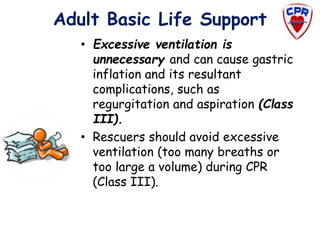
• Excessive ventilation is
unnecessary and can cause gastric
inflation and its resultant
complications, such as
regurgitation and aspiration (Class
III).
• Rescuers should avoid excessive
ventilation (too many breaths or
too large a volume) during CPR
(Class III).
Adult Basic Life Support
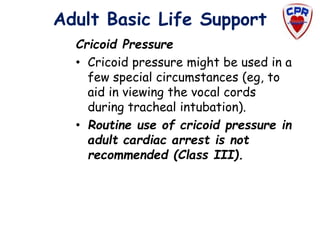
Cricoid Pressure
• Cricoid pressure might be used in a
few special circumstances (eg, to
aid in viewing the vocal cords
during tracheal intubation).
• Routine use of cricoid pressure in
adult cardiac arrest is not
recommended (Class III).
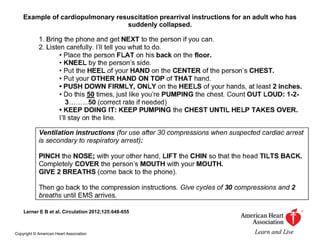
Example of cardiopulmonary resuscitation prearrival instructions for an adult who has
suddenly collapsed.
Lerner E B et al. Circulation 2012;125:648-655
Copyright © American Heart Association
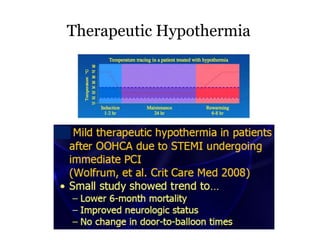
Therapeutic Hypothermia
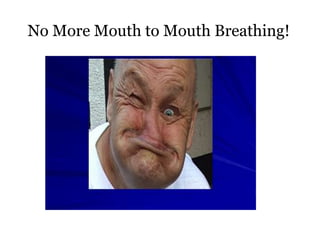
No More Mouth to Mouth Breathing!
Conclusions
• CCR provides uninterrupted perfusion to
heart and brain essential for neurologically
intact survival
• CCR has led to dramatic improvements in
survival vs CPR
• More aggressive post resuscitation care with
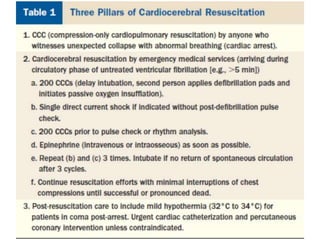
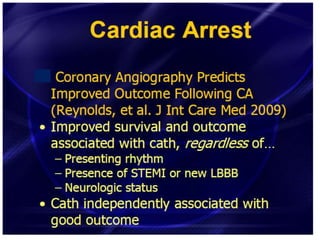
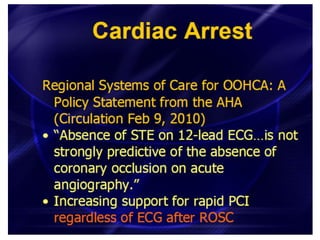
hypothermia / emergent cath-PCI is required
to save even more victims of cardiac arrest
Cardiac resuscitation - fresh views and changes!

Cardiac resuscitation - fresh views and changes!

  • 1.
    From CPR toCCR- why the change ? Dr. Imran Ahmed DM. (Cardiology) Kolkata, India
  • 4.
    Major Determinants ofSurvival From Cardiac Arrest Early / Effective CPR Early Defibrillation
  • 5.
    Three-Phase Model of Resuscitation 02 4 6 8 10 12 14 16 18 20 Arrest Time (min) Circulatory Phase Electrical Phase Metabolic Phase 0 100% Myocardial ATP Weisfeldt ML, Becker LB. JAMA 2002: 288:3035-8
  • 7.
    Outcomes of RapidDefibrillation by Security Officers after Cardiac Arrest in Casinos Survival rate 74 % in patients who received first shock within 3 minutes Survival rate 49 % in patients who received first shock after 3 minutes Intervals of no more than 3 minutes from collapse to defibrillation are necessary to achieve the highest survival rates Valenzuela et al NEJM 2000; 343: 1206
  • 8.
  • 10.
    5 sec 80 160 mmHg Time (sec) 40 120 0 StandardCPR: 30:2 Interruption of chest compression/relaxation directly effects the level of CPP
  • 11.
    From CPR toCCR- why the change ? Simultaneous aortic (red) and right atrial (blue) pressure tracings are shown. With the initiation of chest compressions, it takes some time for the coronary perfusion pressures (aortic diastolic minus the right atrial diastolic pressure) to increase. The chest compression rate is 100/min. Standard CPR: 30:2 Ewy GA, Circulation 2005;111:2131-2142
  • 13.
    Pausing Chest Compressions(CC) to Shock Impacts survival (Yu - Circulation 106:368; 2002) Increasing the pause Reduces success rate Of resuscitation –Edelson(2005) 87% - 9.7 sec – 20% - 22.5 sec •More deaths •Longer time to Return of Spontaneous Circulation (ROSC)
  • 15.
    Drawbacks of mouthto mouth ventilations • Bystanders not willing to perform mouth to mouth • Long interruptions of chest compression • Intrathoracic pressure is increased • Can lead to gastric regurgitations • Not necessary in those who are gasping initially – CC suffices Virkunnen I. J Int Med. 2010, 260:39-42
  • 16.
    Summary of pathophysiologyof Resuscitation  Chest compressions are the single most important intervention !!!! Optimal QUALITY is essential Interruptions are deadly → continuous  Ventilation can be deadly Don’t do when not needed Do it without error when needed  Interventions MUST be prioritized. Learn What to do it When to do it How to do it as well as possible Defibb is better than chest compressions only in the <4 mins
  • 17.
    Survival in TucsonAZ with Cardiocerebral Resuscitation(2.8x) HospitalDischargeSurvival 40% 30% 20% 10% 0% CPR CCR 9% 28/314 25% 34/136 Terry Valenzuela MD AHA Resuscitation Science Symposium 2006 11/03-8/06 1997-1999
  • 18.
    Survival in KansasCity Pre-Hospital Return of Spontaneous Circulation (ROSC) Pre-HospitalROSC 100% 80% 60% 40% 20% 0% CPR CCR 15% 52% Bobrow and SHARE study group
  • 19.
    Survival in WISCONSINwith Normal Brains Three Year Results (2.7x) Cardiocerebral Resuscitation Witnessed collapse with shockable rhythm Neurologicallyintactsurvival 50% 40% 30% 20% 10% 0% CPR CCR 15% 40% p = 0.001 14/92 36/89
  • 20.
    Why Learn CardiocerebralResuscitation (CCR)?  Because IT WORKS!!  It saves lives = SURVIVAL  Until now standard BLS + ALS has failed  Survival has been dismal  And essentially unchanged  Despite 40 years of “improvements” & updates  CCR on the other hand  Dramatically increases survival  Including neurologically normal survival
  • 21.
    Why is CardiocerebralResuscitation (CCR) better than Cardiopulmonary Resuscitation (CPR)?  “CPR” evolved as a single treatment for two totally different disease processes: Respiratory and Cardiac arrests  They differ dramatically in how much oxygen exists in their blood at the onset of arrest Drowning or choking victims use up all available oxygen before arresting. They DO need early ventilation  Cardiac arrest victims have normal oxygenation Initially they do NOT need additional oxygen Instead they need existing O2 pumped to the two organs that determine survival – the heart and brain
  • 22.
    CCR is REALLYSIMPLE stuff ! Continuous Chest Compressions Quality Chest Compressions Uninterrupted Chest Compressions  Quality is crucial – MUST be monitored by the other pumper  Rate (use metronome) of 100 / min  Depth adequate  Recoil absolutely crucial You can ONLY stop Chest Compressions (CC) for Switching pumpers (every minute) 2-3 seconds  Analysis - Is shock indicated (every 200 CC)? 2-3 seconds Shocking 5-7 sec
  • 24.
    2005 AHA Guidelines “Foradult OHCA that is not witnessed, rescuers may give a period of CPR before checking the rhythm and attempting defibrillation” (Class IIb)
  • 25.
    CCR vs. ACLS FUNDAMENTALDIFFERENCES For Adult Non-Traumatic Cardiac Arrest Order in which interventions are performed Specified Continuous Cardiac Compressions Faster more forceful compressions Compressions Before and After Defibrillation Early IV Epinephrine Delay intubation for first 3 rounds Airway: Face Mask 02 No Atropine for first 3 rounds
  • 26.
    EPINEPHRINE Attempt to administerearly IV epinephrine Intraosseous administration fastest Tobias JD, Ross AK (2010). "Intraosseous infusion". ANALGESIA 110 (2): 391–401
  • 27.
    Fundamentals Think 3 cycles:each = 200 CC + analysis ± shock Compressions started immediately upon arrival All victims are initially presumed shockable Therefore all get the same Rx during first 2 minutes (McMAID) All get 200 Chest Compressions (CC) before analysis First rhythm (after 200 CC) is either shockable or not Resume Chest Compressions (CC) Immediately after analysis ± shock – DO NOT pay attention to
  • 28.
    Cardiocerebral Resuscitation (CCR) 200chest compressions 200 chest compressions Single shock without pulse Check or rhythm analysis BVM or Passive Insufflation 15L 02 Begin IV Analysis 200 chest compressions Single shock if Indicated without pulse check or rhythm analysis Analysis Single shock if Indicated without pulse check or rhythm analysis Resume Standard ACLS Consider Endotracheal Intubation 200 chest compressions CCC Only• EMS arrival Administer 1 mg IV Epinephrine Analysis • If adequate bystander chest compressions are provided, EMS providers perform immediate rhythm analysis
  • 29.
    Protocol Oral Pharyngeal (OP)airway Non-rebreather face mask @15 L/min 200 compressions IV access Epinephrine 1mg IVP One shock, 3-5 seconds, no pulse checks.
  • 30.
    Begin second roundof 200 compressions Amiodarone 300mg IVP (anti- arrhythmic) Shock x1 at max joules No pulse checks, not off chest more than 5 seconds. Protocol
  • 31.
    Begin third roundof 200 compressions Epinephrine 1mg IVP Shock x1 Rapid Sequence Intubation (RSI). Ventilate at 6 breaths/minute (BPM) Insert ET tube during the fourth round of 200 chest compressions after the 3rd round shock Protocol
  • 32.
    First 2 minutes Monitor Airway IV Drugs McMAID Metronome Chest Compressions
  • 33.
    First 2 minutes Mc MAID - Metronome / Chest Compressions  Get the Metronome – know how to start it  Chest Compression (CC) Rate is critical  CC rates < 90 → inadequate output  CC rates > 120 → inadequate output  Without a metronome pumpers compression rates of 130-150 are common
  • 34.
    First 2 minutes McM AID - Monitor  Delegate someone to do these (usually the code commander)  Turn the Monitor ON first (clock useful)  Place the pads without interrupting compressions.  Change to DEFIB mode (not monitor)  Shock energy will be preset to maximum Joules (360 J)  Place pads without interrupting compressions
  • 35.
    First 2 minutes McMA ID - Airway (initial)  Delegate someone to do this  Insert Oral Pharyngeal Airway  O2 via Non-rebreather mask  Ensure airway patency
  • 36.
    First 2 minutes McMAI D - IV - vascular access Use Interosseous (IO) whenever a delay is anticipated
  • 37.
    First 2 minutes- McMAI D - Drugs  Delegate one person for this task  Responsible for  Giving drug  Recording when given  Anticipating when next dose is due  Be ready to give ASAP after analysis ± shock  Vasopressors: EPI first – then vasopressin  Exception may be patient expected to respond with ROSC after first shock – use vasopressin 1st instead  Be sure repeat EPI doses given every 2 cycles (~ 4 min)  Amiodarone if first rhythm is shockable  Must remember to give for recurrent or persisting VF
  • 38.
    First 2 minutes MetronomeMonitor Airway IV Drugs McMAID Practice this until one can, as a team, routinely do it in 2 minutes With 2 and more persons on scene CC
  • 39.
    Even seconds without ChestCompressions are deadly
  • 40.
    First 2 minutes Howto analyze ± Shock Practice this – – – ONLY the Code Commander looks at the rhythm. Be sure to switch Pumpers after shock Epi
  • 41.
    Invasive Airway +Ventilations  1 rescuer MUST be available to devote full-time attention to this task  Endotracheal (ET) insertion will always reduce the quality of Chest Compressions (CC)  Paramedics are directed to use a Combitube if they do not get ET on the FIRST try  Anticipate this and have a Combitube ready!  Consider using Combitube in ALL initially shockable patients  A 2nd person must ensure proper ventilation  Time each individual ventilation (1 second)  8-10 seconds between vents (6-8 ventilations / minute)  Volume ~ 500 CC (about 1/2 of an Adult Bag Valve Mask)  ** Volume given over 1 second **  Attach EtCO2
  • 42.
    When to StopChest Compressions (CC)?  If the patient shows signs of brain function AND the rhythm is non-shockable  Clues to ROSC (Return of Spontaneous Circulation)  Waking up  Visualized carotid pulses  Agonal gasps → regular respirations  End tidal CO2 jumps to normal or supra-normal  Pulse check ONLY during pause for analysis  Correlate with rhythm  DO NOT stop Chest Compressions for a good looking rhythm without other clues that ROSC has occurred.
  • 43.
    9.2 28.1 3.6 10.9 Results Survival from Outof Hospital Cardiac ArrestSurvivaltoHospitalDischarge(%) 30 25 20 15 10 5 0 All cardiac arrests Witnessed with VF (55/598) (61/1686) (36/128) (38/348) CCR ALS
  • 44.
    Witnessed VF Survival PassiveOxygen Insufflation vs. BVM Ventilation (17/35) 48% (12/60) 20% 50% 40% 30% 20% 10% 0% Survival BVM Ventilation Passive Oxygen Insufflation
  • 45.
    Possible Reasons forBeneficial Effects of CCR Minimize interruptions of marginal forward blood flow during resuscitation efforts Minimize hyperventilation during resuscitation Delay of advanced airway interventions may enable providers to focus on compressions and earlier epinephrine administration
  • 46.
    Our Goal Shouldbe what is seen in animals (60-70+ survival) 24-HourGoodNeuroSurvival 100 80 60 40 20 0 80% 13% Standard CPR CCC CPR Kern, Hilwig, Berg, Sanders, Ewy. Circulation 2002
  • 50.
    Adult Basic LifeSupport • Minimize the frequency and duration of interruptions in compressions (Class IIa). • Once chest compressions have been started, a trained rescuer should deliver rescue breaths by mouth-to-mouth or bag- mask to provide oxygenation and ventilation.
  • 51.
    Adult Basic LifeSupport • Rescuer fatigue may lead to inadequate compression rates or depth. • When 2 or more rescuers are available it is reasonable to switch chest compressors approximately every 2 minutes (or after about 5 cycles of compressions and ventilations at a ratio of 30:2) to prevent decreases in the quality of compressions (Class IIa). • Every effort should be made to accomplish this switch in 5 seconds.
  • 52.
    Adult Basic LifeSupport • As long as the patient does not have an advanced airway in place, the rescuers should deliver cycles of 30 compressions and 2 breaths during CPR. • The rescuer delivers ventilations during pauses in compressions and delivers each breath over 1 second (Class IIa). • The healthcare provider should use supplementary oxygen (O2 concentration 40%, at a minimum flow rate of 10 to 12 L/min) when available.
  • 53.
    Adult Basic LifeSupport • Excessive ventilation is unnecessary and can cause gastric inflation and its resultant complications, such as regurgitation and aspiration (Class III). • Rescuers should avoid excessive ventilation (too many breaths or too large a volume) during CPR (Class III).
  • 54.
    Adult Basic LifeSupport Cricoid Pressure • Cricoid pressure might be used in a few special circumstances (eg, to aid in viewing the vocal cords during tracheal intubation). • Routine use of cricoid pressure in adult cardiac arrest is not recommended (Class III).
  • 55.
    Example of cardiopulmonaryresuscitation prearrival instructions for an adult who has suddenly collapsed. Lerner E B et al. Circulation 2012;125:648-655 Copyright © American Heart Association
  • 60.
  • 61.
    No More Mouthto Mouth Breathing!
  • 62.
    Conclusions • CCR providesuninterrupted perfusion to heart and brain essential for neurologically intact survival • CCR has led to dramatic improvements in survival vs CPR • More aggressive post resuscitation care with hypothermia / emergent cath-PCI is required to save even more victims of cardiac arrest