an anarchistic anthropological
approach of collaboration
Albert van der Kooij
November 2015
Decade of change
The past 20 years I worked on new educational
concepts.
The world changes fast and education found a
new task: how to educate self conscious
students that are prepared to solve the
questions of tomorrow?
Decade of Change
• The climate change
• Economic crisis
• Failing of the financial system
• Loss of faith in governments
• Migration
• …
Decade of Change
• Occupy movement – but what do we hear
about them right now?
• Towards a new economy: self supporting
communities in food and energy
• Collectives that are based on equality and
dialogue
• Local money
Decade of Change
• One of the fast growing movements is the degrowth
movement.
• Degrowth
• Sustainable degrowth is a downscaling of production
and consumption that increases human well-being and
enhances ecological conditions and equity on the
planet. It calls for a future where societies live within
their ecological means, with open, localized economies
and resources more equally distributed through new
forms of democratic institutions.
Degrowth initiatives, projects, and
research
• From research to best practice to direct action
and protest
• http://www.degrowth.org/research
• Growl => an initiative and network for
teaching and developing knowledge about
degrowth http://co-munity.net/growl/courses
• Activism: Ende Gelände http://350.org/ende-
gelande-wrap-up/
A new approach?
• All these initatives have something in
common:
– It is global, the problemacy is always been placed
in a local cultural context
– It is grass roots, bottom up
– Base on equity
– It is non violent
Is it anarchism?
Is it anarchism?
• A definition
• a political theory holding all forms of
governmental authority to be unnecessary
and undesirable and advocating a society
based on voluntary cooperation and free
association of individuals and groups
A new approach
• Still anarchism is not taken serious, while for
years most revolutions and societal changes
came up from the people.
• Most people associate anarchism with
violence and survival of the fittest (but why?)
• We have marxist studies and economic
research, capitalist studies and research, but
no anarchist approach
Redefining anarchism
• Besides the definition, we need a few basics to
introduce anarchism in education and
research
– Against anti-utopism
– A self organized movement, without an
intellectual vanguard (there is no truth)
Anthropological approach
• Anthropological approach could help:
– Researching (action research) of ancient and
nowadays cultures
– Nowadays – neo liberal – economic approach is
based on profit for less and disregarding local
cultures.
– Coal mines in Germany, palm oil plants in
Indonesia
– It is about unequalities between North and South,
East and West
Our role as researcher and educational
institutes
• Several partners and institutes over here have
an anarchistic or slightly anarchistic approach;
as media artist, in their educational and
didactical approach.
• We should be clear in our values and
characteristics
• Make choices with who and why we
collaborate.
But why?
• To make clear that all the world wide
initiatives are worth it to be taken serious as
an alternative for nowadays politics,
economics and hierarchic organization
• Not acting in the side line anymore
But how?
• Making a statement
• Adopt projects, join the worldwide
movements and make it visible
• Focusing our research and( artistic) work and
make it more interdisciplinary by putting our
questions in a global perspective and integrate
local culture in it
• Be an example by changing our organizations
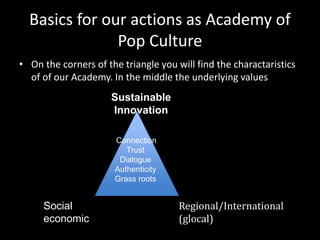
Basics for our actions as Academy of
Pop Culture
• On the corners of the triangle you will find the charactaristics
of of our Academy. In the middle the underlying values
Sustainable
Innovation
Connection
Trust
Dialogue
Authenticity
Grass roots
Social
economic
Regional/International
(glocal)
Which led to
• A flat organization
• Education and work always start with the
personal ambitions and points of view of the
students and team
• Freedom of speech and acting
And most important
• Always stay in dialogue and be open for new
ideas
• Be aware that survival, innovation and
positive societal changes in the past
thousands of years were based on
collaboration, not on individuals, so called
“strong men”.

20151101 i week_liepaja_anarchism

  • 1.
    an anarchistic anthropological approachof collaboration Albert van der Kooij November 2015
  • 2.
    Decade of change Thepast 20 years I worked on new educational concepts. The world changes fast and education found a new task: how to educate self conscious students that are prepared to solve the questions of tomorrow?
  • 3.
    Decade of Change •The climate change • Economic crisis • Failing of the financial system • Loss of faith in governments • Migration • …
  • 4.
    Decade of Change •Occupy movement – but what do we hear about them right now? • Towards a new economy: self supporting communities in food and energy • Collectives that are based on equality and dialogue • Local money
  • 5.
    Decade of Change •One of the fast growing movements is the degrowth movement. • Degrowth • Sustainable degrowth is a downscaling of production and consumption that increases human well-being and enhances ecological conditions and equity on the planet. It calls for a future where societies live within their ecological means, with open, localized economies and resources more equally distributed through new forms of democratic institutions.
  • 6.
    Degrowth initiatives, projects,and research • From research to best practice to direct action and protest • http://www.degrowth.org/research • Growl => an initiative and network for teaching and developing knowledge about degrowth http://co-munity.net/growl/courses • Activism: Ende Gelände http://350.org/ende- gelande-wrap-up/
  • 7.
    A new approach? •All these initatives have something in common: – It is global, the problemacy is always been placed in a local cultural context – It is grass roots, bottom up – Base on equity – It is non violent Is it anarchism?
  • 8.
    Is it anarchism? •A definition • a political theory holding all forms of governmental authority to be unnecessary and undesirable and advocating a society based on voluntary cooperation and free association of individuals and groups
  • 9.
    A new approach •Still anarchism is not taken serious, while for years most revolutions and societal changes came up from the people. • Most people associate anarchism with violence and survival of the fittest (but why?) • We have marxist studies and economic research, capitalist studies and research, but no anarchist approach
  • 10.
    Redefining anarchism • Besidesthe definition, we need a few basics to introduce anarchism in education and research – Against anti-utopism – A self organized movement, without an intellectual vanguard (there is no truth)
  • 11.
    Anthropological approach • Anthropologicalapproach could help: – Researching (action research) of ancient and nowadays cultures – Nowadays – neo liberal – economic approach is based on profit for less and disregarding local cultures. – Coal mines in Germany, palm oil plants in Indonesia – It is about unequalities between North and South, East and West
  • 12.
    Our role asresearcher and educational institutes • Several partners and institutes over here have an anarchistic or slightly anarchistic approach; as media artist, in their educational and didactical approach. • We should be clear in our values and characteristics • Make choices with who and why we collaborate.
  • 13.
    But why? • Tomake clear that all the world wide initiatives are worth it to be taken serious as an alternative for nowadays politics, economics and hierarchic organization • Not acting in the side line anymore
  • 14.
    But how? • Makinga statement • Adopt projects, join the worldwide movements and make it visible • Focusing our research and( artistic) work and make it more interdisciplinary by putting our questions in a global perspective and integrate local culture in it • Be an example by changing our organizations
  • 15.
    Basics for ouractions as Academy of Pop Culture • On the corners of the triangle you will find the charactaristics of of our Academy. In the middle the underlying values Sustainable Innovation Connection Trust Dialogue Authenticity Grass roots Social economic Regional/International (glocal)
  • 16.
    Which led to •A flat organization • Education and work always start with the personal ambitions and points of view of the students and team • Freedom of speech and acting
  • 17.
    And most important •Always stay in dialogue and be open for new ideas • Be aware that survival, innovation and positive societal changes in the past thousands of years were based on collaboration, not on individuals, so called “strong men”.