Dynamics of Change and Its Effect on Society
1
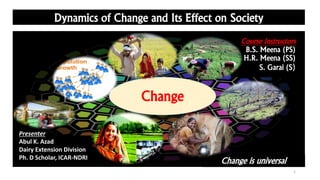
Change
Presenter
Abul K. Azad
Dairy Extension Division
Ph. D Scholar, ICAR-NDRI
Course Instructors
B.S. Meena (PS)
H.R. Meena (SS)
S. Garai (S)
Change is universal
Bullet Points
• Social change takes place in all societies and in all periods of time
• Social change is a complex process.
• Social change is multi-causal
• All factors of social change are closely related to each other.
• Changes are both qualitative and quantitative
2
Effect of change on society
3
Effect of change can be
visible? If yes then How?
Effect of change on society
4
Yes, it is visible
Point of view
Demographically
5
Demographically Biologically
6
Demographically Biologically
Culturally
7
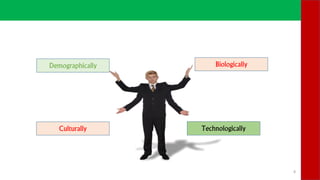
Demographically Biologically
Culturally Technologically
8
Demographic factors
 Demographic factors have been viewed from two different angles.
 They are the qualitative and quantitative
 Qualitatively refers to physical potentialities, mental abilities etc. that are determined by
genetic order.
 But quantitative aspect has been playing the most decisive role in causing social change.
9
Positive Effects
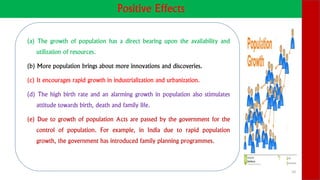
(a) The growth of population has a direct bearing upon the availability and
utilization of resources.
(b) More population brings about more innovations and discoveries.
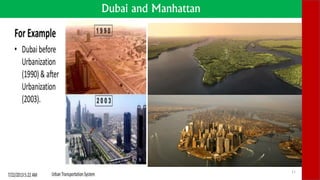
(c) It encourages rapid growth in industrialization and urbanization.
(d) The high birth rate and an alarming growth in population also stimulates
attitude towards birth, death and family life.
(e) Due to growth of population Acts are passed by the government for the
control of population. For example, in India due to rapid population
growth, the government has introduced family planning programmes.
10
Dubai and Manhattan
11
12
Negative Effects
(a) The growth of population has decreased the standard of living of the people in the society.
(b) The growth of population has given birth to a variety of problems like poverty, unemployment,
child labour, crime, juvenile delinquency and beggary.
(c) Increase in population leads to an increase of social differentiation and division of labour.
(d) It brings destructive social conflict and disorganization in migrant’s line.
(e) In the societies where the female population exceeds the male population, polygamy may flourish
and on the other hand, if the number of males exceeds the females, polyandry is likely to prevail.
 Demography plays a significant role in the socio-economic and political transformation of society. It
certainly brings drastic changes not only in the micro- structures but also in macro-structures.
13
Biological factor
 Biological factor plays an important role in the causation of social change.
An ordinarily biological factor refers to those which are concerned with the genetic constitution of
the human beings.
A biological factor includes both non-human beings such as animals, birds, herbs, insects, plants etc.
and human beings.
Human beings use animals, birds, plants and herbs according to the direction of his own culture.
At the same time human beings protect themselves from different harmful elements.
 If there is increase or decrease of these animals, birds, plants etc. it will bring a number of changes
in human society.
14
Biological factor
 Similarly rapid increase or decrease of population also brings a number of changes in
society.
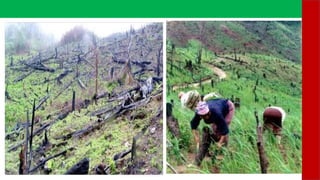
 Rapid population growth influences our environment causes poverty, food shortage
and multiple health problems and thereby brings changes in society
 Different biological process like human procreation, fertility and mortality also
influence the rate of change in a society. Size, density, Migration, immigration etc.
bring a number of changes in society.
15
16
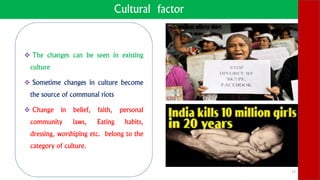
Cultural factor
 The changes can be seen in existing
culture
 Sometime changes in culture become
the source of communal riots
 Change in belief, faith, personal
community laws, Eating habits,
dressing, worshiping etc. belong to the
category of culture.
17
Technological factor
 The technological factors also play important role in causing social change.
 According to W.F. Ogburn, “Technology changes society by changing our
environments to which we In turn adopt.
This change is usually in the material environment and the adjustment that we make
with these changes often modifies customs and social institution initiates a
corresponding social change.
18
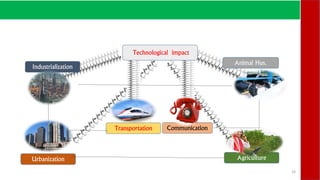
Technological impact
Industrialization
AgricultureUrbanization
Transportation Communication
Animal Hus.
19
20
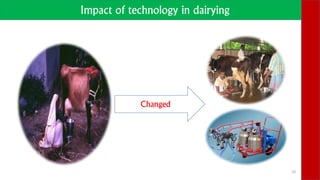
Impact of technology in dairying
Changed
21
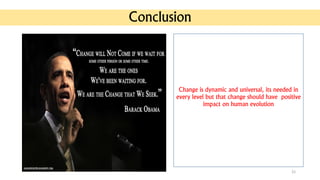
Conclusion
22
Change is dynamic and universal, its needed in
every level but that change should have positive
impact on human evolution
Thank you
23
Thank you
24

Dynamic of change

  • 1.
    Dynamics of Changeand Its Effect on Society 1 Change Presenter Abul K. Azad Dairy Extension Division Ph. D Scholar, ICAR-NDRI Course Instructors B.S. Meena (PS) H.R. Meena (SS) S. Garai (S) Change is universal
  • 2.
    Bullet Points • Socialchange takes place in all societies and in all periods of time • Social change is a complex process. • Social change is multi-causal • All factors of social change are closely related to each other. • Changes are both qualitative and quantitative 2
  • 3.
    Effect of changeon society 3 Effect of change can be visible? If yes then How?
  • 4.
    Effect of changeon society 4 Yes, it is visible
  • 5.
  • 6.
  • 7.
  • 8.
  • 9.
    Demographic factors  Demographicfactors have been viewed from two different angles.  They are the qualitative and quantitative  Qualitatively refers to physical potentialities, mental abilities etc. that are determined by genetic order.  But quantitative aspect has been playing the most decisive role in causing social change. 9
  • 10.
    Positive Effects (a) Thegrowth of population has a direct bearing upon the availability and utilization of resources. (b) More population brings about more innovations and discoveries. (c) It encourages rapid growth in industrialization and urbanization. (d) The high birth rate and an alarming growth in population also stimulates attitude towards birth, death and family life. (e) Due to growth of population Acts are passed by the government for the control of population. For example, in India due to rapid population growth, the government has introduced family planning programmes. 10
  • 11.
  • 12.
  • 13.
    Negative Effects (a) Thegrowth of population has decreased the standard of living of the people in the society. (b) The growth of population has given birth to a variety of problems like poverty, unemployment, child labour, crime, juvenile delinquency and beggary. (c) Increase in population leads to an increase of social differentiation and division of labour. (d) It brings destructive social conflict and disorganization in migrant’s line. (e) In the societies where the female population exceeds the male population, polygamy may flourish and on the other hand, if the number of males exceeds the females, polyandry is likely to prevail.  Demography plays a significant role in the socio-economic and political transformation of society. It certainly brings drastic changes not only in the micro- structures but also in macro-structures. 13
  • 14.
    Biological factor  Biologicalfactor plays an important role in the causation of social change. An ordinarily biological factor refers to those which are concerned with the genetic constitution of the human beings. A biological factor includes both non-human beings such as animals, birds, herbs, insects, plants etc. and human beings. Human beings use animals, birds, plants and herbs according to the direction of his own culture. At the same time human beings protect themselves from different harmful elements.  If there is increase or decrease of these animals, birds, plants etc. it will bring a number of changes in human society. 14
  • 15.
    Biological factor  Similarlyrapid increase or decrease of population also brings a number of changes in society.  Rapid population growth influences our environment causes poverty, food shortage and multiple health problems and thereby brings changes in society  Different biological process like human procreation, fertility and mortality also influence the rate of change in a society. Size, density, Migration, immigration etc. bring a number of changes in society. 15
  • 16.
  • 17.
    Cultural factor  Thechanges can be seen in existing culture  Sometime changes in culture become the source of communal riots  Change in belief, faith, personal community laws, Eating habits, dressing, worshiping etc. belong to the category of culture. 17
  • 18.
    Technological factor  Thetechnological factors also play important role in causing social change.  According to W.F. Ogburn, “Technology changes society by changing our environments to which we In turn adopt. This change is usually in the material environment and the adjustment that we make with these changes often modifies customs and social institution initiates a corresponding social change. 18
  • 19.
  • 20.
    20 Impact of technologyin dairying Changed
  • 21.
  • 22.
    Conclusion 22 Change is dynamicand universal, its needed in every level but that change should have positive impact on human evolution
  • 23.
  • 24.