Self
Organise
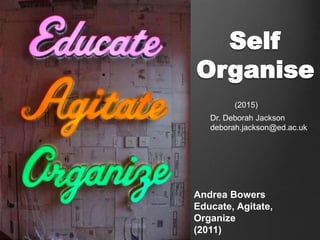
Andrea Bowers
Educate, Agitate,
Organize
(2011)
Dr. Deborah Jackson
deborah.jackson@ed.ac.uk
(2015)
Self Organise…
1. Is reflection, history and theory
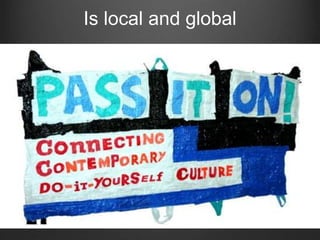
2. Is local and global
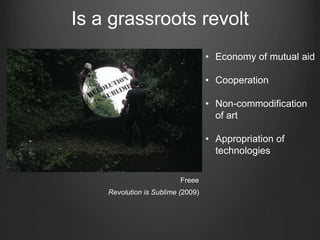
3. Is a grassroots revolt
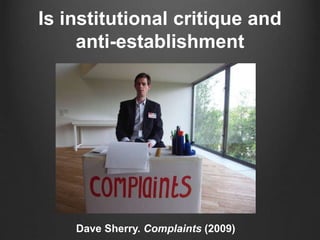
4. Is institutional critique and anti-establishment
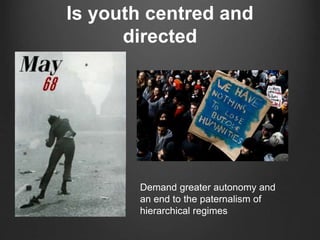
5. Is youth centred and directed
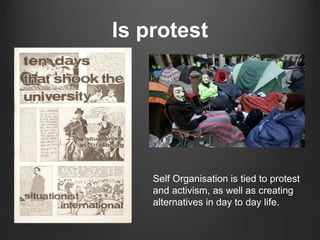
6. Is protest
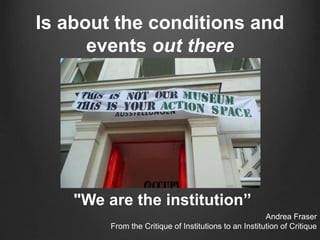
7. Is about the conditions and events out there
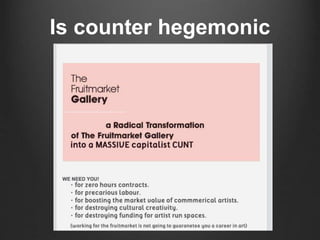
8. Is counter hegemonic (challenge mainstream societies dominatio
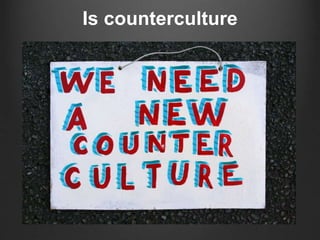
9. Is counterculture
10.Means Do it Yourself
11.Occupies
12.Is independence
Self Organise…
13. Is action
14. Is self-empowerment
15. Moves by practical example
16. Is a counter economic strategy
17. Is political and social
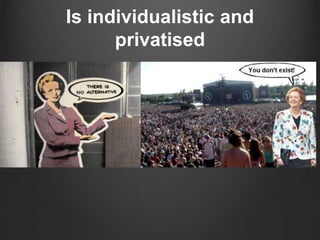
18. Is individualistic and privatised
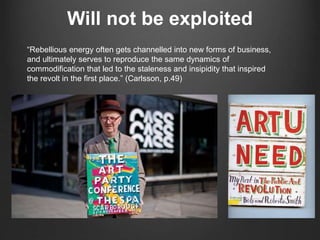
19. Will not be exploited
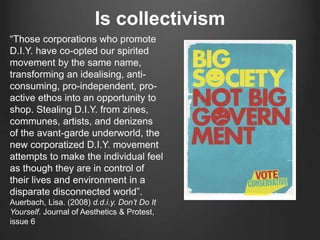
20. Is collectivism
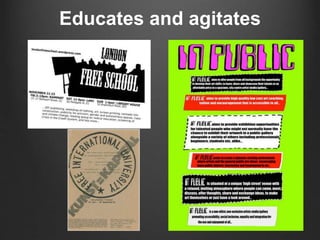
21. Educates and agitates
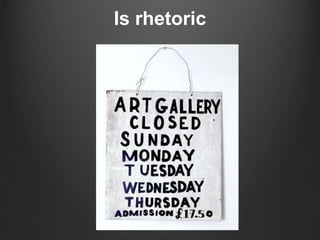
22. Is rhetoric
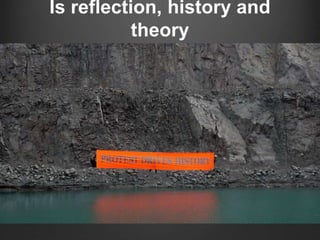
Is reflection, history and
theory
Is local and global
Is a grassroots revolt
Freee
Revolution is Sublime (2009)
• Economy of mutual aid
• Cooperation
• Non-commodification
of art
• Appropriation of
technologies
Is institutional critique and
anti-establishment
Dave Sherry. Complaints (2009)
Is youth centred and
directed
Demand greater autonomy and
an end to the paternalism of
hierarchical regimes
Is protest
Self Organisation is tied to protest
and activism, as well as creating
alternatives in day to day life.
Is about the conditions and
events out there
"We are the institution”
Andrea Fraser
From the Critique of Institutions to an Institution of Critique
Is counter hegemonic
Is counterculture
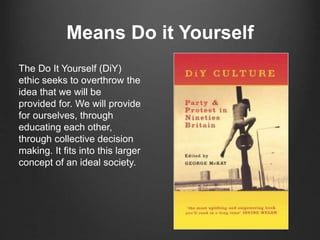
Means Do it Yourself
The Do It Yourself (DiY)
ethic seeks to overthrow the
idea that we will be
provided for. We will provide
for ourselves, through
educating each other,
through collective decision
making. It fits into this larger
concept of an ideal society.
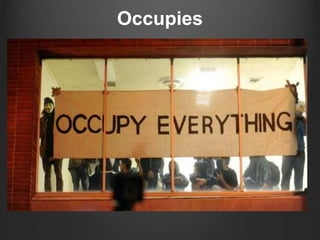
Occupies
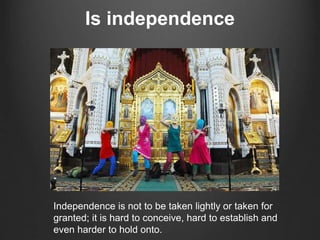
Is independence
Independence is not to be taken lightly or taken for
granted; it is hard to conceive, hard to establish and
even harder to hold onto.
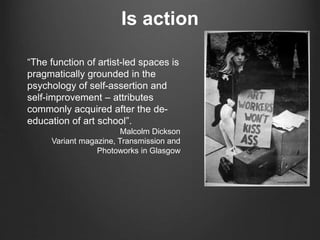
Is action
“The function of artist-led spaces is
pragmatically grounded in the
psychology of self-assertion and
self-improvement – attributes
commonly acquired after the de-
education of art school”.
Malcolm Dickson
Variant magazine, Transmission and
Photoworks in Glasgow
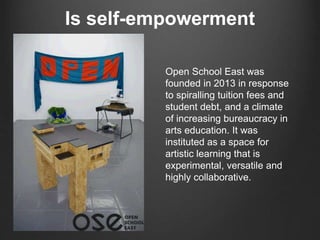
Is self-empowerment
Open School East was
founded in 2013 in response
to spiralling tuition fees and
student debt, and a climate
of increasing bureaucracy in
arts education. It was
instituted as a space for
artistic learning that is
experimental, versatile and
highly collaborative.
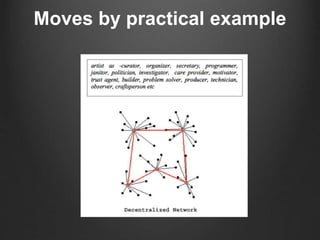
Moves by practical example
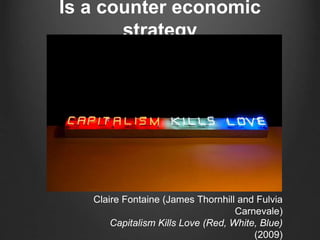
Is a counter economic
strategy
Claire Fontaine (James Thornhill and Fulvia
Carnevale)
Capitalism Kills Love (Red, White, Blue)
(2009)
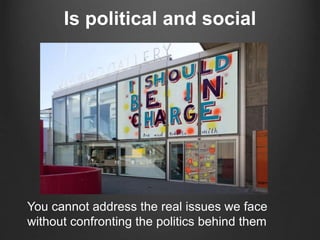
Is political and social
You cannot address the real issues we face
without confronting the politics behind them
Is individualistic and
privatised
Will not be exploited
“Rebellious energy often gets channelled into new forms of business,
and ultimately serves to reproduce the same dynamics of
commodification that led to the staleness and insipidity that inspired
the revolt in the first place.” (Carlsson, p.49)
Is collectivism
“Those corporations who promote
D.I.Y. have co-opted our spirited
movement by the same name,
transforming an idealising, anti-
consuming, pro-independent, pro-
active ethos into an opportunity to
shop. Stealing D.I.Y. from zines,
communes, artists, and denizens
of the avant-garde underworld, the
new corporatized D.I.Y. movement
attempts to make the individual feel
as though they are in control of
their lives and environment in a
disparate disconnected world”.
Auerbach, Lisa. (2008) d.d.i.y. Don’t Do It
Yourself. Journal of Aesthetics & Protest,
issue 6
Educates and agitates
Is rhetoric

1 self organise 2015

  • 1.
    Self Organise Andrea Bowers Educate, Agitate, Organize (2011) Dr.Deborah Jackson deborah.jackson@ed.ac.uk (2015)
  • 2.
    Self Organise… 1. Isreflection, history and theory 2. Is local and global 3. Is a grassroots revolt 4. Is institutional critique and anti-establishment 5. Is youth centred and directed 6. Is protest 7. Is about the conditions and events out there 8. Is counter hegemonic (challenge mainstream societies dominatio 9. Is counterculture 10.Means Do it Yourself 11.Occupies 12.Is independence
  • 3.
    Self Organise… 13. Isaction 14. Is self-empowerment 15. Moves by practical example 16. Is a counter economic strategy 17. Is political and social 18. Is individualistic and privatised 19. Will not be exploited 20. Is collectivism 21. Educates and agitates 22. Is rhetoric
  • 4.
  • 5.
  • 6.
    Is a grassrootsrevolt Freee Revolution is Sublime (2009) • Economy of mutual aid • Cooperation • Non-commodification of art • Appropriation of technologies
  • 7.
    Is institutional critiqueand anti-establishment Dave Sherry. Complaints (2009)
  • 8.
    Is youth centredand directed Demand greater autonomy and an end to the paternalism of hierarchical regimes
  • 9.
    Is protest Self Organisationis tied to protest and activism, as well as creating alternatives in day to day life.
  • 10.
    Is about theconditions and events out there "We are the institution” Andrea Fraser From the Critique of Institutions to an Institution of Critique
  • 11.
  • 12.
  • 13.
    Means Do itYourself The Do It Yourself (DiY) ethic seeks to overthrow the idea that we will be provided for. We will provide for ourselves, through educating each other, through collective decision making. It fits into this larger concept of an ideal society.
  • 14.
  • 15.
    Is independence Independence isnot to be taken lightly or taken for granted; it is hard to conceive, hard to establish and even harder to hold onto.
  • 16.
    Is action “The functionof artist-led spaces is pragmatically grounded in the psychology of self-assertion and self-improvement – attributes commonly acquired after the de- education of art school”. Malcolm Dickson Variant magazine, Transmission and Photoworks in Glasgow
  • 17.
    Is self-empowerment Open SchoolEast was founded in 2013 in response to spiralling tuition fees and student debt, and a climate of increasing bureaucracy in arts education. It was instituted as a space for artistic learning that is experimental, versatile and highly collaborative.
  • 18.
  • 19.
    Is a countereconomic strategy Claire Fontaine (James Thornhill and Fulvia Carnevale) Capitalism Kills Love (Red, White, Blue) (2009)
  • 20.
    Is political andsocial You cannot address the real issues we face without confronting the politics behind them
  • 21.
  • 22.
    Will not beexploited “Rebellious energy often gets channelled into new forms of business, and ultimately serves to reproduce the same dynamics of commodification that led to the staleness and insipidity that inspired the revolt in the first place.” (Carlsson, p.49)
  • 23.
    Is collectivism “Those corporationswho promote D.I.Y. have co-opted our spirited movement by the same name, transforming an idealising, anti- consuming, pro-independent, pro- active ethos into an opportunity to shop. Stealing D.I.Y. from zines, communes, artists, and denizens of the avant-garde underworld, the new corporatized D.I.Y. movement attempts to make the individual feel as though they are in control of their lives and environment in a disparate disconnected world”. Auerbach, Lisa. (2008) d.d.i.y. Don’t Do It Yourself. Journal of Aesthetics & Protest, issue 6
  • 24.
  • 25.

Editor's Notes

  • #5  This lecture series has come about as part of a growing interest in self-organisation. In the wider realm this relates to organisational theories and practices within society. In the artistic realms this relates to curatorial and artistic practice (setting up artist-galleries) and art-writing, setting up zines and the like . Self-organisation has played a significant role in the development of contemporary art. The Self-Organise course has also arisen from a need to address the fact that many artists are either oblivious to the institutional contexts and social conditions that make art practices possible or are dissatisfied with them to some extent.
  • #6 Is local and global Most of the seeds of change in our social history have originated on the margins with groups of people making their own decisions and actions on how they live their lives. This is also a continuation of our culture, as generations have influenced and built on what has gone before, building upon it. This is the essence of self-organising as a movement spreading and influencing the world, it is by this very means that a counter culture is created against the prevailing hegemony of ideas.
  • #7 Self Organise an refer to a range of grassroots social and political activism with a commitment to an economy of mutual aid, cooperation, non-commodification of art, appropriation of digital and communication technologies, and alternative technologies to name but a few.
  • #8 Self-organisation is related to practices of institutional critique and also to the legacies of anti-establishment and counter-cultural practices. The first wave of institutional critique from the late 1960s and early 1970s includes figures like Michael Asher, Robert Smithson, Daniel Buren, Hans Haacke and Marcel Broodthaers. Their critical method was an artistic practice, and the institution in question was the art institution, mainly the art museum, but also galleries and collections. This was a response to artists’ dissatisfaction with public museums and commercial galleries, in terms of access and lack of control over their work. They examined the conditioning of their own activity by the ideological and economic frames of the museum, with the goal of breaking out. They had a strong relation to the anti-institutional revolts of the 1960s and 70s, and to the accompanying philosophical critiques, including the writings of Benjamin Buchloh. Institutional critique thus took on many forms, such as artistic works and interventions, critical writings or (art‑)political activism.
  • #9 Institutional Critique was reflective of widespread discontentment across Europe in the 1960s with the forms of the transmission of knowledge. In particular this chimed with the dissatisfaction amongst students with the content of teaching and with the inequitable relations between teacher and student. This led to students across Europe challenging the status quo with pro-situ happenings that attacked expertise and notably reached its peak in May 1968 with the Paris student uprising when 30,000 students clashed with police, and French workers came out in support with a general strike that almost toppled the government. These events profoundly and irrevocably changed social attitudes resulting from a newfound scepticism of hierarchical structures of power. From a Marxist-Socialist position the events of 1968 signified a renaissance of culture coupled with the re-emergence of the working class, after a post-war period characterised by the rebirth and expansion of capitalism. In Britain art students were in the thick of events in that period, by June 1968 sixteen British colleges and universities were adding their contribution to the summer of discontent, as a direct result of the events in Paris. Hornsey College of Art, the bastion of British student radicalisation, was occupied by students issuing Situationist inspired manifestos, which demanded greater autonomy and an end to the paternalism of hierarchical regimes. Sharing the preoccupations of this tumultuous era with their French counterparts, the all-over aim of the students was to open up the art academies and education to a wider contemporary (art) world.
  • #10 Students rebelled against the authoritarianism of the institution they demanded the democratization of decision-making processes and for changes in the curricula and syllabuses. The Hornsey affair resulted all students, part time staff and administrative workers implicated in the revolt being dismissed. Students at the Scottish Art Schools were by no means immune to the climate of changing opinions and ideas that were emerging. The shared dictum of the political and artistic avant-garde included the re-affirmation of the importance of art, greater public access to art, as well as greater involvement in art activities, and a belief in self-help and mutual aid to get things done, rather than passive dependence on experts and established authorities. These probing questions about the ethics of societal values and the legitimacy of political authority inevitably spread to scrutiny of the established rationales that governed the art world; casting doubt on the neutrality and ethical status of established cultural institutions. This was a catalyst for one of the most significant intellectual shifts, the destabilising of concepts such as authority and objectivity in traditional art historical methodologies. The events of 1968 and the expansion in art school provision during the 1960s, resulted in artists questioning not only their position in society but also their possible means of making a living. Artists were forced to reconsider their role and reacted by subverting the established institutional systems of knowledge and power. This had a profound effect on artist-run culture.  
  • #11 However, as Andrea Fraser’s statement “We are the institution” suggests, the them and us position is no longer tenable and it is a false dichotomy to assume that contemporary self-organised, artist-run culture is against mainstream art practice. Whilst the contemporary artists who self-organise may not be viewed as overt political and social dissidents, they do retain an air of the anti-establishment attitude that motivated their predecessors. One of the problems with past approaches to institutional critique, is that they set up a binary: on the one hand there is the established institution, a centralised system embedded in its own bureaucratic wants and needs; on the other hand, there is the "independent" curator or artist, heroically criticising and resisting, sometimes from the outside, sometimes from within. In essence what Fraser points out is that artists involved in Institutional Critique were working critically from within the institutions. Seeing the institution as a site of critiques and contestation. One of the main issues is that established institutions are broadly characterized by strong hierarchical relations and are built on the principles concerning who is in charge with chains of command delineating responsibilities within the organisation. This is a clear distinction with artist-run initiatives whose self-organisation shapes their artist-driven governance model.  
  • #12 As we have seen, historically, in terms of art practice, self-organisation was often deployed as a rallying call for anti-institutional projects. The underpinning ideology of self-organisation has traditionally denoted an oppositional and revolutionary position, one that challenges institutional hegemony. When we use the term hegemony we are talking about the dominant order comprised of various institutions, traditions and conventions that make up the cultural establishment. Self-organised art practice has always offered a means of challenging the dominant order and continually finding new ways of doing things without the overarching support of an institution, public funding body or private patron. However, as self-organised practices have developed so too has the term. There has been a shift from it merely posing alternatives to the hegemonic order and this has created a need for a critical re-evaluation of the term.
  • #13 Is counterculture counterculture refers to groups that operate outside of mainstream society often showing alternative ways of living, thinking and doing. It can be seen as the cultural equivalent of political opposition because it stands against or outside of mainstream society. It operates in a way that is counter to way that things are done generally in society (what is termed society’s ‘norms’). The counter culture is often a place where progressive ideas originate and develop, before they enter mainstream consciousness.
  • #14 Means Do it Yourself. The Do It Yourself (DiY) ethic seeks to overthrow the idea that we will be provided for. We will provide for ourselves, through educating each other, through collective decision making. It fits into this larger concept of an ideal society. The concept of self-organising signifies a self-starting mind-set, which refuses to wait for recognition or external validation from the established cultural gatekeepers. Shifting the emphasis from only considering your art-making, towards seriously considering how both artists and culture function in society and in particular in relation to institutions.
  • #15 In recent years the impact of social networks upon self-organising has been phenomenal. For instance, anyone interested in emergent self organising processes that occur when diverse individuals assemble for a common cause, cannot fail to be impressed by how the Occupy movement has demonstrated a capacity for well structured engagement through combining the use of online platforms. The Occupy movement, to refresh your memory is an international protest movement against social and economic inequality, and its primary goal is to make the economic and political relations in all societies less vertically hierarchical and more flatly distributed. Whilst the philospher and cultural critic Slavoj Zizek sees Occupy’s idea of self-organisation and non-hierarchical governance as being naïve, it cannot be denied that revolutions, mass demonstrations and political protests of various types have been forged through networks that protesters themselves have created, often with the help of digital technology. From our perspective we are interested of course in the self-organised aspect of these social movements not merely as political activities, but perhaps more importantly because they provide spaces for cultural and artistic growth and experimentation.
  • #16 In the late 1990s, theorist Fredric Jameson argued that the social space was completely saturated with the image of culture. This is because in our professional and daily activities, as well as in the various forms of entertainment we enjoy; society consumes cultural products all the time. This characterizes the postmodern “cultural turn” diagnosed by Jameson…the uses of culture had undergone an unprecedented expansion not just in the marketplace but also along social, political, and economic lines. In contemporary society artists are thought to be important in giving shape to society. In a context where art, politics and the media are all intrinsically linked we can identify that contemporary cultural practices point towards what we might call a new social order, in which art has merged with life. For much of the arts community, self-organised, artist-run initiatives are a paradigm of creative independence. Independence is not to be taken lightly or taken for granted; it is hard to conceive, hard to establish and even harder to hold onto.
  • #17 The ethics of Self-organisation concern taking responsibility for your life and the world around you through positive practical direct action. Practices include dropping out of existing institutions; subversion of existing institutions, or establishing your own. Self Organisation is a means to negotiate established institutional, economic and structural obstacles that were historically perceived as barriers to creative and professional development. For example Artist-Run Initiatives unlike established institutions, provide opportunities for artists to exhibit irrespective of whether they are validated by funding bodies, gallery representation or an extensive C.V. In that sense, ARIs are an extremely effective way for artists to develop both creatively and professionally, whilst exercising a high degree of autonomy, debate, exhibition and promotion within a peer group context   As Malcolm Dickson points out, the synthetic environment of art schools cannot fully expose students to the mechanics of the art world, it would be unreasonable to expect so, as is the expectation that students will transform into professional artists over the duration of their degree. Dickson states: “The function of artist-led spaces is pragmatically grounded in the psychology of self-assertion and self-improvement – attributes commonly acquired after the de-education of art school”. Malcolm Dickson, Variant magazine, Transmission and Photoworks in Glasgow
  • #18 Is self-empowerment It is about inner value and responsibilities Having the initiative to decide for yourself Gaining control over your own life Taking responsibility for your own actions on your own terms Subjective empowerment, the emphasis is on self (even when located within collective practice) Self-organising provides a way of reclaiming power and control of your own life, but it does not end there. Self –organising in the arts: the process of self-determined organising (as opposed to being organised by someone else, and an entity: an organisation of individuals created by them on their own terms. The main reason for self-organising in this context would appear to be the imbalance in the relationship between the majority of artists and the exhibition mainstream. A recent example is Open School East…founded in 2013 in response to spiralling tuition fees and student debt, and a climate of increasing bureaucracy in arts education. It was instituted as a space for artistic learning that is experimental, versatile and highly collaborative.  
  • #19 Self-organisation moves by practical example. It demonstrates through living examples of how a culture could look and operate through offering us a rich and varied history of alternative ways of living and thinking. Artist-run models indicate that these organizations were developed and managed by artists, rather than administrators, and could consequently reflect the needs and desires of artists. Notably, it is not exclusively artists that are included under the idiom artist-run; the term has expanded to include a host of cultural practitioners, including writers and curators. This is because artists are increasingly multi-taskers who balance a number of pursuits, gaining transferable skills and in doing so construct what the cultural theorist Angela McRobbie calls “portfolio careers”. Short-term contracts, part-time, working, freelancing, and self-employment characterises how the majority artists survive and function. Portfolio careers are not generally chosen and are neither are they necessarily a positive because of the precarious labour conditions.
  • #20 Is a counter economic strategy. Self-Organisation has become synonomous with anti-capitalist critique. In the 1990s SO gained an increasingly anti-capitalist and political dimension, which was propelled by anti-globalisation movements. Working in a self-organised way was increasingly seen as the only response to a new political reality, in which multinational companies had replaced national governments as the enemies. The collision of the financial economy with culture prompted a resistance to what the cultural commentator Michael Bracewell terms as “the sterilising grasp of cultural commodification” (Bracewell, M. 2003). Established institutions on the other hand increasingly compete in the leisure industry market with exhibitions that are competitively selected and directed to attract maximum visibility in the mediatised public realm. In the last two decades established institutions have been shifting towards an industrialisation of visual art exhibitions, akin to the Hollywood blockbuster or the musical box-office smashes. Their ambitions are set on broadening and growing their audiences through marketable and profitable exhibitions aimed at tourist that are prepared to pay substantial entry fees.
  • #21  Is political and social. The need for artists to evolve their ways of working has always been necessary. In light of the drastic changes to the structure of the art world over the last decade and the wider socio-political and economic challenges we are facing the need to reconsider our modes of operating to find alternatives seems more pressing than ever. How might we see beyond the current situation and develop institutional models that function in an unknown future? You cannot address the real issues we face without confronting the politics behind them It is not just about outcomes it is also about process. Many movements are not just alternative in their aims, but also alternative in their operation and structure through developing non-hierarchal organisations based on mutual aid. The process of operating in alternative ways can also be seen as a political act in itself, as it rejects the norms of society, often deliberately as a statement of intent. To paraphrase the avant-garde film-maker Jean-Luc Godard, it’s not a question of making political art or film; it’s about making art or film politically. This idea echos through the practices and debates of contemporary artists, radical cultural movements, artist-run organizations, independent curatorial projects and critical writing on art. All of these reflect upon the potency of self-organised practices which seek to challenge the capitalist system we live in, that allows economic and political power to be concentrated.
  • #22 Is individualised and privitised. There are various complications and dependencies that arise between art institutions and the social, economic and political spheres. There is a correlation between economic decline and the increase of self-organised cultural activity. In the UK, self-organising is tainted with some residue of Thatcherism. In 1987 she stated: “There is no such thing as society” This is problematic, the Thatcherite dictate of self, self-empowerment, privileging of the individual. Does this connecting right-wing government with DiY and self-organisation…Both can be seen to enbody a Entrepreneurial spirit…Self-sufficiency   Countercultural moments are always implicated in capital, even where they try to escape or subvert it. Flip this round, the correspondence between DiY and Thatcherism is a symptom of the right’s appropriation of radical terminology.   Radical in terminology, conservative in its self-interest   Art – towards self promotion, part of the cultural politics of autonomy
  • #23 “Rebellious energy often gets channelled into new forms of business, and ultimately serves to reproduce the same dynamics of commodification that led to the staleness and insipidity that inspired the revolt in the first place.” (Carlsson, p.49) Co-optation is where one organism becomes subsumed by another. This is a major problem for the counterculture as movements enter the mainstream, they can become commoditised and sold back to people as fake alternatives, lifestyle choices and basic commodities. Commodification is where a cultural artefact (something which symbolises the movement, or is an aspect of it) is taken by capitalism and converted into a commodity that is then sold back to the population usually trading on the values of the culture it was stolen from. This has been demonstrated time and time again with countercultural movements. Who has not seen products being sold using the symbolism of the 1960s, or using the language of the counterculture when advertising products with the use of phrases like ‘this radical new movement in fashion’ or ‘step outside of the mainstream and be an individual’ etc. Movements are not only commoditised they can also be co-opted by becoming assimilated into the very system that they oppose. This can lead to a loss of independence, with changes being made to the organisation so it fits neatly into the system that they once fundamentally opposed.
  • #24 Artist Lisa Auerbach describes this form of co-option of D.I.Y. as a ‘plague’ veiled in the ideal of empowerment that is sweeping the nation: “Those corporations who promote D.I.Y. have co-opted our spirited movement by the same name, transforming an idealising, anti-consuming, pro-independent, pro-active ethos into an opportunity to shop. Stealing D.I.Y. from zines, communes, artists, and denizens of the avant-garde underworld, the new corporatized D.I.Y. movement attempts to make the individual feel as though they are in control of their lives and environment in a disparate disconnected world”. Auerbach, Lisa. (2008) d.d.i.y. Don’t Do It Yourself. Journal of Aesthetics & Protest, issue 6 Example: Cameron’s visions engender the development of a framework whereby production, distribution and consumption could be organised in a way that is seemingly consistent with grassroots democracy and self-organisation. Contrary to the Coalition Government’s rhetoric of participation and equity, such post-neoliberal discourses are actually subtle techniques of power that promotes individualised and market-oriented constraints. It is manifestly an extension of their demutualisation (privatisation) trajectory rather than a promotion of co-operatives as alternative business models. Principles of fair play and equal opportunities are not embedded in Cameron’s Big Society.
  • #25 It can teach us a myriad of things such as alternative ways of living, socialising, producing resources i.e. food, housing, fuel, alternative ways of working, ways of thinking, producing art, counter culture, providing leisure activities, music scenes and art, how to create less alienating more social, communities, new ways of living, child rearing, distributing resources, decision making, how to organise groups, how to protest etc.
  • #26 As this ’manifesto’ style talk has demonstrated, Self-organise is also rhetoric.