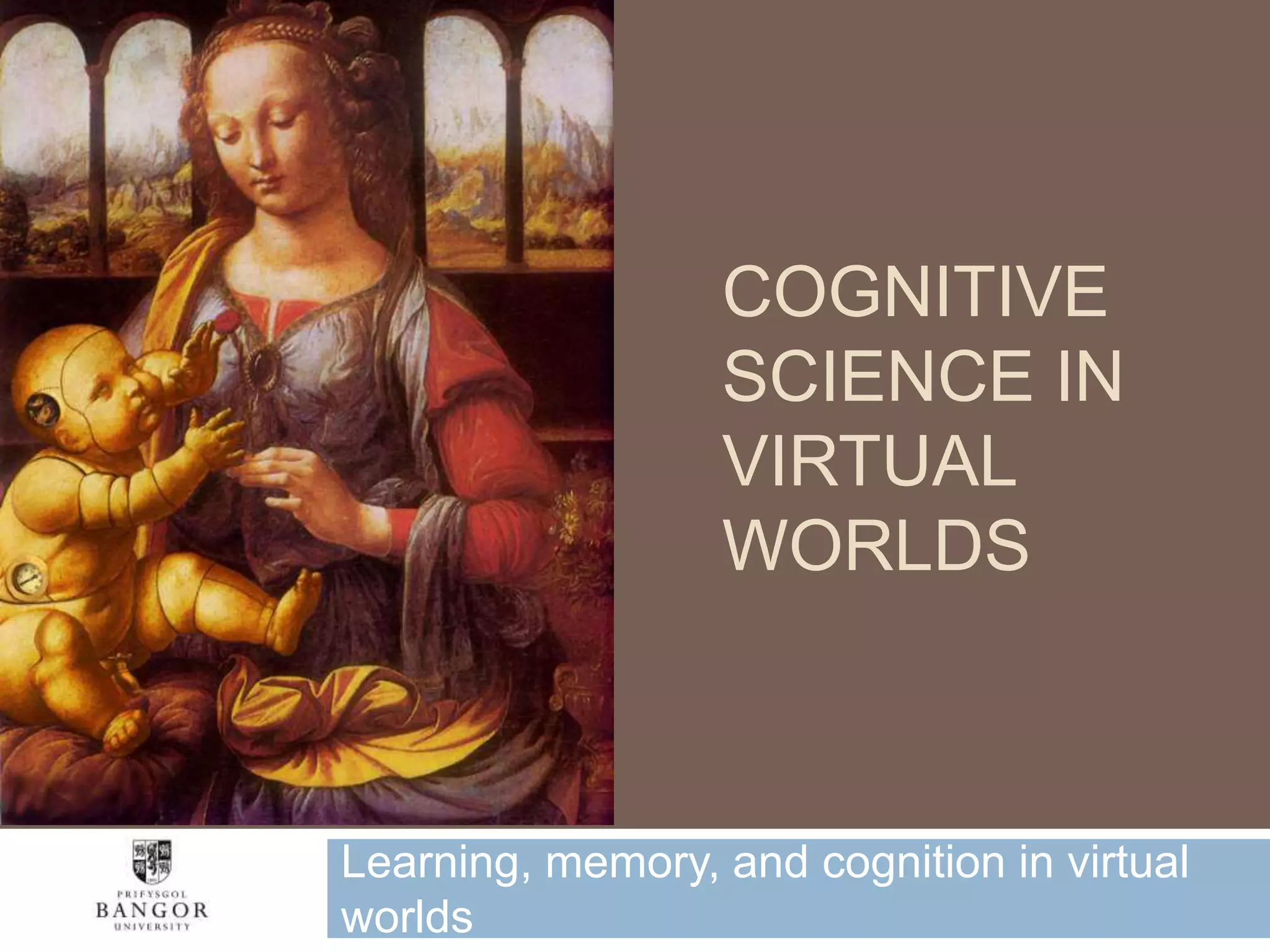
Cognitive Science in Virtual WorldsLearning, memory, and cognition in virtual worlds
Designing learning for artificial agents: Transferring kinaesthetic learners’ procedural skills  in virtual environments to embodied artificial intelligent agents Research Focus
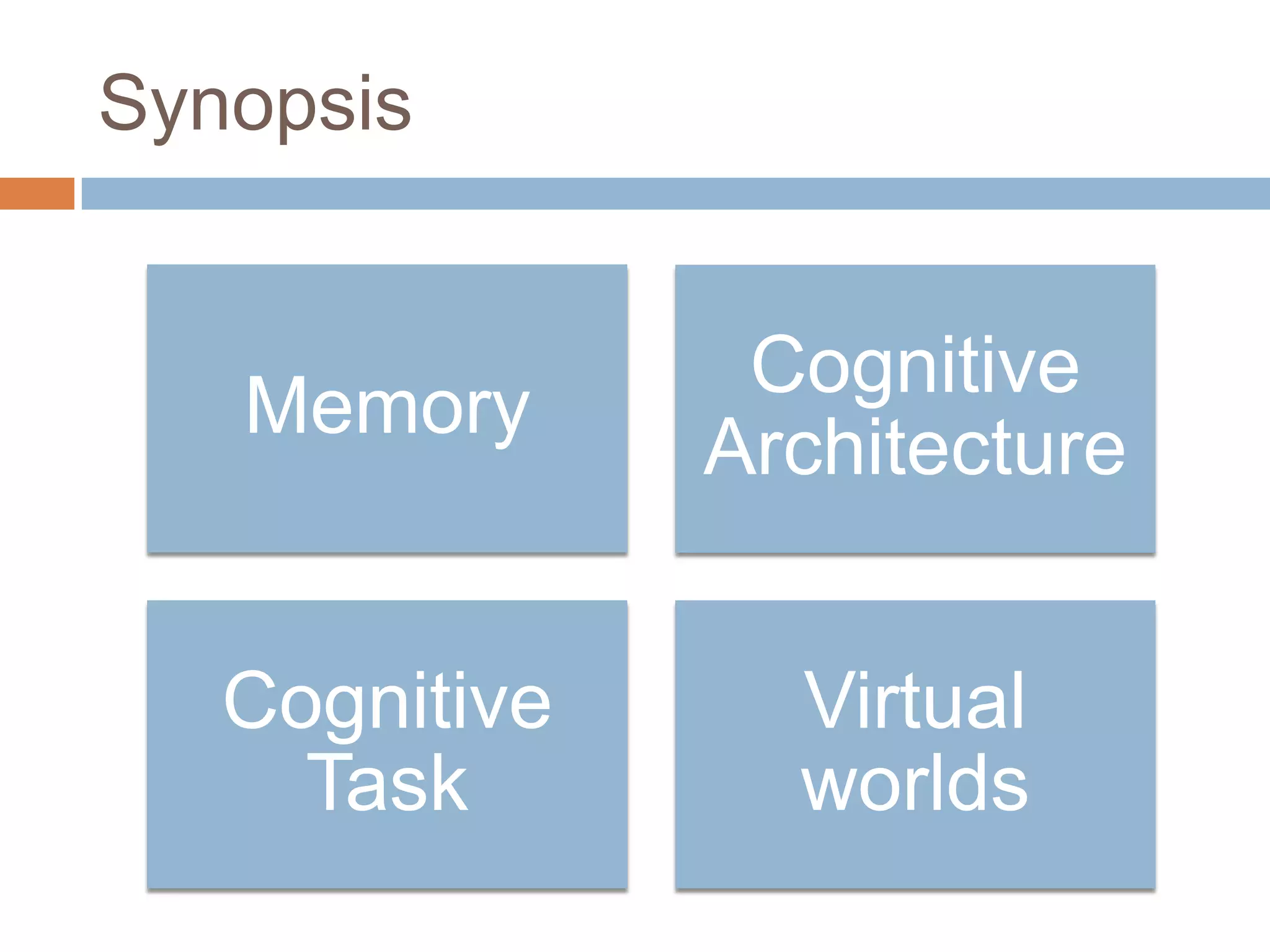
Synopsis
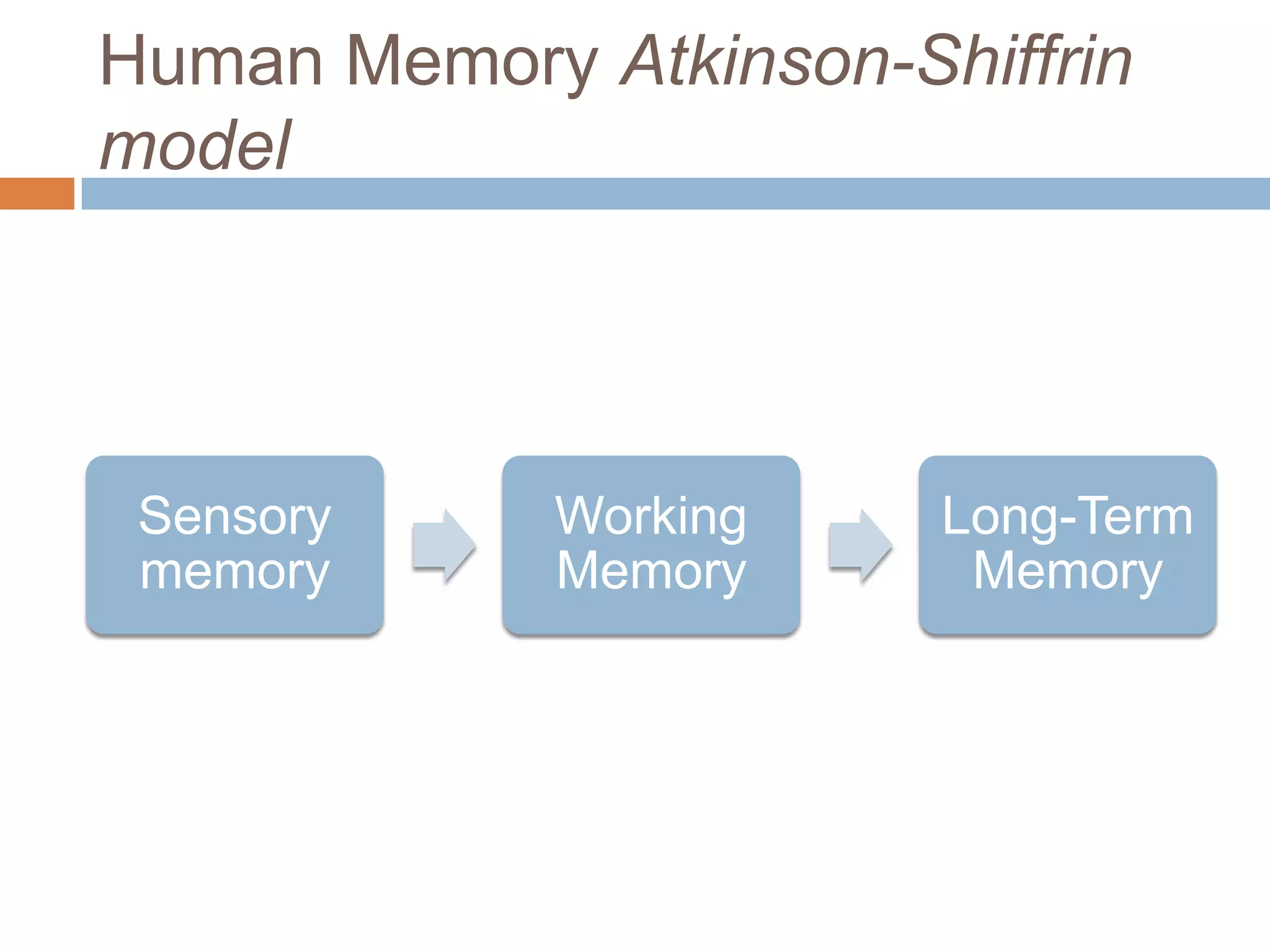
Human Memory Atkinson-Shiffrin model
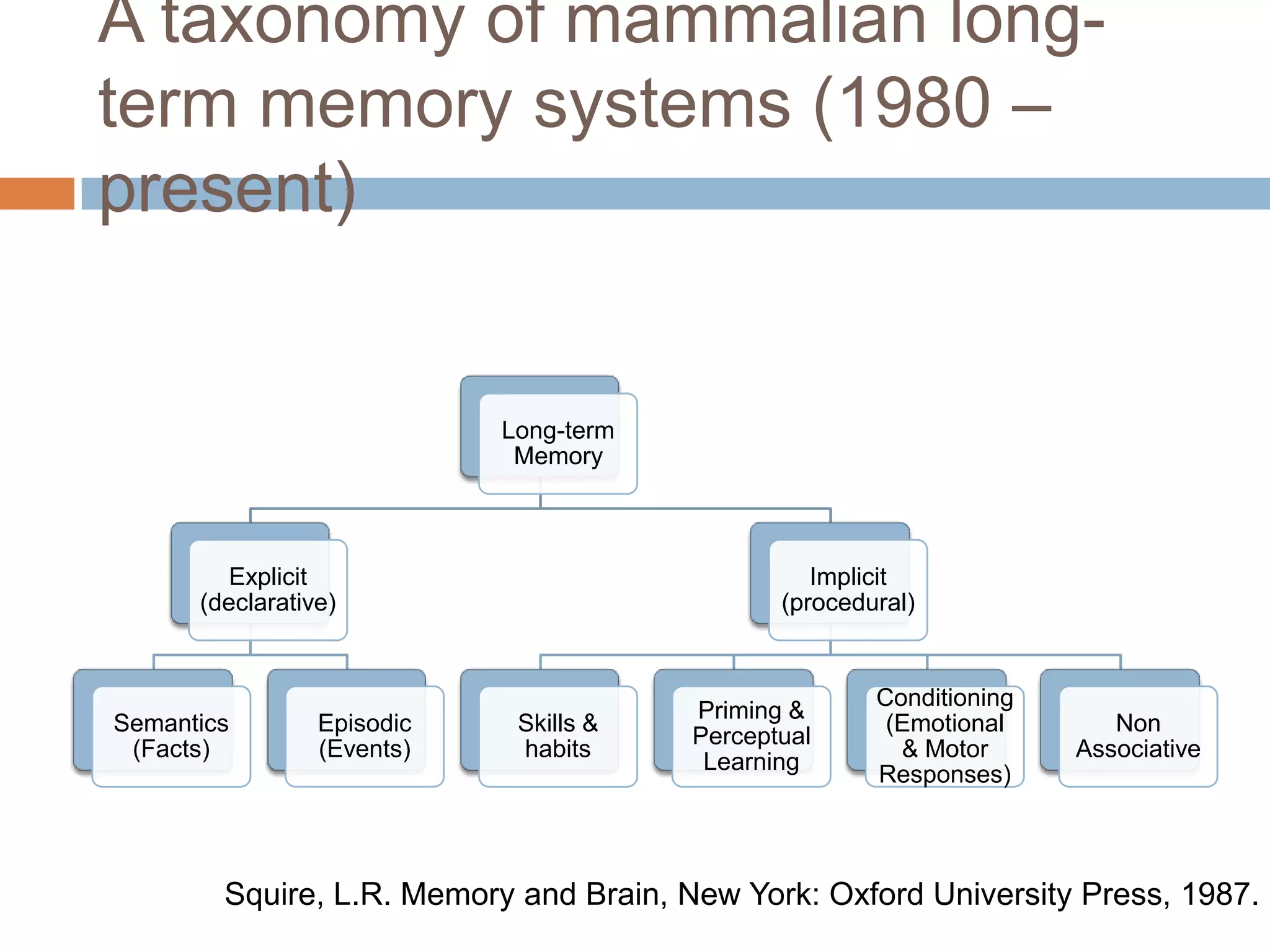
A taxonomy of mammalian long-term memory systems (1980 – present)Squire, L.R. Memory and Brain, New York: Oxford University Press, 1987.
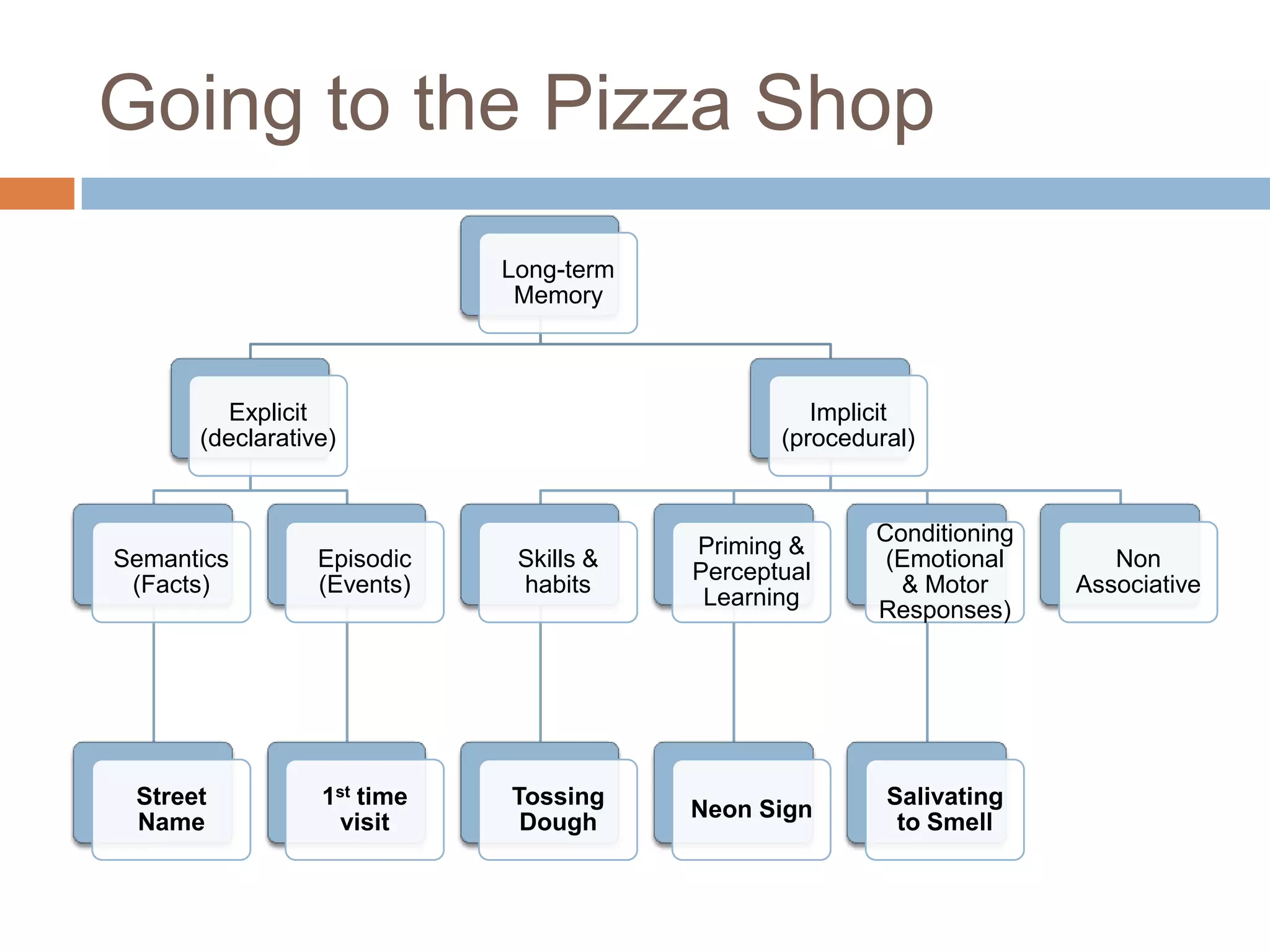
Going to the Pizza Shop
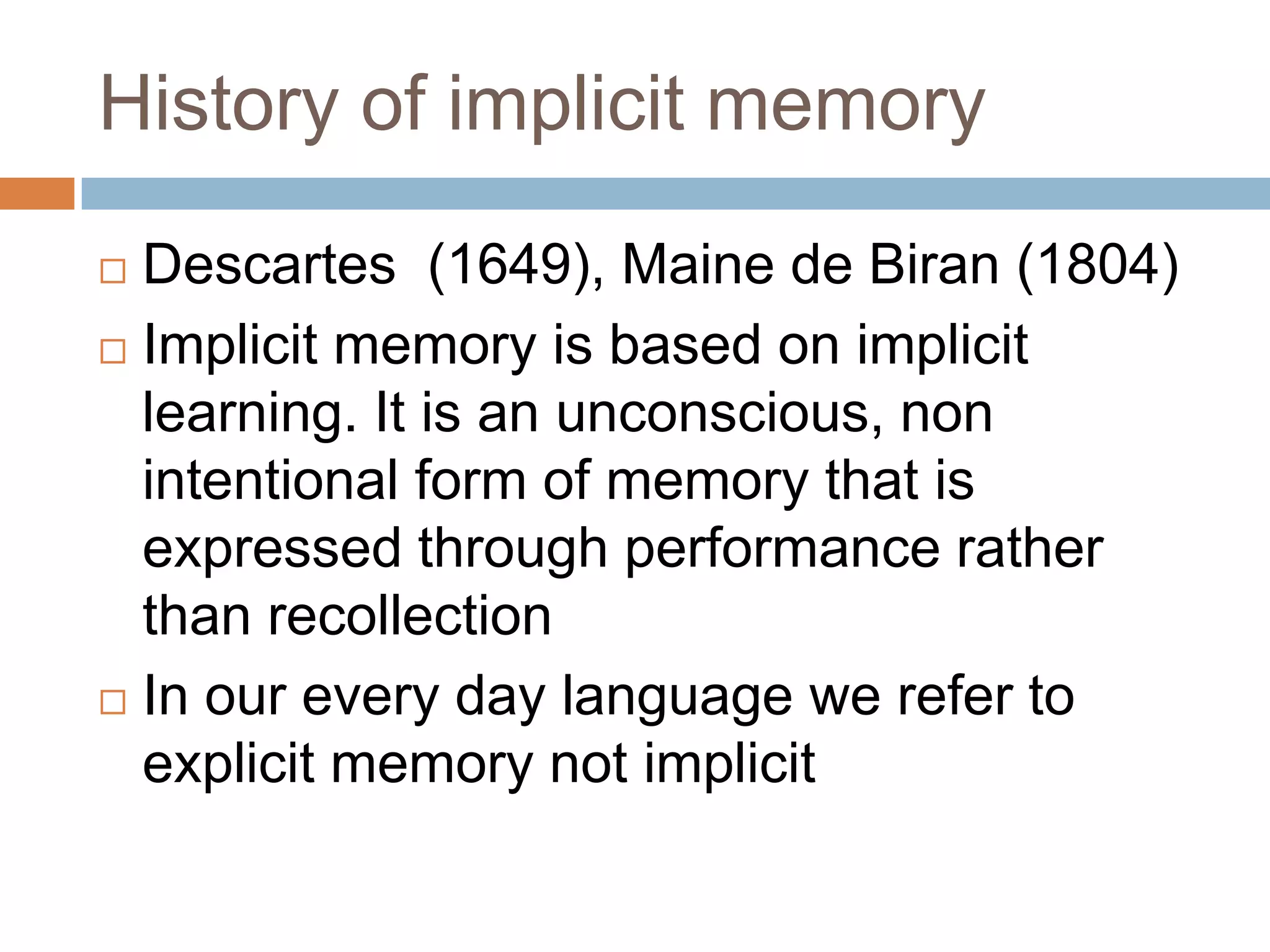
History of implicit memoryDescartes  (1649), Maine de Biran (1804)Implicit memory is based on implicit learning. It is an unconscious, non intentional form of memory that is expressed through performance rather than recollectionIn our every day language we refer to explicit memory not implicit
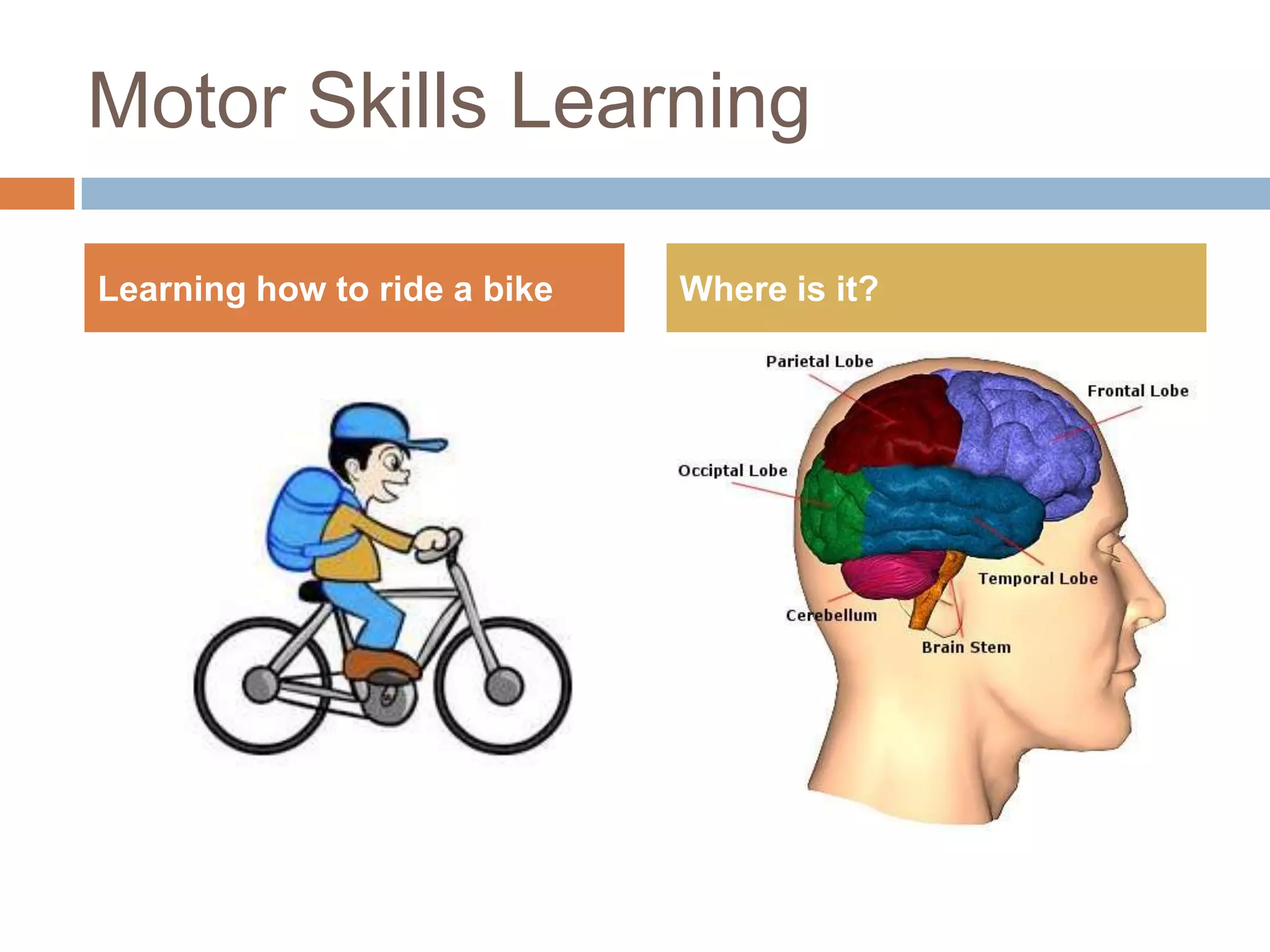
Motor Skills LearningLearning how to ride a bikeWhere is it?
Cognitive Architecture DefinitionA Cognitive Architecture specifies the underlying infrastructure of an intelligent systemsThe short-term and long term memory that store content about the agent’s belief, goals and knowledgeThe representation and organization of structures that are embedded in these memoriesThe functional process that operate on these structures (performance and learning mechanisms)A programming language that lets one construct knowledge-based systems which embody the architecture’s assumptions.
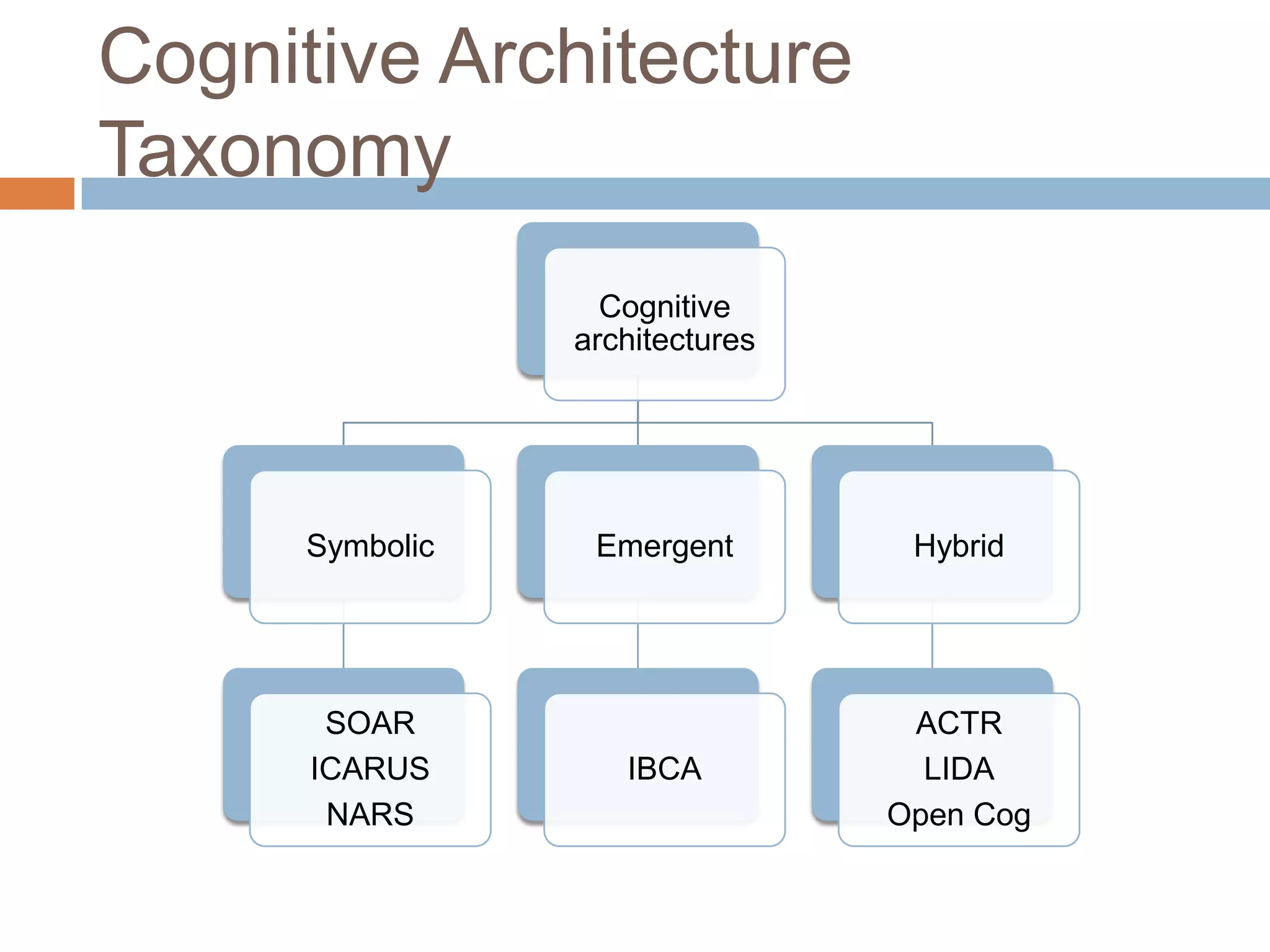
Cognitive Architecture Taxonomy
Symbolic ArchitectureSymbolic AI: the hypothesis that all intelligent thoughts are symbolic manipulation.
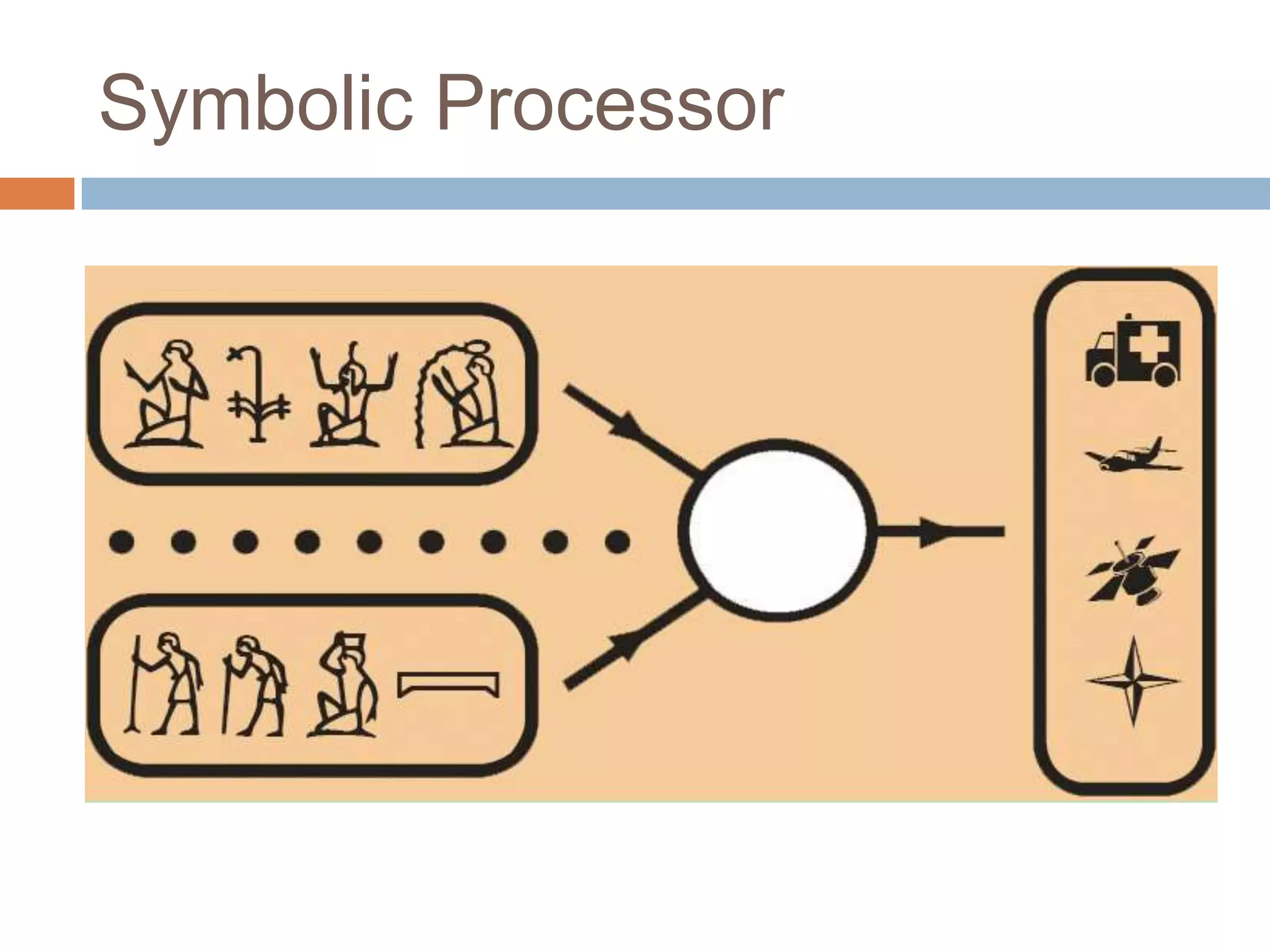
Symbolic Processor
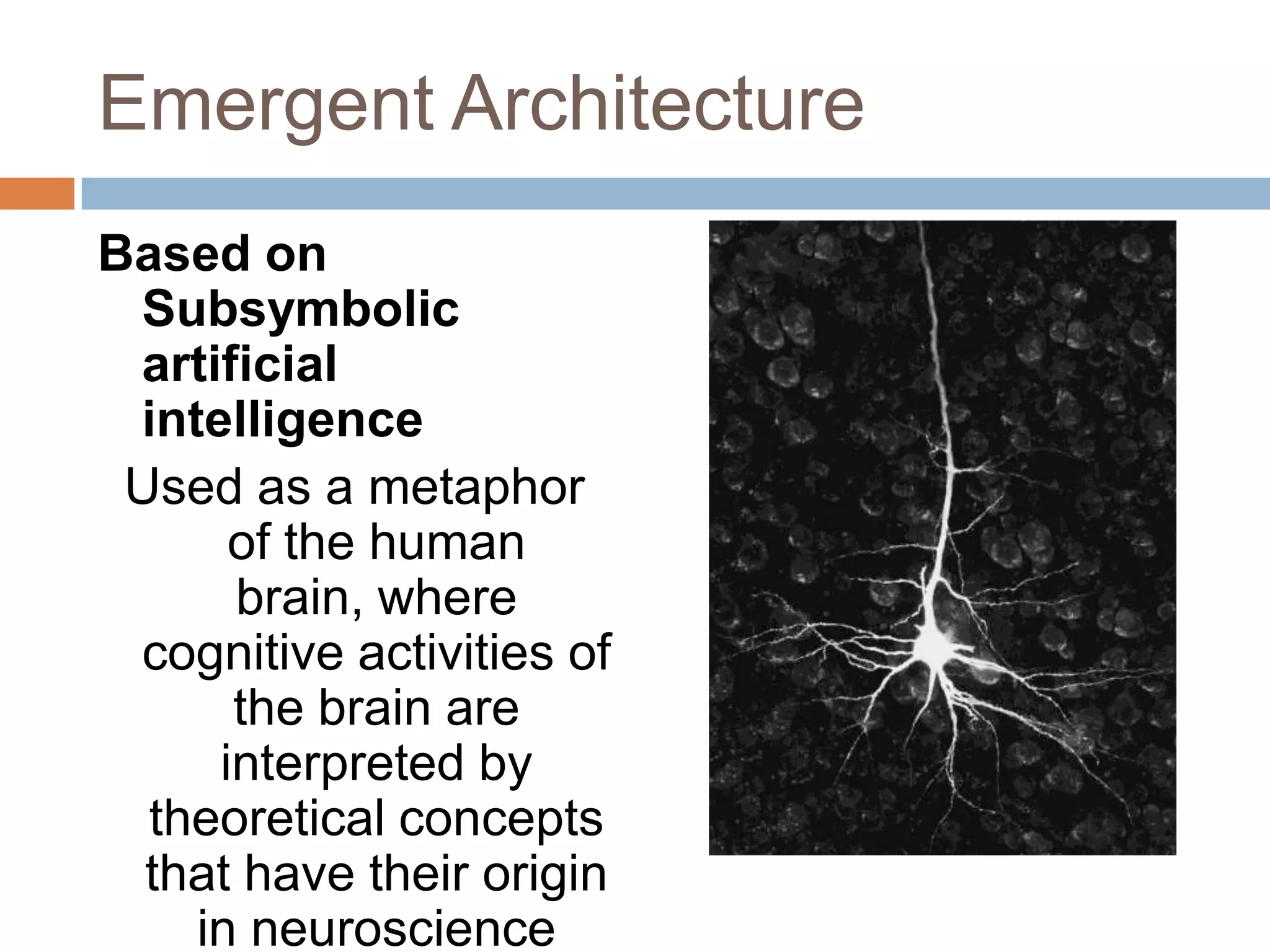
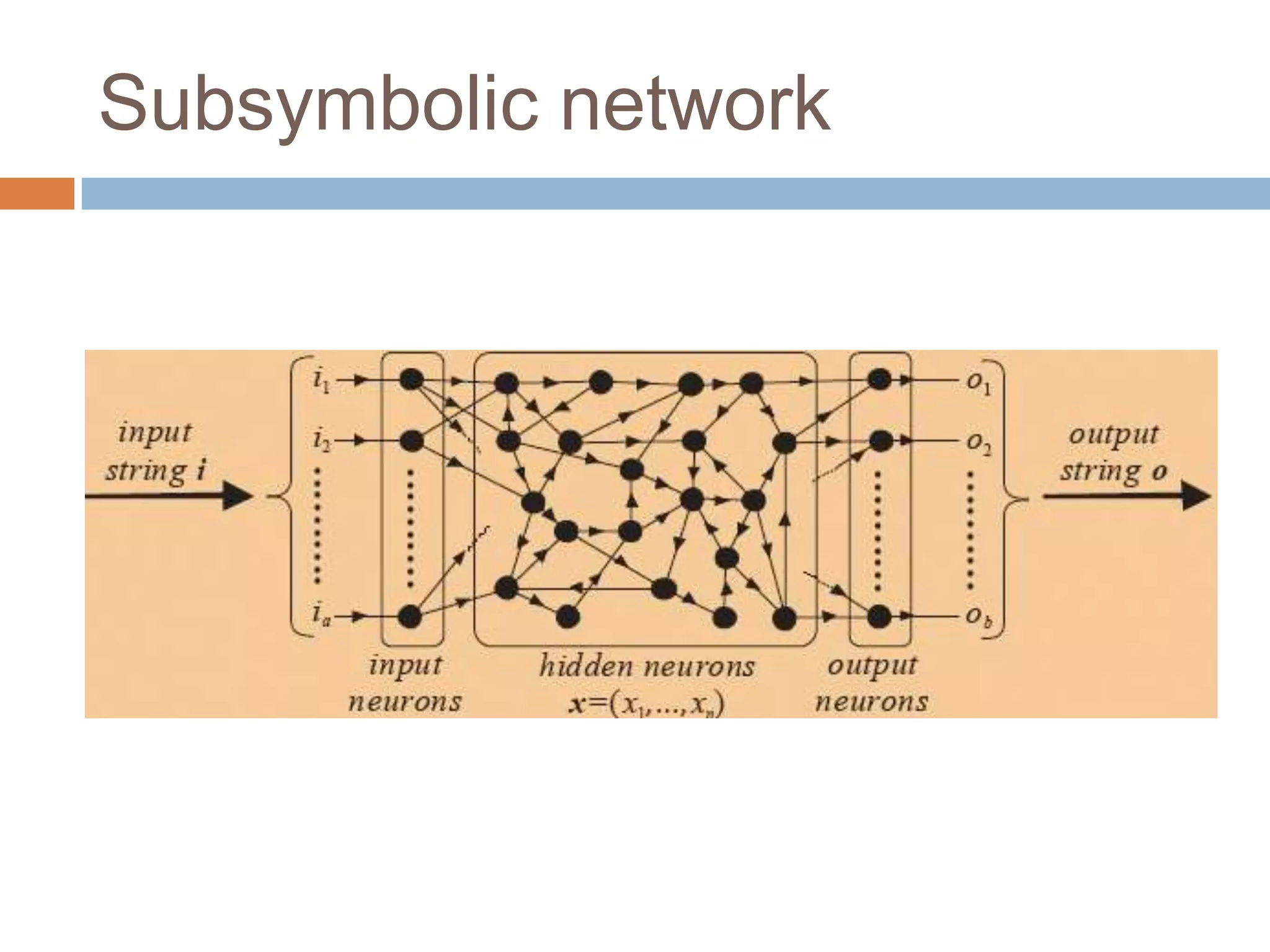
Emergent ArchitectureBased on Subsymbolic artificial intelligenceUsed as a metaphor of the human brain, where cognitive activities of the brain are interpreted by theoretical concepts that have their origin in neuroscience
Subsymbolic network
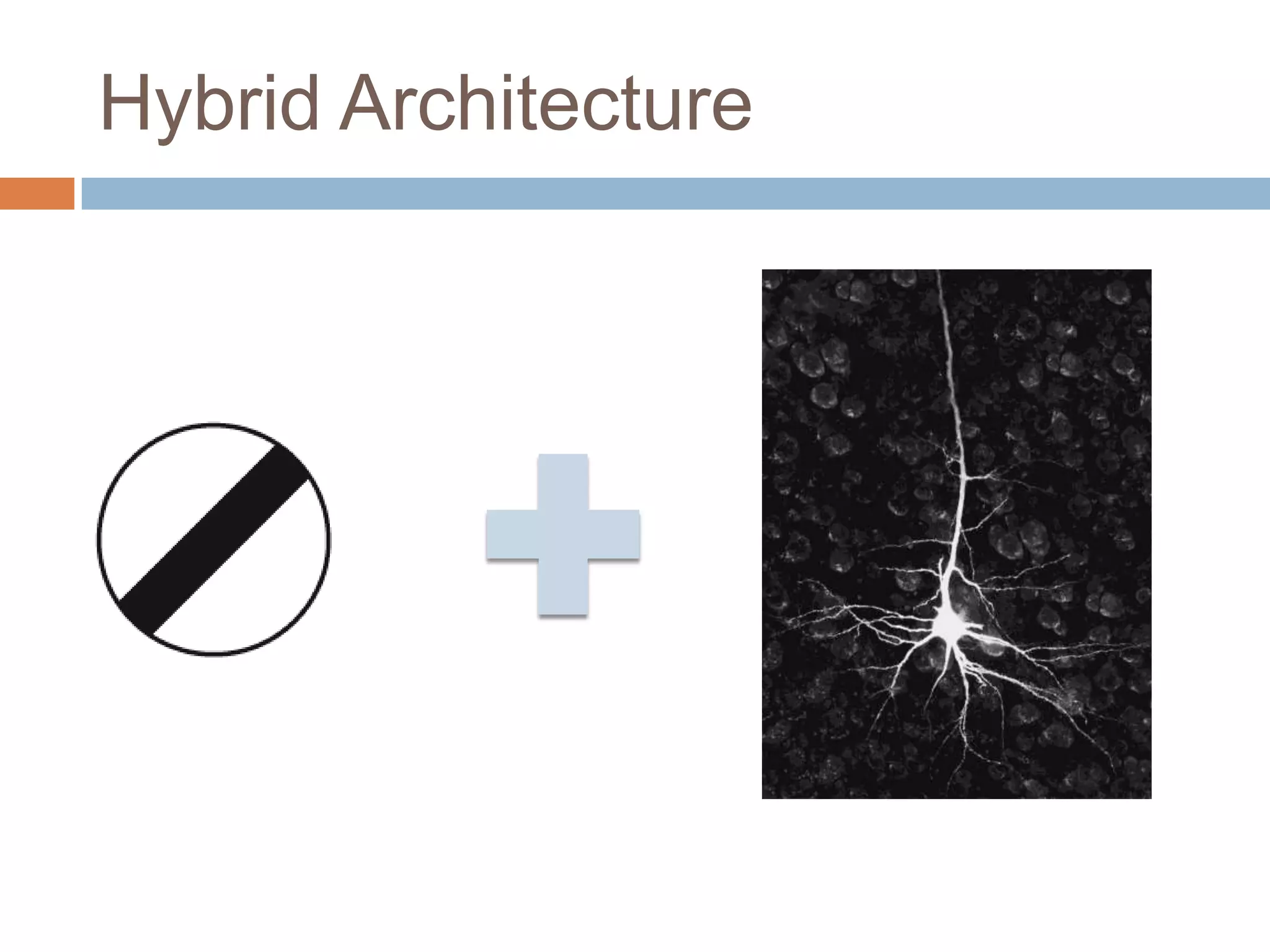
Hybrid Architecture
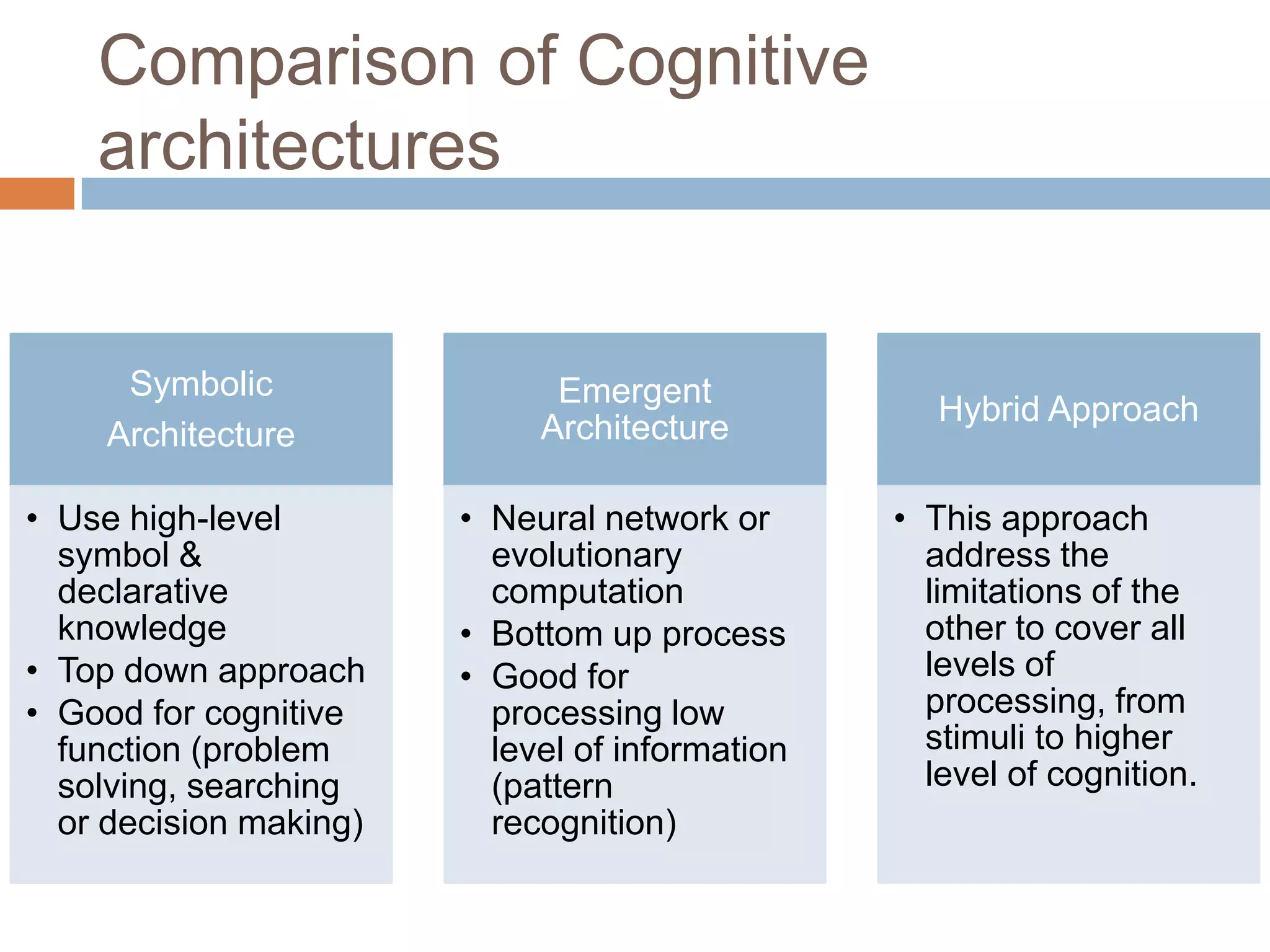
Comparison of Cognitive architectures
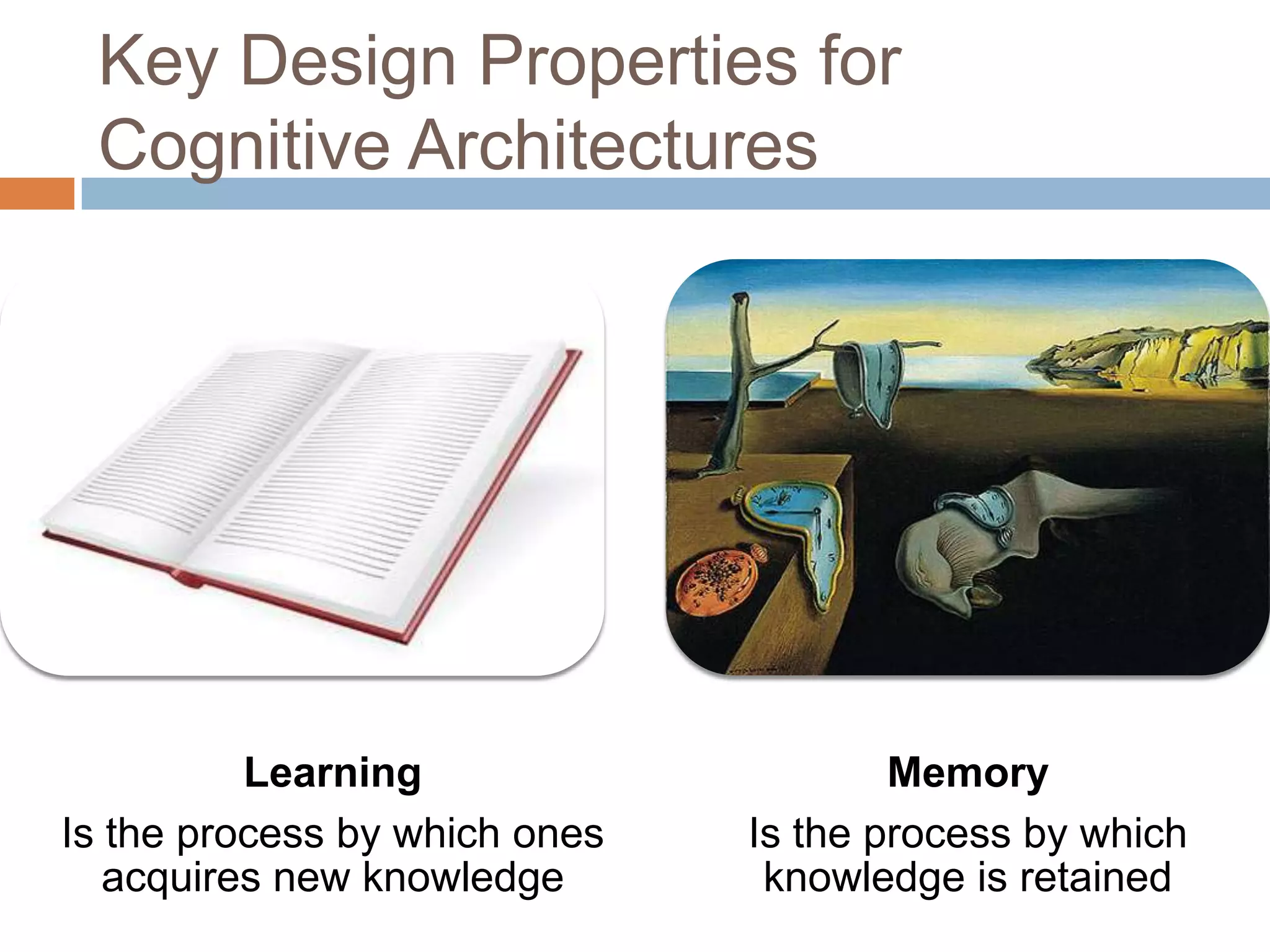
Key Design Properties for Cognitive Architectures
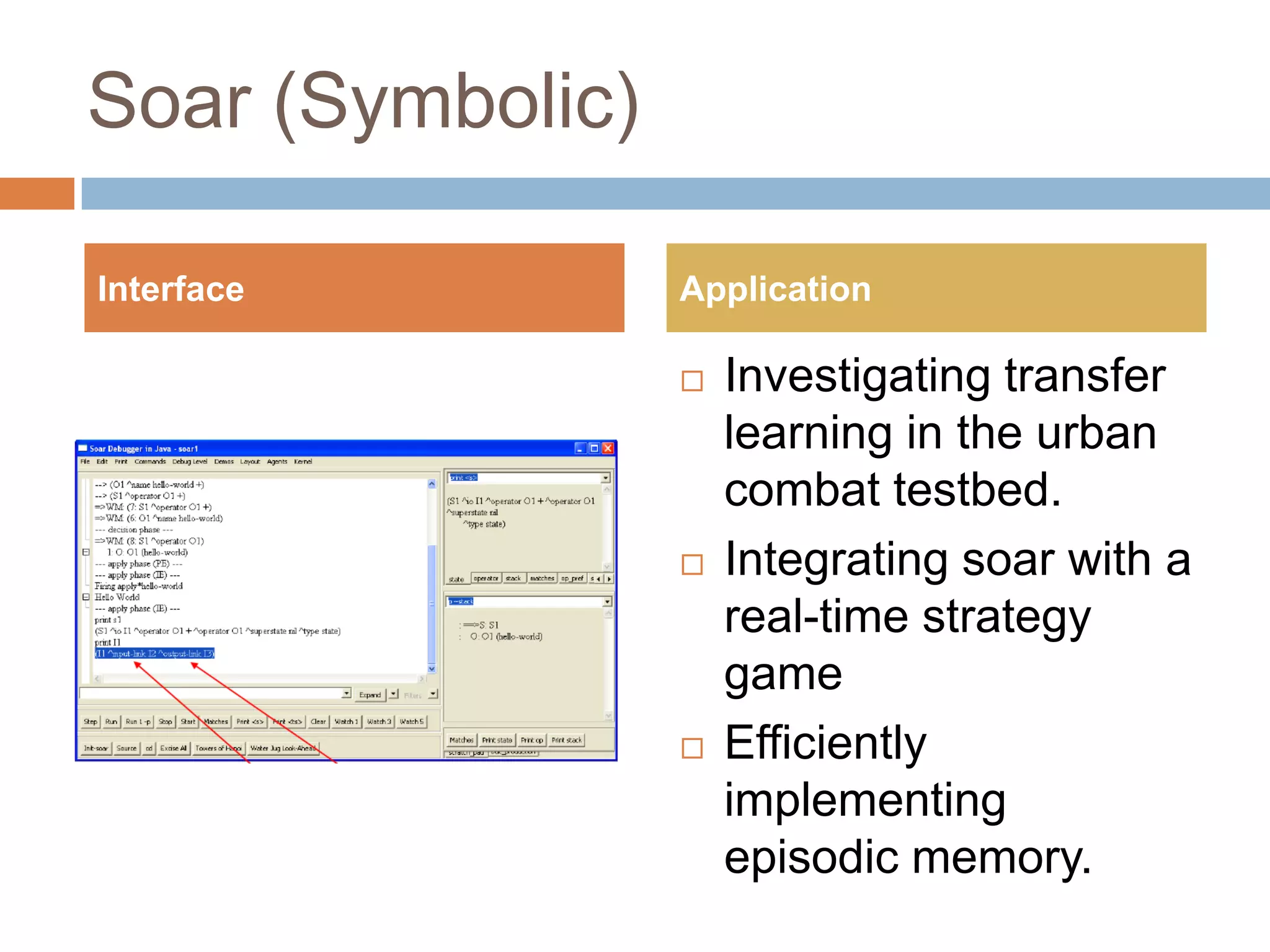
Soar (Symbolic)Investigating transfer learning in the urban combat testbed. Integrating soar with a real-time strategy game Efficiently implementing episodic memory. InterfaceApplication
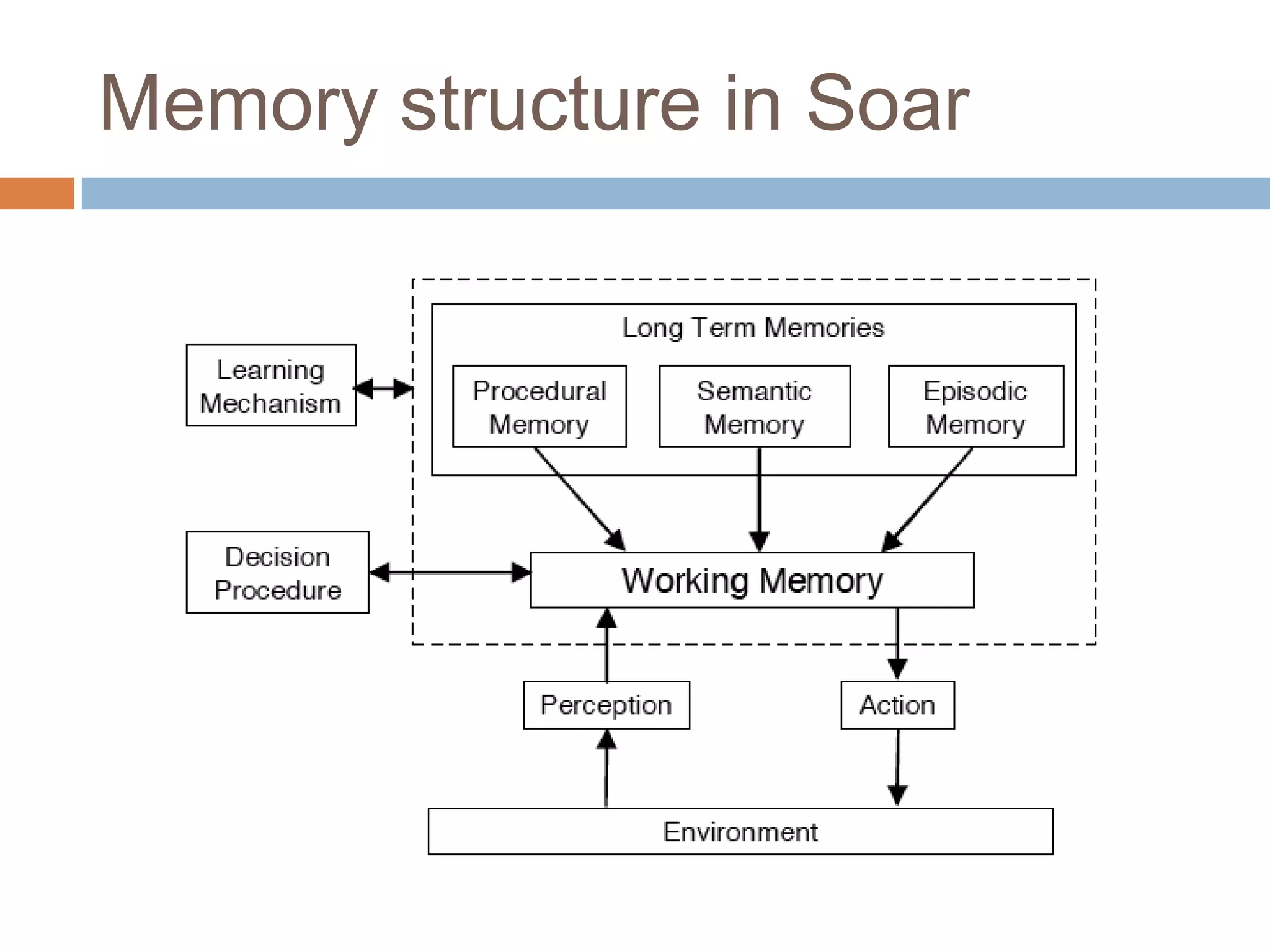
Memory structure in Soar
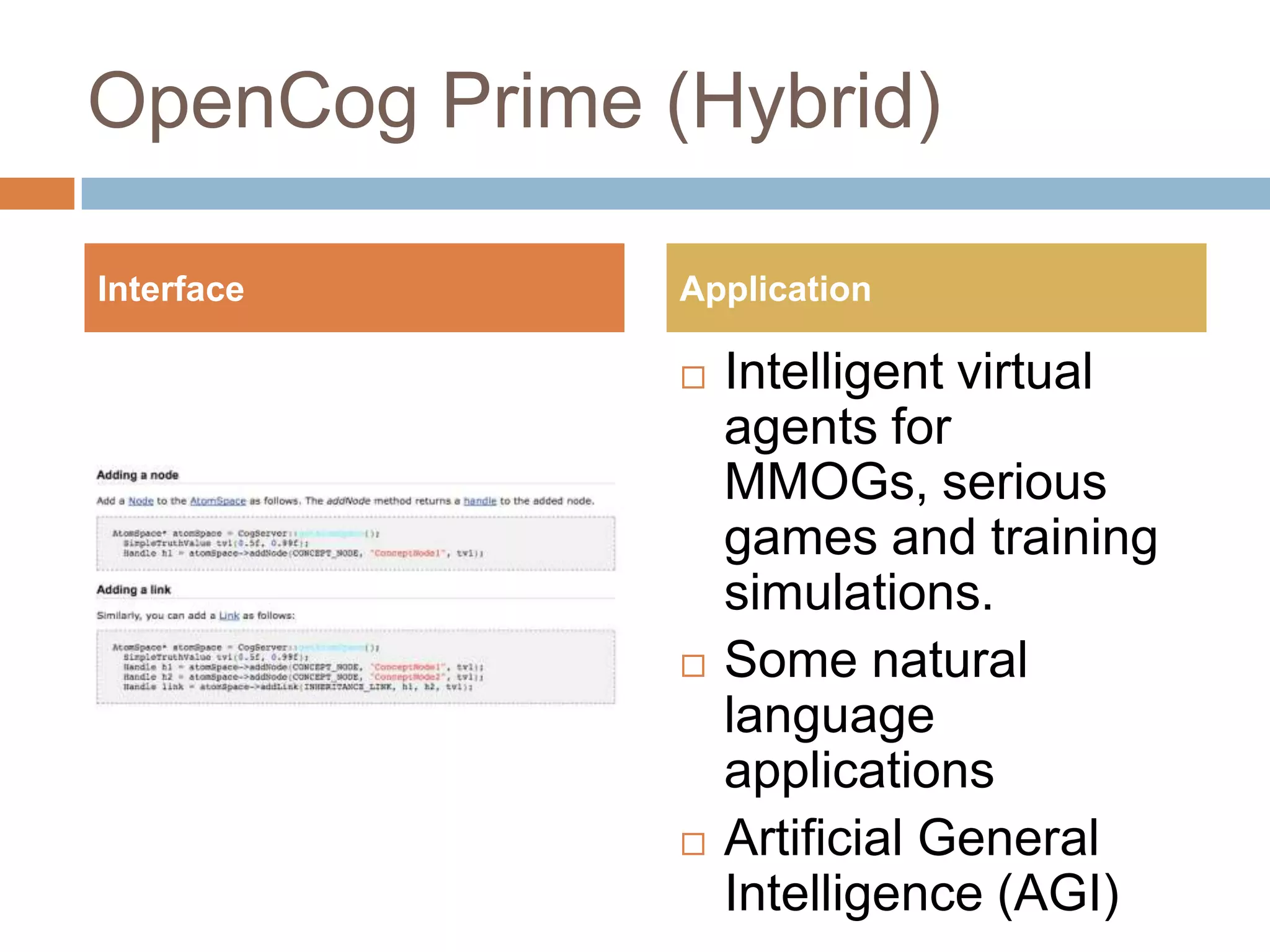
OpenCog Prime (Hybrid)Intelligent virtual agents for MMOGs, serious games and training simulations.Some natural language applicationsArtificial General Intelligence (AGI)InterfaceApplication
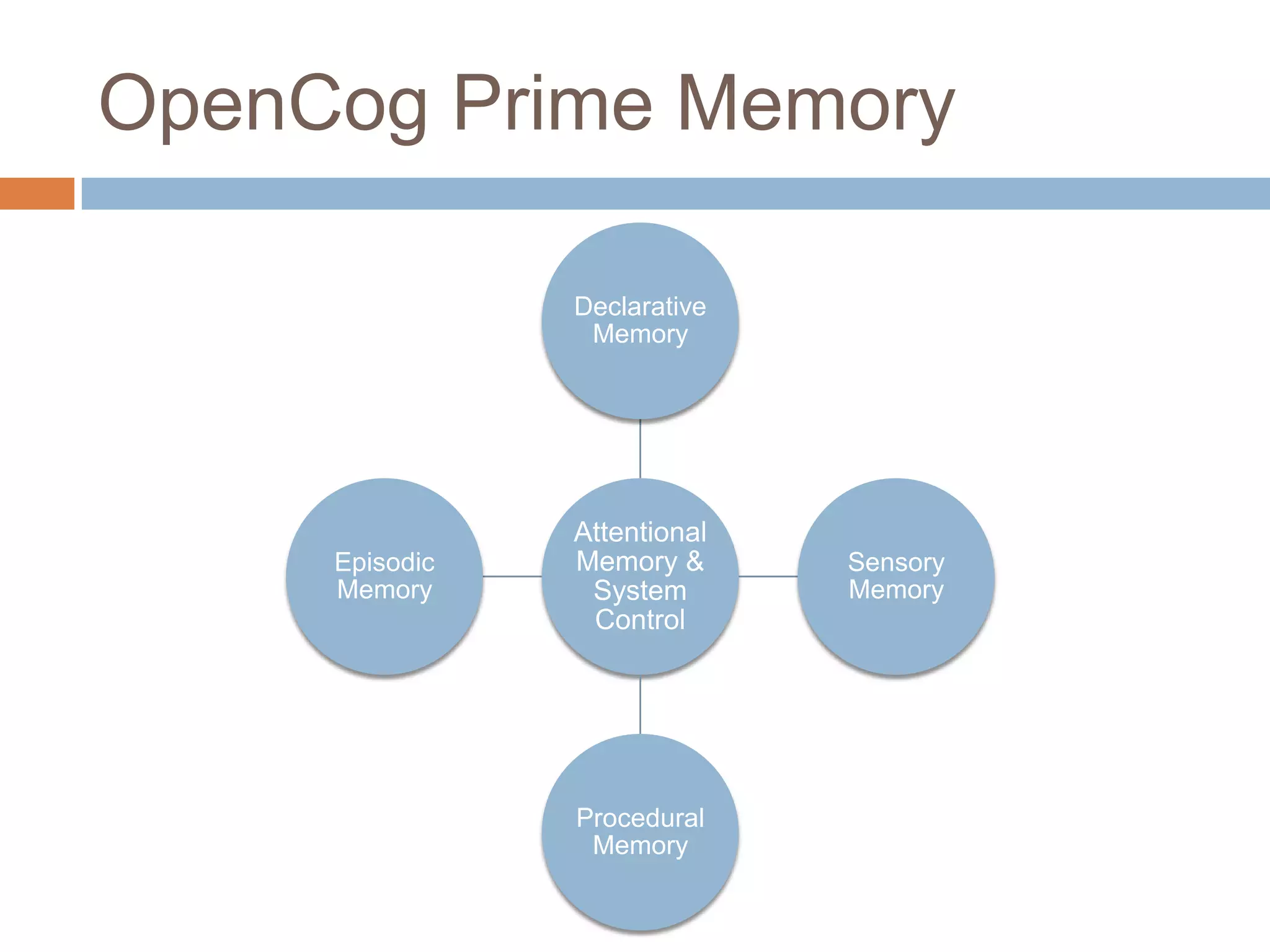
OpenCog Prime Memory
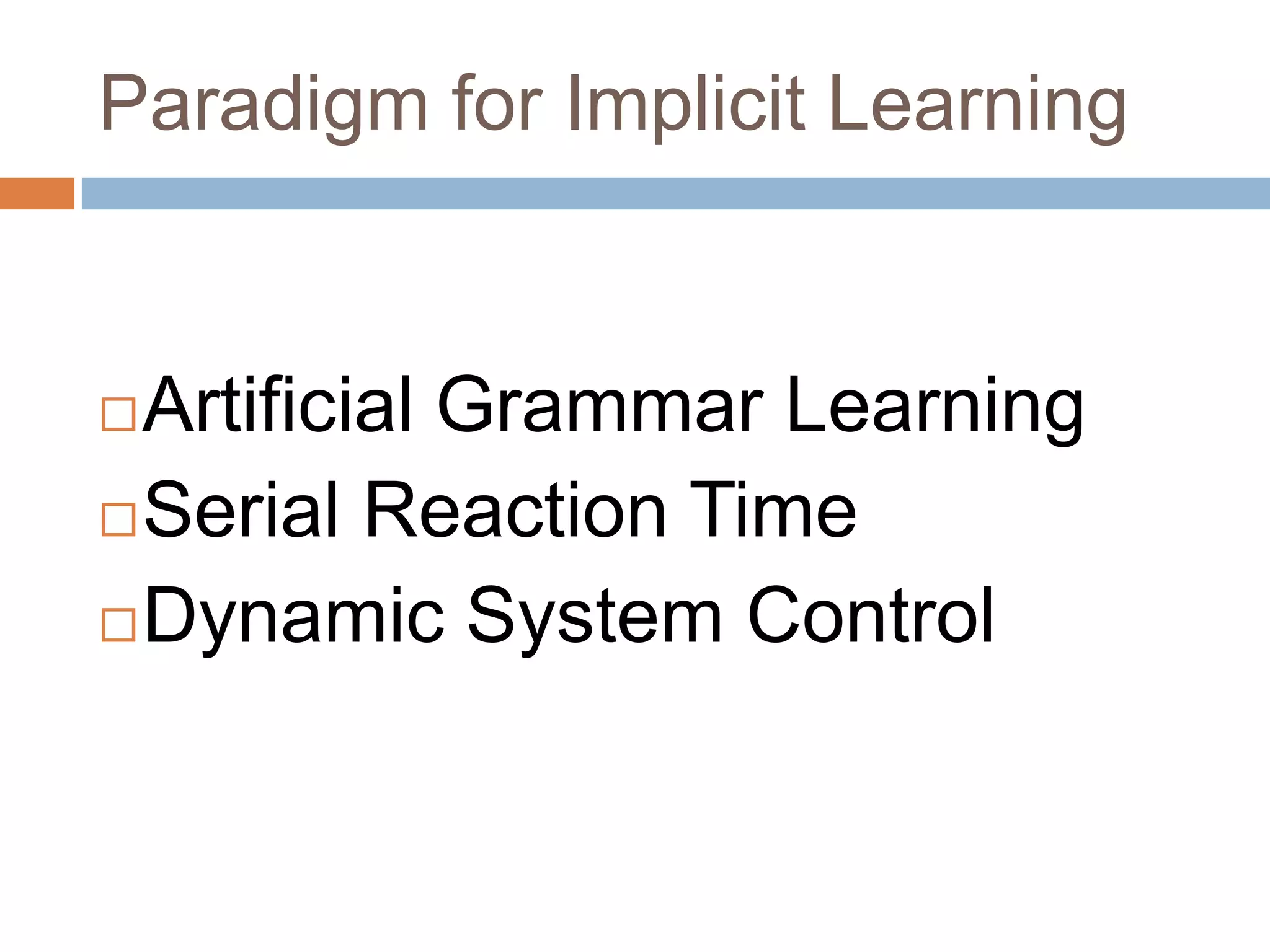
Paradigm for Implicit LearningArtificial Grammar LearningSerial Reaction TimeDynamic System Control
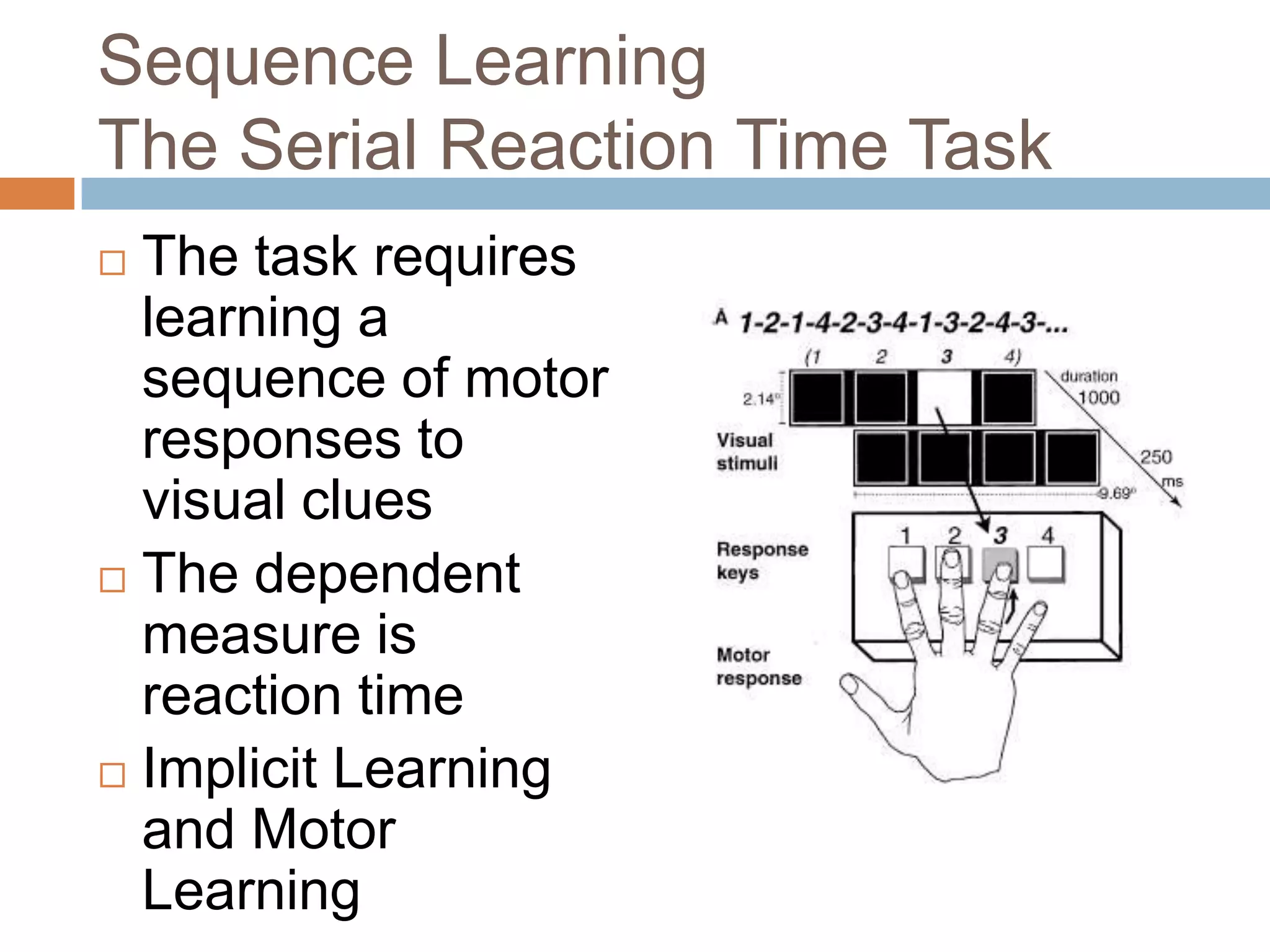
Sequence LearningThe Serial Reaction Time TaskThe task requires learning a sequence of motor responses to visual cluesThe dependent measure is reaction timeImplicit Learning and Motor Learning
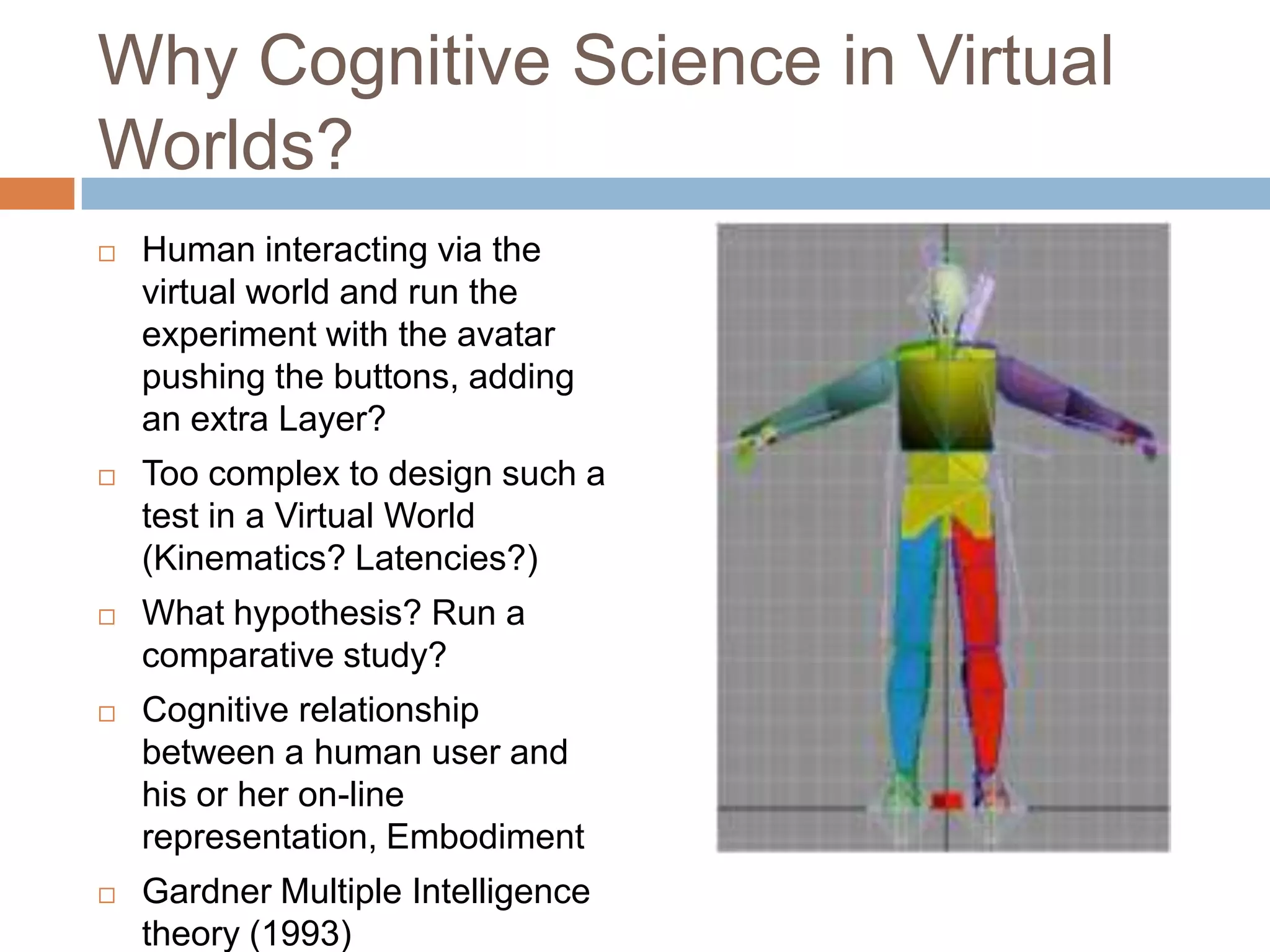
Why Cognitive Science in Virtual Worlds?Human interacting via the virtual world and run the experiment with the avatar pushing the buttons, adding an extra Layer?Too complex to design such a test in a Virtual World (Kinematics? Latencies?)What hypothesis? Run a comparative study?Cognitive relationship between a human user and his or her on-line representation, EmbodimentGardner Multiple Intelligence theory (1993)
Which World?
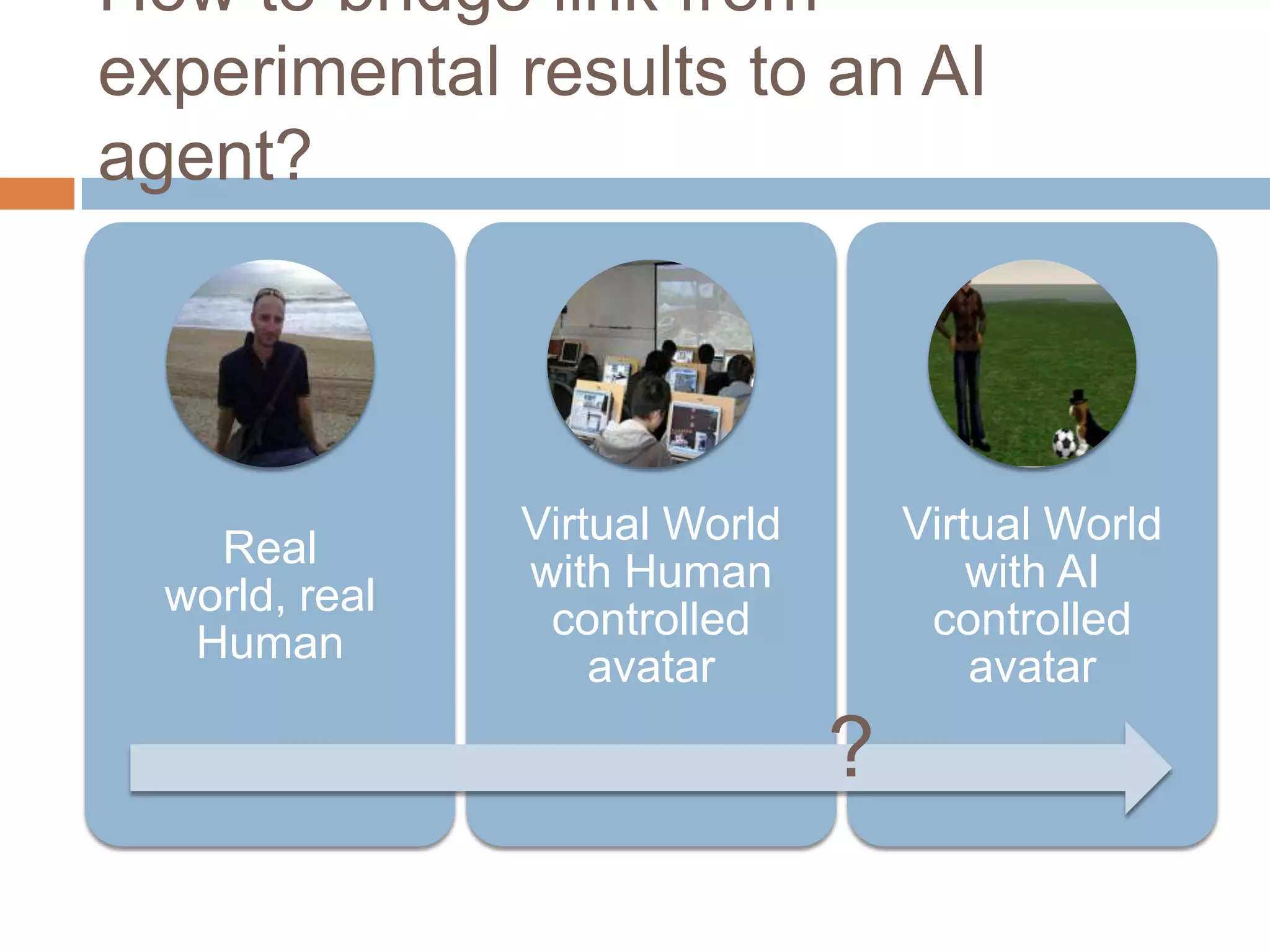
How to bridge link from experimental results to an AI agent??

Cognitive Science in Virtual Worlds

  • 1.
    Cognitive Science inVirtual WorldsLearning, memory, and cognition in virtual worlds
  • 2.
    Designing learning forartificial agents: Transferring kinaesthetic learners’ procedural skills in virtual environments to embodied artificial intelligent agents Research Focus
  • 3.
  • 4.
  • 5.
    A taxonomy ofmammalian long-term memory systems (1980 – present)Squire, L.R. Memory and Brain, New York: Oxford University Press, 1987.
  • 6.
    Going to thePizza Shop
  • 7.
    History of implicitmemoryDescartes (1649), Maine de Biran (1804)Implicit memory is based on implicit learning. It is an unconscious, non intentional form of memory that is expressed through performance rather than recollectionIn our every day language we refer to explicit memory not implicit
  • 8.
    Motor Skills LearningLearninghow to ride a bikeWhere is it?
  • 9.
    Cognitive Architecture DefinitionACognitive Architecture specifies the underlying infrastructure of an intelligent systemsThe short-term and long term memory that store content about the agent’s belief, goals and knowledgeThe representation and organization of structures that are embedded in these memoriesThe functional process that operate on these structures (performance and learning mechanisms)A programming language that lets one construct knowledge-based systems which embody the architecture’s assumptions.
  • 10.
  • 11.
    Symbolic ArchitectureSymbolic AI:the hypothesis that all intelligent thoughts are symbolic manipulation.
  • 12.
  • 13.
    Emergent ArchitectureBased onSubsymbolic artificial intelligenceUsed as a metaphor of the human brain, where cognitive activities of the brain are interpreted by theoretical concepts that have their origin in neuroscience
  • 14.
  • 15.
  • 16.
  • 17.
    Key Design Propertiesfor Cognitive Architectures
  • 18.
    Soar (Symbolic)Investigating transferlearning in the urban combat testbed. Integrating soar with a real-time strategy game Efficiently implementing episodic memory. InterfaceApplication
  • 19.
  • 20.
    OpenCog Prime (Hybrid)Intelligentvirtual agents for MMOGs, serious games and training simulations.Some natural language applicationsArtificial General Intelligence (AGI)InterfaceApplication
  • 21.
  • 22.
    Paradigm for ImplicitLearningArtificial Grammar LearningSerial Reaction TimeDynamic System Control
  • 23.
    Sequence LearningThe SerialReaction Time TaskThe task requires learning a sequence of motor responses to visual cluesThe dependent measure is reaction timeImplicit Learning and Motor Learning
  • 24.
    Why Cognitive Sciencein Virtual Worlds?Human interacting via the virtual world and run the experiment with the avatar pushing the buttons, adding an extra Layer?Too complex to design such a test in a Virtual World (Kinematics? Latencies?)What hypothesis? Run a comparative study?Cognitive relationship between a human user and his or her on-line representation, EmbodimentGardner Multiple Intelligence theory (1993)
  • 25.
  • 26.
    How to bridgelink from experimental results to an AI agent??

Editor's Notes

  • #6 To redo
  • #7 To redo
  • #8 Much debate about learning in the absence ofawareness.• Perhaps unconscious memory?• Perhaps hard to verbalize?In implicit memory studies, subjects are aware of the stimuli, but not necessarily their memory for them.
  • #9 the striatum, cerebellum and motor areas of the cortex (neocortex, parietal cortex). Basal Ganglia
  • #10 Is language an architecture? Definition of an architeture
  • #12 A physical symbol system has the necessary and sufficient means for general intelligence action Newell and Simon (1976)
  • #14 The intuitive processor is a subconceptual connectionist dynamical system that does not admit a complete, formal and precise conceptual level of description Smolensky (1988)
  • #17 perception, robotics, learning and pattern recognition
  • #19 Soar is a general cognitive architecture for developing systems that exhibit intelligent behavio
  • #20 Working memory= short term memory
  • #21 Cognitive Synergy Theory adopts a workingdefinition of intelligence as “the ability toachieve goals in environments”, where the issueof how to weight different goals andenvironments is admitted as a subtle one
  • #22 types ofmemory, corresponding to the following typesof knowledge: declarative, procedural, sensory,episodic, attentional and intentional.The first four of these memory types arestandard in cognitive science [9,10]. Attentionalknowledge is knowledge pertaining to whichentities within the system should get space andtime resources at a given moment; this is closelyrelated to the notion of consciousness [11].Intentional knowledge refers to the system’soverall goals and derived subgoals (which maybe continually revised by the system’s activity
  • #23 VEs in training procedural memory). Pursuit-rotor learning Mirror tracingSerial Retention Time TaskPouring taske.g. retention of procedural knowledge, procedural memory consolidation, procedural learningImplicit learning focuses on generalization to new stimuli rather than the sensitivity to processing the same stimulus again (implicit memory)
  • #24 The quintessential paradigm for studying procedural learning is the serial reaction time (SRT) task [43], in which subjects press keysas quickly as possible in response to stimuli that appear in various locations on the screen. A large response time improvement is observed when the stimulus sequence isrepeated, even when subjects are unaware that a sequence exists. In addition, changing the location of the response keys interferes with SRT learning, but changing the fingers that push the keys does not [44]. Thus, if procedural learning is used in information-integration tasks then switching the locations of the response keys should interfere with learning, but switching the fingers that depress the keys should not.
  • #25 Those with strong bodily-kinesthetic intelligence seem to use what might be termed muscle memory - they remember things through their body such as verbal memory or images.Procedural memory is the long-term memory of skills and procedures, or "how to" knowledge (procedural knowledge).
  • #26 Combines features of web2.0 instant messaging, voice chat, real time social networkingSL is good to mount formal experiments in social psy or cognitive science because the researcher can construct a facility comparable to a lab and can recruit online subjects. low costWoW may be better for nonintrusive statistical methodologies examining social networks and economic systems, because it naturally generates a vast trove of diverse butstandardized data about social and economic interactions. Both allow users to create new software modules to extract data. WoW is a very conducive environment forquantitative research because it encourages individuals to write “mod” or “add-on” programs, and scientists can use some existing software as research tools or write their ownOnline virtual worlds illustrate well the deficienciesof the Internet (46), notably its highlatency (slow packet delivery speed) and lowbandwidth (amount of information that can bedelivered in a given period of time). WoW managesthe bandwidth problem by placing all thegraphics on the users’ computers, but this meansthat they cannot create their own objects and atbest can assemble existing components. Thiswould not work for SL, because the whole pointis to empower users to create everything in theirvirtual world from scratch themselves. The penaltyfor SL users is a delay whenever the avatarmoves to a new location, because all the specificationsfor the environment must be downloadedfrom the server, often thousands of milesaway.