
Research Circle – PHD – 2016
By, Amr Kamel Ahmed
Supervised by, Dr. Alaa Hamdi
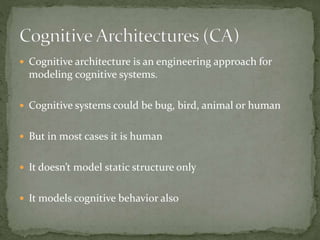
 Cognitive architecture is an engineering approach for
modeling cognitive systems.
 Cognitive systems could be bug, bird, animal or human
 But in most cases it is human
 It doesn’t model static structure only
 It models cognitive behavior also
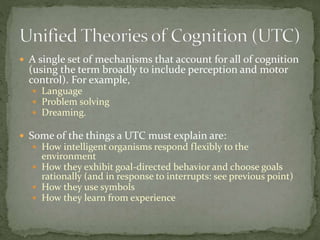
 A single set of mechanisms that account for all of cognition
(using the term broadly to include perception and motor
control). For example,
 Language
 Problem solving
 Dreaming.
 Some of the things a UTC must explain are:
 How intelligent organisms respond flexibly to the
environment
 How they exhibit goal-directed behavior and choose goals
rationally (and in response to interrupts: see previous point)
 How they use symbols
 How they learn from experience
 Psychology
 Evaluating cognitive models
 Studying learning techniques and methods
 Understanding cognition models of specific tasks i.e.
 Vehicle driving
 Computer Programming
 Robotics
 Transformation from systems that do limited low level tasks
extremely well to systems that perform wide range of tasks
with acceptable results
 Artificial Brain Projects
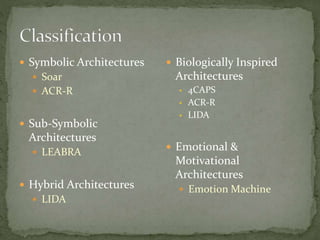
 Symbolic Architectures
 Soar
 ACR-R
 Sub-Symbolic
Architectures
 LEABRA
 Hybrid Architectures
 LIDA
 Biologically Inspired
Architectures
• 4CAPS
• ACR-R
• LIDA
 Emotional &
Motivational
Architectures
 Emotion Machine
Cognitive Architectures
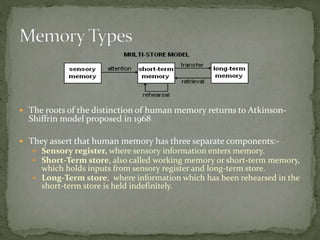
 The roots of the distinction of human memory returns to Atkinson-
Shiffrin model proposed in 1968
 They assert that human memory has three separate components:-
 Sensory register, where sensory information enters memory.
 Short-Term store, also called working memory or short-term memory,
which holds inputs from sensory register and long-term store.
 Long-Term store, where information which has been rehearsed in the
short-term store is held indefinitely.
 Each sensor has its own sensory register
 Do not process information carried by stimulus
 Detect and hold information for use by Short-Term memory
 Information only transferred to short-term memory when
attention is given to it, otherwise decays rapidly and forgotten
 Iconic Memory:-
 Sensory memory associated with visual system.
 It was experimentally shown that it is separated to short-term and
long-term memory
 Decays after 0.5 – 1.0 seconds
 Echoic Memory
 Associated with auditory system
 Holds superficial aspects of sound (e.g. pitch, temp or rhythm)
 Having duration between 1.5 and 5 seconds
 Attended information is transferred to Short-Term Memory (STM)
 Information that enters STM decays and lost as well as sensory
memory
 However it usually stays longer than sensory memory (18 – 20 seconds)
 Information can stay at STM for much longer time through rehearsal
 Information in STM doesn’t have to be of the same modality
 Example, written text enters as visual can be held as auditory and vise
versa
 There is limit to the amount of information that can be held in STM to
7 +/- 2 chuncks
 It is a process involves repeating information over and over
in order to get the information processed and stored in
memory
 There are two types of rehearsal
 Maintenance rehearsal
 It is useful in maintaining information in STM. However; it is not an
effective way of having information processed and transferred into
Long-Term Memory
 Example, repeating a phone number out loud until put the number
onto the phone to make the call.
 Elaborative Rehearsal
 This type of rehearsal if more effective in transfering information
from STM to Long-Term Memory
 It involves thinking about the meaning of the information and
connecting it to other information already stored in memory
 Is the memory stage where information can be stored for long periods
of time.
 Information can be maintained in Long-Term Memory (LTM)
indefinitely
 Two types:-
 Explicit Memory (Declarative) refers to all memories that are
consciously available, includes:-
 Episodic Memory:-
 Refers to memory for specific events in time as well as supporting their formation
and retreival
 Semantic Memory
 Refers to memory of factual information such as meaning of word
 Autobiographical Memory
 Refers to knowledge about events and personal experience from an individual’s
own life.
 Similar to episodic but it is related to individual lifespan
 Implicit Memory (Procedural Memory)
 Refers to the use of objects or movements of the body
 Such as how to use a pencil, drive a car or ride a bicycle
Cognitive Architectures
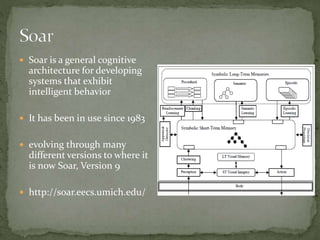
 Soar is a general cognitive
architecture for developing
systems that exhibit
intelligent behavior
 It has been in use since 1983
 evolving through many
different versions to where it
is now Soar, Version 9
 http://soar.eecs.umich.edu/
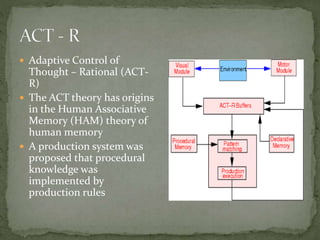
 Adaptive Control of
Thought – Rational (ACT-
R)
 The ACT theory has origins
in the Human Associative
Memory (HAM) theory of
human memory
 A production system was
proposed that procedural
knowledge was
implemented by
production rules
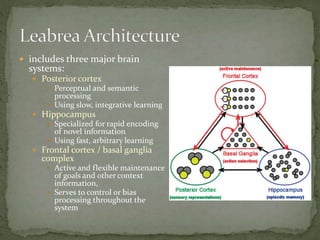
 includes three major brain
systems:
 Posterior cortex
 Perceptual and semantic
processing
 Using slow, integrative learning
 Hippocampus
 Specialized for rapid encoding
of novel information
 Using fast, arbitrary learning
 Frontal cortex / basal ganglia
complex
 Active and flexible maintenance
of goals and other context
information,
 Serves to control or bias
processing throughout the
system
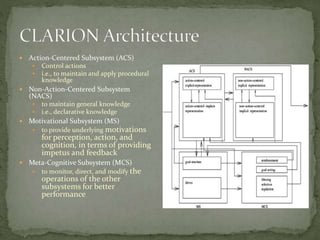
 Action-Centered Subsystem (ACS)
 Control actions
 i.e., to maintain and apply procedural
knowledge
 Non-Action-Centered Subsystem
(NACS)
 to maintain general knowledge
 i.e., declarative knowledge
 Motivational Subsystem (MS)
 to provide underlying motivations
for perception, action, and
cognition, in terms of providing
impetus and feedback
 Meta-Cognitive Subsystem (MCS)
 to monitor, direct, and modify the
operations of the other
subsystems for better
performance
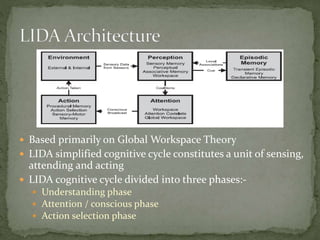
 Based primarily on Global Workspace Theory
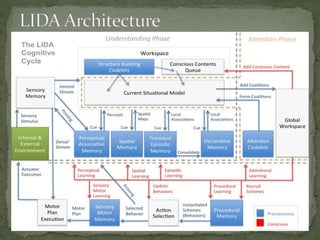
 LIDA simplified cognitive cycle constitutes a unit of sensing,
attending and acting
 LIDA cognitive cycle divided into three phases:-
 Understanding phase
 Attention / conscious phase
 Action selection phase
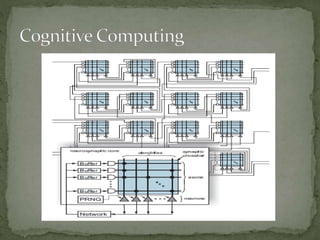
 Cognitive computing aims to develop a coherent, unified,
universal mechanism inspired by the mind’s capabilities
 it seeks to implement a unified computational theory of
the mind
 2007, IBM developed C2 mammalian scale near real-time
cortical simulator
 A notable C2 innovation is the memory efficient
representation of synaptic state significantly increasing
model scale.
 In 2013, IBM introduced the TrueNorth neuromorphic
CMOS chip.
 It consists of 4096 HW cores
 Each one simulating 256 programmable neurons
 Each neuron has 256 programmable synapses
 Although there are hybrid cognitive architectures which
includes both symbolic and sub-symbolic subsystems
however they are separated islands
 There are no integration between symbolic and sub-
symbolic subsystems that enables the usage of symbolic
representations based on sub-symblic platform.
 All symbolic representations relies only on Von Neumann
architecture
 There is no sub-symbolic architecture that allow causality
 How to create symbolic cognitive architecture relies on
neural-based platform
 How to build neural-based hardware platform suitable for
cognitive architectures:-
 Nano scale neurons
 Very low power consumption
 Low cost of implementation
 Scalable to include massive number of neurons (10^8 neurons
scale)
 How to integrate both paradigms into single cognitive
architecture that realizes Allen Newell aspects for Unified
Theory of Cognition
Thank You 

Cognitive Architectures - Research Circle

  • 1.
    Research Circle –PHD – 2016 By, Amr Kamel Ahmed Supervised by, Dr. Alaa Hamdi
  • 2.
     Cognitive architectureis an engineering approach for modeling cognitive systems.  Cognitive systems could be bug, bird, animal or human  But in most cases it is human  It doesn’t model static structure only  It models cognitive behavior also
  • 3.
     A singleset of mechanisms that account for all of cognition (using the term broadly to include perception and motor control). For example,  Language  Problem solving  Dreaming.  Some of the things a UTC must explain are:  How intelligent organisms respond flexibly to the environment  How they exhibit goal-directed behavior and choose goals rationally (and in response to interrupts: see previous point)  How they use symbols  How they learn from experience
  • 4.
     Psychology  Evaluatingcognitive models  Studying learning techniques and methods  Understanding cognition models of specific tasks i.e.  Vehicle driving  Computer Programming  Robotics  Transformation from systems that do limited low level tasks extremely well to systems that perform wide range of tasks with acceptable results  Artificial Brain Projects
  • 5.
     Symbolic Architectures Soar  ACR-R  Sub-Symbolic Architectures  LEABRA  Hybrid Architectures  LIDA  Biologically Inspired Architectures • 4CAPS • ACR-R • LIDA  Emotional & Motivational Architectures  Emotion Machine
  • 6.
  • 7.
     The rootsof the distinction of human memory returns to Atkinson- Shiffrin model proposed in 1968  They assert that human memory has three separate components:-  Sensory register, where sensory information enters memory.  Short-Term store, also called working memory or short-term memory, which holds inputs from sensory register and long-term store.  Long-Term store, where information which has been rehearsed in the short-term store is held indefinitely.
  • 8.
     Each sensorhas its own sensory register  Do not process information carried by stimulus  Detect and hold information for use by Short-Term memory  Information only transferred to short-term memory when attention is given to it, otherwise decays rapidly and forgotten  Iconic Memory:-  Sensory memory associated with visual system.  It was experimentally shown that it is separated to short-term and long-term memory  Decays after 0.5 – 1.0 seconds  Echoic Memory  Associated with auditory system  Holds superficial aspects of sound (e.g. pitch, temp or rhythm)  Having duration between 1.5 and 5 seconds
  • 9.
     Attended informationis transferred to Short-Term Memory (STM)  Information that enters STM decays and lost as well as sensory memory  However it usually stays longer than sensory memory (18 – 20 seconds)  Information can stay at STM for much longer time through rehearsal  Information in STM doesn’t have to be of the same modality  Example, written text enters as visual can be held as auditory and vise versa  There is limit to the amount of information that can be held in STM to 7 +/- 2 chuncks
  • 10.
     It isa process involves repeating information over and over in order to get the information processed and stored in memory  There are two types of rehearsal  Maintenance rehearsal  It is useful in maintaining information in STM. However; it is not an effective way of having information processed and transferred into Long-Term Memory  Example, repeating a phone number out loud until put the number onto the phone to make the call.  Elaborative Rehearsal  This type of rehearsal if more effective in transfering information from STM to Long-Term Memory  It involves thinking about the meaning of the information and connecting it to other information already stored in memory
  • 11.
     Is thememory stage where information can be stored for long periods of time.  Information can be maintained in Long-Term Memory (LTM) indefinitely  Two types:-  Explicit Memory (Declarative) refers to all memories that are consciously available, includes:-  Episodic Memory:-  Refers to memory for specific events in time as well as supporting their formation and retreival  Semantic Memory  Refers to memory of factual information such as meaning of word  Autobiographical Memory  Refers to knowledge about events and personal experience from an individual’s own life.  Similar to episodic but it is related to individual lifespan  Implicit Memory (Procedural Memory)  Refers to the use of objects or movements of the body  Such as how to use a pencil, drive a car or ride a bicycle
  • 12.
  • 13.
     Soar isa general cognitive architecture for developing systems that exhibit intelligent behavior  It has been in use since 1983  evolving through many different versions to where it is now Soar, Version 9  http://soar.eecs.umich.edu/
  • 14.
     Adaptive Controlof Thought – Rational (ACT- R)  The ACT theory has origins in the Human Associative Memory (HAM) theory of human memory  A production system was proposed that procedural knowledge was implemented by production rules
  • 15.
     includes threemajor brain systems:  Posterior cortex  Perceptual and semantic processing  Using slow, integrative learning  Hippocampus  Specialized for rapid encoding of novel information  Using fast, arbitrary learning  Frontal cortex / basal ganglia complex  Active and flexible maintenance of goals and other context information,  Serves to control or bias processing throughout the system
  • 16.
     Action-Centered Subsystem(ACS)  Control actions  i.e., to maintain and apply procedural knowledge  Non-Action-Centered Subsystem (NACS)  to maintain general knowledge  i.e., declarative knowledge  Motivational Subsystem (MS)  to provide underlying motivations for perception, action, and cognition, in terms of providing impetus and feedback  Meta-Cognitive Subsystem (MCS)  to monitor, direct, and modify the operations of the other subsystems for better performance
  • 17.
     Based primarilyon Global Workspace Theory  LIDA simplified cognitive cycle constitutes a unit of sensing, attending and acting  LIDA cognitive cycle divided into three phases:-  Understanding phase  Attention / conscious phase  Action selection phase
  • 19.
     Cognitive computingaims to develop a coherent, unified, universal mechanism inspired by the mind’s capabilities  it seeks to implement a unified computational theory of the mind  2007, IBM developed C2 mammalian scale near real-time cortical simulator  A notable C2 innovation is the memory efficient representation of synaptic state significantly increasing model scale.  In 2013, IBM introduced the TrueNorth neuromorphic CMOS chip.  It consists of 4096 HW cores  Each one simulating 256 programmable neurons  Each neuron has 256 programmable synapses
  • 21.
     Although thereare hybrid cognitive architectures which includes both symbolic and sub-symbolic subsystems however they are separated islands  There are no integration between symbolic and sub- symbolic subsystems that enables the usage of symbolic representations based on sub-symblic platform.  All symbolic representations relies only on Von Neumann architecture  There is no sub-symbolic architecture that allow causality
  • 22.
     How tocreate symbolic cognitive architecture relies on neural-based platform  How to build neural-based hardware platform suitable for cognitive architectures:-  Nano scale neurons  Very low power consumption  Low cost of implementation  Scalable to include massive number of neurons (10^8 neurons scale)  How to integrate both paradigms into single cognitive architecture that realizes Allen Newell aspects for Unified Theory of Cognition
  • 23.