Artificial Intelligence
Introduction
Why Study AI?
• AI makes computers more useful
• Intelligent computer would have huge impact
on civilization
• AI cited as “field I would most like to be in” by
scientists in all fields
• Computer is a good metaphor for talking and
thinking about intelligence
Why Study AI?
• Turning theory into working programs forces
us to work out the details
• AI yields good results for Computer Science
• AI yields good results for other fields
• Computers make good experimental subjects
• Personal motivation: mystery
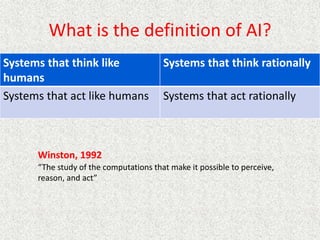
What is the definition of AI?
What do you think?
What is the definition of AI?
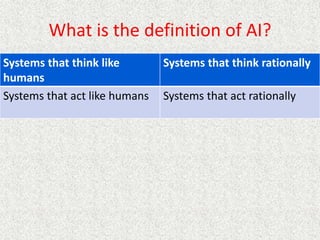
Systems that think like
humans
Systems that think rationally
Systems that act like humans Systems that act rationally
What is the definition of AI?
Systems that think like
humans
Systems that think rationally
Systems that act like humans Systems that act rationally
Bellman, 1978
“[The automation of] activities that we associate with human thinking,
activities such as decision making, problem solving, learning”
What is the definition of AI?
Systems that think like
humans
Systems that think rationally
Systems that act like humans Systems that act rationally
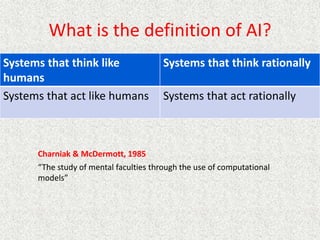
Charniak & McDermott, 1985
“The study of mental faculties through the use of computational
models”
What is the definition of AI?
Systems that think like
humans
Systems that think rationally
Systems that act like humans Systems that act rationally
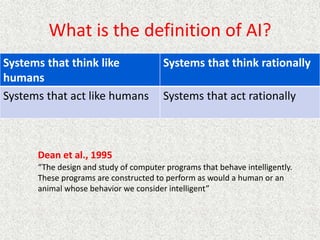
Dean et al., 1995
“The design and study of computer programs that behave intelligently.
These programs are constructed to perform as would a human or an
animal whose behavior we consider intelligent”
What is the definition of AI?
Systems that think like
humans
Systems that think rationally
Systems that act like humans Systems that act rationally
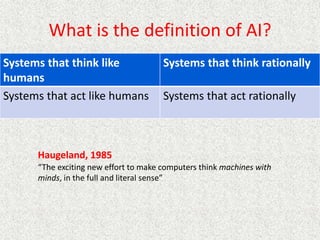
Haugeland, 1985
“The exciting new effort to make computers think machines with
minds, in the full and literal sense”
What is the definition of AI?
Systems that think like
humans
Systems that think rationally
Systems that act like humans Systems that act rationally
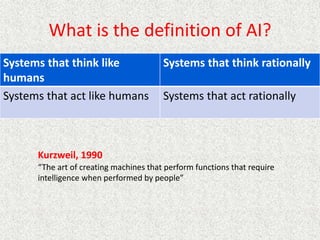
Kurzweil, 1990
“The art of creating machines that perform functions that require
intelligence when performed by people”
What is the definition of AI?
Systems that think like
humans
Systems that think rationally
Systems that act like humans Systems that act rationally
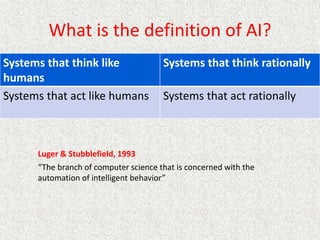
Luger & Stubblefield, 1993
“The branch of computer science that is concerned with the
automation of intelligent behavior”
What is the definition of AI?
Systems that think like
humans
Systems that think rationally
Systems that act like humans Systems that act rationally
Nilsson, 1998
“Many human mental activities such as writing computer programs,
doing mathematics, engaging in common sense reasoning,
understanding language, and even driving an automobile, are said to
demand intelligence. We might say that [these systems] exhibit
artificial intelligence”
What is the definition of AI?
Systems that think like
humans
Systems that think rationally
Systems that act like humans Systems that act rationally
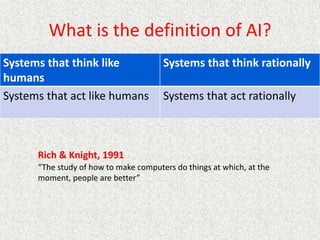
Rich & Knight, 1991
“The study of how to make computers do things at which, at the
moment, people are better”
What is the definition of AI?
Systems that think like
humans
Systems that think rationally
Systems that act like humans Systems that act rationally
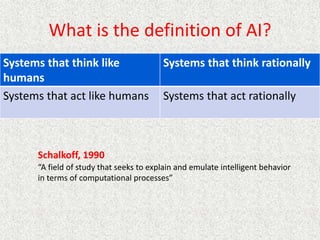
Schalkoff, 1990
“A field of study that seeks to explain and emulate intelligent behavior
in terms of computational processes”
What is the definition of AI?
Systems that think like
humans
Systems that think rationally
Systems that act like humans Systems that act rationally
Winston, 1992
“The study of the computations that make it possible to perceive,
reason, and act”
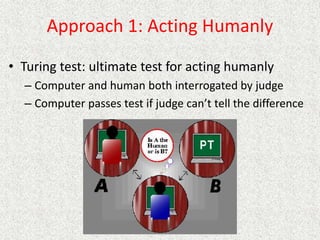
Approach 1: Acting Humanly
• Turing test: ultimate test for acting humanly
– Computer and human both interrogated by judge
– Computer passes test if judge can’t tell the difference
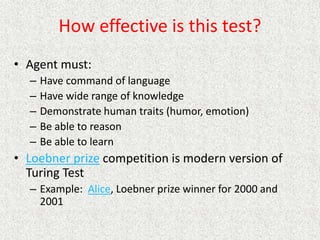
How effective is this test?
• Agent must:
– Have command of language
– Have wide range of knowledge
– Demonstrate human traits (humor, emotion)
– Be able to reason
– Be able to learn
• Loebner prize competition is modern version of
Turing Test
– Example: Alice, Loebner prize winner for 2000 and
2001
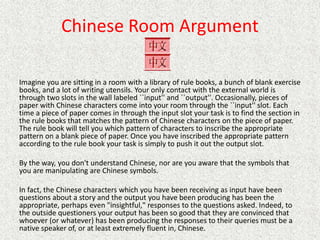
Chinese Room Argument
Imagine you are sitting in a room with a library of rule books, a bunch of blank exercise
books, and a lot of writing utensils. Your only contact with the external world is
through two slots in the wall labeled ``input'' and ``output''. Occasionally, pieces of
paper with Chinese characters come into your room through the ``input'' slot. Each
time a piece of paper comes in through the input slot your task is to find the section in
the rule books that matches the pattern of Chinese characters on the piece of paper.
The rule book will tell you which pattern of characters to inscribe the appropriate
pattern on a blank piece of paper. Once you have inscribed the appropriate pattern
according to the rule book your task is simply to push it out the output slot.
By the way, you don't understand Chinese, nor are you aware that the symbols that
you are manipulating are Chinese symbols.
In fact, the Chinese characters which you have been receiving as input have been
questions about a story and the output you have been producing has been the
appropriate, perhaps even "insightful," responses to the questions asked. Indeed, to
the outside questioners your output has been so good that they are convinced that
whoever (or whatever) has been producing the responses to their queries must be a
native speaker of, or at least extremely fluent in, Chinese.
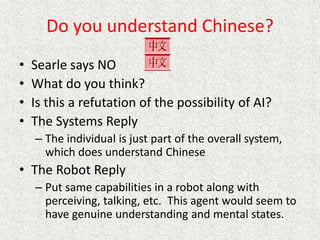
Do you understand Chinese?
• Searle says NO
• What do you think?
• Is this a refutation of the possibility of AI?
• The Systems Reply
– The individual is just part of the overall system,
which does understand Chinese
• The Robot Reply
– Put same capabilities in a robot along with
perceiving, talking, etc. This agent would seem to
have genuine understanding and mental states.
Approach 2: Thinking Humanly
• Requires knowledge of brain function
• What level of abstraction?
• How can we validate this
• This is the focus of Cognitive Science
Approach 3: Thinking Rationally
• Aristotle attempted this
• What are correct arguments or thought
processes?
• Provided foundation of much of AI
• Not all intelligent behavior controlled by logic
• What is our goal? What is the purpose of
thinking?
Approach 4: Acting Rationally
• Act to achieve goals, given set of beliefs
• Rational behavior is doing the “right thing”
– Thing which expects to maximize goal
achievement
• This is approach adopted by Russell & Norvig
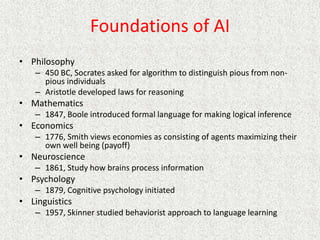
Foundations of AI
• Philosophy
– 450 BC, Socrates asked for algorithm to distinguish pious from non-
pious individuals
– Aristotle developed laws for reasoning
• Mathematics
– 1847, Boole introduced formal language for making logical inference
• Economics
– 1776, Smith views economies as consisting of agents maximizing their
own well being (payoff)
• Neuroscience
– 1861, Study how brains process information
• Psychology
– 1879, Cognitive psychology initiated
• Linguistics
– 1957, Skinner studied behaviorist approach to language learning
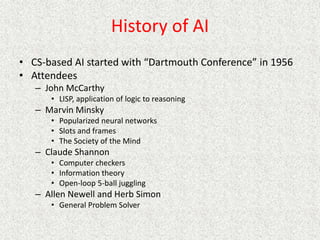
History of AI
• CS-based AI started with “Dartmouth Conference” in 1956
• Attendees
– John McCarthy
• LISP, application of logic to reasoning
– Marvin Minsky
• Popularized neural networks
• Slots and frames
• The Society of the Mind
– Claude Shannon
• Computer checkers
• Information theory
• Open-loop 5-ball juggling
– Allen Newell and Herb Simon
• General Problem Solver
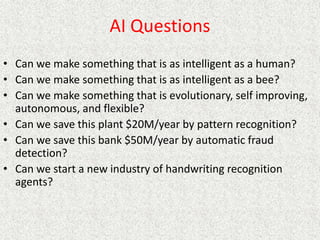
AI Questions
• Can we make something that is as intelligent as a human?
• Can we make something that is as intelligent as a bee?
• Can we make something that is evolutionary, self improving,
autonomous, and flexible?
• Can we save this plant $20M/year by pattern recognition?
• Can we save this bank $50M/year by automatic fraud
detection?
• Can we start a new industry of handwriting recognition
agents?
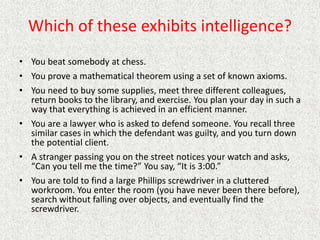
Which of these exhibits intelligence?
• You beat somebody at chess.
• You prove a mathematical theorem using a set of known axioms.
• You need to buy some supplies, meet three different colleagues,
return books to the library, and exercise. You plan your day in such a
way that everything is achieved in an efficient manner.
• You are a lawyer who is asked to defend someone. You recall three
similar cases in which the defendant was guilty, and you turn down
the potential client.
• A stranger passing you on the street notices your watch and asks,
“Can you tell me the time?” You say, “It is 3:00.”
• You are told to find a large Phillips screwdriver in a cluttered
workroom. You enter the room (you have never been there before),
search without falling over objects, and eventually find the
screwdriver.
Which of these exhibits intelligence?
• You are a six-month-old infant. You can produce sounds with your
vocal organs, and you can hear speech sounds around you, but you
do not know how to make the sounds you are hearing. In the next
year, you figure out what the sounds of your parents' language are
and how to make them.
• You are a one-year-old child learning Arabic. You hear strings of
sounds and figure out that they are associated with particular
meanings in the world. Within two years, you learn how to segment
the strings into meaningful parts and produce your own words and
sentences.
• Someone taps a rhythm, and you are able to beat along with it and
to continue it even after it stops.
• You are some sort of primitive invertebrate. You know nothing
about how to move about in your world, only that you need to find
food and keep from bumping into walls. After lots of reinforcement
and punishment, you get around just fine.
Which of these can currently be done?
• Play a decent game of table tennis
• Drive autonomously along a curving mountain road
• Drive autonomously in the center of Cairo
• Play a decent game of bridge
• Discover and prove a new mathematical theorem
• Write an intentionally funny story
• Give competent legal advice in a specialized area of law
• Translate spoken English into spoken Swedish in real time
• Plan schedule of operations for a NASA spacecraft
• Defeat the world champion in chess
Components of an AI System
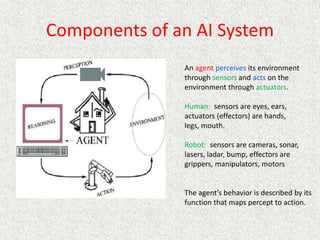
An agent perceives its environment
through sensors and acts on the
environment through actuators.
Human: sensors are eyes, ears,
actuators (effectors) are hands,
legs, mouth.
Robot: sensors are cameras, sonar,
lasers, ladar, bump, effectors are
grippers, manipulators, motors
The agent’s behavior is described by its
function that maps percept to action.
Rationality
• A rational agent does the right thing
(what is this?)
• A fixed performance measure evaluates the
sequence of observed action effects on the
environment
PEAS
• Use PEAS to describe task
– Performance measure
– Environment
– Actuators
– Sensors
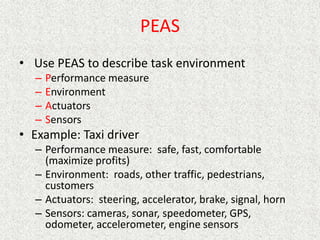
PEAS
• Use PEAS to describe task environment
– Performance measure
– Environment
– Actuators
– Sensors
• Example: Taxi driver
– Performance measure: safe, fast, comfortable
(maximize profits)
– Environment: roads, other traffic, pedestrians,
customers
– Actuators: steering, accelerator, brake, signal, horn
– Sensors: cameras, sonar, speedometer, GPS,
odometer, accelerometer, engine sensors
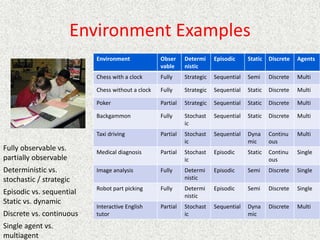
Environment Properties
• Fully observable vs. partially observable
• Deterministic vs. stochastic / strategic
• Episodic vs. sequential
• Static vs. dynamic
• Discrete vs. continuous
• Single agent vs. multiagent
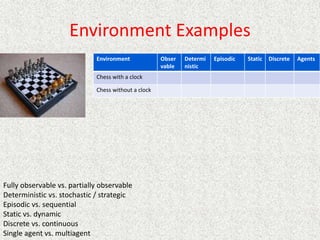
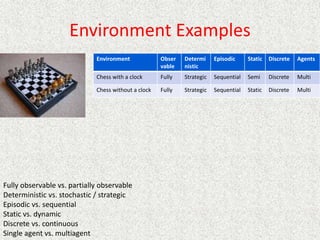
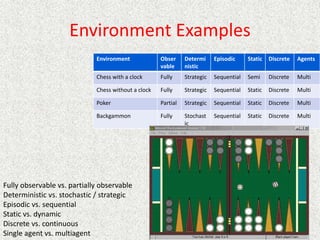
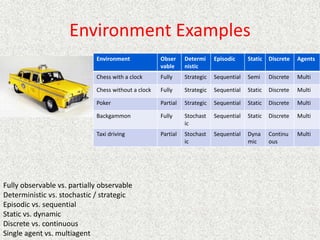
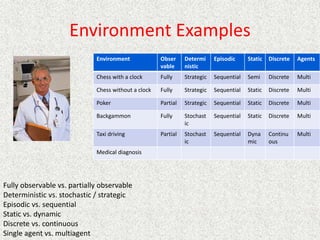
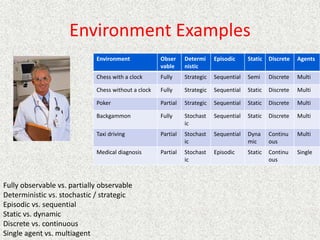
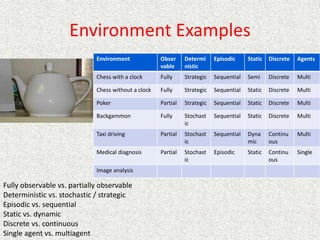
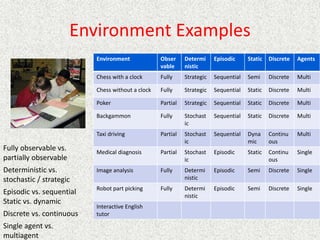
Environment Examples
Environment Obser
vable
Determi
nistic
Episodic Static Discrete Agents
Chess with a clock
Chess without a clock
Fully observable vs. partially observable
Deterministic vs. stochastic / strategic
Episodic vs. sequential
Static vs. dynamic
Discrete vs. continuous
Single agent vs. multiagent
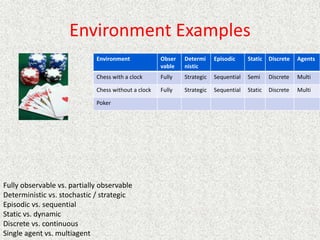
Environment Examples
Environment Obser
vable
Determi
nistic
Episodic Static Discrete Agents
Chess with a clock Fully Strategic Sequential Semi Discrete Multi
Chess without a clock Fully Strategic Sequential Static Discrete Multi
Fully observable vs. partially observable
Deterministic vs. stochastic / strategic
Episodic vs. sequential
Static vs. dynamic
Discrete vs. continuous
Single agent vs. multiagent
Environment Examples
Fully observable vs. partially observable
Deterministic vs. stochastic / strategic
Episodic vs. sequential
Static vs. dynamic
Discrete vs. continuous
Single agent vs. multiagent
Environment Obser
vable
Determi
nistic
Episodic Static Discrete Agents
Chess with a clock Fully Strategic Sequential Semi Discrete Multi
Chess without a clock Fully Strategic Sequential Static Discrete Multi
Poker
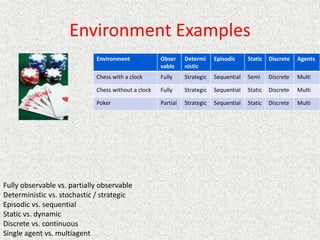
Environment Examples
Fully observable vs. partially observable
Deterministic vs. stochastic / strategic
Episodic vs. sequential
Static vs. dynamic
Discrete vs. continuous
Single agent vs. multiagent
Environment Obser
vable
Determi
nistic
Episodic Static Discrete Agents
Chess with a clock Fully Strategic Sequential Semi Discrete Multi
Chess without a clock Fully Strategic Sequential Static Discrete Multi
Poker Partial Strategic Sequential Static Discrete Multi
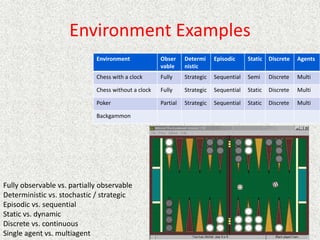
Environment Examples
Fully observable vs. partially observable
Deterministic vs. stochastic / strategic
Episodic vs. sequential
Static vs. dynamic
Discrete vs. continuous
Single agent vs. multiagent
Environment Obser
vable
Determi
nistic
Episodic Static Discrete Agents
Chess with a clock Fully Strategic Sequential Semi Discrete Multi
Chess without a clock Fully Strategic Sequential Static Discrete Multi
Poker Partial Strategic Sequential Static Discrete Multi
Backgammon
Environment Examples
Fully observable vs. partially observable
Deterministic vs. stochastic / strategic
Episodic vs. sequential
Static vs. dynamic
Discrete vs. continuous
Single agent vs. multiagent
Environment Obser
vable
Determi
nistic
Episodic Static Discrete Agents
Chess with a clock Fully Strategic Sequential Semi Discrete Multi
Chess without a clock Fully Strategic Sequential Static Discrete Multi
Poker Partial Strategic Sequential Static Discrete Multi
Backgammon Fully Stochast
ic
Sequential Static Discrete Multi
Environment Examples
Fully observable vs. partially observable
Deterministic vs. stochastic / strategic
Episodic vs. sequential
Static vs. dynamic
Discrete vs. continuous
Single agent vs. multiagent
Environment Obser
vable
Determi
nistic
Episodic Static Discrete Agents
Chess with a clock Fully Strategic Sequential Semi Discrete Multi
Chess without a clock Fully Strategic Sequential Static Discrete Multi
Poker Partial Strategic Sequential Static Discrete Multi
Backgammon Fully Stochast
ic
Sequential Static Discrete Multi
Taxi driving Partial Stochast
ic
Sequential Dyna
mic
Continu
ous
Multi
Environment Examples
Fully observable vs. partially observable
Deterministic vs. stochastic / strategic
Episodic vs. sequential
Static vs. dynamic
Discrete vs. continuous
Single agent vs. multiagent
Environment Obser
vable
Determi
nistic
Episodic Static Discrete Agents
Chess with a clock Fully Strategic Sequential Semi Discrete Multi
Chess without a clock Fully Strategic Sequential Static Discrete Multi
Poker Partial Strategic Sequential Static Discrete Multi
Backgammon Fully Stochast
ic
Sequential Static Discrete Multi
Taxi driving Partial Stochast
ic
Sequential Dyna
mic
Continu
ous
Multi
Medical diagnosis
Environment Examples
Fully observable vs. partially observable
Deterministic vs. stochastic / strategic
Episodic vs. sequential
Static vs. dynamic
Discrete vs. continuous
Single agent vs. multiagent
Environment Obser
vable
Determi
nistic
Episodic Static Discrete Agents
Chess with a clock Fully Strategic Sequential Semi Discrete Multi
Chess without a clock Fully Strategic Sequential Static Discrete Multi
Poker Partial Strategic Sequential Static Discrete Multi
Backgammon Fully Stochast
ic
Sequential Static Discrete Multi
Taxi driving Partial Stochast
ic
Sequential Dyna
mic
Continu
ous
Multi
Medical diagnosis Partial Stochast
ic
Episodic Static Continu
ous
Single
Environment Examples
Fully observable vs. partially observable
Deterministic vs. stochastic / strategic
Episodic vs. sequential
Static vs. dynamic
Discrete vs. continuous
Single agent vs. multiagent
Environment Obser
vable
Determi
nistic
Episodic Static Discrete Agents
Chess with a clock Fully Strategic Sequential Semi Discrete Multi
Chess without a clock Fully Strategic Sequential Static Discrete Multi
Poker Partial Strategic Sequential Static Discrete Multi
Backgammon Fully Stochast
ic
Sequential Static Discrete Multi
Taxi driving Partial Stochast
ic
Sequential Dyna
mic
Continu
ous
Multi
Medical diagnosis Partial Stochast
ic
Episodic Static Continu
ous
Single
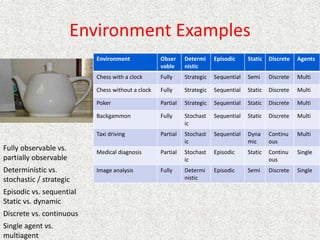
Image analysis
Environment Examples
Environment Obser
vable
Determi
nistic
Episodic Static Discrete Agents
Chess with a clock Fully Strategic Sequential Semi Discrete Multi
Chess without a clock Fully Strategic Sequential Static Discrete Multi
Poker Partial Strategic Sequential Static Discrete Multi
Backgammon Fully Stochast
ic
Sequential Static Discrete Multi
Taxi driving Partial Stochast
ic
Sequential Dyna
mic
Continu
ous
Multi
Medical diagnosis Partial Stochast
ic
Episodic Static Continu
ous
Single
Image analysis Fully Determi
nistic
Episodic Semi Discrete Single
Fully observable vs.
partially observable
Deterministic vs.
stochastic / strategic
Episodic vs. sequential
Static vs. dynamic
Discrete vs. continuous
Single agent vs.
multiagent
Environment Examples
Fully observable vs.
partially observable
Deterministic vs.
stochastic / strategic
Episodic vs. sequential
Static vs. dynamic
Discrete vs. continuous
Single agent vs.
multiagent
Environment Obser
vable
Determi
nistic
Episodic Static Discrete Agents
Chess with a clock Fully Strategic Sequential Semi Discrete Multi
Chess without a clock Fully Strategic Sequential Static Discrete Multi
Poker Partial Strategic Sequential Static Discrete Multi
Backgammon Fully Stochast
ic
Sequential Static Discrete Multi
Taxi driving Partial Stochast
ic
Sequential Dyna
mic
Continu
ous
Multi
Medical diagnosis Partial Stochast
ic
Episodic Static Continu
ous
Single
Image analysis Fully Determi
nistic
Episodic Semi Discrete Single
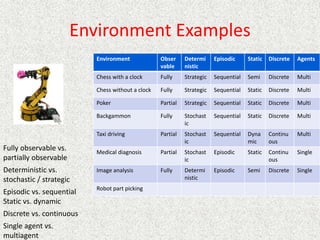
Robot part picking
Environment Examples
Fully observable vs.
partially observable
Deterministic vs.
stochastic / strategic
Episodic vs. sequential
Static vs. dynamic
Discrete vs. continuous
Single agent vs.
multiagent
Environment Obser
vable
Determi
nistic
Episodic Static Discrete Agents
Chess with a clock Fully Strategic Sequential Semi Discrete Multi
Chess without a clock Fully Strategic Sequential Static Discrete Multi
Poker Partial Strategic Sequential Static Discrete Multi
Backgammon Fully Stochast
ic
Sequential Static Discrete Multi
Taxi driving Partial Stochast
ic
Sequential Dyna
mic
Continu
ous
Multi
Medical diagnosis Partial Stochast
ic
Episodic Static Continu
ous
Single
Image analysis Fully Determi
nistic
Episodic Semi Discrete Single
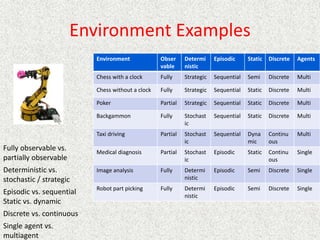
Robot part picking Fully Determi
nistic
Episodic Semi Discrete Single
Environment Examples
Fully observable vs.
partially observable
Deterministic vs.
stochastic / strategic
Episodic vs. sequential
Static vs. dynamic
Discrete vs. continuous
Single agent vs.
multiagent
Environment Obser
vable
Determi
nistic
Episodic Static Discrete Agents
Chess with a clock Fully Strategic Sequential Semi Discrete Multi
Chess without a clock Fully Strategic Sequential Static Discrete Multi
Poker Partial Strategic Sequential Static Discrete Multi
Backgammon Fully Stochast
ic
Sequential Static Discrete Multi
Taxi driving Partial Stochast
ic
Sequential Dyna
mic
Continu
ous
Multi
Medical diagnosis Partial Stochast
ic
Episodic Static Continu
ous
Single
Image analysis Fully Determi
nistic
Episodic Semi Discrete Single
Robot part picking Fully Determi
nistic
Episodic Semi Discrete Single
Interactive English
tutor
Environment Examples
Fully observable vs.
partially observable
Deterministic vs.
stochastic / strategic
Episodic vs. sequential
Static vs. dynamic
Discrete vs. continuous
Single agent vs.
multiagent
Environment Obser
vable
Determi
nistic
Episodic Static Discrete Agents
Chess with a clock Fully Strategic Sequential Semi Discrete Multi
Chess without a clock Fully Strategic Sequential Static Discrete Multi
Poker Partial Strategic Sequential Static Discrete Multi
Backgammon Fully Stochast
ic
Sequential Static Discrete Multi
Taxi driving Partial Stochast
ic
Sequential Dyna
mic
Continu
ous
Multi
Medical diagnosis Partial Stochast
ic
Episodic Static Continu
ous
Single
Image analysis Fully Determi
nistic
Episodic Semi Discrete Single
Robot part picking Fully Determi
nistic
Episodic Semi Discrete Single
Interactive English
tutor
Partial Stochast
ic
Sequential Dyna
mic
Discrete Multi
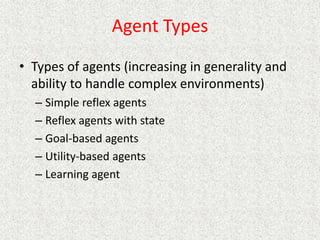
Agent Types
• Types of agents (increasing in generality and
ability to handle complex environments)
– Simple reflex agents
– Reflex agents with state
– Goal-based agents
– Utility-based agents
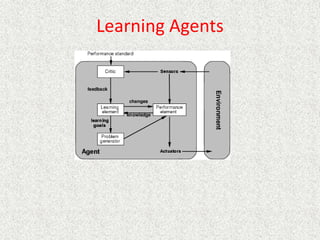
– Learning agent
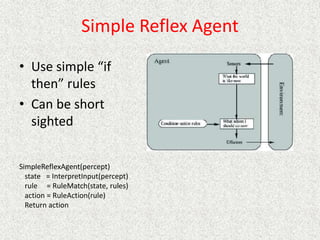
Simple Reflex Agent
• Use simple “if
then” rules
• Can be short
sighted
SimpleReflexAgent(percept)
state = InterpretInput(percept)
rule = RuleMatch(state, rules)
action = RuleAction(rule)
Return action
Example: Vacuum Agent
• Performance?
– 1 point for each square cleaned in time T?
– #clean squares per time step - #moves per time step?
• Environment: vacuum, dirt, multiple areas defined by square regions
• Actions: left, right, suck, idle
• Sensors: location and contents
– [A, dirty]
• Rational is not omniscient
– Environment may be partially observable
• Rational is not clairvoyant
– Environment may be stochastic
• Thus Rational is not always successful
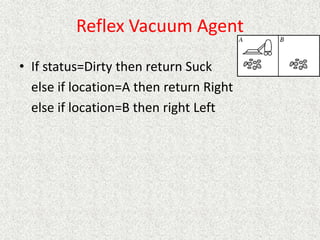
Reflex Vacuum Agent
• If status=Dirty then return Suck
else if location=A then return Right
else if location=B then right Left
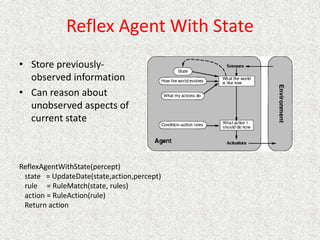
Reflex Agent With State
• Store previously-
observed information
• Can reason about
unobserved aspects of
current state
ReflexAgentWithState(percept)
state = UpdateDate(state,action,percept)
rule = RuleMatch(state, rules)
action = RuleAction(rule)
Return action
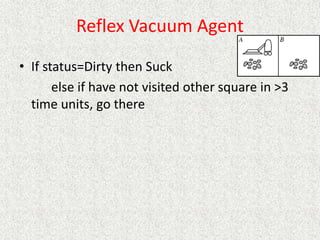
Reflex Vacuum Agent
• If status=Dirty then Suck
else if have not visited other square in >3
time units, go there
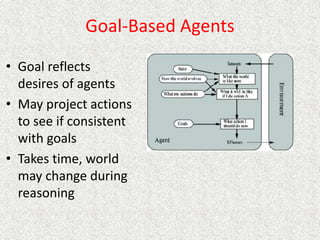
Goal-Based Agents
• Goal reflects
desires of agents
• May project actions
to see if consistent
with goals
• Takes time, world
may change during
reasoning
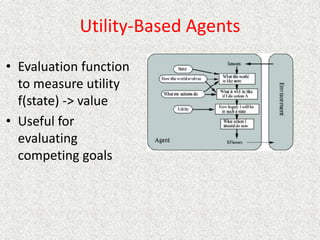
Utility-Based Agents
• Evaluation function
to measure utility
f(state) -> value
• Useful for
evaluating
competing goals
Learning Agents
Xavier mail delivery robot
• Performance: Completed tasks
• Environment: See for yourself
• Actuators: Wheeled robot actuation
• Sensors: Vision, sonar, dead reckoning
• Reasoning: Markov model induction, A*
search, Bayes classification
Pathfinder Medical Diagnosis System
• Performance: Correct Hematopathology
diagnosis
• Environment: Automate human diagnosis,
partially observable, deterministic, episodic,
static, continuous, single agent
• Actuators: Output diagnoses and further test
suggestions
• Sensors: Input symptoms and test results
• Reasoning: Bayesian networks, Monte-Carlo
simulations
TDGammon
• Performance: Ratio of wins to losses
• Environment: Graphical output showing dice roll
and piece movement, fully observable, stochastic,
sequential, static, discrete, multiagent
World Champion Backgammon Player
• Sensors: Keyboard input
• Actuator: Numbers representing moves of pieces
• Reasoning: Reinforcement learning, neural
networks
Alvinn
• Performance: Stay in lane, on road, maintain
speed
• Environment: Driving Hummer on and off road
without manual control (Partially observable,
stochastic, episodic, dynamic, continuous,
single agent), Autonomous automobile
• Actuators: Speed, Steer
• Sensors: Stereo camera input
• Reasoning: Neural networks
Talespin
• Performance: Entertainment value of generated story
• Environment: Generate text-based stories that are creative and
understandable
– One day Joe Bear was hungry. He asked his friend Irving Bird where some
honey was. Irving told him there was a beehive in the oak tree. Joe
threatened to hit Irving if he didn't tell him where some honey was.
– Henry Squirrel was thirsty. He walked over to the river bank where his good
friend Bill Bird was sitting. Henry slipped and fell in the river. Gravity
drowned. Joe Bear was hungry. He asked Irving Bird where some honey
was. Irving refused to tell him, so Joe offered to bring him a worm if he'd
tell him where some honey was. Irving agreed. But Joe didn't know where
any worms were, so he asked Irving, who refused to say. So Joe offered to
bring him a worm if he'd tell him where a worm was. Irving agreed. But Joe
didn't know where any worms were, so he asked Irving, who refused to
say. So Joe offered to bring him a worm if he'd tell him where a worm
was…
• Actuators: Add word/phrase, order parts of story
• Sensors: Dictionary, Facts and relationships
stored in database
• Reasoning: Planning
Webcrawler Softbot
• Search web for items of interest
• Perception: Web pages
• Reasoning: Pattern matching
• Action: Select and traverse hyperlinks
Other Example AI Systems
• Translation of Caterpillar
truck manuals into 20
languages
• Shuttle packing
• Military planning (Desert
Storm)
• Intelligent vehicle
highway negotiation
• Credit card transaction
monitoring
• Billiards robot
• Juggling robot
• Credit card fraud
detection
• Lymphatic system
diagnoses
• Mars rover
• Sky survey galaxy data
analysis
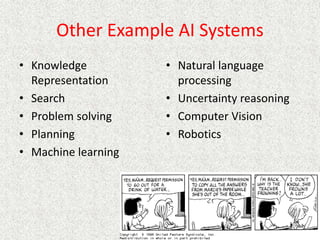
Other Example AI Systems
• Knowledge
Representation
• Search
• Problem solving
• Planning
• Machine learning
• Natural language
processing
• Uncertainty reasoning
• Computer Vision
• Robotics

l1.pptx

  • 1.
  • 2.
    Why Study AI? •AI makes computers more useful • Intelligent computer would have huge impact on civilization • AI cited as “field I would most like to be in” by scientists in all fields • Computer is a good metaphor for talking and thinking about intelligence
  • 3.
    Why Study AI? •Turning theory into working programs forces us to work out the details • AI yields good results for Computer Science • AI yields good results for other fields • Computers make good experimental subjects • Personal motivation: mystery
  • 4.
    What is thedefinition of AI? What do you think?
  • 5.
    What is thedefinition of AI? Systems that think like humans Systems that think rationally Systems that act like humans Systems that act rationally
  • 6.
    What is thedefinition of AI? Systems that think like humans Systems that think rationally Systems that act like humans Systems that act rationally Bellman, 1978 “[The automation of] activities that we associate with human thinking, activities such as decision making, problem solving, learning”
  • 7.
    What is thedefinition of AI? Systems that think like humans Systems that think rationally Systems that act like humans Systems that act rationally Charniak & McDermott, 1985 “The study of mental faculties through the use of computational models”
  • 8.
    What is thedefinition of AI? Systems that think like humans Systems that think rationally Systems that act like humans Systems that act rationally Dean et al., 1995 “The design and study of computer programs that behave intelligently. These programs are constructed to perform as would a human or an animal whose behavior we consider intelligent”
  • 9.
    What is thedefinition of AI? Systems that think like humans Systems that think rationally Systems that act like humans Systems that act rationally Haugeland, 1985 “The exciting new effort to make computers think machines with minds, in the full and literal sense”
  • 10.
    What is thedefinition of AI? Systems that think like humans Systems that think rationally Systems that act like humans Systems that act rationally Kurzweil, 1990 “The art of creating machines that perform functions that require intelligence when performed by people”
  • 11.
    What is thedefinition of AI? Systems that think like humans Systems that think rationally Systems that act like humans Systems that act rationally Luger & Stubblefield, 1993 “The branch of computer science that is concerned with the automation of intelligent behavior”
  • 12.
    What is thedefinition of AI? Systems that think like humans Systems that think rationally Systems that act like humans Systems that act rationally Nilsson, 1998 “Many human mental activities such as writing computer programs, doing mathematics, engaging in common sense reasoning, understanding language, and even driving an automobile, are said to demand intelligence. We might say that [these systems] exhibit artificial intelligence”
  • 13.
    What is thedefinition of AI? Systems that think like humans Systems that think rationally Systems that act like humans Systems that act rationally Rich & Knight, 1991 “The study of how to make computers do things at which, at the moment, people are better”
  • 14.
    What is thedefinition of AI? Systems that think like humans Systems that think rationally Systems that act like humans Systems that act rationally Schalkoff, 1990 “A field of study that seeks to explain and emulate intelligent behavior in terms of computational processes”
  • 15.
    What is thedefinition of AI? Systems that think like humans Systems that think rationally Systems that act like humans Systems that act rationally Winston, 1992 “The study of the computations that make it possible to perceive, reason, and act”
  • 16.
    Approach 1: ActingHumanly • Turing test: ultimate test for acting humanly – Computer and human both interrogated by judge – Computer passes test if judge can’t tell the difference
  • 17.
    How effective isthis test? • Agent must: – Have command of language – Have wide range of knowledge – Demonstrate human traits (humor, emotion) – Be able to reason – Be able to learn • Loebner prize competition is modern version of Turing Test – Example: Alice, Loebner prize winner for 2000 and 2001
  • 18.
    Chinese Room Argument Imagineyou are sitting in a room with a library of rule books, a bunch of blank exercise books, and a lot of writing utensils. Your only contact with the external world is through two slots in the wall labeled ``input'' and ``output''. Occasionally, pieces of paper with Chinese characters come into your room through the ``input'' slot. Each time a piece of paper comes in through the input slot your task is to find the section in the rule books that matches the pattern of Chinese characters on the piece of paper. The rule book will tell you which pattern of characters to inscribe the appropriate pattern on a blank piece of paper. Once you have inscribed the appropriate pattern according to the rule book your task is simply to push it out the output slot. By the way, you don't understand Chinese, nor are you aware that the symbols that you are manipulating are Chinese symbols. In fact, the Chinese characters which you have been receiving as input have been questions about a story and the output you have been producing has been the appropriate, perhaps even "insightful," responses to the questions asked. Indeed, to the outside questioners your output has been so good that they are convinced that whoever (or whatever) has been producing the responses to their queries must be a native speaker of, or at least extremely fluent in, Chinese.
  • 19.
    Do you understandChinese? • Searle says NO • What do you think? • Is this a refutation of the possibility of AI? • The Systems Reply – The individual is just part of the overall system, which does understand Chinese • The Robot Reply – Put same capabilities in a robot along with perceiving, talking, etc. This agent would seem to have genuine understanding and mental states.
  • 20.
    Approach 2: ThinkingHumanly • Requires knowledge of brain function • What level of abstraction? • How can we validate this • This is the focus of Cognitive Science
  • 21.
    Approach 3: ThinkingRationally • Aristotle attempted this • What are correct arguments or thought processes? • Provided foundation of much of AI • Not all intelligent behavior controlled by logic • What is our goal? What is the purpose of thinking?
  • 22.
    Approach 4: ActingRationally • Act to achieve goals, given set of beliefs • Rational behavior is doing the “right thing” – Thing which expects to maximize goal achievement • This is approach adopted by Russell & Norvig
  • 23.
    Foundations of AI •Philosophy – 450 BC, Socrates asked for algorithm to distinguish pious from non- pious individuals – Aristotle developed laws for reasoning • Mathematics – 1847, Boole introduced formal language for making logical inference • Economics – 1776, Smith views economies as consisting of agents maximizing their own well being (payoff) • Neuroscience – 1861, Study how brains process information • Psychology – 1879, Cognitive psychology initiated • Linguistics – 1957, Skinner studied behaviorist approach to language learning
  • 24.
    History of AI •CS-based AI started with “Dartmouth Conference” in 1956 • Attendees – John McCarthy • LISP, application of logic to reasoning – Marvin Minsky • Popularized neural networks • Slots and frames • The Society of the Mind – Claude Shannon • Computer checkers • Information theory • Open-loop 5-ball juggling – Allen Newell and Herb Simon • General Problem Solver
  • 25.
    AI Questions • Canwe make something that is as intelligent as a human? • Can we make something that is as intelligent as a bee? • Can we make something that is evolutionary, self improving, autonomous, and flexible? • Can we save this plant $20M/year by pattern recognition? • Can we save this bank $50M/year by automatic fraud detection? • Can we start a new industry of handwriting recognition agents?
  • 26.
    Which of theseexhibits intelligence? • You beat somebody at chess. • You prove a mathematical theorem using a set of known axioms. • You need to buy some supplies, meet three different colleagues, return books to the library, and exercise. You plan your day in such a way that everything is achieved in an efficient manner. • You are a lawyer who is asked to defend someone. You recall three similar cases in which the defendant was guilty, and you turn down the potential client. • A stranger passing you on the street notices your watch and asks, “Can you tell me the time?” You say, “It is 3:00.” • You are told to find a large Phillips screwdriver in a cluttered workroom. You enter the room (you have never been there before), search without falling over objects, and eventually find the screwdriver.
  • 27.
    Which of theseexhibits intelligence? • You are a six-month-old infant. You can produce sounds with your vocal organs, and you can hear speech sounds around you, but you do not know how to make the sounds you are hearing. In the next year, you figure out what the sounds of your parents' language are and how to make them. • You are a one-year-old child learning Arabic. You hear strings of sounds and figure out that they are associated with particular meanings in the world. Within two years, you learn how to segment the strings into meaningful parts and produce your own words and sentences. • Someone taps a rhythm, and you are able to beat along with it and to continue it even after it stops. • You are some sort of primitive invertebrate. You know nothing about how to move about in your world, only that you need to find food and keep from bumping into walls. After lots of reinforcement and punishment, you get around just fine.
  • 28.
    Which of thesecan currently be done? • Play a decent game of table tennis • Drive autonomously along a curving mountain road • Drive autonomously in the center of Cairo • Play a decent game of bridge • Discover and prove a new mathematical theorem • Write an intentionally funny story • Give competent legal advice in a specialized area of law • Translate spoken English into spoken Swedish in real time • Plan schedule of operations for a NASA spacecraft • Defeat the world champion in chess
  • 29.
    Components of anAI System An agent perceives its environment through sensors and acts on the environment through actuators. Human: sensors are eyes, ears, actuators (effectors) are hands, legs, mouth. Robot: sensors are cameras, sonar, lasers, ladar, bump, effectors are grippers, manipulators, motors The agent’s behavior is described by its function that maps percept to action.
  • 30.
    Rationality • A rationalagent does the right thing (what is this?) • A fixed performance measure evaluates the sequence of observed action effects on the environment
  • 31.
    PEAS • Use PEASto describe task – Performance measure – Environment – Actuators – Sensors
  • 32.
    PEAS • Use PEASto describe task environment – Performance measure – Environment – Actuators – Sensors • Example: Taxi driver – Performance measure: safe, fast, comfortable (maximize profits) – Environment: roads, other traffic, pedestrians, customers – Actuators: steering, accelerator, brake, signal, horn – Sensors: cameras, sonar, speedometer, GPS, odometer, accelerometer, engine sensors
  • 33.
    Environment Properties • Fullyobservable vs. partially observable • Deterministic vs. stochastic / strategic • Episodic vs. sequential • Static vs. dynamic • Discrete vs. continuous • Single agent vs. multiagent
  • 34.
    Environment Examples Environment Obser vable Determi nistic EpisodicStatic Discrete Agents Chess with a clock Chess without a clock Fully observable vs. partially observable Deterministic vs. stochastic / strategic Episodic vs. sequential Static vs. dynamic Discrete vs. continuous Single agent vs. multiagent
  • 35.
    Environment Examples Environment Obser vable Determi nistic EpisodicStatic Discrete Agents Chess with a clock Fully Strategic Sequential Semi Discrete Multi Chess without a clock Fully Strategic Sequential Static Discrete Multi Fully observable vs. partially observable Deterministic vs. stochastic / strategic Episodic vs. sequential Static vs. dynamic Discrete vs. continuous Single agent vs. multiagent
  • 36.
    Environment Examples Fully observablevs. partially observable Deterministic vs. stochastic / strategic Episodic vs. sequential Static vs. dynamic Discrete vs. continuous Single agent vs. multiagent Environment Obser vable Determi nistic Episodic Static Discrete Agents Chess with a clock Fully Strategic Sequential Semi Discrete Multi Chess without a clock Fully Strategic Sequential Static Discrete Multi Poker
  • 37.
    Environment Examples Fully observablevs. partially observable Deterministic vs. stochastic / strategic Episodic vs. sequential Static vs. dynamic Discrete vs. continuous Single agent vs. multiagent Environment Obser vable Determi nistic Episodic Static Discrete Agents Chess with a clock Fully Strategic Sequential Semi Discrete Multi Chess without a clock Fully Strategic Sequential Static Discrete Multi Poker Partial Strategic Sequential Static Discrete Multi
  • 38.
    Environment Examples Fully observablevs. partially observable Deterministic vs. stochastic / strategic Episodic vs. sequential Static vs. dynamic Discrete vs. continuous Single agent vs. multiagent Environment Obser vable Determi nistic Episodic Static Discrete Agents Chess with a clock Fully Strategic Sequential Semi Discrete Multi Chess without a clock Fully Strategic Sequential Static Discrete Multi Poker Partial Strategic Sequential Static Discrete Multi Backgammon
  • 39.
    Environment Examples Fully observablevs. partially observable Deterministic vs. stochastic / strategic Episodic vs. sequential Static vs. dynamic Discrete vs. continuous Single agent vs. multiagent Environment Obser vable Determi nistic Episodic Static Discrete Agents Chess with a clock Fully Strategic Sequential Semi Discrete Multi Chess without a clock Fully Strategic Sequential Static Discrete Multi Poker Partial Strategic Sequential Static Discrete Multi Backgammon Fully Stochast ic Sequential Static Discrete Multi
  • 40.
    Environment Examples Fully observablevs. partially observable Deterministic vs. stochastic / strategic Episodic vs. sequential Static vs. dynamic Discrete vs. continuous Single agent vs. multiagent Environment Obser vable Determi nistic Episodic Static Discrete Agents Chess with a clock Fully Strategic Sequential Semi Discrete Multi Chess without a clock Fully Strategic Sequential Static Discrete Multi Poker Partial Strategic Sequential Static Discrete Multi Backgammon Fully Stochast ic Sequential Static Discrete Multi Taxi driving Partial Stochast ic Sequential Dyna mic Continu ous Multi
  • 41.
    Environment Examples Fully observablevs. partially observable Deterministic vs. stochastic / strategic Episodic vs. sequential Static vs. dynamic Discrete vs. continuous Single agent vs. multiagent Environment Obser vable Determi nistic Episodic Static Discrete Agents Chess with a clock Fully Strategic Sequential Semi Discrete Multi Chess without a clock Fully Strategic Sequential Static Discrete Multi Poker Partial Strategic Sequential Static Discrete Multi Backgammon Fully Stochast ic Sequential Static Discrete Multi Taxi driving Partial Stochast ic Sequential Dyna mic Continu ous Multi Medical diagnosis
  • 42.
    Environment Examples Fully observablevs. partially observable Deterministic vs. stochastic / strategic Episodic vs. sequential Static vs. dynamic Discrete vs. continuous Single agent vs. multiagent Environment Obser vable Determi nistic Episodic Static Discrete Agents Chess with a clock Fully Strategic Sequential Semi Discrete Multi Chess without a clock Fully Strategic Sequential Static Discrete Multi Poker Partial Strategic Sequential Static Discrete Multi Backgammon Fully Stochast ic Sequential Static Discrete Multi Taxi driving Partial Stochast ic Sequential Dyna mic Continu ous Multi Medical diagnosis Partial Stochast ic Episodic Static Continu ous Single
  • 43.
    Environment Examples Fully observablevs. partially observable Deterministic vs. stochastic / strategic Episodic vs. sequential Static vs. dynamic Discrete vs. continuous Single agent vs. multiagent Environment Obser vable Determi nistic Episodic Static Discrete Agents Chess with a clock Fully Strategic Sequential Semi Discrete Multi Chess without a clock Fully Strategic Sequential Static Discrete Multi Poker Partial Strategic Sequential Static Discrete Multi Backgammon Fully Stochast ic Sequential Static Discrete Multi Taxi driving Partial Stochast ic Sequential Dyna mic Continu ous Multi Medical diagnosis Partial Stochast ic Episodic Static Continu ous Single Image analysis
  • 44.
    Environment Examples Environment Obser vable Determi nistic EpisodicStatic Discrete Agents Chess with a clock Fully Strategic Sequential Semi Discrete Multi Chess without a clock Fully Strategic Sequential Static Discrete Multi Poker Partial Strategic Sequential Static Discrete Multi Backgammon Fully Stochast ic Sequential Static Discrete Multi Taxi driving Partial Stochast ic Sequential Dyna mic Continu ous Multi Medical diagnosis Partial Stochast ic Episodic Static Continu ous Single Image analysis Fully Determi nistic Episodic Semi Discrete Single Fully observable vs. partially observable Deterministic vs. stochastic / strategic Episodic vs. sequential Static vs. dynamic Discrete vs. continuous Single agent vs. multiagent
  • 45.
    Environment Examples Fully observablevs. partially observable Deterministic vs. stochastic / strategic Episodic vs. sequential Static vs. dynamic Discrete vs. continuous Single agent vs. multiagent Environment Obser vable Determi nistic Episodic Static Discrete Agents Chess with a clock Fully Strategic Sequential Semi Discrete Multi Chess without a clock Fully Strategic Sequential Static Discrete Multi Poker Partial Strategic Sequential Static Discrete Multi Backgammon Fully Stochast ic Sequential Static Discrete Multi Taxi driving Partial Stochast ic Sequential Dyna mic Continu ous Multi Medical diagnosis Partial Stochast ic Episodic Static Continu ous Single Image analysis Fully Determi nistic Episodic Semi Discrete Single Robot part picking
  • 46.
    Environment Examples Fully observablevs. partially observable Deterministic vs. stochastic / strategic Episodic vs. sequential Static vs. dynamic Discrete vs. continuous Single agent vs. multiagent Environment Obser vable Determi nistic Episodic Static Discrete Agents Chess with a clock Fully Strategic Sequential Semi Discrete Multi Chess without a clock Fully Strategic Sequential Static Discrete Multi Poker Partial Strategic Sequential Static Discrete Multi Backgammon Fully Stochast ic Sequential Static Discrete Multi Taxi driving Partial Stochast ic Sequential Dyna mic Continu ous Multi Medical diagnosis Partial Stochast ic Episodic Static Continu ous Single Image analysis Fully Determi nistic Episodic Semi Discrete Single Robot part picking Fully Determi nistic Episodic Semi Discrete Single
  • 47.
    Environment Examples Fully observablevs. partially observable Deterministic vs. stochastic / strategic Episodic vs. sequential Static vs. dynamic Discrete vs. continuous Single agent vs. multiagent Environment Obser vable Determi nistic Episodic Static Discrete Agents Chess with a clock Fully Strategic Sequential Semi Discrete Multi Chess without a clock Fully Strategic Sequential Static Discrete Multi Poker Partial Strategic Sequential Static Discrete Multi Backgammon Fully Stochast ic Sequential Static Discrete Multi Taxi driving Partial Stochast ic Sequential Dyna mic Continu ous Multi Medical diagnosis Partial Stochast ic Episodic Static Continu ous Single Image analysis Fully Determi nistic Episodic Semi Discrete Single Robot part picking Fully Determi nistic Episodic Semi Discrete Single Interactive English tutor
  • 48.
    Environment Examples Fully observablevs. partially observable Deterministic vs. stochastic / strategic Episodic vs. sequential Static vs. dynamic Discrete vs. continuous Single agent vs. multiagent Environment Obser vable Determi nistic Episodic Static Discrete Agents Chess with a clock Fully Strategic Sequential Semi Discrete Multi Chess without a clock Fully Strategic Sequential Static Discrete Multi Poker Partial Strategic Sequential Static Discrete Multi Backgammon Fully Stochast ic Sequential Static Discrete Multi Taxi driving Partial Stochast ic Sequential Dyna mic Continu ous Multi Medical diagnosis Partial Stochast ic Episodic Static Continu ous Single Image analysis Fully Determi nistic Episodic Semi Discrete Single Robot part picking Fully Determi nistic Episodic Semi Discrete Single Interactive English tutor Partial Stochast ic Sequential Dyna mic Discrete Multi
  • 49.
    Agent Types • Typesof agents (increasing in generality and ability to handle complex environments) – Simple reflex agents – Reflex agents with state – Goal-based agents – Utility-based agents – Learning agent
  • 50.
    Simple Reflex Agent •Use simple “if then” rules • Can be short sighted SimpleReflexAgent(percept) state = InterpretInput(percept) rule = RuleMatch(state, rules) action = RuleAction(rule) Return action
  • 51.
    Example: Vacuum Agent •Performance? – 1 point for each square cleaned in time T? – #clean squares per time step - #moves per time step? • Environment: vacuum, dirt, multiple areas defined by square regions • Actions: left, right, suck, idle • Sensors: location and contents – [A, dirty] • Rational is not omniscient – Environment may be partially observable • Rational is not clairvoyant – Environment may be stochastic • Thus Rational is not always successful
  • 52.
    Reflex Vacuum Agent •If status=Dirty then return Suck else if location=A then return Right else if location=B then right Left
  • 53.
    Reflex Agent WithState • Store previously- observed information • Can reason about unobserved aspects of current state ReflexAgentWithState(percept) state = UpdateDate(state,action,percept) rule = RuleMatch(state, rules) action = RuleAction(rule) Return action
  • 54.
    Reflex Vacuum Agent •If status=Dirty then Suck else if have not visited other square in >3 time units, go there
  • 55.
    Goal-Based Agents • Goalreflects desires of agents • May project actions to see if consistent with goals • Takes time, world may change during reasoning
  • 56.
    Utility-Based Agents • Evaluationfunction to measure utility f(state) -> value • Useful for evaluating competing goals
  • 57.
  • 58.
    Xavier mail deliveryrobot • Performance: Completed tasks • Environment: See for yourself • Actuators: Wheeled robot actuation • Sensors: Vision, sonar, dead reckoning • Reasoning: Markov model induction, A* search, Bayes classification
  • 59.
    Pathfinder Medical DiagnosisSystem • Performance: Correct Hematopathology diagnosis • Environment: Automate human diagnosis, partially observable, deterministic, episodic, static, continuous, single agent • Actuators: Output diagnoses and further test suggestions • Sensors: Input symptoms and test results • Reasoning: Bayesian networks, Monte-Carlo simulations
  • 60.
    TDGammon • Performance: Ratioof wins to losses • Environment: Graphical output showing dice roll and piece movement, fully observable, stochastic, sequential, static, discrete, multiagent World Champion Backgammon Player • Sensors: Keyboard input • Actuator: Numbers representing moves of pieces • Reasoning: Reinforcement learning, neural networks
  • 61.
    Alvinn • Performance: Stayin lane, on road, maintain speed • Environment: Driving Hummer on and off road without manual control (Partially observable, stochastic, episodic, dynamic, continuous, single agent), Autonomous automobile • Actuators: Speed, Steer • Sensors: Stereo camera input • Reasoning: Neural networks
  • 62.
    Talespin • Performance: Entertainmentvalue of generated story • Environment: Generate text-based stories that are creative and understandable – One day Joe Bear was hungry. He asked his friend Irving Bird where some honey was. Irving told him there was a beehive in the oak tree. Joe threatened to hit Irving if he didn't tell him where some honey was. – Henry Squirrel was thirsty. He walked over to the river bank where his good friend Bill Bird was sitting. Henry slipped and fell in the river. Gravity drowned. Joe Bear was hungry. He asked Irving Bird where some honey was. Irving refused to tell him, so Joe offered to bring him a worm if he'd tell him where some honey was. Irving agreed. But Joe didn't know where any worms were, so he asked Irving, who refused to say. So Joe offered to bring him a worm if he'd tell him where a worm was. Irving agreed. But Joe didn't know where any worms were, so he asked Irving, who refused to say. So Joe offered to bring him a worm if he'd tell him where a worm was… • Actuators: Add word/phrase, order parts of story • Sensors: Dictionary, Facts and relationships stored in database • Reasoning: Planning
  • 63.
    Webcrawler Softbot • Searchweb for items of interest • Perception: Web pages • Reasoning: Pattern matching • Action: Select and traverse hyperlinks
  • 64.
    Other Example AISystems • Translation of Caterpillar truck manuals into 20 languages • Shuttle packing • Military planning (Desert Storm) • Intelligent vehicle highway negotiation • Credit card transaction monitoring • Billiards robot • Juggling robot • Credit card fraud detection • Lymphatic system diagnoses • Mars rover • Sky survey galaxy data analysis
  • 65.
    Other Example AISystems • Knowledge Representation • Search • Problem solving • Planning • Machine learning • Natural language processing • Uncertainty reasoning • Computer Vision • Robotics

Editor's Notes

  • #21 What level of abstraction? Knowledge, circuitry, chemical?
  • #30 LADAR is Laser Detection and Ranging Light radar by uses light
  • #34 Fully observable vs. partially observable Environment sensors provide access to complete state of the relevant environment at each point in time Deterministic vs. stochastic / strategic If next state completely determined by current and action, then deterministic, otherwise stochastic If deterministic except for actions of other agents, then strategic Episodic vs. sequential Episodic, action choice depends only on current state Sequential, current action may affect future actions Static vs. dynamic Dynamic, environment can change while agent is deliberating Discrete vs. continuous Applied to state, time, percepts, or actions The way the information is represented Single agent vs. multiagent How distinguish agent from environment? if other's behavior maximizes its performance based on agent, then it is multiagent