Getting Ready for the
Common Core Assessments
Patte Barth
Director, NSBA’s Center for Public Education
NSBA Annual Conference ♦ New Orleans ♦ April 6 2014
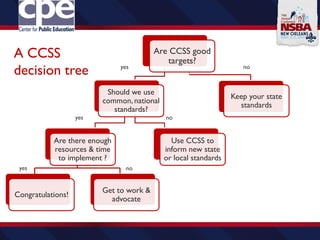
Are CCSS good
targets?
Should we use
common, national
standards?
Are there enough
resources & time
to implement ?
Use CCSS to
inform new state
or local standards
Keep your state
standards
Congratulations!
Get to work &
advocate
noyes
yes
yes
no
no
A CCSS
decision tree
WHAT’S DIFFERENT?
The majority of states have adopted the Common Core
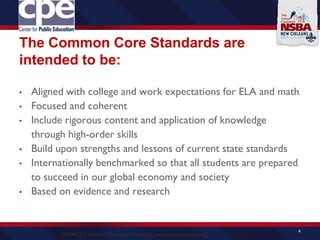
The Common Core Standards are
intended to be:
• Aligned with college and work expectations for ELA and math
• Focused and coherent
• Include rigorous content and application of knowledge
through high-order skills
• Build upon strengths and lessons of current state standards
• Internationally benchmarked so that all students are prepared
to succeed in our global economy and society
• Based on evidence and research
4
SOURCE: Common Core State Standards, www.corestandards.org
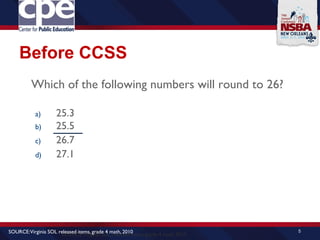
Before CCSS
Which of the following numbers will round to 26?
a) 25.3
b) 25.5
c) 26.7
d) 27.1
5
SOURCE:Virginia SOL released items, grade 4 math, 2010
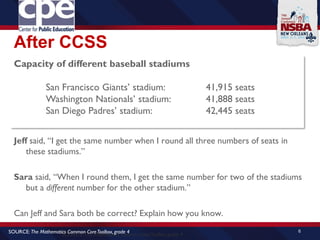
After CCSS
Jeff said, “I get the same number when I round all three numbers of seats in
these stadiums.”
Sara said, “When I round them, I get the same number for two of the stadiums
but a different number for the other stadium.”
Can Jeff and Sara both be correct? Explain how you know.
6
SOURCE: The Mathematics Common CoreToolbox, grade 4
Capacity of different baseball stadiums
San Francisco Giants’ stadium: 41,915 seats
Washington Nationals’ stadium: 41,888 seats
San Diego Padres’ stadium: 42,445 seats
SOURCE: The Mathematics Common CoreToolbox, grade 4
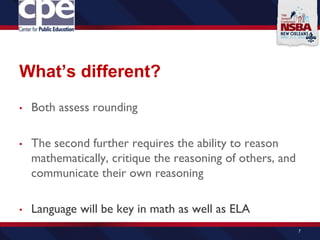
What’s different?
• Both assess rounding
• The second further requires the ability to reason
mathematically, critique the reasoning of others, and
communicate their own reasoning
• Language will be key in math as well as ELA
7
Before CCSS
8
SOURCE:Virginia SOL released items, grade 4 math, 2010
SOURCE: Minnesota grade 3 released item, 2013
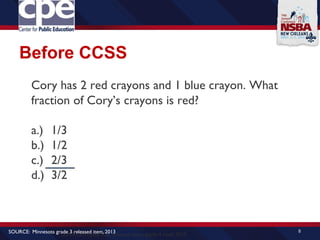
Cory has 2 red crayons and 1 blue crayon. What
fraction of Cory’s crayons is red?
a.) 1/3
b.) 1/2
c.) 2/3
d.) 3/2
After CCSS
9
SOURCE: The Mathematics Common CoreToolbox, grade 4
SOURCE: The Mathematics Common CoreToolbox, grade 3
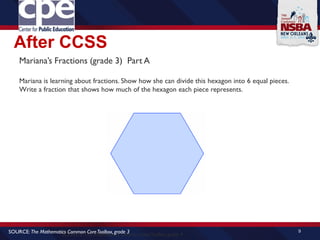
Mariana’s Fractions (grade 3) Part A
Mariana is learning about fractions. Show how she can divide this hexagon into 6 equal pieces.
Write a fraction that shows how much of the hexagon each piece represents.
After CCSS
10
SOURCE: The Mathematics Common CoreToolbox, grade 4
SOURCE: The Mathematics Common CoreToolbox, grade 3
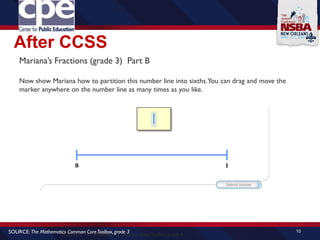
Mariana’s Fractions (grade 3) Part B
Now show Mariana how to partition this number line into sixths.You can drag and move the
marker anywhere on the number line as many times as you like.
After CCSS
11
SOURCE: The Mathematics Common CoreToolbox, grade 4
SOURCE: The Mathematics Common CoreToolbox, grade 3
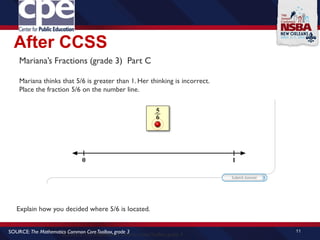
Mariana’s Fractions (grade 3) Part C
Mariana thinks that 5/6 is greater than 1. Her thinking is incorrect.
Place the fraction 5/6 on the number line.
Explain how you decided where 5/6 is located.
After CCSS
12
SOURCE: The Mathematics Common CoreToolbox, grade 4
SOURCE: The Mathematics Common CoreToolbox, grade 3
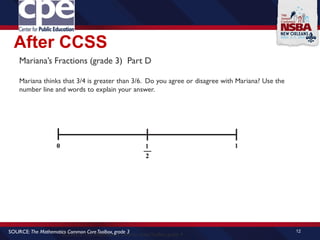
Mariana’s Fractions (grade 3) Part D
Mariana thinks that 3/4 is greater than 3/6. Do you agree or disagree with Mariana? Use the
number line and words to explain your answer.
After CCSS
13
SOURCE: The Mathematics Common CoreToolbox, grade 4
SOURCE: The Mathematics Common CoreToolbox, grade 3
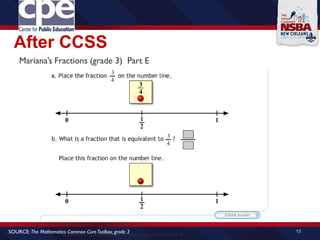
Mariana’s Fractions (grade 3) Part E
What’s different?
• Both assess fractions
• The second is multi-step and is scaffolded, meaning each
step helps students get to the next step
• The second also requires the ability to reason
mathematically and communicate their own reasoning
14
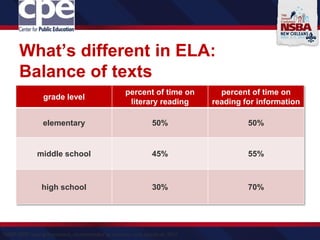
grade level
percent of time on
literary reading
percent of time on
reading for information
elementary 50% 50%
middle school 45% 55%
high school 30% 70%
NAEP 2009 reading framework, recommended by common core standards, 2012
What’s different in ELA:
Balance of texts
Other ELA differences
Standards for reading and writing in history/social studies,
science, and technical subjects
• Complement rather than replace content standards in those subjects
• Responsibility of teachers in those subjects
Emphasis on research and using evidence
Attention to text complexity
SOURCE: Common Core Standards, June 2010
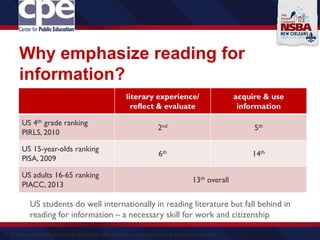
Why emphasize reading for
information?
literary experience/
reflect & evaluate
acquire & use
information
US 4th grade ranking
PIRLS, 2010
2nd 5th
US 15-year-olds ranking
PISA, 2009
6th 14th
US adults 16-65 ranking
PIACC, 2013
13th overall
Rankings based on statistically significant differences in scores between US and other countries.
US students do well internationally in reading literature but fall behind in
reading for information – a necessary skill for work and citizenship
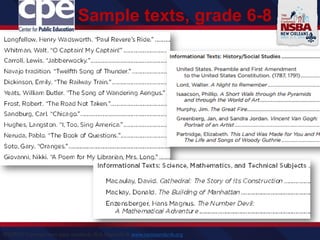
Sample texts, grade 6-8
SOURCE: Common core state standards, ELA,Appendix B, www.corestandards.org
CCSS IN THE STATES
In the last two years, CCSS have come under political fire
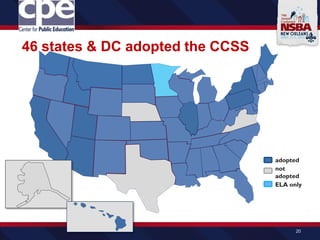
adopted
not
adopted
46 states & DC adopted the CCSS
20
ELA only
adopted
not
adopted
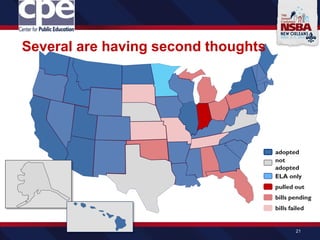
Several are having second thoughts
21
ELA only
pulled out
bills pending
bills failed
What ‘adoption’ means for
states
• must adopt 100% of CCSS K-12 standards
• CCSS should not represent more than 85% of
curriculum
• must begin assessments on CCSS within three years
• no requirements for public accountability
• no mechanism for enforcement by NGA/CCSSO
22SOURCE: NGA, CCSSO
Next Generation Science
Standards
• Collaboration of Achieve, NRC, AAAS, NSTA and 26 lead
states
• ‘Internationally benchmarked’
• Intended to be adopted ‘in whole’
• Carnegie Corp, Noyce Foundation & Dupont sponsors
• To date, seven states have adopted: California, Delaware,
Kansas, Kentucky, Maryland, Rhode Island and Vermont.
• Illinois and Oregon are expected to adopt soon.
23
A state-led effort
• CCSSO and NGA’s Center for Best Practices with an
advisory group: Achieve, Inc.; ACT, Inc.; College Board,
NASBE, and SHEEO
• No federal dollars for development; foundation support,
notably from the Gates Foundation
• US Dept of Ed provided incentives for adoption of “college-
career ready” standards through RTTT competition and
NCLB waivers
24
CCSS Proponents
Promote a college- and career-ready agenda for all students;
support CCSS’s emphasis on knowledge and its applications; see
the value in common standards across the country.
• Business: US Chamber of Commerce, Business Roundtable
• Governors of both parties: eg., Jeb Bush (R-Fla.), Chris
Christie (R-NJ), Steve Beshear (D-Ky.), Andrew Cuomo (D-
NY)
• Education associations: both teachers’ unions, the PTA
Pushback
• Tea Party/libertarian groups: oppose the idea of
common standards maintaining that they should be a local
decision
• Pioneer Institute, Heartland, Cato, American Principles Project, Family
Research Council, Home School Legal Defense Fund
• Progressive educators: oppose what they see as a
corporate influence and fear it will impose more test-driven
accountability
• FairTest, Diane Ravitch, United Opt Out National
NSBA’s position
• supports state-led process to define common standards
• supports federal funding for research and/or help to
states for developing assessments
• supports nationally available tests that states may adopt
voluntarily
• opposes federal mandates or coercion, eg. a condition
for receiving Title 1 funds
27
State CCSS
assessment consortia
• formed to develop common “next generation” assessments
aligned to the CCSS
• supported by $346 million federal grants
• PARCC: Partnership for Assessment of Readiness for College
& Careers headed by Achieve, Inc.
• SBAC: SMARTER Balanced Assessment Consortium headed
by Washington state department of education
28
State consortia assessments
• intended to assess higher order thinking at grades 3-8 and high
school
• measure growth and proficiency
• computer-administered online to provide rapid feedback
• both summative assessments for accountability, and
formative assessments to monitor students’ progress
• aligned resources, ie., model lessons, diagnostic tools,
professional development
29
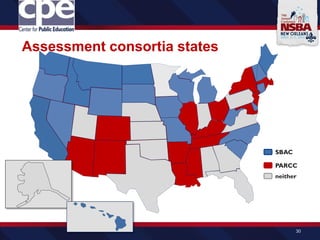
SBAC
Assessment consortia states
30
PARCC
neither
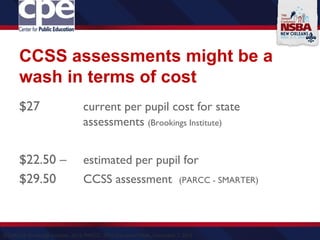
CCSS assessments might be a
wash in terms of cost
$27 current per pupil cost for state
assessments (Brookings Institute)
$22.50 – estimated per pupil for
$29.50 CCSS assessment (PARCC - SMARTER)
SOURCES: Brookings Institute, 2012; PARCC, 2012; EducationWeek, December 7, 2012
WHAT THE PUBLIC THINKS
CCSS pushback notwithstanding, polls tell a more complicated story
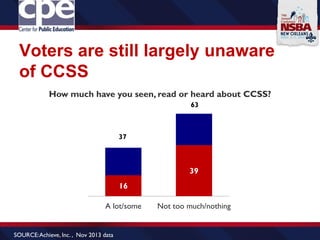
Voters are still largely unaware
of CCSS
16
39
A lot/some Not too much/nothing
How much have you seen, read or heard about CCSS?
37
63
SOURCE:Achieve, Inc. , Nov 2013 data
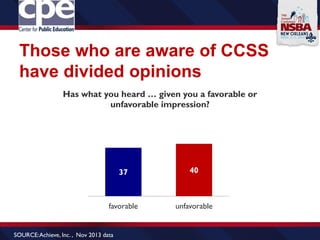
Those who are aware of CCSS
have divided opinions
37 40
favorable unfavorable
Has what you heard … given you a favorable or
unfavorable impression?
SOURCE:Achieve, Inc. , Nov 2013 data
After hearing a description,
opinions change …
36
13
favor oppose
[after description] do you favor or oppose CCSS?
69
23
strongly strongly
SOURCE:Achieve, Inc. , Nov 2013 data
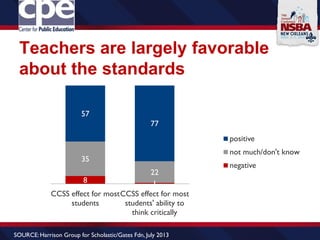
Teachers are largely favorable
about the standards
8 1
35
22
57
77
CCSS effect for most
students
CCSS effect for most
students' ability to
think critically
positive
not much/don't know
negative
SOURCE:Harrison Group for Scholastic/Gates Fdn, July 2013
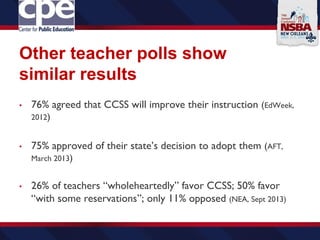
Other teacher polls show
similar results
• 76% agreed that CCSS will improve their instruction (EdWeek,
2012)
• 75% approved of their state’s decision to adopt them (AFT,
March 2013)
• 26% of teachers “wholeheartedly” favor CCSS; 50% favor
“with some reservations”; only 11% opposed (NEA, Sept 2013)
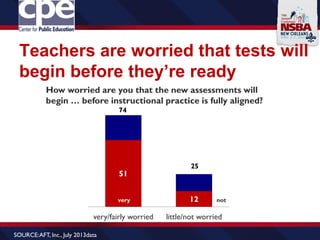
Teachers are worried that tests will
begin before they’re ready
51
12
very/fairly worried little/not worried
74
25
very not
SOURCE:AFT, Inc., July 2013data
How worried are you that the new assessments will
begin … before instructional practice is fully aligned?
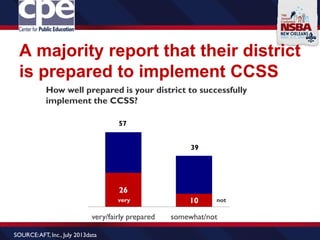
A majority report that their district
is prepared to implement CCSS
26
10
very/fairly prepared somewhat/not
57
39
very not
SOURCE:AFT, Inc., July 2013data
How well prepared is your district to successfully
implement the CCSS?
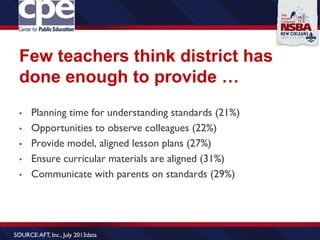
Few teachers think district has
done enough to provide …
• Planning time for understanding standards (21%)
• Opportunities to observe colleagues (22%)
• Provide model, aligned lesson plans (27%)
• Ensure curricular materials are aligned (31%)
• Communicate with parents on standards (29%)
SOURCE:AFT, Inc., July 2013data
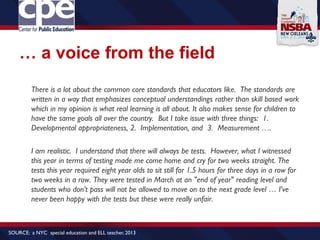
… a voice from the field
There is a lot about the common core standards that educators like. The standards are
written in a way that emphasizes conceptual understandings rather than skill based work
which in my opinion is what real learning is all about. It also makes sense for children to
have the same goals all over the country. But I take issue with three things: 1.
Developmental appropriateness, 2. Implementation, and 3. Measurement ….
I am realistic. I understand that there will always be tests. However, what I witnessed
this year in terms of testing made me come home and cry for two weeks straight. The
tests this year required eight year olds to sit still for 1.5 hours for three days in a row for
two weeks in a row. They were tested in March at an "end of year" reading level and
students who don't pass will not be allowed to move on to the next grade level … I've
never been happy with the tests but these were really unfair.
SOURCE: a NYC special education and ELL teacher, 2013
Calls for a moratorium on
CCSS accountability
• NEA and AFT called for 1-2 year moratorium on common
core accountability
• NSBA joined AASA, NAESP and NASSP in statement calling
for more time for CCSS implementation
• US Department of Education willing to waive “double-
testing” with transition to CCSS; California granted waiver
GETTING READY
While the politics play out, districts are having to move forward
What challenges do school
districts face?
• Timeline: 1st assessments to be administered 2014-15
• Technology: more computers, greater bandwidth
• Professional development: time is money
• New curriculum & materials: CCSS aligned
• Extra supports for students: crucial for ELL & special
needs students
• Managing expectations: CCSS are higher for most of
you; expect your initial scores to be lower
44
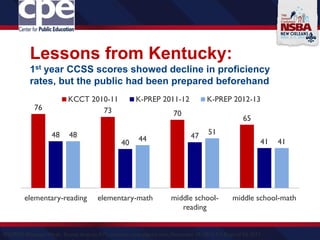
Lessons from Kentucky:
1st year CCSS scores showed decline in proficiency
rates, but the public had been prepared beforehand
76 73 70
65
48
40
47
41
48 44
51
41
elementary-reading elementary-math middle school-
reading
middle school-math
KCCT 2010-11 K-PREP 2011-12 K-PREP 2012-13
SOURCE: Education Week, Scores drop on KY’s common core-aligned tests, November 19, 2012; KY Dept of Ed, 2013
What Kentucky did
• Communicated need for higher standards & getting
public support
• Collaborations among many stakeholders, including
KSBA
• Aligned courses & curriculum
• Professional development for school boards as well
as teachers and principals
46
What school boards should do
Advice from Kentucky School Boards Association:
 Set clear and high expectations
 Create the conditions for success
 Hold the system accountable
 Create the public will to succeed
 Learn as a board team
47
SOURCE: Kentucky School Boards Association, 2012
Good communication is
essential
• Be informed and able to separate fact from rumor
• Support your teachers; let their work carry the message to
parents
• Use your data to inform your policies and to engage the
community
• Engage with your state association about your experiences
• Be an advocate
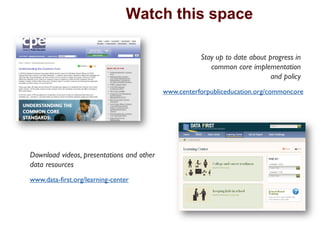
Watch this space
www.data-first.org/learning-center
Stay up to date about progress in
common core implementation
and policy
Download videos, presentations and other
data resources
www.centerforpubliceducation.org/commoncore

CCSS 2014 Annual Conference

  • 1.
    Getting Ready forthe Common Core Assessments Patte Barth Director, NSBA’s Center for Public Education NSBA Annual Conference ♦ New Orleans ♦ April 6 2014
  • 2.
    Are CCSS good targets? Shouldwe use common, national standards? Are there enough resources & time to implement ? Use CCSS to inform new state or local standards Keep your state standards Congratulations! Get to work & advocate noyes yes yes no no A CCSS decision tree
  • 3.
    WHAT’S DIFFERENT? The majorityof states have adopted the Common Core
  • 4.
    The Common CoreStandards are intended to be: • Aligned with college and work expectations for ELA and math • Focused and coherent • Include rigorous content and application of knowledge through high-order skills • Build upon strengths and lessons of current state standards • Internationally benchmarked so that all students are prepared to succeed in our global economy and society • Based on evidence and research 4 SOURCE: Common Core State Standards, www.corestandards.org
  • 5.
    Before CCSS Which ofthe following numbers will round to 26? a) 25.3 b) 25.5 c) 26.7 d) 27.1 5 SOURCE:Virginia SOL released items, grade 4 math, 2010 SOURCE:Virginia SOL released items, grade 4 math, 2010
  • 6.
    After CCSS Jeff said,“I get the same number when I round all three numbers of seats in these stadiums.” Sara said, “When I round them, I get the same number for two of the stadiums but a different number for the other stadium.” Can Jeff and Sara both be correct? Explain how you know. 6 SOURCE: The Mathematics Common CoreToolbox, grade 4 Capacity of different baseball stadiums San Francisco Giants’ stadium: 41,915 seats Washington Nationals’ stadium: 41,888 seats San Diego Padres’ stadium: 42,445 seats SOURCE: The Mathematics Common CoreToolbox, grade 4
  • 7.
    What’s different? • Bothassess rounding • The second further requires the ability to reason mathematically, critique the reasoning of others, and communicate their own reasoning • Language will be key in math as well as ELA 7
  • 8.
    Before CCSS 8 SOURCE:Virginia SOLreleased items, grade 4 math, 2010 SOURCE: Minnesota grade 3 released item, 2013 Cory has 2 red crayons and 1 blue crayon. What fraction of Cory’s crayons is red? a.) 1/3 b.) 1/2 c.) 2/3 d.) 3/2
  • 9.
    After CCSS 9 SOURCE: TheMathematics Common CoreToolbox, grade 4 SOURCE: The Mathematics Common CoreToolbox, grade 3 Mariana’s Fractions (grade 3) Part A Mariana is learning about fractions. Show how she can divide this hexagon into 6 equal pieces. Write a fraction that shows how much of the hexagon each piece represents.
  • 10.
    After CCSS 10 SOURCE: TheMathematics Common CoreToolbox, grade 4 SOURCE: The Mathematics Common CoreToolbox, grade 3 Mariana’s Fractions (grade 3) Part B Now show Mariana how to partition this number line into sixths.You can drag and move the marker anywhere on the number line as many times as you like.
  • 11.
    After CCSS 11 SOURCE: TheMathematics Common CoreToolbox, grade 4 SOURCE: The Mathematics Common CoreToolbox, grade 3 Mariana’s Fractions (grade 3) Part C Mariana thinks that 5/6 is greater than 1. Her thinking is incorrect. Place the fraction 5/6 on the number line. Explain how you decided where 5/6 is located.
  • 12.
    After CCSS 12 SOURCE: TheMathematics Common CoreToolbox, grade 4 SOURCE: The Mathematics Common CoreToolbox, grade 3 Mariana’s Fractions (grade 3) Part D Mariana thinks that 3/4 is greater than 3/6. Do you agree or disagree with Mariana? Use the number line and words to explain your answer.
  • 13.
    After CCSS 13 SOURCE: TheMathematics Common CoreToolbox, grade 4 SOURCE: The Mathematics Common CoreToolbox, grade 3 Mariana’s Fractions (grade 3) Part E
  • 14.
    What’s different? • Bothassess fractions • The second is multi-step and is scaffolded, meaning each step helps students get to the next step • The second also requires the ability to reason mathematically and communicate their own reasoning 14
  • 15.
    grade level percent oftime on literary reading percent of time on reading for information elementary 50% 50% middle school 45% 55% high school 30% 70% NAEP 2009 reading framework, recommended by common core standards, 2012 What’s different in ELA: Balance of texts
  • 16.
    Other ELA differences Standardsfor reading and writing in history/social studies, science, and technical subjects • Complement rather than replace content standards in those subjects • Responsibility of teachers in those subjects Emphasis on research and using evidence Attention to text complexity SOURCE: Common Core Standards, June 2010
  • 17.
    Why emphasize readingfor information? literary experience/ reflect & evaluate acquire & use information US 4th grade ranking PIRLS, 2010 2nd 5th US 15-year-olds ranking PISA, 2009 6th 14th US adults 16-65 ranking PIACC, 2013 13th overall Rankings based on statistically significant differences in scores between US and other countries. US students do well internationally in reading literature but fall behind in reading for information – a necessary skill for work and citizenship
  • 18.
    Sample texts, grade6-8 SOURCE: Common core state standards, ELA,Appendix B, www.corestandards.org
  • 19.
    CCSS IN THESTATES In the last two years, CCSS have come under political fire
  • 20.
    adopted not adopted 46 states &DC adopted the CCSS 20 ELA only
  • 21.
    adopted not adopted Several are havingsecond thoughts 21 ELA only pulled out bills pending bills failed
  • 22.
    What ‘adoption’ meansfor states • must adopt 100% of CCSS K-12 standards • CCSS should not represent more than 85% of curriculum • must begin assessments on CCSS within three years • no requirements for public accountability • no mechanism for enforcement by NGA/CCSSO 22SOURCE: NGA, CCSSO
  • 23.
    Next Generation Science Standards •Collaboration of Achieve, NRC, AAAS, NSTA and 26 lead states • ‘Internationally benchmarked’ • Intended to be adopted ‘in whole’ • Carnegie Corp, Noyce Foundation & Dupont sponsors • To date, seven states have adopted: California, Delaware, Kansas, Kentucky, Maryland, Rhode Island and Vermont. • Illinois and Oregon are expected to adopt soon. 23
  • 24.
    A state-led effort •CCSSO and NGA’s Center for Best Practices with an advisory group: Achieve, Inc.; ACT, Inc.; College Board, NASBE, and SHEEO • No federal dollars for development; foundation support, notably from the Gates Foundation • US Dept of Ed provided incentives for adoption of “college- career ready” standards through RTTT competition and NCLB waivers 24
  • 25.
    CCSS Proponents Promote acollege- and career-ready agenda for all students; support CCSS’s emphasis on knowledge and its applications; see the value in common standards across the country. • Business: US Chamber of Commerce, Business Roundtable • Governors of both parties: eg., Jeb Bush (R-Fla.), Chris Christie (R-NJ), Steve Beshear (D-Ky.), Andrew Cuomo (D- NY) • Education associations: both teachers’ unions, the PTA
  • 26.
    Pushback • Tea Party/libertariangroups: oppose the idea of common standards maintaining that they should be a local decision • Pioneer Institute, Heartland, Cato, American Principles Project, Family Research Council, Home School Legal Defense Fund • Progressive educators: oppose what they see as a corporate influence and fear it will impose more test-driven accountability • FairTest, Diane Ravitch, United Opt Out National
  • 27.
    NSBA’s position • supportsstate-led process to define common standards • supports federal funding for research and/or help to states for developing assessments • supports nationally available tests that states may adopt voluntarily • opposes federal mandates or coercion, eg. a condition for receiving Title 1 funds 27
  • 28.
    State CCSS assessment consortia •formed to develop common “next generation” assessments aligned to the CCSS • supported by $346 million federal grants • PARCC: Partnership for Assessment of Readiness for College & Careers headed by Achieve, Inc. • SBAC: SMARTER Balanced Assessment Consortium headed by Washington state department of education 28
  • 29.
    State consortia assessments •intended to assess higher order thinking at grades 3-8 and high school • measure growth and proficiency • computer-administered online to provide rapid feedback • both summative assessments for accountability, and formative assessments to monitor students’ progress • aligned resources, ie., model lessons, diagnostic tools, professional development 29
  • 30.
  • 31.
    CCSS assessments mightbe a wash in terms of cost $27 current per pupil cost for state assessments (Brookings Institute) $22.50 – estimated per pupil for $29.50 CCSS assessment (PARCC - SMARTER) SOURCES: Brookings Institute, 2012; PARCC, 2012; EducationWeek, December 7, 2012
  • 32.
    WHAT THE PUBLICTHINKS CCSS pushback notwithstanding, polls tell a more complicated story
  • 33.
    Voters are stilllargely unaware of CCSS 16 39 A lot/some Not too much/nothing How much have you seen, read or heard about CCSS? 37 63 SOURCE:Achieve, Inc. , Nov 2013 data
  • 34.
    Those who areaware of CCSS have divided opinions 37 40 favorable unfavorable Has what you heard … given you a favorable or unfavorable impression? SOURCE:Achieve, Inc. , Nov 2013 data
  • 35.
    After hearing adescription, opinions change … 36 13 favor oppose [after description] do you favor or oppose CCSS? 69 23 strongly strongly SOURCE:Achieve, Inc. , Nov 2013 data
  • 36.
    Teachers are largelyfavorable about the standards 8 1 35 22 57 77 CCSS effect for most students CCSS effect for most students' ability to think critically positive not much/don't know negative SOURCE:Harrison Group for Scholastic/Gates Fdn, July 2013
  • 37.
    Other teacher pollsshow similar results • 76% agreed that CCSS will improve their instruction (EdWeek, 2012) • 75% approved of their state’s decision to adopt them (AFT, March 2013) • 26% of teachers “wholeheartedly” favor CCSS; 50% favor “with some reservations”; only 11% opposed (NEA, Sept 2013)
  • 38.
    Teachers are worriedthat tests will begin before they’re ready 51 12 very/fairly worried little/not worried 74 25 very not SOURCE:AFT, Inc., July 2013data How worried are you that the new assessments will begin … before instructional practice is fully aligned?
  • 39.
    A majority reportthat their district is prepared to implement CCSS 26 10 very/fairly prepared somewhat/not 57 39 very not SOURCE:AFT, Inc., July 2013data How well prepared is your district to successfully implement the CCSS?
  • 40.
    Few teachers thinkdistrict has done enough to provide … • Planning time for understanding standards (21%) • Opportunities to observe colleagues (22%) • Provide model, aligned lesson plans (27%) • Ensure curricular materials are aligned (31%) • Communicate with parents on standards (29%) SOURCE:AFT, Inc., July 2013data
  • 41.
    … a voicefrom the field There is a lot about the common core standards that educators like. The standards are written in a way that emphasizes conceptual understandings rather than skill based work which in my opinion is what real learning is all about. It also makes sense for children to have the same goals all over the country. But I take issue with three things: 1. Developmental appropriateness, 2. Implementation, and 3. Measurement …. I am realistic. I understand that there will always be tests. However, what I witnessed this year in terms of testing made me come home and cry for two weeks straight. The tests this year required eight year olds to sit still for 1.5 hours for three days in a row for two weeks in a row. They were tested in March at an "end of year" reading level and students who don't pass will not be allowed to move on to the next grade level … I've never been happy with the tests but these were really unfair. SOURCE: a NYC special education and ELL teacher, 2013
  • 42.
    Calls for amoratorium on CCSS accountability • NEA and AFT called for 1-2 year moratorium on common core accountability • NSBA joined AASA, NAESP and NASSP in statement calling for more time for CCSS implementation • US Department of Education willing to waive “double- testing” with transition to CCSS; California granted waiver
  • 43.
    GETTING READY While thepolitics play out, districts are having to move forward
  • 44.
    What challenges doschool districts face? • Timeline: 1st assessments to be administered 2014-15 • Technology: more computers, greater bandwidth • Professional development: time is money • New curriculum & materials: CCSS aligned • Extra supports for students: crucial for ELL & special needs students • Managing expectations: CCSS are higher for most of you; expect your initial scores to be lower 44
  • 45.
    Lessons from Kentucky: 1styear CCSS scores showed decline in proficiency rates, but the public had been prepared beforehand 76 73 70 65 48 40 47 41 48 44 51 41 elementary-reading elementary-math middle school- reading middle school-math KCCT 2010-11 K-PREP 2011-12 K-PREP 2012-13 SOURCE: Education Week, Scores drop on KY’s common core-aligned tests, November 19, 2012; KY Dept of Ed, 2013
  • 46.
    What Kentucky did •Communicated need for higher standards & getting public support • Collaborations among many stakeholders, including KSBA • Aligned courses & curriculum • Professional development for school boards as well as teachers and principals 46
  • 47.
    What school boardsshould do Advice from Kentucky School Boards Association:  Set clear and high expectations  Create the conditions for success  Hold the system accountable  Create the public will to succeed  Learn as a board team 47 SOURCE: Kentucky School Boards Association, 2012
  • 48.
    Good communication is essential •Be informed and able to separate fact from rumor • Support your teachers; let their work carry the message to parents • Use your data to inform your policies and to engage the community • Engage with your state association about your experiences • Be an advocate
  • 49.
    Watch this space www.data-first.org/learning-center Stayup to date about progress in common core implementation and policy Download videos, presentations and other data resources www.centerforpubliceducation.org/commoncore