Successful schools make students feel welcome, academically engaged and supported 
by the adults in the building. Considering the school climate of your schools is as 
important as examining student scores and graduation rates because a healthy 
environment can have a tremendous impact on student achievement. This 
presentation reviews the research on the relationship between school climate and 
student learning,  and gives an overview of what students nationally think and say 
about the climate of their schools. 


                                                                                       1
2
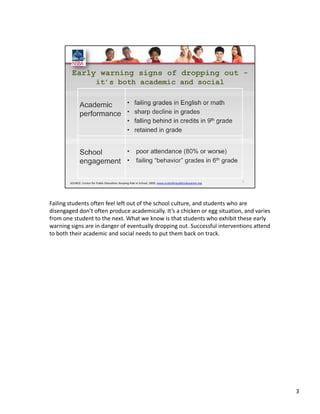
Failing students often feel left out of the school culture, and students who are 
disengaged don’t often produce academically. It’s a chicken or egg situation, and varies 
from one student to the next. What we know is that students who exhibit these early 
warning signs are in danger of eventually dropping out. Successful interventions attend 
to both their academic and social needs to put them back on track.


                                                                                            3
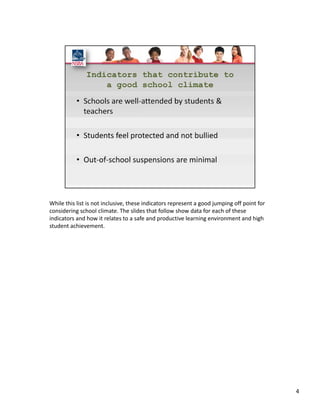
While this list is not inclusive, these indicators represent a good jumping off point for 
considering school climate. The slides that follow show data for each of these 
indicators and how it relates to a safe and productive learning environment and high 
student achievement.


                                                                                             4
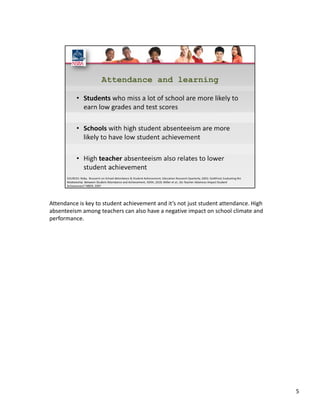
Attendance is key to student achievement and it’s not just student attendance. High 
absenteeism among teachers can also have a negative impact on school climate and 
performance.


                                                                                       5
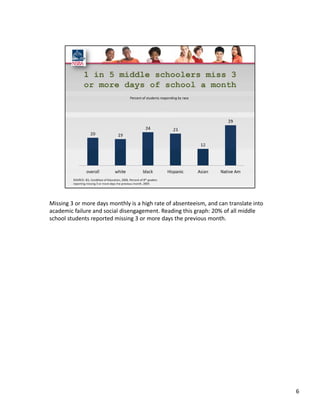
Missing 3 or more days monthly is a high rate of absenteeism, and can translate into 
academic failure and social disengagement. Reading this graph: 20% of all middle 
school students reported missing 3 or more days the previous month.  


                                                                                        6
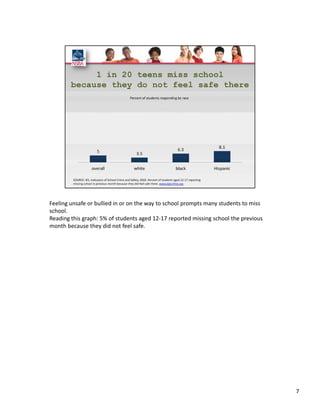
Feeling unsafe or bullied in or on the way to school prompts many students to miss 
school. 
Reading this graph: 5% of students aged 12‐17 reported missing school the previous 
month because they did not feel safe. 


                                                                                      7
8
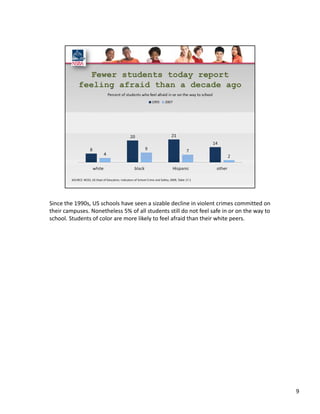
Since the 1990s, US schools have seen a sizable decline in violent crimes committed on 
their campuses. Nonetheless 5% of all students still do not feel safe in or on the way to 
school. Students of color are more likely to feel afraid than their white peers.


                                                                                             9
10
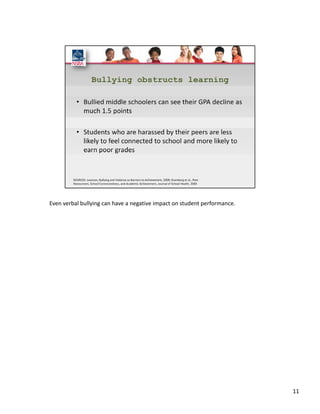
Even verbal bullying can have a negative impact on student performance.


                                                                          11
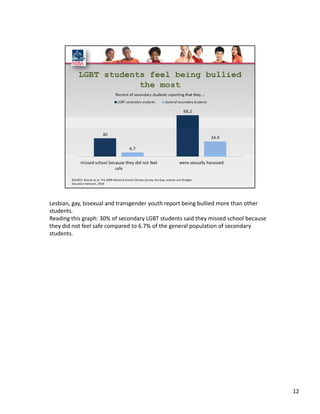
Lesbian, gay, bisexual and transgender youth report being bullied more than other 
students. 
Reading this graph: 30% of secondary LGBT students said they missed school because 
they did not feel safe compared to 6.7% of the general population of secondary 
students. 


                                                                                      12
13
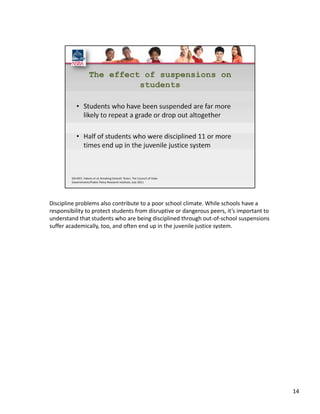
Discipline problems also contribute to a poor school climate. While schools have a 
responsibility to protect students from disruptive or dangerous peers, it’s important to 
understand that students who are being disciplined through out‐of‐school suspensions 
suffer academically, too, and often end up in the juvenile justice system.


                                                                                            14
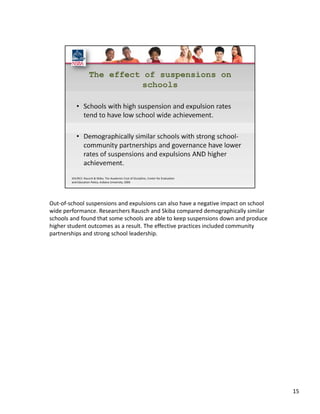
Out‐of‐school suspensions and expulsions can also have a negative impact on school 
wide performance. Researchers Rausch and Skiba compared demographically similar 
schools and found that some schools are able to keep suspensions down and produce 
higher student outcomes as a result. The effective practices included community 
partnerships and strong school leadership. 


                                                                                      15
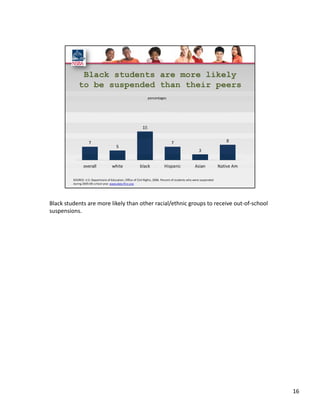
Black students are more likely than other racial/ethnic groups to receive out‐of‐school 
suspensions. 


                                                                                           16
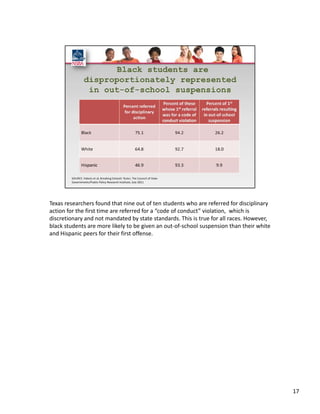
Texas researchers found that nine out of ten students who are referred for disciplinary 
action for the first time are referred for a “code of conduct” violation,  which is 
discretionary and not mandated by state standards. This is true for all races. However, 
black students are more likely to be given an out‐of‐school suspension than their white 
and Hispanic peers for their first offense. 


                                                                                           17
18
19
20
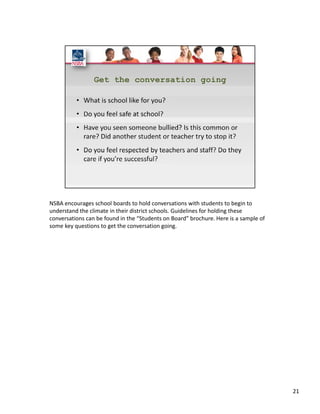
NSBA encourages school boards to hold conversations with students to begin to 
understand the climate in their district schools. Guidelines for holding these 
conversations can be found in the “Students on Board” brochure. Here is a sample of 
some key questions to get the conversation going.  


                                                                                       21
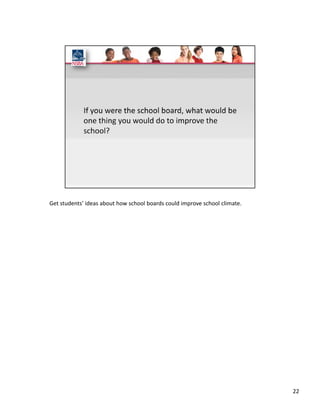
Get students’ ideas about how school boards could improve school climate.


                                                                            22
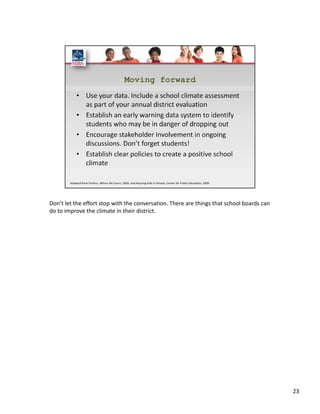
Don’t let the effort stop with the conversation. There are things that school boards can 
do to improve the climate in their district. 


                                                                                            23
24

Students on Board (With Notes)