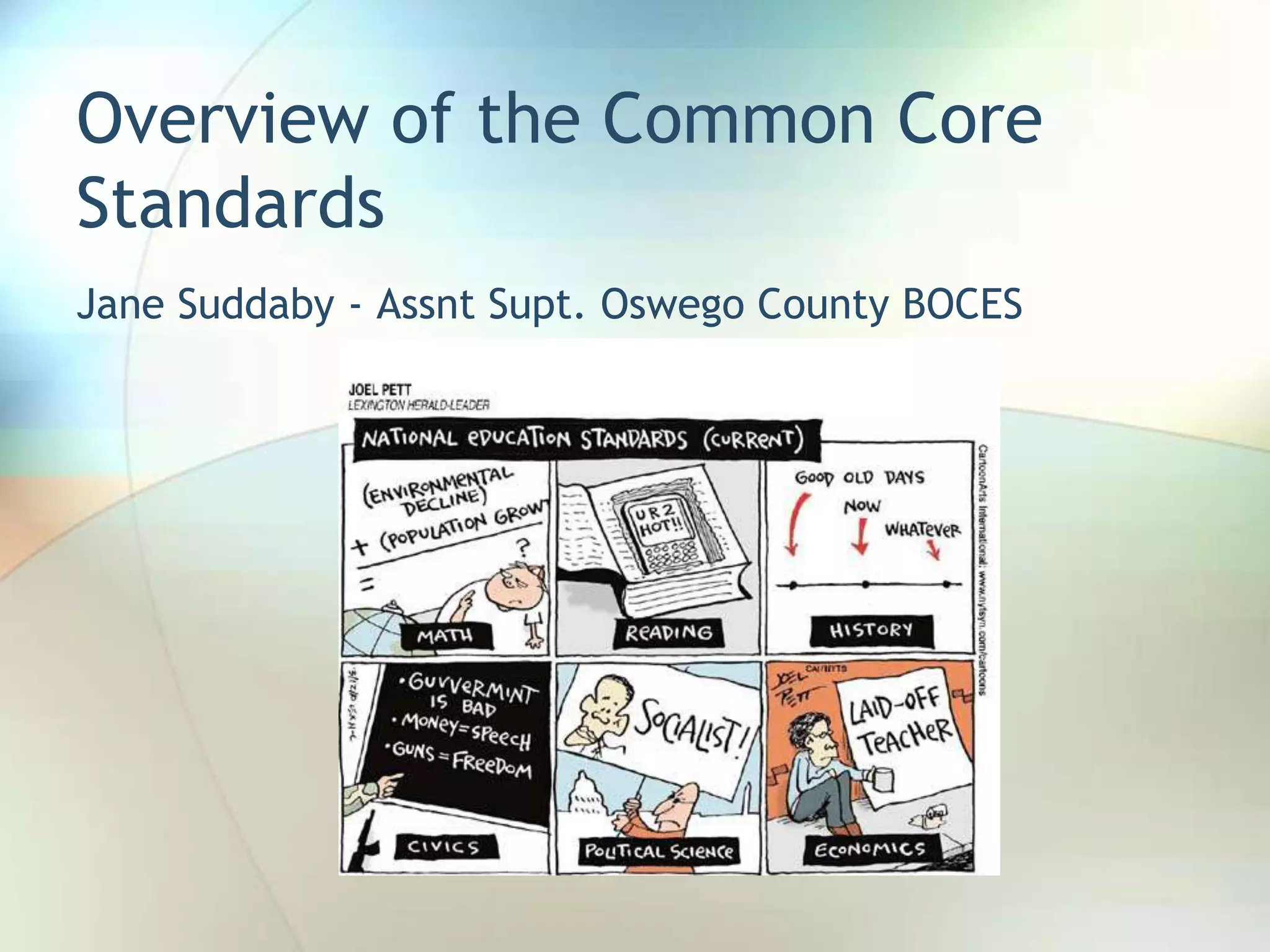
Overview of the Common Core Standards Jane Suddaby - Assnt Supt. Oswego County BOCES
Here we go…Common Core Standards
What are the Common Core State Standards?Aligned with college and work expectations
Focused and coherent
Include rigorous content and application of knowledge through high-order skills
Build upon strengths and lessons of current state standards
Internationally benchmarked so that all students are prepared to succeed in our global economy and society
Based on evidence and research
State led – coordinated by NGA Center and CCSSOWho is CCSO & NGA?COUNCIL OF CHIEF STATE SCHOOL OFFICERS (CCSSO) &NATIONAL GOVERNORS ASSOCIATION CENTER FOR BEST PRACTICES(NGA CENTER)JUNE 2010
Why is this important?Currently, every state has its own set of academic standards, meaning public education students in each state are learning to different levelsAll students must be prepared to compete with not only their American peers in the next state, but with students from around the world
Design and OrganizationMajor design goalsAlign with best evidence on college and career readiness expectationsBuild on the best standards work of the statesMaintain focus on what matters most for readiness
College & Career ReadinessIndependentStrong content knowledgeRespond to various audiences, tasks, purposes and disciplinesComprehend and critiqueValue evidenceTechnology & digital mediaPerspectives & cultures
STANDARDS FORENGLISH LANGUAGE ARTS&LITERACY IN HISTORY/SOCIAL STUDIES,SCIENCE, AND TECHNICAL SUBJECTSJUNE 2010
Design and OrganizationFour strandsReading (including Reading Foundational Skills)WritingSpeaking and ListeningLanguageAn integrated model of literacyMedia requirements blended throughout
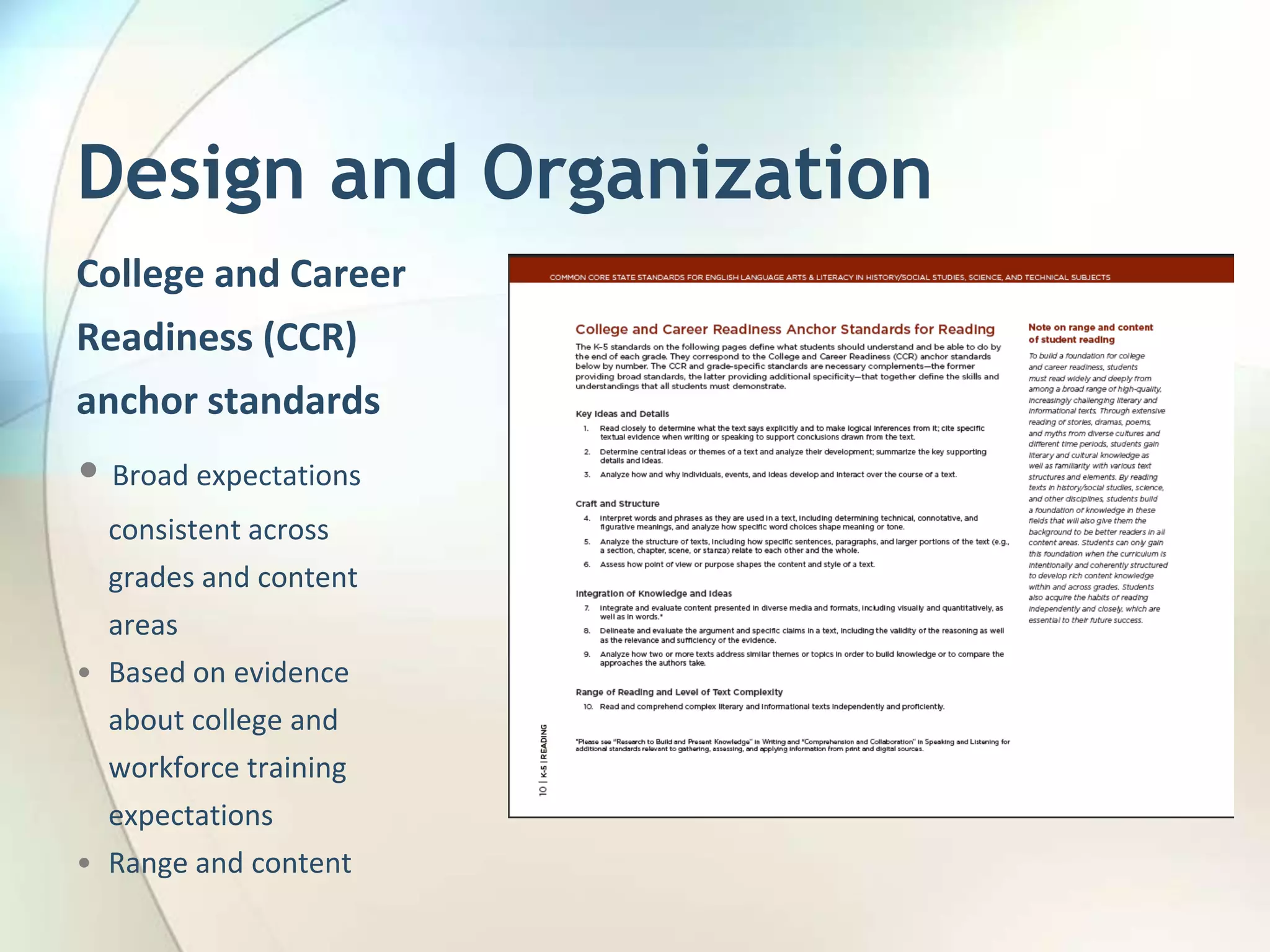
Design and OrganizationCollege and Career Readiness (CCR) anchor standardsBroad expectations   	consistent across 	grades and content 	areas 	Based on evidence	about college and	workforce training	expectations 	Range and content
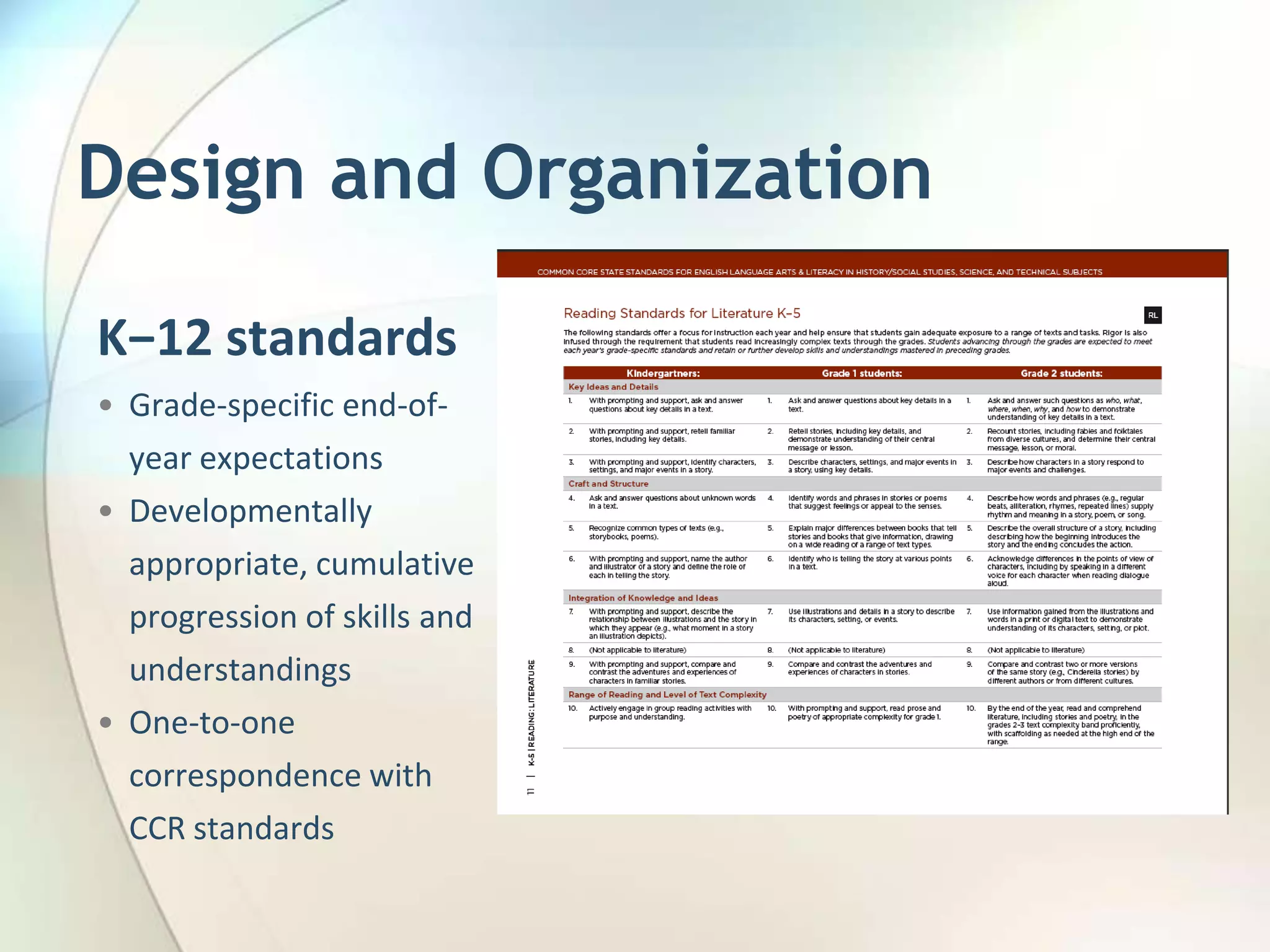
Design and OrganizationK−12 standardsGrade-specific end-of-year expectationsDevelopmentally appropriate, cumulative progression of skills and understandingsOne-to-one correspondence with CCR standards
WRITINGProduction and distribution of writing (standards 4−6)Developing and strengthening writingUsing technology to produce and enhance writingResearch (standards 7−9)Engaging in research and writing about sourcesRange of writing (standard 10)Writing routinely over various time frames
STANDARDS FORMATHEMATICSJUNE 2010
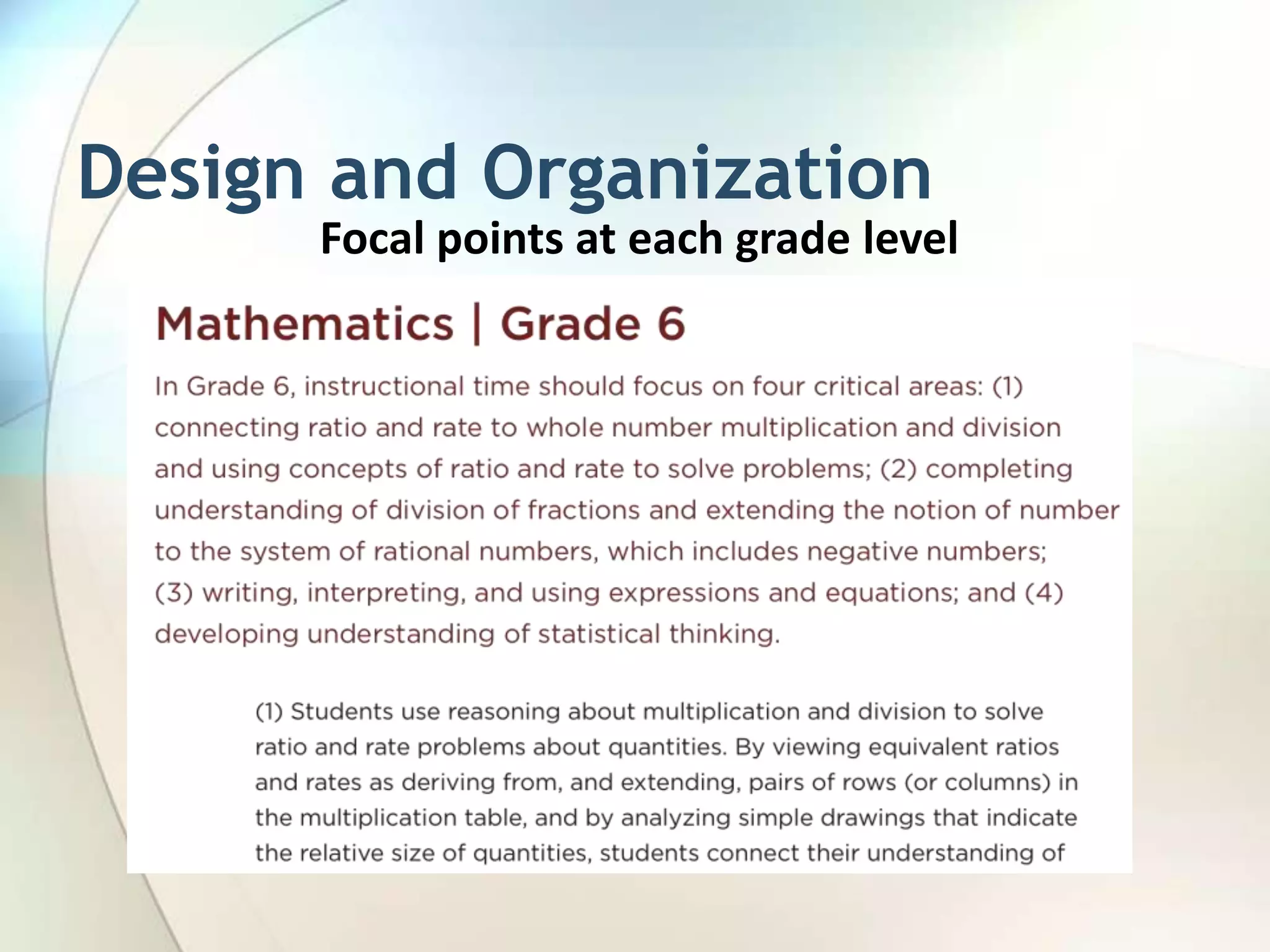
Design and OrganizationStandards for Mathematical PracticeCarry across all grade levelsDescribe habits of mind of a mathematically expert studentStandards for Mathematical ContentK-8 standards presented by grade levelOrganized into domains that progress over several gradesGrade introductions give 2–4 focal points at each grade levelHigh school standards presented by conceptual theme (Number & Quantity, Algebra, Functions, Modeling, Geometry, Statistics & Probability)
CCSS vs. NYS State StandardsNew Vocabulary
Domain– used to be “Strands”
Cluster– used to be “bands within the strand”
Standard–used to be “performance indicator”
8 Standards of Practice -“Habits of Mind”-	same for all – WILL BE TESTED!
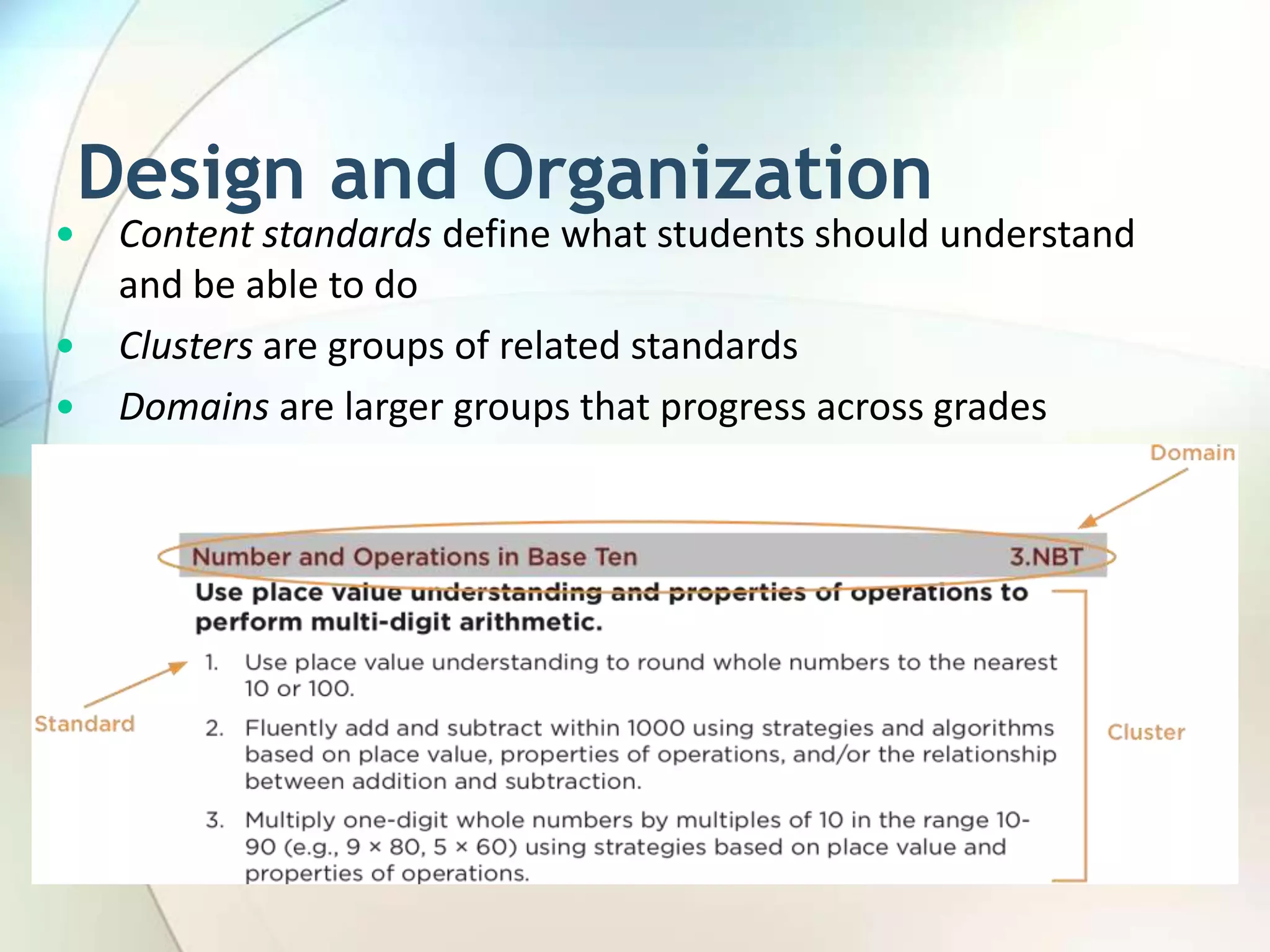
Standards of Content- different by grade levelDesign and OrganizationContent standards define what students should understand and be able to do
Clusters are groups of related standards
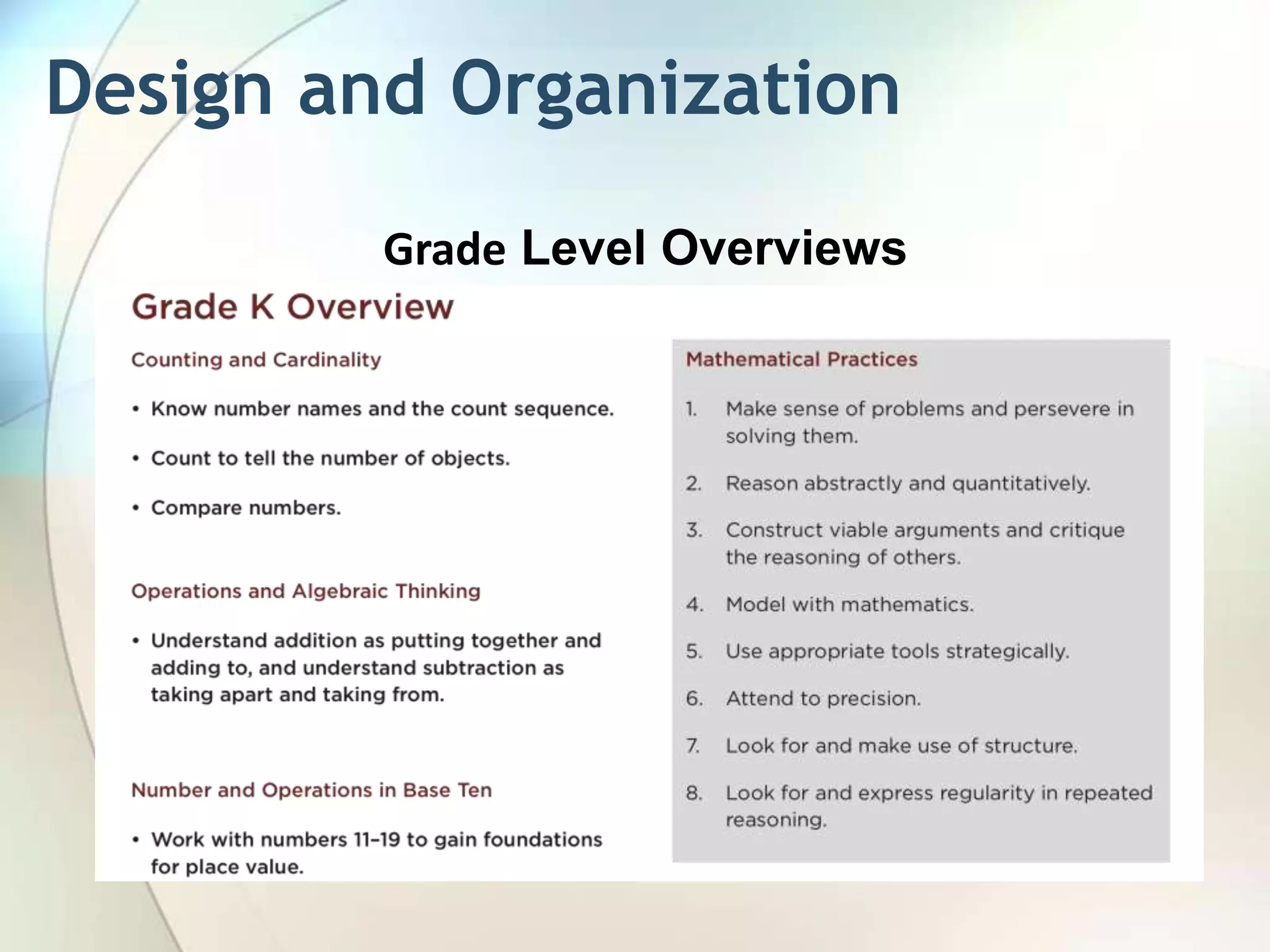
Domains are larger groups that progress across gradesDesign and OrganizationGrade Level Overviews
Design and OrganizationFocal points at each grade level
Statistics & Probability Gr 6Develop understanding of statistical variabilityRecognize a statistical question as one that anticipates variability in the data related to the question and accounts for it in the answers. For example, “How old am I?” is not a statistical question, but “How old are the students in my school?” is a statistical question because one anticipates variability in students’ ages.Understand that a set of data collected to answer a statistical question has a distribution which can be described by its center, spread, and overall shape.Recognize that a measure of center for a numerical data set summarizes all of its values with a single number, while a measure of variation describes how its values vary with a single number.
Algebra Grade 8Graded ramp up to Algebra in Grade 8	Properties of operations, similarity, ratio and proportional relationships, rational number system.Focus on linear equations and functions in Grade 8Expressions and Equations Work with radicals and integer exponents. Understand the connections between proportional relationships, lines, and linear equations. Analyze and solve linear equations and pairs of simultaneous linear equations.	Functions Define, evaluate, and compare functions. Use functions to model relationships between quantities.
High SchoolConceptual themes in high schoolNumber and QuantityAlgebraFunctionsModelingGeometryStatistics and ProbabilityCollege and career readiness threshold(+) standards indicate material beyond the threshold; can be in courses required for all students.
Geometry – High SchoolMiddle school foundationsHands-on experience with transformations.Low tech (transparencies) or high tech (dynamic geometry software).High school rigor and applicationsProperties of rotations, reflections, translations, and dilations are assumed, proofs start from there.Connections with algebra and modeling
Common Core Standards (CCS)Common Core State Standards (CCSS)Common Core Standards –NYS Board of Regents 		adopted July 19th, 2010.15% maximum additional for statesCompleted this summer by teachers, administrators curriculum specialists, professorsNYS released for review/feedback in the field in October.Tentative date for NYS adoption January 2011
Timeline…2010-2011 (This year!)Familiarize with CCS/CCSSBegin developing curriculumsTesting on 2005 standards2011-2012 (Next year!)Familiarize with CCS/CCSSContinue to develop curriculums Testing on 2005 standardsAfter testing in May begin “new curriculums”
…and time passes…2012-2013 Expectations aligned with CCSS“interim” assessments administeredCurriculum models availablePARCC (Partnership for the Assessment of Readiness for College and Careers) assessments field tested2013-2014 CCSS standards taught & tested“interim” assessments administered
	…and then…2014-2015 - CCSS and PARCC (Partnership for the Assessment of Readiness for College and Careers) assessments operational
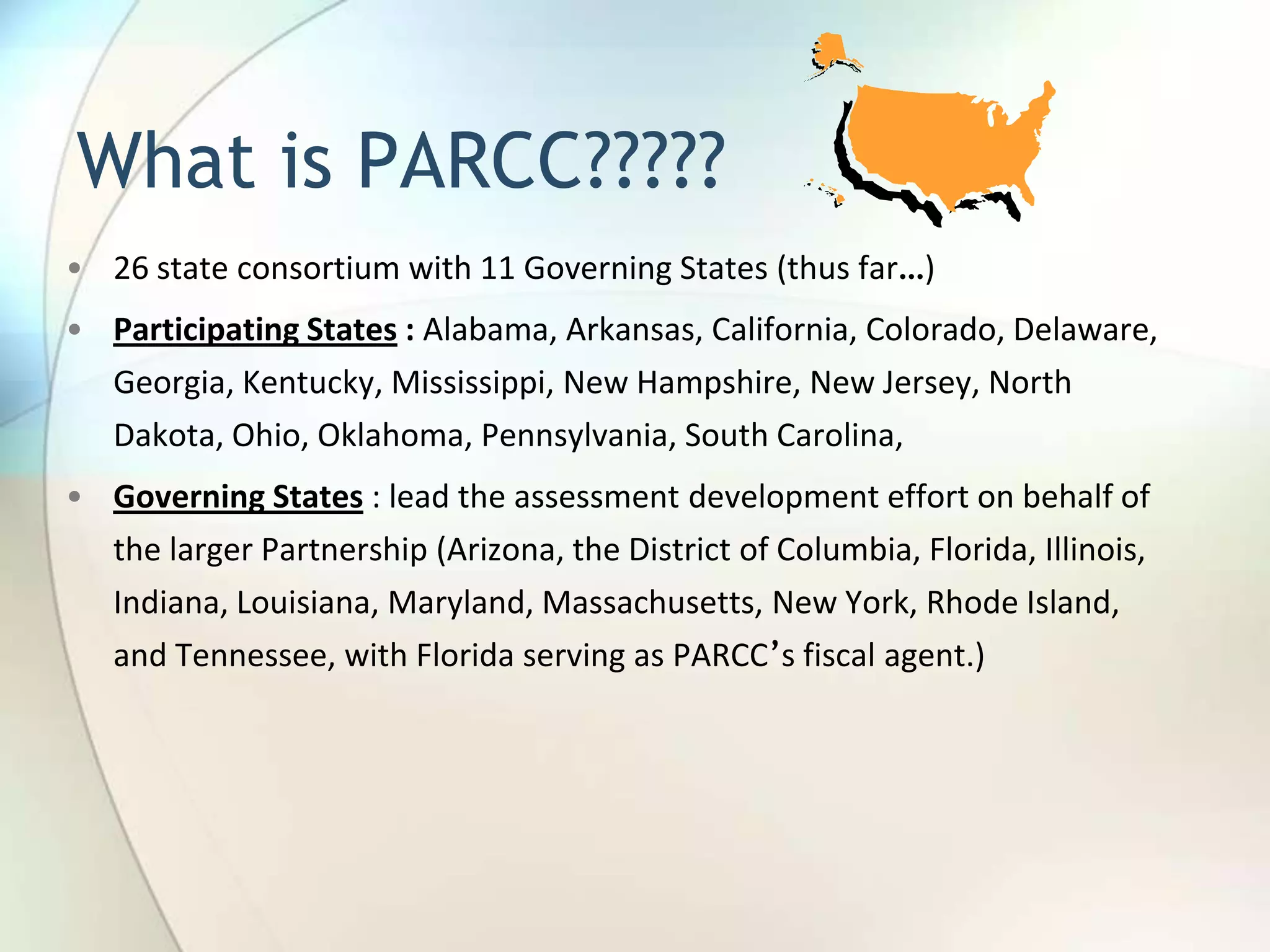
What is PARCC?????26 state consortium with 11 Governing States (thus far…)Participating States : Alabama, Arkansas, California, Colorado, Delaware, Georgia, Kentucky, Mississippi, New Hampshire, New Jersey, North Dakota, Ohio, Oklahoma, Pennsylvania, South Carolina, Governing States: lead the assessment development effort on behalf of the larger Partnership (Arizona, the District of Columbia, Florida, Illinois, Indiana, Louisiana, Maryland, Massachusetts, New York, Rhode Island, and Tennessee, with Florida serving as PARCC’s fiscal agent.)
What is PARCC suppose to do????Goal of PARCCFacilitate an assessment system to increase graduation rates and readiness for college and/or careersProvide needed information to all groups that students are on track and graduate preparedProposed…Computer based testingAdministered during the year at the time of completion of materialData available to remediate or accelerate learningCommon measures among states since done in partnership
More About PARCCMore Meaningful Standards: The Partnership’s assessment system will be anchored in the Common Core State Standards which are consistent across states, clear to the public, and provide an on-ramp to college and careers. Higher Quality Tests: PARCC assessments will include sophisticated items and performance tasks to measure critical thinking, strategic problem solving, research and writing.Through-Course Testing: Students will take parts of the assessment at key times during the school year, closer to when they learn the material. Maximize Technology: PARCC assessments in most grades will be computer based. Cross-State Comparability: States in PARCC will adopt common assessments and common performance standards.
Jane's ccss

  • 1.
    Overview of theCommon Core Standards Jane Suddaby - Assnt Supt. Oswego County BOCES
  • 2.
    Here we go…CommonCore Standards
  • 3.
    What are theCommon Core State Standards?Aligned with college and work expectations
  • 4.
  • 5.
    Include rigorous contentand application of knowledge through high-order skills
  • 6.
    Build upon strengthsand lessons of current state standards
  • 7.
    Internationally benchmarked sothat all students are prepared to succeed in our global economy and society
  • 8.
    Based on evidenceand research
  • 9.
    State led –coordinated by NGA Center and CCSSOWho is CCSO & NGA?COUNCIL OF CHIEF STATE SCHOOL OFFICERS (CCSSO) &NATIONAL GOVERNORS ASSOCIATION CENTER FOR BEST PRACTICES(NGA CENTER)JUNE 2010
  • 10.
    Why is thisimportant?Currently, every state has its own set of academic standards, meaning public education students in each state are learning to different levelsAll students must be prepared to compete with not only their American peers in the next state, but with students from around the world
  • 11.
    Design and OrganizationMajordesign goalsAlign with best evidence on college and career readiness expectationsBuild on the best standards work of the statesMaintain focus on what matters most for readiness
  • 12.
    College & CareerReadinessIndependentStrong content knowledgeRespond to various audiences, tasks, purposes and disciplinesComprehend and critiqueValue evidenceTechnology & digital mediaPerspectives & cultures
  • 13.
    STANDARDS FORENGLISH LANGUAGEARTS&LITERACY IN HISTORY/SOCIAL STUDIES,SCIENCE, AND TECHNICAL SUBJECTSJUNE 2010
  • 14.
    Design and OrganizationFourstrandsReading (including Reading Foundational Skills)WritingSpeaking and ListeningLanguageAn integrated model of literacyMedia requirements blended throughout
  • 15.
    Design and OrganizationCollegeand Career Readiness (CCR) anchor standardsBroad expectations consistent across grades and content areas Based on evidence about college and workforce training expectations Range and content
  • 16.
    Design and OrganizationK−12standardsGrade-specific end-of-year expectationsDevelopmentally appropriate, cumulative progression of skills and understandingsOne-to-one correspondence with CCR standards
  • 17.
    WRITINGProduction and distributionof writing (standards 4−6)Developing and strengthening writingUsing technology to produce and enhance writingResearch (standards 7−9)Engaging in research and writing about sourcesRange of writing (standard 10)Writing routinely over various time frames
  • 18.
  • 19.
    Design and OrganizationStandardsfor Mathematical PracticeCarry across all grade levelsDescribe habits of mind of a mathematically expert studentStandards for Mathematical ContentK-8 standards presented by grade levelOrganized into domains that progress over several gradesGrade introductions give 2–4 focal points at each grade levelHigh school standards presented by conceptual theme (Number & Quantity, Algebra, Functions, Modeling, Geometry, Statistics & Probability)
  • 20.
    CCSS vs. NYSState StandardsNew Vocabulary
  • 21.
    Domain– used tobe “Strands”
  • 22.
    Cluster– used tobe “bands within the strand”
  • 23.
    Standard–used to be“performance indicator”
  • 24.
    8 Standards ofPractice -“Habits of Mind”- same for all – WILL BE TESTED!
  • 25.
    Standards of Content-different by grade levelDesign and OrganizationContent standards define what students should understand and be able to do
  • 26.
    Clusters are groupsof related standards
  • 27.
    Domains are largergroups that progress across gradesDesign and OrganizationGrade Level Overviews
  • 28.
    Design and OrganizationFocalpoints at each grade level
  • 29.
    Statistics & ProbabilityGr 6Develop understanding of statistical variabilityRecognize a statistical question as one that anticipates variability in the data related to the question and accounts for it in the answers. For example, “How old am I?” is not a statistical question, but “How old are the students in my school?” is a statistical question because one anticipates variability in students’ ages.Understand that a set of data collected to answer a statistical question has a distribution which can be described by its center, spread, and overall shape.Recognize that a measure of center for a numerical data set summarizes all of its values with a single number, while a measure of variation describes how its values vary with a single number.
  • 30.
    Algebra Grade 8Gradedramp up to Algebra in Grade 8 Properties of operations, similarity, ratio and proportional relationships, rational number system.Focus on linear equations and functions in Grade 8Expressions and Equations Work with radicals and integer exponents. Understand the connections between proportional relationships, lines, and linear equations. Analyze and solve linear equations and pairs of simultaneous linear equations. Functions Define, evaluate, and compare functions. Use functions to model relationships between quantities.
  • 31.
    High SchoolConceptual themesin high schoolNumber and QuantityAlgebraFunctionsModelingGeometryStatistics and ProbabilityCollege and career readiness threshold(+) standards indicate material beyond the threshold; can be in courses required for all students.
  • 32.
    Geometry – HighSchoolMiddle school foundationsHands-on experience with transformations.Low tech (transparencies) or high tech (dynamic geometry software).High school rigor and applicationsProperties of rotations, reflections, translations, and dilations are assumed, proofs start from there.Connections with algebra and modeling
  • 33.
    Common Core Standards(CCS)Common Core State Standards (CCSS)Common Core Standards –NYS Board of Regents adopted July 19th, 2010.15% maximum additional for statesCompleted this summer by teachers, administrators curriculum specialists, professorsNYS released for review/feedback in the field in October.Tentative date for NYS adoption January 2011
  • 34.
    Timeline…2010-2011 (This year!)Familiarizewith CCS/CCSSBegin developing curriculumsTesting on 2005 standards2011-2012 (Next year!)Familiarize with CCS/CCSSContinue to develop curriculums Testing on 2005 standardsAfter testing in May begin “new curriculums”
  • 35.
    …and time passes…2012-2013Expectations aligned with CCSS“interim” assessments administeredCurriculum models availablePARCC (Partnership for the Assessment of Readiness for College and Careers) assessments field tested2013-2014 CCSS standards taught & tested“interim” assessments administered
  • 36.
    …and then…2014-2015 -CCSS and PARCC (Partnership for the Assessment of Readiness for College and Careers) assessments operational
  • 37.
    What is PARCC?????26state consortium with 11 Governing States (thus far…)Participating States : Alabama, Arkansas, California, Colorado, Delaware, Georgia, Kentucky, Mississippi, New Hampshire, New Jersey, North Dakota, Ohio, Oklahoma, Pennsylvania, South Carolina, Governing States: lead the assessment development effort on behalf of the larger Partnership (Arizona, the District of Columbia, Florida, Illinois, Indiana, Louisiana, Maryland, Massachusetts, New York, Rhode Island, and Tennessee, with Florida serving as PARCC’s fiscal agent.)
  • 38.
    What is PARCCsuppose to do????Goal of PARCCFacilitate an assessment system to increase graduation rates and readiness for college and/or careersProvide needed information to all groups that students are on track and graduate preparedProposed…Computer based testingAdministered during the year at the time of completion of materialData available to remediate or accelerate learningCommon measures among states since done in partnership
  • 39.
    More About PARCCMoreMeaningful Standards: The Partnership’s assessment system will be anchored in the Common Core State Standards which are consistent across states, clear to the public, and provide an on-ramp to college and careers. Higher Quality Tests: PARCC assessments will include sophisticated items and performance tasks to measure critical thinking, strategic problem solving, research and writing.Through-Course Testing: Students will take parts of the assessment at key times during the school year, closer to when they learn the material. Maximize Technology: PARCC assessments in most grades will be computer based. Cross-State Comparability: States in PARCC will adopt common assessments and common performance standards.
  • 40.
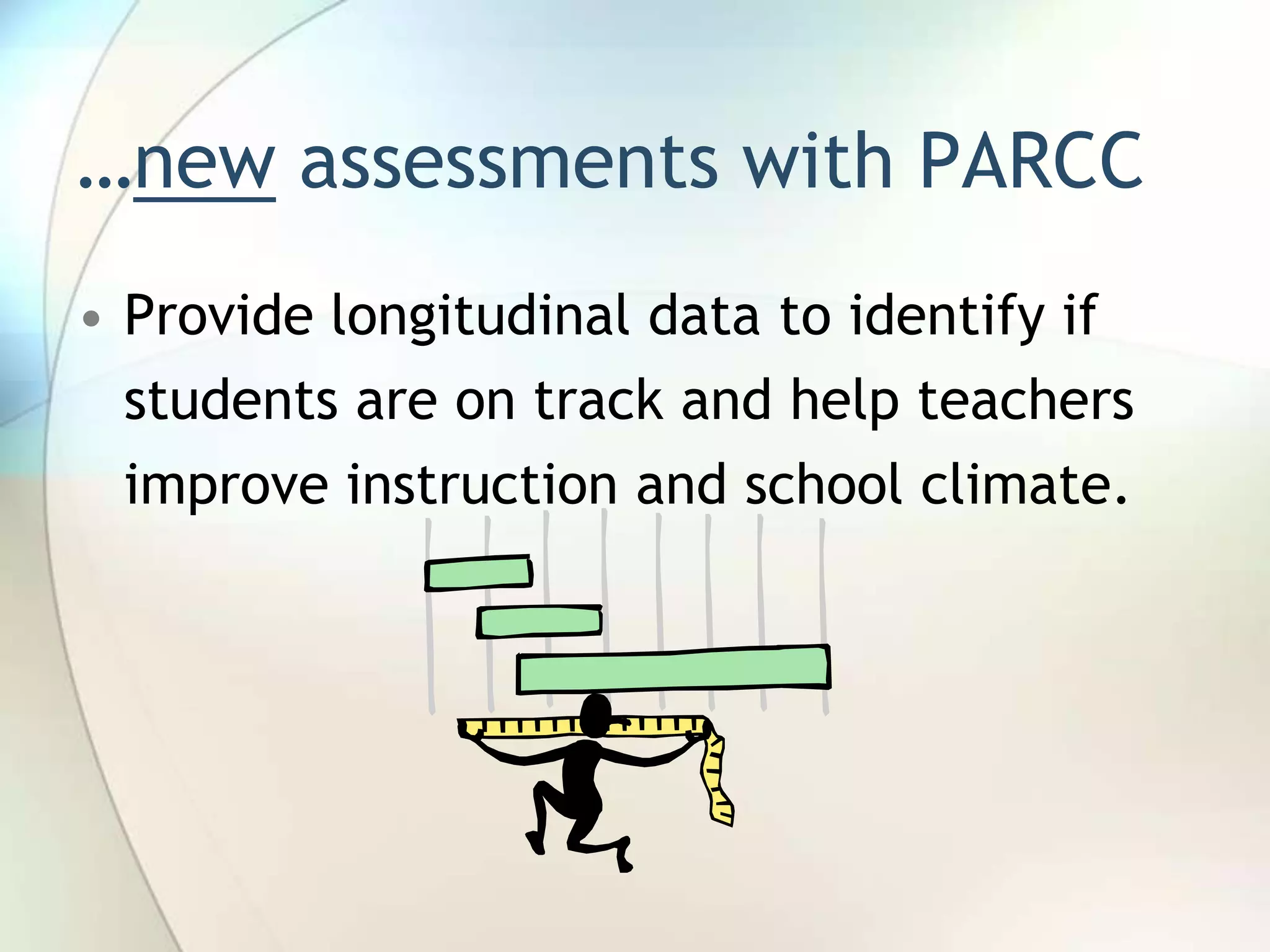
    …new assessments withPARCCProvide longitudinal data to identify if students are on track and help teachers improve instruction and school climate.
  • 41.
    While we arestill at it…Curriculum models may be developed differently than in the past…F.Y.I. Curriculums are NOT just the standards!NYS will issue a RFP to develop P-12 curriculum model. Required??? Yes, for some, maybe…Model will beSequencedContent-specificSpiraledInclude sample tasksDeveloped spring of 2011, available spring 2012
  • 42.
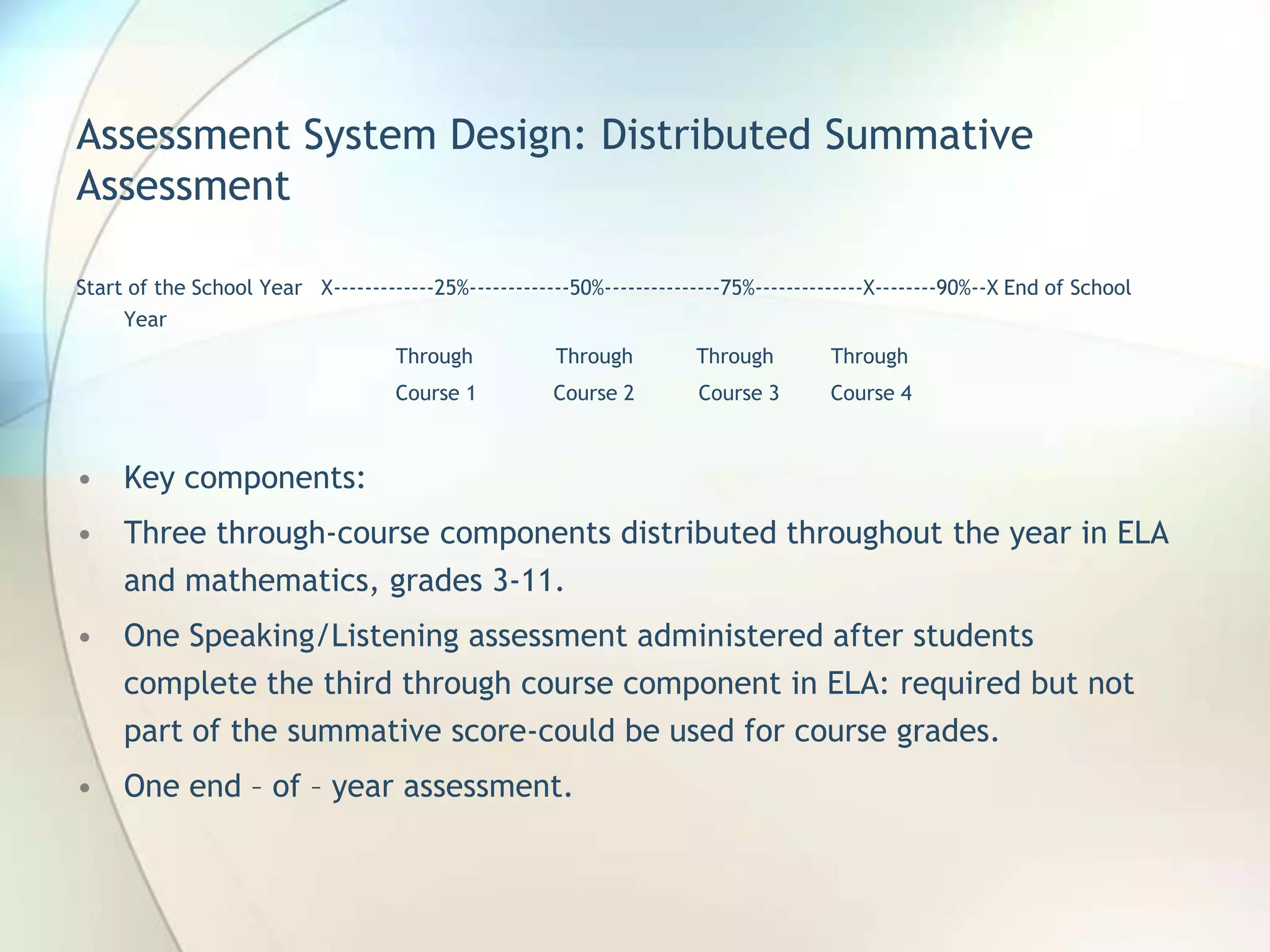
    Assessment System Design:Distributed Summative AssessmentStart of the School Year X-------------25%-------------50%---------------75%--------------X--------90%--X End of School Year Through Through Through Through Course 1 Course 2 Course 3 Course 4Key components:Three through-course components distributed throughout the year in ELA and mathematics, grades 3-11.One Speaking/Listening assessment administered after students complete the third through course component in ELA: required but not part of the summative score-could be used for course grades.One end – of – year assessment.
  • 43.
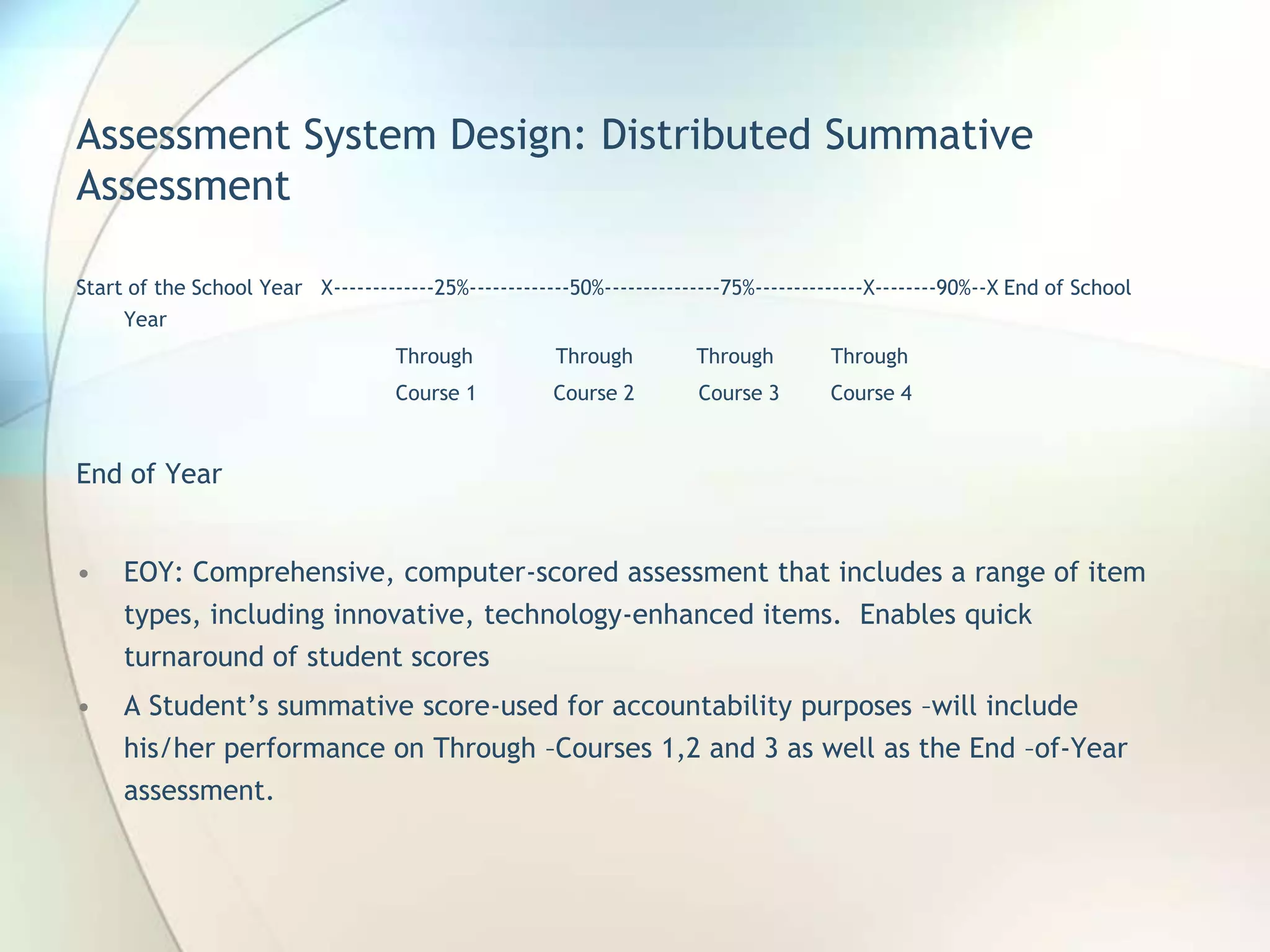
    Assessment System Design:Distributed Summative AssessmentStart of the School Year X-------------25%-------------50%---------------75%--------------X--------90%--X End of School Year Through Through Through Through Course 1 Course 2 Course 3 Course 4End of YearEOY: Comprehensive, computer-scored assessment that includes a range of item types, including innovative, technology-enhanced items. Enables quick turnaround of student scoresA Student’s summative score-used for accountability purposes –will include his/her performance on Through –Courses 1,2 and 3 as well as the End –of-Year assessment.

  • 44.
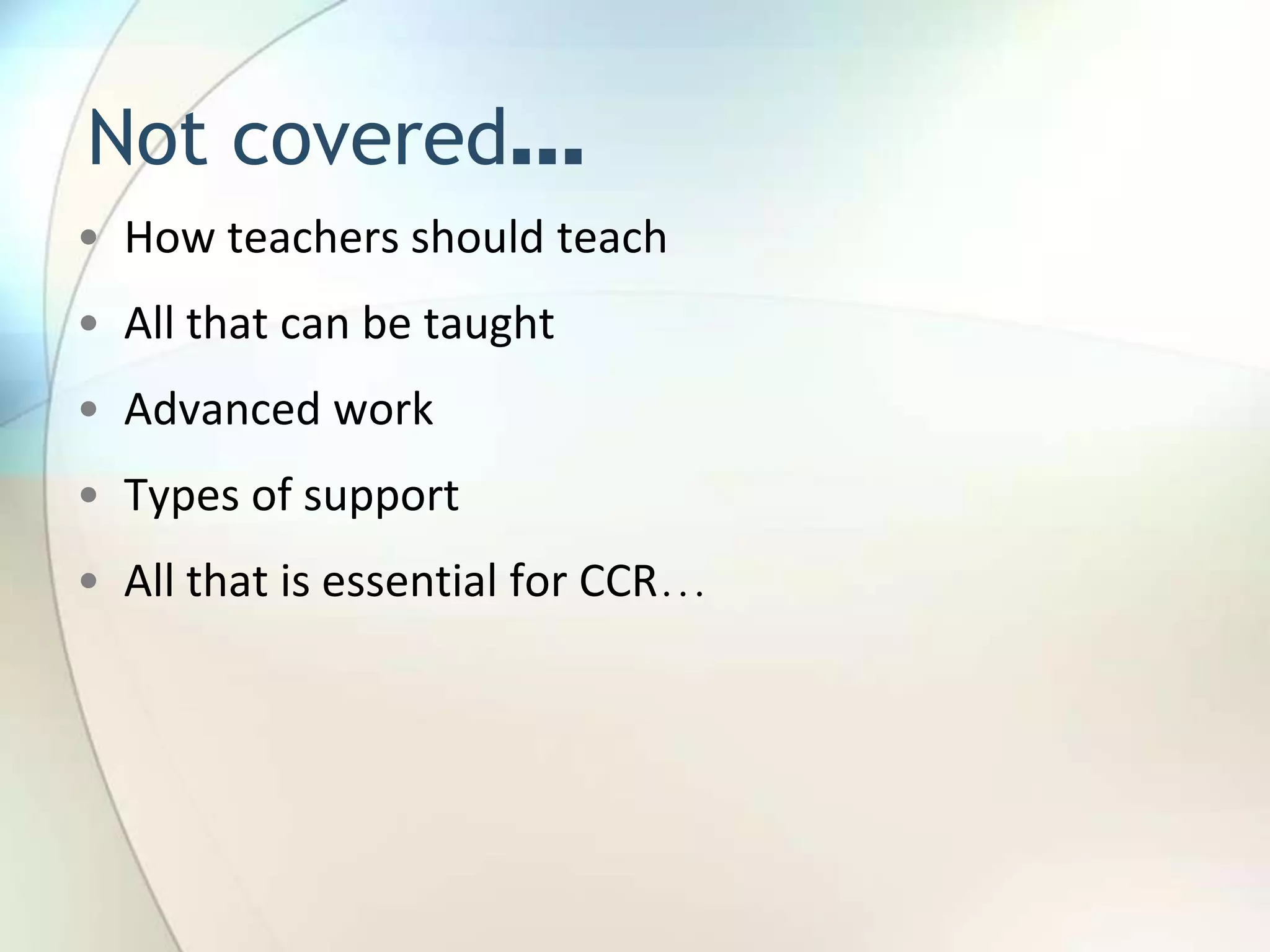
    Not covered…How teachersshould teachAll that can be taughtAdvanced workTypes of supportAll that is essential for CCR…
  • 45.
    Contact info:Jane Suddaby-AssntSupt –Oswego County BOCESjsuddaby@oswegoboces.org963-4248Latest information:http://www.p12.nysed.gov/ciai/common_core_standards/home.html
  • 46.
  • 48.
    Up close andcomfy with the CCS!What are you noticing?What questions do you have?What support do you need?What conversations need to happen?