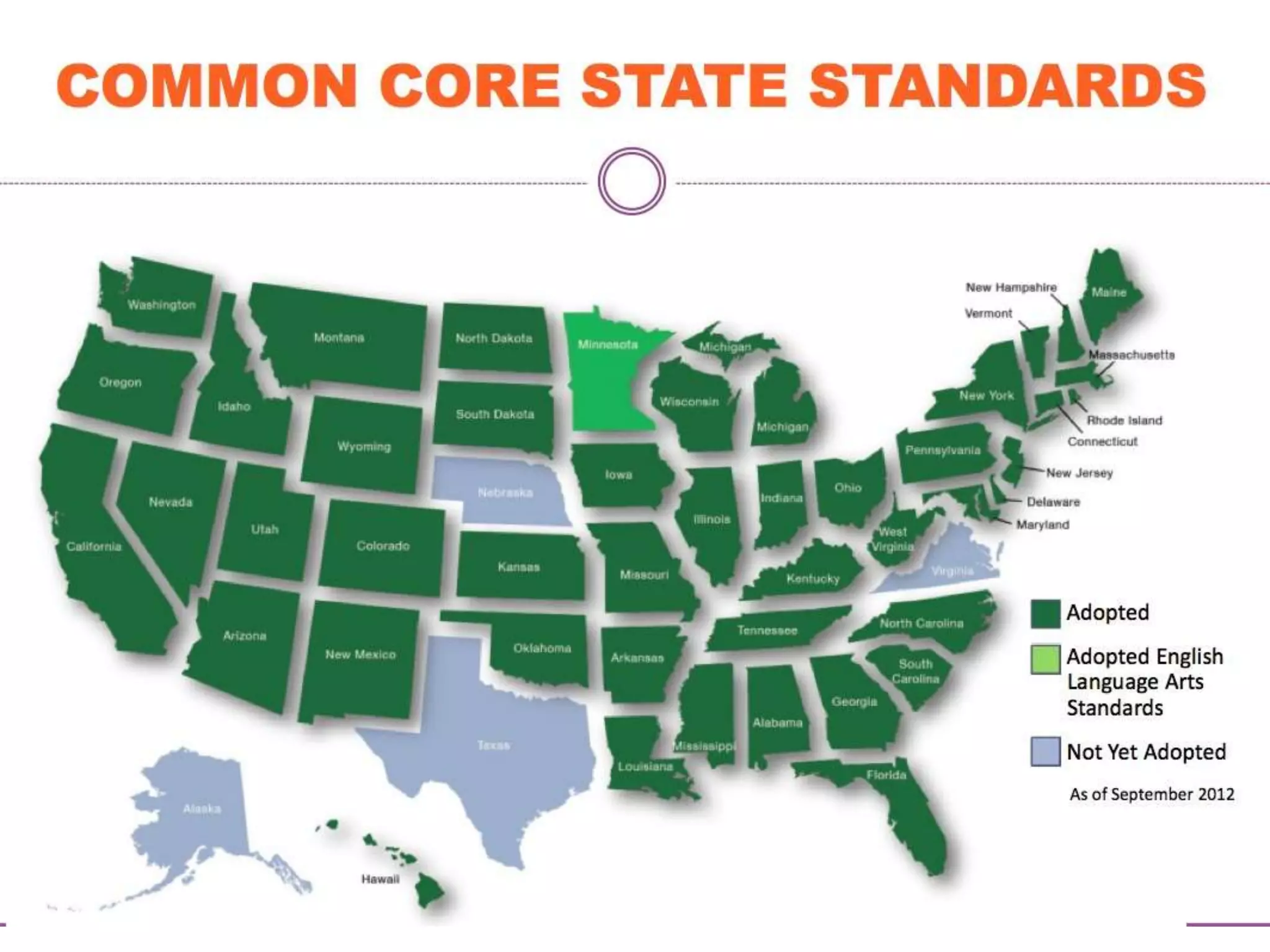
Common Core Standards
A Challenge and an Opportunity
Workforce Needs: Employee
Deficiencies
Of the high school students that you recently hired, what were their
deficiencies?


   Written Communication                                               81%

   Leadership                                                          73%

   Work Ethic                                                          70%

   Critical Thinking & Problem Solving                                 70%

   Self-Direction                                                      58%

 Source: Are They Really Ready to Work?
 (2006) The Conference Board, Corporate Voices for
 Working Families, P21, and SHRM
Why Now?


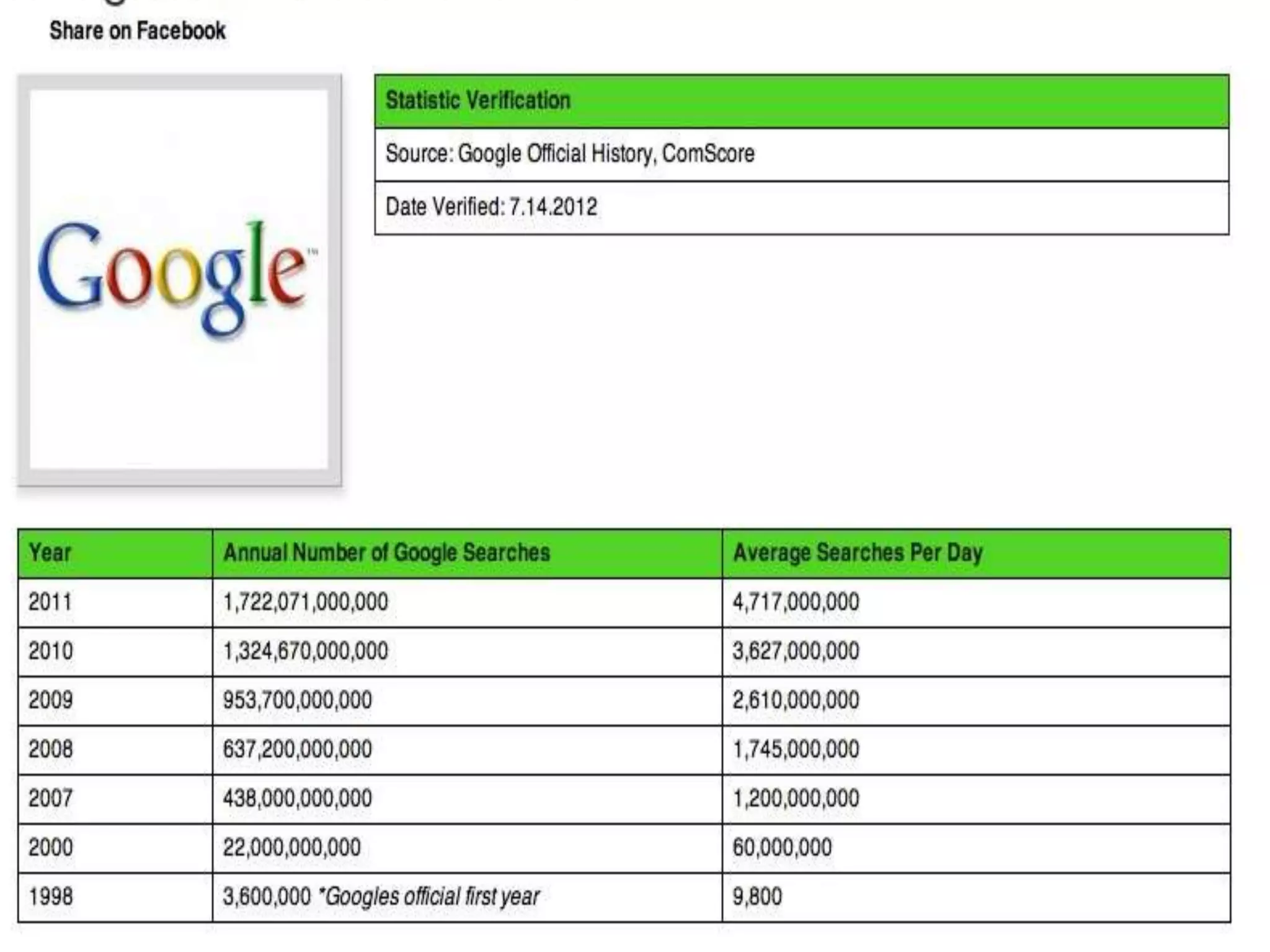
• Global competition

• Today’s jobs require different skills

• Thinking and Reasoning will become basic
  skills
Why is This Important for
      Students, Teachers, and Parents?
• Prepares students with the knowledge and
  skills they need to similar standards across
  states
• Student mobility
• Succeed in college and work
• Ensures consistent expectations
  regardless of a student’s zip code
• Provides educators, parents, and students
  with clear, focused guideposts
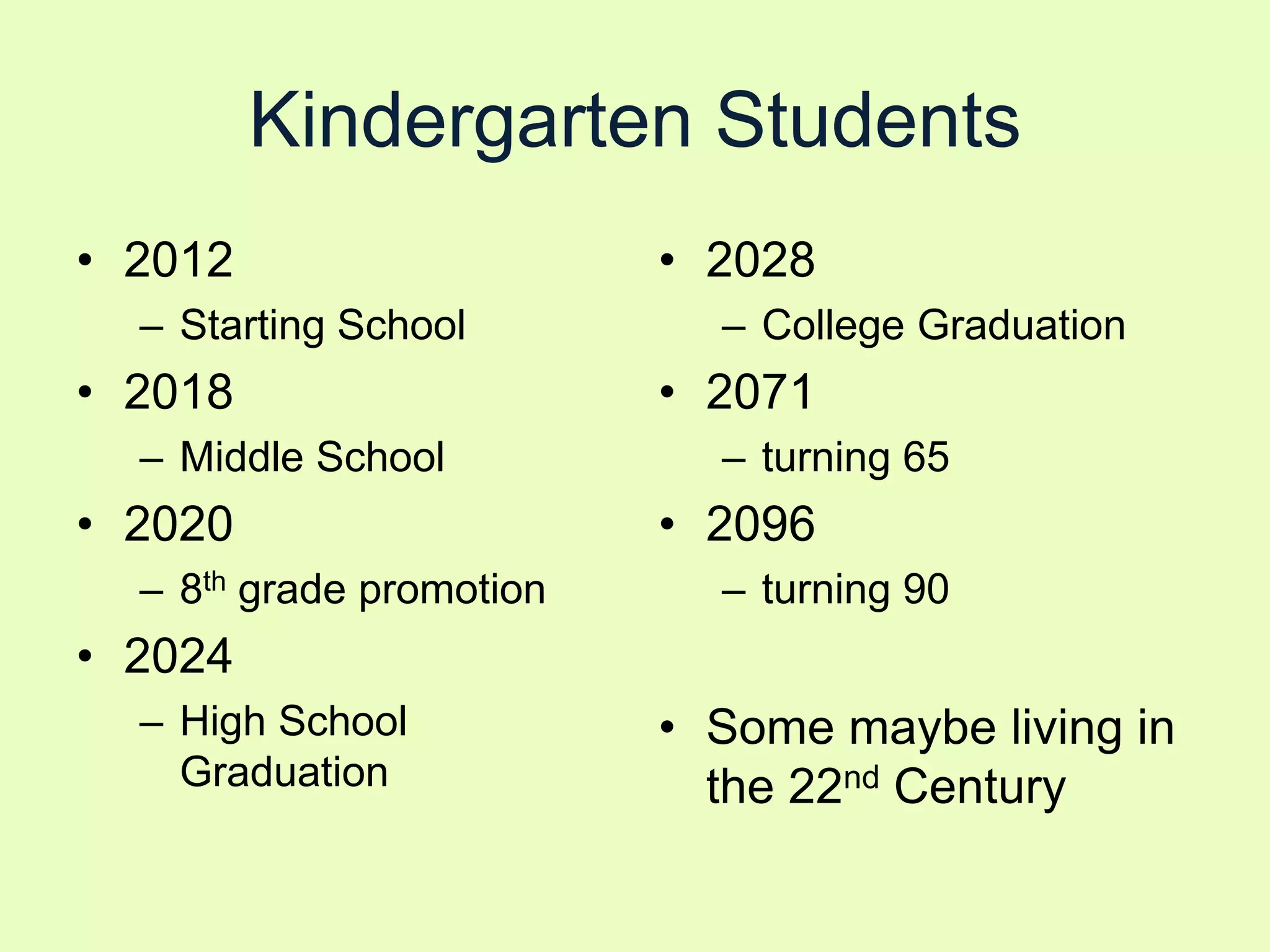
Kindergarten Students
• 2012                    • 2028
  – Starting School         – College Graduation
• 2018                    • 2071
  – Middle School           – turning 65
• 2020                    • 2096
  – 8th grade promotion     – turning 90
• 2024
  – High School           • Some maybe living in
    Graduation              the 22nd Century
VIDEO
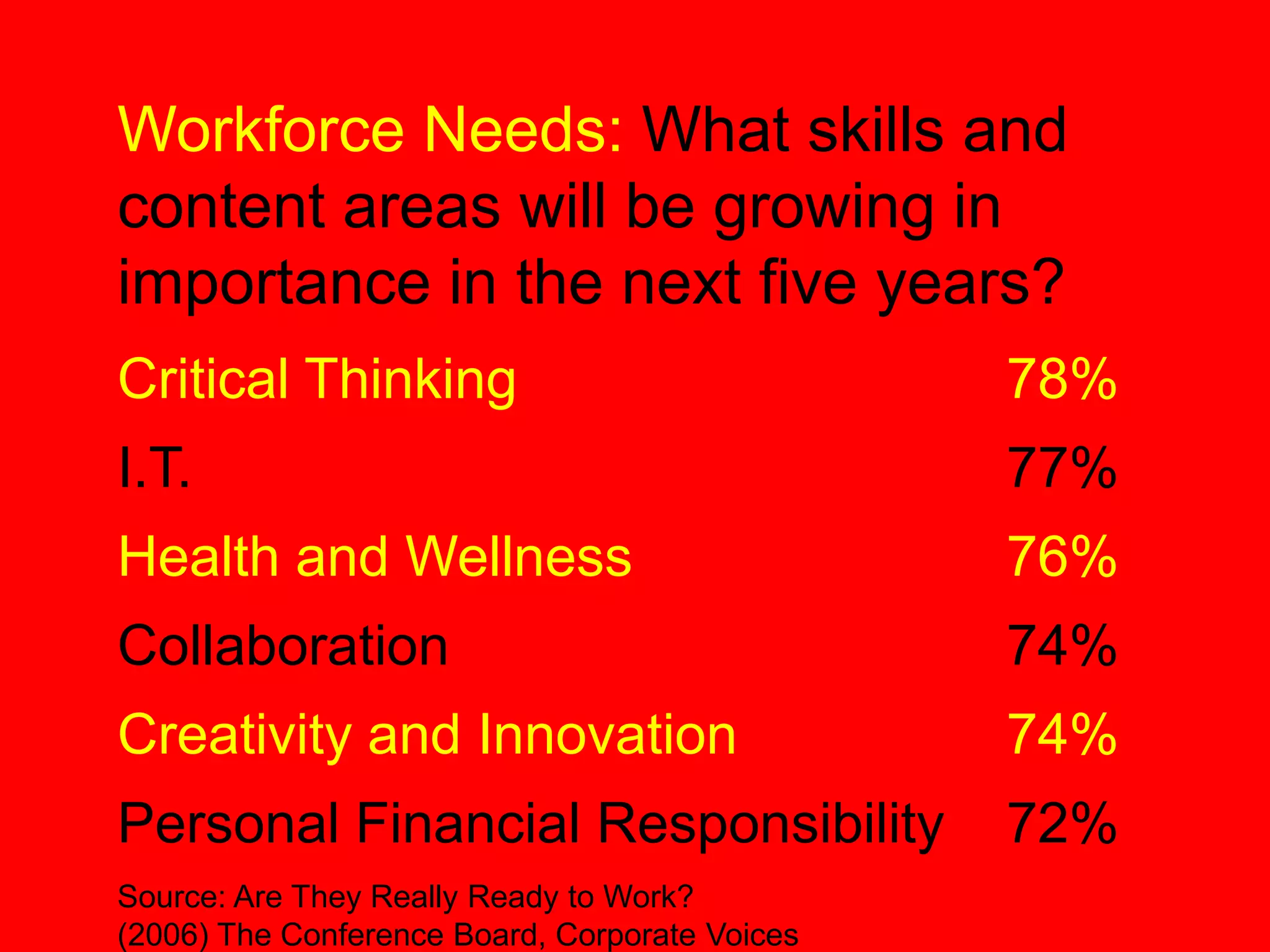
Workforce Needs: What skills and
content areas will be growing in
importance in the next five years?
Critical Thinking                               78%
I.T.                                            77%
Health and Wellness                             76%
Collaboration                                   74%
Creativity and Innovation                       74%
Personal Financial Responsibility               72%
Source: Are They Really Ready to Work?
(2006) The Conference Board, Corporate Voices
Standards
    Definition – Level of quality accepted as norm

          Types of Standards
•   State Standard
•   Common Core
•   College Readiness (ACT)
•   National Organizations
•   International
There is a greater focus on:
• Non-fiction text
• Self directed learning
• 4 C’s
        • Critical Thinking
        • Communication
        • Collaboration
        • Creativity
Advantages to Common Core
            Standards
• A focus on college and career readiness
• Inclusion of the four strands of English Language Arts:
         •   Reading
         •   Writing
         •   Listening and speaking
         •   Language
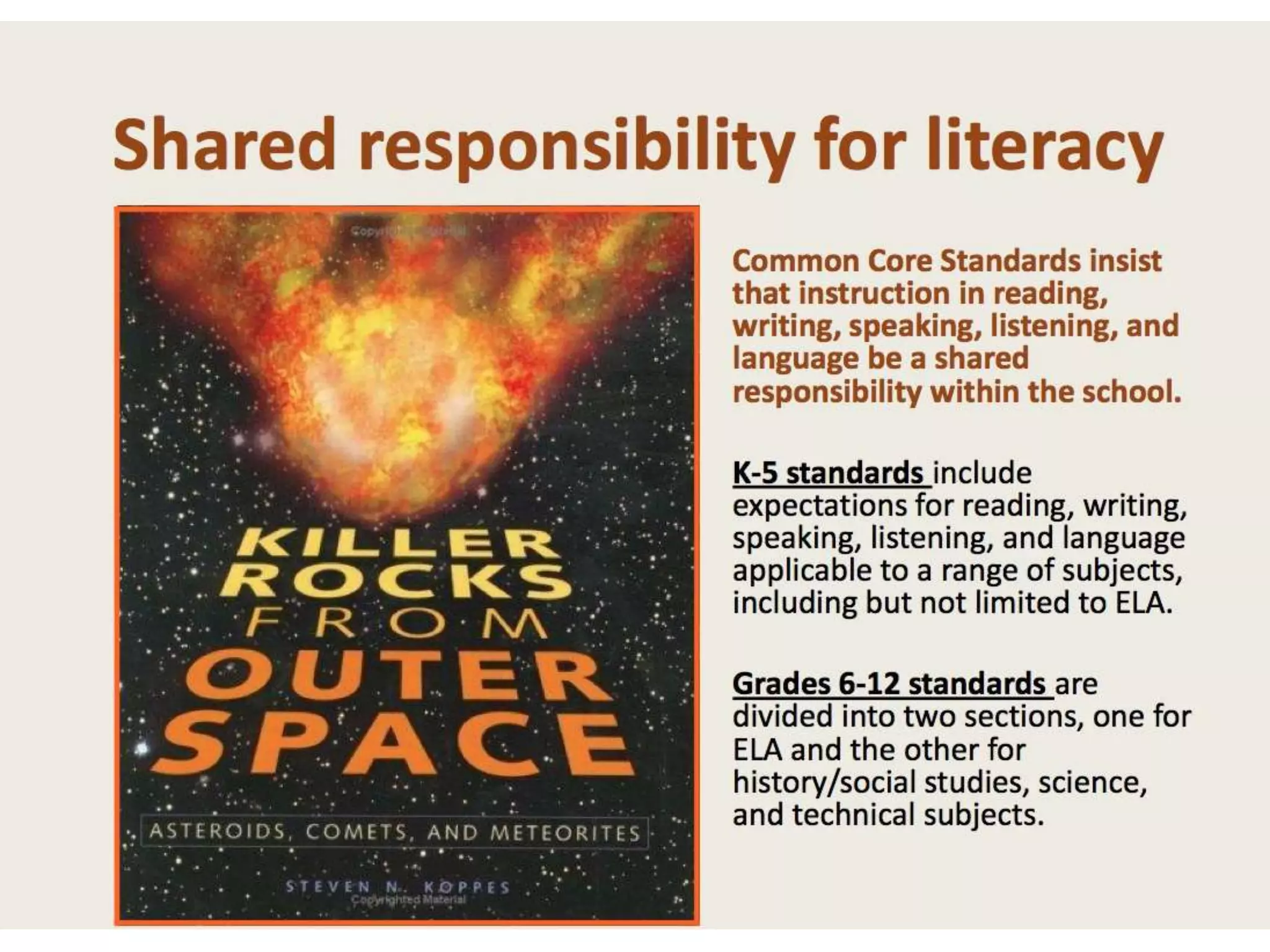
• The benefits of an integrated literacy approach – all educators have a shared
  responsibility for literacy instruction, regardless of discipline or content area.
• A focus on results rather than means – . . .―the Standards leave room for
  teachers, curriculum developers, and states to determine how those goals should be

  reached and what additional topics should be addressed.‖ (p. 4)
• Efficiencies of scale – common standards allow for greater collaboration among
  states in the areas of:
          • Professional development
          • Resource development
          • Teaching tools
                                                                                       15
Rothman’s Key Points
• Common Core have paired down the list of
  topic to allow teachers to focus on subject.
(Depth, not breath)
• Common Core Lessons and testing get
  more complex as students progress.
  (Ramping up difficultly)
• Common Core focuses on both aspects of
  literacy. (Speaking and Listening)
•   Robert Rothman Michigan State University
VIDEO
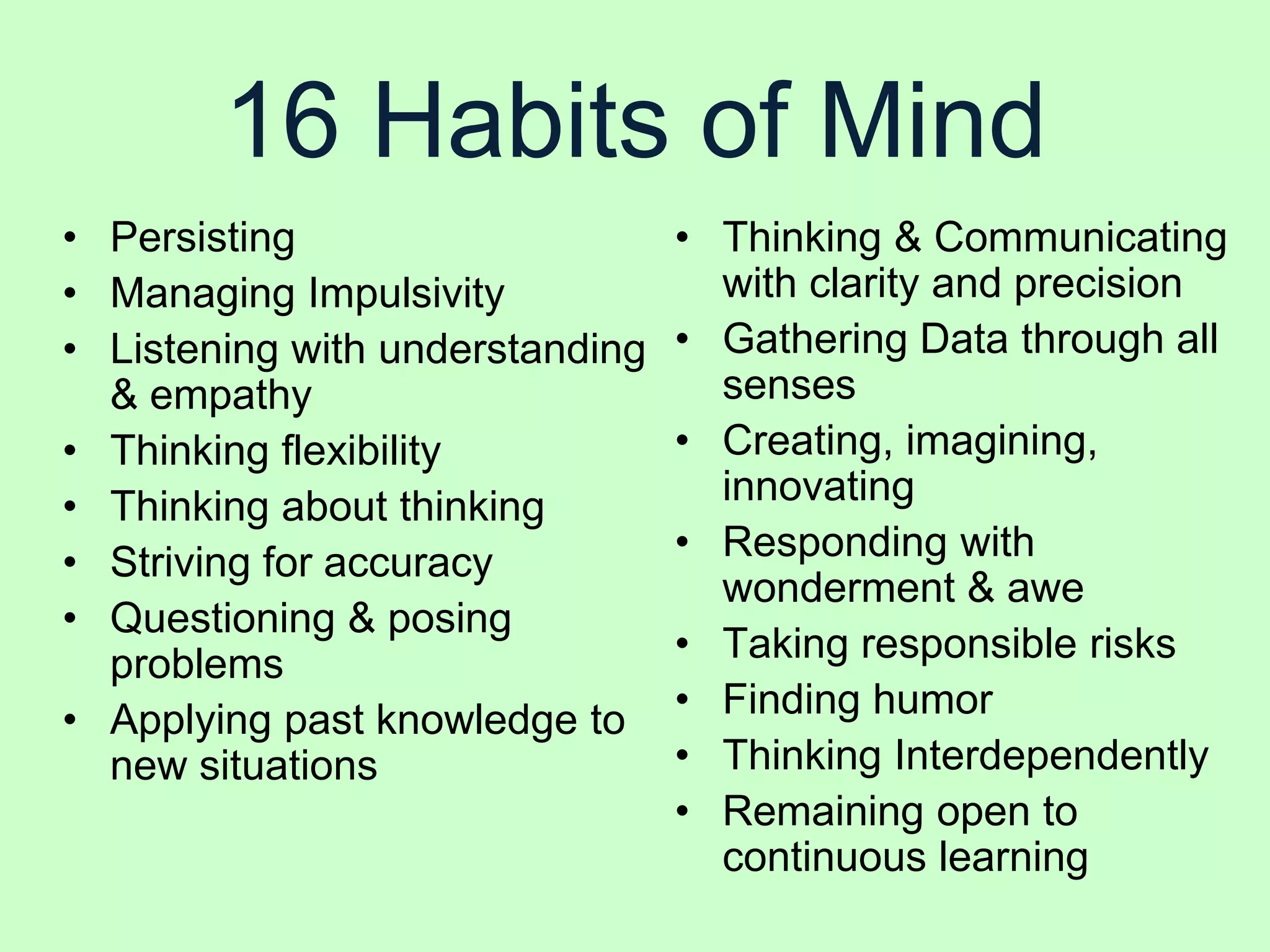
16 Habits of Mind
• Persisting                     • Thinking & Communicating
• Managing Impulsivity             with clarity and precision
• Listening with understanding   • Gathering Data through all
  & empathy                        senses
• Thinking flexibility           • Creating, imagining,
• Thinking about thinking          innovating
• Striving for accuracy          • Responding with
                                   wonderment & awe
• Questioning & posing
  problems                       • Taking responsible risks
• Applying past knowledge to     • Finding humor
  new situations                 • Thinking Interdependently
                                 • Remaining open to
                                   continuous learning
Rigor
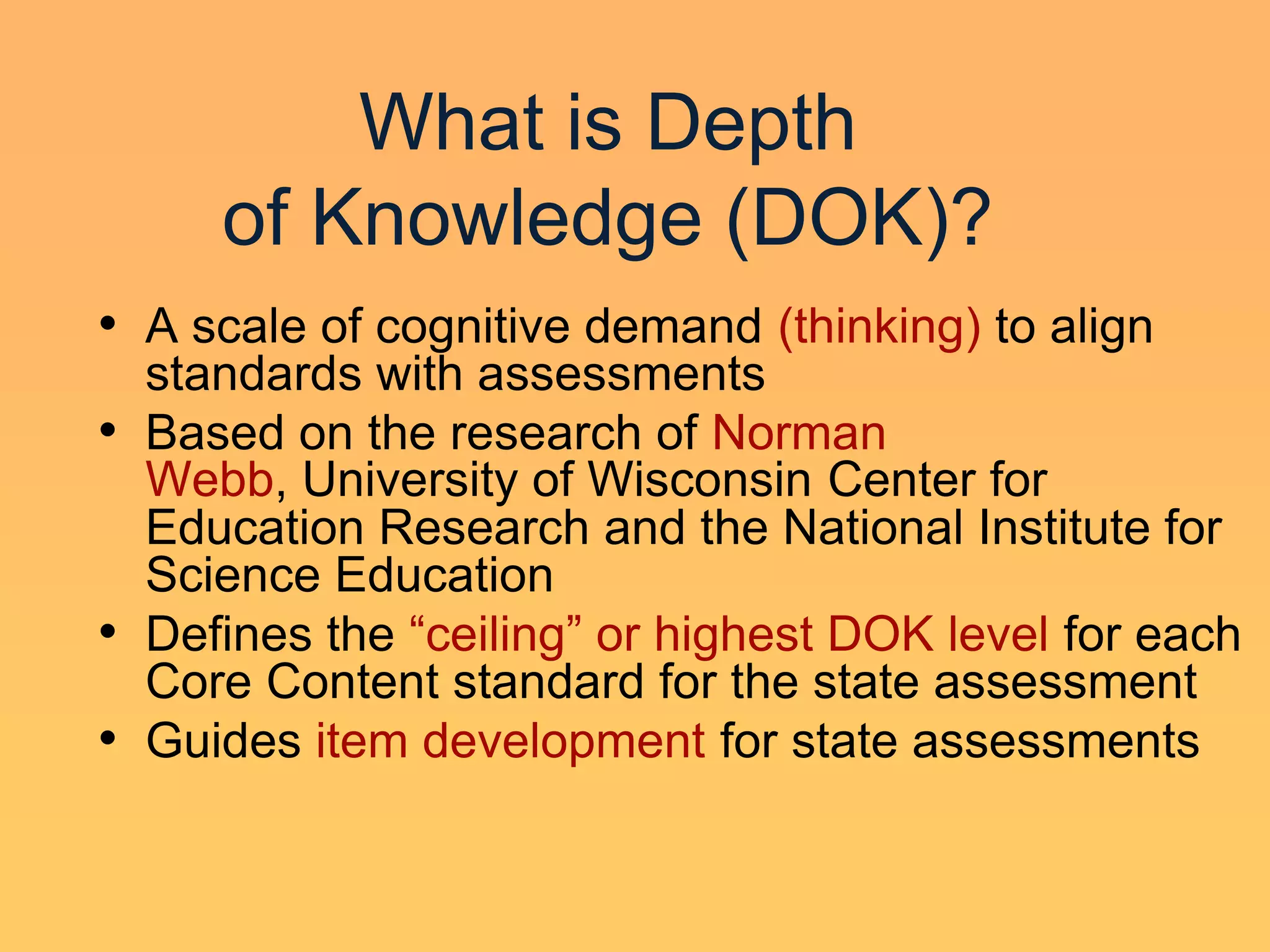
What is Depth
     of Knowledge (DOK)?
• A scale of cognitive demand (thinking) to align
  standards with assessments
• Based on the research of Norman
  Webb, University of Wisconsin Center for
  Education Research and the National Institute for
  Science Education
• Defines the ―ceiling‖ or highest DOK level for each
  Core Content standard for the state assessment
• Guides item development for state assessments
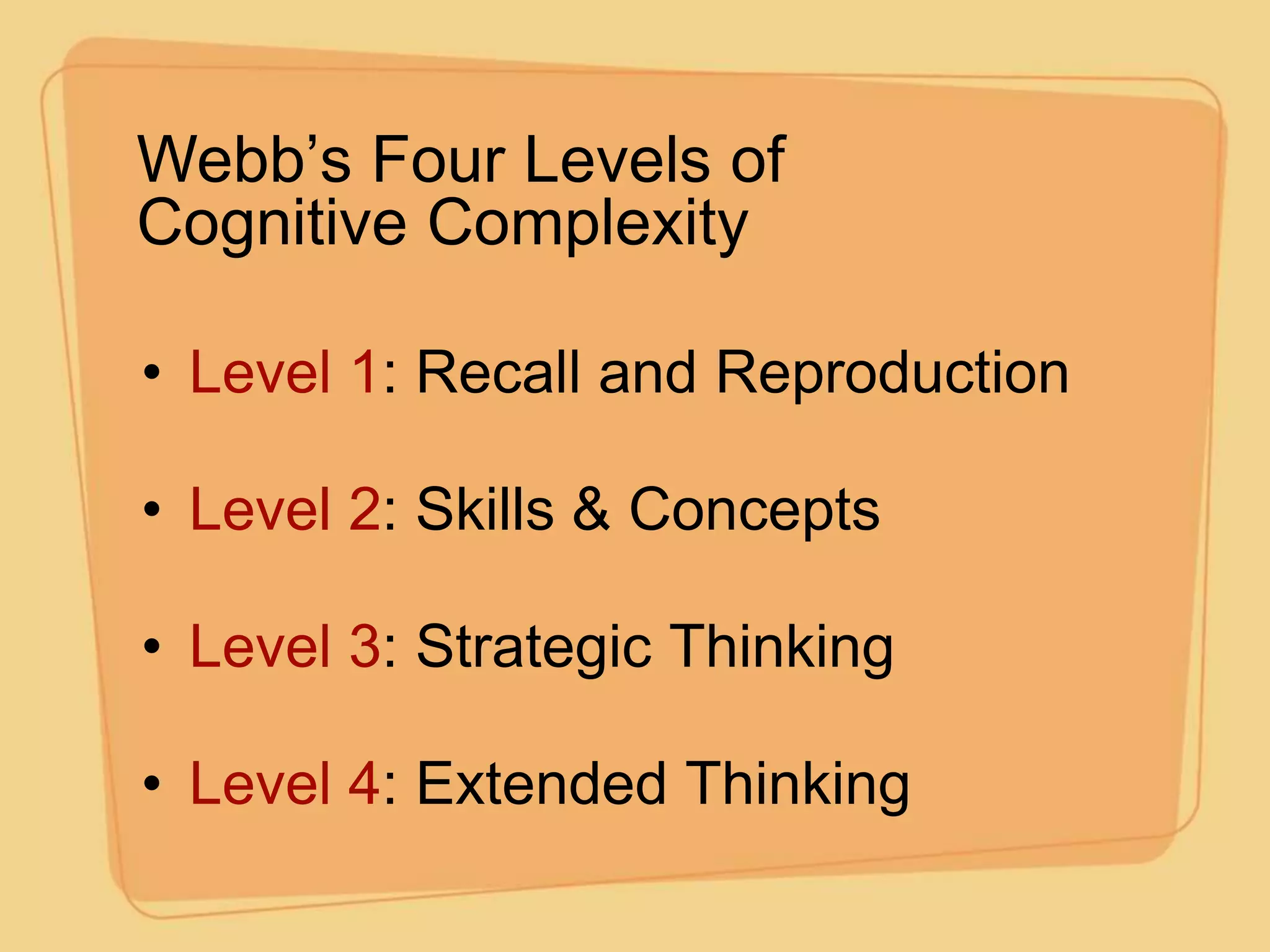
Webb’s Four Levels of
Cognitive Complexity

• Level 1: Recall and Reproduction

• Level 2: Skills & Concepts

• Level 3: Strategic Thinking

• Level 4: Extended Thinking
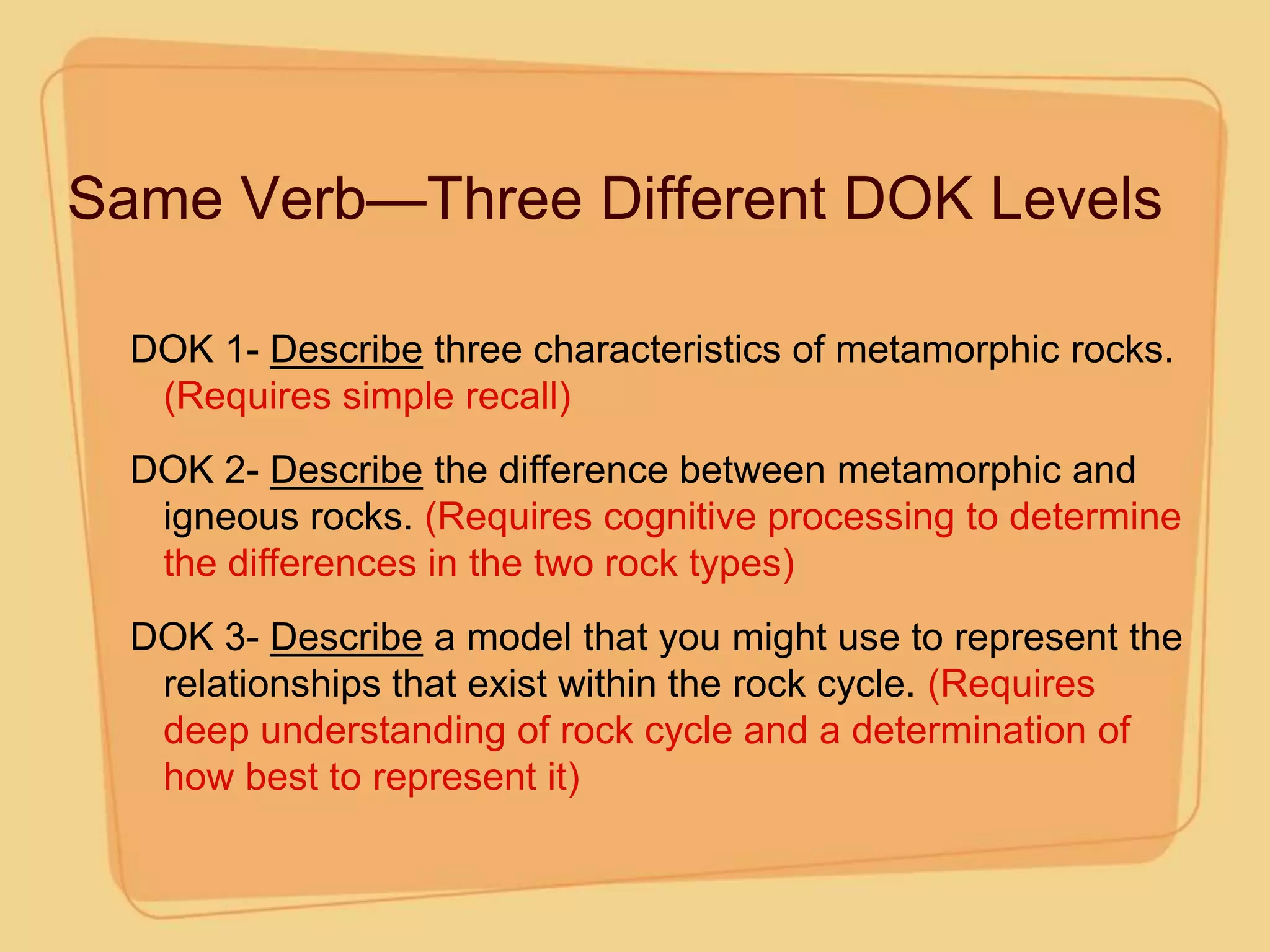
Same Verb—Three Different DOK Levels

  DOK 1- Describe three characteristics of metamorphic rocks.
   (Requires simple recall)
  DOK 2- Describe the difference between metamorphic and
   igneous rocks. (Requires cognitive processing to determine
   the differences in the two rock types)
  DOK 3- Describe a model that you might use to represent the
   relationships that exist within the rock cycle. (Requires
   deep understanding of rock cycle and a determination of
   how best to represent it)
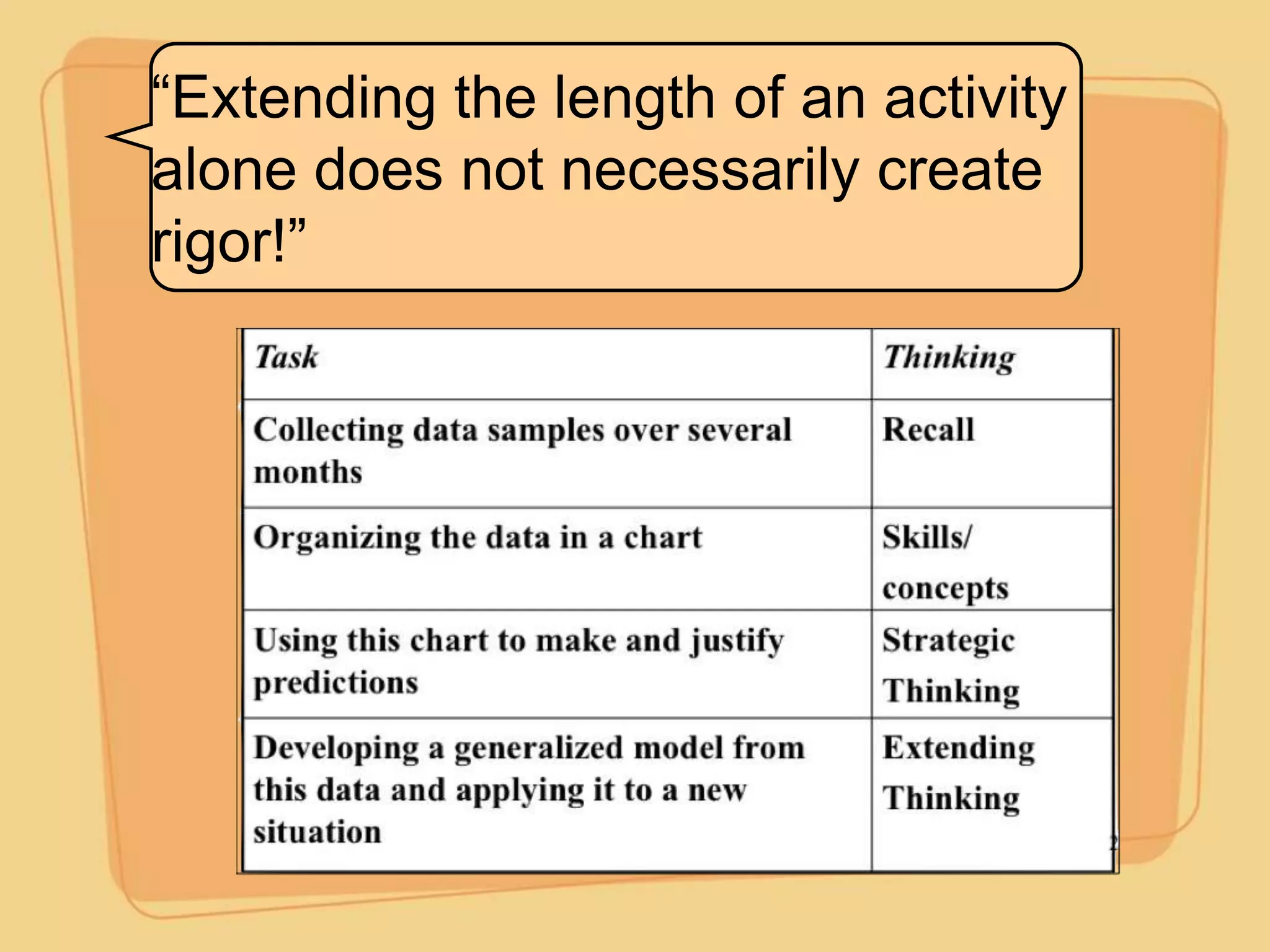
―Extending the length of an activity
alone does not necessarily create
rigor!‖
The Standards cultivate three mutually reinforcing writing
capacities:
  – To persuade
  – To explain
  – To convey real or imagined experience
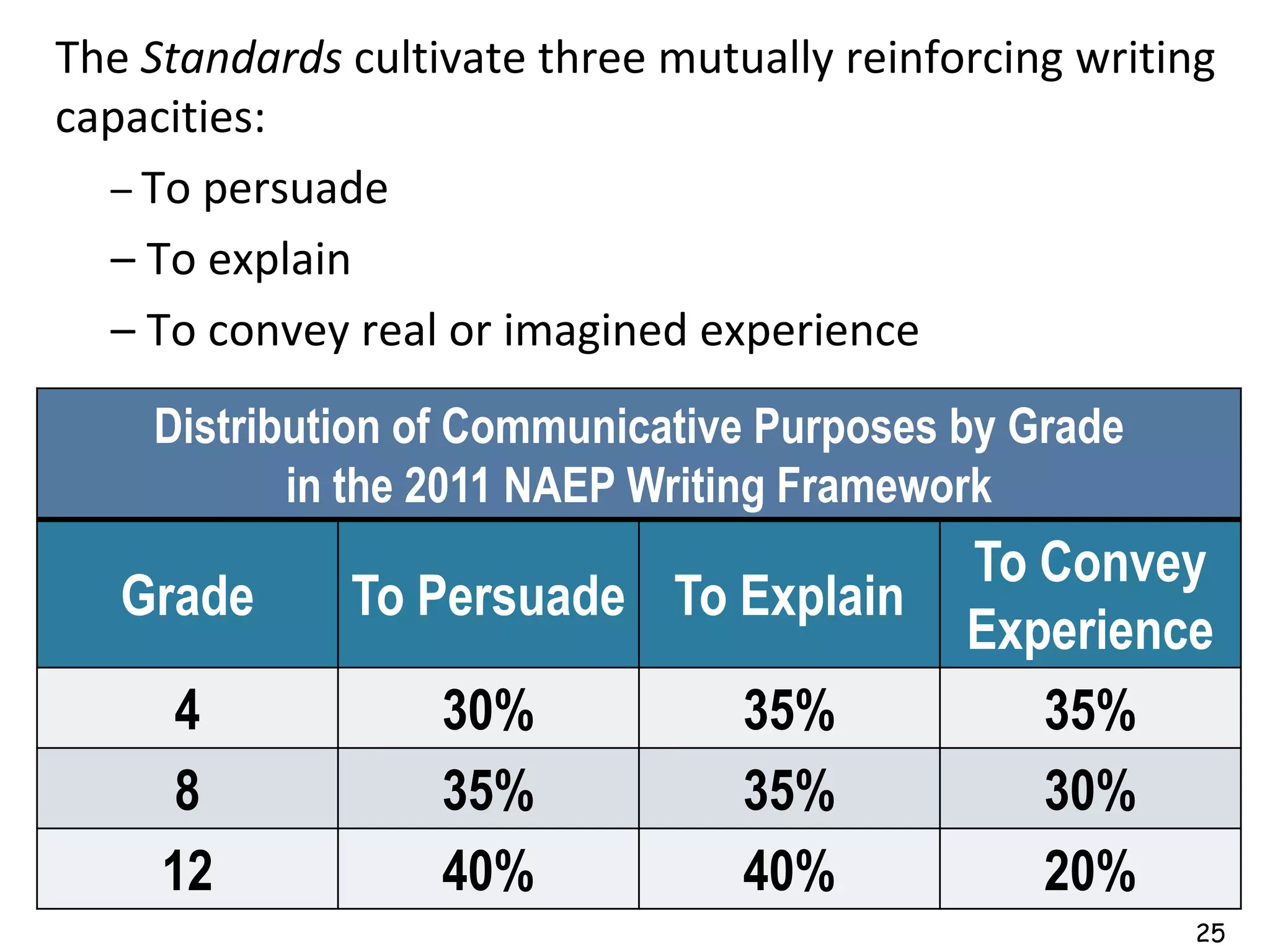
    Distribution of Communicative Purposes by Grade
           in the 2011 NAEP Writing Framework
                                             To Convey
   Grade      To Persuade To Explain
                                             Experience
     4             30%            35%           35%
     8             35%            35%           30%
     12            40%            40%           20%
                                                        25
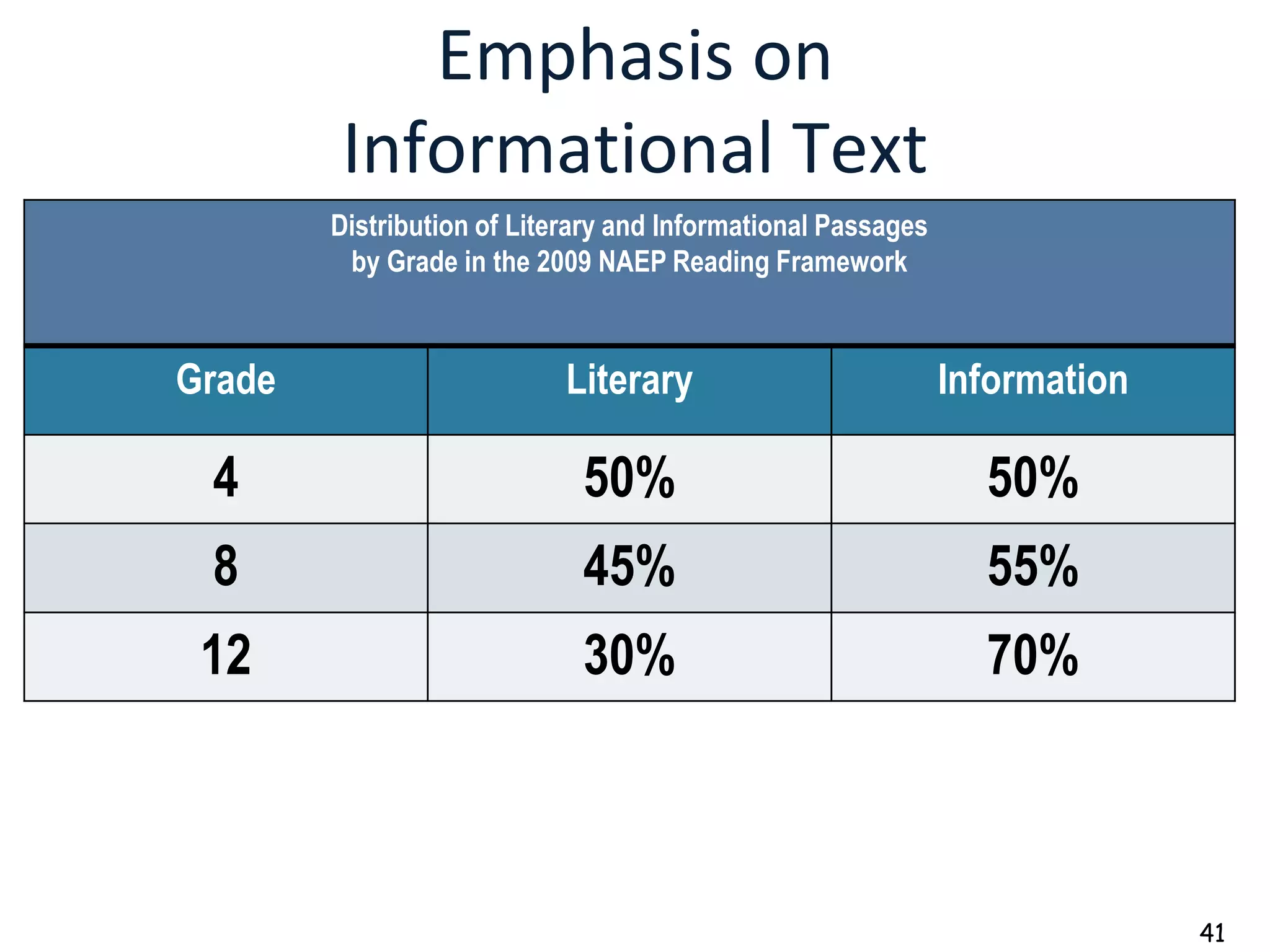
Emphasis on
        Informational Text
        Distribution of Literary and Informational Passages
         by Grade in the 2009 NAEP Reading Framework


Grade                       Literary                          Information

 4                           50%                                50%
 8                           45%                                55%
 12                          30%                                70%


                                                                            41
Overview of Text   Text Complexity

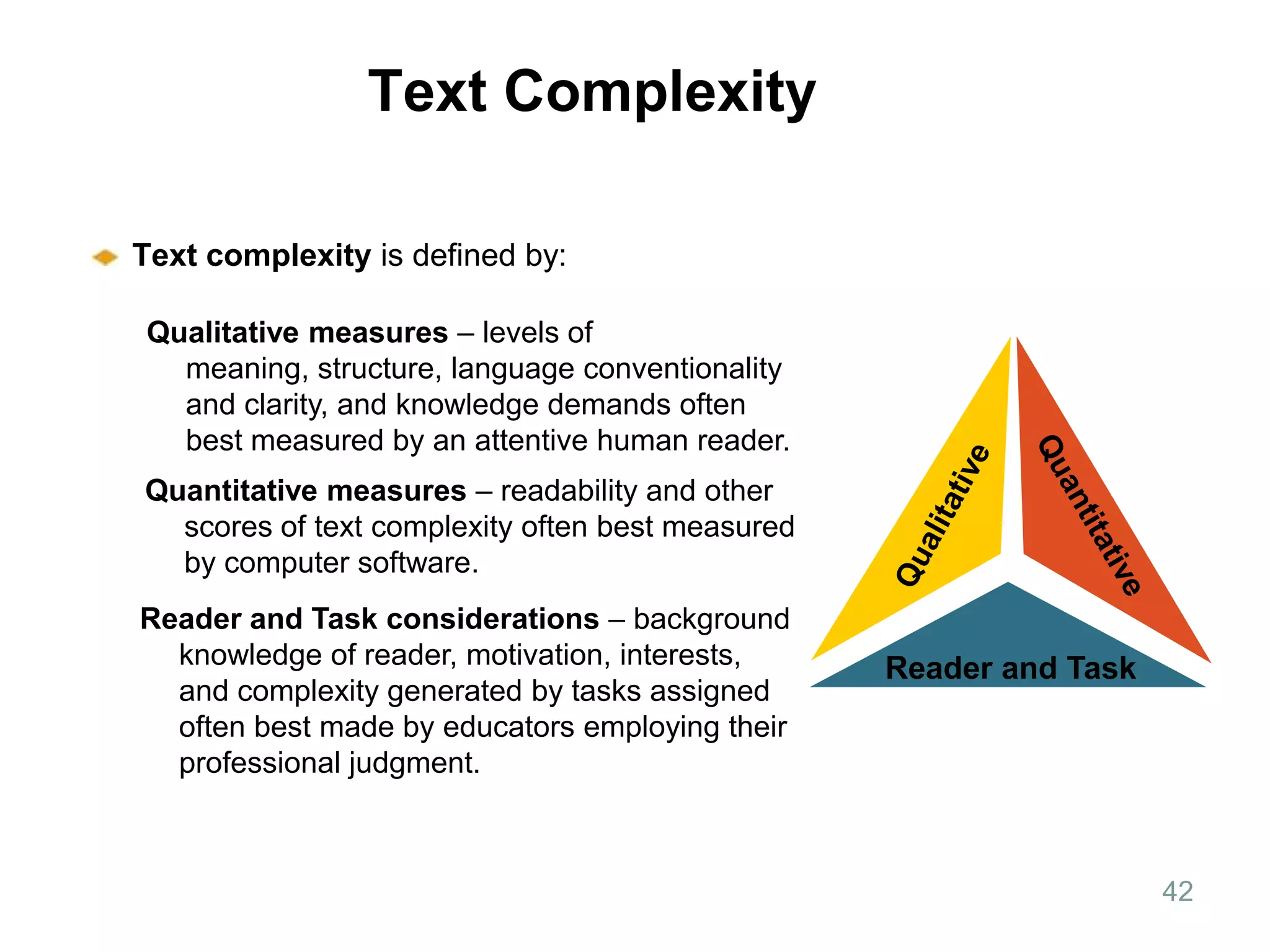
   Text complexity is defined by:

   Qualitative measures – levels of
     meaning, structure, language conventionality
     and clarity, and knowledge demands often
     best measured by an attentive human reader.
   Quantitative measures – readability and other
     scores of text complexity often best measured
     by computer software.
   Reader and Task considerations – background
     knowledge of reader, motivation, interests,     Reader and Task
     and complexity generated by tasks assigned
     often best made by educators employing their
     professional judgment.


                                                                       42
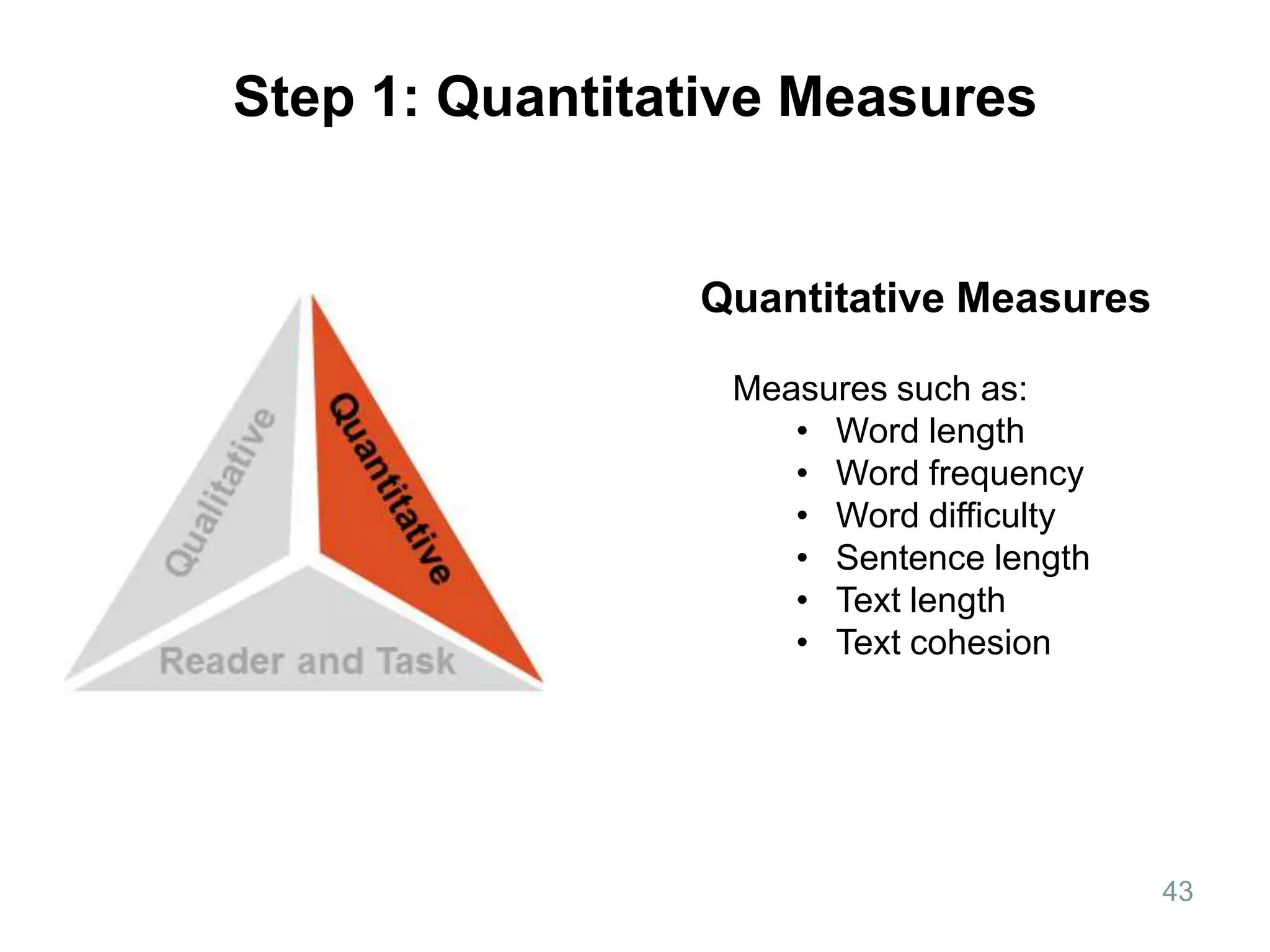
Step 1: Quantitative Measures


                Quantitative Measures

                  Measures such as:
                     • Word length
                     • Word frequency
                     • Word difficulty
                     • Sentence length
                     • Text length
                     • Text cohesion


                                         43
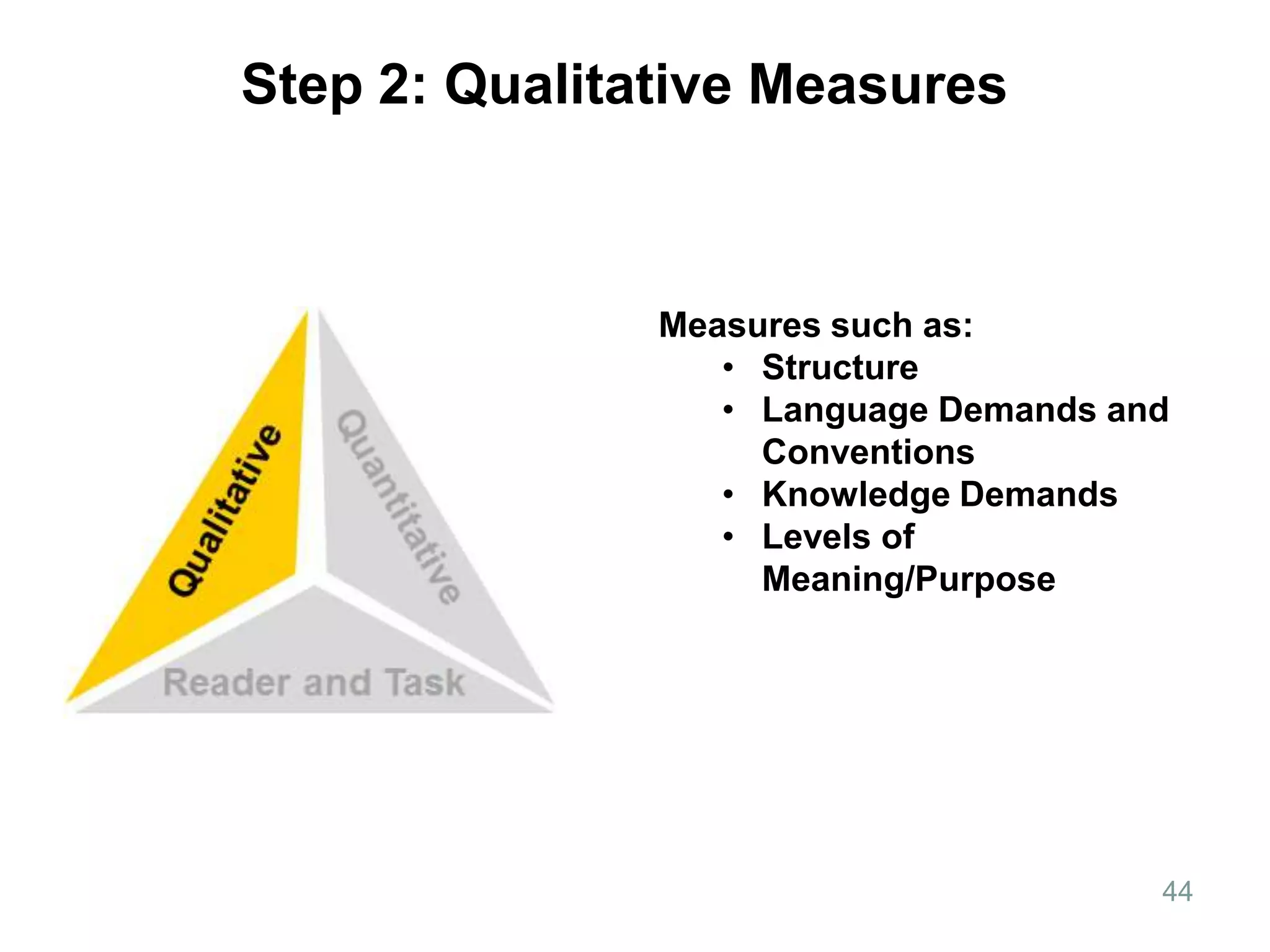
Step 2: Qualitative Measures


               Measures such as:
                  • Structure
                  • Language Demands and
                    Conventions
                  • Knowledge Demands
                  • Levels of
                    Meaning/Purpose


                                       44
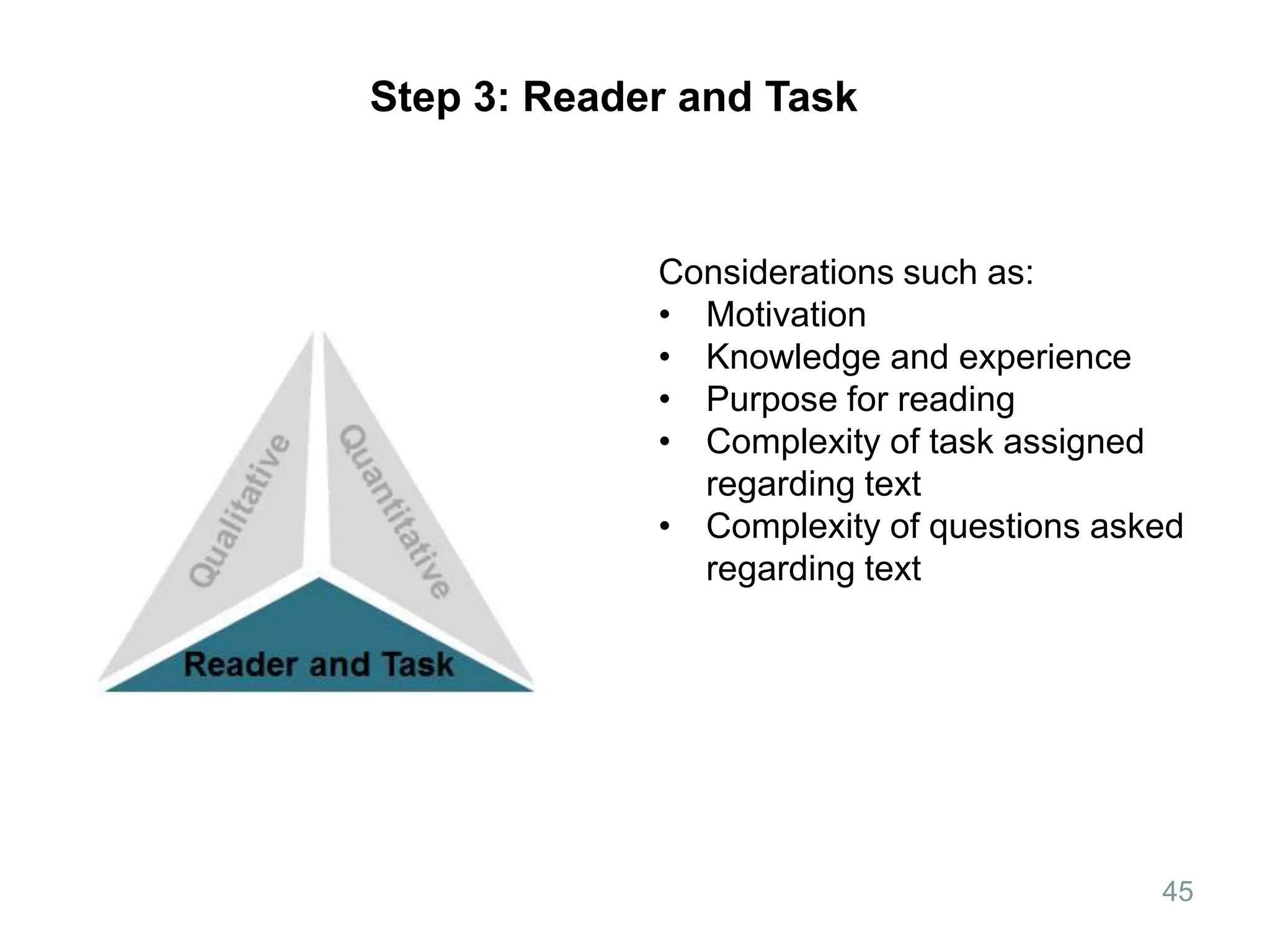
Step 3: Reader and Task


             Considerations such as:
             • Motivation
             • Knowledge and experience
             • Purpose for reading
             • Complexity of task assigned
               regarding text
             • Complexity of questions asked
               regarding text


                                          45
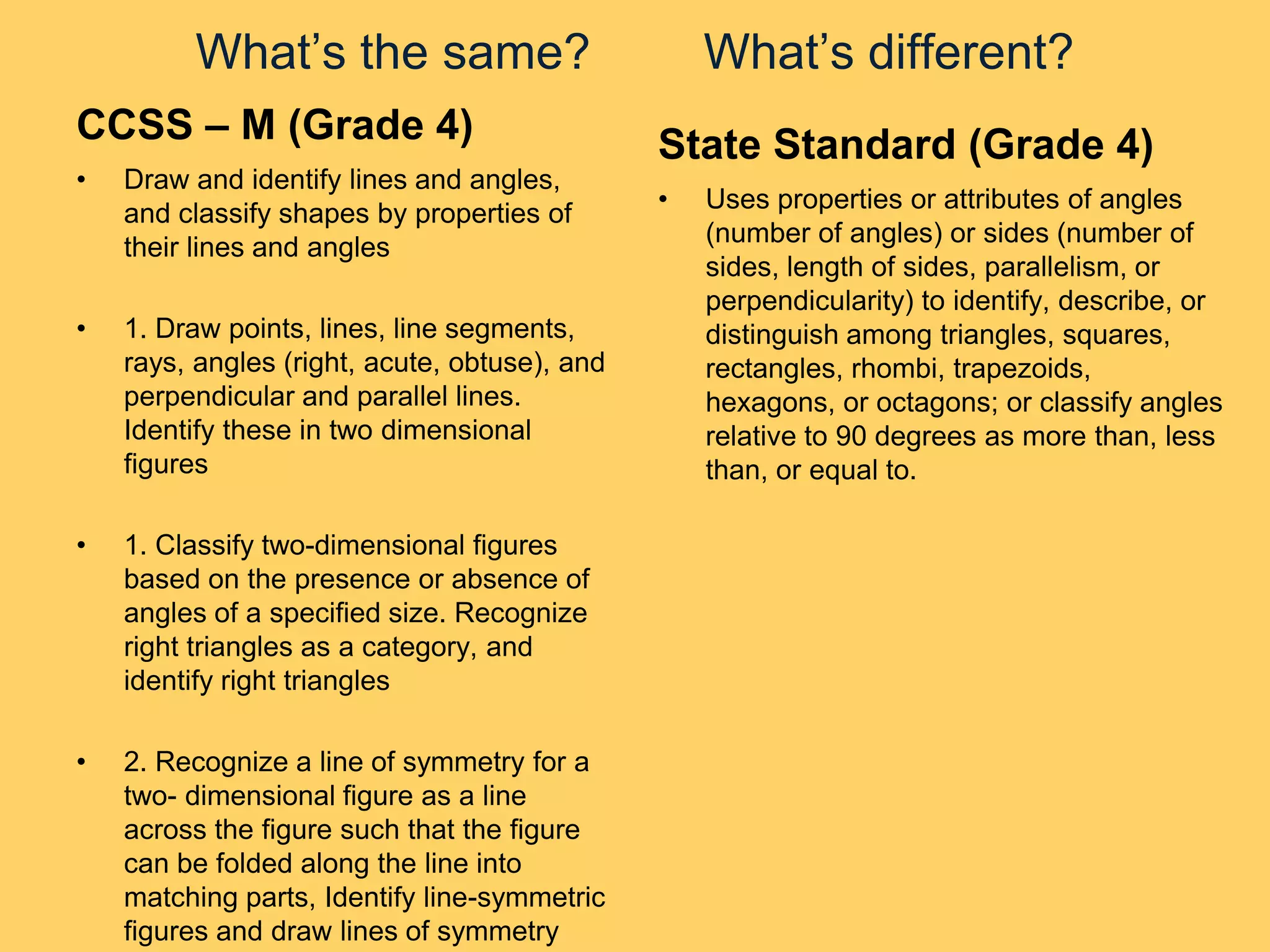
What’s the same?                          What’s different?
CCSS – M (Grade 4)                             State Standard (Grade 4)
•   Draw and identify lines and angles,
                                               •   Uses properties or attributes of angles
    and classify shapes by properties of
                                                   (number of angles) or sides (number of
    their lines and angles
                                                   sides, length of sides, parallelism, or
                                                   perpendicularity) to identify, describe, or
•   1. Draw points, lines, line segments,          distinguish among triangles, squares,
    rays, angles (right, acute, obtuse), and       rectangles, rhombi, trapezoids,
    perpendicular and parallel lines.              hexagons, or octagons; or classify angles
    Identify these in two dimensional              relative to 90 degrees as more than, less
    figures                                        than, or equal to.

•   1. Classify two-dimensional figures
    based on the presence or absence of
    angles of a specified size. Recognize
    right triangles as a category, and
    identify right triangles

•   2. Recognize a line of symmetry for a
    two- dimensional figure as a line
    across the figure such that the figure
    can be folded along the line into
    matching parts, Identify line-symmetric
    figures and draw lines of symmetry
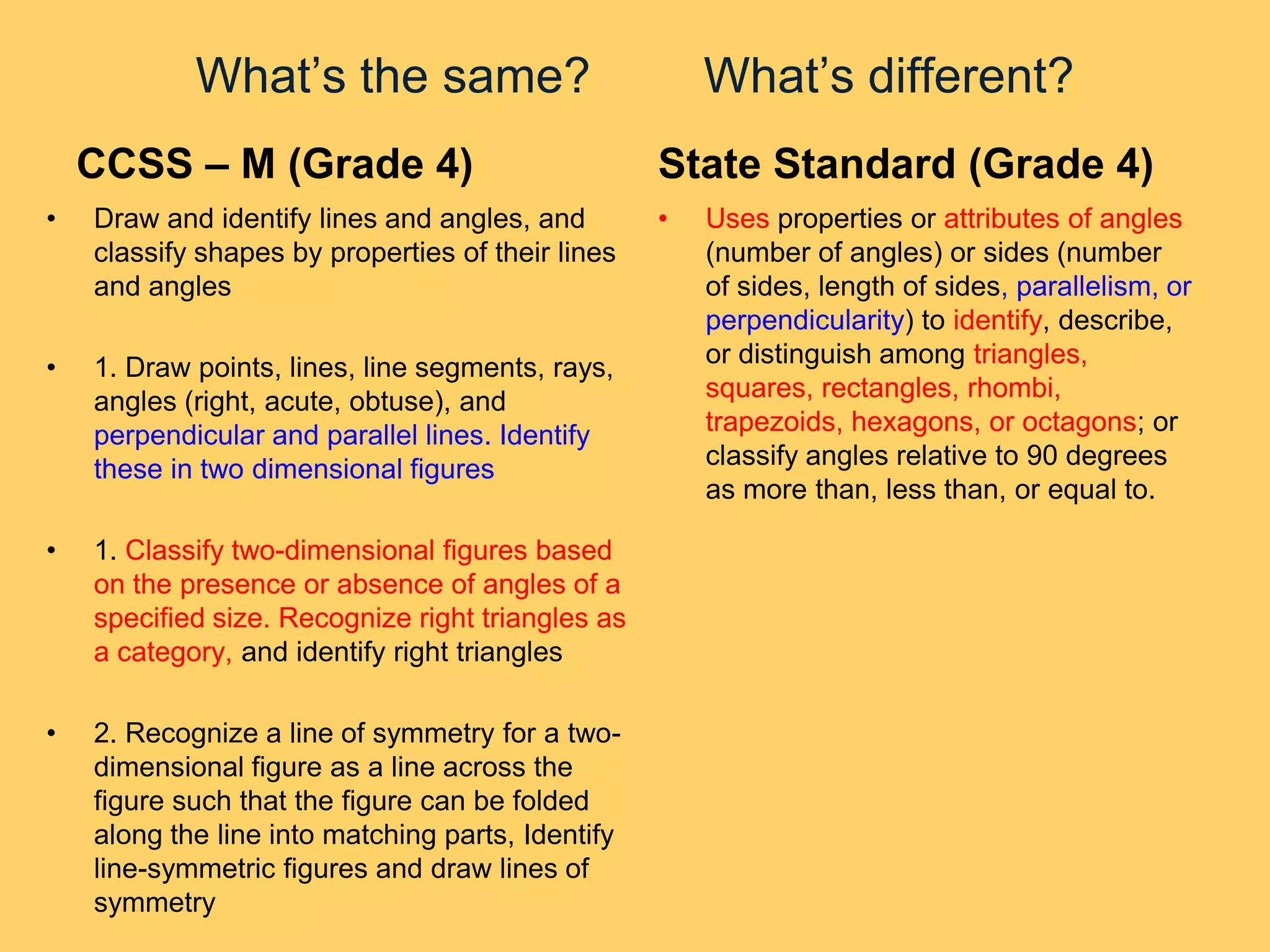
What’s the same?                           What’s different?
    CCSS – M (Grade 4)                             State Standard (Grade 4)
•   Draw and identify lines and angles, and        •   Uses properties or attributes of angles
    classify shapes by properties of their lines       (number of angles) or sides (number
    and angles                                         of sides, length of sides, parallelism, or
                                                       perpendicularity) to identify, describe,
•   1. Draw points, lines, line segments, rays,        or distinguish among triangles,
    angles (right, acute, obtuse), and                 squares, rectangles, rhombi,
    perpendicular and parallel lines. Identify         trapezoids, hexagons, or octagons; or
    these in two dimensional figures                   classify angles relative to 90 degrees
                                                       as more than, less than, or equal to.

•   1. Classify two-dimensional figures based
    on the presence or absence of angles of a
    specified size. Recognize right triangles as
    a category, and identify right triangles

•   2. Recognize a line of symmetry for a two-
    dimensional figure as a line across the
    figure such that the figure can be folded
    along the line into matching parts, Identify
    line-symmetric figures and draw lines of
    symmetry
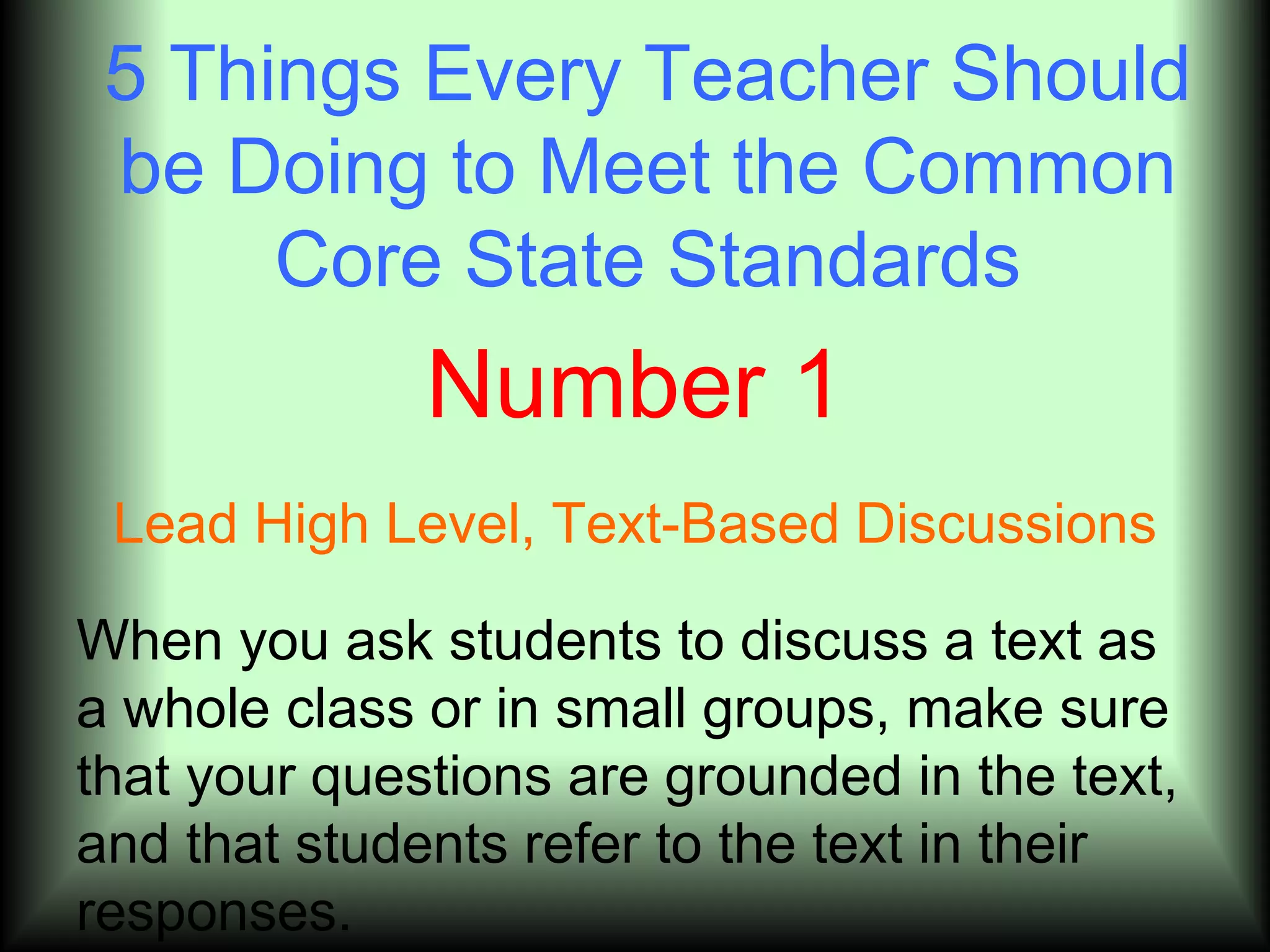
5 Things Every Teacher Should
 be Doing to Meet the Common
      Core State Standards
              Number 1
 Lead High Level, Text-Based Discussions

When you ask students to discuss a text as
a whole class or in small groups, make sure
that your questions are grounded in the text,
and that students refer to the text in their
responses.
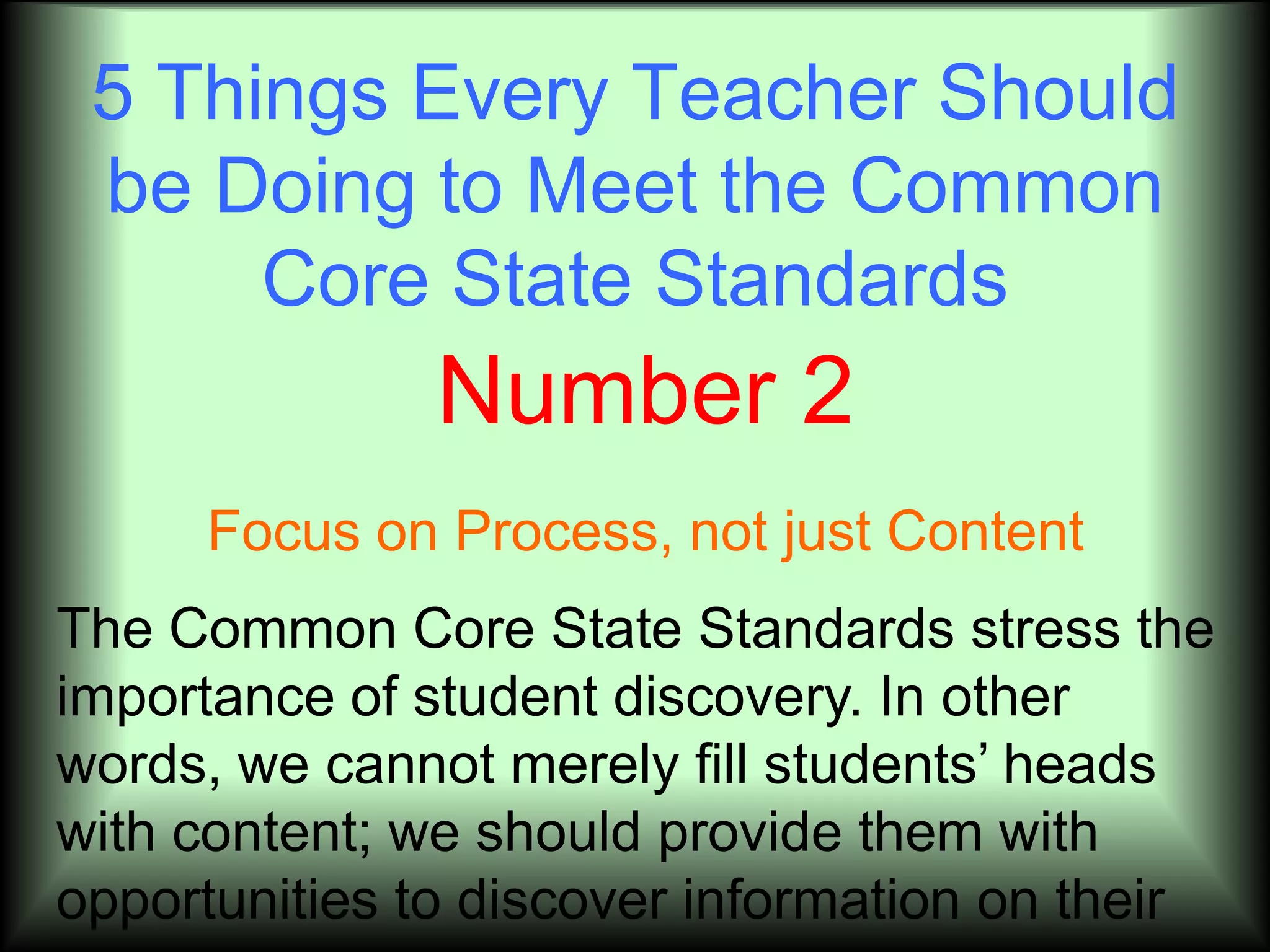
5 Things Every Teacher Should
 be Doing to Meet the Common
      Core State Standards
               Number 2
     Focus on Process, not just Content
The Common Core State Standards stress the
importance of student discovery. In other
words, we cannot merely fill students’ heads
with content; we should provide them with
opportunities to discover information on their
5 Things Every Teacher Should
 be Doing to Meet the Common
      Core State Standards
              Number 3
Create Assignments for Real Audiences and
            with Real Purposes
There is an importance of writing for a
variety of audiences. Students should ―write
routinely over extended time frames...for a
range of tasks, purposes, and audiences‖.
5 Things Every Teacher Should
 be Doing to Meet the Common
      Core State Standards
              Number 4
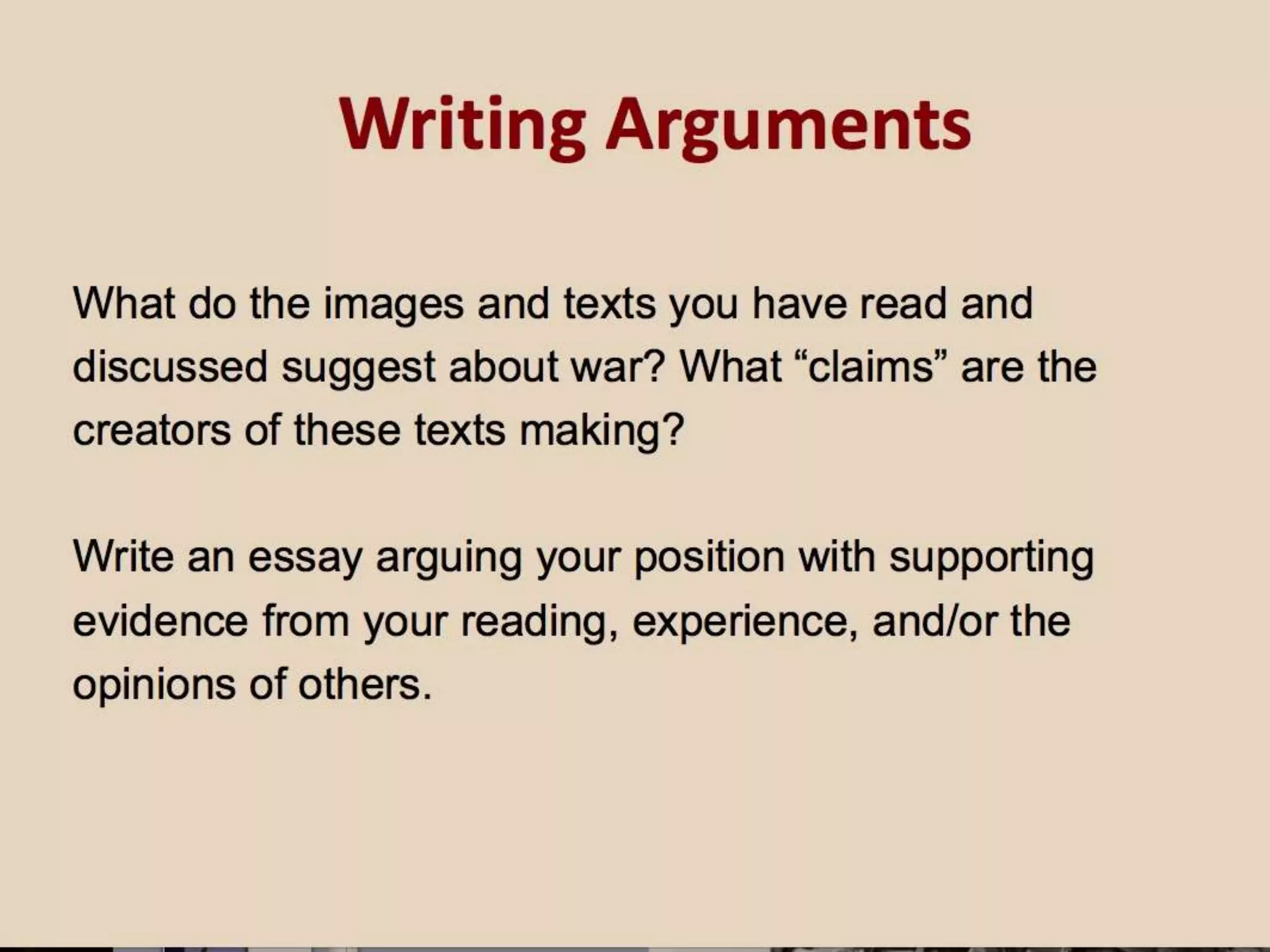
     Teach Argument, Not Persuasion

The CCSS favor argument over persuasion
because it requires more logic and reason,
and is more in line with the kind of writing
that students will be expected to do in
college.
5 Things Every Teacher Should
 be Doing to Meet the Common
      Core State Standards
              Number 5
         Increase Text Complexity

Look for balance: material should be difficult
enough that students are learning something
new, but not so hard that they give up.
Most Importantly
• Ensure that the movement towards Common Core is
  only a part of a larger M.S.A.D. No. 27 district reform
  effort.

• School reform needs to center on the relationships
  among students, teachers, parents, educational leaders,
  and the community

• The quality of those interactions will be what leads to
  high student learning more than any set of standards
Burning
Questions

Common Core State Standards - Presented by Tim Doak

  • 1.
    Common Core Standards AChallenge and an Opportunity
  • 2.
    Workforce Needs: Employee Deficiencies Ofthe high school students that you recently hired, what were their deficiencies? Written Communication 81% Leadership 73% Work Ethic 70% Critical Thinking & Problem Solving 70% Self-Direction 58% Source: Are They Really Ready to Work? (2006) The Conference Board, Corporate Voices for Working Families, P21, and SHRM
  • 3.
    Why Now? • Globalcompetition • Today’s jobs require different skills • Thinking and Reasoning will become basic skills
  • 4.
    Why is ThisImportant for Students, Teachers, and Parents? • Prepares students with the knowledge and skills they need to similar standards across states • Student mobility • Succeed in college and work • Ensures consistent expectations regardless of a student’s zip code • Provides educators, parents, and students with clear, focused guideposts
  • 5.
    Kindergarten Students • 2012 • 2028 – Starting School – College Graduation • 2018 • 2071 – Middle School – turning 65 • 2020 • 2096 – 8th grade promotion – turning 90 • 2024 – High School • Some maybe living in Graduation the 22nd Century
  • 8.
  • 11.
    Workforce Needs: Whatskills and content areas will be growing in importance in the next five years? Critical Thinking 78% I.T. 77% Health and Wellness 76% Collaboration 74% Creativity and Innovation 74% Personal Financial Responsibility 72% Source: Are They Really Ready to Work? (2006) The Conference Board, Corporate Voices
  • 13.
    Standards Definition – Level of quality accepted as norm Types of Standards • State Standard • Common Core • College Readiness (ACT) • National Organizations • International
  • 14.
    There is agreater focus on: • Non-fiction text • Self directed learning • 4 C’s • Critical Thinking • Communication • Collaboration • Creativity
  • 15.
    Advantages to CommonCore Standards • A focus on college and career readiness • Inclusion of the four strands of English Language Arts: • Reading • Writing • Listening and speaking • Language • The benefits of an integrated literacy approach – all educators have a shared responsibility for literacy instruction, regardless of discipline or content area. • A focus on results rather than means – . . .―the Standards leave room for teachers, curriculum developers, and states to determine how those goals should be reached and what additional topics should be addressed.‖ (p. 4) • Efficiencies of scale – common standards allow for greater collaboration among states in the areas of: • Professional development • Resource development • Teaching tools 15
  • 16.
    Rothman’s Key Points •Common Core have paired down the list of topic to allow teachers to focus on subject. (Depth, not breath) • Common Core Lessons and testing get more complex as students progress. (Ramping up difficultly) • Common Core focuses on both aspects of literacy. (Speaking and Listening) • Robert Rothman Michigan State University
  • 18.
  • 19.
    16 Habits ofMind • Persisting • Thinking & Communicating • Managing Impulsivity with clarity and precision • Listening with understanding • Gathering Data through all & empathy senses • Thinking flexibility • Creating, imagining, • Thinking about thinking innovating • Striving for accuracy • Responding with wonderment & awe • Questioning & posing problems • Taking responsible risks • Applying past knowledge to • Finding humor new situations • Thinking Interdependently • Remaining open to continuous learning
  • 20.
  • 21.
    What is Depth of Knowledge (DOK)? • A scale of cognitive demand (thinking) to align standards with assessments • Based on the research of Norman Webb, University of Wisconsin Center for Education Research and the National Institute for Science Education • Defines the ―ceiling‖ or highest DOK level for each Core Content standard for the state assessment • Guides item development for state assessments
  • 22.
    Webb’s Four Levelsof Cognitive Complexity • Level 1: Recall and Reproduction • Level 2: Skills & Concepts • Level 3: Strategic Thinking • Level 4: Extended Thinking
  • 23.
    Same Verb—Three DifferentDOK Levels DOK 1- Describe three characteristics of metamorphic rocks. (Requires simple recall) DOK 2- Describe the difference between metamorphic and igneous rocks. (Requires cognitive processing to determine the differences in the two rock types) DOK 3- Describe a model that you might use to represent the relationships that exist within the rock cycle. (Requires deep understanding of rock cycle and a determination of how best to represent it)
  • 24.
    ―Extending the lengthof an activity alone does not necessarily create rigor!‖
  • 25.
    The Standards cultivatethree mutually reinforcing writing capacities: – To persuade – To explain – To convey real or imagined experience Distribution of Communicative Purposes by Grade in the 2011 NAEP Writing Framework To Convey Grade To Persuade To Explain Experience 4 30% 35% 35% 8 35% 35% 30% 12 40% 40% 20% 25
  • 41.
    Emphasis on Informational Text Distribution of Literary and Informational Passages by Grade in the 2009 NAEP Reading Framework Grade Literary Information 4 50% 50% 8 45% 55% 12 30% 70% 41
  • 42.
    Overview of Text Text Complexity Text complexity is defined by: Qualitative measures – levels of meaning, structure, language conventionality and clarity, and knowledge demands often best measured by an attentive human reader. Quantitative measures – readability and other scores of text complexity often best measured by computer software. Reader and Task considerations – background knowledge of reader, motivation, interests, Reader and Task and complexity generated by tasks assigned often best made by educators employing their professional judgment. 42
  • 43.
    Step 1: QuantitativeMeasures Quantitative Measures Measures such as: • Word length • Word frequency • Word difficulty • Sentence length • Text length • Text cohesion 43
  • 44.
    Step 2: QualitativeMeasures Measures such as: • Structure • Language Demands and Conventions • Knowledge Demands • Levels of Meaning/Purpose 44
  • 45.
    Step 3: Readerand Task Considerations such as: • Motivation • Knowledge and experience • Purpose for reading • Complexity of task assigned regarding text • Complexity of questions asked regarding text 45
  • 46.
    What’s the same? What’s different? CCSS – M (Grade 4) State Standard (Grade 4) • Draw and identify lines and angles, • Uses properties or attributes of angles and classify shapes by properties of (number of angles) or sides (number of their lines and angles sides, length of sides, parallelism, or perpendicularity) to identify, describe, or • 1. Draw points, lines, line segments, distinguish among triangles, squares, rays, angles (right, acute, obtuse), and rectangles, rhombi, trapezoids, perpendicular and parallel lines. hexagons, or octagons; or classify angles Identify these in two dimensional relative to 90 degrees as more than, less figures than, or equal to. • 1. Classify two-dimensional figures based on the presence or absence of angles of a specified size. Recognize right triangles as a category, and identify right triangles • 2. Recognize a line of symmetry for a two- dimensional figure as a line across the figure such that the figure can be folded along the line into matching parts, Identify line-symmetric figures and draw lines of symmetry
  • 47.
    What’s the same? What’s different? CCSS – M (Grade 4) State Standard (Grade 4) • Draw and identify lines and angles, and • Uses properties or attributes of angles classify shapes by properties of their lines (number of angles) or sides (number and angles of sides, length of sides, parallelism, or perpendicularity) to identify, describe, • 1. Draw points, lines, line segments, rays, or distinguish among triangles, angles (right, acute, obtuse), and squares, rectangles, rhombi, perpendicular and parallel lines. Identify trapezoids, hexagons, or octagons; or these in two dimensional figures classify angles relative to 90 degrees as more than, less than, or equal to. • 1. Classify two-dimensional figures based on the presence or absence of angles of a specified size. Recognize right triangles as a category, and identify right triangles • 2. Recognize a line of symmetry for a two- dimensional figure as a line across the figure such that the figure can be folded along the line into matching parts, Identify line-symmetric figures and draw lines of symmetry
  • 48.
    5 Things EveryTeacher Should be Doing to Meet the Common Core State Standards Number 1 Lead High Level, Text-Based Discussions When you ask students to discuss a text as a whole class or in small groups, make sure that your questions are grounded in the text, and that students refer to the text in their responses.
  • 49.
    5 Things EveryTeacher Should be Doing to Meet the Common Core State Standards Number 2 Focus on Process, not just Content The Common Core State Standards stress the importance of student discovery. In other words, we cannot merely fill students’ heads with content; we should provide them with opportunities to discover information on their
  • 50.
    5 Things EveryTeacher Should be Doing to Meet the Common Core State Standards Number 3 Create Assignments for Real Audiences and with Real Purposes There is an importance of writing for a variety of audiences. Students should ―write routinely over extended time frames...for a range of tasks, purposes, and audiences‖.
  • 51.
    5 Things EveryTeacher Should be Doing to Meet the Common Core State Standards Number 4 Teach Argument, Not Persuasion The CCSS favor argument over persuasion because it requires more logic and reason, and is more in line with the kind of writing that students will be expected to do in college.
  • 52.
    5 Things EveryTeacher Should be Doing to Meet the Common Core State Standards Number 5 Increase Text Complexity Look for balance: material should be difficult enough that students are learning something new, but not so hard that they give up.
  • 53.
    Most Importantly • Ensurethat the movement towards Common Core is only a part of a larger M.S.A.D. No. 27 district reform effort. • School reform needs to center on the relationships among students, teachers, parents, educational leaders, and the community • The quality of those interactions will be what leads to high student learning more than any set of standards
  • 54.

Editor's Notes

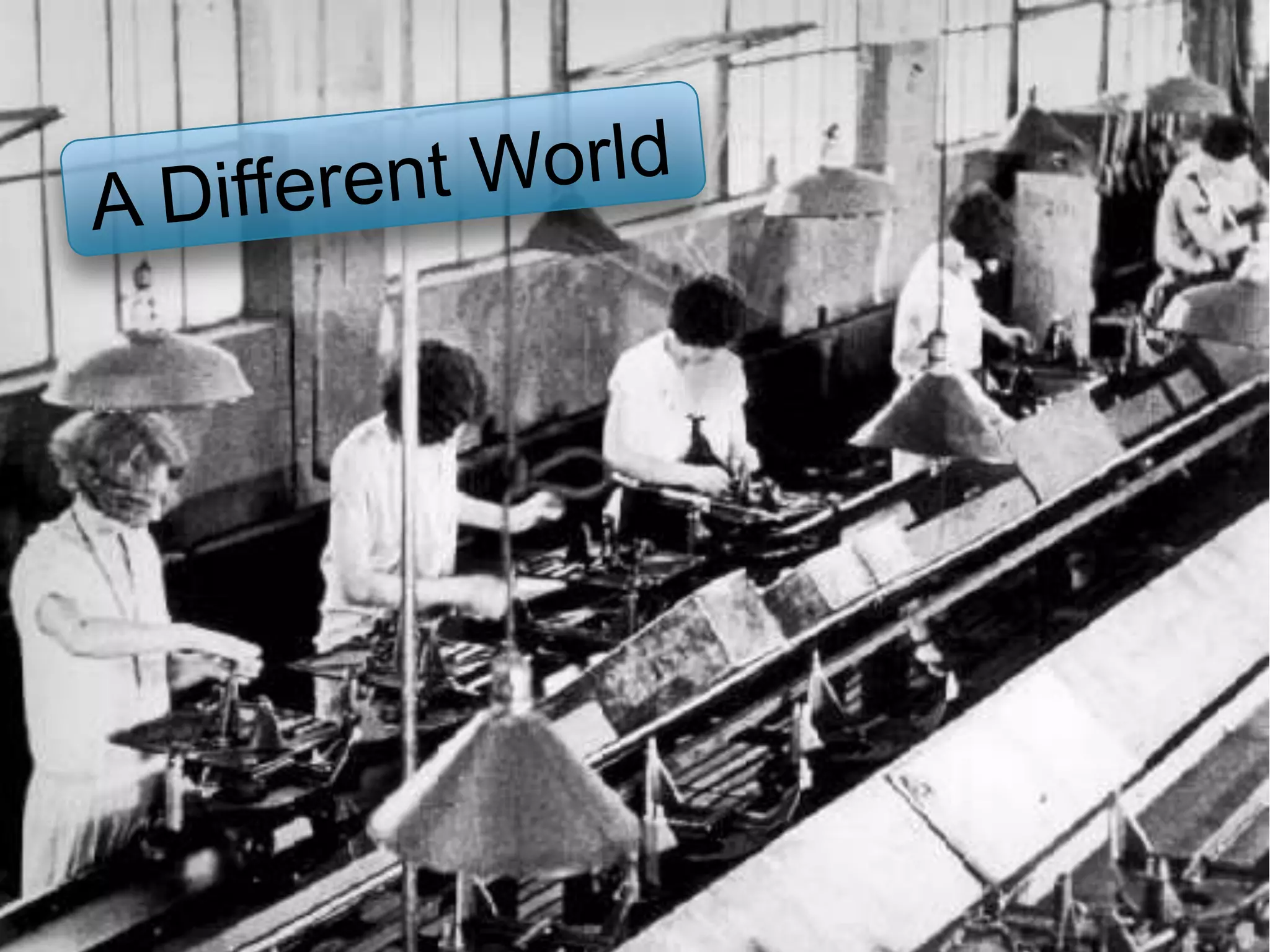
  • #7 We are in a different time, then this picture. How are our schools changing, or have they? Are we preparing our students for 1973?, 1995? Can you honestly say that your school’s curriculum is preparing your students for 2015 or 2020? What needs to be adjusted in order to prepare our students for the global society.
  • #11 This is an exciting time, Common Core State Standards is a remarkable time in our history, They are here and now what, that’s what this gift is all about today, becoming informed. The more each of us know, the better we can start to make wise decisions about implementation. The second gift is that of time, the standards do not have to be in place by the end of this year, you have time to create a thoughtful plan of implementation. The third gift is tools.
  • #16 Focus on Four Strands(reading, writing, speaking and listening, and language)The benefits of an integrated literacy approach(both in terms of reaching out to content areas beyond ELA and also in terms of research and media skills being integrated into the four strands)A focus on results rather than means(“the Standards leave room for teachers, curriculum developers, and states to determine how those goals should be reached and what additional topics should be addressed” (p. 4).)
  • #21 Your last handout shows some examples of a current California Content Standard aligned with a Common Core State Standard. Look over yours with a partner and determine what the standard for both is asking the student to do. It will be easier if you circle the verbs in each one. What did you notice?Where is the rigor?
  • #26 One reason for this shift in the organization of writing standards is to better prepare students for college and career writing. This shift matches the NAEP (National Assessment of Educational Progress) framework.Notice the decreasing emphasis on writing to convey an experience (narrative), and the increase in writing to persuade or explain.