Common Core and its Challenge
Zhonghe Wu (Ph.D.), Professor
Feb. 7, 2016
Content of Discussion
• What is the Common Core?
• Why the Common Core?
• How to implement Common Core?
• What can QD Learning help?
• Questions/Answers
What is the Common Core?
• National Governors Association (NGA) and the Council of Chief
State School Officers (CCSSO) convened a state-led process
in 2009 to develop common ELA and Math standards.
• A state-led effort to develop a common set of standards in
English language arts (ELA) and math that:
• Align college and workplace expectations
• The CCSS have been adopted by 46 states
• The CCSS will affect all public schools in adopted states
• Implementation beginning 2012
• New state assessments in 2014-15
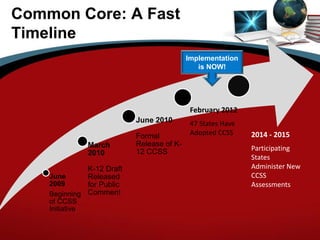
Common Core: A Fast
Timeline
June
2009
Beginning
of CCSS
Initiative
March
2010
K-12 Draft
Released
for Public
Comment
June 2010
Formal
Release of K-
12 CCSS
February 2012
47 States Have
Adopted CCSS 2014 - 2015
Participating
States
Administer New
CCSS
Assessments
Implementation
is NOW!
Why the Common Core?
• Evidence was used to guide critical decisions in the following
areas:
– Timing of when content should be introduced and the progression of that
content
– Ensuring focus and coherence
• Evidence includes:
– Standards from high-performing countries, leading states, and nationally-
regarded frameworks
– Research on adolescent literacy, text complexity, mathematics
instruction, quantitative literacy
CCSS – Mathematics
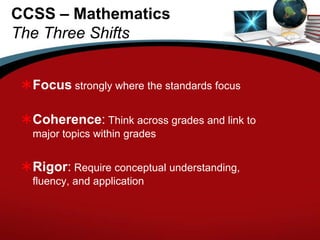
The Three Shifts
Focus strongly where the standards focus
Coherence: Think across grades and link to
major topics within grades
Rigor: Require conceptual understanding,
fluency, and application
CCSS -Mathematics
There are two sets of standards in math
CCSS – Mathematics
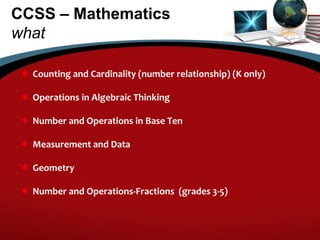
what
 Counting and Cardinality (number relationship) (K only)
 Operations in Algebraic Thinking
 Number and Operations in Base Ten
 Measurement and Data
 Geometry
 Number and Operations-Fractions (grades 3-5)
CCSS – Mathematics
how
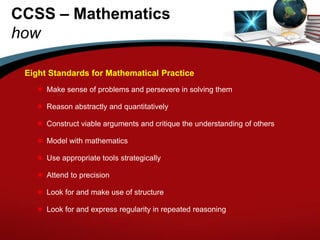
Eight Standards for Mathematical Practice
 Make sense of problems and persevere in solving them
 Reason abstractly and quantitatively
 Construct viable arguments and critique the understanding of others
 Model with mathematics
 Use appropriate tools strategically
 Attend to precision
 Look for and make use of structure
 Look for and express regularity in repeated reasoning
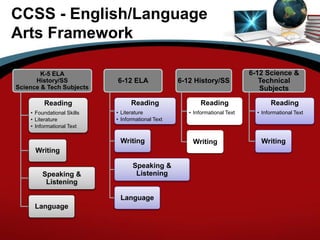
CCSS - English/Language
Arts Framework
K-5 ELA
History/SS
Science & Tech Subjects
Reading
• Foundational Skills
• Literature
• Informational Text
Writing
Speaking &
Listening
Language
6-12 ELA
Reading
• Literature
• Informational Text
Writing
Speaking &
Listening
Language
6-12 History/SS
Reading
• Informational Text
Writing
6-12 Science &
Technical
Subjects
Reading
• Informational Text
Writing
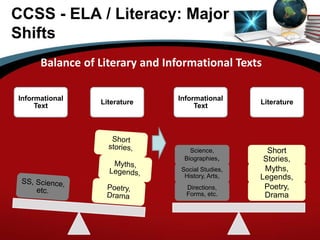
CCSS - ELA / Literacy: Major
Shifts
Balance of Literary and Informational Texts
Informational
Text
Literature
Informational
Text
Literature
Poetry,
Drama
Myths,
Legends,
Short
Stories,
Directions,
Forms, etc.
Social Studies,
History, Arts,
Science,
Biographies,
Assessment Update
Assessments will begin the 2014-2015 school year
SBAC
Will incorporate technology with computer based testing
How to implement Common
Core?
School
Teacher
Parent
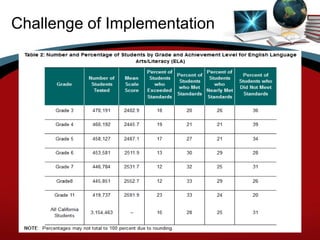
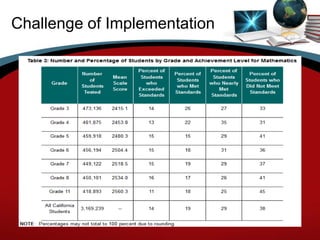
Challenge of Implementation
How can QD Learning
(work with Parents) help?
 Have teachers and professors to teach
 Math
More practice with reasoning
Encourage children to develop their critical thinking skills.
Ask students to think of different ways they can solve problems.
Have children apply their math knowledge to a real-world scenario,
such as doubling a recipe or calculating the area of a room.
 Language
More reading and making connections to culture and community
Talk, read, listen, sing, and play games with your child
Questions
&
Answers

Common core and its challenge

  • 1.
    Common Core andits Challenge Zhonghe Wu (Ph.D.), Professor Feb. 7, 2016
  • 2.
    Content of Discussion •What is the Common Core? • Why the Common Core? • How to implement Common Core? • What can QD Learning help? • Questions/Answers
  • 3.
    What is theCommon Core? • National Governors Association (NGA) and the Council of Chief State School Officers (CCSSO) convened a state-led process in 2009 to develop common ELA and Math standards. • A state-led effort to develop a common set of standards in English language arts (ELA) and math that: • Align college and workplace expectations • The CCSS have been adopted by 46 states • The CCSS will affect all public schools in adopted states • Implementation beginning 2012 • New state assessments in 2014-15
  • 4.
    Common Core: AFast Timeline June 2009 Beginning of CCSS Initiative March 2010 K-12 Draft Released for Public Comment June 2010 Formal Release of K- 12 CCSS February 2012 47 States Have Adopted CCSS 2014 - 2015 Participating States Administer New CCSS Assessments Implementation is NOW!
  • 5.
    Why the CommonCore? • Evidence was used to guide critical decisions in the following areas: – Timing of when content should be introduced and the progression of that content – Ensuring focus and coherence • Evidence includes: – Standards from high-performing countries, leading states, and nationally- regarded frameworks – Research on adolescent literacy, text complexity, mathematics instruction, quantitative literacy
  • 6.
    CCSS – Mathematics TheThree Shifts Focus strongly where the standards focus Coherence: Think across grades and link to major topics within grades Rigor: Require conceptual understanding, fluency, and application
  • 7.
    CCSS -Mathematics There aretwo sets of standards in math
  • 8.
    CCSS – Mathematics what Counting and Cardinality (number relationship) (K only)  Operations in Algebraic Thinking  Number and Operations in Base Ten  Measurement and Data  Geometry  Number and Operations-Fractions (grades 3-5)
  • 9.
    CCSS – Mathematics how EightStandards for Mathematical Practice  Make sense of problems and persevere in solving them  Reason abstractly and quantitatively  Construct viable arguments and critique the understanding of others  Model with mathematics  Use appropriate tools strategically  Attend to precision  Look for and make use of structure  Look for and express regularity in repeated reasoning
  • 10.
    CCSS - English/Language ArtsFramework K-5 ELA History/SS Science & Tech Subjects Reading • Foundational Skills • Literature • Informational Text Writing Speaking & Listening Language 6-12 ELA Reading • Literature • Informational Text Writing Speaking & Listening Language 6-12 History/SS Reading • Informational Text Writing 6-12 Science & Technical Subjects Reading • Informational Text Writing
  • 11.
    CCSS - ELA/ Literacy: Major Shifts Balance of Literary and Informational Texts Informational Text Literature Informational Text Literature Poetry, Drama Myths, Legends, Short Stories, Directions, Forms, etc. Social Studies, History, Arts, Science, Biographies,
  • 12.
    Assessment Update Assessments willbegin the 2014-2015 school year SBAC Will incorporate technology with computer based testing
  • 13.
    How to implementCommon Core? School Teacher Parent
  • 14.
  • 15.
  • 16.
    How can QDLearning (work with Parents) help?  Have teachers and professors to teach  Math More practice with reasoning Encourage children to develop their critical thinking skills. Ask students to think of different ways they can solve problems. Have children apply their math knowledge to a real-world scenario, such as doubling a recipe or calculating the area of a room.  Language More reading and making connections to culture and community Talk, read, listen, sing, and play games with your child
  • 17.