


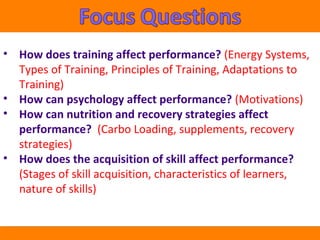








• How does training affect performance? (Energy Systems, 
Types of Training, Principles of Training, Adaptations to 
Training) 
• How can psychology affect performance? (Motivations) 
• How can nutrition and recovery strategies affect 
performance? (Carbo Loading, supplements, recovery 
strategies) 
• How does the acquisition of skill affect performance? 
(Stages of skill acquisition, characteristics of learners, 
nature of skills)
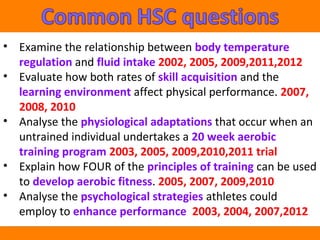
• Examine the relationship between body temperature 
regulation and fluid intake 2002, 2005, 2009,2011,2012 
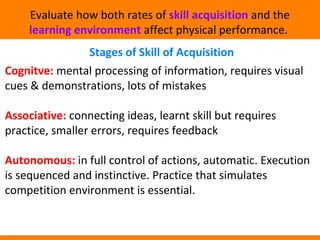
• Evaluate how both rates of skill acquisition and the 
learning environment affect physical performance. 2007, 
2008, 2010 
• Analyse the physiological adaptations that occur when an 
untrained individual undertakes a 20 week aerobic 
training program 2003, 2005, 2009,2010,2011 trial 
• Explain how FOUR of the principles of training can be used 
to develop aerobic fitness. 2005, 2007, 2009,2010 
• Analyse the psychological strategies athletes could 
employ to enhance performance 2003, 2004, 2007,2012
Examine the relationship between body temperature regulation 
and fluid intake 
For highly active people, in hot weather, fluid loss can 
increase significantly. Too little fluid intake can impact 
perspiration (heat loss) and can leads to overheating & heat 
related physiological damage (heat stress, heat cramps, heat 
rash, dizziness, heat stoke, fainting). 
What about in the COLD: We lose a lot of fluid in cold 
weather through respiration (breathing out). Our bodies are 
working hard carrying the weight of layers of clothing and 
sweat evaporates quickly. As it is not hot, we don’t FEEL 
thirsty. And therefore do not replenish our fluid levels as 
regularly leading to dehydration.
Examine the relationship between body temperature regulation 
and fluid intake 
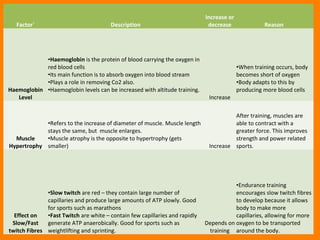
If you don't drink enough, you will become dehydrated and 
your body's total blood volume will drop. Because the heart 
has access to less blood, it has to pump faster to circulate the 
same amount of blood - and your heart rate will rise. If you 
don't replace the lost fluids by drinking, your heart rate will 
increase, and your ability to perform will decrease rapidly. 
So drinking fluids during exercise has several benefits: 
•Fights dehydration 
•Offsets body temperature increase (regulates temperature) 
•Minimises cardiovascular stress
WHAT ARE YOUR HYDRATION 
RECOOMENDATIONS?
Evaluate how both rates of skill acquisition and the 
learning environment affect physical performance. 
Stages of Skill of Acquisition 
Cognitve: mental processing of information, requires visual 
cues & demonstrations, lots of mistakes 
Associative: connecting ideas, learnt skill but requires 
practice, smaller errors, requires feedback 
Autonomous: in full control of actions, automatic. Execution 
is sequenced and instinctive. Practice that simulates 
competition environment is essential.
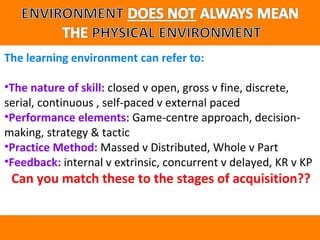
The learning environment can refer to: 
•The nature of skill: closed v open, gross v fine, discrete, 
serial, continuous , self-paced v external paced 
•Performance elements: Game-centre approach, decision-making, 
strategy & tactic 
•Practice Method: Massed v Distributed, Whole v Part 
•Feedback: internal v extrinsic, concurrent v delayed, KR v KP 
Can you match these to the stages of acquisition??
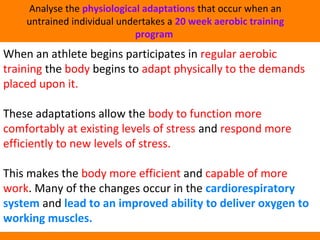
Analyse the physiological adaptations that occur when an 
untrained individual undertakes a 20 week aerobic training 
program 
When an athlete begins participates in regular aerobic 
training the body begins to adapt physically to the demands 
placed upon it. 
These adaptations allow the body to function more 
comfortably at existing levels of stress and respond more 
efficiently to new levels of stress. 
This makes the body more efficient and capable of more 
work. Many of the changes occur in the cardiorespiratory 
system and lead to an improved ability to deliver oxygen to 
working muscles.
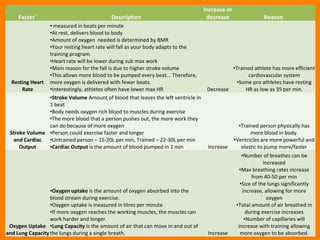
Factor` Description 
Increase or 
decrease Reason 
Resting Heart 
Rate 
• measured in beats per minute 
•At rest, delivers blood to body 
•Amount of oxygen needed is determined by BMR 
•Your resting heart rate will fall as your body adapts to the 
training program. 
•Heart rate will be lower during sub max work 
•Main reason for the fall is due to higher stroke volume 
•This allows more blood to be pumped every beat... Therefore, 
more oxygen is delivered with fewer beats. 
•Interestingly, athletes often have lower max HR Decrease 
•Trained athlete has more efficient 
cardiovascular system 
•Some pro athletes have resting 
HR as low as 35 per min. 
Stroke Volume 
and Cardiac 
Output 
•Stroke Volume Amount of blood that leaves the left ventricle in 
1 beat 
•Body needs oxygen rich blood to muscles during exercise 
•The more blood that a person pushes out, the more work they 
can do because of more oxygen 
•Person could exercise faster and longer 
•Untrained person – 15-20L per min, Trained – 22-30L per min 
•Cardiac Output is the amount of blood pumped in 1 min Increase 
•Trained person physically has 
more blood in body. 
•Ventricles are more powerful and 
elastic to pump more/faster 
Oxygen Uptake 
and Lung Capacity 
•Oxygen uptake is the amount of oxygen absorbed into the 
blood stream during exercise. 
•Oxygen uptake is measured in litres per minute 
•If more oxygen reaches the working muscles, the muscles can 
work harder and longer. 
•Lung Capacity is the amount of air that can move in and out of 
the lungs during a single breath. Increase 
•Number of breathes can be 
increased 
•Max breathing rates increase 
from 40-50 per min 
•Size of the lungs significantly 
increase, allowing for more 
oxygen 
•Total amount of air breathed in 
during exercise increases 
•Number of capillaries will 
increase with training allowing 
more oxygen to be absorbed.
Factor` Description 
Increase or 
decrease Reason 
Haemoglobin 
Level 
•Haemoglobin is the protein of blood carrying the oxygen in 
red blood cells 
•Its main function is to absorb oxygen into blood stream 
•Plays a role in removing Co2 also. 
•Haemoglobin levels can be increased with altitude training. 
Increase 
•When training occurs, body 
becomes short of oxygen 
•Body adapts to this by 
producing more blood cells 
Muscle 
Hypertrophy 
•Refers to the increase of diameter of muscle. Muscle length 
stays the same, but muscle enlarges. 
•Muscle atrophy is the opposite to hypertrophy (gets 
smaller) Increase 
After training, muscles are 
able to contract with a 
greater force. This improves 
strength and power related 
sports. 
Effect on 
Slow/Fast 
twitch Fibres 
•Slow twitch are red – they contain large number of 
capillaries and produce large amounts of ATP slowly. Good 
for sports such as marathons 
•Fast Twitch are white – contain few capillaries and rapidly 
generate ATP anaerobically. Good for sports such as 
weightlifting and sprinting. 
Depends on 
training 
•Endurance training 
encourages slow twitch fibres 
to develop because it allows 
body to make more 
capillaries, allowing for more 
oxygen to be transported 
around the body.
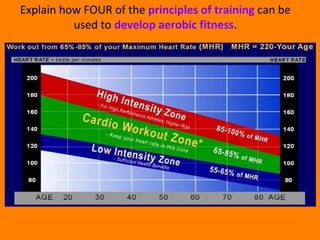
Explain how FOUR of the principles of training can be 
used to develop aerobic fitness.
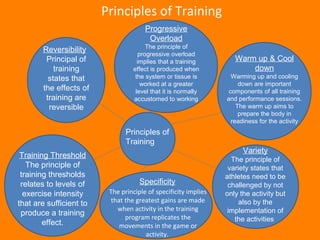
Principles of Training 
Progressive 
Overload 
The principle of 
progressive overload 
implies that a training 
effect is produced when 
the system or tissue is 
worked at a greater 
level that it is normally 
accustomed to working 
Principles of 
Training 
Reversibility 
Principal of 
training 
states that 
the effects of 
training are 
reversible 
Warm up & Cool 
down 
Warming up and cooling 
down are important 
components of all training 
and performance sessions. 
The warm up aims to 
prepare the body in 
readiness for the activity 
Variety 
The principle of 
variety states that 
athletes need to be 
challenged by not 
only the activity but 
also by the 
implementation of 
the activities 
Training Threshold 
The principle of 
training thresholds 
relates to levels of 
exercise intensity 
that are sufficient to 
produce a training 
effect. 
Specificity 
The principle of specificity implies 
that the greatest gains are made 
when activity in the training 
program replicates the 
movements in the game or 
activity.
Explain how FOUR of the principles of training can be 
used to develop aerobic fitness. 
• Choose 4 principles that relate to aerobic training 
• Give specific examples of activities 
• Must enhance aerobic capacity 
• Relate to physiological adaptations
Analyse the psychological strategies athletes could 
employ to enhance performance 
Concentration: ability to focus on task 
at hand 
Mental rehearsal: picturing 
performance before executing it 
Relaxation techniques: techniques to 
control the body’s response to stress 
Goal setting: targets that direct effort 
(must be SMART)
But how do they enhance performance? 
Concentration: allows you to be ‘in the zone’, clears distractions, 
allows you to focus on execution (doing) 
Mental rehearsal: provide clear idea of what is to be done, 
heightens concentration, narrows thoughts on task 
Relaxation techniques: allows athlete to reach optimal arousal eg. 
meditation, self-talk, centred breathing. 
Goal setting: provides focus, can be measured, gives feedback.
• Describe recovery strategies used to improve 
performance? 
• Discuss the effectiveness of the use of 
supplementation to improve performance? 
• Analyse the use of feedback to improve an athlete’s 
performance? 
• Outline the features of the alactacid (ATP/PC) and the 
lactic acid energy systems
1. Describe the dietary considerations of an athlete before, 
during and post performance 
2. Assess the ways in which attitude training and acclimatisation can 
influence the physiological preparation and performance of an 
endurance athlete 
3. There are many factors involved in the preparation of an athlete 
for optimum 
performance. Select EITHER a power athlete OR an endurance 
athlete. Design a training program for this athlete, justifying the 
key features that would need to be included 
4. Describe how a coach could evaluate the effectiveness of the skill 
instruction element of a training session. 
5. Justify the use of skill-related tests to identify skilled performers 
for team selection trials
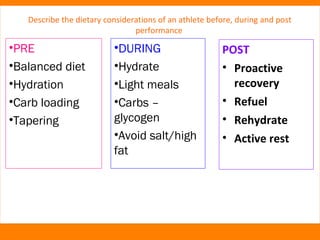
Describe the dietary considerations of an athlete before, during and post 
•PRE 
•Balanced diet 
•Hydration 
•Carb loading 
•Tapering 
performance 
•DURING 
•Hydrate 
•Light meals 
•Carbs – 
glycogen 
•Avoid salt/high 
fat 
POST 
• Proactive 
recovery 
• Refuel 
• Rehydrate 
• Active rest
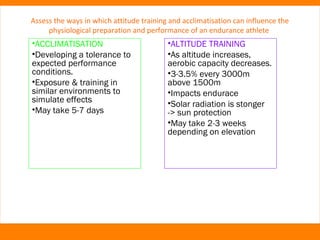
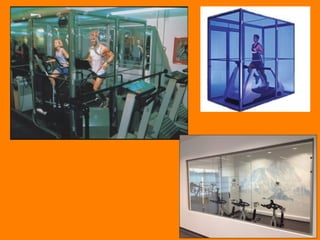
Assess the ways in which attitude training and acclimatisation can influence the 
physiological preparation and performance of an endurance athlete 
•ACCLIMATISATION 
•Developing a tolerance to 
expected performance 
conditions. 
•Exposure & training in 
similar environments to 
simulate effects 
•May take 5-7 days 
•ALTITUDE TRAINING 
•As altitude increases, 
aerobic capacity decreases. 
•3-3.5% every 3000m 
above 1500m 
•Impacts endurace 
•Solar radiation is stonger 
-> sun protection 
•May take 2-3 weeks 
depending on elevation
There are many factors involved in the 
preparation of an athlete for optimum 
performance. 
Select EITHER a power athlete OR an endurance 
athlete. 
Design a training program for this athlete, 
justifying the key features that would need to be 
included
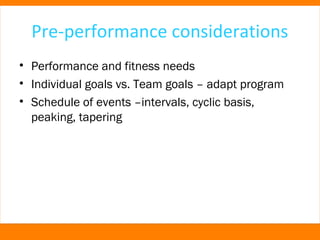
Pre-performance considerations 
• Performance and fitness needs 
• Individual goals vs. Team goals – adapt program 
• Schedule of events –intervals, cyclic basis, 
peaking, tapering
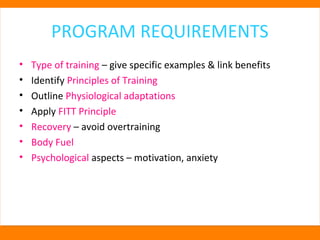
PROGRAM REQUIREMENTS 
• Type of training – give specific examples & link benefits 
• Identify Principles of Training 
• Outline Physiological adaptations 
• Apply FITT Principle 
• Recovery – avoid overtraining 
• Body Fuel 
• Psychological aspects – motivation, anxiety
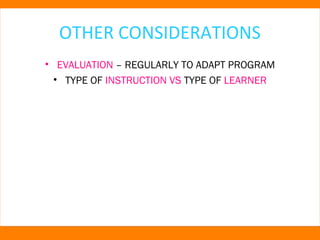
OTHER CONSIDERATIONS 
• EVALUATION – REGULARLY TO ADAPT PROGRAM 
• TYPE OF INSTRUCTION VS TYPE OF LEARNER
Select EITHER a power athlete OR 
an endurance athlete. 
• READ THE QUESTION CAREFULLY 
• THEY WILL EITHER SPECIFY A SPORT, FITNESS ASPECT OR ask you to 
BE GENERAL 
• YOU WILL NEED TO KNOW EXAMPLES OF ACTIVITIES FOR EVERYTHING 
& ANYTHING. 
• TRICK: FIND ACTIVITES THAT TRAIN MULITPLE ASPECTS, THEN ADAPT 
THEM TO SUIT THE QUESTION 
• EG. SQUATS = BUILD POWER, SPEED, STRENGTH, ASSIST CORE
Describe how a coach could evaluate the effectiveness of the skill instruction element 
of a training session. 
EFFECTIVE INSTRUCTION IS: 
• brief — it is important that instruction is concise and factual to allow maximal practice time 
• well timed — use words when their impact will be greatest 
• specific — instruction needs to be specific to the skill, game and situation; it should not be 
general 
• constructive — focus on the positive points for improvement, not on how poorly the skill is 
being performed 
• clear — there should be no misunderstanding about the information communicated by the 
coach. Questions should be encouraged if the message is not understood. 
• informative — all instruction should relate specifically to information that the players need 
to know. Additional, unrelated material is confusing and can actually hinder the learning 
process. 
• demonstrable — effective instruction is supported by visual aids such as demonstrations to 
provide clear pictures of skills and techniques.
Coach evaluation tools 
• Feedback from athletes: verbal or errors made (acquisition of skill) 
• Feedback required by athlete (types of feedback) 
• Video analysis 
• Skill-related tests 
• Improvement in performance 
• Ability of athlete to apply instructions/feedback 
• Questions asked 
• Goals met – cyclic process
Justify the use of skill-related tests to identify skilled performers 
for team selection trials 
• Skill related tests NOT health related tests give examples. 
• Valid, reliable 
• Objective – compared to norms/ranks/scales (without bias) based on 
measurement 
• Relate to characteristics of a skilled-performer: including mental 
approach, kinesthetic sense, consistency, anticipation and timing 
• Justify its use in team selections
• Annotated notes 
• Summarise summaries 
• Q&A 
• Flash cards 
• Posters 
• Recordings
• Highlights key terms 
• Helps summarise notes – work smarter, 
not harder. 
• Revises 
• You retain 80% more information when 
holding a pen/pencil in hand
• Helps to memorise answers 
• Highlights key terms 
• Condenses information 
• Portable, easy to take around 
• Easiest & quickest way to study
• Visual stimulus: mind map 
• Constant reminder of notes 
• Good for memorising
• Recording notes onto tape and listening to 
them as you go to sleep. 
• Yep it works.
2014 HSC PDHPE  Trial Preparation

2014 HSC PDHPE Trial Preparation

  • 4.
    • How doestraining affect performance? (Energy Systems, Types of Training, Principles of Training, Adaptations to Training) • How can psychology affect performance? (Motivations) • How can nutrition and recovery strategies affect performance? (Carbo Loading, supplements, recovery strategies) • How does the acquisition of skill affect performance? (Stages of skill acquisition, characteristics of learners, nature of skills)
  • 5.
    • Examine therelationship between body temperature regulation and fluid intake 2002, 2005, 2009,2011,2012 • Evaluate how both rates of skill acquisition and the learning environment affect physical performance. 2007, 2008, 2010 • Analyse the physiological adaptations that occur when an untrained individual undertakes a 20 week aerobic training program 2003, 2005, 2009,2010,2011 trial • Explain how FOUR of the principles of training can be used to develop aerobic fitness. 2005, 2007, 2009,2010 • Analyse the psychological strategies athletes could employ to enhance performance 2003, 2004, 2007,2012
  • 6.
    Examine the relationshipbetween body temperature regulation and fluid intake For highly active people, in hot weather, fluid loss can increase significantly. Too little fluid intake can impact perspiration (heat loss) and can leads to overheating & heat related physiological damage (heat stress, heat cramps, heat rash, dizziness, heat stoke, fainting). What about in the COLD: We lose a lot of fluid in cold weather through respiration (breathing out). Our bodies are working hard carrying the weight of layers of clothing and sweat evaporates quickly. As it is not hot, we don’t FEEL thirsty. And therefore do not replenish our fluid levels as regularly leading to dehydration.
  • 7.
    Examine the relationshipbetween body temperature regulation and fluid intake If you don't drink enough, you will become dehydrated and your body's total blood volume will drop. Because the heart has access to less blood, it has to pump faster to circulate the same amount of blood - and your heart rate will rise. If you don't replace the lost fluids by drinking, your heart rate will increase, and your ability to perform will decrease rapidly. So drinking fluids during exercise has several benefits: •Fights dehydration •Offsets body temperature increase (regulates temperature) •Minimises cardiovascular stress
  • 8.
    WHAT ARE YOURHYDRATION RECOOMENDATIONS?
  • 9.
    Evaluate how bothrates of skill acquisition and the learning environment affect physical performance. Stages of Skill of Acquisition Cognitve: mental processing of information, requires visual cues & demonstrations, lots of mistakes Associative: connecting ideas, learnt skill but requires practice, smaller errors, requires feedback Autonomous: in full control of actions, automatic. Execution is sequenced and instinctive. Practice that simulates competition environment is essential.
  • 10.
    The learning environmentcan refer to: •The nature of skill: closed v open, gross v fine, discrete, serial, continuous , self-paced v external paced •Performance elements: Game-centre approach, decision-making, strategy & tactic •Practice Method: Massed v Distributed, Whole v Part •Feedback: internal v extrinsic, concurrent v delayed, KR v KP Can you match these to the stages of acquisition??
  • 11.
    Analyse the physiologicaladaptations that occur when an untrained individual undertakes a 20 week aerobic training program When an athlete begins participates in regular aerobic training the body begins to adapt physically to the demands placed upon it. These adaptations allow the body to function more comfortably at existing levels of stress and respond more efficiently to new levels of stress. This makes the body more efficient and capable of more work. Many of the changes occur in the cardiorespiratory system and lead to an improved ability to deliver oxygen to working muscles.
  • 12.
    Factor` Description Increaseor decrease Reason Resting Heart Rate • measured in beats per minute •At rest, delivers blood to body •Amount of oxygen needed is determined by BMR •Your resting heart rate will fall as your body adapts to the training program. •Heart rate will be lower during sub max work •Main reason for the fall is due to higher stroke volume •This allows more blood to be pumped every beat... Therefore, more oxygen is delivered with fewer beats. •Interestingly, athletes often have lower max HR Decrease •Trained athlete has more efficient cardiovascular system •Some pro athletes have resting HR as low as 35 per min. Stroke Volume and Cardiac Output •Stroke Volume Amount of blood that leaves the left ventricle in 1 beat •Body needs oxygen rich blood to muscles during exercise •The more blood that a person pushes out, the more work they can do because of more oxygen •Person could exercise faster and longer •Untrained person – 15-20L per min, Trained – 22-30L per min •Cardiac Output is the amount of blood pumped in 1 min Increase •Trained person physically has more blood in body. •Ventricles are more powerful and elastic to pump more/faster Oxygen Uptake and Lung Capacity •Oxygen uptake is the amount of oxygen absorbed into the blood stream during exercise. •Oxygen uptake is measured in litres per minute •If more oxygen reaches the working muscles, the muscles can work harder and longer. •Lung Capacity is the amount of air that can move in and out of the lungs during a single breath. Increase •Number of breathes can be increased •Max breathing rates increase from 40-50 per min •Size of the lungs significantly increase, allowing for more oxygen •Total amount of air breathed in during exercise increases •Number of capillaries will increase with training allowing more oxygen to be absorbed.
  • 13.
    Factor` Description Increaseor decrease Reason Haemoglobin Level •Haemoglobin is the protein of blood carrying the oxygen in red blood cells •Its main function is to absorb oxygen into blood stream •Plays a role in removing Co2 also. •Haemoglobin levels can be increased with altitude training. Increase •When training occurs, body becomes short of oxygen •Body adapts to this by producing more blood cells Muscle Hypertrophy •Refers to the increase of diameter of muscle. Muscle length stays the same, but muscle enlarges. •Muscle atrophy is the opposite to hypertrophy (gets smaller) Increase After training, muscles are able to contract with a greater force. This improves strength and power related sports. Effect on Slow/Fast twitch Fibres •Slow twitch are red – they contain large number of capillaries and produce large amounts of ATP slowly. Good for sports such as marathons •Fast Twitch are white – contain few capillaries and rapidly generate ATP anaerobically. Good for sports such as weightlifting and sprinting. Depends on training •Endurance training encourages slow twitch fibres to develop because it allows body to make more capillaries, allowing for more oxygen to be transported around the body.
  • 14.
    Explain how FOURof the principles of training can be used to develop aerobic fitness.
  • 15.
    Principles of Training Progressive Overload The principle of progressive overload implies that a training effect is produced when the system or tissue is worked at a greater level that it is normally accustomed to working Principles of Training Reversibility Principal of training states that the effects of training are reversible Warm up & Cool down Warming up and cooling down are important components of all training and performance sessions. The warm up aims to prepare the body in readiness for the activity Variety The principle of variety states that athletes need to be challenged by not only the activity but also by the implementation of the activities Training Threshold The principle of training thresholds relates to levels of exercise intensity that are sufficient to produce a training effect. Specificity The principle of specificity implies that the greatest gains are made when activity in the training program replicates the movements in the game or activity.
  • 16.
    Explain how FOURof the principles of training can be used to develop aerobic fitness. • Choose 4 principles that relate to aerobic training • Give specific examples of activities • Must enhance aerobic capacity • Relate to physiological adaptations
  • 17.
    Analyse the psychologicalstrategies athletes could employ to enhance performance Concentration: ability to focus on task at hand Mental rehearsal: picturing performance before executing it Relaxation techniques: techniques to control the body’s response to stress Goal setting: targets that direct effort (must be SMART)
  • 18.
    But how dothey enhance performance? Concentration: allows you to be ‘in the zone’, clears distractions, allows you to focus on execution (doing) Mental rehearsal: provide clear idea of what is to be done, heightens concentration, narrows thoughts on task Relaxation techniques: allows athlete to reach optimal arousal eg. meditation, self-talk, centred breathing. Goal setting: provides focus, can be measured, gives feedback.
  • 19.
    • Describe recoverystrategies used to improve performance? • Discuss the effectiveness of the use of supplementation to improve performance? • Analyse the use of feedback to improve an athlete’s performance? • Outline the features of the alactacid (ATP/PC) and the lactic acid energy systems
  • 23.
    1. Describe thedietary considerations of an athlete before, during and post performance 2. Assess the ways in which attitude training and acclimatisation can influence the physiological preparation and performance of an endurance athlete 3. There are many factors involved in the preparation of an athlete for optimum performance. Select EITHER a power athlete OR an endurance athlete. Design a training program for this athlete, justifying the key features that would need to be included 4. Describe how a coach could evaluate the effectiveness of the skill instruction element of a training session. 5. Justify the use of skill-related tests to identify skilled performers for team selection trials
  • 24.
    Describe the dietaryconsiderations of an athlete before, during and post •PRE •Balanced diet •Hydration •Carb loading •Tapering performance •DURING •Hydrate •Light meals •Carbs – glycogen •Avoid salt/high fat POST • Proactive recovery • Refuel • Rehydrate • Active rest
  • 25.
    Assess the waysin which attitude training and acclimatisation can influence the physiological preparation and performance of an endurance athlete •ACCLIMATISATION •Developing a tolerance to expected performance conditions. •Exposure & training in similar environments to simulate effects •May take 5-7 days •ALTITUDE TRAINING •As altitude increases, aerobic capacity decreases. •3-3.5% every 3000m above 1500m •Impacts endurace •Solar radiation is stonger -> sun protection •May take 2-3 weeks depending on elevation
  • 27.
    There are manyfactors involved in the preparation of an athlete for optimum performance. Select EITHER a power athlete OR an endurance athlete. Design a training program for this athlete, justifying the key features that would need to be included
  • 28.
    Pre-performance considerations •Performance and fitness needs • Individual goals vs. Team goals – adapt program • Schedule of events –intervals, cyclic basis, peaking, tapering
  • 29.
    PROGRAM REQUIREMENTS •Type of training – give specific examples & link benefits • Identify Principles of Training • Outline Physiological adaptations • Apply FITT Principle • Recovery – avoid overtraining • Body Fuel • Psychological aspects – motivation, anxiety
  • 30.
    OTHER CONSIDERATIONS •EVALUATION – REGULARLY TO ADAPT PROGRAM • TYPE OF INSTRUCTION VS TYPE OF LEARNER
  • 31.
    Select EITHER apower athlete OR an endurance athlete. • READ THE QUESTION CAREFULLY • THEY WILL EITHER SPECIFY A SPORT, FITNESS ASPECT OR ask you to BE GENERAL • YOU WILL NEED TO KNOW EXAMPLES OF ACTIVITIES FOR EVERYTHING & ANYTHING. • TRICK: FIND ACTIVITES THAT TRAIN MULITPLE ASPECTS, THEN ADAPT THEM TO SUIT THE QUESTION • EG. SQUATS = BUILD POWER, SPEED, STRENGTH, ASSIST CORE
  • 32.
    Describe how acoach could evaluate the effectiveness of the skill instruction element of a training session. EFFECTIVE INSTRUCTION IS: • brief — it is important that instruction is concise and factual to allow maximal practice time • well timed — use words when their impact will be greatest • specific — instruction needs to be specific to the skill, game and situation; it should not be general • constructive — focus on the positive points for improvement, not on how poorly the skill is being performed • clear — there should be no misunderstanding about the information communicated by the coach. Questions should be encouraged if the message is not understood. • informative — all instruction should relate specifically to information that the players need to know. Additional, unrelated material is confusing and can actually hinder the learning process. • demonstrable — effective instruction is supported by visual aids such as demonstrations to provide clear pictures of skills and techniques.
  • 33.
    Coach evaluation tools • Feedback from athletes: verbal or errors made (acquisition of skill) • Feedback required by athlete (types of feedback) • Video analysis • Skill-related tests • Improvement in performance • Ability of athlete to apply instructions/feedback • Questions asked • Goals met – cyclic process
  • 34.
    Justify the useof skill-related tests to identify skilled performers for team selection trials • Skill related tests NOT health related tests give examples. • Valid, reliable • Objective – compared to norms/ranks/scales (without bias) based on measurement • Relate to characteristics of a skilled-performer: including mental approach, kinesthetic sense, consistency, anticipation and timing • Justify its use in team selections
  • 38.
    • Annotated notes • Summarise summaries • Q&A • Flash cards • Posters • Recordings
  • 39.
    • Highlights keyterms • Helps summarise notes – work smarter, not harder. • Revises • You retain 80% more information when holding a pen/pencil in hand
  • 40.
    • Helps tomemorise answers • Highlights key terms • Condenses information • Portable, easy to take around • Easiest & quickest way to study
  • 41.
    • Visual stimulus:mind map • Constant reminder of notes • Good for memorising
  • 42.
    • Recording notesonto tape and listening to them as you go to sleep. • Yep it works.

Editor's Notes

  • #9 Textbook Page 221 – hydrate before & after, every 15-20mins whilst running,drink water & low carb, acclimatise, wear light clothing, avoid activity in high tempa (below 30 degrees, below humidity of 90%)
  • #11 Butchers Paper: match the learning environment to stages of skill acquisition
  • #39 Using butchers paper, class discusses what areas are covered by the following questions. Are there common areas?
  • #40 Using butchers paper, class discusses what areas are covered by the following questions. Are there common areas?
  • #41 Using butchers paper, class discusses what areas are covered by the following questions. Are there common areas?
  • #42 Using butchers paper, class discusses what areas are covered by the following questions. Are there common areas?
  • #43 Using butchers paper, class discusses what areas are covered by the following questions. Are there common areas?