Gymnastics Federation of India
Gymnastics
By- AZHAR HUSSAIN ANSARI
DEPARTMENT OF PHYSICAL EDUCATION
BIRLA CAMPUS H.N.B.G.U.
SRINAGAR GARHWAL
Gymnastics
Gymnastics is a sport that includes physical
exercises
requiring balance, strength, flexibility, agility,
coordination, and endurance. The movements
involved in gymnastics contribute to the
development of the arms, legs, shoulders, back,
chest, and abdominal muscle groups.
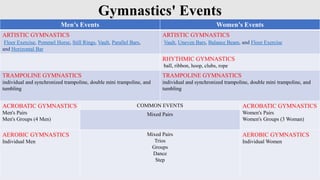
Gymnastics' Events
Men’s Events Women’s Events
ARTISTIC GYMNASTICS
Floor Exercise, Pommel Horse, Still Rings, Vault, Parallel Bars,
and Horizontal Bar
ARTISTIC GYMNASTICS
Vault, Uneven Bars, Balance Beam, and Floor Exercise
RHYTHMIC GYMNASTICS
ball, ribbon, hoop, clubs, rope
TRAMPOLINE GYMNASTICS
individual and synchronized trampoline, double mini trampoline, and
tumbling
TRAMPOLINE GYMNASTICS
individual and synchronized trampoline, double mini trampoline, and
tumbling
ACROBATIC GYMNASTICS
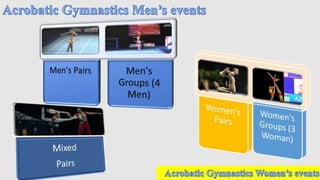
Men's Pairs
Men's Groups (4 Men)
COMMON EVENTS ACROBATIC GYMNASTICS
Women's Pairs
Women's Groups (3 Woman)
Mixed Pairs
AEROBIC GYMNASTICS
Individual Men
Mixed Pairs
Trios
Groups
Dance
Step
AEROBIC GYMNASTICS
Individual Women
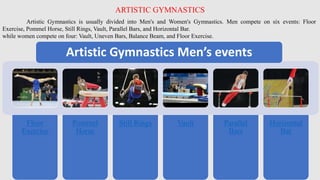
Artistic Gymnastics is usually divided into Men's and Women's Gymnastics. Men compete on six events: Floor
Exercise, Pommel Horse, Still Rings, Vault, Parallel Bars, and Horizontal Bar.
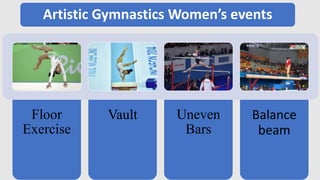
while women compete on four: Vault, Uneven Bars, Balance Beam, and Floor Exercise.
ARTISTIC GYMNASTICS
Floor
Exercise
Pommel
Horse
Still Rings Vault Parallel
Bars
Horizontal
Bar
Artistic Gymnastics Men’s events
Floor
Exercise
Vault Uneven
Bars
Balance
beam
Artistic Gymnastics Women’s events
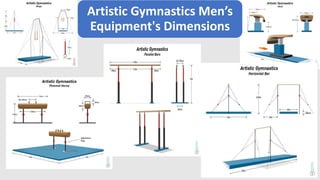
Artistic Gymnastics Men’s
Equipment's Dimensions
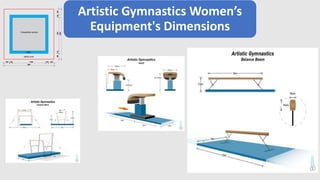
Artistic Gymnastics Women’s
Equipment's Dimensions
RHYTHMIC GYMNASTICS
This is a sport that combines elements of ballet, gymnastics, dance, and apparatus manipulation. The sport
involves the performance of five separate routines with the use of five apparatus; ball, ribbon, hoop, clubs, rope—on a
floor area, with a much greater emphasis on the aesthetic rather than the acrobatic. There are also group routines
consisting of 5 gymnasts and 5 apparatuses of their choice. Rhythmic routines are scored out of a possible 30 points;
the score for artistry (choreography and music) is averaged with the score for difficulty of the moves and then added to
the score for execution.
The first World Championships were held in 1963 with its first appearance at the Olympics in 1984.
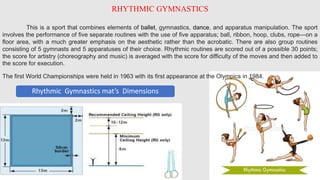
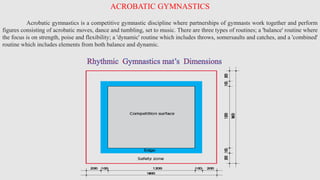
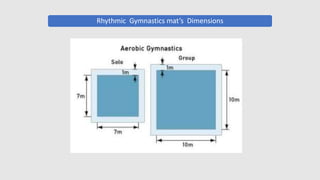
Rhythmic Gymnastics mat’s Dimensions
TRAMPOLINE GYMNASTICS
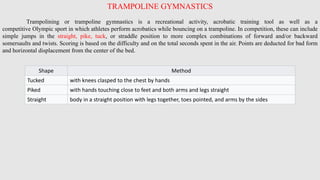
Trampolining or trampoline gymnastics is a recreational activity, acrobatic training tool as well as a
competitive Olympic sport in which athletes perform acrobatics while bouncing on a trampoline. In competition, these can include
simple jumps in the straight, pike, tuck, or straddle position to more complex combinations of forward and/or backward
somersaults and twists. Scoring is based on the difficulty and on the total seconds spent in the air. Points are deducted for bad form
and horizontal displacement from the center of the bed.
Shape Method
Tucked with knees clasped to the chest by hands
Piked with hands touching close to feet and both arms and legs straight
Straight body in a straight position with legs together, toes pointed, and arms by the sides
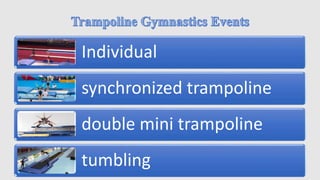
Individual
synchronized trampoline
double mini trampoline
tumbling
ACROBATIC GYMNASTICS
Acrobatic gymnastics is a competitive gymnastic discipline where partnerships of gymnasts work together and perform
figures consisting of acrobatic moves, dance and tumbling, set to music. There are three types of routines; a 'balance' routine where
the focus is on strength, poise and flexibility; a 'dynamic' routine which includes throws, somersaults and catches, and a 'combined'
routine which includes elements from both balance and dynamic.
AEROBIC GYMNASTICS
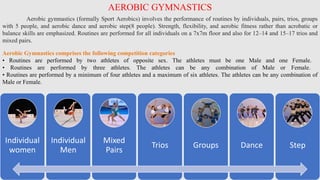
Aerobic gymnastics (formally Sport Aerobics) involves the performance of routines by individuals, pairs, trios, groups
with 5 people, and aerobic dance and aerobic step(8 people). Strength, flexibility, and aerobic fitness rather than acrobatic or
balance skills are emphasized. Routines are performed for all individuals on a 7x7m floor and also for 12–14 and 15–17 trios and
mixed pairs.
Individual
women
Individual
Men
Mixed
Pairs
Trios Groups Dance Step
Aerobic Gymnastics comprises the following competition categories
• Routines are performed by two athletes of opposite sex. The athletes must be one Male and one Female.
• Routines are performed by three athletes. The athletes can be any combination of Male or Female.
• Routines are performed by a minimum of four athletes and a maximum of six athletes. The athletes can be any combination of
Male or Female.
Rhythmic Gymnastics mat’s Dimensions

Gymnastics Events & Equipment Dimensions

  • 1.
    Gymnastics Federation ofIndia Gymnastics By- AZHAR HUSSAIN ANSARI DEPARTMENT OF PHYSICAL EDUCATION BIRLA CAMPUS H.N.B.G.U. SRINAGAR GARHWAL
  • 2.
    Gymnastics Gymnastics is asport that includes physical exercises requiring balance, strength, flexibility, agility, coordination, and endurance. The movements involved in gymnastics contribute to the development of the arms, legs, shoulders, back, chest, and abdominal muscle groups.
  • 3.
    Gymnastics' Events Men’s EventsWomen’s Events ARTISTIC GYMNASTICS Floor Exercise, Pommel Horse, Still Rings, Vault, Parallel Bars, and Horizontal Bar ARTISTIC GYMNASTICS Vault, Uneven Bars, Balance Beam, and Floor Exercise RHYTHMIC GYMNASTICS ball, ribbon, hoop, clubs, rope TRAMPOLINE GYMNASTICS individual and synchronized trampoline, double mini trampoline, and tumbling TRAMPOLINE GYMNASTICS individual and synchronized trampoline, double mini trampoline, and tumbling ACROBATIC GYMNASTICS Men's Pairs Men's Groups (4 Men) COMMON EVENTS ACROBATIC GYMNASTICS Women's Pairs Women's Groups (3 Woman) Mixed Pairs AEROBIC GYMNASTICS Individual Men Mixed Pairs Trios Groups Dance Step AEROBIC GYMNASTICS Individual Women
  • 4.
    Artistic Gymnastics isusually divided into Men's and Women's Gymnastics. Men compete on six events: Floor Exercise, Pommel Horse, Still Rings, Vault, Parallel Bars, and Horizontal Bar. while women compete on four: Vault, Uneven Bars, Balance Beam, and Floor Exercise. ARTISTIC GYMNASTICS Floor Exercise Pommel Horse Still Rings Vault Parallel Bars Horizontal Bar Artistic Gymnastics Men’s events
  • 5.
  • 6.
  • 7.
  • 8.
    RHYTHMIC GYMNASTICS This isa sport that combines elements of ballet, gymnastics, dance, and apparatus manipulation. The sport involves the performance of five separate routines with the use of five apparatus; ball, ribbon, hoop, clubs, rope—on a floor area, with a much greater emphasis on the aesthetic rather than the acrobatic. There are also group routines consisting of 5 gymnasts and 5 apparatuses of their choice. Rhythmic routines are scored out of a possible 30 points; the score for artistry (choreography and music) is averaged with the score for difficulty of the moves and then added to the score for execution. The first World Championships were held in 1963 with its first appearance at the Olympics in 1984. Rhythmic Gymnastics mat’s Dimensions
  • 9.
    TRAMPOLINE GYMNASTICS Trampolining ortrampoline gymnastics is a recreational activity, acrobatic training tool as well as a competitive Olympic sport in which athletes perform acrobatics while bouncing on a trampoline. In competition, these can include simple jumps in the straight, pike, tuck, or straddle position to more complex combinations of forward and/or backward somersaults and twists. Scoring is based on the difficulty and on the total seconds spent in the air. Points are deducted for bad form and horizontal displacement from the center of the bed. Shape Method Tucked with knees clasped to the chest by hands Piked with hands touching close to feet and both arms and legs straight Straight body in a straight position with legs together, toes pointed, and arms by the sides
  • 10.
  • 11.
    ACROBATIC GYMNASTICS Acrobatic gymnasticsis a competitive gymnastic discipline where partnerships of gymnasts work together and perform figures consisting of acrobatic moves, dance and tumbling, set to music. There are three types of routines; a 'balance' routine where the focus is on strength, poise and flexibility; a 'dynamic' routine which includes throws, somersaults and catches, and a 'combined' routine which includes elements from both balance and dynamic.
  • 13.
    AEROBIC GYMNASTICS Aerobic gymnastics(formally Sport Aerobics) involves the performance of routines by individuals, pairs, trios, groups with 5 people, and aerobic dance and aerobic step(8 people). Strength, flexibility, and aerobic fitness rather than acrobatic or balance skills are emphasized. Routines are performed for all individuals on a 7x7m floor and also for 12–14 and 15–17 trios and mixed pairs. Individual women Individual Men Mixed Pairs Trios Groups Dance Step Aerobic Gymnastics comprises the following competition categories • Routines are performed by two athletes of opposite sex. The athletes must be one Male and one Female. • Routines are performed by three athletes. The athletes can be any combination of Male or Female. • Routines are performed by a minimum of four athletes and a maximum of six athletes. The athletes can be any combination of Male or Female.
  • 14.