2014 年能源科學教育研討會
1
能源科學教育研討會
新知識、新希望、新願景
會 議 手 冊
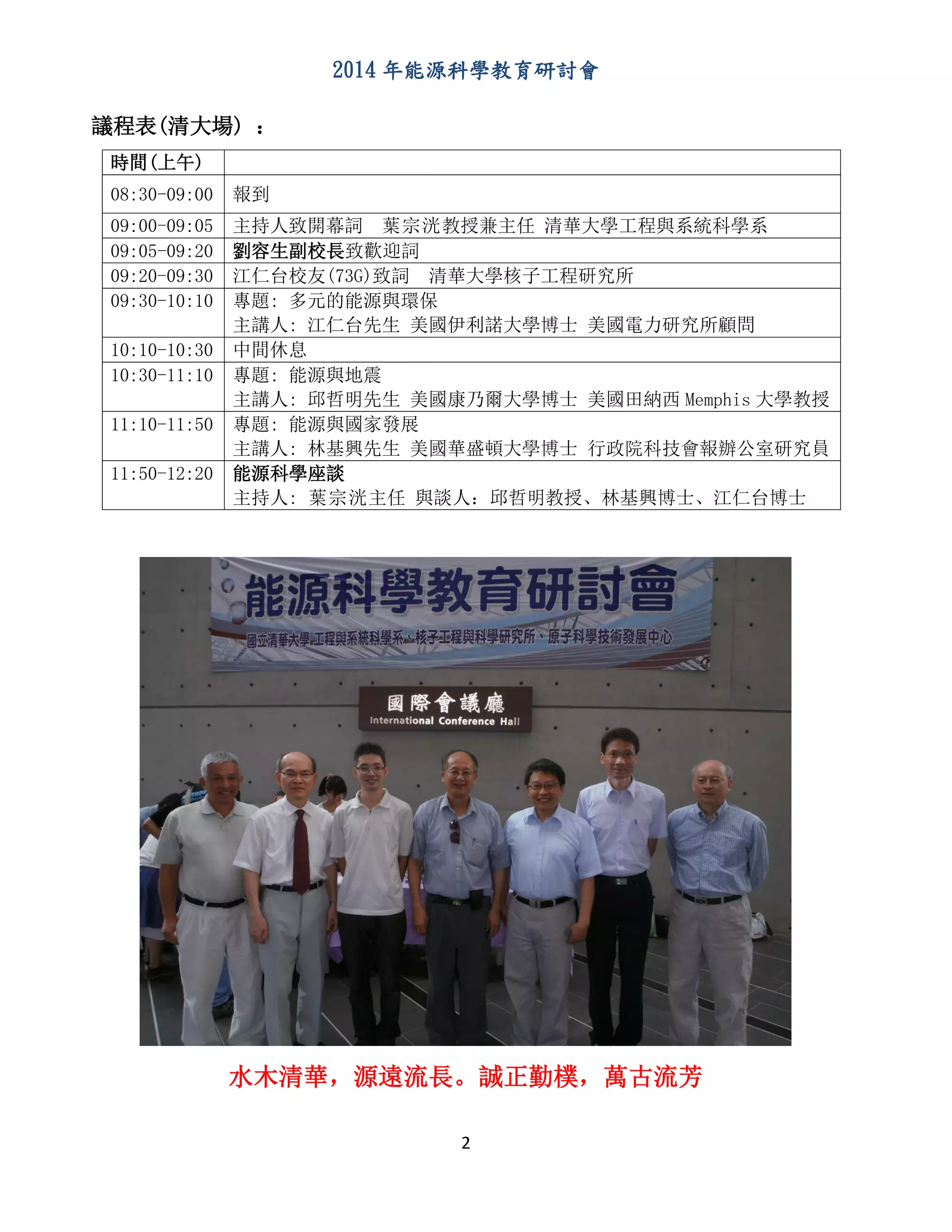
2014 年 7 月 19 日 (六) 清華大學旺宏館國際會議廳
2014 年 7 月 20 日 (日) 臺灣師範大學公館校區國際會議廳
國立臺灣師範大學、國立清華大學主辦
2014 年能源科學教育研討會
2
議程表(清大場) :
時間(上午)
08:30-09:00 報到
09:00-09:05 主持人致開幕詞 葉宗洸教授兼主任 清華大學工程與系統科學系
09:05-09:20 劉容生副校長致歡迎詞
09:20-09:30 江仁台校友(73G)致詞 清華大學核子工程研究所
09:30-10:10 專題: 多元的能源與環保
主講人: 江仁台先生 美國伊利諾大學博士 美國電力研究所顧問
10:10-10:30 中間休息
10:30-11:10 專題: 能源與地震
主講人: 邱哲明先生 美國康乃爾大學博士 美國田納西 Memphis 大學教授
11:10-11:50 專題: 能源與國家發展
主講人: 林基興先生 美國華盛頓大學博士 行政院科技會報辦公室研究員
11:50-12:20 能源科學座談
主持人: 葉宗洸主任 與談人:邱哲明教授、林基興博士、江仁台博士
水木清華,源遠流長。誠正勤樸,萬古流芳
2014 年能源科學教育研討會
3
議程表 (師大場) :
時間(上午)
08:30-09:00 報到
09:00-09:05 主持人致開幕詞 吳文欽教授兼主任 臺灣師範大學物理學系
09:05-09:15 江仁台校友(59 級)致詞 臺灣師範大學物理學系
09:15-09:30 貴賓致詞: 梁啟源董事長 中華經濟研究院
09:30-10:10 專題: 多元的能源與環保
主講人: 江仁台先生 美國伊利諾大學博士 美國電力研究所顧問
10:10-10:50 專題: 能源與地震
主講人: 邱哲明先生 美國康乃爾大學博士 美國田納西 Memphis 大學教授
10:50-11:30 專題: 能源與國家發展
主講人: 林基興先生 美國華盛頓大學博士 行政院科技會報辦公室研究員
11:30-12:00 能源科學座談
主持人: 吳文欽主任 與談人:邱哲明教授、林基興博士、江仁台博士
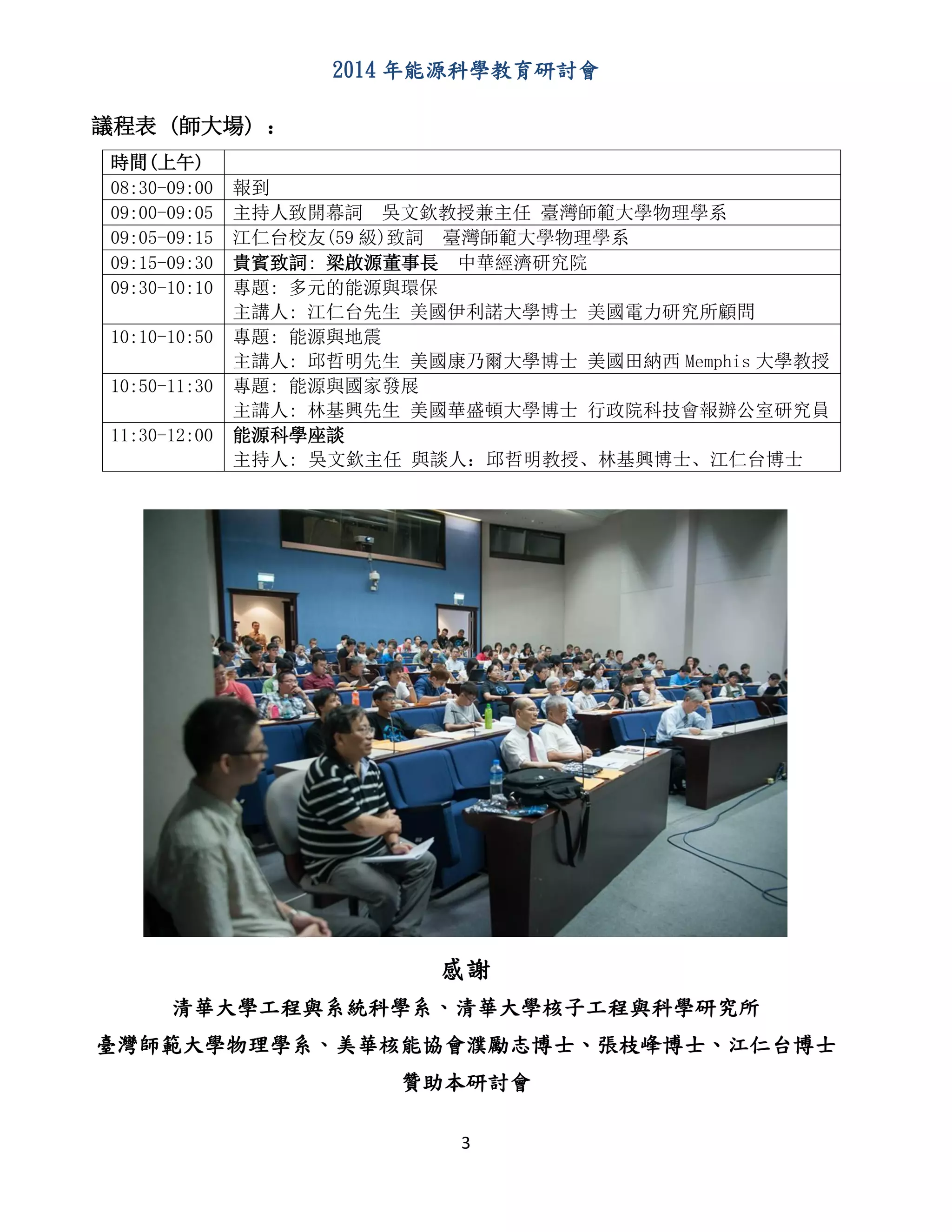
感謝
清華大學工程與系統科學系、清華大學核子工程與科學研究所
臺灣師範大學物理學系、美華核能協會濮勵志博士、張枝峰博士、江仁台博士
贊助本研討會
2014 年能源科學教育研討會
4
多元的能源與環保
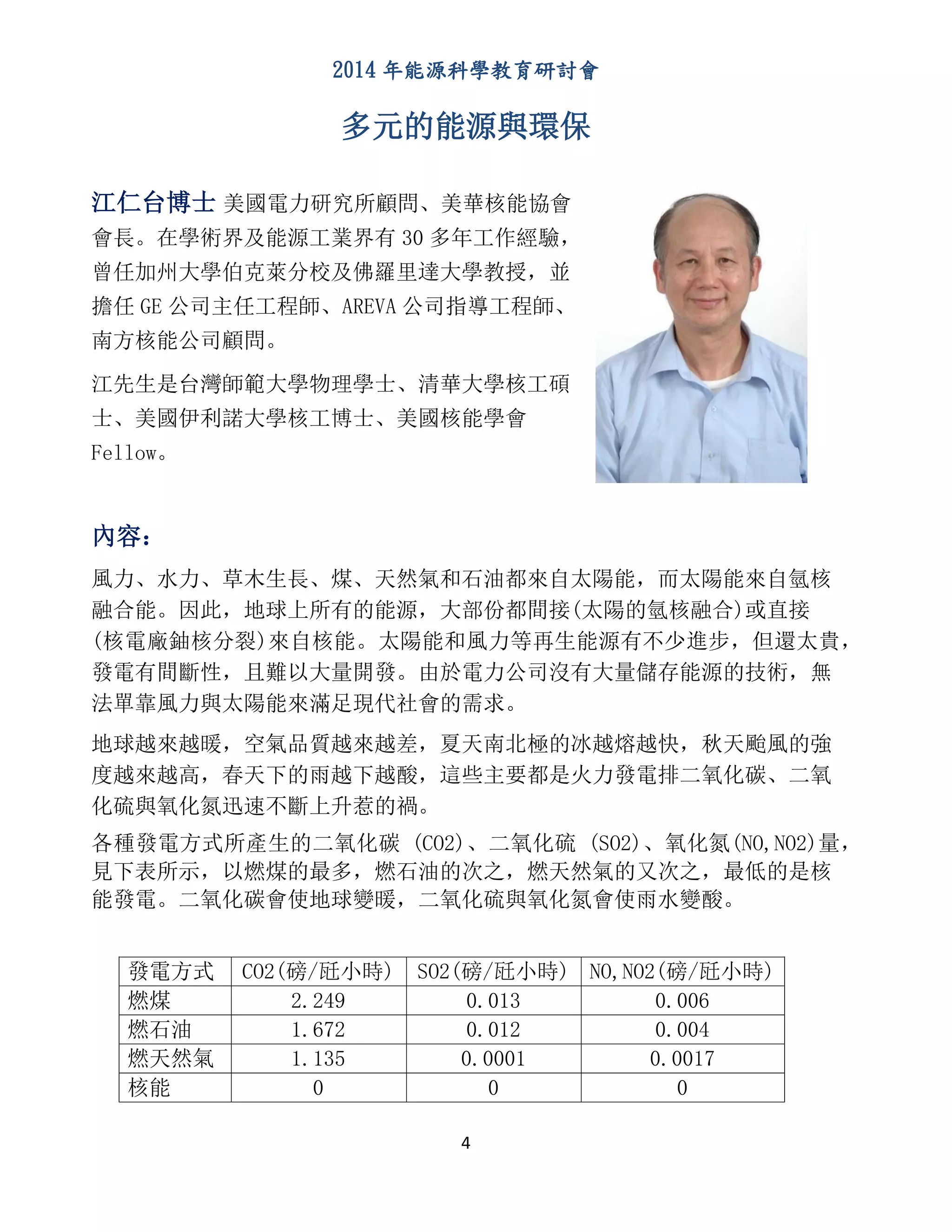
江仁台博士 美國電力研究所顧問、美華核能協會
會長。在學術界及能源工業界有 30 多年工作經驗,
曾任加州大學伯克萊分校及佛羅里達大學教授,並
擔任 GE 公司主任工程師、AREVA 公司指導工程師、
南方核能公司顧問。
江先生是台灣師範大學物理學士、清華大學核工碩
士、美國伊利諾大學核工博士、美國核能學會
Fellow。
內容:
風力、水力、草木生長、煤、天然氣和石油都來自太陽能,而太陽能來自氫核
融合能。因此,地球上所有的能源,大部份都間接(太陽的氫核融合)或直接
(核電廠鈾核分裂)來自核能。太陽能和風力等再生能源有不少進步,但還太貴,
發電有間斷性,且難以大量開發。由於電力公司沒有大量儲存能源的技術,無
法單靠風力與太陽能來滿足現代社會的需求。
地球越來越暖,空氣品質越來越差,夏天南北極的冰越熔越快,秋天颱風的強
度越來越高,春天下的雨越下越酸,這些主要都是火力發電排二氧化碳、二氧
化硫與氧化氮迅速不斷上升惹的禍。
各種發電方式所產生的二氧化碳 (CO2)、二氧化硫 (SO2)、氧化氮(NO,NO2)量,
見下表所示,以燃煤的最多,燃石油的次之,燃天然氣的又次之,最低的是核
能發電。二氧化碳會使地球變暖,二氧化硫與氧化氮會使雨水變酸。
發電方式 CO2(磅/瓩小時) SO2(磅/瓩小時) NO,NO2(磅/瓩小時)
燃煤 2.249 0.013 0.006
燃石油 1.672 0.012 0.004
燃天然氣 1.135 0.0001 0.0017
核能 0 0 0
2014 年能源科學教育研討會
5
環保與溫室氣體排放量
台灣溫室氣體的總排放量,從 1990 年的 138.3 百萬公噸二氧化碳當量,上升
至 2010 年的 274.7 百萬公噸二氧化碳當量,約計成長 98.6%。台灣 2010 年溫
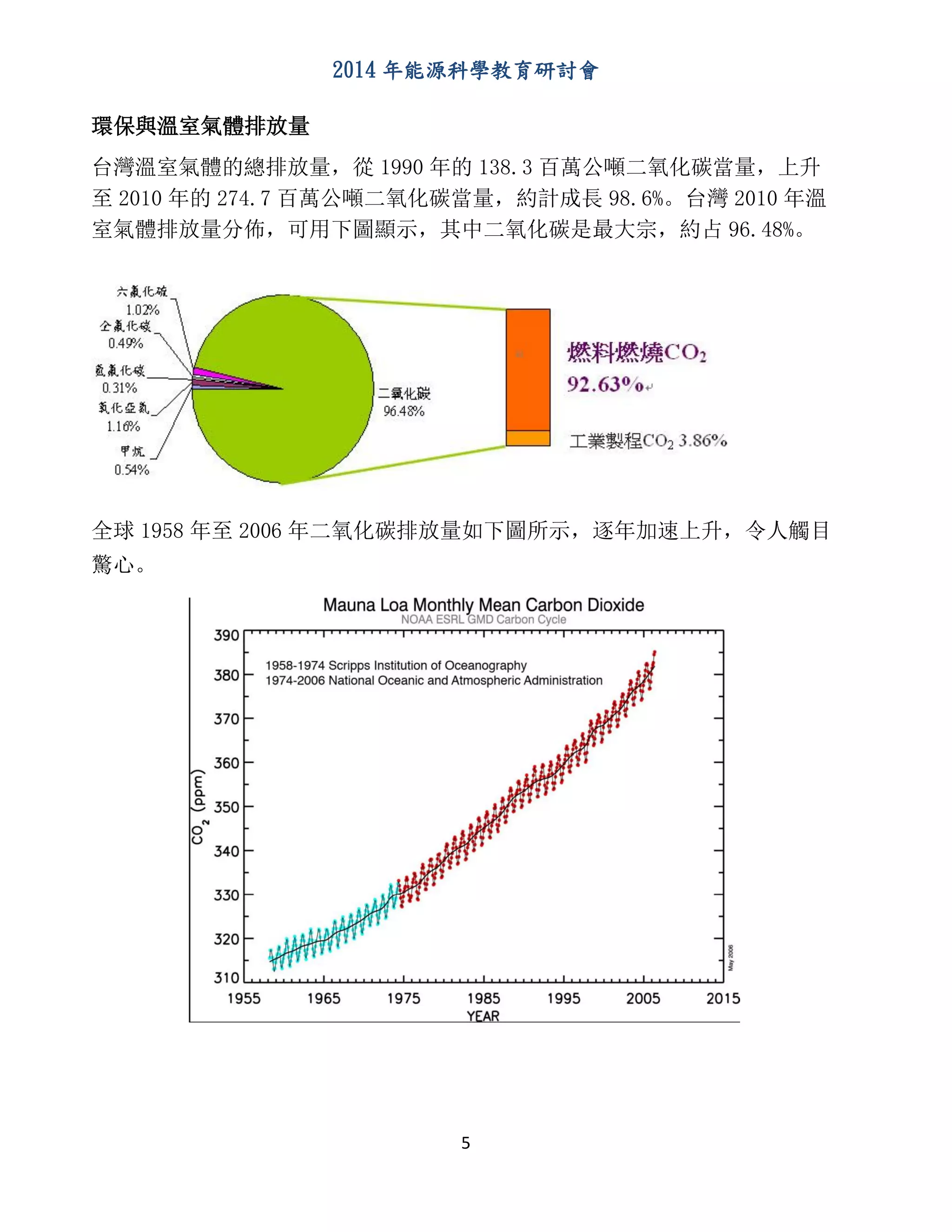
室氣體排放量分佈,可用下圖顯示,其中二氧化碳是最大宗,約占 96.48%。
全球 1958 年至 2006 年二氧化碳排放量如下圖所示,逐年加速上升,令人觸目
驚心。
2014 年能源科學教育研討會
6
全球變暖已經影響到世界各地,包括增長損壞的珊瑚礁,冰川融化,更持久的
乾旱,更糟糕的事情是海平面上升、動植物種的喪失和農業產量的萎縮。
為了避免了這種命運,需要大幅減少溫室氣體排放量,這意味著必須改革生產
和消費能源的方式。
美國總統歐巴馬上(6)月 2 日宣布推動美國環境保護署的一項提案:在 2030 年
之前,把美國電廠的二氧化碳排放量,按 2005 年的標準減少 30%。瞄準的目標
是全美碳汙染的最大來源,即 600 多家火力發電廠。
能源風險比較
在歐洲,每年死於煤、油及天然氣工業的事故超過 500 人。全世界每年死於因
燃燒煤導致呼吸道疾病者,超過 170,000 人。
製造太陽能板是一個涉及十分劇毒的過程,釋放出多種對人體健康有害的汙染
物。安裝太陽能板也牽涉到兩種最危險的行業,屋頂作業以及電路作業。統計
屋頂作業及太陽能板安裝作業數據,發現在這行業裏,每 10 的 12 次方瓦小時
(TWh)的發電量,會造成兩人死於自屋頂掉落。核能發電每 TWh 的發電量,只
造成 0.05 人死亡(含括所有的原因,甚至爐心熔解)。
60 年來核電運轉,全球有三次嚴重核電事故。三哩島二號機事故,沒有造成人
員死亡,而且附近民眾並無任何可察覺到的健康問題,因此三哩島一號機仍在
正常運轉。車諾比核電廠是俄式,台灣的核電廠是美式,車諾比核災不會在台
灣發生。福島事件中,沒有一個人因為輻射照射而死亡,2013 年世界衛生組織
《健康風險評估》指出,99%居民的外部劑量低於 10 毫西弗,99.9%居民的內
部劑量低於 1 毫西弗。因此,電廠附近的人會有長時期輻射健康問題是微乎其
微的。
1 西弗相當於 1 公斤的人體經 X 光照射後,吸收 1 焦耳的輻射能量(1 公斤人體
的體溫將升高約 0.24 攝式度)。最低安全標準是,每人每年接受的輻射劑量不
能超過 50 毫西弗 ,而且一年中任何一季人體接受的輻射劑量不能超過 25 毫
西弗。人們每年所得平均的背景輻射劑量約為 3.012 毫西弗, 包括自然輻射
劑量 2.40 毫西弗 和人造輻射劑量 0.612 毫西弗。
2014 年能源科學教育研討會
7
美國能源近況
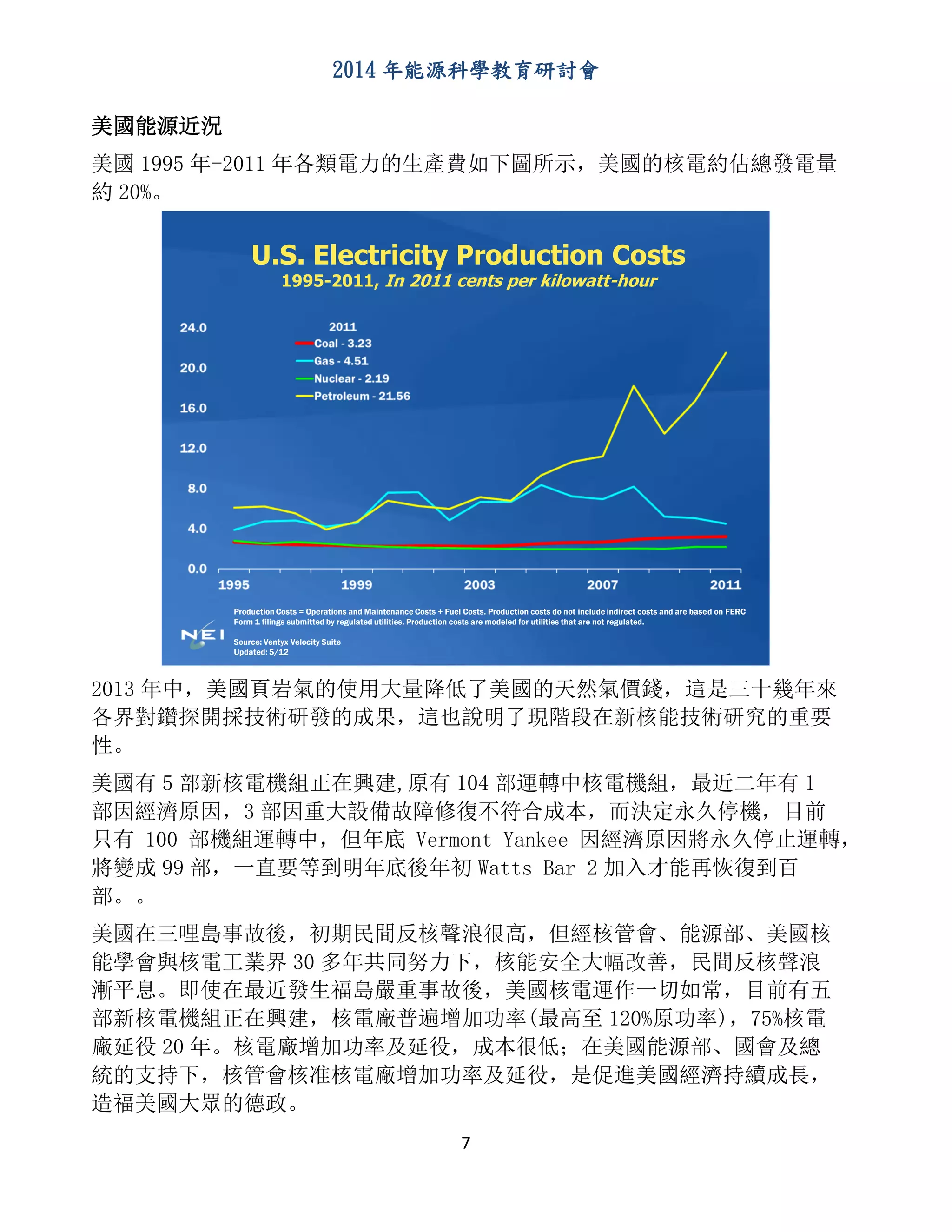
美國 1995 年-2011 年各類電力的生產費如下圖所示,美國的核電約佔總發電量
約 20%。
U.S. Electricity Production Costs
1995-2011, In 2011 cents per kilowatt-hour
Production Costs = Operations and Maintenance Costs + Fuel Costs. Production costs do not include indirect costs and are based on FERC
Form 1 filings submitted by regulated utilities. Production costs are modeled for utilities that are not regulated.
Source: Ventyx Velocity Suite
Updated: 5/12
2013 年中,美國頁岩氣的使用大量降低了美國的天然氣價錢,這是三十幾年來
各界對鑽探開採技術研發的成果,這也說明了現階段在新核能技術研究的重要
性。
美國有 5 部新核電機組正在興建,原有 104 部運轉中核電機組,最近二年有 1
部因經濟原因,3 部因重大設備故障修復不符合成本,而決定永久停機,目前
只有 100 部機組運轉中,但年底 Vermont Yankee 因經濟原因將永久停止運轉,
將變成 99 部,一直要等到明年底後年初 Watts Bar 2 加入才能再恢復到百
部。。
美國在三哩島事故後,初期民間反核聲浪很高,但經核管會、能源部、美國核
能學會與核電工業界 30 多年共同努力下,核能安全大幅改善,民間反核聲浪
漸平息。即使在最近發生福島嚴重事故後,美國核電運作一切如常,目前有五
部新核電機組正在興建,核電廠普遍增加功率(最高至 120%原功率),75%核電
廠延役 20 年。核電廠增加功率及延役,成本很低;在美國能源部、國會及總
統的支持下,核管會核准核電廠增加功率及延役,是促進美國經濟持續成長,
造福美國大眾的德政。
2014 年能源科學教育研討會
8
德國能源近況
2012 年德國電力為 70%化石燃料、5%太陽能、7%風力和 18%核能。德國雖產低
價煤填補廢核的部份缺口,但再生能源成本很高,2013 年德國住宅電價約為台
灣的 4 倍。德國表面上決定「非核家園」政策,但可從接壤的法國購買不足的
核電(法國 79%為核電),又受到俄國特別照顧,輸入廉價燃油和天然氣。為解
決再生能源高比例影響電網穩定,德國投入巨資(200 億歐元)更新電網,但
受民眾抗爭而建置進度嚴重落後,昂貴電費導致產業外移與員工失業。
英國能源與環保近況
英國風險專家所做能源風險的研究,舉福島核災中因海嘯死亡的人數、比核災
多得多的例子,認為氣候風險遠大於核能風險,因為氣候風險無法控制,但核
災的風險卻可以控制。
英國在福島核災後,支持核電的民調不降反增,就是因為大多數的英國人,覺
得氣候變遷的風險,大過核災的風險。英國的環保人士、生態學家,也大都支
持這種看法。目前,英國正在招標建新核電廠,英國對 GE 製造、與龍門核四
廠同型的進步型沸水式核反應爐(ABWR) ,很有興趣,很可能會到日本 ABWR 各
廠與龍門核四廠考察、取經。
法國能源近況
法國在深受 1974 年能源危機之苦後,大力發展核能發電,目前核電佔法國總
發電量的 79%,還賣電到因減核電而缺電的德國賺錢。因為大量的使用核電,
法國是排放二氧化碳最低的工業國。
台灣能源近況
2012 年台灣電力為 40.7%燃煤、30.2%燃氣、2.5%燃油、3.4%太陽能與風力、
3.4%汽電共生 18.4%核能和 1.4%抽蓄水力。台電每度電的發電成本,核能
0.69 元,天然氣發電是核能的 4.7 倍,而每度電成本高達 5.96 元的燃油,更
是核能的 8.6 倍,台電因此盡量利用核能,而閒置其他發電機組。
在台灣,由於天然氣須加液化費及長途運費,無論美國產地的天然氣費用多低,
加液化和長途運費後,天然氣在台灣的價錢比美國就高出許多。此外,台灣是
島國,還有短期儲存量(約一週)和戰時運輸的關鍵問題。
太陽能、風能等各類再生能源,發展受制於氣候和土地條件,發電有間斷性,
且難以大量開發,實際應用上各有先天限制,勉強只能做到輔助角色。
2014 年能源科學教育研討會
9
未來能源與環保需求
為避免排放溫室氣體造成地球溫度危險上升,未來四十年內,需要減少 80%二
氧化碳排放,但同時又面臨二至三倍全球的能源需求。因此,需要能產生大量
「零碳」排放的廉價能源,目前看起來核能是唯一辦得到的能源。
核能安全與效益
核電的安全是可以控制的,核廢料是可以處理的,核電的發電成本是最便宜和
穩定的,核電不會排放二氧化碳。
台灣已經商轉的核一、核二、核三電廠,商轉的安全記錄良好。當年,核一、
核二、核三都是台灣成功的大建設,三十多年來,三座核能電廠所發的廉價電
力,對促進台灣的環保和經濟發展貢獻良多。
核四採用進步型沸水式反應爐的安全功能包括:一)反應爐提高了爐內泵的性
能,同時省略了大型外循環泵。二)全數位化反應爐的保護系統,確保高水準
的可靠性和簡化了安全檢測和應變能力。三)全數位化反應爐控制系統使得控
制室可容易的、更快速的控制電廠的營運和流程。四)改進緊急爐心冷卻系統,
提供了對預防事故發生一個非常高水準的保障。
嚴重事故後,反應爐將立即停機。衰變熱將被餘熱移除系統排出,緊急爐心冷
卻系統將啟動。萬一電廠停電,進步型沸水式反應爐可完全自動化解沒有冷卻
水的事故,而且運轉員可以三天不需操作。三天內,運轉員只須補充緊急冷卻
系統供水。這些改進使反應爐明顯的比以前更安全。GE公司的安全度評估顯示,
爐心損壞事件發生的或然率不超過六百萬年一次,進步型沸水式反應爐爐心損
壞機率為1.6×10⁻⁷。
核四進步型沸水式反應爐的優點包括︰一) 核四進步型沸水式反應爐比核一沸
水式第四代和核二沸水式第六代更安全。二) 核四進步型沸水式反應爐之發電
功率(1350MW)比核二沸水六式發電功率(985MW)與核一沸水四式(636MW)
能提供更充裕的電力供應。三)滿足台灣北部高電力的需求。
台灣核電現況
受「非核家園」思維的影響,台灣目前核四廠一號機計劃封存、二號機停建,
核一、核二和核三廠所有的六部機組,計劃在運轉發電四十年後,全部不再延
役。技術上,各機組增加功率及延役二十年的商業運轉毫無問題。不再增加功
率及延役,完全是為了達成「非核家園」的政治決策。若延役20年以6部機組
平均每年發400億度電估計,可以替台灣額外創造至少2兆新台幣的利益,還能
大量減排二氧化碳。若增加功率,可以創造更多的額外利益。
2014 年能源科學教育研討會
10
若急廢核電,台灣為島嶼獨立電網,無外國電力可支援。根據日本停用核電的
經驗,限電將難以避免。急廢核電將導致物價將因電價大幅上漲而高漲,民眾
購買力大幅下降,對社會民生大不利,限電將造成企業競爭力衰退,外資恐裹
足不前,能外移的產業將外移,台灣的經濟前途堪憂。
核四廠是國家的重大建設,投資巨大,已接近完工。當年核准興建時,是經過
慎重評估的。巨大投資,都是民脂民膏,除非有重大缺失,完全無法補正,否
則不宜封存或廢棄。核四若商轉,不但可避免投資2838億元建廠的浪費,每天
還將增加約六千萬元的收入,除可維持低價和穩定的電源,還能大量減排二氧
化碳。
大陸核電現況
大陸有28部新核電機組正在興建,21部核電機組運轉中。大陸興建和投入運轉
核電機組的速度,相信令全世界真的是瞠目結舌。香港核電投資公司投資廣東
大亞灣核電站,佔股25%,大亞灣核電大部分售予香港。
台灣環保檢討
台灣2010年溫室氣體排放量約為1990年的兩倍,每年仍繼續迅速增長。台灣目
前的能源與環保政策是︰確保核安,穩健減核,打造綠能低碳環境,逐步邁向
「非核家園」。
由於台灣要減核,然而太陽能與風力發電難以大量開發,無法取代核電,打造
綠能低碳的環保目標將無法達成。因此,民國91年公布的「環境基本法」第23
條文︰「政府應訂定計畫,逐步達成非核家園目標…」明顯已過時。
為達到低碳的環保目標,建議「環境基本法」第23條文應改為︰「政府應執行
知核計畫,維持合理比例的核能發電,減少火力發電二氧化碳的排放量,以保
護環境,降低氣候變壞的風險。」
最佳能源與環保組合、台灣需要核電
火力發電燃料成本高,並會大量排放二氧化碳,造成空氣污染與地球溫室效應。
太陽能發電、風力發電等再生能源受制於氣候和空地,成本高,發電為間斷性
不穩定,而且難以大量開發。
台灣島缺乏煤、天然氣和石油資源,電網獨立,發展再生能源既受制於氣候和
土地條件又不穩,實在沒有放棄核電的條件。何況核電造成死亡率的風險遠小
於煤、油及天然氣工業的事故和燃煤的風險,甚至於小於太陽能發電的風險。
核電的安全是可以控制的,核廢料是可以處理的,核電的發電成本是便宜和穩
2014 年能源科學教育研討會
11
定的,而且核電幾乎不會排放二氧化碳。
就能源風險、經濟發展和環保減碳三方面綜合考量,台灣的能源和環保政策,
在加強核電安全監督的原則下,宜參照美國的能源與環保多元化,理智而且負
責的維持適度的核能發電。將國家的能源和環保政策的目標,由「非核家園」
改為「知核家園」,讓核四廠早日商轉,並將核一、核二和核三廠商轉延壽二
十年,以保障「不限電、維持合理電價、維持減碳承諾」的三大民生需求,
及提高台灣的競爭力。
2014 年能源科學教育研討會
12
Conventional and Unconventional Energy Resources and Their
Relationship to Earthquakes
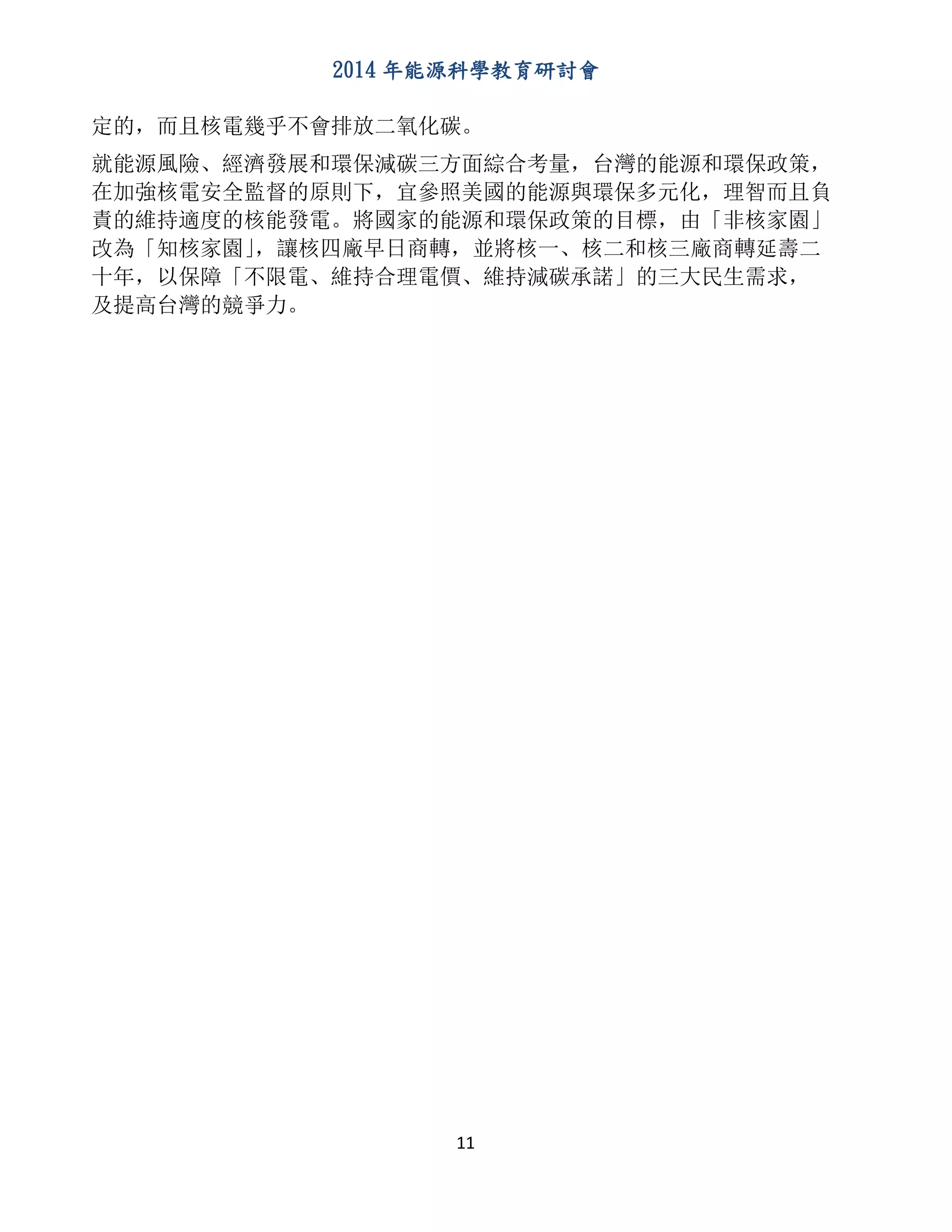
邱哲明博士 美國 Memphis 大學教授,任教 30 多年。
邱先生是美國康乃爾大學博士 中央大學地球物理碩
士、台灣師範大學物理學士。
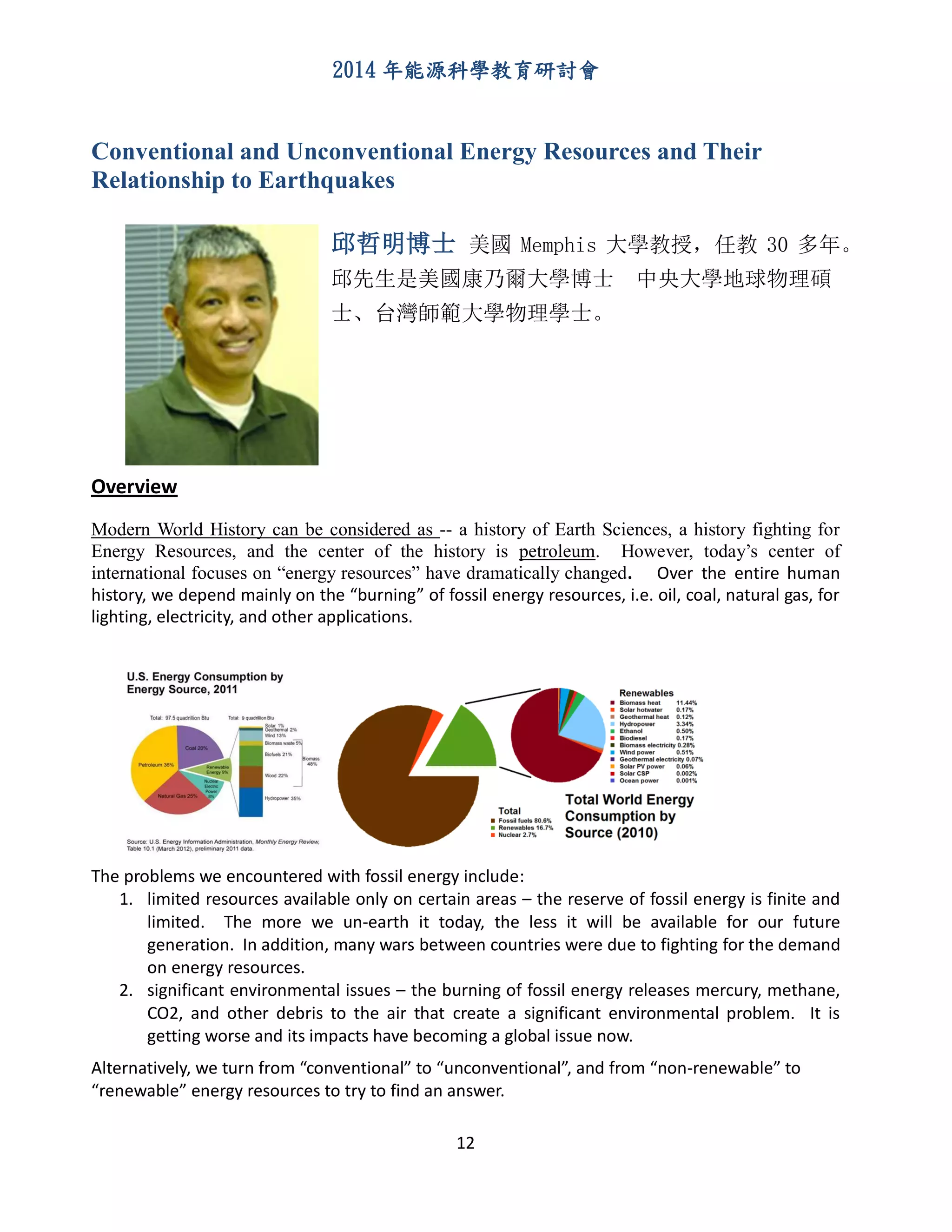
Overview
Modern World History can be considered as -- a history of Earth Sciences, a history fighting for
Energy Resources, and the center of the history is petroleum. However, today’s center of
international focuses on “energy resources” have dramatically changed. Over the entire human
history, we depend mainly on the “burning” of fossil energy resources, i.e. oil, coal, natural gas, for
lighting, electricity, and other applications.
The problems we encountered with fossil energy include:
1. limited resources available only on certain areas – the reserve of fossil energy is finite and
limited. The more we un-earth it today, the less it will be available for our future
generation. In addition, many wars between countries were due to fighting for the demand
on energy resources.
2. significant environmental issues – the burning of fossil energy releases mercury, methane,
CO2, and other debris to the air that create a significant environmental problem. It is
getting worse and its impacts have becoming a global issue now.
Alternatively, we turn from “conventional” to “unconventional”, and from “non-renewable” to
“renewable” energy resources to try to find an answer.
2014 年能源科學教育研討會
13
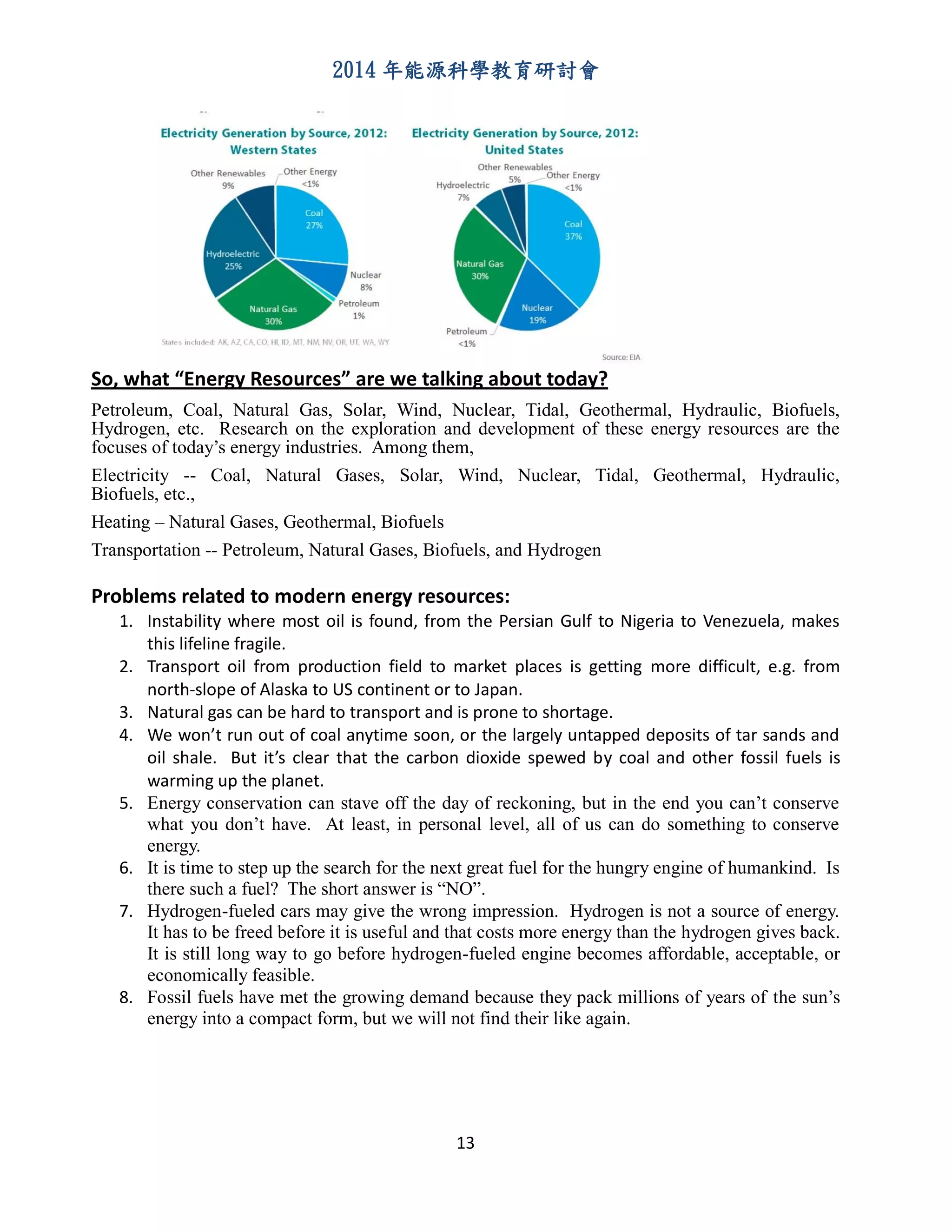
So, what “Energy Resources” are we talking about today?
Petroleum, Coal, Natural Gas, Solar, Wind, Nuclear, Tidal, Geothermal, Hydraulic, Biofuels,
Hydrogen, etc. Research on the exploration and development of these energy resources are the
focuses of today’s energy industries. Among them,
Electricity -- Coal, Natural Gases, Solar, Wind, Nuclear, Tidal, Geothermal, Hydraulic,
Biofuels, etc.,
Heating – Natural Gases, Geothermal, Biofuels
Transportation -- Petroleum, Natural Gases, Biofuels, and Hydrogen
Problems related to modern energy resources:
1. Instability where most oil is found, from the Persian Gulf to Nigeria to Venezuela, makes
this lifeline fragile.
2. Transport oil from production field to market places is getting more difficult, e.g. from
north-slope of Alaska to US continent or to Japan.
3. Natural gas can be hard to transport and is prone to shortage.
4. We won’t run out of coal anytime soon, or the largely untapped deposits of tar sands and
oil shale. But it’s clear that the carbon dioxide spewed by coal and other fossil fuels is
warming up the planet.
5. Energy conservation can stave off the day of reckoning, but in the end you can’t conserve
what you don’t have. At least, in personal level, all of us can do something to conserve
energy.
6. It is time to step up the search for the next great fuel for the hungry engine of humankind. Is
there such a fuel? The short answer is “NO”.
7. Hydrogen-fueled cars may give the wrong impression. Hydrogen is not a source of energy.
It has to be freed before it is useful and that costs more energy than the hydrogen gives back.
It is still long way to go before hydrogen-fueled engine becomes affordable, acceptable, or
economically feasible.
8. Fossil fuels have met the growing demand because they pack millions of years of the sun’s
energy into a compact form, but we will not find their like again.
2014 年能源科學教育研討會
14
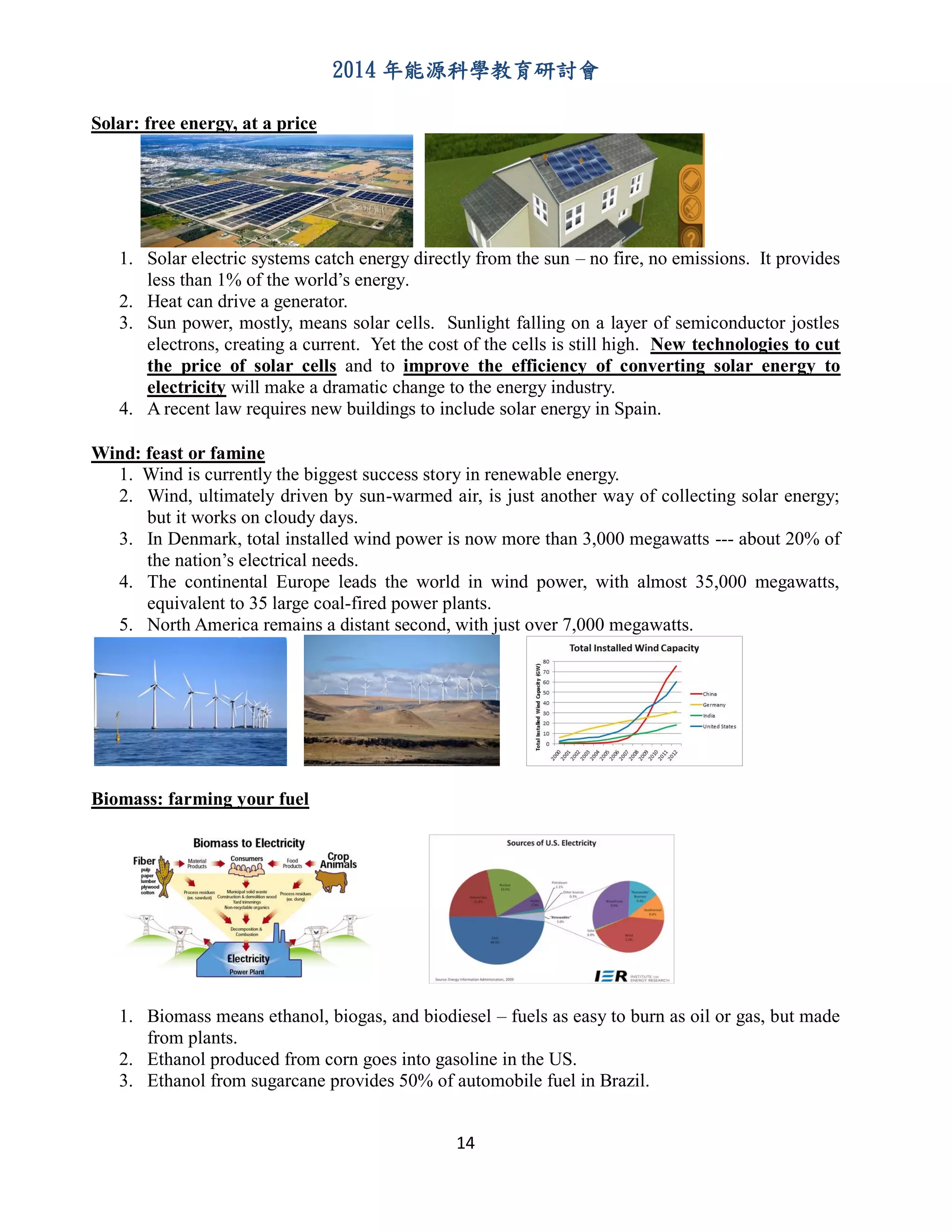
Solar: free energy, at a price
1. Solar electric systems catch energy directly from the sun – no fire, no emissions. It provides
less than 1% of the world’s energy.
2. Heat can drive a generator.
3. Sun power, mostly, means solar cells. Sunlight falling on a layer of semiconductor jostles
electrons, creating a current. Yet the cost of the cells is still high. New technologies to cut
the price of solar cells and to improve the efficiency of converting solar energy to
electricity will make a dramatic change to the energy industry.
4. A recent law requires new buildings to include solar energy in Spain.
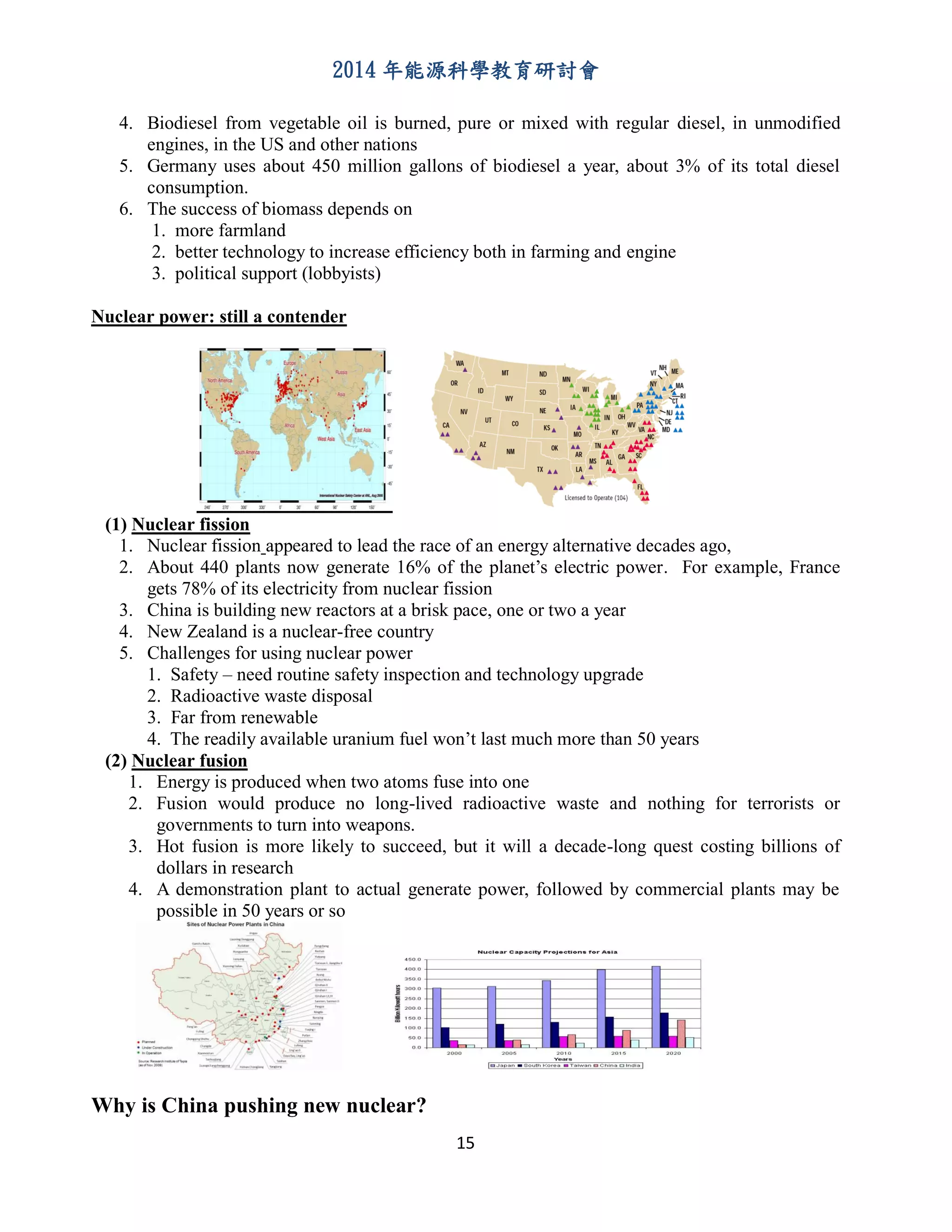
Wind: feast or famine
1. Wind is currently the biggest success story in renewable energy.
2. Wind, ultimately driven by sun-warmed air, is just another way of collecting solar energy;
but it works on cloudy days.
3. In Denmark, total installed wind power is now more than 3,000 megawatts --- about 20% of
the nation’s electrical needs.
4. The continental Europe leads the world in wind power, with almost 35,000 megawatts,
equivalent to 35 large coal-fired power plants.
5. North America remains a distant second, with just over 7,000 megawatts.
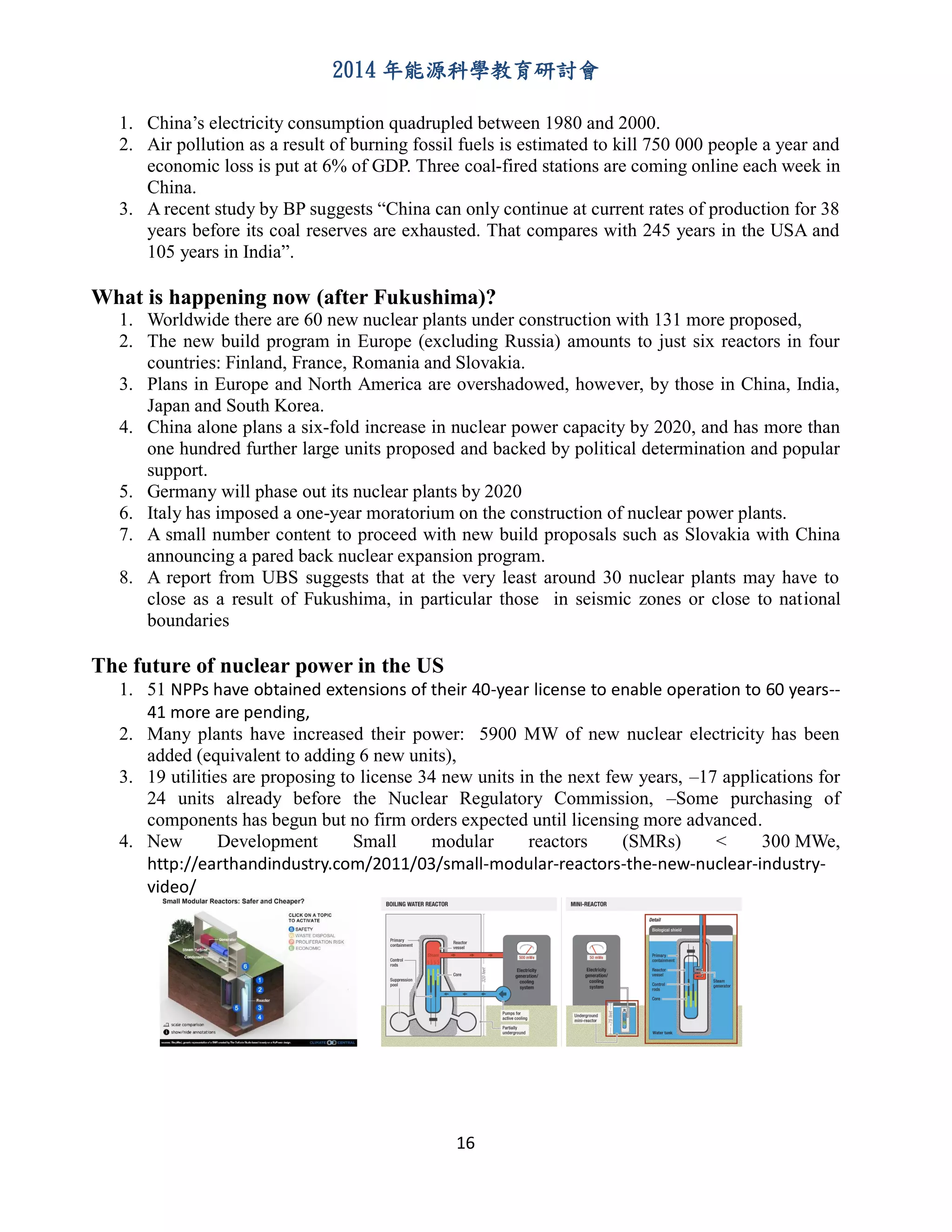
Biomass: farming your fuel
1. Biomass means ethanol, biogas, and biodiesel – fuels as easy to burn as oil or gas, but made
from plants.
2. Ethanol produced from corn goes into gasoline in the US.
3. Ethanol from sugarcane provides 50% of automobile fuel in Brazil.
2014 年能源科學教育研討會
15
4. Biodiesel from vegetable oil is burned, pure or mixed with regular diesel, in unmodified
engines, in the US and other nations
5. Germany uses about 450 million gallons of biodiesel a year, about 3% of its total diesel
consumption.
6. The success of biomass depends on
1. more farmland
2. better technology to increase efficiency both in farming and engine
3. political support (lobbyists)
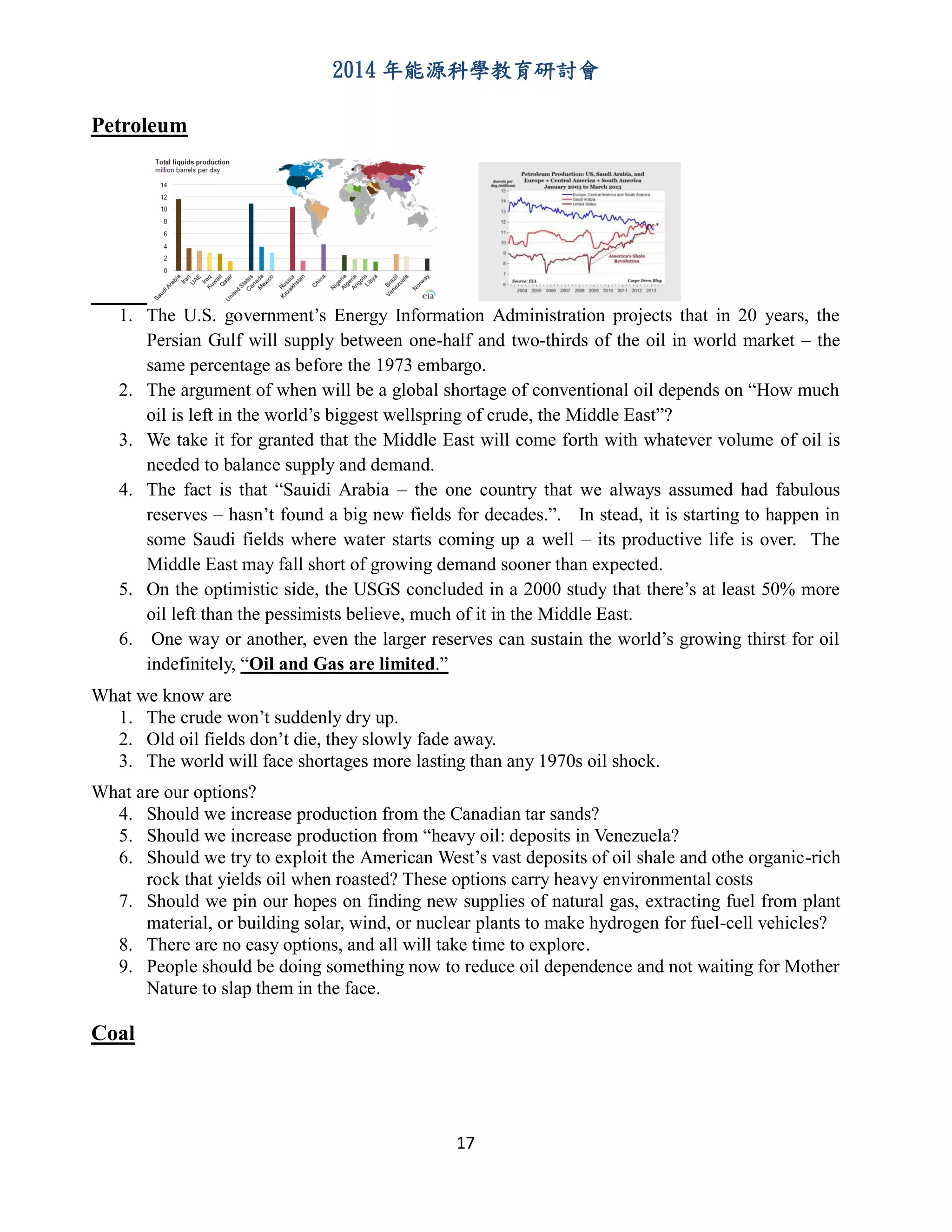
Nuclear power: still a contender
(1) Nuclear fission
1. Nuclear fission appeared to lead the race of an energy alternative decades ago,
2. About 440 plants now generate 16% of the planet’s electric power. For example, France
gets 78% of its electricity from nuclear fission
3. China is building new reactors at a brisk pace, one or two a year
4. New Zealand is a nuclear-free country
5. Challenges for using nuclear power
1. Safety – need routine safety inspection and technology upgrade
2. Radioactive waste disposal
3. Far from renewable
4. The readily available uranium fuel won’t last much more than 50 years
(2) Nuclear fusion
1. Energy is produced when two atoms fuse into one
2. Fusion would produce no long-lived radioactive waste and nothing for terrorists or
governments to turn into weapons.
3. Hot fusion is more likely to succeed, but it will a decade-long quest costing billions of
dollars in research
4. A demonstration plant to actual generate power, followed by commercial plants may be
possible in 50 years or so
Why is China pushing new nuclear?
2014 年能源科學教育研討會
16
1. China’s electricity consumption quadrupled between 1980 and 2000.
2. Air pollution as a result of burning fossil fuels is estimated to kill 750 000 people a year and
economic loss is put at 6% of GDP. Three coal-fired stations are coming online each week in
China.
3. A recent study by BP suggests “China can only continue at current rates of production for 38
years before its coal reserves are exhausted. That compares with 245 years in the USA and
105 years in India”.
What is happening now (after Fukushima)?
1. Worldwide there are 60 new nuclear plants under construction with 131 more proposed,
2. The new build program in Europe (excluding Russia) amounts to just six reactors in four
countries: Finland, France, Romania and Slovakia.
3. Plans in Europe and North America are overshadowed, however, by those in China, India,
Japan and South Korea.
4. China alone plans a six-fold increase in nuclear power capacity by 2020, and has more than
one hundred further large units proposed and backed by political determination and popular
support.
5. Germany will phase out its nuclear plants by 2020
6. Italy has imposed a one-year moratorium on the construction of nuclear power plants.
7. A small number content to proceed with new build proposals such as Slovakia with China
announcing a pared back nuclear expansion program.
8. A report from UBS suggests that at the very least around 30 nuclear plants may have to
close as a result of Fukushima, in particular those in seismic zones or close to national
boundaries
The future of nuclear power in the US
1. 51 NPPs have obtained extensions of their 40-year license to enable operation to 60 years--
41 more are pending,
2. Many plants have increased their power: 5900 MW of new nuclear electricity has been
added (equivalent to adding 6 new units),
3. 19 utilities are proposing to license 34 new units in the next few years, –17 applications for
24 units already before the Nuclear Regulatory Commission, –Some purchasing of
components has begun but no firm orders expected until licensing more advanced.
4. New Development Small modular reactors (SMRs) < 300 MWe,
http://earthandindustry.com/2011/03/small-modular-reactors-the-new-nuclear-industry-
video/
2014 年能源科學教育研討會
17
Petroleum
1. The U.S. government’s Energy Information Administration projects that in 20 years, the
Persian Gulf will supply between one-half and two-thirds of the oil in world market – the
same percentage as before the 1973 embargo.
2. The argument of when will be a global shortage of conventional oil depends on “How much
oil is left in the world’s biggest wellspring of crude, the Middle East”?
3. We take it for granted that the Middle East will come forth with whatever volume of oil is
needed to balance supply and demand.
4. The fact is that “Sauidi Arabia – the one country that we always assumed had fabulous
reserves – hasn’t found a big new fields for decades.”. In stead, it is starting to happen in
some Saudi fields where water starts coming up a well – its productive life is over. The
Middle East may fall short of growing demand sooner than expected.
5. On the optimistic side, the USGS concluded in a 2000 study that there’s at least 50% more
oil left than the pessimists believe, much of it in the Middle East.
6. One way or another, even the larger reserves can sustain the world’s growing thirst for oil
indefinitely, “Oil and Gas are limited.”
What we know are
1. The crude won’t suddenly dry up.
2. Old oil fields don’t die, they slowly fade away.
3. The world will face shortages more lasting than any 1970s oil shock.
What are our options?
4. Should we increase production from the Canadian tar sands?
5. Should we increase production from “heavy oil: deposits in Venezuela?
6. Should we try to exploit the American West’s vast deposits of oil shale and othe organic-rich
rock that yields oil when roasted? These options carry heavy environmental costs
7. Should we pin our hopes on finding new supplies of natural gas, extracting fuel from plant
material, or building solar, wind, or nuclear plants to make hydrogen for fuel-cell vehicles?
8. There are no easy options, and all will take time to explore.
9. People should be doing something now to reduce oil dependence and not waiting for Mother
Nature to slap them in the face.
Coal
2014 年能源科學教育研討會
18
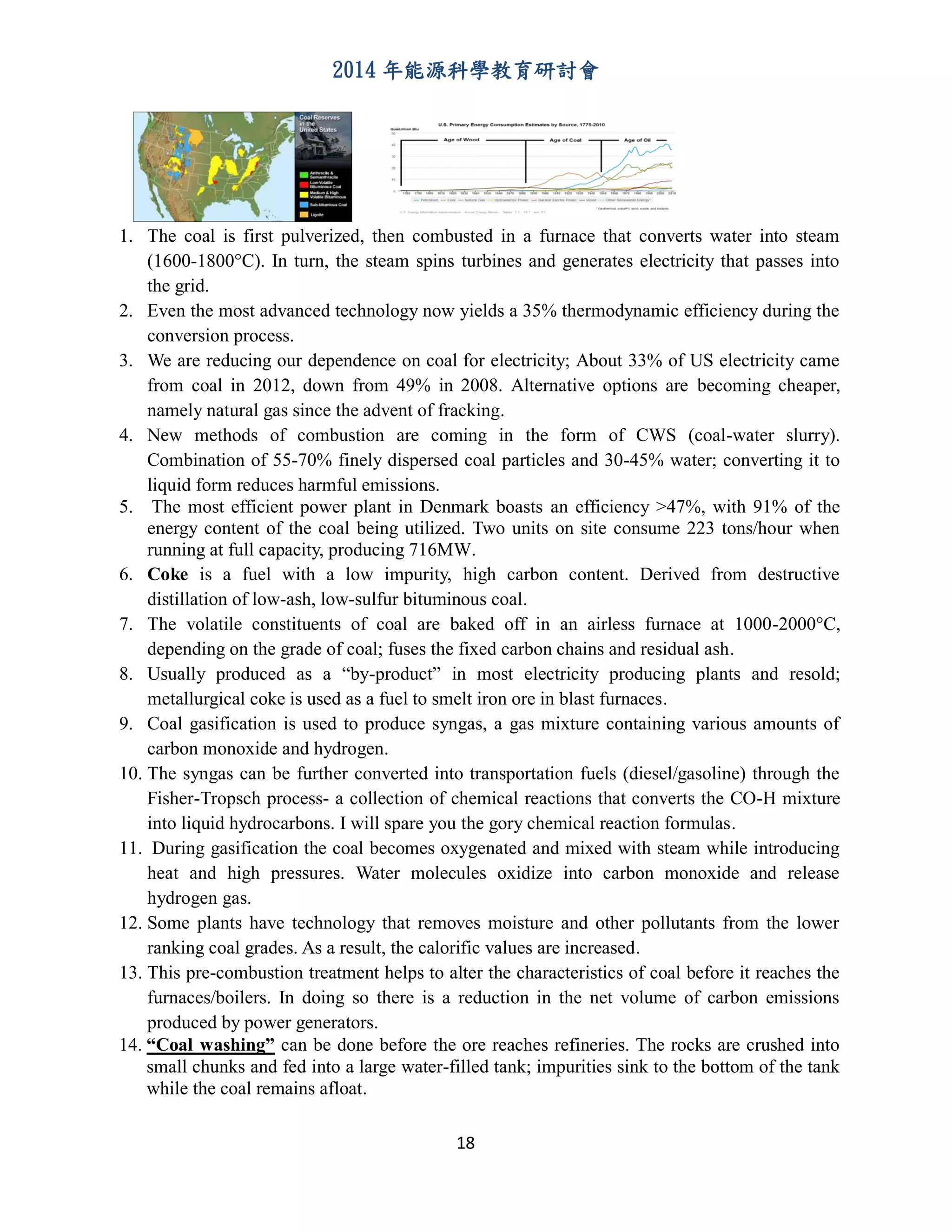
1. The coal is first pulverized, then combusted in a furnace that converts water into steam
(1600-1800°C). In turn, the steam spins turbines and generates electricity that passes into
the grid.
2. Even the most advanced technology now yields a 35% thermodynamic efficiency during the
conversion process.
3. We are reducing our dependence on coal for electricity; About 33% of US electricity came
from coal in 2012, down from 49% in 2008. Alternative options are becoming cheaper,
namely natural gas since the advent of fracking.
4. New methods of combustion are coming in the form of CWS (coal-water slurry).
Combination of 55-70% finely dispersed coal particles and 30-45% water; converting it to
liquid form reduces harmful emissions.
5. The most efficient power plant in Denmark boasts an efficiency >47%, with 91% of the
energy content of the coal being utilized. Two units on site consume 223 tons/hour when
running at full capacity, producing 716MW.
6. Coke is a fuel with a low impurity, high carbon content. Derived from destructive
distillation of low-ash, low-sulfur bituminous coal.
7. The volatile constituents of coal are baked off in an airless furnace at 1000-2000°C,
depending on the grade of coal; fuses the fixed carbon chains and residual ash.
8. Usually produced as a “by-product” in most electricity producing plants and resold;
metallurgical coke is used as a fuel to smelt iron ore in blast furnaces.
9. Coal gasification is used to produce syngas, a gas mixture containing various amounts of
carbon monoxide and hydrogen.
10. The syngas can be further converted into transportation fuels (diesel/gasoline) through the
Fisher-Tropsch process- a collection of chemical reactions that converts the CO-H mixture
into liquid hydrocarbons. I will spare you the gory chemical reaction formulas.
11. During gasification the coal becomes oxygenated and mixed with steam while introducing
heat and high pressures. Water molecules oxidize into carbon monoxide and release
hydrogen gas.
12. Some plants have technology that removes moisture and other pollutants from the lower
ranking coal grades. As a result, the calorific values are increased.
13. This pre-combustion treatment helps to alter the characteristics of coal before it reaches the
furnaces/boilers. In doing so there is a reduction in the net volume of carbon emissions
produced by power generators.
14. “Coal washing” can be done before the ore reaches refineries. The rocks are crushed into
small chunks and fed into a large water-filled tank; impurities sink to the bottom of the tank
while the coal remains afloat.
2014 年能源科學教育研討會
19
15. When sulfur is chemically bound to the coal it can be broken down with various chemical
reactions, but this has proven to be too expensive; therefore most modern power plants
(anything built after 1978) use “scrubbers”.
16. “Scrubbers” or “flume gas desulfurization units” are special devices installed to clean the
sulfur from the coal’s combustion gases before they proceed up the smokestack.
17. Scrubber is simply a mixture of limestone and water. The compound is sprayed into the
combustion gases. Once introduced, the limestone and sulfur combine to form a paste or dry
powder.
Advantages of Coal
1. Coal is one of the safest fuels to extract; no nuclear meltdowns, oil spills, etc- only the
occasional collapsed mine.
2. Greater security of reserves; 65% of the world’s oil is located in the Middle East, whereas
coal deposits can be imported from a wide range of sources.
3. Technology is allowing for cleaner burning and greater thermal efficiency; future estimates
predict an efficiency of 55% in electricity generation.
Natural Gases
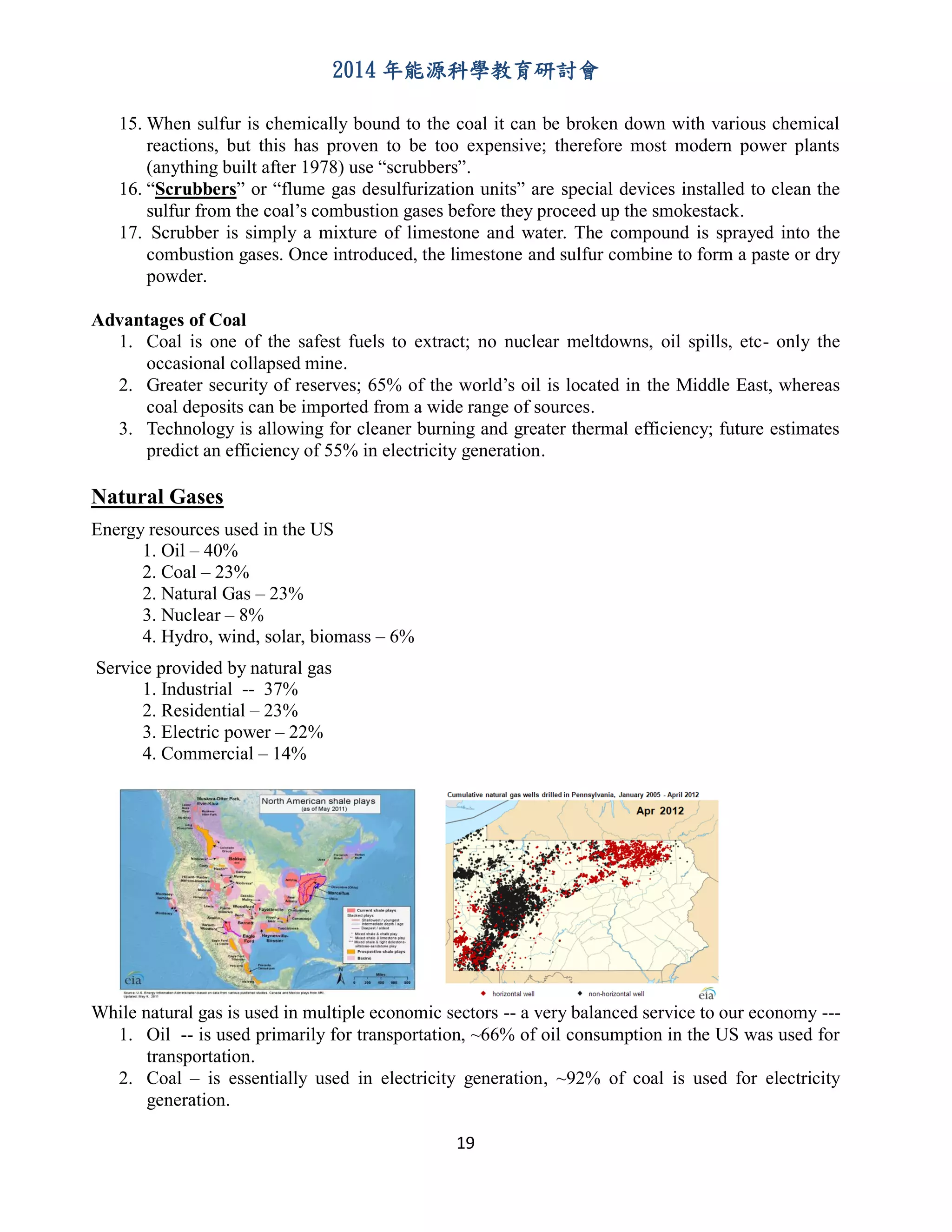
Energy resources used in the US
1. Oil – 40%
2. Coal – 23%
2. Natural Gas – 23%
3. Nuclear – 8%
4. Hydro, wind, solar, biomass – 6%
Service provided by natural gas
1. Industrial -- 37%
2. Residential – 23%
3. Electric power – 22%
4. Commercial – 14%
While natural gas is used in multiple economic sectors -- a very balanced service to our economy ---
1. Oil -- is used primarily for transportation, ~66% of oil consumption in the US was used for
transportation.
2. Coal – is essentially used in electricity generation, ~92% of coal is used for electricity
generation.
2014 年能源科學教育研討會
20
3. Nuclear, wind, tidal, solar, and hydro – are used exclusively for electricity generation.
Advantage of Natural Gas
1. Natural gas can be used to produce heat in an efficient and clean manner.
2. In the industrial sector, process heat is by far the leading end use of natural gas, ~accounts
for 55% of industrial natural gas usage
3. For commercial and residential users – natural gas is the leading resource of energy for
space and hot water heating.
4. Natural gas is chemically simple – it is methane (CH4), Oil and Coal are chemically more
complex.
5. The cleanliness and efficiency of natural gas is the primary reasons why it is valued more
importantly in recent time than the two other fossil resources.
6. Some 25 trillion cubic feet (Tcf) of natural gas was produced in the US and Canada in 2002
– unconventional reservoirs contributed 20%.
7. In 2003, the National Petroleum Council estimates that total gas production from the US and
Canada, excluding the Arctic regions, will struggle to remain at the 25 Tcf level in the
future.
8. By 2025, the NPC expects unconventional gas will account for 10 Tcf, or 40% of the gas
flowing from the non-Arctic regions of North America.
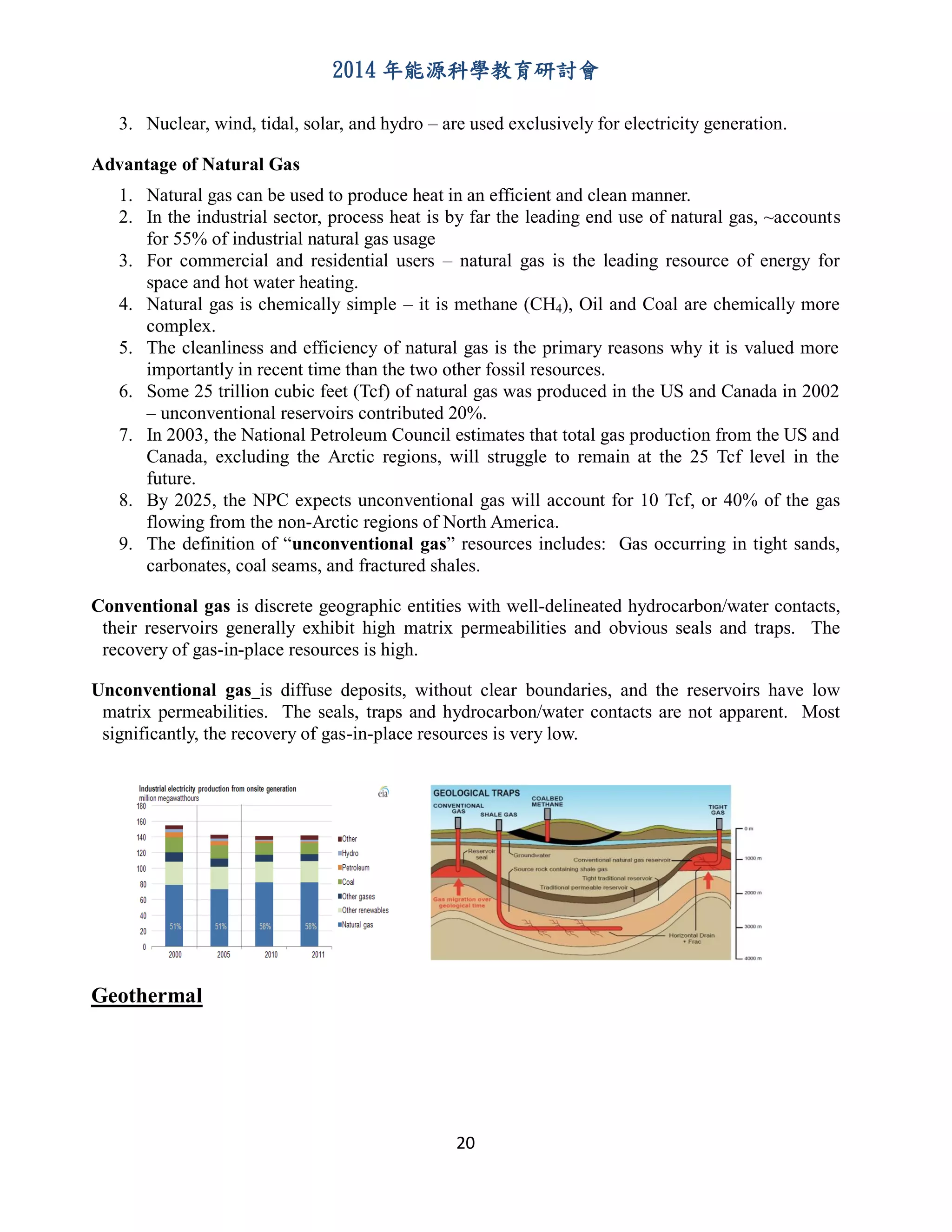
9. The definition of “unconventional gas” resources includes: Gas occurring in tight sands,
carbonates, coal seams, and fractured shales.
Conventional gas is discrete geographic entities with well-delineated hydrocarbon/water contacts,
their reservoirs generally exhibit high matrix permeabilities and obvious seals and traps. The
recovery of gas-in-place resources is high.
Unconventional gas is diffuse deposits, without clear boundaries, and the reservoirs have low
matrix permeabilities. The seals, traps and hydrocarbon/water contacts are not apparent. Most
significantly, the recovery of gas-in-place resources is very low.
Geothermal
2014 年能源科學教育研討會
21
1. USA, Mexico, and Philippines lead the world with geothermal power generation and other
applications. Other countries including Iceland, New Zealand, Japan, Indonesia, and a few
other countries are also famous for their geothermal power generation.
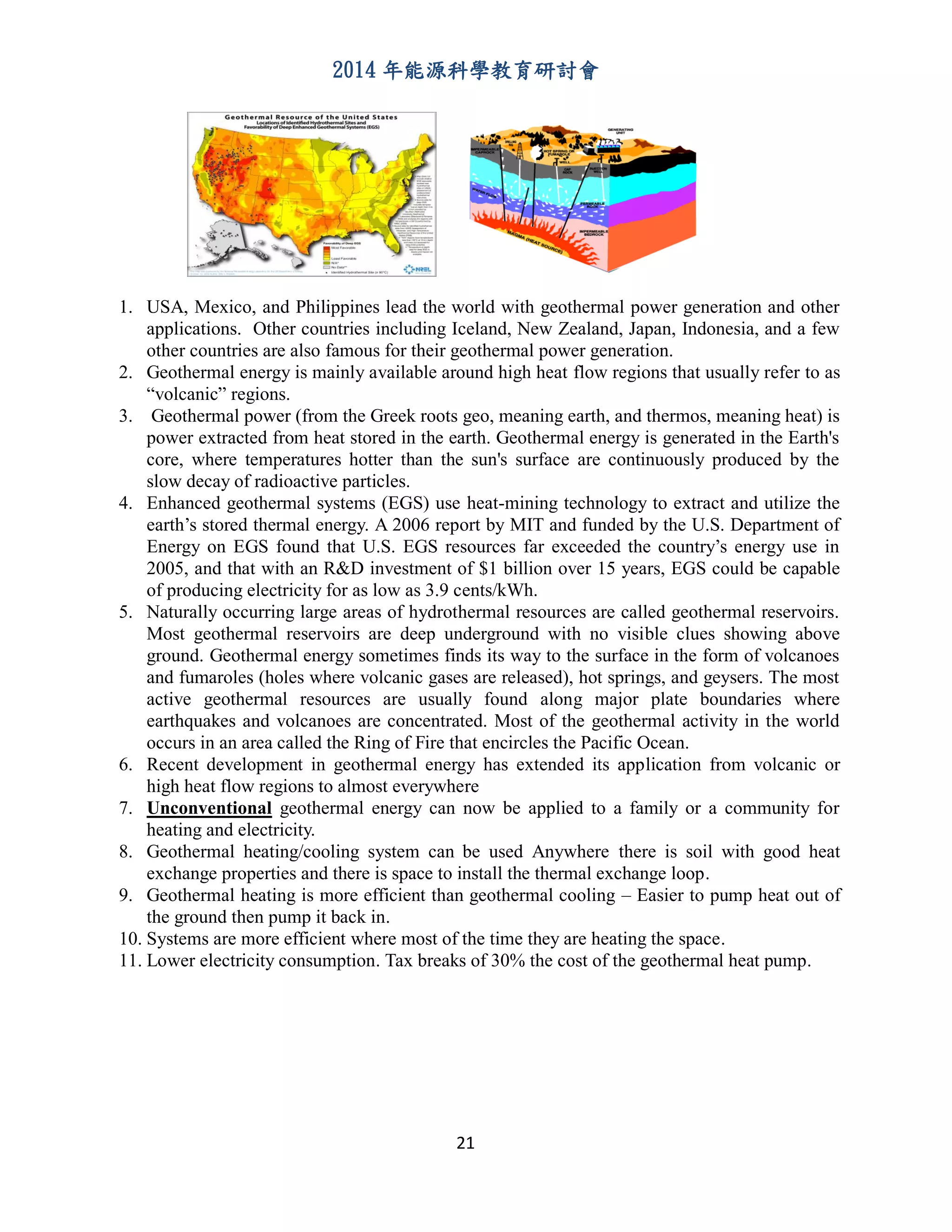
2. Geothermal energy is mainly available around high heat flow regions that usually refer to as
“volcanic” regions.
3. Geothermal power (from the Greek roots geo, meaning earth, and thermos, meaning heat) is
power extracted from heat stored in the earth. Geothermal energy is generated in the Earth's
core, where temperatures hotter than the sun's surface are continuously produced by the
slow decay of radioactive particles.
4. Enhanced geothermal systems (EGS) use heat-mining technology to extract and utilize the
earth’s stored thermal energy. A 2006 report by MIT and funded by the U.S. Department of
Energy on EGS found that U.S. EGS resources far exceeded the country’s energy use in
2005, and that with an R&D investment of $1 billion over 15 years, EGS could be capable
of producing electricity for as low as 3.9 cents/kWh.
5. Naturally occurring large areas of hydrothermal resources are called geothermal reservoirs.
Most geothermal reservoirs are deep underground with no visible clues showing above
ground. Geothermal energy sometimes finds its way to the surface in the form of volcanoes
and fumaroles (holes where volcanic gases are released), hot springs, and geysers. The most
active geothermal resources are usually found along major plate boundaries where
earthquakes and volcanoes are concentrated. Most of the geothermal activity in the world
occurs in an area called the Ring of Fire that encircles the Pacific Ocean.
6. Recent development in geothermal energy has extended its application from volcanic or
high heat flow regions to almost everywhere
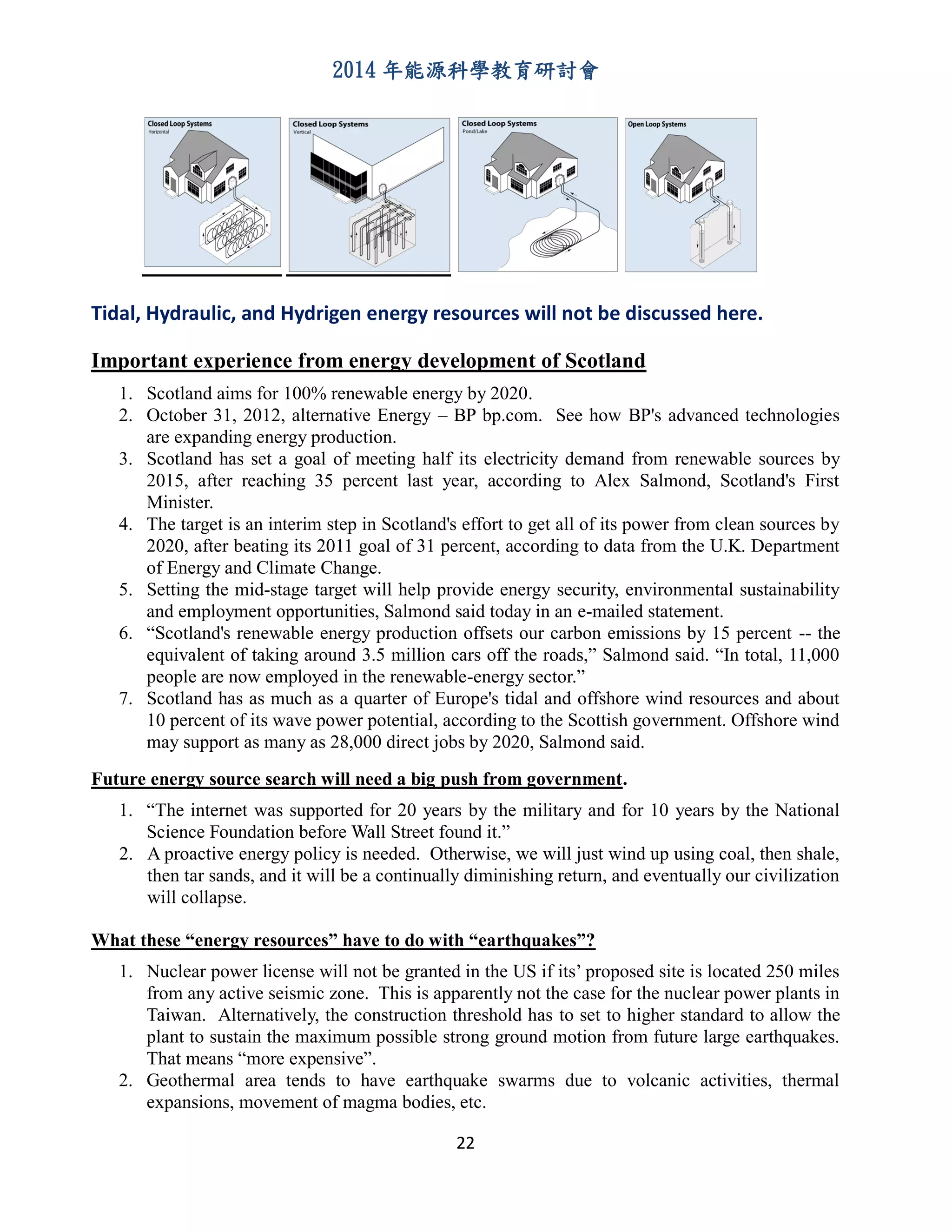
7. Unconventional geothermal energy can now be applied to a family or a community for
heating and electricity.
8. Geothermal heating/cooling system can be used Anywhere there is soil with good heat
exchange properties and there is space to install the thermal exchange loop.
9. Geothermal heating is more efficient than geothermal cooling – Easier to pump heat out of
the ground then pump it back in.
10. Systems are more efficient where most of the time they are heating the space.
11. Lower electricity consumption. Tax breaks of 30% the cost of the geothermal heat pump.
2014 年能源科學教育研討會
22
Tidal, Hydraulic, and Hydrigen energy resources will not be discussed here.
Important experience from energy development of Scotland
1. Scotland aims for 100% renewable energy by 2020.
2. October 31, 2012, alternative Energy – BP bp.com. See how BP's advanced technologies
are expanding energy production.
3. Scotland has set a goal of meeting half its electricity demand from renewable sources by
2015, after reaching 35 percent last year, according to Alex Salmond, Scotland's First
Minister.
4. The target is an interim step in Scotland's effort to get all of its power from clean sources by
2020, after beating its 2011 goal of 31 percent, according to data from the U.K. Department
of Energy and Climate Change.
5. Setting the mid-stage target will help provide energy security, environmental sustainability
and employment opportunities, Salmond said today in an e-mailed statement.
6. “Scotland's renewable energy production offsets our carbon emissions by 15 percent -- the
equivalent of taking around 3.5 million cars off the roads,” Salmond said. “In total, 11,000
people are now employed in the renewable-energy sector.”
7. Scotland has as much as a quarter of Europe's tidal and offshore wind resources and about
10 percent of its wave power potential, according to the Scottish government. Offshore wind
may support as many as 28,000 direct jobs by 2020, Salmond said.
Future energy source search will need a big push from government.
1. “The internet was supported for 20 years by the military and for 10 years by the National
Science Foundation before Wall Street found it.”
2. A proactive energy policy is needed. Otherwise, we will just wind up using coal, then shale,
then tar sands, and it will be a continually diminishing return, and eventually our civilization
will collapse.
What these “energy resources” have to do with “earthquakes”?
1. Nuclear power license will not be granted in the US if its’ proposed site is located 250 miles
from any active seismic zone. This is apparently not the case for the nuclear power plants in
Taiwan. Alternatively, the construction threshold has to set to higher standard to allow the
plant to sustain the maximum possible strong ground motion from future large earthquakes.
That means “more expensive”.
2. Geothermal area tends to have earthquake swarms due to volcanic activities, thermal
expansions, movement of magma bodies, etc.
2014 年能源科學教育研討會
23
3. Deep drilling wells for petroleum and natural gas productions may induce earthquakes.
Recent moderate and unusual earthquakes occurred in central Arkansas, Oklahoma city of
Oklahoma, and Dallas region of Texas are good examples of induced earthquakes from
natural gas production.
4. Deep waste water well may also induce earthquakes when injection of water penetrates into
existing nearby faults
So, what can we do about it?
1. Earthquakes are still far from been predictable with today’s knowledge and technology. Our
best choice is an “early warning system”.
2. Early warning system works beautifully in the 2011 Tohoku, Japan earthquake. Damages of
the Fukushima nuclear disaster were not due to the large strong motions from earthquakes
but mainly due to the damage of the backup power generator from the Tsunami.
3. Standalone – single station early warning system for railroads and other critical facilities.
Early warning system has been installed along the bullet train routes. Electric power will be
automatically shut down when strong ground motion is detected. During the earthquake,
there were 23+ bullet trains in motion. All of them were successfully powered down due to
the action taken from the early warning system.
4. Multiple stations – seismic array early warning system for distant critical facilities including
nuclear power plan, super computer center, hospital, government building, etc. Multiple
station early warning systems in Japan had also provided critical information of strong
ground motion to allow critical facilities such as nuclear power plants, super computers,
government buildings, etc. to shutdown during earthquakes.
5. All nuclear power plants in Japan (including Fukushima) performed beautifully well to
sustain strong ground motions due to the earthquakes. That means that all plants were
constructed to their expectations based on “the regional predicted maximum ground
acceleration and seismicity”.
2014 年能源科學教育研討會
24
能源與國家發展
林基興博士 行政院科技會報辦公室研究員、研究
風險與科技政策,包括國家能源。曾任教台大化工所、
任職公益刊物科學月刊社理事長,宣導核能科技與輻
射的健康效應,並出書《為何害怕核能與輻射》。
林先生是台灣大學化工學士、美國華盛頓大學工程博
士。
講綱:
(1)宏觀世局:世界能源有限,石化原料(煤、油、氣)實應留給醫藥民生
用,而非燒掉當能源。比較各類能源發電成本與外部社會成本,例如,
每單位電量所產生的二氧化碳,結果可知其為當今全球暖化禍首,這就
顯露「公有的悲劇」(Tragedy of the Commons)。綜觀各先進國研發經
費,為何能源殿後?
(2)自知之明:我國困境包括,98%能源賴進口、獨立電網島國缺邦交、空
污等能源廢棄物、CO2 人均排放全球第 18 名(亞洲第一)、GDP 成長與 CO2
排放等比、各式發電遭受抗爭。
(3)各式發電優缺:包括比較等量發電時各式發電導致死亡人數。一旦設置
太陽能,土地即至少 20 年無法他用,若廣設,影響糧食安全、生態等。
太陽能電池含硫化鎘、製程氫氟酸等毒。再生能源電逾 20%,供電不穩,
不能當基載電源(不足擔大任)。我國風車因噪音近距等,無法施工。
(4)抗爭與媒體的虛實:國人為何不信核四廠址耐震?例如,1965—1992 年
間,國際原子能總署與美國貝泰工程顧問公司等不同機構 7 次地質調查,
均確認附近屬緻密堅硬岩盤。國人就是自卑,認為日本會發生(福島)
事故,台灣更會發生。為何媒體一再傳播負面訊息?
(5)因不解而害怕:影響民眾風險認知的關鍵是「恐懼」。我國宣稱要實現
「非核家園」,但那是什麼內涵?科技議題適合民調嗎?民調可當政策依
據嗎?
(6)結論:當前關鍵問題為,「台灣的最佳組合能源?」我國 2009 年起的
「能源國家型科技計畫」建樹如何?台灣需要設立「科技與媒體中心」。

2014 能源科學教育研討會 手冊

  • 1.
    2014 年能源科學教育研討會 1 能源科學教育研討會 新知識、新希望、新願景 會 議手 冊 2014 年 7 月 19 日 (六) 清華大學旺宏館國際會議廳 2014 年 7 月 20 日 (日) 臺灣師範大學公館校區國際會議廳 國立臺灣師範大學、國立清華大學主辦
  • 2.
    2014 年能源科學教育研討會 2 議程表(清大場) : 時間(上午) 08:30-09:00報到 09:00-09:05 主持人致開幕詞 葉宗洸教授兼主任 清華大學工程與系統科學系 09:05-09:20 劉容生副校長致歡迎詞 09:20-09:30 江仁台校友(73G)致詞 清華大學核子工程研究所 09:30-10:10 專題: 多元的能源與環保 主講人: 江仁台先生 美國伊利諾大學博士 美國電力研究所顧問 10:10-10:30 中間休息 10:30-11:10 專題: 能源與地震 主講人: 邱哲明先生 美國康乃爾大學博士 美國田納西 Memphis 大學教授 11:10-11:50 專題: 能源與國家發展 主講人: 林基興先生 美國華盛頓大學博士 行政院科技會報辦公室研究員 11:50-12:20 能源科學座談 主持人: 葉宗洸主任 與談人:邱哲明教授、林基興博士、江仁台博士 水木清華,源遠流長。誠正勤樸,萬古流芳
  • 3.
    2014 年能源科學教育研討會 3 議程表 (師大場): 時間(上午) 08:30-09:00 報到 09:00-09:05 主持人致開幕詞 吳文欽教授兼主任 臺灣師範大學物理學系 09:05-09:15 江仁台校友(59 級)致詞 臺灣師範大學物理學系 09:15-09:30 貴賓致詞: 梁啟源董事長 中華經濟研究院 09:30-10:10 專題: 多元的能源與環保 主講人: 江仁台先生 美國伊利諾大學博士 美國電力研究所顧問 10:10-10:50 專題: 能源與地震 主講人: 邱哲明先生 美國康乃爾大學博士 美國田納西 Memphis 大學教授 10:50-11:30 專題: 能源與國家發展 主講人: 林基興先生 美國華盛頓大學博士 行政院科技會報辦公室研究員 11:30-12:00 能源科學座談 主持人: 吳文欽主任 與談人:邱哲明教授、林基興博士、江仁台博士 感謝 清華大學工程與系統科學系、清華大學核子工程與科學研究所 臺灣師範大學物理學系、美華核能協會濮勵志博士、張枝峰博士、江仁台博士 贊助本研討會
  • 4.
    2014 年能源科學教育研討會 4 多元的能源與環保 江仁台博士 美國電力研究所顧問、美華核能協會 會長。在學術界及能源工業界有30 多年工作經驗, 曾任加州大學伯克萊分校及佛羅里達大學教授,並 擔任 GE 公司主任工程師、AREVA 公司指導工程師、 南方核能公司顧問。 江先生是台灣師範大學物理學士、清華大學核工碩 士、美國伊利諾大學核工博士、美國核能學會 Fellow。 內容: 風力、水力、草木生長、煤、天然氣和石油都來自太陽能,而太陽能來自氫核 融合能。因此,地球上所有的能源,大部份都間接(太陽的氫核融合)或直接 (核電廠鈾核分裂)來自核能。太陽能和風力等再生能源有不少進步,但還太貴, 發電有間斷性,且難以大量開發。由於電力公司沒有大量儲存能源的技術,無 法單靠風力與太陽能來滿足現代社會的需求。 地球越來越暖,空氣品質越來越差,夏天南北極的冰越熔越快,秋天颱風的強 度越來越高,春天下的雨越下越酸,這些主要都是火力發電排二氧化碳、二氧 化硫與氧化氮迅速不斷上升惹的禍。 各種發電方式所產生的二氧化碳 (CO2)、二氧化硫 (SO2)、氧化氮(NO,NO2)量, 見下表所示,以燃煤的最多,燃石油的次之,燃天然氣的又次之,最低的是核 能發電。二氧化碳會使地球變暖,二氧化硫與氧化氮會使雨水變酸。 發電方式 CO2(磅/瓩小時) SO2(磅/瓩小時) NO,NO2(磅/瓩小時) 燃煤 2.249 0.013 0.006 燃石油 1.672 0.012 0.004 燃天然氣 1.135 0.0001 0.0017 核能 0 0 0
  • 5.
    2014 年能源科學教育研討會 5 環保與溫室氣體排放量 台灣溫室氣體的總排放量,從 1990年的 138.3 百萬公噸二氧化碳當量,上升 至 2010 年的 274.7 百萬公噸二氧化碳當量,約計成長 98.6%。台灣 2010 年溫 室氣體排放量分佈,可用下圖顯示,其中二氧化碳是最大宗,約占 96.48%。 全球 1958 年至 2006 年二氧化碳排放量如下圖所示,逐年加速上升,令人觸目 驚心。
  • 6.
    2014 年能源科學教育研討會 6 全球變暖已經影響到世界各地,包括增長損壞的珊瑚礁,冰川融化,更持久的 乾旱,更糟糕的事情是海平面上升、動植物種的喪失和農業產量的萎縮。 為了避免了這種命運,需要大幅減少溫室氣體排放量,這意味著必須改革生產 和消費能源的方式。 美國總統歐巴馬上(6)月 2日宣布推動美國環境保護署的一項提案:在 2030 年 之前,把美國電廠的二氧化碳排放量,按 2005 年的標準減少 30%。瞄準的目標 是全美碳汙染的最大來源,即 600 多家火力發電廠。 能源風險比較 在歐洲,每年死於煤、油及天然氣工業的事故超過 500 人。全世界每年死於因 燃燒煤導致呼吸道疾病者,超過 170,000 人。 製造太陽能板是一個涉及十分劇毒的過程,釋放出多種對人體健康有害的汙染 物。安裝太陽能板也牽涉到兩種最危險的行業,屋頂作業以及電路作業。統計 屋頂作業及太陽能板安裝作業數據,發現在這行業裏,每 10 的 12 次方瓦小時 (TWh)的發電量,會造成兩人死於自屋頂掉落。核能發電每 TWh 的發電量,只 造成 0.05 人死亡(含括所有的原因,甚至爐心熔解)。 60 年來核電運轉,全球有三次嚴重核電事故。三哩島二號機事故,沒有造成人 員死亡,而且附近民眾並無任何可察覺到的健康問題,因此三哩島一號機仍在 正常運轉。車諾比核電廠是俄式,台灣的核電廠是美式,車諾比核災不會在台 灣發生。福島事件中,沒有一個人因為輻射照射而死亡,2013 年世界衛生組織 《健康風險評估》指出,99%居民的外部劑量低於 10 毫西弗,99.9%居民的內 部劑量低於 1 毫西弗。因此,電廠附近的人會有長時期輻射健康問題是微乎其 微的。 1 西弗相當於 1 公斤的人體經 X 光照射後,吸收 1 焦耳的輻射能量(1 公斤人體 的體溫將升高約 0.24 攝式度)。最低安全標準是,每人每年接受的輻射劑量不 能超過 50 毫西弗 ,而且一年中任何一季人體接受的輻射劑量不能超過 25 毫 西弗。人們每年所得平均的背景輻射劑量約為 3.012 毫西弗, 包括自然輻射 劑量 2.40 毫西弗 和人造輻射劑量 0.612 毫西弗。
  • 7.
    2014 年能源科學教育研討會 7 美國能源近況 美國 1995年-2011 年各類電力的生產費如下圖所示,美國的核電約佔總發電量 約 20%。 U.S. Electricity Production Costs 1995-2011, In 2011 cents per kilowatt-hour Production Costs = Operations and Maintenance Costs + Fuel Costs. Production costs do not include indirect costs and are based on FERC Form 1 filings submitted by regulated utilities. Production costs are modeled for utilities that are not regulated. Source: Ventyx Velocity Suite Updated: 5/12 2013 年中,美國頁岩氣的使用大量降低了美國的天然氣價錢,這是三十幾年來 各界對鑽探開採技術研發的成果,這也說明了現階段在新核能技術研究的重要 性。 美國有 5 部新核電機組正在興建,原有 104 部運轉中核電機組,最近二年有 1 部因經濟原因,3 部因重大設備故障修復不符合成本,而決定永久停機,目前 只有 100 部機組運轉中,但年底 Vermont Yankee 因經濟原因將永久停止運轉, 將變成 99 部,一直要等到明年底後年初 Watts Bar 2 加入才能再恢復到百 部。。 美國在三哩島事故後,初期民間反核聲浪很高,但經核管會、能源部、美國核 能學會與核電工業界 30 多年共同努力下,核能安全大幅改善,民間反核聲浪 漸平息。即使在最近發生福島嚴重事故後,美國核電運作一切如常,目前有五 部新核電機組正在興建,核電廠普遍增加功率(最高至 120%原功率),75%核電 廠延役 20 年。核電廠增加功率及延役,成本很低;在美國能源部、國會及總 統的支持下,核管會核准核電廠增加功率及延役,是促進美國經濟持續成長, 造福美國大眾的德政。
  • 8.
    2014 年能源科學教育研討會 8 德國能源近況 2012 年德國電力為70%化石燃料、5%太陽能、7%風力和 18%核能。德國雖產低 價煤填補廢核的部份缺口,但再生能源成本很高,2013 年德國住宅電價約為台 灣的 4 倍。德國表面上決定「非核家園」政策,但可從接壤的法國購買不足的 核電(法國 79%為核電),又受到俄國特別照顧,輸入廉價燃油和天然氣。為解 決再生能源高比例影響電網穩定,德國投入巨資(200 億歐元)更新電網,但 受民眾抗爭而建置進度嚴重落後,昂貴電費導致產業外移與員工失業。 英國能源與環保近況 英國風險專家所做能源風險的研究,舉福島核災中因海嘯死亡的人數、比核災 多得多的例子,認為氣候風險遠大於核能風險,因為氣候風險無法控制,但核 災的風險卻可以控制。 英國在福島核災後,支持核電的民調不降反增,就是因為大多數的英國人,覺 得氣候變遷的風險,大過核災的風險。英國的環保人士、生態學家,也大都支 持這種看法。目前,英國正在招標建新核電廠,英國對 GE 製造、與龍門核四 廠同型的進步型沸水式核反應爐(ABWR) ,很有興趣,很可能會到日本 ABWR 各 廠與龍門核四廠考察、取經。 法國能源近況 法國在深受 1974 年能源危機之苦後,大力發展核能發電,目前核電佔法國總 發電量的 79%,還賣電到因減核電而缺電的德國賺錢。因為大量的使用核電, 法國是排放二氧化碳最低的工業國。 台灣能源近況 2012 年台灣電力為 40.7%燃煤、30.2%燃氣、2.5%燃油、3.4%太陽能與風力、 3.4%汽電共生 18.4%核能和 1.4%抽蓄水力。台電每度電的發電成本,核能 0.69 元,天然氣發電是核能的 4.7 倍,而每度電成本高達 5.96 元的燃油,更 是核能的 8.6 倍,台電因此盡量利用核能,而閒置其他發電機組。 在台灣,由於天然氣須加液化費及長途運費,無論美國產地的天然氣費用多低, 加液化和長途運費後,天然氣在台灣的價錢比美國就高出許多。此外,台灣是 島國,還有短期儲存量(約一週)和戰時運輸的關鍵問題。 太陽能、風能等各類再生能源,發展受制於氣候和土地條件,發電有間斷性, 且難以大量開發,實際應用上各有先天限制,勉強只能做到輔助角色。
  • 9.
    2014 年能源科學教育研討會 9 未來能源與環保需求 為避免排放溫室氣體造成地球溫度危險上升,未來四十年內,需要減少 80%二 氧化碳排放,但同時又面臨二至三倍全球的能源需求。因此,需要能產生大量 「零碳」排放的廉價能源,目前看起來核能是唯一辦得到的能源。 核能安全與效益 核電的安全是可以控制的,核廢料是可以處理的,核電的發電成本是最便宜和 穩定的,核電不會排放二氧化碳。 台灣已經商轉的核一、核二、核三電廠,商轉的安全記錄良好。當年,核一、 核二、核三都是台灣成功的大建設,三十多年來,三座核能電廠所發的廉價電 力,對促進台灣的環保和經濟發展貢獻良多。 核四採用進步型沸水式反應爐的安全功能包括:一)反應爐提高了爐內泵的性 能,同時省略了大型外循環泵。二)全數位化反應爐的保護系統,確保高水準 的可靠性和簡化了安全檢測和應變能力。三)全數位化反應爐控制系統使得控 制室可容易的、更快速的控制電廠的營運和流程。四)改進緊急爐心冷卻系統, 提供了對預防事故發生一個非常高水準的保障。 嚴重事故後,反應爐將立即停機。衰變熱將被餘熱移除系統排出,緊急爐心冷 卻系統將啟動。萬一電廠停電,進步型沸水式反應爐可完全自動化解沒有冷卻 水的事故,而且運轉員可以三天不需操作。三天內,運轉員只須補充緊急冷卻 系統供水。這些改進使反應爐明顯的比以前更安全。GE公司的安全度評估顯示, 爐心損壞事件發生的或然率不超過六百萬年一次,進步型沸水式反應爐爐心損 壞機率為1.6×10⁻⁷。 核四進步型沸水式反應爐的優點包括︰一)核四進步型沸水式反應爐比核一沸 水式第四代和核二沸水式第六代更安全。二) 核四進步型沸水式反應爐之發電 功率(1350MW)比核二沸水六式發電功率(985MW)與核一沸水四式(636MW) 能提供更充裕的電力供應。三)滿足台灣北部高電力的需求。 台灣核電現況 受「非核家園」思維的影響,台灣目前核四廠一號機計劃封存、二號機停建, 核一、核二和核三廠所有的六部機組,計劃在運轉發電四十年後,全部不再延 役。技術上,各機組增加功率及延役二十年的商業運轉毫無問題。不再增加功 率及延役,完全是為了達成「非核家園」的政治決策。若延役20年以6部機組 平均每年發400億度電估計,可以替台灣額外創造至少2兆新台幣的利益,還能 大量減排二氧化碳。若增加功率,可以創造更多的額外利益。
  • 10.
    2014 年能源科學教育研討會 10 若急廢核電,台灣為島嶼獨立電網,無外國電力可支援。根據日本停用核電的 經驗,限電將難以避免。急廢核電將導致物價將因電價大幅上漲而高漲,民眾 購買力大幅下降,對社會民生大不利,限電將造成企業競爭力衰退,外資恐裹 足不前,能外移的產業將外移,台灣的經濟前途堪憂。 核四廠是國家的重大建設,投資巨大,已接近完工。當年核准興建時,是經過 慎重評估的。巨大投資,都是民脂民膏,除非有重大缺失,完全無法補正,否 則不宜封存或廢棄。核四若商轉,不但可避免投資2838億元建廠的浪費,每天 還將增加約六千萬元的收入,除可維持低價和穩定的電源,還能大量減排二氧 化碳。 大陸核電現況 大陸有28部新核電機組正在興建,21部核電機組運轉中。大陸興建和投入運轉 核電機組的速度,相信令全世界真的是瞠目結舌。香港核電投資公司投資廣東 大亞灣核電站,佔股25%,大亞灣核電大部分售予香港。 台灣環保檢討 台灣2010年溫室氣體排放量約為1990年的兩倍,每年仍繼續迅速增長。台灣目 前的能源與環保政策是︰確保核安,穩健減核,打造綠能低碳環境,逐步邁向 「非核家園」。 由於台灣要減核,然而太陽能與風力發電難以大量開發,無法取代核電,打造 綠能低碳的環保目標將無法達成。因此,民國91年公布的「環境基本法」第23 條文︰「政府應訂定計畫,逐步達成非核家園目標…」明顯已過時。 為達到低碳的環保目標,建議「環境基本法」第23條文應改為︰「政府應執行 知核計畫,維持合理比例的核能發電,減少火力發電二氧化碳的排放量,以保 護環境,降低氣候變壞的風險。」 最佳能源與環保組合、台灣需要核電 火力發電燃料成本高,並會大量排放二氧化碳,造成空氣污染與地球溫室效應。 太陽能發電、風力發電等再生能源受制於氣候和空地,成本高,發電為間斷性 不穩定,而且難以大量開發。 台灣島缺乏煤、天然氣和石油資源,電網獨立,發展再生能源既受制於氣候和 土地條件又不穩,實在沒有放棄核電的條件。何況核電造成死亡率的風險遠小 於煤、油及天然氣工業的事故和燃煤的風險,甚至於小於太陽能發電的風險。 核電的安全是可以控制的,核廢料是可以處理的,核電的發電成本是便宜和穩
  • 11.
  • 12.
    2014 年能源科學教育研討會 12 Conventional andUnconventional Energy Resources and Their Relationship to Earthquakes 邱哲明博士 美國 Memphis 大學教授,任教 30 多年。 邱先生是美國康乃爾大學博士 中央大學地球物理碩 士、台灣師範大學物理學士。 Overview Modern World History can be considered as -- a history of Earth Sciences, a history fighting for Energy Resources, and the center of the history is petroleum. However, today’s center of international focuses on “energy resources” have dramatically changed. Over the entire human history, we depend mainly on the “burning” of fossil energy resources, i.e. oil, coal, natural gas, for lighting, electricity, and other applications. The problems we encountered with fossil energy include: 1. limited resources available only on certain areas – the reserve of fossil energy is finite and limited. The more we un-earth it today, the less it will be available for our future generation. In addition, many wars between countries were due to fighting for the demand on energy resources. 2. significant environmental issues – the burning of fossil energy releases mercury, methane, CO2, and other debris to the air that create a significant environmental problem. It is getting worse and its impacts have becoming a global issue now. Alternatively, we turn from “conventional” to “unconventional”, and from “non-renewable” to “renewable” energy resources to try to find an answer.
  • 13.
    2014 年能源科學教育研討會 13 So, what“Energy Resources” are we talking about today? Petroleum, Coal, Natural Gas, Solar, Wind, Nuclear, Tidal, Geothermal, Hydraulic, Biofuels, Hydrogen, etc. Research on the exploration and development of these energy resources are the focuses of today’s energy industries. Among them, Electricity -- Coal, Natural Gases, Solar, Wind, Nuclear, Tidal, Geothermal, Hydraulic, Biofuels, etc., Heating – Natural Gases, Geothermal, Biofuels Transportation -- Petroleum, Natural Gases, Biofuels, and Hydrogen Problems related to modern energy resources: 1. Instability where most oil is found, from the Persian Gulf to Nigeria to Venezuela, makes this lifeline fragile. 2. Transport oil from production field to market places is getting more difficult, e.g. from north-slope of Alaska to US continent or to Japan. 3. Natural gas can be hard to transport and is prone to shortage. 4. We won’t run out of coal anytime soon, or the largely untapped deposits of tar sands and oil shale. But it’s clear that the carbon dioxide spewed by coal and other fossil fuels is warming up the planet. 5. Energy conservation can stave off the day of reckoning, but in the end you can’t conserve what you don’t have. At least, in personal level, all of us can do something to conserve energy. 6. It is time to step up the search for the next great fuel for the hungry engine of humankind. Is there such a fuel? The short answer is “NO”. 7. Hydrogen-fueled cars may give the wrong impression. Hydrogen is not a source of energy. It has to be freed before it is useful and that costs more energy than the hydrogen gives back. It is still long way to go before hydrogen-fueled engine becomes affordable, acceptable, or economically feasible. 8. Fossil fuels have met the growing demand because they pack millions of years of the sun’s energy into a compact form, but we will not find their like again.
  • 14.
    2014 年能源科學教育研討會 14 Solar: freeenergy, at a price 1. Solar electric systems catch energy directly from the sun – no fire, no emissions. It provides less than 1% of the world’s energy. 2. Heat can drive a generator. 3. Sun power, mostly, means solar cells. Sunlight falling on a layer of semiconductor jostles electrons, creating a current. Yet the cost of the cells is still high. New technologies to cut the price of solar cells and to improve the efficiency of converting solar energy to electricity will make a dramatic change to the energy industry. 4. A recent law requires new buildings to include solar energy in Spain. Wind: feast or famine 1. Wind is currently the biggest success story in renewable energy. 2. Wind, ultimately driven by sun-warmed air, is just another way of collecting solar energy; but it works on cloudy days. 3. In Denmark, total installed wind power is now more than 3,000 megawatts --- about 20% of the nation’s electrical needs. 4. The continental Europe leads the world in wind power, with almost 35,000 megawatts, equivalent to 35 large coal-fired power plants. 5. North America remains a distant second, with just over 7,000 megawatts. Biomass: farming your fuel 1. Biomass means ethanol, biogas, and biodiesel – fuels as easy to burn as oil or gas, but made from plants. 2. Ethanol produced from corn goes into gasoline in the US. 3. Ethanol from sugarcane provides 50% of automobile fuel in Brazil.
  • 15.
    2014 年能源科學教育研討會 15 4. Biodieselfrom vegetable oil is burned, pure or mixed with regular diesel, in unmodified engines, in the US and other nations 5. Germany uses about 450 million gallons of biodiesel a year, about 3% of its total diesel consumption. 6. The success of biomass depends on 1. more farmland 2. better technology to increase efficiency both in farming and engine 3. political support (lobbyists) Nuclear power: still a contender (1) Nuclear fission 1. Nuclear fission appeared to lead the race of an energy alternative decades ago, 2. About 440 plants now generate 16% of the planet’s electric power. For example, France gets 78% of its electricity from nuclear fission 3. China is building new reactors at a brisk pace, one or two a year 4. New Zealand is a nuclear-free country 5. Challenges for using nuclear power 1. Safety – need routine safety inspection and technology upgrade 2. Radioactive waste disposal 3. Far from renewable 4. The readily available uranium fuel won’t last much more than 50 years (2) Nuclear fusion 1. Energy is produced when two atoms fuse into one 2. Fusion would produce no long-lived radioactive waste and nothing for terrorists or governments to turn into weapons. 3. Hot fusion is more likely to succeed, but it will a decade-long quest costing billions of dollars in research 4. A demonstration plant to actual generate power, followed by commercial plants may be possible in 50 years or so Why is China pushing new nuclear?
  • 16.
    2014 年能源科學教育研討會 16 1. China’selectricity consumption quadrupled between 1980 and 2000. 2. Air pollution as a result of burning fossil fuels is estimated to kill 750 000 people a year and economic loss is put at 6% of GDP. Three coal-fired stations are coming online each week in China. 3. A recent study by BP suggests “China can only continue at current rates of production for 38 years before its coal reserves are exhausted. That compares with 245 years in the USA and 105 years in India”. What is happening now (after Fukushima)? 1. Worldwide there are 60 new nuclear plants under construction with 131 more proposed, 2. The new build program in Europe (excluding Russia) amounts to just six reactors in four countries: Finland, France, Romania and Slovakia. 3. Plans in Europe and North America are overshadowed, however, by those in China, India, Japan and South Korea. 4. China alone plans a six-fold increase in nuclear power capacity by 2020, and has more than one hundred further large units proposed and backed by political determination and popular support. 5. Germany will phase out its nuclear plants by 2020 6. Italy has imposed a one-year moratorium on the construction of nuclear power plants. 7. A small number content to proceed with new build proposals such as Slovakia with China announcing a pared back nuclear expansion program. 8. A report from UBS suggests that at the very least around 30 nuclear plants may have to close as a result of Fukushima, in particular those in seismic zones or close to national boundaries The future of nuclear power in the US 1. 51 NPPs have obtained extensions of their 40-year license to enable operation to 60 years-- 41 more are pending, 2. Many plants have increased their power: 5900 MW of new nuclear electricity has been added (equivalent to adding 6 new units), 3. 19 utilities are proposing to license 34 new units in the next few years, –17 applications for 24 units already before the Nuclear Regulatory Commission, –Some purchasing of components has begun but no firm orders expected until licensing more advanced. 4. New Development Small modular reactors (SMRs) < 300 MWe, http://earthandindustry.com/2011/03/small-modular-reactors-the-new-nuclear-industry- video/
  • 17.
    2014 年能源科學教育研討會 17 Petroleum 1. TheU.S. government’s Energy Information Administration projects that in 20 years, the Persian Gulf will supply between one-half and two-thirds of the oil in world market – the same percentage as before the 1973 embargo. 2. The argument of when will be a global shortage of conventional oil depends on “How much oil is left in the world’s biggest wellspring of crude, the Middle East”? 3. We take it for granted that the Middle East will come forth with whatever volume of oil is needed to balance supply and demand. 4. The fact is that “Sauidi Arabia – the one country that we always assumed had fabulous reserves – hasn’t found a big new fields for decades.”. In stead, it is starting to happen in some Saudi fields where water starts coming up a well – its productive life is over. The Middle East may fall short of growing demand sooner than expected. 5. On the optimistic side, the USGS concluded in a 2000 study that there’s at least 50% more oil left than the pessimists believe, much of it in the Middle East. 6. One way or another, even the larger reserves can sustain the world’s growing thirst for oil indefinitely, “Oil and Gas are limited.” What we know are 1. The crude won’t suddenly dry up. 2. Old oil fields don’t die, they slowly fade away. 3. The world will face shortages more lasting than any 1970s oil shock. What are our options? 4. Should we increase production from the Canadian tar sands? 5. Should we increase production from “heavy oil: deposits in Venezuela? 6. Should we try to exploit the American West’s vast deposits of oil shale and othe organic-rich rock that yields oil when roasted? These options carry heavy environmental costs 7. Should we pin our hopes on finding new supplies of natural gas, extracting fuel from plant material, or building solar, wind, or nuclear plants to make hydrogen for fuel-cell vehicles? 8. There are no easy options, and all will take time to explore. 9. People should be doing something now to reduce oil dependence and not waiting for Mother Nature to slap them in the face. Coal
  • 18.
    2014 年能源科學教育研討會 18 1. Thecoal is first pulverized, then combusted in a furnace that converts water into steam (1600-1800°C). In turn, the steam spins turbines and generates electricity that passes into the grid. 2. Even the most advanced technology now yields a 35% thermodynamic efficiency during the conversion process. 3. We are reducing our dependence on coal for electricity; About 33% of US electricity came from coal in 2012, down from 49% in 2008. Alternative options are becoming cheaper, namely natural gas since the advent of fracking. 4. New methods of combustion are coming in the form of CWS (coal-water slurry). Combination of 55-70% finely dispersed coal particles and 30-45% water; converting it to liquid form reduces harmful emissions. 5. The most efficient power plant in Denmark boasts an efficiency >47%, with 91% of the energy content of the coal being utilized. Two units on site consume 223 tons/hour when running at full capacity, producing 716MW. 6. Coke is a fuel with a low impurity, high carbon content. Derived from destructive distillation of low-ash, low-sulfur bituminous coal. 7. The volatile constituents of coal are baked off in an airless furnace at 1000-2000°C, depending on the grade of coal; fuses the fixed carbon chains and residual ash. 8. Usually produced as a “by-product” in most electricity producing plants and resold; metallurgical coke is used as a fuel to smelt iron ore in blast furnaces. 9. Coal gasification is used to produce syngas, a gas mixture containing various amounts of carbon monoxide and hydrogen. 10. The syngas can be further converted into transportation fuels (diesel/gasoline) through the Fisher-Tropsch process- a collection of chemical reactions that converts the CO-H mixture into liquid hydrocarbons. I will spare you the gory chemical reaction formulas. 11. During gasification the coal becomes oxygenated and mixed with steam while introducing heat and high pressures. Water molecules oxidize into carbon monoxide and release hydrogen gas. 12. Some plants have technology that removes moisture and other pollutants from the lower ranking coal grades. As a result, the calorific values are increased. 13. This pre-combustion treatment helps to alter the characteristics of coal before it reaches the furnaces/boilers. In doing so there is a reduction in the net volume of carbon emissions produced by power generators. 14. “Coal washing” can be done before the ore reaches refineries. The rocks are crushed into small chunks and fed into a large water-filled tank; impurities sink to the bottom of the tank while the coal remains afloat.
  • 19.
    2014 年能源科學教育研討會 19 15. Whensulfur is chemically bound to the coal it can be broken down with various chemical reactions, but this has proven to be too expensive; therefore most modern power plants (anything built after 1978) use “scrubbers”. 16. “Scrubbers” or “flume gas desulfurization units” are special devices installed to clean the sulfur from the coal’s combustion gases before they proceed up the smokestack. 17. Scrubber is simply a mixture of limestone and water. The compound is sprayed into the combustion gases. Once introduced, the limestone and sulfur combine to form a paste or dry powder. Advantages of Coal 1. Coal is one of the safest fuels to extract; no nuclear meltdowns, oil spills, etc- only the occasional collapsed mine. 2. Greater security of reserves; 65% of the world’s oil is located in the Middle East, whereas coal deposits can be imported from a wide range of sources. 3. Technology is allowing for cleaner burning and greater thermal efficiency; future estimates predict an efficiency of 55% in electricity generation. Natural Gases Energy resources used in the US 1. Oil – 40% 2. Coal – 23% 2. Natural Gas – 23% 3. Nuclear – 8% 4. Hydro, wind, solar, biomass – 6% Service provided by natural gas 1. Industrial -- 37% 2. Residential – 23% 3. Electric power – 22% 4. Commercial – 14% While natural gas is used in multiple economic sectors -- a very balanced service to our economy --- 1. Oil -- is used primarily for transportation, ~66% of oil consumption in the US was used for transportation. 2. Coal – is essentially used in electricity generation, ~92% of coal is used for electricity generation.
  • 20.
    2014 年能源科學教育研討會 20 3. Nuclear,wind, tidal, solar, and hydro – are used exclusively for electricity generation. Advantage of Natural Gas 1. Natural gas can be used to produce heat in an efficient and clean manner. 2. In the industrial sector, process heat is by far the leading end use of natural gas, ~accounts for 55% of industrial natural gas usage 3. For commercial and residential users – natural gas is the leading resource of energy for space and hot water heating. 4. Natural gas is chemically simple – it is methane (CH4), Oil and Coal are chemically more complex. 5. The cleanliness and efficiency of natural gas is the primary reasons why it is valued more importantly in recent time than the two other fossil resources. 6. Some 25 trillion cubic feet (Tcf) of natural gas was produced in the US and Canada in 2002 – unconventional reservoirs contributed 20%. 7. In 2003, the National Petroleum Council estimates that total gas production from the US and Canada, excluding the Arctic regions, will struggle to remain at the 25 Tcf level in the future. 8. By 2025, the NPC expects unconventional gas will account for 10 Tcf, or 40% of the gas flowing from the non-Arctic regions of North America. 9. The definition of “unconventional gas” resources includes: Gas occurring in tight sands, carbonates, coal seams, and fractured shales. Conventional gas is discrete geographic entities with well-delineated hydrocarbon/water contacts, their reservoirs generally exhibit high matrix permeabilities and obvious seals and traps. The recovery of gas-in-place resources is high. Unconventional gas is diffuse deposits, without clear boundaries, and the reservoirs have low matrix permeabilities. The seals, traps and hydrocarbon/water contacts are not apparent. Most significantly, the recovery of gas-in-place resources is very low. Geothermal
  • 21.
    2014 年能源科學教育研討會 21 1. USA,Mexico, and Philippines lead the world with geothermal power generation and other applications. Other countries including Iceland, New Zealand, Japan, Indonesia, and a few other countries are also famous for their geothermal power generation. 2. Geothermal energy is mainly available around high heat flow regions that usually refer to as “volcanic” regions. 3. Geothermal power (from the Greek roots geo, meaning earth, and thermos, meaning heat) is power extracted from heat stored in the earth. Geothermal energy is generated in the Earth's core, where temperatures hotter than the sun's surface are continuously produced by the slow decay of radioactive particles. 4. Enhanced geothermal systems (EGS) use heat-mining technology to extract and utilize the earth’s stored thermal energy. A 2006 report by MIT and funded by the U.S. Department of Energy on EGS found that U.S. EGS resources far exceeded the country’s energy use in 2005, and that with an R&D investment of $1 billion over 15 years, EGS could be capable of producing electricity for as low as 3.9 cents/kWh. 5. Naturally occurring large areas of hydrothermal resources are called geothermal reservoirs. Most geothermal reservoirs are deep underground with no visible clues showing above ground. Geothermal energy sometimes finds its way to the surface in the form of volcanoes and fumaroles (holes where volcanic gases are released), hot springs, and geysers. The most active geothermal resources are usually found along major plate boundaries where earthquakes and volcanoes are concentrated. Most of the geothermal activity in the world occurs in an area called the Ring of Fire that encircles the Pacific Ocean. 6. Recent development in geothermal energy has extended its application from volcanic or high heat flow regions to almost everywhere 7. Unconventional geothermal energy can now be applied to a family or a community for heating and electricity. 8. Geothermal heating/cooling system can be used Anywhere there is soil with good heat exchange properties and there is space to install the thermal exchange loop. 9. Geothermal heating is more efficient than geothermal cooling – Easier to pump heat out of the ground then pump it back in. 10. Systems are more efficient where most of the time they are heating the space. 11. Lower electricity consumption. Tax breaks of 30% the cost of the geothermal heat pump.
  • 22.
    2014 年能源科學教育研討會 22 Tidal, Hydraulic,and Hydrigen energy resources will not be discussed here. Important experience from energy development of Scotland 1. Scotland aims for 100% renewable energy by 2020. 2. October 31, 2012, alternative Energy – BP bp.com. See how BP's advanced technologies are expanding energy production. 3. Scotland has set a goal of meeting half its electricity demand from renewable sources by 2015, after reaching 35 percent last year, according to Alex Salmond, Scotland's First Minister. 4. The target is an interim step in Scotland's effort to get all of its power from clean sources by 2020, after beating its 2011 goal of 31 percent, according to data from the U.K. Department of Energy and Climate Change. 5. Setting the mid-stage target will help provide energy security, environmental sustainability and employment opportunities, Salmond said today in an e-mailed statement. 6. “Scotland's renewable energy production offsets our carbon emissions by 15 percent -- the equivalent of taking around 3.5 million cars off the roads,” Salmond said. “In total, 11,000 people are now employed in the renewable-energy sector.” 7. Scotland has as much as a quarter of Europe's tidal and offshore wind resources and about 10 percent of its wave power potential, according to the Scottish government. Offshore wind may support as many as 28,000 direct jobs by 2020, Salmond said. Future energy source search will need a big push from government. 1. “The internet was supported for 20 years by the military and for 10 years by the National Science Foundation before Wall Street found it.” 2. A proactive energy policy is needed. Otherwise, we will just wind up using coal, then shale, then tar sands, and it will be a continually diminishing return, and eventually our civilization will collapse. What these “energy resources” have to do with “earthquakes”? 1. Nuclear power license will not be granted in the US if its’ proposed site is located 250 miles from any active seismic zone. This is apparently not the case for the nuclear power plants in Taiwan. Alternatively, the construction threshold has to set to higher standard to allow the plant to sustain the maximum possible strong ground motion from future large earthquakes. That means “more expensive”. 2. Geothermal area tends to have earthquake swarms due to volcanic activities, thermal expansions, movement of magma bodies, etc.
  • 23.
    2014 年能源科學教育研討會 23 3. Deepdrilling wells for petroleum and natural gas productions may induce earthquakes. Recent moderate and unusual earthquakes occurred in central Arkansas, Oklahoma city of Oklahoma, and Dallas region of Texas are good examples of induced earthquakes from natural gas production. 4. Deep waste water well may also induce earthquakes when injection of water penetrates into existing nearby faults So, what can we do about it? 1. Earthquakes are still far from been predictable with today’s knowledge and technology. Our best choice is an “early warning system”. 2. Early warning system works beautifully in the 2011 Tohoku, Japan earthquake. Damages of the Fukushima nuclear disaster were not due to the large strong motions from earthquakes but mainly due to the damage of the backup power generator from the Tsunami. 3. Standalone – single station early warning system for railroads and other critical facilities. Early warning system has been installed along the bullet train routes. Electric power will be automatically shut down when strong ground motion is detected. During the earthquake, there were 23+ bullet trains in motion. All of them were successfully powered down due to the action taken from the early warning system. 4. Multiple stations – seismic array early warning system for distant critical facilities including nuclear power plan, super computer center, hospital, government building, etc. Multiple station early warning systems in Japan had also provided critical information of strong ground motion to allow critical facilities such as nuclear power plants, super computers, government buildings, etc. to shutdown during earthquakes. 5. All nuclear power plants in Japan (including Fukushima) performed beautifully well to sustain strong ground motions due to the earthquakes. That means that all plants were constructed to their expectations based on “the regional predicted maximum ground acceleration and seismicity”.
  • 24.
    2014 年能源科學教育研討會 24 能源與國家發展 林基興博士 行政院科技會報辦公室研究員、研究 風險與科技政策,包括國家能源。曾任教台大化工所、 任職公益刊物科學月刊社理事長,宣導核能科技與輻 射的健康效應,並出書《為何害怕核能與輻射》。 林先生是台灣大學化工學士、美國華盛頓大學工程博 士。 講綱: (1)宏觀世局:世界能源有限,石化原料(煤、油、氣)實應留給醫藥民生 用,而非燒掉當能源。比較各類能源發電成本與外部社會成本,例如, 每單位電量所產生的二氧化碳,結果可知其為當今全球暖化禍首,這就 顯露「公有的悲劇」(Tragedyof the Commons)。綜觀各先進國研發經 費,為何能源殿後? (2)自知之明:我國困境包括,98%能源賴進口、獨立電網島國缺邦交、空 污等能源廢棄物、CO2 人均排放全球第 18 名(亞洲第一)、GDP 成長與 CO2 排放等比、各式發電遭受抗爭。 (3)各式發電優缺:包括比較等量發電時各式發電導致死亡人數。一旦設置 太陽能,土地即至少 20 年無法他用,若廣設,影響糧食安全、生態等。 太陽能電池含硫化鎘、製程氫氟酸等毒。再生能源電逾 20%,供電不穩, 不能當基載電源(不足擔大任)。我國風車因噪音近距等,無法施工。 (4)抗爭與媒體的虛實:國人為何不信核四廠址耐震?例如,1965—1992 年 間,國際原子能總署與美國貝泰工程顧問公司等不同機構 7 次地質調查, 均確認附近屬緻密堅硬岩盤。國人就是自卑,認為日本會發生(福島) 事故,台灣更會發生。為何媒體一再傳播負面訊息? (5)因不解而害怕:影響民眾風險認知的關鍵是「恐懼」。我國宣稱要實現 「非核家園」,但那是什麼內涵?科技議題適合民調嗎?民調可當政策依 據嗎? (6)結論:當前關鍵問題為,「台灣的最佳組合能源?」我國 2009 年起的 「能源國家型科技計畫」建樹如何?台灣需要設立「科技與媒體中心」。