PLANNING FOR
ENERGY
Session 16 / Kangjun Choi
What is Energy?
Energy is power that allow residents to maintain
post-industrial lifestyle in developed countries
by activating factories, cars, and home
appliances.
What are the energy issues?
 The U.S. relies heavily on nonrenewable
fossil fuel energy which causes climate
change, soil, air, and water pollution.
 The Federal government does not have a
clear national energy policy.
 U.S. Coal Power Plants produce more than
100 million tons of potentially toxic coal
ash each year.
What are the energy
issues?(Cont.)
 A Pond with decades of coal ash broke
through a dam & spilled over 300 acres at the
Kingston Fossil Plant in December 2008.
 According to the International Energy
Agency, the U.S. is poised to overtake
Saudi Arabia as the world’s leading oil
producer by 2020.
 More than 160-million-gallon of oil from the
2010 BP Deepwater Horizon blowout in the
Gulf of Mexico devastated coastal
ecosystem.
Goals
o Securing affordable long-term energy
supplies
o Becoming more energy efficient
o Conserving on the use of energy
o Reducing energy related pollution
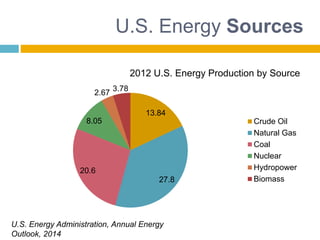
U.S. Energy Sources
13.84
27.8
20.6
8.05
2.67
3.78
2012 U.S. Energy Production by Source
Crude Oil
Natural Gas
Coal
Nuclear
Hydropower
Biomass
U.S. Energy Administration, Annual Energy
Outlook, 2014
Oil
 Refining petroleum into gasoline & burning
gasoline in motor vehicles creates air & water
pollution.
 Horizontal drilling & hydraulic fracturing
allowed to extract 6.4 million barrels a day.
 Costs of guarding international oil supply
routes are not being paid by consumers.
Natural Gas
 Produces ~ ½ as much in carbon dioxide
emission as coal.
 Cheap & Abundant reserves in U.S.
 More than ½ of U.S. residences are being
heated with natural gas.
 U.S is leading producer of natural gas.
 Natural gas is a potent greenhouse gas, ~20
times more concentrated than carbon
dioxide.
Coal
o The largest coal reserves are in U.S.
o Coal mining process pollutes soil & water with
acid mine drainage & methyl mercury.
o Burning Coal threats human health by
emitting nitrogen dioxide & sulfur dioxide.
o 1.016 billion tons were used for 39% of total
electricity & 20.6% of total energy needs in
2012.
o Coal mining is declining due to the price of
natural gas.
Nuclear
 The U.S. has more nuclear power plants
than any other country.
 Nuclear power plants last 60 ~ 80 years and
need to be monitored and protected from
natural disasters to prevent radiation leaks.
 The plutonium that fuels nuclear plants is
one of the most hazardous substances on
earth.
Hydropower
 The U.S. has more then 4,000 hydroelectric
dams.
 They generated fairly inexpensive electricity
(~2.67% of total energy needs) in 2012.
 They also decreased fish runs and flooded
millions of acres.
 Several older dams have been dismantled
since the late 1990s.
Biomass
 Biomass is energy from plant and animal
products.
 Burning harvest slash & lumber pieces
 can generate electricity & air pollution
 Extracting methane from decomposing organic
matter
 can generate electricity & carbon dioxide from
daily farm & landfills
 Extracting ethanol from corn
 can be used to power cars, but economically not
practical. It yields lower miles than gasoline & the
ratio of energy returned from the ethanol to the
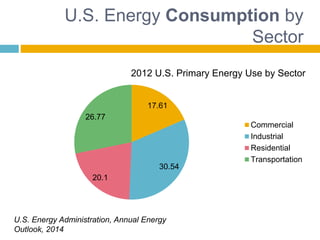
U.S. Energy Consumption by
Sector
17.61
30.54
20.1
26.77
2012 U.S. Primary Energy Use by Sector
Commercial
Industrial
Residential
Transportation
U.S. Energy Administration, Annual Energy
Outlook, 2014
The Federal Government
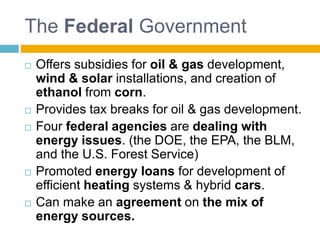
 Offers subsidies for oil & gas development,
wind & solar installations, and creation of
ethanol from corn.
 Provides tax breaks for oil & gas development.
 Four federal agencies are dealing with
energy issues. (the DOE, the EPA, the BLM,
and the U.S. Forest Service)
 Promoted energy loans for development of
efficient heating systems & hybrid cars.
 Can make an agreement on the mix of
energy sources.
The Department of Energy
 Founded in 1977.
 Prefers to focus on greater energy production
& efficiency rather than energy conservation.
 Working to
 reduce dependence on imported oil.
 promote energy efficiency in homes & buildings.
 develop technologies that increase the
production of domestic oil and natural gas.
 develop clean coal technology, carbon capture,
nuclear fusion, the safe disposal of nuclear waste.
 Regulate the transmission & sale of natural gas,
oil and electricity.
Environmental Protection
Agency
 The EPA has set energy & fuel efficiency
standards for electrical appliances and
conducting the Energy Star Program.
 The EPA has not yet defined coal ash as
hazardous waste.
The U.S. Forest Service
 Monitors private energy companies which
are extracting coal, uranium, oil, and gas from
national forests.
The State Governments
 Adopted renewable portfolio standards that
require utilities to acquire a certain proportion
of their energy supplies from renewable
sources.
 State energy offices
 have promoted energy efficiency &
conservation programs for new energy
resource development.
 Identify energy loss & recommend investment
 Provide low-interest loans & tax credits for
energy-saving projects
Building Codes
o Require new commercial, residential, and
public buildings
o Alterations to existing buildings to meet energy
efficiency standards
o Help building owners conserve energy & save
money
The Local Government
 Zoning ordinances can promote national
security & economic sustainability by
allowing mixed-use development around
public transportation.
 Subdivision regulations can require
vegetative buffers around buildings to
reduce cooling needs.
 Can incorporate energy planning into the
comprehensive planning process.
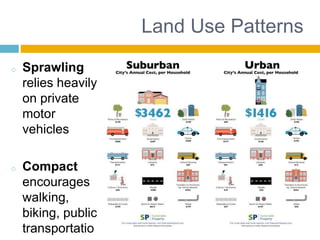
Land Use Patterns
o Sprawling
relies heavily
on private
motor
vehicles
o Compact
encourages
walking,
biking, public
transportatio
Individual level
 https://youtu.be/0bKh79SrdIE
Case Study: Stairs vs Elevator
 Last semester, I climbed stairs instead of taking
elevators and counted times that I used stairs
instead of an elevator for 13 weeks.
 I was living on the third floor on my residence
hall. So, I counted numbers when I passed
third floors.
 I developed my leg muscles and reduced
electricity fee, the local communities’ fossil
fuels, coals, and air pollution.
 The elevator which is located in my previous
residential hall is a hydraulic elevator with 3,500
lbs. of capacity.
 It takes 2,021 kilowatt per hour. Michigan's
electricity costs 13.60 cents/kWh for residential
Case Study: Stairs vs
Elevator(Cont.)
 Michigan's electricity cost (13.60 cents per 1
kilowatt per hour) times the elevator’s electric
usage (2,021 Kilowatt) is $274.86.
 It is the price of operating the elevator per
hour. The elevator takes 30 seconds from
first floor to third floor.
 Therefore, the elevator can take me from the
first floor to the third floor 120 times in an
hour.
Case Study: Stairs vs
Elevator(Cont.)
 Single operation cost of the elevator was $2.29
(274.86/120=2.29).
 I went up and down stairs 1,914 floors and chose
climbing stairs instead of taking elevators 638
times.
 $1461.32 was saved. (638*2.29=1461.32)
 A single operation of the elevator from third floor
to first floor takes 16.84 Kilowatt.
 Since I didn’t take the elevator for 638 times,
10,743.92 kilowatt is
saved.(16.84*638=10,743.92)
Case Study: Stairs vs
Elevator(Cont.)
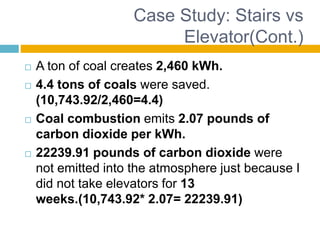
 A ton of coal creates 2,460 kWh.
 4.4 tons of coals were saved.
(10,743.92/2,460=4.4)
 Coal combustion emits 2.07 pounds of
carbon dioxide per kWh.
 22239.91 pounds of carbon dioxide were
not emitted into the atmosphere just because I
did not take elevators for 13
weeks.(10,743.92* 2.07= 22239.91)
Case Study: Stairs vs
Elevator(Cont.)
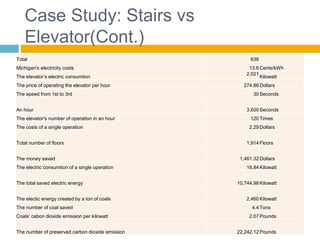
Total 638
Michigan's electricity costs 13.6Cents/kWh
The elevator’s electric consumtion
2,021
Kilowatt
The price of operating the elevator per hour 274.86Dollars
The speed from 1st to 3rd 30Seconds
An hour 3,600Seconds
The elevator's number of operation in an hour 120Times
The costs of a single operation 2.29Dollars
Total number of floors 1,914Floors
The money saved 1,461.32Dollars
The electric consumtion of a single operation 16.84Kilowatt
The total saved electric energy 10,744.98Kilowatt
The electic energy created by a ton of coals 2,460Kilowatt
The number of coal saved 4.4 Tons
Coals' cabon dioxide emission per kilowatt 2.07Pounds
The number of preserved carbon dioxide emission 22,242.12Pounds
Planning for Energy

Planning for Energy

  • 1.
  • 2.
    What is Energy? Energyis power that allow residents to maintain post-industrial lifestyle in developed countries by activating factories, cars, and home appliances.
  • 3.
    What are theenergy issues?  The U.S. relies heavily on nonrenewable fossil fuel energy which causes climate change, soil, air, and water pollution.  The Federal government does not have a clear national energy policy.  U.S. Coal Power Plants produce more than 100 million tons of potentially toxic coal ash each year.
  • 4.
    What are theenergy issues?(Cont.)  A Pond with decades of coal ash broke through a dam & spilled over 300 acres at the Kingston Fossil Plant in December 2008.  According to the International Energy Agency, the U.S. is poised to overtake Saudi Arabia as the world’s leading oil producer by 2020.  More than 160-million-gallon of oil from the 2010 BP Deepwater Horizon blowout in the Gulf of Mexico devastated coastal ecosystem.
  • 5.
    Goals o Securing affordablelong-term energy supplies o Becoming more energy efficient o Conserving on the use of energy o Reducing energy related pollution
  • 6.
    U.S. Energy Sources 13.84 27.8 20.6 8.05 2.67 3.78 2012U.S. Energy Production by Source Crude Oil Natural Gas Coal Nuclear Hydropower Biomass U.S. Energy Administration, Annual Energy Outlook, 2014
  • 7.
    Oil  Refining petroleuminto gasoline & burning gasoline in motor vehicles creates air & water pollution.  Horizontal drilling & hydraulic fracturing allowed to extract 6.4 million barrels a day.  Costs of guarding international oil supply routes are not being paid by consumers.
  • 8.
    Natural Gas  Produces~ ½ as much in carbon dioxide emission as coal.  Cheap & Abundant reserves in U.S.  More than ½ of U.S. residences are being heated with natural gas.  U.S is leading producer of natural gas.  Natural gas is a potent greenhouse gas, ~20 times more concentrated than carbon dioxide.
  • 9.
    Coal o The largestcoal reserves are in U.S. o Coal mining process pollutes soil & water with acid mine drainage & methyl mercury. o Burning Coal threats human health by emitting nitrogen dioxide & sulfur dioxide. o 1.016 billion tons were used for 39% of total electricity & 20.6% of total energy needs in 2012. o Coal mining is declining due to the price of natural gas.
  • 10.
    Nuclear  The U.S.has more nuclear power plants than any other country.  Nuclear power plants last 60 ~ 80 years and need to be monitored and protected from natural disasters to prevent radiation leaks.  The plutonium that fuels nuclear plants is one of the most hazardous substances on earth.
  • 11.
    Hydropower  The U.S.has more then 4,000 hydroelectric dams.  They generated fairly inexpensive electricity (~2.67% of total energy needs) in 2012.  They also decreased fish runs and flooded millions of acres.  Several older dams have been dismantled since the late 1990s.
  • 12.
    Biomass  Biomass isenergy from plant and animal products.  Burning harvest slash & lumber pieces  can generate electricity & air pollution  Extracting methane from decomposing organic matter  can generate electricity & carbon dioxide from daily farm & landfills  Extracting ethanol from corn  can be used to power cars, but economically not practical. It yields lower miles than gasoline & the ratio of energy returned from the ethanol to the
  • 13.
    U.S. Energy Consumptionby Sector 17.61 30.54 20.1 26.77 2012 U.S. Primary Energy Use by Sector Commercial Industrial Residential Transportation U.S. Energy Administration, Annual Energy Outlook, 2014
  • 14.
    The Federal Government Offers subsidies for oil & gas development, wind & solar installations, and creation of ethanol from corn.  Provides tax breaks for oil & gas development.  Four federal agencies are dealing with energy issues. (the DOE, the EPA, the BLM, and the U.S. Forest Service)  Promoted energy loans for development of efficient heating systems & hybrid cars.  Can make an agreement on the mix of energy sources.
  • 15.
    The Department ofEnergy  Founded in 1977.  Prefers to focus on greater energy production & efficiency rather than energy conservation.  Working to  reduce dependence on imported oil.  promote energy efficiency in homes & buildings.  develop technologies that increase the production of domestic oil and natural gas.  develop clean coal technology, carbon capture, nuclear fusion, the safe disposal of nuclear waste.  Regulate the transmission & sale of natural gas, oil and electricity.
  • 16.
    Environmental Protection Agency  TheEPA has set energy & fuel efficiency standards for electrical appliances and conducting the Energy Star Program.  The EPA has not yet defined coal ash as hazardous waste.
  • 17.
    The U.S. ForestService  Monitors private energy companies which are extracting coal, uranium, oil, and gas from national forests.
  • 18.
    The State Governments Adopted renewable portfolio standards that require utilities to acquire a certain proportion of their energy supplies from renewable sources.  State energy offices  have promoted energy efficiency & conservation programs for new energy resource development.  Identify energy loss & recommend investment  Provide low-interest loans & tax credits for energy-saving projects
  • 19.
    Building Codes o Requirenew commercial, residential, and public buildings o Alterations to existing buildings to meet energy efficiency standards o Help building owners conserve energy & save money
  • 20.
    The Local Government Zoning ordinances can promote national security & economic sustainability by allowing mixed-use development around public transportation.  Subdivision regulations can require vegetative buffers around buildings to reduce cooling needs.  Can incorporate energy planning into the comprehensive planning process.
  • 21.
    Land Use Patterns oSprawling relies heavily on private motor vehicles o Compact encourages walking, biking, public transportatio
  • 22.
  • 23.
    Case Study: Stairsvs Elevator  Last semester, I climbed stairs instead of taking elevators and counted times that I used stairs instead of an elevator for 13 weeks.  I was living on the third floor on my residence hall. So, I counted numbers when I passed third floors.  I developed my leg muscles and reduced electricity fee, the local communities’ fossil fuels, coals, and air pollution.  The elevator which is located in my previous residential hall is a hydraulic elevator with 3,500 lbs. of capacity.  It takes 2,021 kilowatt per hour. Michigan's electricity costs 13.60 cents/kWh for residential
  • 24.
    Case Study: Stairsvs Elevator(Cont.)  Michigan's electricity cost (13.60 cents per 1 kilowatt per hour) times the elevator’s electric usage (2,021 Kilowatt) is $274.86.  It is the price of operating the elevator per hour. The elevator takes 30 seconds from first floor to third floor.  Therefore, the elevator can take me from the first floor to the third floor 120 times in an hour.
  • 25.
    Case Study: Stairsvs Elevator(Cont.)  Single operation cost of the elevator was $2.29 (274.86/120=2.29).  I went up and down stairs 1,914 floors and chose climbing stairs instead of taking elevators 638 times.  $1461.32 was saved. (638*2.29=1461.32)  A single operation of the elevator from third floor to first floor takes 16.84 Kilowatt.  Since I didn’t take the elevator for 638 times, 10,743.92 kilowatt is saved.(16.84*638=10,743.92)
  • 26.
    Case Study: Stairsvs Elevator(Cont.)  A ton of coal creates 2,460 kWh.  4.4 tons of coals were saved. (10,743.92/2,460=4.4)  Coal combustion emits 2.07 pounds of carbon dioxide per kWh.  22239.91 pounds of carbon dioxide were not emitted into the atmosphere just because I did not take elevators for 13 weeks.(10,743.92* 2.07= 22239.91)
  • 27.
    Case Study: Stairsvs Elevator(Cont.) Total 638 Michigan's electricity costs 13.6Cents/kWh The elevator’s electric consumtion 2,021 Kilowatt The price of operating the elevator per hour 274.86Dollars The speed from 1st to 3rd 30Seconds An hour 3,600Seconds The elevator's number of operation in an hour 120Times The costs of a single operation 2.29Dollars Total number of floors 1,914Floors The money saved 1,461.32Dollars The electric consumtion of a single operation 16.84Kilowatt The total saved electric energy 10,744.98Kilowatt The electic energy created by a ton of coals 2,460Kilowatt The number of coal saved 4.4 Tons Coals' cabon dioxide emission per kilowatt 2.07Pounds The number of preserved carbon dioxide emission 22,242.12Pounds