6 Easy Steps to an Effective 
Needs Assessment 
Michael Management Corporation 
www.michaelmanagement.com
Meet Your Host & Speaker 
Erin Lett 
• Operations Manager 
• Joined MMC in 2010 
• BA in Communications from Stetson 
• elett@michaelmanagement.com 
Copyright © Michael Management Corporation - All rights reserved www.michaelmanagement.com
Meet Your Co-Speaker 
Leslie Bass 
• Project Manager & 
• Senior Instructional Designer 
• Over 25 years IT experience 
• Joined MMC as Lead Instructional Designer 
• Created hundreds of eLearning simulations 
• lbass@michaelmanagement.com 
Copyright © Michael Management Corporation - All rights reserved www.michaelmanagement.com
Agenda 
• What is a Needs Assessment? 
• Why Are Needs Assessments Important? 
• 6 Easy Steps to an Effective Needs Assessment 
• Summary 
• Q&A 
Copyright © Michael Management Corporation - All rights reserved 
www.michaelmanagement.com
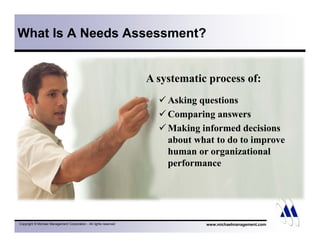
What Is A Needs Assessment? 
A systematic process of: 
Asking questions 
Comparing answers 
Making informed decisions 
about what to do to improve 
human or organizational 
performance 
Copyright © Michael Management Corporation - All rights reserved www.michaelmanagement.com
Agenda 
• What is a Needs Assessment? 
• Why Are Needs Assessments Important? 
• 6 Easy Steps to an Effective Needs Assessment 
• Summary 
• QA 
Copyright © Michael Management Corporation - All rights reserved 
www.michaelmanagement.com
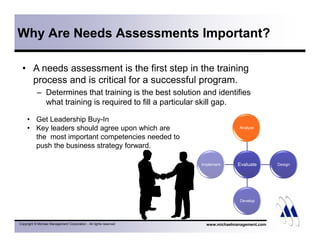
Why Are Needs Assessments Important? 
• A needs assessment is the first step in the training 
process and is critical for a successful program. 
– Determines that training is the best solution and identifies 
what training is required to fill a particular skill gap. 
• Get Leadership Buy-In 
• Key leaders should agree upon which are 
the most important competencies needed to 
push the business strategy forward. 
Analyze 
Evaluate 
Copyright © Michael Management Corporation - All rights reserved www.michaelmanagement.com 
Design 
Develop 
Implement
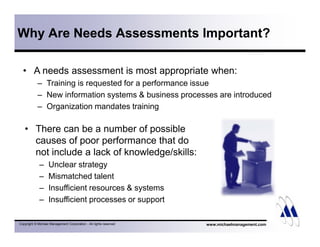
Why Are Needs Assessments Important? 
• A needs assessment is most appropriate when: 
– Training is requested for a performance issue 
– New information systems  business processes are introduced 
– Organization mandates training 
• There can be a number of possible 
causes of poor performance that do 
not include a lack of knowledge/skills: 
– Unclear strategy 
– Mismatched talent 
– Insufficient resources  systems 
– Insufficient processes or support 
Copyright © Michael Management Corporation - All rights reserved www.michaelmanagement.com
Why Are Needs Assessments Important? 
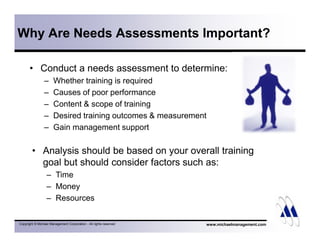
• Conduct a needs assessment to determine: 
– Whether training is required 
– Causes of poor performance 
– Content  scope of training 
– Desired training outcomes  measurement 
– Gain management support 
• Analysis should be based on your overall training 
goal but should consider factors such as: 
– Time 
– Money 
– Resources 
Copyright © Michael Management Corporation - All rights reserved www.michaelmanagement.com
Agenda 
• What is a Needs Assessment? 
• Why Are Needs Assessments Important? 
• 6 Easy Steps to an Effective Needs Assessment 
• Summary 
• QA 
Copyright © Michael Management Corporation - All rights reserved 
www.michaelmanagement.com
# 1 Perform a “Gap” Analysis 
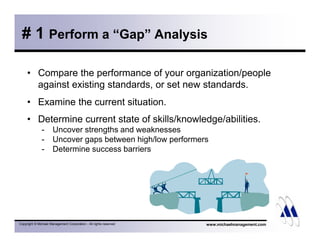
• Compare the performance of your organization/people 
against existing standards, or set new standards. 
• Examine the current situation. 
• Determine current state of skills/knowledge/abilities. 
- Uncover strengths and weaknesses 
- Uncover gaps between high/low performers 
- Determine success barriers 
Copyright © Michael Management Corporation - All rights reserved www.michaelmanagement.com
# 1 Perform a “Gap” Analysis 
• Determine the desired or necessary situation. 
- Conditions for success 
• Focus on necessary job tasks  standards. 
- Required skills, knowledge  abilities 
- Identify critical tasks, don’t just observe current practices 
- Actual needs vs. perceived needs 
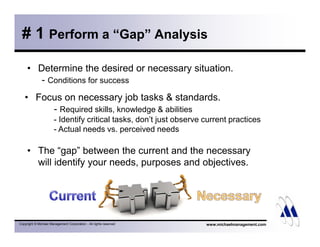
• The “gap” between the current and the necessary 
will identify your needs, purposes and objectives. 
Copyright © Michael Management Corporation - All rights reserved www.michaelmanagement.com
# 2 Identify Priorities  Importance 
• The “Gap” analysis should have produced a list of needs for: 
– Training  development 
– Career development 
– Organizational development 
– Other interventions 
• Examine those needs in view of their importance to your 
organizational goals, realities and constraints. 
Copyright © Michael Management Corporation - All rights reserved www.michaelmanagement.com
# 3 Collect Appropriate Data 
• Determine who you should ask. 
– Start with senior-level management 
– Front line managers 
– Employees performing the job role 
• Develop the right questions to ask. 
Copyright © Michael Management Corporation - All rights reserved www.michaelmanagement.com
# 3 Collect Appropriate Data 
• Senior/Front Line Management 
– What operational/business results do you expect? 
– What is hindering results? 
– What are ideal job roles/responsibilities? 
– What tools/resources are currently in place? 
– What would an ideal curriculum look like? 
• Workers 
– What is your current/desired level of performance? 
– What would help you perform at a higher level? 
– What learning opportunities would you like to see offered? 
Copyright © Michael Management Corporation - All rights reserved www.michaelmanagement.com
# 3 Collect Appropriate Data 
• Provide examples of external  internal factors. 
• Acknowledge gaps between what management feels 
is occurring and what the employee feels. 
• Use anonymous questions to allow for honest answers. 
• Interview employees from various 
departments  levels of your organization. 
Copyright © Michael Management Corporation - All rights reserved www.michaelmanagement.com
# 4 Analyze Data Effectively 
• Tabulate the results to get a clear picture of action steps. 
– Training needs assessments don’t begin with a solution in mind 
– Taking time to review  organize results is critical 
• Organize the results to determine performance objectives 
and instructional objectives. 
Copyright © Michael Management Corporation - All rights reserved www.michaelmanagement.com
# 5 Provide Appropriate Feedback 
• Identify causes of performance problems. 
- Explain the performance requirements 
- Report if they are being met 
- Explain what training solutions are required 
- Explain how solutions can be accomplished 
• For every identified need, ask: 
- Are employees doing their job effectively? 
- Do they know how to do their job? 
Copyright © Michael Management Corporation - All rights reserved www.michaelmanagement.com
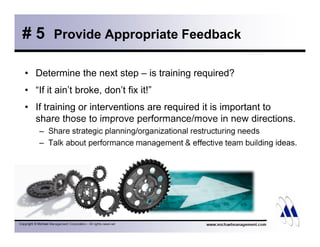
# 5 Provide Appropriate Feedback 
• Determine the next step – is training required? 
• “If it ain’t broke, don’t fix it!” 
• If training or interventions are required it is important to 
share those to improve performance/move in new directions. 
– Share strategic planning/organizational restructuring needs 
– Talk about performance management  effective team building ideas. 
Copyright © Michael Management Corporation - All rights reserved www.michaelmanagement.com
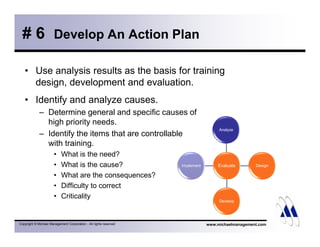
# 6 Develop An Action Plan 
• Use analysis results as the basis for training 
design, development and evaluation. 
• Identify and analyze causes. 
– Determine general and specific causes of 
high priority needs. 
– Identify the items that are controllable 
with training. 
• What is the need? 
• What is the cause? 
• What are the consequences? 
• Difficulty to correct 
• Criticality 
Analyze 
Evaluate 
Design 
Develop 
Implement 
Copyright © Michael Management Corporation - All rights reserved www.michaelmanagement.com
# 6 Develop An Action Plan 
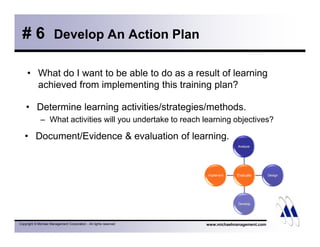
• What do I want to be able to do as a result of learning 
achieved from implementing this training plan? 
• Determine learning activities/strategies/methods. 
– What activities will you undertake to reach learning objectives? 
• Document/Evidence  evaluation of learning. 
Analyze 
Evaluate 
Copyright © Michael Management Corporation - All rights reserved www.michaelmanagement.com 
Design 
Develop 
Implement
# 6 Develop An Action Plan 
• S.M.A.R.T.E.R 
– Specific 
– Measurable 
– Acceptable 
– Realistic to achieve 
– Time-bound with a deadline 
– Extending your capabilities 
– Rewarding to you 
Copyright © Michael Management Corporation - All rights reserved www.michaelmanagement.com
Agenda 
• What is a Needs Assessment? 
• Why Are Needs Assessments Important? 
• 6 Easy Steps to an Effective Needs Assessment 
• Summary 
• QA 
Copyright © Michael Management Corporation - All rights reserved 
www.michaelmanagement.com
Summary 
• # 1 Perform a “Gap” analysis 
• # 2 Identify Priorities and Importance 
• # 3 Collect Appropriate Data 
• # 4 Analyze Data Effectively 
• # 5 Provide Appropriate Feedback 
• # 6 Develop An Action Plan 
Copyright © Michael Management Corporation - All rights reserved www.michaelmanagement.com
Agenda 
• What is a Needs Assessment? 
• Why Are Needs Assessments Important? 
• 6 Easy Steps to an Effective Needs Assessment 
• Summary 
• QA 
Copyright © Michael Management Corporation - All rights reserved 
www.michaelmanagement.com
Questions  Answers 
Have additional questions? 
Contact us at (800) 608-0490 
info@michaelmanagement.com 
Copyright © Michael Management Corporation - All rights reserved www.michaelmanagement.com

6 Steps to an Effective Needs Assessment

  • 1.
    6 Easy Stepsto an Effective Needs Assessment Michael Management Corporation www.michaelmanagement.com
  • 2.
    Meet Your Host& Speaker Erin Lett • Operations Manager • Joined MMC in 2010 • BA in Communications from Stetson • elett@michaelmanagement.com Copyright © Michael Management Corporation - All rights reserved www.michaelmanagement.com
  • 3.
    Meet Your Co-Speaker Leslie Bass • Project Manager & • Senior Instructional Designer • Over 25 years IT experience • Joined MMC as Lead Instructional Designer • Created hundreds of eLearning simulations • lbass@michaelmanagement.com Copyright © Michael Management Corporation - All rights reserved www.michaelmanagement.com
  • 4.
    Agenda • Whatis a Needs Assessment? • Why Are Needs Assessments Important? • 6 Easy Steps to an Effective Needs Assessment • Summary • Q&A Copyright © Michael Management Corporation - All rights reserved www.michaelmanagement.com
  • 5.
    What Is ANeeds Assessment? A systematic process of: Asking questions Comparing answers Making informed decisions about what to do to improve human or organizational performance Copyright © Michael Management Corporation - All rights reserved www.michaelmanagement.com
  • 6.
    Agenda • Whatis a Needs Assessment? • Why Are Needs Assessments Important? • 6 Easy Steps to an Effective Needs Assessment • Summary • QA Copyright © Michael Management Corporation - All rights reserved www.michaelmanagement.com
  • 7.
    Why Are NeedsAssessments Important? • A needs assessment is the first step in the training process and is critical for a successful program. – Determines that training is the best solution and identifies what training is required to fill a particular skill gap. • Get Leadership Buy-In • Key leaders should agree upon which are the most important competencies needed to push the business strategy forward. Analyze Evaluate Copyright © Michael Management Corporation - All rights reserved www.michaelmanagement.com Design Develop Implement
  • 8.
    Why Are NeedsAssessments Important? • A needs assessment is most appropriate when: – Training is requested for a performance issue – New information systems business processes are introduced – Organization mandates training • There can be a number of possible causes of poor performance that do not include a lack of knowledge/skills: – Unclear strategy – Mismatched talent – Insufficient resources systems – Insufficient processes or support Copyright © Michael Management Corporation - All rights reserved www.michaelmanagement.com
  • 9.
    Why Are NeedsAssessments Important? • Conduct a needs assessment to determine: – Whether training is required – Causes of poor performance – Content scope of training – Desired training outcomes measurement – Gain management support • Analysis should be based on your overall training goal but should consider factors such as: – Time – Money – Resources Copyright © Michael Management Corporation - All rights reserved www.michaelmanagement.com
  • 10.
    Agenda • Whatis a Needs Assessment? • Why Are Needs Assessments Important? • 6 Easy Steps to an Effective Needs Assessment • Summary • QA Copyright © Michael Management Corporation - All rights reserved www.michaelmanagement.com
  • 11.
    # 1 Performa “Gap” Analysis • Compare the performance of your organization/people against existing standards, or set new standards. • Examine the current situation. • Determine current state of skills/knowledge/abilities. - Uncover strengths and weaknesses - Uncover gaps between high/low performers - Determine success barriers Copyright © Michael Management Corporation - All rights reserved www.michaelmanagement.com
  • 12.
    # 1 Performa “Gap” Analysis • Determine the desired or necessary situation. - Conditions for success • Focus on necessary job tasks standards. - Required skills, knowledge abilities - Identify critical tasks, don’t just observe current practices - Actual needs vs. perceived needs • The “gap” between the current and the necessary will identify your needs, purposes and objectives. Copyright © Michael Management Corporation - All rights reserved www.michaelmanagement.com
  • 13.
    # 2 IdentifyPriorities Importance • The “Gap” analysis should have produced a list of needs for: – Training development – Career development – Organizational development – Other interventions • Examine those needs in view of their importance to your organizational goals, realities and constraints. Copyright © Michael Management Corporation - All rights reserved www.michaelmanagement.com
  • 14.
    # 3 CollectAppropriate Data • Determine who you should ask. – Start with senior-level management – Front line managers – Employees performing the job role • Develop the right questions to ask. Copyright © Michael Management Corporation - All rights reserved www.michaelmanagement.com
  • 15.
    # 3 CollectAppropriate Data • Senior/Front Line Management – What operational/business results do you expect? – What is hindering results? – What are ideal job roles/responsibilities? – What tools/resources are currently in place? – What would an ideal curriculum look like? • Workers – What is your current/desired level of performance? – What would help you perform at a higher level? – What learning opportunities would you like to see offered? Copyright © Michael Management Corporation - All rights reserved www.michaelmanagement.com
  • 16.
    # 3 CollectAppropriate Data • Provide examples of external internal factors. • Acknowledge gaps between what management feels is occurring and what the employee feels. • Use anonymous questions to allow for honest answers. • Interview employees from various departments levels of your organization. Copyright © Michael Management Corporation - All rights reserved www.michaelmanagement.com
  • 17.
    # 4 AnalyzeData Effectively • Tabulate the results to get a clear picture of action steps. – Training needs assessments don’t begin with a solution in mind – Taking time to review organize results is critical • Organize the results to determine performance objectives and instructional objectives. Copyright © Michael Management Corporation - All rights reserved www.michaelmanagement.com
  • 18.
    # 5 ProvideAppropriate Feedback • Identify causes of performance problems. - Explain the performance requirements - Report if they are being met - Explain what training solutions are required - Explain how solutions can be accomplished • For every identified need, ask: - Are employees doing their job effectively? - Do they know how to do their job? Copyright © Michael Management Corporation - All rights reserved www.michaelmanagement.com
  • 19.
    # 5 ProvideAppropriate Feedback • Determine the next step – is training required? • “If it ain’t broke, don’t fix it!” • If training or interventions are required it is important to share those to improve performance/move in new directions. – Share strategic planning/organizational restructuring needs – Talk about performance management effective team building ideas. Copyright © Michael Management Corporation - All rights reserved www.michaelmanagement.com
  • 20.
    # 6 DevelopAn Action Plan • Use analysis results as the basis for training design, development and evaluation. • Identify and analyze causes. – Determine general and specific causes of high priority needs. – Identify the items that are controllable with training. • What is the need? • What is the cause? • What are the consequences? • Difficulty to correct • Criticality Analyze Evaluate Design Develop Implement Copyright © Michael Management Corporation - All rights reserved www.michaelmanagement.com
  • 21.
    # 6 DevelopAn Action Plan • What do I want to be able to do as a result of learning achieved from implementing this training plan? • Determine learning activities/strategies/methods. – What activities will you undertake to reach learning objectives? • Document/Evidence evaluation of learning. Analyze Evaluate Copyright © Michael Management Corporation - All rights reserved www.michaelmanagement.com Design Develop Implement
  • 22.
    # 6 DevelopAn Action Plan • S.M.A.R.T.E.R – Specific – Measurable – Acceptable – Realistic to achieve – Time-bound with a deadline – Extending your capabilities – Rewarding to you Copyright © Michael Management Corporation - All rights reserved www.michaelmanagement.com
  • 23.
    Agenda • Whatis a Needs Assessment? • Why Are Needs Assessments Important? • 6 Easy Steps to an Effective Needs Assessment • Summary • QA Copyright © Michael Management Corporation - All rights reserved www.michaelmanagement.com
  • 24.
    Summary • #1 Perform a “Gap” analysis • # 2 Identify Priorities and Importance • # 3 Collect Appropriate Data • # 4 Analyze Data Effectively • # 5 Provide Appropriate Feedback • # 6 Develop An Action Plan Copyright © Michael Management Corporation - All rights reserved www.michaelmanagement.com
  • 25.
    Agenda • Whatis a Needs Assessment? • Why Are Needs Assessments Important? • 6 Easy Steps to an Effective Needs Assessment • Summary • QA Copyright © Michael Management Corporation - All rights reserved www.michaelmanagement.com
  • 26.
    Questions Answers Have additional questions? Contact us at (800) 608-0490 info@michaelmanagement.com Copyright © Michael Management Corporation - All rights reserved www.michaelmanagement.com