Discussion Draft
Continuous Improvement
and
Innovation
The What, Why, How of Change Methodologies
Alan Cay Culler CEO and Founder
Results-Alliance LLC
+1-973-744-4911
www.results-alliance.com
alan@results-alliance.com
Richard Taylor, CTO
RWTA Associates, Inc.
+1-330-668-2190
www.rwtaylorassoc.com
RWTaylorAssoc@gmail.com
Discussion Draft
Contents
• What is CI? Pages 4-8
• What does a CI Implementation Look Like? Page 10
• Innovation Pages 11-12
• About Results-Alliance Pages 13-15
2
Discussion Draft
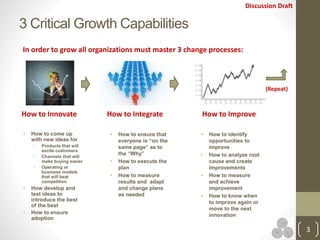
3 Critical Growth Capabilities
• How to come up
with new ideas for
• Products that will
excite customers
• Channels that will
make buying easier
• Operating or
business models
that will beat
competition
• How develop and
test ideas to
introduce the best
of the best
• How to ensure
adoption
3
In order to grow all organizations must master 3 change processes:
How to Innovate How to ImproveHow to Integrate
• How to ensure that
everyone is “on the
same page” as to
the “Why”
• How to execute the
plan
• How to measure
results and adapt
and change plans
as needed
• How to identify
opportunities to
improve
• How to analyze root
cause and create
improvements
• How to measure
and achieve
improvement
• How to know when
to improve again or
move to the next
innovation
(Repeat)
Discussion Draft
What is Continuous Improvement?
• Continuous Improvement (CI)is a rigorous, systematic way for
organization to improve performance.
• Used by DuPont, GE, BP, Whirlpool, Allied Signal, Toyota, Ford,
Motorola, Honeywell, Chase and many others.
• While there are many different approaches they all boil down to”
• Measure where you are today (baseline),
• Understand the causes and plan to improve,
• Measure the improvement,
• Repeat.
• CI is easy to understand, but it is a discipline that requires
consistent practice
• CI is most often used in improving business and operational
processes
• Implementing Continuous Improvement across the organization
requires Leadership focus and commitment, using a consistent
methodology
• A CI effort does have start-up expense, but becomes self-funding
(paid for by revenue increases, and cost savings) in a year.
4
Discussion Draft
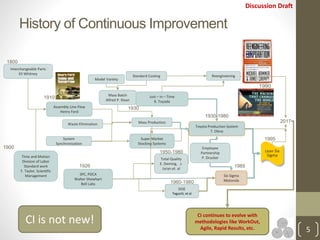
History of Continuous Improvement
Interchangeable Parts
Eli Whitney
Assembly Line Flow
Henry Ford
Waste Elimination
System
Synchronization
Total Quality
E. Deming, J.
Juran et. al
Super Market
Stocking Systems
Mass Production
Mass Batch
Alfred P. Sloan
DOE
Taguchi, et al
SPC, PDCA
Walter Shewhart
Bell Labs
Time and Motion
Division of Labor
Standard work
F. Taylor, Scientific
Management
Standard Costing
Model Variety
Employee
Partnership
P. Drucker
Just – in – Time
K. Toyada
Lean Six
Sigma
1800
1900
1910
1930
1985
1930-1980
1990
1995
1950-1980
1926
1960-1980
Six Sigma
Motorola
Toyota Production System
T. Ohno
CI is not new!
5
Reengineering
CI continues to evolve with
methodologies like WorkOut,
Agile, Rapid Results, etc.
2017
Discussion Draft
Structured
Methodology
Engaged
Team
Sustainable
Change
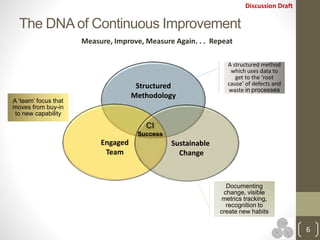
The DNA of Continuous Improvement
CI
Success
A structured method
which uses data to
get to the ‘root
cause’ of defects and
waste in processes
Documenting
change, visible
metrics tracking,
recognition to
create new habits
A ‘team’ focus that
moves from buy-in
to new capability
Measure, Improve, Measure Again. . . Repeat
6
Discussion Draft
PDCA Plan (Why/What, How, Who/When) Do ActCheck
Six Sigma
12 Steps
Analyze Improve ControlDefine Measure
1. Define
Problem
2. Specifications / Metrics
3. Quantify Measurability
4. Baseline
5. Goal
6. List Inputs
7. Prioritize Inputs
8. Quantify Input Settings
9. Plan Implementation
10. Validate plan
11. Control Inputs Monitor Outputs
12. Sustain and Translate
Business
Process
Management
Document Measure Improve Manage
L e a d e r s h i p
Design for
Six Sigma
(new processes)
12 Steps
Analyze Design VerifyDefine Measure
1. Define
Problem
2. Specifications / Metrics
3. Quantify Measurability
4. Current State
5. Goal
6. Design Inputs
7. Prioritize Design Inputs
8. Quantify Design Inputs
9. Plan Implementation
10. Confirm plan
11. Control Inputs / Monitor Performance
12. Sustain and Translate
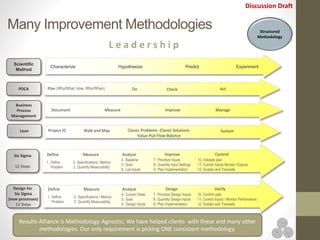
Many Improvement Methodologies
Scientific
Method
Characterize Hypothesize Predict Experiment
Results-Alliance is Methodology-Agnostic; We have helped clients with these and many other
methodologies. Our only requirement is picking ONE consistent methodology.
Structured
Methodology
Lean Project ID Walk and Map SustainClassic Problems -Classic Solutions
Value-Pull-Flow-Balance
Discussion Draft
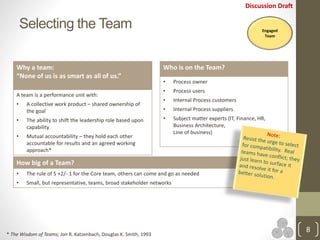
Selecting the Team
Why a team:
“None of us is as smart as all of us.”
A team is a performance unit with:
• A collective work product – shared ownership of
the goal
• The ability to shift the leadership role based upon
capability
• Mutual accountability – they hold each other
accountable for results and an agreed working
approach*
How big of a Team?
• The rule of 5 +2/- 1 for the Core team, others can come and go as needed
• Small, but representative, teams, broad stakeholder networks
Who is on the Team?
• Process owner
• Process users
• Internal Process customers
• Internal Process suppliers
• Subject matter experts (IT, Finance, HR,
Business Architecture,
Line of business)
8
Engaged
Team
* The Wisdom of Teams; Jon R. Katzenbach, Douglas K. Smith, 1993
Discussion Draft
9
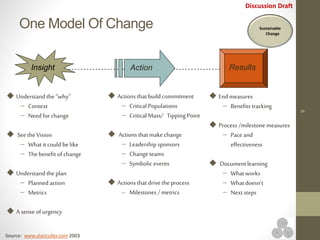
One Model Of Change
ActionInsight Results
 Understand the “why”
 Context
 Need for change
 Seethe Vision
 What it could belike
 Thebenefit of change
 Understand the plan
 Plannedaction
 Metrics
 A sense of urgency
 Actions that build commitment
 Critical Populations
 Critical Mass/ Tipping Point
 Actions that makechange
 Leadership sponsors
 Changeteams
 Symbolic events
 Actions that drivethe process
– Milestones / metrics
 End measures
 Benefits tracking
 Process /milestone measures
 Pace and
effectiveness
 Documentlearning
 What works
 What doesn’t
 Next steps
Source: www.alanculler.com 2003
Sustainable
Change
Discussion Draft
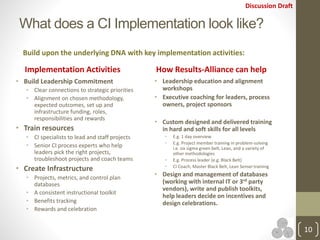
What does a CI Implementation look like?
Implementation Activities
• Build Leadership Commitment
• Clear connections to strategic priorities
• Alignment on chosen methodology,
expected outcomes, set up and
infrastructure funding, roles,
responsibilities and rewards
• Train resources
• CI specialists to lead and staff projects
• Senior CI process experts who help
leaders pick the right projects,
troubleshoot projects and coach teams
• Create Infrastructure
• Projects, metrics, and control plan
databases
• A consistent instructional toolkit
• Benefits tracking
• Rewards and celebration
How Results-Alliance can help
• Leadership education and alignment
workshops
• Executive coaching for leaders, process
owners, project sponsors
• Custom designed and delivered training
in hard and soft skills for all levels
• E.g. 1 day overview
• E.g. Project member training in problem-solving
i.e. six sigma green belt, Lean, and a variety of
other methodologies
• E.g. Process leader (e.g. Black Belt)
• CI Coach, Master Black Belt, Lean Sensei training
• Design and management of databases
(working with internal IT or 3rd party
vendors), write and publish toolkits,
help leaders decide on incentives and
design celebrations.
10
Build upon the underlying DNA with key implementation activities:
Discussion Draft
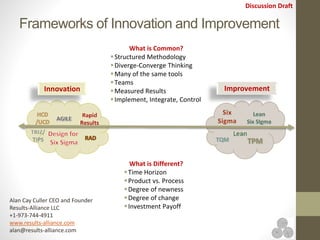
Frameworks of Innovation and Improvement
What is Common?
Structured Methodology
Diverge-Converge Thinking
Many of the same tools
Teams
Measured Results
Implement, Integrate, Control
What is Different?
Time Horizon
Product vs. Process
Degree of newness
Degree of change
Investment Payoff
ImprovementInnovation
Alan Cay Culler CEO and Founder
Results-Alliance LLC
+1-973-744-4911
www.results-alliance.com
alan@results-alliance.com
Discussion Draft
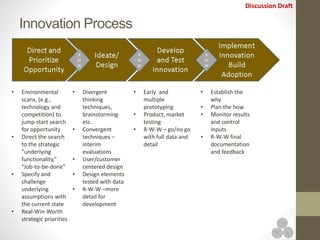
Innovation Process
• Environmental
scans, (e.g.,
technology and
competition) to
jump-start search
for opportunity
• Direct the search
to the strategic
“underlying
functionality,”
“Job-to-be-done”
• Specify and
challenge
underlying
assumptions with
the current state
• Real-Win-Worth
strategic priorities
• Divergent
thinking
techniques,
brainstorming
etc.
• Convergent
techniques –
interim
evaluations
• User/customer
centered design
• Design elements
tested with data
• R-W-W –more
detail for
development
• Early and
multiple
prototyping
• Product, market
testing
• R-W-W – go/no go
with full data and
detail
• Establish the
why
• Plan the how
• Monitor results
and control
inputs
• R-W-W final
documentation
and feedback
Discussion Draft
About Results-Alliance
• Results-Alliance is a confederation of independent consultants and small consulting firms
collaborating with clients to drive business results.
• The Results-Alliance Consulting Model
• Results-Driven - Every engagement begins with the results to be achieved.
• Client Led – the client becomes the ‘general contractor’ specifying desired results to be
achieved and participating at every stage of the process. The client decides the pace and
what is appropriate change.
• Capability Building – Results-Alliance consultants want to share their experience with
client organizations. The client learns how to continue the work without another consulting
project. Typical capabilities include:
• Innovation –from ideation to development to execution –the creation of new products,
processes and business models.
• Integration –getting everyone on the same page and focused on delivering results using
leadership alignment workshops and organization and process design
• Improvement – measure where you are – improve- measure where you got to -repeat –
rigorous and systematic improvement using many different methodologies
• Internal consulting – building internal consulting firms and customer-focused corporate
service departments to do what we do.
• Cost effective – The typical consulting pyramid is Partner-junior partner-manager- stream
manager- associates- analysts. Results-Alliance provides senior resources who actually
do real work
• www.results-alliance.com
13
Discussion Draft
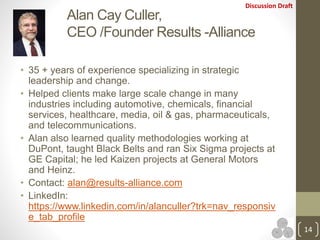
Alan Cay Culler,
CEO /Founder Results -Alliance
• 35 + years of experience specializing in strategic
leadership and change.
• Helped clients make large scale change in many
industries including automotive, chemicals, financial
services, healthcare, media, oil & gas, pharmaceuticals,
and telecommunications.
• Alan also learned quality methodologies working at
DuPont, taught Black Belts and ran Six Sigma projects at
GE Capital; he led Kaizen projects at General Motors
and Heinz.
• Contact: alan@results-alliance.com
• LinkedIn:
https://www.linkedin.com/in/alanculler?trk=nav_responsiv
e_tab_profile
14
Discussion Draft
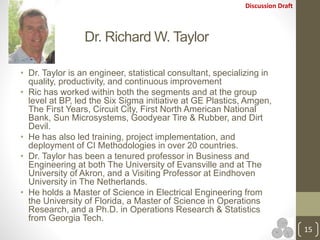
Dr. Richard W. Taylor
15
• Dr. Taylor is an engineer, statistical consultant, specializing in
quality, productivity, and continuous improvement
• Ric has worked within both the segments and at the group
level at BP, led the Six Sigma initiative at GE Plastics, Amgen,
The First Years, Circuit City, First North American National
Bank, Sun Microsystems, Goodyear Tire & Rubber, and Dirt
Devil.
• He has also led training, project implementation, and
deployment of CI Methodologies in over 20 countries.
• Dr. Taylor has been a tenured professor in Business and
Engineering at both The University of Evansville and at The
University of Akron, and a Visiting Professor at Eindhoven
University in The Netherlands.
• He holds a Master of Science in Electrical Engineering from
the University of Florida, a Master of Science in Operations
Research, and a Ph.D. in Operations Research & Statistics
from Georgia Tech.

R a ci & innovation

  • 1.
    Discussion Draft Continuous Improvement and Innovation TheWhat, Why, How of Change Methodologies Alan Cay Culler CEO and Founder Results-Alliance LLC +1-973-744-4911 www.results-alliance.com alan@results-alliance.com Richard Taylor, CTO RWTA Associates, Inc. +1-330-668-2190 www.rwtaylorassoc.com RWTaylorAssoc@gmail.com
  • 2.
    Discussion Draft Contents • Whatis CI? Pages 4-8 • What does a CI Implementation Look Like? Page 10 • Innovation Pages 11-12 • About Results-Alliance Pages 13-15 2
  • 3.
    Discussion Draft 3 CriticalGrowth Capabilities • How to come up with new ideas for • Products that will excite customers • Channels that will make buying easier • Operating or business models that will beat competition • How develop and test ideas to introduce the best of the best • How to ensure adoption 3 In order to grow all organizations must master 3 change processes: How to Innovate How to ImproveHow to Integrate • How to ensure that everyone is “on the same page” as to the “Why” • How to execute the plan • How to measure results and adapt and change plans as needed • How to identify opportunities to improve • How to analyze root cause and create improvements • How to measure and achieve improvement • How to know when to improve again or move to the next innovation (Repeat)
  • 4.
    Discussion Draft What isContinuous Improvement? • Continuous Improvement (CI)is a rigorous, systematic way for organization to improve performance. • Used by DuPont, GE, BP, Whirlpool, Allied Signal, Toyota, Ford, Motorola, Honeywell, Chase and many others. • While there are many different approaches they all boil down to” • Measure where you are today (baseline), • Understand the causes and plan to improve, • Measure the improvement, • Repeat. • CI is easy to understand, but it is a discipline that requires consistent practice • CI is most often used in improving business and operational processes • Implementing Continuous Improvement across the organization requires Leadership focus and commitment, using a consistent methodology • A CI effort does have start-up expense, but becomes self-funding (paid for by revenue increases, and cost savings) in a year. 4
  • 5.
    Discussion Draft History ofContinuous Improvement Interchangeable Parts Eli Whitney Assembly Line Flow Henry Ford Waste Elimination System Synchronization Total Quality E. Deming, J. Juran et. al Super Market Stocking Systems Mass Production Mass Batch Alfred P. Sloan DOE Taguchi, et al SPC, PDCA Walter Shewhart Bell Labs Time and Motion Division of Labor Standard work F. Taylor, Scientific Management Standard Costing Model Variety Employee Partnership P. Drucker Just – in – Time K. Toyada Lean Six Sigma 1800 1900 1910 1930 1985 1930-1980 1990 1995 1950-1980 1926 1960-1980 Six Sigma Motorola Toyota Production System T. Ohno CI is not new! 5 Reengineering CI continues to evolve with methodologies like WorkOut, Agile, Rapid Results, etc. 2017
  • 6.
    Discussion Draft Structured Methodology Engaged Team Sustainable Change The DNAof Continuous Improvement CI Success A structured method which uses data to get to the ‘root cause’ of defects and waste in processes Documenting change, visible metrics tracking, recognition to create new habits A ‘team’ focus that moves from buy-in to new capability Measure, Improve, Measure Again. . . Repeat 6
  • 7.
    Discussion Draft PDCA Plan(Why/What, How, Who/When) Do ActCheck Six Sigma 12 Steps Analyze Improve ControlDefine Measure 1. Define Problem 2. Specifications / Metrics 3. Quantify Measurability 4. Baseline 5. Goal 6. List Inputs 7. Prioritize Inputs 8. Quantify Input Settings 9. Plan Implementation 10. Validate plan 11. Control Inputs Monitor Outputs 12. Sustain and Translate Business Process Management Document Measure Improve Manage L e a d e r s h i p Design for Six Sigma (new processes) 12 Steps Analyze Design VerifyDefine Measure 1. Define Problem 2. Specifications / Metrics 3. Quantify Measurability 4. Current State 5. Goal 6. Design Inputs 7. Prioritize Design Inputs 8. Quantify Design Inputs 9. Plan Implementation 10. Confirm plan 11. Control Inputs / Monitor Performance 12. Sustain and Translate Many Improvement Methodologies Scientific Method Characterize Hypothesize Predict Experiment Results-Alliance is Methodology-Agnostic; We have helped clients with these and many other methodologies. Our only requirement is picking ONE consistent methodology. Structured Methodology Lean Project ID Walk and Map SustainClassic Problems -Classic Solutions Value-Pull-Flow-Balance
  • 8.
    Discussion Draft Selecting theTeam Why a team: “None of us is as smart as all of us.” A team is a performance unit with: • A collective work product – shared ownership of the goal • The ability to shift the leadership role based upon capability • Mutual accountability – they hold each other accountable for results and an agreed working approach* How big of a Team? • The rule of 5 +2/- 1 for the Core team, others can come and go as needed • Small, but representative, teams, broad stakeholder networks Who is on the Team? • Process owner • Process users • Internal Process customers • Internal Process suppliers • Subject matter experts (IT, Finance, HR, Business Architecture, Line of business) 8 Engaged Team * The Wisdom of Teams; Jon R. Katzenbach, Douglas K. Smith, 1993
  • 9.
    Discussion Draft 9 One ModelOf Change ActionInsight Results  Understand the “why”  Context  Need for change  Seethe Vision  What it could belike  Thebenefit of change  Understand the plan  Plannedaction  Metrics  A sense of urgency  Actions that build commitment  Critical Populations  Critical Mass/ Tipping Point  Actions that makechange  Leadership sponsors  Changeteams  Symbolic events  Actions that drivethe process – Milestones / metrics  End measures  Benefits tracking  Process /milestone measures  Pace and effectiveness  Documentlearning  What works  What doesn’t  Next steps Source: www.alanculler.com 2003 Sustainable Change
  • 10.
    Discussion Draft What doesa CI Implementation look like? Implementation Activities • Build Leadership Commitment • Clear connections to strategic priorities • Alignment on chosen methodology, expected outcomes, set up and infrastructure funding, roles, responsibilities and rewards • Train resources • CI specialists to lead and staff projects • Senior CI process experts who help leaders pick the right projects, troubleshoot projects and coach teams • Create Infrastructure • Projects, metrics, and control plan databases • A consistent instructional toolkit • Benefits tracking • Rewards and celebration How Results-Alliance can help • Leadership education and alignment workshops • Executive coaching for leaders, process owners, project sponsors • Custom designed and delivered training in hard and soft skills for all levels • E.g. 1 day overview • E.g. Project member training in problem-solving i.e. six sigma green belt, Lean, and a variety of other methodologies • E.g. Process leader (e.g. Black Belt) • CI Coach, Master Black Belt, Lean Sensei training • Design and management of databases (working with internal IT or 3rd party vendors), write and publish toolkits, help leaders decide on incentives and design celebrations. 10 Build upon the underlying DNA with key implementation activities:
  • 11.
    Discussion Draft Frameworks ofInnovation and Improvement What is Common? Structured Methodology Diverge-Converge Thinking Many of the same tools Teams Measured Results Implement, Integrate, Control What is Different? Time Horizon Product vs. Process Degree of newness Degree of change Investment Payoff ImprovementInnovation Alan Cay Culler CEO and Founder Results-Alliance LLC +1-973-744-4911 www.results-alliance.com alan@results-alliance.com
  • 12.
    Discussion Draft Innovation Process •Environmental scans, (e.g., technology and competition) to jump-start search for opportunity • Direct the search to the strategic “underlying functionality,” “Job-to-be-done” • Specify and challenge underlying assumptions with the current state • Real-Win-Worth strategic priorities • Divergent thinking techniques, brainstorming etc. • Convergent techniques – interim evaluations • User/customer centered design • Design elements tested with data • R-W-W –more detail for development • Early and multiple prototyping • Product, market testing • R-W-W – go/no go with full data and detail • Establish the why • Plan the how • Monitor results and control inputs • R-W-W final documentation and feedback
  • 13.
    Discussion Draft About Results-Alliance •Results-Alliance is a confederation of independent consultants and small consulting firms collaborating with clients to drive business results. • The Results-Alliance Consulting Model • Results-Driven - Every engagement begins with the results to be achieved. • Client Led – the client becomes the ‘general contractor’ specifying desired results to be achieved and participating at every stage of the process. The client decides the pace and what is appropriate change. • Capability Building – Results-Alliance consultants want to share their experience with client organizations. The client learns how to continue the work without another consulting project. Typical capabilities include: • Innovation –from ideation to development to execution –the creation of new products, processes and business models. • Integration –getting everyone on the same page and focused on delivering results using leadership alignment workshops and organization and process design • Improvement – measure where you are – improve- measure where you got to -repeat – rigorous and systematic improvement using many different methodologies • Internal consulting – building internal consulting firms and customer-focused corporate service departments to do what we do. • Cost effective – The typical consulting pyramid is Partner-junior partner-manager- stream manager- associates- analysts. Results-Alliance provides senior resources who actually do real work • www.results-alliance.com 13
  • 14.
    Discussion Draft Alan CayCuller, CEO /Founder Results -Alliance • 35 + years of experience specializing in strategic leadership and change. • Helped clients make large scale change in many industries including automotive, chemicals, financial services, healthcare, media, oil & gas, pharmaceuticals, and telecommunications. • Alan also learned quality methodologies working at DuPont, taught Black Belts and ran Six Sigma projects at GE Capital; he led Kaizen projects at General Motors and Heinz. • Contact: alan@results-alliance.com • LinkedIn: https://www.linkedin.com/in/alanculler?trk=nav_responsiv e_tab_profile 14
  • 15.
    Discussion Draft Dr. RichardW. Taylor 15 • Dr. Taylor is an engineer, statistical consultant, specializing in quality, productivity, and continuous improvement • Ric has worked within both the segments and at the group level at BP, led the Six Sigma initiative at GE Plastics, Amgen, The First Years, Circuit City, First North American National Bank, Sun Microsystems, Goodyear Tire & Rubber, and Dirt Devil. • He has also led training, project implementation, and deployment of CI Methodologies in over 20 countries. • Dr. Taylor has been a tenured professor in Business and Engineering at both The University of Evansville and at The University of Akron, and a Visiting Professor at Eindhoven University in The Netherlands. • He holds a Master of Science in Electrical Engineering from the University of Florida, a Master of Science in Operations Research, and a Ph.D. in Operations Research & Statistics from Georgia Tech.