UNCCD 2nd Scientific Conference
    Economic assessment of desertification, sustainable land management and
              resilience of arid, semi-arid and dry sub-humid areas
                         9-12 April 2013 - Bonn, Germany

        DAY 2 – WED 5.1: Economics of Land Degradation (ELD) initiative


     Bridging the science-policy-practice divide:
Making a case for land degradation through valuation of
                   ecosystem services
Session outline
•   Why such an initiative?
•   The ELD approach
•   Links to complementary initiatives
•   Identified knowledge and practice gaps
•   Organisational structure and the three ELD working groups
    – Stacey Noel (ELD working group leader on options and pathways for action)
    – Makiko Yashiro (UNEP) representing Pushpam Kumar, ELD working group leader
      on scenarios
• Panel discussion
    –   Mark Schauer (ELD Secretariat, GIZ)
    –   Richard Thomas (ELD Scientific coordinator, UNU-INWEH)
    –   Emma Quillérou (ELD Scientific coordination, UNU-INWEH)
    –   Stacey Noel (SEI, ELD working group leader on options and pathways for action)
    –   Ephraim Nkonya (IFPRI, ELD scientific partner)
    –   Simone Quatrini (Global Mechanism of the UNCCD)
Why such an initiative?

• ELD movie

• Not much action so far despite well-known technical solutions,
  hence economic approach

• Three types of problems faced by land managers that economics
  can help solve:
   – Decide which option benefits the most to society as a whole (eg
     Development vs Conservation)
   – set “fairer” compensation levels and reduce social unrest
     (redistribution from winners to losers)
   – assess further opportunities for development and set up new
     markets
The ELD approach

•   Cost-benefit analysis
•   based on the total economic value
•   of ecosystem services derived from land
•   to compare the costs of action to the benefits from action

• If benefits > costs, we should take action
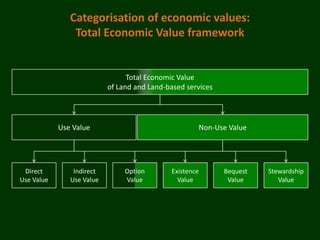
Categorisation of economic values:
                Total Economic Value framework


                                 Total Economic Value
                           of Land and Land-based services


            Use Value                                Non-Use Value


 Direct         Indirect        Option       Existence       Bequest   Stewardship
Use Value      Use Value        Value          Value          Value       Value
Categorisation of ecosystems services:
        Millennium Ecosystem Assessment framework

• The economic value of an ecosystem is the sum of economic values
  derived from individual services flows
   – Provisioning services, e.g. food, timber and fresh water
   – Regulating services, e.g. pollution reduction
   – Cultural services, e.g. aesthetic and spiritual values
   – Supporting services, e.g. soil formation and nutrient cycling*
• A framework which excludes the value of natural resource stocks for
  future benefits (so far)
   – If the flow of services is maintained but the stock decreases over
      time, then the system will not be sustainable in the long run!
   – Stock value can be estimated by complementary methods, e.g.
      green accounting
                                                   * Risk of double-counting
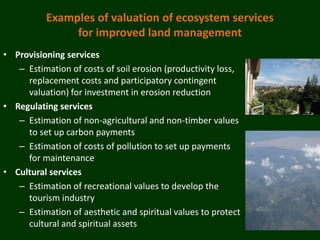
Examples of valuation of ecosystem services
               for improved land management
• Provisioning services
   – Estimation of costs of soil erosion (productivity loss,
     replacement costs and participatory contingent
     valuation) for investment in erosion reduction
• Regulating services
   – Estimation of non-agricultural and non-timber values
     to set up carbon payments
   – Estimation of costs of pollution to set up payments
     for maintenance
• Cultural services
   – Estimation of recreational values to develop the
     tourism industry
   – Estimation of aesthetic and spiritual values to protect
     cultural and spiritual assets
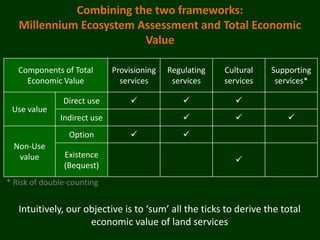
Combining the two frameworks:
   Millennium Ecosystem Assessment and Total Economic
                         Value

   Components of Total       Provisioning   Regulating   Cultural   Supporting
     Economic Value            services      services    services    services*

               Direct use                                 
 Use value
              Indirect use                                            
                 Option                        
 Non-Use
  value        Existence
                                                            
               (Bequest)
* Risk of double-counting


   Intuitively, our objective is to ‘sum’ all the ticks to derive the total
                     economic value of land services
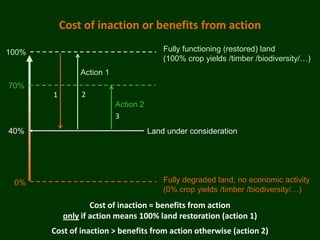
Cost of inaction or benefits from action

100%                                     Fully functioning (restored) land
                                         (100% crop yields /timber /biodiversity/…)
               Action 1
70%
       1        2
                          Action 2
                          3
40%                                  Land under consideration


 0%                                      Fully degraded land, no economic activity
                                         (0% crop yields /timber /biodiversity/…)
                   Cost of inaction = benefits from action
           only if action means 100% land restoration (action 1)
       Cost of inaction > benefits from action otherwise (action 2)
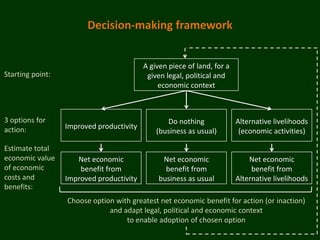
Decision-making framework


                                          A given piece of land, for a
Starting point:                            given legal, political and
                                               economic context


3 options for                                    Do nothing              Alternative livelihoods
action:           Improved productivity
                                              (business as usual)         (economic activities)

Estimate total
economic value       Net economic               Net economic                 Net economic
of economic           benefit from               benefit from                 benefit from
costs and         Improved productivity        business as usual         Alternative livelihoods
benefits:
                  Choose option with greatest net economic benefit for action (or inaction)
                              and adapt legal, political and economic context
                                   to enable adoption of chosen option
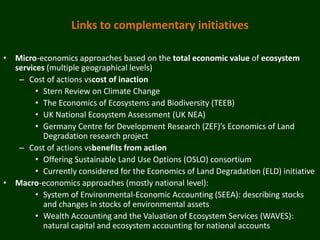
Links to complementary initiatives

• Micro-economics approaches based on the total economic value of ecosystem
  services (multiple geographical levels)
   – Cost of actions vscost of inaction
        • Stern Review on Climate Change
        • The Economics of Ecosystems and Biodiversity (TEEB)
        • UK National Ecosystem Assessment (UK NEA)
        • Germany Centre for Development Research (ZEF)’s Economics of Land
          Degradation research project
   – Cost of actions vsbenefits from action
        • Offering Sustainable Land Use Options (OSLO) consortium
        • Currently considered for the Economics of Land Degradation (ELD) initiative
• Macro-economics approaches (mostly national level):
        • System of Environmental-Economic Accounting (SEEA): describing stocks
          and changes in stocks of environmental assets
        • Wealth Accounting and the Valuation of Ecosystem Services (WAVES):
          natural capital and ecosystem accounting for national accounts
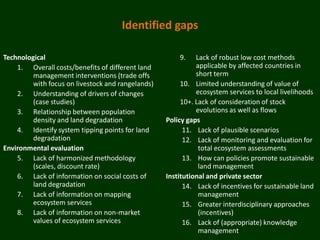
Identified gaps

Technological                                          9.    Lack of robust low cost methods
    1. Overall costs/benefits of different land              applicable by affected countries in
         management interventions (trade offs                short term
         with focus on livestock and rangelands)        10. Limited understanding of value of
    2. Understanding of drivers of changes                   ecosystem services to local livelihoods
         (case studies)                                 10+. Lack of consideration of stock
    3. Relationship between population                       evolutions as well as flows
         density and land degradation              Policy gaps
    4. Identify system tipping points for land           11. Lack of plausible scenarios
         degradation                                     12. Lack of monitoring and evaluation for
Environmental evaluation                                      total ecosystem assessments
    5. Lack of harmonized methodology                    13. How can policies promote sustainable
         (scales, discount rate)                              land management
    6. Lack of information on social costs of      Institutional and private sector
         land degradation                                14. Lack of incentives for sustainable land
    7. Lack of information on mapping                         management
         ecosystem services                              15. Greater interdisciplinary approaches
    8. Lack of information on non-market                      (incentives)
         values of ecosystem services                    16. Lack of (appropriate) knowledge
                                                              management
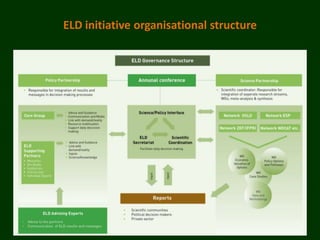
ELD initiative organisational structure
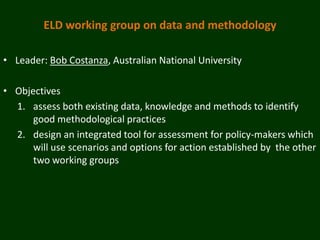
ELD working group on data and methodology

• Leader: Bob Costanza, Australian National University

• Objectives
  1. assess both existing data, knowledge and methods to identify
      good methodological practices
  2. design an integrated tool for assessment for policy-makers which
      will use scenarios and options for action established by the other
      two working groups
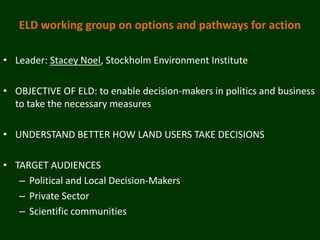
ELD working group on options and pathways for action

• Leader: Stacey Noel, Stockholm Environment Institute

• OBJECTIVE OF ELD: to enable decision-makers in politics and business
  to take the necessary measures

• UNDERSTAND BETTER HOW LAND USERS TAKE DECISIONS

• TARGET AUDIENCES
   – Political and Local Decision-Makers
   – Private Sector
   – Scientific communities
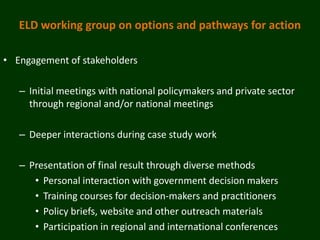
ELD working group on options and pathways for action

• Engagement of stakeholders

   – Initial meetings with national policymakers and private sector
     through regional and/or national meetings

   – Deeper interactions during case study work

   – Presentation of final result through diverse methods
      • Personal interaction with government decision makers
      • Training courses for decision-makers and practitioners
      • Policy briefs, website and other outreach materials
      • Participation in regional and international conferences
ELD working group on economic evaluation of options
                       (scenarios)

• (see dedicated presentation)
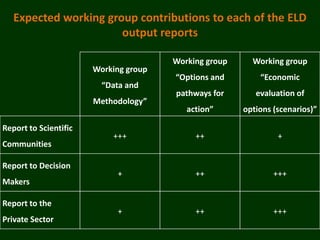
Expected working group contributions to each of the ELD
                       output reports

                                       Working group     Working group
                       Working group
                                       “Options and        “Economic
                         “Data and
                                       pathways for       evaluation of
                       Methodology”
                                          action”      options (scenarios)”

Report to Scientific
                           +++              ++                  +
Communities

Report to Decision
                            +               ++                 +++
Makers

Report to the
                            +               ++                 +++
Private Sector
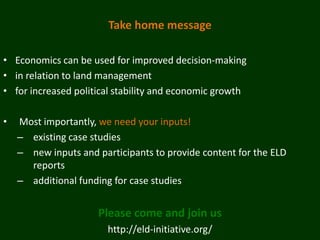
Take home message

• Economics can be used for improved decision-making
• in relation to land management
• for increased political stability and economic growth

•   Most importantly, we need your inputs!
    – existing case studies
    – new inputs and participants to provide content for the ELD
      reports
    – additional funding for case studies


                      Please come and join us
                        http://eld-initiative.org/

Richard THOMAS, Mark SCHAUER "Economics of Land Degradation (ELD) Initiative - Bridging the science-policy-practice divide - Making a case for tackling land degradation through valuation of ecosystem servicesence eld-session_unu-inweh

  • 1.
    UNCCD 2nd ScientificConference Economic assessment of desertification, sustainable land management and resilience of arid, semi-arid and dry sub-humid areas 9-12 April 2013 - Bonn, Germany DAY 2 – WED 5.1: Economics of Land Degradation (ELD) initiative Bridging the science-policy-practice divide: Making a case for land degradation through valuation of ecosystem services
  • 2.
    Session outline • Why such an initiative? • The ELD approach • Links to complementary initiatives • Identified knowledge and practice gaps • Organisational structure and the three ELD working groups – Stacey Noel (ELD working group leader on options and pathways for action) – Makiko Yashiro (UNEP) representing Pushpam Kumar, ELD working group leader on scenarios • Panel discussion – Mark Schauer (ELD Secretariat, GIZ) – Richard Thomas (ELD Scientific coordinator, UNU-INWEH) – Emma Quillérou (ELD Scientific coordination, UNU-INWEH) – Stacey Noel (SEI, ELD working group leader on options and pathways for action) – Ephraim Nkonya (IFPRI, ELD scientific partner) – Simone Quatrini (Global Mechanism of the UNCCD)
  • 3.
    Why such aninitiative? • ELD movie • Not much action so far despite well-known technical solutions, hence economic approach • Three types of problems faced by land managers that economics can help solve: – Decide which option benefits the most to society as a whole (eg Development vs Conservation) – set “fairer” compensation levels and reduce social unrest (redistribution from winners to losers) – assess further opportunities for development and set up new markets
  • 4.
    The ELD approach • Cost-benefit analysis • based on the total economic value • of ecosystem services derived from land • to compare the costs of action to the benefits from action • If benefits > costs, we should take action
  • 5.
    Categorisation of economicvalues: Total Economic Value framework Total Economic Value of Land and Land-based services Use Value Non-Use Value Direct Indirect Option Existence Bequest Stewardship Use Value Use Value Value Value Value Value
  • 6.
    Categorisation of ecosystemsservices: Millennium Ecosystem Assessment framework • The economic value of an ecosystem is the sum of economic values derived from individual services flows – Provisioning services, e.g. food, timber and fresh water – Regulating services, e.g. pollution reduction – Cultural services, e.g. aesthetic and spiritual values – Supporting services, e.g. soil formation and nutrient cycling* • A framework which excludes the value of natural resource stocks for future benefits (so far) – If the flow of services is maintained but the stock decreases over time, then the system will not be sustainable in the long run! – Stock value can be estimated by complementary methods, e.g. green accounting * Risk of double-counting
  • 7.
    Examples of valuationof ecosystem services for improved land management • Provisioning services – Estimation of costs of soil erosion (productivity loss, replacement costs and participatory contingent valuation) for investment in erosion reduction • Regulating services – Estimation of non-agricultural and non-timber values to set up carbon payments – Estimation of costs of pollution to set up payments for maintenance • Cultural services – Estimation of recreational values to develop the tourism industry – Estimation of aesthetic and spiritual values to protect cultural and spiritual assets
  • 8.
    Combining the twoframeworks: Millennium Ecosystem Assessment and Total Economic Value Components of Total Provisioning Regulating Cultural Supporting Economic Value services services services services* Direct use    Use value Indirect use    Option   Non-Use value Existence  (Bequest) * Risk of double-counting Intuitively, our objective is to ‘sum’ all the ticks to derive the total economic value of land services
  • 9.
    Cost of inactionor benefits from action 100% Fully functioning (restored) land (100% crop yields /timber /biodiversity/…) Action 1 70% 1 2 Action 2 3 40% Land under consideration 0% Fully degraded land, no economic activity (0% crop yields /timber /biodiversity/…) Cost of inaction = benefits from action only if action means 100% land restoration (action 1) Cost of inaction > benefits from action otherwise (action 2)
  • 10.
    Decision-making framework A given piece of land, for a Starting point: given legal, political and economic context 3 options for Do nothing Alternative livelihoods action: Improved productivity (business as usual) (economic activities) Estimate total economic value Net economic Net economic Net economic of economic benefit from benefit from benefit from costs and Improved productivity business as usual Alternative livelihoods benefits: Choose option with greatest net economic benefit for action (or inaction) and adapt legal, political and economic context to enable adoption of chosen option
  • 11.
    Links to complementaryinitiatives • Micro-economics approaches based on the total economic value of ecosystem services (multiple geographical levels) – Cost of actions vscost of inaction • Stern Review on Climate Change • The Economics of Ecosystems and Biodiversity (TEEB) • UK National Ecosystem Assessment (UK NEA) • Germany Centre for Development Research (ZEF)’s Economics of Land Degradation research project – Cost of actions vsbenefits from action • Offering Sustainable Land Use Options (OSLO) consortium • Currently considered for the Economics of Land Degradation (ELD) initiative • Macro-economics approaches (mostly national level): • System of Environmental-Economic Accounting (SEEA): describing stocks and changes in stocks of environmental assets • Wealth Accounting and the Valuation of Ecosystem Services (WAVES): natural capital and ecosystem accounting for national accounts
  • 12.
    Identified gaps Technological 9. Lack of robust low cost methods 1. Overall costs/benefits of different land applicable by affected countries in management interventions (trade offs short term with focus on livestock and rangelands) 10. Limited understanding of value of 2. Understanding of drivers of changes ecosystem services to local livelihoods (case studies) 10+. Lack of consideration of stock 3. Relationship between population evolutions as well as flows density and land degradation Policy gaps 4. Identify system tipping points for land 11. Lack of plausible scenarios degradation 12. Lack of monitoring and evaluation for Environmental evaluation total ecosystem assessments 5. Lack of harmonized methodology 13. How can policies promote sustainable (scales, discount rate) land management 6. Lack of information on social costs of Institutional and private sector land degradation 14. Lack of incentives for sustainable land 7. Lack of information on mapping management ecosystem services 15. Greater interdisciplinary approaches 8. Lack of information on non-market (incentives) values of ecosystem services 16. Lack of (appropriate) knowledge management
  • 13.
  • 14.
    ELD working groupon data and methodology • Leader: Bob Costanza, Australian National University • Objectives 1. assess both existing data, knowledge and methods to identify good methodological practices 2. design an integrated tool for assessment for policy-makers which will use scenarios and options for action established by the other two working groups
  • 15.
    ELD working groupon options and pathways for action • Leader: Stacey Noel, Stockholm Environment Institute • OBJECTIVE OF ELD: to enable decision-makers in politics and business to take the necessary measures • UNDERSTAND BETTER HOW LAND USERS TAKE DECISIONS • TARGET AUDIENCES – Political and Local Decision-Makers – Private Sector – Scientific communities
  • 16.
    ELD working groupon options and pathways for action • Engagement of stakeholders – Initial meetings with national policymakers and private sector through regional and/or national meetings – Deeper interactions during case study work – Presentation of final result through diverse methods • Personal interaction with government decision makers • Training courses for decision-makers and practitioners • Policy briefs, website and other outreach materials • Participation in regional and international conferences
  • 17.
    ELD working groupon economic evaluation of options (scenarios) • (see dedicated presentation)
  • 18.
    Expected working groupcontributions to each of the ELD output reports Working group Working group Working group “Options and “Economic “Data and pathways for evaluation of Methodology” action” options (scenarios)” Report to Scientific +++ ++ + Communities Report to Decision + ++ +++ Makers Report to the + ++ +++ Private Sector
  • 19.
    Take home message •Economics can be used for improved decision-making • in relation to land management • for increased political stability and economic growth • Most importantly, we need your inputs! – existing case studies – new inputs and participants to provide content for the ELD reports – additional funding for case studies Please come and join us http://eld-initiative.org/

Editor's Notes

  • #8 Photos: Ethiopia and Rwanda, Emmanuelle Quillérou
  • #10 Continuum of land states between fully functioning and fully degraded land, and the relationship between the costs of land degradation and the potential benefits from land restoration.Arrow 1 corresponds to the costs of land degradationArrow 2 corresponds to the potential benefits of land restorationArrow 3 corresponds to the effective benefits from land restoration