Key Findings and Lessons Learned from the
Asia-Pacific Multi-stakeholder Consultation
                 on Rio+20

            Asia-Pacific Regional Preparatory Meeting for Rio+20
                   19-20 October 2011, Seoul, Republic of Korea


                       Hironori Hamanaka
                       Chair, Board of Directors
                       Institute for Global
                       Environmental Strategies (IGES)
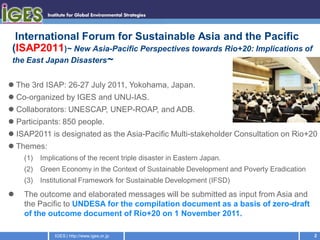
International Forum for Sustainable Asia and the Pacific
 (ISAP2011)~ New Asia-Pacific Perspectives towards Rio+20: Implications of
 the East Japan Disasters~


 The 3rd ISAP: 26-27 July 2011, Yokohama, Japan.
 Co-organized by IGES and UNU-IAS.
 Collaborators: UNESCAP, UNEP-ROAP, and ADB.
 Participants: 850 people.
 ISAP2011 is designated as the Asia-Pacific Multi-stakeholder Consultation on Rio+20
 Themes:
    (1)   Implications of the recent triple disaster in Eastern Japan.
    (2)   Green Economy in the Context of Sustainable Development and Poverty Eradication
    (3)   Institutional Framework for Sustainable Development (IFSD)
   The outcome and elaborated messages will be submitted as input from Asia and
    the Pacific to UNDESA for the compilation document as a basis of zero-draft
    of the outcome document of Rio+20 on 1 November 2011.

              IGES | http://www.iges.or.jp                                                  2
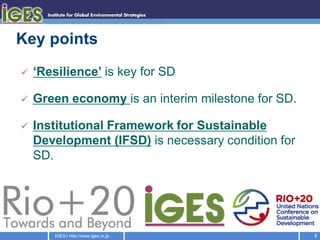
Key points
   ‘Resilience’ is key for SD

   Green economy is an interim milestone for SD.

   Institutional Framework for Sustainable
    Development (IFSD) is necessary condition for
    SD.


        IGES | http://www.iges.or.jp                3
Sustainable and Resilient Society (1)

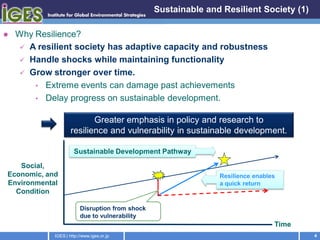
   Why Resilience?
     A resilient society has adaptive capacity and robustness
     Handle shocks while maintaining functionality
     Grow stronger over time.
        • Extreme events can damage past achievements
        • Delay progress on sustainable development.


                            Greater emphasis in policy and research to
                     resilience and vulnerability in sustainable development.

                      Sustainable Development Pathway

   Social,
Economic, and                                                   Resilience enables
Environmental                                                   a quick return
  Condition

                         Disruption from shock
                         due to vulnerability
                                                                                 Time
             IGES | http://www.iges.or.jp                                                4
Sustainable and Resilient Society (2)


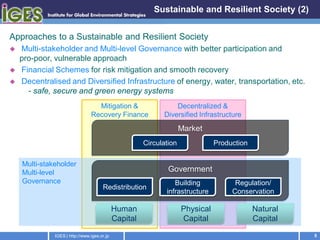
Approaches to a Sustainable and Resilient Society
   Multi-stakeholder and Multi-level Governance with better participation and
    pro-poor, vulnerable approach
   Financial Schemes for risk mitigation and smooth recovery
   Decentralised and Diversified Infrastructure of energy, water, transportation, etc.
      - safe, secure and green energy systems
                                  Mitigation &                   Decentralized &
                                Recovery Finance             Diversified Infrastructure
                                                                     Market
                                                       Circulation              Production

    Multi-stakeholder
    Multi-level                                                Government
    Governance                                                   Building             Regulation/
                                      Redistribution
                                                              infrastructure         Conservation

                                             Human                   Physical                Natural
                                             Capital                 Capital                 Capital

              IGES | http://www.iges.or.jp                                                             5
Green Economy (1)


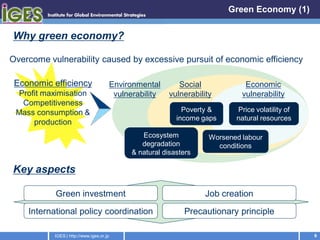
Why green economy?

Overcome vulnerability caused by excessive pursuit of economic efficiency

 Economic efficiency                      Environmental        Social             Economic
 Profit maximisation                       vulnerability    vulnerability        vulnerability
  Competitiveness
 Mass consumption &                                             Poverty &      Price volatility of
                                                              income gaps      natural resources
     production
                                                   Ecosystem            Worsened labour
                                                   degradation            conditions
                                                & natural disasters

Key aspects

           Green investment                                            Job creation
    International policy coordination                           Precautionary principle

           IGES | http://www.iges.or.jp                                                              6
Green Economy (2)

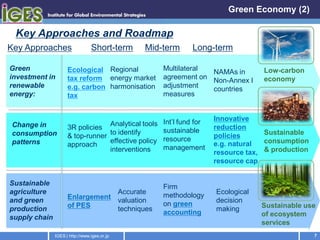
 Key Approaches and Roadmap
Key Approaches                   Short-term   Mid-term        Long-term

Green                Ecological Regional             Multilateral NAMAs in         Low-carbon
investment in        tax reform energy market        agreement on Non-Annex I      economy
renewable            e.g. carbon harmonisation       adjustment   countries
energy:              tax                             measures


                                                     Int’l fund for   Innovative
Change in                         Analytical tools                    reduction
                     3R policies                     sustainable
consumption                       to identify                         policies      Sustainable
                     & top-runner                    resource
patterns                          effective policy                    e.g. natural  consumption
                     approach                        management
                                  interventions                       resource tax, & production
                                                                      resource cap


Sustainable                                          Firm
agriculture                      Accurate            methodology      Ecological
and green            Enlargement valuation                            decision
                     of PES                          on green                      Sustainable use
production                       techniques          accounting       making
supply chain                                                                       of ecosystem
                                                                                   services
               IGES | http://www.iges.or.jp                                                        7
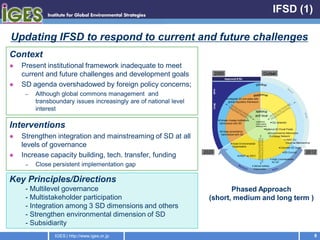
IFSD (1)

Updating IFSD to respond to current and future challenges
Context
   Present institutional framework inadequate to meet
    current and future challenges and development goals
   SD agenda overshadowed by foreign policy concerns;
     –   Although global commons management and
         transboundary issues increasingly are of national level
         interest

Interventions
   Strengthen integration and mainstreaming of SD at all
    levels of governance
   Increase capacity building, tech. transfer, funding
     –   Close persistent implementation gap

Key Principles/Directions
     - Multilevel governance                                              Phased Approach
     - Multistakeholder participation                              (short, medium and long term )
     - Integration among 3 SD dimensions and others
     - Strengthen environmental dimension of SD
     - Subsidiarity
                IGES | http://www.iges.or.jp                                                        8
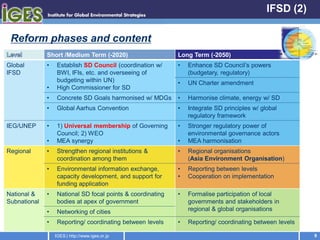
IFSD (2)

 Reform phases and content
              Short /Medium Term (-2020)                     Long Term (-2050)
Global        •    Establish SD Council (coordination w/     •   Enhance SD Council’s powers
IFSD               BWI, IFIs, etc. and overseeing of             (budgetary, regulatory)
                   budgeting within UN)                      •   UN Charter amendment
              •    High Commissioner for SD
              •    Concrete SD Goals harmonised w/ MDGs      •   Harmonise climate, energy w/ SD
              •    Global Aarhus Convention                  •   Integrate SD principles w/ global
                                                                 regulatory framework
IEG/UNEP      •    1) Universal membership of Governing      •   Stronger regulatory power of
                   Council; 2) WEO                               environmental governance actors
              •    MEA synergy                               •   MEA harmonisation
Regional      •    Strengthen regional institutions &        •   Regional organisations
                   coordination among them                       (Asia Environment Organisation)
              •    Environmental information exchange,       •   Reporting between levels
                   capacity development, and support for     •   Cooperation on implementation
                   funding application
National &    •    National SD focal points & coordinating   •   Formalise participation of local
Subnational        bodies at apex of government                  governments and stakeholders in
              •    Networking of cities                          regional & global organisations

              •    Reporting/ coordinating between levels    •   Reporting/ coordinating between levels

                  IGES | http://www.iges.or.jp                                                            9
Thank you very much for your attention.
                                   http://www.iges.or.jp/


    IGES | http://www.iges.or.jp                            10

IGES' presentation at the Asia-Pacific Regional Preparatory Meeting for Rio+20: "Key Findings and Lessons Learned from the Asia-Pacific Multi-stakeholder Consultation on Rio+20"

  • 1.
    Key Findings andLessons Learned from the Asia-Pacific Multi-stakeholder Consultation on Rio+20 Asia-Pacific Regional Preparatory Meeting for Rio+20 19-20 October 2011, Seoul, Republic of Korea Hironori Hamanaka Chair, Board of Directors Institute for Global Environmental Strategies (IGES)
  • 2.
    International Forum forSustainable Asia and the Pacific (ISAP2011)~ New Asia-Pacific Perspectives towards Rio+20: Implications of the East Japan Disasters~  The 3rd ISAP: 26-27 July 2011, Yokohama, Japan.  Co-organized by IGES and UNU-IAS.  Collaborators: UNESCAP, UNEP-ROAP, and ADB.  Participants: 850 people.  ISAP2011 is designated as the Asia-Pacific Multi-stakeholder Consultation on Rio+20  Themes: (1) Implications of the recent triple disaster in Eastern Japan. (2) Green Economy in the Context of Sustainable Development and Poverty Eradication (3) Institutional Framework for Sustainable Development (IFSD)  The outcome and elaborated messages will be submitted as input from Asia and the Pacific to UNDESA for the compilation document as a basis of zero-draft of the outcome document of Rio+20 on 1 November 2011. IGES | http://www.iges.or.jp 2
  • 3.
    Key points  ‘Resilience’ is key for SD  Green economy is an interim milestone for SD.  Institutional Framework for Sustainable Development (IFSD) is necessary condition for SD. IGES | http://www.iges.or.jp 3
  • 4.
    Sustainable and ResilientSociety (1)  Why Resilience?  A resilient society has adaptive capacity and robustness  Handle shocks while maintaining functionality  Grow stronger over time. • Extreme events can damage past achievements • Delay progress on sustainable development. Greater emphasis in policy and research to resilience and vulnerability in sustainable development. Sustainable Development Pathway Social, Economic, and Resilience enables Environmental a quick return Condition Disruption from shock due to vulnerability Time IGES | http://www.iges.or.jp 4
  • 5.
    Sustainable and ResilientSociety (2) Approaches to a Sustainable and Resilient Society  Multi-stakeholder and Multi-level Governance with better participation and pro-poor, vulnerable approach  Financial Schemes for risk mitigation and smooth recovery  Decentralised and Diversified Infrastructure of energy, water, transportation, etc. - safe, secure and green energy systems Mitigation & Decentralized & Recovery Finance Diversified Infrastructure Market Circulation Production Multi-stakeholder Multi-level Government Governance Building Regulation/ Redistribution infrastructure Conservation Human Physical Natural Capital Capital Capital IGES | http://www.iges.or.jp 5
  • 6.
    Green Economy (1) Whygreen economy? Overcome vulnerability caused by excessive pursuit of economic efficiency Economic efficiency Environmental Social Economic Profit maximisation vulnerability vulnerability vulnerability Competitiveness Mass consumption & Poverty & Price volatility of income gaps natural resources production Ecosystem Worsened labour degradation conditions & natural disasters Key aspects Green investment Job creation International policy coordination Precautionary principle IGES | http://www.iges.or.jp 6
  • 7.
    Green Economy (2) Key Approaches and Roadmap Key Approaches Short-term Mid-term Long-term Green Ecological Regional Multilateral NAMAs in Low-carbon investment in tax reform energy market agreement on Non-Annex I economy renewable e.g. carbon harmonisation adjustment countries energy: tax measures Int’l fund for Innovative Change in Analytical tools reduction 3R policies sustainable consumption to identify policies Sustainable & top-runner resource patterns effective policy e.g. natural consumption approach management interventions resource tax, & production resource cap Sustainable Firm agriculture Accurate methodology Ecological and green Enlargement valuation decision of PES on green Sustainable use production techniques accounting making supply chain of ecosystem services IGES | http://www.iges.or.jp 7
  • 8.
    IFSD (1) Updating IFSDto respond to current and future challenges Context  Present institutional framework inadequate to meet current and future challenges and development goals  SD agenda overshadowed by foreign policy concerns; – Although global commons management and transboundary issues increasingly are of national level interest Interventions  Strengthen integration and mainstreaming of SD at all levels of governance  Increase capacity building, tech. transfer, funding – Close persistent implementation gap Key Principles/Directions - Multilevel governance Phased Approach - Multistakeholder participation (short, medium and long term ) - Integration among 3 SD dimensions and others - Strengthen environmental dimension of SD - Subsidiarity IGES | http://www.iges.or.jp 8
  • 9.
    IFSD (2) Reformphases and content Short /Medium Term (-2020) Long Term (-2050) Global • Establish SD Council (coordination w/ • Enhance SD Council’s powers IFSD BWI, IFIs, etc. and overseeing of (budgetary, regulatory) budgeting within UN) • UN Charter amendment • High Commissioner for SD • Concrete SD Goals harmonised w/ MDGs • Harmonise climate, energy w/ SD • Global Aarhus Convention • Integrate SD principles w/ global regulatory framework IEG/UNEP • 1) Universal membership of Governing • Stronger regulatory power of Council; 2) WEO environmental governance actors • MEA synergy • MEA harmonisation Regional • Strengthen regional institutions & • Regional organisations coordination among them (Asia Environment Organisation) • Environmental information exchange, • Reporting between levels capacity development, and support for • Cooperation on implementation funding application National & • National SD focal points & coordinating • Formalise participation of local Subnational bodies at apex of government governments and stakeholders in • Networking of cities regional & global organisations • Reporting/ coordinating between levels • Reporting/ coordinating between levels IGES | http://www.iges.or.jp 9
  • 10.
    Thank you verymuch for your attention. http://www.iges.or.jp/ IGES | http://www.iges.or.jp 10