Integrated Natural Resources Management 
and the GEF - Reconciling global environmental 
values and sustainable development 
Multi-Focal Area Task Force Meeting 
Washington, November 15th 2004
Target 9, Goal 7 of the Millennium Development Goals 
““Ensure Environmental Sustainability”” 
“Integrate the principles of sustainable development into 
country policies and programs and reverse the loss 
of environmental resources.” 
The indicators linked to this target refer to: 
•Forest cover and biodiversity 
•Sustainable energy 
•Water
WSSD Plan of Implementation 
Managing natural resources in an integrated 
Manner is essential for sustainable development 
In Johannesburg, international consensus was reached around 
the two basic approaches that should organize the global effort 
towards environmentally sustainable development: 
•Integrated management of natural resources, including energy; 
•Enhancement of cooperation and synergies, with emphasis 
on the regional level.
· Combat desertification and mitigate the effects of extreme 
climatic events through land and natural resources management; 
• Improve access to reliable, affordable, economically viable, 
socially acceptable and environmentally sound energy 
• Develop integrated water resources management and water 
efficiency plans by 2005; 
• Develop and implement national/regional strategies, with regard 
to integrated river basin and groundwater management; 
• Develop programs for mitigating the effects of extreme 
water-related events, and implement an integrated multi-hazard, 
inclusive approach 
• Develop and implement integrated land management and 
water-use plans that are based on sustainable use of renewable 
resources and on integrated assessments of socio-economic and 
environmental potentials; 
• Encourage the UNFCCC, the CBD and the CCD to continue 
exploring and enhancing synergies
The GEF is identified as a key institution by 
WSSD to experiment and demonstrate ways to 
translate these principles and approaches into on 
the ground practices 
One specific reference: “utilize…the GEF..to provide 
financial resources to developing countries, in particular 
to LDCs and SIDS, to meet their needs in … reliable, 
affordable, economically viable, socially acceptable 
and environmentally sound energy.”
A compelling rationale for the need of a GEF response 
to the call for integration: 
•The clear and coherent message deriving from MDGs and WSSD 
•The GEF Operational Strategy that recognizes the need for 
integrating water, land use and biodiversity, and adopts the 
ecosystem approach 
•The size of the GEF portfolio - risks of overlaps and antagonistic 
linkages in many geographic areas 
•The addition of the Land Degradation focal area 
•The new focus on climate change adaptation 
•The recommendations of STAP on interlinkages and groundwater
So far, the integration and joining of forces among 
GEF focal areas has not occurred spontaneously 
Major internal obstacles add to 
well known external constraints: 
•The operational structure, organized in GEFSEC and IAs, 
around focal areas (OPs, Task Forces, etc.) 
•Lack of coordination in Strategic Priorities, lack of an 
overall strategic priority 
•The focal area nominal allocation of resources 
•The organizational structure by focal area teams
A possible way ahead towards 
integration intended as the joining of forces 
across focal areas towards a common 
objective 
The concrete steps that GEF can undertake in the 
short term will have 
(i) to be of an experimental/demonstration 
nature, and 
(i) build upon existing opportunities.
A clear Geographical Context 
Integration requires a clear geographical context, i.e.: 
a system with defined boundaries. This system may 
vary according to the “entry point”: 
•Water: a river/lake/aquifer basin, or a large marine 
ecosystem 
•Land degradation: a productive landscape? 
•Biodiversity: a higher level ecosystem? 
•Climate change, a region sharing a common sustainable 
energy resource, or a country as a whole? 
Given its overarching nature, climate adaptation measures and 
considerations may have to be introduced in each of the four 
above contexts.
A Principal Objective 
Every integrated program of interventions will be 
aimed at achieving a principal objective, whose nature 
will depend upon the “entry point” and whose goal, in 
line with the MDGs and the WSSD Plan of 
Implementation, will be the fostering of 
environmentally sustainable development. In doing so, 
global benefits will be accrued in a cluster of focal 
areas, or even in all of them. A tentative/preliminary 
Operational Program indication will correspond to the 
Principal Objective.
A Diagnostic Analysis 
The design of an integrated project or program will 
require a sufficient level of understanding of the region, 
of the problems and their root causes, of the possible 
solutions and actions. Hence, integrated action can only 
be undertaken when a Diagnostic Analysis based on 
solid science and around which the consensus at the 
inter-ministerial level in the country (ies) has been 
reached, is available
An enabling environment for stress reduction 
On the ground integration can be experimented more 
effectively when the stage of the implementation of 
stress reduction/mitigation measures has been 
reached, and the enabling environment is in place. 
These four pre-requisites may provide the criteria for 
identifying and selecting the opportunities for 
integration where action can be taken in the short 
term.
Breaking focal area barriers: 
Possible actions 
•Merging of resources 
•Increase in PDF-B funds for the design of integrated projects 
and multi-project programs 
•Incentives (fee premiums?) to encourage our agencies to 
engage in integrated programs 
•Adoption of a new set of overall “GEF strategic priorities”, 
which would privilege integration 
•Creation of new multi-focal operational programs (Integrated 
Natural Resources Management in Hydrographic Basins, or “Energy for 
Environmentally Sustainable Development in LDCs and SIDS) 
•systematic dialogue among focal areas in the Secretariat and 
Task Forces and strengthening of Task Forces
The new challenge in the 
IW focal area: 
Catalyzing an Integrated Response to 
Strategic Action Programs 
LAND 
WATER 
BIODIVERSITY 
CLIMATE 
CONTAMINANTS
EXAMPLE OF A 
POSSIBLE INTEGRATED 
APPROACH 
THE CASPIAN SEA BASIN 
The Challenge: 
Sustainable Integrated 
Management of the 
Caspian Environment
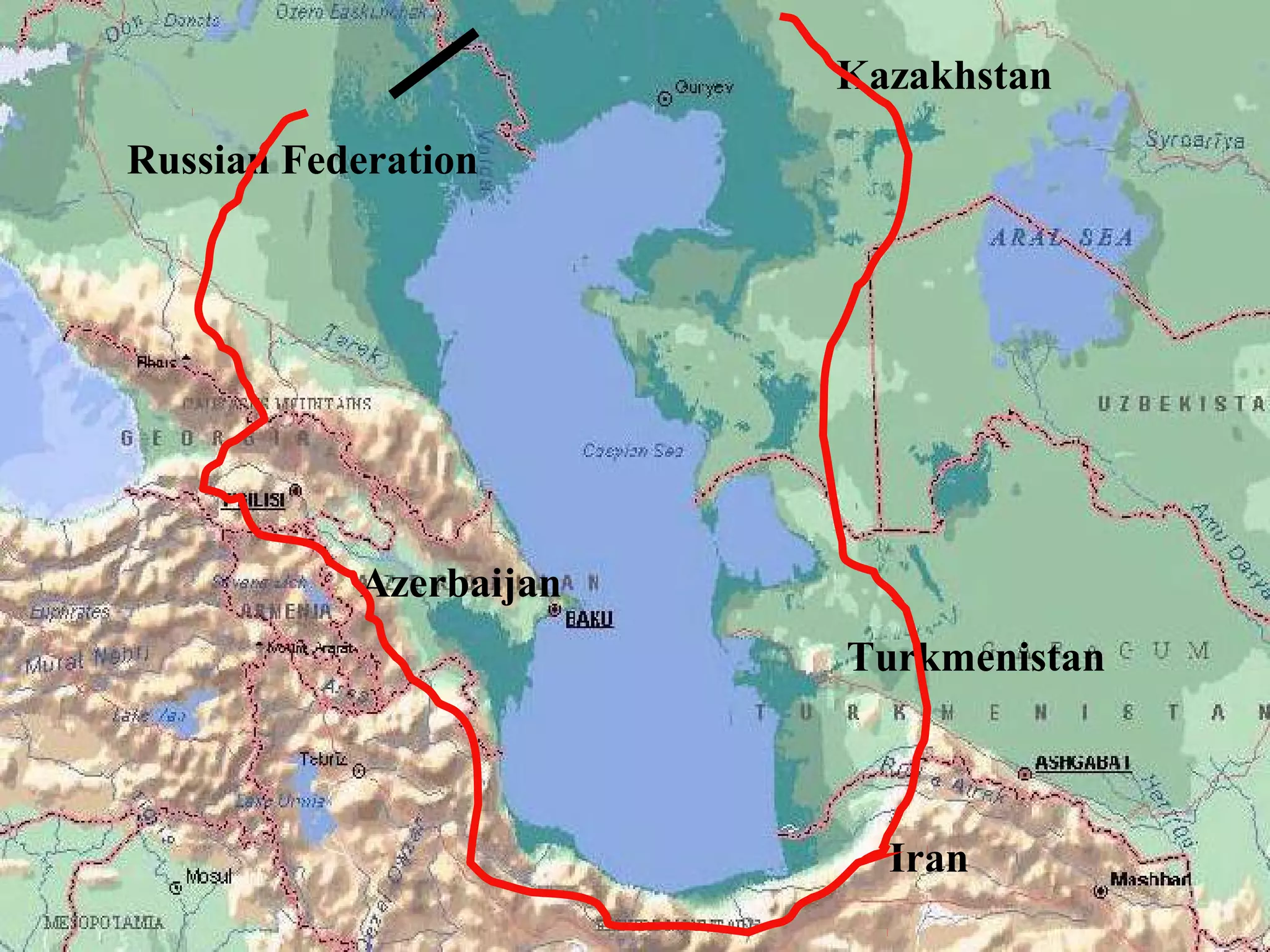
Russian Federation 
Azerbaijan 
Kazakhstan 
Turkmenistan 
Iran
As a result of a first IW - GEF project, 
the riparian countries have agreed on a 
Strategic Action Programme and on a 
binding environmental Caspian Convention 
Payvand's Iran News ... 
11/5/03 
Convention for Protection of Caspian Environment signed in 
Iran 
The Convention for the Protection of the Marine Environment of 
the Caspian Sea (Tehran Convention) was signed by the 
plenipotentiary representatives of the five littoral countries of the 
sea in Tehran on Tuesday, IRNA reported. 
Iran, Russia, Kazakhstan, Azerbaijan and Turkmenistan are the 
five countries situated around the world's biggest lake. 
According to the Tehran Convention, all Caspian Sea littoral 
countries are committed to take all necessary measures, 
individually or collectively, to reduce and control pollution of the 
sea.
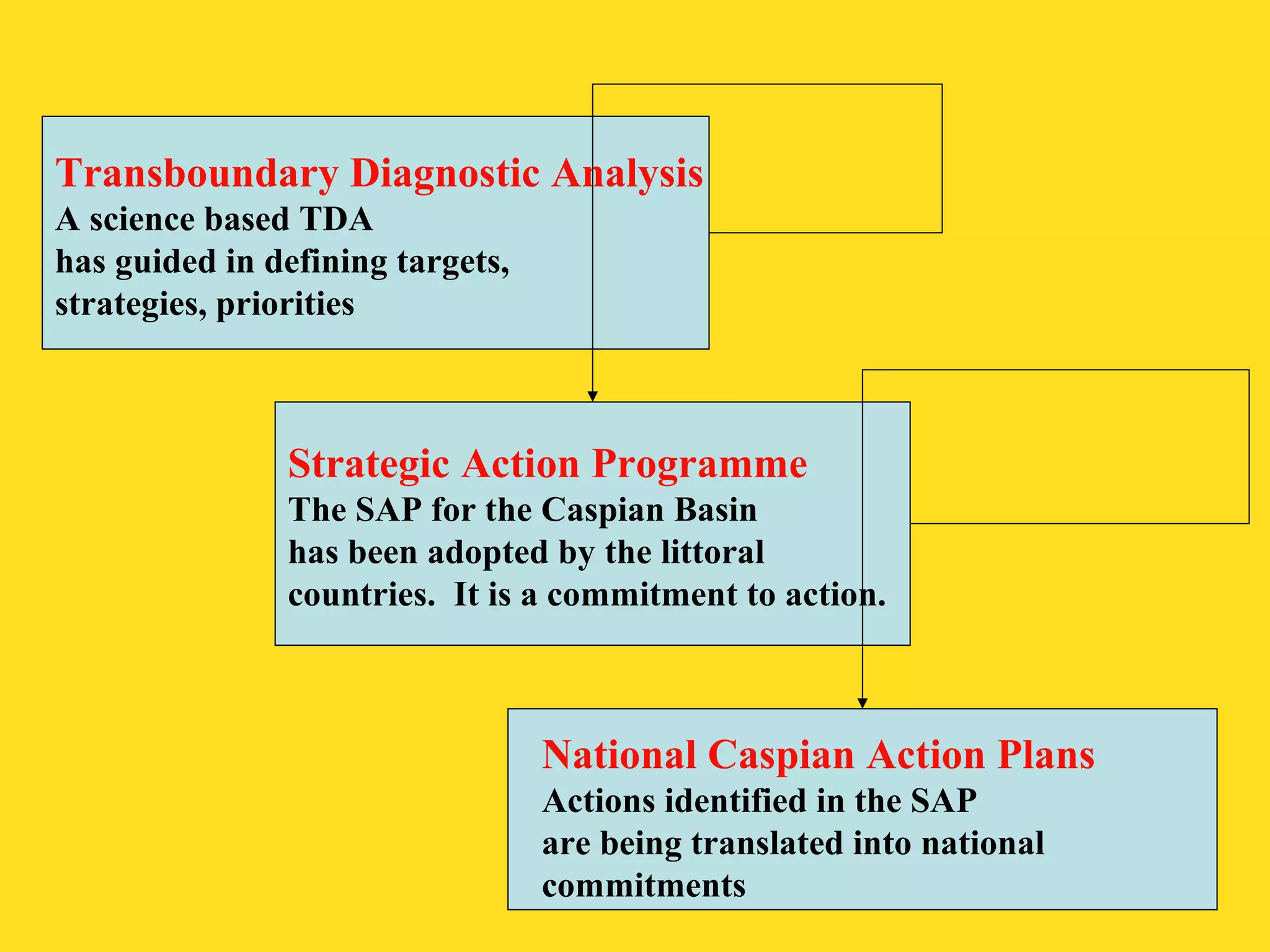
Transboundary Diagnostic Analysis 
A science based TDA 
has guided in defining targets, 
strategies, priorities 
Strategic Action Programme 
The SAP for the Caspian Basin 
has been adopted by the littoral 
countries. It is a commitment to action. 
National Caspian Action Plans 
Actions identified in the SAP 
are being translated into national 
commitments
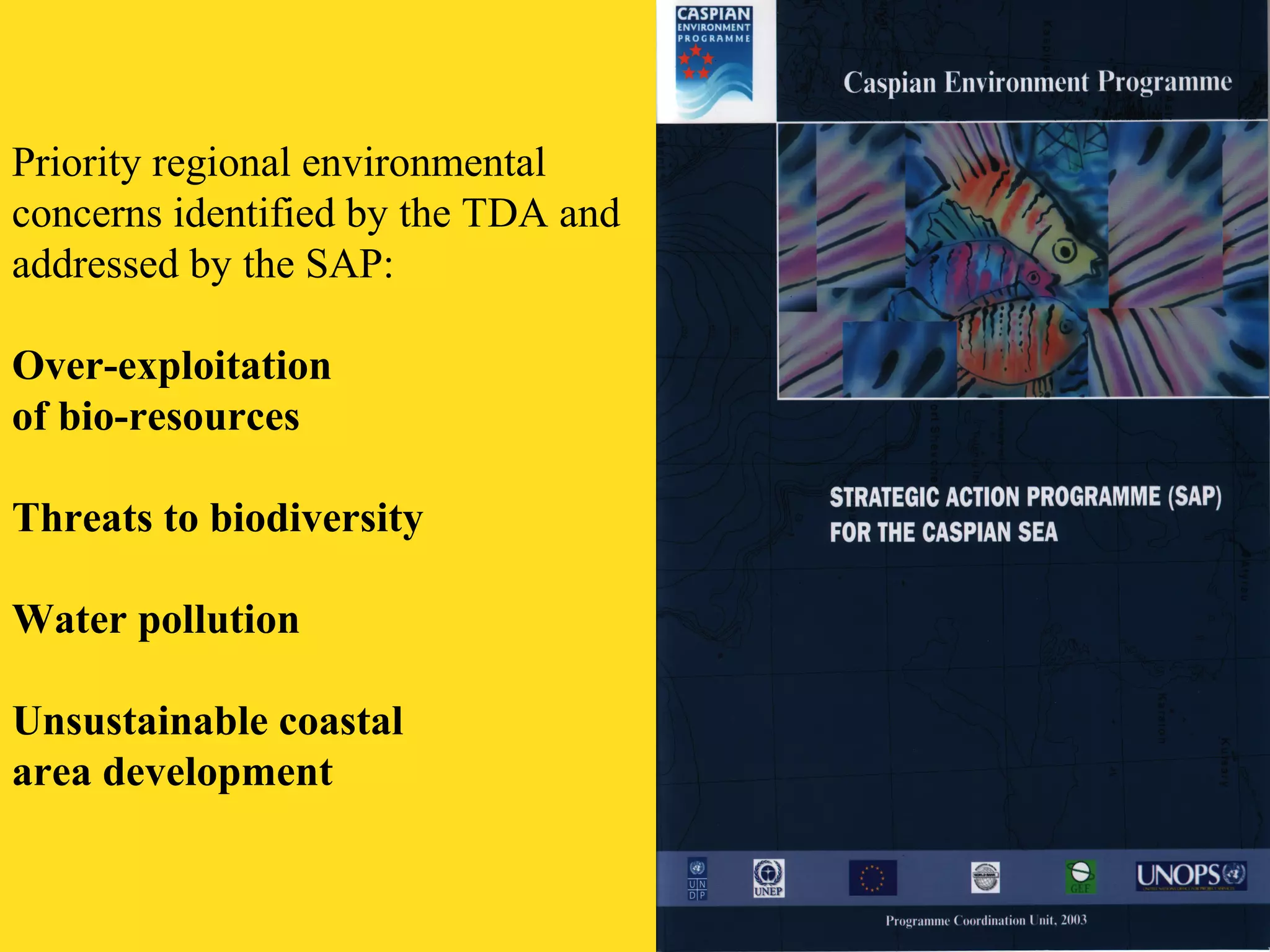
Priority regional environmental 
concerns identified by the TDA and 
addressed by the SAP: 
Over-exploitation 
of bio-resources 
Threats to biodiversity 
Water pollution 
Unsustainable coastal 
area development
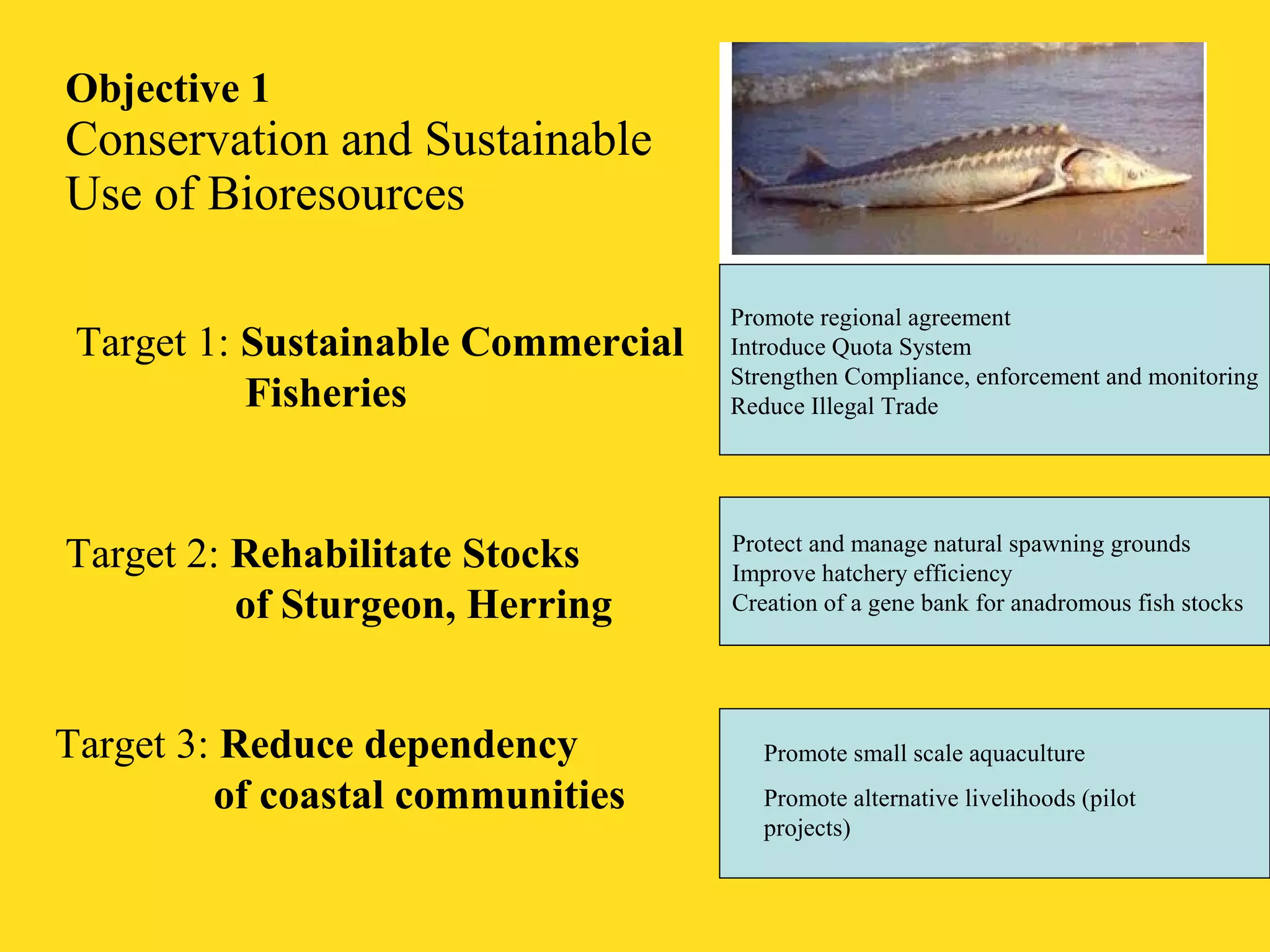
Objective 1 
Conservation and Sustainable 
Use of Bioresources 
Target 1: Sustainable Commercial 
Fisheries 
Target 2: Rehabilitate Stocks 
of Sturgeon, Herring 
Target 3: Reduce dependency 
of coastal communities 
Promote regional agreement 
Introduce Quota System 
Strengthen Compliance, enforcement and monitoring 
Reduce Illegal Trade 
Protect and manage natural spawning grounds 
Improve hatchery efficiency 
Creation of a gene bank for anadromous fish stocks 
Promote small scale aquaculture 
Promote alternative livelihoods (pilot 
projects)
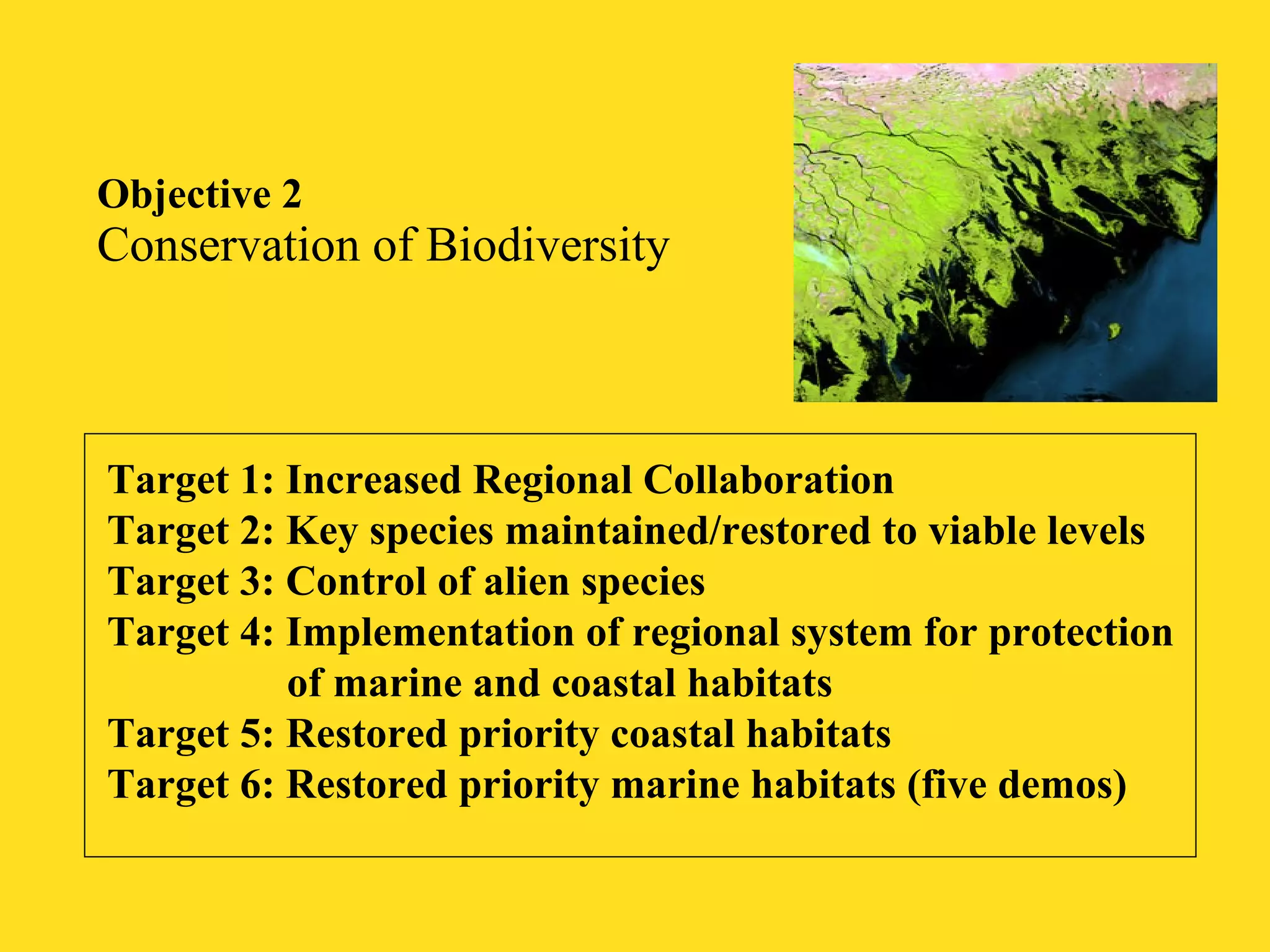
Objective 2 
Conservation of Biodiversity 
Target 1: Increased Regional Collaboration 
Target 2: Key species maintained/restored to viable levels 
Target 3: Control of alien species 
Target 4: Implementation of regional system for protection 
of marine and coastal habitats 
Target 5: Restored priority coastal habitats 
Target 6: Restored priority marine habitats (five demos)
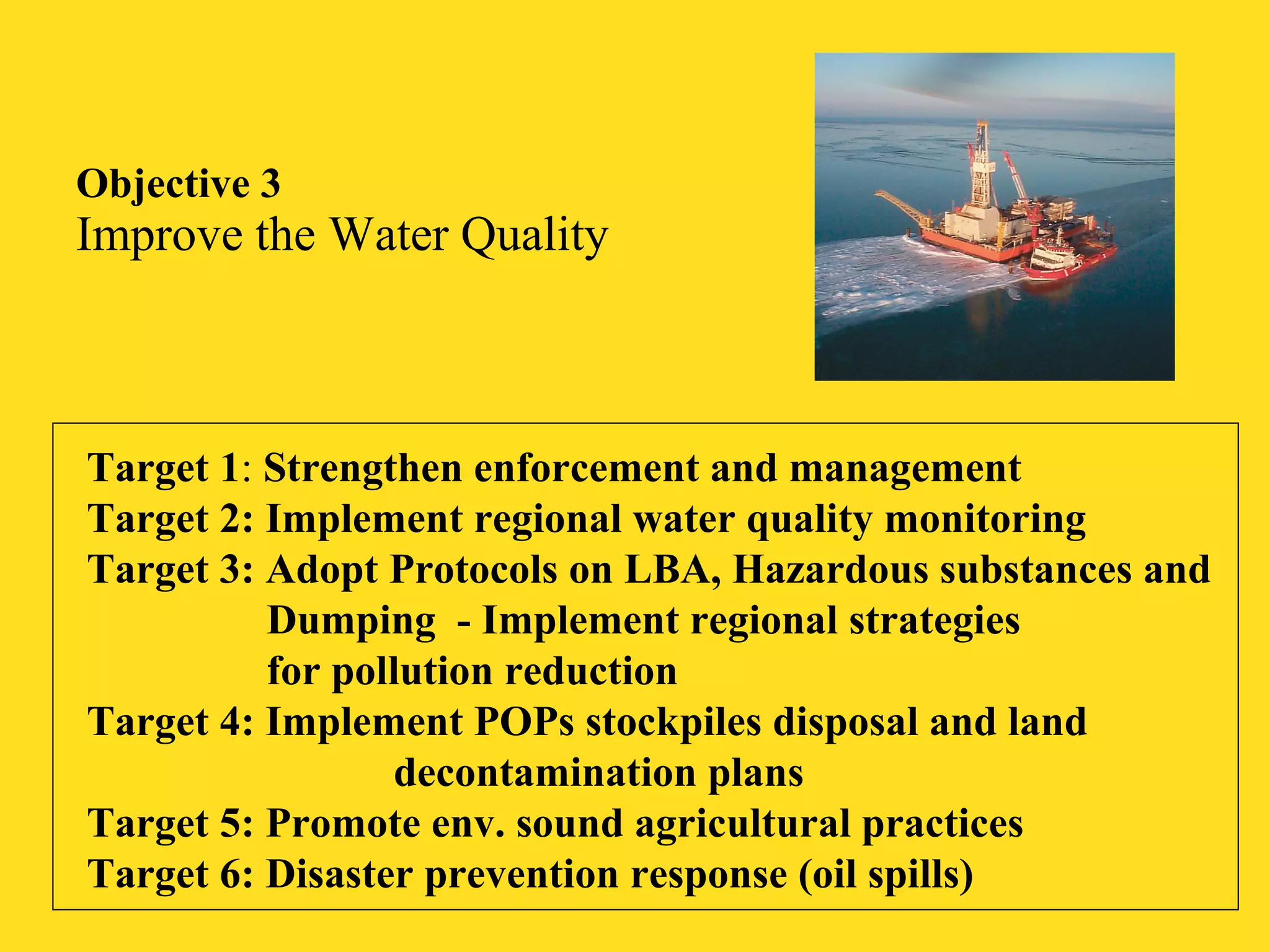
Objective 3 
Improve the Water Quality 
Target 1: Strengthen enforcement and management 
Target 2: Implement regional water quality monitoring 
Target 3: Adopt Protocols on LBA, Hazardous substances and 
Dumping - Implement regional strategies 
for pollution reduction 
Target 4: Implement POPs stockpiles disposal and land 
decontamination plans 
Target 5: Promote env. sound agricultural practices 
Target 6: Disaster prevention response (oil spills)
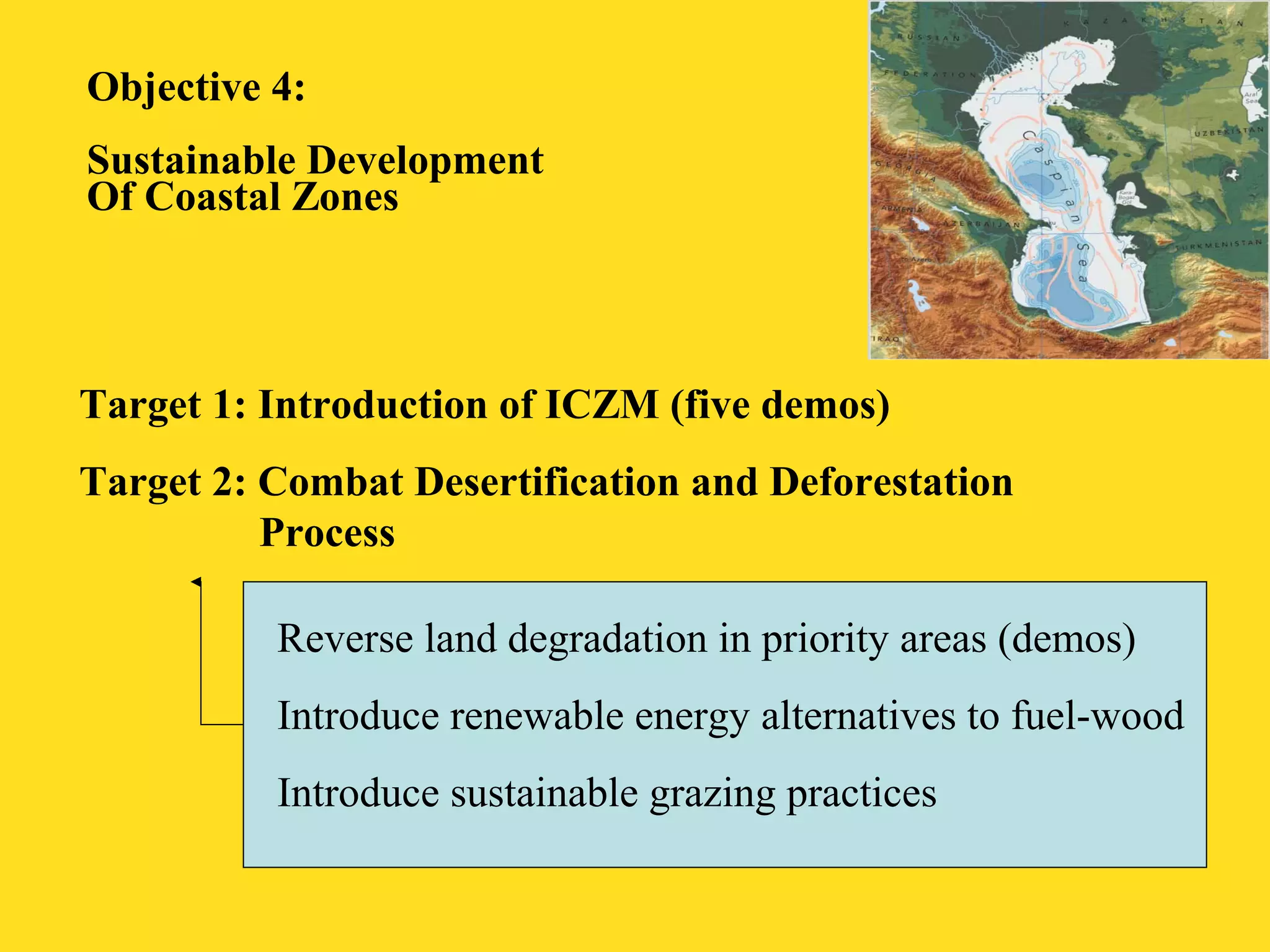
Objective 4: 
Sustainable Development 
Of Coastal Zones 
Target 1: Introduction of ICZM (five demos) 
Target 2: Combat Desertification and Deforestation 
Process 
Reverse land degradation in priority areas (demos) 
Introduce renewable energy alternatives to fuel-wood 
Introduce sustainable grazing practices
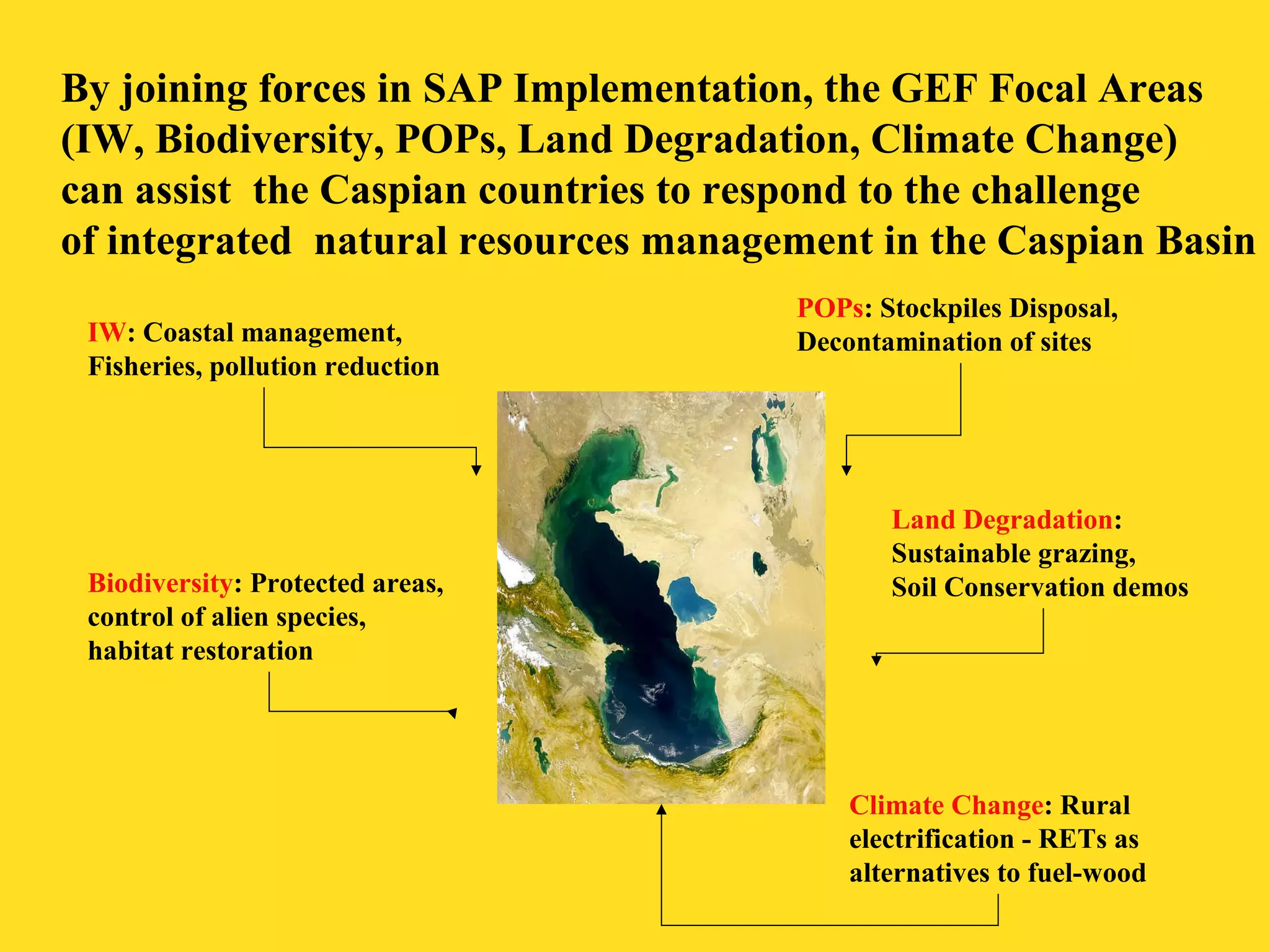
By joining forces in SAP Implementation, the GEF Focal Areas 
(IW, Biodiversity, POPs, Land Degradation, Climate Change) 
can assist the Caspian countries to respond to the challenge 
of integrated natural resources management in the Caspian Basin 
POPs: Stockpiles Disposal, 
IW: Coastal management, Decontamination of sites 
Fisheries, pollution reduction 
Biodiversity: Protected areas, 
control of alien species, 
habitat restoration 
Land Degradation: 
Sustainable grazing, 
Soil Conservation demos 
Climate Change: Rural 
electrification - RETs as 
alternatives to fuel-wood
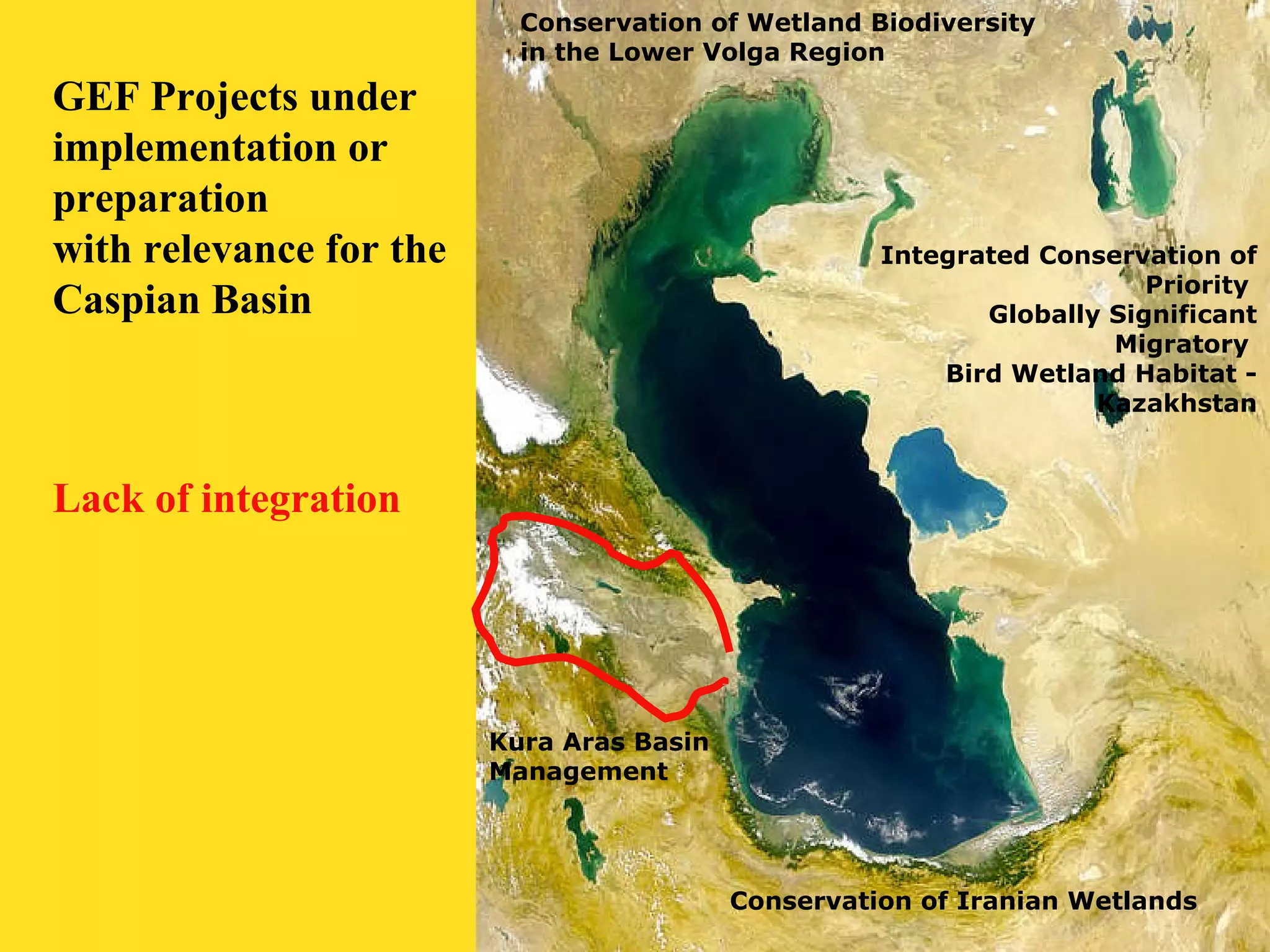
Conservation of Wetland Biodiversity 
in the Lower Volga Region 
Integrated Conservation of 
Priority 
Globally Significant 
Migratory 
Bird Wetland Habitat - 
Kazakhstan 
Conservation of Iranian Wetlands 
Kura Aras Basin 
Management 
GEF Projects under 
implementation or 
preparation 
with relevance for the 
Caspian Basin 
Lack of integration
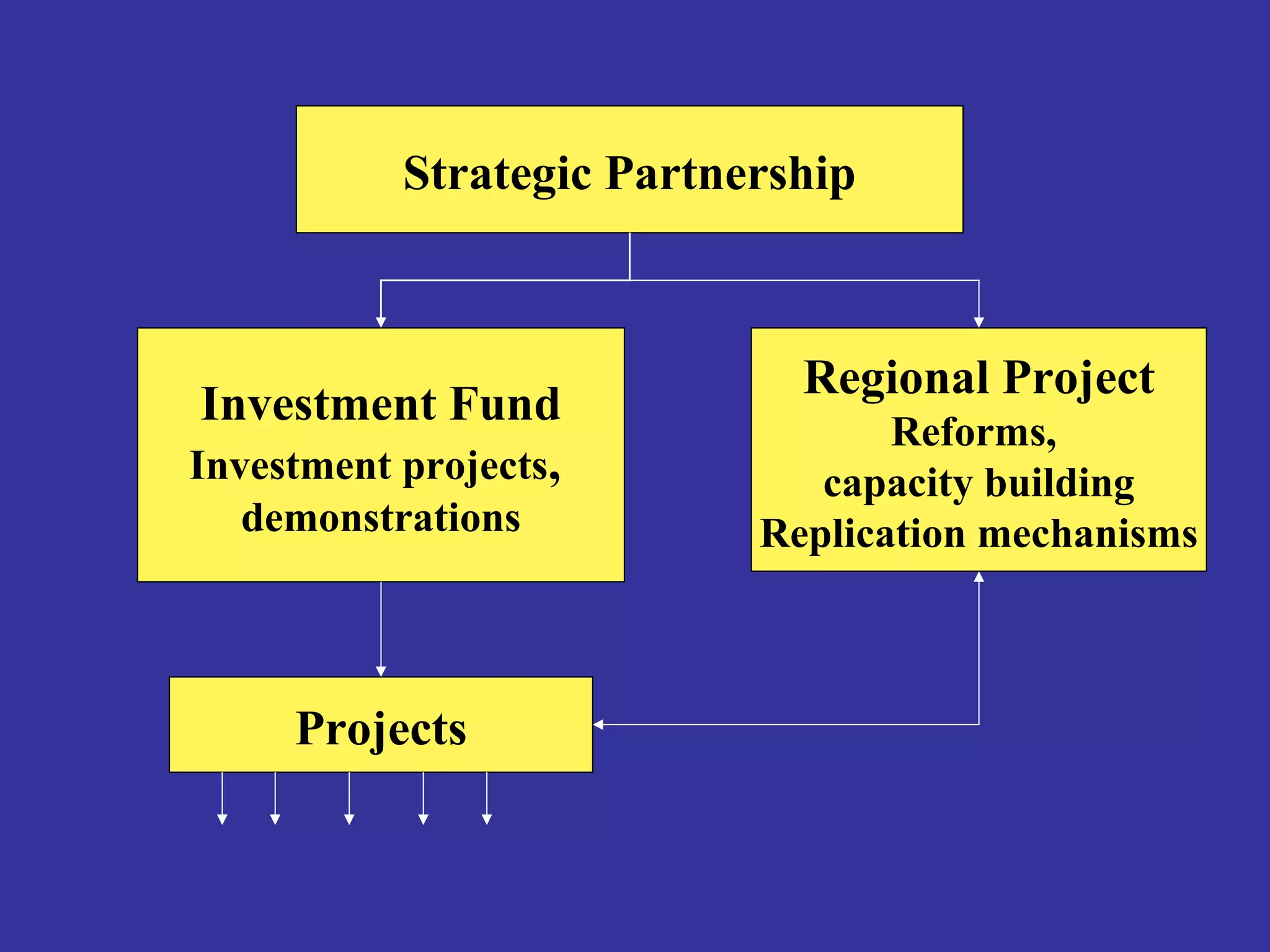
Strategic Partnership 
Investment Fund 
Investment projects, 
demonstrations 
Regional Project 
Reforms, 
capacity building 
Replication mechanisms 
Projects
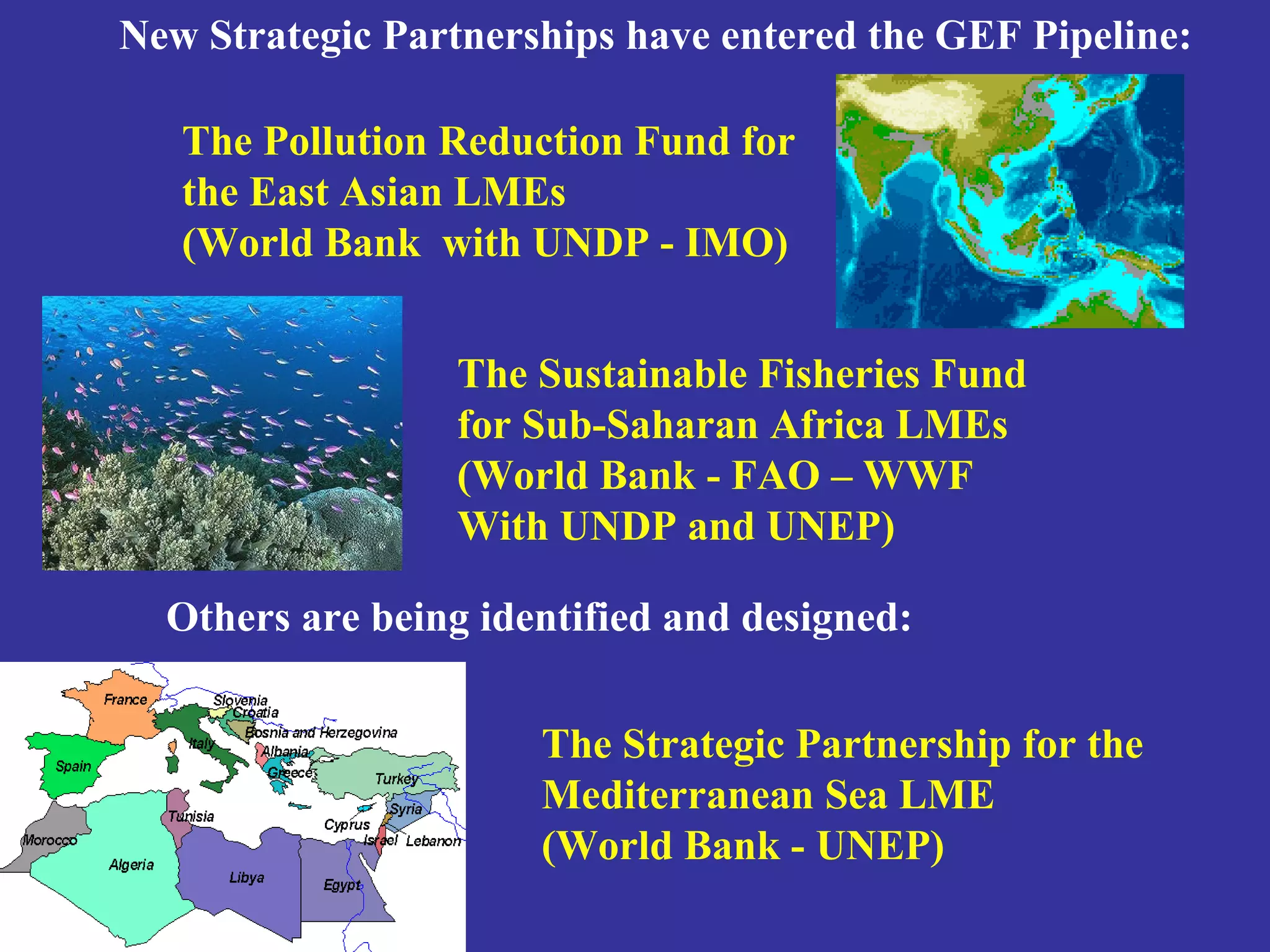
New Strategic Partnerships have entered the GEF Pipeline: 
The Pollution Reduction Fund for 
the East Asian LMEs 
(World Bank with UNDP - IMO) 
The Sustainable Fisheries Fund 
for Sub-Saharan Africa LMEs 
(World Bank - FAO – WWF 
With UNDP and UNEP) 
Others are being identified and designed: 
The Strategic Partnership for the 
Mediterranean Sea LME 
(World Bank - UNEP)

Integrated Natural Resource Management and the GEF- Reconciling Global Environmental Values and Sustainable Development

  • 1.
    Integrated Natural ResourcesManagement and the GEF - Reconciling global environmental values and sustainable development Multi-Focal Area Task Force Meeting Washington, November 15th 2004
  • 2.
    Target 9, Goal7 of the Millennium Development Goals ““Ensure Environmental Sustainability”” “Integrate the principles of sustainable development into country policies and programs and reverse the loss of environmental resources.” The indicators linked to this target refer to: •Forest cover and biodiversity •Sustainable energy •Water
  • 3.
    WSSD Plan ofImplementation Managing natural resources in an integrated Manner is essential for sustainable development In Johannesburg, international consensus was reached around the two basic approaches that should organize the global effort towards environmentally sustainable development: •Integrated management of natural resources, including energy; •Enhancement of cooperation and synergies, with emphasis on the regional level.
  • 4.
    · Combat desertificationand mitigate the effects of extreme climatic events through land and natural resources management; • Improve access to reliable, affordable, economically viable, socially acceptable and environmentally sound energy • Develop integrated water resources management and water efficiency plans by 2005; • Develop and implement national/regional strategies, with regard to integrated river basin and groundwater management; • Develop programs for mitigating the effects of extreme water-related events, and implement an integrated multi-hazard, inclusive approach • Develop and implement integrated land management and water-use plans that are based on sustainable use of renewable resources and on integrated assessments of socio-economic and environmental potentials; • Encourage the UNFCCC, the CBD and the CCD to continue exploring and enhancing synergies
  • 5.
    The GEF isidentified as a key institution by WSSD to experiment and demonstrate ways to translate these principles and approaches into on the ground practices One specific reference: “utilize…the GEF..to provide financial resources to developing countries, in particular to LDCs and SIDS, to meet their needs in … reliable, affordable, economically viable, socially acceptable and environmentally sound energy.”
  • 6.
    A compelling rationalefor the need of a GEF response to the call for integration: •The clear and coherent message deriving from MDGs and WSSD •The GEF Operational Strategy that recognizes the need for integrating water, land use and biodiversity, and adopts the ecosystem approach •The size of the GEF portfolio - risks of overlaps and antagonistic linkages in many geographic areas •The addition of the Land Degradation focal area •The new focus on climate change adaptation •The recommendations of STAP on interlinkages and groundwater
  • 7.
    So far, theintegration and joining of forces among GEF focal areas has not occurred spontaneously Major internal obstacles add to well known external constraints: •The operational structure, organized in GEFSEC and IAs, around focal areas (OPs, Task Forces, etc.) •Lack of coordination in Strategic Priorities, lack of an overall strategic priority •The focal area nominal allocation of resources •The organizational structure by focal area teams
  • 8.
    A possible wayahead towards integration intended as the joining of forces across focal areas towards a common objective The concrete steps that GEF can undertake in the short term will have (i) to be of an experimental/demonstration nature, and (i) build upon existing opportunities.
  • 9.
    A clear GeographicalContext Integration requires a clear geographical context, i.e.: a system with defined boundaries. This system may vary according to the “entry point”: •Water: a river/lake/aquifer basin, or a large marine ecosystem •Land degradation: a productive landscape? •Biodiversity: a higher level ecosystem? •Climate change, a region sharing a common sustainable energy resource, or a country as a whole? Given its overarching nature, climate adaptation measures and considerations may have to be introduced in each of the four above contexts.
  • 10.
    A Principal Objective Every integrated program of interventions will be aimed at achieving a principal objective, whose nature will depend upon the “entry point” and whose goal, in line with the MDGs and the WSSD Plan of Implementation, will be the fostering of environmentally sustainable development. In doing so, global benefits will be accrued in a cluster of focal areas, or even in all of them. A tentative/preliminary Operational Program indication will correspond to the Principal Objective.
  • 11.
    A Diagnostic Analysis The design of an integrated project or program will require a sufficient level of understanding of the region, of the problems and their root causes, of the possible solutions and actions. Hence, integrated action can only be undertaken when a Diagnostic Analysis based on solid science and around which the consensus at the inter-ministerial level in the country (ies) has been reached, is available
  • 12.
    An enabling environmentfor stress reduction On the ground integration can be experimented more effectively when the stage of the implementation of stress reduction/mitigation measures has been reached, and the enabling environment is in place. These four pre-requisites may provide the criteria for identifying and selecting the opportunities for integration where action can be taken in the short term.
  • 13.
    Breaking focal areabarriers: Possible actions •Merging of resources •Increase in PDF-B funds for the design of integrated projects and multi-project programs •Incentives (fee premiums?) to encourage our agencies to engage in integrated programs •Adoption of a new set of overall “GEF strategic priorities”, which would privilege integration •Creation of new multi-focal operational programs (Integrated Natural Resources Management in Hydrographic Basins, or “Energy for Environmentally Sustainable Development in LDCs and SIDS) •systematic dialogue among focal areas in the Secretariat and Task Forces and strengthening of Task Forces
  • 14.
    The new challengein the IW focal area: Catalyzing an Integrated Response to Strategic Action Programs LAND WATER BIODIVERSITY CLIMATE CONTAMINANTS
  • 15.
    EXAMPLE OF A POSSIBLE INTEGRATED APPROACH THE CASPIAN SEA BASIN The Challenge: Sustainable Integrated Management of the Caspian Environment
  • 16.
    Russian Federation Azerbaijan Kazakhstan Turkmenistan Iran
  • 17.
    As a resultof a first IW - GEF project, the riparian countries have agreed on a Strategic Action Programme and on a binding environmental Caspian Convention Payvand's Iran News ... 11/5/03 Convention for Protection of Caspian Environment signed in Iran The Convention for the Protection of the Marine Environment of the Caspian Sea (Tehran Convention) was signed by the plenipotentiary representatives of the five littoral countries of the sea in Tehran on Tuesday, IRNA reported. Iran, Russia, Kazakhstan, Azerbaijan and Turkmenistan are the five countries situated around the world's biggest lake. According to the Tehran Convention, all Caspian Sea littoral countries are committed to take all necessary measures, individually or collectively, to reduce and control pollution of the sea.
  • 18.
    Transboundary Diagnostic Analysis A science based TDA has guided in defining targets, strategies, priorities Strategic Action Programme The SAP for the Caspian Basin has been adopted by the littoral countries. It is a commitment to action. National Caspian Action Plans Actions identified in the SAP are being translated into national commitments
  • 19.
    Priority regional environmental concerns identified by the TDA and addressed by the SAP: Over-exploitation of bio-resources Threats to biodiversity Water pollution Unsustainable coastal area development
  • 20.
    Objective 1 Conservationand Sustainable Use of Bioresources Target 1: Sustainable Commercial Fisheries Target 2: Rehabilitate Stocks of Sturgeon, Herring Target 3: Reduce dependency of coastal communities Promote regional agreement Introduce Quota System Strengthen Compliance, enforcement and monitoring Reduce Illegal Trade Protect and manage natural spawning grounds Improve hatchery efficiency Creation of a gene bank for anadromous fish stocks Promote small scale aquaculture Promote alternative livelihoods (pilot projects)
  • 21.
    Objective 2 Conservationof Biodiversity Target 1: Increased Regional Collaboration Target 2: Key species maintained/restored to viable levels Target 3: Control of alien species Target 4: Implementation of regional system for protection of marine and coastal habitats Target 5: Restored priority coastal habitats Target 6: Restored priority marine habitats (five demos)
  • 22.
    Objective 3 Improvethe Water Quality Target 1: Strengthen enforcement and management Target 2: Implement regional water quality monitoring Target 3: Adopt Protocols on LBA, Hazardous substances and Dumping - Implement regional strategies for pollution reduction Target 4: Implement POPs stockpiles disposal and land decontamination plans Target 5: Promote env. sound agricultural practices Target 6: Disaster prevention response (oil spills)
  • 23.
    Objective 4: SustainableDevelopment Of Coastal Zones Target 1: Introduction of ICZM (five demos) Target 2: Combat Desertification and Deforestation Process Reverse land degradation in priority areas (demos) Introduce renewable energy alternatives to fuel-wood Introduce sustainable grazing practices
  • 24.
    By joining forcesin SAP Implementation, the GEF Focal Areas (IW, Biodiversity, POPs, Land Degradation, Climate Change) can assist the Caspian countries to respond to the challenge of integrated natural resources management in the Caspian Basin POPs: Stockpiles Disposal, IW: Coastal management, Decontamination of sites Fisheries, pollution reduction Biodiversity: Protected areas, control of alien species, habitat restoration Land Degradation: Sustainable grazing, Soil Conservation demos Climate Change: Rural electrification - RETs as alternatives to fuel-wood
  • 25.
    Conservation of WetlandBiodiversity in the Lower Volga Region Integrated Conservation of Priority Globally Significant Migratory Bird Wetland Habitat - Kazakhstan Conservation of Iranian Wetlands Kura Aras Basin Management GEF Projects under implementation or preparation with relevance for the Caspian Basin Lack of integration
  • 26.
    Strategic Partnership InvestmentFund Investment projects, demonstrations Regional Project Reforms, capacity building Replication mechanisms Projects
  • 27.
    New Strategic Partnershipshave entered the GEF Pipeline: The Pollution Reduction Fund for the East Asian LMEs (World Bank with UNDP - IMO) The Sustainable Fisheries Fund for Sub-Saharan Africa LMEs (World Bank - FAO – WWF With UNDP and UNEP) Others are being identified and designed: The Strategic Partnership for the Mediterranean Sea LME (World Bank - UNEP)