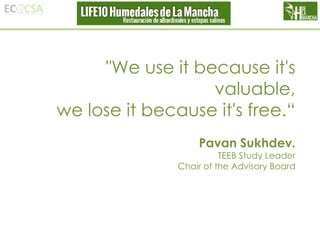
"We use it because it's
valuable,
we lose it because it's free.“
Pavan Sukhdev.

TEEB Study Leader
Chair of the Advisory Board
1. What´s TEEB?

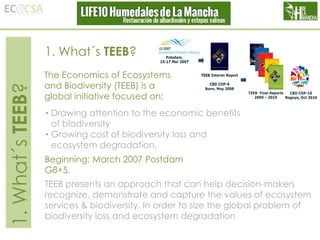
1. What´s TEEB?
The Economics of Ecosystems
and Biodiversity (TEEB) is a
global initiative focused on:
• Drawing attention to the economic benefits
of biodiversity
• Growing cost of biodiversity loss and
ecosystem degradation.
Beginning: March 2007 Postdam
G8+5.
TEEB presents an approach that can help decision-makers
recognize, demonstrate and capture the values of ecosystem
services & biodiversity. In order to size the global problem of
biodiversity loss and ecosystem degradation
1. What´s TEEB?

TEEB FOR WETLANDS
The importance of wetlands:
• In Water cycle
• Adressing water objetives (Rio+20, MDG and 2015
SDG)
Main goals:
Recognizing, demonstrating, and capturing the values of
ecosystem services
In order to…
• better informed,
• more efficient,
• fairer decision making
1. What´s TEEB?

What does TEEB try to answer?
• Benefits and risks of loss
Role of wetlands and their values
• Measuring to manage
Measure helps to manage
• Integrating the values into decision making
improve the consideration of the values and
benefits
• Transforming TEEB approach
Scales
2. Ecosystem services

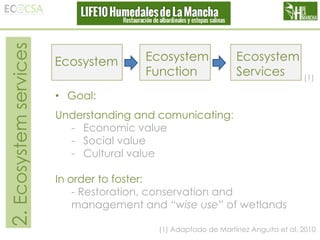
Ecosystem

Ecosystem
Function

Ecosystem
Services

(1)

• Goal:
Understanding and comunicating:
- Economic value
- Social value
- Cultural value
In order to foster:
- Restoration, conservation and
management and “wise use” of wetlands
(1) Adaptado de Martínez Anguita et al. 2010
2. Ecosystem services

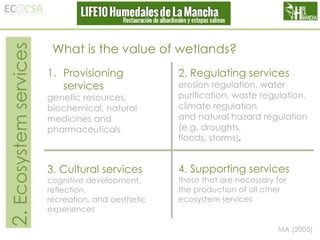
What is the value of wetlands?
1. Provisioning
services

2. Regulating services

genetic resources,
biochemical, natural
medicines and
pharmaceuticals

erosion regulation, water
purification, waste regulation,
climate regulation
and natural hazard regulation
(e.g. droughts,
floods, storms).

3. Cultural services

4. Supporting services

cognitive development,
reflection,
recreation, and aesthetic
experiences

those that are necessary for
the production of all other
ecosystem services

MA (2005)
2. Ecosystem services

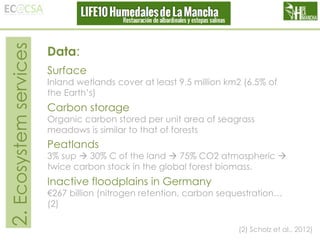
Data:
Surface

Inland wetlands cover at least 9.5 million km2 (6.5% of
the Earth’s)

Carbon storage

Organic carbon stored per unit area of seagrass
meadows is similar to that of forests

Peatlands

3% sup  30% C of the land  75% CO2 atmospheric 
twice carbon stock in the global forest biomass.

Inactive floodplains in Germany

€267 billion (nitrogen retention, carbon sequestration…
(2)
(2) Scholz et al., 2012)
2. Ecosystem services

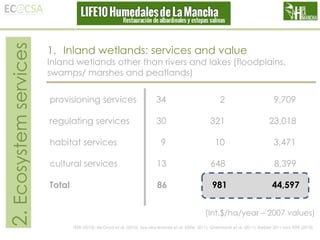
1. Inland wetlands: services and value

Inland wetlands other than rivers and lakes (floodplains,
swamps/ marshes and peatlands)
provisioning services

34

2

9,709

regulating services

30

321

23,018

habitat services

9

10

3,471

cultural services

13

648

8,399

Total

86

981

44,597

(Int.$/ha/year – 2007 values)
TEEB (2010); de Groot et al. (2010); See also Brander et al. (2006, 2011), Ghermandi et al. (2011), Barbier 2011 and TEEB (2010)
2. Ecosystem services

…but:

-

Relation between wetlands landscape
Ecosystem services not synergistic
Interconnectivity
People
Value ≠ Price
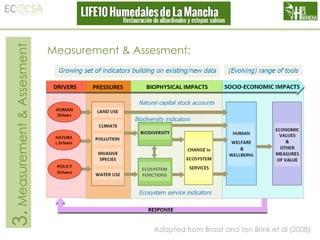
3. Measurement & Assesment

Measurement & Assesment:

Adapted from Braat and ten Brink et al (2008)
3. Measurement & Assessment

The values of nature:
• Qualitative analysis based on non-numerical
information.

• Quantitative data represent state, changes in
the ecosystems and the services they provide
using numerical units of measurement
• Geospatial mapping allows the quantitative
data to be linked with geographical information
• Monetary valuation can build on biophysical
information on the services provided by
ecosystems to derive values
3. Measurement & Assessment

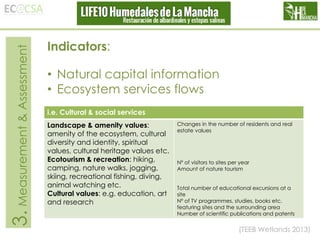
Indicators:
• Natural capital information
• Ecosystem services flows
i.e. Cultural & social services
Landscape & amenity values:
amenity of the ecosystem, cultural
diversity and identity, spiritual
values, cultural heritage values etc.
Ecotourism & recreation: hiking,
camping, nature walks, jogging,
skiing, recreational fishing, diving,
animal watching etc.
Cultural values: e.g. education, art
and research

Changes in the number of residents and real
estate values

Nº of visitors to sites per year
Amount of nature tourism
Total number of educational excursions at a
site
Nº of TV programmes, studies, books etc.
featuring sites and the surrounding area
Number of scientific publications and patents

(TEEB Wetlands 2013)
3. Measurement & Assessment

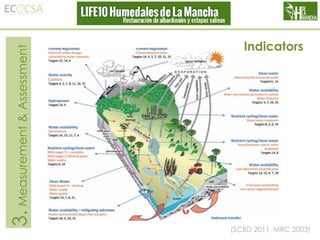
Indicators

(SCBD 2011, MRC 2003)
3. Measurement & Assessment

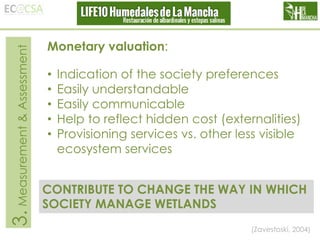
Monetary valuation:
•
•
•
•
•

Indication of the society preferences
Easily understandable
Easily communicable
Help to reflect hidden cost (externalities)
Provisioning services vs. other less visible
ecosystem services

CONTRIBUTE TO CHANGE THE WAY IN WHICH
SOCIETY MANAGE WETLANDS
(Zavestoski, 2004)
3. Measurement & Assessment

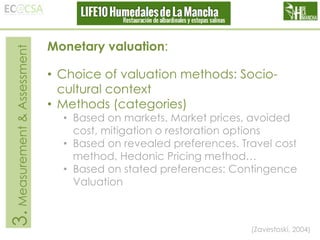
Monetary valuation:
• Choice of valuation methods: Sociocultural context
• Methods (categories)

• Based on markets. Market prices, avoided
cost, mitigation o restoration options
• Based on revealed preferences. Travel cost
method, Hedonic Pricing method…
• Based on stated preferences: Contingence
Valuation

(Zavestoski, 2004)
3. Measurement & Assessment

Monetary valuation: Limitations
• A range of methodologies are needed
• Both biophysical and monetary
approaches
• Ethical values, cultural needs, ancestral
rights?
• Anthropocentric focus (ignores ecosystem

that do not provide directs benefits to people or
economy Based )

IGNORE ECONOMIC VALUE IS REDUCE THE ABILITY
TO MAKE ROBUST ARGUMENTS FOR THE CHANGE
3. Measurement & Assessment

TEEB 6-step approach (I)
Step 1: Problem with stakeholders
Step 2: Most relevant ecosystem services
most relevant
Step 3: Identify information needs:
• Methods
• Information
3. Measurement & Assessment

TEEB 6-step approach (II)
Step 4: Assess expected changes in
ecosystem services:
• availability
• Distribution

Step 5: Identify and appraise policy options
Step 6: Assess social and environmental
impacts of policy options
3. Measurement & Assessment

Summary

• Complexity of the processes
Information helps to manage. Indicators for
wetlands management
• Interactions not well known enough. Transparent
assessment
What cover and what dos not cover.
Appreciate hydrological function to understand
benefit for people and economy
• Economic value of ecosystem services when
possible.
Single not enough, combine
• Contribution to social and economic
development
Identify opportunities on wetland degradation.
4. Tools

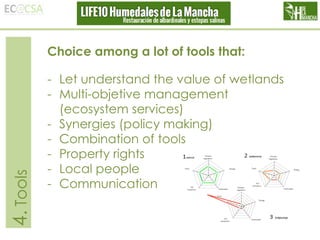
Choice among a lot of tools that:
- Let understand the value of wetlands
- Multi-objetive management
(ecosystem services)
- Synergies (policy making)
- Combination of tools
- Property rights
- Local people
- Communication
Tools (I):
- Site management
- Land planning & Regulation

4. Tools

-

Regulation of water discharges
Regulation of products
Spatial planning
Liability

- Property rights
Tools (II): Market Based Instruments (MBI)
- Price influencing in people
- Externalities (price not always takes account

4. Tools

all costs)

- MBI as a way for integrating loss of
value into cost
- Taxes, subsidies…
- Tradable permits (markets)
- PES (Payment for Ecosystem Services)
Tools (III): Market Based Instruments (MBI)
- Flexibility (choice)
- Effective when cause degradation is
mainly economic

4. Tools

- Questioned (right to pollute)
- Lack of genuine incentives (ethics,
culture…)
5. “Need for Action”

Which are the main goals of the TEEB
approach? (I)
- Knowledge of the critical role of
ecosystem services (in this case wetland
ecosystem)

- Multi-objetive management (do not
focus in biodiversity or single ecosystem
services (ES))

- Involve and engage local communities
- Value of restored ES more than
restoration cost
5. “Need for Action”

Which are the main goals of the TEEB
approach? (II)
- Sustainability (all sustainability vectors:
social, economical and natural)

- Traditional knowledge and practices
- Manage transition (evaluate the way for
the transition among winner and losers)

- Education, communication,
(communication and more communication)
davidalvarez@ecoacsa.com
Ecoacsa Reserva de Biodiversidad, S.L.
Tlf: 911252203
info@ecoacsa.com
www.ecoacsa.com

TEEB: Servicios de los ecosistemas

  • 3.
    "We use itbecause it's valuable, we lose it because it's free.“ Pavan Sukhdev. TEEB Study Leader Chair of the Advisory Board
  • 5.
    1. What´s TEEB? 1.What´s TEEB? The Economics of Ecosystems and Biodiversity (TEEB) is a global initiative focused on: • Drawing attention to the economic benefits of biodiversity • Growing cost of biodiversity loss and ecosystem degradation. Beginning: March 2007 Postdam G8+5. TEEB presents an approach that can help decision-makers recognize, demonstrate and capture the values of ecosystem services & biodiversity. In order to size the global problem of biodiversity loss and ecosystem degradation
  • 6.
    1. What´s TEEB? TEEBFOR WETLANDS The importance of wetlands: • In Water cycle • Adressing water objetives (Rio+20, MDG and 2015 SDG) Main goals: Recognizing, demonstrating, and capturing the values of ecosystem services In order to… • better informed, • more efficient, • fairer decision making
  • 7.
    1. What´s TEEB? Whatdoes TEEB try to answer? • Benefits and risks of loss Role of wetlands and their values • Measuring to manage Measure helps to manage • Integrating the values into decision making improve the consideration of the values and benefits • Transforming TEEB approach Scales
  • 9.
    2. Ecosystem services Ecosystem Ecosystem Function Ecosystem Services (1) •Goal: Understanding and comunicating: - Economic value - Social value - Cultural value In order to foster: - Restoration, conservation and management and “wise use” of wetlands (1) Adaptado de Martínez Anguita et al. 2010
  • 10.
    2. Ecosystem services Whatis the value of wetlands? 1. Provisioning services 2. Regulating services genetic resources, biochemical, natural medicines and pharmaceuticals erosion regulation, water purification, waste regulation, climate regulation and natural hazard regulation (e.g. droughts, floods, storms). 3. Cultural services 4. Supporting services cognitive development, reflection, recreation, and aesthetic experiences those that are necessary for the production of all other ecosystem services MA (2005)
  • 11.
    2. Ecosystem services Data: Surface Inlandwetlands cover at least 9.5 million km2 (6.5% of the Earth’s) Carbon storage Organic carbon stored per unit area of seagrass meadows is similar to that of forests Peatlands 3% sup  30% C of the land  75% CO2 atmospheric  twice carbon stock in the global forest biomass. Inactive floodplains in Germany €267 billion (nitrogen retention, carbon sequestration… (2) (2) Scholz et al., 2012)
  • 12.
    2. Ecosystem services 1.Inland wetlands: services and value Inland wetlands other than rivers and lakes (floodplains, swamps/ marshes and peatlands) provisioning services 34 2 9,709 regulating services 30 321 23,018 habitat services 9 10 3,471 cultural services 13 648 8,399 Total 86 981 44,597 (Int.$/ha/year – 2007 values) TEEB (2010); de Groot et al. (2010); See also Brander et al. (2006, 2011), Ghermandi et al. (2011), Barbier 2011 and TEEB (2010)
  • 13.
    2. Ecosystem services …but: - Relationbetween wetlands landscape Ecosystem services not synergistic Interconnectivity People Value ≠ Price
  • 15.
    3. Measurement &Assesment Measurement & Assesment: Adapted from Braat and ten Brink et al (2008)
  • 16.
    3. Measurement &Assessment The values of nature: • Qualitative analysis based on non-numerical information. • Quantitative data represent state, changes in the ecosystems and the services they provide using numerical units of measurement • Geospatial mapping allows the quantitative data to be linked with geographical information • Monetary valuation can build on biophysical information on the services provided by ecosystems to derive values
  • 17.
    3. Measurement &Assessment Indicators: • Natural capital information • Ecosystem services flows i.e. Cultural & social services Landscape & amenity values: amenity of the ecosystem, cultural diversity and identity, spiritual values, cultural heritage values etc. Ecotourism & recreation: hiking, camping, nature walks, jogging, skiing, recreational fishing, diving, animal watching etc. Cultural values: e.g. education, art and research Changes in the number of residents and real estate values Nº of visitors to sites per year Amount of nature tourism Total number of educational excursions at a site Nº of TV programmes, studies, books etc. featuring sites and the surrounding area Number of scientific publications and patents (TEEB Wetlands 2013)
  • 18.
    3. Measurement &Assessment Indicators (SCBD 2011, MRC 2003)
  • 19.
    3. Measurement &Assessment Monetary valuation: • • • • • Indication of the society preferences Easily understandable Easily communicable Help to reflect hidden cost (externalities) Provisioning services vs. other less visible ecosystem services CONTRIBUTE TO CHANGE THE WAY IN WHICH SOCIETY MANAGE WETLANDS (Zavestoski, 2004)
  • 20.
    3. Measurement &Assessment Monetary valuation: • Choice of valuation methods: Sociocultural context • Methods (categories) • Based on markets. Market prices, avoided cost, mitigation o restoration options • Based on revealed preferences. Travel cost method, Hedonic Pricing method… • Based on stated preferences: Contingence Valuation (Zavestoski, 2004)
  • 21.
    3. Measurement &Assessment Monetary valuation: Limitations • A range of methodologies are needed • Both biophysical and monetary approaches • Ethical values, cultural needs, ancestral rights? • Anthropocentric focus (ignores ecosystem that do not provide directs benefits to people or economy Based ) IGNORE ECONOMIC VALUE IS REDUCE THE ABILITY TO MAKE ROBUST ARGUMENTS FOR THE CHANGE
  • 22.
    3. Measurement &Assessment TEEB 6-step approach (I) Step 1: Problem with stakeholders Step 2: Most relevant ecosystem services most relevant Step 3: Identify information needs: • Methods • Information
  • 23.
    3. Measurement &Assessment TEEB 6-step approach (II) Step 4: Assess expected changes in ecosystem services: • availability • Distribution Step 5: Identify and appraise policy options Step 6: Assess social and environmental impacts of policy options
  • 24.
    3. Measurement &Assessment Summary • Complexity of the processes Information helps to manage. Indicators for wetlands management • Interactions not well known enough. Transparent assessment What cover and what dos not cover. Appreciate hydrological function to understand benefit for people and economy • Economic value of ecosystem services when possible. Single not enough, combine • Contribution to social and economic development Identify opportunities on wetland degradation.
  • 26.
    4. Tools Choice amonga lot of tools that: - Let understand the value of wetlands - Multi-objetive management (ecosystem services) - Synergies (policy making) - Combination of tools - Property rights - Local people - Communication
  • 27.
    Tools (I): - Sitemanagement - Land planning & Regulation 4. Tools - Regulation of water discharges Regulation of products Spatial planning Liability - Property rights
  • 28.
    Tools (II): MarketBased Instruments (MBI) - Price influencing in people - Externalities (price not always takes account 4. Tools all costs) - MBI as a way for integrating loss of value into cost - Taxes, subsidies… - Tradable permits (markets) - PES (Payment for Ecosystem Services)
  • 29.
    Tools (III): MarketBased Instruments (MBI) - Flexibility (choice) - Effective when cause degradation is mainly economic 4. Tools - Questioned (right to pollute) - Lack of genuine incentives (ethics, culture…)
  • 31.
    5. “Need forAction” Which are the main goals of the TEEB approach? (I) - Knowledge of the critical role of ecosystem services (in this case wetland ecosystem) - Multi-objetive management (do not focus in biodiversity or single ecosystem services (ES)) - Involve and engage local communities - Value of restored ES more than restoration cost
  • 32.
    5. “Need forAction” Which are the main goals of the TEEB approach? (II) - Sustainability (all sustainability vectors: social, economical and natural) - Traditional knowledge and practices - Manage transition (evaluate the way for the transition among winner and losers) - Education, communication, (communication and more communication)
  • 33.
    davidalvarez@ecoacsa.com Ecoacsa Reserva deBiodiversidad, S.L. Tlf: 911252203 info@ecoacsa.com www.ecoacsa.com