10th February, 2010
Pusa Institute, New Delhi

                            India TEEB

                          Pavan Sukhdev
                        Study Leader – TEEB
        & Special Adviser & Head - Green Economy Initiative
             United Nations Environment Programme
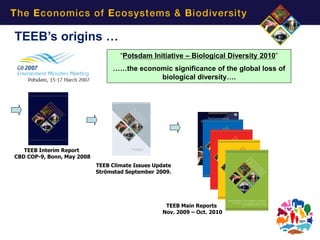
TEEB‟s origins …
                                    “Potsdam Initiative – Biological Diversity 2010”
                                 ……the economic significance of the global loss of
                                            biological diversity….


   TEEB Interim Report
CBD COP-9, Bonn, May 2008
                            TEEB Climate Issues Update
                            Strömstad September 2009.


                                                    TEEB Main Reports
                                                   Nov. 2009 – Oct. 2010
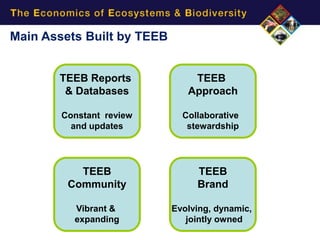
Main Assets Built by TEEB


       TEEB Reports             TEEB
        & Databases            Approach

        Constant review       Collaborative
          and updates          stewardship


           TEEB                  TEEB
         Community               Brand

          Vibrant &         Evolving, dynamic,
          expanding            jointly owned
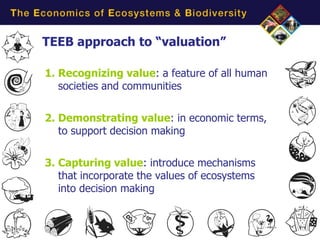
TEEB approach to “valuation”

1. Recognizing value: a feature of all human
   societies and communities


2. Demonstrating value: in economic terms,
   to support decision making

3. Capturing value: introduce mechanisms
   that incorporate the values of ecosystems
   into decision making
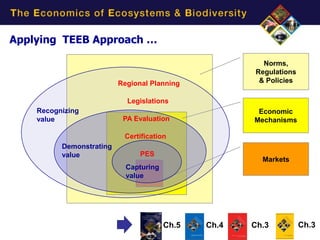
Applying TEEB Approach …

                                                        Norms,
                                                      Regulations
                          Regional Planning            & Policies

                            Legislations
    Recognizing                                        Economic
    value                  PA Evaluation              Mechanisms

                           Certification
          Demonstrating
          value                 PES
                                                        Markets
                            Capturing
                            value


                                        Ch.5   Ch.4   Ch.3          Ch.3
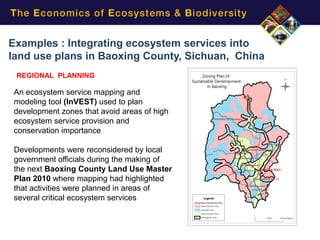
Examples : Integrating ecosystem services into
land use plans in Baoxing County, Sichuan, China
 REGIONAL PLANNING

An ecosystem service mapping and
modeling tool (InVEST) used to plan
development zones that avoid areas of high
ecosystem service provision and
conservation importance

Developments were reconsidered by local
government officials during the making of
the next Baoxing County Land Use Master
Plan 2010 where mapping had highlighted
that activities were planned in areas of
several critical ecosystem services
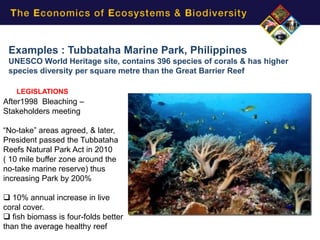
Examples : Tubbataha Marine Park, Philippines
 UNESCO World Heritage site, contains 396 species of corals & has higher
 species diversity per square metre than the Great Barrier Reef

   LEGISLATIONS
After1998 Bleaching –
Stakeholders meeting

“No-take” areas agreed, & later,
President passed the Tubbataha
Reefs Natural Park Act in 2010
( 10 mile buffer zone around the
no-take marine reserve) thus
increasing Park by 200%

 10% annual increase in live
coral cover.
 fish biomass is four-folds better
than the average healthy reef
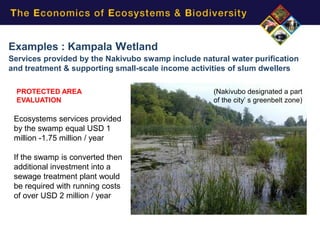
Examples : Kampala Wetland
Services provided by the Nakivubo swamp include natural water purification
and treatment & supporting small-scale income activities of slum dwellers

  PROTECTED AREA                                    (Nakivubo designated a part
  EVALUATION                                        of the city’ s greenbelt zone)

 Ecosystems services provided
 by the swamp equal USD 1
 million -1.75 million / year

 If the swamp is converted then
 additional investment into a
 sewage treatment plant would
 be required with running costs
 of over USD 2 million / year
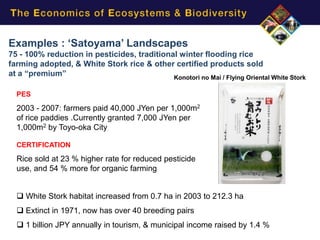
Examples : „Satoyama‟ Landscapes
75 - 100% reduction in pesticides, traditional winter flooding rice
farming adopted, & White Stork rice & other certified products sold
at a “premium”                               Konotori no Mai / Flying Oriental White Stork

  PES

  2003 - 2007: farmers paid 40,000 JYen per 1,000m2
  of rice paddies .Currently granted 7,000 JYen per
  1,000m2 by Toyo-oka City

  CERTIFICATION

  Rice sold at 23 % higher rate for reduced pesticide
  use, and 54 % more for organic farming


   White Stork habitat increased from 0.7 ha in 2003 to 212.3 ha
   Extinct in 1971, now has over 40 breeding pairs
   1 billion JPY annually in tourism, & municipal income raised by 1.4 %
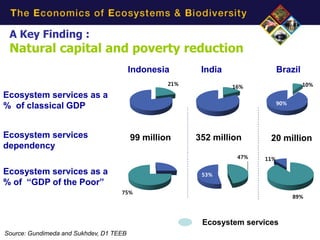
A Key Finding :
 Natural capital and poverty reduction
                                         Indonesia          India                Brazil
                                                    21%                                   10%
                                                                    16%
Ecosystem services as a
                                                                                 90%
% of classical GDP
                                         79%              84%

Ecosystem services                       99 million       352 million       20 million
dependency
                                                                     47%   11%
                                                    25%
Ecosystem services as a                                     53%
% of “GDP of the Poor”
                                    75%
                                                                                       89%


                                                            Ecosystem services
Source: Gundimeda and Sukhdev, D1 TEEB
   19.04.2011                                  10
A Key Recommendation :
Measuring better to manage better
 Natural resources are economic assets, whether or not they enter the
 marketpace
 Conventional measures of national economic performance (eg : GDP
 Growth) fail to reflect these stocks and their benefits flows.


 Rapidly upgrade the System of National Accounts (SNA) to include
  changes in natural capital stocks and ecosystem service flows
  (CBD Strategic Plan – Target 2 ... in [..])

 URGENT : physical accounts for forest stocks / carbon storage
  need to be in place (e.g. for orderly development of REDD+)


                                              Ch.3                Ch.3,5
A Key Recommendation :
Financial Disclosure and “Net Positive Impact”

Corporate financial reporting standards & purchasing policies do not
generally require attention to environmental externalities


 Disclose all major externalities in the annual reports and accounts
  of business and other organizations

 Reflect all environmental liabilities and changes in natural assets of
  the Corporation in its statutory accounts

 Principles of „No Net Loss‟ or „Net Positive Impact‟ (avoidance,
  mitigation, restoration, compensation, etc) should be integrated
  into normal business practice
                                                                       Ch.3-5
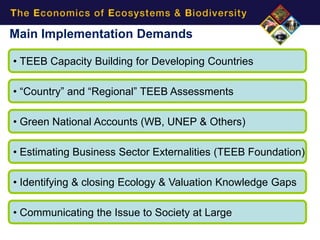
Main Implementation Demands

• TEEB Capacity Building for Developing Countries

• “Country” and “Regional” TEEB Assessments

• Green National Accounts (WB, UNEP & Others)

• Estimating Business Sector Externalities (TEEB Foundation)

• Identifying & closing Ecology & Valuation Knowledge Gaps

• Communicating the Issue to Society at Large
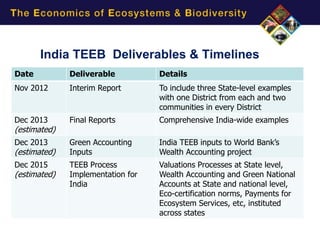
India TEEB Deliverables & Timelines
Date          (To Be Discussed at Stakeholder Meeting)
              Deliverable           Details
Nov 2012      Interim Report        To include three State-level examples
                                    with one District from each and two
                                    communities in every District
Dec 2013      Final Reports         Comprehensive India-wide examples
(estimated)
Dec 2013      Green Accounting      India TEEB inputs to World Bank’s
(estimated)   Inputs                Wealth Accounting project
Dec 2015      TEEB Process          Valuations Processes at State level,
(estimated)   Implementation for    Wealth Accounting and Green National
              India                 Accounts at State and national level,
                                    Eco-certification norms, Payments for
                                    Ecosystem Services, etc, instituted
                                    across states
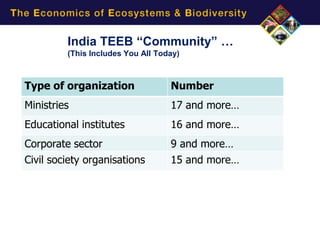
India TEEB “Community” …
         (This Includes You All Today)


Type of organization               Number
Ministries                         17 and more…
Educational institutes             16 and more…
Corporate sector                   9 and more…
Civil society organisations        15 and more…
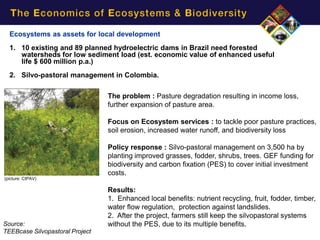
Ecosystems as assets for local development
  1. 10 existing and 89 planned hydroelectric dams in Brazil need forested
     watersheds for low sediment load (est. economic value of enhanced useful
     life $ 600 million p.a.)
  2. Silvo-pastoral management in Colombia.

                                 The problem : Pasture degradation resulting in income loss,
                                 further expansion of pasture area.

                                 Focus on Ecosystem services : to tackle poor pasture practices,
                                 soil erosion, increased water runoff, and biodiversity loss

                                 Policy response : Silvo-pastoral management on 3,500 ha by
                                 planting improved grasses, fodder, shrubs, trees. GEF funding for
                                 biodiversity and carbon fixation (PES) to cover initial investment
                                 costs.
(picture: CIPAV)

                                 Results:
                                 1. Enhanced local benefits: nutrient recycling, fruit, fodder, timber,
                                 water flow regulation, protection against landslides.
                                 2. After the project, farmers still keep the silvopastoral systems
Source:                          without the PES, due to its multiple benefits.
TEEBcase Silvopastoral Project
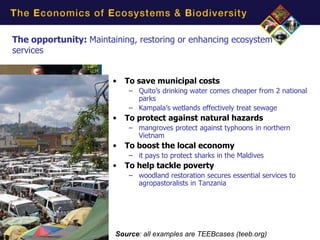
The opportunity: Maintaining, restoring or enhancing ecosystem
services


                       •   To save municipal costs
                            – Quito’s drinking water comes cheaper from 2 national
                              parks
                            – Kampala’s wetlands effectively treat sewage
                       •   To protect against natural hazards
                            – mangroves protect against typhoons in northern
                              Vietnam
                       •   To boost the local economy
                            – it pays to protect sharks in the Maldives
                       •   To help tackle poverty
                            – woodland restoration secures essential services to
                              agropastoralists in Tanzania


                        Source: all examples are TEEBcases (teeb.org)
Thank You !

www.teebweb.org

www.teeb4me.com

India teeb launch pavan sukhdev

  • 1.
    10th February, 2010 PusaInstitute, New Delhi India TEEB Pavan Sukhdev Study Leader – TEEB & Special Adviser & Head - Green Economy Initiative United Nations Environment Programme
  • 2.
    TEEB‟s origins … “Potsdam Initiative – Biological Diversity 2010” ……the economic significance of the global loss of biological diversity…. TEEB Interim Report CBD COP-9, Bonn, May 2008 TEEB Climate Issues Update Strömstad September 2009. TEEB Main Reports Nov. 2009 – Oct. 2010
  • 3.
    Main Assets Builtby TEEB TEEB Reports TEEB & Databases Approach Constant review Collaborative and updates stewardship TEEB TEEB Community Brand Vibrant & Evolving, dynamic, expanding jointly owned
  • 4.
    TEEB approach to“valuation” 1. Recognizing value: a feature of all human societies and communities 2. Demonstrating value: in economic terms, to support decision making 3. Capturing value: introduce mechanisms that incorporate the values of ecosystems into decision making
  • 5.
    Applying TEEB Approach… Norms, Regulations Regional Planning & Policies Legislations Recognizing Economic value PA Evaluation Mechanisms Certification Demonstrating value PES Markets Capturing value Ch.5 Ch.4 Ch.3 Ch.3
  • 6.
    Examples : Integratingecosystem services into land use plans in Baoxing County, Sichuan, China REGIONAL PLANNING An ecosystem service mapping and modeling tool (InVEST) used to plan development zones that avoid areas of high ecosystem service provision and conservation importance Developments were reconsidered by local government officials during the making of the next Baoxing County Land Use Master Plan 2010 where mapping had highlighted that activities were planned in areas of several critical ecosystem services
  • 7.
    Examples : TubbatahaMarine Park, Philippines UNESCO World Heritage site, contains 396 species of corals & has higher species diversity per square metre than the Great Barrier Reef LEGISLATIONS After1998 Bleaching – Stakeholders meeting “No-take” areas agreed, & later, President passed the Tubbataha Reefs Natural Park Act in 2010 ( 10 mile buffer zone around the no-take marine reserve) thus increasing Park by 200%  10% annual increase in live coral cover.  fish biomass is four-folds better than the average healthy reef
  • 8.
    Examples : KampalaWetland Services provided by the Nakivubo swamp include natural water purification and treatment & supporting small-scale income activities of slum dwellers PROTECTED AREA (Nakivubo designated a part EVALUATION of the city’ s greenbelt zone) Ecosystems services provided by the swamp equal USD 1 million -1.75 million / year If the swamp is converted then additional investment into a sewage treatment plant would be required with running costs of over USD 2 million / year
  • 9.
    Examples : „Satoyama‟Landscapes 75 - 100% reduction in pesticides, traditional winter flooding rice farming adopted, & White Stork rice & other certified products sold at a “premium” Konotori no Mai / Flying Oriental White Stork PES 2003 - 2007: farmers paid 40,000 JYen per 1,000m2 of rice paddies .Currently granted 7,000 JYen per 1,000m2 by Toyo-oka City CERTIFICATION Rice sold at 23 % higher rate for reduced pesticide use, and 54 % more for organic farming  White Stork habitat increased from 0.7 ha in 2003 to 212.3 ha  Extinct in 1971, now has over 40 breeding pairs  1 billion JPY annually in tourism, & municipal income raised by 1.4 %
  • 10.
    A Key Finding: Natural capital and poverty reduction Indonesia India Brazil 21% 10% 16% Ecosystem services as a 90% % of classical GDP 79% 84% Ecosystem services 99 million 352 million 20 million dependency 47% 11% 25% Ecosystem services as a 53% % of “GDP of the Poor” 75% 89% Ecosystem services Source: Gundimeda and Sukhdev, D1 TEEB 19.04.2011 10
  • 11.
    A Key Recommendation: Measuring better to manage better Natural resources are economic assets, whether or not they enter the marketpace Conventional measures of national economic performance (eg : GDP Growth) fail to reflect these stocks and their benefits flows.  Rapidly upgrade the System of National Accounts (SNA) to include changes in natural capital stocks and ecosystem service flows (CBD Strategic Plan – Target 2 ... in [..])  URGENT : physical accounts for forest stocks / carbon storage need to be in place (e.g. for orderly development of REDD+) Ch.3 Ch.3,5
  • 12.
    A Key Recommendation: Financial Disclosure and “Net Positive Impact” Corporate financial reporting standards & purchasing policies do not generally require attention to environmental externalities  Disclose all major externalities in the annual reports and accounts of business and other organizations  Reflect all environmental liabilities and changes in natural assets of the Corporation in its statutory accounts  Principles of „No Net Loss‟ or „Net Positive Impact‟ (avoidance, mitigation, restoration, compensation, etc) should be integrated into normal business practice Ch.3-5
  • 13.
    Main Implementation Demands •TEEB Capacity Building for Developing Countries • “Country” and “Regional” TEEB Assessments • Green National Accounts (WB, UNEP & Others) • Estimating Business Sector Externalities (TEEB Foundation) • Identifying & closing Ecology & Valuation Knowledge Gaps • Communicating the Issue to Society at Large
  • 14.
    India TEEB Deliverables& Timelines Date (To Be Discussed at Stakeholder Meeting) Deliverable Details Nov 2012 Interim Report To include three State-level examples with one District from each and two communities in every District Dec 2013 Final Reports Comprehensive India-wide examples (estimated) Dec 2013 Green Accounting India TEEB inputs to World Bank’s (estimated) Inputs Wealth Accounting project Dec 2015 TEEB Process Valuations Processes at State level, (estimated) Implementation for Wealth Accounting and Green National India Accounts at State and national level, Eco-certification norms, Payments for Ecosystem Services, etc, instituted across states
  • 15.
    India TEEB “Community”… (This Includes You All Today) Type of organization Number Ministries 17 and more… Educational institutes 16 and more… Corporate sector 9 and more… Civil society organisations 15 and more…
  • 16.
    Ecosystems as assetsfor local development 1. 10 existing and 89 planned hydroelectric dams in Brazil need forested watersheds for low sediment load (est. economic value of enhanced useful life $ 600 million p.a.) 2. Silvo-pastoral management in Colombia. The problem : Pasture degradation resulting in income loss, further expansion of pasture area. Focus on Ecosystem services : to tackle poor pasture practices, soil erosion, increased water runoff, and biodiversity loss Policy response : Silvo-pastoral management on 3,500 ha by planting improved grasses, fodder, shrubs, trees. GEF funding for biodiversity and carbon fixation (PES) to cover initial investment costs. (picture: CIPAV) Results: 1. Enhanced local benefits: nutrient recycling, fruit, fodder, timber, water flow regulation, protection against landslides. 2. After the project, farmers still keep the silvopastoral systems Source: without the PES, due to its multiple benefits. TEEBcase Silvopastoral Project
  • 17.
    The opportunity: Maintaining,restoring or enhancing ecosystem services • To save municipal costs – Quito’s drinking water comes cheaper from 2 national parks – Kampala’s wetlands effectively treat sewage • To protect against natural hazards – mangroves protect against typhoons in northern Vietnam • To boost the local economy – it pays to protect sharks in the Maldives • To help tackle poverty – woodland restoration secures essential services to agropastoralists in Tanzania Source: all examples are TEEBcases (teeb.org)
  • 18.