© University of Reading 2010 www.reading.ac.uk/library
Library
‘What did I do wrong?’
Supporting independent learning
practices to avoid plagiarism
Helen Hathaway
Information Skills Co-ordinator, University Teaching Fellow
‘What did I do wrong?’
• Introduction to project
• Rationale and aims
• Project team: Library, Study Advice, ISLC
Helen
Hathaway
Kim
Shahabudin
Clare
Nukui
Liz
Wilding
Rhianedd
Smith
Background and scope
• Funding
• Three projects into one
• Timing! Started September 2012, finish June 2013
– Interim report Dec 2012
– Research report
• What have we done?
Supporting research
• As researchers
• Developing
researchers of the
future
– This project
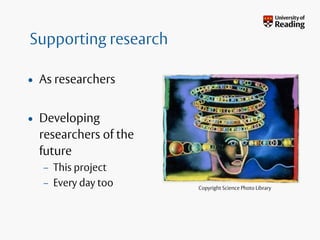
– Every day too Copyright Science Photo Library
What do others think?
We carried out research…
…with Library staff
…with students
…with academics
…with learning developers
…on Turnitin
“If we knew what it was we were
doing, it would not be called
research, would it?”
Albert Einstein
Library staff views
• “The most frequent query I get is about citing webpages or documents
found on the web. Sometimes they aren’t suitable sources though, so I
have to try to steer them to something better!”
• “Most of my enquiries from students come from opposite ends of the
spectrum:
1) The students who have had a piece of work back saying they
haven’t referenced properly or who know that they have no idea
about referencing
2) The student who’s sorted most of their references and has an
unusual type of material to reference”
• “A lot of the students that I deal with are overseas and tend to get the
plagiarism warnings piled on to them big style so I tend to
recommend it as a way of avoiding charges of plagiarism.”
Put yourself in a student’s shoes…
“How should I reference an App,
a packet of crisps, a practical
protocol?”
“How many sources should I
use?”
“I know what a reference is – but
what’s a citation?”
“Why does this tutor want a
different referencing style
from that one?”
“Do I need a reference list AND a
bibliography?”
“Will I be marked down for
missing a comma?”
“I have a misconduct interview:
what happens now?”
Copyright Photolibrary
Student comments
• “Did referencing at school so don’t need to learn it again.”
• “Didn’t do referencing at school – was totally lost when I got here.”
• “One tutor wants me to reference like this, the others want me to
do it differently – I don’t understand why.”
• “I got my referencing wrong in my first year and my tutor took me
on one side and told me to be more careful next time. Got it wrong
in the 2nd year and suddenly it was all regulations and zero marks.”
• “Referencing is just something you have to do, otherwise you lose
marks.”
• “I ran out of time, and decided I’d lose fewer marks for not
checking my references than for handing in late. I got zero.”
Surveyed School Directors
of teaching and learning
• Advice and guidance on finding appropriate academic
sources of info
• Referencing principles and practice
• Feedback – when and how
• How important for Part 1, Part 2, Masters
• What are the reasons for incorrect referencing
• What is your response
• Current strategies effective or not
• Additional resources you would like?
Feedback from academics
• “Inadvertent plagiarism' is usually explained by people being under
pressure.”
• “Plagiarism can be less of a problem on modules where assignments
are designed to force students to think independently.”
• “Anecdotally it seems that anxiety about referencing is seen more with
dissertations. “
• “Students can focus disproportionately on micro-details like p/pp.”
• “There is a growing problem with students in English Literature
referencing e-books. “
• “International students may have been to a vast range of different
types of colleges and universities and it is very hard to know what
training and information they've been given in the past.”
Turnitin
Survey of School Directors of Teaching and Learning and School E-
learning Co-ordinators….and others
Does Turnitin help with academic practice/ referencing?
Results evenly balanced
• “Definitely worth using Turnitin formatively, but does require
sufficient time - students often need more practice in note-taking
etc.”
• “personally I haven't detected any significant decline in poor
academic practice”
• “Turnitin is not necessarily reliable. It often fails to detect
plagiarism. However it helps to sensitise students of good academic
conventions.”
Utilising alternative perspectives?
How is it taught now? identifying gaps
At Reading… At other institutions…
What have we developed?
• ‘Toolkit’ of bite-sezed re-purposable resources
(launched)
• Aimed at academics to use with their students
• Stored in Blackboard Organisation
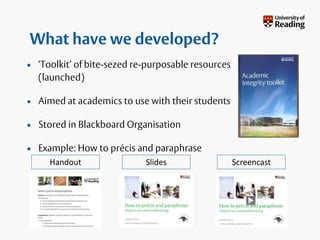
• Example: How to précis and paraphrase
Handout Slides Screencast
How did we get on together?
Good
• input from people
working in different roles
• access to different
strategic issues
• differing relationships
with students and
academics
• paid project workers
Bad
• speed of decision making
• getting together at the
same time!
• differing aspirations for
the project
• different structures of
services/depts.
No ugly!
Copyright Getty Images
Results of research
• Crucial to go beyond formatting and
show role of correct referencing in
academic writing
• Many students fail to engage with
skills teaching
• Students report lack of consistency
and difficulty in finding guidance
• Implications of alternative academic
cultures and experiences
Non-attributed – 1
hour looking for it
on Flickr
Recommendations
• Pre-entry information and compulsory self-test?
• Student facing resource(s)
• Some suggestions on effective
BUT that’s another story
1974/5, Mendoza, Private collection,
Bridgeman Education

What did I do wrong?”a project to support independent learning practices to avoid plagiarism.

  • 1.
    © University ofReading 2010 www.reading.ac.uk/library Library ‘What did I do wrong?’ Supporting independent learning practices to avoid plagiarism Helen Hathaway Information Skills Co-ordinator, University Teaching Fellow
  • 2.
    ‘What did Ido wrong?’ • Introduction to project • Rationale and aims • Project team: Library, Study Advice, ISLC Helen Hathaway Kim Shahabudin Clare Nukui Liz Wilding Rhianedd Smith
  • 3.
    Background and scope •Funding • Three projects into one • Timing! Started September 2012, finish June 2013 – Interim report Dec 2012 – Research report • What have we done?
  • 4.
    Supporting research • Asresearchers • Developing researchers of the future – This project – Every day too Copyright Science Photo Library
  • 5.
    What do othersthink? We carried out research… …with Library staff …with students …with academics …with learning developers …on Turnitin “If we knew what it was we were doing, it would not be called research, would it?” Albert Einstein
  • 6.
    Library staff views •“The most frequent query I get is about citing webpages or documents found on the web. Sometimes they aren’t suitable sources though, so I have to try to steer them to something better!” • “Most of my enquiries from students come from opposite ends of the spectrum: 1) The students who have had a piece of work back saying they haven’t referenced properly or who know that they have no idea about referencing 2) The student who’s sorted most of their references and has an unusual type of material to reference” • “A lot of the students that I deal with are overseas and tend to get the plagiarism warnings piled on to them big style so I tend to recommend it as a way of avoiding charges of plagiarism.”
  • 7.
    Put yourself ina student’s shoes… “How should I reference an App, a packet of crisps, a practical protocol?” “How many sources should I use?” “I know what a reference is – but what’s a citation?” “Why does this tutor want a different referencing style from that one?” “Do I need a reference list AND a bibliography?” “Will I be marked down for missing a comma?” “I have a misconduct interview: what happens now?” Copyright Photolibrary
  • 8.
    Student comments • “Didreferencing at school so don’t need to learn it again.” • “Didn’t do referencing at school – was totally lost when I got here.” • “One tutor wants me to reference like this, the others want me to do it differently – I don’t understand why.” • “I got my referencing wrong in my first year and my tutor took me on one side and told me to be more careful next time. Got it wrong in the 2nd year and suddenly it was all regulations and zero marks.” • “Referencing is just something you have to do, otherwise you lose marks.” • “I ran out of time, and decided I’d lose fewer marks for not checking my references than for handing in late. I got zero.”
  • 9.
    Surveyed School Directors ofteaching and learning • Advice and guidance on finding appropriate academic sources of info • Referencing principles and practice • Feedback – when and how • How important for Part 1, Part 2, Masters • What are the reasons for incorrect referencing • What is your response • Current strategies effective or not • Additional resources you would like?
  • 10.
    Feedback from academics •“Inadvertent plagiarism' is usually explained by people being under pressure.” • “Plagiarism can be less of a problem on modules where assignments are designed to force students to think independently.” • “Anecdotally it seems that anxiety about referencing is seen more with dissertations. “ • “Students can focus disproportionately on micro-details like p/pp.” • “There is a growing problem with students in English Literature referencing e-books. “ • “International students may have been to a vast range of different types of colleges and universities and it is very hard to know what training and information they've been given in the past.”
  • 11.
    Turnitin Survey of SchoolDirectors of Teaching and Learning and School E- learning Co-ordinators….and others Does Turnitin help with academic practice/ referencing? Results evenly balanced • “Definitely worth using Turnitin formatively, but does require sufficient time - students often need more practice in note-taking etc.” • “personally I haven't detected any significant decline in poor academic practice” • “Turnitin is not necessarily reliable. It often fails to detect plagiarism. However it helps to sensitise students of good academic conventions.”
  • 12.
  • 13.
    How is ittaught now? identifying gaps At Reading… At other institutions…
  • 14.
    What have wedeveloped? • ‘Toolkit’ of bite-sezed re-purposable resources (launched) • Aimed at academics to use with their students • Stored in Blackboard Organisation • Example: How to précis and paraphrase Handout Slides Screencast
  • 15.
    How did weget on together? Good • input from people working in different roles • access to different strategic issues • differing relationships with students and academics • paid project workers Bad • speed of decision making • getting together at the same time! • differing aspirations for the project • different structures of services/depts. No ugly! Copyright Getty Images
  • 16.
    Results of research •Crucial to go beyond formatting and show role of correct referencing in academic writing • Many students fail to engage with skills teaching • Students report lack of consistency and difficulty in finding guidance • Implications of alternative academic cultures and experiences Non-attributed – 1 hour looking for it on Flickr
  • 17.
    Recommendations • Pre-entry informationand compulsory self-test? • Student facing resource(s) • Some suggestions on effective BUT that’s another story 1974/5, Mendoza, Private collection, Bridgeman Education

Editor's Notes

  • #3 Background and who we are Kim – Study Adviser and sessional lecturer in the Department of Classics on classical reception in popular culture Clare - IFP Programme Director / Senior Tutor Liz - Assistant Director ISLC International study and language centre – deal with Presessional students and International Foundation Programme Rhi – now Museum Studies Programme Director
  • #4 We have a process to fund projects Similarities between our 3 – referencing, avoiding plagiarism and flipped learning International students dimension and looked at both undergraduate and post graduate students Missed the summer vacation Look at other resources, identify gaps, produce a toolkit Research report still being written
  • #5 Our research has provided local evidence of the need to develop researchers of the future. Researchers are not just made – they develop and the journey they have been on (or not) as first and second year students about finding information will affect where they are as researchers whether doing projects, dissertations, masters, PhD’s and beyond. International students may not have this experience. Every day librarians advise on exploiting resources that indirectly and directly support effective researching.
  • #6 Feedback also from Study advisers and Student advisers. external research with learning developers, which is what turned up the trends for academic integrity and compulsory tests/quizzes. Librarian as researchers learnt about collaboration across three different sections - benefits and drawbacks of this style of research grouping which may be useful to share as collaborations are becoming more popular with University administrations and with funding bodies. Diversity of Communities of Practice (national and local) that we were able to draw on LearnHigher – especially academic writing, note making and referencing sections
  • #7  Relate to wider context of academic study
  • #8 How many could you answer or be expected to answer? From LL’s and Study Advisers Shows the difficulties students face when trying to get definitive answers about referencing queries: yet we penalise them for getting it wrong. Note also anxiety and stress (results of email survey)
  • #9 Focus groups with English students – project officer/ problems presented to SA’s Reported comments from Study Advisers/RUStudents’ Union /ISLC Survey by email resulted in 75 responses – considered and thoughtful not just moany, but highlighted real issues eg Difficulty in finding sources of help, feeling too trivial to bother tutors. Focus groups with Int students revealed they were more likely to ask for help, paraphrasing a big difficulty in a second language. Have not been through UK HE, range of practices in home countries.
  • #11 English/ISLC
  • #12 32 responses.
  • #13 Often said that international students have particular problems with referencing. “It's like I'm getting touch with a whole lot of intellectual ancestors and mentors”. Not a homogeneous group – problems of Chinese students quite different to problems of Indian students. Key could be to use different cultures to explain importance of referencing. From Puerto Rico, Maori culture, India, Malaysian Chinese, Germany (brand names)
  • #14 All English Anglia Ruskin – how to do it in Harvard Nottingham Iden
  • #15 Should they be made into OER’s? Launch event with speaker Our speaker was Diane Schmitt, Senior Lecturer in EFL/TESOL at Nottingham Trent University, whose topic was Adding ‘purpose’ to instruction on the use of sources, referencing and ‘avoiding plagiarism’. Diane argued that we need to refocus on the fact that the absence of plagiarism is not equivalent to good writing. We should instead move towards a ‘pedagogy for using sources’, teaching students how, why and when to use sources in their discipline. An especially useful ‘takeaway’ message proposed encouraging students to take a staged approach to reading, starting with a short introductory text that outlined the main issues and topics before moving on to in-depth research in second-level sources which could be used to support their academic writing. Bringing reading into the classroom can help to support ‘reading to learn’ as well as building knowledge and the comprehension of arguments. Printed packs contain 17 handouts, 8 exercise sheets with answers, 13 sets of PowerPoint slides, useful websites and links to some screencasts. Not intended that academics should photocopy and hand out, but embed in teaching – hence in Blackboard.
  • #16 As a part-timer, it's been helpful to have other team members on campus on the days I'm not. Project workers - as we would find it hard otherwise to find additional time while still doing our day jobs. the input of differing points of view has also helped to hone our thinking and eventually recommendations! Creative Keeping in touch/wanting to know everything even if dividing up the work is best practice. “I’ve collaborated with many different colleagues within the same unit in the past, but this is actually the first time I’ve had the opportunity to collaborate with people from other areas. Overall, I’ve found it very stimulating – primarily because of the obvious advantages of hearing different perspectives and ideas, and seeing other ways of working. I’ve probably taken more away than I have put in, as unfortunately time has been a big issue for me. One problem with working collaboratively is that things can sometimes move a little slowly.   I feel that the exchange of ideas and information has worked pretty well through the combination of emails, f2f meetings and the wiki. I was a little unsure of how I would like the wiki at first, but I’ve found that having one as a central repository for documents and discussion has been useful. However, in terms of moving ahead, ie making decisions and really getting things to happen, the live meetings have been most productive in my opinion”
  • #17 Results from Students’ email survey and focus groups most compelling and of most interest? Avoiding using sources which they are not sure how to reference correctly. Too trivial to bother tutors with. Not engaging as perception they are not plagiarising unless copying and pasting Int students – paraphrasing a big problem, But more inclined to get together the discuss problems and go to tutor (at Presessional level). They Acknowledge their need – but will that carry over into programme of study? Are we supporting researchers of the future (context not all go on to research but finding evidence and information in employment and being able to evidence it is surely a transferable skill)
  • #18  Paper kit distributed to Schools and to key staff in T&L, University Board for T&L and Sub-committee for the Development and Enhancement of T&L – favourably received and suggestions for future development. Request to enrol whole Departments or Schools Using academics from different cultures to help explain their experiences? Academic Integrity’ resources including online self-audit tests Single, clear authoritative source of guidance for the future Practical applications rather than yet more reading guides