Understanding digital natives


          Professor David Nicholas
                    CIBER
          UCL Centre for Publishing
          University College London
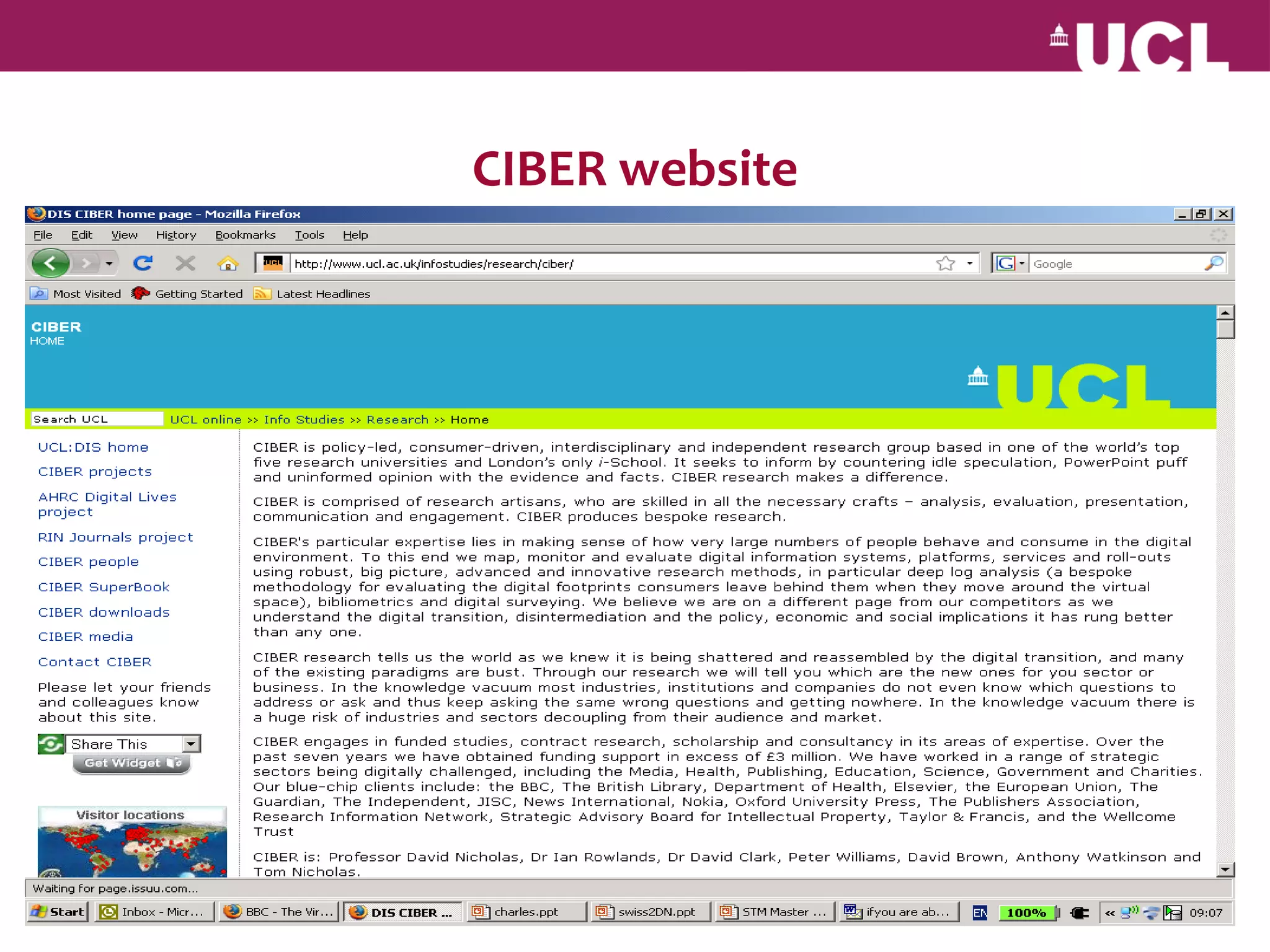
http://www.ucl.ac.uk/infostudies/research/ciber/
Background

• Choice, digital transition, unbelievable
  access, Google & disintermediation
  transformed information landscape
• Because so much information seeking
  goes on remotely and anonymously not
  woken up to this yet. Yet digital
  transition further to go: e-books
• Badly need to visualise and
  conceptualise what is going on,
  especially in regard the young
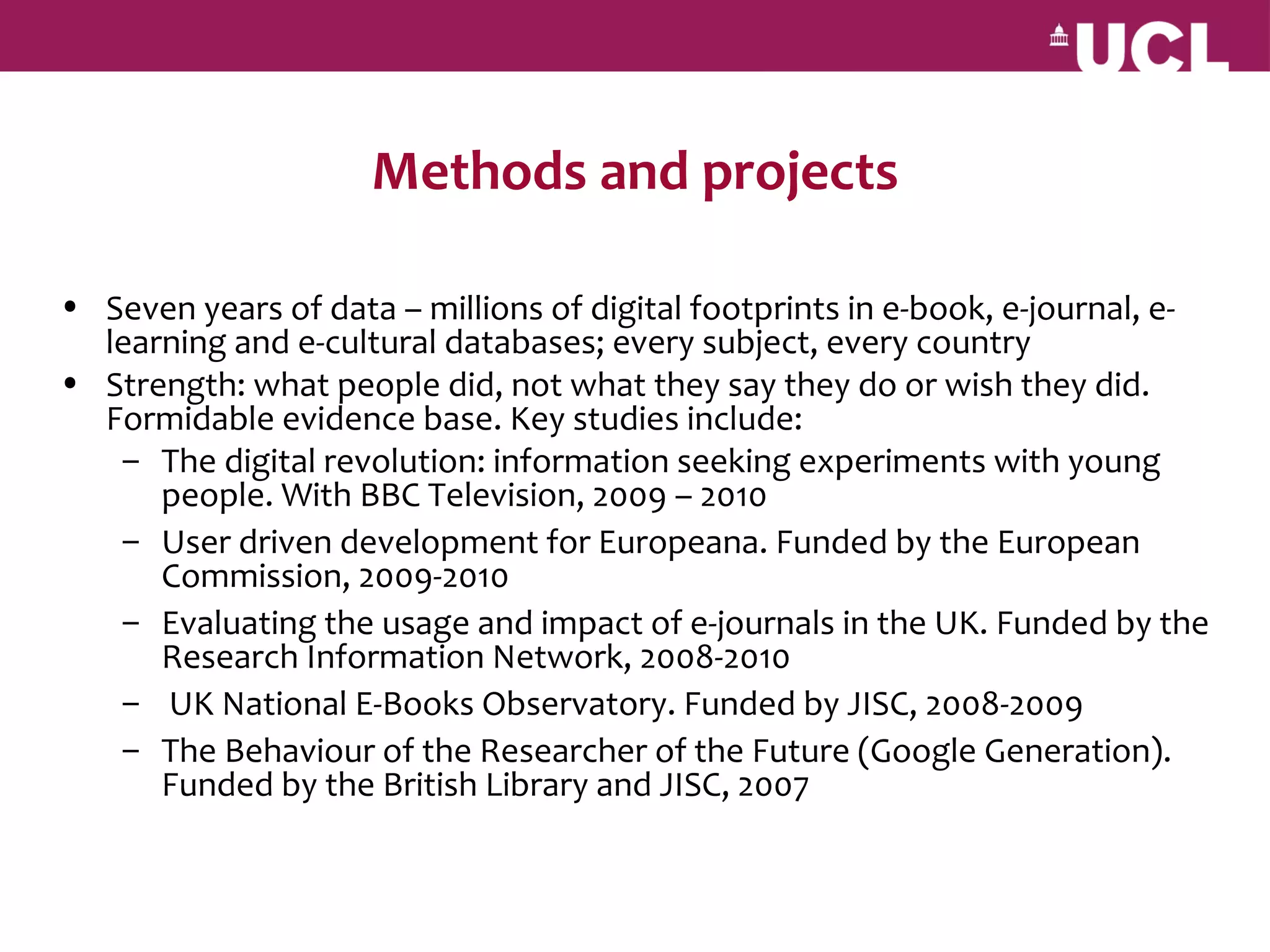
• Hence CIBER’s Virtual Scholar research
  programme
Methods and projects

• Seven years of data – millions of digital footprints in e-book, e-journal, e-
  learning and e-cultural databases; every subject, every country
• Strength: what people did, not what they say they do or wish they did.
  Formidable evidence base. Key studies include:
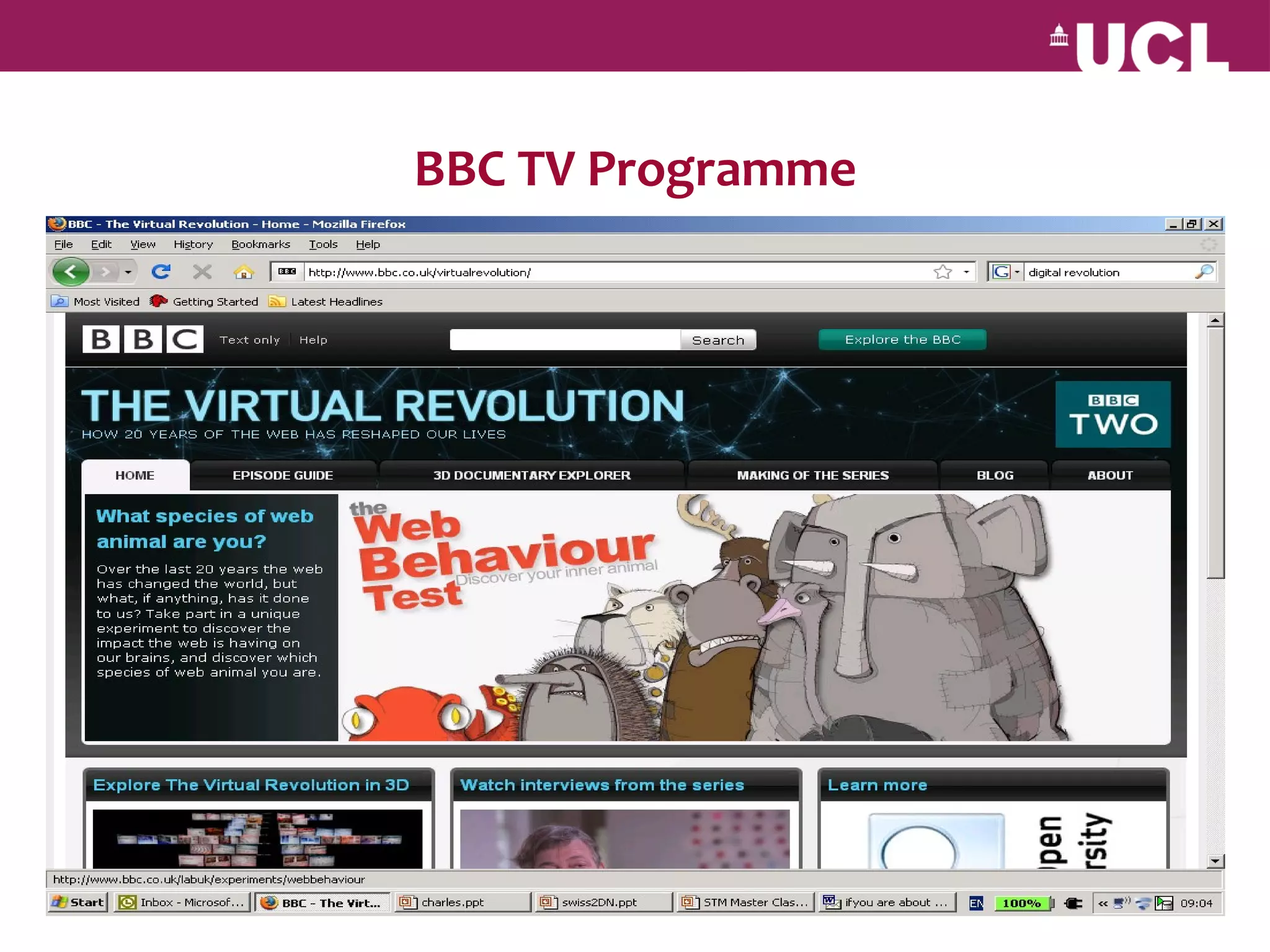
   – The digital revolution: information seeking experiments with young
      people. With BBC Television, 2009 – 2010
   – User driven development for Europeana. Funded by the European
      Commission, 2009-2010
   – Evaluating the usage and impact of e-journals in the UK. Funded by the
      Research Information Network, 2008-2010
   – UK National E-Books Observatory. Funded by JISC, 2008-2009
   – The Behaviour of the Researcher of the Future (Google Generation).
      Funded by the British Library and JISC, 2007
The Big finding

• Really only one finding and that is the digital has fundamentally
  changed us all – we are all the GoogleGeneration! We have all been
  conditioned
• You have heard of extreme sports, well we have all become
  extreme information seekers and young people, as with everything,
  are more extreme
• The really big difference is that young people know no other world
• What has to said at the outset is that we still do not know whether
  what we are seeing is simply a manifestation of age differences
  rather than generational differences
• Will now focus on the four aspects of digital information use and
  seeking which have the most significance for publishers
A. The horizontal has replaced the
              vertical
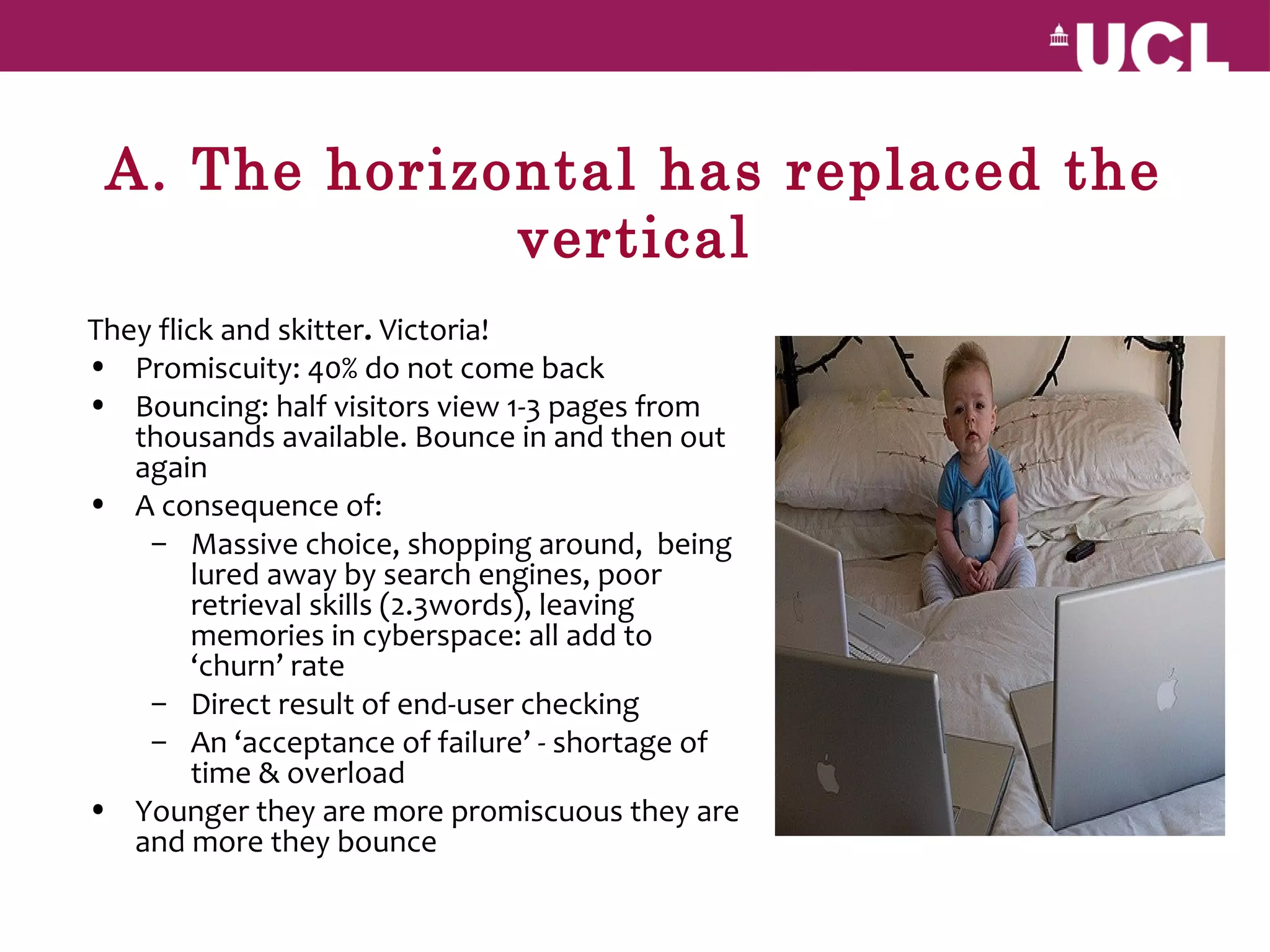
They flick and skitter. Victoria!
• Promiscuity: 40% do not come back
• Bouncing: half visitors view 1-3 pages from
   thousands available. Bounce in and then out
   again
• A consequence of:
    – Massive choice, shopping around, being
        lured away by search engines, poor
        retrieval skills (2.3words), leaving
        memories in cyberspace: all add to
        ‘churn’ rate
    – Direct result of end-user checking
    – An ‘acceptance of failure’ - shortage of
        time & overload
• Younger they are more promiscuous they are
   and more they bounce
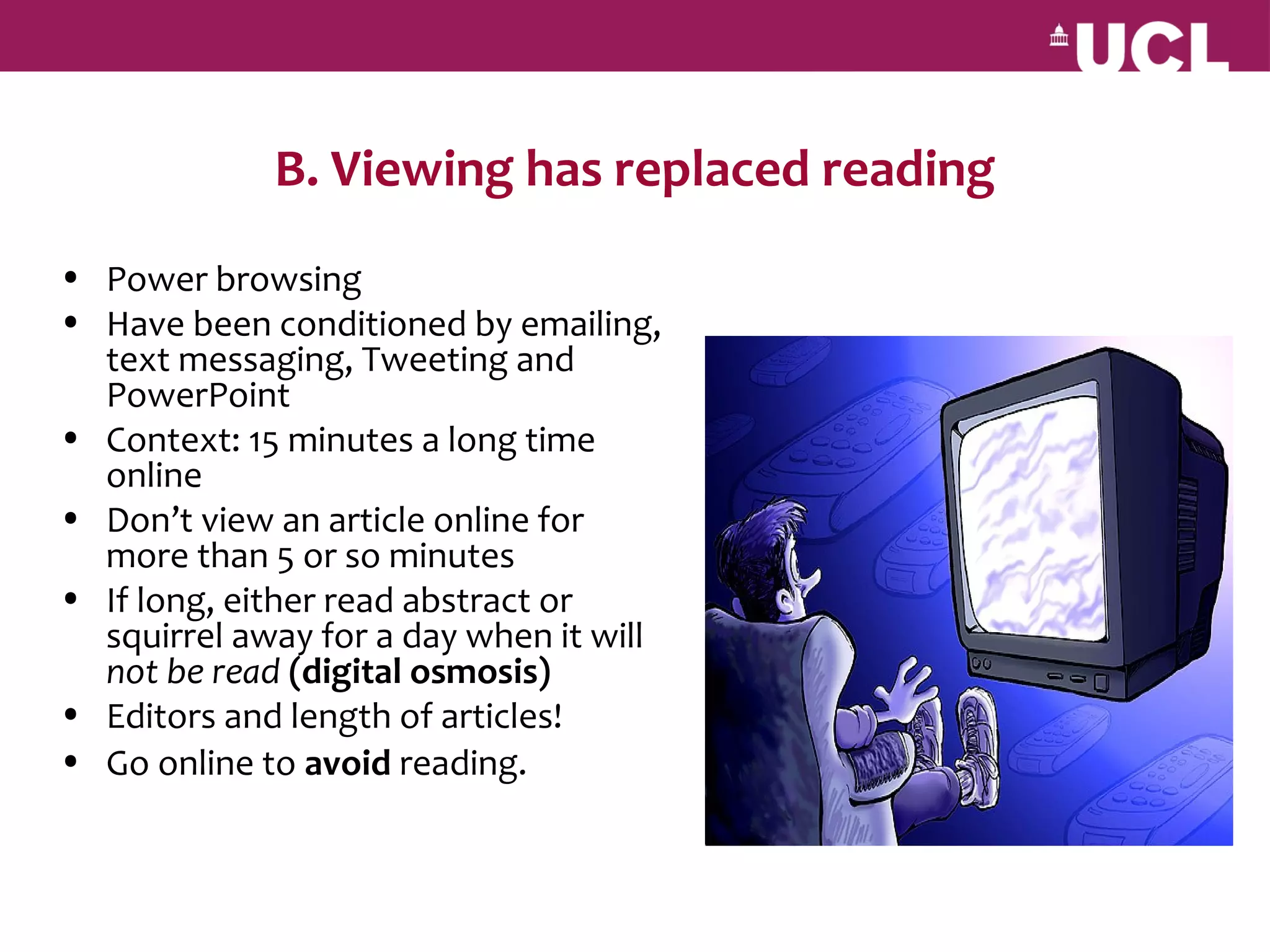
B. Viewing has replaced reading
• Power browsing
• Have been conditioned by emailing,
  text messaging, Tweeting and
  PowerPoint
• Context: 15 minutes a long time
  online
• Don’t view an article online for
  more than 5 or so minutes
• If long, either read abstract or
  squirrel away for a day when it will
  not be read (digital osmosis)
• Editors and length of articles!
• Go online to avoid reading.
Power browsing example

• I can update my knowledge very
  quickly…the sheer number of
  books is overwhelming, if I can
  look at them very quickly – you
  know within 15 mins, I can look
  at 3 or 4 books – and get some
  very superficial knowledge of
  what is in them, nevertheless it
  improves my scholarship, because
  in the back of my mind, these
  books already exist
C. They like it simple and fast

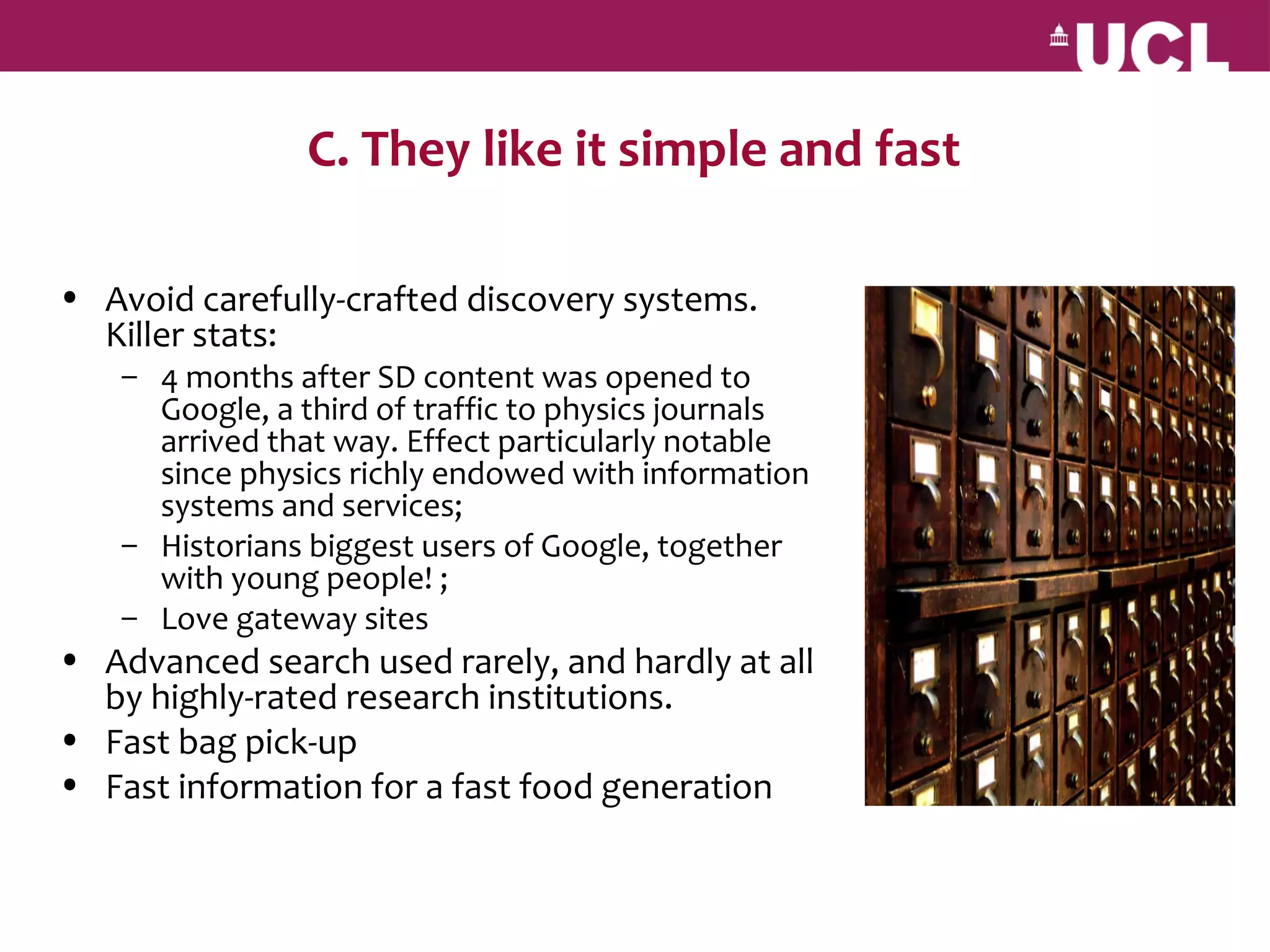
• Avoid carefully-crafted discovery systems.
  Killer stats:
    – 4 months after SD content was opened to
      Google, a third of traffic to physics journals
      arrived that way. Effect particularly notable
      since physics richly endowed with information
      systems and services;
    – Historians biggest users of Google, together
      with young people! ;
    – Love gateway sites
• Advanced search used rarely, and hardly at all
  by highly-rated research institutions.
• Fast bag pick-up
• Fast information for a fast food generation
D. Brand and authority is much more complicated


• Difficult in cyberspace:
  responsibility/authority almost
  impossible in a digital environment –
  so many players, so many brands, so
  much churn
• Also what you think is brand is not
  what other people think, especially
  what young people think. Wallmart!
Conclusions: GG V the rest

• Searches lighter.
   – View fewer pages, visit fewer sites and did fewer searches during a visit.
   – Spend much less time on each question, a fraction of that spent by older
      generations. Trend intensifies as questions become more ambiguous.
• Lazier, more direct searchers.
   – Their search statements were much closer textually to the question as
      given than older participants. Copy and paste OK!
• Less confident searchers
   – Don't have the evaluation skills to really know, hence they cut and run. Far
      less confident about judging the quality/relevance of what they find.
• Crowd source
   – Under 20s spend more time on social networking sites, are more regular
      users and rate them more importantly. Not kids but younger adults the
      biggest users
• Multi-tasking
   – Young adults the biggest but we don’t know that they are the best
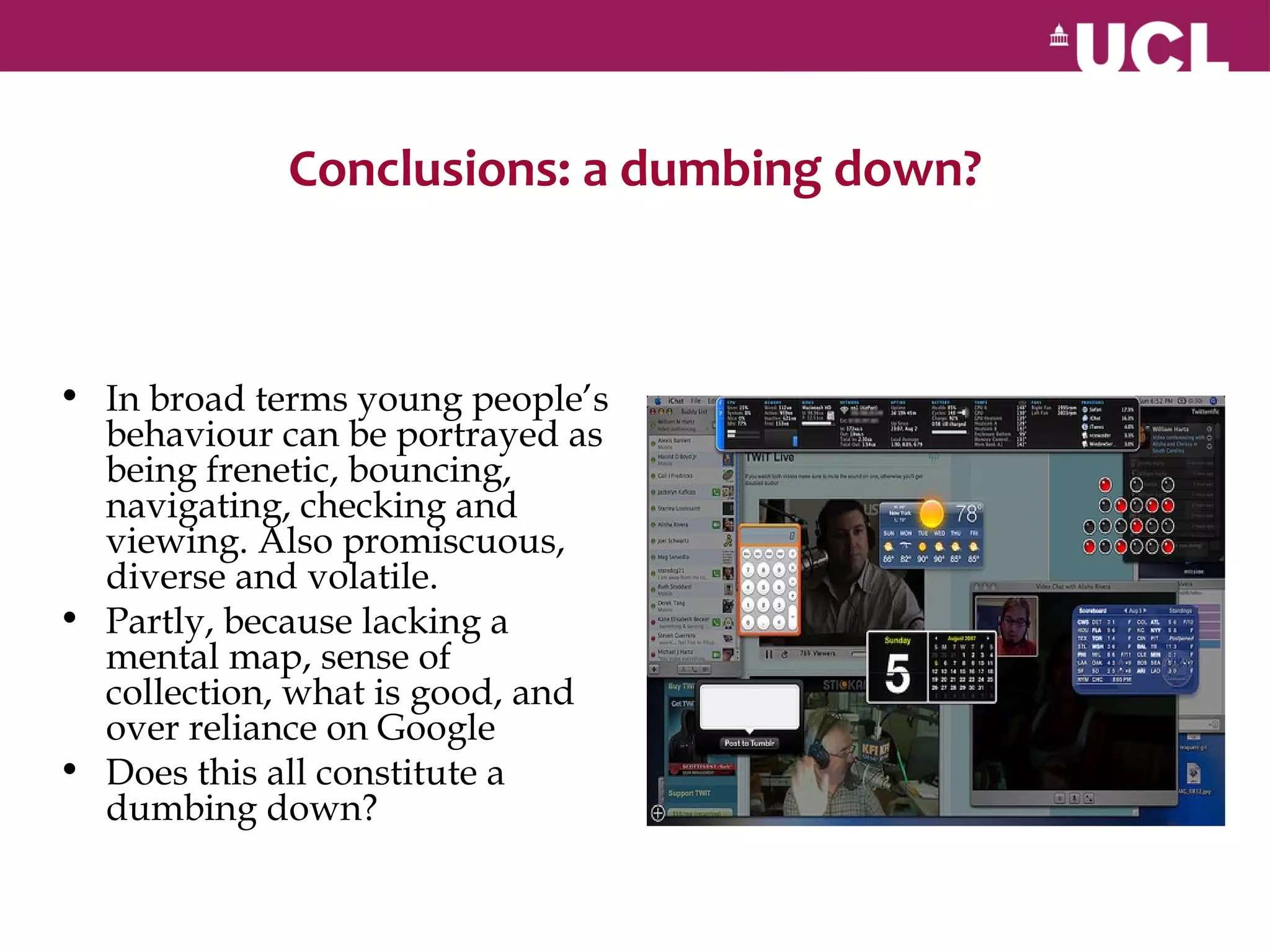
Conclusions: a dumbing down?


• In broad terms young people’s
  behaviour can be portrayed as
  being frenetic, bouncing,
  navigating, checking and
  viewing. Also promiscuous,
  diverse and volatile.
• Partly, because lacking a
  mental map, sense of
  collection, what is good, and
  over reliance on Google
• Does this all constitute a
  dumbing down?
Suggestions for publishers

Huge success story so far but no room for complacency

1.   Create immersive digital environments and ones you can
     speed across
2.   Access no longer an outcome; you need to demonstrate
     academic outcomes
3.   Monitor, monitor and monitor again the virtual
     environment, otherwise you will decouple from your
     consumer base
1a. ‘Immersive’ social information environments


• The students said something which threw us all initially - they could
  not understand why they had to do all the work in getting
  something from the website. At first this was attributed to laziness
  but it turned out not to be that. They felt the content was locked,
  submerged and they had to dig a lot to see it, when maybe the
  service could make some things available automatically – the data
  coming to them, rather than having to chase it.
• Returned book trolley! Come on guys wake up, stop chasing
  FaceBook the lessons to be learnt are in your own backyard
1b. Help power browse


• Shorten and structure articles; downloads not the
  gold standard; help people move fast or flick.
• Love abstracts make them more informative
• Elsevier doing interesting things here
2. Demonstrate academic and financial outcomes


• Better students, degrees, researchers, more funding etc
• Information literacy role –publishers the new librarians
• Cost-effectiveness – the car park question
3. Monitor, monitor and monitor


• User-driven revolution
• Dynamic - an Internet year just 7 weeks
• Digital concrete
Further information
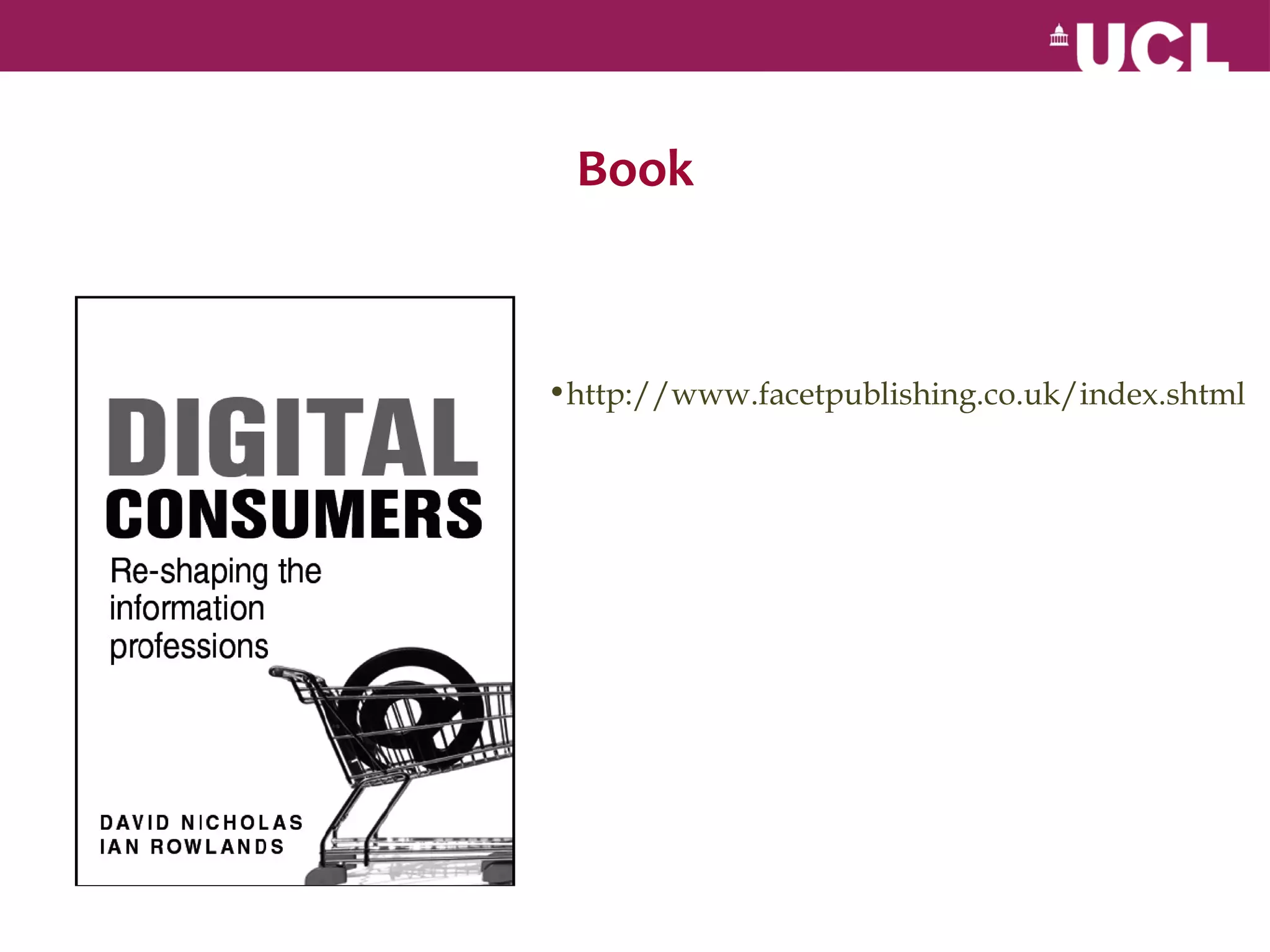
Book


•http://www.facetpublishing.co.uk/index.shtml
BBC TV Programme
CIBER website

326 nicholas web_seminar2010

  • 1.
    Understanding digital natives Professor David Nicholas CIBER UCL Centre for Publishing University College London http://www.ucl.ac.uk/infostudies/research/ciber/
  • 2.
    Background • Choice, digitaltransition, unbelievable access, Google & disintermediation transformed information landscape • Because so much information seeking goes on remotely and anonymously not woken up to this yet. Yet digital transition further to go: e-books • Badly need to visualise and conceptualise what is going on, especially in regard the young • Hence CIBER’s Virtual Scholar research programme
  • 3.
    Methods and projects •Seven years of data – millions of digital footprints in e-book, e-journal, e- learning and e-cultural databases; every subject, every country • Strength: what people did, not what they say they do or wish they did. Formidable evidence base. Key studies include: – The digital revolution: information seeking experiments with young people. With BBC Television, 2009 – 2010 – User driven development for Europeana. Funded by the European Commission, 2009-2010 – Evaluating the usage and impact of e-journals in the UK. Funded by the Research Information Network, 2008-2010 – UK National E-Books Observatory. Funded by JISC, 2008-2009 – The Behaviour of the Researcher of the Future (Google Generation). Funded by the British Library and JISC, 2007
  • 4.
    The Big finding •Really only one finding and that is the digital has fundamentally changed us all – we are all the GoogleGeneration! We have all been conditioned • You have heard of extreme sports, well we have all become extreme information seekers and young people, as with everything, are more extreme • The really big difference is that young people know no other world • What has to said at the outset is that we still do not know whether what we are seeing is simply a manifestation of age differences rather than generational differences • Will now focus on the four aspects of digital information use and seeking which have the most significance for publishers
  • 5.
    A. The horizontalhas replaced the vertical They flick and skitter. Victoria! • Promiscuity: 40% do not come back • Bouncing: half visitors view 1-3 pages from thousands available. Bounce in and then out again • A consequence of: – Massive choice, shopping around, being lured away by search engines, poor retrieval skills (2.3words), leaving memories in cyberspace: all add to ‘churn’ rate – Direct result of end-user checking – An ‘acceptance of failure’ - shortage of time & overload • Younger they are more promiscuous they are and more they bounce
  • 6.
    B. Viewing hasreplaced reading • Power browsing • Have been conditioned by emailing, text messaging, Tweeting and PowerPoint • Context: 15 minutes a long time online • Don’t view an article online for more than 5 or so minutes • If long, either read abstract or squirrel away for a day when it will not be read (digital osmosis) • Editors and length of articles! • Go online to avoid reading.
  • 7.
    Power browsing example •I can update my knowledge very quickly…the sheer number of books is overwhelming, if I can look at them very quickly – you know within 15 mins, I can look at 3 or 4 books – and get some very superficial knowledge of what is in them, nevertheless it improves my scholarship, because in the back of my mind, these books already exist
  • 8.
    C. They likeit simple and fast • Avoid carefully-crafted discovery systems. Killer stats: – 4 months after SD content was opened to Google, a third of traffic to physics journals arrived that way. Effect particularly notable since physics richly endowed with information systems and services; – Historians biggest users of Google, together with young people! ; – Love gateway sites • Advanced search used rarely, and hardly at all by highly-rated research institutions. • Fast bag pick-up • Fast information for a fast food generation
  • 9.
    D. Brand andauthority is much more complicated • Difficult in cyberspace: responsibility/authority almost impossible in a digital environment – so many players, so many brands, so much churn • Also what you think is brand is not what other people think, especially what young people think. Wallmart!
  • 10.
    Conclusions: GG Vthe rest • Searches lighter. – View fewer pages, visit fewer sites and did fewer searches during a visit. – Spend much less time on each question, a fraction of that spent by older generations. Trend intensifies as questions become more ambiguous. • Lazier, more direct searchers. – Their search statements were much closer textually to the question as given than older participants. Copy and paste OK! • Less confident searchers – Don't have the evaluation skills to really know, hence they cut and run. Far less confident about judging the quality/relevance of what they find. • Crowd source – Under 20s spend more time on social networking sites, are more regular users and rate them more importantly. Not kids but younger adults the biggest users • Multi-tasking – Young adults the biggest but we don’t know that they are the best
  • 11.
    Conclusions: a dumbingdown? • In broad terms young people’s behaviour can be portrayed as being frenetic, bouncing, navigating, checking and viewing. Also promiscuous, diverse and volatile. • Partly, because lacking a mental map, sense of collection, what is good, and over reliance on Google • Does this all constitute a dumbing down?
  • 12.
    Suggestions for publishers Hugesuccess story so far but no room for complacency 1. Create immersive digital environments and ones you can speed across 2. Access no longer an outcome; you need to demonstrate academic outcomes 3. Monitor, monitor and monitor again the virtual environment, otherwise you will decouple from your consumer base
  • 13.
    1a. ‘Immersive’ socialinformation environments • The students said something which threw us all initially - they could not understand why they had to do all the work in getting something from the website. At first this was attributed to laziness but it turned out not to be that. They felt the content was locked, submerged and they had to dig a lot to see it, when maybe the service could make some things available automatically – the data coming to them, rather than having to chase it. • Returned book trolley! Come on guys wake up, stop chasing FaceBook the lessons to be learnt are in your own backyard
  • 14.
    1b. Help powerbrowse • Shorten and structure articles; downloads not the gold standard; help people move fast or flick. • Love abstracts make them more informative • Elsevier doing interesting things here
  • 15.
    2. Demonstrate academicand financial outcomes • Better students, degrees, researchers, more funding etc • Information literacy role –publishers the new librarians • Cost-effectiveness – the car park question
  • 16.
    3. Monitor, monitorand monitor • User-driven revolution • Dynamic - an Internet year just 7 weeks • Digital concrete
  • 17.
  • 18.
  • 19.
  • 20.

Editor's Notes

  • #12 The study confirms what many are beginning to suspect: that the web is having a profound impact on how we conceptualise, seek, evaluate and use information. What Marshall McLuhan called 'the Gutenberg galaxy' - that universe of linear exposition, quiet contemplation, disciplined reading and study - is imploding, and we don't know if what will replace it will be better or worse. But at least you can find the Wikipedia entry for 'Gutenberg galaxy' in 0.34 seconds
  • #13 Access the driver. More people drawn into scholarly net (all scholars now) & existing users can search more freely & flexibly. Growth. I ncreasing: a) numbers of students; b) digitization of back numbers; c) impact of big deals; d) preference to have everything digital ; e) use of Course Management Systems for online reading lists with easy links to material and minimal effort for students to access; f) wireless/broadband; g) mobile devices Good news for publishers! But lots of ‘noise’, which unfortunately confused for satisfaction: majority of users robots and as for the humans – boy they are behave in interesting ways