1

INCOME TAXATION 6th Edition (BY: VALENCIA & ROXAS)
SUGGESTED ANSWERS

Chapter 1: General Principles
and Concepts of Taxation

CHAPTER 1

GENERAL PRINCIPLES AND CONCEPTS OF TAXATION
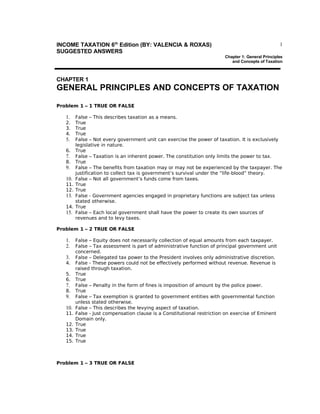
Problem 1 – 1 TRUE OR FALSE

1.

2.
3.
4.

5.
6.

7.

8.

9.

10.
11.
12.

13.
14.

15.

False – This describes taxation as a means.
True
True
True
False – Not every government unit can exercise the power of taxation. It is exclusively
legislative in nature.
True
False – Taxation is an inherent power. The constitution only limits the power to tax.
True
False – The benefits from taxation may or may not be experienced by the taxpayer. The
justification to collect tax is government’s survival under the “life-blood” theory.
False – Not all government’s funds come from taxes.
True
True
False - Government agencies engaged in proprietary functions are subject tax unless
stated otherwise.
True
False – Each local government shall have the power to create its own sources of
revenues and to levy taxes.

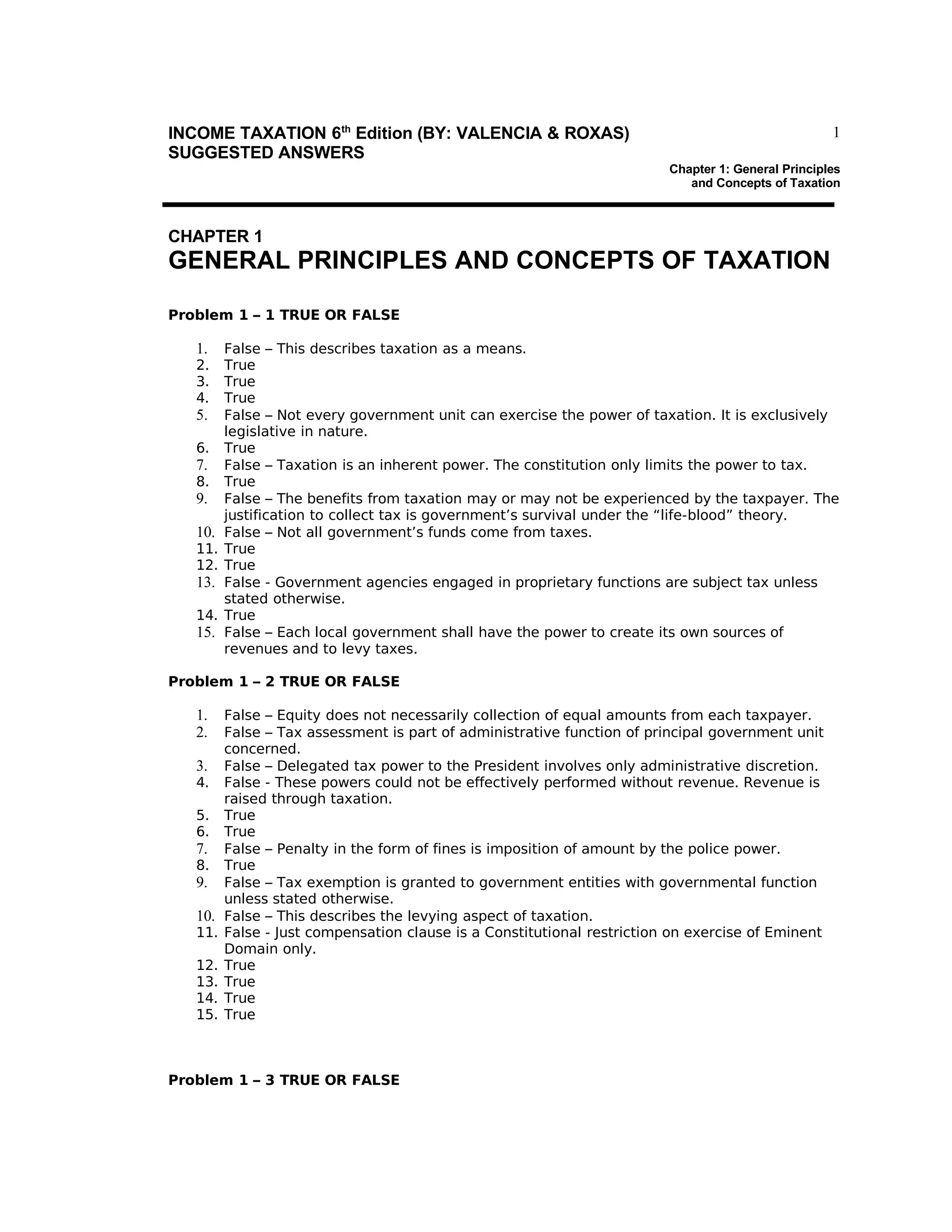
Problem 1 – 2 TRUE OR FALSE

1.
2.
3.
4.
5.
6.

7.

8.

9.
10.

11.
12.
13.
14.
15.

False – Equity does not necessarily collection of equal amounts from each taxpayer.
False – Tax assessment is part of administrative function of principal government unit
concerned.
False – Delegated tax power to the President involves only administrative discretion.
False - These powers could not be effectively performed without revenue. Revenue is
raised through taxation.
True
True
False – Penalty in the form of fines is imposition of amount by the police power.
True
False – Tax exemption is granted to government entities with governmental function
unless stated otherwise.
False – This describes the levying aspect of taxation.
False - Just compensation clause is a Constitutional restriction on exercise of Eminent
Domain only.
True
True
True
True

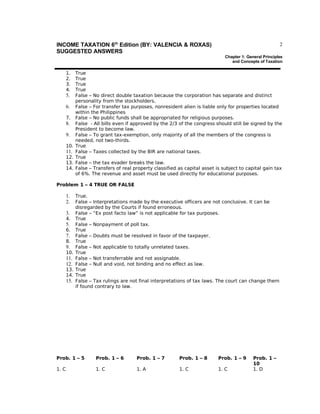
Problem 1 – 3 TRUE OR FALSE
2

INCOME TAXATION 6th Edition (BY: VALENCIA & ROXAS)
SUGGESTED ANSWERS

Chapter 1: General Principles
and Concepts of Taxation

1.
2.
3.
4.

5.
6.

7.

8.
9.
10.

11.

12.
13.
14.

True
True
True
True
False – No direct double taxation because the corporation has separate and distinct
personality from the stockholders.
False – For transfer tax purposes, nonresident alien is liable only for properties located
within the Philippines
False – No public funds shall be appropriated for religious purposes.
False - All bills even if approved by the 2/3 of the congress should still be signed by the
President to become law.
False – To grant tax-exemption, only majority of all the members of the congress is
needed, not two-thirds.
True
False – Taxes collected by the BIR are national taxes.
True
False – the tax evader breaks the law.
False – Transfers of real property classified as capital asset is subject to capital gain tax
of 6%. The revenue and asset must be used directly for educational purposes.

Problem 1 – 4 TRUE OR FALSE

1.
2.
3.

4.

5.

6.

7.

8.

9.

10.

11.
12.
13.
14.

15.

True.
False – Interpretations made by the executive officers are not conclusive. It can be
disregarded by the Courts if found erroneous.
False – “Ex post facto law” is not applicable for tax purposes.
True
False – Nonpayment of poll tax.
True
False – Doubts must be resolved in favor of the taxpayer.
True
False – Not applicable to totally unrelated taxes.
True
False – Not transferrable and not assignable.
False – Null and void, not binding and no effect as law.
True
True
False – Tax rulings are not final interpretations of tax laws. The court can change them
if found contrary to law.

Prob. 1 – 5

Prob. 1 – 6

Prob. 1 – 7

Prob. 1 – 8

Prob. 1 – 9

1. C

1. C

1. A

1. C

1. C

Prob. 1 –
10
1. D
3

INCOME TAXATION 6th Edition (BY: VALENCIA & ROXAS)
SUGGESTED ANSWERS

Chapter 1: General Principles
and Concepts of Taxation

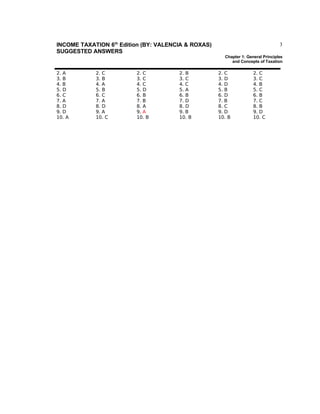
2. A
3. B
4. B
5. D
6. C
7. A
8. D
9. D
10. A

2. C
3. B
4. A
5. B
6. C
7. A
8. D
9. A
10. C

2. C
3. C
4. C
5. D
6. B
7. B
8. A
9. A
10. B

2. B
3. C
4. C
5. A
6. B
7. D
8. D
9. B
10. B

2. C
3. D
4. D
5. B
6. D
7. B
8. C
9. D
10. B

2. C
3. C
4. B
5. C
6. B
7. C
8. B
9. D
10. C

Income Taxation - Answer key (6th Edition by Valencia)- Chapter 1

  • 1.
    1 INCOME TAXATION 6thEdition (BY: VALENCIA & ROXAS) SUGGESTED ANSWERS Chapter 1: General Principles and Concepts of Taxation CHAPTER 1 GENERAL PRINCIPLES AND CONCEPTS OF TAXATION Problem 1 – 1 TRUE OR FALSE 1. 2. 3. 4. 5. 6. 7. 8. 9. 10. 11. 12. 13. 14. 15. False – This describes taxation as a means. True True True False – Not every government unit can exercise the power of taxation. It is exclusively legislative in nature. True False – Taxation is an inherent power. The constitution only limits the power to tax. True False – The benefits from taxation may or may not be experienced by the taxpayer. The justification to collect tax is government’s survival under the “life-blood” theory. False – Not all government’s funds come from taxes. True True False - Government agencies engaged in proprietary functions are subject tax unless stated otherwise. True False – Each local government shall have the power to create its own sources of revenues and to levy taxes. Problem 1 – 2 TRUE OR FALSE 1. 2. 3. 4. 5. 6. 7. 8. 9. 10. 11. 12. 13. 14. 15. False – Equity does not necessarily collection of equal amounts from each taxpayer. False – Tax assessment is part of administrative function of principal government unit concerned. False – Delegated tax power to the President involves only administrative discretion. False - These powers could not be effectively performed without revenue. Revenue is raised through taxation. True True False – Penalty in the form of fines is imposition of amount by the police power. True False – Tax exemption is granted to government entities with governmental function unless stated otherwise. False – This describes the levying aspect of taxation. False - Just compensation clause is a Constitutional restriction on exercise of Eminent Domain only. True True True True Problem 1 – 3 TRUE OR FALSE
  • 2.
    2 INCOME TAXATION 6thEdition (BY: VALENCIA & ROXAS) SUGGESTED ANSWERS Chapter 1: General Principles and Concepts of Taxation 1. 2. 3. 4. 5. 6. 7. 8. 9. 10. 11. 12. 13. 14. True True True True False – No direct double taxation because the corporation has separate and distinct personality from the stockholders. False – For transfer tax purposes, nonresident alien is liable only for properties located within the Philippines False – No public funds shall be appropriated for religious purposes. False - All bills even if approved by the 2/3 of the congress should still be signed by the President to become law. False – To grant tax-exemption, only majority of all the members of the congress is needed, not two-thirds. True False – Taxes collected by the BIR are national taxes. True False – the tax evader breaks the law. False – Transfers of real property classified as capital asset is subject to capital gain tax of 6%. The revenue and asset must be used directly for educational purposes. Problem 1 – 4 TRUE OR FALSE 1. 2. 3. 4. 5. 6. 7. 8. 9. 10. 11. 12. 13. 14. 15. True. False – Interpretations made by the executive officers are not conclusive. It can be disregarded by the Courts if found erroneous. False – “Ex post facto law” is not applicable for tax purposes. True False – Nonpayment of poll tax. True False – Doubts must be resolved in favor of the taxpayer. True False – Not applicable to totally unrelated taxes. True False – Not transferrable and not assignable. False – Null and void, not binding and no effect as law. True True False – Tax rulings are not final interpretations of tax laws. The court can change them if found contrary to law. Prob. 1 – 5 Prob. 1 – 6 Prob. 1 – 7 Prob. 1 – 8 Prob. 1 – 9 1. C 1. C 1. A 1. C 1. C Prob. 1 – 10 1. D
  • 3.
    3 INCOME TAXATION 6thEdition (BY: VALENCIA & ROXAS) SUGGESTED ANSWERS Chapter 1: General Principles and Concepts of Taxation 2. A 3. B 4. B 5. D 6. C 7. A 8. D 9. D 10. A 2. C 3. B 4. A 5. B 6. C 7. A 8. D 9. A 10. C 2. C 3. C 4. C 5. D 6. B 7. B 8. A 9. A 10. B 2. B 3. C 4. C 5. A 6. B 7. D 8. D 9. B 10. B 2. C 3. D 4. D 5. B 6. D 7. B 8. C 9. D 10. B 2. C 3. C 4. B 5. C 6. B 7. C 8. B 9. D 10. C