TAXATION OF MNCs – HEADING TOWARDS A
RESOLUTION
CA Jugal Gala
RESEARCH CREDITS
Deepika S
Gracelin Lita P
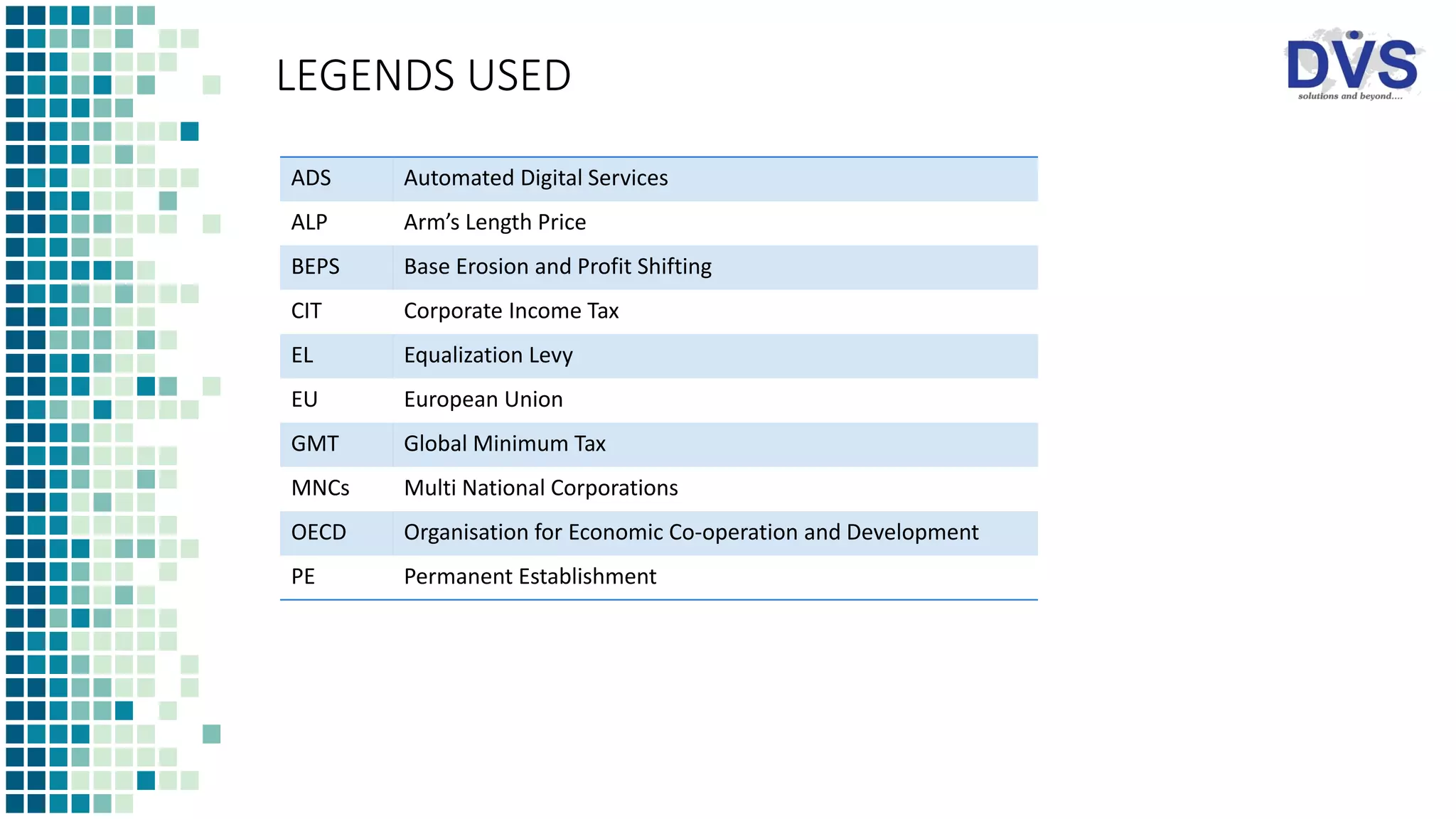
LEGENDS USED
ADS Automated Digital Services
ALP Arm’s Length Price
BEPS Base Erosion and Profit Shifting
CIT Corporate Income Tax
EL Equalization Levy
EU European Union
GMT Global Minimum Tax
MNCs Multi National Corporations
OECD Organisation for Economic Co-operation and Development
PE Permanent Establishment
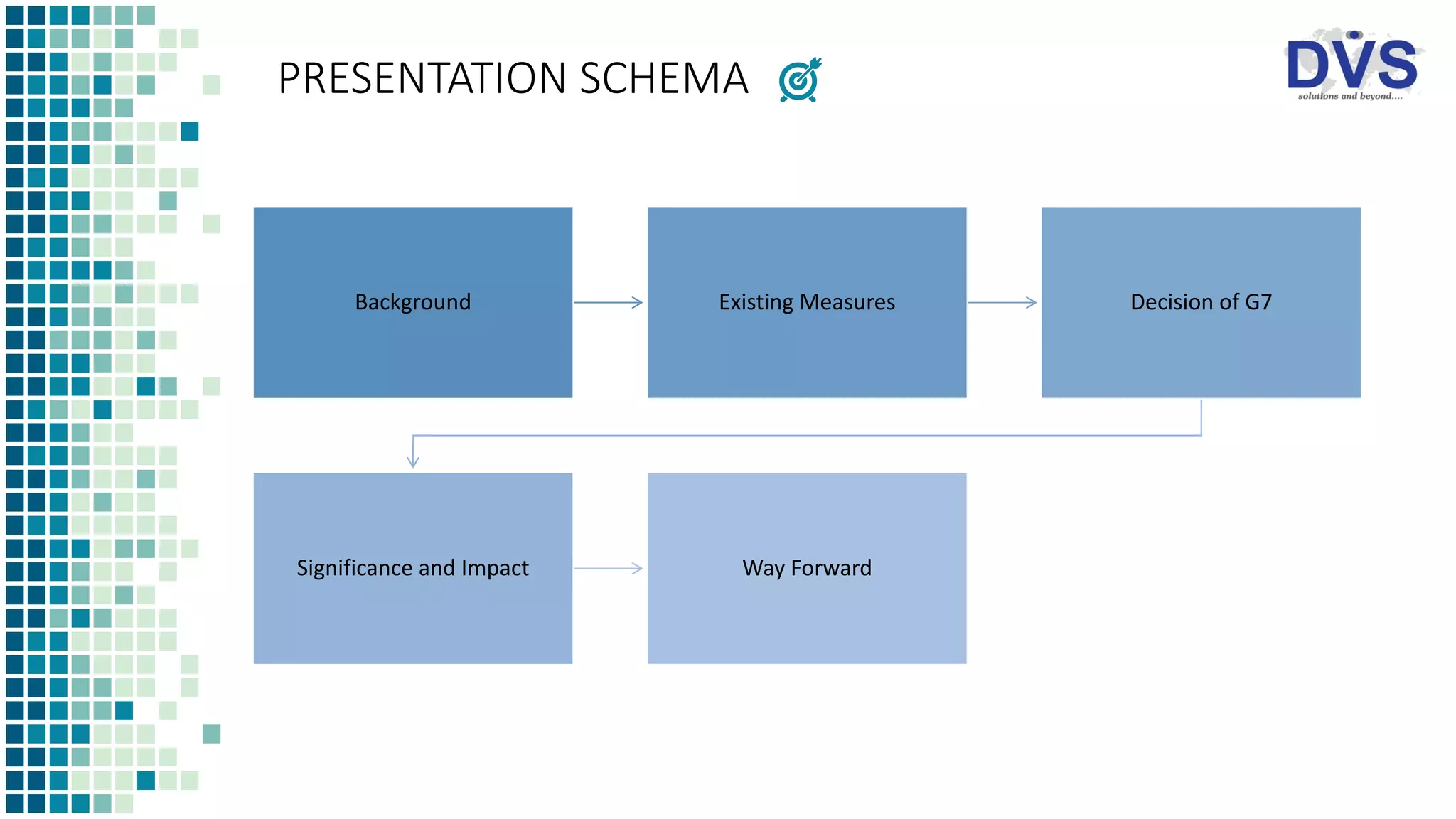
PRESENTATION SCHEMA
Background Existing Measures Decision of G7
Significance and Impact Way Forward
BACKGROUND
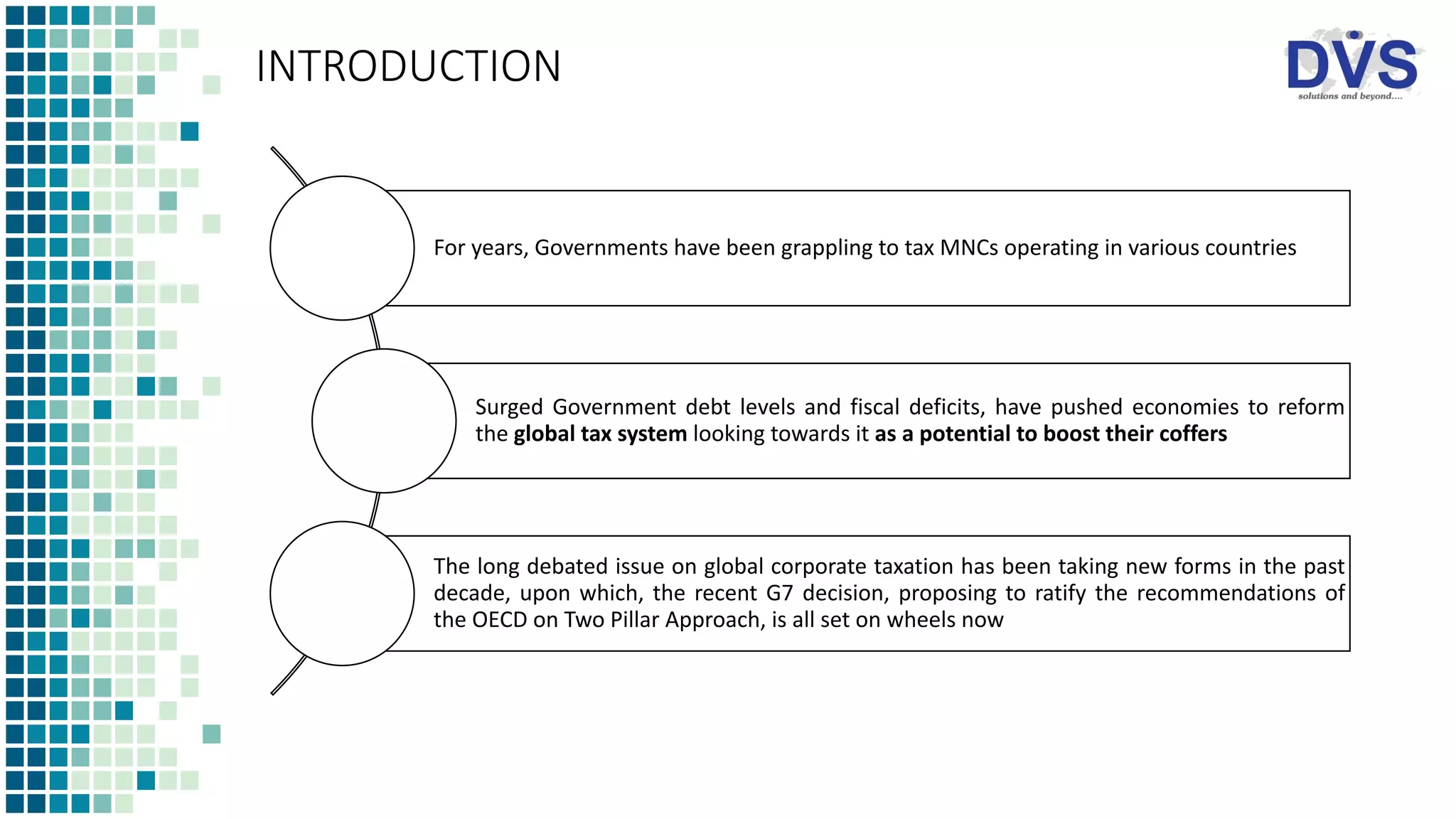
INTRODUCTION
For years, Governments have been grappling to tax MNCs operating in various countries
Surged Government debt levels and fiscal deficits, have pushed economies to reform
the global tax system looking towards it as a potential to boost their coffers
The long debated issue on global corporate taxation has been taking new forms in the past
decade, upon which, the recent G7 decision, proposing to ratify the recommendations of
the OECD on Two Pillar Approach, is all set on wheels now
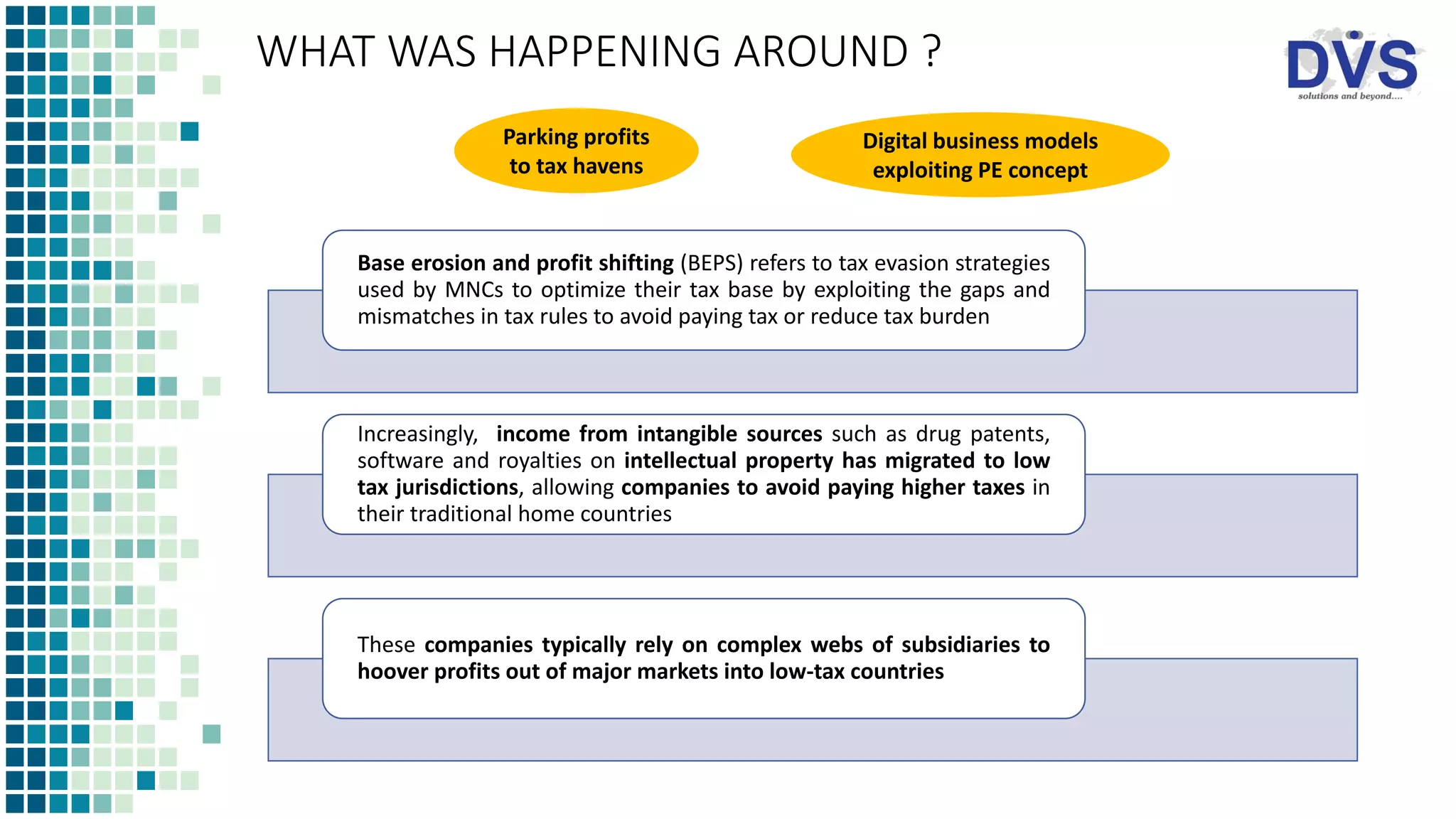
WHAT WAS HAPPENING AROUND ?
Base erosion and profit shifting (BEPS) refers to tax evasion strategies
used by MNCs to optimize their tax base by exploiting the gaps and
mismatches in tax rules to avoid paying tax or reduce tax burden
Increasingly, income from intangible sources such as drug patents,
software and royalties on intellectual property has migrated to low
tax jurisdictions, allowing companies to avoid paying higher taxes in
their traditional home countries
These companies typically rely on complex webs of subsidiaries to
hoover profits out of major markets into low-tax countries
Parking profits
to tax havens
Digital business models
exploiting PE concept
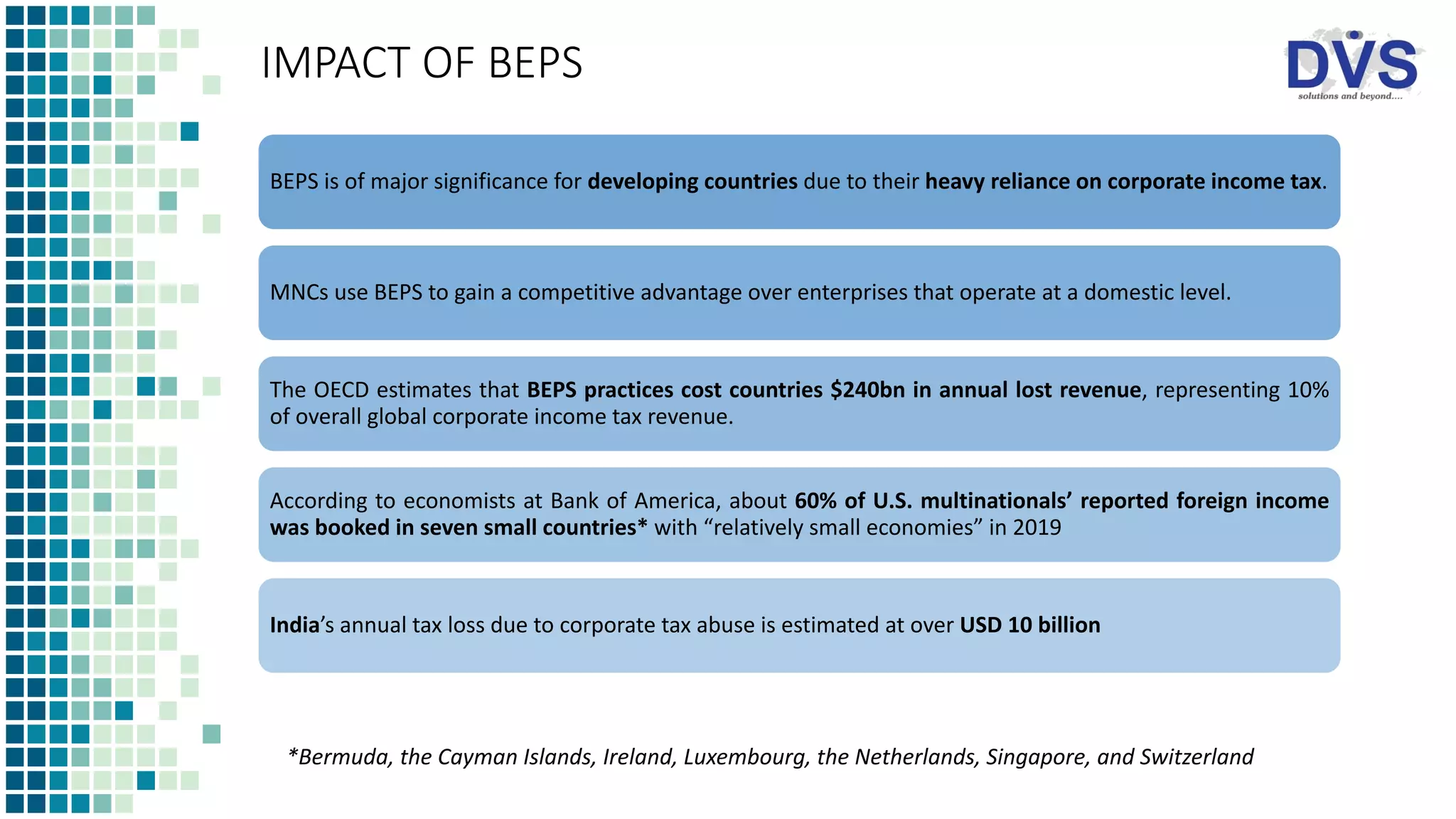
IMPACT OF BEPS
BEPS is of major significance for developing countries due to their heavy reliance on corporate income tax.
MNCs use BEPS to gain a competitive advantage over enterprises that operate at a domestic level.
The OECD estimates that BEPS practices cost countries $240bn in annual lost revenue, representing 10%
of overall global corporate income tax revenue.
According to economists at Bank of America, about 60% of U.S. multinationals’ reported foreign income
was booked in seven small countries* with “relatively small economies” in 2019
India’s annual tax loss due to corporate tax abuse is estimated at over USD 10 billion
*Bermuda, the Cayman Islands, Ireland, Luxembourg, the Netherlands, Singapore, and Switzerland
EXISTING MEASURES
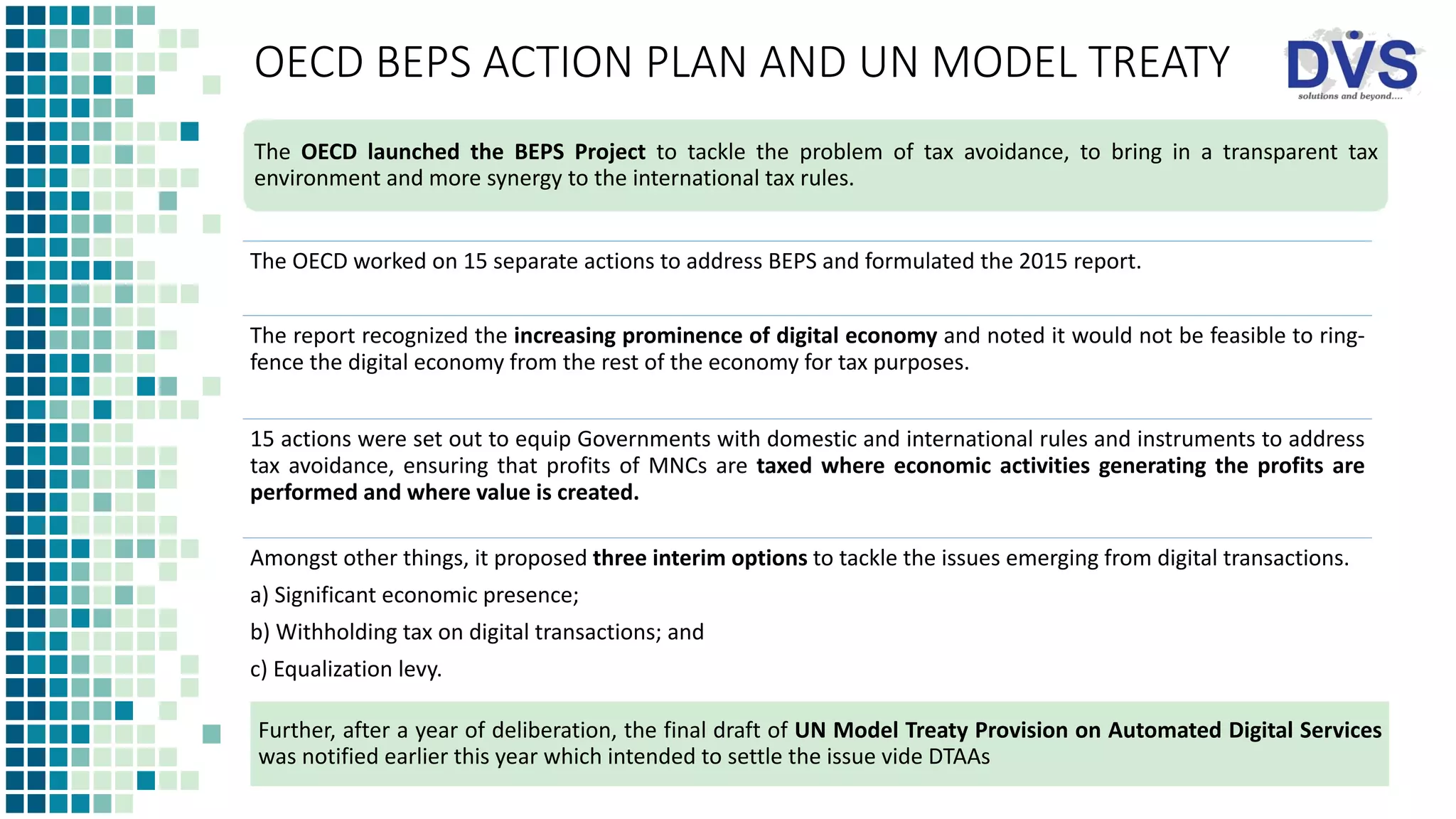
OECD BEPS ACTION PLAN AND UN MODEL TREATY
The OECD worked on 15 separate actions to address BEPS and formulated the 2015 report.
The report recognized the increasing prominence of digital economy and noted it would not be feasible to ring-
fence the digital economy from the rest of the economy for tax purposes.
15 actions were set out to equip Governments with domestic and international rules and instruments to address
tax avoidance, ensuring that profits of MNCs are taxed where economic activities generating the profits are
performed and where value is created.
Amongst other things, it proposed three interim options to tackle the issues emerging from digital transactions.
a) Significant economic presence;
b) Withholding tax on digital transactions; and
c) Equalization levy.
The OECD launched the BEPS Project to tackle the problem of tax avoidance, to bring in a transparent tax
environment and more synergy to the international tax rules.
Further, after a year of deliberation, the final draft of UN Model Treaty Provision on Automated Digital Services
was notified earlier this year which intended to settle the issue vide DTAAs
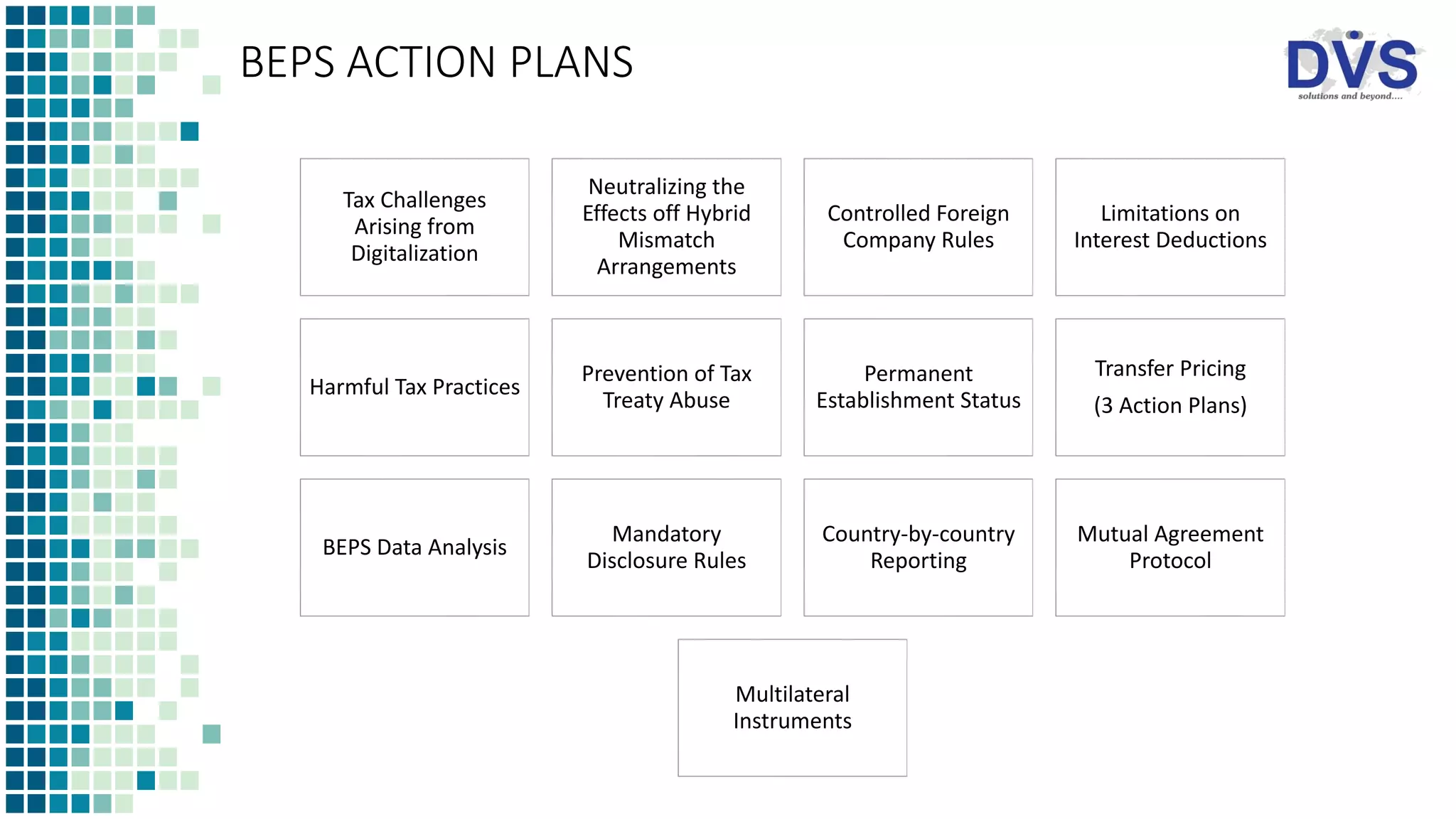
BEPS ACTION PLANS
Tax Challenges
Arising from
Digitalization
Neutralizing the
Effects off Hybrid
Mismatch
Arrangements
Controlled Foreign
Company Rules
Limitations on
Interest Deductions
Harmful Tax Practices
Prevention of Tax
Treaty Abuse
Permanent
Establishment Status
Transfer Pricing
(3 Action Plans)
BEPS Data Analysis
Mandatory
Disclosure Rules
Country-by-country
Reporting
Mutual Agreement
Protocol
Multilateral
Instruments
HOW COUNTRIES WERE RESPONDING
• In the recent past, countries including India, have implemented various measures such as interest
deductibility limits, Country-by-Country Reporting, etc. in accordance with OECD
recommendations
• Notably, novel policies have also been developed including equalisation levies and digital service
taxes alongside more common use of gross-based withholding taxes targeted at digital services
• However, such interim measures imposed by the developing countries such as India and few EU
countries like Italy, UK, Spain, etc. have fumed up the US Government contending that the same
was targeted against its homeland technogiants
DECISION OF G7
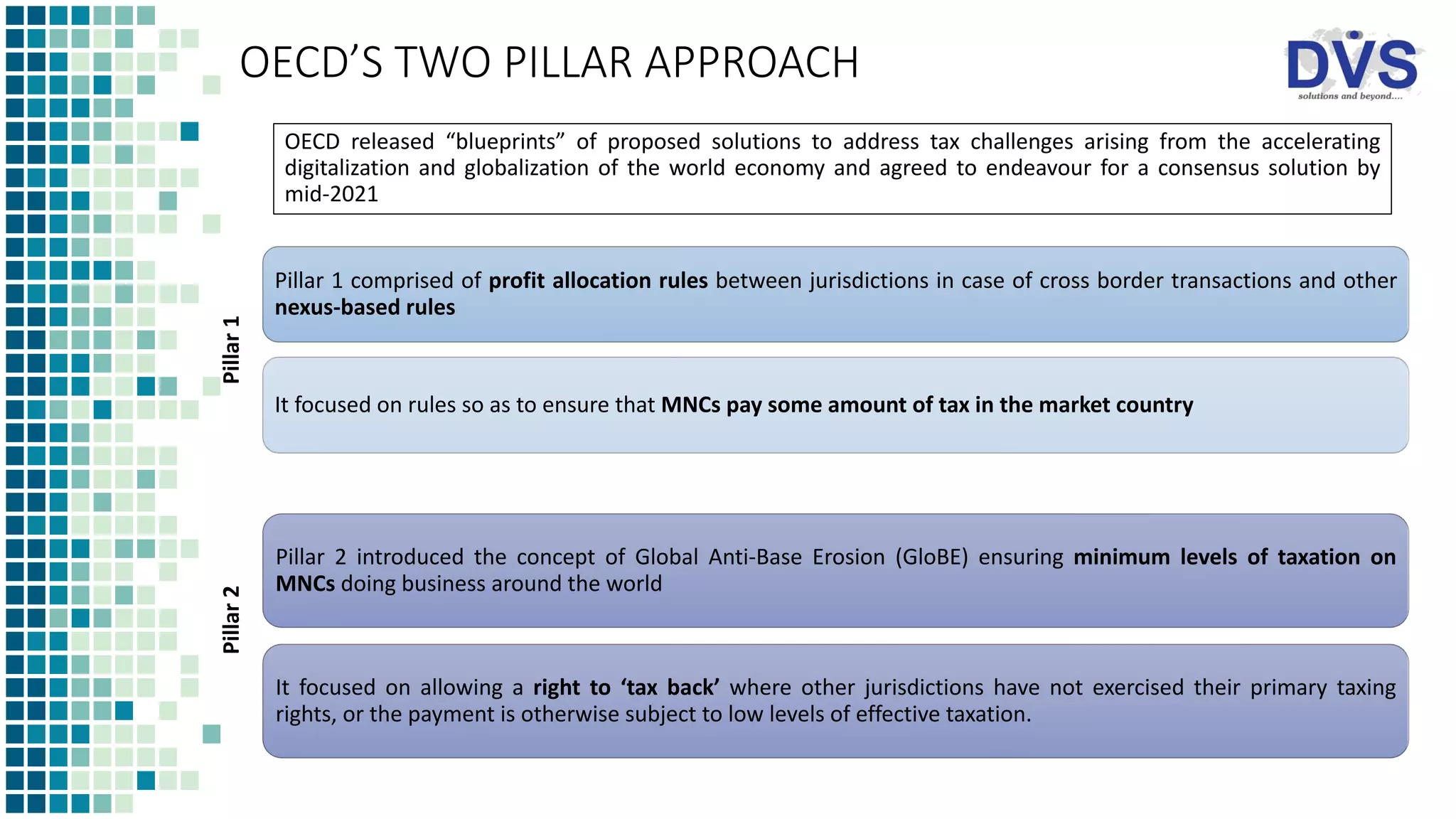
OECD’S TWO PILLAR APPROACH
Pillar 1 comprised of profit allocation rules between jurisdictions in case of cross border transactions and other
nexus-based rules
It focused on rules so as to ensure that MNCs pay some amount of tax in the market country
Pillar
1
Pillar 2 introduced the concept of Global Anti-Base Erosion (GloBE) ensuring minimum levels of taxation on
MNCs doing business around the world
It focused on allowing a right to ‘tax back’ where other jurisdictions have not exercised their primary taxing
rights, or the payment is otherwise subject to low levels of effective taxation.
Pillar
2
OECD released “blueprints” of proposed solutions to address tax challenges arising from the accelerating
digitalization and globalization of the world economy and agreed to endeavour for a consensus solution by
mid-2021
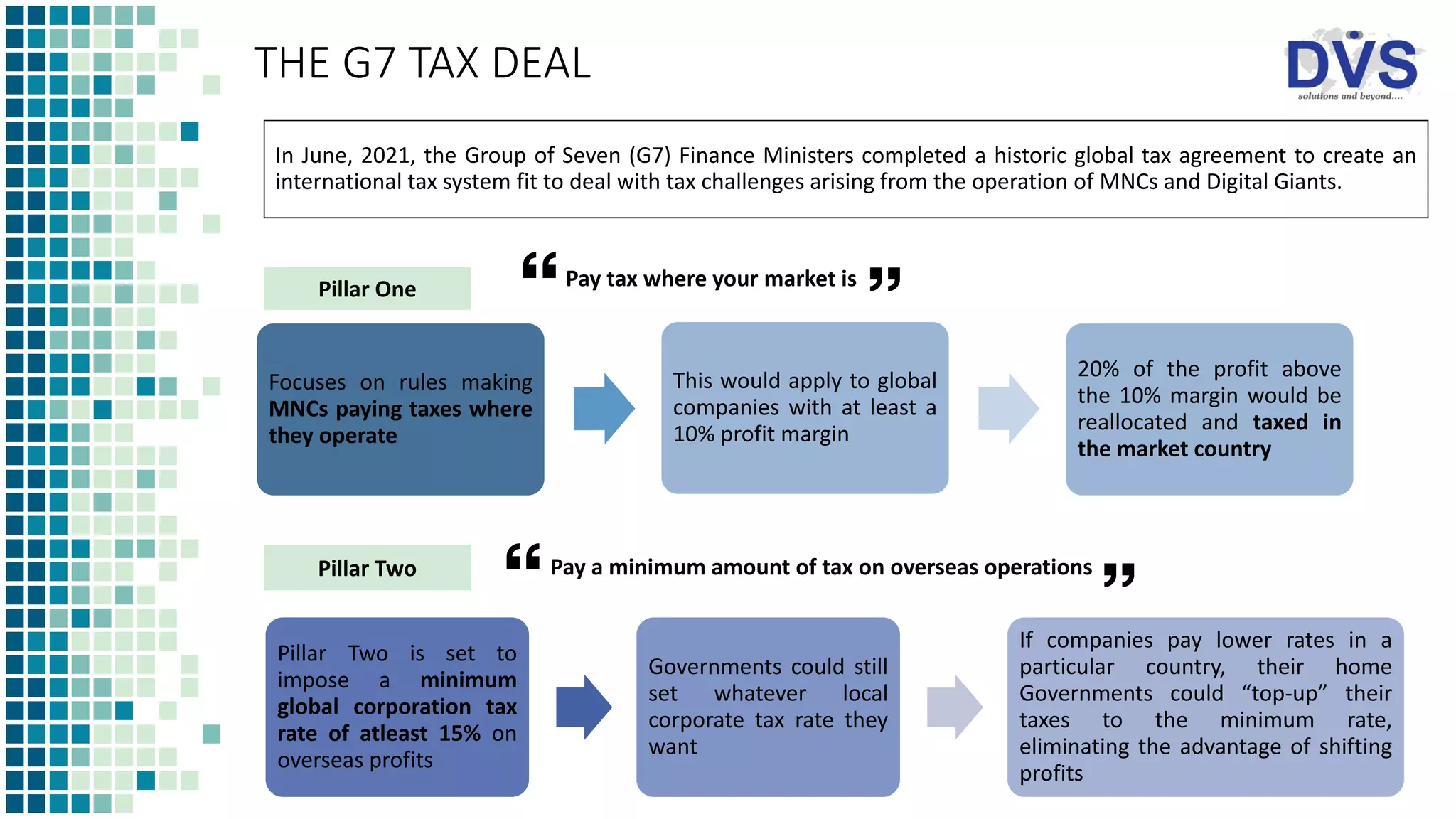
In June, 2021, the Group of Seven (G7) Finance Ministers completed a historic global tax agreement to create an
international tax system fit to deal with tax challenges arising from the operation of MNCs and Digital Giants.
THE G7 TAX DEAL
Pillar One
Focuses on rules making
MNCs paying taxes where
they operate
This would apply to global
companies with at least a
10% profit margin
20% of the profit above
the 10% margin would be
reallocated and taxed in
the market country
Pillar Two
Pillar Two is set to
impose a minimum
global corporation tax
rate of atleast 15% on
overseas profits
Governments could still
set whatever local
corporate tax rate they
want
If companies pay lower rates in a
particular country, their home
Governments could “top-up” their
taxes to the minimum rate,
eliminating the advantage of shifting
profits
Pay tax where your market is
Pay a minimum amount of tax on overseas operations
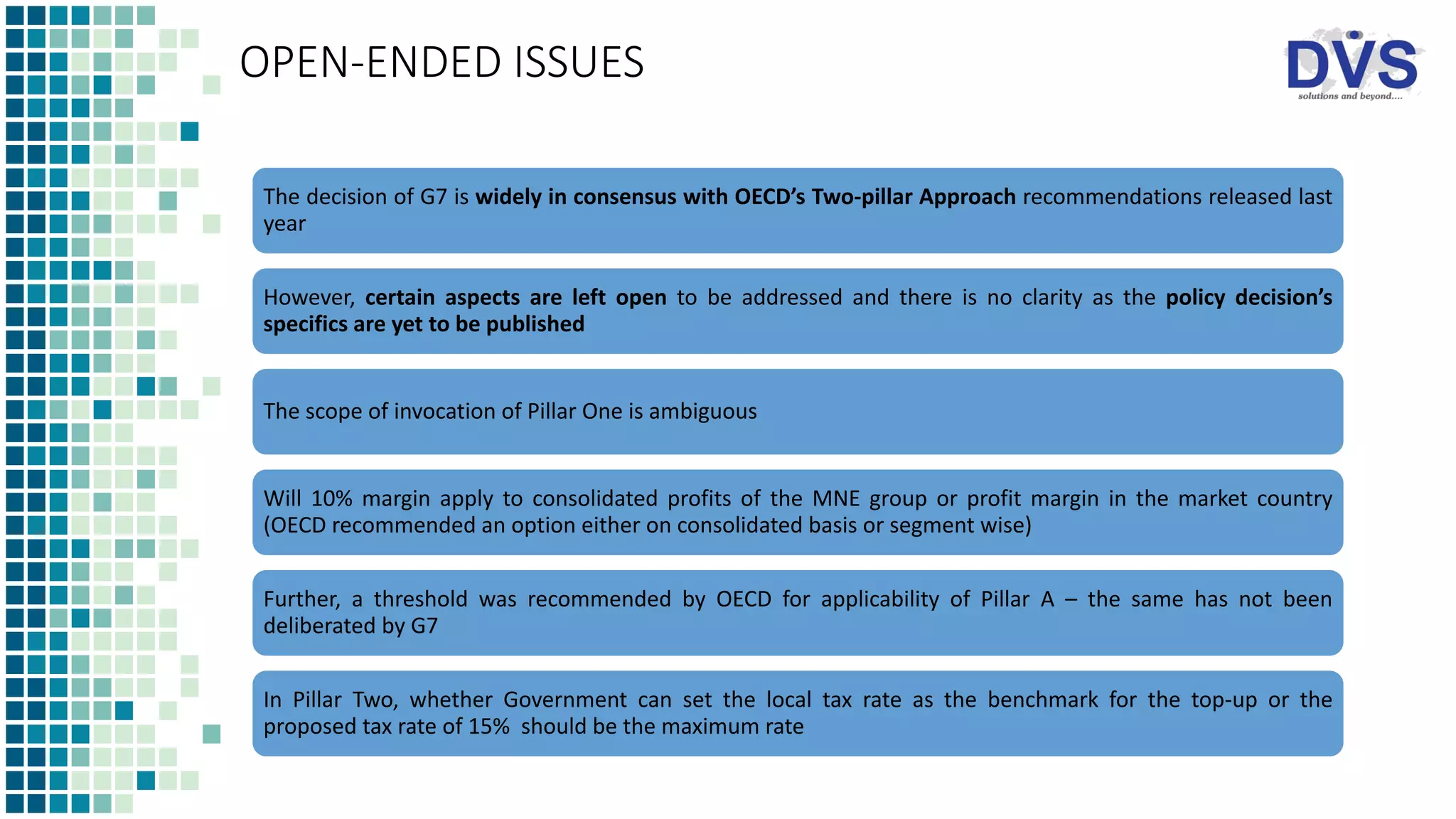
OPEN-ENDED ISSUES
The decision of G7 is widely in consensus with OECD’s Two-pillar Approach recommendations released last
year
However, certain aspects are left open to be addressed and there is no clarity as the policy decision’s
specifics are yet to be published
The scope of invocation of Pillar One is ambiguous
Will 10% margin apply to consolidated profits of the MNE group or profit margin in the market country
(OECD recommended an option either on consolidated basis or segment wise)
Further, a threshold was recommended by OECD for applicability of Pillar A – the same has not been
deliberated by G7
In Pillar Two, whether Government can set the local tax rate as the benchmark for the top-up or the
proposed tax rate of 15% should be the maximum rate
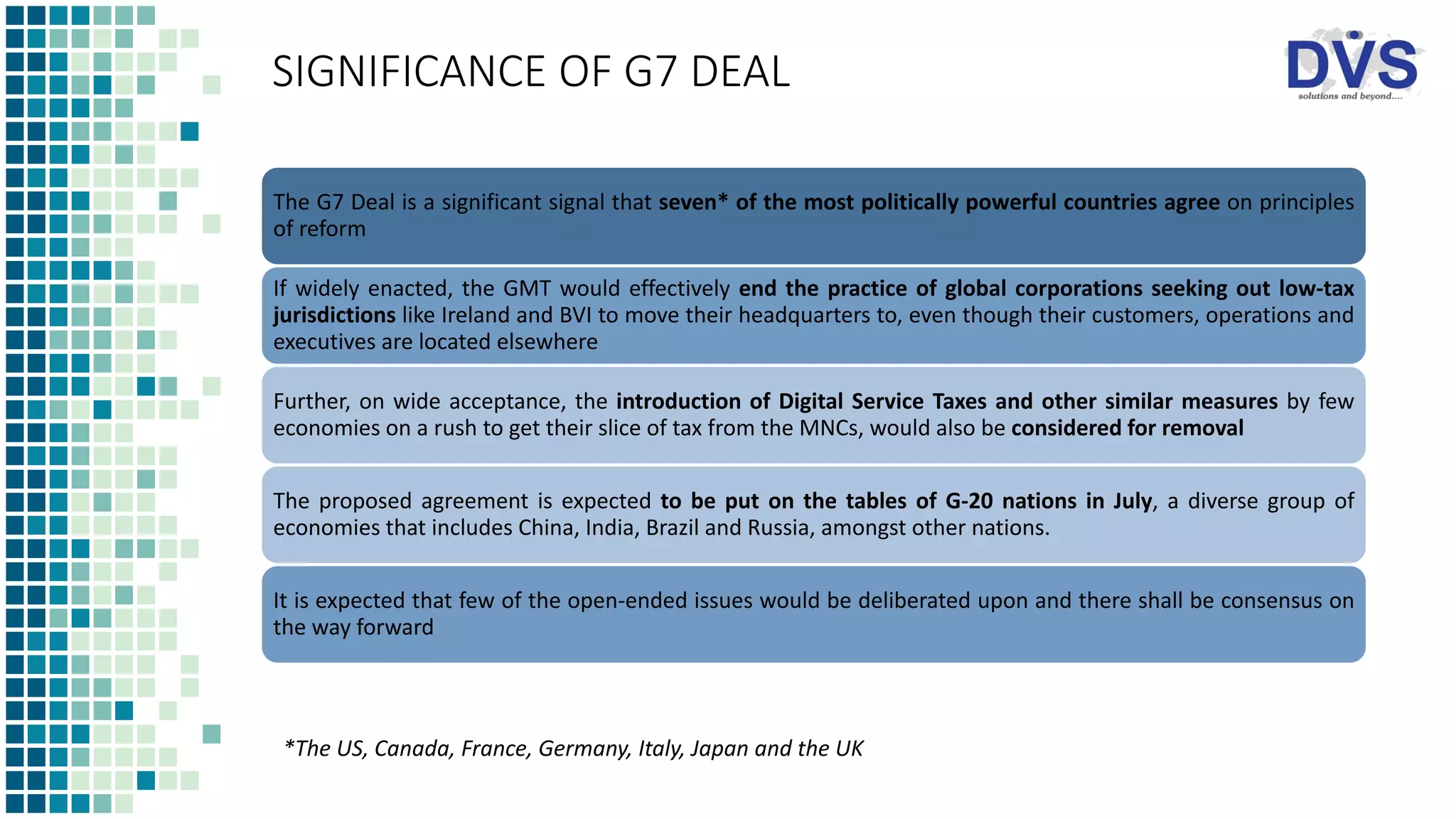
SIGNIFICANCE OF G7 DEAL
The G7 Deal is a significant signal that seven* of the most politically powerful countries agree on principles
of reform
If widely enacted, the GMT would effectively end the practice of global corporations seeking out low-tax
jurisdictions like Ireland and BVI to move their headquarters to, even though their customers, operations and
executives are located elsewhere
Further, on wide acceptance, the introduction of Digital Service Taxes and other similar measures by few
economies on a rush to get their slice of tax from the MNCs, would also be considered for removal
The proposed agreement is expected to be put on the tables of G-20 nations in July, a diverse group of
economies that includes China, India, Brazil and Russia, amongst other nations.
It is expected that few of the open-ended issues would be deliberated upon and there shall be consensus on
the way forward
*The US, Canada, France, Germany, Italy, Japan and the UK
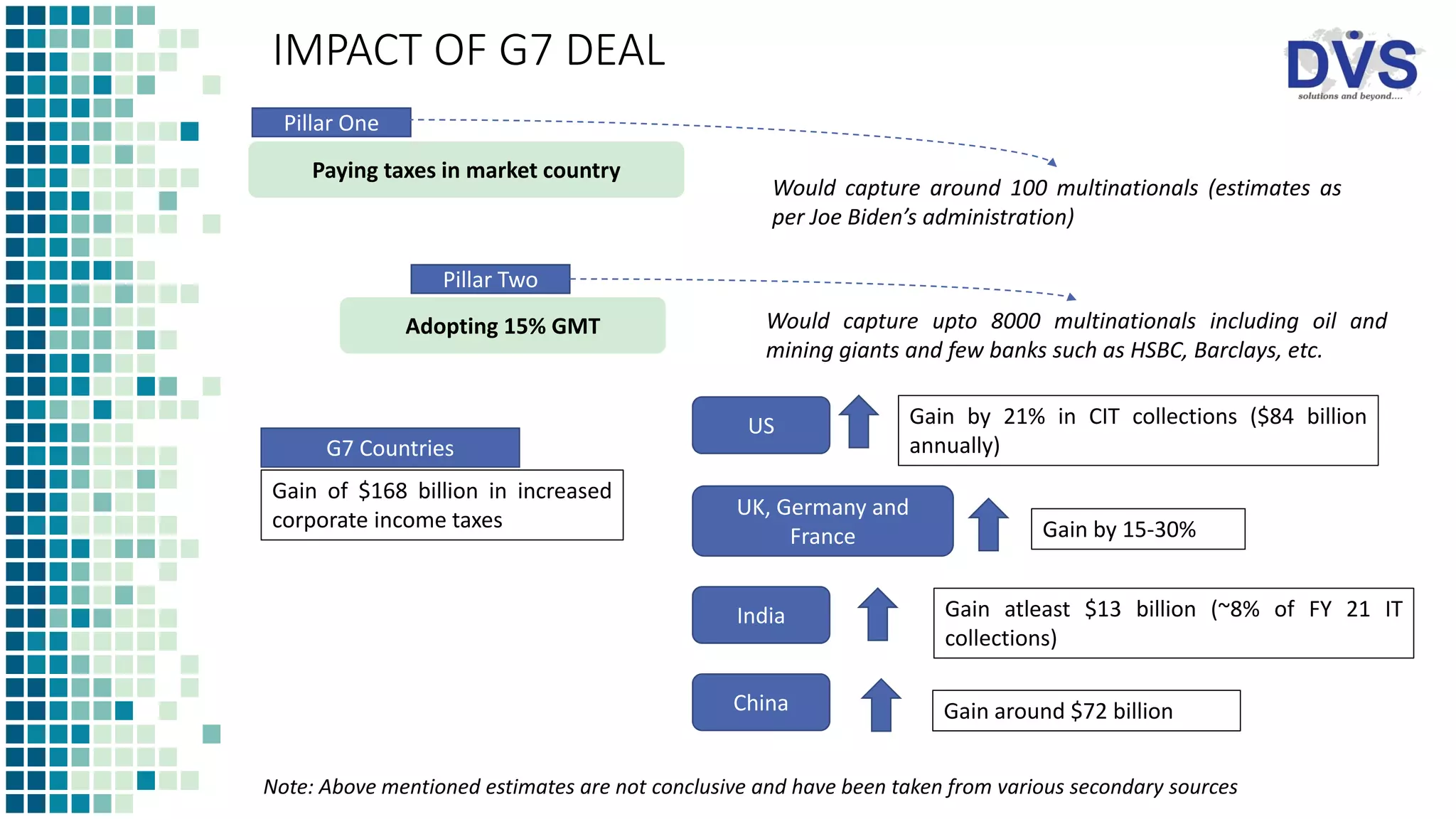
IMPACT OF G7 DEAL
Adopting 15% GMT
G7 Countries
Gain of $168 billion in increased
corporate income taxes
Pillar Two
US
UK, Germany and
France
India
Gain by 21% in CIT collections ($84 billion
annually)
Gain by 15-30%
China
Gain atleast $13 billion (~8% of FY 21 IT
collections)
Would capture upto 8000 multinationals including oil and
mining giants and few banks such as HSBC, Barclays, etc.
Note: Above mentioned estimates are not conclusive and have been taken from various secondary sources
Pillar One
Paying taxes in market country
Would capture around 100 multinationals (estimates as
per Joe Biden’s administration)
Gain around $72 billion
ECONOMIES WHO WILL FEEL THE PINCH
▪ Estimates place that at least $81 Billion in additional tax revenues each year would be raised under the
reforms.
▪Pillar one would bring in between $5bn and $12bn to G7 Countries.
▪Pillar two, the global minimum rate, would collect between $42bn and $70bn.
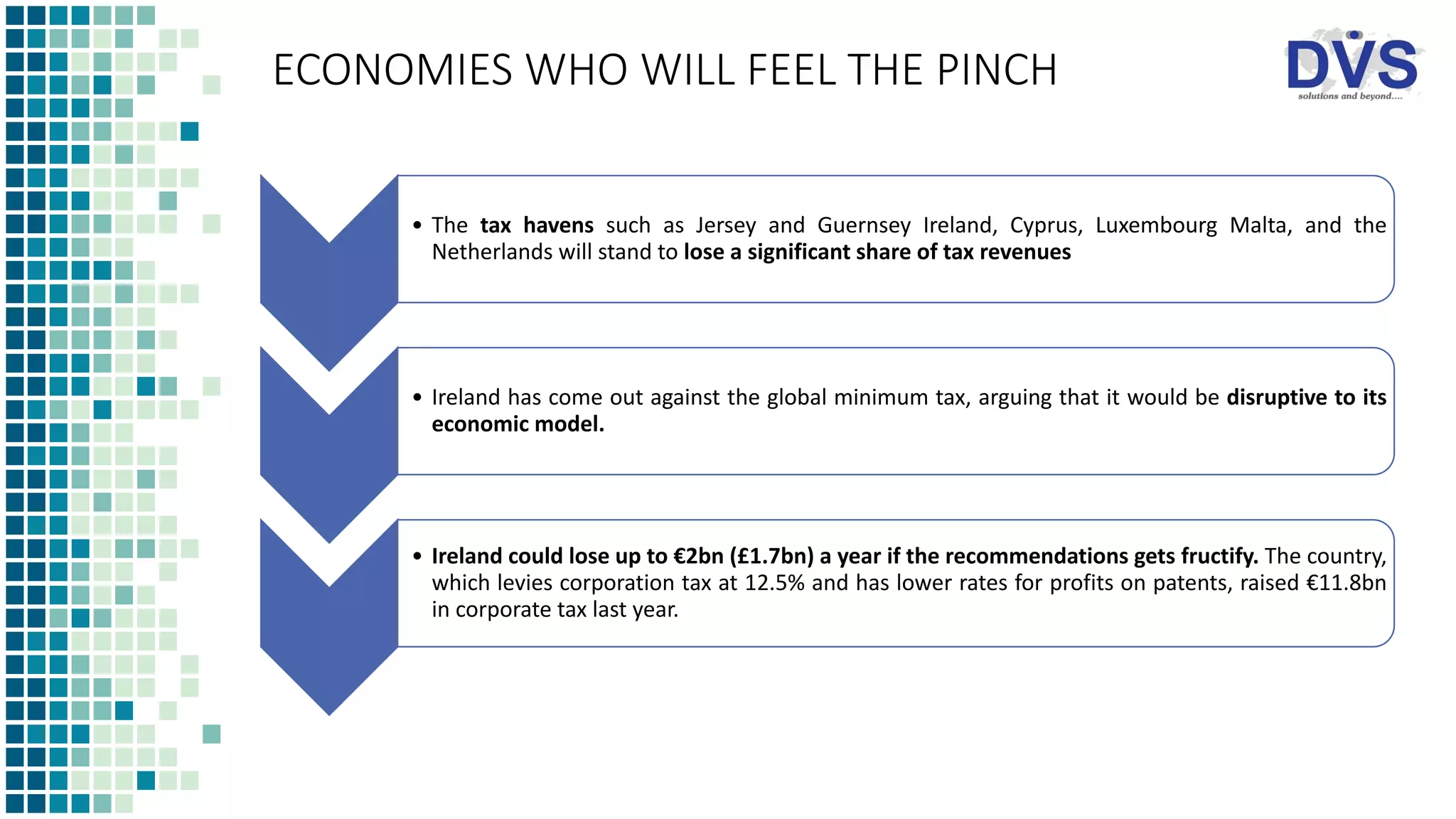
• The tax havens such as Jersey and Guernsey Ireland, Cyprus, Luxembourg Malta, and the
Netherlands will stand to lose a significant share of tax revenues
• Ireland has come out against the global minimum tax, arguing that it would be disruptive to its
economic model.
• Ireland could lose up to €2bn (£1.7bn) a year if the recommendations gets fructify. The country,
which levies corporation tax at 12.5% and has lower rates for profits on patents, raised €11.8bn
in corporate tax last year.
POSSIBLE IMPACT ON INDIA
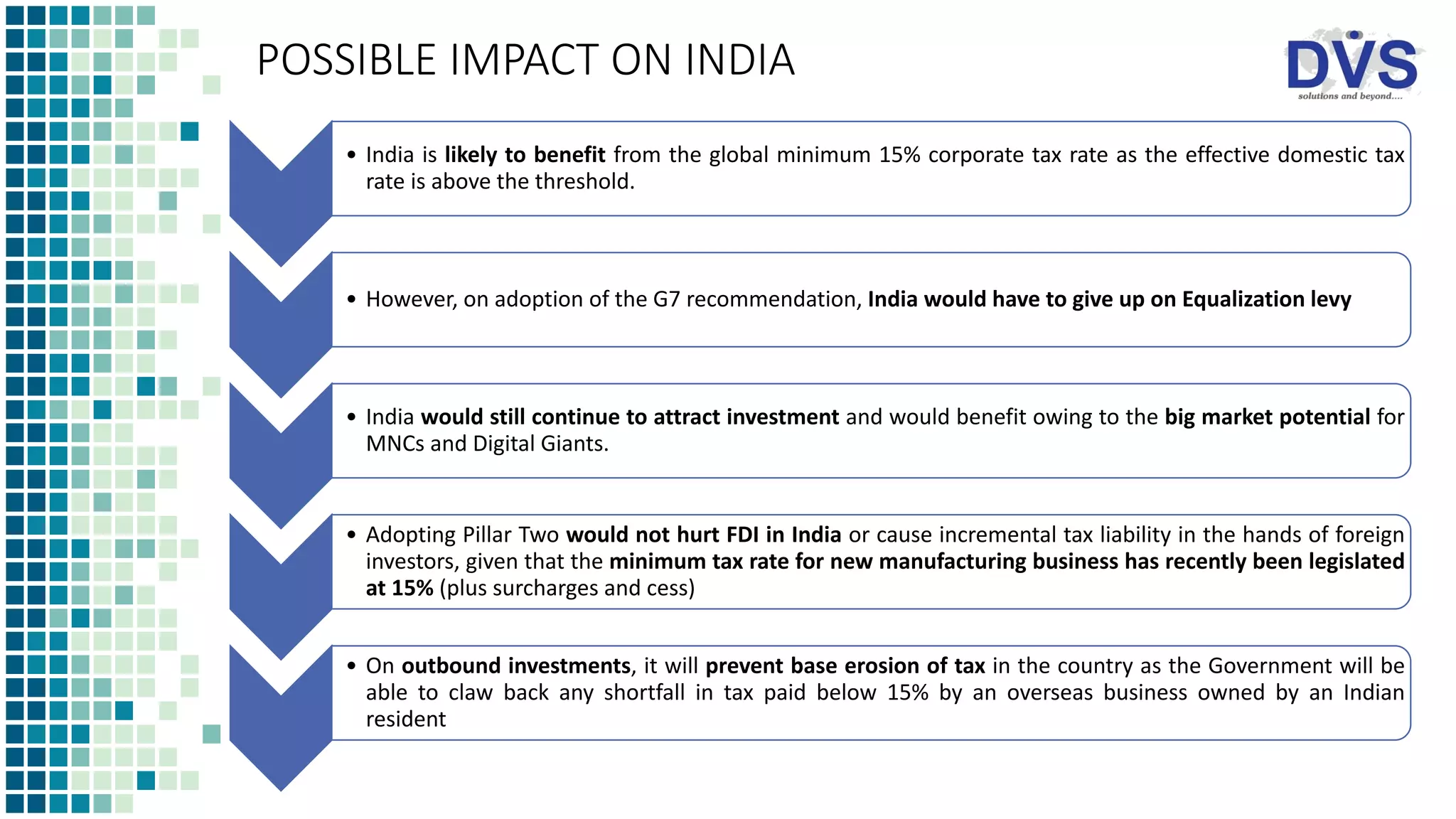
• India is likely to benefit from the global minimum 15% corporate tax rate as the effective domestic tax
rate is above the threshold.
• However, on adoption of the G7 recommendation, India would have to give up on Equalization levy
• India would still continue to attract investment and would benefit owing to the big market potential for
MNCs and Digital Giants.
• Adopting Pillar Two would not hurt FDI in India or cause incremental tax liability in the hands of foreign
investors, given that the minimum tax rate for new manufacturing business has recently been legislated
at 15% (plus surcharges and cess)
• On outbound investments, it will prevent base erosion of tax in the country as the Government will be
able to claw back any shortfall in tax paid below 15% by an overseas business owned by an Indian
resident
ISSUES AND CHALLENGES TALKED OVER
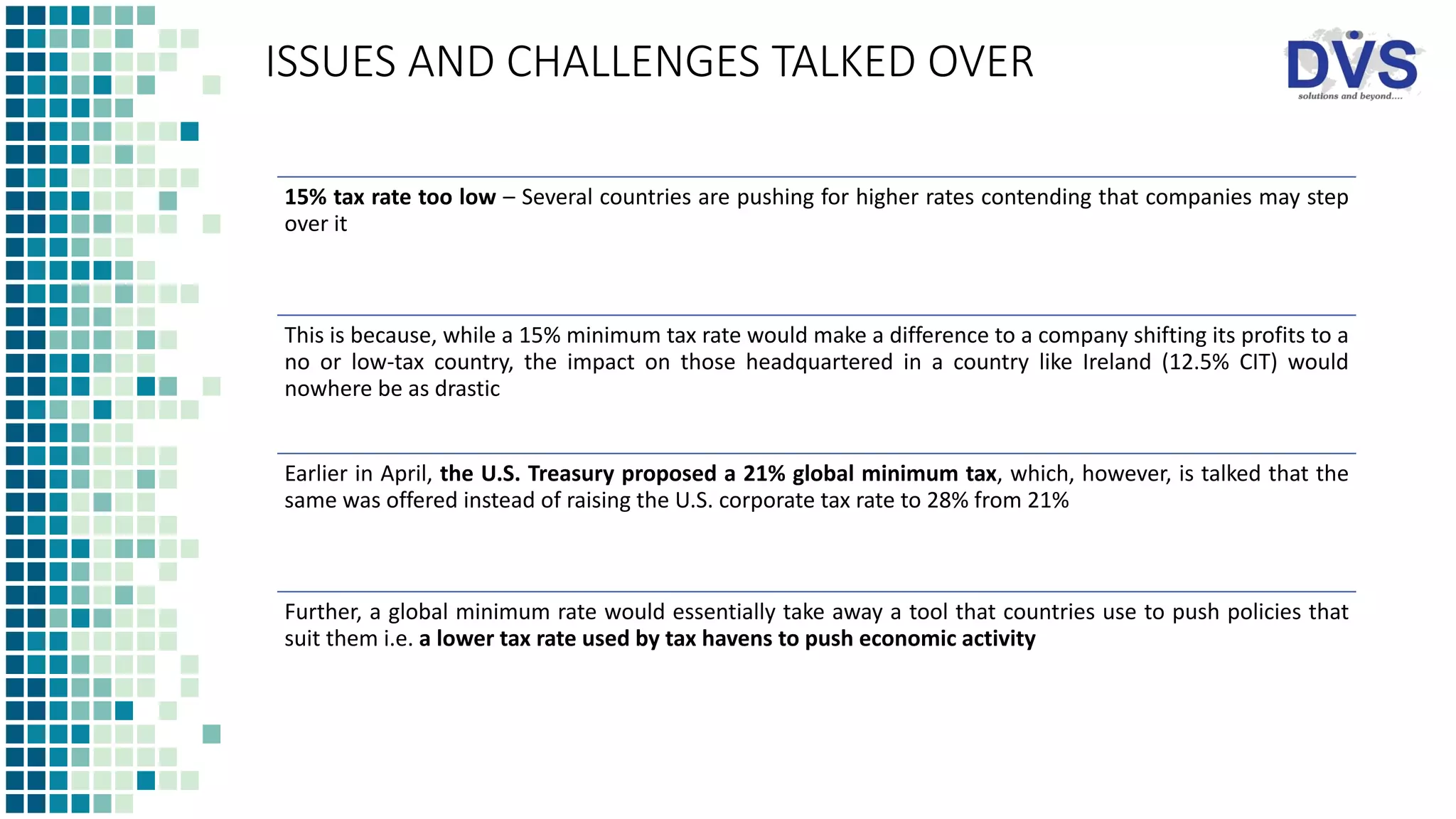
15% tax rate too low – Several countries are pushing for higher rates contending that companies may step
over it
This is because, while a 15% minimum tax rate would make a difference to a company shifting its profits to a
no or low-tax country, the impact on those headquartered in a country like Ireland (12.5% CIT) would
nowhere be as drastic
Earlier in April, the U.S. Treasury proposed a 21% global minimum tax, which, however, is talked that the
same was offered instead of raising the U.S. corporate tax rate to 28% from 21%
Further, a global minimum rate would essentially take away a tool that countries use to push policies that
suit them i.e. a lower tax rate used by tax havens to push economic activity
WAY FORWARD
The proposed global minimum tax would end the race-to-the-bottom in corporate taxation, and help the
global economy thrive.
If pursued, it will level the playing field for businesses and encourage countries to compete on positive bases, such as
educating and training their work forces and investing in research and development and infrastructure.
Key details of the G7 deal still needs to be deliberated upon and the full implementation could take years. There
may be some developments in this regard in the upcoming G20 meet in July
There should be appropriate coordination between the application of the new international tax rules including the
Digital Services Taxes
Overall, countries with a moderate tax system stand to benefit at the cost of “tax havens” with low or nil tax rates
Thank You!
Scan the QR Code to Join our
Research Group on WhatsApp
Scan the QR Code to explore more
Research from our Website
DVS Advisors LLP
India-Singapore-London-Dubai-Malaysia-Africa
www.dvsca.com
Copyrights © 2021 DVS Advisors LLP

Taxation of MNCs: Heading towards a resolution

  • 1.
    TAXATION OF MNCs– HEADING TOWARDS A RESOLUTION CA Jugal Gala
  • 2.
  • 3.
    LEGENDS USED ADS AutomatedDigital Services ALP Arm’s Length Price BEPS Base Erosion and Profit Shifting CIT Corporate Income Tax EL Equalization Levy EU European Union GMT Global Minimum Tax MNCs Multi National Corporations OECD Organisation for Economic Co-operation and Development PE Permanent Establishment
  • 4.
    PRESENTATION SCHEMA Background ExistingMeasures Decision of G7 Significance and Impact Way Forward
  • 5.
  • 6.
    INTRODUCTION For years, Governmentshave been grappling to tax MNCs operating in various countries Surged Government debt levels and fiscal deficits, have pushed economies to reform the global tax system looking towards it as a potential to boost their coffers The long debated issue on global corporate taxation has been taking new forms in the past decade, upon which, the recent G7 decision, proposing to ratify the recommendations of the OECD on Two Pillar Approach, is all set on wheels now
  • 7.
    WHAT WAS HAPPENINGAROUND ? Base erosion and profit shifting (BEPS) refers to tax evasion strategies used by MNCs to optimize their tax base by exploiting the gaps and mismatches in tax rules to avoid paying tax or reduce tax burden Increasingly, income from intangible sources such as drug patents, software and royalties on intellectual property has migrated to low tax jurisdictions, allowing companies to avoid paying higher taxes in their traditional home countries These companies typically rely on complex webs of subsidiaries to hoover profits out of major markets into low-tax countries Parking profits to tax havens Digital business models exploiting PE concept
  • 8.
    IMPACT OF BEPS BEPSis of major significance for developing countries due to their heavy reliance on corporate income tax. MNCs use BEPS to gain a competitive advantage over enterprises that operate at a domestic level. The OECD estimates that BEPS practices cost countries $240bn in annual lost revenue, representing 10% of overall global corporate income tax revenue. According to economists at Bank of America, about 60% of U.S. multinationals’ reported foreign income was booked in seven small countries* with “relatively small economies” in 2019 India’s annual tax loss due to corporate tax abuse is estimated at over USD 10 billion *Bermuda, the Cayman Islands, Ireland, Luxembourg, the Netherlands, Singapore, and Switzerland
  • 9.
  • 10.
    OECD BEPS ACTIONPLAN AND UN MODEL TREATY The OECD worked on 15 separate actions to address BEPS and formulated the 2015 report. The report recognized the increasing prominence of digital economy and noted it would not be feasible to ring- fence the digital economy from the rest of the economy for tax purposes. 15 actions were set out to equip Governments with domestic and international rules and instruments to address tax avoidance, ensuring that profits of MNCs are taxed where economic activities generating the profits are performed and where value is created. Amongst other things, it proposed three interim options to tackle the issues emerging from digital transactions. a) Significant economic presence; b) Withholding tax on digital transactions; and c) Equalization levy. The OECD launched the BEPS Project to tackle the problem of tax avoidance, to bring in a transparent tax environment and more synergy to the international tax rules. Further, after a year of deliberation, the final draft of UN Model Treaty Provision on Automated Digital Services was notified earlier this year which intended to settle the issue vide DTAAs
  • 11.
    BEPS ACTION PLANS TaxChallenges Arising from Digitalization Neutralizing the Effects off Hybrid Mismatch Arrangements Controlled Foreign Company Rules Limitations on Interest Deductions Harmful Tax Practices Prevention of Tax Treaty Abuse Permanent Establishment Status Transfer Pricing (3 Action Plans) BEPS Data Analysis Mandatory Disclosure Rules Country-by-country Reporting Mutual Agreement Protocol Multilateral Instruments
  • 12.
    HOW COUNTRIES WERERESPONDING • In the recent past, countries including India, have implemented various measures such as interest deductibility limits, Country-by-Country Reporting, etc. in accordance with OECD recommendations • Notably, novel policies have also been developed including equalisation levies and digital service taxes alongside more common use of gross-based withholding taxes targeted at digital services • However, such interim measures imposed by the developing countries such as India and few EU countries like Italy, UK, Spain, etc. have fumed up the US Government contending that the same was targeted against its homeland technogiants
  • 13.
  • 14.
    OECD’S TWO PILLARAPPROACH Pillar 1 comprised of profit allocation rules between jurisdictions in case of cross border transactions and other nexus-based rules It focused on rules so as to ensure that MNCs pay some amount of tax in the market country Pillar 1 Pillar 2 introduced the concept of Global Anti-Base Erosion (GloBE) ensuring minimum levels of taxation on MNCs doing business around the world It focused on allowing a right to ‘tax back’ where other jurisdictions have not exercised their primary taxing rights, or the payment is otherwise subject to low levels of effective taxation. Pillar 2 OECD released “blueprints” of proposed solutions to address tax challenges arising from the accelerating digitalization and globalization of the world economy and agreed to endeavour for a consensus solution by mid-2021
  • 15.
    In June, 2021,the Group of Seven (G7) Finance Ministers completed a historic global tax agreement to create an international tax system fit to deal with tax challenges arising from the operation of MNCs and Digital Giants. THE G7 TAX DEAL Pillar One Focuses on rules making MNCs paying taxes where they operate This would apply to global companies with at least a 10% profit margin 20% of the profit above the 10% margin would be reallocated and taxed in the market country Pillar Two Pillar Two is set to impose a minimum global corporation tax rate of atleast 15% on overseas profits Governments could still set whatever local corporate tax rate they want If companies pay lower rates in a particular country, their home Governments could “top-up” their taxes to the minimum rate, eliminating the advantage of shifting profits Pay tax where your market is Pay a minimum amount of tax on overseas operations
  • 16.
    OPEN-ENDED ISSUES The decisionof G7 is widely in consensus with OECD’s Two-pillar Approach recommendations released last year However, certain aspects are left open to be addressed and there is no clarity as the policy decision’s specifics are yet to be published The scope of invocation of Pillar One is ambiguous Will 10% margin apply to consolidated profits of the MNE group or profit margin in the market country (OECD recommended an option either on consolidated basis or segment wise) Further, a threshold was recommended by OECD for applicability of Pillar A – the same has not been deliberated by G7 In Pillar Two, whether Government can set the local tax rate as the benchmark for the top-up or the proposed tax rate of 15% should be the maximum rate
  • 17.
    SIGNIFICANCE OF G7DEAL The G7 Deal is a significant signal that seven* of the most politically powerful countries agree on principles of reform If widely enacted, the GMT would effectively end the practice of global corporations seeking out low-tax jurisdictions like Ireland and BVI to move their headquarters to, even though their customers, operations and executives are located elsewhere Further, on wide acceptance, the introduction of Digital Service Taxes and other similar measures by few economies on a rush to get their slice of tax from the MNCs, would also be considered for removal The proposed agreement is expected to be put on the tables of G-20 nations in July, a diverse group of economies that includes China, India, Brazil and Russia, amongst other nations. It is expected that few of the open-ended issues would be deliberated upon and there shall be consensus on the way forward *The US, Canada, France, Germany, Italy, Japan and the UK
  • 18.
    IMPACT OF G7DEAL Adopting 15% GMT G7 Countries Gain of $168 billion in increased corporate income taxes Pillar Two US UK, Germany and France India Gain by 21% in CIT collections ($84 billion annually) Gain by 15-30% China Gain atleast $13 billion (~8% of FY 21 IT collections) Would capture upto 8000 multinationals including oil and mining giants and few banks such as HSBC, Barclays, etc. Note: Above mentioned estimates are not conclusive and have been taken from various secondary sources Pillar One Paying taxes in market country Would capture around 100 multinationals (estimates as per Joe Biden’s administration) Gain around $72 billion
  • 19.
    ECONOMIES WHO WILLFEEL THE PINCH ▪ Estimates place that at least $81 Billion in additional tax revenues each year would be raised under the reforms. ▪Pillar one would bring in between $5bn and $12bn to G7 Countries. ▪Pillar two, the global minimum rate, would collect between $42bn and $70bn. • The tax havens such as Jersey and Guernsey Ireland, Cyprus, Luxembourg Malta, and the Netherlands will stand to lose a significant share of tax revenues • Ireland has come out against the global minimum tax, arguing that it would be disruptive to its economic model. • Ireland could lose up to €2bn (£1.7bn) a year if the recommendations gets fructify. The country, which levies corporation tax at 12.5% and has lower rates for profits on patents, raised €11.8bn in corporate tax last year.
  • 20.
    POSSIBLE IMPACT ONINDIA • India is likely to benefit from the global minimum 15% corporate tax rate as the effective domestic tax rate is above the threshold. • However, on adoption of the G7 recommendation, India would have to give up on Equalization levy • India would still continue to attract investment and would benefit owing to the big market potential for MNCs and Digital Giants. • Adopting Pillar Two would not hurt FDI in India or cause incremental tax liability in the hands of foreign investors, given that the minimum tax rate for new manufacturing business has recently been legislated at 15% (plus surcharges and cess) • On outbound investments, it will prevent base erosion of tax in the country as the Government will be able to claw back any shortfall in tax paid below 15% by an overseas business owned by an Indian resident
  • 21.
    ISSUES AND CHALLENGESTALKED OVER 15% tax rate too low – Several countries are pushing for higher rates contending that companies may step over it This is because, while a 15% minimum tax rate would make a difference to a company shifting its profits to a no or low-tax country, the impact on those headquartered in a country like Ireland (12.5% CIT) would nowhere be as drastic Earlier in April, the U.S. Treasury proposed a 21% global minimum tax, which, however, is talked that the same was offered instead of raising the U.S. corporate tax rate to 28% from 21% Further, a global minimum rate would essentially take away a tool that countries use to push policies that suit them i.e. a lower tax rate used by tax havens to push economic activity
  • 22.
    WAY FORWARD The proposedglobal minimum tax would end the race-to-the-bottom in corporate taxation, and help the global economy thrive. If pursued, it will level the playing field for businesses and encourage countries to compete on positive bases, such as educating and training their work forces and investing in research and development and infrastructure. Key details of the G7 deal still needs to be deliberated upon and the full implementation could take years. There may be some developments in this regard in the upcoming G20 meet in July There should be appropriate coordination between the application of the new international tax rules including the Digital Services Taxes Overall, countries with a moderate tax system stand to benefit at the cost of “tax havens” with low or nil tax rates
  • 23.
    Thank You! Scan theQR Code to Join our Research Group on WhatsApp Scan the QR Code to explore more Research from our Website DVS Advisors LLP India-Singapore-London-Dubai-Malaysia-Africa www.dvsca.com Copyrights © 2021 DVS Advisors LLP