CASE BASED DISCUSSION
DR. R. RAJKUMAR D.M.
CONSULTANT MEDICAL ONCOLOGIST
VELAMMAL MEDICAL COLLEGE &
SPECIALITY HOSPITALS
CASE BASED DISCUSSION
• 36 yrs/ M
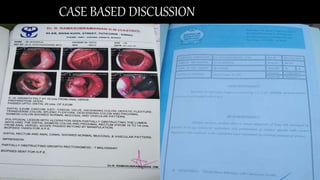
• CA RECTUM ( 2015)
• cT3
CASE BASED DISCUSSION
• Neoadjuvant chemoRT
Received 25 + RT/ 3×
chemo
• 8/2015
CASE BASED DISCUSSION
How will U treat in 2021?
1. NACT+RT SURGERY
2. TNT SURGERY
CASE BASED DISCUSSION
• CHOICE OF NEOADJUVANT CHEMO
1. INFUSIONAL 5 FU
2. CAPECITABINE
3. CAPEOX
4. CHEMO+BIOLOGICALS
CASE BASED DISCUSSION
• CHOICE OF RT
1. SCRT
2. LCRT
CASE BASED DISCUSSION
• CHOICE OF SURGERY
1. OPEN
2. LAPROSCOPIC
3. ROBOTIC
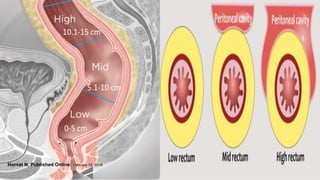
Figure 6a. Tumor location in the craniocaudal direction. (a) Illustration depicts the sagittal view of the rectum and provides the measurements of the tumor from the anal
verge, which help categorize tumor location. Blue lines separate the low, mid-, and high rectum. (Figure 6a reprinted, under a CC BY-ND 4.0 license, from Memorial Sloan
Kettering Cancer Center.) (b–d) Sagittal T2-weighted MR images show tumors (arrow) in the high (b), mid- (c), and low (d) rectum. Dotted line = measurement from the
rectum entrance to the tumor location.
Horvat N. Published Online: February 15, 2019
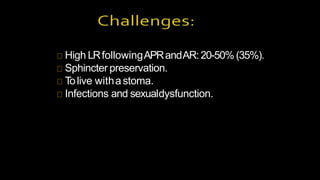
High LRfollowingAPRandAR:20-50%(35%).
Sphincter preservation.
Tolive withastoma.
Infections and sexualdysfunction.
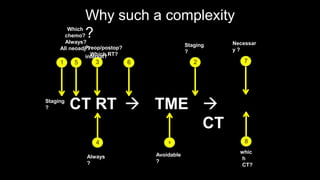
Why such a complexity
?
CT RT  TME 
CT
2
1
4
5 7
8
9
Which RT?
3 6
Necessar
y ?
whic
h
CT?
Staging
?
Always
?
Which
chemo?
Always?
All neoadj ?
Preop/postop?
interval?
Avoidable
?
Staging
?
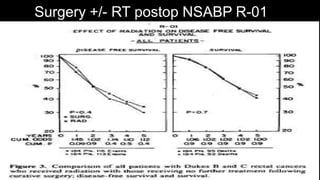
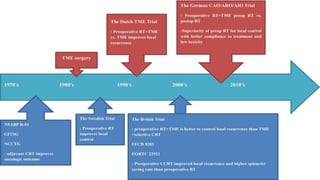
Surgery +/- RT postop NSABP R-01
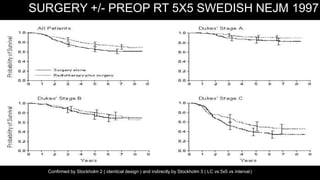
SURGERY +/- PREOP RT 5X5 SWEDISH NEJM 1997
Confirmed by Stockholm 2 ( identical design ) and indirectly by Stockholm 3 ( LC vs 5x5 vs interval)
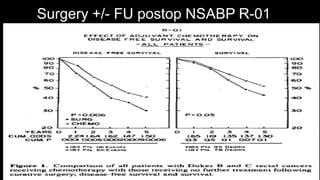
Surgery +/- FU postop NSABP R-01
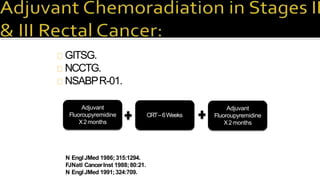
GITSG.
NCCTG.
NSABPR-01.
N EnglJMed 1986;315:1294.
FJNatl CancerInst 1988;80:21.
N EnglJMed 1991;324:709.
Adjuvant
Fluoroupyremidine
X2months
CRT–6Weeks
Adjuvant
Fluoroupyremidine
X2months
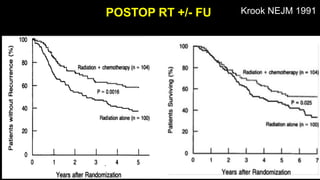
POSTOP RT +/- FU Krook NEJM 1991
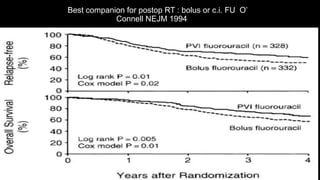
Best companion for postop RT : bolus or c.i. FU O’
Connell NEJM 1994
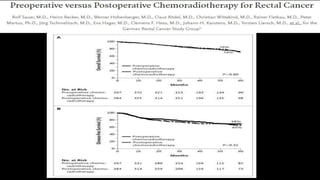
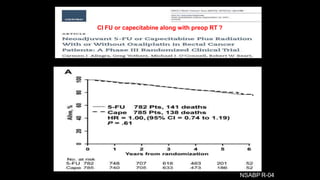
NSABP R-04
CI FU or capecitabine along with preop RT ?
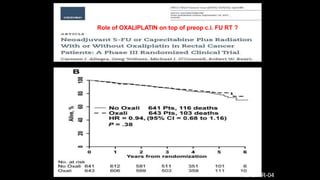
NSABP R-04
Role of OXALIPLATIN on top of preop c.i. FU RT ?
.
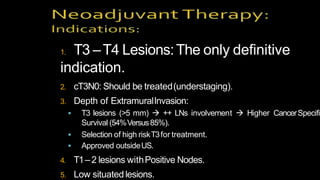
1. T3 –T4 Lesions:The only definitive
indication.
2. cT3N0: Should be treated(understaging).
3. Depth of ExtramuralInvasion:
 T3 lesions (>5 mm)  ++ LNs involvement  Higher CancerSpecific
Survival (54%Versus85%).
 Selection of high riskT3for treatment.
 Approved outsideUS.
4. T1–2 lesions withPositive Nodes.
5. Low situated lesions.
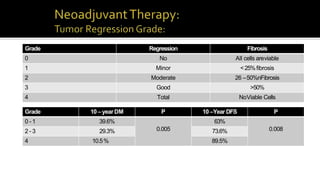
Grade Regression Fibrosis
0 No All cells areviable
1 Minor <25%fibrosis
2 Moderate 26 –50%nFibrosis
3 Good >50%
4 Total NoViable Cells
Grade 10 –yearDM P 10 –Year DFS P
0 - 1 39.6%
0.005
63%
0.008
2 - 3 29.3% 73.6%
4 10.5% 89.5%
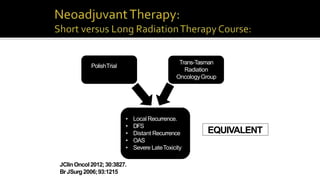
PolishTrial
Trans-Tasman
Radiation
OncologyGroup
• Local Recurrence.
• DFS
• Distant Recurrence
• OAS
• Severe LateToxicity
EQUIVALENT
JClinOncol2012;30:3827.
BrJSurg2006;93:1215
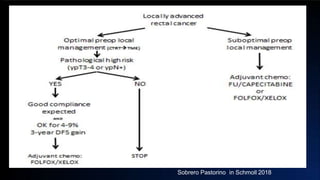
Sobrero Pastorino in Schmoll 2018
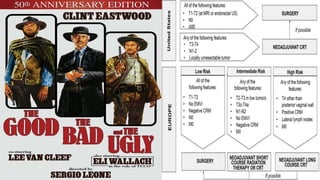
Figure 1. Schematic flowchart summarizes the current management concepts of rectal cancer in the United States and Europe.
Horvat N. Published Online: February 15, 2019
Total neoadjuvant therapy in locally advanced rectal cancer: Role of systemic chemotherapy
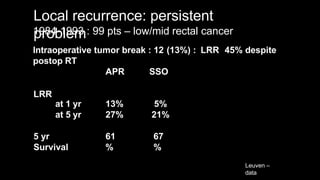
Local recurrence: persistent
problem
1984-1993 : 99 pts – low/mid rectal cancer
Intraoperative tumor break : 12 (13%) : LRR 45% despite
postop RT
LRR
APR SSO
at 1 yr 13% 5%
at 5 yr 27% 21%
5 yr
Survival
61
%
67
%
Leuven –
data
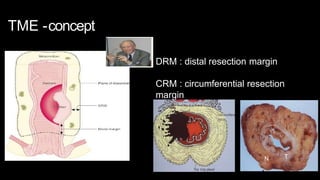
TME -concept
DRM : distal resection margin
CRM : circumferential resection
margin
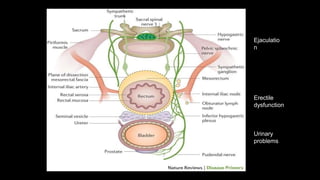
T
N
Ejaculatio
n
Erectile
dysfunction
Urinary
problems
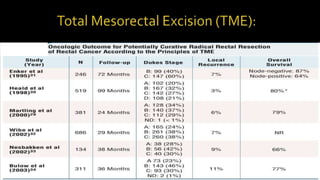
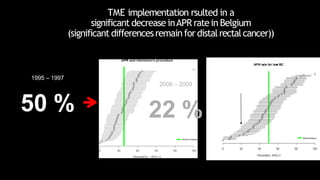
TME implementation rsulted in a
significant decreaseinAPR ratein Belgium
(significant differencesremainfor distalrectalcancer))
1995 – 1997
50 %
2006 – 2009
22 %
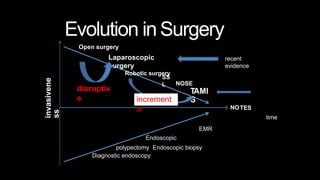
Evolution in Surgery
Open surgery
Laparoscopic
surgery
Robotic surgery
SS
L NOSE
TAMI
S
NOTES
time
EMR
Endoscopic
polypectomy Endoscopic biopsy
Diagnostic endoscopy
invasivene
ss recent
evidence
disruptiv
e increment
al
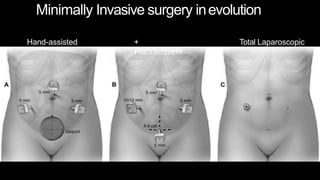
Minimally Invasive surgery inevolution
Hand-assisted +
Pfannenstiehl
Total Laparoscopic
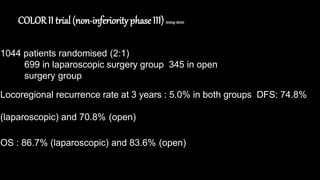
COLORII trial (non-inferiorityphase III) 2004-2010
1044 patients randomised (2:1)
699 in laparoscopic surgery group 345 in open
surgery group
Locoregional recurrence rate at 3 years : 5.0% in both groups DFS: 74.8%
(laparoscopic) and 70.8% (open)
OS : 86.7% (laparoscopic) and 83.6% (open)
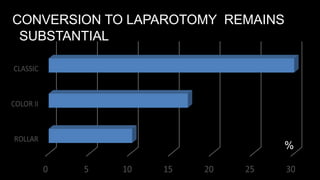
CONVERSION TO LAPAROTOMY REMAINS
SUBSTANTIAL
%
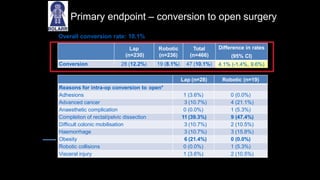
Primary endpoint – conversion to open surgery
Lap
(n=230)
Robotic
(n=236)
Total
(n=466)
Difference in rates
(95% CI)
Conversion 28 (12.2%) 19 (8.1%) 47 (10.1%) 4.1% (-1.4%, 9.6%)
Overall conversion rate: 10.1%
Lap (n=28) Robotic (n=19)
Reasons for intra-op conversion to open*
Adhesions 1 (3.6%) 0 (0.0%)
Advanced cancer 3 (10.7%) 4 (21.1%)
Anaesthetic complication 0 (0.0%) 1 (5.3%)
Completion of rectal/pelvic dissection 11 (39.3%) 9 (47.4%)
Difficult colonic mobilisation 3 (10.7%) 2 (10.5%)
Haemorrhage 3 (10.7%) 3 (15.8%)
Obesity 6 (21.4%) 0 (0.0%)
Robotic collisions 0 (0.0%) 1 (5.3%)
Visceral injury 1 (3.6%) 2 (10.5%)
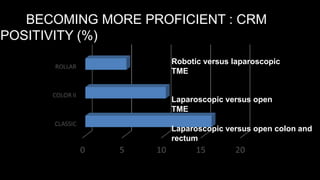
BECOMING MORE PROFICIENT : CRM
POSITIVITY (%)
Robotic versus laparoscopic
TME
Laparoscopic versus open
TME
Laparoscopic versus open colon and
rectum
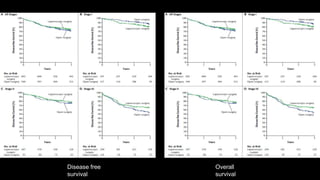
Disease free
survival
Overall
survival
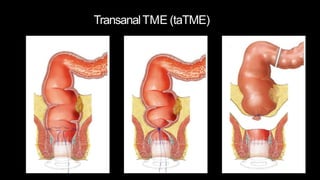
TransanalTME (taTME)
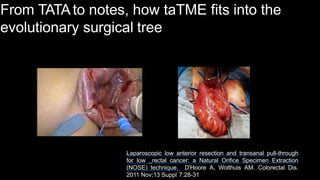
Laparoscopic low anterior resection and transanal pull-through
for low rectal cancer: a Natural Orifice Specimen Extraction
(NOSE) technique. D'Hoore A, Wolthuis AM. Colorectal Dis.
2011 Nov;13 Suppl 7:28-31
From TATAto notes, how taTME fits into the
evolutionary surgical tree
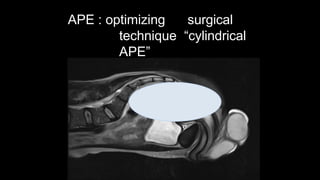
APE : optimizing surgical
technique “cylindrical
APE”
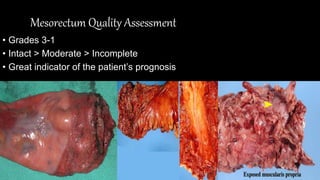
Mesorectum Quality Assessment
• Grades 3-1
• Intact > Moderate > Incomplete
• Great indicator of the patient’s prognosis
KNOWING THE MARGINS
1. Mucosal
2. Serosal
3. Mesenteric radial
4. Radial
5. CRM
CASE BASED DISCUSSION
• DFS 6 YRS
• FREQUENT URINATION ( 2021)
• REEVALUATION
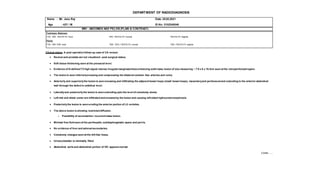
DEPARTMENT OF RADIODIAGNOSIS
Clinical status: A post operative follow-up case of CA rectum.
 Rectum and prostate are not visualized - post surgical status.
 Soft tissue thickening seen at the presacral level.
 Evidence of ill-defined T2 high signal intense irregular marginated lessenhancing solid mass lesion of size measuring ~ 7.9 x 6 x 10.3cm seen at the retroperitoneal region.
 The lesion is seen inferiorlyencasing and compressing the bilateral common iliac arteries and veins.
 Anteriorly and superiorlythe lesion is seen encasing and infiltrating the adjacent bowel loops (small bowel loops), mesenteryand peritoneumand extending to the anterior abdominal
wall through the defect in umbilical level.
 Laterallyand posteriorlythe lesion is seen extending upto the level of colostomy stoma.
 Left mid and distal ureter are infiltrated and encased by the lesion and causing left sided hydroureteronephrosis.
 Posteriorlythe lesion is seen eroding the anterior portion of L5 vertebra.
 The above lesion is showing restricted diffusion.
o Possibility of secondaries/ recurrent mass lesion.
 Minimal free fluid seen at the perihepatic, subdiaphragmatic space and pelvis.
 No evidence of liver and adrenal secondaries.
 Colostomy changes seen at the left iliac fossa.
 Urinarybladder is minimally filled.
 Abdominal aorta and abdominal portion of IVC appearsnormal.
Contd…..,
Name : Mr. Jesu Raj Date: 25.02.2021
Age : 42Y / M ID.No: 2102240048
MRI - ABDOMEN AND PELVIS (PLAIN & CONTRAST)
Technique: Abdomen:
T1W, T2W, FIESTA-FS Axial T2W, FIESTA-FS Coronal FIESTA-FS Sagittal
Pelvis:
T1W, T2W STIR axial T2W, T2FS, FIESTA-FS coronal T2W, FIESTA-FS sagittal
CASE BASED DISCUSSION
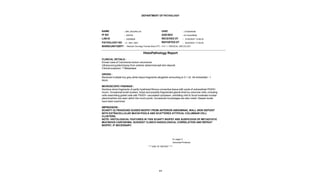
DEPARTMENT OF PATHOLOGY
NAME
IP NO
LAB ID
PATHOLOGY NO
: MR. JESURAJ.M
: 222700
: 33036928
: S - 663 / 2021
UHID
AGE/SEX
RECEIVED DT
REPORTED DT
: 2102240048
: 42 Years/Male
: 27/02/2021 13:09:32
: 04/03/2021 17:25:25
WARD/UNIT/DEPT : Medical Oncology Female Ward (TF) - 313 / I / MEDICAL ONCOLOGY
HistoPathology Report
CLINICAL DETAILS :
Known case of Carcinoma rectum recurrence.
Ultrasound guided biopsy from anterior abdominal wall skin deposit.
Clinical suspicion: ? Metastasis.
GROSS :
Received multiple tiny grey white tissue fragments altogether amounting to 0.1 ml. All embedded - 1
block.
MICROSCOPIC FINDINGS :
Sections show fragments of partly hyalinized fibrous connective tissue with pools of extracellular PASD+
mucin. Occasional small clusters, strips and possibly fragmented glands lined by columnar cells, including
cells resembling goblet cells with PASD+ vacuolated cytoplasm, exhibiting mild to focal moderate nuclear
pleomorphism are seen within the mucin pools. Occasional muciphages are also noted. Deeper levels
have been examined.
IMPRESSION :
SCANTY ULTRASOUND GUIDED BIOPSY FROM ANTERIOR ABDOMINAL WALL SKIN DEPOSIT
WITH EXTRACELLULAR MUCIN POOLS AND SCATTERED ATYPICAL COLUMNAR CELL
CLUSTERS.
NOTE: HISTOLOGICAL FEATURES IN THIS SCANTY BIOPSY ARE SUSPICIOUS OF METASTATIC
MUCINOUS CARCINOMA. SUGGEST CLINICO-RADIOLOGICAL CORRELATION AND REPEAT
BIOPSY, IF NECESSARY.
Dr.Jagan C
Associate Professor
**** END OF REPORT ****
1/1

M crc ppt

  • 1.
    CASE BASED DISCUSSION DR.R. RAJKUMAR D.M. CONSULTANT MEDICAL ONCOLOGIST VELAMMAL MEDICAL COLLEGE & SPECIALITY HOSPITALS
  • 2.
    CASE BASED DISCUSSION •36 yrs/ M • CA RECTUM ( 2015) • cT3
  • 3.
  • 4.
    CASE BASED DISCUSSION •Neoadjuvant chemoRT Received 25 + RT/ 3× chemo • 8/2015
  • 5.
  • 6.
  • 7.
    CASE BASED DISCUSSION Howwill U treat in 2021? 1. NACT+RT SURGERY 2. TNT SURGERY
  • 8.
    CASE BASED DISCUSSION •CHOICE OF NEOADJUVANT CHEMO 1. INFUSIONAL 5 FU 2. CAPECITABINE 3. CAPEOX 4. CHEMO+BIOLOGICALS
  • 9.
    CASE BASED DISCUSSION •CHOICE OF RT 1. SCRT 2. LCRT
  • 10.
    CASE BASED DISCUSSION •CHOICE OF SURGERY 1. OPEN 2. LAPROSCOPIC 3. ROBOTIC
  • 11.
    Figure 6a. Tumorlocation in the craniocaudal direction. (a) Illustration depicts the sagittal view of the rectum and provides the measurements of the tumor from the anal verge, which help categorize tumor location. Blue lines separate the low, mid-, and high rectum. (Figure 6a reprinted, under a CC BY-ND 4.0 license, from Memorial Sloan Kettering Cancer Center.) (b–d) Sagittal T2-weighted MR images show tumors (arrow) in the high (b), mid- (c), and low (d) rectum. Dotted line = measurement from the rectum entrance to the tumor location. Horvat N. Published Online: February 15, 2019
  • 12.
    High LRfollowingAPRandAR:20-50%(35%). Sphincter preservation. Tolivewithastoma. Infections and sexualdysfunction.
  • 13.
    Why such acomplexity ? CT RT  TME  CT 2 1 4 5 7 8 9 Which RT? 3 6 Necessar y ? whic h CT? Staging ? Always ? Which chemo? Always? All neoadj ? Preop/postop? interval? Avoidable ? Staging ?
  • 16.
    Surgery +/- RTpostop NSABP R-01
  • 17.
    SURGERY +/- PREOPRT 5X5 SWEDISH NEJM 1997 Confirmed by Stockholm 2 ( identical design ) and indirectly by Stockholm 3 ( LC vs 5x5 vs interval)
  • 19.
    Surgery +/- FUpostop NSABP R-01
  • 20.
    GITSG. NCCTG. NSABPR-01. N EnglJMed 1986;315:1294. FJNatlCancerInst 1988;80:21. N EnglJMed 1991;324:709. Adjuvant Fluoroupyremidine X2months CRT–6Weeks Adjuvant Fluoroupyremidine X2months
  • 21.
    POSTOP RT +/-FU Krook NEJM 1991
  • 22.
    Best companion forpostop RT : bolus or c.i. FU O’ Connell NEJM 1994
  • 24.
    NSABP R-04 CI FUor capecitabine along with preop RT ?
  • 25.
    NSABP R-04 Role ofOXALIPLATIN on top of preop c.i. FU RT ?
  • 26.
  • 27.
    1. T3 –T4Lesions:The only definitive indication. 2. cT3N0: Should be treated(understaging). 3. Depth of ExtramuralInvasion:  T3 lesions (>5 mm)  ++ LNs involvement  Higher CancerSpecific Survival (54%Versus85%).  Selection of high riskT3for treatment.  Approved outsideUS. 4. T1–2 lesions withPositive Nodes. 5. Low situated lesions.
  • 28.
    Grade Regression Fibrosis 0No All cells areviable 1 Minor <25%fibrosis 2 Moderate 26 –50%nFibrosis 3 Good >50% 4 Total NoViable Cells Grade 10 –yearDM P 10 –Year DFS P 0 - 1 39.6% 0.005 63% 0.008 2 - 3 29.3% 73.6% 4 10.5% 89.5%
  • 29.
    PolishTrial Trans-Tasman Radiation OncologyGroup • Local Recurrence. •DFS • Distant Recurrence • OAS • Severe LateToxicity EQUIVALENT JClinOncol2012;30:3827. BrJSurg2006;93:1215
  • 30.
  • 31.
    Figure 1. Schematicflowchart summarizes the current management concepts of rectal cancer in the United States and Europe. Horvat N. Published Online: February 15, 2019
  • 32.
    Total neoadjuvant therapyin locally advanced rectal cancer: Role of systemic chemotherapy
  • 33.
    Local recurrence: persistent problem 1984-1993: 99 pts – low/mid rectal cancer Intraoperative tumor break : 12 (13%) : LRR 45% despite postop RT LRR APR SSO at 1 yr 13% 5% at 5 yr 27% 21% 5 yr Survival 61 % 67 % Leuven – data
  • 34.
    TME -concept DRM :distal resection margin CRM : circumferential resection margin T N
  • 35.
  • 36.
    TME implementation rsultedin a significant decreaseinAPR ratein Belgium (significant differencesremainfor distalrectalcancer)) 1995 – 1997 50 % 2006 – 2009 22 %
  • 37.
    Evolution in Surgery Opensurgery Laparoscopic surgery Robotic surgery SS L NOSE TAMI S NOTES time EMR Endoscopic polypectomy Endoscopic biopsy Diagnostic endoscopy invasivene ss recent evidence disruptiv e increment al
  • 38.
    Minimally Invasive surgeryinevolution Hand-assisted + Pfannenstiehl Total Laparoscopic
  • 39.
    COLORII trial (non-inferiorityphaseIII) 2004-2010 1044 patients randomised (2:1) 699 in laparoscopic surgery group 345 in open surgery group Locoregional recurrence rate at 3 years : 5.0% in both groups DFS: 74.8% (laparoscopic) and 70.8% (open) OS : 86.7% (laparoscopic) and 83.6% (open)
  • 40.
    CONVERSION TO LAPAROTOMYREMAINS SUBSTANTIAL %
  • 41.
    Primary endpoint –conversion to open surgery Lap (n=230) Robotic (n=236) Total (n=466) Difference in rates (95% CI) Conversion 28 (12.2%) 19 (8.1%) 47 (10.1%) 4.1% (-1.4%, 9.6%) Overall conversion rate: 10.1% Lap (n=28) Robotic (n=19) Reasons for intra-op conversion to open* Adhesions 1 (3.6%) 0 (0.0%) Advanced cancer 3 (10.7%) 4 (21.1%) Anaesthetic complication 0 (0.0%) 1 (5.3%) Completion of rectal/pelvic dissection 11 (39.3%) 9 (47.4%) Difficult colonic mobilisation 3 (10.7%) 2 (10.5%) Haemorrhage 3 (10.7%) 3 (15.8%) Obesity 6 (21.4%) 0 (0.0%) Robotic collisions 0 (0.0%) 1 (5.3%) Visceral injury 1 (3.6%) 2 (10.5%)
  • 42.
    BECOMING MORE PROFICIENT: CRM POSITIVITY (%) Robotic versus laparoscopic TME Laparoscopic versus open TME Laparoscopic versus open colon and rectum
  • 43.
  • 44.
  • 45.
    Laparoscopic low anteriorresection and transanal pull-through for low rectal cancer: a Natural Orifice Specimen Extraction (NOSE) technique. D'Hoore A, Wolthuis AM. Colorectal Dis. 2011 Nov;13 Suppl 7:28-31 From TATAto notes, how taTME fits into the evolutionary surgical tree
  • 46.
    APE : optimizingsurgical technique “cylindrical APE”
  • 47.
    Mesorectum Quality Assessment •Grades 3-1 • Intact > Moderate > Incomplete • Great indicator of the patient’s prognosis
  • 48.
    KNOWING THE MARGINS 1.Mucosal 2. Serosal 3. Mesenteric radial 4. Radial 5. CRM
  • 49.
    CASE BASED DISCUSSION •DFS 6 YRS • FREQUENT URINATION ( 2021) • REEVALUATION
  • 50.
    DEPARTMENT OF RADIODIAGNOSIS Clinicalstatus: A post operative follow-up case of CA rectum.  Rectum and prostate are not visualized - post surgical status.  Soft tissue thickening seen at the presacral level.  Evidence of ill-defined T2 high signal intense irregular marginated lessenhancing solid mass lesion of size measuring ~ 7.9 x 6 x 10.3cm seen at the retroperitoneal region.  The lesion is seen inferiorlyencasing and compressing the bilateral common iliac arteries and veins.  Anteriorly and superiorlythe lesion is seen encasing and infiltrating the adjacent bowel loops (small bowel loops), mesenteryand peritoneumand extending to the anterior abdominal wall through the defect in umbilical level.  Laterallyand posteriorlythe lesion is seen extending upto the level of colostomy stoma.  Left mid and distal ureter are infiltrated and encased by the lesion and causing left sided hydroureteronephrosis.  Posteriorlythe lesion is seen eroding the anterior portion of L5 vertebra.  The above lesion is showing restricted diffusion. o Possibility of secondaries/ recurrent mass lesion.  Minimal free fluid seen at the perihepatic, subdiaphragmatic space and pelvis.  No evidence of liver and adrenal secondaries.  Colostomy changes seen at the left iliac fossa.  Urinarybladder is minimally filled.  Abdominal aorta and abdominal portion of IVC appearsnormal. Contd….., Name : Mr. Jesu Raj Date: 25.02.2021 Age : 42Y / M ID.No: 2102240048 MRI - ABDOMEN AND PELVIS (PLAIN & CONTRAST) Technique: Abdomen: T1W, T2W, FIESTA-FS Axial T2W, FIESTA-FS Coronal FIESTA-FS Sagittal Pelvis: T1W, T2W STIR axial T2W, T2FS, FIESTA-FS coronal T2W, FIESTA-FS sagittal
  • 51.
  • 52.
    DEPARTMENT OF PATHOLOGY NAME IPNO LAB ID PATHOLOGY NO : MR. JESURAJ.M : 222700 : 33036928 : S - 663 / 2021 UHID AGE/SEX RECEIVED DT REPORTED DT : 2102240048 : 42 Years/Male : 27/02/2021 13:09:32 : 04/03/2021 17:25:25 WARD/UNIT/DEPT : Medical Oncology Female Ward (TF) - 313 / I / MEDICAL ONCOLOGY HistoPathology Report CLINICAL DETAILS : Known case of Carcinoma rectum recurrence. Ultrasound guided biopsy from anterior abdominal wall skin deposit. Clinical suspicion: ? Metastasis. GROSS : Received multiple tiny grey white tissue fragments altogether amounting to 0.1 ml. All embedded - 1 block. MICROSCOPIC FINDINGS : Sections show fragments of partly hyalinized fibrous connective tissue with pools of extracellular PASD+ mucin. Occasional small clusters, strips and possibly fragmented glands lined by columnar cells, including cells resembling goblet cells with PASD+ vacuolated cytoplasm, exhibiting mild to focal moderate nuclear pleomorphism are seen within the mucin pools. Occasional muciphages are also noted. Deeper levels have been examined. IMPRESSION : SCANTY ULTRASOUND GUIDED BIOPSY FROM ANTERIOR ABDOMINAL WALL SKIN DEPOSIT WITH EXTRACELLULAR MUCIN POOLS AND SCATTERED ATYPICAL COLUMNAR CELL CLUSTERS. NOTE: HISTOLOGICAL FEATURES IN THIS SCANTY BIOPSY ARE SUSPICIOUS OF METASTATIC MUCINOUS CARCINOMA. SUGGEST CLINICO-RADIOLOGICAL CORRELATION AND REPEAT BIOPSY, IF NECESSARY. Dr.Jagan C Associate Professor **** END OF REPORT **** 1/1