4 October 2012


IEBA

by Marcel van Marrewijk


A next level in employee benefits
Moving from pampering and pleasing to inspiring and teasing

Balancing and aligning employees and corporate needs Implications for
monitoring, HR and health management


 V1.0
   1
SHORT INTRODUCTION

Marcel van Marrewijk


Expertise in hi-endsurveys&assessments

Teamed-up with scientists from EUR & UU

Research to Improve; former CEO Great Place to Work

Author of 16 academic papers including
Journal of Business Ethics(top 30 most influential papers over the last 30 years)

Author of the "Cubrix, an integral framework for organizational
development and performance improvement


2
AGENDA

    •   Introduction
    •   Changing world
        –    Complexity
        –    Necessity to transform towards next levels of development
    •   New insights
        –    Happiness@work
        –    Organizational Energy
        –    Cubrix - integral framework
    •   Towards thriving and sustainable organizations
        –    New concept of Good Employership
    •   Eforis: a truly innovative format for empowering employees
        –    BPR Toolbox


3
4
Spectrum for organisation development and performance improvement - www.cub
6
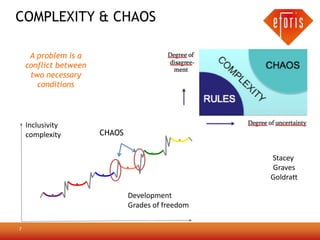
COMPLEXITY & CHAOS

     A problem is a
    conflict between
     two necessary
       conditions


    Inclusivity
    complexity         CHAOS


                                                   Stacey
                                                   Graves
                                                   Goldratt

                               Development
                               Grades of freedom

7
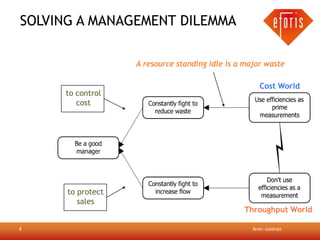
SOLVING A MANAGEMENT DILEMMA

                   A resource standing idle is a major waste

                                                      Cost World
     to control
        cost


      to protect
         sales
                                                Throughput World

8                                                  Bron: Goldratt
“THE WORLD WILL NOT EVOLVE
        PAST ITS CURRENT STATE,
    BY USING THE SAME THINKING THAT
        CREATED THE SITUATION.”
               ALBERT EINSTEIN


9
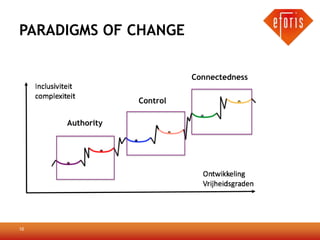
PARADIGMS OF CHANGE

                           Connectedness

                 Control

     Authority


10
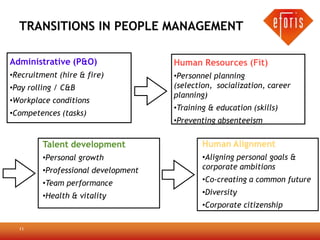
TRANSITIONS IN PEOPLE MANAGEMENT

Administrative (P&O)                 Human Resources (Fit)
•Recruitment (hire & fire)           •Personnel planning
•Pay rolling / C&B                   (selection, socialization, career
                                     planning)
•Workplace conditions
                                     •Training & education (skills)
•Competences (tasks)
                                     •Preventing absenteeism


         Talent development                  Human Alignment
         •Personal growth                    •Aligning personal goals &
         •Professional development           corporate ambitions

         •Team performance                   •Co-creating a common future

         •Health & vitality                  •Diversity
                                             •Corporate citizenship

  11
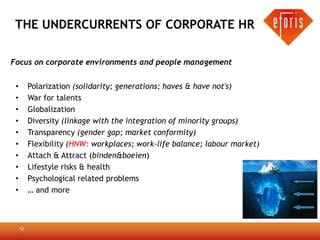
THE UNDERCURRENTS OF CORPORATE HR

Focus on corporate environments and people management


 •        Polarization (solidarity; generations; haves & have not's)
 •        War for talents
 •        Globalization
 •        Diversity (linkage with the integration of minority groups)
 •        Transparency (gender gap; market conformity)
 •        Flexibility (HNW: workplaces; work-life balance; labour market)
 •        Attach & Attract (binden&boeien)
 •        Lifestyle risks & health
 •        Psychological related problems
 •        … and more


     12
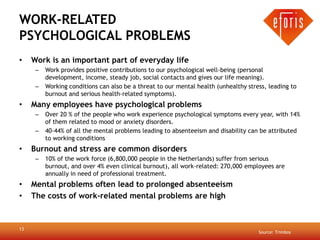
WORK-RELATED
PSYCHOLOGICAL PROBLEMS
•    Work is an important part of everyday life
      –   Work provides positive contributions to our psychological well-being (personal
          development, income, steady job, social contacts and gives our life meaning).
      –   Working conditions can also be a threat to our mental health (unhealthy stress, leading to
          burnout and serious health-related symptoms).
•    Many employees have psychological problems
      –   Over 20 % of the people who work experience psychological symptoms every year, with 14%
          of them related to mood or anxiety disorders.
      –   40-44% of all the mental problems leading to absenteeism and disability can be attributed
          to working conditions
•    Burnout and stress are common disorders
      –   10% of the work force (6,800,000 people in the Netherlands) suffer from serious
          burnout, and over 4% even clinical burnout), all work-related: 270,000 employees are
          annually in need of professional treatment.
•    Mental problems often lead to prolonged absenteeism
•    The costs of work-related mental problems are high


13
                                                                                      Source: Trimbos
NEW INSIGHTS AND UNDERSTANDING

From the disciplines of management science and positive psychology

•    Happiness@work (GelukkigWerken)
      – Onno Hamburger
•    The value of happiness
      – dr. Gretchen Spreitzer& dr. Christine Porath
•    Organizational Energy
      – Prof.dr. Heike Bruch
•    The Progress Principle
      – Prof.dr. Teresa Amabile, Research director Harvard BS
•    Beyond Performance
      – McKinsey: Scott Keller & Colin Price
•    Cubrix, an integral framework for organization development and
     performance improvement


14
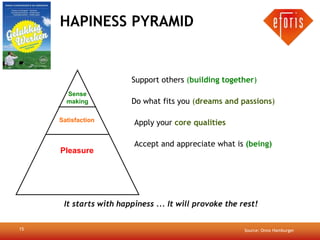
HAPINESS PYRAMID


                        Support others (building together)
       Sense
       making           Do what fits you (dreams and passions)

     Satisfaction        Apply your core qualities

                         Accept and appreciate what is (being)
     Pleasure


      It starts with happiness ... It will provoke the rest!


15                                                      Source: Onno Hamburger
CREATING SUSTAINABLE
      PERFORMANCE
      HBR: GRETCHEN SPREITZER AND CHRISTINE PORATH

     What drives sustainable individual and organizational performance?

     Employees who are thriving - not just satisfied and
     productive, but also engaged in creating the future.


     People who fit this description demonstrated:
     • 16% better overall performance
     • 125% less burnout
     • 32% more commitment to the organization
     • 46% more job satisfaction than their peers.


16
THRIVING PERFORMANCE
     HBR: GRETCHEN SPREITZER AND CHRISTINE PORATH


     Thriving has two components:
     • vitality, or the sense of being alive and excited, and
     • learning, or the growth that comes from gaining knowledge and skills.


     Four mechanisms create the conditions for thriving:
     • providing decision-making discretion
     • sharing information about the organization and its strategy
     • minimizing incivility (lack of good manners)
     • offering performance feedback.


     Helping people grow and remain energized at work is valiant
     on its own merits—but it can also boost performance in a
     sustainable way.

17
NEW INSIGHTS
(SCIENTIFICLY VALIDATED)


              •    Prof. Teresa Amabile conducted a rigorous analysis of nearly
                   12,000 diary entries provided by 238 employees in 7 companies.
              •     She noticed that seemingly mundane workday events can make or
                   break employees' inner work lives.
              •    Managers can foster progress and enhance inner work by:
                    –      Removing obstacles such as meaningless tasks and toxic relationships
                    –      Activating catalysts that directly facilitate project work, such as clear goals
                           and autonomy
                    –      Uplifting workers, through encouragements and demonstrations of respect and
                           collegiality,
              •    She concluded that happiness boosts creativity by 50% and
                   productivity with 25%-30% when employees are successfully
                   engaged with meaningful work.

                    [The Progress Principle: Using Small Wins to Ignite Joy, Engagement, and
                   Creativity at Work, 2011, Harvard Review Press, Boston]


18
NEW INSIGHTS
  (SCIENTIFICLY VALIDATED)


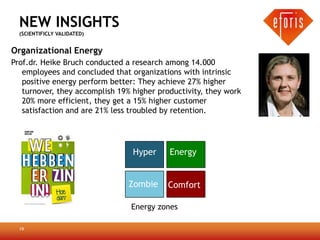
Organizational Energy
Prof.dr. Heike Bruch conducted a research among 14.000
   employees and concluded that organizations with intrinsic
   positive energy perform better: They achieve 27% higher
   turnover, they accomplish 19% higher productivity, they work
   20% more efficient, they get a 15% higher customer
   satisfaction and are 21% less troubled by retention.


                                 Hyper     Energy


                                Zombie    Comfort

                                Energy zones

  19
NEW INSIGHTS
(SCIENTIFICLY VALIDATED)


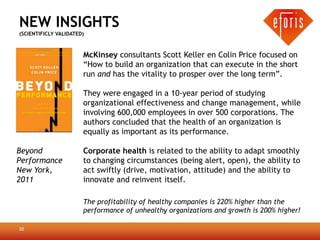
                       McKinsey consultants Scott Keller en Colin Price focused on
                       “How to build an organization that can execute in the short
                       run and has the vitality to prosper over the long term”.

                       They were engaged in a 10-year period of studying
                       organizational effectiveness and change management, while
                       involving 600,000 employees in over 500 corporations. The
                       authors concluded that the health of an organization is
                       equally as important as its performance.

Beyond                 Corporate health is related to the ability to adapt smoothly
Performance            to changing circumstances (being alert, open), the ability to
New York,              act swiftly (drive, motivation, attitude) and the ability to
2011                   innovate and reinvent itself.

                       The profitability of healthy companies is 220% higher than the
                       performance of unhealthy organizations and growth is 200% higher!

20
NEW INSIGHTS

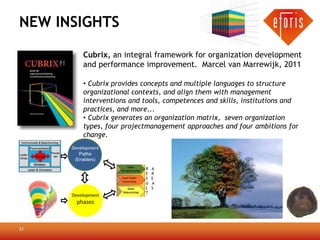
           Cubrix, an integral framework for organization development
           and performance improvement. Marcel van Marrewijk, 2011

           • Cubrix provides concepts and multiple languages to structure
           organizational contexts, and align them with management
           interventions and tools, competences and skills, institutions and
           practices, and more...
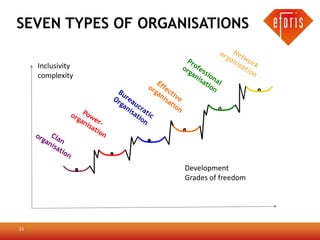
           • Cubrix generates an organization matrix, seven organization
           types, four projectmanagement approaches and four ambitions for
           change.
      Development
         Paths
       (Enablers)

                             R   A
                             E   R
                             S   E
                             U   A
                             L   S
                             T
      Development
        phases


21
VALUEBASED LEADERSHIP

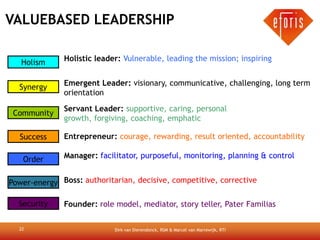
   Holism     Holistic leader: Vulnerable, leading the mission; inspiring


  Synergy     Emergent Leader: visionary, communicative, challenging, long term
              orientation

              Servant Leader: supportive, caring, personal
 Community
              growth, forgiving, coaching, emphatic

  Success     Entrepreneur: courage, rewarding, result oriented, accountability

   Order      Manager: facilitator, purposeful, monitoring, planning & control


Power-energy Boss: authoritarian, decisive, competitive, corrective

  Security    Founder: role model, mediator, story teller, Pater Familias

  22                        Dirk van Dierendonck, RSM & Marcel van Marrewijk, RTI
SEVEN TYPES OF ORGANISATIONS

     Inclusivity
     complexity


                    Development
                    Grades of freedom


23
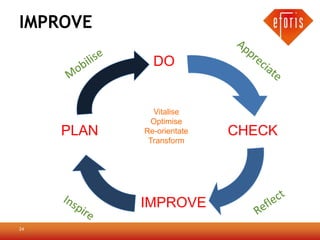
IMPROVE

              DO


              Vitalise
              Optimise
     PLAN   Re-orientate   CHECK
             Transform


            IMPROVE
24
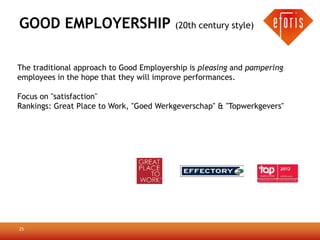
GOOD EMPLOYERSHIP (20th century style)

The traditional approach to Good Employership is pleasing and pampering
employees in the hope that they will improve performances.

Focus on "satisfaction"
Rankings: Great Place to Work, "Goed Werkgeverschap" & "Topwerkgevers"


25
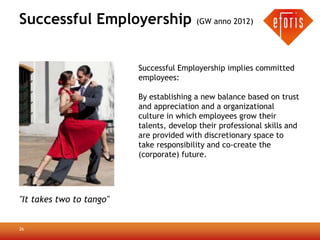
Successful Employership                   (GW anno 2012)


                          Successful Employership implies committed
                          employees:

                          By establishing a new balance based on trust
                          and appreciation and a organizational
                          culture in which employees grow their
                          talents, develop their professional skills and
                          are provided with discretionary space to
                          take responsibility and co-create the
                          (corporate) future.


"It takes two to tango"


26
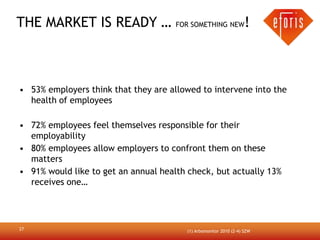
THE MARKET IS READY … FOR SOMETHING NEW!


• 53% employers think that they are allowed to intervene into the
  health of employees

• 72% employees feel themselves responsible for their
  employability
• 80% employees allow employers to confront them on these
  matters
• 91% would like to get an annual health check, but actually 13%
  receives one…


27                                      (1) Arbomonitor 2010 (2-4) SZW
MISSION

Eforis wants to contribute to improving and sustaining the performance of
   employees and organizations, through a value innovation strategy.

     By providing a hi-quality online toolbox which generates
     understanding, advice and support on the core topics of
     Engagement, Productivity and tenability with respect to (lifestyle)
     Risks.

     This way the Eforis approach supports the development and
     performance improvement of organizations, with respect to:
      – Attractive workplaces (Good Employership)
      – High Performance Organizations (Good Entrepreneurship)
      – Sustainable organizations (CSR)


28
BPR PRINCIPLES

•    Value innovation strategy: 10 x better & 10 x cheaper
•    From a push to a pull strategy
•    Employee ownership
•    Science Inside
•    Insight + Advice + Support
•    Co-creating and partnerships
•    Employee ownership


29
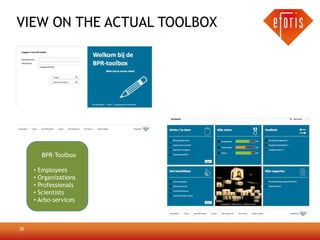
VIEW ON THE ACTUAL TOOLBOX


       BPR-Toolbox

     • Employees
     • Organizations
     • Professionals
     • Scientists
     • Arbo-services


30
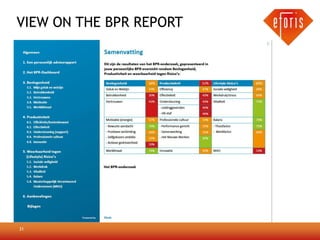
VIEW ON THE BPR REPORT


31
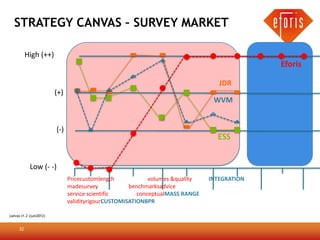
STRATEGY CANVAS – SURVEY MARKET

           High (++)
                                                                                             Eforis

                                                                                  JDR
                         (+)
                                                                                WVM


                         (-)
                                                                                 ESS


            Low (- -)
                               Pricecustomlength            volumes &quality   INTEGRATION
                               madesurvey            benchmarksadvice
                               service scientific       conceptualMASS RANGE
                               validityrigourCUSTOMISATIONBPR

canvas v1.2 (juni2012)


      32
CONSEQUENCES FOR C & B

• Support the Most Advanced (Applicable), Yet Acceptable solution
  (Maya principle)
• C & B should support more complex development phases by
  creating new approaches, and transform from:
     –   Control to Connectedness
     –   Procedures bases on uniformity (N= ∞) to Individualism (N=1)
     –   Materialistic to Idealistic
     –   From Status oriented to Growth and Development (learning)
     –   From Static to Dynamics
     –   From Rights to Possibilities
     –   From C&B 1.0 to C&B 2.0


33
                                                                        33
CONTACT

Sciencerelated              Salesordemonstration?
Marcel van Marrewijk        Bob Zeegers
E: marcel@vanmarrewijk.nl   E: Bob.zeegers@eforis.nl
M: + 31 (0) 6 8 1953 777    M: + 31 (0) 6 11 000 818

                            Berry Tanis
                            E: berry.tanis@eforis.nl
                            M: + 31 (0) 6 54 957 321


                            www.eforis.nl


                                                       34
                                                       34

20121004 v1.0 final

  • 1.
    4 October 2012 IEBA byMarcel van Marrewijk A next level in employee benefits Moving from pampering and pleasing to inspiring and teasing Balancing and aligning employees and corporate needs Implications for monitoring, HR and health management V1.0 1
  • 2.
    SHORT INTRODUCTION Marcel vanMarrewijk Expertise in hi-endsurveys&assessments Teamed-up with scientists from EUR & UU Research to Improve; former CEO Great Place to Work Author of 16 academic papers including Journal of Business Ethics(top 30 most influential papers over the last 30 years) Author of the "Cubrix, an integral framework for organizational development and performance improvement 2
  • 3.
    AGENDA • Introduction • Changing world – Complexity – Necessity to transform towards next levels of development • New insights – Happiness@work – Organizational Energy – Cubrix - integral framework • Towards thriving and sustainable organizations – New concept of Good Employership • Eforis: a truly innovative format for empowering employees – BPR Toolbox 3
  • 4.
  • 5.
    Spectrum for organisationdevelopment and performance improvement - www.cub
  • 6.
  • 7.
    COMPLEXITY & CHAOS A problem is a conflict between two necessary conditions Inclusivity complexity CHAOS Stacey Graves Goldratt Development Grades of freedom 7
  • 8.
    SOLVING A MANAGEMENTDILEMMA A resource standing idle is a major waste Cost World to control cost to protect sales Throughput World 8 Bron: Goldratt
  • 9.
    “THE WORLD WILLNOT EVOLVE PAST ITS CURRENT STATE, BY USING THE SAME THINKING THAT CREATED THE SITUATION.” ALBERT EINSTEIN 9
  • 10.
    PARADIGMS OF CHANGE Connectedness Control Authority 10
  • 11.
    TRANSITIONS IN PEOPLEMANAGEMENT Administrative (P&O) Human Resources (Fit) •Recruitment (hire & fire) •Personnel planning •Pay rolling / C&B (selection, socialization, career planning) •Workplace conditions •Training & education (skills) •Competences (tasks) •Preventing absenteeism Talent development Human Alignment •Personal growth •Aligning personal goals & •Professional development corporate ambitions •Team performance •Co-creating a common future •Health & vitality •Diversity •Corporate citizenship 11
  • 12.
    THE UNDERCURRENTS OFCORPORATE HR Focus on corporate environments and people management • Polarization (solidarity; generations; haves & have not's) • War for talents • Globalization • Diversity (linkage with the integration of minority groups) • Transparency (gender gap; market conformity) • Flexibility (HNW: workplaces; work-life balance; labour market) • Attach & Attract (binden&boeien) • Lifestyle risks & health • Psychological related problems • … and more 12
  • 13.
    WORK-RELATED PSYCHOLOGICAL PROBLEMS • Work is an important part of everyday life – Work provides positive contributions to our psychological well-being (personal development, income, steady job, social contacts and gives our life meaning). – Working conditions can also be a threat to our mental health (unhealthy stress, leading to burnout and serious health-related symptoms). • Many employees have psychological problems – Over 20 % of the people who work experience psychological symptoms every year, with 14% of them related to mood or anxiety disorders. – 40-44% of all the mental problems leading to absenteeism and disability can be attributed to working conditions • Burnout and stress are common disorders – 10% of the work force (6,800,000 people in the Netherlands) suffer from serious burnout, and over 4% even clinical burnout), all work-related: 270,000 employees are annually in need of professional treatment. • Mental problems often lead to prolonged absenteeism • The costs of work-related mental problems are high 13 Source: Trimbos
  • 14.
    NEW INSIGHTS ANDUNDERSTANDING From the disciplines of management science and positive psychology • Happiness@work (GelukkigWerken) – Onno Hamburger • The value of happiness – dr. Gretchen Spreitzer& dr. Christine Porath • Organizational Energy – Prof.dr. Heike Bruch • The Progress Principle – Prof.dr. Teresa Amabile, Research director Harvard BS • Beyond Performance – McKinsey: Scott Keller & Colin Price • Cubrix, an integral framework for organization development and performance improvement 14
  • 15.
    HAPINESS PYRAMID Support others (building together) Sense making Do what fits you (dreams and passions) Satisfaction Apply your core qualities Accept and appreciate what is (being) Pleasure It starts with happiness ... It will provoke the rest! 15 Source: Onno Hamburger
  • 16.
    CREATING SUSTAINABLE PERFORMANCE HBR: GRETCHEN SPREITZER AND CHRISTINE PORATH What drives sustainable individual and organizational performance? Employees who are thriving - not just satisfied and productive, but also engaged in creating the future. People who fit this description demonstrated: • 16% better overall performance • 125% less burnout • 32% more commitment to the organization • 46% more job satisfaction than their peers. 16
  • 17.
    THRIVING PERFORMANCE HBR: GRETCHEN SPREITZER AND CHRISTINE PORATH Thriving has two components: • vitality, or the sense of being alive and excited, and • learning, or the growth that comes from gaining knowledge and skills. Four mechanisms create the conditions for thriving: • providing decision-making discretion • sharing information about the organization and its strategy • minimizing incivility (lack of good manners) • offering performance feedback. Helping people grow and remain energized at work is valiant on its own merits—but it can also boost performance in a sustainable way. 17
  • 18.
    NEW INSIGHTS (SCIENTIFICLY VALIDATED) • Prof. Teresa Amabile conducted a rigorous analysis of nearly 12,000 diary entries provided by 238 employees in 7 companies. • She noticed that seemingly mundane workday events can make or break employees' inner work lives. • Managers can foster progress and enhance inner work by: – Removing obstacles such as meaningless tasks and toxic relationships – Activating catalysts that directly facilitate project work, such as clear goals and autonomy – Uplifting workers, through encouragements and demonstrations of respect and collegiality, • She concluded that happiness boosts creativity by 50% and productivity with 25%-30% when employees are successfully engaged with meaningful work. [The Progress Principle: Using Small Wins to Ignite Joy, Engagement, and Creativity at Work, 2011, Harvard Review Press, Boston] 18
  • 19.
    NEW INSIGHTS (SCIENTIFICLY VALIDATED) Organizational Energy Prof.dr. Heike Bruch conducted a research among 14.000 employees and concluded that organizations with intrinsic positive energy perform better: They achieve 27% higher turnover, they accomplish 19% higher productivity, they work 20% more efficient, they get a 15% higher customer satisfaction and are 21% less troubled by retention. Hyper Energy Zombie Comfort Energy zones 19
  • 20.
    NEW INSIGHTS (SCIENTIFICLY VALIDATED) McKinsey consultants Scott Keller en Colin Price focused on “How to build an organization that can execute in the short run and has the vitality to prosper over the long term”. They were engaged in a 10-year period of studying organizational effectiveness and change management, while involving 600,000 employees in over 500 corporations. The authors concluded that the health of an organization is equally as important as its performance. Beyond Corporate health is related to the ability to adapt smoothly Performance to changing circumstances (being alert, open), the ability to New York, act swiftly (drive, motivation, attitude) and the ability to 2011 innovate and reinvent itself. The profitability of healthy companies is 220% higher than the performance of unhealthy organizations and growth is 200% higher! 20
  • 21.
    NEW INSIGHTS Cubrix, an integral framework for organization development and performance improvement. Marcel van Marrewijk, 2011 • Cubrix provides concepts and multiple languages to structure organizational contexts, and align them with management interventions and tools, competences and skills, institutions and practices, and more... • Cubrix generates an organization matrix, seven organization types, four projectmanagement approaches and four ambitions for change. Development Paths (Enablers) R A E R S E U A L S T Development phases 21
  • 22.
    VALUEBASED LEADERSHIP Holism Holistic leader: Vulnerable, leading the mission; inspiring Synergy Emergent Leader: visionary, communicative, challenging, long term orientation Servant Leader: supportive, caring, personal Community growth, forgiving, coaching, emphatic Success Entrepreneur: courage, rewarding, result oriented, accountability Order Manager: facilitator, purposeful, monitoring, planning & control Power-energy Boss: authoritarian, decisive, competitive, corrective Security Founder: role model, mediator, story teller, Pater Familias 22 Dirk van Dierendonck, RSM & Marcel van Marrewijk, RTI
  • 23.
    SEVEN TYPES OFORGANISATIONS Inclusivity complexity Development Grades of freedom 23
  • 24.
    IMPROVE DO Vitalise Optimise PLAN Re-orientate CHECK Transform IMPROVE 24
  • 25.
    GOOD EMPLOYERSHIP (20thcentury style) The traditional approach to Good Employership is pleasing and pampering employees in the hope that they will improve performances. Focus on "satisfaction" Rankings: Great Place to Work, "Goed Werkgeverschap" & "Topwerkgevers" 25
  • 26.
    Successful Employership (GW anno 2012) Successful Employership implies committed employees: By establishing a new balance based on trust and appreciation and a organizational culture in which employees grow their talents, develop their professional skills and are provided with discretionary space to take responsibility and co-create the (corporate) future. "It takes two to tango" 26
  • 27.
    THE MARKET ISREADY … FOR SOMETHING NEW! • 53% employers think that they are allowed to intervene into the health of employees • 72% employees feel themselves responsible for their employability • 80% employees allow employers to confront them on these matters • 91% would like to get an annual health check, but actually 13% receives one… 27 (1) Arbomonitor 2010 (2-4) SZW
  • 28.
    MISSION Eforis wants tocontribute to improving and sustaining the performance of employees and organizations, through a value innovation strategy. By providing a hi-quality online toolbox which generates understanding, advice and support on the core topics of Engagement, Productivity and tenability with respect to (lifestyle) Risks. This way the Eforis approach supports the development and performance improvement of organizations, with respect to: – Attractive workplaces (Good Employership) – High Performance Organizations (Good Entrepreneurship) – Sustainable organizations (CSR) 28
  • 29.
    BPR PRINCIPLES • Value innovation strategy: 10 x better & 10 x cheaper • From a push to a pull strategy • Employee ownership • Science Inside • Insight + Advice + Support • Co-creating and partnerships • Employee ownership 29
  • 30.
    VIEW ON THEACTUAL TOOLBOX BPR-Toolbox • Employees • Organizations • Professionals • Scientists • Arbo-services 30
  • 31.
    VIEW ON THEBPR REPORT 31
  • 32.
    STRATEGY CANVAS –SURVEY MARKET High (++) Eforis JDR (+) WVM (-) ESS Low (- -) Pricecustomlength volumes &quality INTEGRATION madesurvey benchmarksadvice service scientific conceptualMASS RANGE validityrigourCUSTOMISATIONBPR canvas v1.2 (juni2012) 32
  • 33.
    CONSEQUENCES FOR C& B • Support the Most Advanced (Applicable), Yet Acceptable solution (Maya principle) • C & B should support more complex development phases by creating new approaches, and transform from: – Control to Connectedness – Procedures bases on uniformity (N= ∞) to Individualism (N=1) – Materialistic to Idealistic – From Status oriented to Growth and Development (learning) – From Static to Dynamics – From Rights to Possibilities – From C&B 1.0 to C&B 2.0 33 33
  • 34.
    CONTACT Sciencerelated Salesordemonstration? Marcel van Marrewijk Bob Zeegers E: marcel@vanmarrewijk.nl E: Bob.zeegers@eforis.nl M: + 31 (0) 6 8 1953 777 M: + 31 (0) 6 11 000 818 Berry Tanis E: berry.tanis@eforis.nl M: + 31 (0) 6 54 957 321 www.eforis.nl 34 34