AGILE ADDICTION
Patterns for changing organizations
Emiliano Soldi
@AgileTriathlete
#AgileAddictionVia Arcivescovo Calabiana, 6 - MilanoJUNE 14TH 2019
Addiction is a brain disorder characterized
by compulsive engagement in rewarding stimuli
despite adverse consequences.
[...]
Two properties characterize all addictive stimuli:
they are reinforcing and intrinsically rewarding.
Wikipedia
ADDICTION
Addiction is a brain disorder characterized
by compulsive engagement in rewarding stimuli
despite adverse consequences.
[...]
Two properties characterize all addictive stimuli:
they are reinforcing and intrinsically rewarding.
Wikipedia
ADDICTION
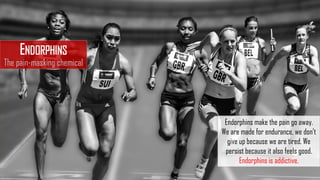
ENDORPHINS
The pain-masking chemical
Endorphins make the pain go away.
We are made for endurance, we don’t
give up because we are tired. We
persist because it also feels good.
Endorphins is addictive.
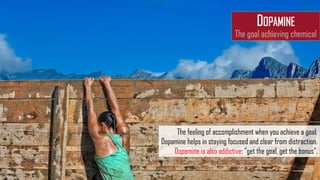
The feeling of accomplishment when you achieve a goal.
Dopamine helps in staying focused and clear from distraction.
Dopamine is also addictive: "get the goal, get the bonus".
DOPAMINE
The goal achieving chemical
YES, CLEAR.
BUT, WHAT DOES THAT HAS TO DO WITH AGILE?
INDIVIDUALS AND INTERACTIONS
OVER
PROCESS AND TOOLS
Isn't this also terribly addictive?
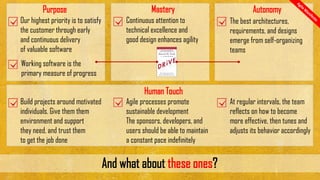
Our highest priority is to satisfy
the customer through early
and continuous delivery
of valuable software
Working software is the
primary measure of progress
Purpose Mastery
Continuous attention to
technical excellence and
good design enhances agility
Autonomy
The best architectures,
requirements, and designs
emerge from self-organizing
teams
Human Touch
Build projects around motivated
individuals. Give them them
environment and support
they need, and trust them
to get the job done
Agile processes promote
sustainable development
The sponsors, developers, and
users should be able to maintain
a constant pace indefinitely
At regular intervals, the team
reflects on how to become
more effective, then tunes and
adjusts its behavior accordingly
And what about these ones?
HOW POWERFUL WOULD IT BE
IF WE COULD PUT OUR PERSONAL ADDICTION
AT THE SERVICE OF THE AGILE ONE?
COOL, READY!
SHALL WE START?
CURIOSITY
PASSION
BUILD YOUR SELF-CONFIDENCE
STUDYING
A lot, actually
Mastering Agile means to know a lot in different,
adjacent areas (e.g. product vs project management,
scaling frameworks, change management, complexity
theory, system thinking, lean, etc.). Additionally,
acquiring skills like facilitating, training and coaching,
is key to Agile adoption within teams and organization.
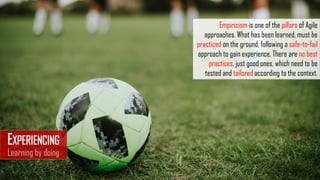
EXPERIENCING
Learning by doing
Empiricism is one of the pillars of Agile
approaches. What has been learned, must be
practiced on the ground, following a safe-to-fail
approach to gain experience. There are no best
practices, just good ones, which need to be
tested and tailored according to the context.
PARTICIPATING
Living the Agile Community
GROW YOUR TEAM
BUILD YOUR TEAM
Creating strong bonds
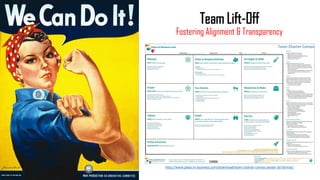
Team Lift-Off
Fostering Alignment & Transparency
http://www.plays-in-business.com/download/team-charter-canvas-poster-a0-format/
IMPROVE YOUR TEAM
Driving Continuous Improvement
Continuous improvement is central to any
agile teams. Every iteration shall bring
betterments in product or process aspects
and in teams behaviors and ways of
working. Teams need guidance and support
to be develop such an important mindset.
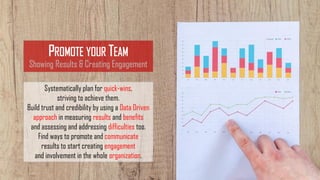
PROMOTE YOUR TEAM
Showing Results & Creating Engagement
Systematically plan for quick-wins,
striving to achieve them.
Build trust and credibility by using a Data Driven
approach in measuring results and benefits
and assessing and addressing difficulties too.
Find ways to promote and communicate
results to start creating engagement
and involvement in the whole organization.
PREPARE FOR SCALING
STRENGTHEN YOUR RESILIENCE
CHANGE IS SCARING
Dancing with uncertainty
Agile radically change the way people work in
organizations. Working in small, cross-functional
teams increases transparency, collaboration,
direct communication, engagement, This can be
scary and needs to be managed accordingly.
Empatia
EMPATHY
Synching with others
Develop your empathy to understand others’ point
of view, acknowledging any difficulties or doubts.
You will become more aware of impacts and any
possible resistance you could encounter.
PEER COACHING
Exploring alternatives
Find someone who shares your passion for Agile. Develop
mutual trust. Organize regular peer-coaching sessions,
to help each other face the challenges of change
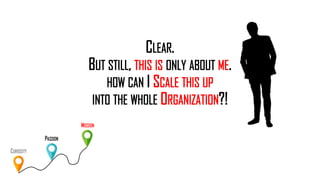
CLEAR.
BUT STILL, THIS IS ONLY ABOUT ME.
HOW CAN I SCALE THIS UP
INTO THE WHOLE ORGANIZATION?!
CURIOSITY
PASSION
MISSION
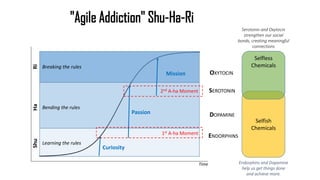
Time
Shu
Passion
Selfish
Chemicals
Selfless
Chemicals
"Agile Addiction" Shu-Ha-Ri
Bending the rules
Breaking the rules
ENDORPHINS
DOPAMINE
SEROTONIN
OXYTOCIN
2nd A-ha Moment
Endorphins and Dopamine
help us get things done
and achieve more.
Serotonin and Oxytocin
strengthen our social
bonds, creating meaningful
connections
Learning the rules
1st A-ha Moment
Curiosity
Mission
HaRi
LEAD THE CHANGE
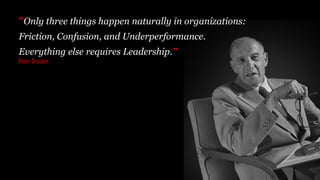
”Only three things happen naturally in organizations:
Friction, Confusion, and Underperformance.
Everything else requires Leadership.”
Peter Drucker
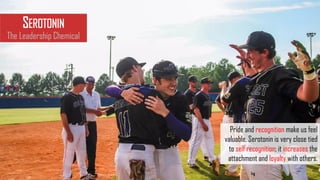
Pride and recognition make us feel
valuable. Serotonin is very close tied
to self recognition; it increases the
attachment and loyalty with others.
SEROTONIN
The Leadership Chemical
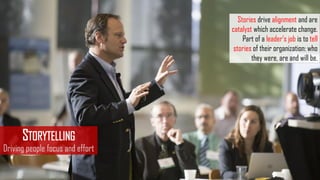
Stories drive alignment and are
catalyst which accelerate change.
Part of a leader’s job is to tell
stories of their organization: who
they were, are and will be.
STORYTELLING
Driving people focus and effort
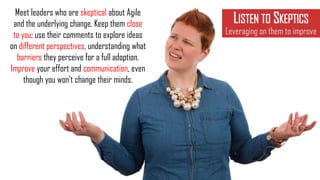
Meet leaders who are skeptical about Agile
and the underlying change. Keep them close
to you; use their comments to explore ideas
on different perspectives, understanding what
barriers they perceive for a full adoption.
Improve your effort and communication, even
though you won't change their minds.
LISTEN TO SKEPTICS
Leveraging on them to improve
DEVELOP YOUR TRIBE
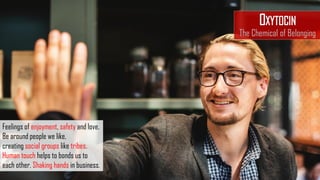
Feelings of enjoyment, safety and love.
Be around people we like,
creating social groups like tribes.
Human touch helps to bonds us to
each other. Shaking hands in business.
OXYTOCIN
The Chemical of Belonging
BUILD YOUR TRIBE
"A tribe is a group of people connected
to one another, connected to a leader,
and connected to an idea"
Seth Godin
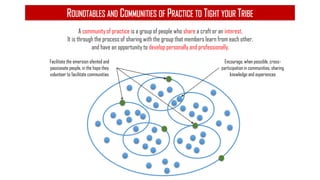
Encourage, when possible, cross-
participation in communities, sharing
knowledge and experiences
ROUNDTABLES AND COMMUNITIES OF PRACTICE TO TIGHT YOUR TRIBE
Facilitate the emersion ofented and
passionate people, in the hope they
volunteer to facilitate communities
A community of practice is a group of people who share a craft or an interest.
It is through the process of sharing with the group that members learn from each other,
and have an opportunity to develop personally and professionally.
EXECUTE THE CHANGE
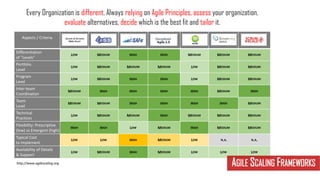
Aspects / Criteria
Differentiation
of "Levels"
LOW MEDIUM HIGH HIGH MEDIUM MEDIUM MEDIUM
Portfolio
Level
LOW MEDIUM MEDIUM MEDIUM LOW MEDIUM MEDIUM
Program
Level
LOW MEDIUM HIGH HIGH LOW MEDIUM MEDIUM
Inter-team
Coordination
MEDIUM HIGH HIGH HIGH HIGH MEDIUM HIGH
Team
Level
MEDIUM MEDIUM HIGH HIGH HIGH HIGH MEDIUM
Technical
Practices
LOW MEDIUM MEDIUM HIGH MEDIUM MEDIUM MEDIUM
Flexibility: Prescriptive
(low) vs Emergent (high)
HIGH HIGH LOW MEDIUM HIGH MEDIUM MEDIUM
Typical Cost
to Implement
LOW LOW HIGH MEDIUM LOW N.A. N.A.
Availability of Details
& Support
LOW MEDIUM HIGH MEDIUM LOW LOW LOW
http://www.agilescaling.org AGILE SCALING FRAMEWORKS
Every Organization is different. Always relying on Agile Principles, assess your organization,
evaluate alternatives, decide which is the best fit and tailor it.
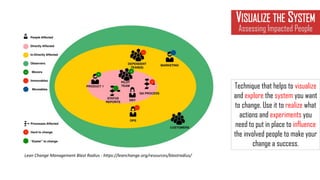
Technique that helps to visualize
and explore the system you want
to change. Use it to realize what
actions and experiments you
need to put in place to influence
the involved people to make your
change a success.
VISUALIZE THE SYSTEM
Assessing Impacted People
Lean Change Management Blast Radius - https://leanchange.org/resources/blastradius/
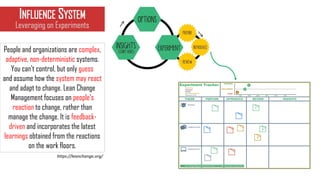
INFLUENCE SYSTEM
Leveraging on Experiments
People and organizations are complex,
adaptive, non-deterministic systems.
You can't control, but only guess
and assume how the system may react
and adapt to change. Lean Change
Management focuses on people's
reaction to change, rather than
manage the change. It is feedback-
driven and incorporates the latest
learnings obtained from the reactions
on the work floors.
https://leanchange.org/
YES, I DEFINITELY THINK THAT AGILE IS A KIND OF ADDICTION.
IT'S A MEAN TO MAKE HARD WORK COEXIST WITH HIGH LEVELS OF CREATIVITY,
COLLABORATION, ENGAGEMENT, AUTONOMY AND, WHY NOT, HAPPINESS.
AND THAT'S EXACTLY WHEN ENDORPHINS, DOPAMINE,
SEROTONIN AND OXYTOCIN ARE TRIGGERED IN UNISON,
BOOSTING THE QUALITY, EFFECTIVENESS AND VALUE OF OUR WORK.
Emiliano Soldi
@AgileTriathlete
https://www.linkedin.com/in/emilianosoldi/

Agile addiction patterns for changing organizations

  • 1.
    AGILE ADDICTION Patterns forchanging organizations Emiliano Soldi @AgileTriathlete #AgileAddictionVia Arcivescovo Calabiana, 6 - MilanoJUNE 14TH 2019
  • 2.
    Addiction is abrain disorder characterized by compulsive engagement in rewarding stimuli despite adverse consequences. [...] Two properties characterize all addictive stimuli: they are reinforcing and intrinsically rewarding. Wikipedia ADDICTION
  • 3.
    Addiction is abrain disorder characterized by compulsive engagement in rewarding stimuli despite adverse consequences. [...] Two properties characterize all addictive stimuli: they are reinforcing and intrinsically rewarding. Wikipedia ADDICTION
  • 4.
    ENDORPHINS The pain-masking chemical Endorphinsmake the pain go away. We are made for endurance, we don’t give up because we are tired. We persist because it also feels good. Endorphins is addictive.
  • 5.
    The feeling ofaccomplishment when you achieve a goal. Dopamine helps in staying focused and clear from distraction. Dopamine is also addictive: "get the goal, get the bonus". DOPAMINE The goal achieving chemical
  • 6.
    YES, CLEAR. BUT, WHATDOES THAT HAS TO DO WITH AGILE?
  • 7.
    INDIVIDUALS AND INTERACTIONS OVER PROCESSAND TOOLS Isn't this also terribly addictive?
  • 8.
    Our highest priorityis to satisfy the customer through early and continuous delivery of valuable software Working software is the primary measure of progress Purpose Mastery Continuous attention to technical excellence and good design enhances agility Autonomy The best architectures, requirements, and designs emerge from self-organizing teams Human Touch Build projects around motivated individuals. Give them them environment and support they need, and trust them to get the job done Agile processes promote sustainable development The sponsors, developers, and users should be able to maintain a constant pace indefinitely At regular intervals, the team reflects on how to become more effective, then tunes and adjusts its behavior accordingly And what about these ones?
  • 9.
    HOW POWERFUL WOULDIT BE IF WE COULD PUT OUR PERSONAL ADDICTION AT THE SERVICE OF THE AGILE ONE?
  • 10.
    COOL, READY! SHALL WESTART? CURIOSITY PASSION
  • 11.
  • 12.
    STUDYING A lot, actually MasteringAgile means to know a lot in different, adjacent areas (e.g. product vs project management, scaling frameworks, change management, complexity theory, system thinking, lean, etc.). Additionally, acquiring skills like facilitating, training and coaching, is key to Agile adoption within teams and organization.
  • 13.
    EXPERIENCING Learning by doing Empiricismis one of the pillars of Agile approaches. What has been learned, must be practiced on the ground, following a safe-to-fail approach to gain experience. There are no best practices, just good ones, which need to be tested and tailored according to the context.
  • 14.
  • 15.
  • 16.
  • 17.
    Team Lift-Off Fostering Alignment& Transparency http://www.plays-in-business.com/download/team-charter-canvas-poster-a0-format/
  • 18.
    IMPROVE YOUR TEAM DrivingContinuous Improvement Continuous improvement is central to any agile teams. Every iteration shall bring betterments in product or process aspects and in teams behaviors and ways of working. Teams need guidance and support to be develop such an important mindset.
  • 19.
    PROMOTE YOUR TEAM ShowingResults & Creating Engagement Systematically plan for quick-wins, striving to achieve them. Build trust and credibility by using a Data Driven approach in measuring results and benefits and assessing and addressing difficulties too. Find ways to promote and communicate results to start creating engagement and involvement in the whole organization.
  • 20.
  • 21.
    CHANGE IS SCARING Dancingwith uncertainty Agile radically change the way people work in organizations. Working in small, cross-functional teams increases transparency, collaboration, direct communication, engagement, This can be scary and needs to be managed accordingly.
  • 22.
    Empatia EMPATHY Synching with others Developyour empathy to understand others’ point of view, acknowledging any difficulties or doubts. You will become more aware of impacts and any possible resistance you could encounter.
  • 23.
    PEER COACHING Exploring alternatives Findsomeone who shares your passion for Agile. Develop mutual trust. Organize regular peer-coaching sessions, to help each other face the challenges of change
  • 24.
    CLEAR. BUT STILL, THISIS ONLY ABOUT ME. HOW CAN I SCALE THIS UP INTO THE WHOLE ORGANIZATION?! CURIOSITY PASSION MISSION
  • 25.
    Time Shu Passion Selfish Chemicals Selfless Chemicals "Agile Addiction" Shu-Ha-Ri Bendingthe rules Breaking the rules ENDORPHINS DOPAMINE SEROTONIN OXYTOCIN 2nd A-ha Moment Endorphins and Dopamine help us get things done and achieve more. Serotonin and Oxytocin strengthen our social bonds, creating meaningful connections Learning the rules 1st A-ha Moment Curiosity Mission HaRi
  • 26.
  • 27.
    ”Only three thingshappen naturally in organizations: Friction, Confusion, and Underperformance. Everything else requires Leadership.” Peter Drucker
  • 28.
    Pride and recognitionmake us feel valuable. Serotonin is very close tied to self recognition; it increases the attachment and loyalty with others. SEROTONIN The Leadership Chemical
  • 29.
    Stories drive alignmentand are catalyst which accelerate change. Part of a leader’s job is to tell stories of their organization: who they were, are and will be. STORYTELLING Driving people focus and effort
  • 30.
    Meet leaders whoare skeptical about Agile and the underlying change. Keep them close to you; use their comments to explore ideas on different perspectives, understanding what barriers they perceive for a full adoption. Improve your effort and communication, even though you won't change their minds. LISTEN TO SKEPTICS Leveraging on them to improve
  • 31.
  • 32.
    Feelings of enjoyment,safety and love. Be around people we like, creating social groups like tribes. Human touch helps to bonds us to each other. Shaking hands in business. OXYTOCIN The Chemical of Belonging
  • 33.
    BUILD YOUR TRIBE "Atribe is a group of people connected to one another, connected to a leader, and connected to an idea" Seth Godin
  • 34.
    Encourage, when possible,cross- participation in communities, sharing knowledge and experiences ROUNDTABLES AND COMMUNITIES OF PRACTICE TO TIGHT YOUR TRIBE Facilitate the emersion ofented and passionate people, in the hope they volunteer to facilitate communities A community of practice is a group of people who share a craft or an interest. It is through the process of sharing with the group that members learn from each other, and have an opportunity to develop personally and professionally.
  • 35.
  • 36.
    Aspects / Criteria Differentiation of"Levels" LOW MEDIUM HIGH HIGH MEDIUM MEDIUM MEDIUM Portfolio Level LOW MEDIUM MEDIUM MEDIUM LOW MEDIUM MEDIUM Program Level LOW MEDIUM HIGH HIGH LOW MEDIUM MEDIUM Inter-team Coordination MEDIUM HIGH HIGH HIGH HIGH MEDIUM HIGH Team Level MEDIUM MEDIUM HIGH HIGH HIGH HIGH MEDIUM Technical Practices LOW MEDIUM MEDIUM HIGH MEDIUM MEDIUM MEDIUM Flexibility: Prescriptive (low) vs Emergent (high) HIGH HIGH LOW MEDIUM HIGH MEDIUM MEDIUM Typical Cost to Implement LOW LOW HIGH MEDIUM LOW N.A. N.A. Availability of Details & Support LOW MEDIUM HIGH MEDIUM LOW LOW LOW http://www.agilescaling.org AGILE SCALING FRAMEWORKS Every Organization is different. Always relying on Agile Principles, assess your organization, evaluate alternatives, decide which is the best fit and tailor it.
  • 37.
    Technique that helpsto visualize and explore the system you want to change. Use it to realize what actions and experiments you need to put in place to influence the involved people to make your change a success. VISUALIZE THE SYSTEM Assessing Impacted People Lean Change Management Blast Radius - https://leanchange.org/resources/blastradius/
  • 38.
    INFLUENCE SYSTEM Leveraging onExperiments People and organizations are complex, adaptive, non-deterministic systems. You can't control, but only guess and assume how the system may react and adapt to change. Lean Change Management focuses on people's reaction to change, rather than manage the change. It is feedback- driven and incorporates the latest learnings obtained from the reactions on the work floors. https://leanchange.org/
  • 39.
    YES, I DEFINITELYTHINK THAT AGILE IS A KIND OF ADDICTION. IT'S A MEAN TO MAKE HARD WORK COEXIST WITH HIGH LEVELS OF CREATIVITY, COLLABORATION, ENGAGEMENT, AUTONOMY AND, WHY NOT, HAPPINESS. AND THAT'S EXACTLY WHEN ENDORPHINS, DOPAMINE, SEROTONIN AND OXYTOCIN ARE TRIGGERED IN UNISON, BOOSTING THE QUALITY, EFFECTIVENESS AND VALUE OF OUR WORK.
  • 40.