RESEARCH METHODSLecture 1:Introduction to ResearchbyDaing Nasir Ibrahim, Phd, CA(M), FCPAhttp://www.management.usm.my/daing
What Is Research?Definition:  An organised, systematic, data-based critical scientific inquiry or investigation into a specific problem, undertaken with the objective of finding answers or solutions to it.
Outcome:  Information that enables managers to make decisions to rectify problems.
Data : Primary (first-hand) or Secondary (readily available); Quantitative or Qualitative Research Methods:  The ways in which research studies are designed and the procedures by which data are analysedSurvey Methodology:  Research conducted by collecting data and analysing them to come up with answers to various issues of interest to us.
Types of ResearchApplied Research:  Research done with the intention of applying the results of its finding to solving specific problems currently being experienced in the organisation.Basic Research: Research done with the intention to generate more knowledge and understanding of the phenomena that occur and to build theories based on the research results.Both types of research follow the same steps of systematic inquiry to arrive at solutions to problems.
Managers and Research: The value of acquiring research skillsManager as research-based decision makerSubordinate employee as researcherManager as research service buyer or evaluatorManager as evaluator of secondary data sourceResearch specialist
Purpose of ResearchReporting: elementary level; provide an account or summation of data or to generate statistics; simple when data is available; some inference and conclusion drawing.Descriptive Study: Tries to discover answers to the question who, what, when, where, and, sometimes, how.
Purpose of ResearchExplanatory: attempts to explain the reasons for the phenomenon that the descriptive study only observed. The researcher uses theories or at least hypotheses to account for the forces that caused a certain phenomenon to occur.Predictive: Is just as rooted in theory as explanation.Control: Being able to replicate a scenario and dictate a particular outcome is the objective of control
What is a Good Scientific Research?PurposivenessStarted with a definite aim and purposeRigorA good theoretical base and a sound methodological designTestabilityLends itself to testing logically developed hypothesesReplicabilityResearch results supported when research is repeated in other similar circumstances
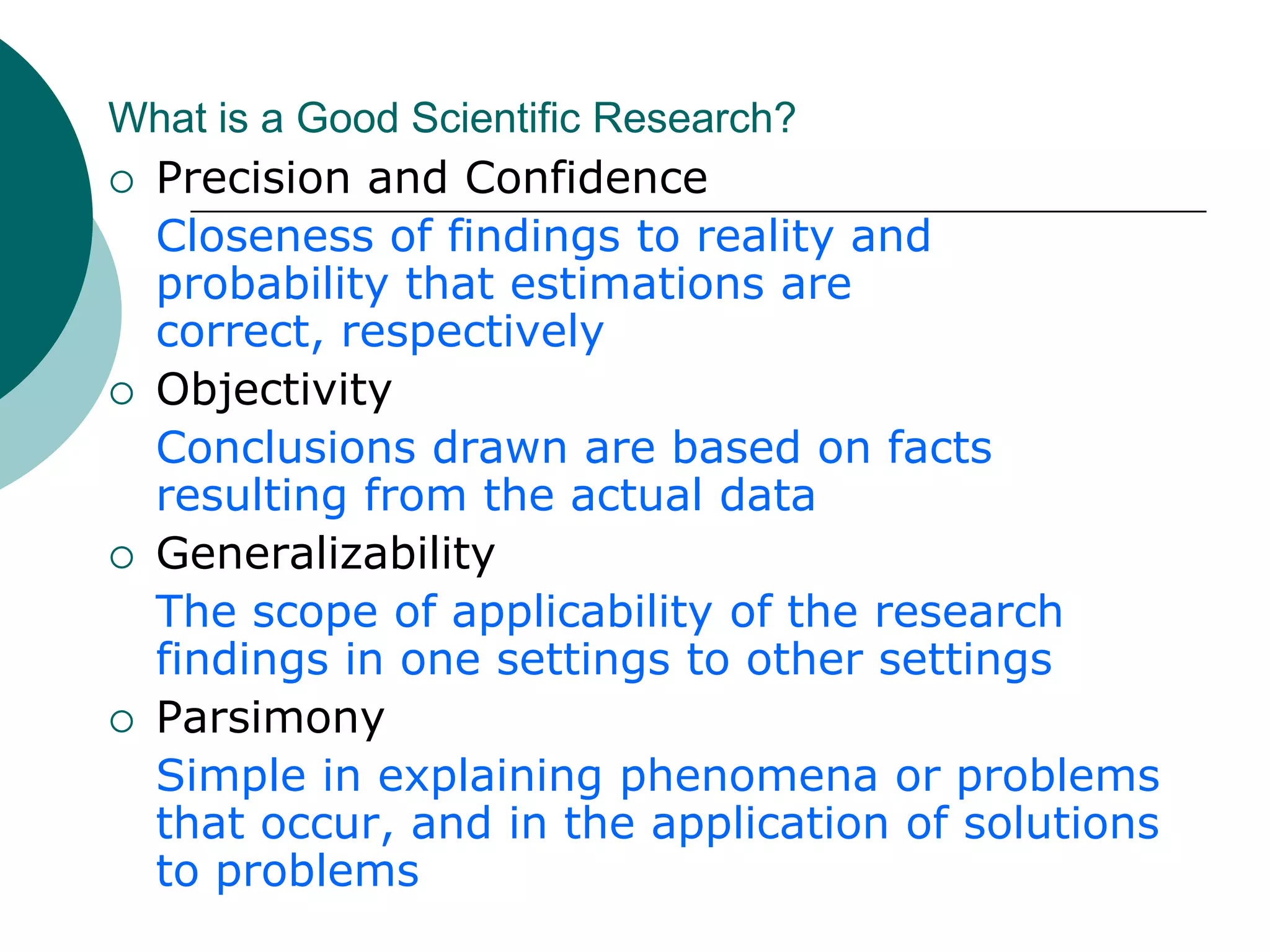
What is a Good Scientific Research?Precision and ConfidenceCloseness of findings to reality and probability that estimations are correct, respectivelyObjectivityConclusions drawn are based on facts resulting from the actual dataGeneralizabilityThe scope of applicability of the research findings in one settings to other settingsParsimonySimple in explaining phenomena or problems that occur, and in the application of solutions to problems
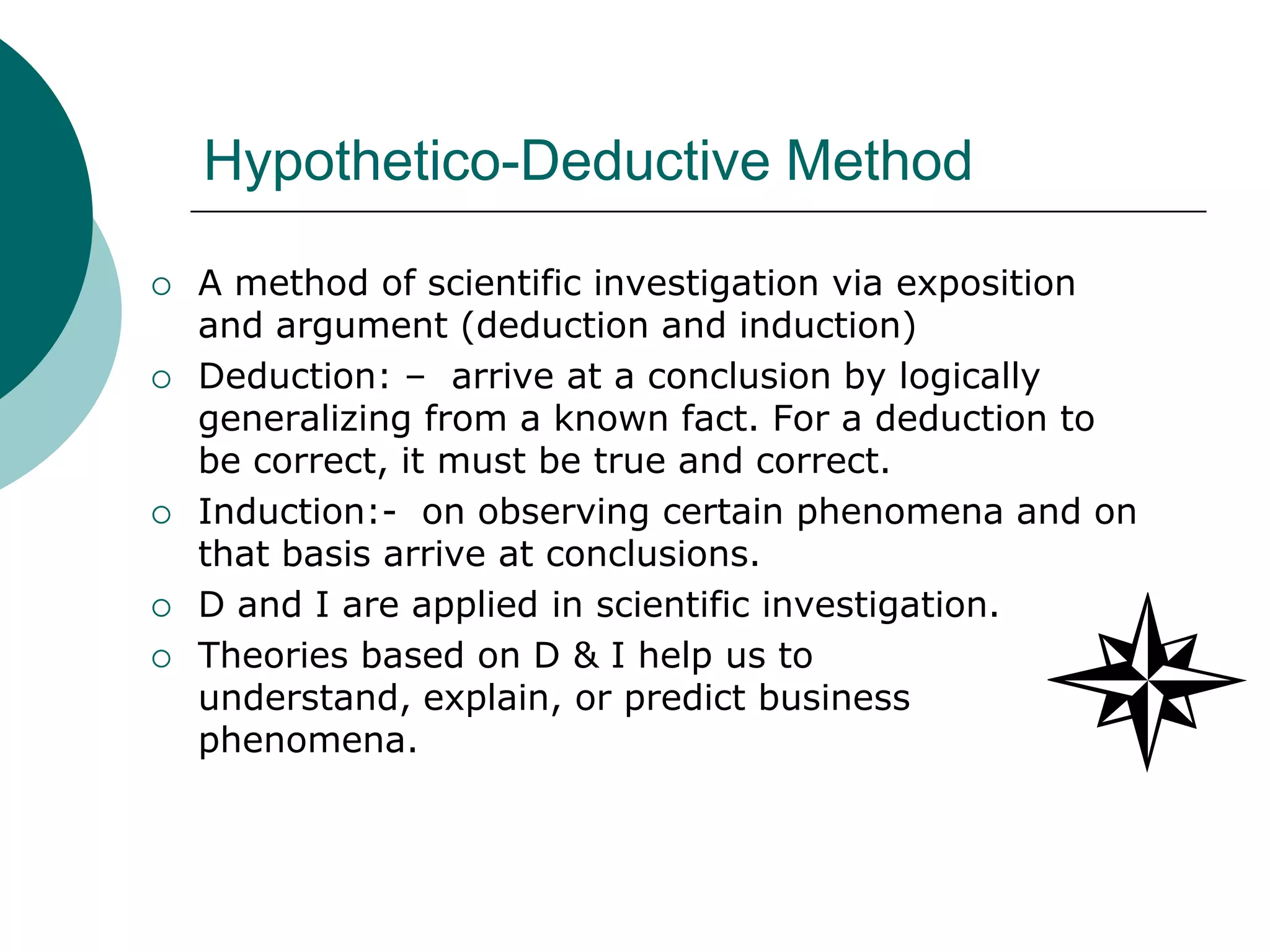
Hypothetico-Deductive MethodA method of scientific investigation via exposition and argument (deduction and induction) Deduction: –  arrive at a conclusion by logically generalizing from a known fact. For a deduction to be correct, it must be true and correct.Induction:-  on observing certain phenomena and on that basis arrive at conclusions.D and I are applied in scientific investigation.Theories based on D & I help us to understand, explain, or predict business phenomena.
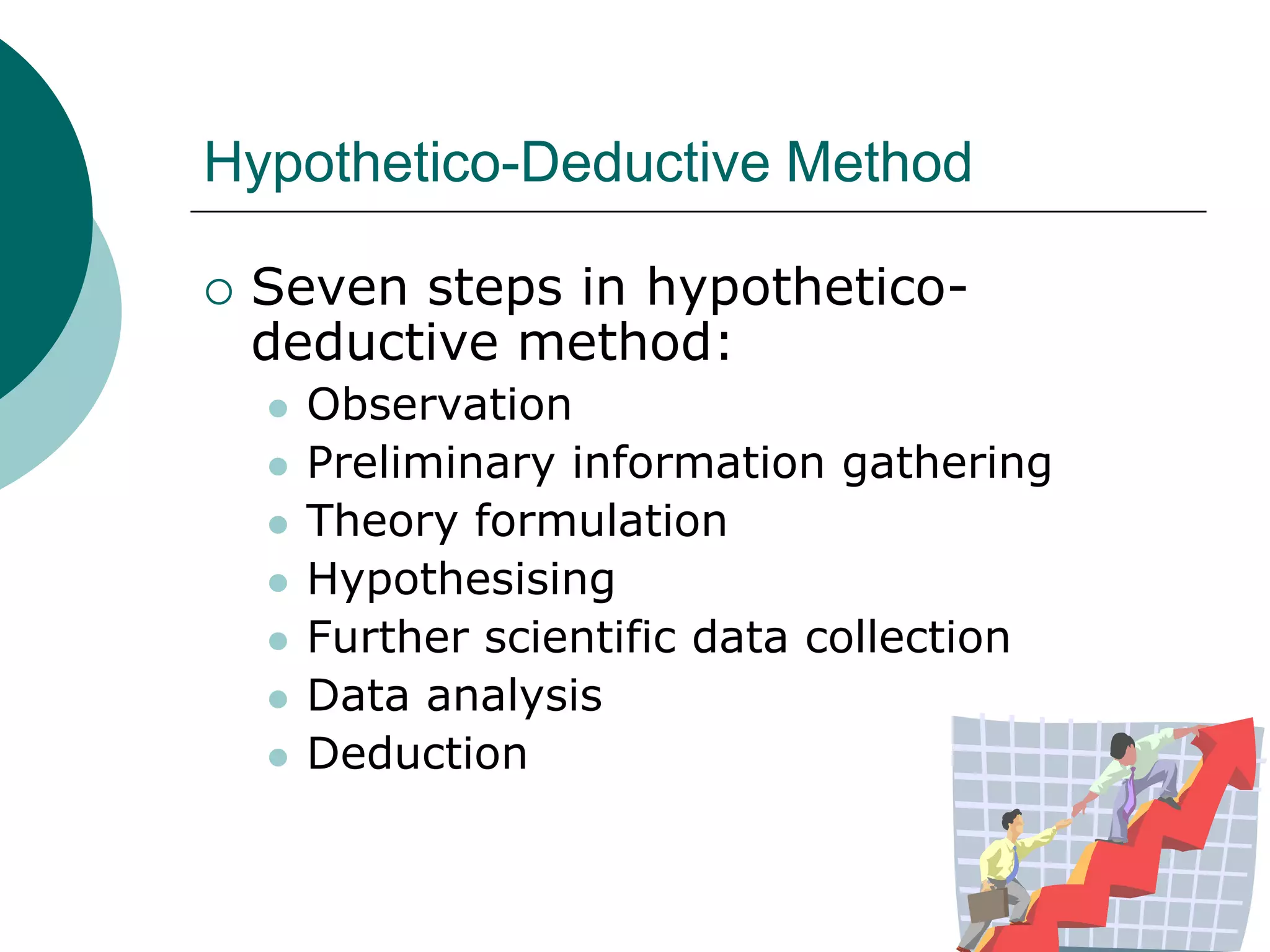
Hypothetico-Deductive MethodSeven steps in hypothetico-deductive method:ObservationPreliminary information gatheringTheory formulationHypothesisingFurther scientific data collectionData analysisDeduction
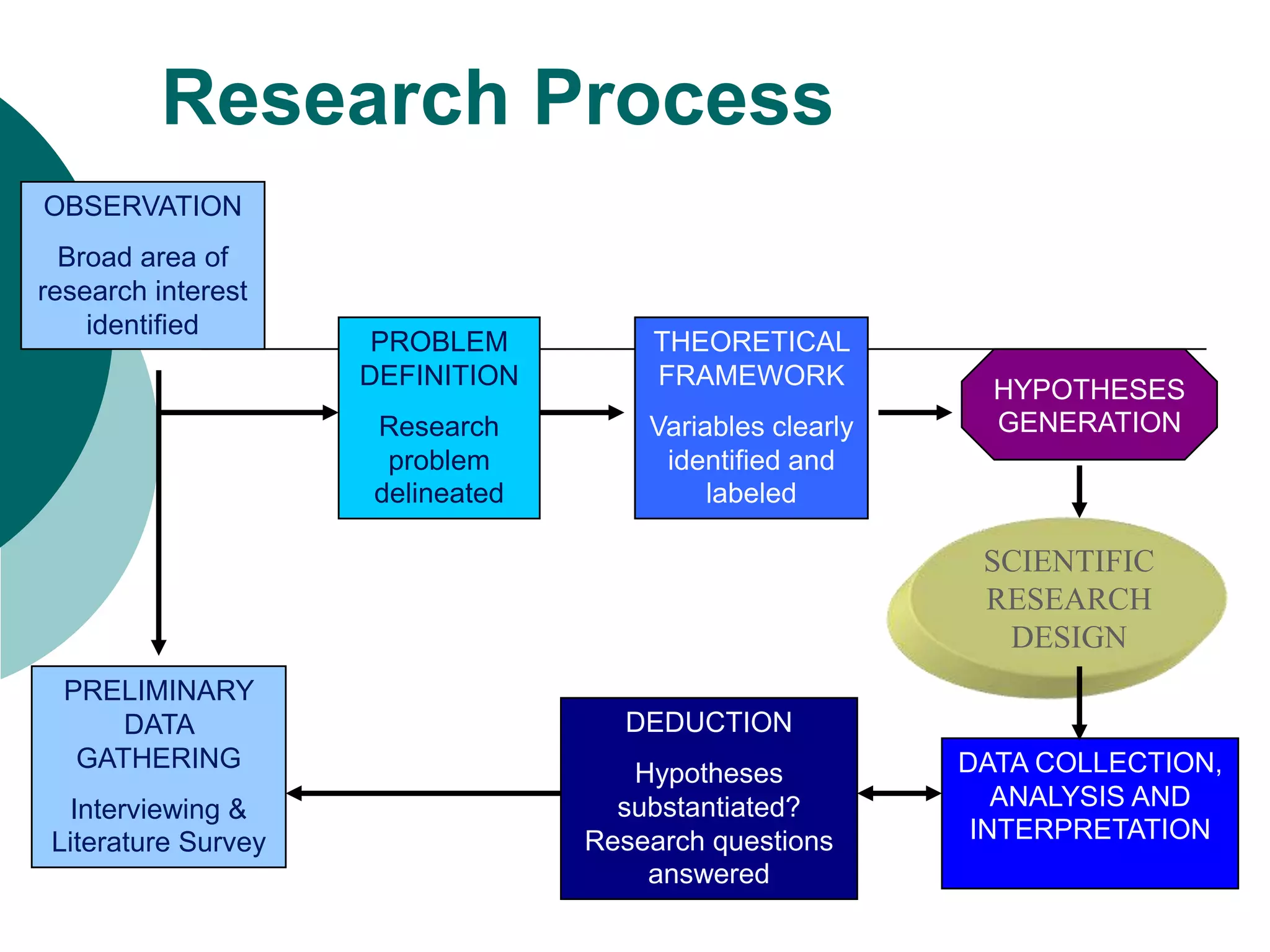
Research ProcessOBSERVATIONBroad area of research interest identifiedPROBLEM DEFINITIONResearch problem delineatedTHEORETICAL FRAMEWORKVariables clearly identified and labeledHYPOTHESES GENERATIONSCIENTIFICRESEARCHDESIGNPRELIMINARY DATA GATHERINGInterviewing & Literature SurveyDEDUCTIONHypotheses substantiated? Research questions answeredDATA COLLECTION, ANALYSIS AND INTERPRETATION

20110801100832 lecture 1 research

  • 1.
    RESEARCH METHODSLecture 1:Introductionto ResearchbyDaing Nasir Ibrahim, Phd, CA(M), FCPAhttp://www.management.usm.my/daing
  • 2.
    What Is Research?Definition: An organised, systematic, data-based critical scientific inquiry or investigation into a specific problem, undertaken with the objective of finding answers or solutions to it.
  • 3.
    Outcome: Informationthat enables managers to make decisions to rectify problems.
  • 4.
    Data : Primary(first-hand) or Secondary (readily available); Quantitative or Qualitative Research Methods: The ways in which research studies are designed and the procedures by which data are analysedSurvey Methodology: Research conducted by collecting data and analysing them to come up with answers to various issues of interest to us.
  • 5.
    Types of ResearchAppliedResearch: Research done with the intention of applying the results of its finding to solving specific problems currently being experienced in the organisation.Basic Research: Research done with the intention to generate more knowledge and understanding of the phenomena that occur and to build theories based on the research results.Both types of research follow the same steps of systematic inquiry to arrive at solutions to problems.
  • 6.
    Managers and Research:The value of acquiring research skillsManager as research-based decision makerSubordinate employee as researcherManager as research service buyer or evaluatorManager as evaluator of secondary data sourceResearch specialist
  • 7.
    Purpose of ResearchReporting:elementary level; provide an account or summation of data or to generate statistics; simple when data is available; some inference and conclusion drawing.Descriptive Study: Tries to discover answers to the question who, what, when, where, and, sometimes, how.
  • 8.
    Purpose of ResearchExplanatory:attempts to explain the reasons for the phenomenon that the descriptive study only observed. The researcher uses theories or at least hypotheses to account for the forces that caused a certain phenomenon to occur.Predictive: Is just as rooted in theory as explanation.Control: Being able to replicate a scenario and dictate a particular outcome is the objective of control
  • 9.
    What is aGood Scientific Research?PurposivenessStarted with a definite aim and purposeRigorA good theoretical base and a sound methodological designTestabilityLends itself to testing logically developed hypothesesReplicabilityResearch results supported when research is repeated in other similar circumstances
  • 10.
    What is aGood Scientific Research?Precision and ConfidenceCloseness of findings to reality and probability that estimations are correct, respectivelyObjectivityConclusions drawn are based on facts resulting from the actual dataGeneralizabilityThe scope of applicability of the research findings in one settings to other settingsParsimonySimple in explaining phenomena or problems that occur, and in the application of solutions to problems
  • 11.
    Hypothetico-Deductive MethodA methodof scientific investigation via exposition and argument (deduction and induction) Deduction: – arrive at a conclusion by logically generalizing from a known fact. For a deduction to be correct, it must be true and correct.Induction:- on observing certain phenomena and on that basis arrive at conclusions.D and I are applied in scientific investigation.Theories based on D & I help us to understand, explain, or predict business phenomena.
  • 12.
    Hypothetico-Deductive MethodSeven stepsin hypothetico-deductive method:ObservationPreliminary information gatheringTheory formulationHypothesisingFurther scientific data collectionData analysisDeduction
  • 13.
    Research ProcessOBSERVATIONBroad areaof research interest identifiedPROBLEM DEFINITIONResearch problem delineatedTHEORETICAL FRAMEWORKVariables clearly identified and labeledHYPOTHESES GENERATIONSCIENTIFICRESEARCHDESIGNPRELIMINARY DATA GATHERINGInterviewing & Literature SurveyDEDUCTIONHypotheses substantiated? Research questions answeredDATA COLLECTION, ANALYSIS AND INTERPRETATION
  • 14.
    Stages in theResearch ProcessThe stages overlap continuously, i.e., overlap chronologically and functionally interrelatedForward linkage - early stages of the research process will influence the design of the later stagesBackward linkage - the late stages of the research process will have an influence on the early stages