Managing University Resources: Increasing and Diversifying Financial Resources and Developing Public Private Partnerships Marina Dabic University of Zagreb Faculty of Economics and Business [email_address]
 
Overview of the presentation University Funding Case of Croatia Initial Findings: A Study in Diversity Implementing change in the face of diversity: No common starting points in countries that we took in consideration Facing the cost of change: Differing levels of support Requirements for change Working groups aims
THE EMERGING   HIGER EDUCATION ENVIRONMENT STUDENTS * ENLIGHENED & DEMANDING * NEW DIMENSION OF  KNOWLEDGE SATISFACTION SUPPLIERS TEHNOLOGY * RAPID ADVANCEMENT *SHORTENED LIFECYCLES MARKET * GLOBALISATION * TURBULENCE EXISTING COMPETITORS NEW COMPETITORS UNIVERSITIES  UNDER GROWING PRESSURE * TIME - TO - MARKET PRESSURE * PRICING  PRESSURE * GLOBAL  QUALITY  STANDARDS * VARIETY & CUSTOMISATION
Our objectives is to find answers to listed questions What’s right What’s wrong What is important Are we going forward or backward What’s needed to be done A new approach
What ‘we’ need to see A perfect match to declared   objectives Opportunity for positive   association The level of the posibiliy of goal achievement A demonstrable awareness of   what we are all about
It is what we asked for •  A clear problem •  A fresh approach •  Something no-one has done before •  Something that will make a difference •  Something that will transfer Contribute to the funding debate from an institutional Perspective Provide examples of good practice in  financial   resources  and full  public private partnership Identify the relationship between funding/costing and autonomy, governance and accountability .  Further develop initial findings through integration of   external presentations and experience from   participating experts
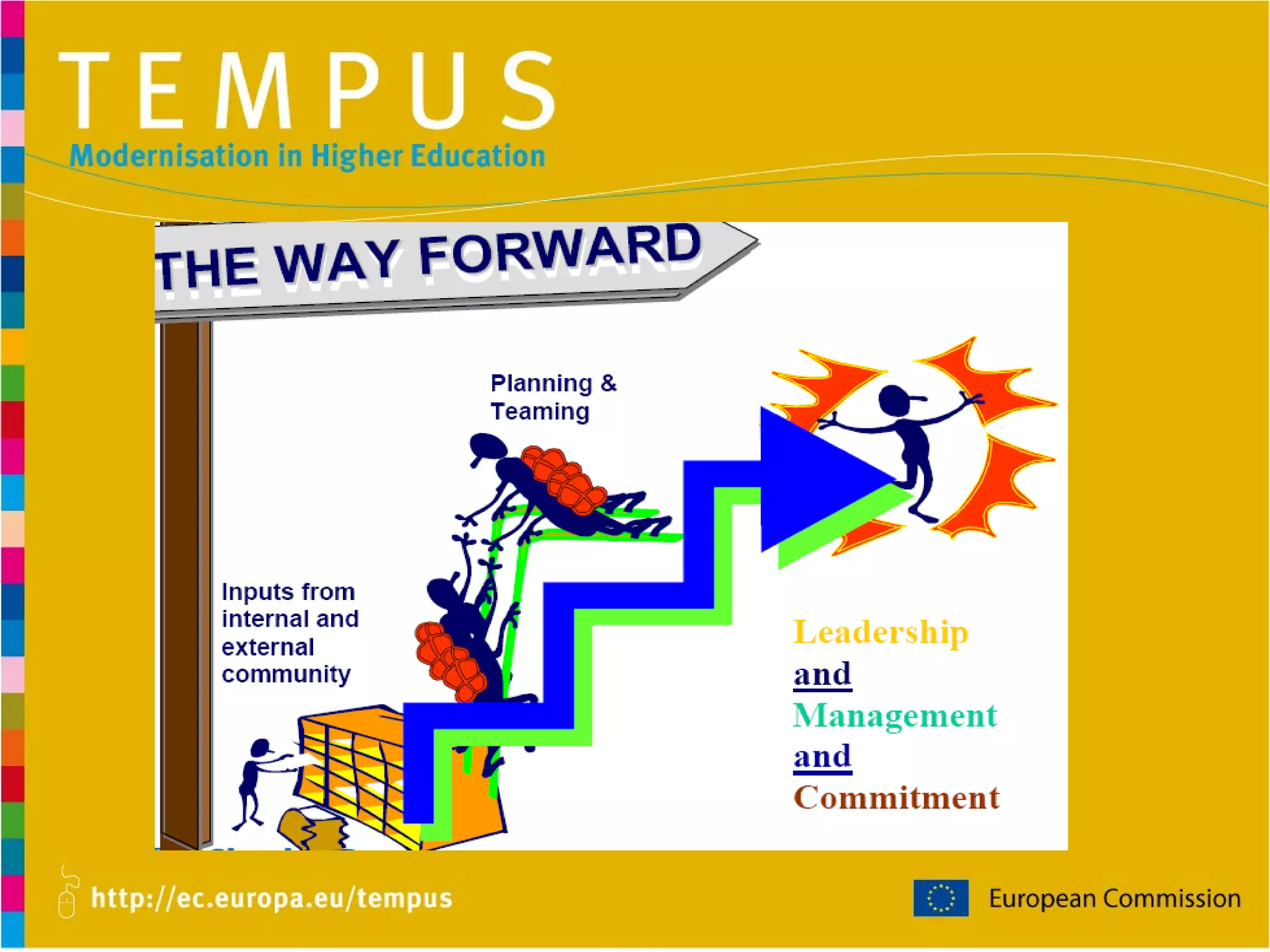
D rivers of Change Shifts emphasis –fr om  funding  to  resource  and  activities Global monitoring  of university resources Innovative creation of solution concepts to exploit technology Funding of technology creation only in very special cases  or  that should be applicable to all
 
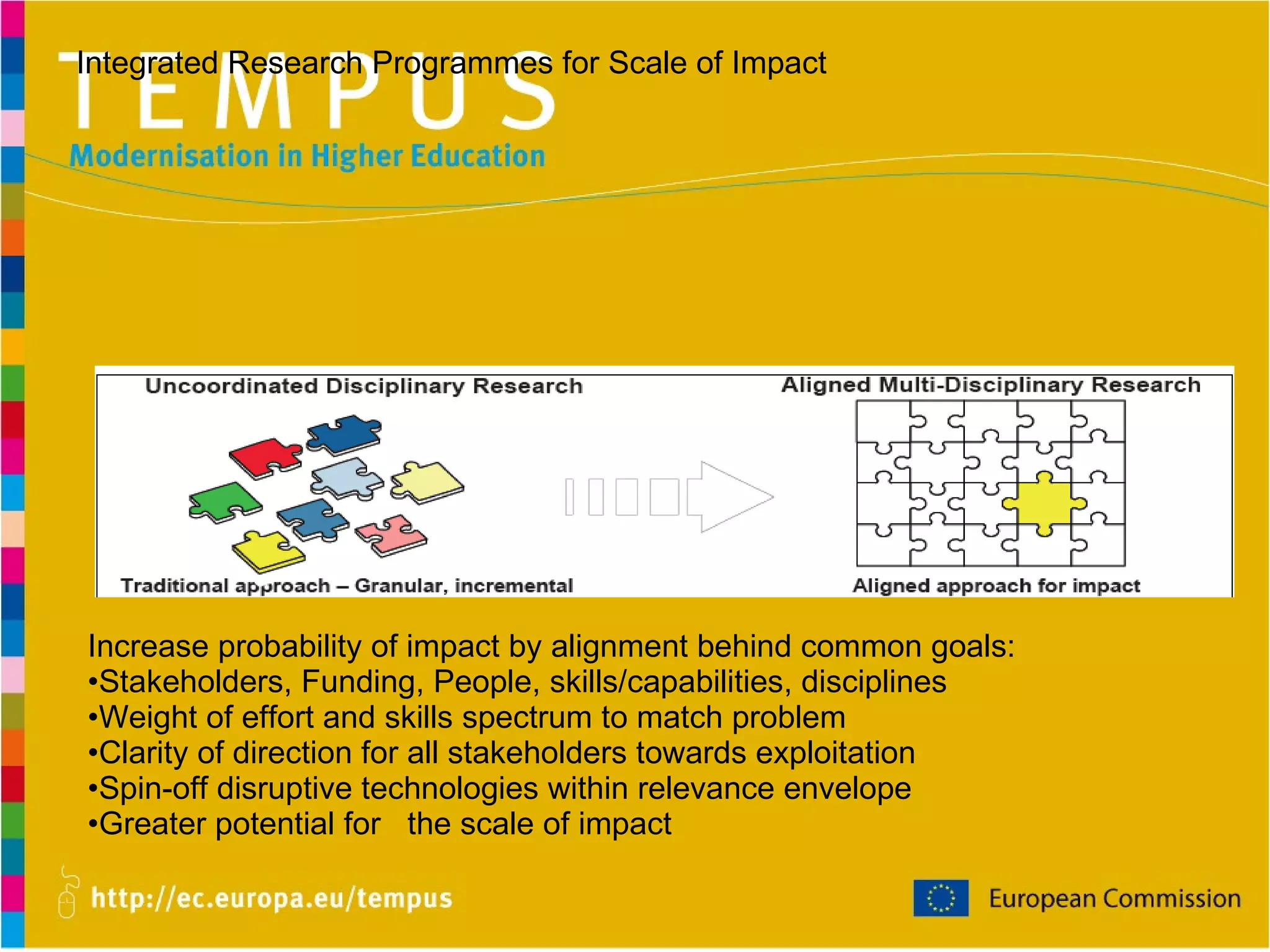
Integrated Research Programmes for Scale  of Impact   Increase probability of impact by alignment behind common goals: • Stakeholders, Funding, People, skills/capabilities, disciplines • Weight of effort and skills spectrum to match problem • Clarity of direction for all stakeholders towards exploitation • Spin-off disruptive technologies within relevance envelope • Greater potential for  the  scale of impact
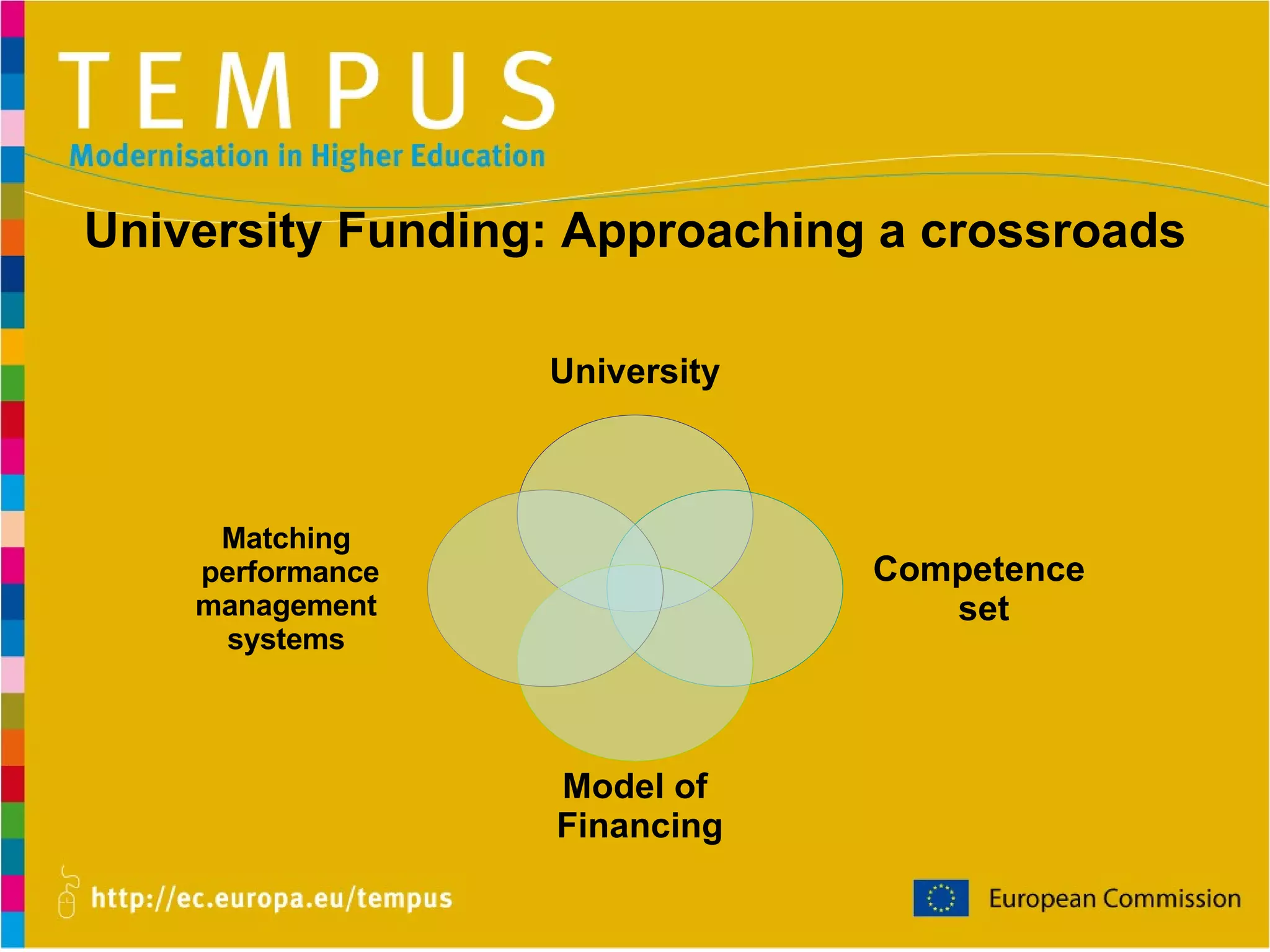
University Funding: Approaching a crossroads   University Competence  set Model of Financing Matching performance management  systems
GROUP WORK TASK Duration 30 minutes Analyse the chosen universities from your respective countries by applying  four elements of SWOT analysis. Please write down the results on a piece of paper. Choose a group representative to present results of their SWOT analysis to the audience. Finally, let us compare the results of each group and  identify common charachteristics of the results.
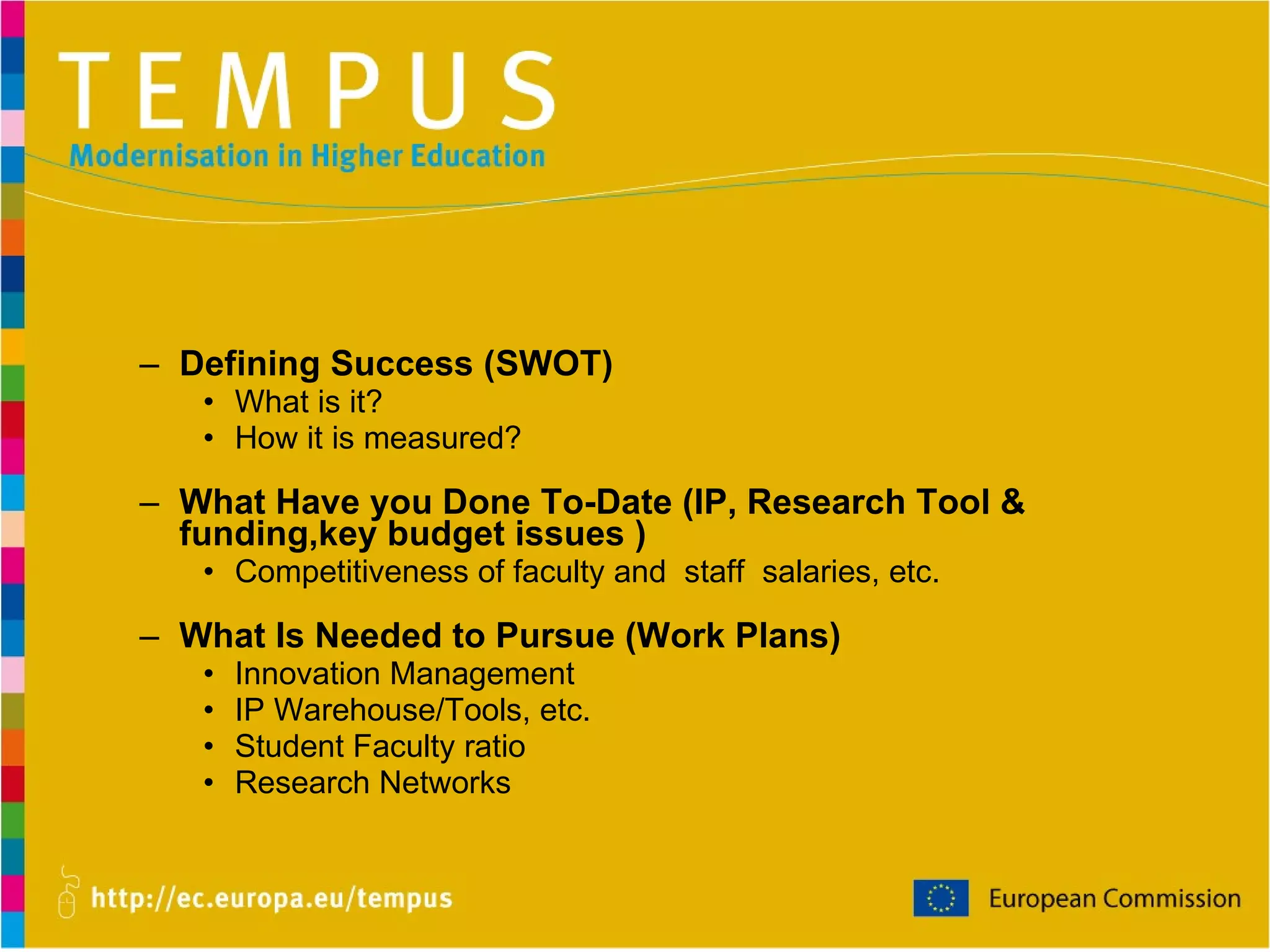
Assessment Review Process An Interactive Discussion during  Workshop Start At The Highest Level Defining Success (SWOT) What is it? How it is measured? What Have  you  Done To-Date (IP, Research Tool  & funding,key budget issues  ) Competitiveness of faculty and  staff  salaries, etc. What Is Needed to Pursue (Work Plans)  Innovation Management IP Warehouse/Tools, etc. Student Faculty ratio Research Networks
What Do We Need To Continue Growing & Expanding?
SWOT Analysis Strength What areas have produced success to-date?
SWOT Analysis Weaknesses What are we missing today that will be critical to have in place and operating effectively in order to achieve the goals we set (Financial & Otherwise)?
SWOT Analysis Opportunities What situations exist that will enable us to maintain and improve our success and find new levels of performance and results?
SWOT Analysis Threats What issues are out there that can or will challenge our ability to meet your development targets?
Task 2 Internal / External Assessment Where Do You Stand Compared to Other Universities: In Your Country In Europe Worldwide Give the mark from 1(lowest)-5 (highest) Put the marks on the pieece of the paer without naming university. Discussion
What we like What could be improved What is valued What worked well in the financing Credibility The Future
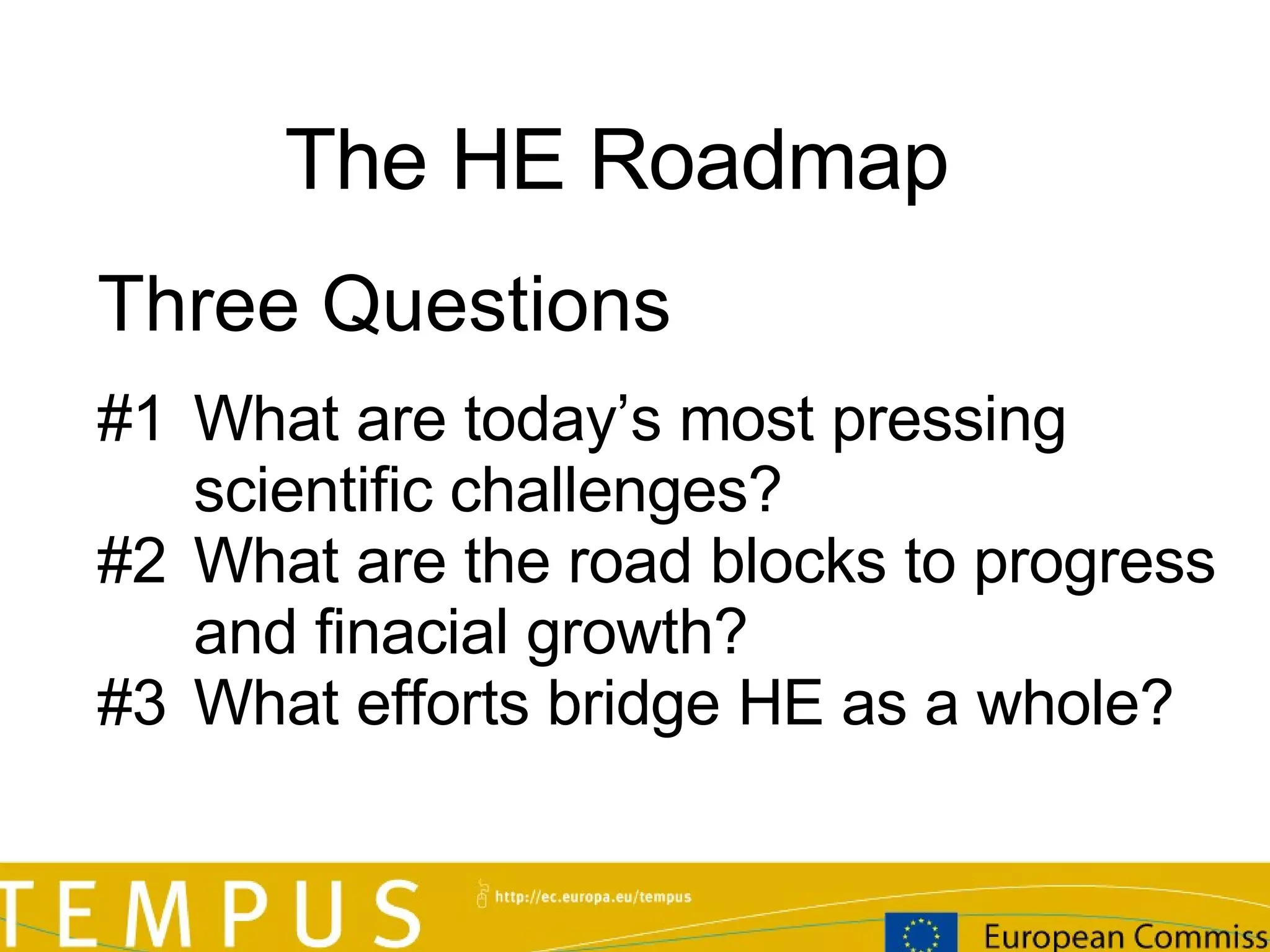
The H E  Roadmap Three Questions #1  What are today’s most pressing scientific challenges?  #2  What are the road blocks to progress  and finacial growth ? #3  What efforts bridge H E  as a whole?
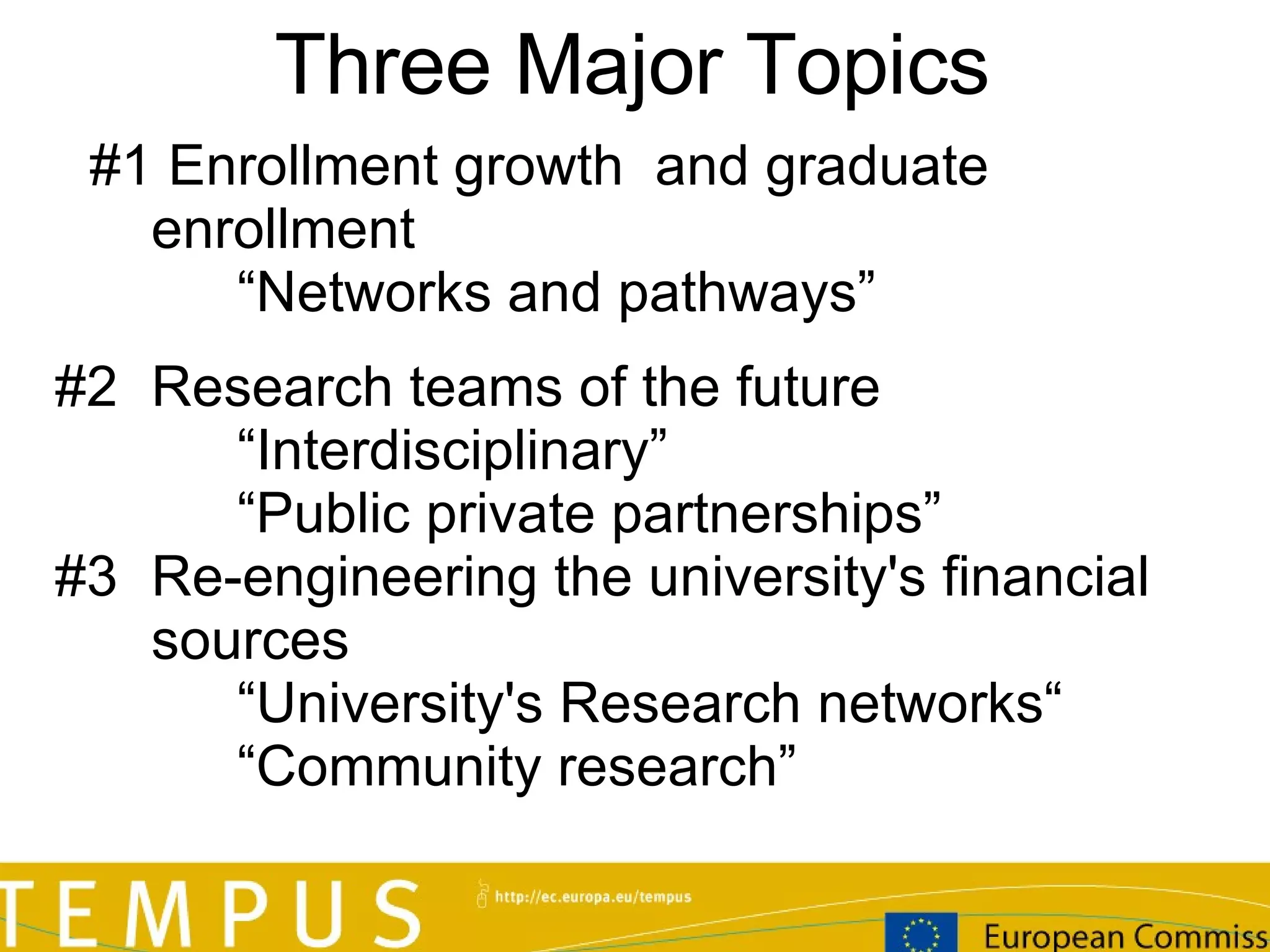
Three Major T opics #  # 1  Enrollment growth  and graduate enrollment “ Networks and pathways” #2  Research teams of the future “ Interdisciplinary” “ Public private partnerships” #3 Re-engineering the university's financial sources “ University's Research networks“ “ Community research”
Wh ich   universities  have produced success to-date?
What Are Your Universities Primary Needs Regarding The  Universites Resources ?
In Addition To Financial Targets,  What Other Metrics Might You Consider?
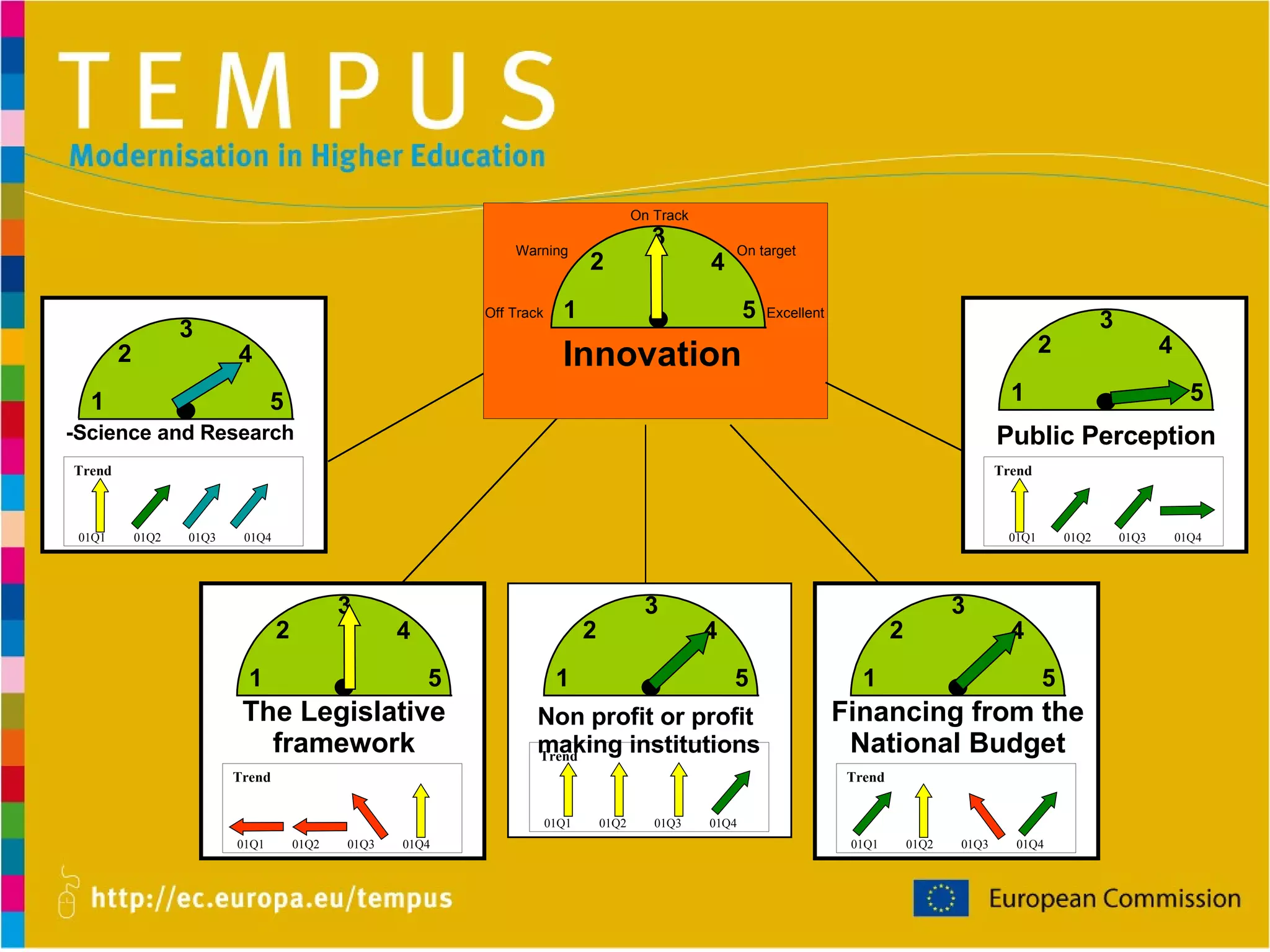
Non profit or profit making institutions 1 5 3 2 4 The Legislative framework 1 5 3 2 4 -Science and Research 1 5 3 2 4 1 5 3 2 4 On Track Warning Off Track On target Excellent Innovation Public Perception 1 5 3 2 4 Trend 01Q1 01Q2 01Q3 01Q4 Financing from the National Budget and own revenue 1 5 3 2 4
How does the co-operation work? Matching business needs with applied research potential of the University Applying for additional resources to finance joint projects Coordinating the protection and marketing of University's intellectual property Informing on innovation and entrepreneurship
Do you have r egulations of the University on the protection of intellectual property rights and the handling of intellectual property ?
Current Environment Lack of consistent administrative rules and clear national legislation regarding ownership rights to IP created at academic institutions throughout the CEE hurt both the inventors and the institutions . Lack of clear ownership of IP leads to delays in licensing processes (at a minimum) and at worst makes IP impossible to license at all. The academic institutions in the CEE must work at the national level, if necessary, to ensure that the ownership rights in the academic field are clearly defined. Institutions may lose financial opportunities because they may not provide sufficient administrative support and incentive for  researchers  to entrust the administration with their IP.
University Innovation Fund Exploitation of University IP (20% to UF, 50-80% to inventor) I N C O M E S C O S T S University Central Budget (=???) Fees of IP Protection  Running expenses of Patents Other costs
Learning from best “ Taking inspiration from the United States, nearly all other OECD countries have reformed research funding regulations or employment laws to allow research institutions to file, own and license the IP generated with public research funds.” Prominent among these are  Germany, Austria, Denmark, Norway, Japan and Korea . See: OECD report “Turning Science into Business: Patenting and Licensing at Public Research Organizations 2003”
Benefits of  partnership  in the US 450 new companies were formed in 2002 based on University research. Since 1980 - 4,320 companies have been formed 2,076 new products have been created by university researchers Universities and their scientists received $ 1.3 billion in 2002 from technology transfer activities (3.6% of total funding) 260,000 new high paying jobs created (1999 Survey) 40 Billion added to US economy (1999 Survey)

Observations: Patent Activity Accelerates 9-Year Trend Of Steady  Growth An increase of  244% in ten years Source: AUTM, 2000 Survey
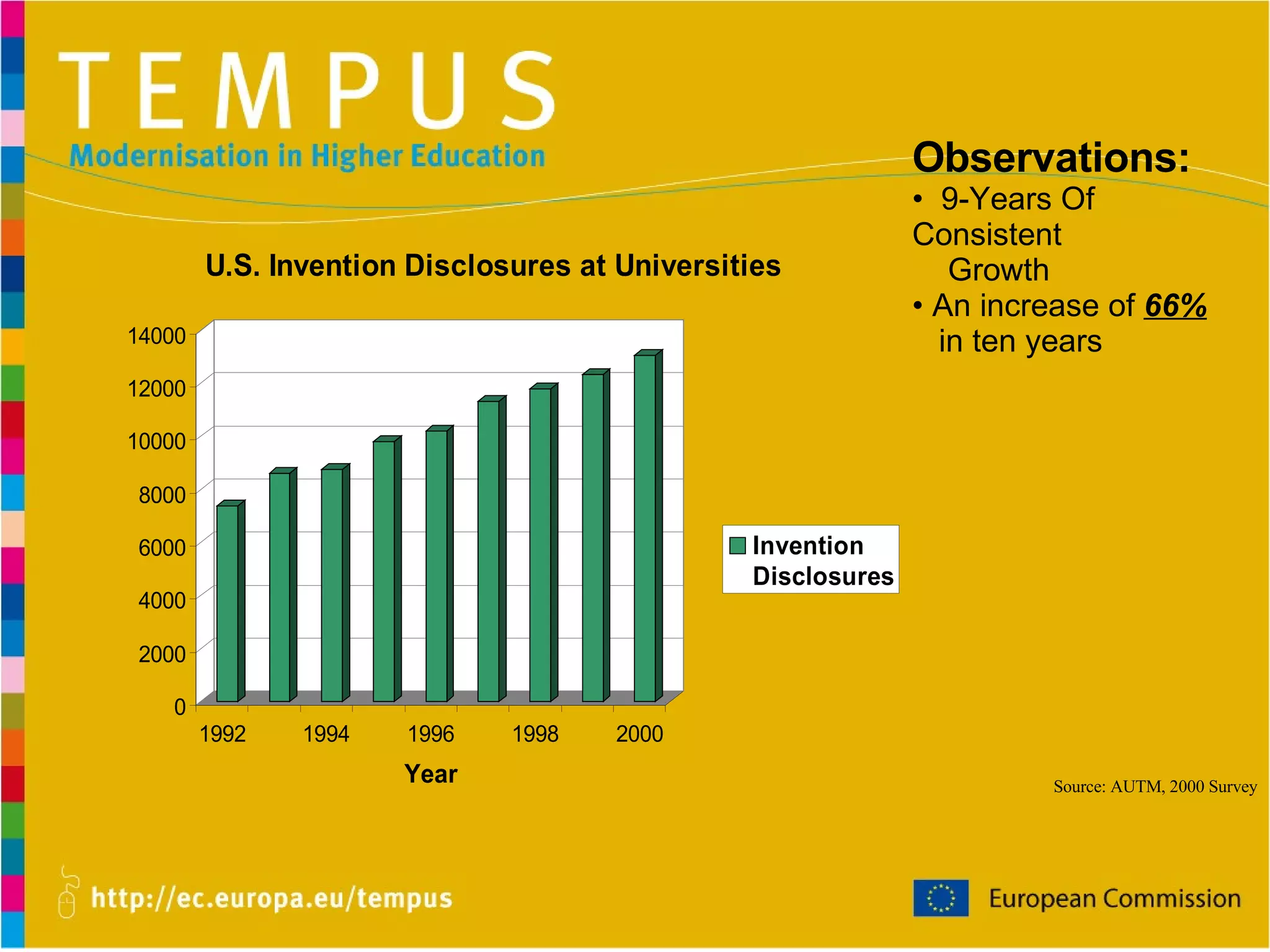
Observations: 9-Years Of Consistent Growth An increase of  66% in ten years Source: AUTM, 2000 Survey
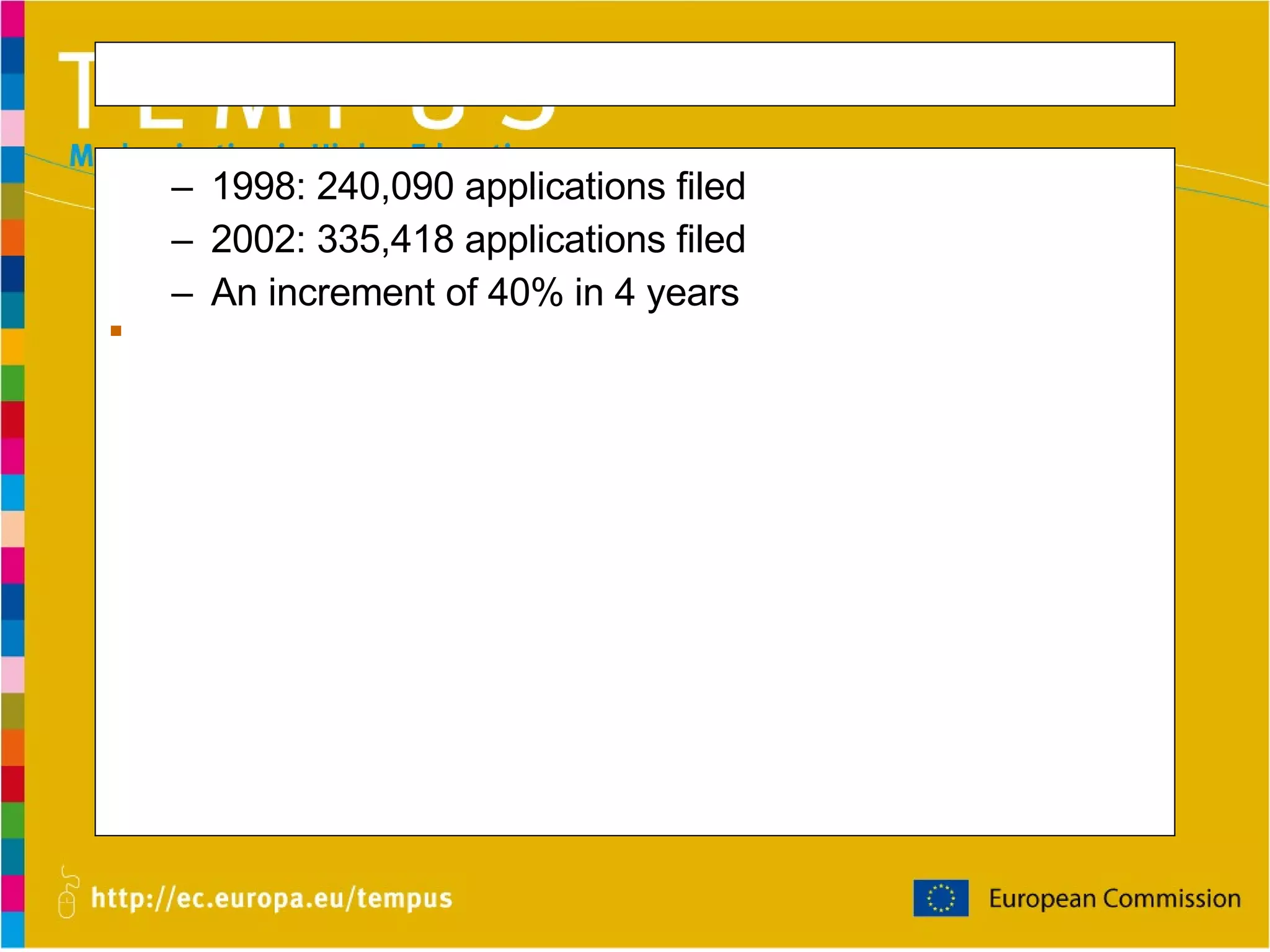
Patent Office Statistics Each week,  the Patent Office issues approximately 3,500 new patents. 1998: 240,090 applications filed 2002: 335,418 applications filed An increment of 40% in 4 years Biotechnology-related patent applications increased 154% from 1996 to 2002, from 18,695 applications to 47,473.
Exploitation of University IP National and EU Funds Industrial finance Collaborators Material Transfer Agreements Secrecy Declarations „ Only” publication University Ownership of the IP Common Ownership of the IP Used IP Who owns the IP? Service patent? Employee’s patent? Inventor’s patent? Who has the right of exploitation? Who has the right to buy a license? 1. Inventor 2. Inventor …  n. Inventor Industrial partner owns the IP Royalty to the University? No more question. To be decided Outputs Stakeholders University
Levels of Technology Transfer Service type functions Managing industrial partners Building up an IP portfolio (patents etc.) IP marketing (lisence stb.) Spin-off companies Business type functions  „ Pre-seed” financing Complexity IP-legal advise and support Material Transfer Agreements Secrecy Declarations Consultancy Changing the attitude towards patenting Incubator, science park Level 1 University patent office (~” l ocal IP manager”) Level 2 Full function TTO – incubator („business-development”)
Patent Warehousing Is This A Strategy to Be Pursued? What is it? Independent Non-profits managing patents and have the authority to grant licenses Warehouse provides holders with a minimum income based on % generated by the warehouse Primary Purpose of Patent Warehousing Promote scientific progress & technology development by providing incentives for inventors and entrepreneurs How Established Is This Strategy?
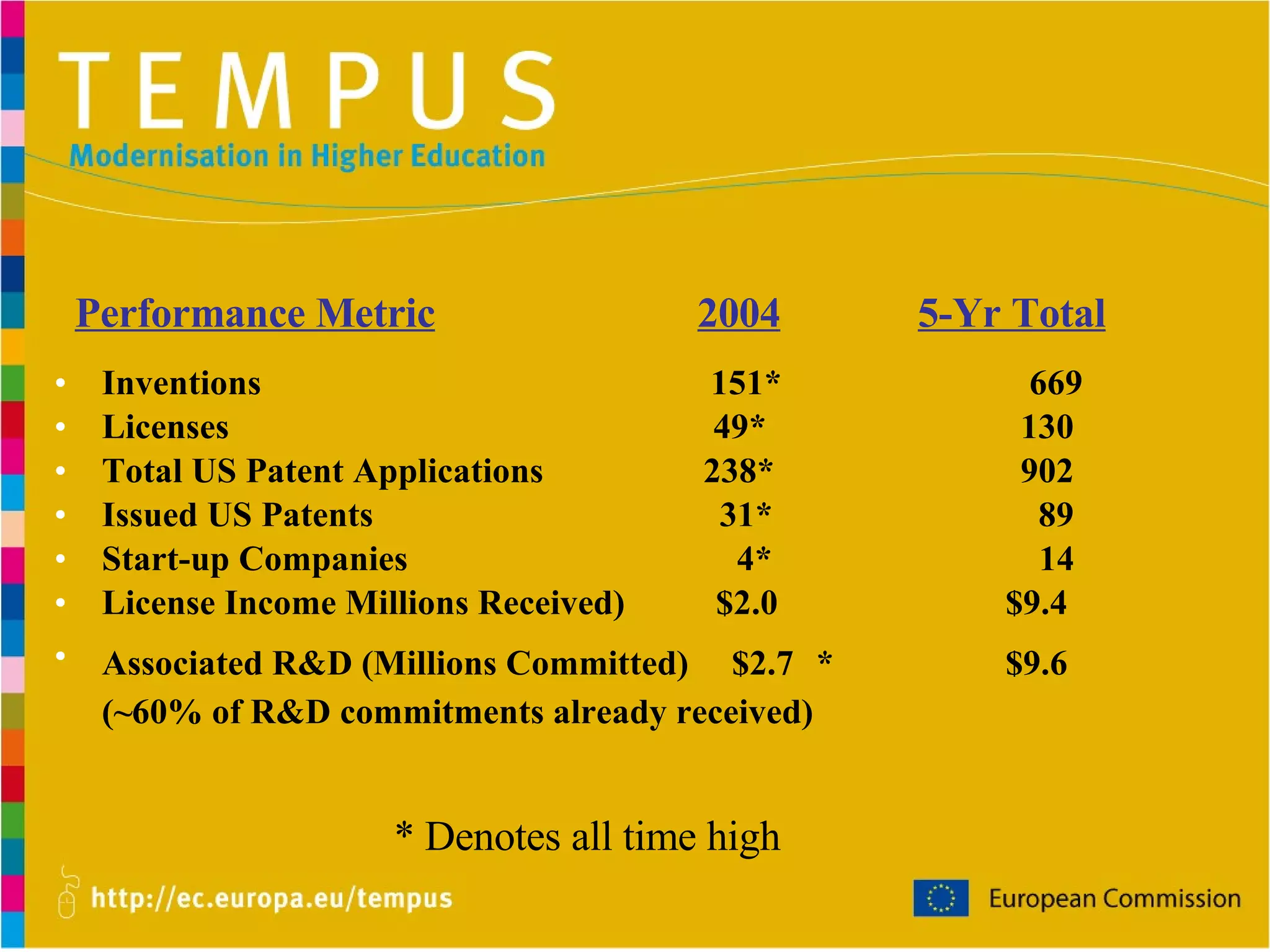
Inventions   151*   669 Licenses     49*   130 Total US Patent Applications  238*   902 Issued US Patents   31*   89 Start-up Companies  4*  14 License Income Millions Received)   $2.0   $9.4 Associated R&D (Millions Committed)   $2.7 *   $9.6 (~60% of R&D commitments already received) Technology Transfer Summary  John Hopkins University   Performance Metric 2004   5-Yr Total * Denotes all time high
Key to success Invention Disclosers Invention Disclosers Invention Disclosers Invention Disclosers
Task 3.  Readiness Assessment Evaluates an organizations ability to carry out a defined task(s) or produce a particular set of results Areas for readiness include: Adequate staffing (Staff coverage / training) Policies & procedures  Facilities & equipment  General experience
Discuss financial success is linked to academic success and that the process of generating non-government funding is likely in the longer term to increase the differentiation between universities and particularly between the 'successful' and the less 'successful' institutions.
demonstrable excellence in Learning & Teaching Evidence of: Student impact Impact on colleagues Impact on community ‘ Ambassador’ for University
Task 4. Learning from Best Practice resourcing from excellence Activity Circulate  and discuss Decide amongst  yo u which  university  should be  awarded  and why. You have 10 minutes for discussion  and to give Financial Time Award! Define criteria to evaluate practice Purpose Context & Content Process Feedback
What areas of Strategic/Business Development Do You Think Should Be Pursued?
Summary -Key messages • The  path  to benefit   is unclear Raise public awarnase  the academic base -step changes towards Solution Concepts • More  joint  research / funding bodies • Share risk, share cost, create multiple exploitation routes • Step changes in  t he use of the funding • New mechanisms  of private public partnerships, University positioning  • Management and funding cultures, choice of metrics Foster discussion and dialogue among policy makers, practitioners, researchers, professional associations,students
Developing A Workable Plan Next Steps Consolidate all of the input from our discussions Place it into a model in which we can fully review everything in its entirety Review current situation Assess what is really possible Prepare recommendations to be considered

Marina Dabic Managing University Resources

  • 1.
    Managing University Resources:Increasing and Diversifying Financial Resources and Developing Public Private Partnerships Marina Dabic University of Zagreb Faculty of Economics and Business [email_address]
  • 2.
  • 3.
    Overview of thepresentation University Funding Case of Croatia Initial Findings: A Study in Diversity Implementing change in the face of diversity: No common starting points in countries that we took in consideration Facing the cost of change: Differing levels of support Requirements for change Working groups aims
  • 4.
    THE EMERGING HIGER EDUCATION ENVIRONMENT STUDENTS * ENLIGHENED & DEMANDING * NEW DIMENSION OF KNOWLEDGE SATISFACTION SUPPLIERS TEHNOLOGY * RAPID ADVANCEMENT *SHORTENED LIFECYCLES MARKET * GLOBALISATION * TURBULENCE EXISTING COMPETITORS NEW COMPETITORS UNIVERSITIES UNDER GROWING PRESSURE * TIME - TO - MARKET PRESSURE * PRICING PRESSURE * GLOBAL QUALITY STANDARDS * VARIETY & CUSTOMISATION
  • 5.
    Our objectives isto find answers to listed questions What’s right What’s wrong What is important Are we going forward or backward What’s needed to be done A new approach
  • 6.
    What ‘we’ needto see A perfect match to declared objectives Opportunity for positive association The level of the posibiliy of goal achievement A demonstrable awareness of what we are all about
  • 7.
    It is whatwe asked for • A clear problem • A fresh approach • Something no-one has done before • Something that will make a difference • Something that will transfer Contribute to the funding debate from an institutional Perspective Provide examples of good practice in financial resources and full public private partnership Identify the relationship between funding/costing and autonomy, governance and accountability . Further develop initial findings through integration of external presentations and experience from participating experts
  • 8.
    D rivers ofChange Shifts emphasis –fr om funding to resource and activities Global monitoring of university resources Innovative creation of solution concepts to exploit technology Funding of technology creation only in very special cases or that should be applicable to all
  • 9.
  • 10.
    Integrated Research Programmesfor Scale of Impact Increase probability of impact by alignment behind common goals: • Stakeholders, Funding, People, skills/capabilities, disciplines • Weight of effort and skills spectrum to match problem • Clarity of direction for all stakeholders towards exploitation • Spin-off disruptive technologies within relevance envelope • Greater potential for the scale of impact
  • 11.
    University Funding: Approachinga crossroads University Competence set Model of Financing Matching performance management systems
  • 12.
    GROUP WORK TASKDuration 30 minutes Analyse the chosen universities from your respective countries by applying four elements of SWOT analysis. Please write down the results on a piece of paper. Choose a group representative to present results of their SWOT analysis to the audience. Finally, let us compare the results of each group and identify common charachteristics of the results.
  • 13.
    Assessment Review ProcessAn Interactive Discussion during Workshop Start At The Highest Level Defining Success (SWOT) What is it? How it is measured? What Have you Done To-Date (IP, Research Tool & funding,key budget issues ) Competitiveness of faculty and staff salaries, etc. What Is Needed to Pursue (Work Plans) Innovation Management IP Warehouse/Tools, etc. Student Faculty ratio Research Networks
  • 14.
    What Do WeNeed To Continue Growing & Expanding?
  • 15.
    SWOT Analysis StrengthWhat areas have produced success to-date?
  • 16.
    SWOT Analysis WeaknessesWhat are we missing today that will be critical to have in place and operating effectively in order to achieve the goals we set (Financial & Otherwise)?
  • 17.
    SWOT Analysis OpportunitiesWhat situations exist that will enable us to maintain and improve our success and find new levels of performance and results?
  • 18.
    SWOT Analysis ThreatsWhat issues are out there that can or will challenge our ability to meet your development targets?
  • 19.
    Task 2 Internal/ External Assessment Where Do You Stand Compared to Other Universities: In Your Country In Europe Worldwide Give the mark from 1(lowest)-5 (highest) Put the marks on the pieece of the paer without naming university. Discussion
  • 20.
    What we likeWhat could be improved What is valued What worked well in the financing Credibility The Future
  • 21.
    The H E Roadmap Three Questions #1 What are today’s most pressing scientific challenges? #2 What are the road blocks to progress and finacial growth ? #3 What efforts bridge H E as a whole?
  • 22.
    Three Major Topics # # 1 Enrollment growth and graduate enrollment “ Networks and pathways” #2 Research teams of the future “ Interdisciplinary” “ Public private partnerships” #3 Re-engineering the university's financial sources “ University's Research networks“ “ Community research”
  • 23.
    Wh ich universities have produced success to-date?
  • 24.
    What Are YourUniversities Primary Needs Regarding The Universites Resources ?
  • 25.
    In Addition ToFinancial Targets, What Other Metrics Might You Consider?
  • 26.
    Non profit orprofit making institutions 1 5 3 2 4 The Legislative framework 1 5 3 2 4 -Science and Research 1 5 3 2 4 1 5 3 2 4 On Track Warning Off Track On target Excellent Innovation Public Perception 1 5 3 2 4 Trend 01Q1 01Q2 01Q3 01Q4 Financing from the National Budget and own revenue 1 5 3 2 4
  • 27.
    How does theco-operation work? Matching business needs with applied research potential of the University Applying for additional resources to finance joint projects Coordinating the protection and marketing of University's intellectual property Informing on innovation and entrepreneurship
  • 28.
    Do you haver egulations of the University on the protection of intellectual property rights and the handling of intellectual property ?
  • 29.
    Current Environment Lackof consistent administrative rules and clear national legislation regarding ownership rights to IP created at academic institutions throughout the CEE hurt both the inventors and the institutions . Lack of clear ownership of IP leads to delays in licensing processes (at a minimum) and at worst makes IP impossible to license at all. The academic institutions in the CEE must work at the national level, if necessary, to ensure that the ownership rights in the academic field are clearly defined. Institutions may lose financial opportunities because they may not provide sufficient administrative support and incentive for researchers to entrust the administration with their IP.
  • 30.
    University Innovation FundExploitation of University IP (20% to UF, 50-80% to inventor) I N C O M E S C O S T S University Central Budget (=???) Fees of IP Protection Running expenses of Patents Other costs
  • 31.
    Learning from best“ Taking inspiration from the United States, nearly all other OECD countries have reformed research funding regulations or employment laws to allow research institutions to file, own and license the IP generated with public research funds.” Prominent among these are Germany, Austria, Denmark, Norway, Japan and Korea . See: OECD report “Turning Science into Business: Patenting and Licensing at Public Research Organizations 2003”
  • 32.
    Benefits of partnership in the US 450 new companies were formed in 2002 based on University research. Since 1980 - 4,320 companies have been formed 2,076 new products have been created by university researchers Universities and their scientists received $ 1.3 billion in 2002 from technology transfer activities (3.6% of total funding) 260,000 new high paying jobs created (1999 Survey) 40 Billion added to US economy (1999 Survey)
  • 33.
    Observations: Patent ActivityAccelerates 9-Year Trend Of Steady Growth An increase of 244% in ten years Source: AUTM, 2000 Survey
  • 34.
    Observations: 9-Years OfConsistent Growth An increase of 66% in ten years Source: AUTM, 2000 Survey
  • 35.
    Patent Office StatisticsEach week, the Patent Office issues approximately 3,500 new patents. 1998: 240,090 applications filed 2002: 335,418 applications filed An increment of 40% in 4 years Biotechnology-related patent applications increased 154% from 1996 to 2002, from 18,695 applications to 47,473.
  • 36.
    Exploitation of UniversityIP National and EU Funds Industrial finance Collaborators Material Transfer Agreements Secrecy Declarations „ Only” publication University Ownership of the IP Common Ownership of the IP Used IP Who owns the IP? Service patent? Employee’s patent? Inventor’s patent? Who has the right of exploitation? Who has the right to buy a license? 1. Inventor 2. Inventor … n. Inventor Industrial partner owns the IP Royalty to the University? No more question. To be decided Outputs Stakeholders University
  • 37.
    Levels of TechnologyTransfer Service type functions Managing industrial partners Building up an IP portfolio (patents etc.) IP marketing (lisence stb.) Spin-off companies Business type functions „ Pre-seed” financing Complexity IP-legal advise and support Material Transfer Agreements Secrecy Declarations Consultancy Changing the attitude towards patenting Incubator, science park Level 1 University patent office (~” l ocal IP manager”) Level 2 Full function TTO – incubator („business-development”)
  • 38.
    Patent Warehousing IsThis A Strategy to Be Pursued? What is it? Independent Non-profits managing patents and have the authority to grant licenses Warehouse provides holders with a minimum income based on % generated by the warehouse Primary Purpose of Patent Warehousing Promote scientific progress & technology development by providing incentives for inventors and entrepreneurs How Established Is This Strategy?
  • 39.
    Inventions 151* 669 Licenses 49* 130 Total US Patent Applications 238* 902 Issued US Patents 31* 89 Start-up Companies 4* 14 License Income Millions Received) $2.0 $9.4 Associated R&D (Millions Committed) $2.7 * $9.6 (~60% of R&D commitments already received) Technology Transfer Summary John Hopkins University Performance Metric 2004 5-Yr Total * Denotes all time high
  • 40.
    Key to successInvention Disclosers Invention Disclosers Invention Disclosers Invention Disclosers
  • 41.
    Task 3. Readiness Assessment Evaluates an organizations ability to carry out a defined task(s) or produce a particular set of results Areas for readiness include: Adequate staffing (Staff coverage / training) Policies & procedures Facilities & equipment General experience
  • 42.
    Discuss financial successis linked to academic success and that the process of generating non-government funding is likely in the longer term to increase the differentiation between universities and particularly between the 'successful' and the less 'successful' institutions.
  • 43.
    demonstrable excellence inLearning & Teaching Evidence of: Student impact Impact on colleagues Impact on community ‘ Ambassador’ for University
  • 44.
    Task 4. Learningfrom Best Practice resourcing from excellence Activity Circulate and discuss Decide amongst yo u which university should be awarded and why. You have 10 minutes for discussion and to give Financial Time Award! Define criteria to evaluate practice Purpose Context & Content Process Feedback
  • 45.
    What areas ofStrategic/Business Development Do You Think Should Be Pursued?
  • 46.
    Summary -Key messages• The path to benefit is unclear Raise public awarnase the academic base -step changes towards Solution Concepts • More joint research / funding bodies • Share risk, share cost, create multiple exploitation routes • Step changes in t he use of the funding • New mechanisms of private public partnerships, University positioning • Management and funding cultures, choice of metrics Foster discussion and dialogue among policy makers, practitioners, researchers, professional associations,students
  • 47.
    Developing A WorkablePlan Next Steps Consolidate all of the input from our discussions Place it into a model in which we can fully review everything in its entirety Review current situation Assess what is really possible Prepare recommendations to be considered