A
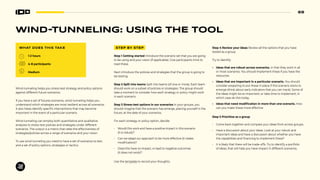
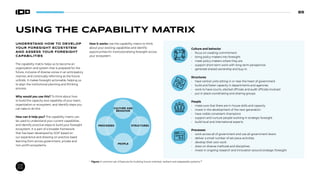
BEYOND STRATEGIC
PLANNING
A FORESIGHT TOOLKIT FOR
DECISION MAKERS
1
ABOUT CALIFORNIA 100
The California 100 Initiative envisions a future that is innovative,
sustainable, and equitable for all. Our mission is to strengthen
California’s ability to collectively solve problems and shape our long-
term future over the next 100 years.
California 100 is organized around 15 policy domains and driven
by interrelated stages of work: research, policy innovation and
engagement with Californians. California 100’s work is guided by an
expert and intergenerational Commission. Through various projects
and activities, California 100 seeks to move California towards an
aspirational vision—changing policies and practices, attitudes and
mindsets, to inspire a more vibrant future. california100.org
ABOUT SOIF
School of International Futures (SOIF) is a global non-profit
collective of practitioners in strategy and policy for current
and future generations. Our vision is a better, fairer and more
sustainable world for current and future generations. We
achieve this by empowering people to use participatory futures
and foresight to drive societal transformation through their
organizations, communities and countries. soif.org.uk
Contact: For more information on this primer please get in touch
at hello@soif.org.uk or info@california100.org
DISCLAIMER
The contents of this toolkit reflect the views of the authors, who
are responsible for the facts and the accuracy of the information
presented herein. This toolkit does not constitute a standard,
specification, or regulation.
ACKNOWLEDGEMENTS
We thank the following team members for their contributions
to this publication:
California 100
Karthick Ramakrishnan, PhD
Lindsay Maple, M.P.P.
Jesse Melgar, M.P.P.
Henry E. Brady, PhD
SOIF
Cat Tully, MPA, MA Cantab
Peter Glenday, DPhil
Anna Williams
Ellen Shepherd
Ruth Beveridge
Suggested citation Peter Glenday, Karthick Ramakrishnan,
California 100, and School of International Futures (2023).
Beyond Strategic Planning: A Foresight Toolkit for Decision
Makers. University of California.
https://creativecommons.org/licenses/by-nc-sa/4.0/
2
FOREWORD
“CHANCE FAVORS ONLY THE
PREPARED MIND.”
Louis Pasteur’s famous maxim—urging scientists
to make abundant observations in order to draw
insights from anomalies—serves as important
guidance to organizational leaders today who are
navigating critically uncertain futures.
It is no exaggeration to say that we live in a period
of major disruption and uncertainty. COVID-19 has
semi-permanently altered the ways we live, learn,
eat, and work. Climate-related challenges, such
as extreme heat and coastal flooding, call into
question the continued viability of entire cities
and regions. And advancements in technology,
from genetic medicine to artificial intelligence,
offer considerable promise and risk, for our lives
as well as our livelihoods.
While we have much to be concerned about our
long-term futures, we also have ample cause for
hope. Hope that is embodied in a new crop of
public officials, organization leaders, and everyday
residents. In people coming together, unflinching
in their determination to tackle grand challenges
rather than ignoring them. Leaders who
demonstrate and inspire a refreshing openness
to new ways of learning and doing.
Strategic foresight, as the Organisation for
Economic Co-operation and Development
(OECD) puts it, is “a structured and systematic
way of using ideas about the future to anticipate
and better prepare for change.” Strategic foresight
is not new. Its modern development traces back
to the mid 1940s and RAND Corporation’s work on
the United States’ Cold War strategy, and to the
1970s, as Shell Corporation’s methods of scenario
planning helped it navigate the 1973 oil crisis more
effectively than its competitors.
Still, strategic foresight remains a privileged
enterprise. It is still largely confined to global
corporations and select national agencies
and international organizations. Even though
community organizations, government agencies,
philanthropies, and everyday citizens have an
enormous stake in our collective future, most of
us are unprepared to engage meaningfully with
the seismic shifts that are underway—in our
economy and society, planet and polity.
California 100 and the School of International
Futures (SOIF) are collaborating together because
we both believe fundamentally in the need to
democratize the work of futures thinking and
futures design. The challenges facing our people
and the planet are too enormous to confine
strategic foresight for the privileged few.
This toolkit is intended as a primer on strategic
foresight, with pragmatic tools that enable
decision makers and strategists of various
stripes—from within government agencies and
philanthropies, to community organizations and
educational institutions—to be better prepared
for future success under conditions of massive
uncertainty and rapid change.
You might ask, “What is the best way to engage
with this toolkit? Should I read it cover to cover?
Or can I just jump in and read whatever strikes
my fancy?”
We say that the journey is up to you. Some of you
might wish to read the entire toolkit, including
additional resources, before you dive into any of
the examples. Others might wish to try some
quick and fun exercises, like the Future News
Headline exercise, to whet your appetite for
futures thinking and futures design.
Whatever your approach, we have three asks:
1. Try out a few tools, preferably with a friend or
colleague (or two, or three!)
2. Take time to discuss new insights and
perspectives with others in your organization or
community
3. Reach out and join us! We are part of a fast
growing practitioner community from around
the world seeking to build more just, equitable,
and sustainable futures
Thank you, and we can’t wait to see you along our
journeys,
Cat and Karthick
Cat Tully is managing director of School of International
Futures (SOIF).
Karthick Ramakrishnan is executive director of California 100.
3
BEYOND STRATEGIC PLANNING: A FORESIGHT
TOOLKIT FOR DECISION MAKERS
THIS TOOLKIT IS DESIGNED FOR
LEADERS WHO ARE LOOKING
TO APPLY FORESIGHT TO THEIR
WORK.
It provides a brief introduction to strategic
foresight and how it can be used to support
decision-making. It contains suggestions about
how to get started applying foresight for impact.
It builds on insights from California 100’s work to
envision and realize an aspirational future for the
state of California, and SOIF’s experience working
with governments, civil society, and other sectors
internationally.
It will not answer all of your questions, but will
help you to understand what foresight is, and
how it can be used to support strategic planning,
policy-making and leadership under conditions of
uncertainty.
This toolkit introduces a simple, pragmatic
approach to using foresight in communities
and organizations.
It helps you to start to connect into a broader
community of practice, and to access tools,
resources and approaches that you can begin
to use on a daily basis.
IF YOU WANT TO... JUMP TO...
Understand what foresight is and how it can help you 04
Use foresight tools in your work 17
Start with a clear question and purpose 19
Think differently about change 27
Imagine alternative futures 44
Navigate uncertainty 56
Take a systematic approach on your foresight journey 72
Build your foresight ecosystem 79
Connect and learn 89
4
1
UNDERSTAND WHAT
FORESIGHT IS AND
HOW IT CAN HELP YOU
5
WHY THE FUTURE, WHY NOW?
FORESIGHT: AN ESSENTIAL SKILL FOR
DECISION MAKERS.
Strategic foresight is a critical tool for effective decision making and
effective organizations. It is an organized, systematic process for
engaging with uncertainty and looking beyond the expected.
By thinking systematically about the future, strategic foresight
helps you to understand and engage with complexity, to build
resilience, set your strategic direction and improve policies, plans
and strategies.
You can usefully apply foresight approaches whether working at a
global or regional level, in cities, as teams or within communities.
You can also apply foresight at a personal level by building individual
futures literacy and understanding.
It is not about predicting the future, but about understanding the
current and future contextual and operating environment. Insights
gained from foresight equip organizations to recognize emerging
threats and opportunities, and to respond to them by improving
their competitiveness, resilience and agility.
WHY THE FUTURE, WHY NOW?
We are living in an increasingly complex and non-predictable world
where change is not the exception but the new norm. This brings a
higher degree of uncertainty and volatility.
FORESIGHT BRINGS THREE
KEY BENEFITS
• Build vision Make strategic choices to shape the
future you want
• Manage risk Build preparedness for alternative
possible futures
• Increase awareness and agility Create future-ready and
alert organizations that can adapt as the future evolves
Governments, communities, and societies are simultaneously
navigating local and global challenges, climate emergencies, rapid
technological transformations, demographic and value shifts, and
challenges around truth and democracy.
While we may be able to anticipate some of the impacts that these
challenges will have on society over the coming years, we also know
that highly complex problems can only be solved using processes
that are systemic, emergent, and participatory.
We have to collectively find new ways to think differently about
change, anticipate disruptions, and seize new opportunities. In
order to succeed, we need to move away from linear views of the
future and traditional planning approaches, towards anticipatory
governance.
This requires strategic foresight—an understanding of what might
change and the ability to navigate uncertainty under alternative
futures. We also need new governance approaches that embrace
complexity, underpinned by values of participation.
TRANSFORMATION REQUIRES A PERSONAL,
ORGANIZATIONAL AND SYSTEM-WIDE
JOURNEY.
Ensuring effective long-term decision-making is difficult. It requires
leaders and decision makers across public, private and civil society
to be incentivized, and for all citizens, residents, and stakeholders to
have a say about the future.
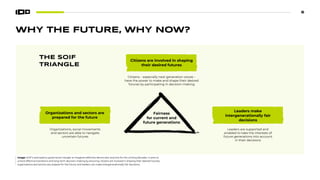
The SOIF triangle, depicted on the next page, sets out three key
areas for reimagining effective democratic practice for the coming
decades. It recognizes that meaningful and enduring change
requires action and collaboration across sectors, and among citizens
and institutional leaders.
6
WHY THE FUTURE, WHY NOW?
Image: SOIF’s anticipatory governance triangle re-imagines effective democratic practice for the coming decades. It aims to
unlock effective transitions and long-term decision-making by ensuring: citizens are involved in shaping their desired futures;
organizations and sectors are prepare for the future; and leaders can make intergenerationally fair decisions.
Leaders are supported and
enabled to take the interests of
future generations into account
in their decisions
Leaders make
intergenerationally fair
decisions
THE SOIF
TRIANGLE
Organizations, social movements
and sectors are able to navigate
uncertain futures
Organizations and sectors are
prepared for the future
Citizens – especially next generation voices –
have the power to make and shape their desired
futures by participating in decision-making
Citizens are involved in shaping
their desired futures
Fairness
for current and
future generations
7
FORESIGHT FOR TRANSFORMATION
1. CITIZENS ARE INVOLVED IN SHAPING THEIR
DESIRED FUTURES
The act of reflecting on the future collectively — and the capability
to do so — is valuable for all communities and countries at all times.
Strategic foresight is not a luxury; it is a necessity. It helps build
vision, resilience and empowerment in an uncertain world
It is important to ensure citizens are involved in shaping their desired
futures, and that they have the power to make and shape their desired
futures by participating in decision-making. This process of collective
reflection on the future enables resilience and empowerment.
You can read a bit more about how different countries and
communities have used foresight, including in Aruba to engage
over 60,000 participants, and how Oman developed participative
scenarios as part of Vision 2040 (page 14). For other inspiration see
the Building Better Futures: toolkit1
from WCVA and SOIF based on
community futures work in Wales.
2. ORGANIZATIONS AND SECTORS ARE
PREPARED FOR THE FUTURE
Foresight can be applied at an organizational and sectoral level,
by building the capability to be ‘futures-prepared’ into programs,
policies, and teams. And it can be applied in engaging with policy
and strategy processes, serving as a vehicle to bring different
stakeholders together to design desired futures and understand the
ways to achieve them.
Incorporating strategic foresight into your practice can be a
fundamental skill for fostering both resiliency and innovation. It can
help you view the future in new ways, imagining new possibilities
and acting on opportunities.
You can read how the Canterbury District Health Board in New
Zealand embraced foresight to transform their health system on
page 10, and how leadership-backed foresight transformed strategy
for the International Federation of the Red Cross on page 11.
Section 4 provides more guidance on how to start to integrate foresight
into your work, building your capacity and capability as an ecosystem.
3. LEADERS MAKE INTERGENERATIONALLY
FAIR DECISIONS
Decisions being made today affect current generations as well as
future ones. Leaders need to be supported and enabled to take
the interests of all generations into account in their decisions.
Intergenerational fairness requires requires approaches that help
leaders to understand different views about the future, and what
different generations want. It requires engagement through
dialogue, deliberation and participation.
Intergenerational fairness is key to unlocking the transformative
potential of tomorrow, empowering citizens, and holding today’s
decision makers accountable to future generations.
There are practical ways to do this, including intergenerational
assessment and dialogues. More fundamentally, intergenerational
fairness can also be embedded as a principle in governance structures.
Read more about intergenerational fairness on page 15 or visit
soif.org.uk/igf
We are part of a wider community of interest
and advocacy
As a decision maker, your role is to be both an ambassador to
the past and a midwife to the future. To create the conditions
for change.
This requires movement building and field-building, as well
as weaving networks that embrace, honor, and support
champions for transformative change across the country and
around the world.
You can find more about this approach and suggestions for
connecting with existing communities of practitioners in
Section 5 of this toolkit.
8
HOW TO THINK ABOUT THE FUTURE
Strategic foresight is not about predicting or forecasting the future.
It is both art and science that together make possible the craft of
foresight. Achieving impact requires a good understanding of the
tools and techniques of strategic foresight, as well as the judgment
needed to use them effectively. It also requires a mindset and
cultural shifts in mindset and organizational culture.
The benefit of strategic foresight is that it enables the stakeholders
involved in a decision to engage more fully with complexity and
uncertainty. It creates an explicit and often overlooked step in the
strategic planning process where decision makers’ assumptions
about the future can be challenged.
As humans, we often jump to conclusions about the shape of the
future. We rely on mental heuristics, commons-sense approaches
to problem solving based on past experiences, to make speedy
decisions. In the face of overwhelming uncertainty, these mostly
encourage us to assume that tomorrow will be like today.
This status quo bias is often implicit and unquestioned within
organizations, professional groups, and other communities.
Impactful futures work happens when you keep an open
mind. You must embrace uncertainty as a fact of life, instead
of something to fear. Even the best-laid strategic plans cannot
account for all the unpredictable twists and turns facing an
organization or agency.
HERE ARE SOME POINTERS ON HOW TO
THINK ABOUT THE FUTURE:
Take time seriously: We often think of time in a linear way, with
the past leading to the present and then the future. Futures work
can challenge our conventional view of time and the stories we tell
about the future. A key part of this mindset shift is understanding
our biases, and acknowledging that our experience of the past will
shape our thinking about the future. The stories of the past are
often indistinguishable from stories we tell about the future.
Be open to pattern sensing: This is a way of thinking that
acknowledges we can look for and identify patterns using
the knowledge we have at our disposal, even if there is no
comprehensive data set available. Often exploring the future
is about taking small leaps based on weak signals. You won’t
always take a data-driven approach. And that’s okay.
Explore complexity and interdependencies: It is important to
think not only about the issues and problems your organization
is grappling with, but also how these issues interconnect and
interplay within your organization and beyond. A project may be
about the future of a specific organization, policy or population,
but its future is built by its interactions with other systems. This is
about understanding your place in the wider system, and where
your leverage points are—getting clear on what is under your
influence, and what is not.
Push the limits of critical uncertainties: These are unpredictable
drivers that have a significant impact on the outcome. Pattern-
sensing moves beyond logic and data to explore a divergent range
of possible outcomes in these unpredictable factors.
Seek interesting perspectives: Foresight gives us the legitimacy to
‘think together’ by respecting and seeking out diverse perspectives.
The act of reflecting on the future collectively is not a luxury; it is a
necessity. It helps us build vision, resilience and empowerment in
an uncertain world. It allows us to widen our perspective, building
understanding and avoiding bias.
Build agency: The ultimate aim of strategic foresight is to improve
decision-making today for a better future. The process of collective
reflection and imagination helps people to have more agency over
their futures.
The California 100 logo was
designed to play with perspective..
9
9
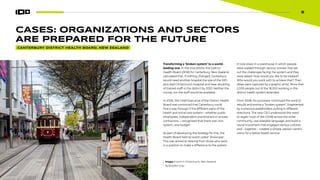
Transforming a ‘broken system’ to a world-
leading one. In the mid-2000s, the District
Health Board (DHB) for Canterbury, New Zealand,
calculated that, if nothing changed, Canterbury
would need another hospital the size of the 500-
plus bed Christchurch hospital and near-doubling
of trained staff in the district by 2020. Neither the
money nor the staff would be available.
In 2006, the Chief Executive of the District Health
Board was convinced that Canterbury could
find a way through if the different parts of the
health and social care system—whether public
employees, independent practitioners or private
contractors— recognised that there was ‘one
system, one budget’.
As part of developing the strategy for this, the
Health Board held an event called ‘Showcase’.
This was aimed at hearing from those who were
in a position to make a difference to the system.
It took place in a warehouse in which people
were walked through various ‘scenes’ that set
out the challenges facing the system and they
were asked: How would you like to be treated?
Who would you work with to achieve that? Their
ideas were captured by a graphic artist. More than
2,000 people out of the 18,000 working in the
district health system attended.
From 2008, his successor continued the work to
rebuild and evolve a “broken system”, fragmented
by numerous stakeholders pulling in different
directions. The new CEO understood the need
to regain trust of the CDHB across the wider
community, use relatable language, and build a
social movement that engaged various cultures
and – together – created a simple, person-centric
vision for a better health service.
Image: A tram in Christchurch, New Zealand.
By Brayden Gray
CASES: ORGANIZATIONS AND SECTORS
ARE PREPARED FOR THE FUTURE
CANTERBURY DISTRICT HEALTH BOARD, NEW ZEALAND
10
KEY INSIGHTS
• It took courageous, selfless and adaptive leadership
to first change direction and then accelerate the
evolution.
• The process centered around reestablishing
common goals and determine a future vision to
work back from.
• The process made the community part of the
solutions and ownership.
• Experiential workshops were risky, but a huge
success.
Scenarios are thus the
most powerful vehicles...
lifting the ‘blinders’ that
limit our creativity and
resourcefulness.
Peter Schwartz
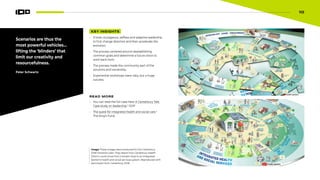
Image: These images were produced for the Canterbury
DHB Transition plan. They depict how Canterbury Health
District could move from a broken (top) to an integrated
(bottom) health and social services system. Reproduced with
permission from Canterbury DHB.
READ MORE
• You can read the full case here: A Canterbury Tale:
Case study on leadership.2
SOIF
• The quest for integrated health and social care.3
The King’s Fund.
10
11
CASES: ORGANIZATIONS AND SECTORS
ARE PREPARED FOR THE FUTURE
HOW LEADERSHIP-BACKED
FORESIGHT TRANSFORMED
STRATEGY FOR THE IFRC—
THE WORLD’S LARGEST
HUMANITARIAN NETWORK
The Geneva-headquartered International
Federation of Red Cross and Red Crescent
Societies (IFRC) supports 192 member National
Societies. It focuses on peacetime disaster
preparedness, relief and long-term disaster-
recovery planning, plus the healthcare needs
of vulnerable people. Every year approximately
160 million people benefit from its services.
In the 2000s, IFRC’s leaders—including former
Secretary-General Elhadj As Sy and ex-Under
Secretary General for Partnerships Jemilah
Mahmood—recognised that a more cohesive,
collective solution was required to keep pace with
the fast-changing context of humanitarian need
with limited resources.
Understanding their duty as stewards of the
IFRC’s performance in the present and future,
they courageously set about transforming the
organization to enable it to continue fulfilling its
mission in generations to come.
They set out on a foresight process, asking three
pivotal questions:
• How is the world changing around us? i.e. are
we paying attention to what is happening
around us
• Where and who will be vulnerable in the
future?
• What is the Future Red Cross and Red
Crescent?
They went to a great effort to engage a wide
variety of stakeholders with about 10,000
people from 192 countries taking part. A novel
brainstorming game played on WhatsApp, called
WhatFutures, targeted low- and middle-income
countries. Data was also gathered through
facebook and face-to-face workshops.
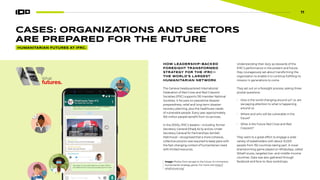
Image: Photos from escape to the future. An immersive
humanitarian strategy game. For more visit https://
whatfutures.org/
HUMANITARIAN FUTURES AT IFRC.
11
12
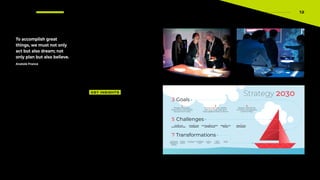
Image: Visualization showing the goals, callenges and transformations outlined in ICRC’s Strategy 2030.
Image caption: Participants at the ICRC’s Future Is Now experiential exhibition.
Using the information they gathered, the team
led by Shaun Hazeldine and Aarathi Krishnan
worked with design partners (including Open Lab
at Newcastle University, Superflux and Changeist)
to showcase the potential of humanitarian aid
futures thinking with an experiential futures
exhibition.
Reactions and feedback were recorded and
used to inform IFRC’s Strategy 2030, which was
presented at the end of 2019 to map out how the
organization planned to tackle the next decade.
KEY INSIGHTS
• The key challenge was creating a more agile
approach to planning that combined a top-
level mandate and bottom-up support
• This was a process of culture change, creative
engagement and experimentation, enabled by
strong leadership.
READ MORE
• You can read the full case here: Humanitarian
Futures at IFRC.4
• Read and download the strategy5
on IFRC’s
website
12
To accomplish great
things, we must not only
act but also dream; not
only plan but also believe.
Anatole France
Strategy
Transformations
Challenges
Goals
Climate and
environmental crisis
Evolving crisis
and disasters
Growing gaps in health
and well-being
Migration and
identity
Values, power
and inclusion
Supporting and
developing National
Societies as strong
and effective
local actors
Inspiring and
mobilising
volunteerism
Ensuring trust and
accountability
Working effectively
as a distributed
network
Influencing
humanitarian
action
Undergoing
a digital
transformation
Financing
the future
People anticipate,
respond to, and quickly
recover from crisis
People lead safe, healthy
and dignified lives and
have opportunities to thrive
People mobilise for
inclusive and peaceful
communities
Strategy
Transformations
Challenges
Goals
Climate and
environmental crisis
Evolving crisis
and disasters
Growing gaps in health
and well-being
Migration and
identity
Values, power
and inclusion
Supporting and
developing National
Societies as strong
and effective
local actors
Inspiring and
mobilising
volunteerism
Ensuring trust and
accountability
Working effectively
as a distributed
network
Influencing
humanitarian
action
Undergoing
a digital
transformation
Financing
the future
People anticipate,
respond to, and quickly
recover from crisis
People lead safe, healthy
and dignified lives and
have opportunities to thrive
People mobilise for
inclusive and peaceful
communities
13
CASES: CITIZENS ARE INVOLVED IN SHAPING
THEIR DESIRED FUTURES
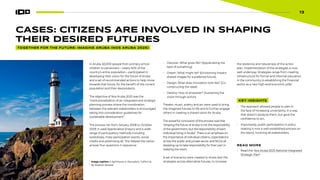
In Aruba, 60,000 people from primary school
children to pensioners—nearly 60% of the
country’s entire population—participated in
developing their vision for the future of Aruba
and a set of recommended actions to help move
towards that future, for the benefit of the current
population and their descendants.
The objective of Nos Aruba 2025 was the
“institutionalization of an integrated and strategic
planning process where the coordination
between the relevant stakeholders is encouraged
taking into consideration guidelines for
sustainable development”.
The process ran from January 2008 to October
2009. It used Appreciative Enquiry and a wide
range of participatory methods including
workshops, mass participation events, social
media and advertising all. This helped the nation
answer four questions in sequence:
Image caption: A lighthouse in Pescadero, California.
By Stephen Bedase
TOGETHER FOR THE FUTURE: IMAGINE ARUBA (NOS ARUBA 2025)
• Discover: What gives life? (Appreciating the
best of something)
• Dream: What might be? (Envisioning impact:
shared images for a preferred future)
• Design: What does innovation look like? (Co-
constructing the ideal)
• Destiny: How to empower? (Sustaining the
vision through action).
Theater, music, poetry and art were used to bring
the imagined futures to life and to further engage
others in creating a shared vision for Aruba.
The powerful conclusion of the process was that
“shaping the future of Aruba is not the responsibility
of the government, but the responsibility of each
individual living in Aruba”. There is an emphasis on
the importance of individual citizens, organizations
across the public and private sector and NGOs all
stepping up to take responsibility for their part in
realizing the vision.
A set of scenarios were created to stress-test the
strategies across alternative futures, to increase
13
the resilience and robustness of the action
plan. Implementation of the strategies is now
well underway. Strategies range from creating
infrastructure for formal and informal education
in the community to establishing the financial
sector as a new high-end economic pillar.
KEY INSIGHTS
• The approach allowed people to plan in
the face of increasing uncertainty, in a way
that doesn’t paralyze them, but gave the
confidence to act,
• Importantly, public participation in policy
making is now a well-established process on
the island, involving all stakeholders.
READ MORE
• Read the: Nos Aruba 2025 National Integrated
Strategic Plan6
14
A PARTICIPATIVE FUTURE FOR
OMAN: THE TURNING POINT
SCENARIOS
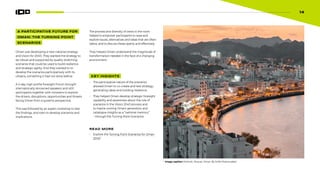
Oman was developing a new national strategy
and Vision for 2040. They wanted the strategy to
be robust and supported by quality stretching
scenarios that could be used to build resilience
and strategic agility. And they wanted to to
develop the scenarios participatively with its
citizens, something it had not done before.
A 2-day, high profile foresight Forum brought
internationally renowned speakers and 400
participants together with ministers to explore
the drivers, disruptions, opportunities and threats
facing Oman from a systems perspective.
This was followed by an expert workshop to test
the findings, and start to develop scenarios and
implications.
14
The process and diversity of views in the room
helped to empower participants to raise and
explore issues, alternatives and ideas that are often
taboo, and to discuss these openly and effectively.
They helped Oman understand the magnitude of
transformation needed in the face of a changing
environment.
KEY INSIGHTS
• The participative nature of the scenarios
allowed Oman to co-create and test strategy;
generating ideas and building resilience.
• They helped Oman develop strategic foresight
capability and awareness about the role of
scenarios in the Vision 2040 process and
to inspire coming Omani generation and
catalogue insights as a “national memory”
– through the Turning Point Scenarios.
READ MORE
• Explore the Turning Point Scenarios for Oman
20407
Image caption: Muttrah, Muscat, Oman. By Anfal Shamsudeen
15
CASES: LEADERS MAKE INTERGENERATIONALLY
FAIR DECISIONS
Younger generations are becoming more vocal
about the impact of the decisions made in the
past that affect their present opportunities
and future. Meanwhile, concerns about
intergenerational fairness have steadily climbed
up the priority ladder over the past decade. The
2020 OECD Report on Governance on Youth,
Trust and Intergenerational Justice outlines the
intergenerational issues underlying many of
today’s most urgent political debates, and we
believe these questions will only intensify in
coming years.
In 2020, School of International Futures and the
Calouste Gulbenkian Foundation published a
methodology to assess whether a decision is fair
to different generations, now and in the future.8
It can be applied by national and local
governments, independent institutions,
international organizations, foundations,
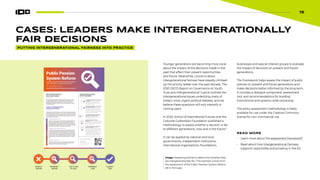
Image: Assessing policies to determine whether they
are intergenerationally fair. This example comes from
the assessment of the Public Pension System Reform
bill in Portugal.
PUTTING INTERGENERATIONAL FAIRNESS INTO PRACTICE
businesses and special interest groups to evaluate
the impact of decisions on present and future
generations.
The Framework helps assess the impact of public
policies on present and future generations and
make decisions better informed by the long-term.
It includes a dialogue component, assessment
tool, and recommendations for building
instituitional and systems-wide ownership.
The policy assessment methodology is freely
available for use under the Creative Commons
license for non-commercial use.
READ MORE
• Learn more about the assessment framework9
• Read about how Intergenerational Fairness
supports responsible policymaking in the EU.
15
16
INTERGENERATIONAL FAIRNESS
IN JAPAN
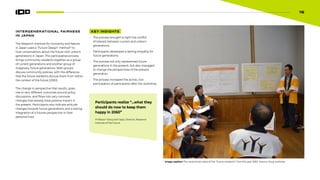
The Research Institute for Humanity and Nature
in Japan used a “Future Design” method10
to
host conversations about the future with unborn
generations in Japan. This participative process
brings community residents together as a group
of current generations and another group of
imaginary, future generations. Both groups
discuss community policies, with the difference
that the future residents discuss them from within
the context of the future (2060).
The change in perspective that results, gives
rise to very different outcomes around policy
discussions, and flows into very concrete
changes that already have positive impact in
the present. Participants also indicate attitude
changes towards future generations and a lasting
integration of a futures perspective in their
personal lives.
KEY INSIGHTS
• The process brought to light the conflict
of interest between current and unborn
generations.
• Participants developed a lasting empathy for
future generations.
• The process not only represented future
generations in the present, but also managed
to change the perspectives of the present
generation
• The process increased the active, civic
participation of participants after the workshop
Image caption: The ceremonial robes of the “future residents” from the year 2060. Source: ritsuji yoshioka
16
Participants realize “…what they
should do now to keep them
happy in 2060”
Professor Tatsuyoshi Saijo, Director, Research
Institute of the Future
17
2
USE FORESIGHT
TOOLS IN YOUR
WORK
18
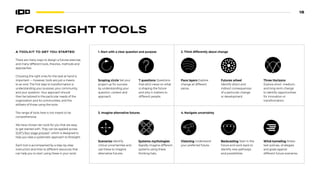
FORESIGHT TOOLS
1. Start with a clear question and purpose
Scoping circle Set your
project up for success
by understanding your
question, context and
approach.
7 questions Questions
that elicit views on what
is shaping the future
and why it matters to
different people.
2. Think differently about change
Pace layers Explore
change at different
paces.
Futures wheel
Identify direct and
indirect consequences
of a particular change
or development.
3. Imagine alternative futures
R B
P G
Scenarios Identify
critical uncertainties and
use these to imagine
alternative futures.
Systems mythologies
Rapidly imagine different
systems using these
thinking hats.
4. Navigate uncertainty
Visioning Understand
your preferred future.
Backcasting Start in the
future and work back to
identify new pathways
and possibilities.
Wind-tunneling Stress-
test policies, strategies
and goals against
different future scenarios.
Three Horizons
Explore short- medium-
and long-term change
to identify opportunities
for innovation or
transformation.
A TOOLKIT TO GET YOU STARTED
There are many ways to design a futures exercise,
and many different tools, theories, methods and
approaches.
Choosing the right ones for the task at hand is
important — however, tools are just a means
to an end. The first step to transformation is
understanding your purpose, your community,
and your question. Your approach should
then be tailored to the particular needs of the
organization and its communities, and the
skillsets of those using the tools.
The range of tools here is not meant to be
comprehensive.
We have chosen ten tools for you that are easy
to get started with. They can be applied across
SOIF’s four stage process11
, which is designed to
help you take a systematic approach to foresight.
Each tool is accompanied by a step-by-step
instruction and links to different resources that
can help you to start using these in your work.
19
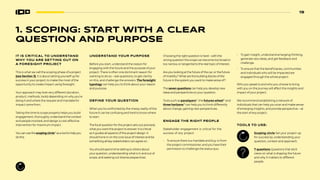
IT IS CRITICAL TO UNDERSTAND
WHY YOU ARE SETTING OUT ON
A FORESIGHT PROJECT
This is what we call the scoping phase of a project
(see Section 3). It is about setting yourself up for
success in your project, to make the most of the
opportunity to create impact using foresight.
Your approach may look very different (duration,
product, methods, tools) depending on why you’re
doing it and where the request and mandate for
impact came from.
Taking the time to scope properly helps you build
engagement, thoroughly understand the context
and people involved, and design a cost-effective
intervention for maximum impact.
Youcanusethescoping circle12
asatooltohelpyou
dothis.
UNDERSTAND YOUR PURPOSE
Before you start, understand the reason for
engaging with the future and the purpose of your
project. There is often one dominant reason for
wanting to do so—ask questions, to get clartity
on this, and challenge the answers. The foresight
typology can help you to think about your reason
and purpose.
DEFINE YOUR QUESTION
When you’re confronted by the messy reality of the
future it can be confusing and hard to know where
to start.
The focal question for the project sets out precisely
what you want the project to answer. It is critical
as it guides all aspects of the project design. It
should hone in on the core issue of interest and be
something all key stakeholders can agree on.
You should spend time talking to others about
your question, understanding what is in and out of
scope, and seeking out diverse pespectives.
Choosing the right question is hard – with the
wrong question the scope can become too broad or
too narrow, or tangential to the real topic of interest.
Are you looking at the future of the car, or the future
of mobility? What are the building blocks of the
future in the system you want to make sense of?
The seven questions can help you develop new
ideas and perspectives on your question.
Tools such as pacelayers13
, the futures wheel14
and
three horizons15
can help you to think differently
about change, gaining new perspectives.
ENGAGE THE RIGHT PEOPLE
Stakeholder engagement is critical for the
success of any project:
• To ensure there is a mandate and buy-in from
the project commissioner, and you have their
permission to challenge the status quo.
• To gain insight, understand emerging thinking,
generate new ideas, and get feedback and
challenge.
• To ensure that the beneficiaries, communities
and individuals who will be impacted are
engaged through the whole project.
Who you speak to and who you choose to bring
with you on the journey will affect the insights and
impact of your project.
We recommend establishing a network of
individuals that can help you scan and make sense
of emerging insights, and provide perspective—at
the start of any project.
TOOLS TO USE:
1. SCOPING: START WITH A CLEAR
QUESTION AND PURPOSE
Scoping circle Set your project up
for success by understanding your
question, context and approach.
7 questions Questions that elicit
views on what is shaping the future
and why it matters to different
people.
20
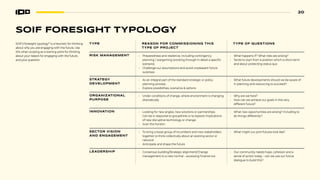
TYPE REASON FOR COMMISSIONING THIS
TYPE OF PROJECT
TYPE OF QUESTIONS
RISK MANAGEMENT • Preparedness and resilience, including contingency
planning / wargaming (working through in detail a specific
scenario)
• Challenge our assumptions and avoid unpleasant future
surprises
• What happens if? What risks are arising?
• Tends to start from a position which is short-term
and about protecting status quo
STRATEGY
DEVELOPMENT
• As an integral part of the standard strategic or policy
planning process.
• Explore possibilities, scenarios  options
• What future developments should we be aware of
in planning and resourcing to succeed?
ORGANIZATIONAL
PURPOSE
• Under conditions of change, where environment is changing
dramatically
• Why are we here?
• How can we achieve our goals in this very
different future?
INNOVATION • Looking for new angles, new solutions or partnerships.
Can be in response to groupthink or to explore implications
of new disruptive technology or change.
• Scan the horizon.
• What new opportunities are arising? Including to
do things differently?
SECTOR VISION
AND ENGAGEMENT
• To bring a loose group of incumbent and new stakeholders
together to think collectively about an existing sector or
network
• Anticipate and shape the future
• What might our joint futures look like?
LEADERSHIP • Consensus building/Strategic alignment/Change
management to a new normal – accessing finance too
• Our community needs hope, cohesion and a
sense of action today – can we use our future
dialogue to build this?
SOIF FORESIGHT TYPOLOGY
SOIF’s foresight typology16
is a heuristic for thinking
about why you are engaging with the future. Use
this when scoping as a starting point for thinking
about your reason for engaging with the future,
and your question.
21
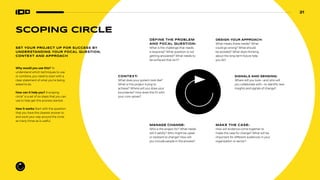
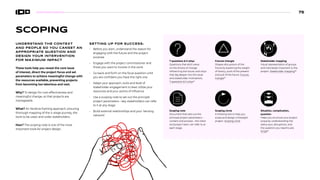
SCOPING CIRCLE
SET YOUR PROJECT UP FOR SUCCESS BY
UNDERSTANDING YOUR FOCAL QUESTION,
CONTEXT AND APPROACH
DEFINE THE PROBLEM
AND FOCAL QUESTION:
What is the challenge that needs
a response? What question is not
getting answered? What needs to
be surfaced that isn’t?
CONTEXT:
What does your system look like?
What is this project trying to
achieve? Where will you draw your
boundaries? How does this fit with
your core values?
MANAGE CHANGE:
Who is the project for? What needs
will it satisfy? Who might be upset
or resistant to change? How will
you include people in the process?
MAKE THE CASE:
How will evidence come together to
make the case for change? What will be
important for different audiences in your
organization or sector?
DESIGN YOUR APPROACH:
What meets these needs? What
could go wrong? What should
be avoided? What does thinking
about the long term future help
you do?
SIGNALS AND SENSING:
Where will you look—and who will
you collaborate with—to identify new
insights and signals of change?
Why would you use this? To
understand which techniques to use
or combine, you need to start with a
clear statement of what you’re being
asked to do.
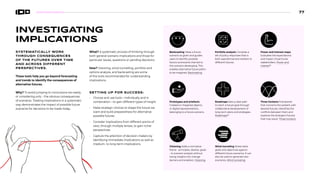
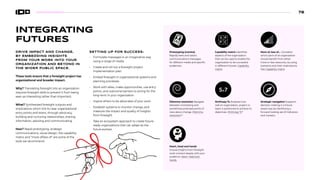
How can it help you? A scoping
circle” is a set of six steps that you can
use to help get this process started.
How it works Start with the question
that you have the clearest answer to
and work your way around the circle
as many times as is useful.
22
SCOPING CIRCLE: USING THE TOOL
WHAT DOES THIS TAKE
1–2 hours
5–8 participants
Medium
You can run this exercise as an individual, but it will produce richer
insights as a group exercise. Try to include different perspectives,
including the person who has asked for the project, beneficiaries,
project team and innovative thinkers.
Although this is a simple tool, using it iteratively deepens your
thinking consdierably. Run it first to scope the project, then revist
this with different people, as you refine your thinking.
Having used the scoping circle, we suggest documenting the scope
of the project in a scoping note. The scoping note should set out the
project parameters—content, people and process—as well as more
formal project management and governance arrangements.
Depending on your governance structures, this can be signed off
with e.g. the project commissioner, or your governing board. This
helps to ensure that everyone agrees on the scope and boundaries
of the project.
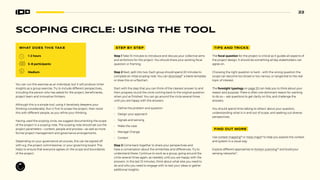
STEP BY STEP
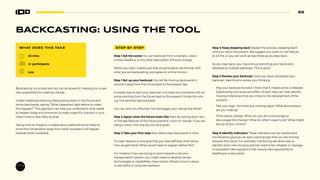
Step 1 Take 10 minutes to introduce and discuss your collective aims
and ambitions for the project. You should share your existing focal
question or framing.
Step 2 Next, split into two. Each group should spend 20 minutes to
complete an initial scoping note. You can download17
a blank template
or draw this on a flipchart.
Start with the step that you can think of the clearest answer to and
then progress round the circle coming back to the original question
when you’ve finished. You can go around the circle several times
until you are happy with the answers.
• Define the problem and question
• Design your approach
• Signals and sensing
• Make the case
• Manage Change
• Context
Step 3 Come back together to share your perspectives and
have a conversation about the similarities and differences. Try to
understand these. Continue to work as a group, going around the
circle several times again, as needed, until you are happy with the
answers. In the last 10 minutes, think about what else you need to
do and who you need to engage with to test your ideas or gather
additional insights.
TIPS AND TRICKS
The focal question for the project is critical as it guides all aspects of
the project design. It should be something all key stakeholders can
agree on.
Choosing the right question is hard – with the wrong question the
scope can become too broad or too narrow, or tangential to the real
topic of interest.
The foresight typology on page 20 can help you to think about your
reason and purpose. There is often one dominant reason for wanting
to do so— ask questions to get clarity on this, and challenge the
answers.
You should spend time talking to others’ about your question,
understanding what is in and out of scope, and seeking out diverse
perspectives.
FIND OUT MORE
Use context mapping18
or mess maps19
to help you explore the context
and system in a visual way.
Explore different approaches to horizon scanning20
and build your
sensing networks21
.
23
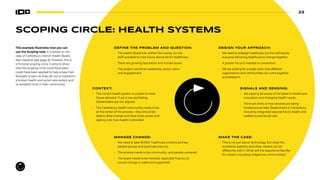
SCOPING CIRCLE: HEALTH SYSTEMS
DEFINE THE PROBLEM AND QUESTION:
• The Health Board has neither the money nor the
staff available to mee future demands for healthcare.
• There are growing reputation and morale issues.
• The project combines leadership, sector vision
and engagement.
CONTEXT:
• The current health system is unable to meet
future demand. Trust is low and falling.
Stakeholders are not aligned.
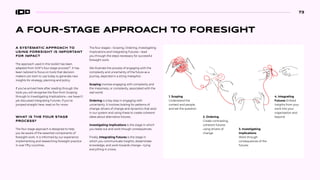
• The Canterbury health community needs to be
at the center of the process—they should be
able to drive change and have more power and
agency over how health is provided.
MANAGE CHANGE:
• We need to take 18,000+ healthcare workers and key
patient groups and social services too.
• The process needs to be community- and people-centered
• The board needs to be involved, especially finance, to
ensure change is viable and supported.
MAKE THE CASE:
• This is not just about technology, but what the
workforce, patients and other citizens can do
differently with it. What will the experience feel like
for citizens, including indigenous communities?
DESIGN YOUR APPROACH:
• We need to redesign healthcare, but this will require
everyone delivering healthcare to change together.
• A greater focus is needed on prevention.
• We are looking for a single vision that different
organizations and communities can come together
and believe in.
SIGNALS AND SENSING:
• We need to be aware of the latest in healthcare
innovation and changing health needs.
• There are shifts in how services are being
funded across New Zealand and in Canterbury.
Including integrated approaches to health and
wellbeing and social care.
This example illustrates how you can
use the Scoping note. It is based on the
case of Canterbury District Health Board,
New Zealand (see page 9), however, this is
a fictional scoping circle. It aims to show
how the scoping circle could have been
could have been applied to help scope their
foresight project as they set out to transform
a broken health and social care system and
re-establish trust in their community.
24
7 QUESTIONS IS AN INTERVIEW TECHNIQUE
THAT ALLOWS YOU TO GATHER INTELLIGENCE
ABOUT THE FUTURE
1. ORACLE
What would you consider to be the critical issues for the future
of [the theme]?
2. OPTIMISTIC
Imagine in 10 years’ time, what would a positive outcome look
like for [the theme] and what would be the signs of success?
3. PESSIMISTIC
What would you see as a bad outcome? How might this come
about?
4. LOOKING FORWARD
Which important decisions need to be made in the short-term
to ensure a successful long-term outcome?
5. CONSTRAINTS
What might stop these decisions from being made taken?
6. LOOKING BACK
What can we learn from our experiences? What mistakes have
been made in the past that we can learn from?
7. LEGACY
If you had a mandate for change, free of constraints, what would
you do to ensure a successful future for [the theme]?
Why would you use this? 7 questions22
is a technique for gathering
strategic insights by interviewing a range of internal and external
stakeholders.
How can it help you? This technique can be used to identify
conflicting or challenging views of the future and extract deep
information about underlying concerns in a policy area. It helps to
stimulate thinking in preparation for a futures workshop. As a first
step to gathering intelligence from stakeholders, it is particularly
useful for obtaining the engagement of senior stakeholders to any
project or issue. It can be used with individuals, groups or as part of
a workshop. The finding from which can feed into backcasting, wind
tunneling or any other visioning activity.
How it works It can be used with individuals, groups or as part of a
workshop. Use the 7 questions provided to conduct semi-structured
interviews with carefully selected stakeholders.
SEVEN QUESTIONS
25
WHAT DOES THIS TAKE
1 hour per interview, plus write-up time
15–20 participants
Low
The 7 Questions technique was pioneered by Shell23
in its strategy
development process. It is a powerful tool for gathering opinion
from diverse stakeholders on the strategic issues that need to
be addressed in a given policy area, and for highlighting areas of
agreement or conflict about the way forward.
This technique allows you to gain insight from both internal and
external stakeholders, through interviews which will give insight
on a focal theme or issue you have identified. Before undertaking
interviews it is important to define the issues that you wish to
explore, this could include developing a hypothesis you would like
to explore using the interview data. It is useful to start interviewing
early in any project as interviews help to define the scope of the
project and its critical issues.
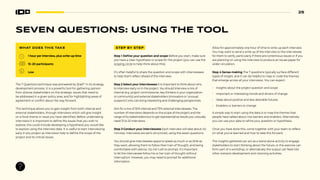
STEP BY STEP
Step 1 Define your question and scope Before you start, make sure
you have a clear hypothesis or scope for the project (you can use the
scoping circle to help think about this).
It’s often helpful to share the question and scope with interviewees
to help them reflect ahead of the interview.
Step 2 Select your interviewees It is important to think about who
to interview early on in the project. You should interview a mix of
internal (e.g. project commissioner, key thinkers in your organization
or community) and external stakeholders (innovators or ‘unusual
suspects’) who can bring interesting and challenging perspectives.
Aim for a mix of 30% internal and 70% external interviewees. The
number of interviews depends on the scope of the project and the
range of its stakeholders but to get representative results you usisually
need 15 to 20 interviews.
Step 3 Conduct your interviewees Each interview will take about 40
minutes. Interviews are semi-structured, using the seven questions.
You should give interviewees space to speak as much or as little as
they want, allowing them to follow their train of thought, and being
comfortable with silence. Do not rush to prompt, it’s important
to let the interviewee follow his or her train of thought without
interruption. However, you may need to prompt for additional
information.
Allow for approximately one hour of time to write up each interview.
You may want to send a write up of the interview to the interviewee
for them to verify, particularly if there are contentious issues or if you
are planning on using the interview to produce an issues paper for
wider circulation.
Step 4 Sense-making The 7 questions typically surface different
types of insight, and it can be helpful to map or code the themes
that emerge across all your interviews. You can expect:
• Insights about the project question and scope
• Important or interesting trends and drivers of change
• Ideas about positive and less desirable futures
• Enablers or barriers to change
A simple way to start using the data is to map the themes that
people have talked about into barriers and enablers. Alternatively
you can use your data to refine your question or hypothesis.
Once you have done this, come together with your team to reflect
on what you’ve learned and how to take this forward.
The insights gathered can act as a stand alone activity to engage
stakeholders to start thinking about the future, or the exercise can
form part of a workshop, or alternatively the output can feed into
other scenario development and visioning activities.
SEVEN QUESTIONS: USING THE TOOL
26
SEVEN QUESTIONS: USING THE TOOL
TIPS AND TRICKS
It’s often best to conduct interviews face to face; ideally in the
interviewee’s office or a place of their choosing. If logistics are
tricky the interviews can be done remotely—if this is the case, try
to do them using a video call, rather than on the phone, as you can
connect and engage more if you can see the interviewee.
If it is possible, take two people to the interview. One can lead the
questions, both should take notes. If this isn’t possible, seek the
interviewee’s permission to record the interview.
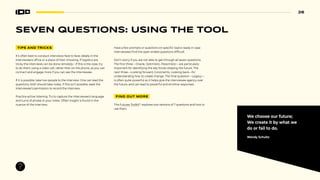
Practice active listening. Try to capture the interviewee’s language
and turns of phrase in your notes. Often insight is found in the
nuance of the interview.
Have a few prompts or questions on specific topics ready in case
interviewees find the open ended questions difficult.
Don’t worry if you are not able to get through all seven questions.
The first three—Oracle, Optimistic, Pessimistic—are particularly
important for identifying the key forces shaping the future. The
next three—Looking forward, Constraints, Looking back—for
understanding how to create change. The final question—Legacy—
is often quite powerful as it helps give the interviewee agency over
the future, and can lead to powerful and emotive responses.
FIND OUT MORE
This Futures Toolkit24
explores two versions of 7 questions and how to
use them.
We choose our future;
We create it by what we
do or fail to do.
Wendy Schultz
27
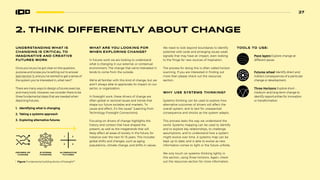
2. THINK DIFFERENTLY ABOUT CHANGE
UNDERSTANDING WHAT IS
CHANGING IS CRITICAL TO
IMAGINATIVE AND CREATIVE
FUTURES WORK
Once you’ve you’ve got clear on the question,
purpose and scope you’re setting out to answer
(see Section 1), and you’ve started to get a sense of
the system you’re interested in, what next?
There are many ways to design a futures exercise,
and many tools. However, we consider there to be
three fundamental steps that are needed when
depicting futures.
1. Identifying what is changing
2. Taking a systems approach
3. Exploring alternative futures
Pace layers Explore change at
different paces.
Futures wheel Identify direct and
indirect consequences of a particular
change or development.
Three Horizons Explore short -
medium-and long-term change to
identify opportunities for innovation
or transformation.
Figure: Fundamental building blocks of foresight25
DRIVERS OF
CHANGE
SYSTEMS
THINKING
ALTERNATIVE
FUTURES
WHAT ARE YOU LOOKING FOR
WHEN EXPLORING CHANGE?
In futures work we are looking to understand
what is changing in our external, or contextual
environment. The change that we’re interseted in
tends to come from the outside.
We’re all familiar with this kind of change, but we
aren’t always able to appreciate its impact on our
sector, or organization.
In foresight work, these drivers of change are
often global or sectoral issues and trends that
shape our future societies and markets. “In
cause and effect, it’s the cause” (Learning from
Technology Foresight Connections).
Focusing on drivers of change highlights the
history and context that have shaped the
present, as well as the megatrends that will
likely affect all areas of society in the future, for
instance over the next 10–15 years. This includes
global shifts and changes, such as aging
populations, climate change, and shifts in values.
We need to look beyond boundaries to identify
potential wild cards and emerging issues weak
signals) that may have an impact, even looking
to the fringe for new sources of inspiration.
The process for doing this is often called horizon
scanning. If you are interested in finding out
more then please check out the resources
section.
WHY USE SYSTEMS THINKING?
Systems thinking can be used to explore how
alternative outcomes of drivers will affect the
overall system, and to test for unexpected
consequence and shocks as the system adapts.
This process tests the way we understand the
world. Systems mapping can be used to identify
and to explore key relationships, to challenge
assumptions, and to understand how a system
might evolve over time. A systems map can be
kept up to date, and is able to evolve as new
information comes to light or the future unfolds.
We only touch on systems thinking lightly in
this section, using three horizons. Again, check
out the resources section for more information.
TOOLS TO USE:
28
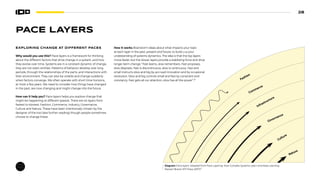
PACE LAYERS
EXPLORING CHANGE AT DIFFERENT PACES
Why would you use this? Pace layers is a framework for thinking
about the different factors that drive change in a system, and how
they evolve over time. Systems are in a constant dynamic of change,
they are not static entities. Patterns of behavior develop over long
periods, through the relationships of the parts, and interactions with
their environment. They can also be volatile and change suddenly
when factors converge. We often operate with short time horizons,
at most a few years. We need to consider how things have changed
in the past, are now changing and might change into the future.
How can it help you? Pace layers helps you explore change that
might be happening at different speeds. There are six layers from
fastest to slowest: Fashion, Commerce, Industry, Governance,
Culture and Nature. These have been intentionally chosen by the
designer of the tool (see further reading) though people sometimes
choose to change these.
How it works Brainstorm ideas about what impacts your topic
at each layer in the past, present and future, to build u-p your
undestanding of systems dynamics. The idea is that the top layers
move faster, but the slower layers provide a stabilizing force and drive
longer-term change: “Fast learns, slow remembers. Fast proposes,
slow disposes. Fast is discontinuous, slow is continuous. Fast and
small instructs slow and big by accrued innovation and by occasional
revolution. Slow and big controls small and fast by constraint and
constancy. Fast gets all our attention, slow has all the power”.26 Fashion
Infrastructure
Commerce
Governance
Culture
Nature
Diagram: Pace layers. Adapted from Pace Layering: How Complex Systems Learn and Keep Learning.
Stewart Brand, MIT Press (2017)27
29
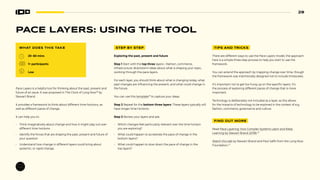
PACE LAYERS: USING THE TOOL
WHAT DOES THIS TAKE
20–60 mins
1+ participants
Low
Pace Layers is a helpful tool for thinking about the past, present and
future of an issue. It was proposed in The Clock of Long Now28
by
Stewart Brand.
It provides a framework to think about different time horizons, as
well as different paces of change.
It can help you to:
• Think imaginatively about change and how it might play out over
different time horizons
• Identify the forces that are shaping the past, present and future of
your question
• Understand how change in different layers could bring about
systemic, or rapid change.
STEP BY STEP
Exploring the past, present and future
Step 1 Start with the top three layers—fashion, commerce,
infrastructure. Brainstorm ideas about what is shaping your topic,
working through the pace layers.
For each layer, you should think about what is changing today, what
past changes are influencing the present, and what could change in
the future.
You can use this template29
to capture your ideas.
Step 2 Repeat for the bottom three layers. These layers typically will
have longer time horizons.
Step 3 Review your layers and ask:
• Which changes feel particularly relevant over the time horizon
you are exploring?
• What could happen to accelerate the pace of change in the
bottom layers?
• What could happen to slow down the pace of change in the
top layers?
TIPS AND TRICKS
There are different ways to use the Pace Layers model, the approach
here is a simple three step process to help you start to use the
framework.
You can extend the approach by mapping change over time, though
the framework was intentionally designed not to include timescales.
It’s important not to get too hung up on the specific layers. It’s
the process of exploring different paces of change that is more
important.
Technology is deliberately not included as a layer, as this allows
for the impacts of technology to be explored in the context of e.g.
fashion, commerce, governance and culture.
FIND OUT MORE
Read Pace Layering: How Complex Systems Learn and Keep
Learning by Stewart Brand (2018).30
Watch this talk by Stewart Brand and Paul Saffo from the Long Now
Foundation.31
30
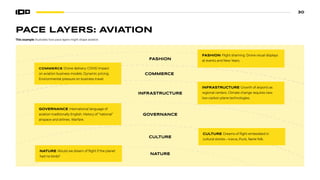
This example illustrates how pace layers might shape aviation.
GOVERNANCE
GOVERNANCE International language of
aviation traditionally English. History of “national”
airspace and airlines. Warfare.
COMMERCE
COMMERCE Drone delivery. COVID impact
on aviation business models. Dynamic pricing.
Environmental pressure on business travel.
FASHION
FASHION Flight shaming. Drone visual displays
at events and New Years.
INFRASTRUCTURE
INFRASTRUCTURE Growth of airports as
regional centers. Climate change requires new
low-carbon plane technologies.
NATURE
NATURE Would we dream of flight if the planet
had no birds?
CULTURE
CULTURE Dreams of flight embedded in
cultural stories—Icarus, Puck, faerie folk.
PACE LAYERS: AVIATION
31
FUTURES WHEELS
EXPLORE THE DIRECT AND INDIRECT
IMPACTS AND IMPLICATIONS OF A DRIVER,
ISSUE OR SCENARIO
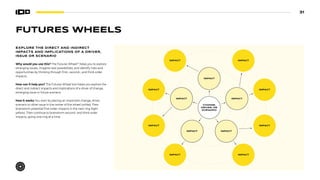
Why would you use this? The Futures Wheel32
helps you to explore
emerging issues, imagine new possibilities, and identify risks and
opportunities by thinking through first-, second-, and third-order
impacts.
How can it help you? The Futures Wheel tool helps you explore the
direct and indirect impacts and implications of a driver of change,
emerging issue or future scenario.
How it works You start by placing an important change, driver,
scenario or other issue in the center of the wheel (white). Then
brainstorm potential first-order impacts in the next ring (light
yellow). Then continue to brainstorm second- and third-order
impacts, going one ring at a time.
CHANGE,
DRIVER, OR
SCENARIO
IMPACT
IMPACT
IMPACT
IMPACT
IMPACT
IMPACT
IMPACT
IMPACT IMPACT
IMPACT
IMPACT
IMPACT
IMPACT
32
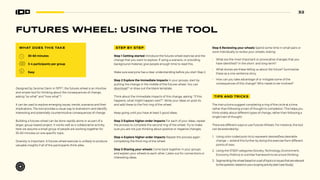
FUTURES WHEEL: USING THE TOOL
WHAT DOES THIS TAKE
30-60 minutes
3-4 participants per group
Easy
Designed by Jerome Glenn in 197133
, the futures wheel is an intuitive
and simple tool for thinking about the consequences of change,
asking “so what” and “now what”?
It can be used to explore emerging issues, trends, scenarios and their
implications. The tool provides a visual way to brainstorm and identify
interesting and potentially counterintuitive consequences of change.
Building a futures wheel can be done rapidly alone or as part of a
larger, group-based project. It works well as a collaborative activity,
here we assume a small group of people are working together for
30-60 minutes on one specific topic.
Diversity is important. A futures wheel exercise is unlikely to produce
valuable insights if all of the participants think alike.
STEP BY STEP
Step 1 Getting started Introduce the futures wheel exercise and the
change that you want to explore. If using a scenario, or providing
background material, give people enough time to read this.
Make sure everyone has a clear understanding before you start Step 2.
Step 2 Explore the immediate impacts In your groups, start by
putting the change in the middle of the futures wheel. You can
download34
or draw out the blank template.
Think about the immediate impacts of this change, asking: ‘‘If this
happens, what might happen next?’’. Write your ideas on post-its
and add these to the first ring of the wheel.
Keep going until you have at least 5 good ideas.
Step 3 Explore higher-order impacts For each of your ideas, repeat
the process to complete the second ring of the wheel. Try to make
sure you are not just thinking about positive or negative changes.
Step 4 Explore higher-order impacts Repeat the process again
completing the third ring of the wheel.
Step 5 Sharing your wheels Come back together in your groups
and explain your wheels to each other. Listen out for connections or
interesting ideas.
Step 6 Reviewing your wheels Spend some time in small pairs or
work individually to review your wheels. Asking:
• What are the most important or provocative changes that you
have identified? In the short- and long-term?
• What stories are these telling us about the future? Summarize
these as a one-sentence story.
• How can you take advantage of or mitigate some of the
consequences of this change? Who needs to be involved?
TIPS AND TRICKS
The instructions suggest completing a ring of the circle at a time,
rather than following a train of thought to completion. This helps you
think widely about different types of change, rather than following a
single train of thought.
There are different ways to use Futures Wheels. For instance, the tool
can be extended by:
1. Using color-coded post-its to represent desired/less desirable
change — extend this further by doing this exercise from different
points of view.
2. Using the STEEP categories (Society, Technology, Environment,
Economy, Politics) or a similar framework to structure thinking.
3. Segmentingthewheelbasedonasetoftopicsorissuesthatarerelevant
tothequestion,basedonyourscopingactivity(seeCaseStudy).
33
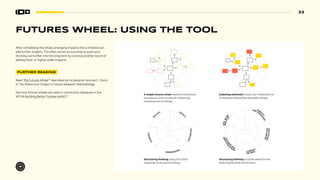
After completing the wheel, arranging impacts into a timeline can
add further insights. This often serves as a prompt to push your
thinking out further into the long term by running another round of
adding third- or higher-order impacts.
FURTHER READING
Read The Futures Wheel35
described by its designer Jerome C. Glenn
in The Millennium Project’s Futures Research Methodology.
See how futures wheels are used in community dialogues in the
WCVA Building Better Futures toolkit.36
FUTURES WHEEL: USING THE TOOL
A simple futures wheel explores implications
one step at a time. to identify interesting
consequences of change.
Exploring sentiment using color-coded post-its
to represent desired/less desirable change.
Structuring thinking using the STEEP
categories to structure thinking.
Structuring thinking a futures wheel for the
exploring the built environment.
34
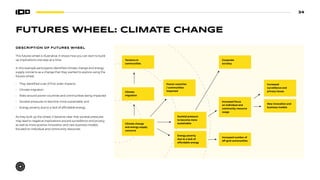
DESCRIPTION OF FUTURES WHEEL
This futures wheel is illustrative. It shows how you can start to build
up implications one step at a time.
In this example participants identified climate change and energy
supply concerns as a change that they wanted to explore using the
futures wheel.
• They identified a set of first order impacts:
• Climate migration
• Risks around poorer countries and communities being impacted
• Societal pressures to become more sustainable; and
• Energy poverty due to a lack of affordable energy.
As they built up the wheel, it became clear that societal pressures
may lead to negative implications around surveillance and privacy,
as well as more positive innovation and new business models,
focused on individual and community resources.
FUTURES WHEEL: CLIMATE CHANGE
Tensions in
communities
Climate
migration
Corporate
scrutiny
Poorer countries
/ communities
impacted
Societal pressure
to become more
sustainable
Increased focus
on individual and
community resource
usage
Energy poverty
due to a lack of
affordable energy
Increased number of
off-grid communities
New innovation and
business models
Increased
surveillance and
privacy issues
Climate change
and energy supply
concerns
35
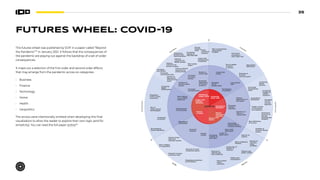
FUTURES WHEEL: COVID-19
This futures wheel was published by SOIF in a paper called “Beyond
the Pandemic”37
in January 2021. It follows that the consequences of
the pandemic are playing out against the backdrop of a set of wider
consequences.
It maps out a selection of the first order and second order effects
that may emerge from the pandemic across six categories:
• Business
• Finance
• Technology
• Home
• Health
• Geopolitics
The arrows were intentionally omitted when developing this final
visualization to allow the reader to explore their own logic (and for
simplicity). You can read the full paper online38
.
BUSINESS
FINANCE
G
E
O
PO
L
I
T
I
C
S
T
E
C
H
NO
L
O
G
Y
Changing
role of
central banks
Large-scale
easing
Low interest
rates
Temptations
of austerity
Diverging
national
outcomes
Chinese
deployment of
soft power
Increasing
humanitarian
crises
Sea of capital
in search
or returns
Pressure on
financial
services sector
Speculative
behaviours
Post fossil
economies:
food, fibre, fuel
New conversations
about public
budgets
Increased
unemployment
More intense
use of digital
platforms
Increasing
digital
communities
Challenges
to privacy
Re-imagining
further education
More visibility
of inequalities
Blurring of work/
household spaces Pressure to
improve pay
and conditions
Poor mental
health
outcomes
Patent wars
and generics
Production of
billions of
vaccines
More conspiracy
theories
Distrust of
science
Refusal of
vaccines,
when
available
Political and
public conflict
Changing perceptions
of life balance
Potential increase
in divorce rates
Woman drawn
back into
domestic sphere
Rise in
social control
technologies
Regulatory
curbs on tech
companies
Increased
importance
of business
resilience
Decline in
world trade
Increased
economic
anxiety
Collapse of
leisure/culture
sectors
Decline of
demand for
office/leisure
space
Adverse
outcomes for
women workers
Declining
commercial rents
Changing
city centers
Increasing
global
poverty
Geopolitical
flashpoints
Tighter control
on movement
and migration
New definitions
of success
Visibility of
inclusive female
leaders
Downward
pressure on
aid and
development
budgets
Increasing
fragility of
conflict
situations
Increased
role for
security
agencies
Narrative of
USA as a
“failed state”
Geopolitical
disruption
Wave of
deaths
Large-scale
business
shutdown
Increasing
public debt
COVID-19
Adverse lifetime
outcomes for
young people
Adverse
outcomes for
BAME workers
Simmering
protests and
demonstrations
New supply
chains
Large scale
infrastructure
investment
Public
makework
schemes
Shorter
working
week
Increasing
interest in
UBI/UBS/UBC
Reassessment
of universities
Educational
inequalities
Domestic
violence
Gender
conflict Increasing
visibility of
care work
Competing
interpretations
of policy motives
New public
behaviours
Cycles of
public grief
HEALTH
HOME
Shared
experience
of health
risk
Retreat
to home
Patched up
supply chains
36
THREE HORIZONS
EXPLORE SHORT- MEDIUM- AND LONG-TERM
CHANGE AND IDENTIFY OPPORTUNITIES FOR
INNOVATION OR TRANSFORMATION
Why would you use this? Three horizons is a framework about
systems transition39
. It can be used as a simple tool to generate rich
structured conversations about desired and undesirable change, how
to get there, and the risks and opportunities along the way.
How can it help you? The concept of horizons is used to help you
think differently about systems change. At H3Uni40
they explain this
by asking you to “Imagine you are looking at a view from the plains
near the coast towards inland mountains. The first horizon is where
the plains end and the foothills of the second horizon rise. Yet behind
them are the high mountains of the third horizon. The plains may
be agricultural, the foothills wooded and the mountains without
trees and with glaciers. Each horizon is qualitatively different. The
analogy here is that we need to be able to see different qualities that
distinguish the short, medium and long term as more significant
than the amount of time.”41
By exploring these horizons it is possible to identify key features
of the systems that underpin each horizon, what can be done to
encourage or discourage change, and identify opportunities for
innovation or transformation.
How it works The three horizons are typically shown visually against
an x-axis of time—from the present into the future —and a y-axis
of the dominance of systems and ideas from less dominant ideas
about the future to the current dominant view of the world.
The first horizon represents the current dominant system—
sometimes described as Business as Usual. As the world changes
some aspects of this system become less fit for purpose, others are
worth conserving.
The second horizon The second horizon is a world in transition, a
temporary system, though that doesn’t necessarily mean it will be
short-lived. It is the land of the entrepreneur, creating innovations
that help prolong H1, and usher in the third horizons. This system
gains dominance and then becomes less relevant in its turn.
The third horizon is the longer-term future. This horizon often
emphasizes the new, the transformative, the visionary, and a break
with past traditions and current assumptions. It is often taken to be
a desired future.
NOW
HIGH
LOW
FUTURE
DOMINANCE
H1
H2
H3
3RD
HORIZON
2RD
HORIZON
1RD
HORIZON
37
THREE HORIZONS: USING THE TOOL
WHAT DOES THIS TAKE
90 mins
3+ participants
Medium
Three Horizons can be used in different ways:
• To explore an issue or change and think about what future(s) this
could create (Option 1)
• To develop a vision and explore what you might need to do to
bring this about (Option 2)
• To understand how to take advantage of opportunities or risks if a
particular scenario were to emerge (Option 3)
• Whichever option you are using, you’ll need to have an agreed
focal issue, for instance, “what is the future of xyz?” or “should we
build capacity in abc?”, you also need to decide how far ahead do
you want to look: ten years, 20 years, or beyond?
• You might already have an issue or strategic question you are
grappling with. If not, you can use tools like the Scoping Circle to
hone in on a topic of interest first.
STEP BY STEP
Option 1: Exploring change
Step 1 Exploring Horizon 1 (Present) (20 mins)
Make sure that there is a shared understanding of the issue or
change that you want to explore. Then discuss how far ahead you
want to look?
Add your time horizon to a three horizons template42
. You can
download this blank template, or on large sheets of paper. Think
about using a wall as it helps to have a lot of space.
Work individually or in small groups to capture thoughts about the
following questions, then have a conversation about your different
perspectives:
• What does the issue / change look like today?
• What is changing that is putting today’s system under pressure?
• What are the defining values or features of the system today?
Step 2 Exploring Horizon 3 (Future) (20 mins)
Now move to Horizon 3 and continue to capture thoughts about the
following questions:
• What might the future system look like? It is fine to have
differences of opinions, try to understand the reasons behind the
differences and capture these on the diagram.
• How would this differ from today? What are the defining values
or features?
• What is changing that could shape this future? Think about
different trends and drivers.
• What is happening today that could be a signal of an emerging
future? Add your ideas to the template as pockets of the future in
the present.
Step 3 Exploring Horizon 2 (Future) (20 mins)
Now think about Horizon 2. Generate ideas about what might
happen in the transition:
• What would this system look like? Think about what would need
to be in place?
• What are some potential opportunities, innovations, tensions or
challenges during this transition?
38
THREE HORIZONS: USING THE TOOL
Step 4 So what? Reflections. (15 mins)
Review the three horizons diagram. Reflect as a group on the story
or stories that you are telling through the map.
• Imagine that you are living in the future, how did you get here?
• What happened to cause the system to start changing? What
were the early signals of change?
• How did you take advantage of opportunities or innovations, how
did you manage or mitigate risks?
TIPS AND TRICKS
There may be a temptation for participants to focus too much on
what they want (their vision), rather than what might be. If this
happens, encourage them to think about different possibilities, and
futures that may be less ideal. You can use three horizons to create a
vision (see Option 2).
People can get overly focused on the shape of the curves. Let
participants know they’re not doing anything complicated! Reassure
them that the curves only indicate that all horizons are present at the
same time – but that each is dominant at different times.
FIND OUT MORE
VisitH3Uniformoreonthethreehorizonsmethodsandhowtouseit.43
Read Three Horizons: The Patterning of Hope by Bill Sharpe44
for more
about the tool and how to think about systems change.
39
THREE HORIZONS
OPTION 1: EXPLORING AN ISSUE OR CHANGE
How did you take advantage of opportunities or innovations, how did
you manage or mitigate risks?
What opportunities, innovations or risks existed in the transition?
What happened to cause the system to start changing?
What were the early signals of change?
Imagine that you are living in the future, how did you get here?
SO WHAT? REFLECTIONS
NOW
HIGH
LOW
FUTURE
DOMINANCE
H1
H2
H3
3RD
HORIZON
2RD
HORIZON
1RD
HORIZON
Step 3 Exploring the
transition
• What does this look
like today?
• What is changing
that is putting
today’s system
under pressure?
• What are the
defining values
or featuresof the
system today?
Step 1 Where are
we now?
• What does this look
like today?
• What is changing
that is putting
today’s system
under pressure?
• What are the
defining values
or featuresof the
system today?
Step 2 Pockets of
the future
• What is happening
today that could
be a signal of an
emerging future?
Step 2 Where are
we going?
• What might the
future system look
like?
• How would this
differ from today?
• What are the
defining values or
features?
• What is changing
that could shape
this future?
40
NOW
HIGH
LOW
FUTURE
DOMINANCE
OF
PREVAILING
PATTERN
2022 2035 2050
H1
H2
H3
3RD
HORIZON
2RD
HORIZON
1RD
HORIZON
THREE HORIZONS: ENERGY
How did you take advantage of opportunities or innovations, how did
you manage or mitigate risks?
We managed to solve the issues around skills through educational schemes
and re-training. We changed how we valued assets with new financing and
asset management strategies that placed a great focus on sustainability.
What opportunities, innovations or risks existed in the transition?
As technology and costs fell, this opened up new markets and opportunities
for local and off-grid energy. There were economic challenges and
disincentives within the system that slowed the transition. A key barrier
to change was the availability of skilled engineers, as well as more general
sector skills.
What happened to cause the system to start changing? What were the early
signals of change?
The underlying economic conditions changed, with falling costs of
renewables, improved technology, and better incentives for change.
Imagine that you are living in the future, how did you get here?
We transitioned away from a centralized energy grid, reliant on carbon fuels.
Today we have local energy grids and renewable energy.
SO WHAT? REFLECTIONS
A WORKED EXAMPLE ON ENERGY
• Rapid growth of
new renewable
capacity
• Falling costs of
production
• Financial
disinvestment
campaigns against
coal
• Economic impact of
stranded assets
• Unemployment
risks
• Skills shortage/
reskilling
• Energy is mostly
produced from
gas and coal in big
power stations
• Experiments with
solar and wind
power
• Energy comes
from renewable
sources produced
more locally
41
THREE HORIZONS
STEP BY STEP
Step 1 Think about the future, what would you want the future to
look like? You can use a news headline or visioning exercise (see
Vision) to help you do this, ask yourself:
• What would it look like to live in this future?
• How are the values of society different?
• How would you describe this future?
• How does this future reflect your core values?
Step 2 Move to Horizon 1, and ask what does the current system look
like? How does this differ from our Vision?
Step 3 Move to Horizon 2, what needs to happen during the
transition? What are some of the opportunities or challenges during
the transition?
Step 4 Think about the pockets of the future in the present? What is
happening today that could be a signal of our vision?
Step 5 Ask yourself, what from the current system would we want
to preserve?
At the end of the exercise reflect on what you can start to do to work
towards your vision. What needs to be done by others? What are
some of the barriers to change?
NOW
HIGH
LOW
FUTURE
DOMINANCE
H1
H2
H3
3RD
HORIZON
2RD
HORIZON
1RD
HORIZON
Step 3 Exploring the
transition
• What needs to
happen during the
transition?
• What are some of
the opportunities or
challenges?
Step 2 Where are
we now?
• What does the
current system look
like?
• How does this differ
from our Vision?
Step 4 Pockets of
the future
• What is happening
today that could
be a signal of our
vision?
Step5 Where are we
now?
• What from our
current vision
would we want to
preserve?
Step 1 Where do
we want to go?
• What do we want
the future system to
look like?
• What would it be
like to live here?
• How are values
different?
• How would we
describe this future?
OPTION 2: DEVELOPING A VISION
42
THREE HORIZONS
STEP BY STEP
You can follow the same steps as in Option 2, but this time
starting with a particular scenario. Make sure you have a shared
understanding of the scenario before you start.
Step 1 Start in Horizon 3 and assume that you are exploring a future
in which your scenario has emerge. You should assume that you are
living in a the world described by you scenario. What are the key
features of this scenario?:
Step 2 Move to Horizon 1, and ask what does the current system look
like? How does this differ from the scenario?
Step 3 Move to Horizon 2 and think about two questions:
1. What do we need to do so we are better prepared for this scenario?
This is about preparing for a particular scenario. What would you
need to do during the transition to be ready for this scenario?
2. What do we need to do to move towards a more positive future?
Think about :
• what are the more positive features of your scenario? How could
you enhance these?
• what are the more negative aspects of your scenario? How could
you recover from or mitigate against these? This is about shaping
the future.
NOW
HIGH
LOW
FUTURE
DOMINANCE
H1
H2
H3
3RD
HORIZON
2RD
HORIZON
1RD
HORIZON
Step 3 Exploring the
transition
• What do we need to
do so we are better
prepared for this
scenario?
• What do we need to
do to move towards
a more positive
future?
Step 2 Where are
we now?
• What does the
current system look
like?
• How does this differ
from our Scenario?
Step 4 Pockets of
the future
• What is happening
today that we could
take advantage of
to improve future
outcomes?
Step 5 Where are we
now?
• What from our
current vision would
we want to preserve
to improve future
outcomes?
Step 1 Our scenario
• What does this
future scenario look
like?
• What are the key
features of this
scenario?
• What would it be
like to live here?
Step 4 Think about the pockets of the future in the present? What is
happening today that we could take advantage of to improve future
outcomes?
Step 5 Finally, think about what from our current vision we would
want to preserve to improve future outcomes?
OPTION 3: EXPLORING AN EMERGING SCENARIO
43
THREE HORIZONS: SUSTAINABLE URBANIZATION
A THREE HORIZONS EXERCISE EXPLORING
SUSTAINABLE URBANIZATION
This Three Horizons example explores how sustainable urbanization
could look in urban environments in Asia by 2050. It has been
adapted as an example.
It comes from a workshop where participants explored four key
themes: resilience, technology, planning and financing. It has been
adapted and made anonymous for this purpose. The three horizons
model shown is from a group exploring financing.
NOW
HIGH
LOW
FUTURE
DOMINANCE
OF
PREVAILING
PATTERN
2022 2035 2050
H1
H2
H3
3RD
HORIZON
2RD
HORIZON
1RD
HORIZON
• Cost saving for emerging
markets
• Greater regional and
global cooperation
• Cost saving for emerging
markets
• New mechanisms for
regulatory compliance
• Scaling up lifecycle
analysis, including with
investors
• Connecting across
heenvironment value
chain to engage architects,
finance actors
• Green mortgages offered
by commercial banks
• Greater involvement of
community and citizens
with financial community.
• Limited awareness of
ESG agenda among asset
managers
• A strong focus on
”efficiency” rather than
“sustainability”
• Knowledge sharing
between finance actors
and specialist planners
• Integrating embodied
carbon into lifecycle
costing
• Growing conversation
about climate change in
Asia-Pacific countries and
cities
• Emissions are fully costed
in property development
and management.
• Legal requirement to
report on carbon exposure
from historic investments.
• Appropriate local,
municipal and state
investment in low carbon
agenda
• Clean energy,
watersecurity,zero-waste,
accessible transport.
• Health and well-being at
the center of ESG agenda
• Net-zero and resilience go
hand in hand.
• Resilient and affordable
housing
44
44
3. IMAGINE ALTERNATIVE FUTURES
CREATE CONTRASTING,
COHERENT FUTURES USING
DRIVERS OF CHANGE AND
IMAGINE NEW POSSIBILITIES.
When a system is well-understood, it can be used
to explore alternative futures. This is necessary
as the future is non-linear, and therefore is
unpredictable.
There are many effective tools and methods for
this, including scenario building. The key point,
however, is to be able to move away from a fixed
idea of the future to identify alternative, yet
credible, futures.
There are many different ways to do this. We are
sharing two in this toolkit. The first is a simple,
structured approach to creating a set of scenarios.
The second, helps you rapidly imagine alternatives
by coloring the future.
USING SCENARIOS TO THINK
SYSTEMATICALLY ABOUT THE
FUTURE.
Scenarios are a way of managing uncertainty
about the future.45
A successful set of scenarios
helps you to shift your thinking beyond the
constraints of today so we can prepare for a
wider range of eventualities, and imagine new
possibilities.
Each scenario should be distinctively different
from the others. They should be easy to
understand and combine both logic and story-
telling to quickly understand the strategic
relevance and implications of the scenario set.
“A scenario is a story with plausible cause and
effect links that connects a future condition
with the present, while illustrating key decisions,
events, and consequences throughout the
narrative.” (Futures Research Methodology
Version 3.0, Glenn 2009).46
WHY THINK ABOUT ALTERNATIVE
FUTURES AND SCENARIOS?
There are many different ways to imagine
alternative futures. There are also a myriad of
scenarios approaches. Some are more intuitive,
others more technical; some values-driven,
others more focused on structure.
You do not need to use scenarios. The key is to
think about a plurality of futures, rather than a
single, linear-view of the future.
The two that we introduce in this toolkit have
been chosen for different reasons:
• The 2x2 scenarios method47
is a useful tool in
policy and strategy. It helps create a scenario
framework that is logical, easy to communicate.
If provides structure through which to imagine
different futures.
• The Systems mythologies48
are more intuitive
and values-driven. The variation we have
included is designed to allow you to use these
quickly to generate novel insights.
For more information on other scenario
methods, please see the resources section.
TOOLS TO USE:
2x2 Scenarios Identify critical
uncertainties and use these to
imagine alternative futures.
Systems mythologies Rapidly
imagine different systems using
these thinking hats.
R B
P G
Figure: Fundamental building blocks of foresight
DRIVERS OF
CHANGE
SYSTEMS
THINKING
ALTERNATIVE
FUTURES
45
2X2 SCENARIOS
IDENTIFY CRITICAL UNCERTAINTIES AND USE
THESE TO IMAGINE ALTERNATIVE FUTURES
Why would you use this? Scenarios help you to imagine how
change may look in the future, imagining new and alternative
possibilities.
How can it help you? Scenarios help you to gain rich insights into
how the future could emerge by developing a set of alternative
stories about the future. They can be used as a social learning
process to help develop shared and challenging perspectives on the
future. As a scenario set they allow you to imagine new possibilities
and identify strategic opportunities and risks that can inform
strategy, planning and decision-making today.
What it is There are many different scenario methods. The
tool detailed here, a double uncertainty or 2x2 approach, is a
structured approach to thinking about the future. It uses pairs of
critical uncertainties—drivers of change that have uncertain or
unpredictable future trajectories but will have high impact on the
future—to create a simple scenario framework in which to imagine
alternative futures.49
Example scenarios: The World Economic Forum‘s scenarios for the future of global food systems in 2030.50
46
2X2 SCENARIOS: USING THE TOOL
WHAT DOES THIS TAKE
2 hours
4+ participants
Medium
The 2x2 approach is sometimes described as “the
Shell approach” but originally comes from SRI, a
West Coast futures consultancy in the 1980s. It
was popularized in The Art of the Long View by
Peter Schwartz.
It is a relatively structured approach to scenario
building, based around the identification of two
critical uncertainties through a Driver Mapping
exercise.
Scenarios are not predictions. The idea is that they
offer interesting—sometimes challenging—ideas
about the future.
They are used to explore alternative ways that the
future may develop. It is important to consider
more than one scenario, and by having a set of
scenarios, you can test how different interventions
may work under different conditions.
STEP BY STEP
There are two key elements that you need before
you start: a defined focal issue, and an agreed
time horizon.
If you don’t have these yet, you can use the
scoping circle to support your thinking.
Step 1 Driver mapping Introduce the focal
issues and time horizon. Ensure there is a shared
understanding.
Then split into small groups. Work individually, or
in pairs, to generate a set of ideas about drivers of
change that could affect your focal issue over this
time horizon.
Each person should aim to identify four to five key
drivers to share with the group. Encourage them to
identify a variety of drivers from across the STEEP
categories. You can use this template51
to help.
Step 2 Share and prioritize drivers Share your
ideas as a group. As you share, have a discussion
about these drivers and start to prioritize these on
a matrix.
Work together to group similar ideas and
consolidate them if appropriate.
Once you have shared, cluster these on a
prioritization matrix (template) based on the
groups view of the impact and uncertainty
associated with the drivers.
Step 3 Identify the critical uncertainties Look at
the top right corner of your matrix. These are your
critical uncertainties. Try to identify two or three
critical uncertainties to use in the next step, when
you generate your scenario framework.
Keep a shortlist of other high impact drivers, as well
as any ideas that feel like potential wildcards. You’ll
use these later in the scenario-building process.
Figure: Prioritize drivers based on their potential impact and level of uncertainty.
LOW
HIGH
LOW
HIGH
POTENTIAL
IMPACT
CRITICAL
UNCERTAINTIES
HIGH
IMPACT DRIVERS
SECONDARY
DRIVERS
UNCERTAINTY
47
2X2 SCENARIOS: USING THE TOOL
Step 4 Developing scenario axes Review and
discuss each ‘critical uncertainty’ as a group.
Can you think of two quite different ways in which
each one may manifest in the future?
Ask the group to describe the ways the drivers
could play out in opposite ways.
The same driver can have multiple interpretations.
It is important to explore different possibilities and
decide what would work best to create contrasting
scenarios through which to explore the focal issue.
For example, the driver ‘Global security’ could
create different kinds of uncertainties.
Step 5 Set up your scenario axes Ask the group
to think about which of their critical uncertainties
might combine to generate a set of four
interesting scenarios.
They want to select two drivers. These should not
be obviously linked. Avoid having two drivers from
the same STEEP category, or uncertainties that
have an obvious relationship (cause and effect).
Choose your scenario axes and draw them up on a
scenario template.
For each scenario, have a quick discussion to
check that they feel useful and worth exploring:
• Are they intuitive?
• Are they relevant to your focal issue ?
• Are they meaningfully different ?
Once you have a set of axes that might work, give
each quadrant a title.
Step 6 Developing the scenarios Introduce
the shortlisted drivers of change from Step 2
(drivers mapping). Which other uncertainties feel
important to explore? What might they look like in
each scenario? Which drivers are high impact (but
relatively certain) that need to featured?
Decide as a group how these drivers might look in
each quadrant before continuing to develop stories.
The WEF, working with Deloitte Consulting, used
a used a 2-axis approach to explore “How will food
systems nutritiously and sustainably feed 8.5
billion people in 2030?“
Looking out from 2017, they identified two critical
uncertainties:.
1. Demand shift: exploring resource-intensive
and resource-efficient demand for food and
agricultural commodities and whether it will be
environmentally friendly.
2. Market connectivity: whether there would be
open trade, trusted and resilient commodity
markets, inclusive of technological innovations.
Figure: The World Economic Forum‘s scenarios for the future of global food systems in 2030
The two uncertainties, were used to create
four potential future worlds. Survival of the
Richest, Unchecked Consumption, Open-source
Sustainability or Local is the New Global.
You can find out more and read the scenarios online.
THE SCENARIOS:
FOUR POTENTIAL FUTURE WORLDS
RESOURCE
INTENSIVE
CONSUMPTION
RESOURCE
EFFICIENT
CONSUMPTION
LOW CONNECTIVITY
HIGH CONNECTIVITY
MARKETS
MARKETS
OPEN-SOURCE
SUSTAINABILITY
UNCHECKED
CONSUMPTION
DEMAND SHIFT
SURVIVAL OF
THE RICHEST
LOCAL IS
THE GLOBAL
48
2X2 SCENARIOS: USING THE TOOL
Step 10 Write your stories
Now start to write a story that ties together the
elements of your scenario. Stories do not have
to be long, but they should help your reader
understand the scenario and bring it to life:
• Be set in the future, written in the present tense.
• Help your reader understand how the world has
emerged (e.g. once upon a time, and then...)
• Describe the key features of the world telling
the story of how people and communities are
affected.
To help you do this it can be helpful to think about
what different characters might be doing in the
future. How are they living? What do they value?
How are they impacted in this scenario?
Another useful technique is VERGE52
, which is
an ethnographic technique for exploring future
change through six domains of change:
• Define: The concepts, ideas and paradigms we
use to define the world around us
• Relate: The social structures and relationships
which link people and organizations
• Connect: The technologies used to connect
people, places and things
• Consume: The processes and technology
through which we consume goods and
services
• Create: The processes and technology through
which we create goods and services
• Destroy: The ways in which we destroy value
and the reasons for doing so.
When working with these domains consider
them from different perspectives e.g. citizens,
companies, governments, students, pensioners.
Alternatively, use news headline to bring your
story to life, or think about what objects, or
artifacts might exist in this future.
TIPS AND TRICKS
A good scenario is not an abstract analysis of
trends. It tells a believable story set in the future
and should involve the audience in the same way
a short-story writer does.
You are not trying to predict the future. You are
trying to describe one possible future, among an
infinite number. You won’t get it right, but you can
make it meaningful and useful for your audience
or ‘client’.
A good scenario helps us to “reperceive the
present”53
— it illuminates the project question
and brings new insight.
from a different (perhaps surprising) angle. It
creates a future world that has implications for
how best to respond to the challenge that has
been set. It can be used to test possible responses
to the challenge.
FIND OUT MORE
• Example food scenarios from the World
Economic Forum (2017)54
.
• Read more about different scenario
approaches and methods in this short paper.55
• Explore the VERGE framework 56
in this article
by Richard Lum.
• Find out more about design fiction and
experiential futures in this article57
.
49
EXAMPLE: MEGA SCENARIOS FOR THE
FUTURE OF CALIFORNIA
Building on its work on issue-based future scenarios for the state,
California 100 developed a set of scenarios58
in partnership with the
Institute for the Future.
These Mega Scenarios looked 10, 30 and 100 years into the future to
explore how deep underlying drivers of change—technology, climate
change, inequality and societies shared understanding — could
impact California’s future.
The scenarios suggested different options for what the state might
look like in the future. Ultimately, this led to a set of public policy
reports59
exploring possibilities on topics from agriculture and food,
governance, media and civil society, education, inequality, energy,
urban planning and criminal justice.
California has seen several unlikely scenarios come to pass, including
the worst global pandemic in over a century and a war in Europe that
is exacerbating inflation in a variety of ways. The Mega Scenarios,
supported by the listening sessions have been an important step to
get Californians more prepared for future scenarios.
The scenarios used two critical uncertainties to create sets of four
scenarios, or alternative futures for California.
A summary of the 10- and 30-year scenarios is provided here. You can
read the full scenarios online.60
Image: The mega scenarios and 14 policy reports. Click on the boxes to read or visit california100.org/research
50
EXAMPLE: CALIFORNIA 100 MEGATRENDS
THE 10 YEAR SCENARIOS
The 10-year scenarios asked “What kind of a state does California
want to be ten years from now?”. They focused on two critical
uncertainties:
1. Whether California would transform politically in response to
emerging issues, or whether it would operate from a similar
status quo as today.
2. Whether Californians would choose policies that are inclusive of
the entire state’s population, or whether they would choose to
divide the state into enclaves with policies decided at the local
and community level.
The two uncertainties created four scenario spaces:
• Texas done right: freedom, choice, and diversity – at a price.
• California New Deal: transformative progressive reforms – at a cost
• Together in the struggle: with limited bandwidth, making the
best of a difficult situation
• Protecting one’s own community (or self) preservation amidst
adversity limited bandwidth
Image: Scenario framework for the 10-year scenarios
POLITICAL AND ECONOMIC
TRANSFORMATION
POLITICAL AND ECONOMIC
INERTIA
INCLUSIVE
SOCIAL
ENVIRONMENT
ENCLAVED
SOCIAL
ENVIRONMENT
TEXAS DONE
RIGHT
1 CALIFORNIA
NEW DEAL
2
PROTECTING
ONE’S OWN
4 TOGETHER
IN THE
STRUGGLE
3
51
EXAMPLE: CALIFORNIA 100 MEGATRENDS
THE 30 YEAR SCENARIOS
The 30-year scenarios were extensions of the 10-year scenarios. As we
move out further in time, this time focused more around long-term
changes in two critical uncertainties:
3. At the level of global coordination amongst the nations of Earth to
address the existential crises of climate, energy, war, disease, food,
and other planetary issues
4. At the level of independence and alignment for the state of
California in terms of its relationship with the federal government,
and its relative profile in world politics.
The two uncertainties created four scenario spaces:
• Seeds of a new world A global network of cities steps up to
provide agile, regional leadership
• Getting it done California sets its own agenda on a global stage,
building allies
• Don’t worry Working internationally to tackle existential threats,
despite top-down control
• Great Power Rivalries held back by U.S. and global politics
Image: Scenario framework for the 30-year scenarios
CALIFORNIA GOES ITS
OWN WAY
CALIFORNIA GOES
ALONG
COORDINATED
GLOBAL
EFFORTS
DISCONNECTED
GLOBAL
EFFORTS
SEEDS OF A
NEW WORLD
1 GETTING
IT DONE
2
GREAT POWER
RIVALRIES
4 DON’T
WORRY
3
52
STEP QUICKLY AND EASILY IN AND OUT OF
THE SHOES OF OTHERS — TO EXPLORE AN
ISSUE FROM DIVERSE PERSPECTIVES.
Why would you use this? This method is designed to enable people
to step quickly and easily in and out of ‘the shoes of others’. This
helps you rapidly imagine different scenarios.
How can it help you? Systems Mythologies61
describes four
archetypes of meaning, each represented by a color—blue, red,
green and purple. Any issue can be explored through the lens of
each architype to generate insights.
How it works The approach presented here makes use of these
four Systems Mythologies as a rapid assessment tool. Individuals or
small groups first review a future-facing issue from the perspectives
offered by each of the four color systems, and then identify and
evaluate opportunities and risks emerging.
SYSTEMS MYTHOLOGIES
R B
P G
Red System
How would it look as
an advertised product,
poised to dominate the
market? How could it
be used as a weapon,
creating imbalances of
power between those
who have access to it
and those who don’t?
Green System
How does it look when
its hacked together in
a garage and donated
to the open-source
movement? How could
it empower individuals
and communities to
create and experiment,
developing a following
with a life of its own?
Purple System
What version of it will
violate social norms,
but potentially spark a
new paradigm? What
breakthrough design
will be heralded as
visionary by some, and
as ludicrous by others?
Blue System
What would this look
like if it was embedded
in the insfrastructure
of society, a utility
or algorithm as
fundamental as the
power grid? How would
it contribute to the
automation of human
labor in a future of
computer controlled
smart environments?
ISSUE, QUESTION OR TECHNOLOGY
53
SYSTEMS MYTHOLOGIES: USING THE TOOL
WHAT DOES THIS TAKE
40-90 mins
4+ participants
Low
Systems Mythologies was developed by the Institute for the Future
(IFTF).62
It describes four architypes of meaning, each represented by
a color — blue, red, green and purple.
The approach here was developed by SOIF. It uses the mythologies
as an appraoch similar to Edward de Bono’s ‘thinking hats’63
or
Marshall McLuhan’s Technology Tetrads64
. It is an effective approach
to imagining alternative futures.
It can help you to develop novel and contrasting views of the future.
STEP BY STEP
Step 1 Agree on the issue Agree on the issue that you want
to explore and your time horizon. Make sure there is a shared
understanding why the issue is important.
R B
P G
Step 2 Imagine the future from different perspectives Work
through each of the colors—systems mythologies— one at a time
(see next page for the descriptions and prompts). You can use this
template to capture your thoughts.
• Spend a few minutes orienting yourself to the worldview of the
people who live here—what enthuses and excites them?
• Identify what they would seek to do with the change, issue or
question under review, and list these out.
• Go round all four, repeating this process and capturing your ideas
about what the future could look like.
Step 3 Consider the so what Review your outputs for each color. In
response to each, think about:
• What are the opportunities in the future that we could take
advantage of?
• What are the threats ? (note: some opportunities may also be
threats)
• What new questions is this raising that we might need to explore
further or research?
• What are some of our personal or organizational blindspots?
Step 4 Prioritize Prioritize your answers. You can use a voting
approach, or just have a conversation about the opportunities,
threats, questions or blindspots you think are most important.
TIPS AND TRICKS
We recommend that you start at the Red or Blue System description
and work clockwise. The order is deliberate as we believe that this
leads to a richer conversation based on our experience using this
approach. But feel free to ignore this!
Consider your own perspectives. As individuals, would you consider
yourself a red, green, blue or purple thinker? How could you use this
to be intentional about creating diverse teams?
Who else might you want to consult to bring additional insights?
FIND OUT MORE
Read the systems mythologies toolkit from IFTF.65
54
SYSTEMS MYTHOLOGIES: THE MYTHOLOGIES
The blue archetype values structure, logic, and
objectivity. It is the color of planners, scientists,
accountants, referees, engineers, and coders.
Blue roles follow set rules to achieve predetermined
outcomes. Strategies are centralized, all-
encompassing designs that attempt to address the
entire system from one set of principles.
Blue is a central command console with labeled
buttons and blinking lights that monitor and adjust
every aspect of the system.
Blue environments are giant machines, designed
for achieving specific goals by following an
established circuit. They are laboratories, power
grids, data centers, traffic infrastructure, and
hospitals.
Prompts:
• What would this look like if it was embedded in
the infrastructure of society, a utility or algorithm
as fundamental as the power grid?
• How would it contribute to automation of human
labor in a future of computer controlled smart
environments?
R B
P G
The green archetype values inclusiveness,
emergence, and creativity. It is the color of
grassroots movements and thriving ecosystems,
of residents, community organizers, musicians,
settlers, farmers, and artists.
It is playful and organic, and will grow according to
its own innate potential and unique personality. It’s
a canvas begging to be painted, and an organism in
search of its true self. Green feels alive and relatable,
but it doesn’t take orders.
Green roles respond to the natural rhythms of their
environment.
Prompts:
• How does it look when it is hacked together
in a garage and donated to the open-source
movement?
• How could it empower individuals and
communities to create and experiment,
developing a following with a life of its own?
The purple archetype values mysteries, hidden
truths, and the unknown. It is the color of, visionaries,
sorcerers, shamans, spies, priests, and aliens.
Purple roles peek behind the curtain of the known
world to the world beyond.
Purpkle thinkers step outside of the box and any
metaphor involving boxes. Purple strategies include
voyages, dreams, experiments, magic spells, and
expeditions
This is at the edges of our understanding, strange
worlds and new paradigms.
Prompts:
• What version of it will violate social norms,
but potentially spark a new paradigm? What
breakthrough design will be heralded as
visionary by some, and as ludicrous by others?
The red archetype values heroes, competition,
and winning. It is the color of agency, urgency,
and blood. It is passionate and driven, and will do
whatever it takes to succeed. Red is behind every
war and every love affair, and will rear its head any
time a line gets drawn in the sand.
Red roles drive the story forward and don’t back
down until they’ve won.
Inside a red system, individual players are free to
make their own choices, and are responsible for
their own survival. Red is a marketplace and a
battlefield.
Prompts:
• How would it look as an advertised product,
poised to dominate the market?
• How could it be used as a weapon, creating
imbalances of power between those who have
acces to it and those who don’t?
Source: Adapted from IFTF systems
mythologies.66
55
SYSTEMS MYTHOLOGIES: SPACE
THIS EXAMPLE EXPLORES THE
FUTURE OF OUTER SPACE.
Looking at this through the four systems lenses,
we might expect to see the following types of
observations. Obviously the more specialist
insight that is brought to bear on this discussion,
the richer the outcomes will be.
Opportunities, for example, might include the
ability to stabilize space activity, and reduce the
risk of bad actors, by engaging fully with ‘Blue’
proposals on regulating space.
They might also include using the ‘open source’
mapping activities of Green actors to supplement
other communications analysis.
R B
P G
Threats might include the risk that an anonymous
friendly satellite is spotted by Green actors.
New analysis might include a review of the
prospects for Red actor interplanetary mining.
Given that most reports suggest it is difficult to
make viable, some further analysis might focus on
unintended consequences of failed attempts to
develop mining in space.
Blind spots might include some social analysis
of the possible effects of the growth of Purple
perspectives on space and the earth, which might
include new forms of consciousness or activism.
Figure: Exploring the future of space through the systems mythologies.
Red system
Red systems thinking sees space as a resource to
be exploited. Space tourism, of course, but beyond
that an opportunity—potentially for mining and
resource extraction. Expect ownership or property
claims to be made for parts of the moon. Red
thinkers will also look for geopolitical advantage
from data collected from space.
Blue system
The blue system sees space as being managed
through a structure of agreements and
conventions—in the same way that the Arctic
has been regulated. Blue thinkers will be looking
to reinforce existing agreements on the use of
space, perhaps looking for a Convention on Space
to reinforce existing agreements. Similarly, they
might be looking for agreements about the use of
data gathered from space.
Green system
Green systems thinking sees space as a
‘commons’ that should be managed for the public
global good. In this lens there are concerns about
the impact of space debris on astronomy, and
of the way in which unmanaged debris creates
risks to other space users. Green activists start
an open source database tracking satellites and
other space activity, to attribute activity as part of
a campaign to make space actors responsible for
external costs.
Purple system
Purple thinkers will be asking about what types
of surprises the new wave of space travel and
exploration will afford. For example, they might
wonder if increasing the numbers of people who
have seen the earth as a whole from space might
start to change people’s consciousness about
the earth.
56
56
4. NAVIGATING UNCERTAINTY
NAVIGATING UNCERTAINTY TO
IMPROVE DECISION-MAKING TODAY.
Ultimately, the purpose of futures work is to improve
the decisions we make today. The key benefits67
of a
strategic foresight approach is that it helps you to:
Build vision Make strategic choices to shape the
future you want
Manage risk Build preparedness for alternative
possible futures
Awareness and Agility Create future-ready and
alert organizations that can adapt as the future
evolves
THE TOOLS IN THIS SECTION
PROVIDE A SYSTEMATIC
APPROACH TO DO THIS —
BRINGING THE FUTURE BACK TO
THE PRESENT.
The idea is that once you have understood your
alternative futures, you need to understand what
you would like to happen (vision).
You can then work backwards to think about how
these futures might emerge (back-casting).
Vision Understand your preferred
future.
Backcasting Start in the future and
work back identify new pathways
and possibilities.
Wind-tunneling Stress-test policies,
strategies and goals against different
future scenarios. Figure: Bringing the futures back to the present. Foresight approaches differ from forecasting and other attempts
to predict the future using linear trends. Foresight explores possible futures (Missing red dot), to help you prepare for
alternatives, and to understand your preferred future or vision.
You can then test your policies, plans and
strategies to see if they will help you to work
towards your vision, or to mitigate against less
desirable outcomes.
This helps you identify what you want to do
today— to create a better future or prepare
what might happen—and what you need to do
if systems start to move towards an alternative
future.
By rehearsing your futures, you can be ready to
respond to emerging futures or shocks.68
TOOLS TO USE:
“DRIVERS OF CHANGE”
“UNCERTAINTIES”
“SYSTEMS”
“SHOCKS”
PAST PRESENT
PREDICTION
EARLY WARING INDICATORS
BACKCAST
(HOW MIGHT THE FUTURE EMERGE)
VISION
(WHAT WE WOULD
LIKE TO HAPPEN)
ALTERNATIVE
SCENARIOS
(WHAT MIGHT
HAPPEN)
“FACTS” “TRENDS” “THE FUTURE”
FUTURE
PAST PRESENT ALTERNATIVE
FUTURES
TRADITIONAL
STRATEGIC
PLANNING
SCENARIOS
APPROACH
TO
PLANNING
57
VISIONING
UNDERSTAND YOUR PREFERRED FUTURE.
Why would you use this? Visioning helps you understand your
preferred future.
How can it help you? Visioning is an important step as it helps
you understand what you want the future to look like and how it fits
with your core values. It creates a sense of agency and direction over
the future.
How it works A visioning exercise can be a useful next step after a
futures wheel, scenario development, or other exercise that helps you
think about alternative possibilities or change. The approach outlined
here helps you think about what success would look like in the future
using news headlines from the future.
Image: Rib Mountain, United States.
By Matt Noble
58
VISIONING: USING THE TOOL
WHAT DOES THIS TAKE
45 mins
4+ participants
Low
Taking time to imagine a collaborative preferred future helps to
move the conversation away from what we expect will happen
towards what is possible.
Although you can’t control the future, visioning gives you clarity
over how you might influence it and what matters to you and your
community.
A well-crafted vision is aspirational and helps motivate people to
come together towards action.
You can use this tool to develop a generic vision for the future, or
to imagine a vision for a focal issue, or a particular change that you
have identified as important or interesting to explore.
Revisit insights from a 7 questions interview, particularly the
optimistic and epitaph questions.When starting with a set of
scenarios or three horizons exercise also look for changes that
you want to enhance or discourage in different scenarios,
to inform visioning.
STEP BY STEP
Step 1 Create your news headlines Work as individuals or in pairs
to come up with ideas about a news headline from the future that
reflects your “wildest dreams”. Depending on your focus this could
be for your country, a particular city or community, or an issue that
you care about.
For instance If what you want is for food systems in California to be
more sustainable on its 200th anniversary in 2050, you could write:
• California enters new century of sustainable farming.
Step 2 Share your headlines Have a discussion about what they are
telling you is important to your group.
Step 3 Imagine what success looks like Now think about what
success would look like if you could overcome barriers to change
and transform the future, for instance:
• There is no hunger and zero waste in California in 2040
Step 4 Share your ideas Share and capture your ideas as a group:
• Why do we think these issues are so important?
• What would it mean for us to achieve this?
Capture your ideas as a vision statement, for instance:
• We envision a California where we have collectively achieved
zero hunger, and zero waste. Everyone has access to affordable,
nutritious food. There is a strong circular economy, with local,
sustainable food production.
• Think creatively about the verbs you can use for instance:
to dream, to fight, to hope, to need.
59
Step 5 Think about change Think about what else is important to
enable this in the future. This includes change that may be outside
of your control:
• What will it be like to live there?
• What is outside of our control that we would need to happen to
enable this future?
• What can we do to achieve this?
• What is holding us back?
• What are the values that are important in our vision?
If using scenarios, or futures wheels as inputs, reflect on the changes
or implications that you thought were positive or negative.
• What do you want to enhance? How can you do this?
• What would you want to discourage?
Step 6: Capture your vision Capture the key elements of your
vision into a short narrative and agree this as a group. Your vision
statements should include outcomes relating to people, places,
communities (or even species). As you craft your vision, test this
against the vision criteria (next page).
TIPS AND TRICKS
A good vision is steeped in clear values. Think about which values
you would like to see out in the world, and how these relate to your
core values.
Creating vision statements is an iterative process. Allow time to
explore and refine the sentences proposed by the group.
Giving your vision a compelling name can help bring it to life quickly
for your audience.
FIND OUT MORE
Explore how Causal Layered Analysis69
and Appreciative Enquiry70
can help you Vision.
VISIONING: USING THE TOOL
60
VISION: FOOD SYSTEMS
A VISION FOR A SUSTAINABLE
AND SECURE FOOD SYSTEM FOR
2030
The UK Government food strategy71
was
developed through extensive industry
consultation and discussions in 2008 and 2009.
The resulting publication, Food 2030 set out
the UK Government’s priorities for tackling the
“big food challenges” of sustainability, security
and health. It is summarized below. It sets out
a compelling vision that has clear end goals,
embedded values. It identifies a key set of issues
that need to be tackled, in response to external
change. It also sets out a set of clear actions and
who needs to be involved in creating change.
You can explore the strategy here.72
OUR VISION FOR A SUSTAINABLE
AND SECURE FOOD SYSTEM FOR
2030. WHAT WE WANT BY 2030…
Consumers are informed, can choose and afford
healthy, sustainable food. This demand is met by
profitable, competitive, highly skilled and resilient
farming, fishing and food businesses, supported
by first class research and development.
Food is produced, processed, and distributed, to
feed a growing global population in ways which:
• use global natural resources sustainably,
• enable the continuing provision of the benefits
and services a healthy natural environment
provides,
• promote high standards of animal health
and welfare,
• protect food safety,
• make a significant contribution to rural
communities, and
• allow us to show global leadership on food
sustainability.
Our food security is ensured through strong UK
agriculture and food sectors and international
trade links with EU and global partners, which
support developing economies.
The UK has a low carbon food system which is
efficient with resources – any waste is reused,
recycled or used for energy generation.
THE STRATEGY IS STRUCTURED AROUND SIX
CORE ISSUES FOR THE FOOD SYSTEM:
ENCOURAGING PEOPLE
TO EAT HEALTHY,
SUSTAINABLE DIET
1
INCREASING THE IMPACT
OF SKILLS, KNOWLEDGE,
RESEARCH AND
TECHNOLOGY
6
ENSURING A RESILIENT,
PROFITABLE AND
COMPETITIVE FOOD
SYSTEM
2
REDUCING, REUSING
AND REPROCESSING
WASTE
5
INCREASING FOOD
PRODUCTION
SUSTAINABILITY
3
REDUCING THE FOOD
SYSTEM’S GREENHOUSE
GAS EMISSIONS
4
61
VISION: SUSTAINABLE DEVELOPMENT
SUSTAINABLE SINGAPORE 2015
Generations of foresight experience led the
government to renew its focus on citizen-centricity
through the Public Service Transformation in 2012.
Shortly afterwards, Our Singapore Conversation
attracted over 46,000 people who expressed their
hopes and ideas for the future through facilitated
dialogues with government officials.73
The Sustainable Singapore Blueprint 201574
is a
nice example as it sets an aspirational vision that
was developed with its citizens, and a clear set
of targets for a more liveable and sustainable
Singapore, based on three pillars of sustainable
development.
You can explore the strategy and vision here.75
Figure: Visualization of targets for 2030 from the Sustainable Singapore Blueprint 2015.
3 Pillars of Sustainable
Development
Promoting Social and
Economic Well-Being
while Protecting the
Environment.
2030 Targets
Sustainable Singapore
Blueprint
62
DEVELOPING AND THINKING ABOUT CORE
VALUES
WHY CORE VALUES?
The success of any type of collective action, either
within an organization or across organizations, often
requires clarifying and agreeing on core values and
principles. This is especially for collective action
under contexts of critical uncertainty, as core values
serve as an anchor for collective prioritization and
decision making under changing circumstances.
Put very simply, we are much more likely to go
far with a “coalition of the aligned” than with a
“coalition of the willing” that has not yet aligned on
shared values and principles.
CLARIFYING YOUR CORE VALUES
Concepts like innovation, resilience, inclusion,
sustainability, equity, and human dignity are
rich and resonant in many societies today. But
what do each of these terms mean? Vagueness
on concepts may serve some useful purposes,
as organization leaders seek to build interest
and initial buy-in among key partners or team
members. Soon, however, the lack of specificity in
core values will tend to cause misunderstandings,
misalignment, and frustration.
BRAINSTORMING TO GAIN
CLARITY ON VALUES
When defining core values, it may be helpful
to consult a dictionary to gain a general
understanding of how a society conceives of a
particular topic. In many instances, however,
your organization or sector may have a very
different understanding of a particular value than
what is included in standard dictionaries. Word
association exercises, involving key partners and
team members, can help your organization gain
more clarity on its core values among internal
audiences. Thinking further ahead, you may also
find it useful to engage a select or representative
group of your key external audiences, in order
to better understand how your core values may
resonate with others.
WORD ASSOCIATION: QUALITIES
AND PROPERTIES OF A VALUE
One way to gain clarity on a core value is to think of
all of the different attributes, properties, synonyms,
and other related terms that people associate
with the concept. Conducting a brainstorming
exercise–such as using bits of paper that are
posted on a wall, or writing words on a big board
with answers that are shouted out, or using
interactive digital tools like “word clouds”—
can help flesh out all of the different ways that
people think about the qualities or properties of
the concept. This is known in logic as concept
intension, which is a collection of properties that
are associated with a term.
WORD ASSOCIATION: REAL- WORLD
EXAMPLES OF VALUES IN ACTION
Another important way to gain clarity on a core
value is to identify examples where you have seen
these values being demonstrated, either partially
or fully. This is known in logic as concept extension,
which is a collection of all of the examples
(projects, activities, outcomes) that your internal
audiences and external audiences may associate
with your core value. Thus, for example, if your
project or initiative seeks to advance sustainability,
you should have a clear sense of “what success
looks like,” using concrete examples that your key
partners and audiences can understand.
GETTING TO A WORKING
DEFINITION OF CORE VALUES
Once you go through your brainstorming exercises,
it will be important to prioritize the terms that are
essential to how your organization understands
and communicates its core values. This involves a
process of simplification and distillation, in order
to get to a working definition of your core value
that is clear with respect to what it includes and, by
implication, what it does not include.
63
DEVELOPING AND THINKING ABOUT CORE
VALUES
CALIFORNIA 100’S CORE VALUES
California 100 focuses on aspirational visions for the
future that are grounded in reality, and in language
that is easily accessible to a variety of audiences.
In California today, many institutions ranging
from corporations and government agencies, to
community organizations and philanthropies,
have committed to core values and priorities like
community inclusion, sustainability, and equity.
In addition, the disruptions and trauma caused by
the COVID-19 pandemic and various natural and
human-caused disasters have underscored the
importance of resilience for many communities.
Finally, California also conceives of itself as a global
leader in innovation, with respect to science and
technology and also with respect to its creative
activities and methods of governance.
Inkeepingwiththeaspirationalnatureoftheexercise,
theCalifornia100teamchosetolayoutitscorevalues
infivesimplewords,whoseacronymspells“IRISE.”
Theydefinetheircorevalues76
asfollows:
• Innovation that improves private and public
sector operations across various domains;
• Resilience that enables communities to
bounce back from a range of natural and
human-caused disasters;
• Inclusion that deepens community
involvement in identifying and implementing
solutions;
• Sustainability that promotes health and well-
being over multiple generations, and
• Equity that ensures justice in the allocation of
resources and life chances.
Figure: California 100’s core values—Innovation, Resilience, Inclusion, Sustainability, Equity—spell “I RISE”.
These core values, and associated explanations,
were part of the initial request for research
proposals that California 100 sent out prior to the
public launch of the initiative, and they remain
essential to the work that California 100 continues
to do–from its public engagement and visioning
work, to its work on advanced technology and its
demonstration projects in policy innovation.
I P I S E
64
BACKCASTING
IDENTIFY THE FACTORS AND
EVENTS THAT LED TO A SPECIFIC
SCENARIO, AND STRATEGIES TO
INFLUENCE IT
Why would you use this? Backcasting helps
you understand the conditions that might cause
your vision of a scenario to emerge. It can help
you identify new initiatives to enhance desirable
changes or mitigate against undesirable events.
Backcasting can also help you monitor whether
a specific scenario is emerging in reality by
identifying early-warning indicators.
How can it help you? Backcasting is an
important step as it helps you to connect future
change back to the present, identifying novel
pathways for change.
What it is Backcasting takes a future scenario
as given and work backwards from that future
to the present to collectively make sense of the
conditions, changes and events that might lead
to it. This creates a shared sense of how the
future might emerge. Interventions can then be
identified to influence each step towards that
future, starting from the present.
Backcasting assumes there are many potential
routes to the same future – creating multiple
backcasts helps identify patterns and determine
whether any specific events are critical.
Figure: Visual depicting stepping back from the future to the present. You can use a single backcast (top) to understand
how the future could emerge. Multiple backcasts (bottom) can help you understand alternative pathways and identify
indicators or signals of change that you can then monitor.
SCENARIO,
VISION, OR
CHANGE
SCENARIO
1
SCENARIO
2
PRESENT FUTURE
EVENTS
PRESENT
FUTURE
65
BACKCASTING: USING THE TOOL
WHAT DOES THIS TAKE
45 mins
4+ participants
Low
Backcasting is a simple tool but can be powerful, helping you to see
new possibilities for creating change.
Unlike traditional planning, Backcasting starts in the future and
works backwards, asking “What happened right before to make
this happen?” This approach can help you understand what needs
to happen today and tomorrow to make a specific scenario or your
Vision more or less likely to arise.
Taking time to imagine a collaborative preferred future helps to
move the conversation away from what we expect will happen
towards what is possible.
STEP BY STEP
Step 1 Set the scene You can backcast from a scenario, vision,
a news headline, or any other description of future change.
Before you start, makes sure that all participants are familiar with
what you are backcasting, and agree on a time horizon.
Step 1 Set up your backcast You will be moving backwards in
around 5 steps from the future back to the present day.
A simple way to start your backcast is to draw out a timeline with an
arrow pointing from the future back to the present. Divide this into
e.g. five sections (see example).
You can work on a flipchart but the bigger your canvas the better!
Step 2 Agree what the future looks like Start by writing down four
or five key features of the future scenario, vision or change. If you are
using a vision, this may be your end goals.
Step 3 Take your first step Now take a step backwards in time.
For each feature or end goal that you have defined, think about
how we get there? What would need to happen before this?
For instance if you are trying to work towards a net zero
transportation system, you might need to develop certain
technologies or capabilities, have certain infrastructure in place,
or see shifts in consumer behavior.
Step 4 Keep stepping back Repeat the process, stepping back
until you reach the present. We suggest you work on one feature
at a time, or you can work across these as you step back.
As you step back, you may end up branching your backcasts,
developing multiple pathways. This is good.
Step 5 Review your backcast Once you have completed your
backcast, take time to review your thinking:
• Play your backcast forward. Check that it makes sense, is feasible.
Questioning the cause and effect of each step can help identify
missing milestones that are critical to the development of the
scenario
• Test your logic. Are there any missing steps? What assumptions
are you making?
• Think about change. What can you do to encourage or
discourage this change? What do other’s need to do? What might
be out of your control?
Step 6 Identify indicators These indicators can be tracked and
monitored to give you an early warning sign that you are moving
towards this future. For example, monitoring sea-level rises to
identify when new housing policies need to be initiated, or changes
in population demographics that require new approaches to
healthcare or education.
66
TIPS AND TRICKS
Complete as many backcast paths as time permits. There is more
than one route to any future. Exploring and evaluating these
different paths can help you identify alternative pathways and
common events.
When thinking about change be clear about who needs to be
involved, not just the how and when.
Backcasting can be a useful step towards developing a roadmap.
FIND OUT MORE
See this example77
from the UK Government of using backcasting for
policy-planning.
Example of a roadmap to Zero Carbon78
transportation developed
using backcasting
BACKCASTING: USING THE TOOL
67
BACKCASTING: LIVEABLE CITIES
NORDIC CITIES BEYOND DIGITAL
DISRUPTION
This example is from a 2015 publication by The
Smart Retro Project coordinated by Demos
Helsinki79
. Through the project a set of scenarios
were developed for the future of Nordic Cities.
This scenario explored how nations could reach a
global consensus that fundamentally changed the
rules by which the global economy and individual
societies functioned. The scenario included an
ambition for global emissions to decrease by
50% by 2040 and for Stockholm to be ranked
among the ten most livable cities in the world.
By stepping back in time they identified a set of
steps that they would need to achieve their goals.
Read the publication here.
Figure: Visualization of the “Global Deal in Lahti” scenario. This scenario, set in 2050, was backcast to understand the key
steps that were needed for it to emerge by 2050.
38 NORDIC CITIES BEYOND DIGITAL DISRUPTION 39
Section 2: Three Scenarios for The Future of Smart Cities
REGIME LEVEL
2035 2040
2030
2025
2020
2015
LANDSCAPE
LEVEL
STOCKHOLM IS
RANKED AMONG
THE TEN MOST
LIVABLE CITIES
IN THE WORLD
NICHE LEVEL 2025 2030 2035 2040
2020
THE ELIMINATION OF
THE CONCEPT OF WASTE
GENERATES NEW BUSINESS
MODELS
REAL ESTATE
PROPERTY TAX RISES
BASIC INCOME IS
INTRODUCED IN
SWEDEN
THE NUMBER OF PEOPLE LIVING
AND WORKING IN BAGARMOSSEN
INCREASES
LOCAL MICROWORK
MARKETS CONNECT
CONSUMERS AND
PRODUCERS OF
SERVICES IN THE
LOCAL AREA
FIRST ROOM TEMPERATURE
AS-A-SERVICE DEAL IS
OFFERED
POP-UP SPACE SHARING IS COMMON, AND
IT IS EASY TO FIND DIFFERENT AVAILABLE
SPACES AT ANY TIME IN ANY AREA
A COMBINED CAFÉ AND
WORKSPACE OPENS
BY THE SQUARE
3D-PRINTING SHOPS CAN NOW BE
FOUND IN EVERY NEIGHBOURHOOD
SENSORS ARE INSERTED IN
PRACTICALLY ALL GOODS SOLD
CROWDFUNDING IS
THE MOST COMMON
WAY TO FINANCE
NEW BUSINESSES
LOCAL MICROWORK MARKETS SPREAD IN
STOCKHOLM, AND BECOME A MAJOR SOURCE
OF INCOME FOR MANY
ALL NEIGHBOURHOODS
IN SWEDEN ARE ENERGY
SELF-SUFFICIENT
BAGARMOSSEN IS ONE OF THE
FIRST AREAS IN STOCKHOLM
WITH A CO-WORKING SPACE
POOL THAT OFFERS PEOPLE A
DIVERSITY OF WORK SPACES
BAGARMOSSEN BECOMES A NODE FOR GAME
DEVELOPERS TESTING IDEAS ON HOW GAMIFICATION
CAN SPUR SUSTAINABLE LIFESTYLES
A CLOTHING LIBRARY OPEN A
SHOP CLOSE TO THE SUBWAY
SMART INNOVATION
ECONOMY IN
BAGARMOSSEN
STOCKHOLM IMPLEMENTED asmartcity
approach in the late 2010s, focusing on
combiningICTdevelopmentwithsmart
solutions to environmental issues. This
accelerated a local smart innovation rev-
olution, where many innovations were
user-driven, created through social and
open collaboration. The services and
products developed would change peo-
ple’s behaviour and make sustainable
lifestyles more feasible and desirable.
Now, in 2040, Stockholm is ranked
among the ten most liveable cities in
the world. An important factor of suc-
cess has been the fruitful grassroots
initiatives in cleantech solutions, modi-
fications of social security systems to fit
diversified working and income condi-
tions, and new crowdsourced solutions
to social needs.
In 2040, most people in Bagarmossen
work from home or in the local area.
A substantial piece of work is done by
freelancers and self-employed entre-
preneurs. A platform economy coexists
with small entrepreneurs, as work is
done both independently and in net-
works and co-operatives. A number of
people specialise in small-scale produc-
tion,mendingandrefiningproductsthat
aresoldbothonlocalandglobalmarkets.
There is a world famous ‘Made in Bagis’
maker movement, and the neighbour-
hood is also known for its high quality
ecological products from local food
co-operatives, sold at the market and in
local restaurants.
ManyeventstakeplaceinBagarmossen
and it is a meeting hub for people from
all over town. A collaborative project
between Stockholmshem, coffee shops
andhomeofficesmadeBagarmossenthe
first area in Stockholm with a co-work-
ing space pool, offering people a diverse
selection of work spaces.
The sharing economy provoked a de-
crease in ownership, which led to peo-
ple having fewer goods at home. This, in
turn, led to a reduced need for space per
capita in homes, facilitating the emer-
gence of a variety of forms of shared
living.
Fromthemid2020sonwardsresidents
andsmall-scalebusinessesmainlyuselo-
callyproducedsolarenergy.Home-own-
ersandindustriessellenergyandheating
back to the grid, and there is a variety of
applicationsoptimisingandreducingthe
energy use of buildings.
Food is grown in a network of small-
scale plots in public green areas and in
former parking spaces. The green spaces
arenowvaluednotonlyasaplaceforrec-
reation, but also as a site for production.
GLOBAL EMISSIONS
HAVE DECREASED
BY 50%
SCALABLE
GLOBAL
BUSINESS
MODELS
STARTUP
ECONOMY
FULL TIME
EMPLOYMENT
WELFARE DOWN
DATA
ECONOMY
UP
NATION STATE
POLICY DOWN
A BOOM IN
UNFORESEEN
NEW TECHNOLOGIES
RENEWABLES
BOOM
AUSTERITY
MINDSET
68
WIND-TUNNELING
STRESS-TEST STRATEGY AND
POLICY OPTIONS AGAINST
DIFFERENT FUTURE SCENARIOS
Why would you use this? To understand which
strategies are most resilient, and what to prepare
for in the event of a particular scenario.
How can it help you? Wind-tunneling helps you
to identify which policies, strategies or tactics are
more effective across a range of scenarios. This
helps you identify priorities for decision-making.
It helps you to make your policies, strategies or
tactics more resilient. It helps you decide what
to do now, and what you might want to do later,
as the future emerges. Use the outputs to inform
strategy and policy planning, risk monitoring, and
assessing impact and capability.
What it is Wind-tunneling takes a systematic
approach to assesss policy options, strategies or
tactics across a range of scenarios. The output is
a matrix that rates the effectiveness of strategies/
policies across a range of scenarios.
Figure: Update legend to “Example showing how to assess options using scenarios. In this example, a set of policy options are
being assessed against four different scenarios. Adapted from Scenario Planning. Guidance Note. UK Government (2009)”.81
SCENARIO FORTRESS
NIRVANA
Pro-poor, secure
ANOTHER BRICK
IN THE WALL
Elite, secure
MIDNIGHT IN
THE GARDEN
Pro-poor, insecure
FOUR HORSEMEN
Elite, insecure
OPTION
1. Funding Broker
2. Technical Assistance
3. Advocacy
4. Corporate Social
Responsability
5. Partnership Broker
6. Maximise Income
7. Whatever
communities want
Robust Significant Important but risky Works Does not work
69
WIND-TUNNELING: USING THE TOOL
WHAT DOES THIS TAKE
1-2 hours
4-8 participants
Medium
Wind-tunneling helps you stress-test strategy and policy options
against different future scenarios.
If you have a set of futures scenarios, wind-tunneling helps you
understand which strategies are most resilient across all scenarios.
It also helps identify specific interventions that may become
important in the event of a particular scenario.
Wind-tunneling can employ both quantitative and qualitative
analyses to stress-test policies and strategies under different
scenarios. The output is a matrix that rates the effectiveness of
strategies/policies across a range of scenarios and your vision.
To use wind-tunneling you need to have a set of scenarios to test,
and a set of policy options, strategies or tactics.
STEP BY STEP
Step 1 Getting started Introduce the scenario set that you are going
to be using and your vision (if applicable). Give participants time to
read these.
Next introduce the policies and strategies that the group is going to
be testing.
Step 2 Split into teams Split into teams (of one or more). Each team
should work on a subset of policies or strategies. The group should
take a moment to consider how each strategy or policy might work
in each scenario.
Step 3 Stress-test options in our scenarios In your groups, you
should imagine that the scenario has emerge, placing yourself in the
future, at the date of your scenarios.
For each strategy or policy option, decide:
• Would this work and have a positive impact in this scenario
(it is robust)?
• Can we adapt our approach to be more effective (it nedes
modification)?
• Does this have no impact, or lead to negative outcomes
(it does not work)?
Use the template to record your thoughts.
Step 4 Review your ideas Review all the options that you have
tested as a group.
Try to identify:
• ideas that are robust across scenarios, in that they work in all
or most scenarios. You should implement these if you have the
resources.
• ideas that are important in a particular scenario. You should
consider preparing to put these in place if this scenario starts to
emerge (think about early indicators that you can track). Some of
the ideas might be so important, or take time to implement, in
which case do this today.
• Ideas that need modification in more than one scenario. How
can you make these more effective
Step 5 Prioritize as a group
• Come back together and compare your ideas from across groups.
• Have a discussion about your ideas. Look at your robust and
important ideas and have a discussion about whether you have
the capabilities and financing to implement these?
• It is likely that there will be trade-offs. Try to identify a portfolio
of ideas, that will help you have impact in different scenarios.
70
TIPS AND TRICKS
If you have limited time, rather than working across the scenario set,
give each group one scenario to work with, then compare across
groups.
FIND OUT MORE
Explore how the European Commission uses wind tunneling to
support legislation and policy-making.80
WIND-TUNNELING: USING THE TOOL
Image: Turning vanes in the 16 Foot Tunnel at Langley.
By NASA
71
WIND-TUNNELING: BREXIT AND HEALTH
USING WIND-TUNNELING TO
UNDERSTAND HOW TO ACHIEVE
QUALITY OUTCOME FOR
PATIENTS AND CLINICAL TRIALS
AFTER BREXIT.
This example is from a piece of work by SOIF
commissioned by Cancer Research UK ahead
of Brexit82
. It took a futures approach based on
horizon scanning, trend analysis and scenario
planning to understand both the short- and
longer-term impacts of Brexit, as well as the
drivers that may influence how future trials are
conducted, and the world in which trials operate.
This approach helped to identify a set of key
recommendations that were stress-tested against
different scenarios.
Figure: Example of wind-tunneling policy options against
a set of scenarios. This example comes from work in 2018
to explore how the future of clinical trials in the UK might
be impacted out to 2028. It identified a set of priorities
and recommendations for Brexit negotiations. It aimed
to ensure a successful future for trials and a positive
outcome for patients. Find out more
IMPLICATION FULL ALIGNMENT PARTIAL ALIGNMENT NO ALIGNMENT RECOMMENDATION
Alignment with
the provisions of
the EU Clinical Trials
Regulation
• UK replicates provisions of the
EU CTR and negotiates access
to the EU portal and database
through a bespoke agreement.
• Harmonised approach to trials
with minimal barriers.
• UK and EU can cooperate
on trials maximising patient
participation and access to
trials and treatments.
• UK seen as an attractive
destination for clinical trials
as part of a unified UK and EU
market.
• UK can replicate provisions of the
EU CTR but does not have access
to the EU portal and database.
• UK facing increased complexity
and difficulty to sponsor EU
trials, particularly for non-
commercial trials and increased
barriers to expanding trials
internationally.
• Quality and frequency of trials
conducted in UK decreases.
• Patients have fewer options and
delayed access to trials and/or
potential innovative treatments.
• UK a less competitive market
for the placement of trials as an
‘additional’ market outside of
the EU.
• UK and EU clinical trials
regulation is not equivalent.
• Increased costs and delays to
international trials.
• Quantity of trials conducted in
UK decreases.
• Patients have fewer options and
delayed access to treatments.
• Potential opportunities to
innovate, but UK potentially less
competitive compared to Full
alignment.
• UK may choose to specialise or
align with another international
market e.g. USA.
• The UK government should
continue to seek full
regulatory alignment with the
forthcoming EU Clinical Trial
Regulation.
• This should include abespoke
agreement for access to the
EU portal and database and to
ensure the UK can take part
in the centralised assessment
process.
Funding • UK can participate in EU
Framework programmes and
funding either as an Associated
country or through a bilateral
agreement.
• UK can participate in EU
framework programmes as a
Third Country but is unlikely to
be eligible for funding.
• New strategies may be required
to support funding and
investment in the longer-term.
• UK can participate in EU
framework programmes as a
Third Country but is ineligible
for funding.
• New strategies will be required
to support funding and
investment in the longer-term.
• The UK and EU should agree full
UK participation in EU framework
programmes with access to
funding for clinical research.
• A long-term strategic approach
to funding of clinical trials is
necessary in the UK to both
ensure investment and to drive
collaboration.
Positive outcome Negative outcome Risk or uncertainty
3
TAKE A SYSTEMATIC
APPROACH ON YOUR
FORESIGHT JOURNEY
72
A FOUR-STAGE APPROACH TO FORESIGHT
A SYSTEMATIC APPROACH TO
USING FORESIGHT IS IMPORTANT
FOR IMPACT
The approach used in this toolkit has been
adapted from SOIF’s four-stage process83
. It has
been tailored to focus on tools that decision
makers can start to use today to generate new
insights for strategy, planning and policy.
If you’ve arrived here after reading through the
tools you will recognise the flow from Scoping
through to Investigating Implications—we haven’t
yet discussed Integrating Futures. If you’ve
jumped straight here, read on for more.
WHAT IS THE FOUR STAGE
PROCESS?
The four stage approach is designed to help
you be aware of the essential components of
foresight work. It is informed by our experience
implementing and researching foresight practice
in over fifty countries.
The four stages—Scoping, Ordering, Investigating
Implications and Integrating Futures—lead
you through the steps necessary for successful
foresight work.
We illustrate the process of engaging with the
complexity and uncertainty of the future as a
journey, depicted in a string metaphor:
Scoping involves engaging with complexity and
the messiness, or complexity, associated with the
real world.
Ordering is a key step in engaging with
uncertainty. It involves looking for patterns of
change, drivers of change and dynamics that exist
in our system and using these to create coherent
ideas about alternative futures..
Investigating implications is the stage in which
you tease out and work though consequences.
Finally, Integrating Futures is the stage in
which you communicate insights, disseminate
knowledge, and work towards change—tying
everything in a bow.
1. Scoping
Understand the
context and people,
and set the question
4. Integrating
Futures Embed
insights from your
work into your
organisation and
beyond
2. Ordering
Create contrasting,
coherent futures
using drivers of
change
3. Investigating
Implications
Work through
consequences of the
futures
73
A FOUR-STAGE APPROACH TO FORESIGHT
HOW DOES IT APPLY TO
FORESIGHT WORK
We use the same four stages in all of work...but
the content, tools and approaches we cover varies
depending on who and what we are working with.
Each organization, context, project and topic is
different—the structure provided by applying the
same four stages in each case allows a greater
focus on the specific differences of content,
culture, and outcomes.
The four stage process is a scaffolding to enable
you to design a strategic foresight intervention
to suit your particular objectives and available
resources— time, budget, expertise, existing
material and research.
Typically, we spend about a third of our time in
scoping, a third integrating and the rest of our
time ordering and investigating implications.
This helps to set up a project for success.
USING THE FOUR STAGE
APPROACH
You can read a bit more about the four-stage
approach and other tools you can use in this
section.
For more information contact hello@soif.org.uk
74
SCOPING
UNDERSTAND THE CONTEXT
AND PEOPLE SO YOU CANSET AN
APPROPRIATE QUESTION AND
DESIGN YOUR INTERVENTION
FOR MAXIMUM IMPACT
These tools help you reveal the core issue
of interest, direct the project focus and set
parameters to achieve meaningful change with
the resources available, preventing projects
from becoming too laborious and vast.
Why? To design for cost-effectiveness and
meaningful change, so that projects are
manageable.
What? An iterative framing approach, ensuring
thorough mapping of the 4-stage journey, the
tools to be used, and wider stakeholders.
How? The scoping note is one of the most
important tools for project design.
SETTING UP FOR SUCCESS:
• Before you start, understand the reason for
engaging with the future and the project
purpose
• Engage with the project commissioner and
those you want to involve in the work
• Go back and forth on the focal question until
you are confident you have the right one
• Adapt your approach, tools and level of
stakeholder engagement to best utilize your
resources and your points of influence
• Use a scoping note to set out the principle
project parameters—key stakeholders can refer
to it at any stage
• Build external relationships and your ‘sensing
network’
7 questions  5 whys
Questions that elicit views
on the drivers of change
influencing the future, and whys
that dig deeper into the issue
and stakeholder motivations.
7 questions  5 whys84
Scoping note
Document that sets out the
principal project parameters –
content and process – the client
and project team can refer to at
each stage.
Futures triangle
Shapes discussions of the
future by exploring the weight
of history, push of the present
and pull of the future. Futures
triangle85
Scoping circle
A thinking tool to help you
scope and design a foresight
project. Scoping circle
Stakeholder mapping
Visual representation of groups
and individuals important to the
project. Stakeholder mapping86
Situation, complication,
question
Helps you structure your project
scope by understanding the
status quo, disruptions, and
the question you need to ask.
SCQA87
75
ORDERING
CREATE CONTRASTING,
COHERENT FUTURES USING
DRIVERS OF CHANGE, IN ORDER
TO ENGAGE WITH ALTERNATIVES
TO THE STATUS QUO
These tools help you go beyond forecasting
and trends. They explore different alternative
futures by examining components in different
combinations, such as the interaction
between drivers.
Why? To go beyond forecasting and trends
to explore different elements in different
combinations.
What? Identify the components and drivers of
disruptive change and order them in different ways,
especially to create divergent images of the future.
How? Scanning for drivers, systems mapping and
scenarios are some of the tools for ordering.
SETTING UP FOR SUCCESS:
• Understand the purposes of—and differences
between—futures thinking, prediction and
forecasting
• Explore different shapes of change and
understand how to engage with complexity
• Identify and use drivers of change to explore
different futures
• Use appropriate methods to develop credible,
coherent, and challenging alternative futures
• Build on others’ analytical work—don’t reinvent
the wheel or get lost in detail
• Have fun, be creative, be bold and enjoy the
unexpected!
Drivers of change (STEEP)
Identifies the Societal,
Techno-logical, Economic,
Environmental and Political
driving forces that determine
macro-level changes and shape
different futures.
Scenario (2x2)
Approach most widely used to
develop scenarios based on the
analysis of drivers of change.
Scenario (2x2)
Casual layered analysis
Analyses and challenges
theories, discourses and
narratives used to explain a past,
present or future situation. CLA
Futures wheel
Graphic visualisation of direct
and indirect consequences
of a particular change or
development. Futures wheel
Verge Explores change through
domains of human experience:
Define, Relate, Connect, Create,
Consume and Destroy. Verge
Archetypes Often used in
forecasting and exploratory
scenario work, archetypes
reflect predetermined shapes of
the future. Archetypes
Verge
R B
P G
Systems mapping
Understand cause and effect, by
exploring how constituent parts
interrelate and interact over
time. Systems mapping
Systems mythologies Step
quickly and easily in and out of
the shoes of others to explore an
issue from diverse perspective.
Systems mythologies
76
INVESTIGATING
IMPLICATIONS
SYSTEMATICALLY WORK
THROUGH CONSEQUENCES
OF THE FUTURES OVER TIME
AND ACROSS DIFFERENT
PERSPECTIVES.
These tools help you go beyond forecasting
and trends to identify the consequences of
alternative futures.
Why? To avoid jumping to conclusions too easily,
or considering only – the obvious consequences
of scenarios. Treating implications in a systematic
way demonstrates the impact of possible future
scenarios for decisions to be made today.
What? A systematic process of thinking through
both general scenario implications and those for
particular issues, questions or pending decisions.
How? Visioning, wind-tunnelling, portfolio and
options analysis, and backcasting are some
of the tools recommended for understanding
implications.
SETTING UP FOR SUCCESS:
• Choose and use tools—individually and in
combination—to gain different types of insight
• Make strategic choices to shape the future we
want and build preparedness for alternative
possible futures
• Consider implications from different points of
view, through multiple lenses, to gain richer
perspectives
• Capture the attention of decision-makers by
identifying immediate implications as well as
medium- to long-term implications
Backcasting Takes a future
scenario as given and guides
users to identify possible
factors and events that led to
this scenario developing. This
enables alternative future paths
to be imagined. Backcasting
Prototypes and artefacts
Created or imagined objects,
or digital representations,
belonging to a future scenario.
Visioning Adds a normative
frame – principles, desires, goals
- to scenario analysis without
losing insights into change
barriers and enablers. Visioning
Portfolio analysis Compiles a
set of policy responses that is
both aspirational and resilient to
different futures.
Roadmaps Sets a clear path
to reach a future goal through
collaborative development of
long-term plans and strategies.
Roadmaps89
Wind-tunneling Stress-tests
goals and objectives against
different future scenarios. It can
also be used to generate new
scenarios. Wind-tunneling
Power and interest maps
Evaluates the expectations
and impact of particular
stakeholders. Power and
interest88
Three horizons Framework
that connects the present with
desired futures, identifies the
conflicts between them and
explores the divergent futures
that may result. Three horizons
77
INTEGRATING
FUTURES
DRIVE IMPACT AND CHANGE,
BY EMBEDDING INSIGHTS
FROM YOUR WORK INTO YOUR
ORGANIZATION AND BEYOND IN
THE WIDER PUBLIC SPACE.
These tools ensure that a foresight project has
organizational and broader impact.
Why? Translating foresight into an organization
requires foresight skills to prevent it from being
seen as interesting rather than important.
What? Synthesized foresight outputs and
implications which link to clear organizational
entry points and levers, through advocacy,
building and nurturing relationships, sharing
information, advising and communicating.
How? Rapid prototyping, strategic
communications, visual design, the capability
matrix and “more of/less of” are some of the
tools we recommend.
SETTING UP FOR SUCCESS:
• Formulate messages in an imaginative way
using a range of media
• Create and roll out a foresight project
implementation plan
• Embed foresight in organizational systems and
planning processes
• Work with allies, make opportunities, use entry
points, and overcome barriers to acting for the
long-term in your organization
• Inspire others to be advocates of your work
• Establish systems to monitor change, and
measure the impact and quality of insights
from foresight
• Take an ecosystem approach to create future-
ready organizations that can adapt as the
future evolves
Prototyping (comms)
Rapidly tests and tailors
communications messages
for different media and specific
audiences.
Dilemma resolution Navigate
between contrasting and
sometimes polarised points of
view about change. Dilemma
resolution90
Heart, head and hands
Ensure insights from foresight
work connect deeply with your
audience. Heart, head and
hands
Capability matrix Identifies
aspects of the organization
that can be used to enable the
organization to be successful
in different futures. Capability
matrix
McKinsey 7s Analyses how
well an organization, project or
team is positioned to achieve its
objectives. McKinsey 7s91
S
P
P
C
Sx7
More of, less of... Considers
which parts of an organization
should benefit from either
more or less resources, by using
scenarios and their implications.
See Capability matrix
Strategic navigation Supports
decision-making in a future-
aware way by identifying a
forward-looking set of indicators
and markers.
78
79
4
BUILD YOUR FORESIGHT
ECOSYSTEM
80
INTEGRATING FUTURES WORK
WHY INTEGRATE FUTURES?
Strategic foresight is not a silver bullet, or a “solution”, it’s rather a
profound belief in the importance of building a culture that can
engage with systemic change and disruptions over time. If applied
appropriately and systematically, foresight can help you to improve
your policies, strategies and plans, as you navigate towards your
vision of the future.
Especially where a proactive approach to innovation is needed,
strategic foresight can help harness the potential of future trends
and mitigate its negative impacts. Foresight is central to our ability
to make effective decisions today and tackle future challenges. It is
not a luxury; it is a necessity.
However, while strategic foresight can provide lots of insights about
the future, it can ultimately fail to create change.
A focus on integration is important as it helps ensure that project
insights are communicated effectively, and that your audience
(whether in your organization or the broader ecosystem) have the
skills and capacity to make sense of the insights from your work.
It also helps you to build future-focused organizations and
ecosystems that are resilient and anticipatory over time.
In this section, we share a simple recipe for communicating
futures—heart, head and hands—and SOIF’s ecosystems approach
to building foresight capability.
INTEGRATION AND TRANSLATION TO IMPACT:
THE HOLY GRAIL OF FORESIGHT.
There are three questions that people often ask:
• How do we ensure things actually change?
• How can we become the kind of organization that does this well?
• How can we tell what works?
These questions are not easy to answer. Change takes time. It can be
hard to attribute success. A general challenge in many strategy and
policy processes is that an effective process often becomes ‘invisible’
during the journey, with results seen as inevitable or common-sense.
It is also harder to prove what might have happened if nothing had
happened—the counterfactual can be hard to prove—and in complex
environments, it can be cause and effect.
However, there is a growing body of evidence about the impact of
foresight work, the ingredients that help to ensure that foresight is
effective, and how governments and other organizations can build
their ecosystems to incentivize long-term thinking, using foresight
and other approaches
BOX: A GROWING SET OF
EVIDENCE ABOUT THE IMPACT
OF FORESIGHT WORK AND HOW
TO BUILD ECOSYSTEMS.
Features of effective systemic
foresight in governments
around the world This report
explores how eight governments
have developed their foresight
ecosystems over time. Building
and sustainaining their capacity
and capability to use foresight.
Read more.92
Additional reading:
• Corporate foresight and its impact on firm performance.
Rohrbeck (2018)93
• Learning from the Future. J. Peter Scoblic, Harvard
Business Review (2020)94
• OECD OPSI’s work in anticipatory innovation governance.95
1
Published April 2021
Features of effective
systemic foresight in
governments around the
world
81
COMMUNICATING FUTURES WORK: THINKING
ABOUT HEART HEAD AND HANDS
COMMUNICATING FUTURES
WORK
Communication is key to ensuring the outputs of
any foresight project are impactful, and not just
seen to be merely interesting.
There are many ways to communicate futures
insights and we’ve shared a few examples here.
The key thing to remember is that the people you
are communicating your insights to haven’t had
the same rich experience of the future that you
have had.
And you can’t repeat the experience for them.
But you need to find a way for them to internalize
enough of your experience so that they can
engage with the critical insights, and act on them.
It’s critical to understand your audience, who you
are engaging with, why, and what will help them
learn. You then need to formulate messages in an
imaginative way in a format that will match their
learning and information styles.
THINKING ABOUT HEART, HEAD
AND HANDS
Effective communications speak to the heart,
head and hands of your audience:
Heart: Does your narrative about the future
engage emotionally? Does it excite or alarm?
Does it have an ‘aha’ moment?
Head: Does your narrative about the future add
up? Does it create a reason to believe?
Hands: Does your narrative about the future have
a path to the future that can start now? Or at least
in your next planning/innovation cycle?
A simple way to use this is to start by thinking
about who your critical audiences are (try not to
have more than three).
Then think about how you want to
communicate. For each audience decide on your
communications approach, including the format
and distribution channels.
Finally sketch out the key messages you think
your audience needs to hear from your project.
How can you make these messages resonate
with the the heart, head, or hands? Try to come
up with at least one message for each of these.
Figure: Effective communications will appeal to the heart, head and hands.
82
CASE: FUTURE FOOD ENVIRONMENTS
AN EXAMPLE: EXPLORING THE FUTURE OF
FOOD IN URBAN ENVIRONMENTS
This example comes from a project exploring Urban Food Futures
in the UK96
. The project asked “what will the food environment in
inner cities be like in 2035?”. The insights from the project were
communicated through different products—a report, an interactive
website and roadmap about the future, and a series of artifacts and
personas that engaged the head, heart and hands:
Head: the food system generates billions of (pounds) dollars in
external costs for both the environment and the health sector. So
this is a market failure.
Heart: Why is food a market at all? What if everyone had the right to
healthy, affordable accessible food?
Hands: encourage the companies that are already doing this;
regulate the companies who are producing unhealthy food (e.g. with
a lot of processed content); support the development of community
enterprise or non-profit companies in under-served areas.
You can explore the outputs online here.97
Figure: Diagram from the Urban Food Futures report. This image shows how
four intervention points can combine to create better food environments.
Figure: Artifact from Urban Food Futures. This is a fictional product that
explores the concepts of restrictions and strict regulation being placed on food.
Figure: A set of personas from Urban Food Futures. These personas were used to bring the roadmap
and ideas from the project to life.
82
83
TAKING AN ECOSYSTEMS APPROACH TO
DEVELOP YOUR FORESIGHT CAPABILITIES
Foresight is often thought about in terms of structures, processes
and tools. However, for sustainable and deep impact it needs to
be considered as an ecosystem of mutually reinforcing and reliant
elements that together provide the type of ongoing long-term
thinking required of today’s decision makers.
This ecosystem contains the people, organizations and institutions
that can help ensure that there is a focus on the long-term; a healthy
supply of foresight, as well as demand; and that the ecosystem is being
curated and nurtured over time.
There is no silver bullet, however, by looking at what is seen to
have worked in practice, it is clear that there is a set of features, or
ingredients, that can help build foresight capability across people,
institutions, processes and culture.
How you choose to sequence and invest in these will depend on your
context and existing capabilities.
In any government, this will likely include efforts within the
legislature, executive, judiciary and audit, as well as work with
independent and arms’ length bodies, citizens and media.
You can read more here.98
CULTURE AND
BEHAVIOR
STRUCTURES
PEOPLE
PROCESSES
CURATING AND
NURTURING
QUALITY
SUPPLY
CREATING
DEMAND
HEALTHY
ECOSYSTEM
1
2
3
4
Figure: SOIF’s foresight ecosystem model is designed to help you build your foresight capability and
capacity and sustain this over time.
84
BUT WHERE DO YOU GET STARTED?
Whether you are looking to build your capacity and capability as a
team, or as part of this wider ecosystem, the capability matrix on the
next page can help.
The capability matrix on the next page can help you to consider
how to this.
BUILDING CAPABILITY ACROSS GOVERNMENT (EXAMPLES)
Legislature
Finland’s Committee of the Future - future trends, 17 Members of
the Finnish Parliament, “generate dialogue with the government on
major future problems and opportunities” and engage with public.
Executive
Singapore’s Centre for Strategic Futures (CSF) and Strategic
Foresight Unit (SFU) connects Cabinet, ministries, business and
civil society. The EU Ministers for the Future network is now
established across the EU.
Judiciary
The Netherlands’ Supreme court is an activist player and
dynamic driver, through The Oslo Principles on Global Climate
Change Obligations and find court cases taken by Dutch
children against the government
Audit The United States Government Accountability Office
(GAO) established the Center for Strategic Foresight to
identifying, monitoring, and analyzing emerging issues
facing policy-makers”.across the federal, down to state, up
to multilateral level, and connects to assessing policy future-
preparedness.
Public and arm’s length bodies Finland’s Sitra funds innovation
and has a responsiblity for promoting wellbeing, and connecting
into Universities. Sitra reports to Parliament and is not
responsible to any particular governmental party. Wales’ Future
Generations Commissioner is an independent body looking at
the wellbeing of future generations.
Citizens and Media Le Grand debat du Climat and regional
Infrastructure investment dialogues are recent examples of
dialogue in France.
TAKING AN ECOSYSTEMS APPROACH TO
DEVELOP YOUR FORESIGHT CAPABILITIES
85
Culture and behavior
• focus on creating commitment
• bring policy-makers into foresight
• meet policy-makers where they are
• support short-term work with long-term perspective
• generate shared ownership and buy-in
Structures
• have central units sitting in or near the heart of government
• build and foster capacity in departments and agencies
• work to have courts, elected officials and audit officials involved
• put in place coordinating and sharing groups
People
• make sure that there are in-house skills and capacity
• invest in the development of the next generation
• have visible consistent champions
• support and nurture people working in strategic foresight
• build local and international experts
Processes
• work across all of government and use all government levers
• deliver a small number of set piece activities
• develop their own work
• draw on diverse methods and disciplines
• invest in ongoing research and innovation around strategic foresight
USING THE CAPABILITY MATRIX
UNDERSTAND HOW TO DEVELOP
YOUR FORESIGHT ECOSYSTEM
AND ASSESS YOUR FORESIGHT
CAPABILITIES
The capability matrix helps us to become an
organization and system that is prepared for the
future, inclusive of diverse voices in an anticipatory
manner, and continually reforming as the future
unfolds. It makes foresight actionable, helping us
to align the institutional planning and thinking
process.
Why would you use this? To think about how
to build the capacity and capability of your team,
organization or ecosystem, and identify steps you
can take to do this.
How can it help you? The capability matrix can
be used to understand your current capabilities
and identify practical steps to build your foresight
ecosystem. It is part of a broader framework
that has been developed by SOIF based on
our experience and drawing on practice-baed
learning from across government, private and
non-profit ecosystems.
How it works Use the capability matrix to think
about your existing capabilties and identify
opportunities for institutionalizing foresight across
your ecosystem.
Figure: A common set of features for building future-oriented, resilient and adapatable systems.99
S
P
P
C
CULTURE AND
BEHAVIOR
STRUCTURES
PEOPLE
PROCESSES
86
USING THE CAPABILITY MATRIX
WHAT DOES THIS TAKE
15 mins +
1+ participants
Medium
The Capability Matrix is a simple but powerful
tools for thinking about how to start building your
foresight capabilities at a team, organization or at
ecosystems level.
It focuses on four sets of features that are
necessary for building capability:
• Culture and behavior
• Structures
• People
• Processes
You can use these as prompts to generate ideas
for building your own capability, then use the
personal reflection exercise to star translating
your ideas into actions.
STEP BY STEP
Step 1 Getting started Start by introducing the
capability matrix to your team. Split into small
groups to brainstorm ideas for how you can build
capability in each of the four areas.
Step 2 Share your ideas Split into small groups
to brainstorm ideas. Capture your ideas on a
template.
As you do this think about:
• What exists today?
• What are the barriers and opportunities?
• What are our strengths and weaknesses?
• What could we do differently?
Step 3 Prioritize your ideas Take a look at your
collective ideas:
• What would you prioritize doing today?
• What ideas will take time or need resourcing?
• Who needs to be involved?
• How can you sequence interventions over time
to catalyze change?
Be specific—agree what actions will be taken,
who will take responsibility for them, and when
they will be implemented.
Step 4: Think about what actions you can
take Having gone through this process, start
to think about the next steps in your personal
foresight journey, and what actions you can take
to integrate foresight into your organization, work
or community:
• What actions might you want to take more
often?
• What behaviors do you need to repeat more
often?
• What actions would you like to take less
frequently?
• What behaviors do you need to repeat less
frequently?
Use the more of / less of template to capture your
ideas. Capture your ideas for actions over the next
week, month and year.
S
P
P
C
TIPS AND TRICKS
Don’t boil the ocean. You can’t do everything. Try to
identify a few key intervention points to focus on.
Think about whether you need to build supply
(skills, projects, scanning capabilities) or demand
(helping decision makers understand and see the
value of futures work, or building requirements for
futures thinking)
There are simple steps you can take to building
culture and skills, such as training, project-based
learning, peer-learning and building networks.
The sequencing and mix is important. Don’t
spend time developing amazing products
if noone is there to use them; identify your
champions and help build supply to meet
demand; ensure there is commitment and
substance behind networks.
FIND OUT MORE
Read Features of Effective Systemic Foresight100
for more insights on the ecosystems capability
model.
87
CAPABILITY MATRIX: FINLAND
Finland has strong institutions for foresight
across the system including in the legislature,
the executive and funded non-departmental
public bodies. It is an example of a well-
structured and well-connected ecosystem for
long-term thinking.
A. The Government Report on the Future engages
with the public, third sector, private sector and
universities.
B. The Parliamentary Committee approves the
Report and uses it to set strategic priorities.
The Committee produces its own futures
reports.
C. Ministries are required to produce futures
reviews to inform government programming.
D. The financially and politically independent
think tank, Sitra, reports to Parliament with a
remit to fund research and innovation, and to
provide insight to the government on the long
term.
E. The Government Foresight Group promotes
foresight at a national and network-wide
level to link foresight and decision-making
processes.
F. The National Foresight network-hosted by the
Prime Minister’s Office and Sitra—connects the
Government Foresight Group with foresight
hubs across the private sector, academia,
regional councils, and the wider research and
innovation system.
G. The government participates in international
foresight activity, including the Network of
Institutions for Future Generations.
H. Finland Futures Research Centre in the
University of Turku is dedicated to futures
studies in academia. Future makers training
developed by SITRA is an example of the
ambition to develop skills and futures literacy
across Finland.
I. There is a perception that there is little conflict
or competition within the system, with space
for cooperation, support and knowledge
exchange.
S
P
P
C
CULTURE AND
BEHAVIOR
STRUCTURES
PEOPLE
PROCESSES
A B
F
D
G
I
C
H
E
Figure: Key ingredients of Finland’s foresight ecosystem. Adapted from School of International Futures (2021).101
88
CAPABILITY MATRIX: NEW ZEALAND
Investment in foresight has been driven
across specific departments and topics in
New Zealand. A sense of stewardship is one
of the drivers of foresight activity.
A. The Public Service Act 2020 requires long-term
insight briefings to be produced by the chief
executive of each government department
every three years. The briefing, which is
unclassified, addresses medium and long-term
threats and opportunities.
B. The 2019 Wellbeing budget and 2020 budget
setzout investment in activities for the long-term.
C. New Zealand draws on methods from the
Maori to bring together multiple views
and manage complexity. The concept of
stewardship originates from Maori culture.
D. D. A number of specific departments and
systems focus on the future, including the New
Zealand Defence Force, Ministry of Foreign
Affairs and Trade, libraries and archives, and
Inland Revenue.
E. The strategy unit of the Inland Revenue
Department—the public service department
responsible for tax revenue and advising tax
policy—uses foresight methods in their work.
F. There are limited parliamentary mechanisms
though the Parliamentary Commissioner
for the Environment has scrutiny and review
capacity to support long-term management
of resources, including preventative measures.
G. There is a history of foresight in crisis response
and risk management—centrally coordinated
with strong integration into communities and
the private sector.
H. Semi-formal networks bring together public
servants interested in foresight, but are
typically unfunded. Academia and non-
profit organizations play a role in supply and
knowledge transfer.
CULTURE AND
BEHAVIOR
STRUCTURES
PEOPLE
PROCESSES
A
B
F
D
G
C
H
E
Figure: Key ingredients of New Zealand’s foresight ecosystem. Adapted from School of International Futures (2021).102
S
P
P
C
89
5
CONNECT
AND LEARN
90
CONNECT AND LEARN
CONTINUING YOUR LEARNING
JOURNEY
A journey to transformation is a personal,
organizational and system-wide journey We need
to be mindful of our own personal practice when
striving to make sense of things in an uncertain
world: using the tools you have at your disposal
and paying attention to our cognitive biases.
What we learn inspires us to build future-alert
organizations and communities.
We are part of a wider community of interest and
advocacy. One that is growing and continually
changing. We learn from each other and support
each other with examples of what we have achieved.
As you continue on your journey, we encourage
you to connect into existing networks and
communities and to see yourself as part of a wider
community.
To help you get started, we are sharing the
following networks, communities and resources.
We hope that you will find them useful, but
remember they are just the tip of the iceberg.
Should you need specific support or contacts,
including to regional networks then, please get in
touch with us at SOIF and California 100.
Communities
• Asia-Pacific Futures Network Global
foresight network focused on the uptake
of futures and foresight across Asia-Pacific
www.asiapacificfutures.net
• Association of Professional Futurists
Community of futurists dedicated to promoting
professional excellence, the value of strategic
foresight and futures studies apf.org
• California 100 A transformative initiative
focused on inspiring a vision and strategy for
California’s next century california100.org
• Federal Foresight Community of Interest
A US based network for federal for agencies
to share best practices, foster cross-agency
support, and develop new and innovative
ways to apply and improve the use of strategic
foresight ffcoi.org
• Foresight for Development Foresight
community focused on promoting
the use of foresight for Africa’s future
foresightfordevelopment.org
• Forum for the Future A non-profit focused on
sustainability www.forumforthefuture.org
• Long Now Foundation and Meetups A growing
network of meetups from the Long Now
Foundation www.meetup.com/topics/longnow
• Next Generation Foresight Practitioners
An international network of young change
makers envisioning inclusive and equitable
futures nextgenforesight.org
• Public Sector Foresight Network Network for
people involved in foresight for public sector
organizations. www.publicsectorforesight.org
• The Millenium Project Independent, non-profit
global participatory futures research think tank
millenniumproject.org
• WorldFutureSocietyhttps://www.worldfuture.org
• Urgent Optimists A global learning
community that allows individuals to connect
on their aspirational futures journeys. https://
urgentoptimists.org
Learning and courses
• The Institute for the Future offers a range
of courses with some scholarships. They also
developed this online coursera course. iftf.org
• Metafuture School offers a range of online
courses including Futures 101, personal
futures and conflict transformation classes
metafutureschool.org
• School of International Futures runs an annual
foresight retreat and online training courses
focused on helping international leaders to
unlock value from foresight. https://soif.org.uk
Toolkits
• The Futures is Ours: Strategic foresight tool kit
from Save the Children
• WCVA Building Better Futures Toolkit for
community foresight
• Futures Frequency a workshop method for
building alternative futures, SITRA
• The Futures Toolkit, UK Government Office for
Science
Specific techniques
• Causal layered analysis and the Six Pillars
Approach contact Sohail Inayatullah at
metafuture.org
• Drivers of change visit driversofchange.com or
see the Center for Strategic Futures
• Experiential futures and design. Get in touch
with Stuart Candy at futuryst.com
• Design futures and rapid-prototyping. Scott
Smith at changeist.com
• TheManoaScenariosMethodandVIsioning
ContactWendySchulzatwww.infinitefutures.com
• Systems practice: take the free Plus Acumen
course on systems thinking plusacumen.org/
courses/systems–practice
91
GLOSSARY
FORESIGHT AND FUTURES TERMS
Business-as-usual The world and the organization
will continue on the same lines. The extended
present.
Co-creation Working together with different groups
of people to explore ideas and solutions.
Complex or wicked problem A problem with many
interacting agents with multiple identities. If you
alter an agent, the effect is unpredictable and cause
and effect are intertwined.
Complicated All components are knowable and
definable and can be cataloged. The relationships
can be described and cause and effect understood.
An interaction will have a replicable outcome.
Driver of change “What’s a driver? In cause and
effect, it’s the cause.” (Learning From Technology
Foresight Connections, Smith  Mason, 2004).103
Drivers are forces or factors of change that have the
potential to “drive” a future in a particular direction.
For example, climate change is a driver of change in
the context of urban development (and many other
contexts). Drivers may have an immediate effect on
the system you are looking at, or may have a more
diffuse impact on a number of direct drivers.
Emerging Issue/Weak Signal An early indication
of a potentially important new event or emerging
phenomenon that could become an emerging
pattern, a major driver or the source of a new trend.
Horizon or Environmental Scanning The
systematic examination of potential threats,
opportunities and likely developments, including
but not restricted to those at the margins of current
thinking and planning. A good horizon scan will scan
widely, involving a wide range of sources to map
the underlying issues, and identify a range of weak
signals, trends, wild cards of other developments,
persistent problems, risks and threats.
Forecasting To predict or estimate (a future event
or trend). Forecast implies less certainty about the
event’s occurrence than a definitive prediction, but
the terms are often used interchangeably. Forecast
is usually applied to short-term futures—such as one
year ahead.
Foresight The capacity to think systematically about
the future.
Futures Academic discipline and research methods
and tools used to develop foresight.
Probable future The future imagined based on an
extrapolation of existing trends. Keep in mind Jim
Dator’s comment that there is no such thing as a
probable future.
Possible future Judged to be less plausible, based
on its logical connection to the perceived reality.
A possible future will still contain embedded
assumptions about the future.
Preferred future or Normative future Having a
preferred scenario, or future.
Plausible future Judged to be reasonable, based on
its underlying assumptions, internal consistency, and
logical connection to reality.
Resilience The ability to recover from difficulties
quickly.
Risk A situation involving exposure to danger or an
adverse outcome.
Risk Management The forecasting and evaluation of
risks together with the identification of procedures
to avoid or minimize their impact.
Sense-making A motivated, continuous effort to
understand connections (e.g. among people, places,
and events) in order to anticipate their trajectories
and act effectively.
Strategic Foresight An organized and systematic
process to engage with uncertainty regarding the
future. “The ability to create and sustain a variety
of high quality forward views and to apply the
emerging insights in organizationally useful ways;
for example, to detect adverse conditions, guide
policy, shape strategy; to explore new markets,
products and service” (Developing and Applying
Strategic Foresight, Slaughter, 1997)104
Systemic Relating to or affecting the whole of a
system, rather than just some parts of it.
SystemsthinkingAholisticapproachtoanalysisthat
focusesonthewaythatasystem’sconstituentparts
interrelateandhowsystemsevolveovertimeand
withinthecontextoflargersystems.Systemsthinking
isafundamentalperspectiveofforesight;thelens
throughwhichfuturesthinkersviewtheworld.
Trend General tendency or direction of a movement/
change over time. A megatrend is a major trend,
at a global or large scale. A trend may be strong or
weak, increasing, decreasing or stable. There is no
guarantee that a trend observed in the past will
continue in the future. Megatrends are the great
forces in societal development that will very likely
affect the future in all areas over the next 10-15 years.
“A trend is a trend, until it bends.” (Ged Davis)105
92
Uncertainty A degree of variability, lack of
predictability or state of doubt about the future or
about what is the right thing to do.
Wild Card There are multiple types of wild card.
When people refer to wild cards they typically
imagine so-called “black swan” (low-probability,
high-impact) events (The Black Swan, Taleb
2007)106
. However there are a range of wild cards
—see for instance Oliver Markey’s typology of
Wildcards in the Compass Anthology. Or the three
mascots of post-normal times: the Black Swan,
Black Elephant and Black Jellyfish.
GLOSSARY
93
1. SOIF and WcVA (2021) WcVA, CGgC: Building
better futures toolkit. Available at https://
wcva.cymru/wp-content/uploads/2021/03/
BUILDING-BETTER-FUTURES-Toolkit.pdf
2. SOIF (2022). A Canterbury Tale: Case study
on leadership. Available at https://soif.org.
uk/app/uploads/2023/01/Case-study-1.-A-
Canterbury-Tale.pdf
3. Timmins, N.  Ham, C. (2013) The quest for
integrated health and social care A case
study in Canterbury, New Zealand. Available
at https://www.kingsfund.org.uk/sites/
default/files/field/field_publication_file/
quest-integrated-care-new-zealand-timmins-
ham-sept13.pdf
4. SOIF (2022). Humanitarian Futures: Case
study on leadership. Available at https://soif.
org.uk/app/uploads/2023/01/Case-study-2.-
Humanitarian-Futures.pdf
5. IFRC (2018) Strategy 2030, Platform for
change, global reach and local action.
Available at https://www.ifrc.org/sites/default/
files/2021-06/S2030-EN.pdf
6. Nos Aruba 2025 National Integrated Strategic
Plan (2010). [online] Available at: https://
deugdelijkbestuuraruba.org/wp-content/
uploads/2016/04/Nos-Aruba-2010-2025.pdf
[Accessed 27 Jan. 2023].
7. The Turning Point Scenarios for Oman
(2017) Available at https://soif.org.uk/app/
uploads/2023/01/Turning-Point-Scenarios-1.pdf
8. School of International Futures (2020)
Framework for intergenerational fairness:
Specialist Report. Available at https://
gulbenkian.pt/de-hoje-para-amanha/
wp-content/uploads/sites/46/2021/07/IGF_
Framework_SpecialistReport_EN.pdf
9. Learn more about the assessment framework
here: https://soif.org.uk/igf/
10. Read about the approach in this article http://
www.souken.kochi-tech.ac.jp/seido/ and visit
http://www.souken.kochi-tech.ac.jp/seido/
(Japanese website) to find out more.
11. SOIF’s four-stage process is a practical
framework for using strategic foresight for
impact. You can find out more at soif.org.uk
12. The scoping circle was developed as a tool
by SOIF.
13. See Brand, S. (2018). Pace Layering: How
Complex Systems Learn and Keep Learning.
Available at https://jods.mitpress.mit.edu/
pub/issue3-brand/release/2
14. Glenn, J.C. (2009). The Futures Wheel. In:
Futures Research Methodology — Version
3.0. The Millennium Project; 3.0 edition.
Available at https://jeasprc.org/wp-content/
uploads/2020/08/06-Futures-Wheel.pdf
15. Sharpe, B. (2019). Three Horizons. H3Uni.
Available at https://www.h3uni.org/tutorial/
three-horizons/
16. SOIF’s foresight typology is designed to
help you think about different reasons for
commissioning futures work. Find out more
at https://soif.org.uk
17. SOIF Scoping Circle Template https://soif.
org.uk/app/uploads/2023/01/scoping-circle-
template.pdf
18. A hands-on guide for modeling, designing,
and leading your company’s next radical
innovation Playbook for Strategic Foresight
and Innovation. (n.d.). [online] Available
at: https://web.stanford.edu/group/
archaeolog/cgi-bin/archaeolog/wp-content/
uploads/2020/05/Playbook-for-Strategic-
Foresight-and-Innovation-US-Stanford.
pdf#page=61 [Accessed 27 Jan. 2023].
19. Horn, R., Weber, R. and Kinetics, S. (n.d.).
New Tools For Resolving Wicked Problems
Mess Mapping and Resolution Mapping
Processes. [online] Available at: https://
www.strategykinetics.com/new_tools_for_
resolving_wicked_problems.pdf
20. Smarter Regulation of Waste in Europe
(LIFE13 ENV-UK-000549) LIFE SMART Waste
Project Horizon Scanning Toolkit. (n.d.).
[online] Available at: https://www.sepa.org.
uk/media/367059/lsw-b4-horizon-scanning-
toolkit-v10.pdf
21. When we talk about sensing networks we
typically mean human networks that help you
detect and make sense of signals of change.
You can, of course, use more automated
approaches. When building your networks try
to follow principles of network weaving: see
weavinglab.org and converge.net
22. Government Office for Science (2017). The
Futures Toolkit. Available at https://assets.
publishing.service.gov.uk/government/
uploads/system/uploads/attachment_data/
file/674209/futures-toolkit-edition-1.pdf
23. The 7 Questions technique was pioneered
by Shell. You can find out more about their
scenarios work at https://www.shell.com/
energy-and-innovation/the-energy-future/
scenarios.html
24. Government Office for Science (2017). The
Futures Toolkit. Available at https://assets.
publishing.service.gov.uk/government/
uploads/system/uploads/attachment_data/
file/674209/futures-toolkit-edition-1.pdf
25. SOIF (2019) The SOIF Primer on Strategic
Foresight. Available at https://cdn2.hubspot.
net/hubfs/5401550/SOIF2019+Primer.pdf
REFERENCES
94
REFERENCES
26. Brand, S. (2018). Pace Layering: How Complex
Systems Learn and Keep Learning. Available
at https://jods.mitpress.mit.edu/pub/issue3-
brand/release/2
27. Brand, S. (2018). Pace Layering: How Complex
Systems Learn and Keep Learning. Available
at https://jods.mitpress.mit.edu/pub/issue3-
brand/release/2
28. Brand, S. (2000). The Clock of the Long Now:
Time and Responsibility. Phoenix Publishing
House
29. SOIF Pace Layers Template available at
https://soif.org.uk/app/uploads/2023/01/pace-
layers-template.pdf
30. Brand, S. (2018). Pace Layering: How Complex
Systems Learn and Keep Learning. Available
at https://jods.mitpress.mit.edu/pub/issue3-
brand/release/2
31. Brand, S. and Saffo, P. (2020). Pace Layers
Thinking. Available at https://www.youtube.
com/watch?v=L7ggrxLabKQ
32. Glenn, J.C. (2009). The Futures Wheel. In:
Futures Research Methodology — Version
3.0. The Millennium Project; 3.0 edition.
Available at https://jeasprc.org/wp-content/
uploads/2020/08/06-Futures-Wheel.pdf
33. Glenn, J.C. (2009). The Futures Wheel. In:
Futures Research Methodology — Version
3.0. The Millennium Project; 3.0 edition.
Available at https://jeasprc.org/wp-content/
uploads/2020/08/06-Futures-Wheel.pdf
34. SOIF Futures Wheel Template available at
https://soif.org.uk/app/uploads/2023/01/
futures-wheel-template.pdf
35. Glenn, J.C. (2009). The Futures Wheel. In:
Futures Research Methodology — Version
3.0. The Millennium Project; 3.0 edition.
Available at https://jeasprc.org/wp-content/
uploads/2020/08/06-Futures-Wheel.pdf
36. SOIF and WcVA (2021). Building better futures
toolkit. Available at https://wcva.cymru/wp-
content/uploads/2021/03/BUILDING-BETTER-
FUTURES-Toolkit.pdf
37. SOIF (2021). The long pandemic: after the
COVID-19 crisis. Available at https://soif.org.
uk/app/uploads/2021/02/SOIF-The-Long-
Pandemic.pdf
38. SOIF (2021). The long pandemic: after the
COVID-19 crisis. Available at https://soif.org.
uk/app/uploads/2021/02/SOIF-The-Long-
Pandemic.pdf
39. Sharpe, B. (2019). Three Horizons. H3Uni.
Available at https://www.h3uni.org/tutorial/
three-horizons/
40. H3Uni. (n.d.). LEARNING WITH WISDOM FOR
A TRANSFORMING WORLD. [online] Available
at: https://h3uni.org [Accessed 27 Jan. 2023]
41. Sharpe, B. (2019). Three Horizons. H3Uni.
Available at https://www.h3uni.org/tutorial/
three-horizons/
42. SOIF Three Horizons Template https://soif.
org.uk/app/uploads/2023/01/three-horizons-
template.pdf
43. Sharpe, B. (2019). Three Horizons. H3Uni.
Available at https://www.h3uni.org/tutorial/
three-horizons/
44. Sharpe, B. (2013). Three Horizons: The
Patterning of Hope. Triarchy Press
45. Scoblic, P. (2020). Learning from the Future.
[online] Harvard Business Review. Available
at: https://hbr.org/2020/07/learning-from-the-
future
46. Glenn, J.C. and Gordon, T.J. (2009). Futures
Research Methodology — Version 3.0. The
Millennium Project; 3.0 edition. Available
at https://www.millennium-project.
org/publications-2/futures-research-
methodology-version-3-0/
47. Curry, A. (n.d.). The Scenarios Question. www.
academia.edu. [online] Available at: https://
www.academia.edu/7217122/The_Scenarios_
Question [Accessed 27 Jan. 2023].
48. Institute for the Future (2014). Systems
Mythology Toolkit. Available at https://legacy.
iftf.org/systemsmythology/
49. Nationalarchives.gov.uk. (2014).
[online] Available at: https://
webarchive.nationalarchives.gov.uk/
ukgwa/20140108141323/http:/www.bis.gov.
uk/assets/foresight/docs/horizon-scanning-
centre/foresight_scenario_planning.pdf
50. World Economic Forum’s System Initiative
and Deloitte Consulting LLP (2017). Shaping
the Future of Global Food Systems: A
Scenario Analysis. Available at https://www3.
weforum.org/docs/IP/2016/NVA/WEF_FSA_
FutureofGlobalFoodSystems.pdf
51. SOIF STEEP Template available at https://soif.org.
uk/app/uploads/2023/01/steep-template.pdf
52. Richard Lum (2014) Working with Verge
Accesible at: https://ddtconference.files.
wordpress.com/2017/07/lum-verge-
apfcompass-april14.pdf
53. Harvard Business Review. (2014). Scenarios:
95
REFERENCES
Shooting the Rapids. [online] Available at:
https://hbr.org/1985/11/scenarios-shooting-
the-rapids
54. World Economic Forum’s System Initiative
and Deloitte Consulting LLP (2017). Shaping
the Future of Global Food Systems: A
Scenario Analysis. Available at https://www3.
weforum.org/docs/IP/2016/NVA/WEF_FSA_
FutureofGlobalFoodSystems.pdf
55. Curry, A. (n.d.). The Scenarios Question. www.
academia.edu. [online] Available at: https://
www.academia.edu/7217122/The_Scenarios_
Question [Accessed 27 Jan. 2023].
56. Richard Lum (2014) Working with Verge
Accesible at https://ddtconference.files.
wordpress.com/2017/07/lum-verge-
apfcompass-april14.pdf
57. Candy, Stuart  Dunagan, Jake. (2016).
The Experiential Turn. Human Futures. 26.
Accesible at: https://www.researchgate.net/
publication/311910011_The_Experiential_Turn
58. California 100 and Institute For The Future
(2022). Mega Scenarios: A Toolkit for the
Future of California. Available at https://
california100.org/research/mega-scenarios/
59. California 100 (2022). California 100 Policy and
Future Scenario Reports. Available at https://
california100.org/research-streams/
60. California 100 and Institute For The Future
(2022). Mega Scenarios: A Toolkit for the
Future of California. Available at https://
california100.org/research/mega-scenarios/
61. Institute for the Future (2014). Systems
Mythology Toolkit. Available at https://legacy.
iftf.org/systemsmythology/
62. Institute for the Future (2014). Systems
Mythology Toolkit. Available at https://legacy.
iftf.org/systemsmythology/
63. The de Bono Group (2019). Six Thinking Hats.
Available at https://www.debonogroup.com/
services/core-programs/six-thinking-hats/
64. Read this article for a quick overview:
McLuhan, A. (2016). What is a Tetrad? [online]
Medium. Available at: https://medium.
com/@andrewmcluhan/what-is-a-tetrad-
ad92cb44d4af and this book for more
information Mcluhan, M. and Mcluhan, E.
(2007). Laws of media : the new science.
Toronto ; Buffalo: University Of Toronto Press.
65. https://legacy.iftf.org/systemsmythology/
66. Institute for the Future (2014). Systems
Mythology Toolkit. Available at https://legacy.
iftf.org/systemsmythology/
67. SOIF key benefits of foresight work. School
of International Futures (2019) The SOIF
Primer on Strategic Foresight. Available at
https://cdn2.hubspot.net/hubfs/5401550/
SOIF2019+Primer.pdf
68. Harvard Business Review. (2014). Scenarios:
Shooting the Rapids. [online] Available at:
https://hbr.org/1985/11/scenarios-shooting-
the-rapids
69. Causal Layered Analysis A Four-Level
Approach to Alternative Futures Relevance
and Use in Foresight(n.d.). [online] Available
at: http://www.metafuture.org/library1/2019/
CLATOOLBOX2017FUTURIBLES.pdf
[Accessed 25 Jan. 2023].
70. The Appreciative Inquiry Commons. (2016).
5-D Cycle of Appreciative Inquiry - The
Appreciative Inquiry Commons. [online]
Available at: https://appreciativeinquiry.
champlain.edu/learn/appreciative-inquiry-
introduction/5-d-cycle-appreciative-inquiry/
71. UK Department for Environment, Food and
Rural Affairs (2010). Food 2030. Available at
https://webarchive.nationalarchives.gov.uk/
ukgwa/20130402151656/http:/archive.defra.gov.
uk/foodfarm/food/pdf/food2030strategy.pdf
72. UK Department for Environment, Food and
Rural Affairs (2010). Food 2030. Available at
https://webarchive.nationalarchives.gov.uk/
ukgwa/20130402151656/http:/archive.defra.gov.
uk/foodfarm/food/pdf/food2030strategy.pdf
73. REACH Government Feedback Unit
(2014). Our SG Conversation. Available at
https://www.reach.gov.sg/Read/Our-SG-
Conversation
74. Ministry of the Environment and Water
Resources and Ministry of National
Development, Singapore (2014). Our Home,
Our Environment, Our Future: Sustainable
Singapore Blueprint 2015. Available at https://
sustainabledevelopment.un.org/content/
documents/1537Sustainable_Singapore_
Blueprint_2015.pdf
75. Strategy Group, Prime Minister’s Office,
Singapore. Sustainable Singapore Blueprint.
[online] Available at: https://www.nccs.gov.sg/
media/publications/sustainable-singapore-
blueprint [Accessed 25 Jan. 2023].
76. California 100 (2023). About Us. Available at
https://california100.org/about/
77. Government Office for Science (2017). The
Futures Toolkit Tools for Futures Thinking and
Foresight Across UK Government Edition 1.0.
[online] Available at: https://assets.publishing.
96
REFERENCES
service.gov.uk/government/uploads/system/
uploads/attachment_data/file/674209/
futures-toolkit-edition-1.pdf
78. Mott MacDonald Ltd. (2021) Decarbonising
UK Transport Final report and technology
roadmaps. [online] Available at: https://assets.
publishing.service.gov.uk/government/
uploads/system/uploads/attachment_data/
file/1001439/decarbonising-uk-transport-
final-report-and-technology-roadmaps.pdf
[Accessed 25 Jan. 2023]
79. Demos Helsinki (2015). Nordic Cities Beyond
Digital Disruption - A Novel Way to Develop
Cities. Available at https://demoshelsinki.
fi/julkaisut/nordic-cities-beyond-digital-
disruption/
80. Fernandes, M. and Heflich, A. (2022). Building
a more resilient Europe for tomorrow. [online]
Available at: https://www.europarl.europa.
eu/RegData/etudes/STUD/2022/699474/
EPRS_STU(2022)699474_EN.pdf [Accessed 25
Jan. 2023].
81. Foresight Horizon Scanning Center,
UK Government Office for Science
(2010). Scenario Planning. Guidance
Note. [online] Available at: https://
webarchive.nationalarchives.gov.uk/
ukgwa/20140108141323/http:/www.bis.gov.
uk/assets/foresight/docs/horizon-scanning-
centre/foresight_scenario_planning.pdf
[Accessed 25 Jan. 2023]
82. School of International Futures (2018). Future
of Clinical Trials After Brexit: Final Report.
Available at https://pink.pharmaintelligence.
informa.com/-/media/supporting-
documents/pink-sheet/2018/08/cruk-ct-
brexit-report.pdf
83. School of International Futures (2014). The
SOIF Learning Journey. Available at https://
soif.org.uk/blog/soif-learning-journey/
84. 5 Whys. MindTools. Available at https://www.
mindtools.com/a3mi00v/5-whys
85. Fergnani, A. (2020) Unpact the Contents
for the Future with the Futures Triangle 2.0.
Medium. Available at https://medium.com/
predict/unpack-the-contest-for-the-future-
with-the-futures-triangle-2-0-c0b904602347
86. Stakeholder mapping. CEIT Climate-KIC
Available at https://transitionshub.climate-kic.
org/multimedia/system-innovation-tools-
pentagonal-problem/
87. SCQA https://strategyu.co/scqa-a-framework-
for-defining-problems-hypotheses/
88. Stakeholder analysis. MindTools. Available
at https://www.mindtools.com/aol0rms/
stakeholder-analysis
89. Government Office for Science (2017). The
Futures Toolkit. Available at https://assets.
publishing.service.gov.uk/government/
uploads/system/uploads/attachment_data/
file/674209/futures-toolkit-edition-1.pdf
90. Dilemma Resolution. H3Uni. Available at
https://www.h3uni.org/exercise/dilemma-
resolution/
91. McKinsey Quarterly (2008) Enduring Ideas:
The 7-S Framework. Available at https://www.
mckinsey.com/capabilities/strategy-and-
corporate-finance/our-insights/enduring-
ideas-the-7-s-framework
92. SOIF (2021). Features of effective systemic
foresight in governments around the world.
Available at https://assets.publishing.service.
gov.uk/government/uploads/system/
uploads/attachment_data/file/985279/
effective-systemic-foresight-governments-
report.pdf
93. Rohrbeck, R. and Kum, M.E. (2018).
Corporate foresight and its impact on
firm performance: A longitudinal analysis.
Technological Forecasting and Social
Change, 129, p.105-116. Available at https://doi.
org/10.1016/j.techfore.2017.12.013
94. Scoblic, J. P. (2020). Learning from the Future:
How to make robust strategy in times of
deep uncertainty. Harvard Business Review.
Available at https://hbr.org/2020/07/learning-
from-the-future
95. Organisation for Economic Co-operation and
Development Observatory of Public Sector
Innovation (OECD OPSI) (n.d.). Anticipatory
Innovation Governance: Exploring the future
and taking action today. Available at https://
oecd-opsi.org/work-areas/anticipatory-
innovation/
96. Impact on Urban Health, School of
International Futures and Shift (2021).
Urban Food Futures: Changing the fate
of our food environments. Available at
https://urbanhealth.org.uk/wp-content/
uploads/2021/05/Urban-Food-Futures-
Report-May-2021-for-web.pdf
97. Impact on Urban Health (2021). Welcome to
Urban Food Futures 2035. Available at https://
foodfutures.urbanhealth.org.uk/
98. SOIF (2021). Features of effective systemic
foresight in governments around the world.
Available at https://assets.publishing.service.
gov.uk/government/uploads/system/uploads/
attachment_data/file/985279/effective-
systemic-foresight-governments-report.pdf
99. SOIF (2021). Features of effective systemic
foresight in governments around the world.
97
REFERENCES
Available at https://assets.publishing.service.
gov.uk/government/uploads/system/uploads/
attachment_data/file/985279/effective-
systemic-foresight-governments-report.pdf
100. SOIF (2021). Features of effective systemic
foresight in governments around the world.
Available at https://assets.publishing.service.
gov.uk/government/uploads/system/uploads/
attachment_data/file/985279/effective-
systemic-foresight-governments-report.pdf
101. SOIF (2021). Features of effective systemic
foresight in governments around the world.
Available at https://assets.publishing.service.
gov.uk/government/uploads/system/uploads/
attachment_data/file/985279/effective-
systemic-foresight-governments-report.pdf
102. SOIF (2021). Features of effective systemic
foresight in governments around the world.
Available at https://assets.publishing.service.
gov.uk/government/uploads/system/uploads/
attachment_data/file/985279/effective-
systemic-foresight-governments-report.pdf
103. Learning From Technology Foresight
Connections - scenario planning, scenarios,
change drivers, ST, trends, mental models.
[online] Available at: https://www.moyak.com/
papers/foresight-techniques-strategies.html
[Accessed 27 Jan. 2023].
104. Slaughter, R. (n.d.). Developing and Applying
Strategic Foresight. [online] Available at:
https://www.ams-forschungsnetzwerk.at/
downloadpub/2002slaughter_Strategic_
Foresight.pdf [Accessed 27 Jan. 2023].
105. Says, T. (2011). Global boosters. [online]
the next wave. Available at: https://
thenextwavefutures.wordpress.
com/2011/01/28/global-boosters/ [Accessed 27
Jan. 2023].
106. Nassim Nicholas Taleb (2016). The black swan:
the impact of the highly improbable. New
York: Random House.
98
California 100
info@california100.org
california100.org
SOIF
hello@soif.org.uk
soif.org.uk

Toolkit-Strategic-Foresight-Decision-Makers.pdf

  • 1.
    A BEYOND STRATEGIC PLANNING A FORESIGHTTOOLKIT FOR DECISION MAKERS
  • 2.
    1 ABOUT CALIFORNIA 100 TheCalifornia 100 Initiative envisions a future that is innovative, sustainable, and equitable for all. Our mission is to strengthen California’s ability to collectively solve problems and shape our long- term future over the next 100 years. California 100 is organized around 15 policy domains and driven by interrelated stages of work: research, policy innovation and engagement with Californians. California 100’s work is guided by an expert and intergenerational Commission. Through various projects and activities, California 100 seeks to move California towards an aspirational vision—changing policies and practices, attitudes and mindsets, to inspire a more vibrant future. california100.org ABOUT SOIF School of International Futures (SOIF) is a global non-profit collective of practitioners in strategy and policy for current and future generations. Our vision is a better, fairer and more sustainable world for current and future generations. We achieve this by empowering people to use participatory futures and foresight to drive societal transformation through their organizations, communities and countries. soif.org.uk Contact: For more information on this primer please get in touch at hello@soif.org.uk or info@california100.org DISCLAIMER The contents of this toolkit reflect the views of the authors, who are responsible for the facts and the accuracy of the information presented herein. This toolkit does not constitute a standard, specification, or regulation. ACKNOWLEDGEMENTS We thank the following team members for their contributions to this publication: California 100 Karthick Ramakrishnan, PhD Lindsay Maple, M.P.P. Jesse Melgar, M.P.P. Henry E. Brady, PhD SOIF Cat Tully, MPA, MA Cantab Peter Glenday, DPhil Anna Williams Ellen Shepherd Ruth Beveridge Suggested citation Peter Glenday, Karthick Ramakrishnan, California 100, and School of International Futures (2023). Beyond Strategic Planning: A Foresight Toolkit for Decision Makers. University of California. https://creativecommons.org/licenses/by-nc-sa/4.0/
  • 3.
    2 FOREWORD “CHANCE FAVORS ONLYTHE PREPARED MIND.” Louis Pasteur’s famous maxim—urging scientists to make abundant observations in order to draw insights from anomalies—serves as important guidance to organizational leaders today who are navigating critically uncertain futures. It is no exaggeration to say that we live in a period of major disruption and uncertainty. COVID-19 has semi-permanently altered the ways we live, learn, eat, and work. Climate-related challenges, such as extreme heat and coastal flooding, call into question the continued viability of entire cities and regions. And advancements in technology, from genetic medicine to artificial intelligence, offer considerable promise and risk, for our lives as well as our livelihoods. While we have much to be concerned about our long-term futures, we also have ample cause for hope. Hope that is embodied in a new crop of public officials, organization leaders, and everyday residents. In people coming together, unflinching in their determination to tackle grand challenges rather than ignoring them. Leaders who demonstrate and inspire a refreshing openness to new ways of learning and doing. Strategic foresight, as the Organisation for Economic Co-operation and Development (OECD) puts it, is “a structured and systematic way of using ideas about the future to anticipate and better prepare for change.” Strategic foresight is not new. Its modern development traces back to the mid 1940s and RAND Corporation’s work on the United States’ Cold War strategy, and to the 1970s, as Shell Corporation’s methods of scenario planning helped it navigate the 1973 oil crisis more effectively than its competitors. Still, strategic foresight remains a privileged enterprise. It is still largely confined to global corporations and select national agencies and international organizations. Even though community organizations, government agencies, philanthropies, and everyday citizens have an enormous stake in our collective future, most of us are unprepared to engage meaningfully with the seismic shifts that are underway—in our economy and society, planet and polity. California 100 and the School of International Futures (SOIF) are collaborating together because we both believe fundamentally in the need to democratize the work of futures thinking and futures design. The challenges facing our people and the planet are too enormous to confine strategic foresight for the privileged few. This toolkit is intended as a primer on strategic foresight, with pragmatic tools that enable decision makers and strategists of various stripes—from within government agencies and philanthropies, to community organizations and educational institutions—to be better prepared for future success under conditions of massive uncertainty and rapid change. You might ask, “What is the best way to engage with this toolkit? Should I read it cover to cover? Or can I just jump in and read whatever strikes my fancy?” We say that the journey is up to you. Some of you might wish to read the entire toolkit, including additional resources, before you dive into any of the examples. Others might wish to try some quick and fun exercises, like the Future News Headline exercise, to whet your appetite for futures thinking and futures design. Whatever your approach, we have three asks: 1. Try out a few tools, preferably with a friend or colleague (or two, or three!) 2. Take time to discuss new insights and perspectives with others in your organization or community 3. Reach out and join us! We are part of a fast growing practitioner community from around the world seeking to build more just, equitable, and sustainable futures Thank you, and we can’t wait to see you along our journeys, Cat and Karthick Cat Tully is managing director of School of International Futures (SOIF). Karthick Ramakrishnan is executive director of California 100.
  • 4.
    3 BEYOND STRATEGIC PLANNING:A FORESIGHT TOOLKIT FOR DECISION MAKERS THIS TOOLKIT IS DESIGNED FOR LEADERS WHO ARE LOOKING TO APPLY FORESIGHT TO THEIR WORK. It provides a brief introduction to strategic foresight and how it can be used to support decision-making. It contains suggestions about how to get started applying foresight for impact. It builds on insights from California 100’s work to envision and realize an aspirational future for the state of California, and SOIF’s experience working with governments, civil society, and other sectors internationally. It will not answer all of your questions, but will help you to understand what foresight is, and how it can be used to support strategic planning, policy-making and leadership under conditions of uncertainty. This toolkit introduces a simple, pragmatic approach to using foresight in communities and organizations. It helps you to start to connect into a broader community of practice, and to access tools, resources and approaches that you can begin to use on a daily basis. IF YOU WANT TO... JUMP TO... Understand what foresight is and how it can help you 04 Use foresight tools in your work 17 Start with a clear question and purpose 19 Think differently about change 27 Imagine alternative futures 44 Navigate uncertainty 56 Take a systematic approach on your foresight journey 72 Build your foresight ecosystem 79 Connect and learn 89
  • 5.
    4 1 UNDERSTAND WHAT FORESIGHT ISAND HOW IT CAN HELP YOU
  • 6.
    5 WHY THE FUTURE,WHY NOW? FORESIGHT: AN ESSENTIAL SKILL FOR DECISION MAKERS. Strategic foresight is a critical tool for effective decision making and effective organizations. It is an organized, systematic process for engaging with uncertainty and looking beyond the expected. By thinking systematically about the future, strategic foresight helps you to understand and engage with complexity, to build resilience, set your strategic direction and improve policies, plans and strategies. You can usefully apply foresight approaches whether working at a global or regional level, in cities, as teams or within communities. You can also apply foresight at a personal level by building individual futures literacy and understanding. It is not about predicting the future, but about understanding the current and future contextual and operating environment. Insights gained from foresight equip organizations to recognize emerging threats and opportunities, and to respond to them by improving their competitiveness, resilience and agility. WHY THE FUTURE, WHY NOW? We are living in an increasingly complex and non-predictable world where change is not the exception but the new norm. This brings a higher degree of uncertainty and volatility. FORESIGHT BRINGS THREE KEY BENEFITS • Build vision Make strategic choices to shape the future you want • Manage risk Build preparedness for alternative possible futures • Increase awareness and agility Create future-ready and alert organizations that can adapt as the future evolves Governments, communities, and societies are simultaneously navigating local and global challenges, climate emergencies, rapid technological transformations, demographic and value shifts, and challenges around truth and democracy. While we may be able to anticipate some of the impacts that these challenges will have on society over the coming years, we also know that highly complex problems can only be solved using processes that are systemic, emergent, and participatory. We have to collectively find new ways to think differently about change, anticipate disruptions, and seize new opportunities. In order to succeed, we need to move away from linear views of the future and traditional planning approaches, towards anticipatory governance. This requires strategic foresight—an understanding of what might change and the ability to navigate uncertainty under alternative futures. We also need new governance approaches that embrace complexity, underpinned by values of participation. TRANSFORMATION REQUIRES A PERSONAL, ORGANIZATIONAL AND SYSTEM-WIDE JOURNEY. Ensuring effective long-term decision-making is difficult. It requires leaders and decision makers across public, private and civil society to be incentivized, and for all citizens, residents, and stakeholders to have a say about the future. The SOIF triangle, depicted on the next page, sets out three key areas for reimagining effective democratic practice for the coming decades. It recognizes that meaningful and enduring change requires action and collaboration across sectors, and among citizens and institutional leaders.
  • 7.
    6 WHY THE FUTURE,WHY NOW? Image: SOIF’s anticipatory governance triangle re-imagines effective democratic practice for the coming decades. It aims to unlock effective transitions and long-term decision-making by ensuring: citizens are involved in shaping their desired futures; organizations and sectors are prepare for the future; and leaders can make intergenerationally fair decisions. Leaders are supported and enabled to take the interests of future generations into account in their decisions Leaders make intergenerationally fair decisions THE SOIF TRIANGLE Organizations, social movements and sectors are able to navigate uncertain futures Organizations and sectors are prepared for the future Citizens – especially next generation voices – have the power to make and shape their desired futures by participating in decision-making Citizens are involved in shaping their desired futures Fairness for current and future generations
  • 8.
    7 FORESIGHT FOR TRANSFORMATION 1.CITIZENS ARE INVOLVED IN SHAPING THEIR DESIRED FUTURES The act of reflecting on the future collectively — and the capability to do so — is valuable for all communities and countries at all times. Strategic foresight is not a luxury; it is a necessity. It helps build vision, resilience and empowerment in an uncertain world It is important to ensure citizens are involved in shaping their desired futures, and that they have the power to make and shape their desired futures by participating in decision-making. This process of collective reflection on the future enables resilience and empowerment. You can read a bit more about how different countries and communities have used foresight, including in Aruba to engage over 60,000 participants, and how Oman developed participative scenarios as part of Vision 2040 (page 14). For other inspiration see the Building Better Futures: toolkit1 from WCVA and SOIF based on community futures work in Wales. 2. ORGANIZATIONS AND SECTORS ARE PREPARED FOR THE FUTURE Foresight can be applied at an organizational and sectoral level, by building the capability to be ‘futures-prepared’ into programs, policies, and teams. And it can be applied in engaging with policy and strategy processes, serving as a vehicle to bring different stakeholders together to design desired futures and understand the ways to achieve them. Incorporating strategic foresight into your practice can be a fundamental skill for fostering both resiliency and innovation. It can help you view the future in new ways, imagining new possibilities and acting on opportunities. You can read how the Canterbury District Health Board in New Zealand embraced foresight to transform their health system on page 10, and how leadership-backed foresight transformed strategy for the International Federation of the Red Cross on page 11. Section 4 provides more guidance on how to start to integrate foresight into your work, building your capacity and capability as an ecosystem. 3. LEADERS MAKE INTERGENERATIONALLY FAIR DECISIONS Decisions being made today affect current generations as well as future ones. Leaders need to be supported and enabled to take the interests of all generations into account in their decisions. Intergenerational fairness requires requires approaches that help leaders to understand different views about the future, and what different generations want. It requires engagement through dialogue, deliberation and participation. Intergenerational fairness is key to unlocking the transformative potential of tomorrow, empowering citizens, and holding today’s decision makers accountable to future generations. There are practical ways to do this, including intergenerational assessment and dialogues. More fundamentally, intergenerational fairness can also be embedded as a principle in governance structures. Read more about intergenerational fairness on page 15 or visit soif.org.uk/igf We are part of a wider community of interest and advocacy As a decision maker, your role is to be both an ambassador to the past and a midwife to the future. To create the conditions for change. This requires movement building and field-building, as well as weaving networks that embrace, honor, and support champions for transformative change across the country and around the world. You can find more about this approach and suggestions for connecting with existing communities of practitioners in Section 5 of this toolkit.
  • 9.
    8 HOW TO THINKABOUT THE FUTURE Strategic foresight is not about predicting or forecasting the future. It is both art and science that together make possible the craft of foresight. Achieving impact requires a good understanding of the tools and techniques of strategic foresight, as well as the judgment needed to use them effectively. It also requires a mindset and cultural shifts in mindset and organizational culture. The benefit of strategic foresight is that it enables the stakeholders involved in a decision to engage more fully with complexity and uncertainty. It creates an explicit and often overlooked step in the strategic planning process where decision makers’ assumptions about the future can be challenged. As humans, we often jump to conclusions about the shape of the future. We rely on mental heuristics, commons-sense approaches to problem solving based on past experiences, to make speedy decisions. In the face of overwhelming uncertainty, these mostly encourage us to assume that tomorrow will be like today. This status quo bias is often implicit and unquestioned within organizations, professional groups, and other communities. Impactful futures work happens when you keep an open mind. You must embrace uncertainty as a fact of life, instead of something to fear. Even the best-laid strategic plans cannot account for all the unpredictable twists and turns facing an organization or agency. HERE ARE SOME POINTERS ON HOW TO THINK ABOUT THE FUTURE: Take time seriously: We often think of time in a linear way, with the past leading to the present and then the future. Futures work can challenge our conventional view of time and the stories we tell about the future. A key part of this mindset shift is understanding our biases, and acknowledging that our experience of the past will shape our thinking about the future. The stories of the past are often indistinguishable from stories we tell about the future. Be open to pattern sensing: This is a way of thinking that acknowledges we can look for and identify patterns using the knowledge we have at our disposal, even if there is no comprehensive data set available. Often exploring the future is about taking small leaps based on weak signals. You won’t always take a data-driven approach. And that’s okay. Explore complexity and interdependencies: It is important to think not only about the issues and problems your organization is grappling with, but also how these issues interconnect and interplay within your organization and beyond. A project may be about the future of a specific organization, policy or population, but its future is built by its interactions with other systems. This is about understanding your place in the wider system, and where your leverage points are—getting clear on what is under your influence, and what is not. Push the limits of critical uncertainties: These are unpredictable drivers that have a significant impact on the outcome. Pattern- sensing moves beyond logic and data to explore a divergent range of possible outcomes in these unpredictable factors. Seek interesting perspectives: Foresight gives us the legitimacy to ‘think together’ by respecting and seeking out diverse perspectives. The act of reflecting on the future collectively is not a luxury; it is a necessity. It helps us build vision, resilience and empowerment in an uncertain world. It allows us to widen our perspective, building understanding and avoiding bias. Build agency: The ultimate aim of strategic foresight is to improve decision-making today for a better future. The process of collective reflection and imagination helps people to have more agency over their futures. The California 100 logo was designed to play with perspective..
  • 10.
    9 9 Transforming a ‘brokensystem’ to a world- leading one. In the mid-2000s, the District Health Board (DHB) for Canterbury, New Zealand, calculated that, if nothing changed, Canterbury would need another hospital the size of the 500- plus bed Christchurch hospital and near-doubling of trained staff in the district by 2020. Neither the money nor the staff would be available. In 2006, the Chief Executive of the District Health Board was convinced that Canterbury could find a way through if the different parts of the health and social care system—whether public employees, independent practitioners or private contractors— recognised that there was ‘one system, one budget’. As part of developing the strategy for this, the Health Board held an event called ‘Showcase’. This was aimed at hearing from those who were in a position to make a difference to the system. It took place in a warehouse in which people were walked through various ‘scenes’ that set out the challenges facing the system and they were asked: How would you like to be treated? Who would you work with to achieve that? Their ideas were captured by a graphic artist. More than 2,000 people out of the 18,000 working in the district health system attended. From 2008, his successor continued the work to rebuild and evolve a “broken system”, fragmented by numerous stakeholders pulling in different directions. The new CEO understood the need to regain trust of the CDHB across the wider community, use relatable language, and build a social movement that engaged various cultures and – together – created a simple, person-centric vision for a better health service. Image: A tram in Christchurch, New Zealand. By Brayden Gray CASES: ORGANIZATIONS AND SECTORS ARE PREPARED FOR THE FUTURE CANTERBURY DISTRICT HEALTH BOARD, NEW ZEALAND
  • 11.
    10 KEY INSIGHTS • Ittook courageous, selfless and adaptive leadership to first change direction and then accelerate the evolution. • The process centered around reestablishing common goals and determine a future vision to work back from. • The process made the community part of the solutions and ownership. • Experiential workshops were risky, but a huge success. Scenarios are thus the most powerful vehicles... lifting the ‘blinders’ that limit our creativity and resourcefulness. Peter Schwartz Image: These images were produced for the Canterbury DHB Transition plan. They depict how Canterbury Health District could move from a broken (top) to an integrated (bottom) health and social services system. Reproduced with permission from Canterbury DHB. READ MORE • You can read the full case here: A Canterbury Tale: Case study on leadership.2 SOIF • The quest for integrated health and social care.3 The King’s Fund. 10
  • 12.
    11 CASES: ORGANIZATIONS ANDSECTORS ARE PREPARED FOR THE FUTURE HOW LEADERSHIP-BACKED FORESIGHT TRANSFORMED STRATEGY FOR THE IFRC— THE WORLD’S LARGEST HUMANITARIAN NETWORK The Geneva-headquartered International Federation of Red Cross and Red Crescent Societies (IFRC) supports 192 member National Societies. It focuses on peacetime disaster preparedness, relief and long-term disaster- recovery planning, plus the healthcare needs of vulnerable people. Every year approximately 160 million people benefit from its services. In the 2000s, IFRC’s leaders—including former Secretary-General Elhadj As Sy and ex-Under Secretary General for Partnerships Jemilah Mahmood—recognised that a more cohesive, collective solution was required to keep pace with the fast-changing context of humanitarian need with limited resources. Understanding their duty as stewards of the IFRC’s performance in the present and future, they courageously set about transforming the organization to enable it to continue fulfilling its mission in generations to come. They set out on a foresight process, asking three pivotal questions: • How is the world changing around us? i.e. are we paying attention to what is happening around us • Where and who will be vulnerable in the future? • What is the Future Red Cross and Red Crescent? They went to a great effort to engage a wide variety of stakeholders with about 10,000 people from 192 countries taking part. A novel brainstorming game played on WhatsApp, called WhatFutures, targeted low- and middle-income countries. Data was also gathered through facebook and face-to-face workshops. Image: Photos from escape to the future. An immersive humanitarian strategy game. For more visit https:// whatfutures.org/ HUMANITARIAN FUTURES AT IFRC. 11
  • 13.
    12 Image: Visualization showingthe goals, callenges and transformations outlined in ICRC’s Strategy 2030. Image caption: Participants at the ICRC’s Future Is Now experiential exhibition. Using the information they gathered, the team led by Shaun Hazeldine and Aarathi Krishnan worked with design partners (including Open Lab at Newcastle University, Superflux and Changeist) to showcase the potential of humanitarian aid futures thinking with an experiential futures exhibition. Reactions and feedback were recorded and used to inform IFRC’s Strategy 2030, which was presented at the end of 2019 to map out how the organization planned to tackle the next decade. KEY INSIGHTS • The key challenge was creating a more agile approach to planning that combined a top- level mandate and bottom-up support • This was a process of culture change, creative engagement and experimentation, enabled by strong leadership. READ MORE • You can read the full case here: Humanitarian Futures at IFRC.4 • Read and download the strategy5 on IFRC’s website 12 To accomplish great things, we must not only act but also dream; not only plan but also believe. Anatole France Strategy Transformations Challenges Goals Climate and environmental crisis Evolving crisis and disasters Growing gaps in health and well-being Migration and identity Values, power and inclusion Supporting and developing National Societies as strong and effective local actors Inspiring and mobilising volunteerism Ensuring trust and accountability Working effectively as a distributed network Influencing humanitarian action Undergoing a digital transformation Financing the future People anticipate, respond to, and quickly recover from crisis People lead safe, healthy and dignified lives and have opportunities to thrive People mobilise for inclusive and peaceful communities Strategy Transformations Challenges Goals Climate and environmental crisis Evolving crisis and disasters Growing gaps in health and well-being Migration and identity Values, power and inclusion Supporting and developing National Societies as strong and effective local actors Inspiring and mobilising volunteerism Ensuring trust and accountability Working effectively as a distributed network Influencing humanitarian action Undergoing a digital transformation Financing the future People anticipate, respond to, and quickly recover from crisis People lead safe, healthy and dignified lives and have opportunities to thrive People mobilise for inclusive and peaceful communities
  • 14.
    13 CASES: CITIZENS AREINVOLVED IN SHAPING THEIR DESIRED FUTURES In Aruba, 60,000 people from primary school children to pensioners—nearly 60% of the country’s entire population—participated in developing their vision for the future of Aruba and a set of recommended actions to help move towards that future, for the benefit of the current population and their descendants. The objective of Nos Aruba 2025 was the “institutionalization of an integrated and strategic planning process where the coordination between the relevant stakeholders is encouraged taking into consideration guidelines for sustainable development”. The process ran from January 2008 to October 2009. It used Appreciative Enquiry and a wide range of participatory methods including workshops, mass participation events, social media and advertising all. This helped the nation answer four questions in sequence: Image caption: A lighthouse in Pescadero, California. By Stephen Bedase TOGETHER FOR THE FUTURE: IMAGINE ARUBA (NOS ARUBA 2025) • Discover: What gives life? (Appreciating the best of something) • Dream: What might be? (Envisioning impact: shared images for a preferred future) • Design: What does innovation look like? (Co- constructing the ideal) • Destiny: How to empower? (Sustaining the vision through action). Theater, music, poetry and art were used to bring the imagined futures to life and to further engage others in creating a shared vision for Aruba. The powerful conclusion of the process was that “shaping the future of Aruba is not the responsibility of the government, but the responsibility of each individual living in Aruba”. There is an emphasis on the importance of individual citizens, organizations across the public and private sector and NGOs all stepping up to take responsibility for their part in realizing the vision. A set of scenarios were created to stress-test the strategies across alternative futures, to increase 13 the resilience and robustness of the action plan. Implementation of the strategies is now well underway. Strategies range from creating infrastructure for formal and informal education in the community to establishing the financial sector as a new high-end economic pillar. KEY INSIGHTS • The approach allowed people to plan in the face of increasing uncertainty, in a way that doesn’t paralyze them, but gave the confidence to act, • Importantly, public participation in policy making is now a well-established process on the island, involving all stakeholders. READ MORE • Read the: Nos Aruba 2025 National Integrated Strategic Plan6
  • 15.
    14 A PARTICIPATIVE FUTUREFOR OMAN: THE TURNING POINT SCENARIOS Oman was developing a new national strategy and Vision for 2040. They wanted the strategy to be robust and supported by quality stretching scenarios that could be used to build resilience and strategic agility. And they wanted to to develop the scenarios participatively with its citizens, something it had not done before. A 2-day, high profile foresight Forum brought internationally renowned speakers and 400 participants together with ministers to explore the drivers, disruptions, opportunities and threats facing Oman from a systems perspective. This was followed by an expert workshop to test the findings, and start to develop scenarios and implications. 14 The process and diversity of views in the room helped to empower participants to raise and explore issues, alternatives and ideas that are often taboo, and to discuss these openly and effectively. They helped Oman understand the magnitude of transformation needed in the face of a changing environment. KEY INSIGHTS • The participative nature of the scenarios allowed Oman to co-create and test strategy; generating ideas and building resilience. • They helped Oman develop strategic foresight capability and awareness about the role of scenarios in the Vision 2040 process and to inspire coming Omani generation and catalogue insights as a “national memory” – through the Turning Point Scenarios. READ MORE • Explore the Turning Point Scenarios for Oman 20407 Image caption: Muttrah, Muscat, Oman. By Anfal Shamsudeen
  • 16.
    15 CASES: LEADERS MAKEINTERGENERATIONALLY FAIR DECISIONS Younger generations are becoming more vocal about the impact of the decisions made in the past that affect their present opportunities and future. Meanwhile, concerns about intergenerational fairness have steadily climbed up the priority ladder over the past decade. The 2020 OECD Report on Governance on Youth, Trust and Intergenerational Justice outlines the intergenerational issues underlying many of today’s most urgent political debates, and we believe these questions will only intensify in coming years. In 2020, School of International Futures and the Calouste Gulbenkian Foundation published a methodology to assess whether a decision is fair to different generations, now and in the future.8 It can be applied by national and local governments, independent institutions, international organizations, foundations, Image: Assessing policies to determine whether they are intergenerationally fair. This example comes from the assessment of the Public Pension System Reform bill in Portugal. PUTTING INTERGENERATIONAL FAIRNESS INTO PRACTICE businesses and special interest groups to evaluate the impact of decisions on present and future generations. The Framework helps assess the impact of public policies on present and future generations and make decisions better informed by the long-term. It includes a dialogue component, assessment tool, and recommendations for building instituitional and systems-wide ownership. The policy assessment methodology is freely available for use under the Creative Commons license for non-commercial use. READ MORE • Learn more about the assessment framework9 • Read about how Intergenerational Fairness supports responsible policymaking in the EU. 15
  • 17.
    16 INTERGENERATIONAL FAIRNESS IN JAPAN TheResearch Institute for Humanity and Nature in Japan used a “Future Design” method10 to host conversations about the future with unborn generations in Japan. This participative process brings community residents together as a group of current generations and another group of imaginary, future generations. Both groups discuss community policies, with the difference that the future residents discuss them from within the context of the future (2060). The change in perspective that results, gives rise to very different outcomes around policy discussions, and flows into very concrete changes that already have positive impact in the present. Participants also indicate attitude changes towards future generations and a lasting integration of a futures perspective in their personal lives. KEY INSIGHTS • The process brought to light the conflict of interest between current and unborn generations. • Participants developed a lasting empathy for future generations. • The process not only represented future generations in the present, but also managed to change the perspectives of the present generation • The process increased the active, civic participation of participants after the workshop Image caption: The ceremonial robes of the “future residents” from the year 2060. Source: ritsuji yoshioka 16 Participants realize “…what they should do now to keep them happy in 2060” Professor Tatsuyoshi Saijo, Director, Research Institute of the Future
  • 18.
  • 19.
    18 FORESIGHT TOOLS 1. Startwith a clear question and purpose Scoping circle Set your project up for success by understanding your question, context and approach. 7 questions Questions that elicit views on what is shaping the future and why it matters to different people. 2. Think differently about change Pace layers Explore change at different paces. Futures wheel Identify direct and indirect consequences of a particular change or development. 3. Imagine alternative futures R B P G Scenarios Identify critical uncertainties and use these to imagine alternative futures. Systems mythologies Rapidly imagine different systems using these thinking hats. 4. Navigate uncertainty Visioning Understand your preferred future. Backcasting Start in the future and work back to identify new pathways and possibilities. Wind-tunneling Stress- test policies, strategies and goals against different future scenarios. Three Horizons Explore short- medium- and long-term change to identify opportunities for innovation or transformation. A TOOLKIT TO GET YOU STARTED There are many ways to design a futures exercise, and many different tools, theories, methods and approaches. Choosing the right ones for the task at hand is important — however, tools are just a means to an end. The first step to transformation is understanding your purpose, your community, and your question. Your approach should then be tailored to the particular needs of the organization and its communities, and the skillsets of those using the tools. The range of tools here is not meant to be comprehensive. We have chosen ten tools for you that are easy to get started with. They can be applied across SOIF’s four stage process11 , which is designed to help you take a systematic approach to foresight. Each tool is accompanied by a step-by-step instruction and links to different resources that can help you to start using these in your work.
  • 20.
    19 IT IS CRITICALTO UNDERSTAND WHY YOU ARE SETTING OUT ON A FORESIGHT PROJECT This is what we call the scoping phase of a project (see Section 3). It is about setting yourself up for success in your project, to make the most of the opportunity to create impact using foresight. Your approach may look very different (duration, product, methods, tools) depending on why you’re doing it and where the request and mandate for impact came from. Taking the time to scope properly helps you build engagement, thoroughly understand the context and people involved, and design a cost-effective intervention for maximum impact. Youcanusethescoping circle12 asatooltohelpyou dothis. UNDERSTAND YOUR PURPOSE Before you start, understand the reason for engaging with the future and the purpose of your project. There is often one dominant reason for wanting to do so—ask questions, to get clartity on this, and challenge the answers. The foresight typology can help you to think about your reason and purpose. DEFINE YOUR QUESTION When you’re confronted by the messy reality of the future it can be confusing and hard to know where to start. The focal question for the project sets out precisely what you want the project to answer. It is critical as it guides all aspects of the project design. It should hone in on the core issue of interest and be something all key stakeholders can agree on. You should spend time talking to others about your question, understanding what is in and out of scope, and seeking out diverse pespectives. Choosing the right question is hard – with the wrong question the scope can become too broad or too narrow, or tangential to the real topic of interest. Are you looking at the future of the car, or the future of mobility? What are the building blocks of the future in the system you want to make sense of? The seven questions can help you develop new ideas and perspectives on your question. Tools such as pacelayers13 , the futures wheel14 and three horizons15 can help you to think differently about change, gaining new perspectives. ENGAGE THE RIGHT PEOPLE Stakeholder engagement is critical for the success of any project: • To ensure there is a mandate and buy-in from the project commissioner, and you have their permission to challenge the status quo. • To gain insight, understand emerging thinking, generate new ideas, and get feedback and challenge. • To ensure that the beneficiaries, communities and individuals who will be impacted are engaged through the whole project. Who you speak to and who you choose to bring with you on the journey will affect the insights and impact of your project. We recommend establishing a network of individuals that can help you scan and make sense of emerging insights, and provide perspective—at the start of any project. TOOLS TO USE: 1. SCOPING: START WITH A CLEAR QUESTION AND PURPOSE Scoping circle Set your project up for success by understanding your question, context and approach. 7 questions Questions that elicit views on what is shaping the future and why it matters to different people.
  • 21.
    20 TYPE REASON FORCOMMISSIONING THIS TYPE OF PROJECT TYPE OF QUESTIONS RISK MANAGEMENT • Preparedness and resilience, including contingency planning / wargaming (working through in detail a specific scenario) • Challenge our assumptions and avoid unpleasant future surprises • What happens if? What risks are arising? • Tends to start from a position which is short-term and about protecting status quo STRATEGY DEVELOPMENT • As an integral part of the standard strategic or policy planning process. • Explore possibilities, scenarios options • What future developments should we be aware of in planning and resourcing to succeed? ORGANIZATIONAL PURPOSE • Under conditions of change, where environment is changing dramatically • Why are we here? • How can we achieve our goals in this very different future? INNOVATION • Looking for new angles, new solutions or partnerships. Can be in response to groupthink or to explore implications of new disruptive technology or change. • Scan the horizon. • What new opportunities are arising? Including to do things differently? SECTOR VISION AND ENGAGEMENT • To bring a loose group of incumbent and new stakeholders together to think collectively about an existing sector or network • Anticipate and shape the future • What might our joint futures look like? LEADERSHIP • Consensus building/Strategic alignment/Change management to a new normal – accessing finance too • Our community needs hope, cohesion and a sense of action today – can we use our future dialogue to build this? SOIF FORESIGHT TYPOLOGY SOIF’s foresight typology16 is a heuristic for thinking about why you are engaging with the future. Use this when scoping as a starting point for thinking about your reason for engaging with the future, and your question.
  • 22.
    21 SCOPING CIRCLE SET YOURPROJECT UP FOR SUCCESS BY UNDERSTANDING YOUR FOCAL QUESTION, CONTEXT AND APPROACH DEFINE THE PROBLEM AND FOCAL QUESTION: What is the challenge that needs a response? What question is not getting answered? What needs to be surfaced that isn’t? CONTEXT: What does your system look like? What is this project trying to achieve? Where will you draw your boundaries? How does this fit with your core values? MANAGE CHANGE: Who is the project for? What needs will it satisfy? Who might be upset or resistant to change? How will you include people in the process? MAKE THE CASE: How will evidence come together to make the case for change? What will be important for different audiences in your organization or sector? DESIGN YOUR APPROACH: What meets these needs? What could go wrong? What should be avoided? What does thinking about the long term future help you do? SIGNALS AND SENSING: Where will you look—and who will you collaborate with—to identify new insights and signals of change? Why would you use this? To understand which techniques to use or combine, you need to start with a clear statement of what you’re being asked to do. How can it help you? A scoping circle” is a set of six steps that you can use to help get this process started. How it works Start with the question that you have the clearest answer to and work your way around the circle as many times as is useful.
  • 23.
    22 SCOPING CIRCLE: USINGTHE TOOL WHAT DOES THIS TAKE 1–2 hours 5–8 participants Medium You can run this exercise as an individual, but it will produce richer insights as a group exercise. Try to include different perspectives, including the person who has asked for the project, beneficiaries, project team and innovative thinkers. Although this is a simple tool, using it iteratively deepens your thinking consdierably. Run it first to scope the project, then revist this with different people, as you refine your thinking. Having used the scoping circle, we suggest documenting the scope of the project in a scoping note. The scoping note should set out the project parameters—content, people and process—as well as more formal project management and governance arrangements. Depending on your governance structures, this can be signed off with e.g. the project commissioner, or your governing board. This helps to ensure that everyone agrees on the scope and boundaries of the project. STEP BY STEP Step 1 Take 10 minutes to introduce and discuss your collective aims and ambitions for the project. You should share your existing focal question or framing. Step 2 Next, split into two. Each group should spend 20 minutes to complete an initial scoping note. You can download17 a blank template or draw this on a flipchart. Start with the step that you can think of the clearest answer to and then progress round the circle coming back to the original question when you’ve finished. You can go around the circle several times until you are happy with the answers. • Define the problem and question • Design your approach • Signals and sensing • Make the case • Manage Change • Context Step 3 Come back together to share your perspectives and have a conversation about the similarities and differences. Try to understand these. Continue to work as a group, going around the circle several times again, as needed, until you are happy with the answers. In the last 10 minutes, think about what else you need to do and who you need to engage with to test your ideas or gather additional insights. TIPS AND TRICKS The focal question for the project is critical as it guides all aspects of the project design. It should be something all key stakeholders can agree on. Choosing the right question is hard – with the wrong question the scope can become too broad or too narrow, or tangential to the real topic of interest. The foresight typology on page 20 can help you to think about your reason and purpose. There is often one dominant reason for wanting to do so— ask questions to get clarity on this, and challenge the answers. You should spend time talking to others’ about your question, understanding what is in and out of scope, and seeking out diverse perspectives. FIND OUT MORE Use context mapping18 or mess maps19 to help you explore the context and system in a visual way. Explore different approaches to horizon scanning20 and build your sensing networks21 .
  • 24.
    23 SCOPING CIRCLE: HEALTHSYSTEMS DEFINE THE PROBLEM AND QUESTION: • The Health Board has neither the money nor the staff available to mee future demands for healthcare. • There are growing reputation and morale issues. • The project combines leadership, sector vision and engagement. CONTEXT: • The current health system is unable to meet future demand. Trust is low and falling. Stakeholders are not aligned. • The Canterbury health community needs to be at the center of the process—they should be able to drive change and have more power and agency over how health is provided. MANAGE CHANGE: • We need to take 18,000+ healthcare workers and key patient groups and social services too. • The process needs to be community- and people-centered • The board needs to be involved, especially finance, to ensure change is viable and supported. MAKE THE CASE: • This is not just about technology, but what the workforce, patients and other citizens can do differently with it. What will the experience feel like for citizens, including indigenous communities? DESIGN YOUR APPROACH: • We need to redesign healthcare, but this will require everyone delivering healthcare to change together. • A greater focus is needed on prevention. • We are looking for a single vision that different organizations and communities can come together and believe in. SIGNALS AND SENSING: • We need to be aware of the latest in healthcare innovation and changing health needs. • There are shifts in how services are being funded across New Zealand and in Canterbury. Including integrated approaches to health and wellbeing and social care. This example illustrates how you can use the Scoping note. It is based on the case of Canterbury District Health Board, New Zealand (see page 9), however, this is a fictional scoping circle. It aims to show how the scoping circle could have been could have been applied to help scope their foresight project as they set out to transform a broken health and social care system and re-establish trust in their community.
  • 25.
    24 7 QUESTIONS ISAN INTERVIEW TECHNIQUE THAT ALLOWS YOU TO GATHER INTELLIGENCE ABOUT THE FUTURE 1. ORACLE What would you consider to be the critical issues for the future of [the theme]? 2. OPTIMISTIC Imagine in 10 years’ time, what would a positive outcome look like for [the theme] and what would be the signs of success? 3. PESSIMISTIC What would you see as a bad outcome? How might this come about? 4. LOOKING FORWARD Which important decisions need to be made in the short-term to ensure a successful long-term outcome? 5. CONSTRAINTS What might stop these decisions from being made taken? 6. LOOKING BACK What can we learn from our experiences? What mistakes have been made in the past that we can learn from? 7. LEGACY If you had a mandate for change, free of constraints, what would you do to ensure a successful future for [the theme]? Why would you use this? 7 questions22 is a technique for gathering strategic insights by interviewing a range of internal and external stakeholders. How can it help you? This technique can be used to identify conflicting or challenging views of the future and extract deep information about underlying concerns in a policy area. It helps to stimulate thinking in preparation for a futures workshop. As a first step to gathering intelligence from stakeholders, it is particularly useful for obtaining the engagement of senior stakeholders to any project or issue. It can be used with individuals, groups or as part of a workshop. The finding from which can feed into backcasting, wind tunneling or any other visioning activity. How it works It can be used with individuals, groups or as part of a workshop. Use the 7 questions provided to conduct semi-structured interviews with carefully selected stakeholders. SEVEN QUESTIONS
  • 26.
    25 WHAT DOES THISTAKE 1 hour per interview, plus write-up time 15–20 participants Low The 7 Questions technique was pioneered by Shell23 in its strategy development process. It is a powerful tool for gathering opinion from diverse stakeholders on the strategic issues that need to be addressed in a given policy area, and for highlighting areas of agreement or conflict about the way forward. This technique allows you to gain insight from both internal and external stakeholders, through interviews which will give insight on a focal theme or issue you have identified. Before undertaking interviews it is important to define the issues that you wish to explore, this could include developing a hypothesis you would like to explore using the interview data. It is useful to start interviewing early in any project as interviews help to define the scope of the project and its critical issues. STEP BY STEP Step 1 Define your question and scope Before you start, make sure you have a clear hypothesis or scope for the project (you can use the scoping circle to help think about this). It’s often helpful to share the question and scope with interviewees to help them reflect ahead of the interview. Step 2 Select your interviewees It is important to think about who to interview early on in the project. You should interview a mix of internal (e.g. project commissioner, key thinkers in your organization or community) and external stakeholders (innovators or ‘unusual suspects’) who can bring interesting and challenging perspectives. Aim for a mix of 30% internal and 70% external interviewees. The number of interviews depends on the scope of the project and the range of its stakeholders but to get representative results you usisually need 15 to 20 interviews. Step 3 Conduct your interviewees Each interview will take about 40 minutes. Interviews are semi-structured, using the seven questions. You should give interviewees space to speak as much or as little as they want, allowing them to follow their train of thought, and being comfortable with silence. Do not rush to prompt, it’s important to let the interviewee follow his or her train of thought without interruption. However, you may need to prompt for additional information. Allow for approximately one hour of time to write up each interview. You may want to send a write up of the interview to the interviewee for them to verify, particularly if there are contentious issues or if you are planning on using the interview to produce an issues paper for wider circulation. Step 4 Sense-making The 7 questions typically surface different types of insight, and it can be helpful to map or code the themes that emerge across all your interviews. You can expect: • Insights about the project question and scope • Important or interesting trends and drivers of change • Ideas about positive and less desirable futures • Enablers or barriers to change A simple way to start using the data is to map the themes that people have talked about into barriers and enablers. Alternatively you can use your data to refine your question or hypothesis. Once you have done this, come together with your team to reflect on what you’ve learned and how to take this forward. The insights gathered can act as a stand alone activity to engage stakeholders to start thinking about the future, or the exercise can form part of a workshop, or alternatively the output can feed into other scenario development and visioning activities. SEVEN QUESTIONS: USING THE TOOL
  • 27.
    26 SEVEN QUESTIONS: USINGTHE TOOL TIPS AND TRICKS It’s often best to conduct interviews face to face; ideally in the interviewee’s office or a place of their choosing. If logistics are tricky the interviews can be done remotely—if this is the case, try to do them using a video call, rather than on the phone, as you can connect and engage more if you can see the interviewee. If it is possible, take two people to the interview. One can lead the questions, both should take notes. If this isn’t possible, seek the interviewee’s permission to record the interview. Practice active listening. Try to capture the interviewee’s language and turns of phrase in your notes. Often insight is found in the nuance of the interview. Have a few prompts or questions on specific topics ready in case interviewees find the open ended questions difficult. Don’t worry if you are not able to get through all seven questions. The first three—Oracle, Optimistic, Pessimistic—are particularly important for identifying the key forces shaping the future. The next three—Looking forward, Constraints, Looking back—for understanding how to create change. The final question—Legacy— is often quite powerful as it helps give the interviewee agency over the future, and can lead to powerful and emotive responses. FIND OUT MORE This Futures Toolkit24 explores two versions of 7 questions and how to use them. We choose our future; We create it by what we do or fail to do. Wendy Schultz
  • 28.
    27 2. THINK DIFFERENTLYABOUT CHANGE UNDERSTANDING WHAT IS CHANGING IS CRITICAL TO IMAGINATIVE AND CREATIVE FUTURES WORK Once you’ve you’ve got clear on the question, purpose and scope you’re setting out to answer (see Section 1), and you’ve started to get a sense of the system you’re interested in, what next? There are many ways to design a futures exercise, and many tools. However, we consider there to be three fundamental steps that are needed when depicting futures. 1. Identifying what is changing 2. Taking a systems approach 3. Exploring alternative futures Pace layers Explore change at different paces. Futures wheel Identify direct and indirect consequences of a particular change or development. Three Horizons Explore short - medium-and long-term change to identify opportunities for innovation or transformation. Figure: Fundamental building blocks of foresight25 DRIVERS OF CHANGE SYSTEMS THINKING ALTERNATIVE FUTURES WHAT ARE YOU LOOKING FOR WHEN EXPLORING CHANGE? In futures work we are looking to understand what is changing in our external, or contextual environment. The change that we’re interseted in tends to come from the outside. We’re all familiar with this kind of change, but we aren’t always able to appreciate its impact on our sector, or organization. In foresight work, these drivers of change are often global or sectoral issues and trends that shape our future societies and markets. “In cause and effect, it’s the cause” (Learning from Technology Foresight Connections). Focusing on drivers of change highlights the history and context that have shaped the present, as well as the megatrends that will likely affect all areas of society in the future, for instance over the next 10–15 years. This includes global shifts and changes, such as aging populations, climate change, and shifts in values. We need to look beyond boundaries to identify potential wild cards and emerging issues weak signals) that may have an impact, even looking to the fringe for new sources of inspiration. The process for doing this is often called horizon scanning. If you are interested in finding out more then please check out the resources section. WHY USE SYSTEMS THINKING? Systems thinking can be used to explore how alternative outcomes of drivers will affect the overall system, and to test for unexpected consequence and shocks as the system adapts. This process tests the way we understand the world. Systems mapping can be used to identify and to explore key relationships, to challenge assumptions, and to understand how a system might evolve over time. A systems map can be kept up to date, and is able to evolve as new information comes to light or the future unfolds. We only touch on systems thinking lightly in this section, using three horizons. Again, check out the resources section for more information. TOOLS TO USE:
  • 29.
    28 PACE LAYERS EXPLORING CHANGEAT DIFFERENT PACES Why would you use this? Pace layers is a framework for thinking about the different factors that drive change in a system, and how they evolve over time. Systems are in a constant dynamic of change, they are not static entities. Patterns of behavior develop over long periods, through the relationships of the parts, and interactions with their environment. They can also be volatile and change suddenly when factors converge. We often operate with short time horizons, at most a few years. We need to consider how things have changed in the past, are now changing and might change into the future. How can it help you? Pace layers helps you explore change that might be happening at different speeds. There are six layers from fastest to slowest: Fashion, Commerce, Industry, Governance, Culture and Nature. These have been intentionally chosen by the designer of the tool (see further reading) though people sometimes choose to change these. How it works Brainstorm ideas about what impacts your topic at each layer in the past, present and future, to build u-p your undestanding of systems dynamics. The idea is that the top layers move faster, but the slower layers provide a stabilizing force and drive longer-term change: “Fast learns, slow remembers. Fast proposes, slow disposes. Fast is discontinuous, slow is continuous. Fast and small instructs slow and big by accrued innovation and by occasional revolution. Slow and big controls small and fast by constraint and constancy. Fast gets all our attention, slow has all the power”.26 Fashion Infrastructure Commerce Governance Culture Nature Diagram: Pace layers. Adapted from Pace Layering: How Complex Systems Learn and Keep Learning. Stewart Brand, MIT Press (2017)27
  • 30.
    29 PACE LAYERS: USINGTHE TOOL WHAT DOES THIS TAKE 20–60 mins 1+ participants Low Pace Layers is a helpful tool for thinking about the past, present and future of an issue. It was proposed in The Clock of Long Now28 by Stewart Brand. It provides a framework to think about different time horizons, as well as different paces of change. It can help you to: • Think imaginatively about change and how it might play out over different time horizons • Identify the forces that are shaping the past, present and future of your question • Understand how change in different layers could bring about systemic, or rapid change. STEP BY STEP Exploring the past, present and future Step 1 Start with the top three layers—fashion, commerce, infrastructure. Brainstorm ideas about what is shaping your topic, working through the pace layers. For each layer, you should think about what is changing today, what past changes are influencing the present, and what could change in the future. You can use this template29 to capture your ideas. Step 2 Repeat for the bottom three layers. These layers typically will have longer time horizons. Step 3 Review your layers and ask: • Which changes feel particularly relevant over the time horizon you are exploring? • What could happen to accelerate the pace of change in the bottom layers? • What could happen to slow down the pace of change in the top layers? TIPS AND TRICKS There are different ways to use the Pace Layers model, the approach here is a simple three step process to help you start to use the framework. You can extend the approach by mapping change over time, though the framework was intentionally designed not to include timescales. It’s important not to get too hung up on the specific layers. It’s the process of exploring different paces of change that is more important. Technology is deliberately not included as a layer, as this allows for the impacts of technology to be explored in the context of e.g. fashion, commerce, governance and culture. FIND OUT MORE Read Pace Layering: How Complex Systems Learn and Keep Learning by Stewart Brand (2018).30 Watch this talk by Stewart Brand and Paul Saffo from the Long Now Foundation.31
  • 31.
    30 This example illustrateshow pace layers might shape aviation. GOVERNANCE GOVERNANCE International language of aviation traditionally English. History of “national” airspace and airlines. Warfare. COMMERCE COMMERCE Drone delivery. COVID impact on aviation business models. Dynamic pricing. Environmental pressure on business travel. FASHION FASHION Flight shaming. Drone visual displays at events and New Years. INFRASTRUCTURE INFRASTRUCTURE Growth of airports as regional centers. Climate change requires new low-carbon plane technologies. NATURE NATURE Would we dream of flight if the planet had no birds? CULTURE CULTURE Dreams of flight embedded in cultural stories—Icarus, Puck, faerie folk. PACE LAYERS: AVIATION
  • 32.
    31 FUTURES WHEELS EXPLORE THEDIRECT AND INDIRECT IMPACTS AND IMPLICATIONS OF A DRIVER, ISSUE OR SCENARIO Why would you use this? The Futures Wheel32 helps you to explore emerging issues, imagine new possibilities, and identify risks and opportunities by thinking through first-, second-, and third-order impacts. How can it help you? The Futures Wheel tool helps you explore the direct and indirect impacts and implications of a driver of change, emerging issue or future scenario. How it works You start by placing an important change, driver, scenario or other issue in the center of the wheel (white). Then brainstorm potential first-order impacts in the next ring (light yellow). Then continue to brainstorm second- and third-order impacts, going one ring at a time. CHANGE, DRIVER, OR SCENARIO IMPACT IMPACT IMPACT IMPACT IMPACT IMPACT IMPACT IMPACT IMPACT IMPACT IMPACT IMPACT IMPACT
  • 33.
    32 FUTURES WHEEL: USINGTHE TOOL WHAT DOES THIS TAKE 30-60 minutes 3-4 participants per group Easy Designed by Jerome Glenn in 197133 , the futures wheel is an intuitive and simple tool for thinking about the consequences of change, asking “so what” and “now what”? It can be used to explore emerging issues, trends, scenarios and their implications. The tool provides a visual way to brainstorm and identify interesting and potentially counterintuitive consequences of change. Building a futures wheel can be done rapidly alone or as part of a larger, group-based project. It works well as a collaborative activity, here we assume a small group of people are working together for 30-60 minutes on one specific topic. Diversity is important. A futures wheel exercise is unlikely to produce valuable insights if all of the participants think alike. STEP BY STEP Step 1 Getting started Introduce the futures wheel exercise and the change that you want to explore. If using a scenario, or providing background material, give people enough time to read this. Make sure everyone has a clear understanding before you start Step 2. Step 2 Explore the immediate impacts In your groups, start by putting the change in the middle of the futures wheel. You can download34 or draw out the blank template. Think about the immediate impacts of this change, asking: ‘‘If this happens, what might happen next?’’. Write your ideas on post-its and add these to the first ring of the wheel. Keep going until you have at least 5 good ideas. Step 3 Explore higher-order impacts For each of your ideas, repeat the process to complete the second ring of the wheel. Try to make sure you are not just thinking about positive or negative changes. Step 4 Explore higher-order impacts Repeat the process again completing the third ring of the wheel. Step 5 Sharing your wheels Come back together in your groups and explain your wheels to each other. Listen out for connections or interesting ideas. Step 6 Reviewing your wheels Spend some time in small pairs or work individually to review your wheels. Asking: • What are the most important or provocative changes that you have identified? In the short- and long-term? • What stories are these telling us about the future? Summarize these as a one-sentence story. • How can you take advantage of or mitigate some of the consequences of this change? Who needs to be involved? TIPS AND TRICKS The instructions suggest completing a ring of the circle at a time, rather than following a train of thought to completion. This helps you think widely about different types of change, rather than following a single train of thought. There are different ways to use Futures Wheels. For instance, the tool can be extended by: 1. Using color-coded post-its to represent desired/less desirable change — extend this further by doing this exercise from different points of view. 2. Using the STEEP categories (Society, Technology, Environment, Economy, Politics) or a similar framework to structure thinking. 3. Segmentingthewheelbasedonasetoftopicsorissuesthatarerelevant tothequestion,basedonyourscopingactivity(seeCaseStudy).
  • 34.
    33 After completing thewheel, arranging impacts into a timeline can add further insights. This often serves as a prompt to push your thinking out further into the long term by running another round of adding third- or higher-order impacts. FURTHER READING Read The Futures Wheel35 described by its designer Jerome C. Glenn in The Millennium Project’s Futures Research Methodology. See how futures wheels are used in community dialogues in the WCVA Building Better Futures toolkit.36 FUTURES WHEEL: USING THE TOOL A simple futures wheel explores implications one step at a time. to identify interesting consequences of change. Exploring sentiment using color-coded post-its to represent desired/less desirable change. Structuring thinking using the STEEP categories to structure thinking. Structuring thinking a futures wheel for the exploring the built environment.
  • 35.
    34 DESCRIPTION OF FUTURESWHEEL This futures wheel is illustrative. It shows how you can start to build up implications one step at a time. In this example participants identified climate change and energy supply concerns as a change that they wanted to explore using the futures wheel. • They identified a set of first order impacts: • Climate migration • Risks around poorer countries and communities being impacted • Societal pressures to become more sustainable; and • Energy poverty due to a lack of affordable energy. As they built up the wheel, it became clear that societal pressures may lead to negative implications around surveillance and privacy, as well as more positive innovation and new business models, focused on individual and community resources. FUTURES WHEEL: CLIMATE CHANGE Tensions in communities Climate migration Corporate scrutiny Poorer countries / communities impacted Societal pressure to become more sustainable Increased focus on individual and community resource usage Energy poverty due to a lack of affordable energy Increased number of off-grid communities New innovation and business models Increased surveillance and privacy issues Climate change and energy supply concerns
  • 36.
    35 FUTURES WHEEL: COVID-19 Thisfutures wheel was published by SOIF in a paper called “Beyond the Pandemic”37 in January 2021. It follows that the consequences of the pandemic are playing out against the backdrop of a set of wider consequences. It maps out a selection of the first order and second order effects that may emerge from the pandemic across six categories: • Business • Finance • Technology • Home • Health • Geopolitics The arrows were intentionally omitted when developing this final visualization to allow the reader to explore their own logic (and for simplicity). You can read the full paper online38 . BUSINESS FINANCE G E O PO L I T I C S T E C H NO L O G Y Changing role of central banks Large-scale easing Low interest rates Temptations of austerity Diverging national outcomes Chinese deployment of soft power Increasing humanitarian crises Sea of capital in search or returns Pressure on financial services sector Speculative behaviours Post fossil economies: food, fibre, fuel New conversations about public budgets Increased unemployment More intense use of digital platforms Increasing digital communities Challenges to privacy Re-imagining further education More visibility of inequalities Blurring of work/ household spaces Pressure to improve pay and conditions Poor mental health outcomes Patent wars and generics Production of billions of vaccines More conspiracy theories Distrust of science Refusal of vaccines, when available Political and public conflict Changing perceptions of life balance Potential increase in divorce rates Woman drawn back into domestic sphere Rise in social control technologies Regulatory curbs on tech companies Increased importance of business resilience Decline in world trade Increased economic anxiety Collapse of leisure/culture sectors Decline of demand for office/leisure space Adverse outcomes for women workers Declining commercial rents Changing city centers Increasing global poverty Geopolitical flashpoints Tighter control on movement and migration New definitions of success Visibility of inclusive female leaders Downward pressure on aid and development budgets Increasing fragility of conflict situations Increased role for security agencies Narrative of USA as a “failed state” Geopolitical disruption Wave of deaths Large-scale business shutdown Increasing public debt COVID-19 Adverse lifetime outcomes for young people Adverse outcomes for BAME workers Simmering protests and demonstrations New supply chains Large scale infrastructure investment Public makework schemes Shorter working week Increasing interest in UBI/UBS/UBC Reassessment of universities Educational inequalities Domestic violence Gender conflict Increasing visibility of care work Competing interpretations of policy motives New public behaviours Cycles of public grief HEALTH HOME Shared experience of health risk Retreat to home Patched up supply chains
  • 37.
    36 THREE HORIZONS EXPLORE SHORT-MEDIUM- AND LONG-TERM CHANGE AND IDENTIFY OPPORTUNITIES FOR INNOVATION OR TRANSFORMATION Why would you use this? Three horizons is a framework about systems transition39 . It can be used as a simple tool to generate rich structured conversations about desired and undesirable change, how to get there, and the risks and opportunities along the way. How can it help you? The concept of horizons is used to help you think differently about systems change. At H3Uni40 they explain this by asking you to “Imagine you are looking at a view from the plains near the coast towards inland mountains. The first horizon is where the plains end and the foothills of the second horizon rise. Yet behind them are the high mountains of the third horizon. The plains may be agricultural, the foothills wooded and the mountains without trees and with glaciers. Each horizon is qualitatively different. The analogy here is that we need to be able to see different qualities that distinguish the short, medium and long term as more significant than the amount of time.”41 By exploring these horizons it is possible to identify key features of the systems that underpin each horizon, what can be done to encourage or discourage change, and identify opportunities for innovation or transformation. How it works The three horizons are typically shown visually against an x-axis of time—from the present into the future —and a y-axis of the dominance of systems and ideas from less dominant ideas about the future to the current dominant view of the world. The first horizon represents the current dominant system— sometimes described as Business as Usual. As the world changes some aspects of this system become less fit for purpose, others are worth conserving. The second horizon The second horizon is a world in transition, a temporary system, though that doesn’t necessarily mean it will be short-lived. It is the land of the entrepreneur, creating innovations that help prolong H1, and usher in the third horizons. This system gains dominance and then becomes less relevant in its turn. The third horizon is the longer-term future. This horizon often emphasizes the new, the transformative, the visionary, and a break with past traditions and current assumptions. It is often taken to be a desired future. NOW HIGH LOW FUTURE DOMINANCE H1 H2 H3 3RD HORIZON 2RD HORIZON 1RD HORIZON
  • 38.
    37 THREE HORIZONS: USINGTHE TOOL WHAT DOES THIS TAKE 90 mins 3+ participants Medium Three Horizons can be used in different ways: • To explore an issue or change and think about what future(s) this could create (Option 1) • To develop a vision and explore what you might need to do to bring this about (Option 2) • To understand how to take advantage of opportunities or risks if a particular scenario were to emerge (Option 3) • Whichever option you are using, you’ll need to have an agreed focal issue, for instance, “what is the future of xyz?” or “should we build capacity in abc?”, you also need to decide how far ahead do you want to look: ten years, 20 years, or beyond? • You might already have an issue or strategic question you are grappling with. If not, you can use tools like the Scoping Circle to hone in on a topic of interest first. STEP BY STEP Option 1: Exploring change Step 1 Exploring Horizon 1 (Present) (20 mins) Make sure that there is a shared understanding of the issue or change that you want to explore. Then discuss how far ahead you want to look? Add your time horizon to a three horizons template42 . You can download this blank template, or on large sheets of paper. Think about using a wall as it helps to have a lot of space. Work individually or in small groups to capture thoughts about the following questions, then have a conversation about your different perspectives: • What does the issue / change look like today? • What is changing that is putting today’s system under pressure? • What are the defining values or features of the system today? Step 2 Exploring Horizon 3 (Future) (20 mins) Now move to Horizon 3 and continue to capture thoughts about the following questions: • What might the future system look like? It is fine to have differences of opinions, try to understand the reasons behind the differences and capture these on the diagram. • How would this differ from today? What are the defining values or features? • What is changing that could shape this future? Think about different trends and drivers. • What is happening today that could be a signal of an emerging future? Add your ideas to the template as pockets of the future in the present. Step 3 Exploring Horizon 2 (Future) (20 mins) Now think about Horizon 2. Generate ideas about what might happen in the transition: • What would this system look like? Think about what would need to be in place? • What are some potential opportunities, innovations, tensions or challenges during this transition?
  • 39.
    38 THREE HORIZONS: USINGTHE TOOL Step 4 So what? Reflections. (15 mins) Review the three horizons diagram. Reflect as a group on the story or stories that you are telling through the map. • Imagine that you are living in the future, how did you get here? • What happened to cause the system to start changing? What were the early signals of change? • How did you take advantage of opportunities or innovations, how did you manage or mitigate risks? TIPS AND TRICKS There may be a temptation for participants to focus too much on what they want (their vision), rather than what might be. If this happens, encourage them to think about different possibilities, and futures that may be less ideal. You can use three horizons to create a vision (see Option 2). People can get overly focused on the shape of the curves. Let participants know they’re not doing anything complicated! Reassure them that the curves only indicate that all horizons are present at the same time – but that each is dominant at different times. FIND OUT MORE VisitH3Uniformoreonthethreehorizonsmethodsandhowtouseit.43 Read Three Horizons: The Patterning of Hope by Bill Sharpe44 for more about the tool and how to think about systems change.
  • 40.
    39 THREE HORIZONS OPTION 1:EXPLORING AN ISSUE OR CHANGE How did you take advantage of opportunities or innovations, how did you manage or mitigate risks? What opportunities, innovations or risks existed in the transition? What happened to cause the system to start changing? What were the early signals of change? Imagine that you are living in the future, how did you get here? SO WHAT? REFLECTIONS NOW HIGH LOW FUTURE DOMINANCE H1 H2 H3 3RD HORIZON 2RD HORIZON 1RD HORIZON Step 3 Exploring the transition • What does this look like today? • What is changing that is putting today’s system under pressure? • What are the defining values or featuresof the system today? Step 1 Where are we now? • What does this look like today? • What is changing that is putting today’s system under pressure? • What are the defining values or featuresof the system today? Step 2 Pockets of the future • What is happening today that could be a signal of an emerging future? Step 2 Where are we going? • What might the future system look like? • How would this differ from today? • What are the defining values or features? • What is changing that could shape this future?
  • 41.
    40 NOW HIGH LOW FUTURE DOMINANCE OF PREVAILING PATTERN 2022 2035 2050 H1 H2 H3 3RD HORIZON 2RD HORIZON 1RD HORIZON THREEHORIZONS: ENERGY How did you take advantage of opportunities or innovations, how did you manage or mitigate risks? We managed to solve the issues around skills through educational schemes and re-training. We changed how we valued assets with new financing and asset management strategies that placed a great focus on sustainability. What opportunities, innovations or risks existed in the transition? As technology and costs fell, this opened up new markets and opportunities for local and off-grid energy. There were economic challenges and disincentives within the system that slowed the transition. A key barrier to change was the availability of skilled engineers, as well as more general sector skills. What happened to cause the system to start changing? What were the early signals of change? The underlying economic conditions changed, with falling costs of renewables, improved technology, and better incentives for change. Imagine that you are living in the future, how did you get here? We transitioned away from a centralized energy grid, reliant on carbon fuels. Today we have local energy grids and renewable energy. SO WHAT? REFLECTIONS A WORKED EXAMPLE ON ENERGY • Rapid growth of new renewable capacity • Falling costs of production • Financial disinvestment campaigns against coal • Economic impact of stranded assets • Unemployment risks • Skills shortage/ reskilling • Energy is mostly produced from gas and coal in big power stations • Experiments with solar and wind power • Energy comes from renewable sources produced more locally
  • 42.
    41 THREE HORIZONS STEP BYSTEP Step 1 Think about the future, what would you want the future to look like? You can use a news headline or visioning exercise (see Vision) to help you do this, ask yourself: • What would it look like to live in this future? • How are the values of society different? • How would you describe this future? • How does this future reflect your core values? Step 2 Move to Horizon 1, and ask what does the current system look like? How does this differ from our Vision? Step 3 Move to Horizon 2, what needs to happen during the transition? What are some of the opportunities or challenges during the transition? Step 4 Think about the pockets of the future in the present? What is happening today that could be a signal of our vision? Step 5 Ask yourself, what from the current system would we want to preserve? At the end of the exercise reflect on what you can start to do to work towards your vision. What needs to be done by others? What are some of the barriers to change? NOW HIGH LOW FUTURE DOMINANCE H1 H2 H3 3RD HORIZON 2RD HORIZON 1RD HORIZON Step 3 Exploring the transition • What needs to happen during the transition? • What are some of the opportunities or challenges? Step 2 Where are we now? • What does the current system look like? • How does this differ from our Vision? Step 4 Pockets of the future • What is happening today that could be a signal of our vision? Step5 Where are we now? • What from our current vision would we want to preserve? Step 1 Where do we want to go? • What do we want the future system to look like? • What would it be like to live here? • How are values different? • How would we describe this future? OPTION 2: DEVELOPING A VISION
  • 43.
    42 THREE HORIZONS STEP BYSTEP You can follow the same steps as in Option 2, but this time starting with a particular scenario. Make sure you have a shared understanding of the scenario before you start. Step 1 Start in Horizon 3 and assume that you are exploring a future in which your scenario has emerge. You should assume that you are living in a the world described by you scenario. What are the key features of this scenario?: Step 2 Move to Horizon 1, and ask what does the current system look like? How does this differ from the scenario? Step 3 Move to Horizon 2 and think about two questions: 1. What do we need to do so we are better prepared for this scenario? This is about preparing for a particular scenario. What would you need to do during the transition to be ready for this scenario? 2. What do we need to do to move towards a more positive future? Think about : • what are the more positive features of your scenario? How could you enhance these? • what are the more negative aspects of your scenario? How could you recover from or mitigate against these? This is about shaping the future. NOW HIGH LOW FUTURE DOMINANCE H1 H2 H3 3RD HORIZON 2RD HORIZON 1RD HORIZON Step 3 Exploring the transition • What do we need to do so we are better prepared for this scenario? • What do we need to do to move towards a more positive future? Step 2 Where are we now? • What does the current system look like? • How does this differ from our Scenario? Step 4 Pockets of the future • What is happening today that we could take advantage of to improve future outcomes? Step 5 Where are we now? • What from our current vision would we want to preserve to improve future outcomes? Step 1 Our scenario • What does this future scenario look like? • What are the key features of this scenario? • What would it be like to live here? Step 4 Think about the pockets of the future in the present? What is happening today that we could take advantage of to improve future outcomes? Step 5 Finally, think about what from our current vision we would want to preserve to improve future outcomes? OPTION 3: EXPLORING AN EMERGING SCENARIO
  • 44.
    43 THREE HORIZONS: SUSTAINABLEURBANIZATION A THREE HORIZONS EXERCISE EXPLORING SUSTAINABLE URBANIZATION This Three Horizons example explores how sustainable urbanization could look in urban environments in Asia by 2050. It has been adapted as an example. It comes from a workshop where participants explored four key themes: resilience, technology, planning and financing. It has been adapted and made anonymous for this purpose. The three horizons model shown is from a group exploring financing. NOW HIGH LOW FUTURE DOMINANCE OF PREVAILING PATTERN 2022 2035 2050 H1 H2 H3 3RD HORIZON 2RD HORIZON 1RD HORIZON • Cost saving for emerging markets • Greater regional and global cooperation • Cost saving for emerging markets • New mechanisms for regulatory compliance • Scaling up lifecycle analysis, including with investors • Connecting across heenvironment value chain to engage architects, finance actors • Green mortgages offered by commercial banks • Greater involvement of community and citizens with financial community. • Limited awareness of ESG agenda among asset managers • A strong focus on ”efficiency” rather than “sustainability” • Knowledge sharing between finance actors and specialist planners • Integrating embodied carbon into lifecycle costing • Growing conversation about climate change in Asia-Pacific countries and cities • Emissions are fully costed in property development and management. • Legal requirement to report on carbon exposure from historic investments. • Appropriate local, municipal and state investment in low carbon agenda • Clean energy, watersecurity,zero-waste, accessible transport. • Health and well-being at the center of ESG agenda • Net-zero and resilience go hand in hand. • Resilient and affordable housing
  • 45.
    44 44 3. IMAGINE ALTERNATIVEFUTURES CREATE CONTRASTING, COHERENT FUTURES USING DRIVERS OF CHANGE AND IMAGINE NEW POSSIBILITIES. When a system is well-understood, it can be used to explore alternative futures. This is necessary as the future is non-linear, and therefore is unpredictable. There are many effective tools and methods for this, including scenario building. The key point, however, is to be able to move away from a fixed idea of the future to identify alternative, yet credible, futures. There are many different ways to do this. We are sharing two in this toolkit. The first is a simple, structured approach to creating a set of scenarios. The second, helps you rapidly imagine alternatives by coloring the future. USING SCENARIOS TO THINK SYSTEMATICALLY ABOUT THE FUTURE. Scenarios are a way of managing uncertainty about the future.45 A successful set of scenarios helps you to shift your thinking beyond the constraints of today so we can prepare for a wider range of eventualities, and imagine new possibilities. Each scenario should be distinctively different from the others. They should be easy to understand and combine both logic and story- telling to quickly understand the strategic relevance and implications of the scenario set. “A scenario is a story with plausible cause and effect links that connects a future condition with the present, while illustrating key decisions, events, and consequences throughout the narrative.” (Futures Research Methodology Version 3.0, Glenn 2009).46 WHY THINK ABOUT ALTERNATIVE FUTURES AND SCENARIOS? There are many different ways to imagine alternative futures. There are also a myriad of scenarios approaches. Some are more intuitive, others more technical; some values-driven, others more focused on structure. You do not need to use scenarios. The key is to think about a plurality of futures, rather than a single, linear-view of the future. The two that we introduce in this toolkit have been chosen for different reasons: • The 2x2 scenarios method47 is a useful tool in policy and strategy. It helps create a scenario framework that is logical, easy to communicate. If provides structure through which to imagine different futures. • The Systems mythologies48 are more intuitive and values-driven. The variation we have included is designed to allow you to use these quickly to generate novel insights. For more information on other scenario methods, please see the resources section. TOOLS TO USE: 2x2 Scenarios Identify critical uncertainties and use these to imagine alternative futures. Systems mythologies Rapidly imagine different systems using these thinking hats. R B P G Figure: Fundamental building blocks of foresight DRIVERS OF CHANGE SYSTEMS THINKING ALTERNATIVE FUTURES
  • 46.
    45 2X2 SCENARIOS IDENTIFY CRITICALUNCERTAINTIES AND USE THESE TO IMAGINE ALTERNATIVE FUTURES Why would you use this? Scenarios help you to imagine how change may look in the future, imagining new and alternative possibilities. How can it help you? Scenarios help you to gain rich insights into how the future could emerge by developing a set of alternative stories about the future. They can be used as a social learning process to help develop shared and challenging perspectives on the future. As a scenario set they allow you to imagine new possibilities and identify strategic opportunities and risks that can inform strategy, planning and decision-making today. What it is There are many different scenario methods. The tool detailed here, a double uncertainty or 2x2 approach, is a structured approach to thinking about the future. It uses pairs of critical uncertainties—drivers of change that have uncertain or unpredictable future trajectories but will have high impact on the future—to create a simple scenario framework in which to imagine alternative futures.49 Example scenarios: The World Economic Forum‘s scenarios for the future of global food systems in 2030.50
  • 47.
    46 2X2 SCENARIOS: USINGTHE TOOL WHAT DOES THIS TAKE 2 hours 4+ participants Medium The 2x2 approach is sometimes described as “the Shell approach” but originally comes from SRI, a West Coast futures consultancy in the 1980s. It was popularized in The Art of the Long View by Peter Schwartz. It is a relatively structured approach to scenario building, based around the identification of two critical uncertainties through a Driver Mapping exercise. Scenarios are not predictions. The idea is that they offer interesting—sometimes challenging—ideas about the future. They are used to explore alternative ways that the future may develop. It is important to consider more than one scenario, and by having a set of scenarios, you can test how different interventions may work under different conditions. STEP BY STEP There are two key elements that you need before you start: a defined focal issue, and an agreed time horizon. If you don’t have these yet, you can use the scoping circle to support your thinking. Step 1 Driver mapping Introduce the focal issues and time horizon. Ensure there is a shared understanding. Then split into small groups. Work individually, or in pairs, to generate a set of ideas about drivers of change that could affect your focal issue over this time horizon. Each person should aim to identify four to five key drivers to share with the group. Encourage them to identify a variety of drivers from across the STEEP categories. You can use this template51 to help. Step 2 Share and prioritize drivers Share your ideas as a group. As you share, have a discussion about these drivers and start to prioritize these on a matrix. Work together to group similar ideas and consolidate them if appropriate. Once you have shared, cluster these on a prioritization matrix (template) based on the groups view of the impact and uncertainty associated with the drivers. Step 3 Identify the critical uncertainties Look at the top right corner of your matrix. These are your critical uncertainties. Try to identify two or three critical uncertainties to use in the next step, when you generate your scenario framework. Keep a shortlist of other high impact drivers, as well as any ideas that feel like potential wildcards. You’ll use these later in the scenario-building process. Figure: Prioritize drivers based on their potential impact and level of uncertainty. LOW HIGH LOW HIGH POTENTIAL IMPACT CRITICAL UNCERTAINTIES HIGH IMPACT DRIVERS SECONDARY DRIVERS UNCERTAINTY
  • 48.
    47 2X2 SCENARIOS: USINGTHE TOOL Step 4 Developing scenario axes Review and discuss each ‘critical uncertainty’ as a group. Can you think of two quite different ways in which each one may manifest in the future? Ask the group to describe the ways the drivers could play out in opposite ways. The same driver can have multiple interpretations. It is important to explore different possibilities and decide what would work best to create contrasting scenarios through which to explore the focal issue. For example, the driver ‘Global security’ could create different kinds of uncertainties. Step 5 Set up your scenario axes Ask the group to think about which of their critical uncertainties might combine to generate a set of four interesting scenarios. They want to select two drivers. These should not be obviously linked. Avoid having two drivers from the same STEEP category, or uncertainties that have an obvious relationship (cause and effect). Choose your scenario axes and draw them up on a scenario template. For each scenario, have a quick discussion to check that they feel useful and worth exploring: • Are they intuitive? • Are they relevant to your focal issue ? • Are they meaningfully different ? Once you have a set of axes that might work, give each quadrant a title. Step 6 Developing the scenarios Introduce the shortlisted drivers of change from Step 2 (drivers mapping). Which other uncertainties feel important to explore? What might they look like in each scenario? Which drivers are high impact (but relatively certain) that need to featured? Decide as a group how these drivers might look in each quadrant before continuing to develop stories. The WEF, working with Deloitte Consulting, used a used a 2-axis approach to explore “How will food systems nutritiously and sustainably feed 8.5 billion people in 2030?“ Looking out from 2017, they identified two critical uncertainties:. 1. Demand shift: exploring resource-intensive and resource-efficient demand for food and agricultural commodities and whether it will be environmentally friendly. 2. Market connectivity: whether there would be open trade, trusted and resilient commodity markets, inclusive of technological innovations. Figure: The World Economic Forum‘s scenarios for the future of global food systems in 2030 The two uncertainties, were used to create four potential future worlds. Survival of the Richest, Unchecked Consumption, Open-source Sustainability or Local is the New Global. You can find out more and read the scenarios online. THE SCENARIOS: FOUR POTENTIAL FUTURE WORLDS RESOURCE INTENSIVE CONSUMPTION RESOURCE EFFICIENT CONSUMPTION LOW CONNECTIVITY HIGH CONNECTIVITY MARKETS MARKETS OPEN-SOURCE SUSTAINABILITY UNCHECKED CONSUMPTION DEMAND SHIFT SURVIVAL OF THE RICHEST LOCAL IS THE GLOBAL
  • 49.
    48 2X2 SCENARIOS: USINGTHE TOOL Step 10 Write your stories Now start to write a story that ties together the elements of your scenario. Stories do not have to be long, but they should help your reader understand the scenario and bring it to life: • Be set in the future, written in the present tense. • Help your reader understand how the world has emerged (e.g. once upon a time, and then...) • Describe the key features of the world telling the story of how people and communities are affected. To help you do this it can be helpful to think about what different characters might be doing in the future. How are they living? What do they value? How are they impacted in this scenario? Another useful technique is VERGE52 , which is an ethnographic technique for exploring future change through six domains of change: • Define: The concepts, ideas and paradigms we use to define the world around us • Relate: The social structures and relationships which link people and organizations • Connect: The technologies used to connect people, places and things • Consume: The processes and technology through which we consume goods and services • Create: The processes and technology through which we create goods and services • Destroy: The ways in which we destroy value and the reasons for doing so. When working with these domains consider them from different perspectives e.g. citizens, companies, governments, students, pensioners. Alternatively, use news headline to bring your story to life, or think about what objects, or artifacts might exist in this future. TIPS AND TRICKS A good scenario is not an abstract analysis of trends. It tells a believable story set in the future and should involve the audience in the same way a short-story writer does. You are not trying to predict the future. You are trying to describe one possible future, among an infinite number. You won’t get it right, but you can make it meaningful and useful for your audience or ‘client’. A good scenario helps us to “reperceive the present”53 — it illuminates the project question and brings new insight. from a different (perhaps surprising) angle. It creates a future world that has implications for how best to respond to the challenge that has been set. It can be used to test possible responses to the challenge. FIND OUT MORE • Example food scenarios from the World Economic Forum (2017)54 . • Read more about different scenario approaches and methods in this short paper.55 • Explore the VERGE framework 56 in this article by Richard Lum. • Find out more about design fiction and experiential futures in this article57 .
  • 50.
    49 EXAMPLE: MEGA SCENARIOSFOR THE FUTURE OF CALIFORNIA Building on its work on issue-based future scenarios for the state, California 100 developed a set of scenarios58 in partnership with the Institute for the Future. These Mega Scenarios looked 10, 30 and 100 years into the future to explore how deep underlying drivers of change—technology, climate change, inequality and societies shared understanding — could impact California’s future. The scenarios suggested different options for what the state might look like in the future. Ultimately, this led to a set of public policy reports59 exploring possibilities on topics from agriculture and food, governance, media and civil society, education, inequality, energy, urban planning and criminal justice. California has seen several unlikely scenarios come to pass, including the worst global pandemic in over a century and a war in Europe that is exacerbating inflation in a variety of ways. The Mega Scenarios, supported by the listening sessions have been an important step to get Californians more prepared for future scenarios. The scenarios used two critical uncertainties to create sets of four scenarios, or alternative futures for California. A summary of the 10- and 30-year scenarios is provided here. You can read the full scenarios online.60 Image: The mega scenarios and 14 policy reports. Click on the boxes to read or visit california100.org/research
  • 51.
    50 EXAMPLE: CALIFORNIA 100MEGATRENDS THE 10 YEAR SCENARIOS The 10-year scenarios asked “What kind of a state does California want to be ten years from now?”. They focused on two critical uncertainties: 1. Whether California would transform politically in response to emerging issues, or whether it would operate from a similar status quo as today. 2. Whether Californians would choose policies that are inclusive of the entire state’s population, or whether they would choose to divide the state into enclaves with policies decided at the local and community level. The two uncertainties created four scenario spaces: • Texas done right: freedom, choice, and diversity – at a price. • California New Deal: transformative progressive reforms – at a cost • Together in the struggle: with limited bandwidth, making the best of a difficult situation • Protecting one’s own community (or self) preservation amidst adversity limited bandwidth Image: Scenario framework for the 10-year scenarios POLITICAL AND ECONOMIC TRANSFORMATION POLITICAL AND ECONOMIC INERTIA INCLUSIVE SOCIAL ENVIRONMENT ENCLAVED SOCIAL ENVIRONMENT TEXAS DONE RIGHT 1 CALIFORNIA NEW DEAL 2 PROTECTING ONE’S OWN 4 TOGETHER IN THE STRUGGLE 3
  • 52.
    51 EXAMPLE: CALIFORNIA 100MEGATRENDS THE 30 YEAR SCENARIOS The 30-year scenarios were extensions of the 10-year scenarios. As we move out further in time, this time focused more around long-term changes in two critical uncertainties: 3. At the level of global coordination amongst the nations of Earth to address the existential crises of climate, energy, war, disease, food, and other planetary issues 4. At the level of independence and alignment for the state of California in terms of its relationship with the federal government, and its relative profile in world politics. The two uncertainties created four scenario spaces: • Seeds of a new world A global network of cities steps up to provide agile, regional leadership • Getting it done California sets its own agenda on a global stage, building allies • Don’t worry Working internationally to tackle existential threats, despite top-down control • Great Power Rivalries held back by U.S. and global politics Image: Scenario framework for the 30-year scenarios CALIFORNIA GOES ITS OWN WAY CALIFORNIA GOES ALONG COORDINATED GLOBAL EFFORTS DISCONNECTED GLOBAL EFFORTS SEEDS OF A NEW WORLD 1 GETTING IT DONE 2 GREAT POWER RIVALRIES 4 DON’T WORRY 3
  • 53.
    52 STEP QUICKLY ANDEASILY IN AND OUT OF THE SHOES OF OTHERS — TO EXPLORE AN ISSUE FROM DIVERSE PERSPECTIVES. Why would you use this? This method is designed to enable people to step quickly and easily in and out of ‘the shoes of others’. This helps you rapidly imagine different scenarios. How can it help you? Systems Mythologies61 describes four archetypes of meaning, each represented by a color—blue, red, green and purple. Any issue can be explored through the lens of each architype to generate insights. How it works The approach presented here makes use of these four Systems Mythologies as a rapid assessment tool. Individuals or small groups first review a future-facing issue from the perspectives offered by each of the four color systems, and then identify and evaluate opportunities and risks emerging. SYSTEMS MYTHOLOGIES R B P G Red System How would it look as an advertised product, poised to dominate the market? How could it be used as a weapon, creating imbalances of power between those who have access to it and those who don’t? Green System How does it look when its hacked together in a garage and donated to the open-source movement? How could it empower individuals and communities to create and experiment, developing a following with a life of its own? Purple System What version of it will violate social norms, but potentially spark a new paradigm? What breakthrough design will be heralded as visionary by some, and as ludicrous by others? Blue System What would this look like if it was embedded in the insfrastructure of society, a utility or algorithm as fundamental as the power grid? How would it contribute to the automation of human labor in a future of computer controlled smart environments? ISSUE, QUESTION OR TECHNOLOGY
  • 54.
    53 SYSTEMS MYTHOLOGIES: USINGTHE TOOL WHAT DOES THIS TAKE 40-90 mins 4+ participants Low Systems Mythologies was developed by the Institute for the Future (IFTF).62 It describes four architypes of meaning, each represented by a color — blue, red, green and purple. The approach here was developed by SOIF. It uses the mythologies as an appraoch similar to Edward de Bono’s ‘thinking hats’63 or Marshall McLuhan’s Technology Tetrads64 . It is an effective approach to imagining alternative futures. It can help you to develop novel and contrasting views of the future. STEP BY STEP Step 1 Agree on the issue Agree on the issue that you want to explore and your time horizon. Make sure there is a shared understanding why the issue is important. R B P G Step 2 Imagine the future from different perspectives Work through each of the colors—systems mythologies— one at a time (see next page for the descriptions and prompts). You can use this template to capture your thoughts. • Spend a few minutes orienting yourself to the worldview of the people who live here—what enthuses and excites them? • Identify what they would seek to do with the change, issue or question under review, and list these out. • Go round all four, repeating this process and capturing your ideas about what the future could look like. Step 3 Consider the so what Review your outputs for each color. In response to each, think about: • What are the opportunities in the future that we could take advantage of? • What are the threats ? (note: some opportunities may also be threats) • What new questions is this raising that we might need to explore further or research? • What are some of our personal or organizational blindspots? Step 4 Prioritize Prioritize your answers. You can use a voting approach, or just have a conversation about the opportunities, threats, questions or blindspots you think are most important. TIPS AND TRICKS We recommend that you start at the Red or Blue System description and work clockwise. The order is deliberate as we believe that this leads to a richer conversation based on our experience using this approach. But feel free to ignore this! Consider your own perspectives. As individuals, would you consider yourself a red, green, blue or purple thinker? How could you use this to be intentional about creating diverse teams? Who else might you want to consult to bring additional insights? FIND OUT MORE Read the systems mythologies toolkit from IFTF.65
  • 55.
    54 SYSTEMS MYTHOLOGIES: THEMYTHOLOGIES The blue archetype values structure, logic, and objectivity. It is the color of planners, scientists, accountants, referees, engineers, and coders. Blue roles follow set rules to achieve predetermined outcomes. Strategies are centralized, all- encompassing designs that attempt to address the entire system from one set of principles. Blue is a central command console with labeled buttons and blinking lights that monitor and adjust every aspect of the system. Blue environments are giant machines, designed for achieving specific goals by following an established circuit. They are laboratories, power grids, data centers, traffic infrastructure, and hospitals. Prompts: • What would this look like if it was embedded in the infrastructure of society, a utility or algorithm as fundamental as the power grid? • How would it contribute to automation of human labor in a future of computer controlled smart environments? R B P G The green archetype values inclusiveness, emergence, and creativity. It is the color of grassroots movements and thriving ecosystems, of residents, community organizers, musicians, settlers, farmers, and artists. It is playful and organic, and will grow according to its own innate potential and unique personality. It’s a canvas begging to be painted, and an organism in search of its true self. Green feels alive and relatable, but it doesn’t take orders. Green roles respond to the natural rhythms of their environment. Prompts: • How does it look when it is hacked together in a garage and donated to the open-source movement? • How could it empower individuals and communities to create and experiment, developing a following with a life of its own? The purple archetype values mysteries, hidden truths, and the unknown. It is the color of, visionaries, sorcerers, shamans, spies, priests, and aliens. Purple roles peek behind the curtain of the known world to the world beyond. Purpkle thinkers step outside of the box and any metaphor involving boxes. Purple strategies include voyages, dreams, experiments, magic spells, and expeditions This is at the edges of our understanding, strange worlds and new paradigms. Prompts: • What version of it will violate social norms, but potentially spark a new paradigm? What breakthrough design will be heralded as visionary by some, and as ludicrous by others? The red archetype values heroes, competition, and winning. It is the color of agency, urgency, and blood. It is passionate and driven, and will do whatever it takes to succeed. Red is behind every war and every love affair, and will rear its head any time a line gets drawn in the sand. Red roles drive the story forward and don’t back down until they’ve won. Inside a red system, individual players are free to make their own choices, and are responsible for their own survival. Red is a marketplace and a battlefield. Prompts: • How would it look as an advertised product, poised to dominate the market? • How could it be used as a weapon, creating imbalances of power between those who have acces to it and those who don’t? Source: Adapted from IFTF systems mythologies.66
  • 56.
    55 SYSTEMS MYTHOLOGIES: SPACE THISEXAMPLE EXPLORES THE FUTURE OF OUTER SPACE. Looking at this through the four systems lenses, we might expect to see the following types of observations. Obviously the more specialist insight that is brought to bear on this discussion, the richer the outcomes will be. Opportunities, for example, might include the ability to stabilize space activity, and reduce the risk of bad actors, by engaging fully with ‘Blue’ proposals on regulating space. They might also include using the ‘open source’ mapping activities of Green actors to supplement other communications analysis. R B P G Threats might include the risk that an anonymous friendly satellite is spotted by Green actors. New analysis might include a review of the prospects for Red actor interplanetary mining. Given that most reports suggest it is difficult to make viable, some further analysis might focus on unintended consequences of failed attempts to develop mining in space. Blind spots might include some social analysis of the possible effects of the growth of Purple perspectives on space and the earth, which might include new forms of consciousness or activism. Figure: Exploring the future of space through the systems mythologies. Red system Red systems thinking sees space as a resource to be exploited. Space tourism, of course, but beyond that an opportunity—potentially for mining and resource extraction. Expect ownership or property claims to be made for parts of the moon. Red thinkers will also look for geopolitical advantage from data collected from space. Blue system The blue system sees space as being managed through a structure of agreements and conventions—in the same way that the Arctic has been regulated. Blue thinkers will be looking to reinforce existing agreements on the use of space, perhaps looking for a Convention on Space to reinforce existing agreements. Similarly, they might be looking for agreements about the use of data gathered from space. Green system Green systems thinking sees space as a ‘commons’ that should be managed for the public global good. In this lens there are concerns about the impact of space debris on astronomy, and of the way in which unmanaged debris creates risks to other space users. Green activists start an open source database tracking satellites and other space activity, to attribute activity as part of a campaign to make space actors responsible for external costs. Purple system Purple thinkers will be asking about what types of surprises the new wave of space travel and exploration will afford. For example, they might wonder if increasing the numbers of people who have seen the earth as a whole from space might start to change people’s consciousness about the earth.
  • 57.
    56 56 4. NAVIGATING UNCERTAINTY NAVIGATINGUNCERTAINTY TO IMPROVE DECISION-MAKING TODAY. Ultimately, the purpose of futures work is to improve the decisions we make today. The key benefits67 of a strategic foresight approach is that it helps you to: Build vision Make strategic choices to shape the future you want Manage risk Build preparedness for alternative possible futures Awareness and Agility Create future-ready and alert organizations that can adapt as the future evolves THE TOOLS IN THIS SECTION PROVIDE A SYSTEMATIC APPROACH TO DO THIS — BRINGING THE FUTURE BACK TO THE PRESENT. The idea is that once you have understood your alternative futures, you need to understand what you would like to happen (vision). You can then work backwards to think about how these futures might emerge (back-casting). Vision Understand your preferred future. Backcasting Start in the future and work back identify new pathways and possibilities. Wind-tunneling Stress-test policies, strategies and goals against different future scenarios. Figure: Bringing the futures back to the present. Foresight approaches differ from forecasting and other attempts to predict the future using linear trends. Foresight explores possible futures (Missing red dot), to help you prepare for alternatives, and to understand your preferred future or vision. You can then test your policies, plans and strategies to see if they will help you to work towards your vision, or to mitigate against less desirable outcomes. This helps you identify what you want to do today— to create a better future or prepare what might happen—and what you need to do if systems start to move towards an alternative future. By rehearsing your futures, you can be ready to respond to emerging futures or shocks.68 TOOLS TO USE: “DRIVERS OF CHANGE” “UNCERTAINTIES” “SYSTEMS” “SHOCKS” PAST PRESENT PREDICTION EARLY WARING INDICATORS BACKCAST (HOW MIGHT THE FUTURE EMERGE) VISION (WHAT WE WOULD LIKE TO HAPPEN) ALTERNATIVE SCENARIOS (WHAT MIGHT HAPPEN) “FACTS” “TRENDS” “THE FUTURE” FUTURE PAST PRESENT ALTERNATIVE FUTURES TRADITIONAL STRATEGIC PLANNING SCENARIOS APPROACH TO PLANNING
  • 58.
    57 VISIONING UNDERSTAND YOUR PREFERREDFUTURE. Why would you use this? Visioning helps you understand your preferred future. How can it help you? Visioning is an important step as it helps you understand what you want the future to look like and how it fits with your core values. It creates a sense of agency and direction over the future. How it works A visioning exercise can be a useful next step after a futures wheel, scenario development, or other exercise that helps you think about alternative possibilities or change. The approach outlined here helps you think about what success would look like in the future using news headlines from the future. Image: Rib Mountain, United States. By Matt Noble
  • 59.
    58 VISIONING: USING THETOOL WHAT DOES THIS TAKE 45 mins 4+ participants Low Taking time to imagine a collaborative preferred future helps to move the conversation away from what we expect will happen towards what is possible. Although you can’t control the future, visioning gives you clarity over how you might influence it and what matters to you and your community. A well-crafted vision is aspirational and helps motivate people to come together towards action. You can use this tool to develop a generic vision for the future, or to imagine a vision for a focal issue, or a particular change that you have identified as important or interesting to explore. Revisit insights from a 7 questions interview, particularly the optimistic and epitaph questions.When starting with a set of scenarios or three horizons exercise also look for changes that you want to enhance or discourage in different scenarios, to inform visioning. STEP BY STEP Step 1 Create your news headlines Work as individuals or in pairs to come up with ideas about a news headline from the future that reflects your “wildest dreams”. Depending on your focus this could be for your country, a particular city or community, or an issue that you care about. For instance If what you want is for food systems in California to be more sustainable on its 200th anniversary in 2050, you could write: • California enters new century of sustainable farming. Step 2 Share your headlines Have a discussion about what they are telling you is important to your group. Step 3 Imagine what success looks like Now think about what success would look like if you could overcome barriers to change and transform the future, for instance: • There is no hunger and zero waste in California in 2040 Step 4 Share your ideas Share and capture your ideas as a group: • Why do we think these issues are so important? • What would it mean for us to achieve this? Capture your ideas as a vision statement, for instance: • We envision a California where we have collectively achieved zero hunger, and zero waste. Everyone has access to affordable, nutritious food. There is a strong circular economy, with local, sustainable food production. • Think creatively about the verbs you can use for instance: to dream, to fight, to hope, to need.
  • 60.
    59 Step 5 Thinkabout change Think about what else is important to enable this in the future. This includes change that may be outside of your control: • What will it be like to live there? • What is outside of our control that we would need to happen to enable this future? • What can we do to achieve this? • What is holding us back? • What are the values that are important in our vision? If using scenarios, or futures wheels as inputs, reflect on the changes or implications that you thought were positive or negative. • What do you want to enhance? How can you do this? • What would you want to discourage? Step 6: Capture your vision Capture the key elements of your vision into a short narrative and agree this as a group. Your vision statements should include outcomes relating to people, places, communities (or even species). As you craft your vision, test this against the vision criteria (next page). TIPS AND TRICKS A good vision is steeped in clear values. Think about which values you would like to see out in the world, and how these relate to your core values. Creating vision statements is an iterative process. Allow time to explore and refine the sentences proposed by the group. Giving your vision a compelling name can help bring it to life quickly for your audience. FIND OUT MORE Explore how Causal Layered Analysis69 and Appreciative Enquiry70 can help you Vision. VISIONING: USING THE TOOL
  • 61.
    60 VISION: FOOD SYSTEMS AVISION FOR A SUSTAINABLE AND SECURE FOOD SYSTEM FOR 2030 The UK Government food strategy71 was developed through extensive industry consultation and discussions in 2008 and 2009. The resulting publication, Food 2030 set out the UK Government’s priorities for tackling the “big food challenges” of sustainability, security and health. It is summarized below. It sets out a compelling vision that has clear end goals, embedded values. It identifies a key set of issues that need to be tackled, in response to external change. It also sets out a set of clear actions and who needs to be involved in creating change. You can explore the strategy here.72 OUR VISION FOR A SUSTAINABLE AND SECURE FOOD SYSTEM FOR 2030. WHAT WE WANT BY 2030… Consumers are informed, can choose and afford healthy, sustainable food. This demand is met by profitable, competitive, highly skilled and resilient farming, fishing and food businesses, supported by first class research and development. Food is produced, processed, and distributed, to feed a growing global population in ways which: • use global natural resources sustainably, • enable the continuing provision of the benefits and services a healthy natural environment provides, • promote high standards of animal health and welfare, • protect food safety, • make a significant contribution to rural communities, and • allow us to show global leadership on food sustainability. Our food security is ensured through strong UK agriculture and food sectors and international trade links with EU and global partners, which support developing economies. The UK has a low carbon food system which is efficient with resources – any waste is reused, recycled or used for energy generation. THE STRATEGY IS STRUCTURED AROUND SIX CORE ISSUES FOR THE FOOD SYSTEM: ENCOURAGING PEOPLE TO EAT HEALTHY, SUSTAINABLE DIET 1 INCREASING THE IMPACT OF SKILLS, KNOWLEDGE, RESEARCH AND TECHNOLOGY 6 ENSURING A RESILIENT, PROFITABLE AND COMPETITIVE FOOD SYSTEM 2 REDUCING, REUSING AND REPROCESSING WASTE 5 INCREASING FOOD PRODUCTION SUSTAINABILITY 3 REDUCING THE FOOD SYSTEM’S GREENHOUSE GAS EMISSIONS 4
  • 62.
    61 VISION: SUSTAINABLE DEVELOPMENT SUSTAINABLESINGAPORE 2015 Generations of foresight experience led the government to renew its focus on citizen-centricity through the Public Service Transformation in 2012. Shortly afterwards, Our Singapore Conversation attracted over 46,000 people who expressed their hopes and ideas for the future through facilitated dialogues with government officials.73 The Sustainable Singapore Blueprint 201574 is a nice example as it sets an aspirational vision that was developed with its citizens, and a clear set of targets for a more liveable and sustainable Singapore, based on three pillars of sustainable development. You can explore the strategy and vision here.75 Figure: Visualization of targets for 2030 from the Sustainable Singapore Blueprint 2015. 3 Pillars of Sustainable Development Promoting Social and Economic Well-Being while Protecting the Environment. 2030 Targets Sustainable Singapore Blueprint
  • 63.
    62 DEVELOPING AND THINKINGABOUT CORE VALUES WHY CORE VALUES? The success of any type of collective action, either within an organization or across organizations, often requires clarifying and agreeing on core values and principles. This is especially for collective action under contexts of critical uncertainty, as core values serve as an anchor for collective prioritization and decision making under changing circumstances. Put very simply, we are much more likely to go far with a “coalition of the aligned” than with a “coalition of the willing” that has not yet aligned on shared values and principles. CLARIFYING YOUR CORE VALUES Concepts like innovation, resilience, inclusion, sustainability, equity, and human dignity are rich and resonant in many societies today. But what do each of these terms mean? Vagueness on concepts may serve some useful purposes, as organization leaders seek to build interest and initial buy-in among key partners or team members. Soon, however, the lack of specificity in core values will tend to cause misunderstandings, misalignment, and frustration. BRAINSTORMING TO GAIN CLARITY ON VALUES When defining core values, it may be helpful to consult a dictionary to gain a general understanding of how a society conceives of a particular topic. In many instances, however, your organization or sector may have a very different understanding of a particular value than what is included in standard dictionaries. Word association exercises, involving key partners and team members, can help your organization gain more clarity on its core values among internal audiences. Thinking further ahead, you may also find it useful to engage a select or representative group of your key external audiences, in order to better understand how your core values may resonate with others. WORD ASSOCIATION: QUALITIES AND PROPERTIES OF A VALUE One way to gain clarity on a core value is to think of all of the different attributes, properties, synonyms, and other related terms that people associate with the concept. Conducting a brainstorming exercise–such as using bits of paper that are posted on a wall, or writing words on a big board with answers that are shouted out, or using interactive digital tools like “word clouds”— can help flesh out all of the different ways that people think about the qualities or properties of the concept. This is known in logic as concept intension, which is a collection of properties that are associated with a term. WORD ASSOCIATION: REAL- WORLD EXAMPLES OF VALUES IN ACTION Another important way to gain clarity on a core value is to identify examples where you have seen these values being demonstrated, either partially or fully. This is known in logic as concept extension, which is a collection of all of the examples (projects, activities, outcomes) that your internal audiences and external audiences may associate with your core value. Thus, for example, if your project or initiative seeks to advance sustainability, you should have a clear sense of “what success looks like,” using concrete examples that your key partners and audiences can understand. GETTING TO A WORKING DEFINITION OF CORE VALUES Once you go through your brainstorming exercises, it will be important to prioritize the terms that are essential to how your organization understands and communicates its core values. This involves a process of simplification and distillation, in order to get to a working definition of your core value that is clear with respect to what it includes and, by implication, what it does not include.
  • 64.
    63 DEVELOPING AND THINKINGABOUT CORE VALUES CALIFORNIA 100’S CORE VALUES California 100 focuses on aspirational visions for the future that are grounded in reality, and in language that is easily accessible to a variety of audiences. In California today, many institutions ranging from corporations and government agencies, to community organizations and philanthropies, have committed to core values and priorities like community inclusion, sustainability, and equity. In addition, the disruptions and trauma caused by the COVID-19 pandemic and various natural and human-caused disasters have underscored the importance of resilience for many communities. Finally, California also conceives of itself as a global leader in innovation, with respect to science and technology and also with respect to its creative activities and methods of governance. Inkeepingwiththeaspirationalnatureoftheexercise, theCalifornia100teamchosetolayoutitscorevalues infivesimplewords,whoseacronymspells“IRISE.” Theydefinetheircorevalues76 asfollows: • Innovation that improves private and public sector operations across various domains; • Resilience that enables communities to bounce back from a range of natural and human-caused disasters; • Inclusion that deepens community involvement in identifying and implementing solutions; • Sustainability that promotes health and well- being over multiple generations, and • Equity that ensures justice in the allocation of resources and life chances. Figure: California 100’s core values—Innovation, Resilience, Inclusion, Sustainability, Equity—spell “I RISE”. These core values, and associated explanations, were part of the initial request for research proposals that California 100 sent out prior to the public launch of the initiative, and they remain essential to the work that California 100 continues to do–from its public engagement and visioning work, to its work on advanced technology and its demonstration projects in policy innovation. I P I S E
  • 65.
    64 BACKCASTING IDENTIFY THE FACTORSAND EVENTS THAT LED TO A SPECIFIC SCENARIO, AND STRATEGIES TO INFLUENCE IT Why would you use this? Backcasting helps you understand the conditions that might cause your vision of a scenario to emerge. It can help you identify new initiatives to enhance desirable changes or mitigate against undesirable events. Backcasting can also help you monitor whether a specific scenario is emerging in reality by identifying early-warning indicators. How can it help you? Backcasting is an important step as it helps you to connect future change back to the present, identifying novel pathways for change. What it is Backcasting takes a future scenario as given and work backwards from that future to the present to collectively make sense of the conditions, changes and events that might lead to it. This creates a shared sense of how the future might emerge. Interventions can then be identified to influence each step towards that future, starting from the present. Backcasting assumes there are many potential routes to the same future – creating multiple backcasts helps identify patterns and determine whether any specific events are critical. Figure: Visual depicting stepping back from the future to the present. You can use a single backcast (top) to understand how the future could emerge. Multiple backcasts (bottom) can help you understand alternative pathways and identify indicators or signals of change that you can then monitor. SCENARIO, VISION, OR CHANGE SCENARIO 1 SCENARIO 2 PRESENT FUTURE EVENTS PRESENT FUTURE
  • 66.
    65 BACKCASTING: USING THETOOL WHAT DOES THIS TAKE 45 mins 4+ participants Low Backcasting is a simple tool but can be powerful, helping you to see new possibilities for creating change. Unlike traditional planning, Backcasting starts in the future and works backwards, asking “What happened right before to make this happen?” This approach can help you understand what needs to happen today and tomorrow to make a specific scenario or your Vision more or less likely to arise. Taking time to imagine a collaborative preferred future helps to move the conversation away from what we expect will happen towards what is possible. STEP BY STEP Step 1 Set the scene You can backcast from a scenario, vision, a news headline, or any other description of future change. Before you start, makes sure that all participants are familiar with what you are backcasting, and agree on a time horizon. Step 1 Set up your backcast You will be moving backwards in around 5 steps from the future back to the present day. A simple way to start your backcast is to draw out a timeline with an arrow pointing from the future back to the present. Divide this into e.g. five sections (see example). You can work on a flipchart but the bigger your canvas the better! Step 2 Agree what the future looks like Start by writing down four or five key features of the future scenario, vision or change. If you are using a vision, this may be your end goals. Step 3 Take your first step Now take a step backwards in time. For each feature or end goal that you have defined, think about how we get there? What would need to happen before this? For instance if you are trying to work towards a net zero transportation system, you might need to develop certain technologies or capabilities, have certain infrastructure in place, or see shifts in consumer behavior. Step 4 Keep stepping back Repeat the process, stepping back until you reach the present. We suggest you work on one feature at a time, or you can work across these as you step back. As you step back, you may end up branching your backcasts, developing multiple pathways. This is good. Step 5 Review your backcast Once you have completed your backcast, take time to review your thinking: • Play your backcast forward. Check that it makes sense, is feasible. Questioning the cause and effect of each step can help identify missing milestones that are critical to the development of the scenario • Test your logic. Are there any missing steps? What assumptions are you making? • Think about change. What can you do to encourage or discourage this change? What do other’s need to do? What might be out of your control? Step 6 Identify indicators These indicators can be tracked and monitored to give you an early warning sign that you are moving towards this future. For example, monitoring sea-level rises to identify when new housing policies need to be initiated, or changes in population demographics that require new approaches to healthcare or education.
  • 67.
    66 TIPS AND TRICKS Completeas many backcast paths as time permits. There is more than one route to any future. Exploring and evaluating these different paths can help you identify alternative pathways and common events. When thinking about change be clear about who needs to be involved, not just the how and when. Backcasting can be a useful step towards developing a roadmap. FIND OUT MORE See this example77 from the UK Government of using backcasting for policy-planning. Example of a roadmap to Zero Carbon78 transportation developed using backcasting BACKCASTING: USING THE TOOL
  • 68.
    67 BACKCASTING: LIVEABLE CITIES NORDICCITIES BEYOND DIGITAL DISRUPTION This example is from a 2015 publication by The Smart Retro Project coordinated by Demos Helsinki79 . Through the project a set of scenarios were developed for the future of Nordic Cities. This scenario explored how nations could reach a global consensus that fundamentally changed the rules by which the global economy and individual societies functioned. The scenario included an ambition for global emissions to decrease by 50% by 2040 and for Stockholm to be ranked among the ten most livable cities in the world. By stepping back in time they identified a set of steps that they would need to achieve their goals. Read the publication here. Figure: Visualization of the “Global Deal in Lahti” scenario. This scenario, set in 2050, was backcast to understand the key steps that were needed for it to emerge by 2050. 38 NORDIC CITIES BEYOND DIGITAL DISRUPTION 39 Section 2: Three Scenarios for The Future of Smart Cities REGIME LEVEL 2035 2040 2030 2025 2020 2015 LANDSCAPE LEVEL STOCKHOLM IS RANKED AMONG THE TEN MOST LIVABLE CITIES IN THE WORLD NICHE LEVEL 2025 2030 2035 2040 2020 THE ELIMINATION OF THE CONCEPT OF WASTE GENERATES NEW BUSINESS MODELS REAL ESTATE PROPERTY TAX RISES BASIC INCOME IS INTRODUCED IN SWEDEN THE NUMBER OF PEOPLE LIVING AND WORKING IN BAGARMOSSEN INCREASES LOCAL MICROWORK MARKETS CONNECT CONSUMERS AND PRODUCERS OF SERVICES IN THE LOCAL AREA FIRST ROOM TEMPERATURE AS-A-SERVICE DEAL IS OFFERED POP-UP SPACE SHARING IS COMMON, AND IT IS EASY TO FIND DIFFERENT AVAILABLE SPACES AT ANY TIME IN ANY AREA A COMBINED CAFÉ AND WORKSPACE OPENS BY THE SQUARE 3D-PRINTING SHOPS CAN NOW BE FOUND IN EVERY NEIGHBOURHOOD SENSORS ARE INSERTED IN PRACTICALLY ALL GOODS SOLD CROWDFUNDING IS THE MOST COMMON WAY TO FINANCE NEW BUSINESSES LOCAL MICROWORK MARKETS SPREAD IN STOCKHOLM, AND BECOME A MAJOR SOURCE OF INCOME FOR MANY ALL NEIGHBOURHOODS IN SWEDEN ARE ENERGY SELF-SUFFICIENT BAGARMOSSEN IS ONE OF THE FIRST AREAS IN STOCKHOLM WITH A CO-WORKING SPACE POOL THAT OFFERS PEOPLE A DIVERSITY OF WORK SPACES BAGARMOSSEN BECOMES A NODE FOR GAME DEVELOPERS TESTING IDEAS ON HOW GAMIFICATION CAN SPUR SUSTAINABLE LIFESTYLES A CLOTHING LIBRARY OPEN A SHOP CLOSE TO THE SUBWAY SMART INNOVATION ECONOMY IN BAGARMOSSEN STOCKHOLM IMPLEMENTED asmartcity approach in the late 2010s, focusing on combiningICTdevelopmentwithsmart solutions to environmental issues. This accelerated a local smart innovation rev- olution, where many innovations were user-driven, created through social and open collaboration. The services and products developed would change peo- ple’s behaviour and make sustainable lifestyles more feasible and desirable. Now, in 2040, Stockholm is ranked among the ten most liveable cities in the world. An important factor of suc- cess has been the fruitful grassroots initiatives in cleantech solutions, modi- fications of social security systems to fit diversified working and income condi- tions, and new crowdsourced solutions to social needs. In 2040, most people in Bagarmossen work from home or in the local area. A substantial piece of work is done by freelancers and self-employed entre- preneurs. A platform economy coexists with small entrepreneurs, as work is done both independently and in net- works and co-operatives. A number of people specialise in small-scale produc- tion,mendingandrefiningproductsthat aresoldbothonlocalandglobalmarkets. There is a world famous ‘Made in Bagis’ maker movement, and the neighbour- hood is also known for its high quality ecological products from local food co-operatives, sold at the market and in local restaurants. ManyeventstakeplaceinBagarmossen and it is a meeting hub for people from all over town. A collaborative project between Stockholmshem, coffee shops andhomeofficesmadeBagarmossenthe first area in Stockholm with a co-work- ing space pool, offering people a diverse selection of work spaces. The sharing economy provoked a de- crease in ownership, which led to peo- ple having fewer goods at home. This, in turn, led to a reduced need for space per capita in homes, facilitating the emer- gence of a variety of forms of shared living. Fromthemid2020sonwardsresidents andsmall-scalebusinessesmainlyuselo- callyproducedsolarenergy.Home-own- ersandindustriessellenergyandheating back to the grid, and there is a variety of applicationsoptimisingandreducingthe energy use of buildings. Food is grown in a network of small- scale plots in public green areas and in former parking spaces. The green spaces arenowvaluednotonlyasaplaceforrec- reation, but also as a site for production. GLOBAL EMISSIONS HAVE DECREASED BY 50% SCALABLE GLOBAL BUSINESS MODELS STARTUP ECONOMY FULL TIME EMPLOYMENT WELFARE DOWN DATA ECONOMY UP NATION STATE POLICY DOWN A BOOM IN UNFORESEEN NEW TECHNOLOGIES RENEWABLES BOOM AUSTERITY MINDSET
  • 69.
    68 WIND-TUNNELING STRESS-TEST STRATEGY AND POLICYOPTIONS AGAINST DIFFERENT FUTURE SCENARIOS Why would you use this? To understand which strategies are most resilient, and what to prepare for in the event of a particular scenario. How can it help you? Wind-tunneling helps you to identify which policies, strategies or tactics are more effective across a range of scenarios. This helps you identify priorities for decision-making. It helps you to make your policies, strategies or tactics more resilient. It helps you decide what to do now, and what you might want to do later, as the future emerges. Use the outputs to inform strategy and policy planning, risk monitoring, and assessing impact and capability. What it is Wind-tunneling takes a systematic approach to assesss policy options, strategies or tactics across a range of scenarios. The output is a matrix that rates the effectiveness of strategies/ policies across a range of scenarios. Figure: Update legend to “Example showing how to assess options using scenarios. In this example, a set of policy options are being assessed against four different scenarios. Adapted from Scenario Planning. Guidance Note. UK Government (2009)”.81 SCENARIO FORTRESS NIRVANA Pro-poor, secure ANOTHER BRICK IN THE WALL Elite, secure MIDNIGHT IN THE GARDEN Pro-poor, insecure FOUR HORSEMEN Elite, insecure OPTION 1. Funding Broker 2. Technical Assistance 3. Advocacy 4. Corporate Social Responsability 5. Partnership Broker 6. Maximise Income 7. Whatever communities want Robust Significant Important but risky Works Does not work
  • 70.
    69 WIND-TUNNELING: USING THETOOL WHAT DOES THIS TAKE 1-2 hours 4-8 participants Medium Wind-tunneling helps you stress-test strategy and policy options against different future scenarios. If you have a set of futures scenarios, wind-tunneling helps you understand which strategies are most resilient across all scenarios. It also helps identify specific interventions that may become important in the event of a particular scenario. Wind-tunneling can employ both quantitative and qualitative analyses to stress-test policies and strategies under different scenarios. The output is a matrix that rates the effectiveness of strategies/policies across a range of scenarios and your vision. To use wind-tunneling you need to have a set of scenarios to test, and a set of policy options, strategies or tactics. STEP BY STEP Step 1 Getting started Introduce the scenario set that you are going to be using and your vision (if applicable). Give participants time to read these. Next introduce the policies and strategies that the group is going to be testing. Step 2 Split into teams Split into teams (of one or more). Each team should work on a subset of policies or strategies. The group should take a moment to consider how each strategy or policy might work in each scenario. Step 3 Stress-test options in our scenarios In your groups, you should imagine that the scenario has emerge, placing yourself in the future, at the date of your scenarios. For each strategy or policy option, decide: • Would this work and have a positive impact in this scenario (it is robust)? • Can we adapt our approach to be more effective (it nedes modification)? • Does this have no impact, or lead to negative outcomes (it does not work)? Use the template to record your thoughts. Step 4 Review your ideas Review all the options that you have tested as a group. Try to identify: • ideas that are robust across scenarios, in that they work in all or most scenarios. You should implement these if you have the resources. • ideas that are important in a particular scenario. You should consider preparing to put these in place if this scenario starts to emerge (think about early indicators that you can track). Some of the ideas might be so important, or take time to implement, in which case do this today. • Ideas that need modification in more than one scenario. How can you make these more effective Step 5 Prioritize as a group • Come back together and compare your ideas from across groups. • Have a discussion about your ideas. Look at your robust and important ideas and have a discussion about whether you have the capabilities and financing to implement these? • It is likely that there will be trade-offs. Try to identify a portfolio of ideas, that will help you have impact in different scenarios.
  • 71.
    70 TIPS AND TRICKS Ifyou have limited time, rather than working across the scenario set, give each group one scenario to work with, then compare across groups. FIND OUT MORE Explore how the European Commission uses wind tunneling to support legislation and policy-making.80 WIND-TUNNELING: USING THE TOOL Image: Turning vanes in the 16 Foot Tunnel at Langley. By NASA
  • 72.
    71 WIND-TUNNELING: BREXIT ANDHEALTH USING WIND-TUNNELING TO UNDERSTAND HOW TO ACHIEVE QUALITY OUTCOME FOR PATIENTS AND CLINICAL TRIALS AFTER BREXIT. This example is from a piece of work by SOIF commissioned by Cancer Research UK ahead of Brexit82 . It took a futures approach based on horizon scanning, trend analysis and scenario planning to understand both the short- and longer-term impacts of Brexit, as well as the drivers that may influence how future trials are conducted, and the world in which trials operate. This approach helped to identify a set of key recommendations that were stress-tested against different scenarios. Figure: Example of wind-tunneling policy options against a set of scenarios. This example comes from work in 2018 to explore how the future of clinical trials in the UK might be impacted out to 2028. It identified a set of priorities and recommendations for Brexit negotiations. It aimed to ensure a successful future for trials and a positive outcome for patients. Find out more IMPLICATION FULL ALIGNMENT PARTIAL ALIGNMENT NO ALIGNMENT RECOMMENDATION Alignment with the provisions of the EU Clinical Trials Regulation • UK replicates provisions of the EU CTR and negotiates access to the EU portal and database through a bespoke agreement. • Harmonised approach to trials with minimal barriers. • UK and EU can cooperate on trials maximising patient participation and access to trials and treatments. • UK seen as an attractive destination for clinical trials as part of a unified UK and EU market. • UK can replicate provisions of the EU CTR but does not have access to the EU portal and database. • UK facing increased complexity and difficulty to sponsor EU trials, particularly for non- commercial trials and increased barriers to expanding trials internationally. • Quality and frequency of trials conducted in UK decreases. • Patients have fewer options and delayed access to trials and/or potential innovative treatments. • UK a less competitive market for the placement of trials as an ‘additional’ market outside of the EU. • UK and EU clinical trials regulation is not equivalent. • Increased costs and delays to international trials. • Quantity of trials conducted in UK decreases. • Patients have fewer options and delayed access to treatments. • Potential opportunities to innovate, but UK potentially less competitive compared to Full alignment. • UK may choose to specialise or align with another international market e.g. USA. • The UK government should continue to seek full regulatory alignment with the forthcoming EU Clinical Trial Regulation. • This should include abespoke agreement for access to the EU portal and database and to ensure the UK can take part in the centralised assessment process. Funding • UK can participate in EU Framework programmes and funding either as an Associated country or through a bilateral agreement. • UK can participate in EU framework programmes as a Third Country but is unlikely to be eligible for funding. • New strategies may be required to support funding and investment in the longer-term. • UK can participate in EU framework programmes as a Third Country but is ineligible for funding. • New strategies will be required to support funding and investment in the longer-term. • The UK and EU should agree full UK participation in EU framework programmes with access to funding for clinical research. • A long-term strategic approach to funding of clinical trials is necessary in the UK to both ensure investment and to drive collaboration. Positive outcome Negative outcome Risk or uncertainty
  • 73.
    3 TAKE A SYSTEMATIC APPROACHON YOUR FORESIGHT JOURNEY 72
  • 74.
    A FOUR-STAGE APPROACHTO FORESIGHT A SYSTEMATIC APPROACH TO USING FORESIGHT IS IMPORTANT FOR IMPACT The approach used in this toolkit has been adapted from SOIF’s four-stage process83 . It has been tailored to focus on tools that decision makers can start to use today to generate new insights for strategy, planning and policy. If you’ve arrived here after reading through the tools you will recognise the flow from Scoping through to Investigating Implications—we haven’t yet discussed Integrating Futures. If you’ve jumped straight here, read on for more. WHAT IS THE FOUR STAGE PROCESS? The four stage approach is designed to help you be aware of the essential components of foresight work. It is informed by our experience implementing and researching foresight practice in over fifty countries. The four stages—Scoping, Ordering, Investigating Implications and Integrating Futures—lead you through the steps necessary for successful foresight work. We illustrate the process of engaging with the complexity and uncertainty of the future as a journey, depicted in a string metaphor: Scoping involves engaging with complexity and the messiness, or complexity, associated with the real world. Ordering is a key step in engaging with uncertainty. It involves looking for patterns of change, drivers of change and dynamics that exist in our system and using these to create coherent ideas about alternative futures.. Investigating implications is the stage in which you tease out and work though consequences. Finally, Integrating Futures is the stage in which you communicate insights, disseminate knowledge, and work towards change—tying everything in a bow. 1. Scoping Understand the context and people, and set the question 4. Integrating Futures Embed insights from your work into your organisation and beyond 2. Ordering Create contrasting, coherent futures using drivers of change 3. Investigating Implications Work through consequences of the futures 73
  • 75.
    A FOUR-STAGE APPROACHTO FORESIGHT HOW DOES IT APPLY TO FORESIGHT WORK We use the same four stages in all of work...but the content, tools and approaches we cover varies depending on who and what we are working with. Each organization, context, project and topic is different—the structure provided by applying the same four stages in each case allows a greater focus on the specific differences of content, culture, and outcomes. The four stage process is a scaffolding to enable you to design a strategic foresight intervention to suit your particular objectives and available resources— time, budget, expertise, existing material and research. Typically, we spend about a third of our time in scoping, a third integrating and the rest of our time ordering and investigating implications. This helps to set up a project for success. USING THE FOUR STAGE APPROACH You can read a bit more about the four-stage approach and other tools you can use in this section. For more information contact hello@soif.org.uk 74
  • 76.
    SCOPING UNDERSTAND THE CONTEXT ANDPEOPLE SO YOU CANSET AN APPROPRIATE QUESTION AND DESIGN YOUR INTERVENTION FOR MAXIMUM IMPACT These tools help you reveal the core issue of interest, direct the project focus and set parameters to achieve meaningful change with the resources available, preventing projects from becoming too laborious and vast. Why? To design for cost-effectiveness and meaningful change, so that projects are manageable. What? An iterative framing approach, ensuring thorough mapping of the 4-stage journey, the tools to be used, and wider stakeholders. How? The scoping note is one of the most important tools for project design. SETTING UP FOR SUCCESS: • Before you start, understand the reason for engaging with the future and the project purpose • Engage with the project commissioner and those you want to involve in the work • Go back and forth on the focal question until you are confident you have the right one • Adapt your approach, tools and level of stakeholder engagement to best utilize your resources and your points of influence • Use a scoping note to set out the principle project parameters—key stakeholders can refer to it at any stage • Build external relationships and your ‘sensing network’ 7 questions 5 whys Questions that elicit views on the drivers of change influencing the future, and whys that dig deeper into the issue and stakeholder motivations. 7 questions 5 whys84 Scoping note Document that sets out the principal project parameters – content and process – the client and project team can refer to at each stage. Futures triangle Shapes discussions of the future by exploring the weight of history, push of the present and pull of the future. Futures triangle85 Scoping circle A thinking tool to help you scope and design a foresight project. Scoping circle Stakeholder mapping Visual representation of groups and individuals important to the project. Stakeholder mapping86 Situation, complication, question Helps you structure your project scope by understanding the status quo, disruptions, and the question you need to ask. SCQA87 75
  • 77.
    ORDERING CREATE CONTRASTING, COHERENT FUTURESUSING DRIVERS OF CHANGE, IN ORDER TO ENGAGE WITH ALTERNATIVES TO THE STATUS QUO These tools help you go beyond forecasting and trends. They explore different alternative futures by examining components in different combinations, such as the interaction between drivers. Why? To go beyond forecasting and trends to explore different elements in different combinations. What? Identify the components and drivers of disruptive change and order them in different ways, especially to create divergent images of the future. How? Scanning for drivers, systems mapping and scenarios are some of the tools for ordering. SETTING UP FOR SUCCESS: • Understand the purposes of—and differences between—futures thinking, prediction and forecasting • Explore different shapes of change and understand how to engage with complexity • Identify and use drivers of change to explore different futures • Use appropriate methods to develop credible, coherent, and challenging alternative futures • Build on others’ analytical work—don’t reinvent the wheel or get lost in detail • Have fun, be creative, be bold and enjoy the unexpected! Drivers of change (STEEP) Identifies the Societal, Techno-logical, Economic, Environmental and Political driving forces that determine macro-level changes and shape different futures. Scenario (2x2) Approach most widely used to develop scenarios based on the analysis of drivers of change. Scenario (2x2) Casual layered analysis Analyses and challenges theories, discourses and narratives used to explain a past, present or future situation. CLA Futures wheel Graphic visualisation of direct and indirect consequences of a particular change or development. Futures wheel Verge Explores change through domains of human experience: Define, Relate, Connect, Create, Consume and Destroy. Verge Archetypes Often used in forecasting and exploratory scenario work, archetypes reflect predetermined shapes of the future. Archetypes Verge R B P G Systems mapping Understand cause and effect, by exploring how constituent parts interrelate and interact over time. Systems mapping Systems mythologies Step quickly and easily in and out of the shoes of others to explore an issue from diverse perspective. Systems mythologies 76
  • 78.
    INVESTIGATING IMPLICATIONS SYSTEMATICALLY WORK THROUGH CONSEQUENCES OFTHE FUTURES OVER TIME AND ACROSS DIFFERENT PERSPECTIVES. These tools help you go beyond forecasting and trends to identify the consequences of alternative futures. Why? To avoid jumping to conclusions too easily, or considering only – the obvious consequences of scenarios. Treating implications in a systematic way demonstrates the impact of possible future scenarios for decisions to be made today. What? A systematic process of thinking through both general scenario implications and those for particular issues, questions or pending decisions. How? Visioning, wind-tunnelling, portfolio and options analysis, and backcasting are some of the tools recommended for understanding implications. SETTING UP FOR SUCCESS: • Choose and use tools—individually and in combination—to gain different types of insight • Make strategic choices to shape the future we want and build preparedness for alternative possible futures • Consider implications from different points of view, through multiple lenses, to gain richer perspectives • Capture the attention of decision-makers by identifying immediate implications as well as medium- to long-term implications Backcasting Takes a future scenario as given and guides users to identify possible factors and events that led to this scenario developing. This enables alternative future paths to be imagined. Backcasting Prototypes and artefacts Created or imagined objects, or digital representations, belonging to a future scenario. Visioning Adds a normative frame – principles, desires, goals - to scenario analysis without losing insights into change barriers and enablers. Visioning Portfolio analysis Compiles a set of policy responses that is both aspirational and resilient to different futures. Roadmaps Sets a clear path to reach a future goal through collaborative development of long-term plans and strategies. Roadmaps89 Wind-tunneling Stress-tests goals and objectives against different future scenarios. It can also be used to generate new scenarios. Wind-tunneling Power and interest maps Evaluates the expectations and impact of particular stakeholders. Power and interest88 Three horizons Framework that connects the present with desired futures, identifies the conflicts between them and explores the divergent futures that may result. Three horizons 77
  • 79.
    INTEGRATING FUTURES DRIVE IMPACT ANDCHANGE, BY EMBEDDING INSIGHTS FROM YOUR WORK INTO YOUR ORGANIZATION AND BEYOND IN THE WIDER PUBLIC SPACE. These tools ensure that a foresight project has organizational and broader impact. Why? Translating foresight into an organization requires foresight skills to prevent it from being seen as interesting rather than important. What? Synthesized foresight outputs and implications which link to clear organizational entry points and levers, through advocacy, building and nurturing relationships, sharing information, advising and communicating. How? Rapid prototyping, strategic communications, visual design, the capability matrix and “more of/less of” are some of the tools we recommend. SETTING UP FOR SUCCESS: • Formulate messages in an imaginative way using a range of media • Create and roll out a foresight project implementation plan • Embed foresight in organizational systems and planning processes • Work with allies, make opportunities, use entry points, and overcome barriers to acting for the long-term in your organization • Inspire others to be advocates of your work • Establish systems to monitor change, and measure the impact and quality of insights from foresight • Take an ecosystem approach to create future- ready organizations that can adapt as the future evolves Prototyping (comms) Rapidly tests and tailors communications messages for different media and specific audiences. Dilemma resolution Navigate between contrasting and sometimes polarised points of view about change. Dilemma resolution90 Heart, head and hands Ensure insights from foresight work connect deeply with your audience. Heart, head and hands Capability matrix Identifies aspects of the organization that can be used to enable the organization to be successful in different futures. Capability matrix McKinsey 7s Analyses how well an organization, project or team is positioned to achieve its objectives. McKinsey 7s91 S P P C Sx7 More of, less of... Considers which parts of an organization should benefit from either more or less resources, by using scenarios and their implications. See Capability matrix Strategic navigation Supports decision-making in a future- aware way by identifying a forward-looking set of indicators and markers. 78
  • 80.
  • 81.
    80 INTEGRATING FUTURES WORK WHYINTEGRATE FUTURES? Strategic foresight is not a silver bullet, or a “solution”, it’s rather a profound belief in the importance of building a culture that can engage with systemic change and disruptions over time. If applied appropriately and systematically, foresight can help you to improve your policies, strategies and plans, as you navigate towards your vision of the future. Especially where a proactive approach to innovation is needed, strategic foresight can help harness the potential of future trends and mitigate its negative impacts. Foresight is central to our ability to make effective decisions today and tackle future challenges. It is not a luxury; it is a necessity. However, while strategic foresight can provide lots of insights about the future, it can ultimately fail to create change. A focus on integration is important as it helps ensure that project insights are communicated effectively, and that your audience (whether in your organization or the broader ecosystem) have the skills and capacity to make sense of the insights from your work. It also helps you to build future-focused organizations and ecosystems that are resilient and anticipatory over time. In this section, we share a simple recipe for communicating futures—heart, head and hands—and SOIF’s ecosystems approach to building foresight capability. INTEGRATION AND TRANSLATION TO IMPACT: THE HOLY GRAIL OF FORESIGHT. There are three questions that people often ask: • How do we ensure things actually change? • How can we become the kind of organization that does this well? • How can we tell what works? These questions are not easy to answer. Change takes time. It can be hard to attribute success. A general challenge in many strategy and policy processes is that an effective process often becomes ‘invisible’ during the journey, with results seen as inevitable or common-sense. It is also harder to prove what might have happened if nothing had happened—the counterfactual can be hard to prove—and in complex environments, it can be cause and effect. However, there is a growing body of evidence about the impact of foresight work, the ingredients that help to ensure that foresight is effective, and how governments and other organizations can build their ecosystems to incentivize long-term thinking, using foresight and other approaches BOX: A GROWING SET OF EVIDENCE ABOUT THE IMPACT OF FORESIGHT WORK AND HOW TO BUILD ECOSYSTEMS. Features of effective systemic foresight in governments around the world This report explores how eight governments have developed their foresight ecosystems over time. Building and sustainaining their capacity and capability to use foresight. Read more.92 Additional reading: • Corporate foresight and its impact on firm performance. Rohrbeck (2018)93 • Learning from the Future. J. Peter Scoblic, Harvard Business Review (2020)94 • OECD OPSI’s work in anticipatory innovation governance.95 1 Published April 2021 Features of effective systemic foresight in governments around the world
  • 82.
    81 COMMUNICATING FUTURES WORK:THINKING ABOUT HEART HEAD AND HANDS COMMUNICATING FUTURES WORK Communication is key to ensuring the outputs of any foresight project are impactful, and not just seen to be merely interesting. There are many ways to communicate futures insights and we’ve shared a few examples here. The key thing to remember is that the people you are communicating your insights to haven’t had the same rich experience of the future that you have had. And you can’t repeat the experience for them. But you need to find a way for them to internalize enough of your experience so that they can engage with the critical insights, and act on them. It’s critical to understand your audience, who you are engaging with, why, and what will help them learn. You then need to formulate messages in an imaginative way in a format that will match their learning and information styles. THINKING ABOUT HEART, HEAD AND HANDS Effective communications speak to the heart, head and hands of your audience: Heart: Does your narrative about the future engage emotionally? Does it excite or alarm? Does it have an ‘aha’ moment? Head: Does your narrative about the future add up? Does it create a reason to believe? Hands: Does your narrative about the future have a path to the future that can start now? Or at least in your next planning/innovation cycle? A simple way to use this is to start by thinking about who your critical audiences are (try not to have more than three). Then think about how you want to communicate. For each audience decide on your communications approach, including the format and distribution channels. Finally sketch out the key messages you think your audience needs to hear from your project. How can you make these messages resonate with the the heart, head, or hands? Try to come up with at least one message for each of these. Figure: Effective communications will appeal to the heart, head and hands.
  • 83.
    82 CASE: FUTURE FOODENVIRONMENTS AN EXAMPLE: EXPLORING THE FUTURE OF FOOD IN URBAN ENVIRONMENTS This example comes from a project exploring Urban Food Futures in the UK96 . The project asked “what will the food environment in inner cities be like in 2035?”. The insights from the project were communicated through different products—a report, an interactive website and roadmap about the future, and a series of artifacts and personas that engaged the head, heart and hands: Head: the food system generates billions of (pounds) dollars in external costs for both the environment and the health sector. So this is a market failure. Heart: Why is food a market at all? What if everyone had the right to healthy, affordable accessible food? Hands: encourage the companies that are already doing this; regulate the companies who are producing unhealthy food (e.g. with a lot of processed content); support the development of community enterprise or non-profit companies in under-served areas. You can explore the outputs online here.97 Figure: Diagram from the Urban Food Futures report. This image shows how four intervention points can combine to create better food environments. Figure: Artifact from Urban Food Futures. This is a fictional product that explores the concepts of restrictions and strict regulation being placed on food. Figure: A set of personas from Urban Food Futures. These personas were used to bring the roadmap and ideas from the project to life. 82
  • 84.
    83 TAKING AN ECOSYSTEMSAPPROACH TO DEVELOP YOUR FORESIGHT CAPABILITIES Foresight is often thought about in terms of structures, processes and tools. However, for sustainable and deep impact it needs to be considered as an ecosystem of mutually reinforcing and reliant elements that together provide the type of ongoing long-term thinking required of today’s decision makers. This ecosystem contains the people, organizations and institutions that can help ensure that there is a focus on the long-term; a healthy supply of foresight, as well as demand; and that the ecosystem is being curated and nurtured over time. There is no silver bullet, however, by looking at what is seen to have worked in practice, it is clear that there is a set of features, or ingredients, that can help build foresight capability across people, institutions, processes and culture. How you choose to sequence and invest in these will depend on your context and existing capabilities. In any government, this will likely include efforts within the legislature, executive, judiciary and audit, as well as work with independent and arms’ length bodies, citizens and media. You can read more here.98 CULTURE AND BEHAVIOR STRUCTURES PEOPLE PROCESSES CURATING AND NURTURING QUALITY SUPPLY CREATING DEMAND HEALTHY ECOSYSTEM 1 2 3 4 Figure: SOIF’s foresight ecosystem model is designed to help you build your foresight capability and capacity and sustain this over time.
  • 85.
    84 BUT WHERE DOYOU GET STARTED? Whether you are looking to build your capacity and capability as a team, or as part of this wider ecosystem, the capability matrix on the next page can help. The capability matrix on the next page can help you to consider how to this. BUILDING CAPABILITY ACROSS GOVERNMENT (EXAMPLES) Legislature Finland’s Committee of the Future - future trends, 17 Members of the Finnish Parliament, “generate dialogue with the government on major future problems and opportunities” and engage with public. Executive Singapore’s Centre for Strategic Futures (CSF) and Strategic Foresight Unit (SFU) connects Cabinet, ministries, business and civil society. The EU Ministers for the Future network is now established across the EU. Judiciary The Netherlands’ Supreme court is an activist player and dynamic driver, through The Oslo Principles on Global Climate Change Obligations and find court cases taken by Dutch children against the government Audit The United States Government Accountability Office (GAO) established the Center for Strategic Foresight to identifying, monitoring, and analyzing emerging issues facing policy-makers”.across the federal, down to state, up to multilateral level, and connects to assessing policy future- preparedness. Public and arm’s length bodies Finland’s Sitra funds innovation and has a responsiblity for promoting wellbeing, and connecting into Universities. Sitra reports to Parliament and is not responsible to any particular governmental party. Wales’ Future Generations Commissioner is an independent body looking at the wellbeing of future generations. Citizens and Media Le Grand debat du Climat and regional Infrastructure investment dialogues are recent examples of dialogue in France. TAKING AN ECOSYSTEMS APPROACH TO DEVELOP YOUR FORESIGHT CAPABILITIES
  • 86.
    85 Culture and behavior •focus on creating commitment • bring policy-makers into foresight • meet policy-makers where they are • support short-term work with long-term perspective • generate shared ownership and buy-in Structures • have central units sitting in or near the heart of government • build and foster capacity in departments and agencies • work to have courts, elected officials and audit officials involved • put in place coordinating and sharing groups People • make sure that there are in-house skills and capacity • invest in the development of the next generation • have visible consistent champions • support and nurture people working in strategic foresight • build local and international experts Processes • work across all of government and use all government levers • deliver a small number of set piece activities • develop their own work • draw on diverse methods and disciplines • invest in ongoing research and innovation around strategic foresight USING THE CAPABILITY MATRIX UNDERSTAND HOW TO DEVELOP YOUR FORESIGHT ECOSYSTEM AND ASSESS YOUR FORESIGHT CAPABILITIES The capability matrix helps us to become an organization and system that is prepared for the future, inclusive of diverse voices in an anticipatory manner, and continually reforming as the future unfolds. It makes foresight actionable, helping us to align the institutional planning and thinking process. Why would you use this? To think about how to build the capacity and capability of your team, organization or ecosystem, and identify steps you can take to do this. How can it help you? The capability matrix can be used to understand your current capabilities and identify practical steps to build your foresight ecosystem. It is part of a broader framework that has been developed by SOIF based on our experience and drawing on practice-baed learning from across government, private and non-profit ecosystems. How it works Use the capability matrix to think about your existing capabilties and identify opportunities for institutionalizing foresight across your ecosystem. Figure: A common set of features for building future-oriented, resilient and adapatable systems.99 S P P C CULTURE AND BEHAVIOR STRUCTURES PEOPLE PROCESSES
  • 87.
    86 USING THE CAPABILITYMATRIX WHAT DOES THIS TAKE 15 mins + 1+ participants Medium The Capability Matrix is a simple but powerful tools for thinking about how to start building your foresight capabilities at a team, organization or at ecosystems level. It focuses on four sets of features that are necessary for building capability: • Culture and behavior • Structures • People • Processes You can use these as prompts to generate ideas for building your own capability, then use the personal reflection exercise to star translating your ideas into actions. STEP BY STEP Step 1 Getting started Start by introducing the capability matrix to your team. Split into small groups to brainstorm ideas for how you can build capability in each of the four areas. Step 2 Share your ideas Split into small groups to brainstorm ideas. Capture your ideas on a template. As you do this think about: • What exists today? • What are the barriers and opportunities? • What are our strengths and weaknesses? • What could we do differently? Step 3 Prioritize your ideas Take a look at your collective ideas: • What would you prioritize doing today? • What ideas will take time or need resourcing? • Who needs to be involved? • How can you sequence interventions over time to catalyze change? Be specific—agree what actions will be taken, who will take responsibility for them, and when they will be implemented. Step 4: Think about what actions you can take Having gone through this process, start to think about the next steps in your personal foresight journey, and what actions you can take to integrate foresight into your organization, work or community: • What actions might you want to take more often? • What behaviors do you need to repeat more often? • What actions would you like to take less frequently? • What behaviors do you need to repeat less frequently? Use the more of / less of template to capture your ideas. Capture your ideas for actions over the next week, month and year. S P P C TIPS AND TRICKS Don’t boil the ocean. You can’t do everything. Try to identify a few key intervention points to focus on. Think about whether you need to build supply (skills, projects, scanning capabilities) or demand (helping decision makers understand and see the value of futures work, or building requirements for futures thinking) There are simple steps you can take to building culture and skills, such as training, project-based learning, peer-learning and building networks. The sequencing and mix is important. Don’t spend time developing amazing products if noone is there to use them; identify your champions and help build supply to meet demand; ensure there is commitment and substance behind networks. FIND OUT MORE Read Features of Effective Systemic Foresight100 for more insights on the ecosystems capability model.
  • 88.
    87 CAPABILITY MATRIX: FINLAND Finlandhas strong institutions for foresight across the system including in the legislature, the executive and funded non-departmental public bodies. It is an example of a well- structured and well-connected ecosystem for long-term thinking. A. The Government Report on the Future engages with the public, third sector, private sector and universities. B. The Parliamentary Committee approves the Report and uses it to set strategic priorities. The Committee produces its own futures reports. C. Ministries are required to produce futures reviews to inform government programming. D. The financially and politically independent think tank, Sitra, reports to Parliament with a remit to fund research and innovation, and to provide insight to the government on the long term. E. The Government Foresight Group promotes foresight at a national and network-wide level to link foresight and decision-making processes. F. The National Foresight network-hosted by the Prime Minister’s Office and Sitra—connects the Government Foresight Group with foresight hubs across the private sector, academia, regional councils, and the wider research and innovation system. G. The government participates in international foresight activity, including the Network of Institutions for Future Generations. H. Finland Futures Research Centre in the University of Turku is dedicated to futures studies in academia. Future makers training developed by SITRA is an example of the ambition to develop skills and futures literacy across Finland. I. There is a perception that there is little conflict or competition within the system, with space for cooperation, support and knowledge exchange. S P P C CULTURE AND BEHAVIOR STRUCTURES PEOPLE PROCESSES A B F D G I C H E Figure: Key ingredients of Finland’s foresight ecosystem. Adapted from School of International Futures (2021).101
  • 89.
    88 CAPABILITY MATRIX: NEWZEALAND Investment in foresight has been driven across specific departments and topics in New Zealand. A sense of stewardship is one of the drivers of foresight activity. A. The Public Service Act 2020 requires long-term insight briefings to be produced by the chief executive of each government department every three years. The briefing, which is unclassified, addresses medium and long-term threats and opportunities. B. The 2019 Wellbeing budget and 2020 budget setzout investment in activities for the long-term. C. New Zealand draws on methods from the Maori to bring together multiple views and manage complexity. The concept of stewardship originates from Maori culture. D. D. A number of specific departments and systems focus on the future, including the New Zealand Defence Force, Ministry of Foreign Affairs and Trade, libraries and archives, and Inland Revenue. E. The strategy unit of the Inland Revenue Department—the public service department responsible for tax revenue and advising tax policy—uses foresight methods in their work. F. There are limited parliamentary mechanisms though the Parliamentary Commissioner for the Environment has scrutiny and review capacity to support long-term management of resources, including preventative measures. G. There is a history of foresight in crisis response and risk management—centrally coordinated with strong integration into communities and the private sector. H. Semi-formal networks bring together public servants interested in foresight, but are typically unfunded. Academia and non- profit organizations play a role in supply and knowledge transfer. CULTURE AND BEHAVIOR STRUCTURES PEOPLE PROCESSES A B F D G C H E Figure: Key ingredients of New Zealand’s foresight ecosystem. Adapted from School of International Futures (2021).102 S P P C
  • 90.
  • 91.
    90 CONNECT AND LEARN CONTINUINGYOUR LEARNING JOURNEY A journey to transformation is a personal, organizational and system-wide journey We need to be mindful of our own personal practice when striving to make sense of things in an uncertain world: using the tools you have at your disposal and paying attention to our cognitive biases. What we learn inspires us to build future-alert organizations and communities. We are part of a wider community of interest and advocacy. One that is growing and continually changing. We learn from each other and support each other with examples of what we have achieved. As you continue on your journey, we encourage you to connect into existing networks and communities and to see yourself as part of a wider community. To help you get started, we are sharing the following networks, communities and resources. We hope that you will find them useful, but remember they are just the tip of the iceberg. Should you need specific support or contacts, including to regional networks then, please get in touch with us at SOIF and California 100. Communities • Asia-Pacific Futures Network Global foresight network focused on the uptake of futures and foresight across Asia-Pacific www.asiapacificfutures.net • Association of Professional Futurists Community of futurists dedicated to promoting professional excellence, the value of strategic foresight and futures studies apf.org • California 100 A transformative initiative focused on inspiring a vision and strategy for California’s next century california100.org • Federal Foresight Community of Interest A US based network for federal for agencies to share best practices, foster cross-agency support, and develop new and innovative ways to apply and improve the use of strategic foresight ffcoi.org • Foresight for Development Foresight community focused on promoting the use of foresight for Africa’s future foresightfordevelopment.org • Forum for the Future A non-profit focused on sustainability www.forumforthefuture.org • Long Now Foundation and Meetups A growing network of meetups from the Long Now Foundation www.meetup.com/topics/longnow • Next Generation Foresight Practitioners An international network of young change makers envisioning inclusive and equitable futures nextgenforesight.org • Public Sector Foresight Network Network for people involved in foresight for public sector organizations. www.publicsectorforesight.org • The Millenium Project Independent, non-profit global participatory futures research think tank millenniumproject.org • WorldFutureSocietyhttps://www.worldfuture.org • Urgent Optimists A global learning community that allows individuals to connect on their aspirational futures journeys. https:// urgentoptimists.org Learning and courses • The Institute for the Future offers a range of courses with some scholarships. They also developed this online coursera course. iftf.org • Metafuture School offers a range of online courses including Futures 101, personal futures and conflict transformation classes metafutureschool.org • School of International Futures runs an annual foresight retreat and online training courses focused on helping international leaders to unlock value from foresight. https://soif.org.uk Toolkits • The Futures is Ours: Strategic foresight tool kit from Save the Children • WCVA Building Better Futures Toolkit for community foresight • Futures Frequency a workshop method for building alternative futures, SITRA • The Futures Toolkit, UK Government Office for Science Specific techniques • Causal layered analysis and the Six Pillars Approach contact Sohail Inayatullah at metafuture.org • Drivers of change visit driversofchange.com or see the Center for Strategic Futures • Experiential futures and design. Get in touch with Stuart Candy at futuryst.com • Design futures and rapid-prototyping. Scott Smith at changeist.com • TheManoaScenariosMethodandVIsioning ContactWendySchulzatwww.infinitefutures.com • Systems practice: take the free Plus Acumen course on systems thinking plusacumen.org/ courses/systems–practice
  • 92.
    91 GLOSSARY FORESIGHT AND FUTURESTERMS Business-as-usual The world and the organization will continue on the same lines. The extended present. Co-creation Working together with different groups of people to explore ideas and solutions. Complex or wicked problem A problem with many interacting agents with multiple identities. If you alter an agent, the effect is unpredictable and cause and effect are intertwined. Complicated All components are knowable and definable and can be cataloged. The relationships can be described and cause and effect understood. An interaction will have a replicable outcome. Driver of change “What’s a driver? In cause and effect, it’s the cause.” (Learning From Technology Foresight Connections, Smith Mason, 2004).103 Drivers are forces or factors of change that have the potential to “drive” a future in a particular direction. For example, climate change is a driver of change in the context of urban development (and many other contexts). Drivers may have an immediate effect on the system you are looking at, or may have a more diffuse impact on a number of direct drivers. Emerging Issue/Weak Signal An early indication of a potentially important new event or emerging phenomenon that could become an emerging pattern, a major driver or the source of a new trend. Horizon or Environmental Scanning The systematic examination of potential threats, opportunities and likely developments, including but not restricted to those at the margins of current thinking and planning. A good horizon scan will scan widely, involving a wide range of sources to map the underlying issues, and identify a range of weak signals, trends, wild cards of other developments, persistent problems, risks and threats. Forecasting To predict or estimate (a future event or trend). Forecast implies less certainty about the event’s occurrence than a definitive prediction, but the terms are often used interchangeably. Forecast is usually applied to short-term futures—such as one year ahead. Foresight The capacity to think systematically about the future. Futures Academic discipline and research methods and tools used to develop foresight. Probable future The future imagined based on an extrapolation of existing trends. Keep in mind Jim Dator’s comment that there is no such thing as a probable future. Possible future Judged to be less plausible, based on its logical connection to the perceived reality. A possible future will still contain embedded assumptions about the future. Preferred future or Normative future Having a preferred scenario, or future. Plausible future Judged to be reasonable, based on its underlying assumptions, internal consistency, and logical connection to reality. Resilience The ability to recover from difficulties quickly. Risk A situation involving exposure to danger or an adverse outcome. Risk Management The forecasting and evaluation of risks together with the identification of procedures to avoid or minimize their impact. Sense-making A motivated, continuous effort to understand connections (e.g. among people, places, and events) in order to anticipate their trajectories and act effectively. Strategic Foresight An organized and systematic process to engage with uncertainty regarding the future. “The ability to create and sustain a variety of high quality forward views and to apply the emerging insights in organizationally useful ways; for example, to detect adverse conditions, guide policy, shape strategy; to explore new markets, products and service” (Developing and Applying Strategic Foresight, Slaughter, 1997)104 Systemic Relating to or affecting the whole of a system, rather than just some parts of it. SystemsthinkingAholisticapproachtoanalysisthat focusesonthewaythatasystem’sconstituentparts interrelateandhowsystemsevolveovertimeand withinthecontextoflargersystems.Systemsthinking isafundamentalperspectiveofforesight;thelens throughwhichfuturesthinkersviewtheworld. Trend General tendency or direction of a movement/ change over time. A megatrend is a major trend, at a global or large scale. A trend may be strong or weak, increasing, decreasing or stable. There is no guarantee that a trend observed in the past will continue in the future. Megatrends are the great forces in societal development that will very likely affect the future in all areas over the next 10-15 years. “A trend is a trend, until it bends.” (Ged Davis)105
  • 93.
    92 Uncertainty A degreeof variability, lack of predictability or state of doubt about the future or about what is the right thing to do. Wild Card There are multiple types of wild card. When people refer to wild cards they typically imagine so-called “black swan” (low-probability, high-impact) events (The Black Swan, Taleb 2007)106 . However there are a range of wild cards —see for instance Oliver Markey’s typology of Wildcards in the Compass Anthology. Or the three mascots of post-normal times: the Black Swan, Black Elephant and Black Jellyfish. GLOSSARY
  • 94.
    93 1. SOIF andWcVA (2021) WcVA, CGgC: Building better futures toolkit. Available at https:// wcva.cymru/wp-content/uploads/2021/03/ BUILDING-BETTER-FUTURES-Toolkit.pdf 2. SOIF (2022). A Canterbury Tale: Case study on leadership. Available at https://soif.org. uk/app/uploads/2023/01/Case-study-1.-A- Canterbury-Tale.pdf 3. Timmins, N. Ham, C. (2013) The quest for integrated health and social care A case study in Canterbury, New Zealand. Available at https://www.kingsfund.org.uk/sites/ default/files/field/field_publication_file/ quest-integrated-care-new-zealand-timmins- ham-sept13.pdf 4. SOIF (2022). Humanitarian Futures: Case study on leadership. Available at https://soif. org.uk/app/uploads/2023/01/Case-study-2.- Humanitarian-Futures.pdf 5. IFRC (2018) Strategy 2030, Platform for change, global reach and local action. Available at https://www.ifrc.org/sites/default/ files/2021-06/S2030-EN.pdf 6. Nos Aruba 2025 National Integrated Strategic Plan (2010). [online] Available at: https:// deugdelijkbestuuraruba.org/wp-content/ uploads/2016/04/Nos-Aruba-2010-2025.pdf [Accessed 27 Jan. 2023]. 7. The Turning Point Scenarios for Oman (2017) Available at https://soif.org.uk/app/ uploads/2023/01/Turning-Point-Scenarios-1.pdf 8. School of International Futures (2020) Framework for intergenerational fairness: Specialist Report. Available at https:// gulbenkian.pt/de-hoje-para-amanha/ wp-content/uploads/sites/46/2021/07/IGF_ Framework_SpecialistReport_EN.pdf 9. Learn more about the assessment framework here: https://soif.org.uk/igf/ 10. Read about the approach in this article http:// www.souken.kochi-tech.ac.jp/seido/ and visit http://www.souken.kochi-tech.ac.jp/seido/ (Japanese website) to find out more. 11. SOIF’s four-stage process is a practical framework for using strategic foresight for impact. You can find out more at soif.org.uk 12. The scoping circle was developed as a tool by SOIF. 13. See Brand, S. (2018). Pace Layering: How Complex Systems Learn and Keep Learning. Available at https://jods.mitpress.mit.edu/ pub/issue3-brand/release/2 14. Glenn, J.C. (2009). The Futures Wheel. In: Futures Research Methodology — Version 3.0. The Millennium Project; 3.0 edition. Available at https://jeasprc.org/wp-content/ uploads/2020/08/06-Futures-Wheel.pdf 15. Sharpe, B. (2019). Three Horizons. H3Uni. Available at https://www.h3uni.org/tutorial/ three-horizons/ 16. SOIF’s foresight typology is designed to help you think about different reasons for commissioning futures work. Find out more at https://soif.org.uk 17. SOIF Scoping Circle Template https://soif. org.uk/app/uploads/2023/01/scoping-circle- template.pdf 18. A hands-on guide for modeling, designing, and leading your company’s next radical innovation Playbook for Strategic Foresight and Innovation. (n.d.). [online] Available at: https://web.stanford.edu/group/ archaeolog/cgi-bin/archaeolog/wp-content/ uploads/2020/05/Playbook-for-Strategic- Foresight-and-Innovation-US-Stanford. pdf#page=61 [Accessed 27 Jan. 2023]. 19. Horn, R., Weber, R. and Kinetics, S. (n.d.). New Tools For Resolving Wicked Problems Mess Mapping and Resolution Mapping Processes. [online] Available at: https:// www.strategykinetics.com/new_tools_for_ resolving_wicked_problems.pdf 20. Smarter Regulation of Waste in Europe (LIFE13 ENV-UK-000549) LIFE SMART Waste Project Horizon Scanning Toolkit. (n.d.). [online] Available at: https://www.sepa.org. uk/media/367059/lsw-b4-horizon-scanning- toolkit-v10.pdf 21. When we talk about sensing networks we typically mean human networks that help you detect and make sense of signals of change. You can, of course, use more automated approaches. When building your networks try to follow principles of network weaving: see weavinglab.org and converge.net 22. Government Office for Science (2017). The Futures Toolkit. Available at https://assets. publishing.service.gov.uk/government/ uploads/system/uploads/attachment_data/ file/674209/futures-toolkit-edition-1.pdf 23. The 7 Questions technique was pioneered by Shell. You can find out more about their scenarios work at https://www.shell.com/ energy-and-innovation/the-energy-future/ scenarios.html 24. Government Office for Science (2017). The Futures Toolkit. Available at https://assets. publishing.service.gov.uk/government/ uploads/system/uploads/attachment_data/ file/674209/futures-toolkit-edition-1.pdf 25. SOIF (2019) The SOIF Primer on Strategic Foresight. Available at https://cdn2.hubspot. net/hubfs/5401550/SOIF2019+Primer.pdf REFERENCES
  • 95.
    94 REFERENCES 26. Brand, S.(2018). Pace Layering: How Complex Systems Learn and Keep Learning. Available at https://jods.mitpress.mit.edu/pub/issue3- brand/release/2 27. Brand, S. (2018). Pace Layering: How Complex Systems Learn and Keep Learning. Available at https://jods.mitpress.mit.edu/pub/issue3- brand/release/2 28. Brand, S. (2000). The Clock of the Long Now: Time and Responsibility. Phoenix Publishing House 29. SOIF Pace Layers Template available at https://soif.org.uk/app/uploads/2023/01/pace- layers-template.pdf 30. Brand, S. (2018). Pace Layering: How Complex Systems Learn and Keep Learning. Available at https://jods.mitpress.mit.edu/pub/issue3- brand/release/2 31. Brand, S. and Saffo, P. (2020). Pace Layers Thinking. Available at https://www.youtube. com/watch?v=L7ggrxLabKQ 32. Glenn, J.C. (2009). The Futures Wheel. In: Futures Research Methodology — Version 3.0. The Millennium Project; 3.0 edition. Available at https://jeasprc.org/wp-content/ uploads/2020/08/06-Futures-Wheel.pdf 33. Glenn, J.C. (2009). The Futures Wheel. In: Futures Research Methodology — Version 3.0. The Millennium Project; 3.0 edition. Available at https://jeasprc.org/wp-content/ uploads/2020/08/06-Futures-Wheel.pdf 34. SOIF Futures Wheel Template available at https://soif.org.uk/app/uploads/2023/01/ futures-wheel-template.pdf 35. Glenn, J.C. (2009). The Futures Wheel. In: Futures Research Methodology — Version 3.0. The Millennium Project; 3.0 edition. Available at https://jeasprc.org/wp-content/ uploads/2020/08/06-Futures-Wheel.pdf 36. SOIF and WcVA (2021). Building better futures toolkit. Available at https://wcva.cymru/wp- content/uploads/2021/03/BUILDING-BETTER- FUTURES-Toolkit.pdf 37. SOIF (2021). The long pandemic: after the COVID-19 crisis. Available at https://soif.org. uk/app/uploads/2021/02/SOIF-The-Long- Pandemic.pdf 38. SOIF (2021). The long pandemic: after the COVID-19 crisis. Available at https://soif.org. uk/app/uploads/2021/02/SOIF-The-Long- Pandemic.pdf 39. Sharpe, B. (2019). Three Horizons. H3Uni. Available at https://www.h3uni.org/tutorial/ three-horizons/ 40. H3Uni. (n.d.). LEARNING WITH WISDOM FOR A TRANSFORMING WORLD. [online] Available at: https://h3uni.org [Accessed 27 Jan. 2023] 41. Sharpe, B. (2019). Three Horizons. H3Uni. Available at https://www.h3uni.org/tutorial/ three-horizons/ 42. SOIF Three Horizons Template https://soif. org.uk/app/uploads/2023/01/three-horizons- template.pdf 43. Sharpe, B. (2019). Three Horizons. H3Uni. Available at https://www.h3uni.org/tutorial/ three-horizons/ 44. Sharpe, B. (2013). Three Horizons: The Patterning of Hope. Triarchy Press 45. Scoblic, P. (2020). Learning from the Future. [online] Harvard Business Review. Available at: https://hbr.org/2020/07/learning-from-the- future 46. Glenn, J.C. and Gordon, T.J. (2009). Futures Research Methodology — Version 3.0. The Millennium Project; 3.0 edition. Available at https://www.millennium-project. org/publications-2/futures-research- methodology-version-3-0/ 47. Curry, A. (n.d.). The Scenarios Question. www. academia.edu. [online] Available at: https:// www.academia.edu/7217122/The_Scenarios_ Question [Accessed 27 Jan. 2023]. 48. Institute for the Future (2014). Systems Mythology Toolkit. Available at https://legacy. iftf.org/systemsmythology/ 49. Nationalarchives.gov.uk. (2014). [online] Available at: https:// webarchive.nationalarchives.gov.uk/ ukgwa/20140108141323/http:/www.bis.gov. uk/assets/foresight/docs/horizon-scanning- centre/foresight_scenario_planning.pdf 50. World Economic Forum’s System Initiative and Deloitte Consulting LLP (2017). Shaping the Future of Global Food Systems: A Scenario Analysis. Available at https://www3. weforum.org/docs/IP/2016/NVA/WEF_FSA_ FutureofGlobalFoodSystems.pdf 51. SOIF STEEP Template available at https://soif.org. uk/app/uploads/2023/01/steep-template.pdf 52. Richard Lum (2014) Working with Verge Accesible at: https://ddtconference.files. wordpress.com/2017/07/lum-verge- apfcompass-april14.pdf 53. Harvard Business Review. (2014). Scenarios:
  • 96.
    95 REFERENCES Shooting the Rapids.[online] Available at: https://hbr.org/1985/11/scenarios-shooting- the-rapids 54. World Economic Forum’s System Initiative and Deloitte Consulting LLP (2017). Shaping the Future of Global Food Systems: A Scenario Analysis. Available at https://www3. weforum.org/docs/IP/2016/NVA/WEF_FSA_ FutureofGlobalFoodSystems.pdf 55. Curry, A. (n.d.). The Scenarios Question. www. academia.edu. [online] Available at: https:// www.academia.edu/7217122/The_Scenarios_ Question [Accessed 27 Jan. 2023]. 56. Richard Lum (2014) Working with Verge Accesible at https://ddtconference.files. wordpress.com/2017/07/lum-verge- apfcompass-april14.pdf 57. Candy, Stuart Dunagan, Jake. (2016). The Experiential Turn. Human Futures. 26. Accesible at: https://www.researchgate.net/ publication/311910011_The_Experiential_Turn 58. California 100 and Institute For The Future (2022). Mega Scenarios: A Toolkit for the Future of California. Available at https:// california100.org/research/mega-scenarios/ 59. California 100 (2022). California 100 Policy and Future Scenario Reports. Available at https:// california100.org/research-streams/ 60. California 100 and Institute For The Future (2022). Mega Scenarios: A Toolkit for the Future of California. Available at https:// california100.org/research/mega-scenarios/ 61. Institute for the Future (2014). Systems Mythology Toolkit. Available at https://legacy. iftf.org/systemsmythology/ 62. Institute for the Future (2014). Systems Mythology Toolkit. Available at https://legacy. iftf.org/systemsmythology/ 63. The de Bono Group (2019). Six Thinking Hats. Available at https://www.debonogroup.com/ services/core-programs/six-thinking-hats/ 64. Read this article for a quick overview: McLuhan, A. (2016). What is a Tetrad? [online] Medium. Available at: https://medium. com/@andrewmcluhan/what-is-a-tetrad- ad92cb44d4af and this book for more information Mcluhan, M. and Mcluhan, E. (2007). Laws of media : the new science. Toronto ; Buffalo: University Of Toronto Press. 65. https://legacy.iftf.org/systemsmythology/ 66. Institute for the Future (2014). Systems Mythology Toolkit. Available at https://legacy. iftf.org/systemsmythology/ 67. SOIF key benefits of foresight work. School of International Futures (2019) The SOIF Primer on Strategic Foresight. Available at https://cdn2.hubspot.net/hubfs/5401550/ SOIF2019+Primer.pdf 68. Harvard Business Review. (2014). Scenarios: Shooting the Rapids. [online] Available at: https://hbr.org/1985/11/scenarios-shooting- the-rapids 69. Causal Layered Analysis A Four-Level Approach to Alternative Futures Relevance and Use in Foresight(n.d.). [online] Available at: http://www.metafuture.org/library1/2019/ CLATOOLBOX2017FUTURIBLES.pdf [Accessed 25 Jan. 2023]. 70. The Appreciative Inquiry Commons. (2016). 5-D Cycle of Appreciative Inquiry - The Appreciative Inquiry Commons. [online] Available at: https://appreciativeinquiry. champlain.edu/learn/appreciative-inquiry- introduction/5-d-cycle-appreciative-inquiry/ 71. UK Department for Environment, Food and Rural Affairs (2010). Food 2030. Available at https://webarchive.nationalarchives.gov.uk/ ukgwa/20130402151656/http:/archive.defra.gov. uk/foodfarm/food/pdf/food2030strategy.pdf 72. UK Department for Environment, Food and Rural Affairs (2010). Food 2030. Available at https://webarchive.nationalarchives.gov.uk/ ukgwa/20130402151656/http:/archive.defra.gov. uk/foodfarm/food/pdf/food2030strategy.pdf 73. REACH Government Feedback Unit (2014). Our SG Conversation. Available at https://www.reach.gov.sg/Read/Our-SG- Conversation 74. Ministry of the Environment and Water Resources and Ministry of National Development, Singapore (2014). Our Home, Our Environment, Our Future: Sustainable Singapore Blueprint 2015. Available at https:// sustainabledevelopment.un.org/content/ documents/1537Sustainable_Singapore_ Blueprint_2015.pdf 75. Strategy Group, Prime Minister’s Office, Singapore. Sustainable Singapore Blueprint. [online] Available at: https://www.nccs.gov.sg/ media/publications/sustainable-singapore- blueprint [Accessed 25 Jan. 2023]. 76. California 100 (2023). About Us. Available at https://california100.org/about/ 77. Government Office for Science (2017). The Futures Toolkit Tools for Futures Thinking and Foresight Across UK Government Edition 1.0. [online] Available at: https://assets.publishing.
  • 97.
    96 REFERENCES service.gov.uk/government/uploads/system/ uploads/attachment_data/file/674209/ futures-toolkit-edition-1.pdf 78. Mott MacDonaldLtd. (2021) Decarbonising UK Transport Final report and technology roadmaps. [online] Available at: https://assets. publishing.service.gov.uk/government/ uploads/system/uploads/attachment_data/ file/1001439/decarbonising-uk-transport- final-report-and-technology-roadmaps.pdf [Accessed 25 Jan. 2023] 79. Demos Helsinki (2015). Nordic Cities Beyond Digital Disruption - A Novel Way to Develop Cities. Available at https://demoshelsinki. fi/julkaisut/nordic-cities-beyond-digital- disruption/ 80. Fernandes, M. and Heflich, A. (2022). Building a more resilient Europe for tomorrow. [online] Available at: https://www.europarl.europa. eu/RegData/etudes/STUD/2022/699474/ EPRS_STU(2022)699474_EN.pdf [Accessed 25 Jan. 2023]. 81. Foresight Horizon Scanning Center, UK Government Office for Science (2010). Scenario Planning. Guidance Note. [online] Available at: https:// webarchive.nationalarchives.gov.uk/ ukgwa/20140108141323/http:/www.bis.gov. uk/assets/foresight/docs/horizon-scanning- centre/foresight_scenario_planning.pdf [Accessed 25 Jan. 2023] 82. School of International Futures (2018). Future of Clinical Trials After Brexit: Final Report. Available at https://pink.pharmaintelligence. informa.com/-/media/supporting- documents/pink-sheet/2018/08/cruk-ct- brexit-report.pdf 83. School of International Futures (2014). The SOIF Learning Journey. Available at https:// soif.org.uk/blog/soif-learning-journey/ 84. 5 Whys. MindTools. Available at https://www. mindtools.com/a3mi00v/5-whys 85. Fergnani, A. (2020) Unpact the Contents for the Future with the Futures Triangle 2.0. Medium. Available at https://medium.com/ predict/unpack-the-contest-for-the-future- with-the-futures-triangle-2-0-c0b904602347 86. Stakeholder mapping. CEIT Climate-KIC Available at https://transitionshub.climate-kic. org/multimedia/system-innovation-tools- pentagonal-problem/ 87. SCQA https://strategyu.co/scqa-a-framework- for-defining-problems-hypotheses/ 88. Stakeholder analysis. MindTools. Available at https://www.mindtools.com/aol0rms/ stakeholder-analysis 89. Government Office for Science (2017). The Futures Toolkit. Available at https://assets. publishing.service.gov.uk/government/ uploads/system/uploads/attachment_data/ file/674209/futures-toolkit-edition-1.pdf 90. Dilemma Resolution. H3Uni. Available at https://www.h3uni.org/exercise/dilemma- resolution/ 91. McKinsey Quarterly (2008) Enduring Ideas: The 7-S Framework. Available at https://www. mckinsey.com/capabilities/strategy-and- corporate-finance/our-insights/enduring- ideas-the-7-s-framework 92. SOIF (2021). Features of effective systemic foresight in governments around the world. Available at https://assets.publishing.service. gov.uk/government/uploads/system/ uploads/attachment_data/file/985279/ effective-systemic-foresight-governments- report.pdf 93. Rohrbeck, R. and Kum, M.E. (2018). Corporate foresight and its impact on firm performance: A longitudinal analysis. Technological Forecasting and Social Change, 129, p.105-116. Available at https://doi. org/10.1016/j.techfore.2017.12.013 94. Scoblic, J. P. (2020). Learning from the Future: How to make robust strategy in times of deep uncertainty. Harvard Business Review. Available at https://hbr.org/2020/07/learning- from-the-future 95. Organisation for Economic Co-operation and Development Observatory of Public Sector Innovation (OECD OPSI) (n.d.). Anticipatory Innovation Governance: Exploring the future and taking action today. Available at https:// oecd-opsi.org/work-areas/anticipatory- innovation/ 96. Impact on Urban Health, School of International Futures and Shift (2021). Urban Food Futures: Changing the fate of our food environments. Available at https://urbanhealth.org.uk/wp-content/ uploads/2021/05/Urban-Food-Futures- Report-May-2021-for-web.pdf 97. Impact on Urban Health (2021). Welcome to Urban Food Futures 2035. Available at https:// foodfutures.urbanhealth.org.uk/ 98. SOIF (2021). Features of effective systemic foresight in governments around the world. Available at https://assets.publishing.service. gov.uk/government/uploads/system/uploads/ attachment_data/file/985279/effective- systemic-foresight-governments-report.pdf 99. SOIF (2021). Features of effective systemic foresight in governments around the world.
  • 98.
    97 REFERENCES Available at https://assets.publishing.service. gov.uk/government/uploads/system/uploads/ attachment_data/file/985279/effective- systemic-foresight-governments-report.pdf 100.SOIF (2021). Features of effective systemic foresight in governments around the world. Available at https://assets.publishing.service. gov.uk/government/uploads/system/uploads/ attachment_data/file/985279/effective- systemic-foresight-governments-report.pdf 101. SOIF (2021). Features of effective systemic foresight in governments around the world. Available at https://assets.publishing.service. gov.uk/government/uploads/system/uploads/ attachment_data/file/985279/effective- systemic-foresight-governments-report.pdf 102. SOIF (2021). Features of effective systemic foresight in governments around the world. Available at https://assets.publishing.service. gov.uk/government/uploads/system/uploads/ attachment_data/file/985279/effective- systemic-foresight-governments-report.pdf 103. Learning From Technology Foresight Connections - scenario planning, scenarios, change drivers, ST, trends, mental models. [online] Available at: https://www.moyak.com/ papers/foresight-techniques-strategies.html [Accessed 27 Jan. 2023]. 104. Slaughter, R. (n.d.). Developing and Applying Strategic Foresight. [online] Available at: https://www.ams-forschungsnetzwerk.at/ downloadpub/2002slaughter_Strategic_ Foresight.pdf [Accessed 27 Jan. 2023]. 105. Says, T. (2011). Global boosters. [online] the next wave. Available at: https:// thenextwavefutures.wordpress. com/2011/01/28/global-boosters/ [Accessed 27 Jan. 2023]. 106. Nassim Nicholas Taleb (2016). The black swan: the impact of the highly improbable. New York: Random House.
  • 99.