Manchester Institute of Innovation ResearchInnovation and Convergence: Digital Convergence and ServicisationIan MilesIan.Miles@mbs.ac.ukIME service innovation seminar 8
Two developments requiring new strategies and capabilitiesServicisationDigital ConvergenceManchester Institute of Innovation Research
Manchester Institute of Innovation ResearchServicisation
Sectoral convergenceSimilar technology
White collar workforce
Customer orientation
Customisation
Many ways in which manufacturing and services look more alike
Services become “productised”, other sectors “servicised”.Manchester Institute of Innovation Research
Productisation of services ..either the evolution of a service to include a productor a service that becomes standardised to a degree where it is marketed as a product. For example in logistics, transport contracts can be so well defined that they turn into a service that is effectively sold as a product.       www..productserviceinnovation.comManchester Institute of Innovation Research
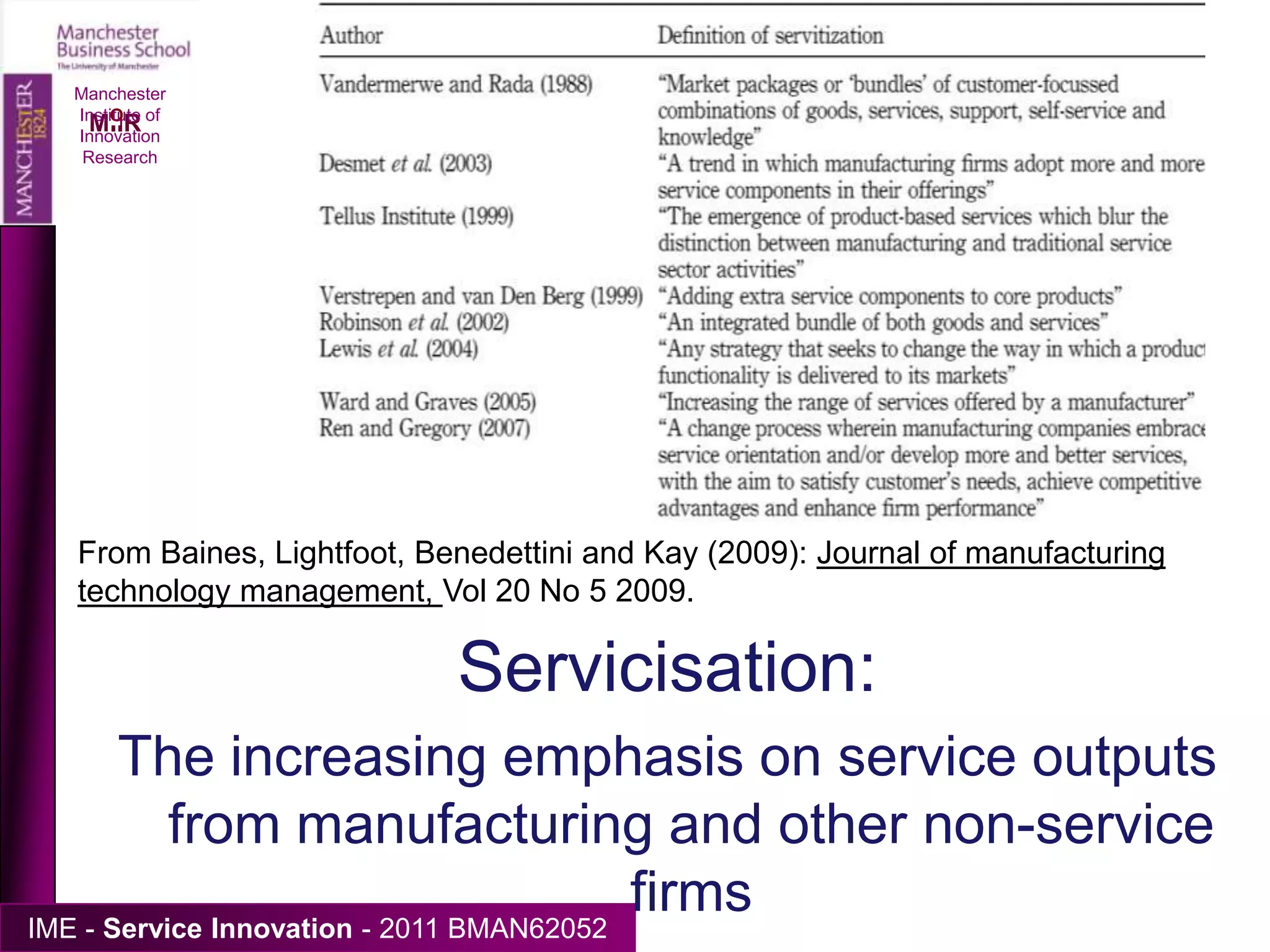
Manchester Institute of Innovation ResearchFrom Baines, Lightfoot, Benedettiniand Kay (2009): Journal of manufacturing technology management, Vol 20 No 5 2009.Servicisation:The increasing emphasis on service outputs from manufacturing and other non-service firms
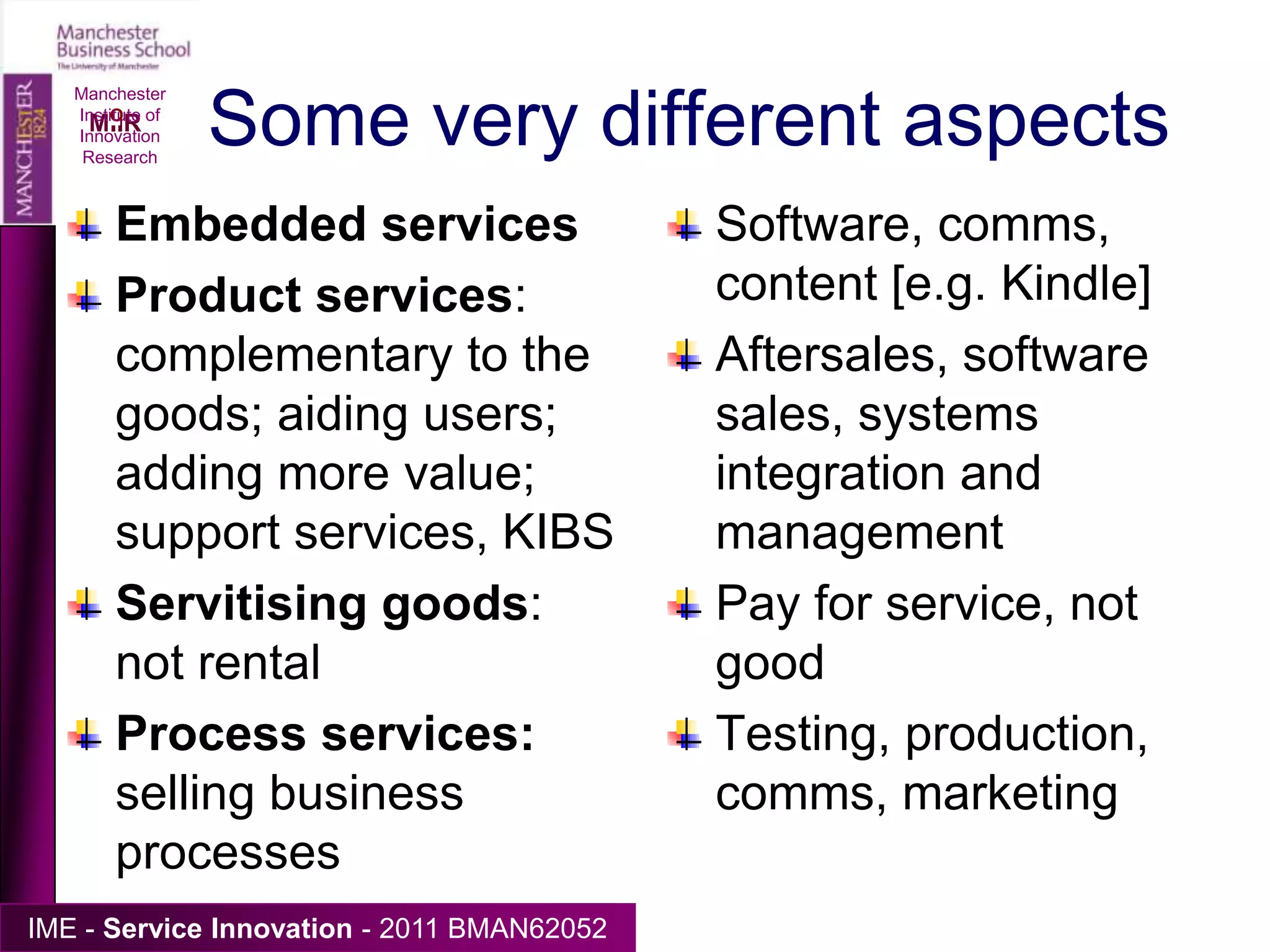
Some very different aspectsEmbedded servicesProduct services: complementary to the goods; aiding users; adding more value; support services, KIBSServitising goods: not rentalProcess services: selling business processesSoftware, comms, content [e.g. Kindle]Aftersales, software sales, systems integration and managementPay for service, not goodTesting, production, comms, marketingManchester Institute of Innovation Research
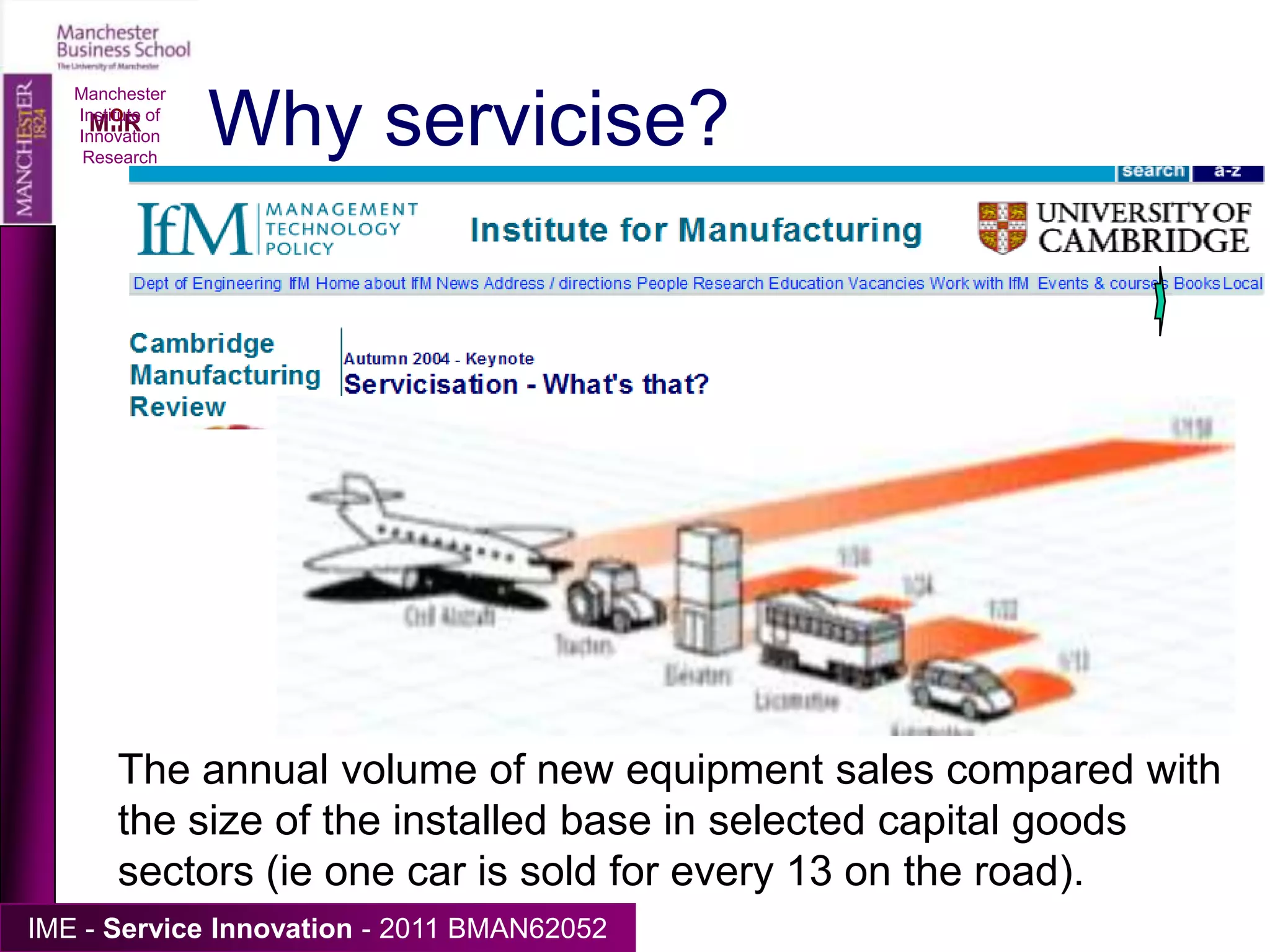
Why servicise?Manchester Institute of Innovation ResearchThe annual volume of new equipment sales compared with the size of the installed base in selected capital goods sectors (ie one car is sold for every 13 on the road).
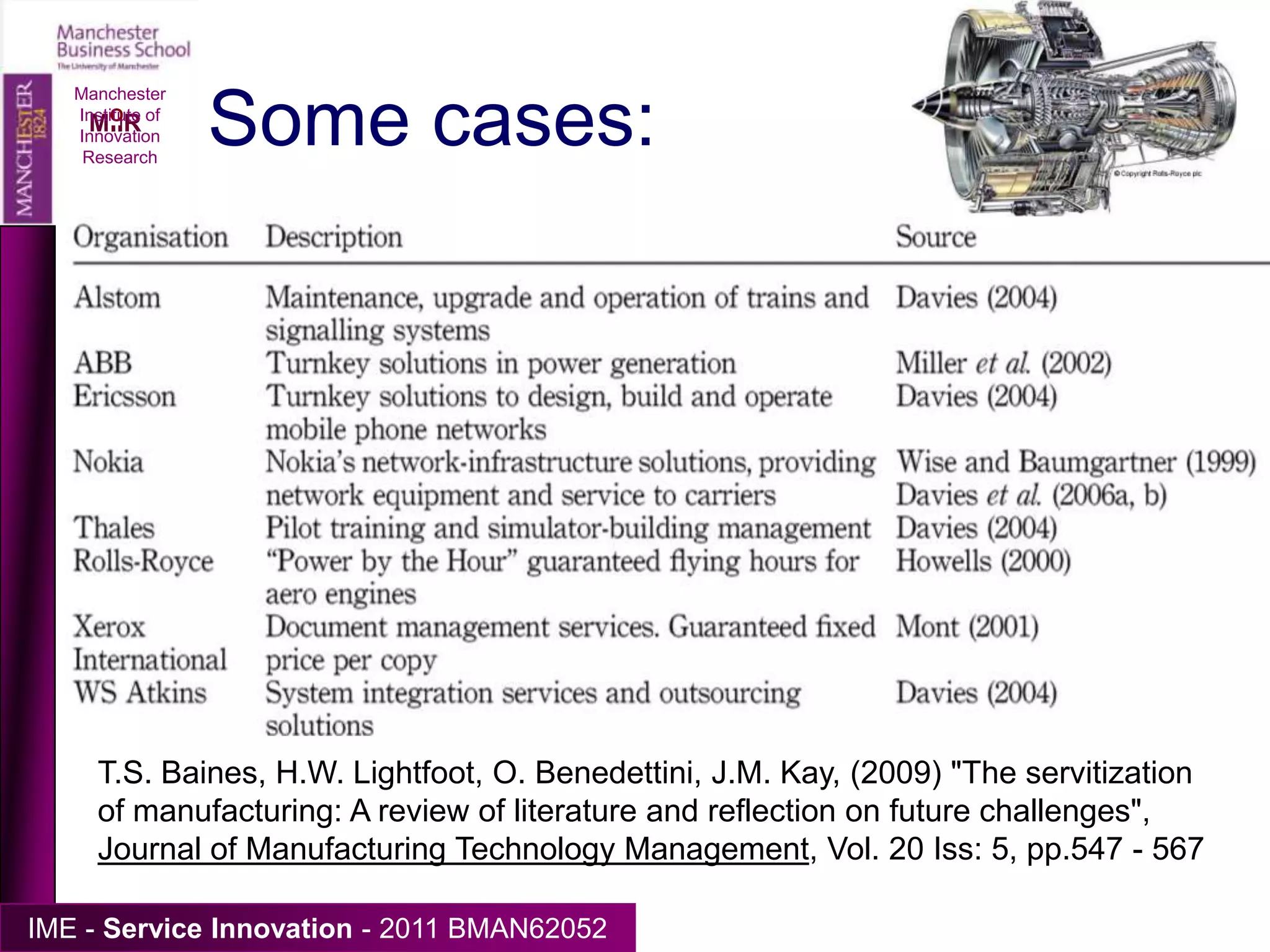
Some cases: Manchester Institute of Innovation ResearchT.S. Baines, H.W. Lightfoot, O. Benedettini, J.M. Kay, (2009) "The servitization of manufacturing: A review of literature and reflection on future challenges", Journal of Manufacturing Technology Management, Vol. 20 Iss: 5, pp.547 - 567
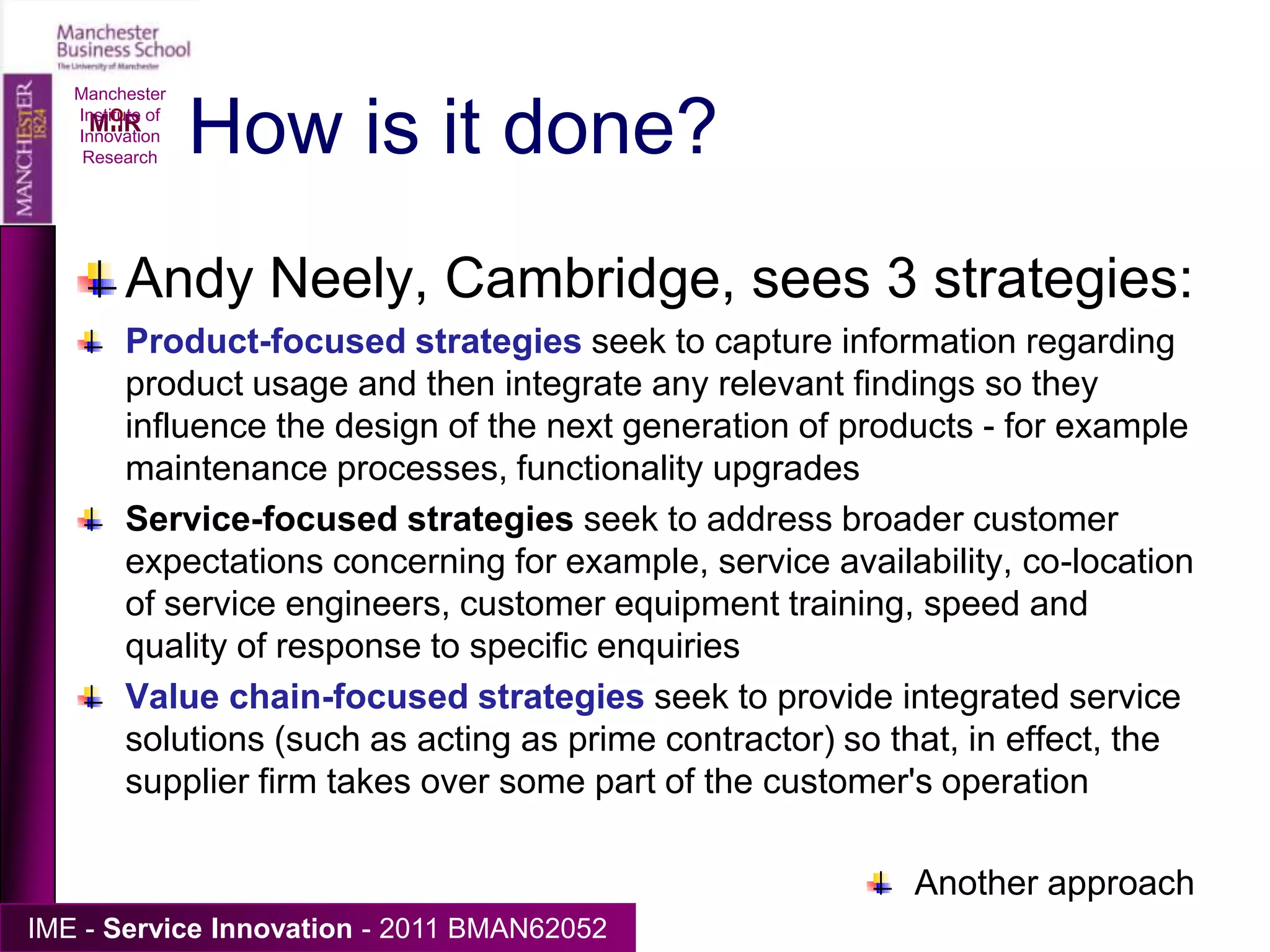
How is it done?Andy Neely, Cambridge, sees 3 strategies:Product-focused strategies seek to capture information regarding product usage and then integrate any relevant findings so they influence the design of the next generation of products - for example maintenance processes, functionality upgradesService-focused strategies seek to address broader customer expectations concerning for example, service availability, co-location of service engineers, customer equipment training, speed and quality of response to specific enquiriesValue chain-focused strategies seek to provide integrated service solutions (such as acting as prime contractor) so that, in effect, the supplier firm takes over some part of the customer's operationAnother approachManchester Institute of Innovation Research
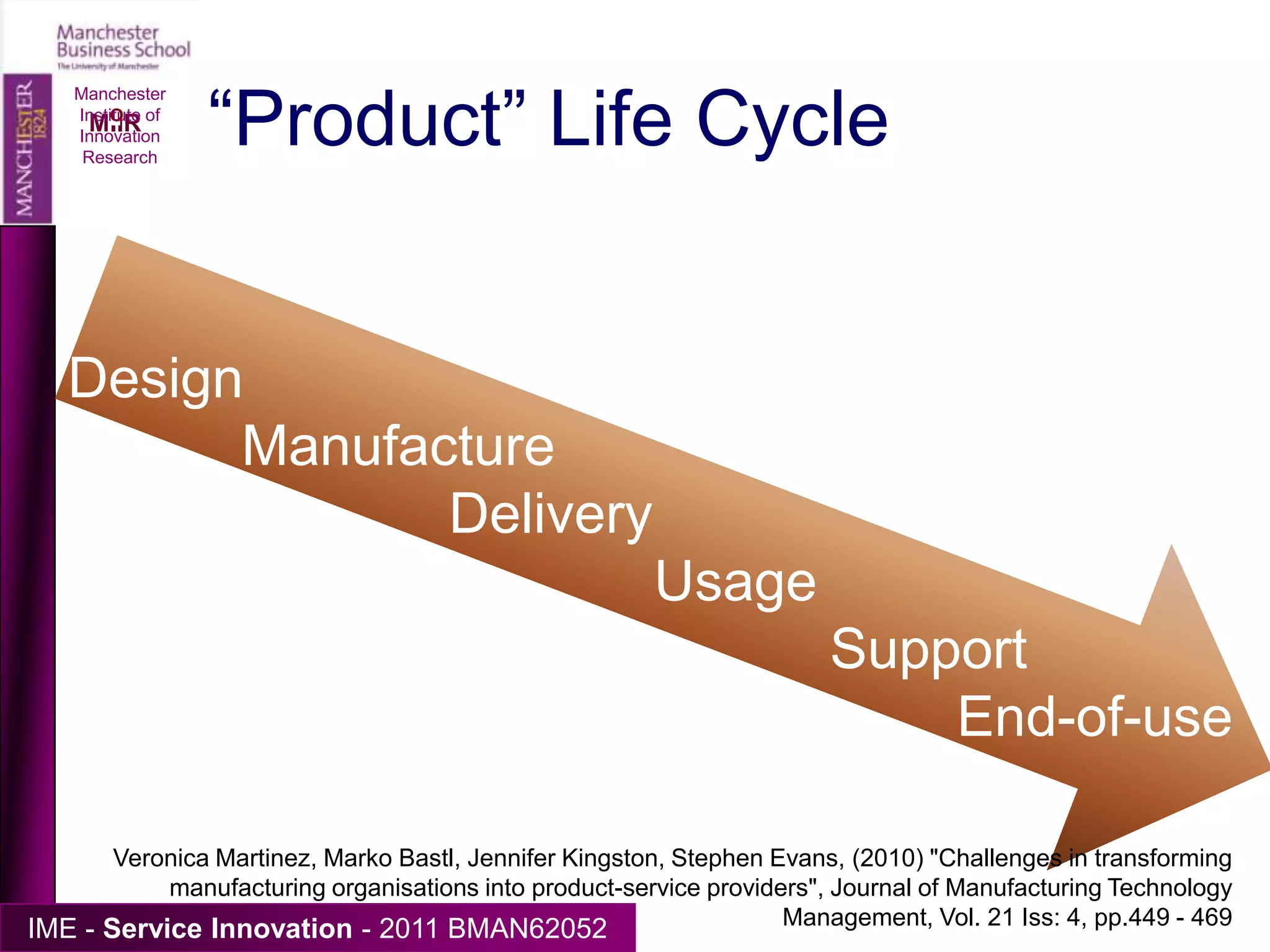
“Product” Life CycleManchester Institute of Innovation ResearchDesign        Manufacture     		Delivery       		 	     Usage        					Support         End-of-useVeronica Martinez, Marko Bastl, Jennifer Kingston, Stephen Evans, (2010) "Challenges in transforming manufacturing organisations into product-service providers", Journal of Manufacturing Technology Management, Vol. 21 Iss: 4, pp.449 - 469
“Product”-service relations: conventional manufacturingManchester Institute of Innovation ResearchDesign      Manufacture     Delivery        Usage        Support         End-of-useSupplierCustomerInteraction: mainly transactional.Some product supportSome peripheral servicesVeronica Martinez, Marko Bastl, Jennifer Kingston, Stephen Evans, (2010) "Challenges in transforming manufacturing organisations into product-service providers", Journal of Manufacturing Technology Management, Vol. 21 Iss: 4, pp.449 - 469
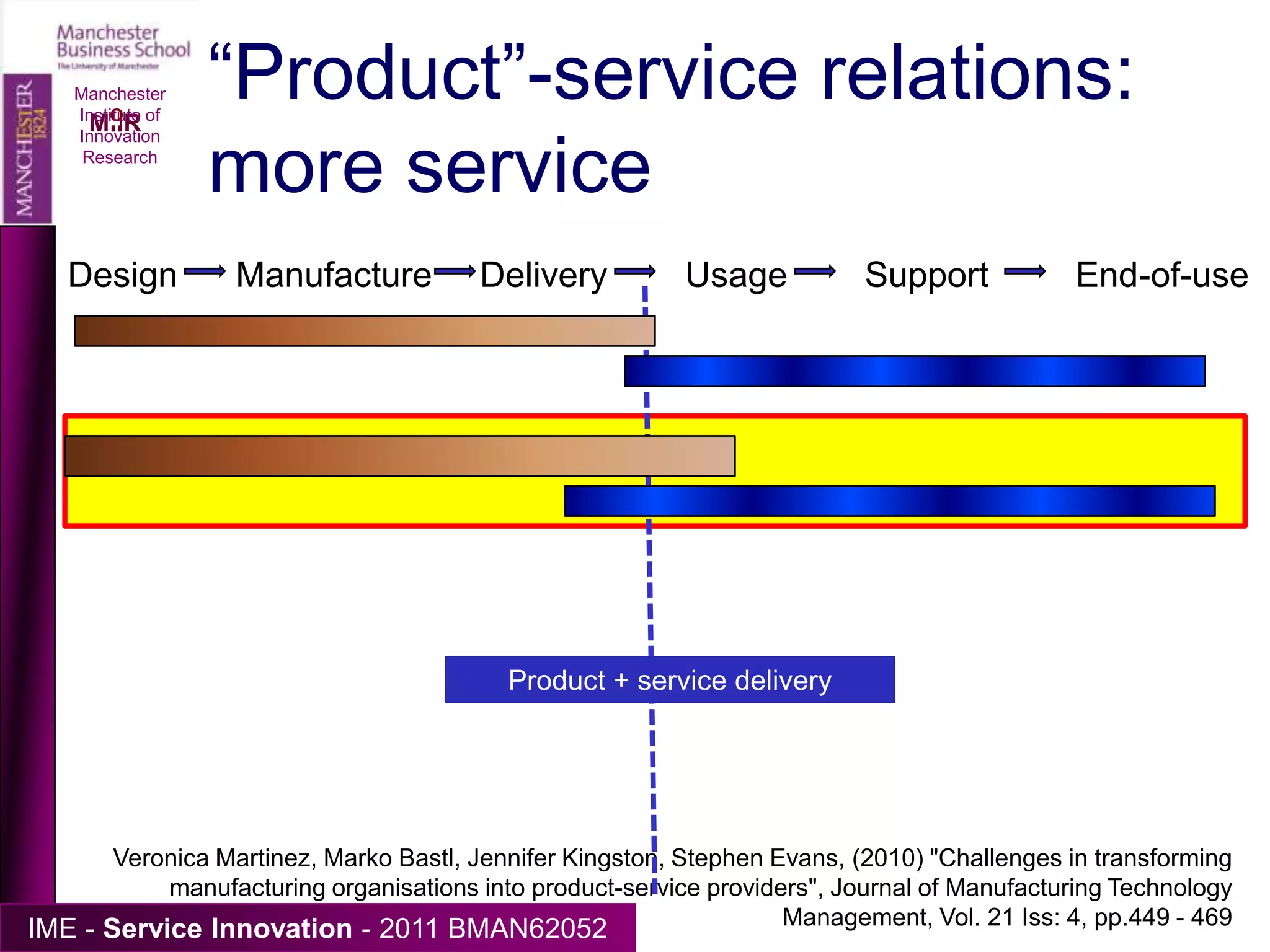
“Product”-service relations: more serviceManchester Institute of Innovation ResearchDesign      Manufacture     Delivery        Usage        Support         End-of-useProduct + service deliveryVeronica Martinez, Marko Bastl, Jennifer Kingston, Stephen Evans, (2010) "Challenges in transforming manufacturing organisations into product-service providers", Journal of Manufacturing Technology Management, Vol. 21 Iss: 4, pp.449 - 469
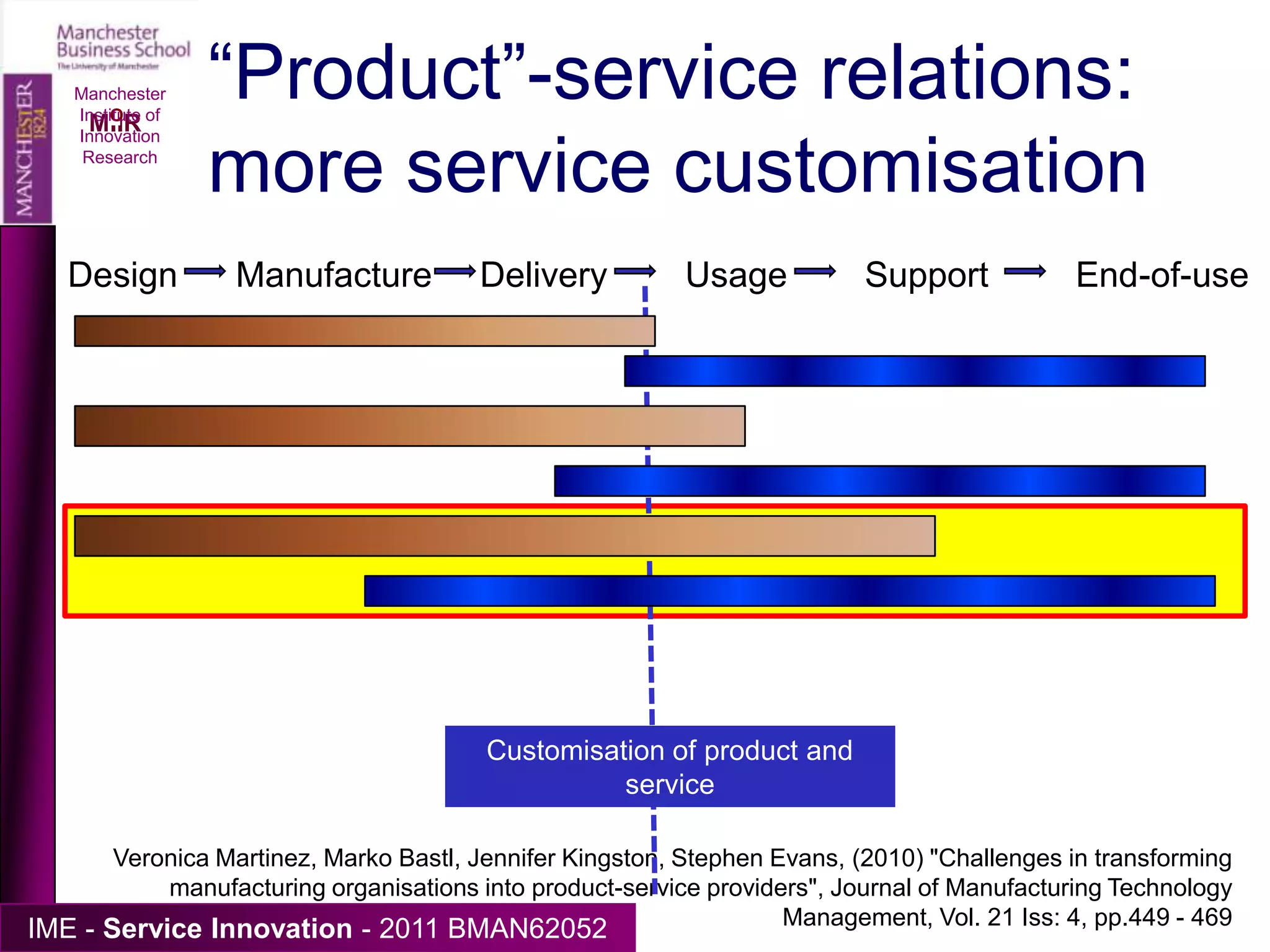
“Product”-service relations: more service customisationManchester Institute of Innovation ResearchDesign      Manufacture     Delivery        Usage        Support         End-of-useCustomisation of product and serviceVeronica Martinez, Marko Bastl, Jennifer Kingston, Stephen Evans, (2010) "Challenges in transforming manufacturing organisations into product-service providers", Journal of Manufacturing Technology Management, Vol. 21 Iss: 4, pp.449 - 469
“Product”-service relations: more service customisationManchester Institute of Innovation ResearchDesign      Manufacture     Delivery        Usage        Support         End-of-useProduct & service codesigned: total solutionsVeronica Martinez, Marko Bastl, Jennifer Kingston, Stephen Evans, (2010) "Challenges in transforming manufacturing organisations into product-service providers", Journal of Manufacturing Technology Management, Vol. 21 Iss: 4, pp.449 - 469
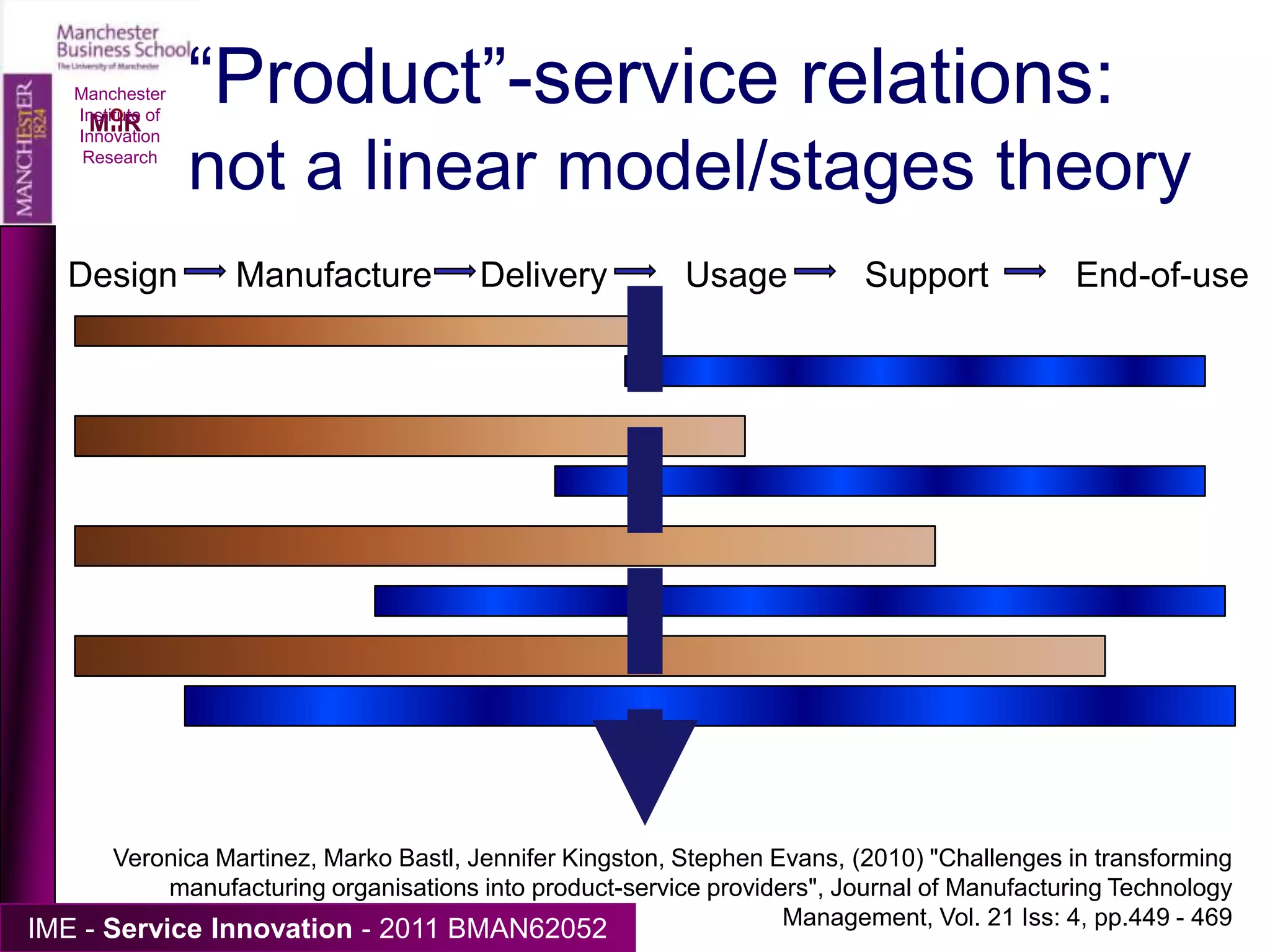
“Product”-service relations: not a linear model/stages theoryManchester Institute of Innovation ResearchDesign      Manufacture     Delivery        Usage        Support         End-of-useVeronica Martinez, Marko Bastl, Jennifer Kingston, Stephen Evans, (2010) "Challenges in transforming manufacturing organisations into product-service providers", Journal of Manufacturing Technology Management, Vol. 21 Iss: 4, pp.449 - 469
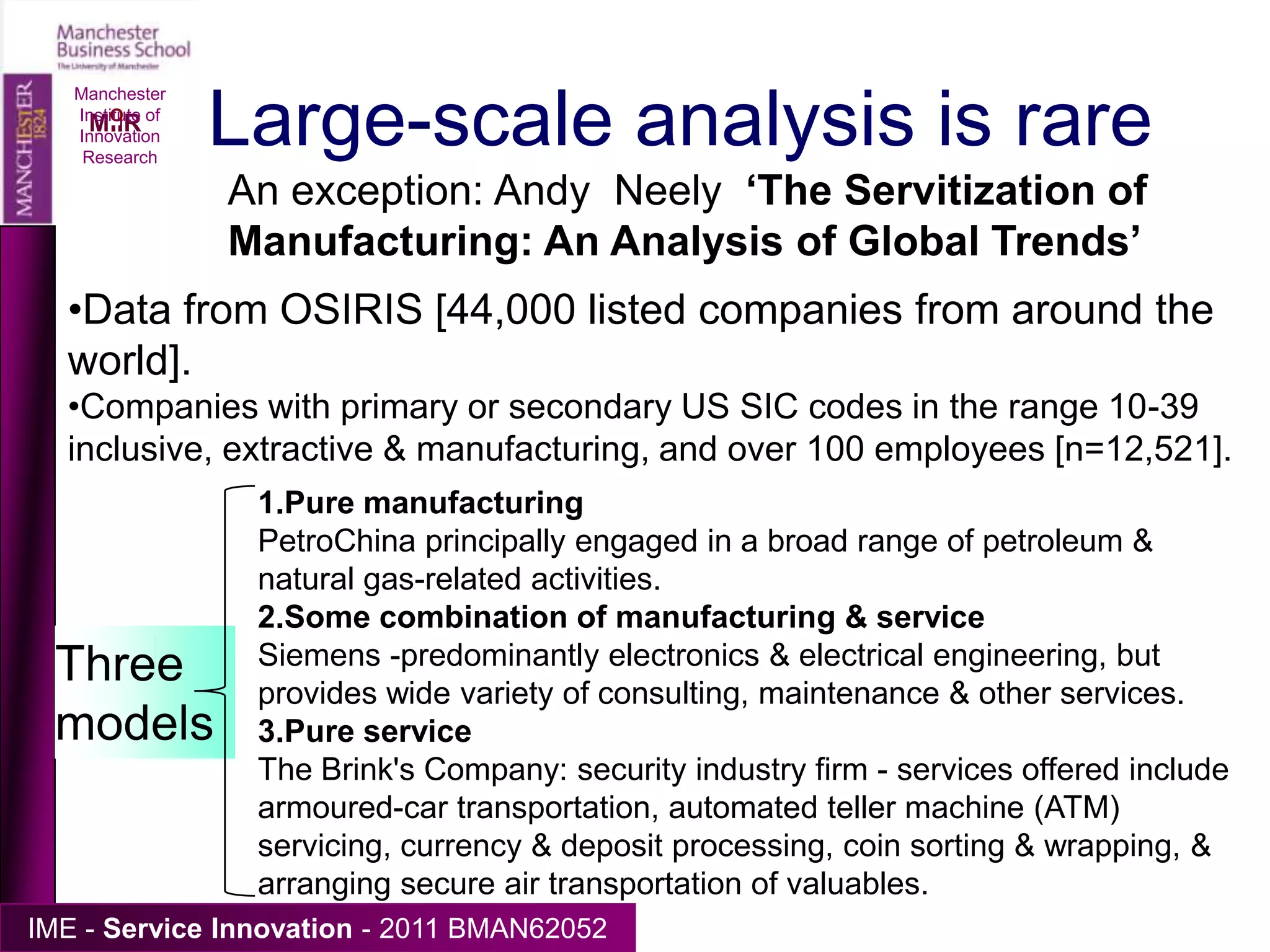
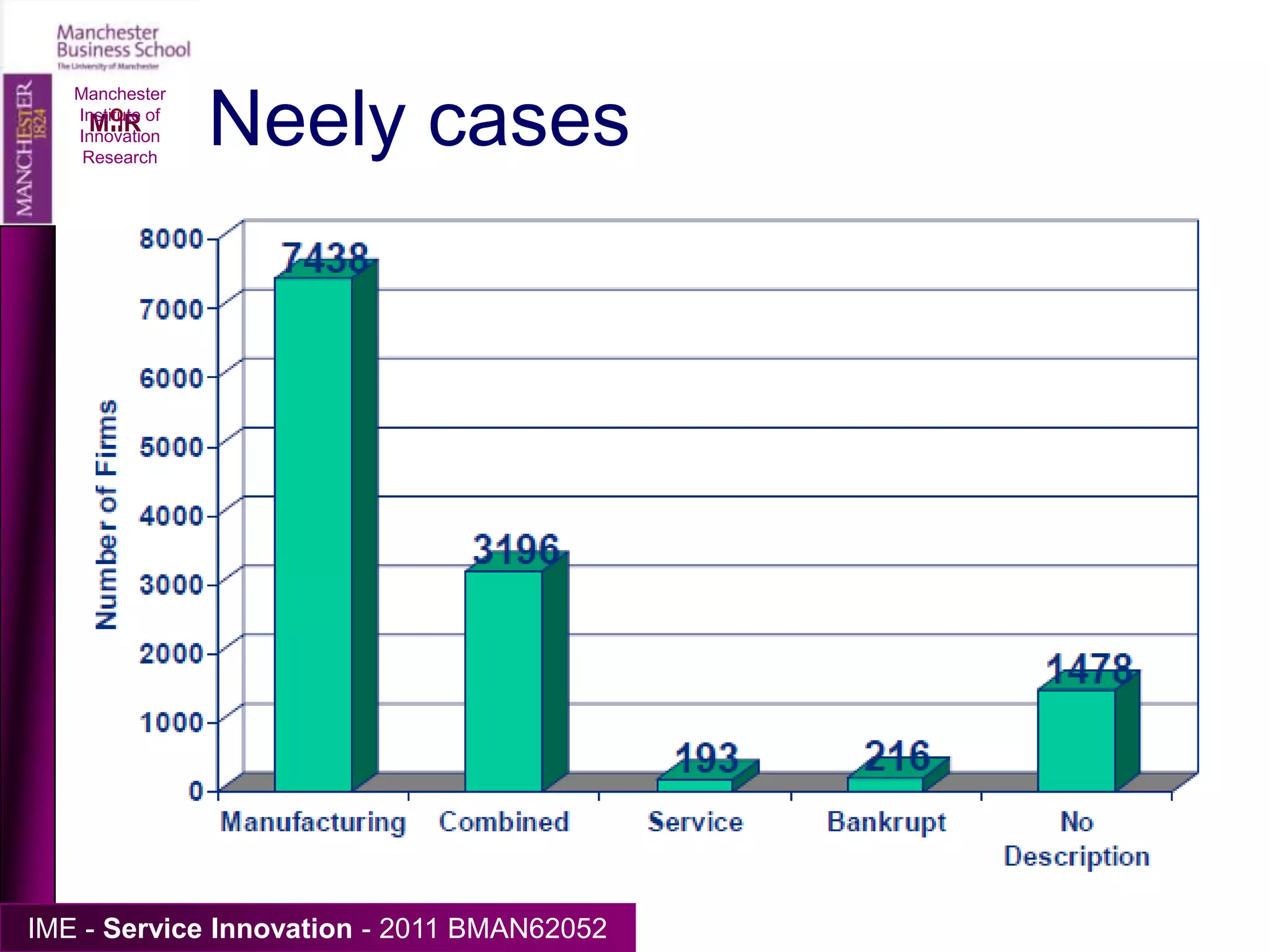
Large-scale analysis is rareManchester Institute of Innovation ResearchAn exception: Andy  Neely  ‘The Servitization of Manufacturing: An Analysis of Global Trends’Data from OSIRIS [44,000 listed companies from around the world].
Companies with primary or secondary US SIC codes in the range 10-39 inclusive, extractive & manufacturing, and over 100 employees [n=12,521].1.Pure manufacturingPetroChina principally engaged in a broad range of petroleum & natural gas-related activities.2.Some combination of manufacturing & serviceSiemens -predominantly electronics & electrical engineering, but provides wide variety of consulting, maintenance & other services.3.Pure serviceThe Brink's Company: security industry firm - services offered include armoured-car transportation, automated teller machine (ATM) servicing, currency & deposit processing, coin sorting & wrapping, & arranging secure air transportation of valuables.Three models
Neely casesManchester Institute of Innovation Research
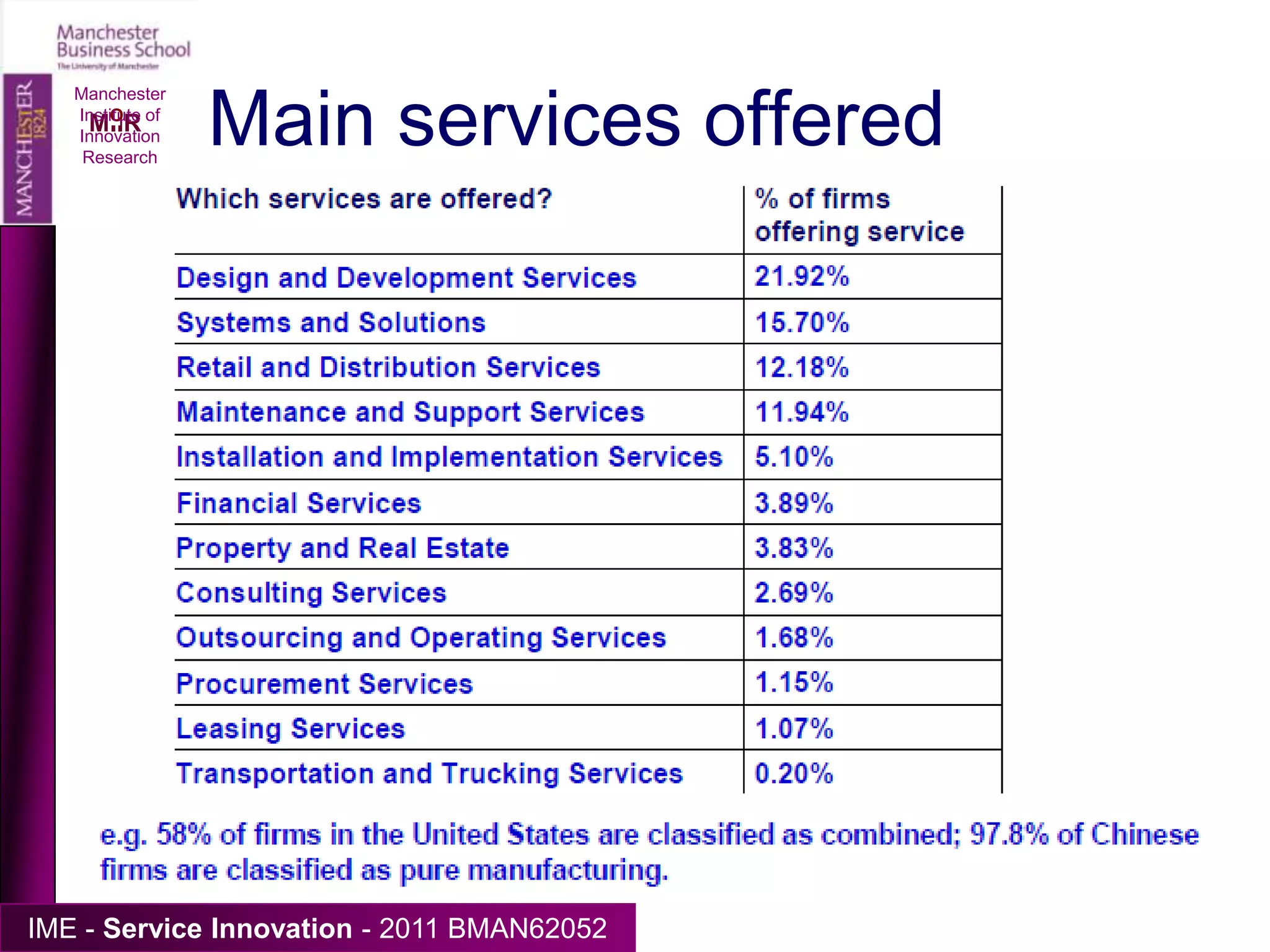
Main services offeredManchester Institute of Innovation Research
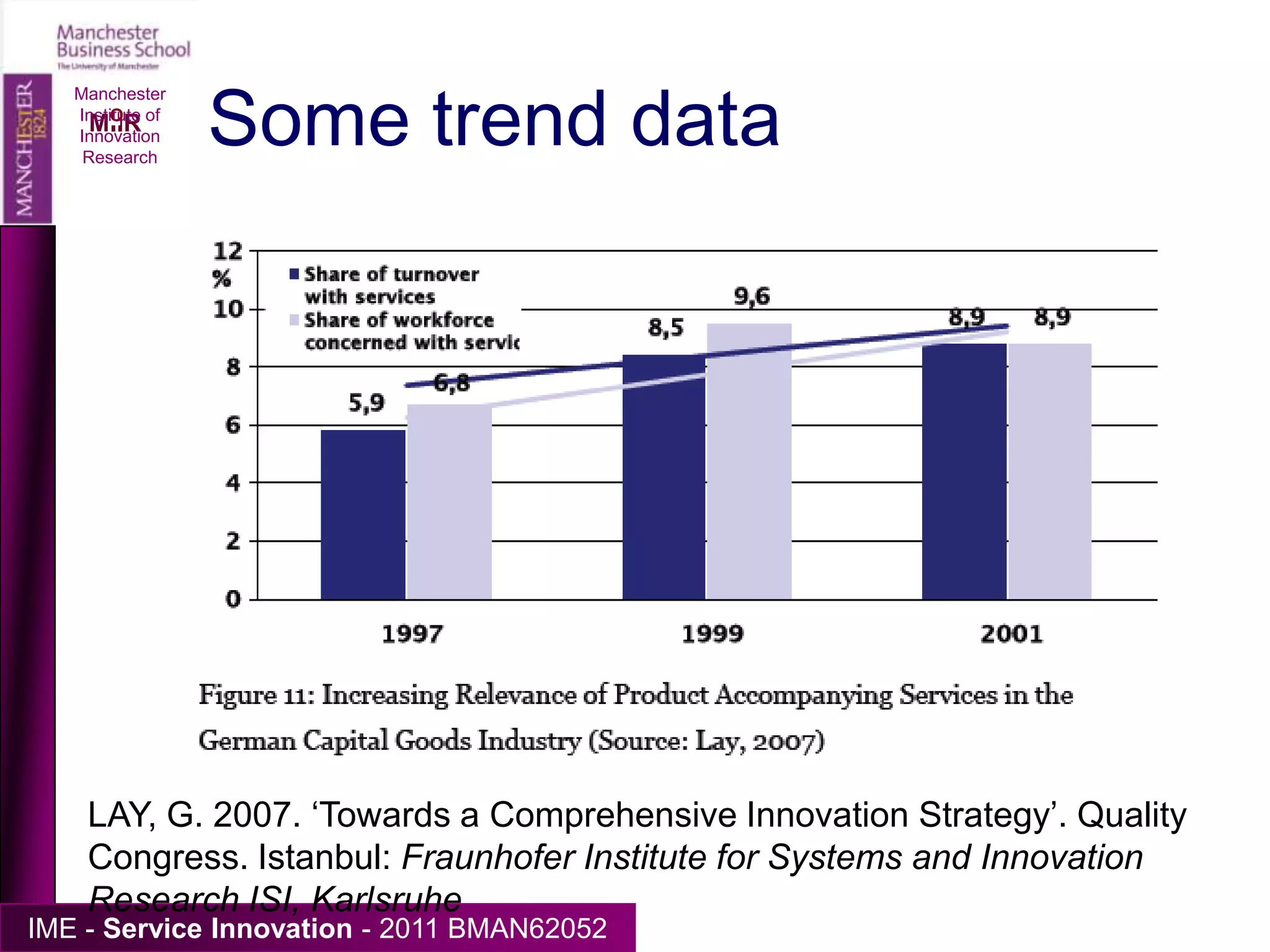
Some trend dataManchester Institute of Innovation ResearchLAY, G. 2007. ‘Towards a Comprehensive Innovation Strategy’. Quality Congress. Istanbul: Fraunhofer Institute for Systems and InnovationResearch ISI, Karlsruhe
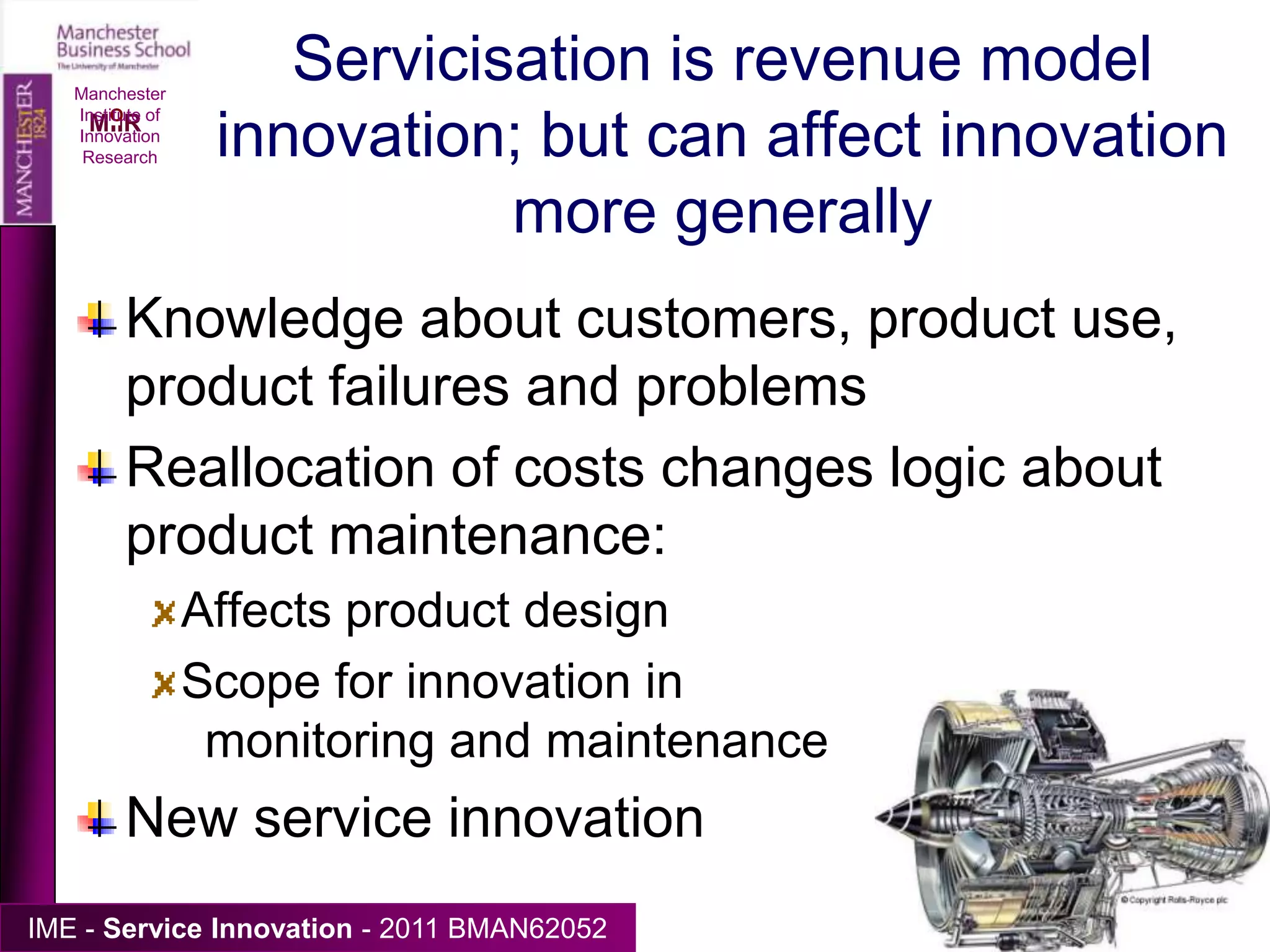
Servicisation is revenue model innovation; but can affect innovation more generallyKnowledge about customers, product use, product failures and problemsReallocation of costs changes logic about product maintenance:Affects product designScope for innovation in 			monitoring and maintenanceNew service innovationManchester Institute of Innovation Research
Environmental argumentServices = less environmental impact (?)Swedish PhD study , firm (and user) interviews:  Oksana Mont  (2004) Product-service systems: Panacea or myth?  Lund University, The International Institute for Industrial Environmental EconomicsManchester Institute of Innovation ResearchDrivers:Some general factors, but also market issues vary considerably across sectors; coercive market includes consumers and regulations Barriers:Limited regulatory drivers; high costs of labour;  need for better awareness on part of consumers and intermediaries (and own staff) – long learning time;  credibility/demonstrability to users; diminished  user responsibility;  possible internal conflicts (2nd hand vs new), etc.
Challenges for servicisersDifferent management and customer relations requiredMay need understanding of new markets, and evaluation of potential of new service offeringMay require thorough reorientation of sales workforceNew capabilities – separate organisation?Manchester Institute of Innovation Research
Exercise!You work for a firm that makes high-value consumer products. (cosmetics, jewellry, babyfood, petfood....) There is a potentially disruptive technology emerging which will allow consumers to make the final products at home, easily, and for much less money.This is attracting a great deal of media attention, and public response to the new offering looks positive.What do you do?Manchester Institute of Innovation Research
Some optionsWe rule out suppressing or banning the technology! (Though you could try dark propaganda against it...)We do not rule out your doing deals with the supplier.We do not rule out your downsizing, but you must try to remain sustainably profitable.Could you go upmarket?Can you complement your product with other tangible elements, or with new services?Can you move away from the original product, and focus on ancillary goods and services that sill appeal to consumers (and maybe give you advantage with the new technology)?Can you do other things with your skills, plant and equipment?Can you  think of other options?Manchester Institute of Innovation Research
The taskDecide on your product and on the strategy/ies you will pursue.  (5 mins+15 mins.)Consider what capabilities you will require to implement this:Types of KnowledgeWorkforce skillsAlliancesEtc					(30 minutes)Decide on what the most urgent of these are, and how you will address them.  (10 mins)Manchester Institute of Innovation Research
Manchester Institute of Innovation ResearchDigital ConvergenceConvergenceWhat is digital convergence?Digital convergence and innovationWho does this affect?How does it affect media, IT industries, other sectors…
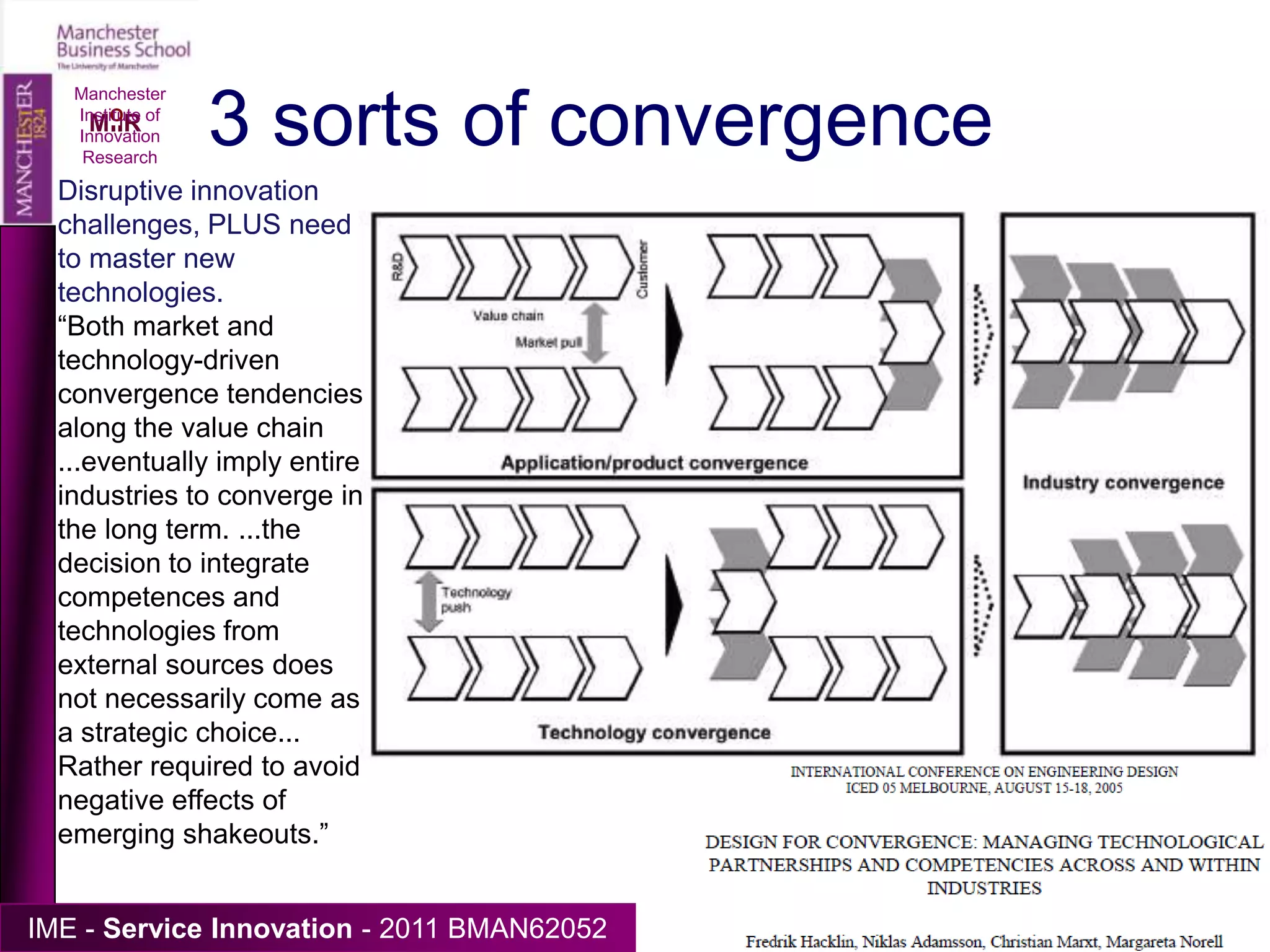
3 sorts of convergenceManchester Institute of Innovation ResearchDisruptive innovation challenges, PLUS need   to master new technologies.“Both market and technology-driven convergence tendencies along the value chain ...eventually imply entire industries to converge in the long term. ...the decision to integrate competences and technologies from  external sources does   not necessarily come as   a strategic choice...   Rather required to avoid negative effects of emerging shakeouts.”
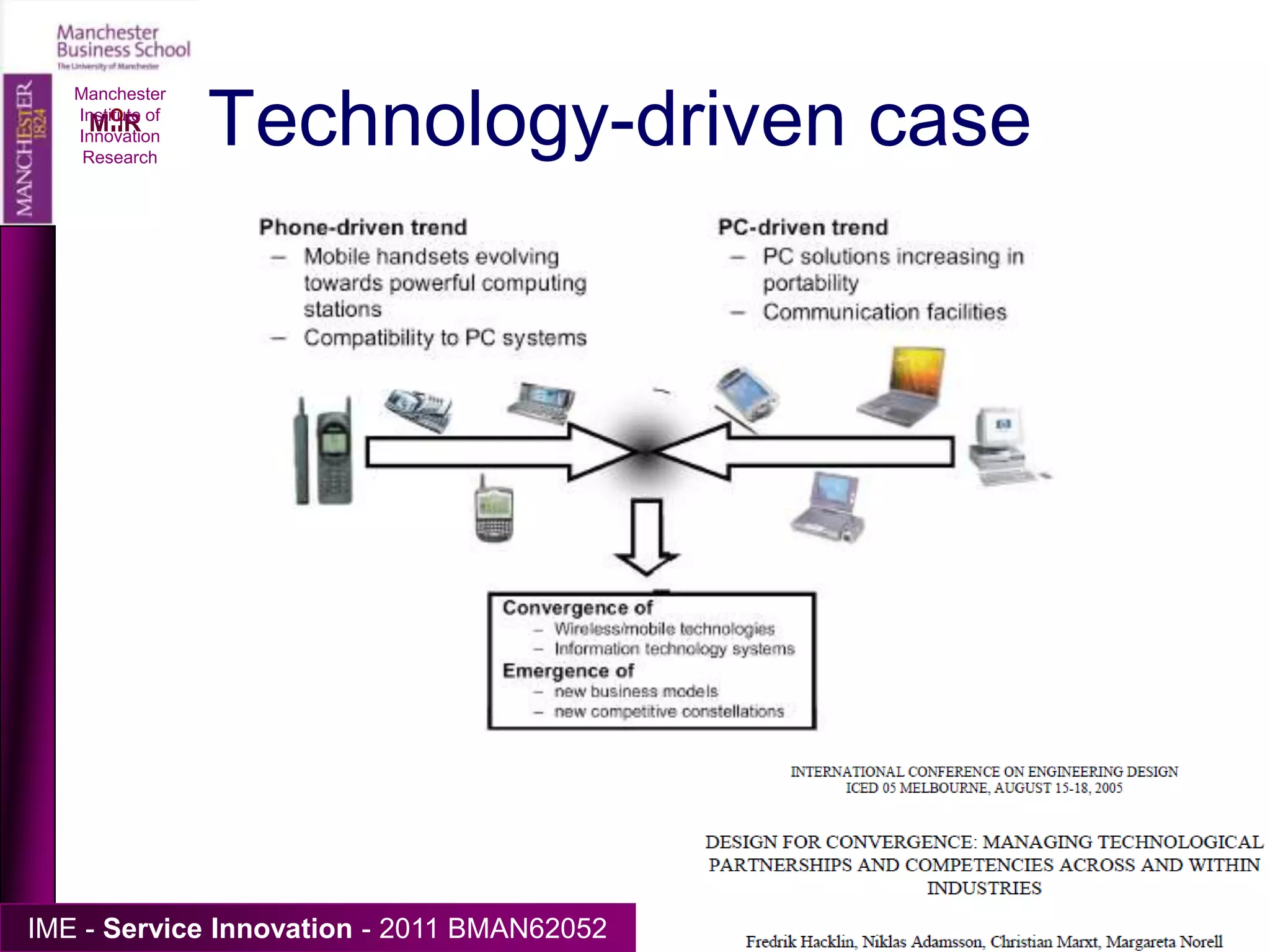
Technology-driven caseManchester Institute of Innovation Research
Manchester Institute of Innovation ResearchConvergenceFor some decades commentators have addressed computer/ telecommunications “convergence” – or collisionHeld by many to be a defining feature of new IT, e.g. Kobiyashi “IT=C&C”…  and related to common underlying technologies (microprocessors, digitalisation)But more industries and activities “converge” than just data processing and communication
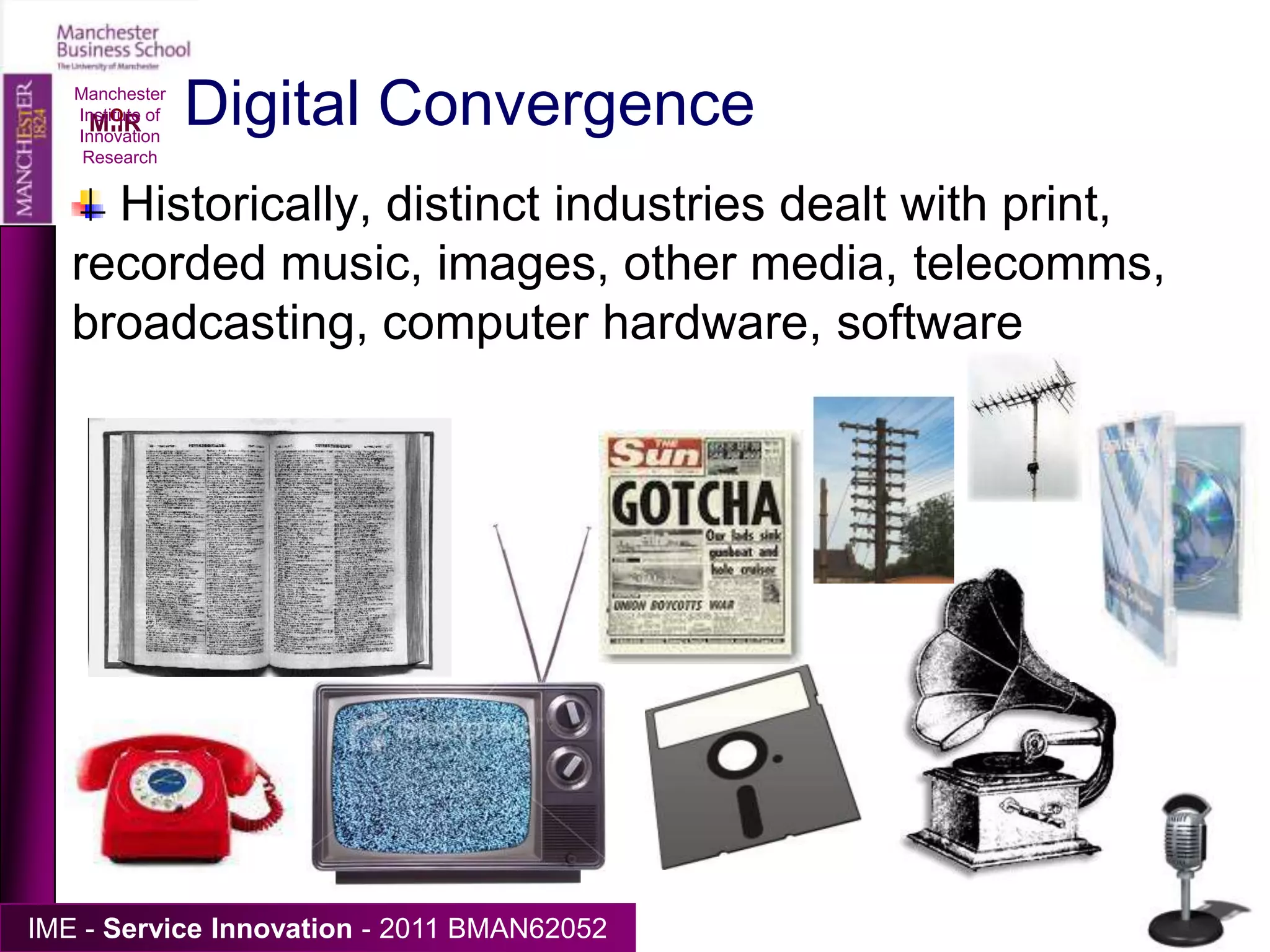
Manchester Institute of Innovation ResearchDigital Convergence  Historically, distinct industries dealt with print, recorded music, images, other media, telecomms, broadcasting, computer hardware, software
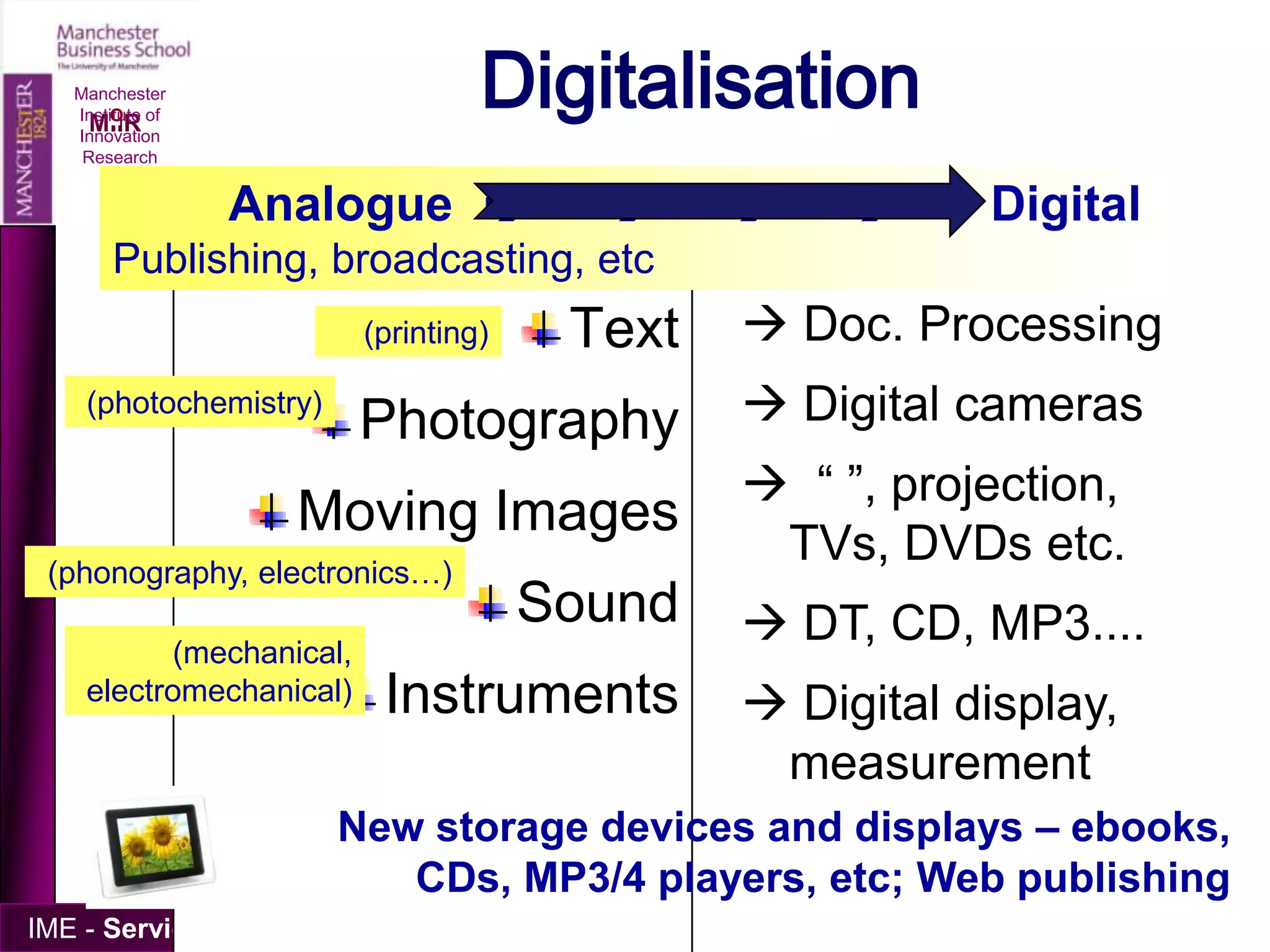
Manchester Institute of Innovation ResearchDigitalisationAnalogue 	         	DigitalPublishing, broadcasting, etcTextPhotographyMoving ImagesSoundInstruments Doc. Processing
 Digital cameras
  “ ”, projection, TVs, DVDs etc.
 DT, CD, MP3....
 Digital display, measurement(printing)(photochemistry)(phonography, electronics…)(mechanical, electromechanical)New storage devices and displays – ebooks, CDs, MP3/4 players, etc; Web publishing
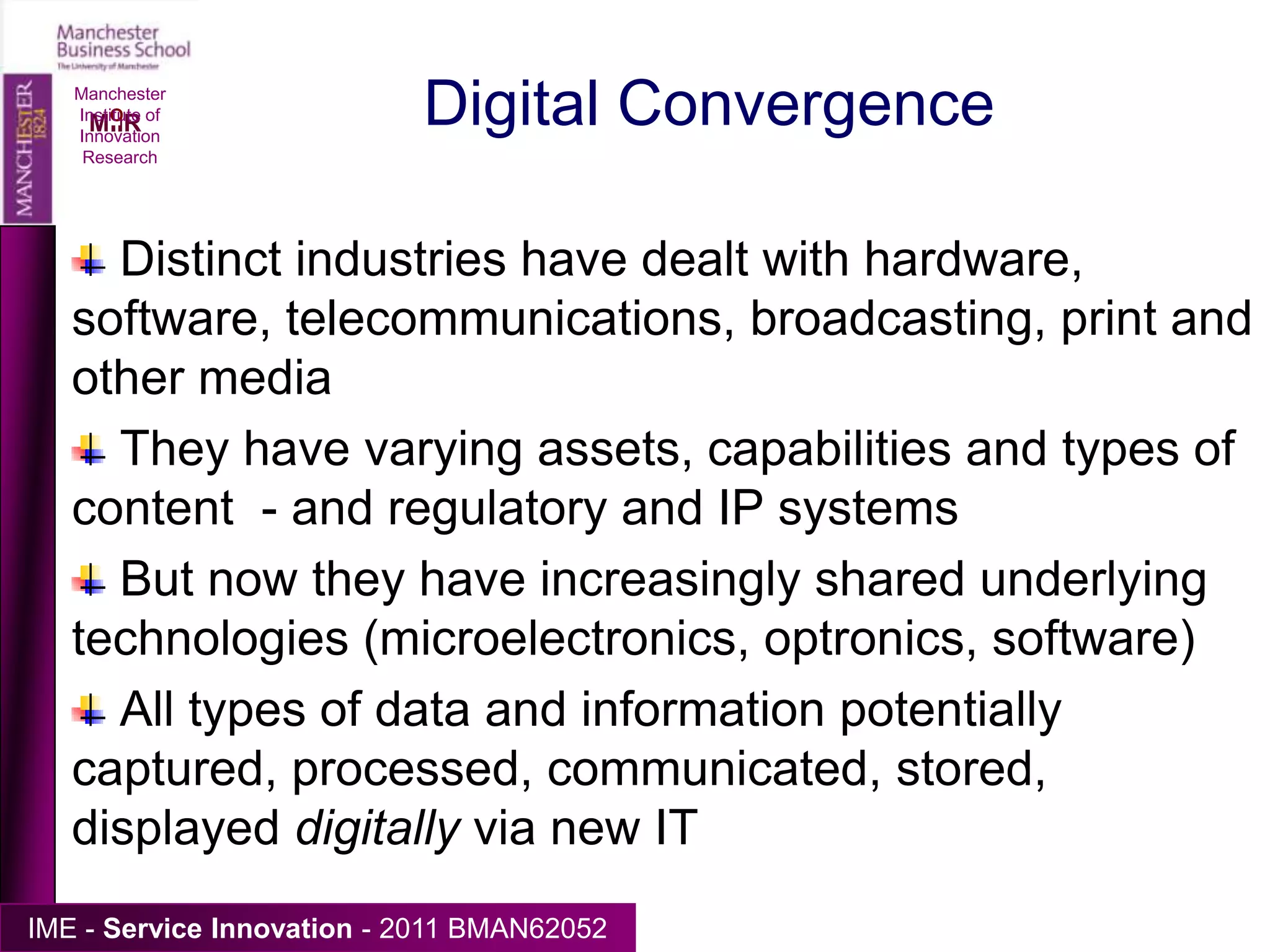
Manchester Institute of Innovation ResearchDigital Convergence   Distinct industries have dealt with hardware, software, telecommunications, broadcasting, print and other media They have varying assets, capabilities and types of content  - and regulatory and IP systems But now they have increasingly shared underlying technologies (microelectronics, optronics, software) All types of data and information potentially captured, processed, communicated, stored, displayed digitally via new IT
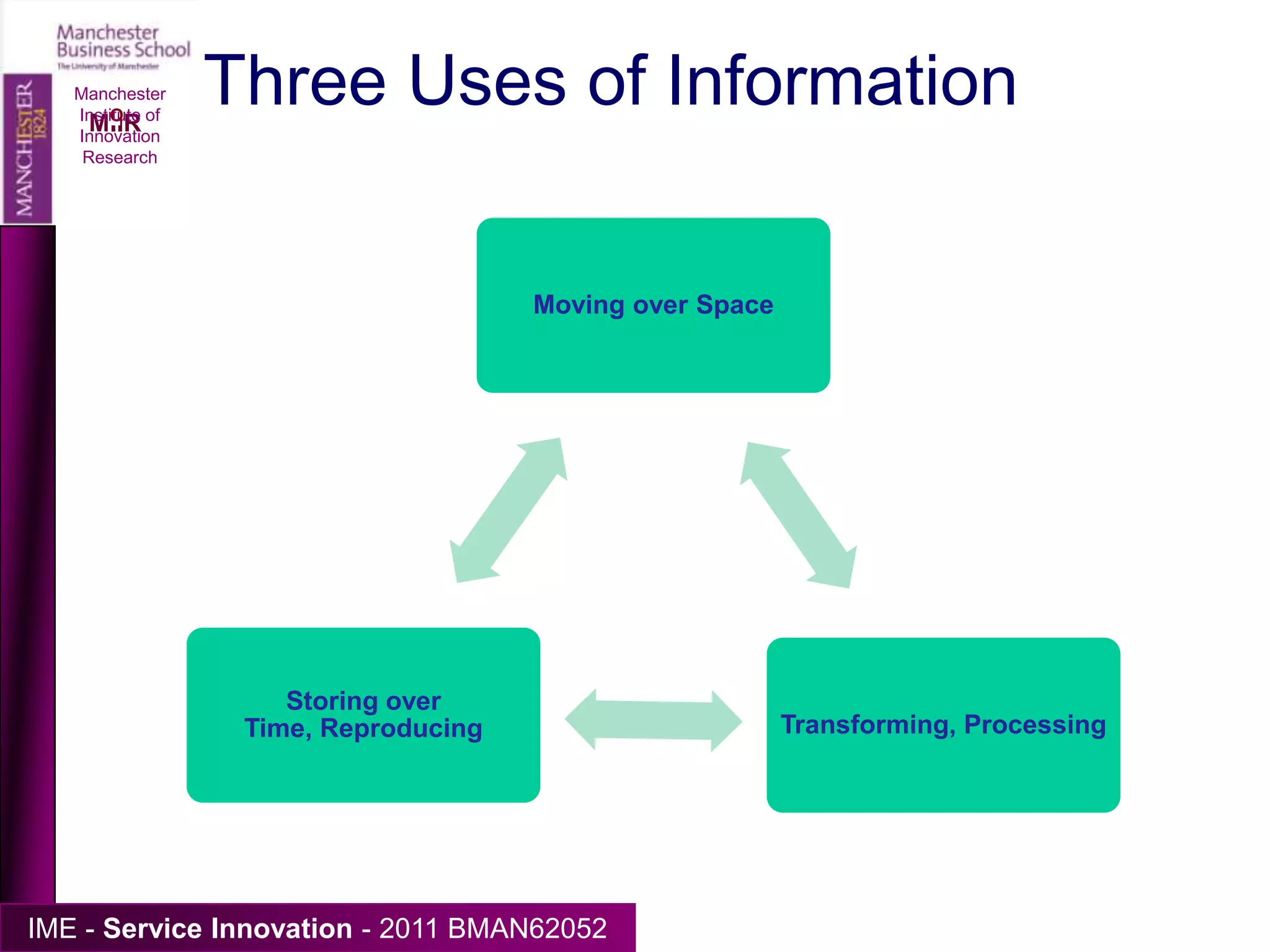
Manchester Institute of Innovation ResearchThree Uses of Information
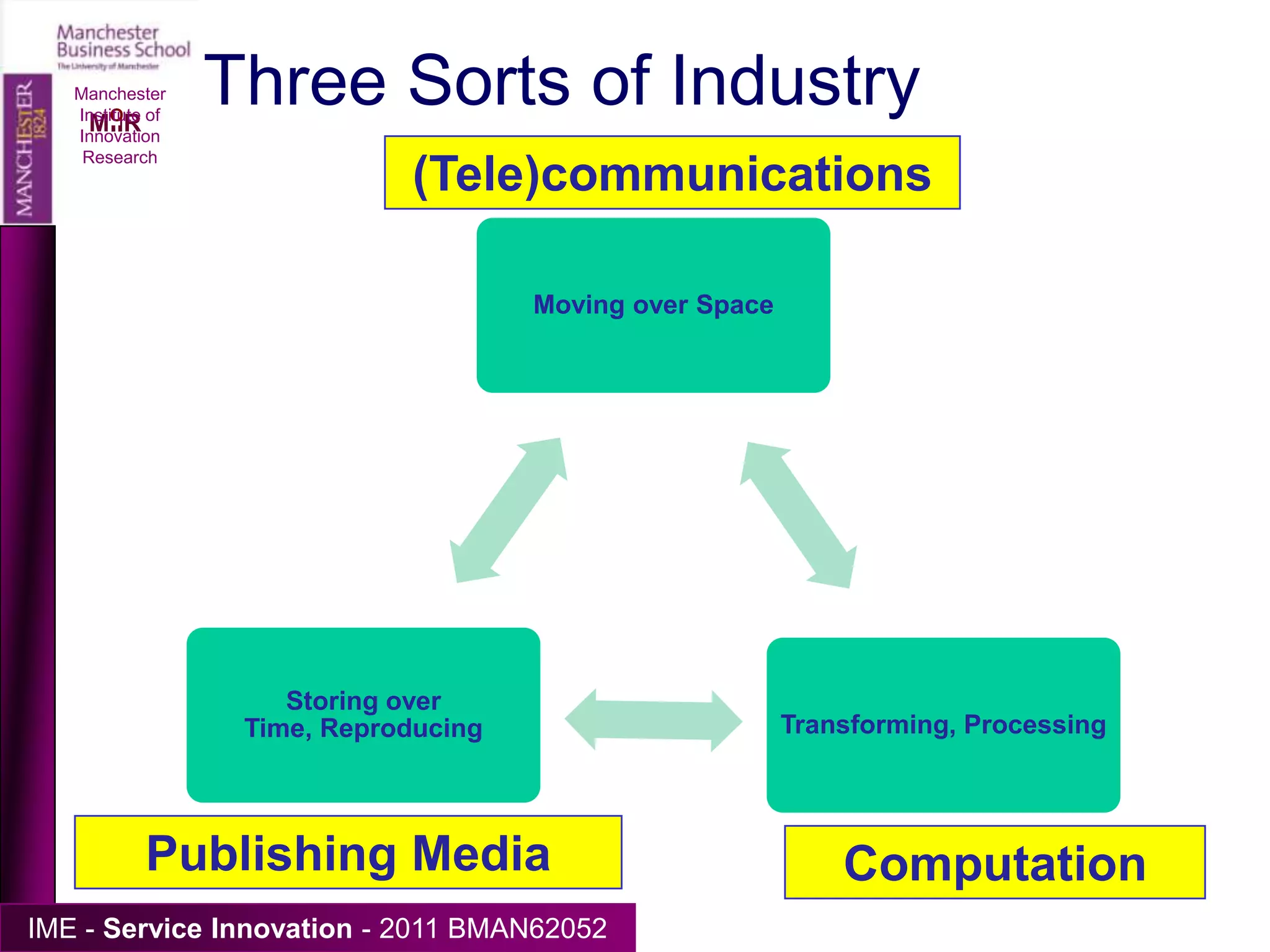
Manchester Institute of Innovation ResearchThree Sorts of Industry(Tele)communicationsPublishing MediaComputation
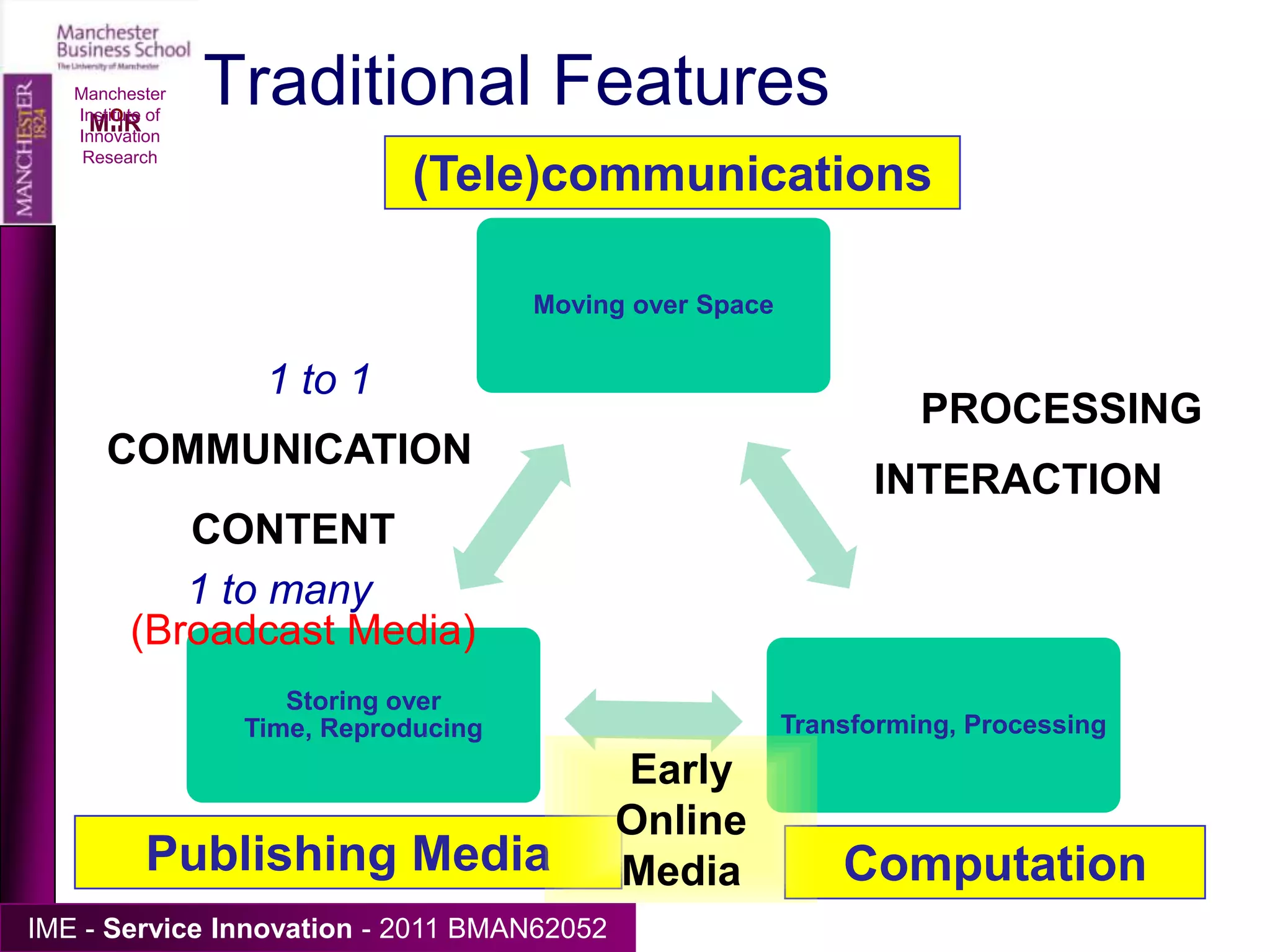
Manchester Institute of Innovation ResearchTraditional Features(Tele)communications1 to 1PROCESSINGCOMMUNICATIONINTERACTIONCONTENT1 to many(Broadcast Media)Early Online MediaPublishing MediaComputation
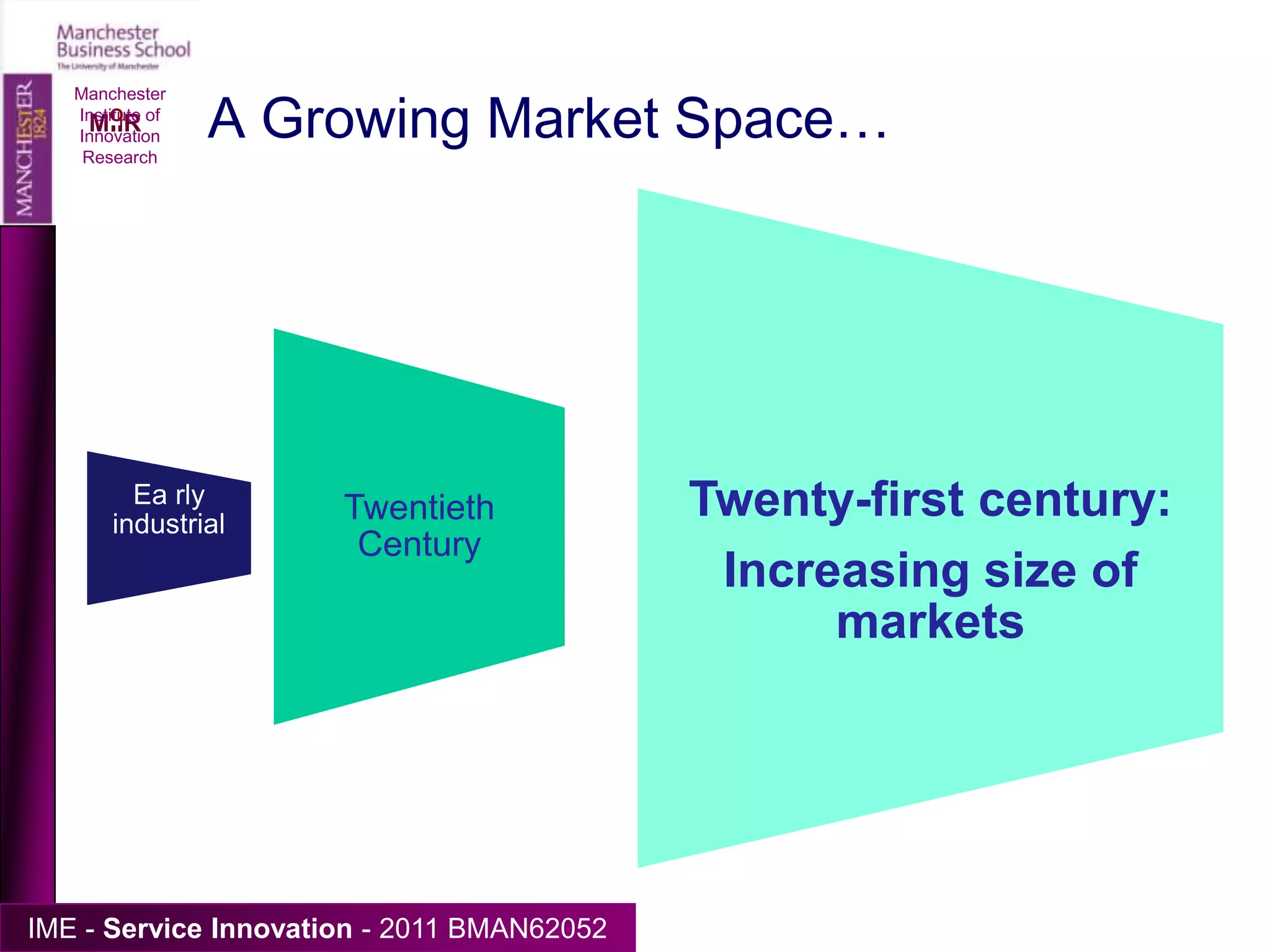
Manchester Institute of Innovation ResearchA Growing Market Space…
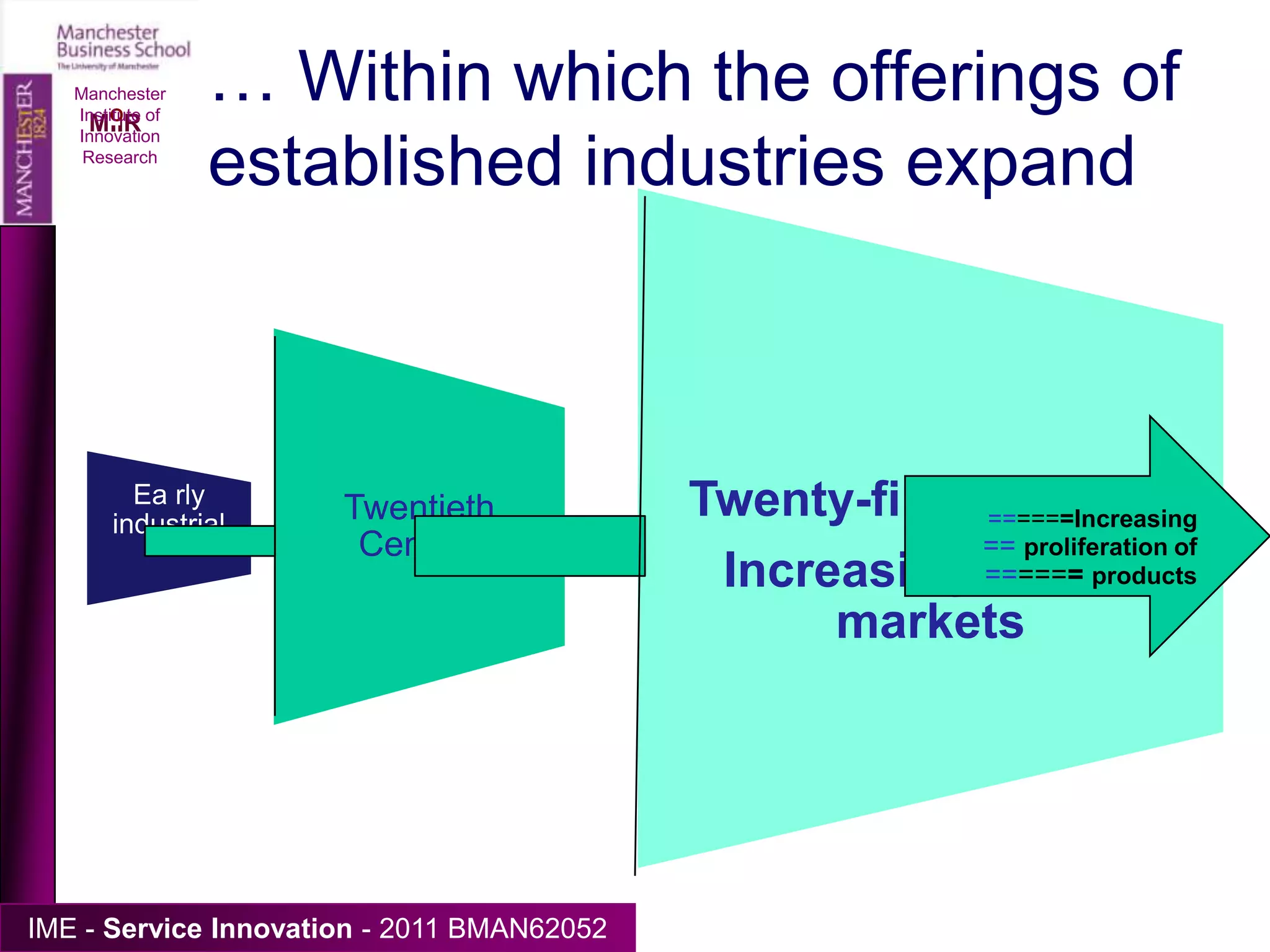
… Within which the offerings of established industries expandManchester Institute of Innovation Research========Increasing ===proliferation of ======= products
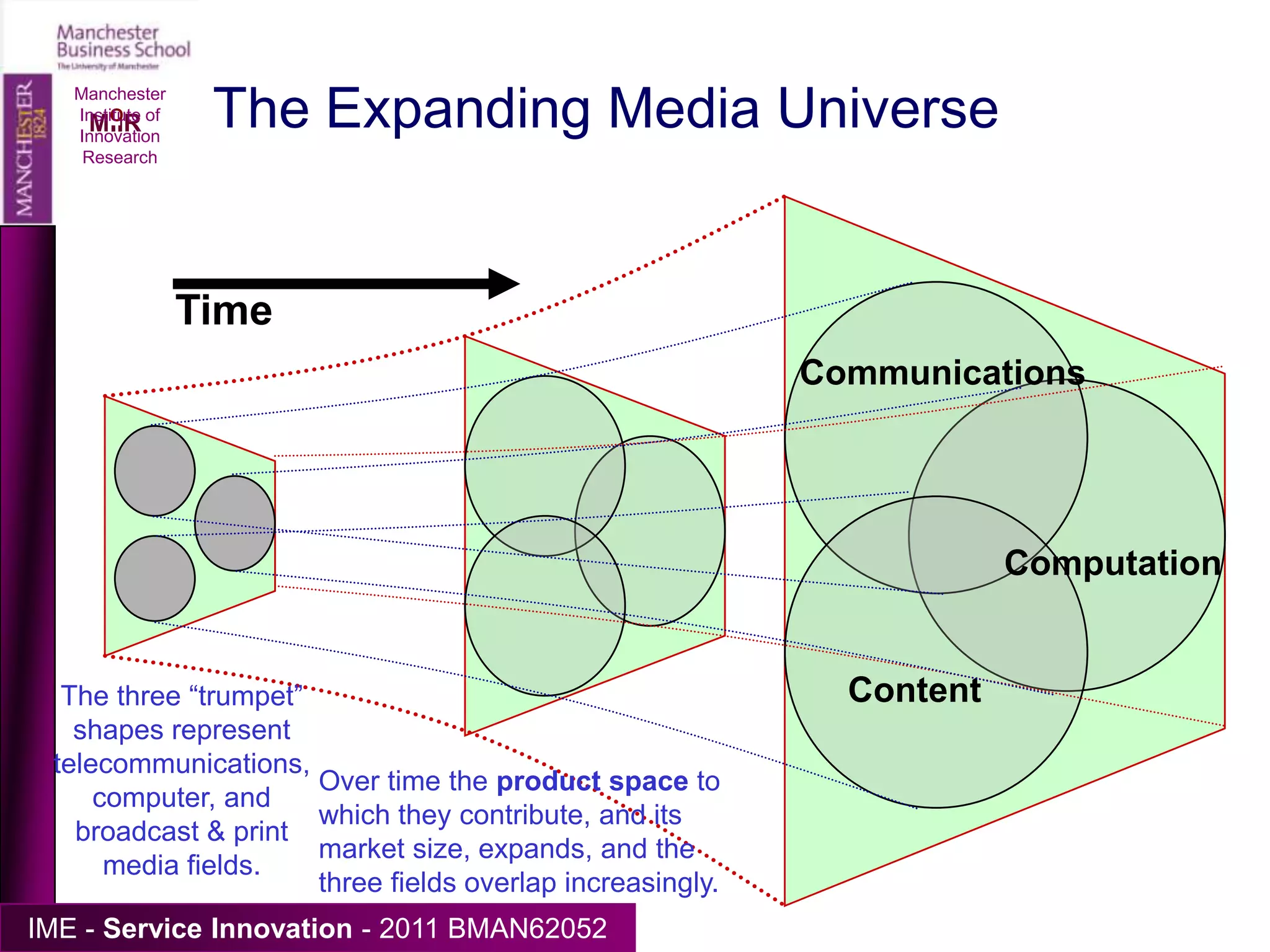
Manchester Institute of Innovation ResearchThe Expanding Media UniverseTimeCommunicationsComputation     ContentThe three “trumpet” shapes represent telecommunications, computer, and broadcast & print media fields.  Over time the product space to which they contribute, and its market size, expands, and the three fields overlap increasingly.
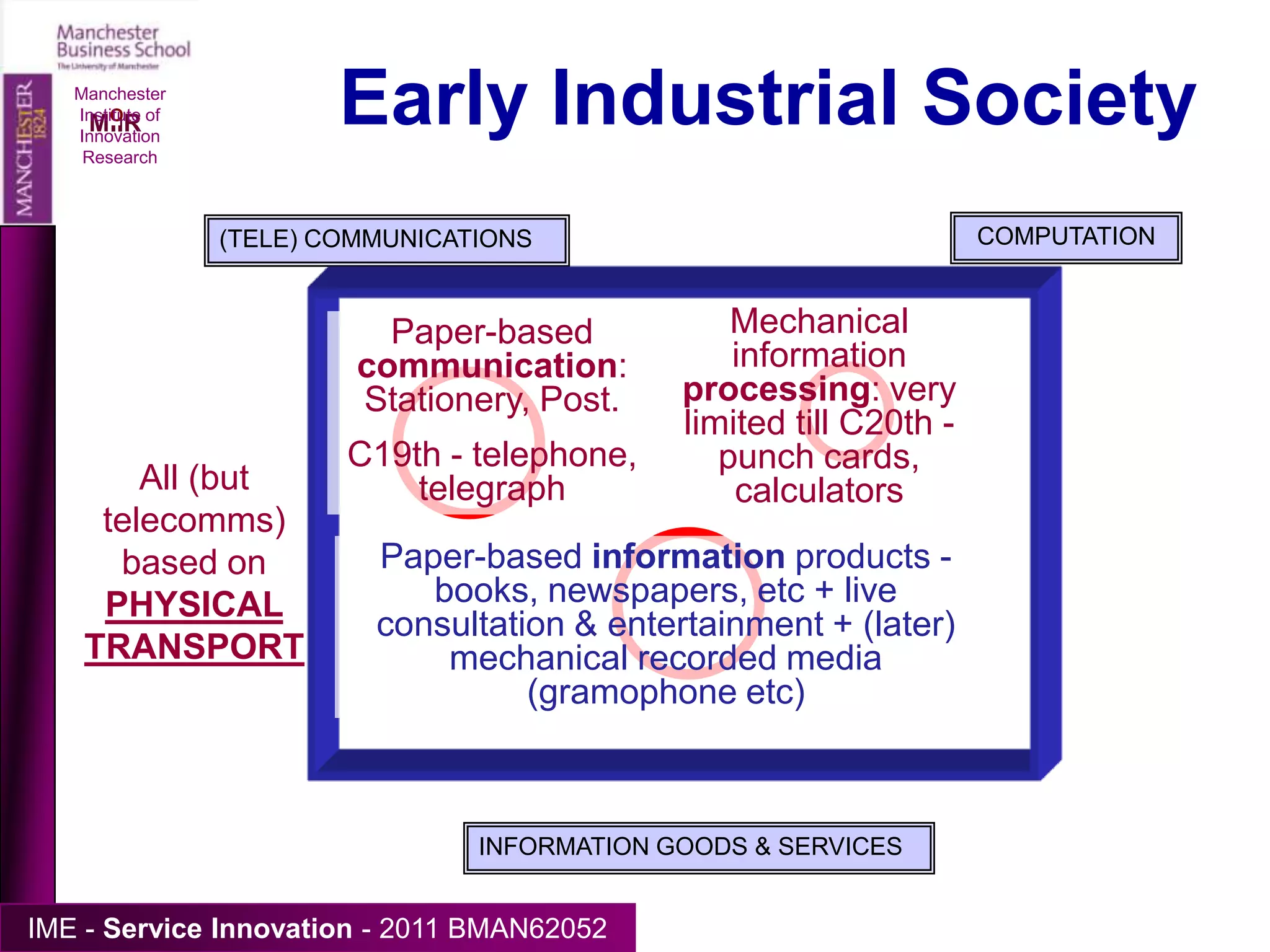
Manchester Institute of Innovation ResearchEarly Industrial SocietyCOMPUTATION(TELE) COMMUNICATIONSMechanical information processing: very limited till C20th - punch cards, calculatorsPaper-based communication: Stationery, Post.C19th - telephone, telegraphAll (but telecomms) based on PHYSICAL TRANSPORTPaper-based information products - books, newspapers, etc + live consultation & entertainment + (later) mechanical recorded media (gramophone etc)INFORMATION GOODS & SERVICES
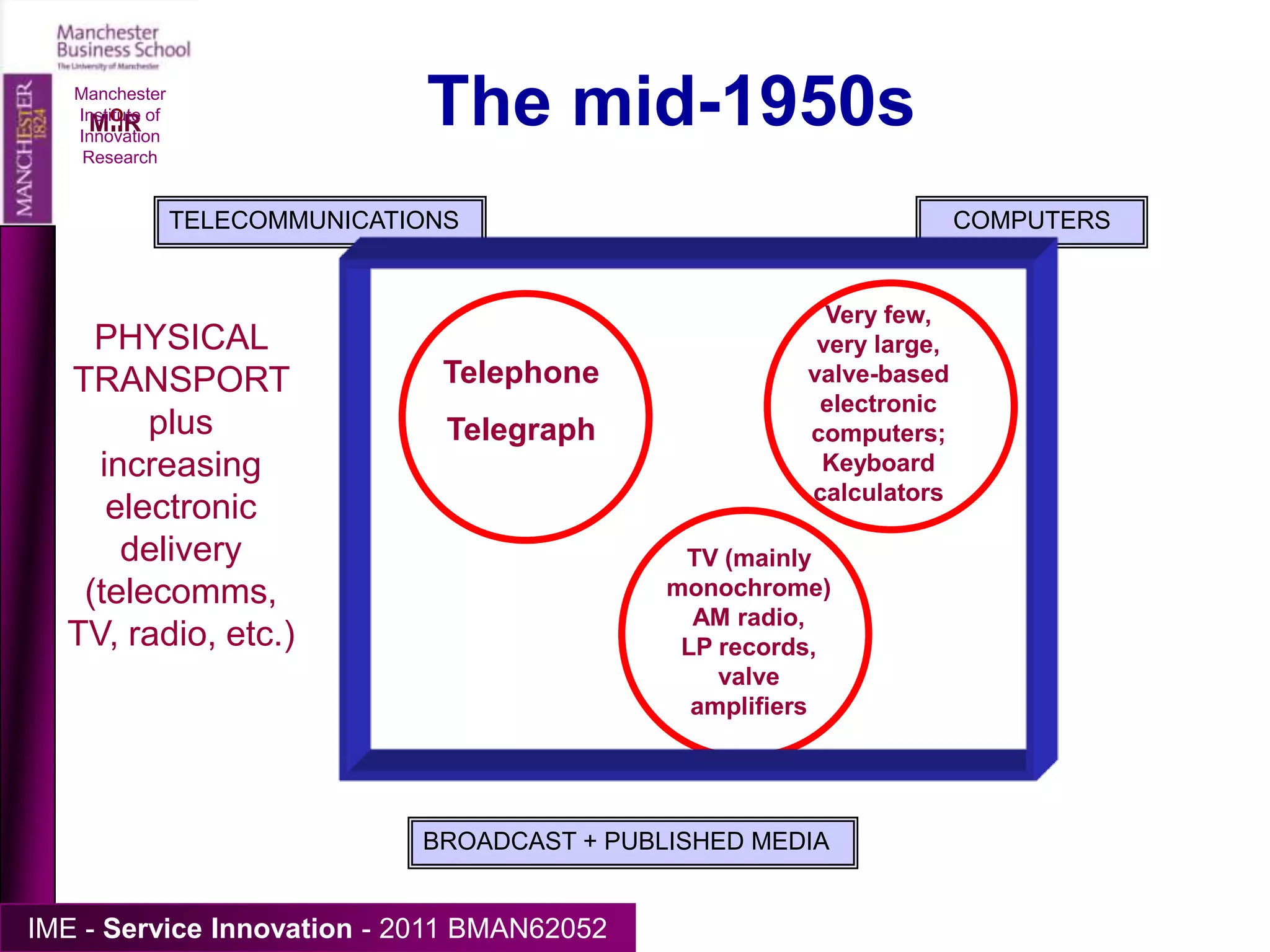
Manchester Institute of Innovation ResearchThe mid-1950sCOMPUTERSTELECOMMUNICATIONSVery few,  very large, valve-based electronic computers; Keyboard calculatorsPHYSICAL TRANSPORT plus increasing electronic delivery (telecomms, TV, radio, etc.)TelephoneTelegraphTV (mainly monochrome)AM radio,    LP records, valve amplifiersBROADCAST + PUBLISHED MEDIA
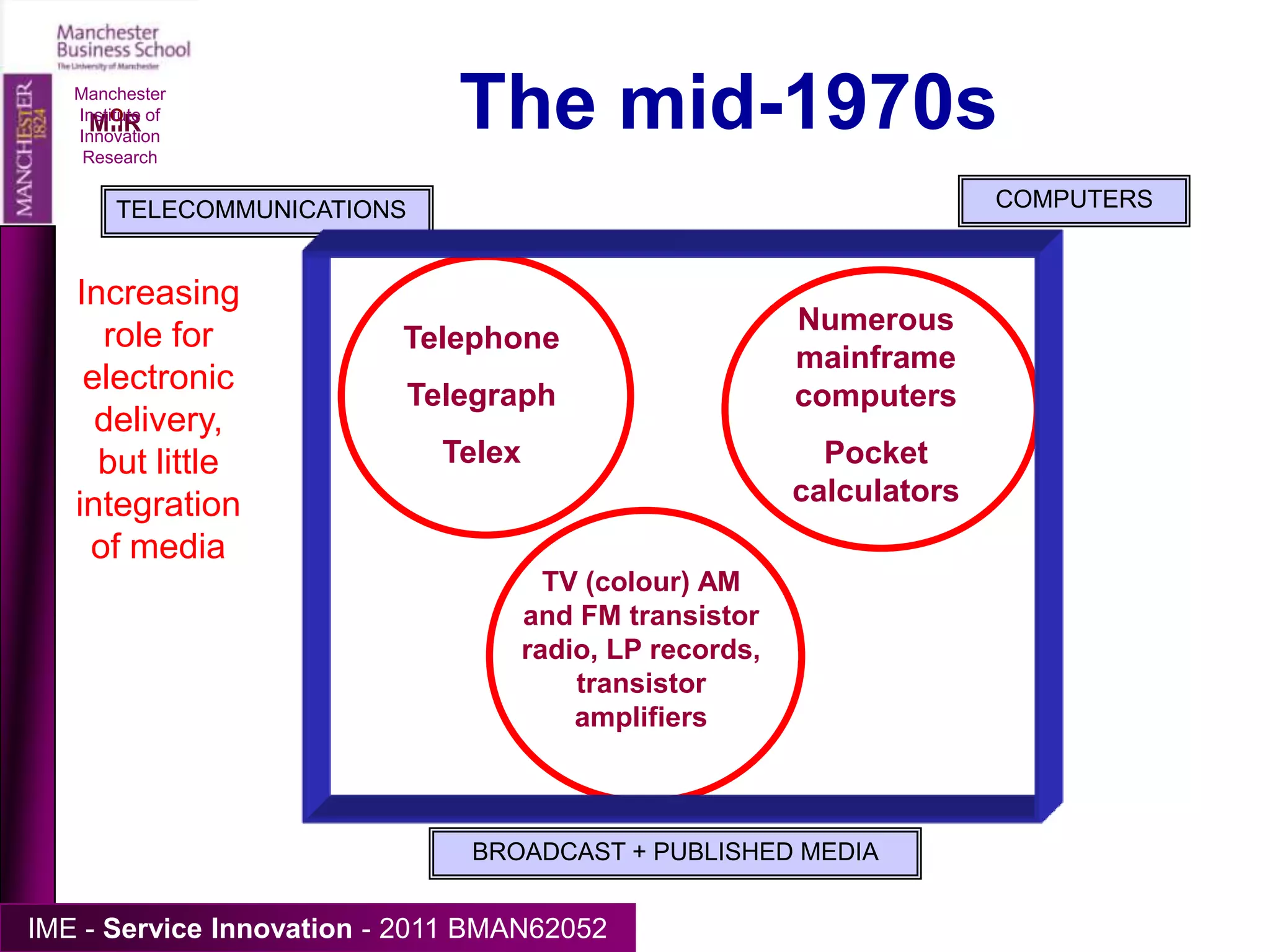
Manchester Institute of Innovation ResearchThe mid-1970sCOMPUTERSTELECOMMUNICATIONSIncreasing role for electronic delivery, but little integration of mediaNumerous mainframe  computersPocket  calculatorsTelephoneTelegraphTelexTV (colour) AM and FM transistor radio, LP records, transistor amplifiersBROADCAST + PUBLISHED MEDIA
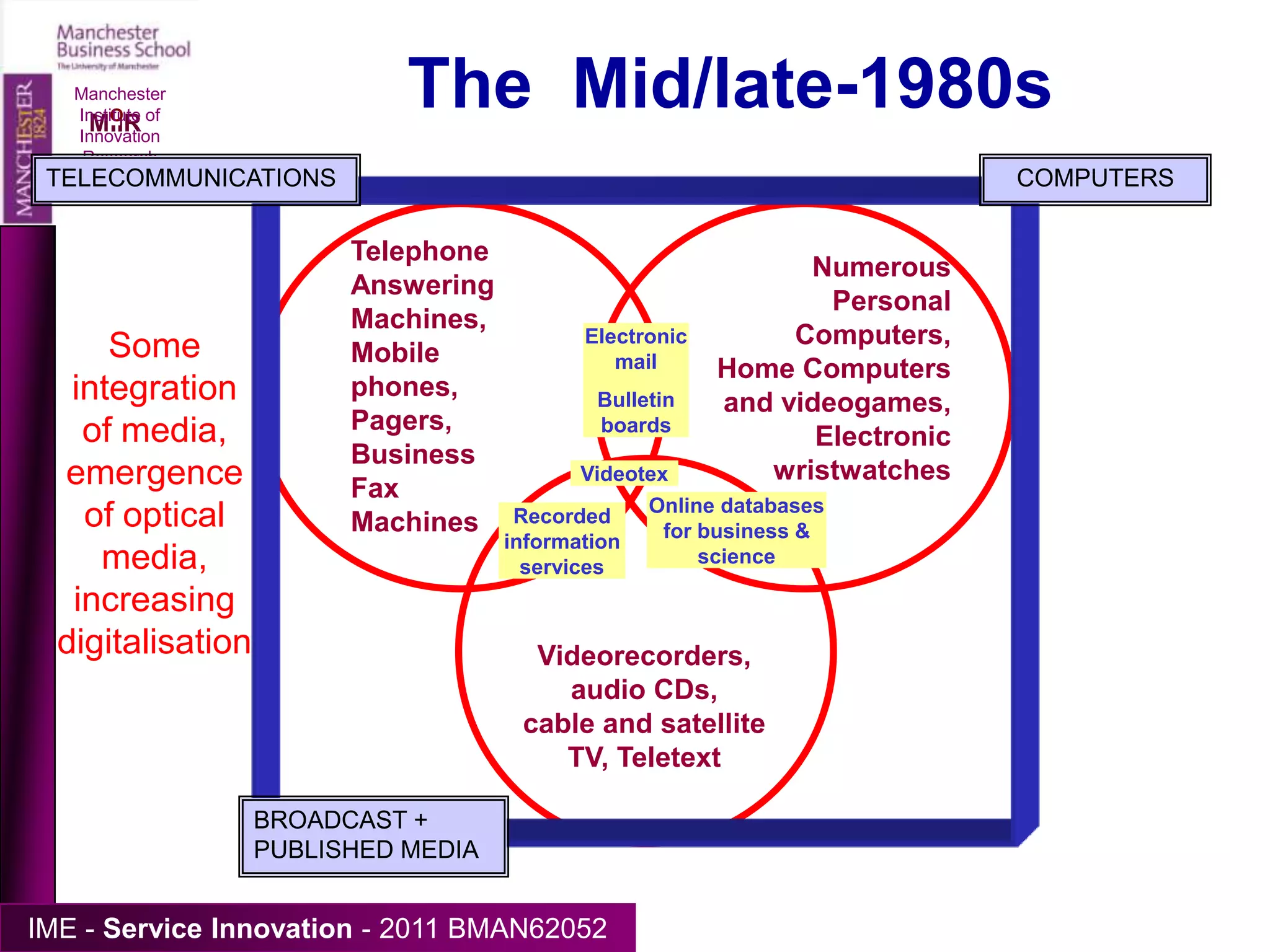
Manchester Institute of Innovation ResearchThe  Mid/late-1980sTELECOMMUNICATIONSCOMPUTERSTelephone Answering Machines, Mobile phones, Pagers, Business Fax MachinesNumerous Personal  Computers, Home Computers and videogames, Electronic wristwatchesSome integration of media, emergence of optical media, increasing digitalisationElectronic  mailBulletin boardsVideotex         Online databases for business & scienceRecorded information servicesVideorecorders, audio CDs,          cable and satellite TV, TeletextBROADCAST + PUBLISHED MEDIA
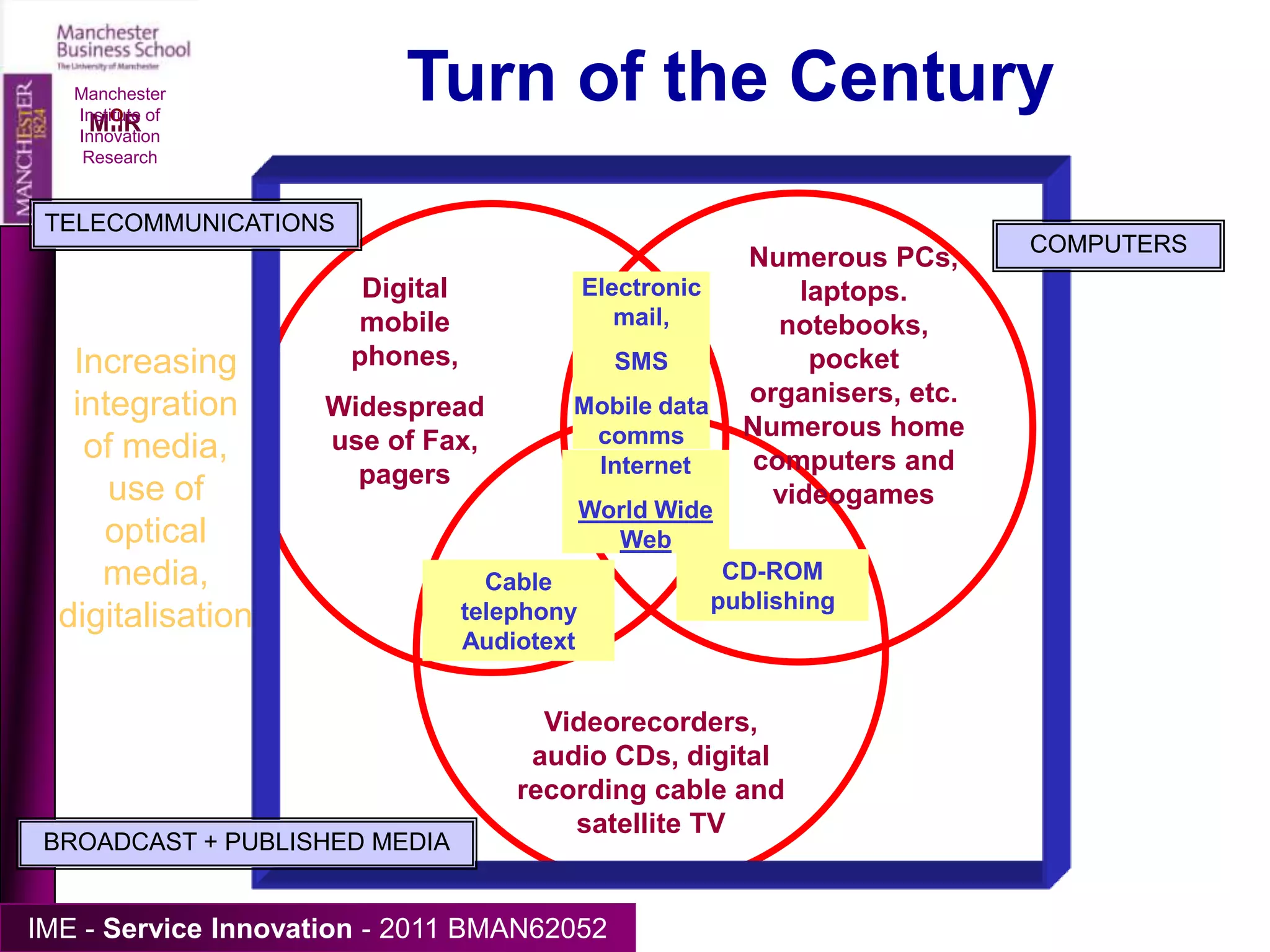
Manchester Institute of Innovation ResearchTurn of the CenturyTELECOMMUNICATIONSCOMPUTERSNumerous PCs, laptops. notebooks, pocket organisers, etc. Numerous home computers and videogamesDigital mobile phones,Widespread use of Fax, pagersElectronic  mail, SMSMobile data commsIncreasing integration of media, use of optical media, digitalisationInternetWorld Wide WebCD-ROM publishingCable telephony AudiotextVideorecorders, audio CDs, digital recording cable and satellite TVBROADCAST + PUBLISHED MEDIA
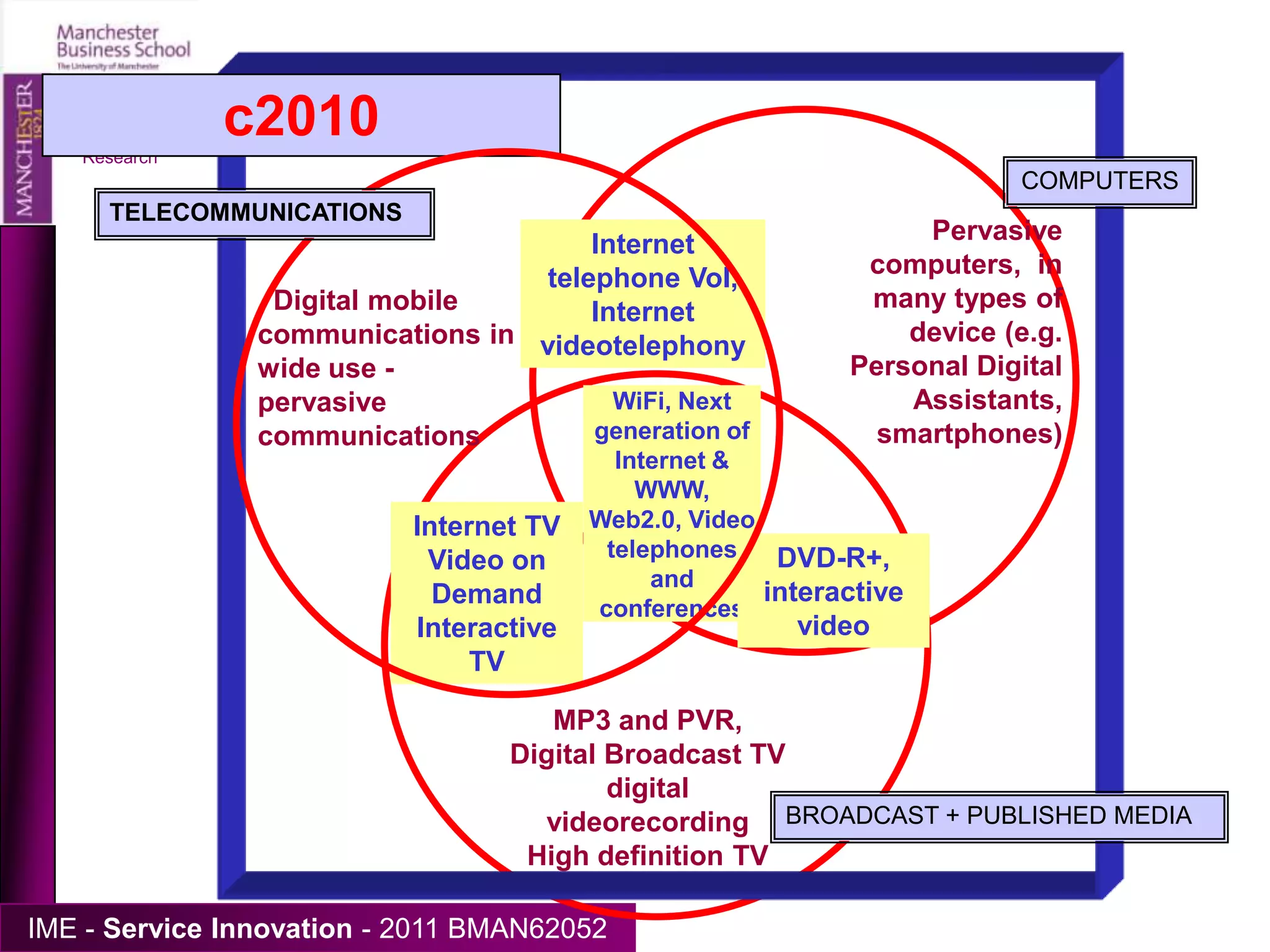
Manchester Institute of Innovation Researchc2010COMPUTERSTELECOMMUNICATIONSPervasive  computers,  in many types of device (e.g. Personal Digital Assistants, smartphones)Internet telephone VoI, Internet  videotelephony  Digital mobile communications in wide use - pervasive communicationsWiFi, Next generation of Internet & WWW,  Web2.0, Video telephones and conferences Internet TV Video on Demand Interactive TVDVD-R+, interactive videoMP3 and PVR, Digital Broadcast TV digital videorecording  High definition TVBROADCAST + PUBLISHED MEDIA
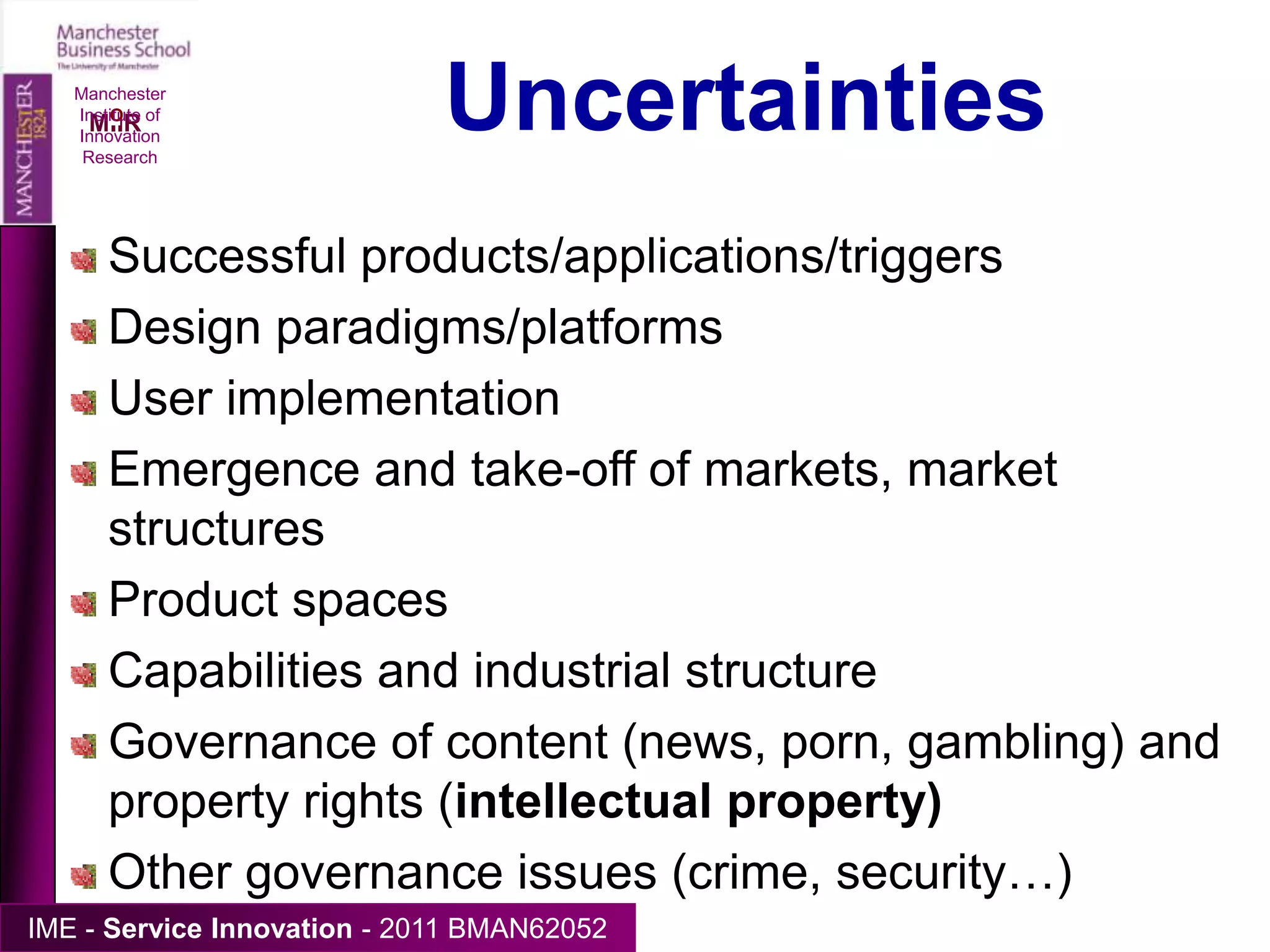
Manchester Institute of Innovation ResearchUncertaintiesSuccessful products/applications/triggersDesign paradigms/platformsUser implementationEmergence and take-off of markets, market structuresProduct spacesCapabilities and industrial structureGovernance of content (news, porn, gambling) and property rights (intellectual property)Other governance issues (crime, security…)
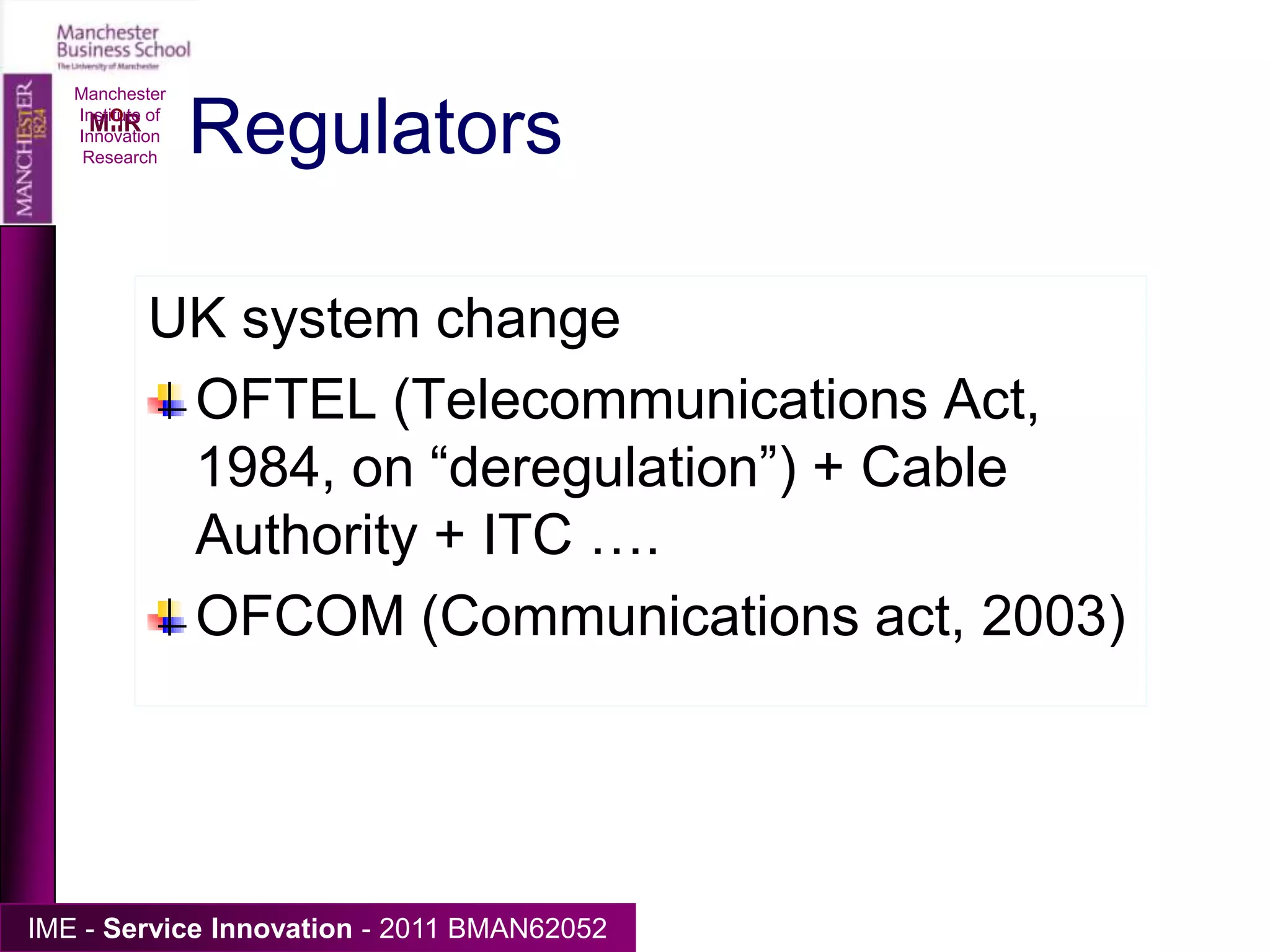
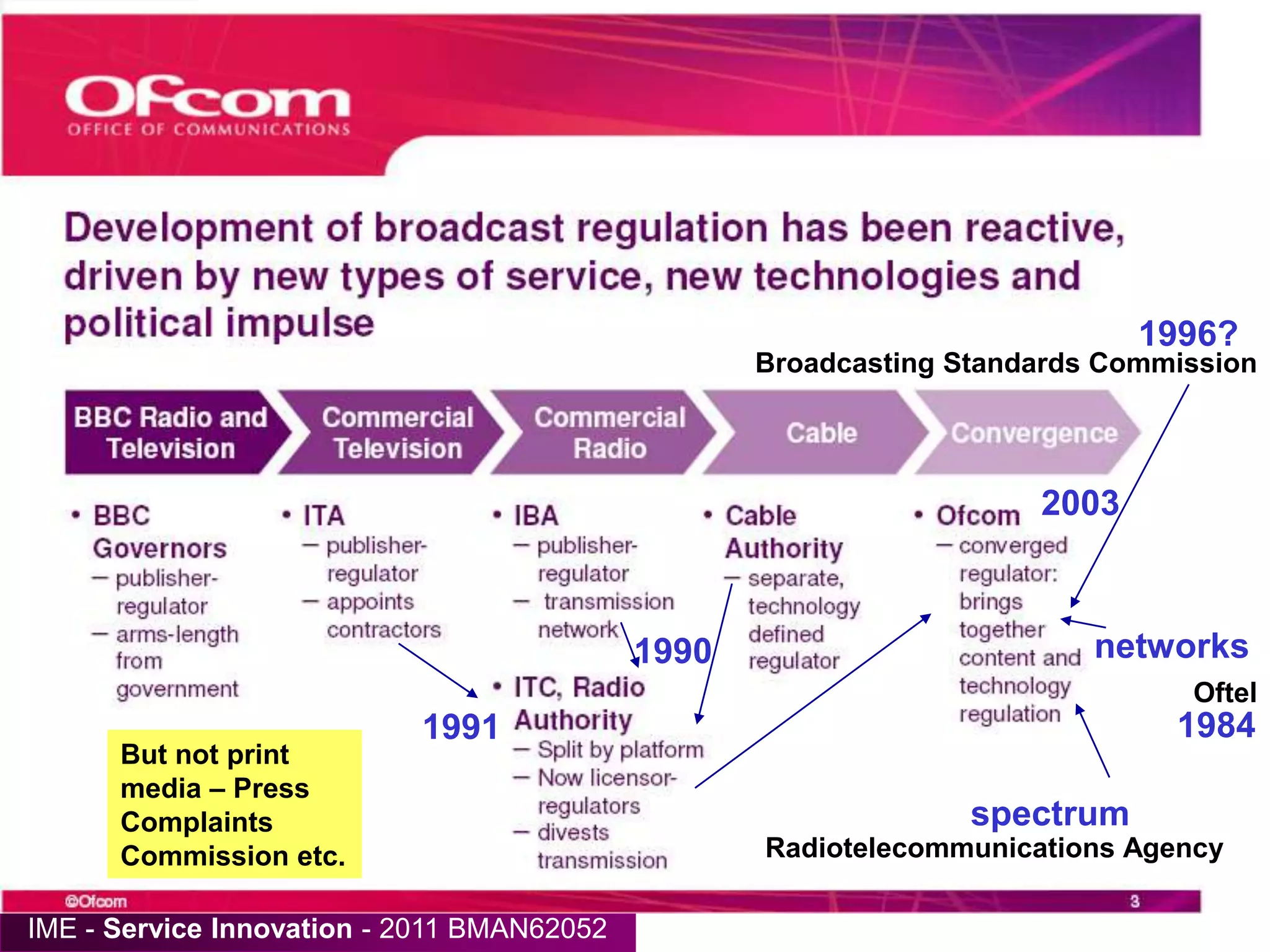
Manchester Institute of Innovation ResearchRegulatorsUK system changeOFTEL (Telecommunications Act,  1984, on “deregulation”) + Cable Authority + ITC ….OFCOM (Communications act, 2003)
Manchester Institute of Innovation Research1996?Broadcasting Standards Commission2003networks1990Oftel19841991But not print media – Press Complaints Commission etc.spectrumRadiotelecommunications Agency
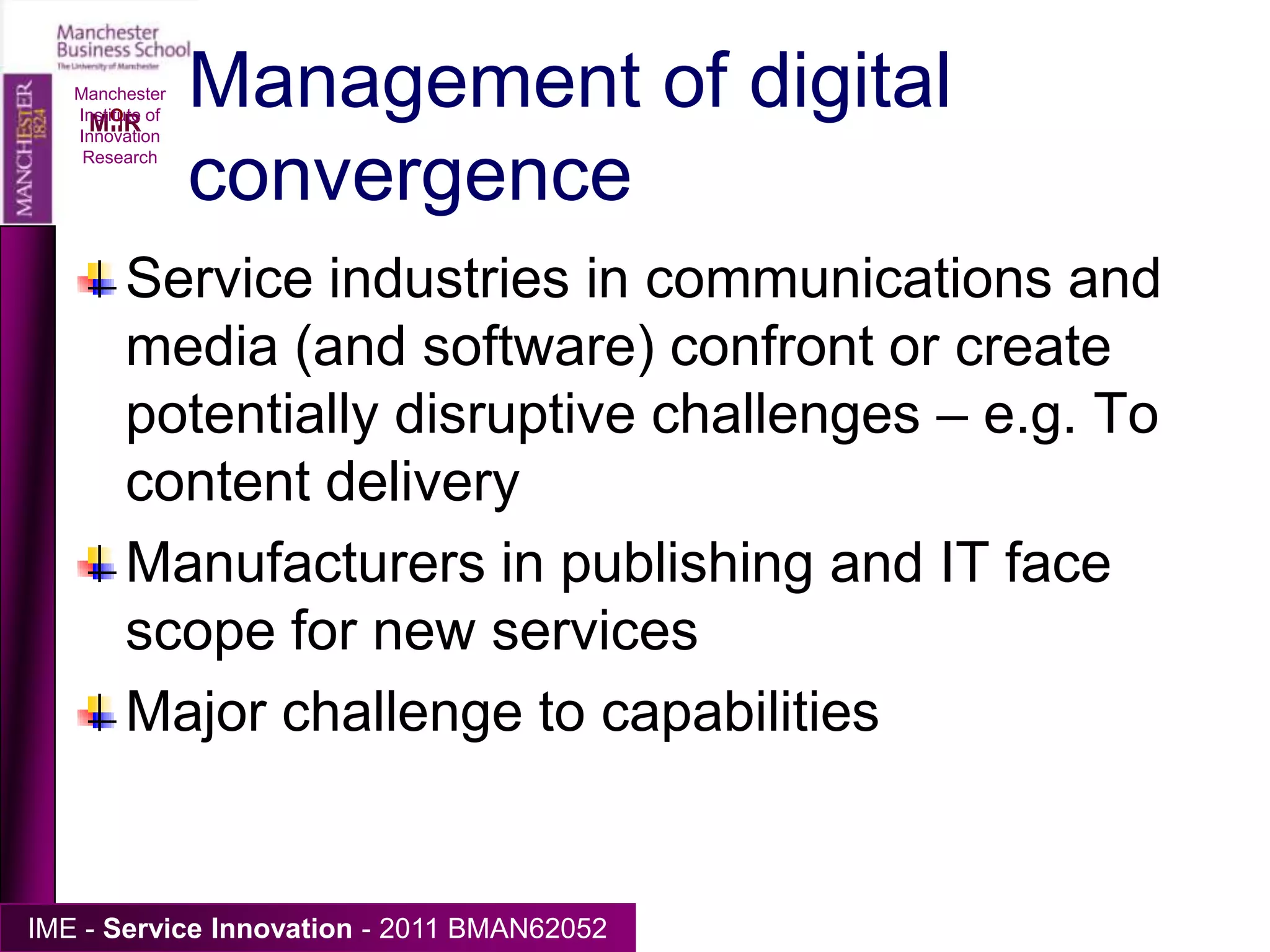
Management of digital convergenceService industries in communications and media (and software) confront or create potentially disruptive challenges – e.g. To content deliveryManufacturers in publishing and IT face scope for new servicesMajor challenge to capabilitiesManchester Institute of Innovation Research
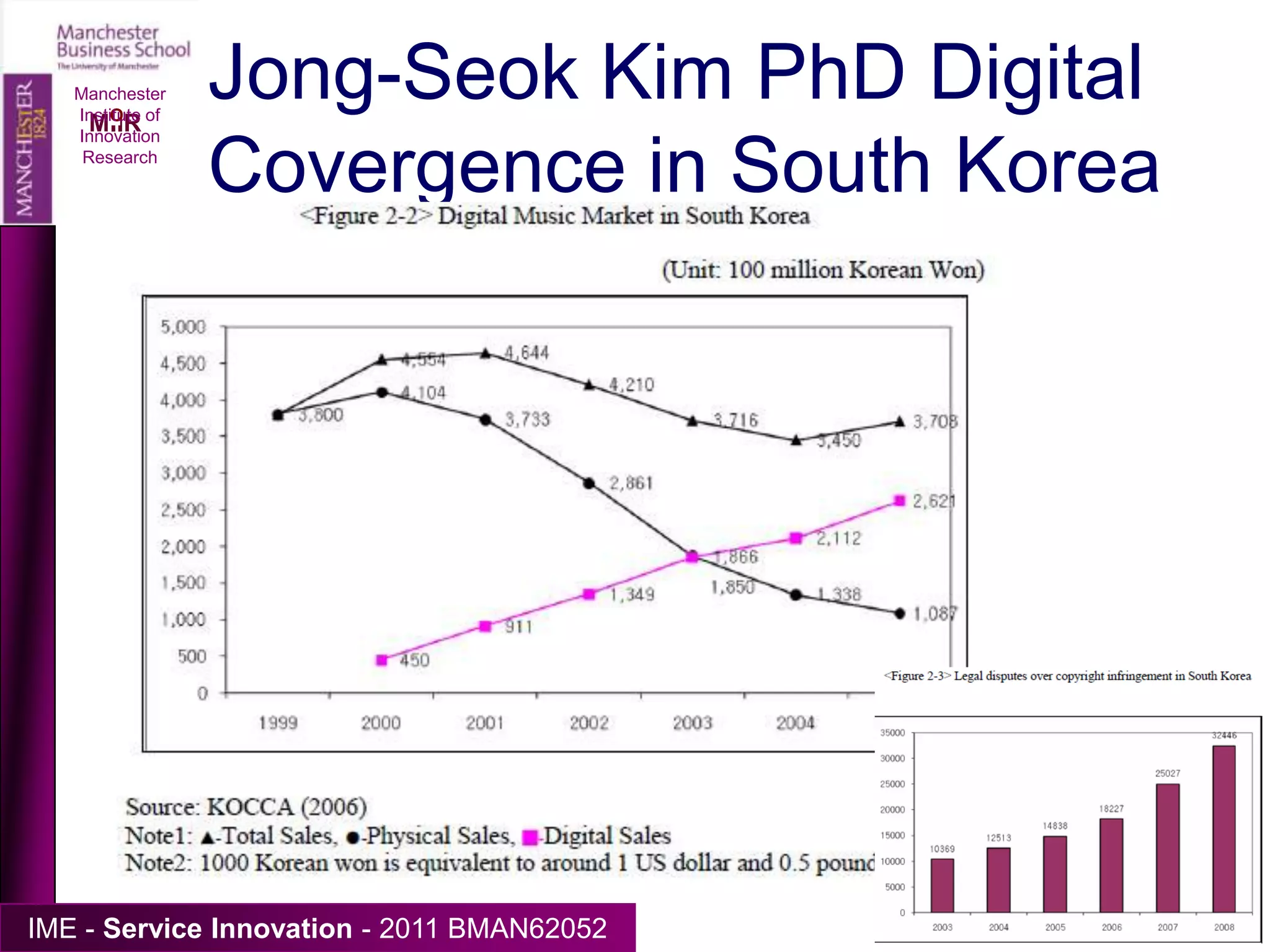
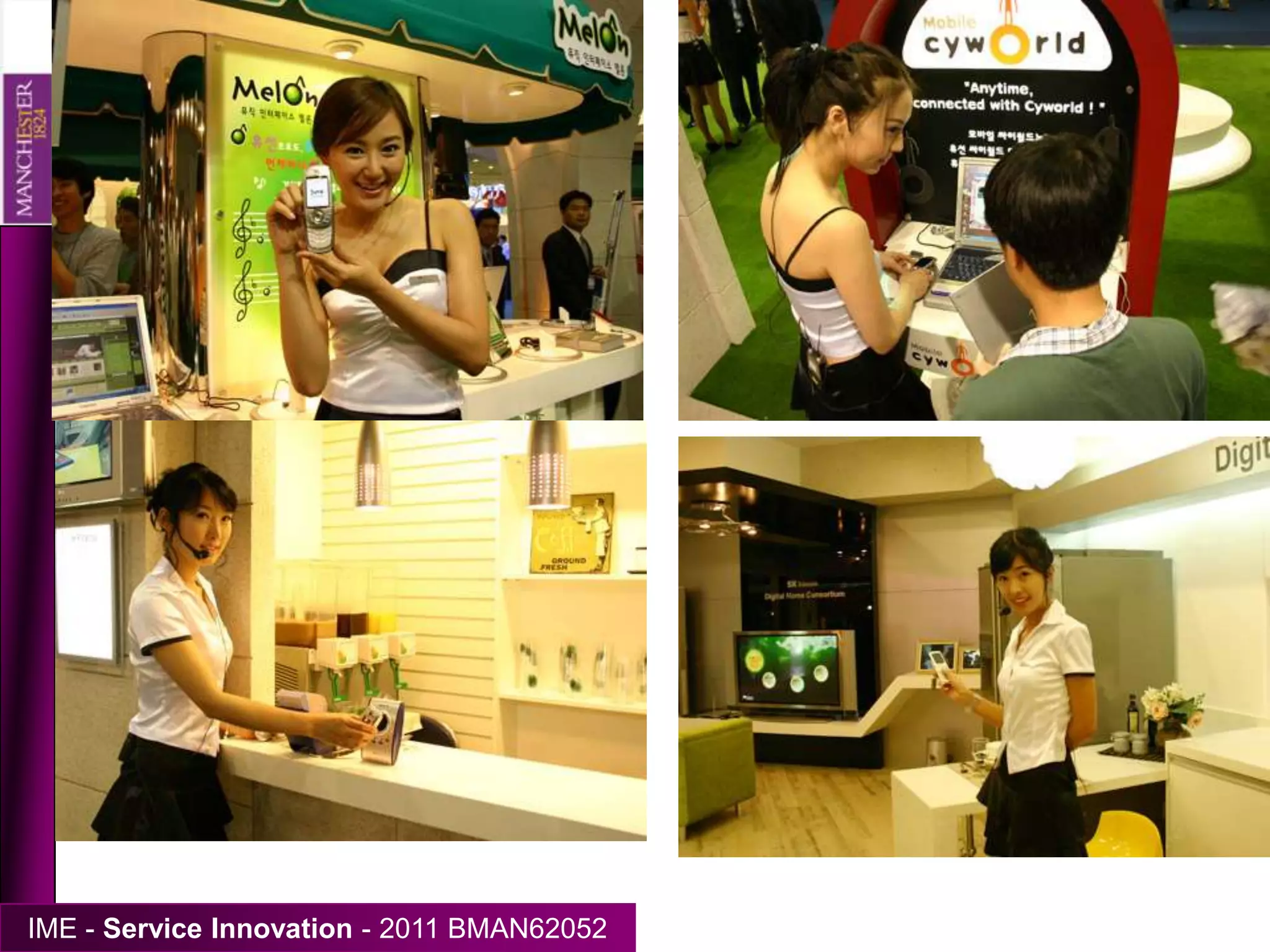
Jong-SeokKim PhD Digital Covergence in South KoreaManchester Institute of Innovation Research

servicisation and digital convergence 2011

  • 1.
    Manchester Institute ofInnovation ResearchInnovation and Convergence: Digital Convergence and ServicisationIan MilesIan.Miles@mbs.ac.ukIME service innovation seminar 8
  • 2.
    Two developments requiringnew strategies and capabilitiesServicisationDigital ConvergenceManchester Institute of Innovation Research
  • 3.
    Manchester Institute ofInnovation ResearchServicisation
  • 4.
  • 5.
  • 6.
  • 7.
  • 8.
    Many ways inwhich manufacturing and services look more alike
  • 9.
    Services become “productised”,other sectors “servicised”.Manchester Institute of Innovation Research
  • 10.
    Productisation of services..either the evolution of a service to include a productor a service that becomes standardised to a degree where it is marketed as a product. For example in logistics, transport contracts can be so well defined that they turn into a service that is effectively sold as a product. www..productserviceinnovation.comManchester Institute of Innovation Research
  • 11.
    Manchester Institute ofInnovation ResearchFrom Baines, Lightfoot, Benedettiniand Kay (2009): Journal of manufacturing technology management, Vol 20 No 5 2009.Servicisation:The increasing emphasis on service outputs from manufacturing and other non-service firms
  • 12.
    Some very differentaspectsEmbedded servicesProduct services: complementary to the goods; aiding users; adding more value; support services, KIBSServitising goods: not rentalProcess services: selling business processesSoftware, comms, content [e.g. Kindle]Aftersales, software sales, systems integration and managementPay for service, not goodTesting, production, comms, marketingManchester Institute of Innovation Research
  • 13.
    Why servicise?Manchester Instituteof Innovation ResearchThe annual volume of new equipment sales compared with the size of the installed base in selected capital goods sectors (ie one car is sold for every 13 on the road).
  • 14.
    Some cases: ManchesterInstitute of Innovation ResearchT.S. Baines, H.W. Lightfoot, O. Benedettini, J.M. Kay, (2009) "The servitization of manufacturing: A review of literature and reflection on future challenges", Journal of Manufacturing Technology Management, Vol. 20 Iss: 5, pp.547 - 567
  • 15.
    How is itdone?Andy Neely, Cambridge, sees 3 strategies:Product-focused strategies seek to capture information regarding product usage and then integrate any relevant findings so they influence the design of the next generation of products - for example maintenance processes, functionality upgradesService-focused strategies seek to address broader customer expectations concerning for example, service availability, co-location of service engineers, customer equipment training, speed and quality of response to specific enquiriesValue chain-focused strategies seek to provide integrated service solutions (such as acting as prime contractor) so that, in effect, the supplier firm takes over some part of the customer's operationAnother approachManchester Institute of Innovation Research
  • 16.
    “Product” Life CycleManchesterInstitute of Innovation ResearchDesign Manufacture Delivery Usage Support End-of-useVeronica Martinez, Marko Bastl, Jennifer Kingston, Stephen Evans, (2010) "Challenges in transforming manufacturing organisations into product-service providers", Journal of Manufacturing Technology Management, Vol. 21 Iss: 4, pp.449 - 469
  • 17.
    “Product”-service relations: conventionalmanufacturingManchester Institute of Innovation ResearchDesign Manufacture Delivery Usage Support End-of-useSupplierCustomerInteraction: mainly transactional.Some product supportSome peripheral servicesVeronica Martinez, Marko Bastl, Jennifer Kingston, Stephen Evans, (2010) "Challenges in transforming manufacturing organisations into product-service providers", Journal of Manufacturing Technology Management, Vol. 21 Iss: 4, pp.449 - 469
  • 18.
    “Product”-service relations: moreserviceManchester Institute of Innovation ResearchDesign Manufacture Delivery Usage Support End-of-useProduct + service deliveryVeronica Martinez, Marko Bastl, Jennifer Kingston, Stephen Evans, (2010) "Challenges in transforming manufacturing organisations into product-service providers", Journal of Manufacturing Technology Management, Vol. 21 Iss: 4, pp.449 - 469
  • 19.
    “Product”-service relations: moreservice customisationManchester Institute of Innovation ResearchDesign Manufacture Delivery Usage Support End-of-useCustomisation of product and serviceVeronica Martinez, Marko Bastl, Jennifer Kingston, Stephen Evans, (2010) "Challenges in transforming manufacturing organisations into product-service providers", Journal of Manufacturing Technology Management, Vol. 21 Iss: 4, pp.449 - 469
  • 20.
    “Product”-service relations: moreservice customisationManchester Institute of Innovation ResearchDesign Manufacture Delivery Usage Support End-of-useProduct & service codesigned: total solutionsVeronica Martinez, Marko Bastl, Jennifer Kingston, Stephen Evans, (2010) "Challenges in transforming manufacturing organisations into product-service providers", Journal of Manufacturing Technology Management, Vol. 21 Iss: 4, pp.449 - 469
  • 21.
    “Product”-service relations: nota linear model/stages theoryManchester Institute of Innovation ResearchDesign Manufacture Delivery Usage Support End-of-useVeronica Martinez, Marko Bastl, Jennifer Kingston, Stephen Evans, (2010) "Challenges in transforming manufacturing organisations into product-service providers", Journal of Manufacturing Technology Management, Vol. 21 Iss: 4, pp.449 - 469
  • 22.
    “Product”-service relations: nota linear model/stages theoryManchester Institute of Innovation ResearchDesign Manufacture Delivery Usage Support End-of-useVeronica Martinez, Marko Bastl, Jennifer Kingston, Stephen Evans, (2010) "Challenges in transforming manufacturing organisations into product-service providers", Journal of Manufacturing Technology Management, Vol. 21 Iss: 4, pp.449 - 469
  • 23.
    Large-scale analysis israreManchester Institute of Innovation ResearchAn exception: Andy Neely ‘The Servitization of Manufacturing: An Analysis of Global Trends’Data from OSIRIS [44,000 listed companies from around the world].
  • 24.
    Companies with primaryor secondary US SIC codes in the range 10-39 inclusive, extractive & manufacturing, and over 100 employees [n=12,521].1.Pure manufacturingPetroChina principally engaged in a broad range of petroleum & natural gas-related activities.2.Some combination of manufacturing & serviceSiemens -predominantly electronics & electrical engineering, but provides wide variety of consulting, maintenance & other services.3.Pure serviceThe Brink's Company: security industry firm - services offered include armoured-car transportation, automated teller machine (ATM) servicing, currency & deposit processing, coin sorting & wrapping, & arranging secure air transportation of valuables.Three models
  • 25.
    Neely casesManchester Instituteof Innovation Research
  • 26.
    Main services offeredManchesterInstitute of Innovation Research
  • 27.
    Some trend dataManchesterInstitute of Innovation ResearchLAY, G. 2007. ‘Towards a Comprehensive Innovation Strategy’. Quality Congress. Istanbul: Fraunhofer Institute for Systems and InnovationResearch ISI, Karlsruhe
  • 28.
    Servicisation is revenuemodel innovation; but can affect innovation more generallyKnowledge about customers, product use, product failures and problemsReallocation of costs changes logic about product maintenance:Affects product designScope for innovation in monitoring and maintenanceNew service innovationManchester Institute of Innovation Research
  • 29.
    Environmental argumentServices =less environmental impact (?)Swedish PhD study , firm (and user) interviews: Oksana Mont (2004) Product-service systems: Panacea or myth? Lund University, The International Institute for Industrial Environmental EconomicsManchester Institute of Innovation ResearchDrivers:Some general factors, but also market issues vary considerably across sectors; coercive market includes consumers and regulations Barriers:Limited regulatory drivers; high costs of labour; need for better awareness on part of consumers and intermediaries (and own staff) – long learning time; credibility/demonstrability to users; diminished user responsibility; possible internal conflicts (2nd hand vs new), etc.
  • 30.
    Challenges for servicisersDifferentmanagement and customer relations requiredMay need understanding of new markets, and evaluation of potential of new service offeringMay require thorough reorientation of sales workforceNew capabilities – separate organisation?Manchester Institute of Innovation Research
  • 31.
    Exercise!You work fora firm that makes high-value consumer products. (cosmetics, jewellry, babyfood, petfood....) There is a potentially disruptive technology emerging which will allow consumers to make the final products at home, easily, and for much less money.This is attracting a great deal of media attention, and public response to the new offering looks positive.What do you do?Manchester Institute of Innovation Research
  • 32.
    Some optionsWe ruleout suppressing or banning the technology! (Though you could try dark propaganda against it...)We do not rule out your doing deals with the supplier.We do not rule out your downsizing, but you must try to remain sustainably profitable.Could you go upmarket?Can you complement your product with other tangible elements, or with new services?Can you move away from the original product, and focus on ancillary goods and services that sill appeal to consumers (and maybe give you advantage with the new technology)?Can you do other things with your skills, plant and equipment?Can you think of other options?Manchester Institute of Innovation Research
  • 33.
    The taskDecide onyour product and on the strategy/ies you will pursue. (5 mins+15 mins.)Consider what capabilities you will require to implement this:Types of KnowledgeWorkforce skillsAlliancesEtc (30 minutes)Decide on what the most urgent of these are, and how you will address them. (10 mins)Manchester Institute of Innovation Research
  • 34.
    Manchester Institute ofInnovation ResearchDigital ConvergenceConvergenceWhat is digital convergence?Digital convergence and innovationWho does this affect?How does it affect media, IT industries, other sectors…
  • 35.
    3 sorts ofconvergenceManchester Institute of Innovation ResearchDisruptive innovation challenges, PLUS need to master new technologies.“Both market and technology-driven convergence tendencies along the value chain ...eventually imply entire industries to converge in the long term. ...the decision to integrate competences and technologies from external sources does not necessarily come as a strategic choice... Rather required to avoid negative effects of emerging shakeouts.”
  • 36.
  • 37.
    Manchester Institute ofInnovation ResearchConvergenceFor some decades commentators have addressed computer/ telecommunications “convergence” – or collisionHeld by many to be a defining feature of new IT, e.g. Kobiyashi “IT=C&C”… and related to common underlying technologies (microprocessors, digitalisation)But more industries and activities “converge” than just data processing and communication
  • 38.
    Manchester Institute ofInnovation ResearchDigital Convergence Historically, distinct industries dealt with print, recorded music, images, other media, telecomms, broadcasting, computer hardware, software
  • 39.
    Manchester Institute ofInnovation ResearchDigitalisationAnalogue     DigitalPublishing, broadcasting, etcTextPhotographyMoving ImagesSoundInstruments Doc. Processing
  • 40.
  • 41.
    ”, projection, TVs, DVDs etc.
  • 42.
    DT, CD,MP3....
  • 43.
    Digital display,measurement(printing)(photochemistry)(phonography, electronics…)(mechanical, electromechanical)New storage devices and displays – ebooks, CDs, MP3/4 players, etc; Web publishing
  • 44.
    Manchester Institute ofInnovation ResearchDigital Convergence Distinct industries have dealt with hardware, software, telecommunications, broadcasting, print and other media They have varying assets, capabilities and types of content - and regulatory and IP systems But now they have increasingly shared underlying technologies (microelectronics, optronics, software) All types of data and information potentially captured, processed, communicated, stored, displayed digitally via new IT
  • 45.
    Manchester Institute ofInnovation ResearchThree Uses of Information
  • 46.
    Manchester Institute ofInnovation ResearchThree Sorts of Industry(Tele)communicationsPublishing MediaComputation
  • 47.
    Manchester Institute ofInnovation ResearchTraditional Features(Tele)communications1 to 1PROCESSINGCOMMUNICATIONINTERACTIONCONTENT1 to many(Broadcast Media)Early Online MediaPublishing MediaComputation
  • 48.
    Manchester Institute ofInnovation ResearchA Growing Market Space…
  • 49.
    … Within whichthe offerings of established industries expandManchester Institute of Innovation Research========Increasing ===proliferation of ======= products
  • 50.
    Manchester Institute ofInnovation ResearchThe Expanding Media UniverseTimeCommunicationsComputation ContentThe three “trumpet” shapes represent telecommunications, computer, and broadcast & print media fields. Over time the product space to which they contribute, and its market size, expands, and the three fields overlap increasingly.
  • 51.
    Manchester Institute ofInnovation ResearchEarly Industrial SocietyCOMPUTATION(TELE) COMMUNICATIONSMechanical information processing: very limited till C20th - punch cards, calculatorsPaper-based communication: Stationery, Post.C19th - telephone, telegraphAll (but telecomms) based on PHYSICAL TRANSPORTPaper-based information products - books, newspapers, etc + live consultation & entertainment + (later) mechanical recorded media (gramophone etc)INFORMATION GOODS & SERVICES
  • 52.
    Manchester Institute ofInnovation ResearchThe mid-1950sCOMPUTERSTELECOMMUNICATIONSVery few, very large, valve-based electronic computers; Keyboard calculatorsPHYSICAL TRANSPORT plus increasing electronic delivery (telecomms, TV, radio, etc.)TelephoneTelegraphTV (mainly monochrome)AM radio, LP records, valve amplifiersBROADCAST + PUBLISHED MEDIA
  • 53.
    Manchester Institute ofInnovation ResearchThe mid-1970sCOMPUTERSTELECOMMUNICATIONSIncreasing role for electronic delivery, but little integration of mediaNumerous mainframe computersPocket calculatorsTelephoneTelegraphTelexTV (colour) AM and FM transistor radio, LP records, transistor amplifiersBROADCAST + PUBLISHED MEDIA
  • 54.
    Manchester Institute ofInnovation ResearchThe Mid/late-1980sTELECOMMUNICATIONSCOMPUTERSTelephone Answering Machines, Mobile phones, Pagers, Business Fax MachinesNumerous Personal Computers, Home Computers and videogames, Electronic wristwatchesSome integration of media, emergence of optical media, increasing digitalisationElectronic mailBulletin boardsVideotex Online databases for business & scienceRecorded information servicesVideorecorders, audio CDs, cable and satellite TV, TeletextBROADCAST + PUBLISHED MEDIA
  • 55.
    Manchester Institute ofInnovation ResearchTurn of the CenturyTELECOMMUNICATIONSCOMPUTERSNumerous PCs, laptops. notebooks, pocket organisers, etc. Numerous home computers and videogamesDigital mobile phones,Widespread use of Fax, pagersElectronic mail, SMSMobile data commsIncreasing integration of media, use of optical media, digitalisationInternetWorld Wide WebCD-ROM publishingCable telephony AudiotextVideorecorders, audio CDs, digital recording cable and satellite TVBROADCAST + PUBLISHED MEDIA
  • 56.
    Manchester Institute ofInnovation Researchc2010COMPUTERSTELECOMMUNICATIONSPervasive computers, in many types of device (e.g. Personal Digital Assistants, smartphones)Internet telephone VoI, Internet videotelephony Digital mobile communications in wide use - pervasive communicationsWiFi, Next generation of Internet & WWW, Web2.0, Video telephones and conferences Internet TV Video on Demand Interactive TVDVD-R+, interactive videoMP3 and PVR, Digital Broadcast TV digital videorecording High definition TVBROADCAST + PUBLISHED MEDIA
  • 57.
    Manchester Institute ofInnovation ResearchUncertaintiesSuccessful products/applications/triggersDesign paradigms/platformsUser implementationEmergence and take-off of markets, market structuresProduct spacesCapabilities and industrial structureGovernance of content (news, porn, gambling) and property rights (intellectual property)Other governance issues (crime, security…)
  • 58.
    Manchester Institute ofInnovation ResearchRegulatorsUK system changeOFTEL (Telecommunications Act, 1984, on “deregulation”) + Cable Authority + ITC ….OFCOM (Communications act, 2003)
  • 59.
    Manchester Institute ofInnovation Research1996?Broadcasting Standards Commission2003networks1990Oftel19841991But not print media – Press Complaints Commission etc.spectrumRadiotelecommunications Agency
  • 60.
    Management of digitalconvergenceService industries in communications and media (and software) confront or create potentially disruptive challenges – e.g. To content deliveryManufacturers in publishing and IT face scope for new servicesMajor challenge to capabilitiesManchester Institute of Innovation Research
  • 61.
    Jong-SeokKim PhD DigitalCovergence in South KoreaManchester Institute of Innovation Research
  • 62.
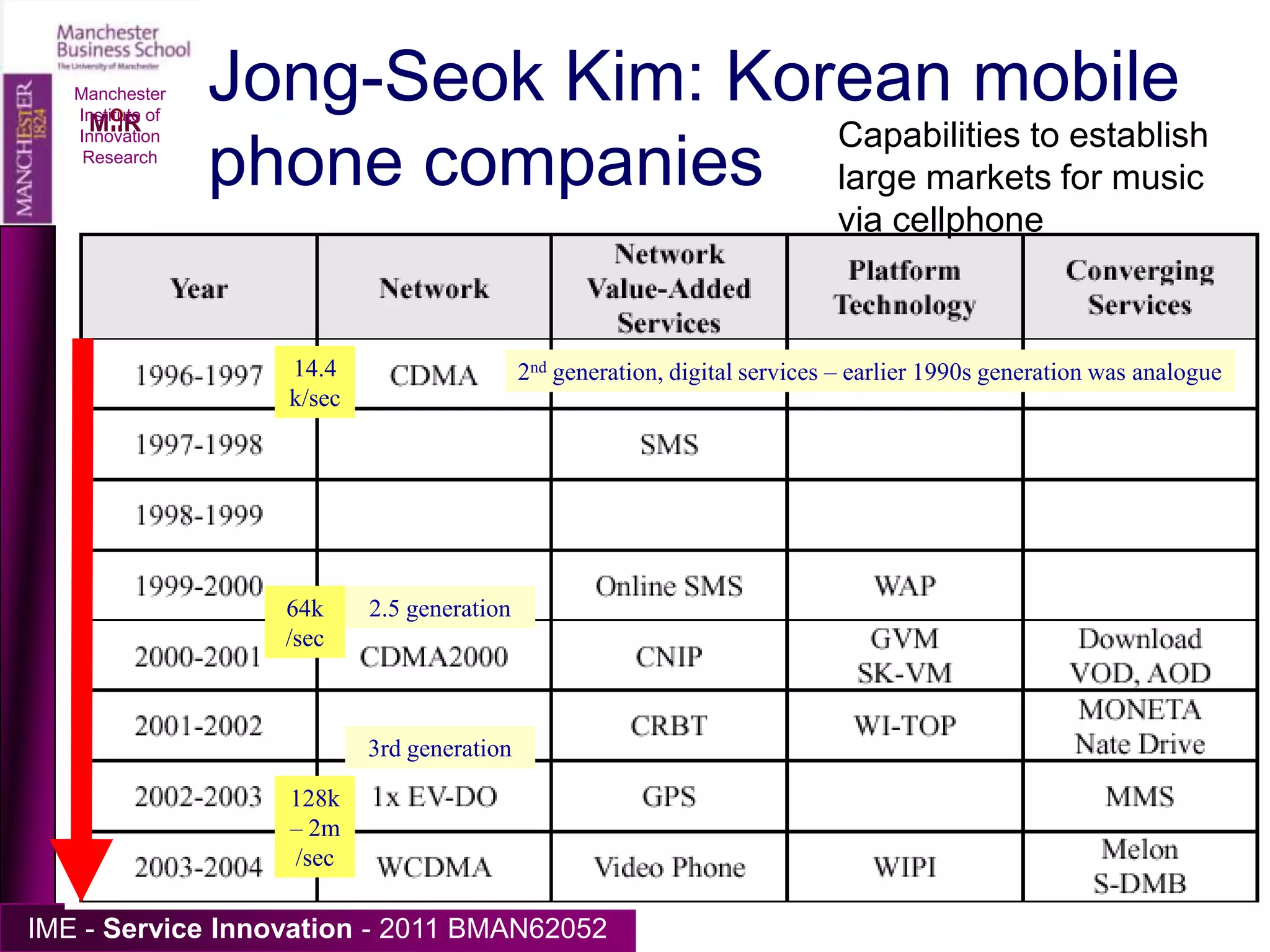
    Manchester Institute ofInnovation ResearchJong-Seok Kim: Korean mobile phone companiesCapabilities to establish large markets for music via cellphone14.4k/sec2nd generation, digital services – earlier 1990s generation was analogue2.5 generation64k /sec3rd generation128k – 2m /sec
  • 63.
    Manchester Institute ofInnovation Research
  • 64.
    Manchester Institute ofInnovation ResearchSKT’s responseThe Network R&D Center’: to develop core technologies to ensure the continual advancement of the next generation network, which in time will become one of the core competencies of mobile network operators. The Platform Research Center: to research, develop, and operate Internet-related services, as well as to develop/grow the Financial Enabling business, which make bankingand financial transaction possible on mobile phone. In addition, to discover new sources of growth engines by creating new businesses based on existing technological platforms. Currently the Center is carrying out R&D activities on WAPbased Platforms, M-Commerce, LBSIn the year 2004, SKT placed more emphasis on the R&D of technology. In addition, aA New Business Division was established, aiming at explore new growth engines. TheNew Business Division deals with the formulation of new business strategies and theirimplementation at global levels. New managerial routines were adopted to operateefficiently and to speed up business processes. The Chief Business Officer wasresponsible for the Business Strategy Division, Business Division, and Customer Division (the new name for the Marketing Division). At the same time, with the continuous introduction of new convergent services, the number of transactions with content providers was escalating. Hence, a Content Business Unit was also formed, to deal with the many issues relating to content.. ...while the three firms took different measures, they watched each other and worked on some common issues
  • 65.
    New knowledge tobe acquiredDRM and relevant systems and solutionsNew markets, their properties and evolving demands, incl. Attitudes to IP and preferences for paymentKnowledge of competing devicesContent providers, the existing music businessPotential new services – ringtone, streaming, downloads, associated content and marketingManchester Institute of Innovation Research
  • 66.
    Manchester Institute ofInnovation ResearchConvergenceExample: “smart phone” and tablets converge entertainment (games, videos, music), communications (phone, VOIP, videophone), publishing (newspaper download), and much more (cameras, health apps)… Much alliance and networking across firms to achieve success in new markets.Blurring industry boundariesNew convergent servicesMuch scope for innovation in new services, improved service designNew playersDiversification, vertical integration (?)Requirement for new strategies, capabilities, organisation
  • 67.
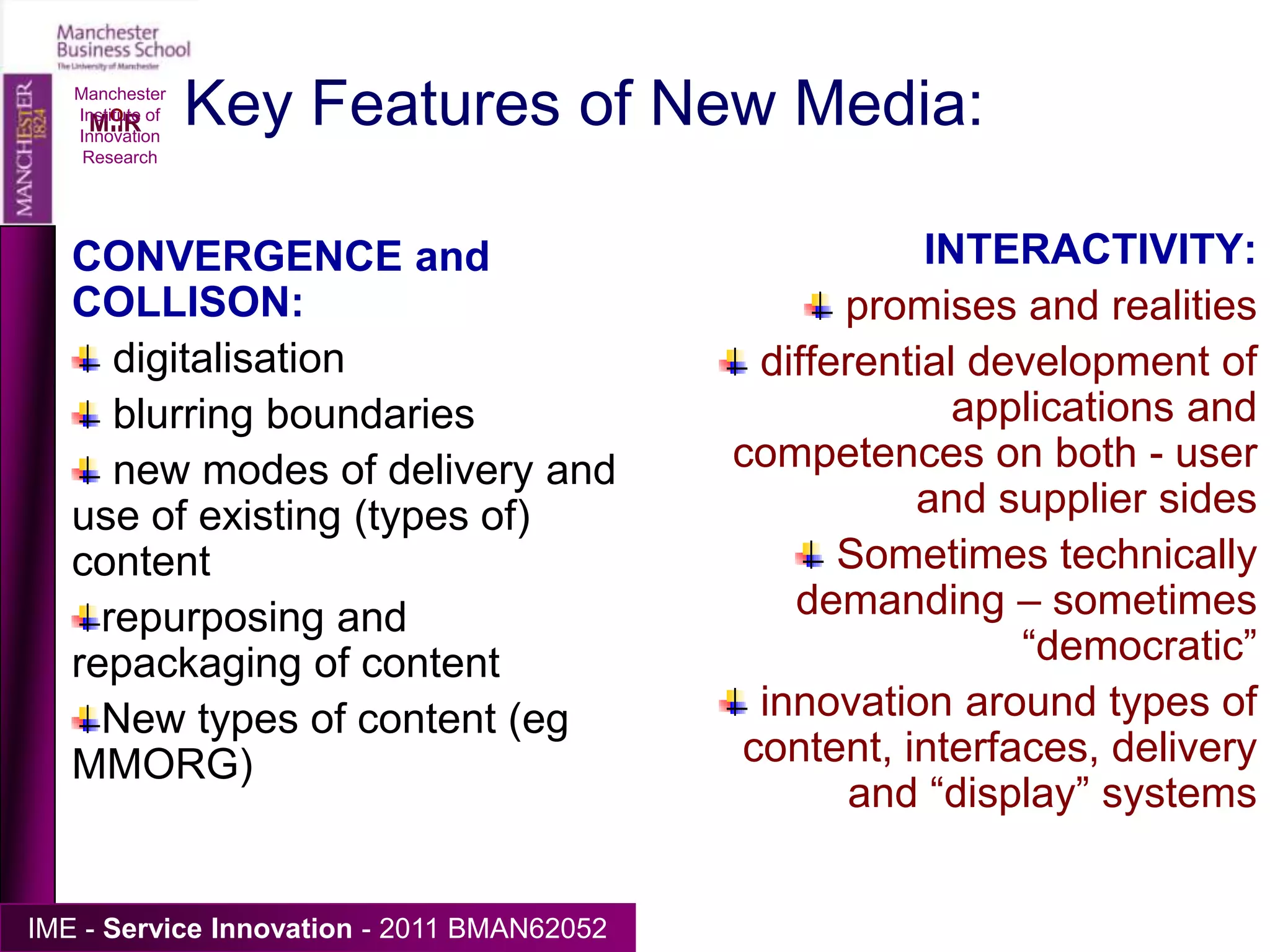
    Manchester Institute ofInnovation ResearchNot just MediaNew categories:e.g. chematronics, mechatronics [watch this space for bio and nano categories]…Converged products:e.g. “smart house” converges consumer electronics, telecomms, utilities, construction
  • 68.
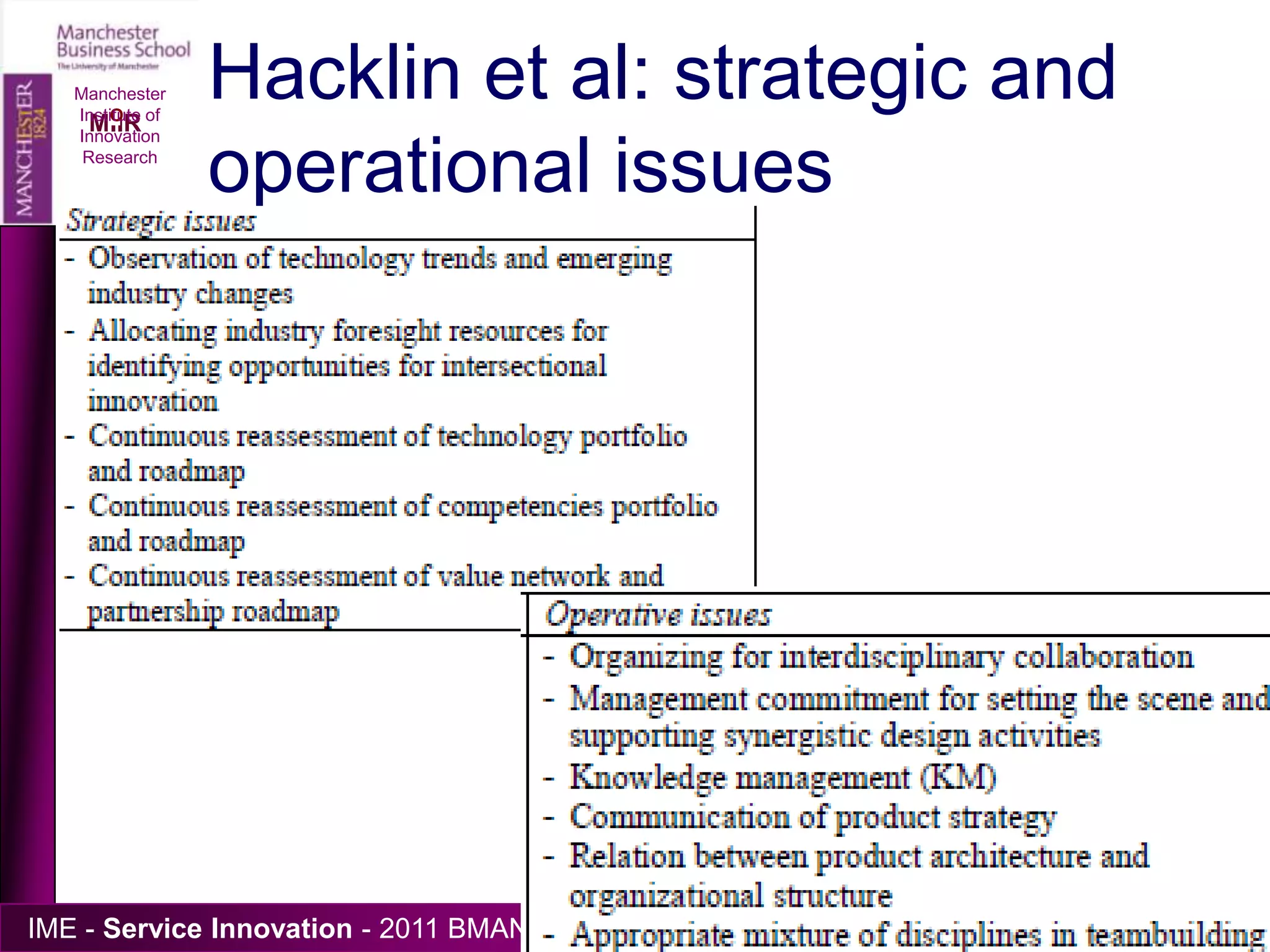
    Manchester Institute ofInnovation ResearchKey Features of New Media: INTERACTIVITY: promises and realities differential development of applications and competences on both - user and supplier sides Sometimes technically demanding – sometimes “democratic” innovation around types of content, interfaces, delivery and “display” systemsCONVERGENCE and COLLISON: digitalisation blurring boundaries new modes of delivery and use of existing (types of) contentrepurposing and repackaging of contentNew types of content (eg MMORG)
  • 69.
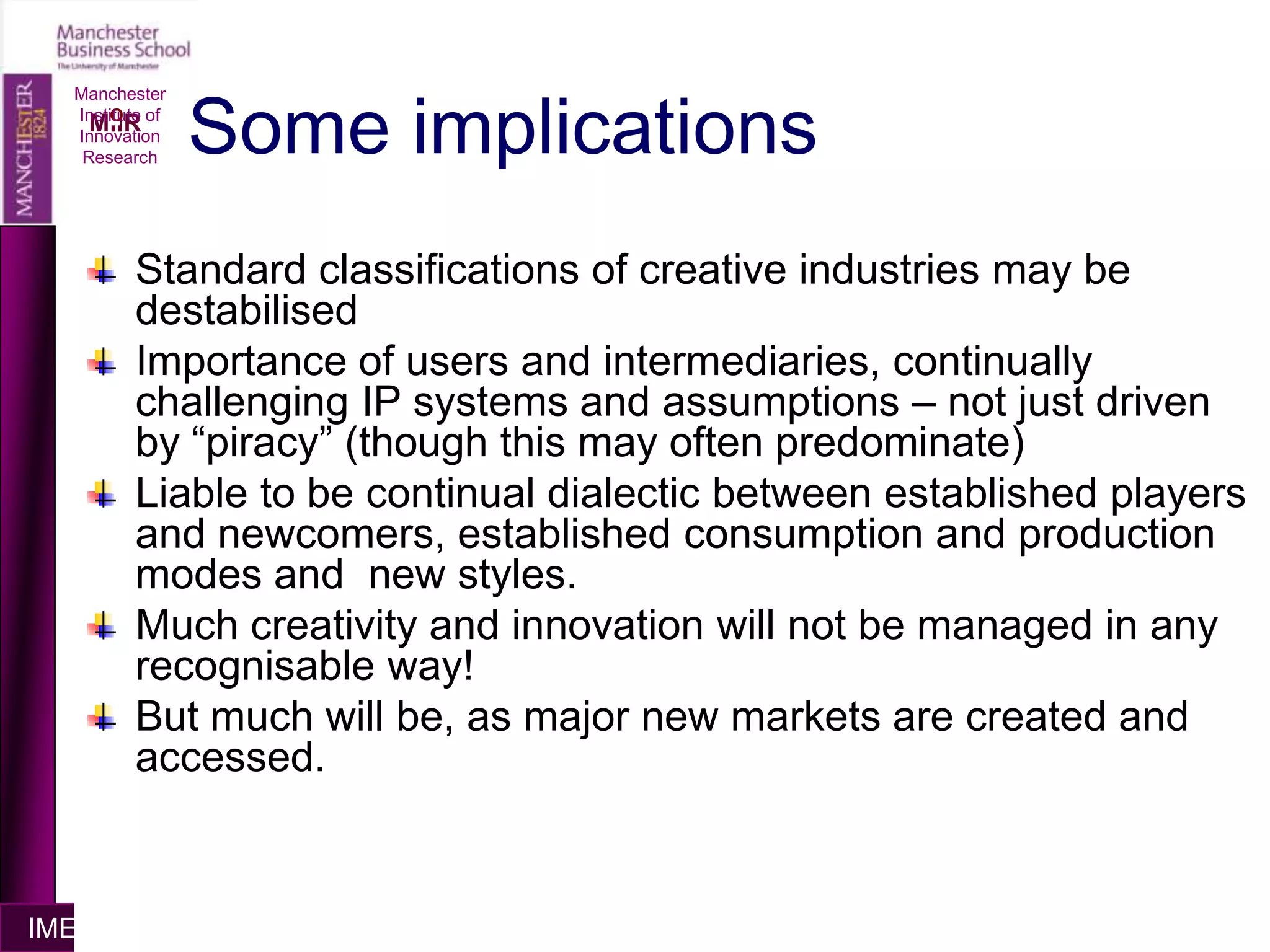
    Hacklin et al:strategic and operational issuesManchester Institute of Innovation Research
  • 70.
    Manchester Institute ofInnovation ResearchSome implicationsStandard classifications of creative industries may be destabilisedImportance of users and intermediaries, continually challenging IP systems and assumptions – not just driven by “piracy” (though this may often predominate)Liable to be continual dialectic between established players and newcomers, established consumption and production modes and new styles.Much creativity and innovation will not be managed in any recognisable way!But much will be, as major new markets are created and accessed.
  • 71.
    Manchester Institute ofInnovation ResearchEnd of Presentation