Service Innovation Policy (and beyond) Ian Miles [email_address] MOSTI service innovation seminar 9
Contents Lobbying Policymakers and Educators SSME, SRII, etc Why? Why Innovation Policy? Why innovation policy for services? What? What policy instruments?  Who can design and implement these? What do we know?  Who is doing what?
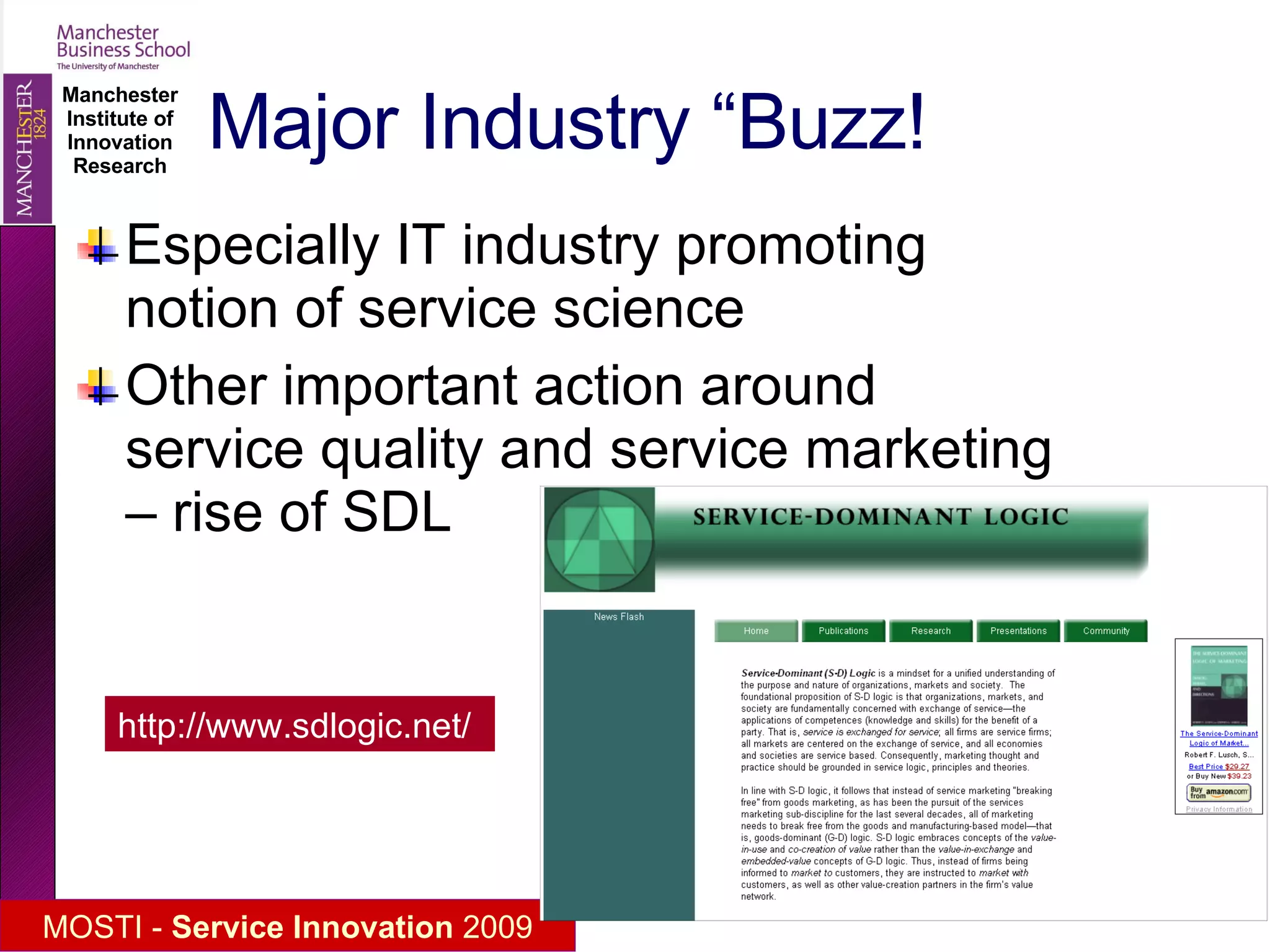
Major Industry “Buzz! Especially IT industry promoting notion of service science Other important action around service quality and service marketing – rise of SDL http://www.sdlogic.net/
and Service Engineering
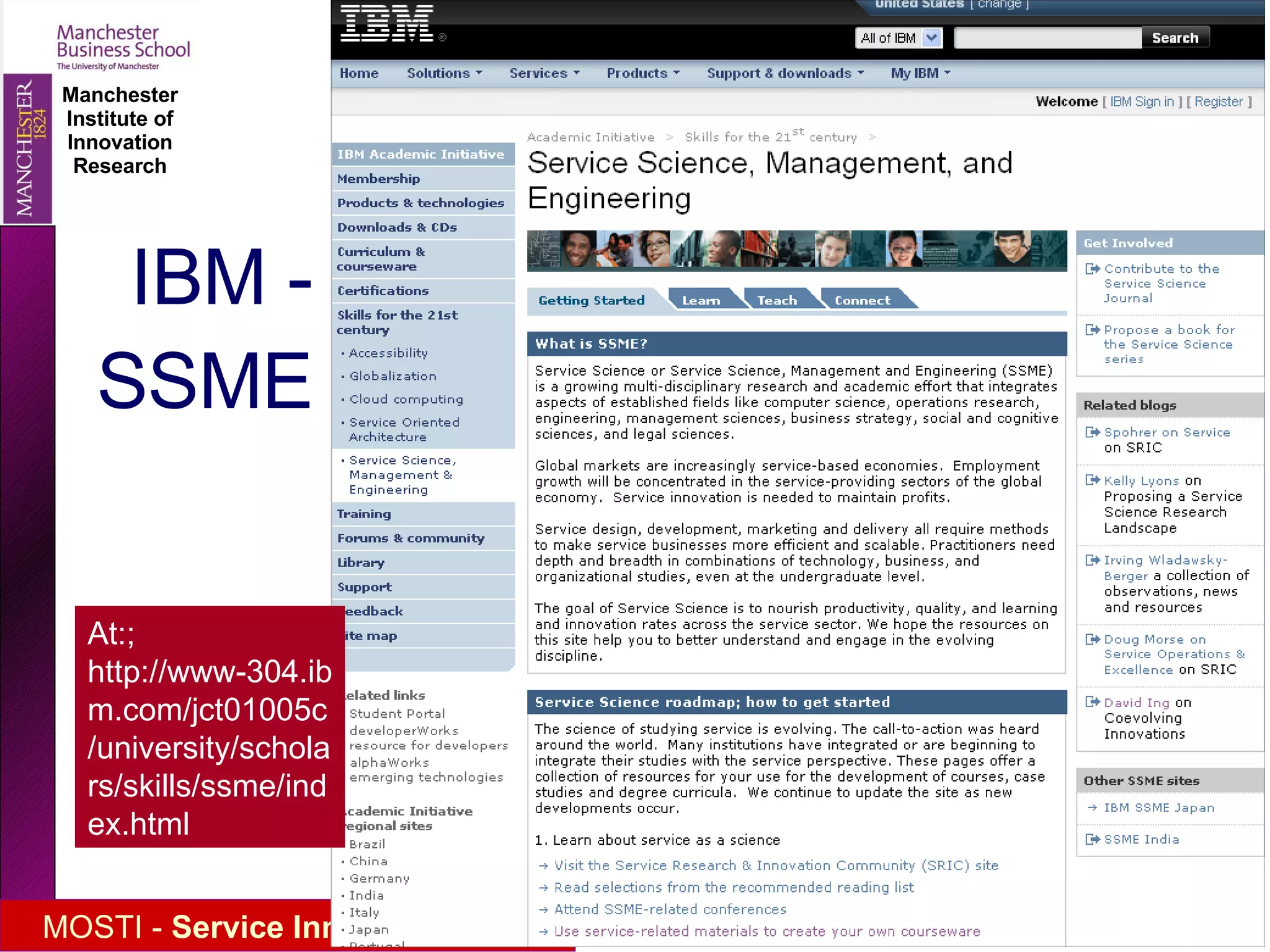
IBM - SSME At:; http://www-304.ibm.com/jct01005c/university/scholars/skills/ssme/index.html
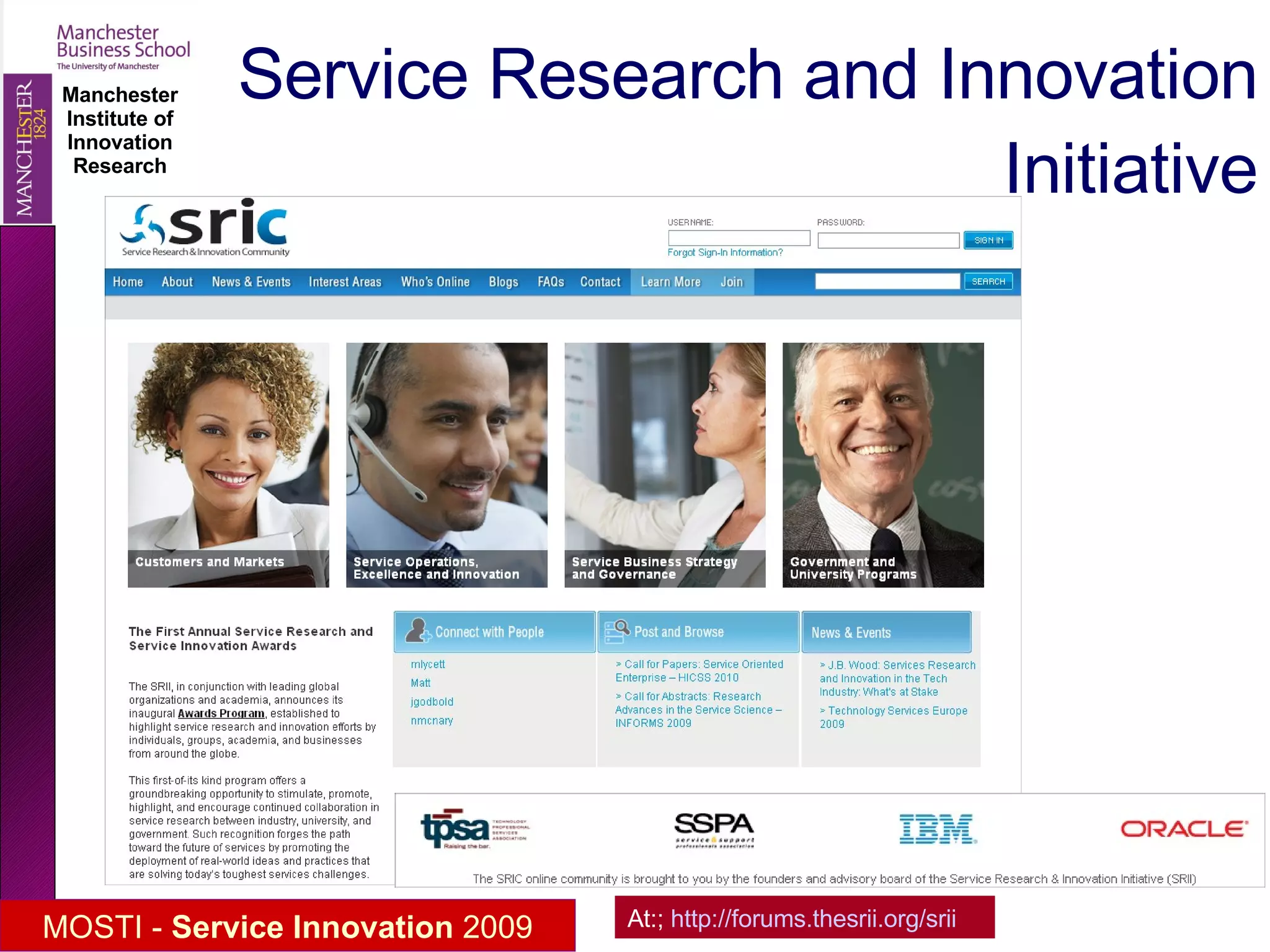
Service Research and Innovation Initiative At:;  http://forums.thesrii.org/srii
Industry impacts on policy Policymakers respond to industrial concerns Plus, much of public sector is about services, and in these sectors there are many innovation initiatives (though these may be labelled efficiency, modernisation, or otherwise)
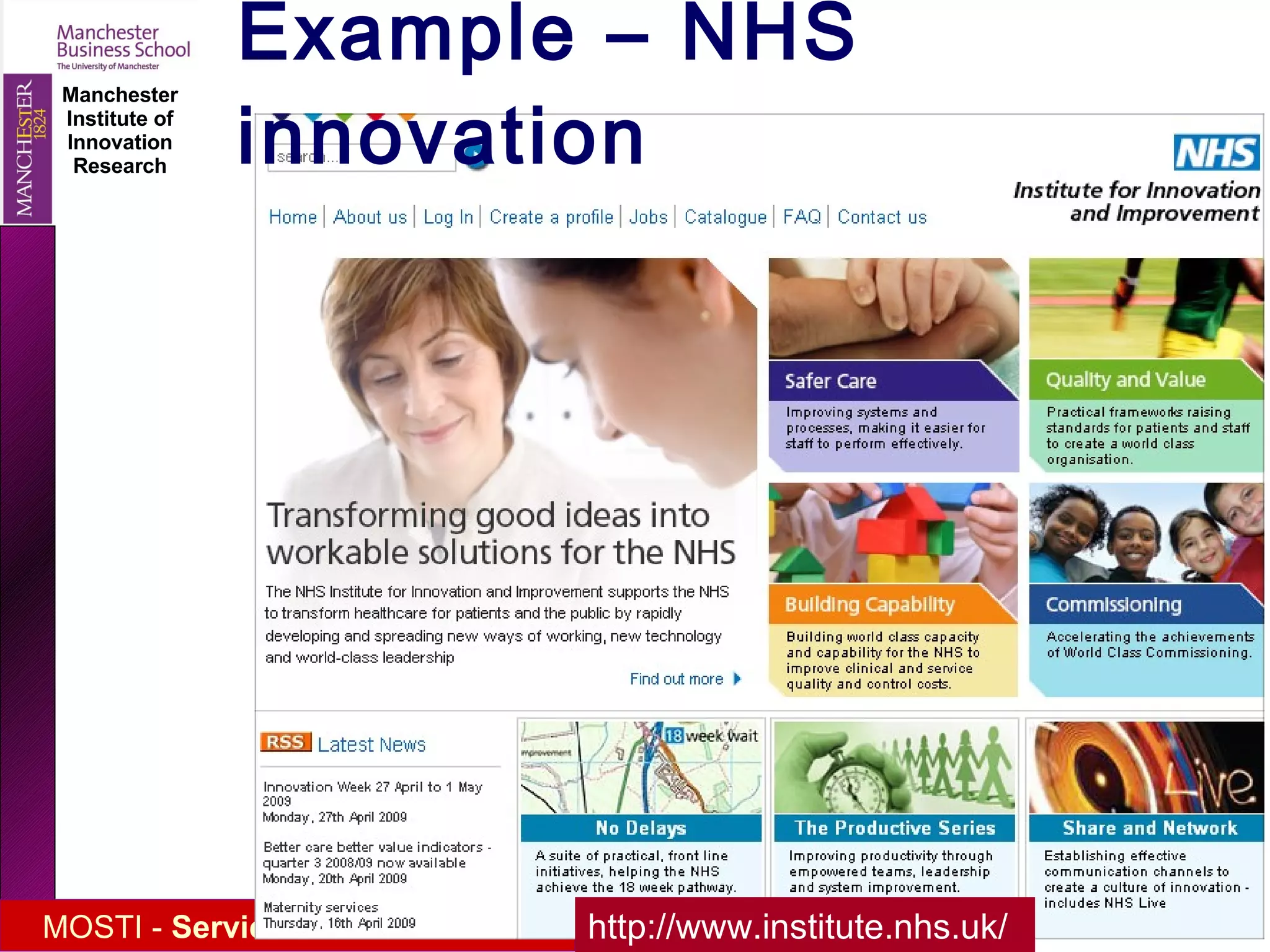
Example – NHS innovation http://www.institute.nhs.uk/
General arguments for innovation policy Should apply to services, if these are not discounted as non-innovative (which does seem to have been the case historically) Market failure, system failure Important for competitiveness, both directly and as business services supporting business in general Important for QOL, esp. non-market services
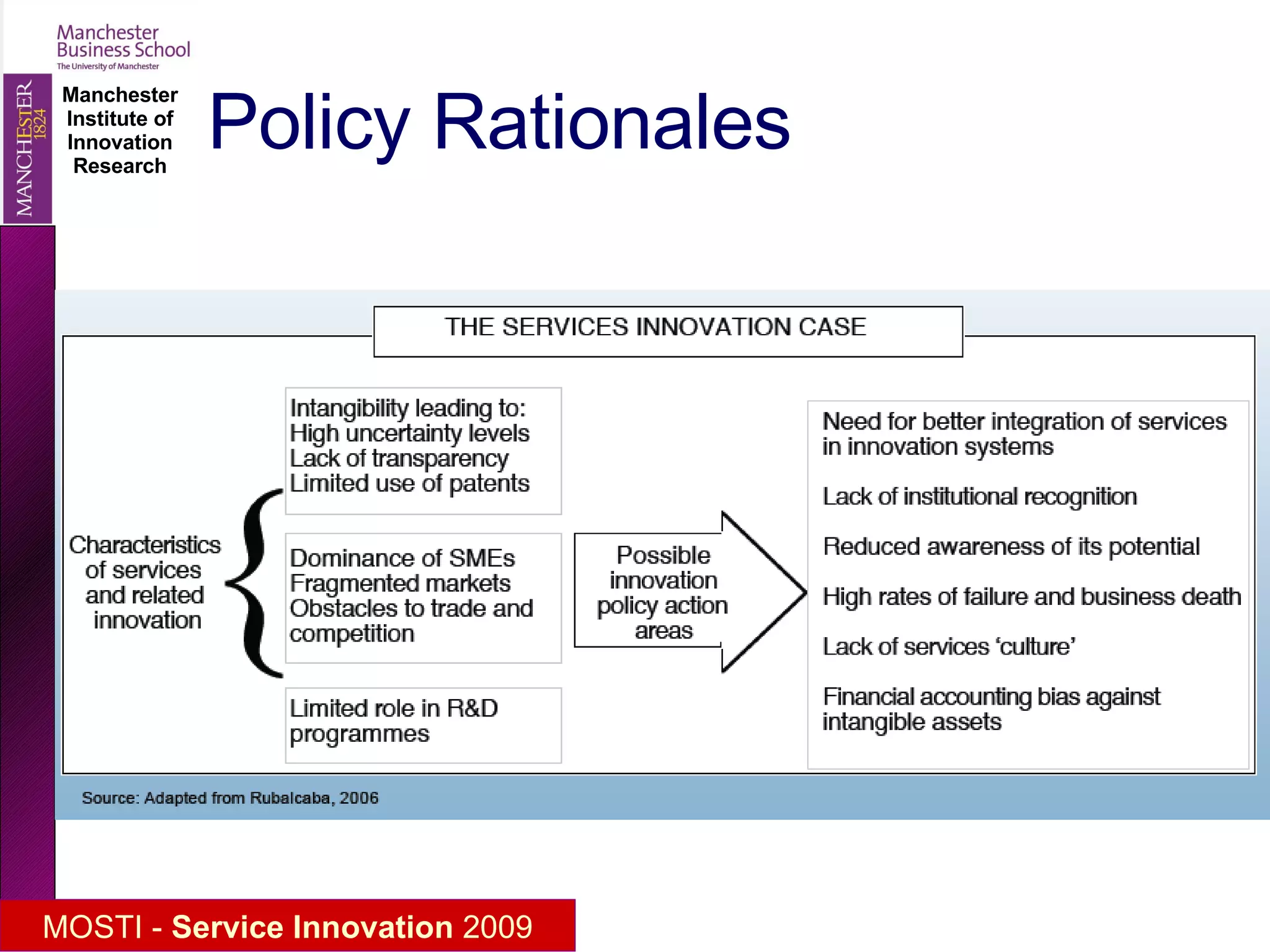
Specific service innovation policy? We know that some features of service innovation are distinctive – e.g. R&D less common Are services worse integrated into innovation systems? Are services overlooked in policy programme formulation and implementation?
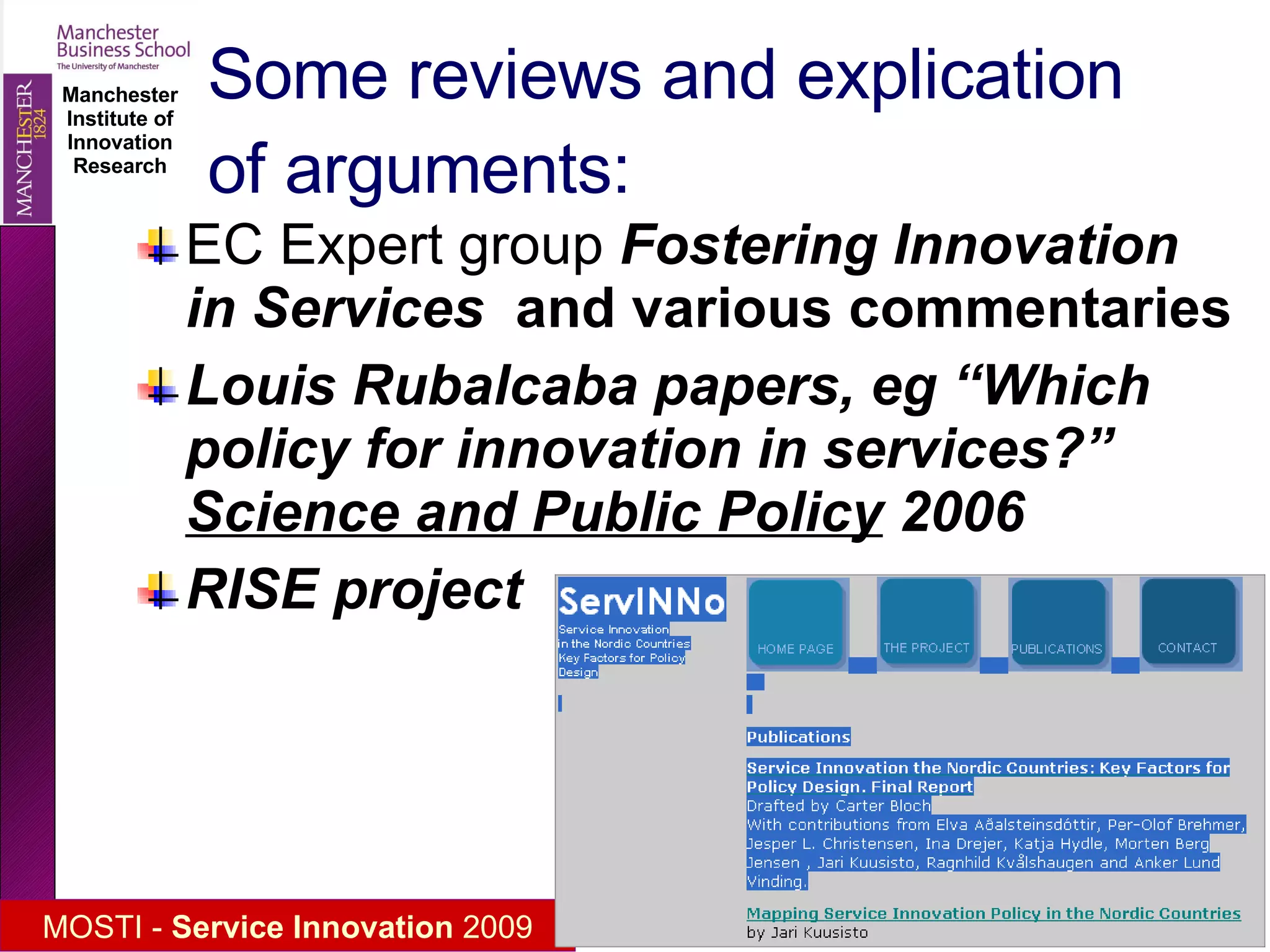
Some reviews and explication of arguments: EC Expert group  Fostering Innovation in Services  and various commentaries Louis Rubalcaba papers, eg “Which policy for innovation in services?”  Science and Public Policy  2006 RISE project
Policy Rationales
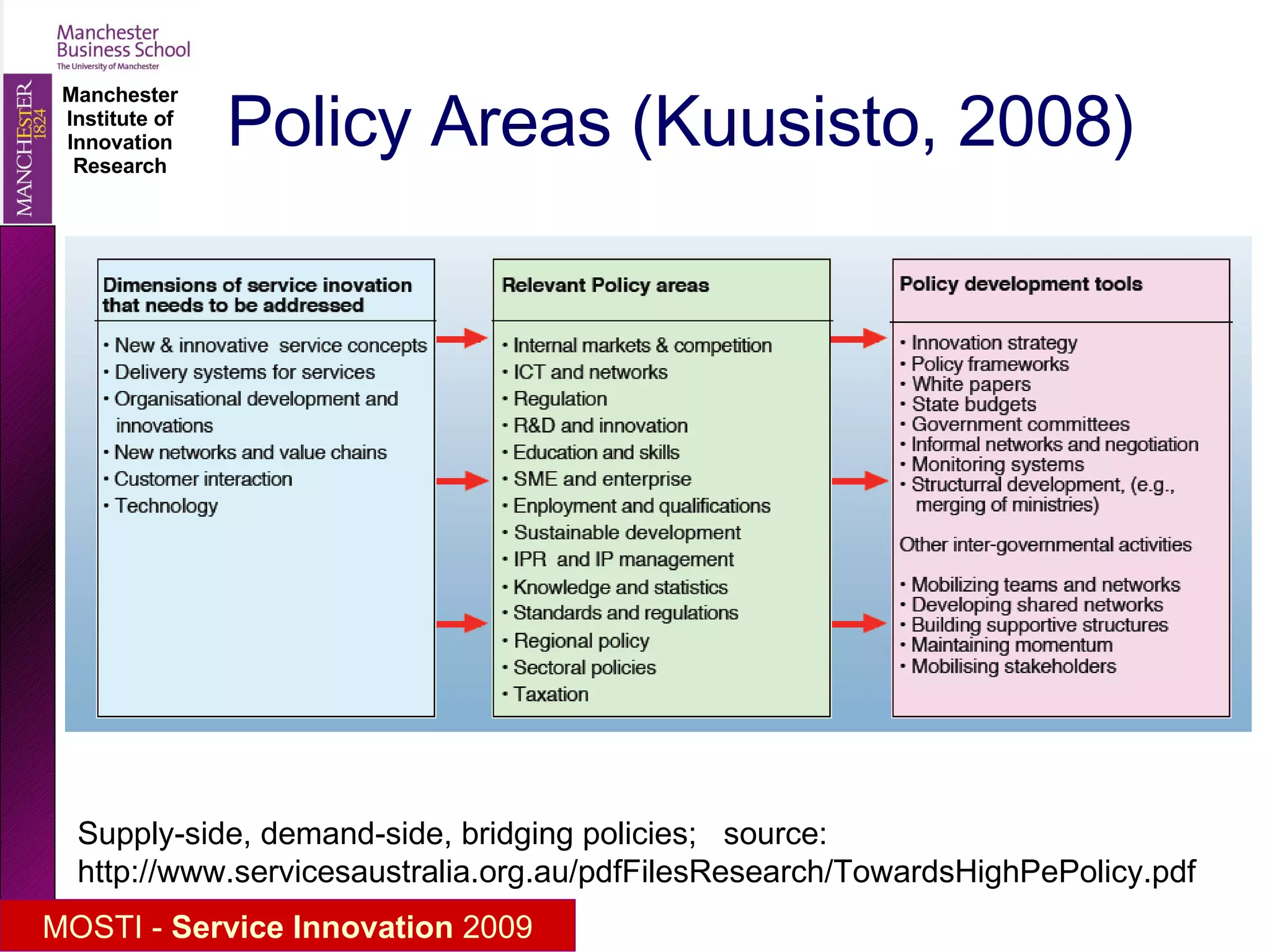
Policy Areas (Kuusisto, 2008) Supply-side, demand-side, bridging policies;  source: http://www.servicesaustralia.org.au/pdfFilesResearch/TowardsHighPePolicy.pdf
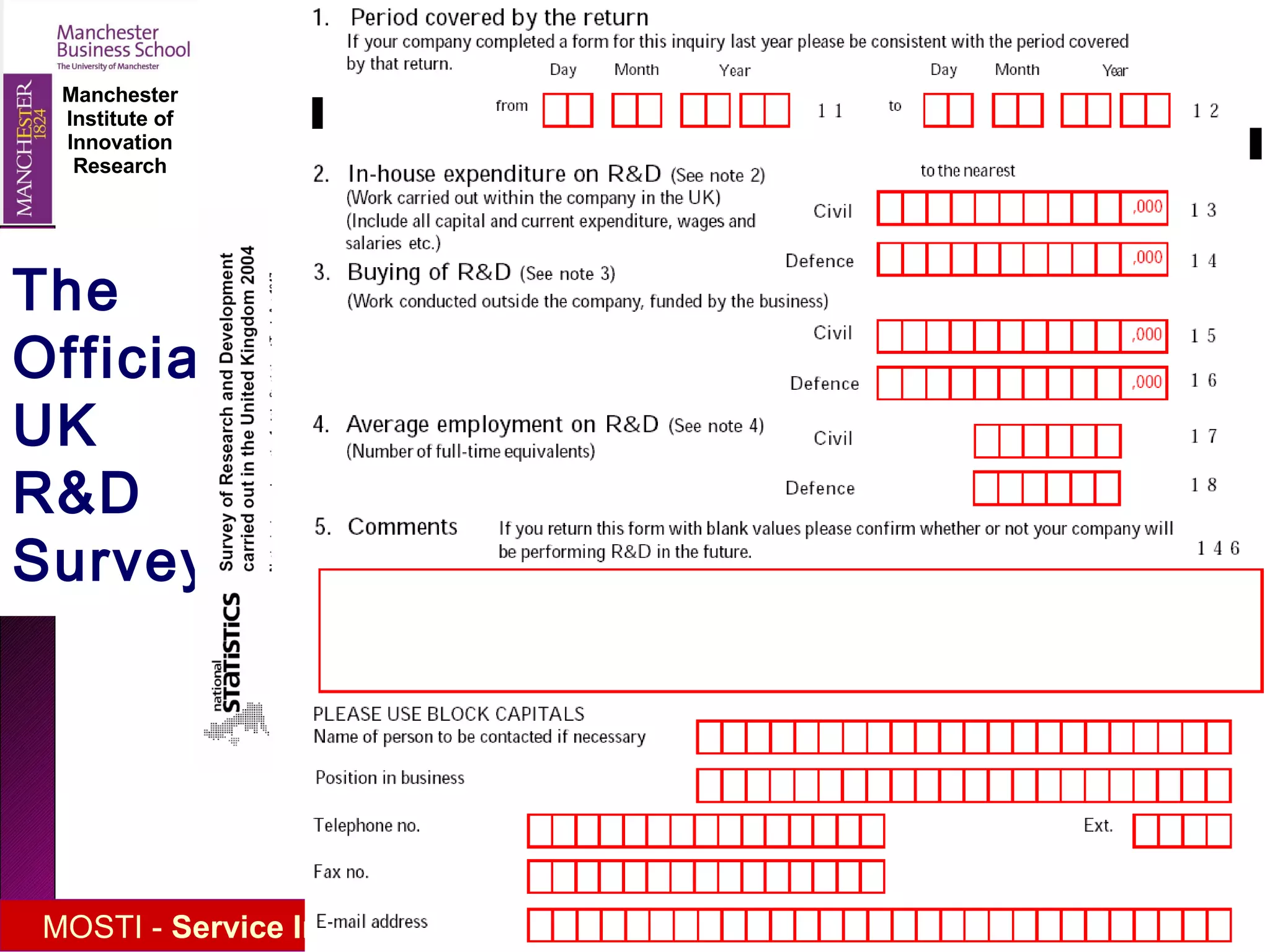
R&D and services Smaller firms: generally do less R&D. Even accounting for this, most services report lower R&D than most equivalent manufacturers Most R&D programmes not service-targeted But still, incentives via tax credits for R&D. etc.?
The Official UK R&D Survey
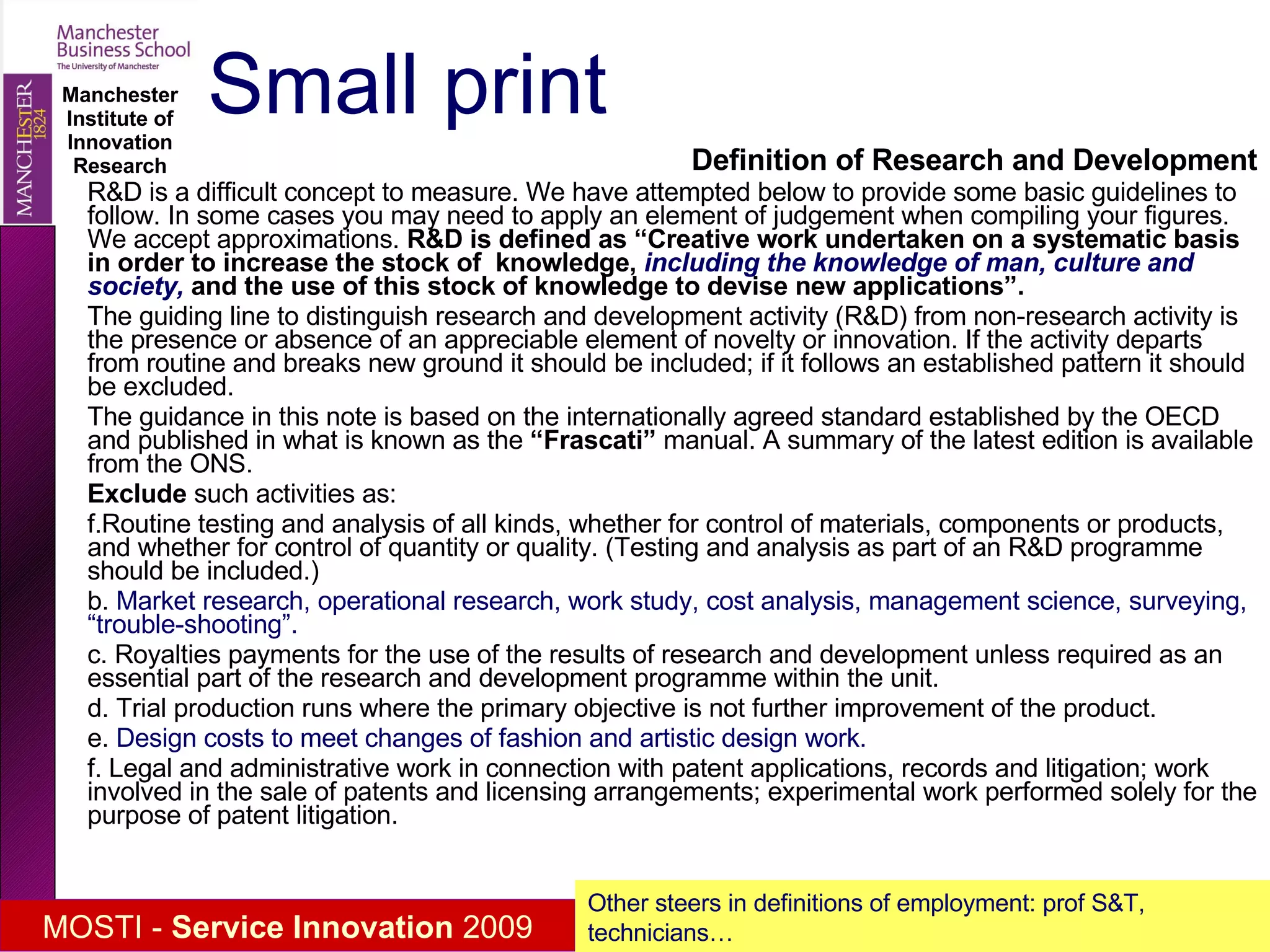
Small print Definition of Research and Development R&D is a difficult concept to measure. We have attempted below to provide some basic guidelines to follow. In some cases you may need to apply an element of judgement when compiling your figures. We accept approximations.  R&D is defined as “Creative work undertaken on a systematic basis in order to increase the stock of  knowledge,  including the knowledge of man, culture and society,  and the use of this stock of knowledge to devise new applications”. The guiding line to distinguish research and development activity (R&D) from non-research activity is the presence or absence of an appreciable element of novelty or innovation. If the activity departs from routine and breaks new ground it should be included; if it follows an established pattern it should be excluded.  The guidance in this note is based on the internationally agreed standard established by the OECD and published in what is known as the  “Frascati”  manual. A summary of the latest edition is available from the ONS. Exclude  such activities as: Routine testing and analysis of all kinds, whether for control of materials, components or products, and whether for control of quantity or quality. (Testing and analysis as part of an R&D programme should be included.) b.  Market research, operational research, work study, cost analysis, management science, surveying, “trouble-shooting”. c. Royalties payments for the use of the results of research and development unless required as an essential part of the research and development programme within the unit. d. Trial production runs where the primary objective is not further improvement of the product. e.  Design costs to meet changes of fashion and artistic design work. f. Legal and administrative work in connection with patent applications, records and litigation; work involved in the sale of patents and licensing arrangements; experimental work performed solely for the purpose of patent litigation. Other steers in definitions of employment: prof S&T, technicians…
Knowing How, Knowing Whom: A Study of the Links between the Knowledge Intensive Services Sector and The Science Base     IoIR  report to Council  for Science and Technology June 2003 http://www.cst.gov.uk/cst/reports/files/knowledge-intensive-services/services-study.pdf
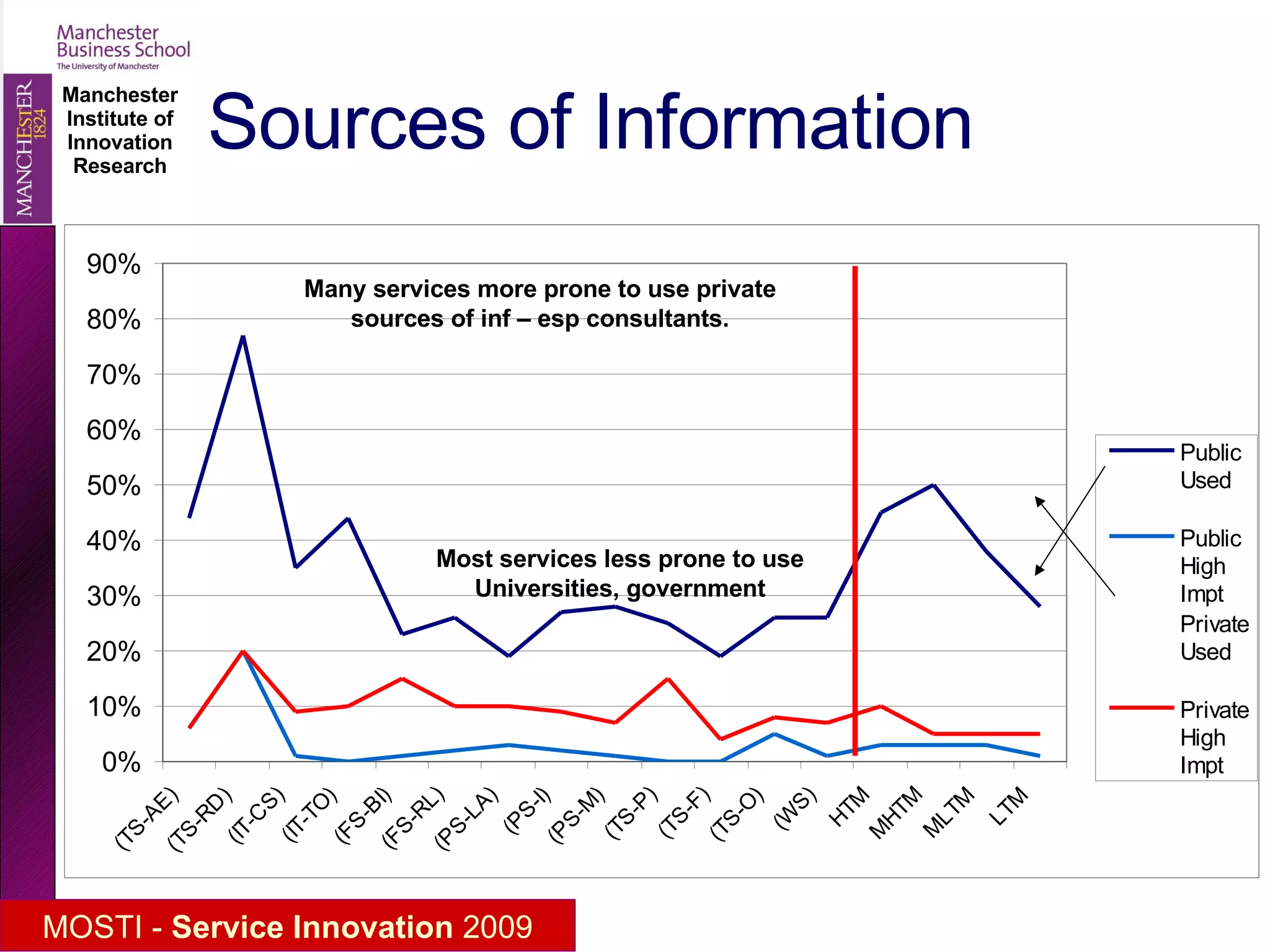
Sources of Information Most services less prone to use Universities, government Many services more prone to use private sources of inf – esp consultants.
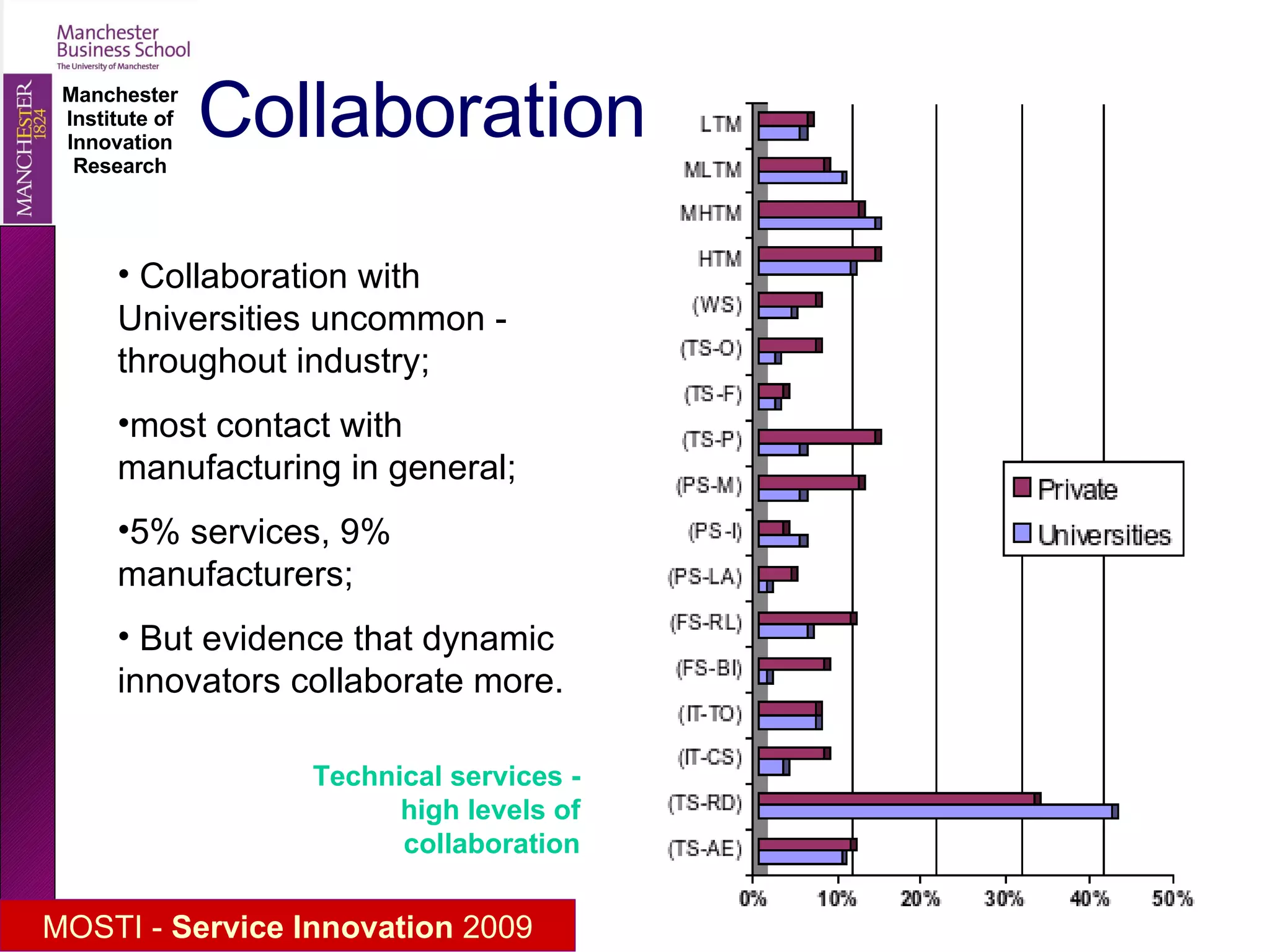
Technical services - high levels of collaboration Collaboration with Universities uncommon - throughout industry;  most contact with manufacturing in general; 5% services, 9% manufacturers;  But evidence that dynamic innovators collaborate more. Collaboration
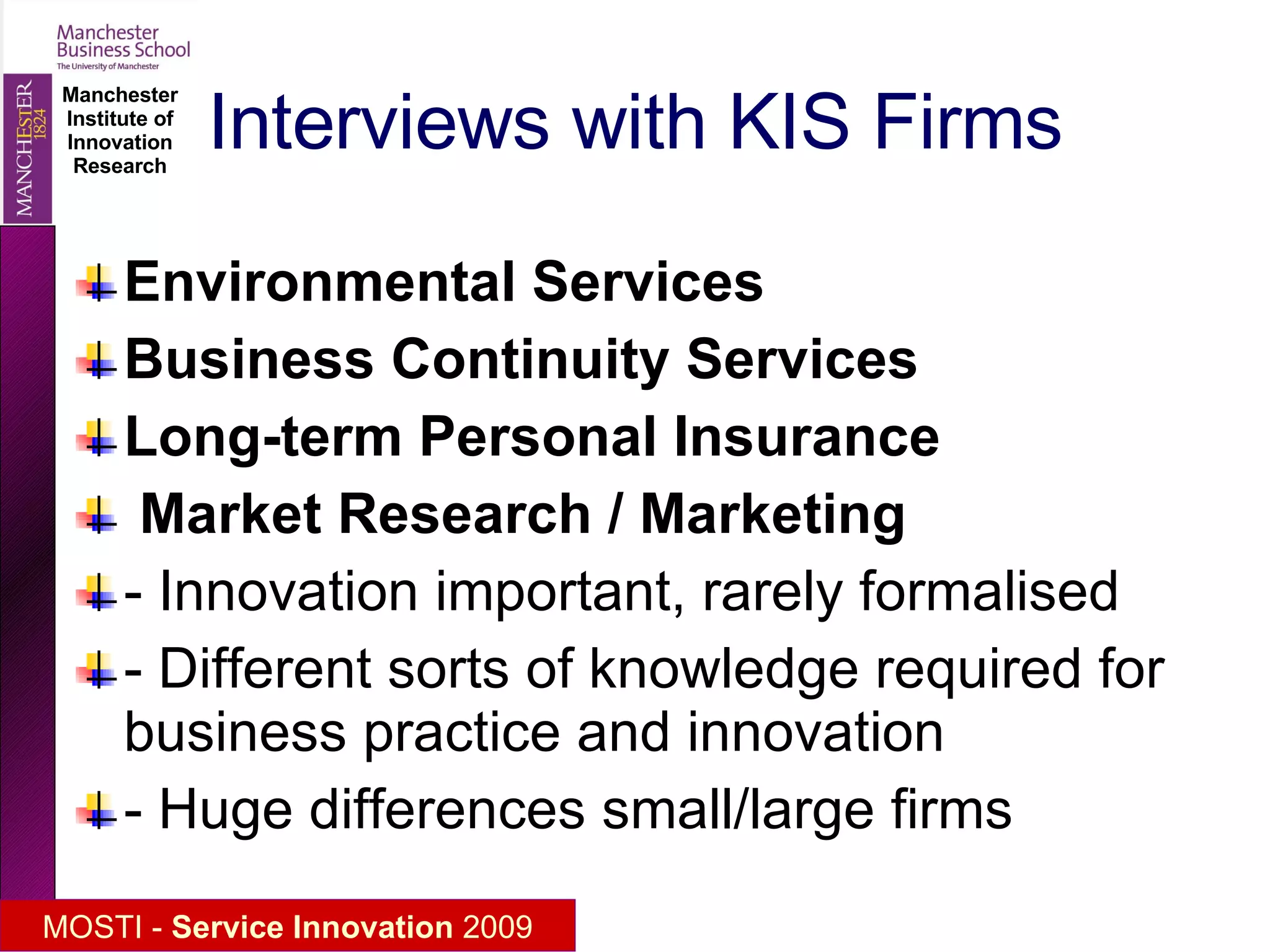
Interviews with KIS Firms Environmental Services Business Continuity Services   Long-term Personal Insurance   Market Research / Marketing - Innovation important, rarely formalised - Different sorts of knowledge required for business practice and innovation - Huge differences small/large firms
Human Resources Much variation, but most frequent account is that graduates are valued as source of general skills, specialist skills are sometimes but not often sought Large firms more likely to be strategic in recruitment Some KIS have elaborate professional development systems
Information, Expertise and Collaboration Small firms have few links in general Linkages often ad hoc Search for right sort of people Collaboration rare, some prominent exceptions Little awareness of support for collaborative research Important sectoral differences in assessment of knowledge base
Supply Side Rarely any specific strategies for KIS, some are recognised as having high potential.  Scope for more development. Variations across Universities and KIS Important role of Centres and Programmes Some apparent linkages are not used for knowledge transfer
Overall Lack of “absorptive capacity” on both sides Centres of excellence and other intermediaries provide compass points, accumulated knowledge, know-who, “translation” capabilities
Policy Better measurement (sampling, surveys) - not to reach targets faster but to inform policy Better targeting of “mainstream” R&D and innovation programmes to engage services beyond the usual suspects some re-engineering of innovation systems awareness and promotion (incl. some benchmarking with service examples, etc.)
Policy Better measurement - not to reach targets faster but to inform policy Better targeting of “mainstream” R&D and innovation programmes to engage services Services-oriented R&D  and  innovation programmes  from science and industrial policy angles (draw on examples of good practice) relate to ongoing initiatives where useful support for new generations of innovation management  ...
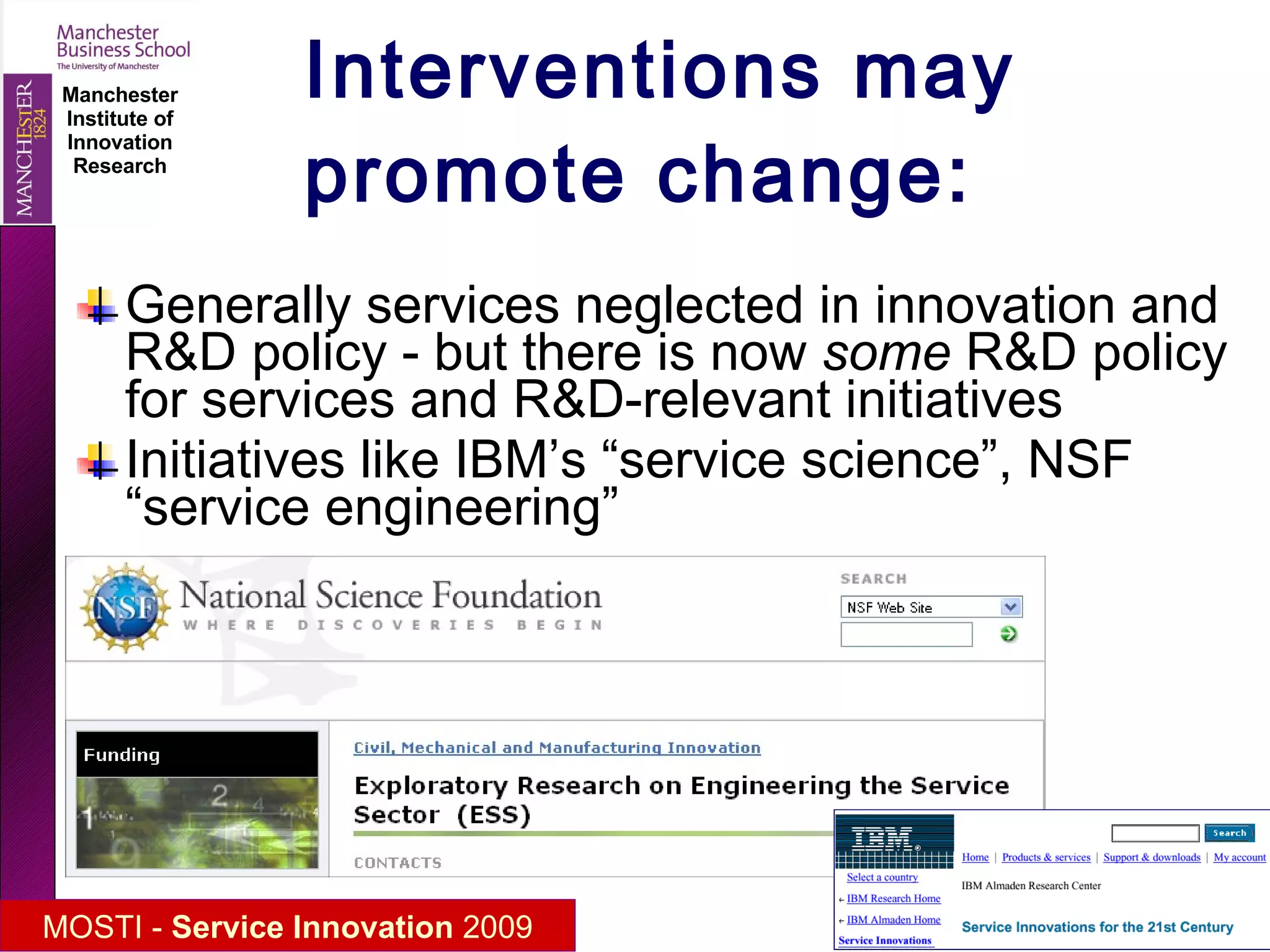
Interventions may promote change: Generally services neglected in innovation and R&D policy - but there is now  some  R&D policy for services and R&D-relevant initiatives Initiatives like IBM’s “service science”, NSF “service engineering”
Some overviews SIID, and more recently IPPS
Many countries active: Some have established service innovation (Finland), R&D (Germany, Canada), engineering (USA) programmes  U.S. Congress - National Innovation Act - add “Fostering the Field of Service Science” to studies conducted by the National Science Foundation  Some countries  have instigated projects to explore prospects (UK, Eire) Also international bodies (EC) – the  EU has identified service and non-technological innovation as one of nine strategic priorities of its innovation strategy; funding programs to create a policy framework and establish knowledge platforms Japan’s “New Economic Growth Strategy” - six key service areas for  service  policy initiatives –  funding for advanced business models in health and welfare, childcare, tourism, business support services and distribution services. Much interest – action very patchy Some more detail…
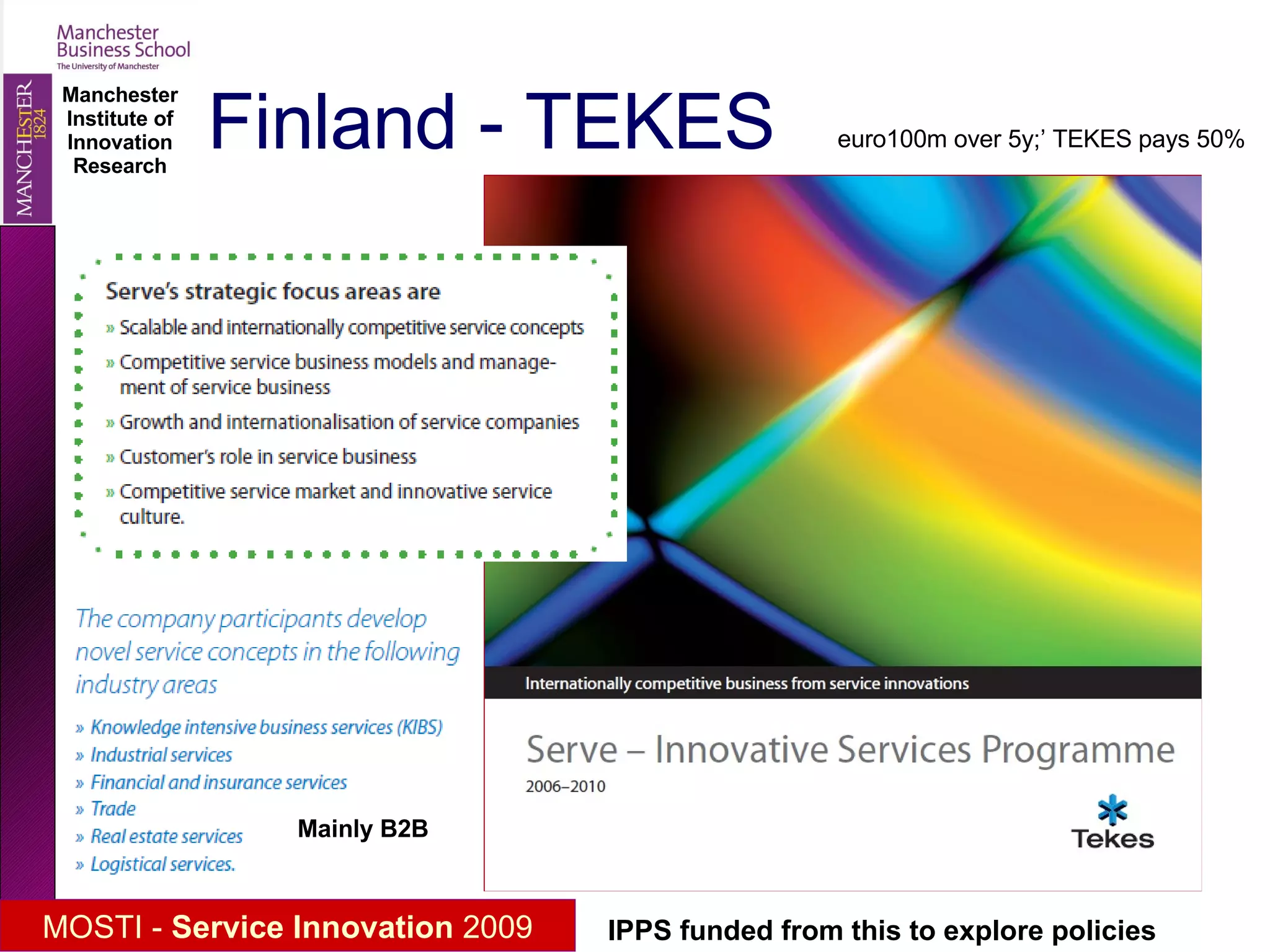
Finland - TEKES euro100m over 5y;’ TEKES pays 50% Mainly B2B IPPS funded from this to explore policies
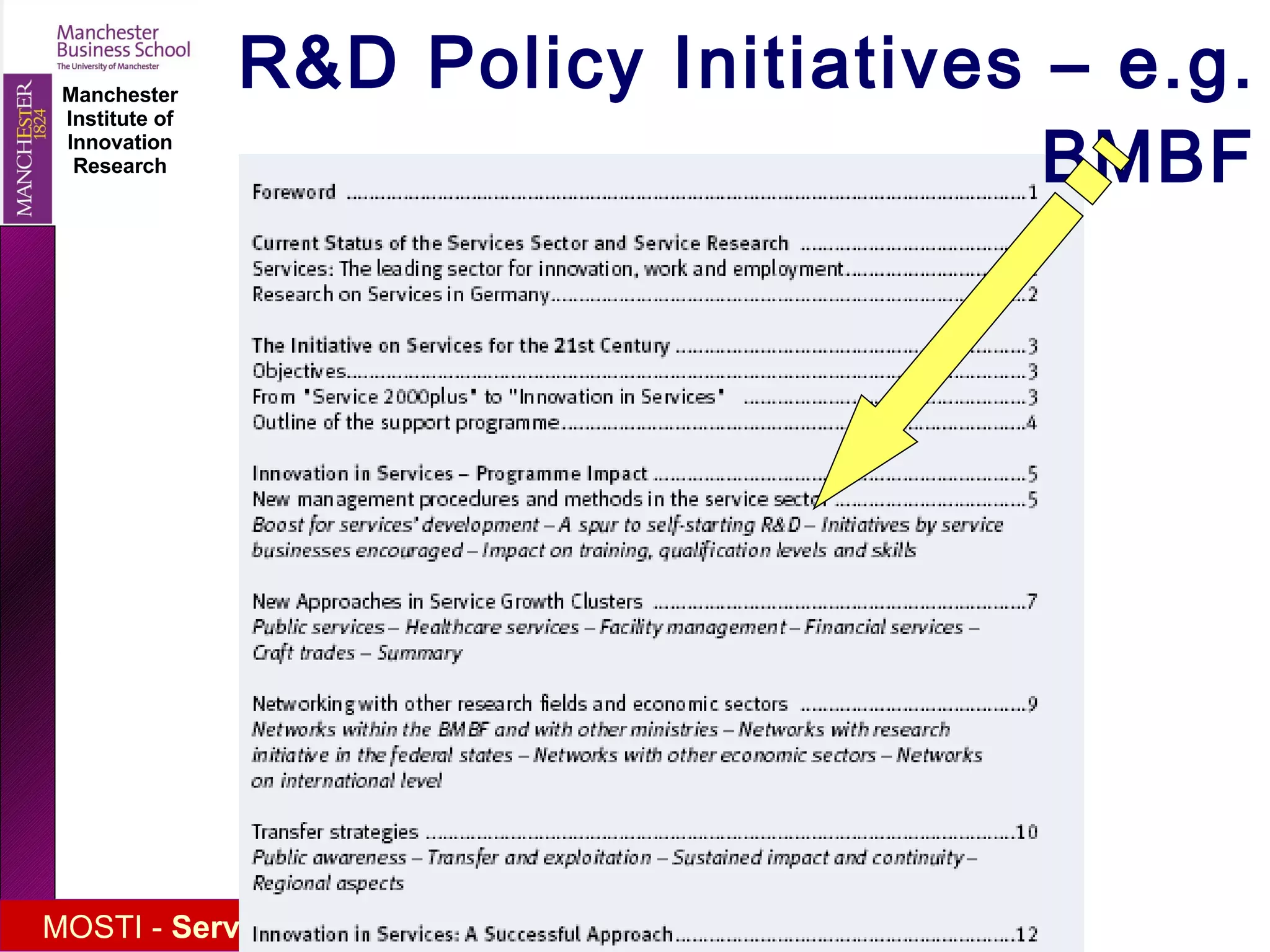
R&D Policy Initiatives – e.g. BMBF
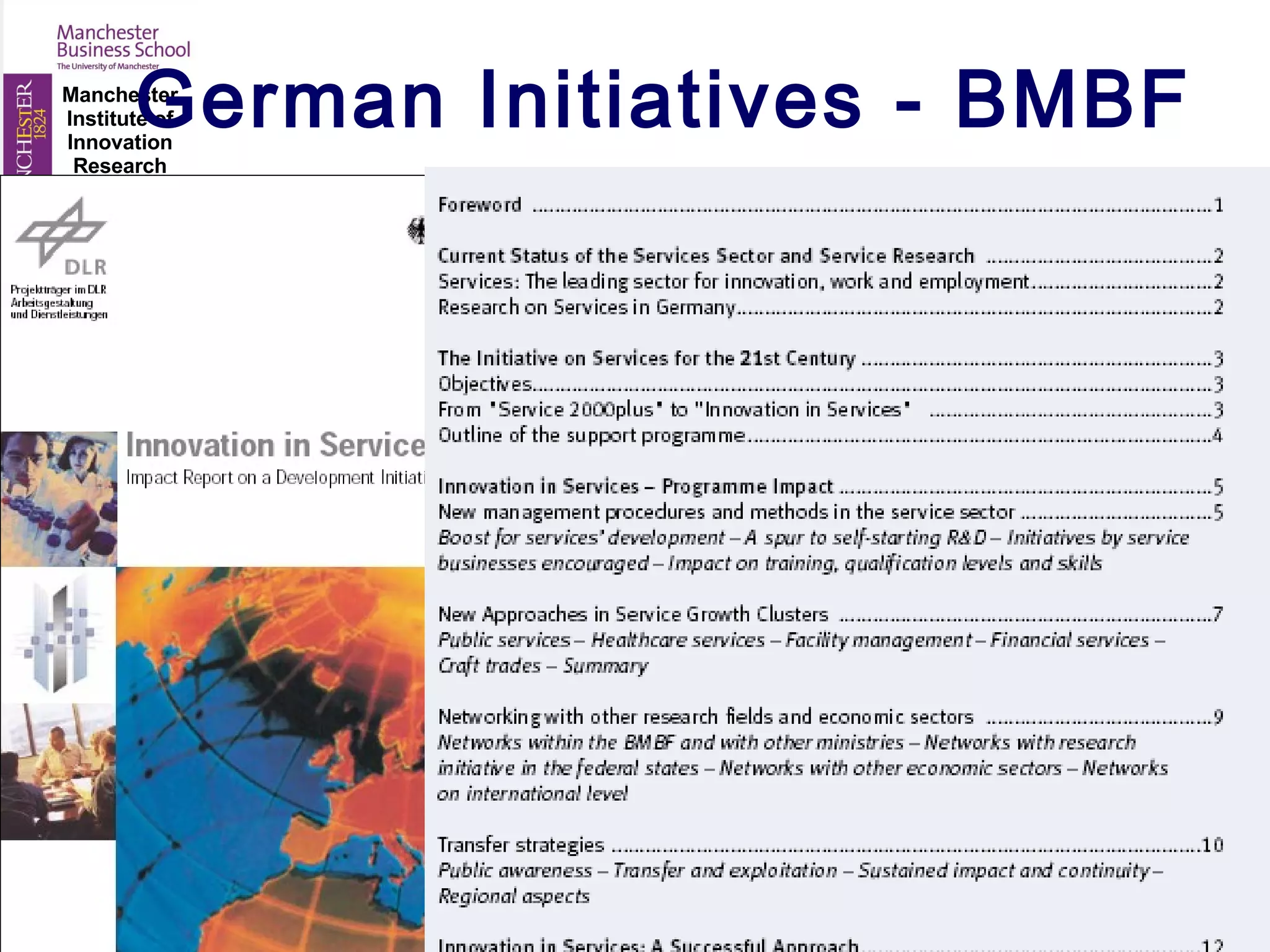
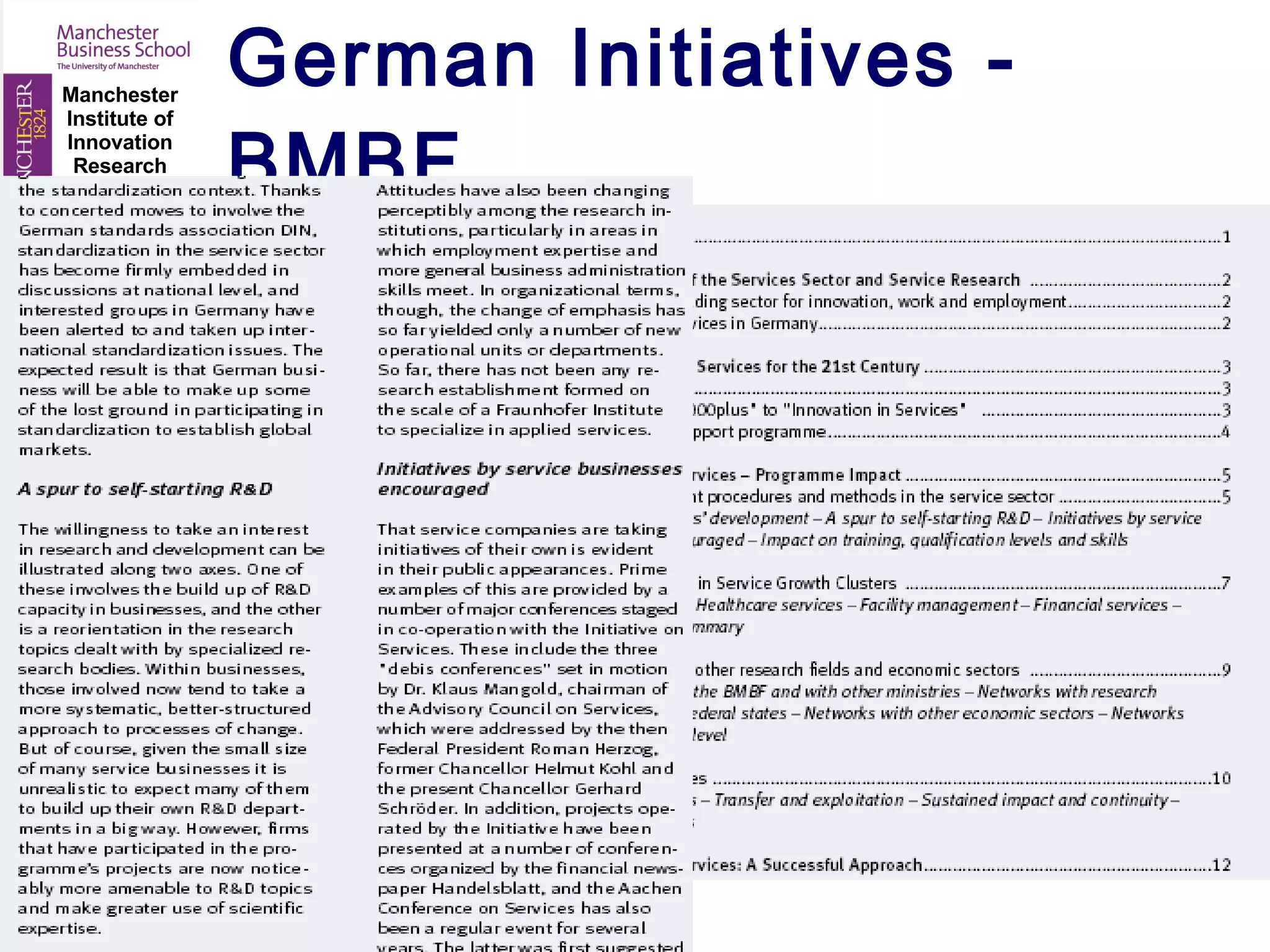
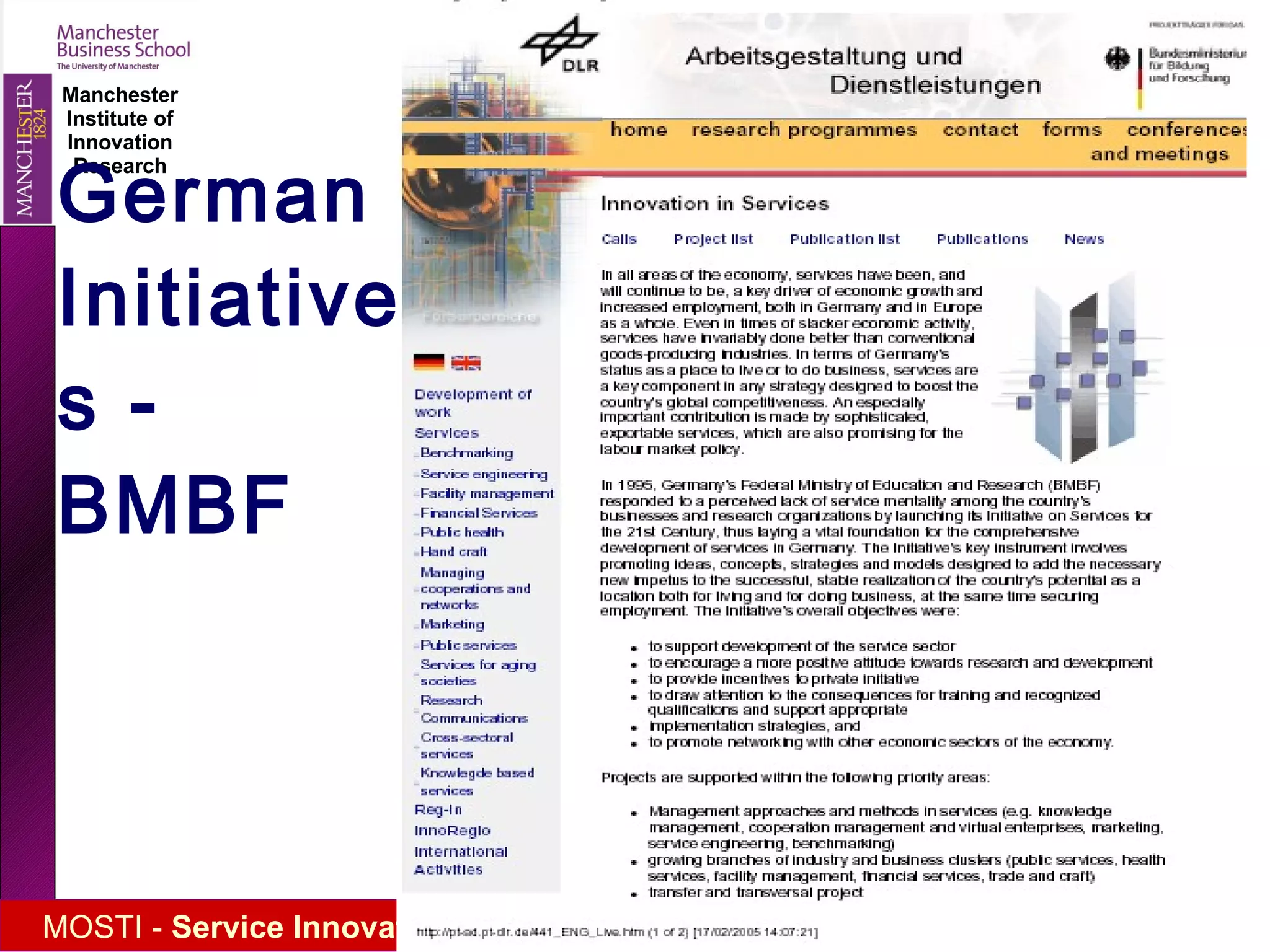
German Initiatives - BMBF
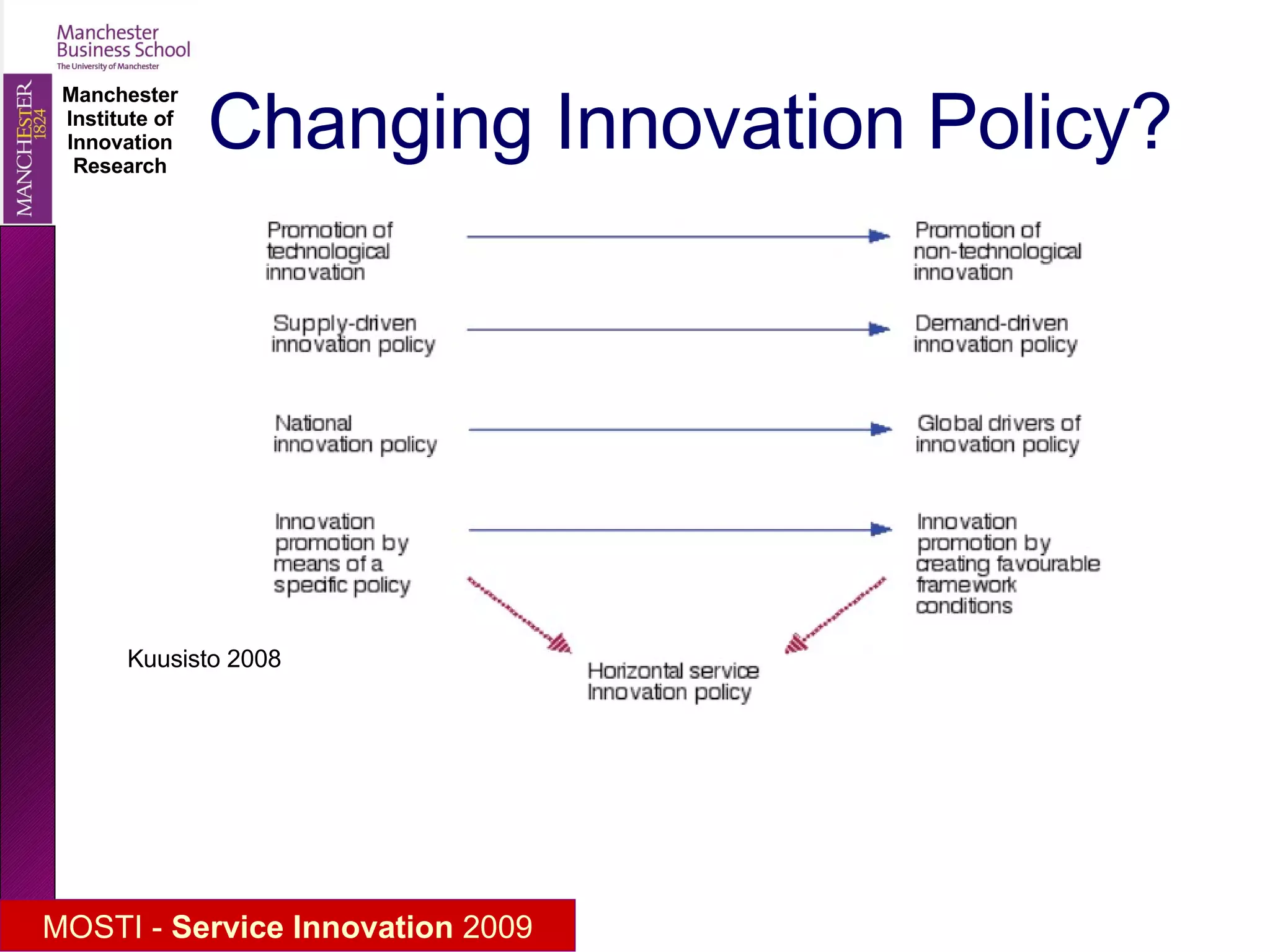
Changing Innovation Policy? Kuusisto 2008
End of Presentation

Service Innovation - Strategy and Policy

  • 1.
    Service Innovation Policy(and beyond) Ian Miles [email_address] MOSTI service innovation seminar 9
  • 2.
    Contents Lobbying Policymakersand Educators SSME, SRII, etc Why? Why Innovation Policy? Why innovation policy for services? What? What policy instruments? Who can design and implement these? What do we know? Who is doing what?
  • 3.
    Major Industry “Buzz!Especially IT industry promoting notion of service science Other important action around service quality and service marketing – rise of SDL http://www.sdlogic.net/
  • 4.
  • 5.
    IBM - SSMEAt:; http://www-304.ibm.com/jct01005c/university/scholars/skills/ssme/index.html
  • 6.
    Service Research andInnovation Initiative At:; http://forums.thesrii.org/srii
  • 7.
    Industry impacts onpolicy Policymakers respond to industrial concerns Plus, much of public sector is about services, and in these sectors there are many innovation initiatives (though these may be labelled efficiency, modernisation, or otherwise)
  • 8.
    Example – NHSinnovation http://www.institute.nhs.uk/
  • 9.
    General arguments forinnovation policy Should apply to services, if these are not discounted as non-innovative (which does seem to have been the case historically) Market failure, system failure Important for competitiveness, both directly and as business services supporting business in general Important for QOL, esp. non-market services
  • 10.
    Specific service innovationpolicy? We know that some features of service innovation are distinctive – e.g. R&D less common Are services worse integrated into innovation systems? Are services overlooked in policy programme formulation and implementation?
  • 11.
    Some reviews andexplication of arguments: EC Expert group Fostering Innovation in Services and various commentaries Louis Rubalcaba papers, eg “Which policy for innovation in services?” Science and Public Policy 2006 RISE project
  • 12.
  • 13.
    Policy Areas (Kuusisto,2008) Supply-side, demand-side, bridging policies; source: http://www.servicesaustralia.org.au/pdfFilesResearch/TowardsHighPePolicy.pdf
  • 14.
    R&D and servicesSmaller firms: generally do less R&D. Even accounting for this, most services report lower R&D than most equivalent manufacturers Most R&D programmes not service-targeted But still, incentives via tax credits for R&D. etc.?
  • 15.
    The Official UKR&D Survey
  • 16.
    Small print Definitionof Research and Development R&D is a difficult concept to measure. We have attempted below to provide some basic guidelines to follow. In some cases you may need to apply an element of judgement when compiling your figures. We accept approximations. R&D is defined as “Creative work undertaken on a systematic basis in order to increase the stock of knowledge, including the knowledge of man, culture and society, and the use of this stock of knowledge to devise new applications”. The guiding line to distinguish research and development activity (R&D) from non-research activity is the presence or absence of an appreciable element of novelty or innovation. If the activity departs from routine and breaks new ground it should be included; if it follows an established pattern it should be excluded. The guidance in this note is based on the internationally agreed standard established by the OECD and published in what is known as the “Frascati” manual. A summary of the latest edition is available from the ONS. Exclude such activities as: Routine testing and analysis of all kinds, whether for control of materials, components or products, and whether for control of quantity or quality. (Testing and analysis as part of an R&D programme should be included.) b. Market research, operational research, work study, cost analysis, management science, surveying, “trouble-shooting”. c. Royalties payments for the use of the results of research and development unless required as an essential part of the research and development programme within the unit. d. Trial production runs where the primary objective is not further improvement of the product. e. Design costs to meet changes of fashion and artistic design work. f. Legal and administrative work in connection with patent applications, records and litigation; work involved in the sale of patents and licensing arrangements; experimental work performed solely for the purpose of patent litigation. Other steers in definitions of employment: prof S&T, technicians…
  • 17.
    Knowing How, KnowingWhom: A Study of the Links between the Knowledge Intensive Services Sector and The Science Base IoIR report to Council for Science and Technology June 2003 http://www.cst.gov.uk/cst/reports/files/knowledge-intensive-services/services-study.pdf
  • 18.
    Sources of InformationMost services less prone to use Universities, government Many services more prone to use private sources of inf – esp consultants.
  • 19.
    Technical services -high levels of collaboration Collaboration with Universities uncommon - throughout industry; most contact with manufacturing in general; 5% services, 9% manufacturers; But evidence that dynamic innovators collaborate more. Collaboration
  • 20.
    Interviews with KISFirms Environmental Services Business Continuity Services Long-term Personal Insurance Market Research / Marketing - Innovation important, rarely formalised - Different sorts of knowledge required for business practice and innovation - Huge differences small/large firms
  • 21.
    Human Resources Muchvariation, but most frequent account is that graduates are valued as source of general skills, specialist skills are sometimes but not often sought Large firms more likely to be strategic in recruitment Some KIS have elaborate professional development systems
  • 22.
    Information, Expertise andCollaboration Small firms have few links in general Linkages often ad hoc Search for right sort of people Collaboration rare, some prominent exceptions Little awareness of support for collaborative research Important sectoral differences in assessment of knowledge base
  • 23.
    Supply Side Rarelyany specific strategies for KIS, some are recognised as having high potential. Scope for more development. Variations across Universities and KIS Important role of Centres and Programmes Some apparent linkages are not used for knowledge transfer
  • 24.
    Overall Lack of“absorptive capacity” on both sides Centres of excellence and other intermediaries provide compass points, accumulated knowledge, know-who, “translation” capabilities
  • 25.
    Policy Better measurement(sampling, surveys) - not to reach targets faster but to inform policy Better targeting of “mainstream” R&D and innovation programmes to engage services beyond the usual suspects some re-engineering of innovation systems awareness and promotion (incl. some benchmarking with service examples, etc.)
  • 26.
    Policy Better measurement- not to reach targets faster but to inform policy Better targeting of “mainstream” R&D and innovation programmes to engage services Services-oriented R&D and innovation programmes from science and industrial policy angles (draw on examples of good practice) relate to ongoing initiatives where useful support for new generations of innovation management ...
  • 27.
    Interventions may promotechange: Generally services neglected in innovation and R&D policy - but there is now some R&D policy for services and R&D-relevant initiatives Initiatives like IBM’s “service science”, NSF “service engineering”
  • 28.
    Some overviews SIID,and more recently IPPS
  • 29.
    Many countries active:Some have established service innovation (Finland), R&D (Germany, Canada), engineering (USA) programmes U.S. Congress - National Innovation Act - add “Fostering the Field of Service Science” to studies conducted by the National Science Foundation Some countries have instigated projects to explore prospects (UK, Eire) Also international bodies (EC) – the EU has identified service and non-technological innovation as one of nine strategic priorities of its innovation strategy; funding programs to create a policy framework and establish knowledge platforms Japan’s “New Economic Growth Strategy” - six key service areas for service policy initiatives – funding for advanced business models in health and welfare, childcare, tourism, business support services and distribution services. Much interest – action very patchy Some more detail…
  • 30.
    Finland - TEKESeuro100m over 5y;’ TEKES pays 50% Mainly B2B IPPS funded from this to explore policies
  • 31.
  • 32.
  • 33.
  • 34.
  • 35.
  • 36.