(Towards) A Brief History of UK Foresight Ian Miles PREST/IoIR University of Manchester
This talk Is work in progress (though a paper is in press, in  IJFIP ) Examines the Foresight Programme and Foresight more widely Argues that UK Foresight was initially highly influenced by the innovation studies community – but suggests that this influence is now much more patchy. Comes from someone who has been involved in some of the activities, and cannot claim a completely uninterested perspective.
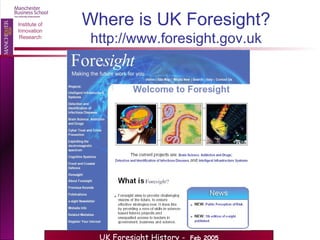
Where is UK Foresight? http://www.foresight.gov.uk
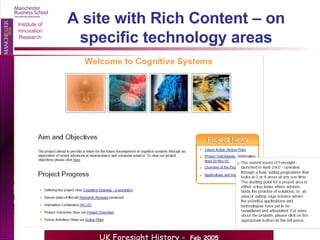
A site with Rich Content – on specific technology areas
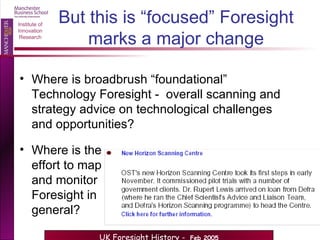
But this is “focused” Foresight marks a major change Where is broadbrush “foundational”  Technology Foresight -  overall scanning and strategy advice on technological challenges and opportunities? Where is the effort to map and monitor Foresight in general?
The Official History Three cycles of UK Foresight: 1994-99, 2000-02, 2002-  Much documentation on website, but some material now regarded as obsolete.
UK Foresight Programme – prehistory Prehistory of concerns about national innovation system , attention to Foresight in other NIS (esp. Japan: Irvine/Martin) SPRU had played key role in developing innovation studies, with early analysis of NIS flowing from earlier work on the “British disease” – work that had moved from the margins to a more centre stage position (good topic for research) SPRU had also been the main scholarly centre for futures work, with its STAFF programme and successor studies.  Loose coupling of analyses, esp through Freeman work on technological revolutions and institutional structures Had seeded both approaches widely – thus establishing base in innovation studies community worldwide for longer-range thinking :
UK Foresight Programme – “First Cycle” Several 1990s efforts to determine critical technologies (involving SPRU, PREST and consultancies): this approach has been pursued in US and France, in particular. 1993  White Paper :   improve connection between science base & wealth creation + quality of life.  Foresight a major instrument. Specific goals:  to inform priorities  (planning)  & promote “Foresight culture” of forward and longer term thinking “beyond the business plan”  (futures, networking) Already quite a mature, well-conceptualised intervention.  And organisationaly well located :
 
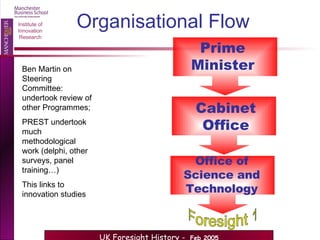
Organisational Flow Ben Martin on Steering Committee: undertook review of other Programmes; PREST undertook much methodological work (delphi, other surveys, panel training…) This links to innovation studies Prime Minister Cabinet Office Office of Science and Technology Foresight 1
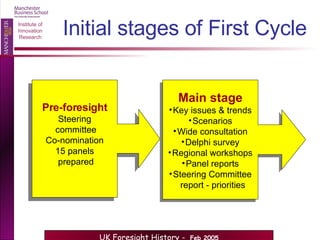
Initial stages of First Cycle Pre-foresight Steering committee Co-nomination 15 panels prepared Main stage Key issues & trends Scenarios Wide consultation Delphi survey Regional workshops Panel reports Steering Committee report - priorities
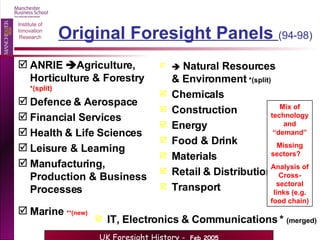
Original Foresight Panels  (94-98) ANRIE   Agriculture, Horticulture & Forestry  *(split) Defence & Aerospace  Financial Services  Health & Life Sciences  Leisure & Learning  Manufacturing, Production & Business Processes  Marine  **(new)    Natural Resources & Environment  *(split)   Chemicals  Construction  Energy  Food & Drink  Materials  Retail & Distribution  Transport Mix of technology and “demand” Missing sectors?  Analysis of Cross-sectoral links (e.g. food chain) IT, Electronics & Communications *  (merged)
Structure placed  Panels at the core Defining constituencies of expertise and stakeholders Generating lists of  Delphi topics Undertaking  consultations Preparing own  views as to R&D  (and other) priorities in interim and final reports Forwarding their proposals in follow-up work.
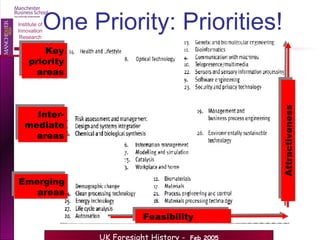
One Priority: Priorities! Key priority areas Inter-mediate areas Emerging areas Feasibility  Attractiveness
Foresight implementation Dissemination by Panels through media, workshops, professional & trade associations 600 events, 130,000 reports distributed 1998 Delphi on website - high usage Foresight Challenge funding initiative to support key priorities  – e.g. Institute of Applied Catalysis.  LINK programme . 54% of Research Council spend aligned with priorities of which £300 million new initiatives Other government departments acting on own areas, and Panels champion this:  Transport, Construction, Defence, etc; and better co-ordination between departments   Foresight was element in gaining major increase for science funding in Government’s Comprehensive Spending Review
Retrospect on First Cycle Successes huge level of voluntary participation widespread support, political commitment sustained broad priorities accepted networking seen as beneficial “ Foresight” more widely accepted as tool taken as model by many other countries Problems insufficient time - esp for USE of Delphi - some frustration insufficient technical support, communication problems, lack of coordination and resource pooling between panels, poor comms between panel members and non-members tendency to “technical fix” solutions - even though many social constraints & issues identified
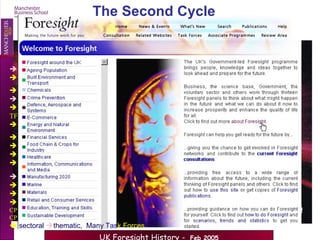
A Transformed Website The Second Cycle      TF          CP CP    sectoral   thematic,  Many   Tas k Forces
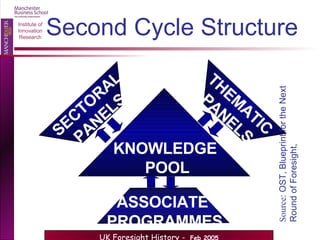
Second Cycle Structure Source : OST,   Blueprint for the Next Round of   Foresight,  SECTORAL PANELS THEMATIC PANELS KNOWLEDGE  POOL ASSOCIATE  PROGRAMMES
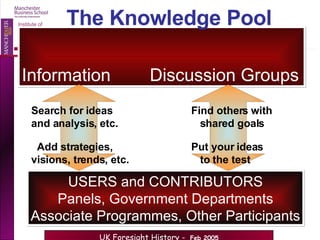
The Knowledge Pool Information Discussion Groups USERS and CONTRIBUTORS Panels, Government Departments Associate Programmes, Other Participants Search for ideas Find others with and analysis, etc.   shared goals Add strategies,  Put your ideas visions, trends, etc.   to the test
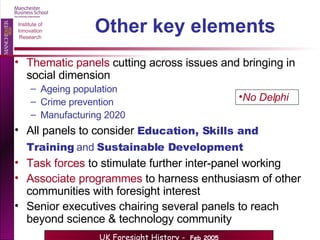
Other key elements Thematic panels  cutting across issues and bringing in social dimension Ageing population Crime prevention Manufacturing 2020 All panels to consider   Education, Skills and Training  and  Sustainable Development   Task forces  to stimulate further inter-panel working Associate programmes  to harness enthusiasm of other communities with foresight interest Senior executives chairing several panels to reach beyond science & technology community No Delphi
Retrospect on Second Cycle Cut short  - internal high level review initiated Some reports publicly criticised in Parliament by responsible Minister – variable quality Problems with Knowledge Pool - low interactivity Short Steering Group report – pamphlet without priorities exercise  Impact and profile less than First Cycle    Website streamlined, much documentation removed (key reports remain, but not always easy to locate)
Second Cycle Problems Still awaiting rigorous evaluation  New methodological framework, plus staff and consultant  changes, reduced any capitalisation or learning from 1st cycle  Institutionalised panels  - reduced access to vision, less individual commitment of members and chairs, and increased lobbying content Lack of core methodology - reduced rigour of approach, scope for integration  “ Ownership” problems for OST of the wide range of social/political issues - disarticulated from OST concerns?
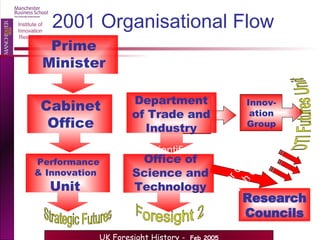
2001 Organisational Flow Research Councils Innov- ation Group DTI Futures Unit Director General of Research Councils Cabinet Office Strategic Futures Performance & Innovation  Unit Prime Minister Office of Science and Technology Foresight 2 Department of Trade and Industry Chief Scientific Advisor
Third Cycle Aim  “to increase UK exploitation of science”, inform but not direct public and private research funders LINK not  driven by Foresight priorities, though remains “a useful and responsive mechanism” Move from  broad set of standing panels  to  rolling programme of projects... Brainstorming of “visionaries” to develop initial shortlist of projects Projects organised in different ways, but based on initial seminar, literature and horizon scanning, in-house and external support, use of futures techniques to avoid extrapolation, limited (at best) role of panels. Delivery target:  overview, vision of what  success  will look like, recommendations for action, networks  that are willing and able to take recommendations forward
Third Cycle Foresight OST Foresight Programme restructured in 2002 No longer covers the whole range of technologies, nor tries to encompass all Foresight Aim  “to increase UK exploitation of science”, inform but not direct public and private research funders LINK cannot be driven by Foresight priorities, though should be seen as useful and responsive mechanism Replacing broad set of standing panels with fluid rolling programme of projects, organised in different ways... Brainstorming of “visionaries” to develop initial shortlist of projects Projects based on initial seminar, literature and horizon scanning, in-house and external support with use of futures techniques to avoid extrapolation Delivery target: overview, vision of what success will look like, recommendations for action, networks keen to take recommendations forward Now focusing on five areas:
A Technology Strategy to increase innovation “ 3.22.  … bringing business, Government, and the research and knowledge transfer communities together to identify the most important emerging, potentially disruptive technologies on the basis of their potential economic, social and environmental benefits for the UK. …  to develop collaborative, application-based solutions to technology development, drawing on the resources and instruments available to all parties. Business has told us that a strategic approach in this area is of high importance … 3.23.  ,,, developing a Technology Strategy that will identify technology priorities. The Strategy will be used to stimulate an industry based technology programme. ,,,  to influence a much wider set of Government policies as well as the behaviour of business and other participants in the innovation system (e.g. RDAs and DAs). 3.24.  The Technology Strategy will be business-led, market focussed and need a high level of stakeholder input. … … 3.28.  Of the countries we have reviewed, several operate some form of strategic selection of technologies and research themes. The models used by the Finnish technology agency ,,, and by Japan appear closest to our proposal…. “
Technology Strategy/ Technology Foresight 3.25.  A  high level Technology Strategy Board  will ensure the technology priorities are market focussed and will  advise on the broad allocation of resources  to them. The Board will also act as a high level forum for interaction between business, Government and other stakeholders. Innovation works best when there is a clear market and business pull and we will focus the Technology Strategy on this basis. The main criteria for prioritising the Technology Strategy themes will be: the degree to which technologies will have an impact on sectors that are a major UK strength (eg pharmaceuticals and aerospace) or have high growth potential; the degree to which a particular technology will have an impact on a number of sectors; strength of the UK SET base relative to other countries; potential economic, social, quality of life and environmental benefits and scope for cross-government collaboration (e.g. healthcare, energy); potential for spill-over benefits and whether there is an underpinning market failure; and the degree to which there is scope for effective action by Government or others. 3.26 . The … Technology Strategy … has the potential to become a key information source, including technology road maps, for all participants in the innovation system, strengthening co-ordination and improving effectiveness at all levels…. Influencing policy by, e.g.  signalling technologies where action might be needed to strengthen the supply of technical skills;  …  where particular attention to regulatory issues may be justified …  generating a higher level of awareness of IP issues …  informing negotiation of EU Framework programmes; and  … the development of standards and measurement …
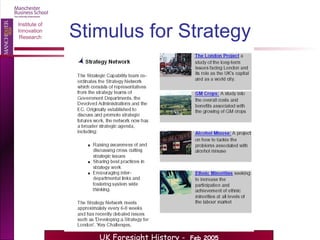
Broader Foresight As well as a move to identify critical technologies and resource these… …  there are continuing efforts, particularly from the Strategy Unit, to stimulate and interrelate long-term strategy-related activities across government.
Strategy Unit http://www.strategy.gov.uk/output/page696.asp
Stimulus for Strategy
Centrifugal Forces Thus there are moves to provide a general strategic overview of technologies – remains to see how the key technologies approach will interconnect with OST Foresight There are efforts to articulate strategy across government… .. But a great deal is underway in various parts of national and regional government across the UK, and its hard to gain an overview
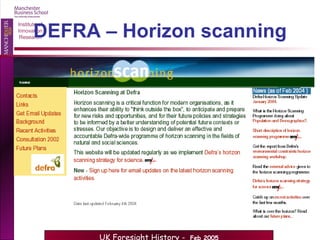
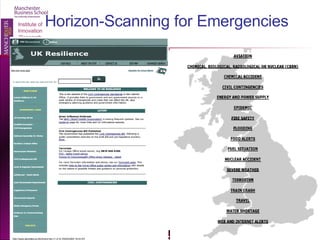
Horizon-Scanning and Roadmapping “ Horizon-Scanning” has become widely used in many government departments instead of “Foresight” Other terms have also made their mark – “roadmapping”, “long-term strategy”. Differences in nuance and detail of approach – but common to see use of workshops plus desk research.  (Eg  Bioscience and NonFood Crops ) Much action around climate change, food, agriculture, rural economy, etc.  Reflects recent crises.  Thus DEFRA is a major actor, and probably ahead of other parts of national government.
DEFRA – Horizon scanning
Horizon-Scanning for Emergencies
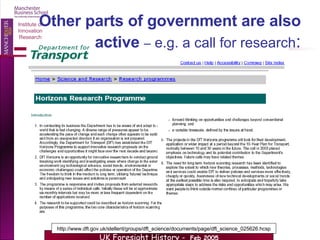
Other parts of government are also  active   –  e.g. a call for research : http://www.dft.gov.uk/stellent/groups/dft_science/documents/page/dft_science_025626.hcsp
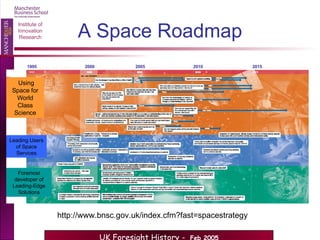
A Space Roadmap Foremost developer of Leading-Edge Solutions Leading Users of Space Services Using Space for World Class Science 1995   2000   2005   2010  2015 http://www.bnsc.gov.uk/index.cfm?fast=spacestrategy
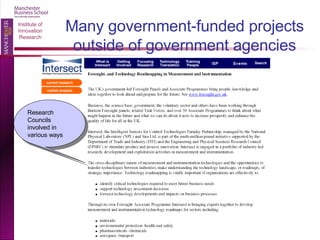
Many government-funded projects outside of government agencies Research Councils involved in various ways
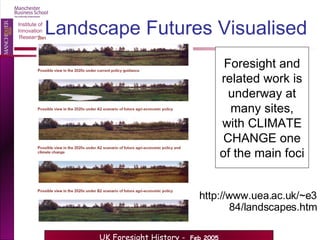
http://www.uea.ac.uk/~e384/landscapes.htm Landscape Futures Visualised Foresight and related work is underway at many sites, with CLIMATE CHANGE one of the main foci
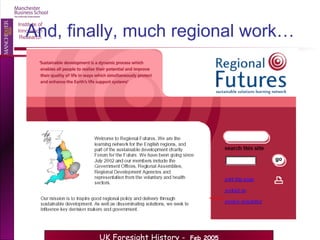
And, finally, much regional work…
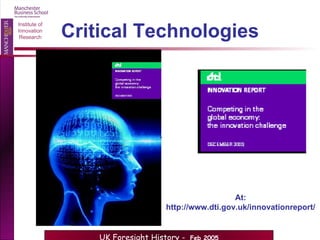
Critical Technologies At:  http://www.dti.gov.uk/innovationreport/
OST's Centre of Excellence in Horizon Scanning: OST's Centre of Excellence in Horizon Scanning - conceived as part of the government's 10-year investment framework for science and innovation - has now begun its operations.. Current activities include pilot projects with a number of client departments, to scope the nature of demand and the practicalities of delivery. The fundamental purpose of Horizon Scanning is to scan systematically for potential future threats, trends, and opportunities. Investigation of 'science' issues will encompass all analytical evidence streams, including economics and social sciences. This comprehensive approach will also inform and provide context for future public engagement priorities. Activities The Centre expects to have three main strands of activity  •  A regular cross-departmental strategic horizon scan to underpin departmental horizon scanning and to inform cross-departmental priorities •  Project work with departments •  Provision of tools and support to spread good practice in departmental horizon scanning The Centre will comprise a small team, with significant outsourcing. CSAC (Committee of Chief Scientific Advisors) has agreed to form a subgroup to oversee the development of the programme and to ensure that it adds value to departments‘ own work. This will be chaired by Howard Dalton (Defra).  Horizon Scanning   Timings •  March 2005: Best practice offer fully launched (defined and tested) •  December 2005: findings of the first strategic horizon scanning exercise available. There will also be various key engagement events and smaller deliverables from the start of next financial year.
Conclusions Foresight of all kinds is underway in many locations in the UK: there are some coordination efforts, but the field is vast and very diverse (are there quality control problems?  Pet methods?) There are now many academics, consultants, and others active in the area. Technology Foresight is underway in several government departments, in addition to the main Foresight programme.  Again, there is some fragmentation, and the effect of a key technology focus coming from Technology Strategy (for innovation)  is unpredictable.  But if Foresight is to do with bringing together opportunities and needs, then we can expect further interesting developments.
End of Presentation

UK Foresight - a view from 2005

  • 1.
    (Towards) A BriefHistory of UK Foresight Ian Miles PREST/IoIR University of Manchester
  • 2.
    This talk Iswork in progress (though a paper is in press, in IJFIP ) Examines the Foresight Programme and Foresight more widely Argues that UK Foresight was initially highly influenced by the innovation studies community – but suggests that this influence is now much more patchy. Comes from someone who has been involved in some of the activities, and cannot claim a completely uninterested perspective.
  • 3.
    Where is UKForesight? http://www.foresight.gov.uk
  • 4.
    A site withRich Content – on specific technology areas
  • 5.
    But this is“focused” Foresight marks a major change Where is broadbrush “foundational” Technology Foresight - overall scanning and strategy advice on technological challenges and opportunities? Where is the effort to map and monitor Foresight in general?
  • 6.
    The Official HistoryThree cycles of UK Foresight: 1994-99, 2000-02, 2002- Much documentation on website, but some material now regarded as obsolete.
  • 7.
    UK Foresight Programme– prehistory Prehistory of concerns about national innovation system , attention to Foresight in other NIS (esp. Japan: Irvine/Martin) SPRU had played key role in developing innovation studies, with early analysis of NIS flowing from earlier work on the “British disease” – work that had moved from the margins to a more centre stage position (good topic for research) SPRU had also been the main scholarly centre for futures work, with its STAFF programme and successor studies. Loose coupling of analyses, esp through Freeman work on technological revolutions and institutional structures Had seeded both approaches widely – thus establishing base in innovation studies community worldwide for longer-range thinking :
  • 8.
    UK Foresight Programme– “First Cycle” Several 1990s efforts to determine critical technologies (involving SPRU, PREST and consultancies): this approach has been pursued in US and France, in particular. 1993 White Paper : improve connection between science base & wealth creation + quality of life. Foresight a major instrument. Specific goals: to inform priorities (planning) & promote “Foresight culture” of forward and longer term thinking “beyond the business plan” (futures, networking) Already quite a mature, well-conceptualised intervention. And organisationaly well located :
  • 9.
  • 10.
    Organisational Flow BenMartin on Steering Committee: undertook review of other Programmes; PREST undertook much methodological work (delphi, other surveys, panel training…) This links to innovation studies Prime Minister Cabinet Office Office of Science and Technology Foresight 1
  • 11.
    Initial stages ofFirst Cycle Pre-foresight Steering committee Co-nomination 15 panels prepared Main stage Key issues & trends Scenarios Wide consultation Delphi survey Regional workshops Panel reports Steering Committee report - priorities
  • 12.
    Original Foresight Panels (94-98) ANRIE  Agriculture, Horticulture & Forestry *(split) Defence & Aerospace Financial Services Health & Life Sciences Leisure & Learning Manufacturing, Production & Business Processes Marine **(new)  Natural Resources & Environment *(split) Chemicals Construction Energy Food & Drink Materials Retail & Distribution Transport Mix of technology and “demand” Missing sectors? Analysis of Cross-sectoral links (e.g. food chain) IT, Electronics & Communications * (merged)
  • 13.
    Structure placed Panels at the core Defining constituencies of expertise and stakeholders Generating lists of Delphi topics Undertaking consultations Preparing own views as to R&D (and other) priorities in interim and final reports Forwarding their proposals in follow-up work.
  • 14.
    One Priority: Priorities!Key priority areas Inter-mediate areas Emerging areas Feasibility Attractiveness
  • 15.
    Foresight implementation Disseminationby Panels through media, workshops, professional & trade associations 600 events, 130,000 reports distributed 1998 Delphi on website - high usage Foresight Challenge funding initiative to support key priorities – e.g. Institute of Applied Catalysis. LINK programme . 54% of Research Council spend aligned with priorities of which £300 million new initiatives Other government departments acting on own areas, and Panels champion this: Transport, Construction, Defence, etc; and better co-ordination between departments Foresight was element in gaining major increase for science funding in Government’s Comprehensive Spending Review
  • 16.
    Retrospect on FirstCycle Successes huge level of voluntary participation widespread support, political commitment sustained broad priorities accepted networking seen as beneficial “ Foresight” more widely accepted as tool taken as model by many other countries Problems insufficient time - esp for USE of Delphi - some frustration insufficient technical support, communication problems, lack of coordination and resource pooling between panels, poor comms between panel members and non-members tendency to “technical fix” solutions - even though many social constraints & issues identified
  • 17.
    A Transformed WebsiteThe Second Cycle      TF          CP CP  sectoral  thematic, Many Tas k Forces
  • 18.
    Second Cycle StructureSource : OST, Blueprint for the Next Round of Foresight, SECTORAL PANELS THEMATIC PANELS KNOWLEDGE POOL ASSOCIATE PROGRAMMES
  • 19.
    The Knowledge PoolInformation Discussion Groups USERS and CONTRIBUTORS Panels, Government Departments Associate Programmes, Other Participants Search for ideas Find others with and analysis, etc. shared goals Add strategies, Put your ideas visions, trends, etc. to the test
  • 20.
    Other key elementsThematic panels cutting across issues and bringing in social dimension Ageing population Crime prevention Manufacturing 2020 All panels to consider Education, Skills and Training and Sustainable Development Task forces to stimulate further inter-panel working Associate programmes to harness enthusiasm of other communities with foresight interest Senior executives chairing several panels to reach beyond science & technology community No Delphi
  • 21.
    Retrospect on SecondCycle Cut short - internal high level review initiated Some reports publicly criticised in Parliament by responsible Minister – variable quality Problems with Knowledge Pool - low interactivity Short Steering Group report – pamphlet without priorities exercise Impact and profile less than First Cycle  Website streamlined, much documentation removed (key reports remain, but not always easy to locate)
  • 22.
    Second Cycle ProblemsStill awaiting rigorous evaluation New methodological framework, plus staff and consultant changes, reduced any capitalisation or learning from 1st cycle Institutionalised panels - reduced access to vision, less individual commitment of members and chairs, and increased lobbying content Lack of core methodology - reduced rigour of approach, scope for integration “ Ownership” problems for OST of the wide range of social/political issues - disarticulated from OST concerns?
  • 23.
    2001 Organisational FlowResearch Councils Innov- ation Group DTI Futures Unit Director General of Research Councils Cabinet Office Strategic Futures Performance & Innovation Unit Prime Minister Office of Science and Technology Foresight 2 Department of Trade and Industry Chief Scientific Advisor
  • 24.
    Third Cycle Aim “to increase UK exploitation of science”, inform but not direct public and private research funders LINK not driven by Foresight priorities, though remains “a useful and responsive mechanism” Move from broad set of standing panels to rolling programme of projects... Brainstorming of “visionaries” to develop initial shortlist of projects Projects organised in different ways, but based on initial seminar, literature and horizon scanning, in-house and external support, use of futures techniques to avoid extrapolation, limited (at best) role of panels. Delivery target: overview, vision of what success will look like, recommendations for action, networks that are willing and able to take recommendations forward
  • 25.
    Third Cycle ForesightOST Foresight Programme restructured in 2002 No longer covers the whole range of technologies, nor tries to encompass all Foresight Aim “to increase UK exploitation of science”, inform but not direct public and private research funders LINK cannot be driven by Foresight priorities, though should be seen as useful and responsive mechanism Replacing broad set of standing panels with fluid rolling programme of projects, organised in different ways... Brainstorming of “visionaries” to develop initial shortlist of projects Projects based on initial seminar, literature and horizon scanning, in-house and external support with use of futures techniques to avoid extrapolation Delivery target: overview, vision of what success will look like, recommendations for action, networks keen to take recommendations forward Now focusing on five areas:
  • 26.
    A Technology Strategyto increase innovation “ 3.22. … bringing business, Government, and the research and knowledge transfer communities together to identify the most important emerging, potentially disruptive technologies on the basis of their potential economic, social and environmental benefits for the UK. … to develop collaborative, application-based solutions to technology development, drawing on the resources and instruments available to all parties. Business has told us that a strategic approach in this area is of high importance … 3.23. ,,, developing a Technology Strategy that will identify technology priorities. The Strategy will be used to stimulate an industry based technology programme. ,,, to influence a much wider set of Government policies as well as the behaviour of business and other participants in the innovation system (e.g. RDAs and DAs). 3.24. The Technology Strategy will be business-led, market focussed and need a high level of stakeholder input. … … 3.28. Of the countries we have reviewed, several operate some form of strategic selection of technologies and research themes. The models used by the Finnish technology agency ,,, and by Japan appear closest to our proposal…. “
  • 27.
    Technology Strategy/ TechnologyForesight 3.25. A high level Technology Strategy Board will ensure the technology priorities are market focussed and will advise on the broad allocation of resources to them. The Board will also act as a high level forum for interaction between business, Government and other stakeholders. Innovation works best when there is a clear market and business pull and we will focus the Technology Strategy on this basis. The main criteria for prioritising the Technology Strategy themes will be: the degree to which technologies will have an impact on sectors that are a major UK strength (eg pharmaceuticals and aerospace) or have high growth potential; the degree to which a particular technology will have an impact on a number of sectors; strength of the UK SET base relative to other countries; potential economic, social, quality of life and environmental benefits and scope for cross-government collaboration (e.g. healthcare, energy); potential for spill-over benefits and whether there is an underpinning market failure; and the degree to which there is scope for effective action by Government or others. 3.26 . The … Technology Strategy … has the potential to become a key information source, including technology road maps, for all participants in the innovation system, strengthening co-ordination and improving effectiveness at all levels…. Influencing policy by, e.g. signalling technologies where action might be needed to strengthen the supply of technical skills; … where particular attention to regulatory issues may be justified … generating a higher level of awareness of IP issues … informing negotiation of EU Framework programmes; and … the development of standards and measurement …
  • 28.
    Broader Foresight Aswell as a move to identify critical technologies and resource these… … there are continuing efforts, particularly from the Strategy Unit, to stimulate and interrelate long-term strategy-related activities across government.
  • 29.
  • 30.
  • 31.
    Centrifugal Forces Thusthere are moves to provide a general strategic overview of technologies – remains to see how the key technologies approach will interconnect with OST Foresight There are efforts to articulate strategy across government… .. But a great deal is underway in various parts of national and regional government across the UK, and its hard to gain an overview
  • 32.
    Horizon-Scanning and Roadmapping“ Horizon-Scanning” has become widely used in many government departments instead of “Foresight” Other terms have also made their mark – “roadmapping”, “long-term strategy”. Differences in nuance and detail of approach – but common to see use of workshops plus desk research. (Eg Bioscience and NonFood Crops ) Much action around climate change, food, agriculture, rural economy, etc. Reflects recent crises. Thus DEFRA is a major actor, and probably ahead of other parts of national government.
  • 33.
  • 34.
  • 35.
    Other parts ofgovernment are also active – e.g. a call for research : http://www.dft.gov.uk/stellent/groups/dft_science/documents/page/dft_science_025626.hcsp
  • 36.
    A Space RoadmapForemost developer of Leading-Edge Solutions Leading Users of Space Services Using Space for World Class Science 1995 2000 2005 2010 2015 http://www.bnsc.gov.uk/index.cfm?fast=spacestrategy
  • 37.
    Many government-funded projectsoutside of government agencies Research Councils involved in various ways
  • 38.
    http://www.uea.ac.uk/~e384/landscapes.htm Landscape FuturesVisualised Foresight and related work is underway at many sites, with CLIMATE CHANGE one of the main foci
  • 39.
    And, finally, muchregional work…
  • 40.
    Critical Technologies At: http://www.dti.gov.uk/innovationreport/
  • 41.
    OST's Centre ofExcellence in Horizon Scanning: OST's Centre of Excellence in Horizon Scanning - conceived as part of the government's 10-year investment framework for science and innovation - has now begun its operations.. Current activities include pilot projects with a number of client departments, to scope the nature of demand and the practicalities of delivery. The fundamental purpose of Horizon Scanning is to scan systematically for potential future threats, trends, and opportunities. Investigation of 'science' issues will encompass all analytical evidence streams, including economics and social sciences. This comprehensive approach will also inform and provide context for future public engagement priorities. Activities The Centre expects to have three main strands of activity • A regular cross-departmental strategic horizon scan to underpin departmental horizon scanning and to inform cross-departmental priorities • Project work with departments • Provision of tools and support to spread good practice in departmental horizon scanning The Centre will comprise a small team, with significant outsourcing. CSAC (Committee of Chief Scientific Advisors) has agreed to form a subgroup to oversee the development of the programme and to ensure that it adds value to departments‘ own work. This will be chaired by Howard Dalton (Defra). Horizon Scanning Timings • March 2005: Best practice offer fully launched (defined and tested) • December 2005: findings of the first strategic horizon scanning exercise available. There will also be various key engagement events and smaller deliverables from the start of next financial year.
  • 42.
    Conclusions Foresight ofall kinds is underway in many locations in the UK: there are some coordination efforts, but the field is vast and very diverse (are there quality control problems? Pet methods?) There are now many academics, consultants, and others active in the area. Technology Foresight is underway in several government departments, in addition to the main Foresight programme. Again, there is some fragmentation, and the effect of a key technology focus coming from Technology Strategy (for innovation) is unpredictable. But if Foresight is to do with bringing together opportunities and needs, then we can expect further interesting developments.
  • 43.