an awareness firm that works with r
universities and their key innovation
tech companies, early stage investo
government agencies) to"
Perspectives from industry leaders: 

a report on university-industry innovation relationships"
Perspectives from the industry on:
OPTIMIZING
UNIVERSITY-INDUSTRY
RELATIONS
Keys to identifying potential university partners
Points of entry into the university environment
Return on engagement related to R&D and innovation
Inhibitors to forming university relationships
How companies are structuring themselves to work with universities
OPTIMIZING
UNIVERSITY-INDUSTRY
RELATIONS
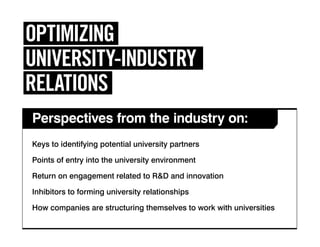
Survey participants:
• 102 leaders of high-tech companies
• 18 industries represented
(46% large sized, 54% small to medium sized)
Currently employed alumni
Publication scanning as a means to
locate faculty expertise
Proximity/location to company facilities
Research facilities related to our
product/service
1 2 3
Past experiences with the institution
University-industry professional
organizations
National ranking reports
(US News and World Report, etc.)
“Being where my competitors are”
Large companies (avg.) | n=46
SME’s (avg.) | n=53
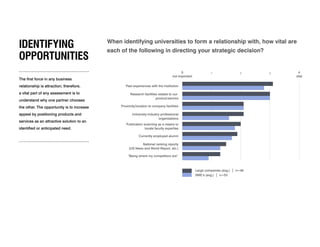
IDENTIFYING
OPPORTUNITIES
The first force in any business
relationship is attraction; therefore,
a vital part of any assessment is to
understand why one partner chooses
the other. The opportunity is to increase
appeal by positioning products and
services as an attractive solution to an
identified or anticipated need.
When identifying universities to form a relationship with, how vital are
each of the following in directing your strategic decision?
0
not important
4
vital
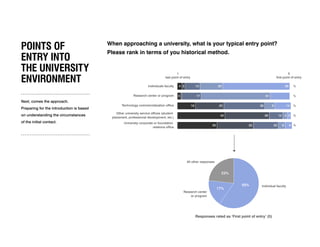
POINTS OF
ENTRY INTO
THE UNIVERSITY
ENVIRONMENT
Next, comes the approach.
Preparing for the introduction is based
on understanding the circumstances
of the initial contact.
When approaching a university, what is your typical entry point?
Please rank in terms of you historical method.
%
%
%
%
%
Individuals faculty
Research center or program
Technology commercialization office
Other university service offices (student
placement, professional development, etc.)
University corporate or foundation
relations office
1
last point of entry
5
first point of entry
1334
1761173
5920
362516 149
3942 3412
3235 6622
59%
17%
23%
Individual faculty
Research center
or program
All other responses
Responses rated as ‘First point of entry’ (5)
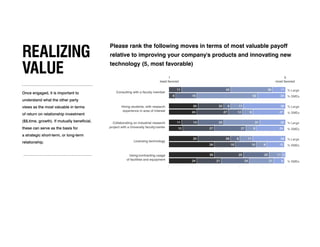
REALIZING
VALUE
Once engaged, it is important to
understand what the other party
views as the most valuable in terms
of return on relationship investment
($$,time, growth). If mutually beneficial,
these can serve as the basis for
a strategic short-term, or long-term
relationship.
Please rank the following moves in terms of most valuable payoff
relative to improving your company's products and innovating new
technology (5, most favorable)
1
least favored
5
most favored
Hiring students, with research
experience in area of interest 279122724
361162225
Collaborating on industrial research
project with a University faculty/center 249272712
2231221411
Using/contracting usage
of facilities and equipment 921242124
311222539
Consulting with a faculty member
2452186
11364211
Licensing technology
159181839
28
% SMEs
% Large
% Large
% Large
% SMEs
% SMEs
% Large
% SMEs
% SMEs
1182825
“Negotiations and terms for
licensing intellectural property”
All other responses
24%
66%
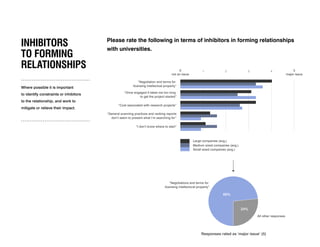
INHIBITORS
TO FORMING
RELATIONSHIPS
Please rate the following in terms of inhibitors in forming relationships
with universities.
Where possible it is important
to identify constraints or inhibitors
to the relationship, and work to
mitigate or relieve their impact.
“I don’t know where to start”
“Cost associated with research projects”
1 32 4
“Once engaged it takes me too long
to get the project started”
“Negotiation and terms for
licensing intellectual property”
“General scanning practices and ranking reports
don’t seem to present what I’m searching for”
Large companies (avg.)
Medium sized companies (avg.)
Small sized companies (avg.)
0
not an issue
5
major issue
Responses rated as ‘major issue’ (5)
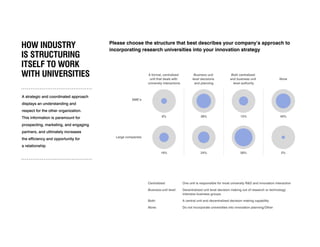
HOW INDUSTRY
IS STRUCTURING
ITSELF TO WORK
WITH UNIVERSITIES
Please choose the structure that best describes your company’s approach to
incorporating research universities into your innovation strategy
A strategic and coordinated approach
displays an understanding and
respect for the other organization.
This information is paramount for
prospecting, marketing, and engaging
partners, and ultimately increases
the efficiency and opportunity for
a relationship
Centralized: One unit is responsible for most university R&D and innovation interaction
Business-unit level: Decentralized unit level decision making out of research or technology
intensive business groups
Both: A central unit and decentralized decision making capability
None: Do not incorporate universities into innovation planning/Other
Large companies
SME’s
A formal, centralized
unit that deals with
university interactions
Business unit
level decisions
and planning
Both centralized
and business unit
level authority
None
6% 38% 15% 40%
16% 24% 58% 2%
an awareness firm that works with research
universities and their key innovation partners (high-
tech companies, early stage investors, and
government agencies) to"

 | inform

 | advocate

 | connect
Early Stage
Investors!
High-tech
Companies!
Government
Agencies!
Research
Universities!
Conversation-building 
initiatives!www.gapfunding.org!www.innovosource.com	
  
JACOB JOHNSON, FOUNDER!
johnson@innovosource.com"
612-280-2462"

University-Industry Innovative Collaboration Perspectives Report (innovosource)

  • 1.
    an awareness firmthat works with r universities and their key innovation tech companies, early stage investo government agencies) to" Perspectives from industry leaders: 
 a report on university-industry innovation relationships"
  • 2.
    Perspectives from theindustry on: OPTIMIZING UNIVERSITY-INDUSTRY RELATIONS Keys to identifying potential university partners Points of entry into the university environment Return on engagement related to R&D and innovation Inhibitors to forming university relationships How companies are structuring themselves to work with universities
  • 3.
    OPTIMIZING UNIVERSITY-INDUSTRY RELATIONS Survey participants: • 102leaders of high-tech companies • 18 industries represented (46% large sized, 54% small to medium sized)
  • 4.
    Currently employed alumni Publicationscanning as a means to locate faculty expertise Proximity/location to company facilities Research facilities related to our product/service 1 2 3 Past experiences with the institution University-industry professional organizations National ranking reports (US News and World Report, etc.) “Being where my competitors are” Large companies (avg.) | n=46 SME’s (avg.) | n=53 IDENTIFYING OPPORTUNITIES The first force in any business relationship is attraction; therefore, a vital part of any assessment is to understand why one partner chooses the other. The opportunity is to increase appeal by positioning products and services as an attractive solution to an identified or anticipated need. When identifying universities to form a relationship with, how vital are each of the following in directing your strategic decision? 0 not important 4 vital
  • 5.
    POINTS OF ENTRY INTO THEUNIVERSITY ENVIRONMENT Next, comes the approach. Preparing for the introduction is based on understanding the circumstances of the initial contact. When approaching a university, what is your typical entry point? Please rank in terms of you historical method. % % % % % Individuals faculty Research center or program Technology commercialization office Other university service offices (student placement, professional development, etc.) University corporate or foundation relations office 1 last point of entry 5 first point of entry 1334 1761173 5920 362516 149 3942 3412 3235 6622 59% 17% 23% Individual faculty Research center or program All other responses Responses rated as ‘First point of entry’ (5)
  • 6.
    REALIZING VALUE Once engaged, itis important to understand what the other party views as the most valuable in terms of return on relationship investment ($$,time, growth). If mutually beneficial, these can serve as the basis for a strategic short-term, or long-term relationship. Please rank the following moves in terms of most valuable payoff relative to improving your company's products and innovating new technology (5, most favorable) 1 least favored 5 most favored Hiring students, with research experience in area of interest 279122724 361162225 Collaborating on industrial research project with a University faculty/center 249272712 2231221411 Using/contracting usage of facilities and equipment 921242124 311222539 Consulting with a faculty member 2452186 11364211 Licensing technology 159181839 28 % SMEs % Large % Large % Large % SMEs % SMEs % Large % SMEs % SMEs 1182825
  • 7.
    “Negotiations and termsfor licensing intellectural property” All other responses 24% 66% INHIBITORS TO FORMING RELATIONSHIPS Please rate the following in terms of inhibitors in forming relationships with universities. Where possible it is important to identify constraints or inhibitors to the relationship, and work to mitigate or relieve their impact. “I don’t know where to start” “Cost associated with research projects” 1 32 4 “Once engaged it takes me too long to get the project started” “Negotiation and terms for licensing intellectual property” “General scanning practices and ranking reports don’t seem to present what I’m searching for” Large companies (avg.) Medium sized companies (avg.) Small sized companies (avg.) 0 not an issue 5 major issue Responses rated as ‘major issue’ (5)
  • 8.
    HOW INDUSTRY IS STRUCTURING ITSELFTO WORK WITH UNIVERSITIES Please choose the structure that best describes your company’s approach to incorporating research universities into your innovation strategy A strategic and coordinated approach displays an understanding and respect for the other organization. This information is paramount for prospecting, marketing, and engaging partners, and ultimately increases the efficiency and opportunity for a relationship Centralized: One unit is responsible for most university R&D and innovation interaction Business-unit level: Decentralized unit level decision making out of research or technology intensive business groups Both: A central unit and decentralized decision making capability None: Do not incorporate universities into innovation planning/Other Large companies SME’s A formal, centralized unit that deals with university interactions Business unit level decisions and planning Both centralized and business unit level authority None 6% 38% 15% 40% 16% 24% 58% 2%
  • 9.
    an awareness firmthat works with research universities and their key innovation partners (high- tech companies, early stage investors, and government agencies) to" | inform | advocate | connect Early Stage Investors! High-tech Companies! Government Agencies! Research Universities! Conversation-building initiatives!www.gapfunding.org!www.innovosource.com   JACOB JOHNSON, FOUNDER! johnson@innovosource.com" 612-280-2462"