Busaba Yongsmith a   Kaew Kangsadalampai b   and  Nissana Harntrikanok b a  Department of Microbiology, Faculty of Science, Kasetsart University.  Bangkok, Thailand b  Department of Food and Nutritional Toxicology. Institute of  Nutrition.  Salaya. Nakornpathom, Thailand Value-creation  on New  YELLOW   Pigments  Produced  by  a  Unique  Mutant  Derived  from   Monascus kaoliang   KB9
Presentation Outline Genealogy of the yellow isolates Cassava/soybean flour submerged culture Rice Solid Culture Downstreaming of the yellow pigment - crude extract - purified  yellow pigment - direct utilization of fermented rice powder Antimutagen / Antioxidant of the yellow products Conclusion
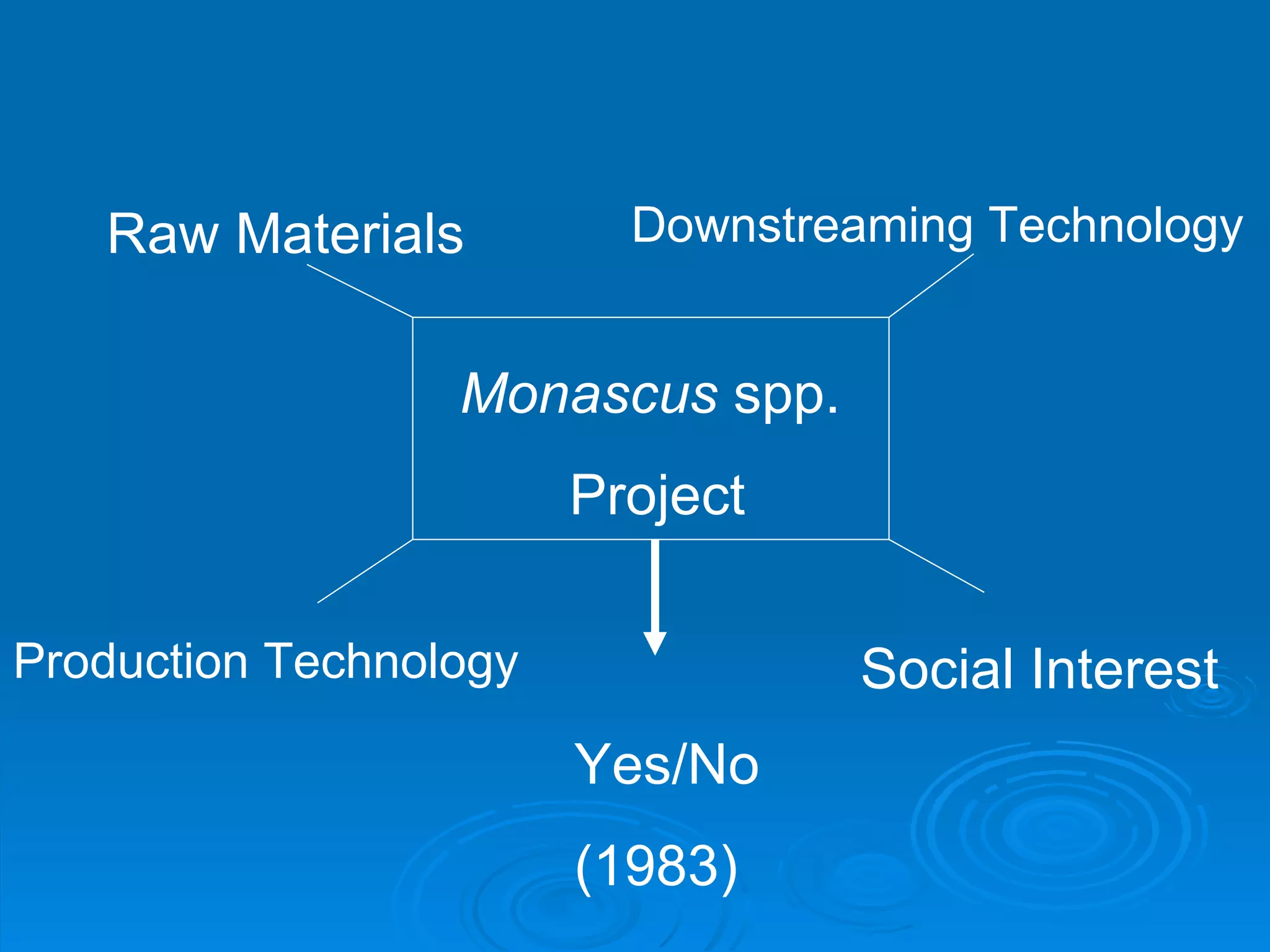
Monascus  spp. Project Raw Materials Downstreaming Technology  Production Technology Social Interest Yes/No (1983)
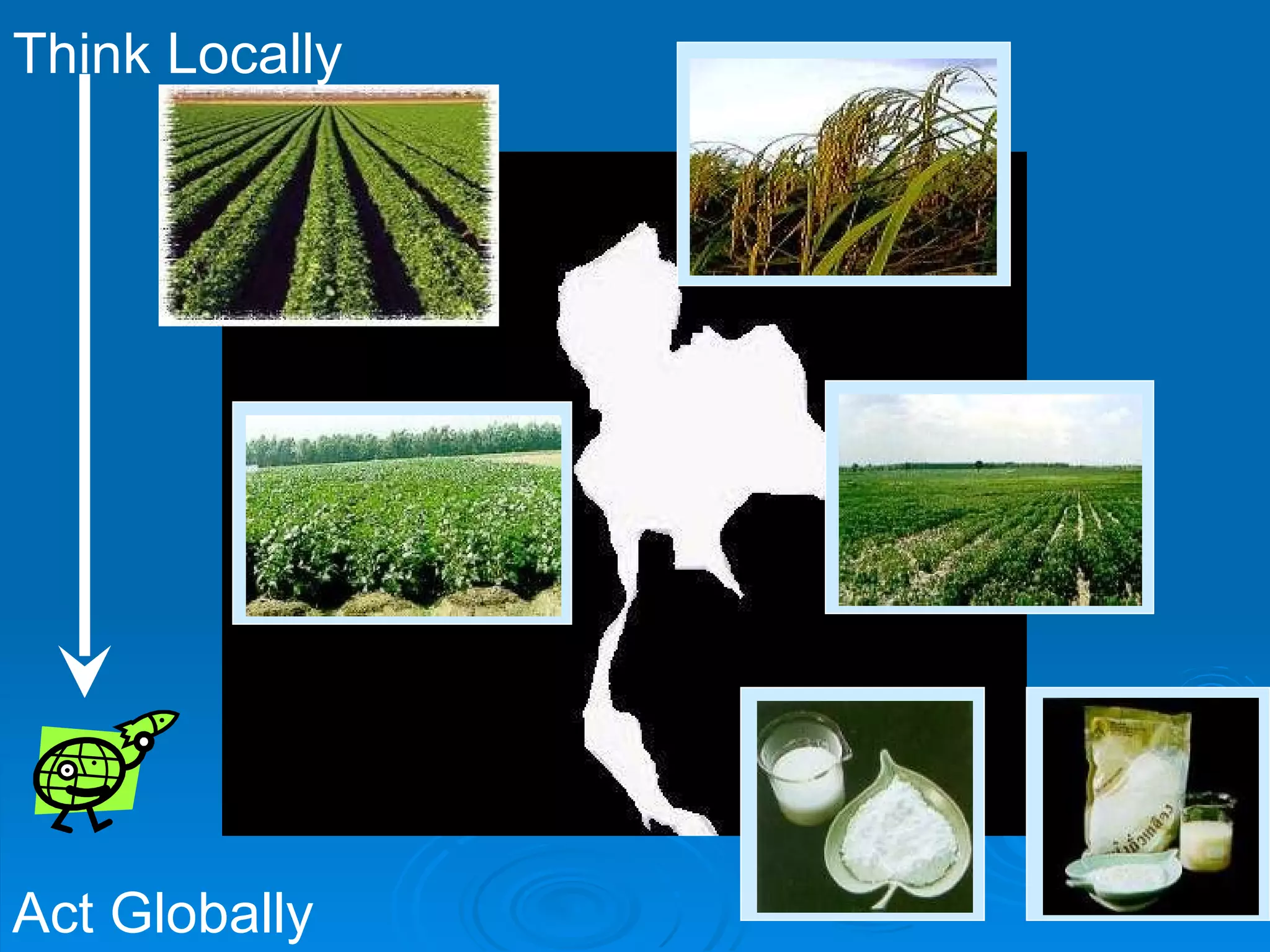
Think Locally Act Globally
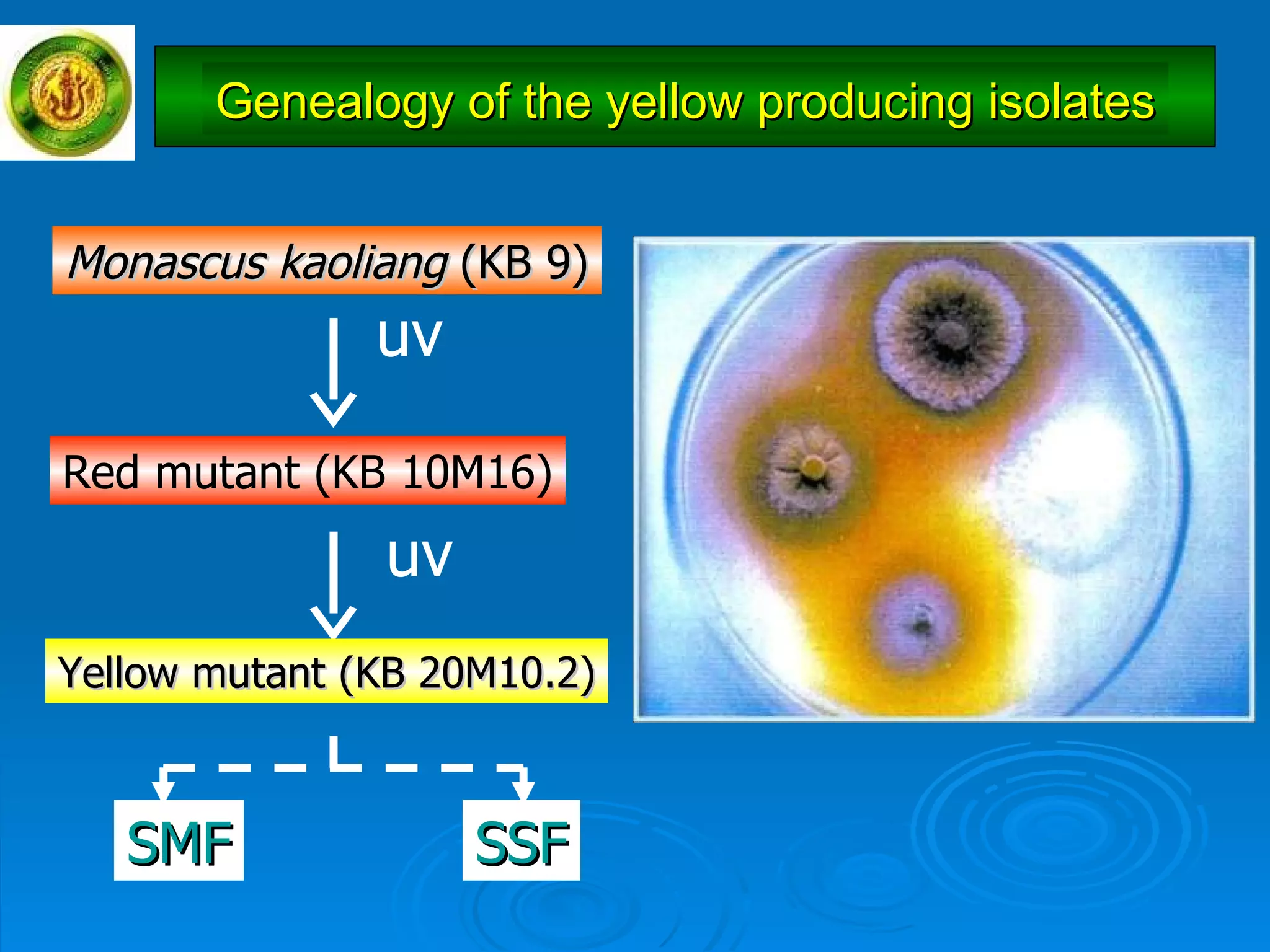
Monascus kaoliang  (KB 9) uv Red mutant (KB 10M16) uv Yellow mutant (KB 20M10.2) SMF SSF Genealogy of the yellow producing isolates
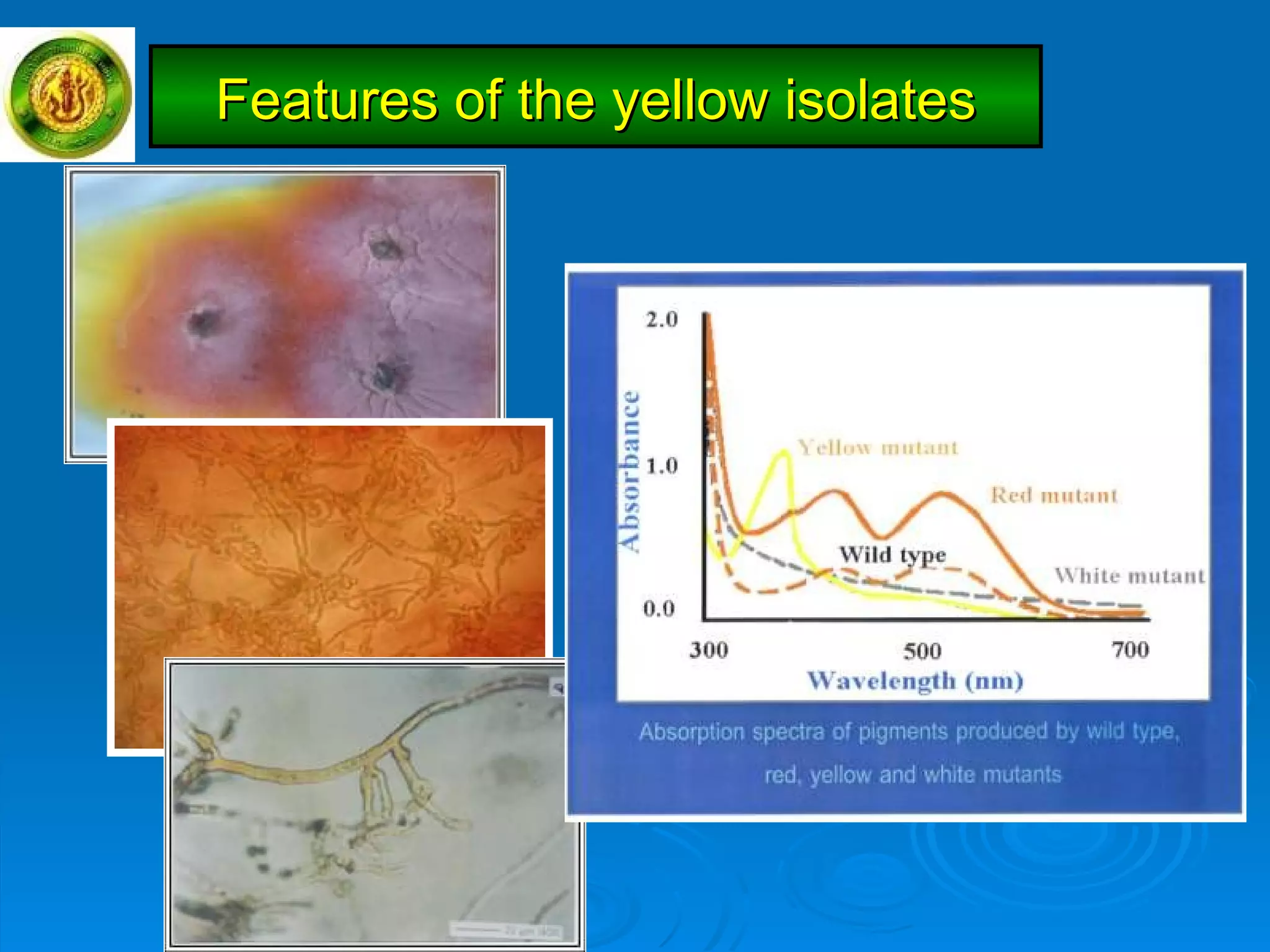
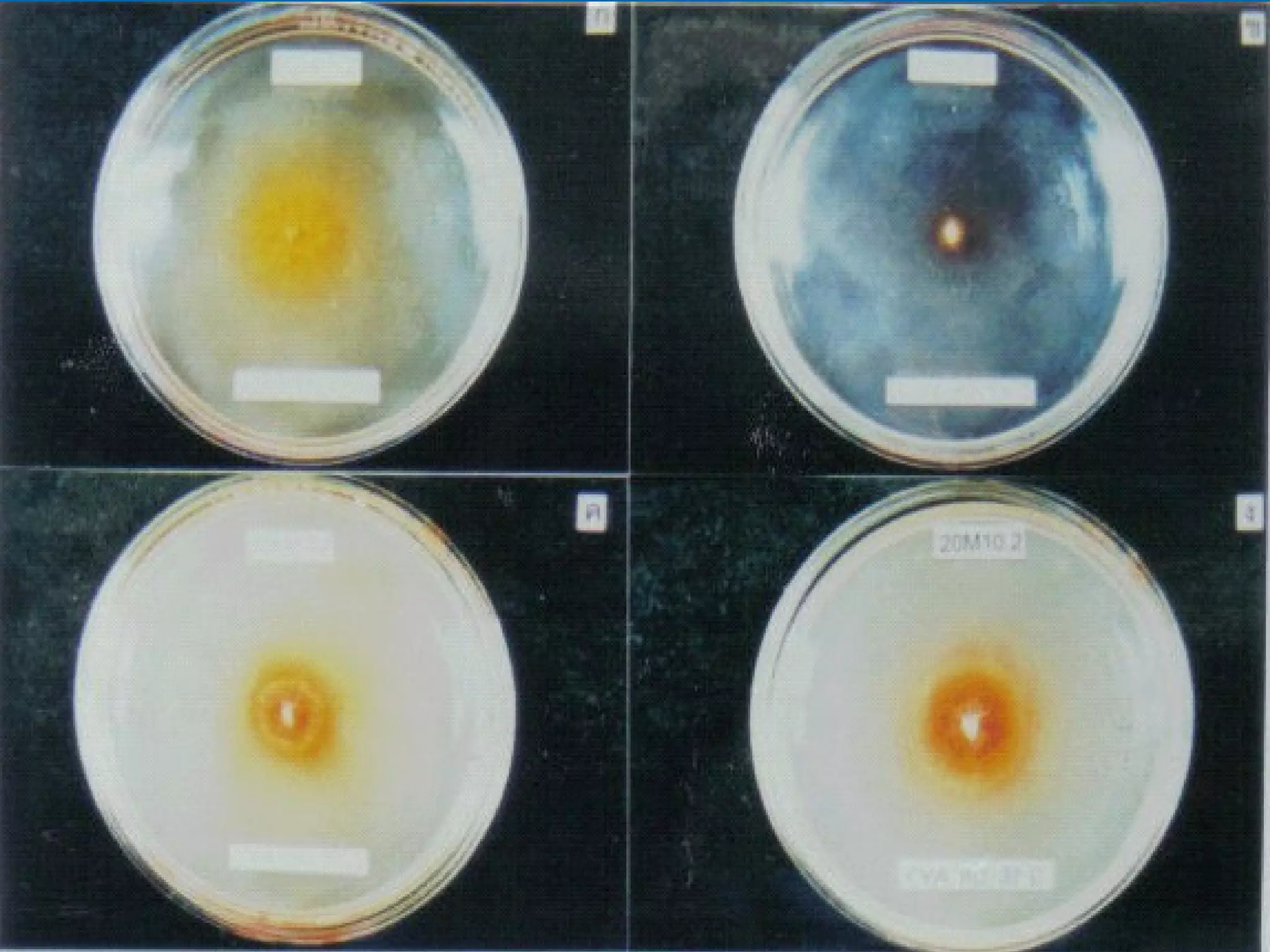
Features of the yellow isolates
 
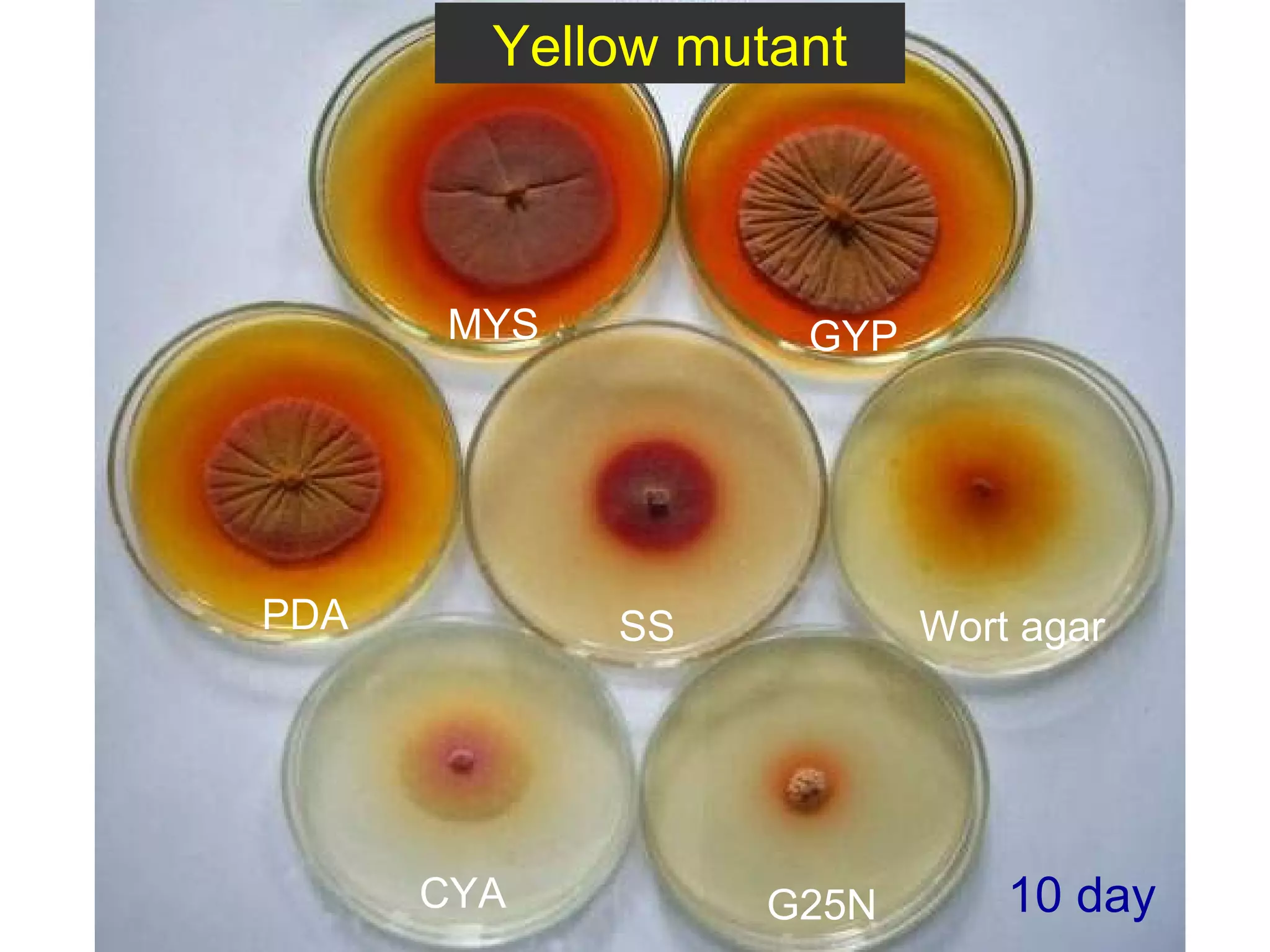
10 day CYA G25N Wort agar PDA GYP SS MYS Yellow mutant
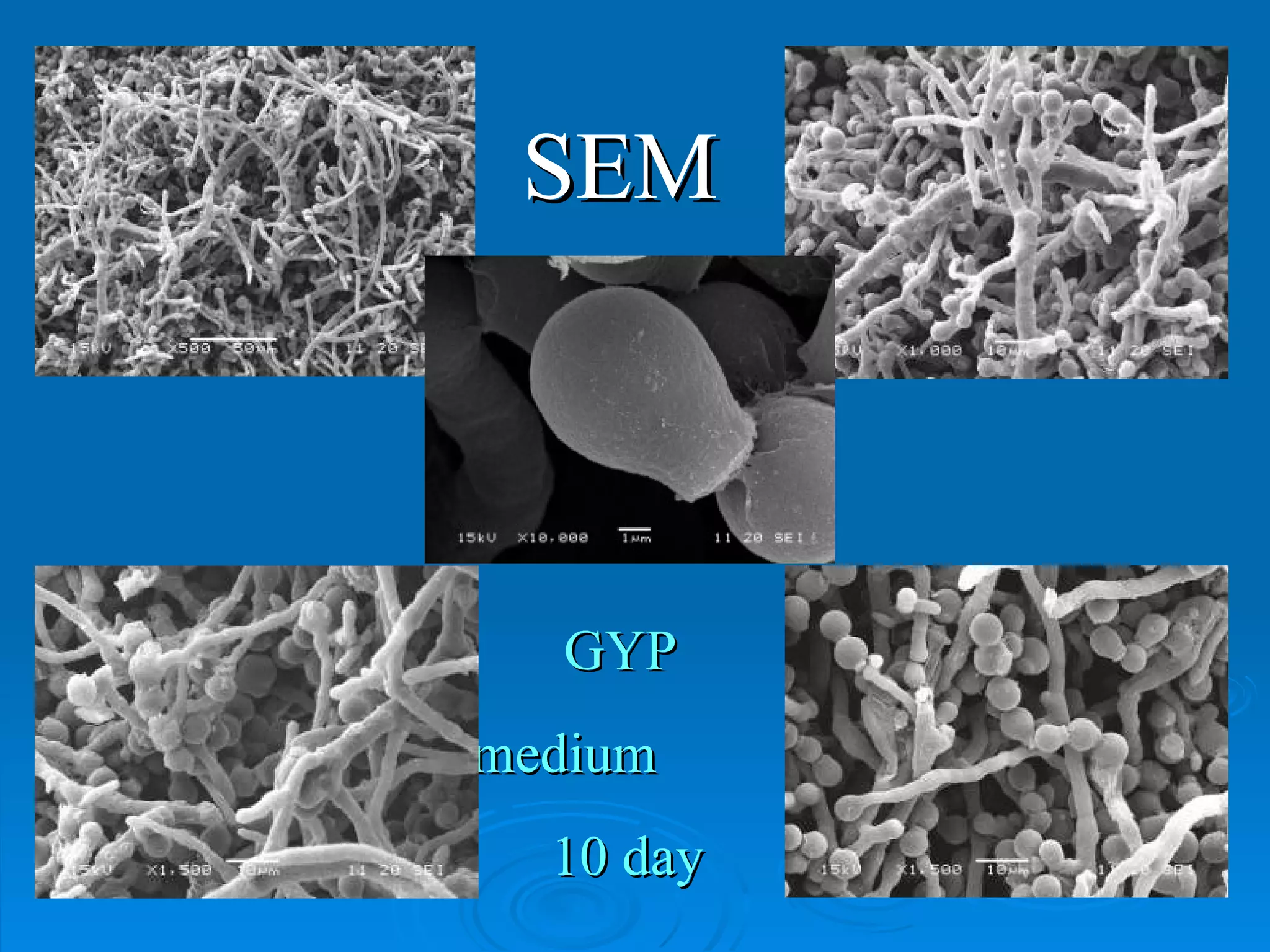
SEM GYP  medium  10 day
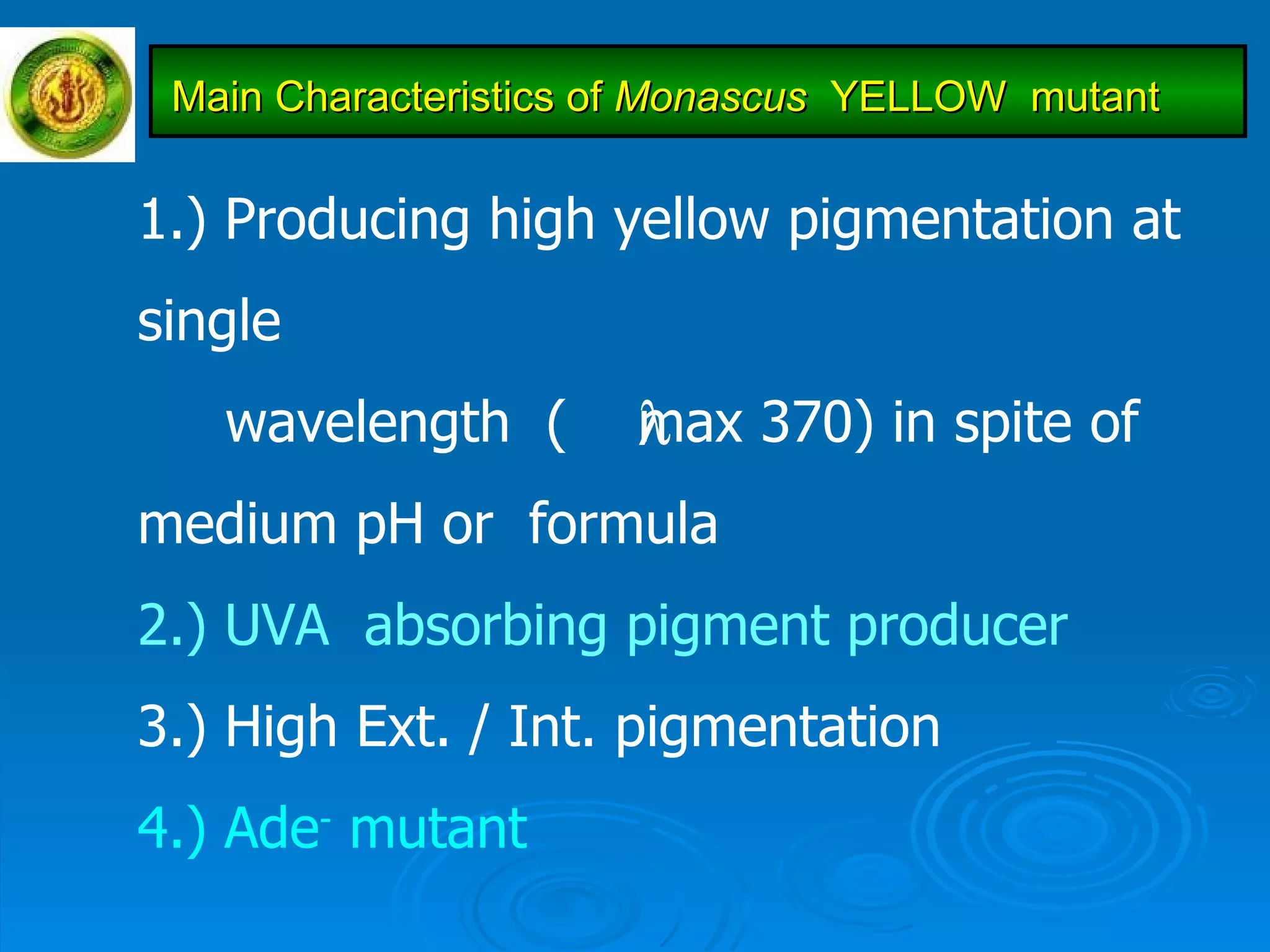
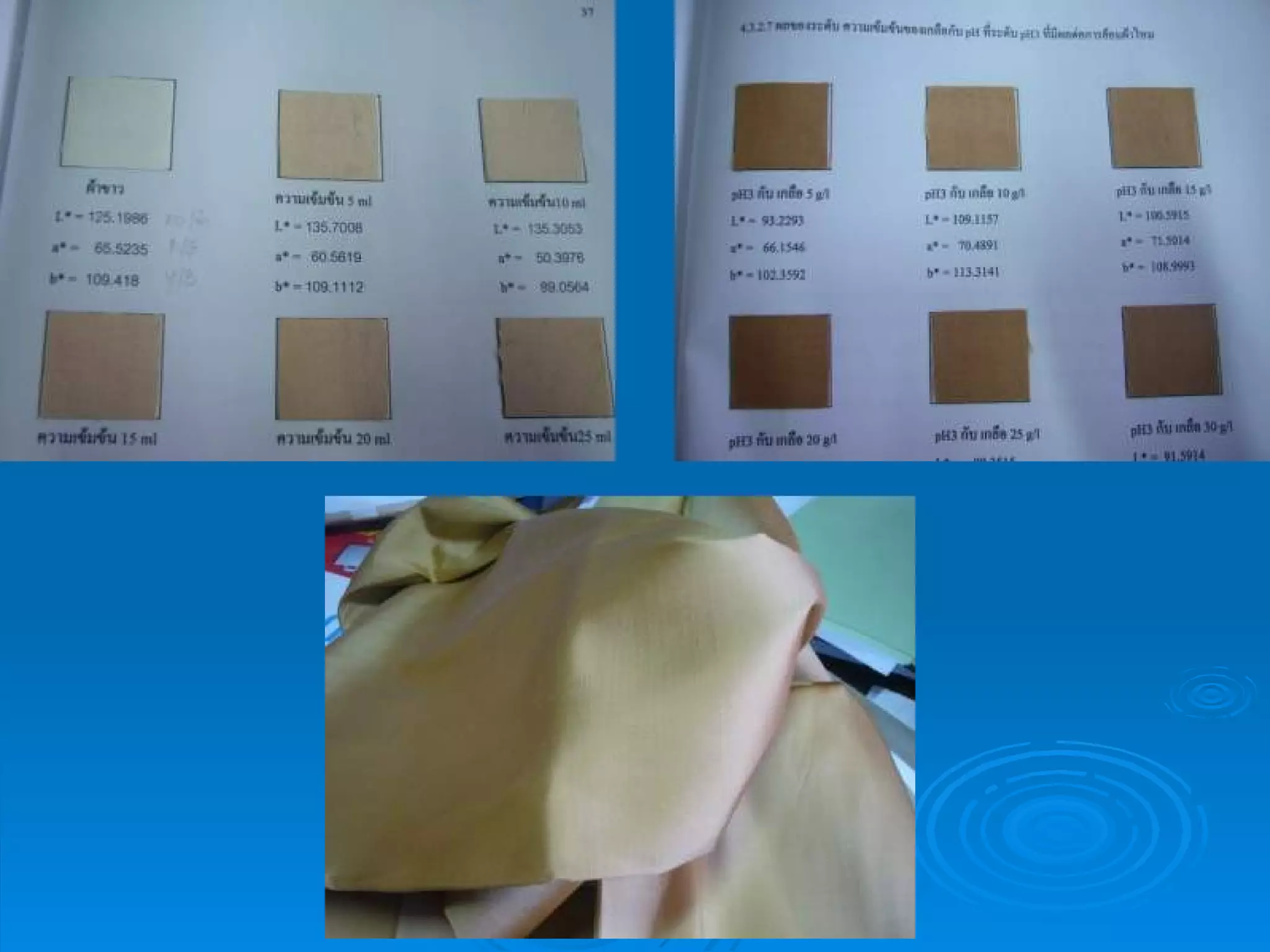
Main Characteristics of  Monascus  YELLOW  mutant 1.) Producing high yellow pigmentation at single  wavelength  (  max 370) in spite of  medium pH or  formula 2.) UVA  absorbing pigment producer 3.) High Ext. / Int. pigmentation 4.) Ade -  mutant 
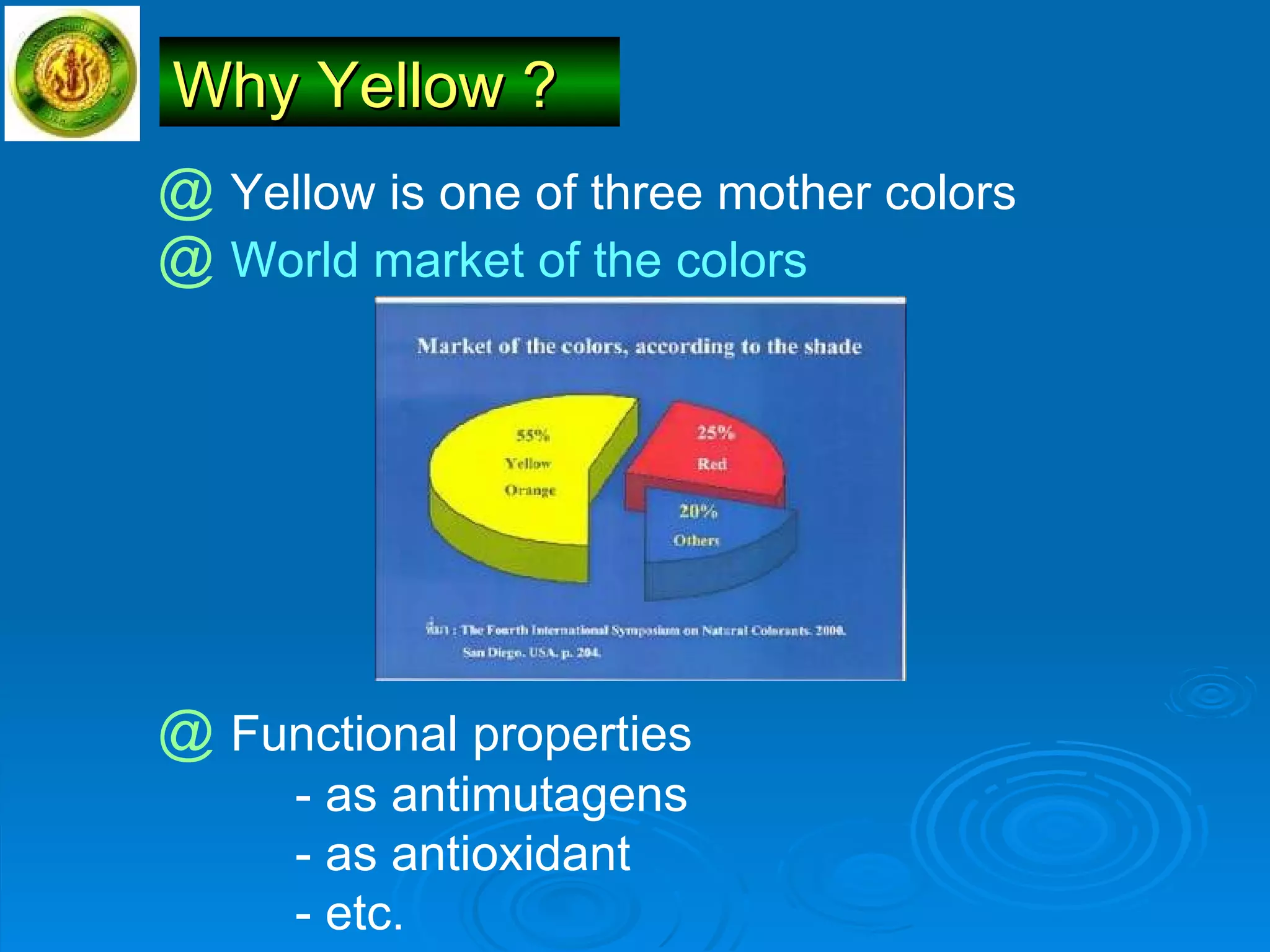
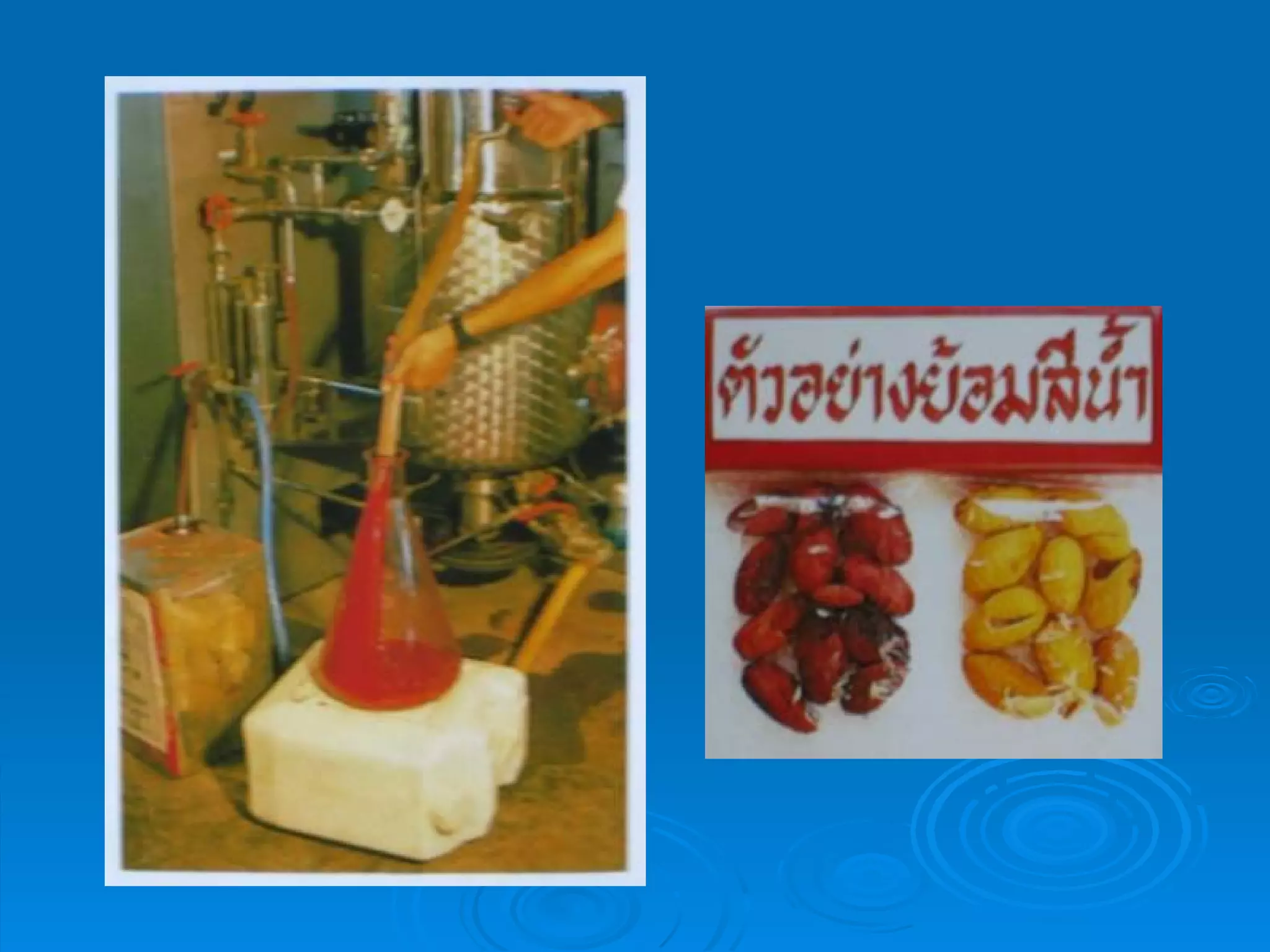
Why Yellow ? @  Yellow is one of three mother colors @  World market of the colors @  Functional properties - as antimutagens - as antioxidant - etc.


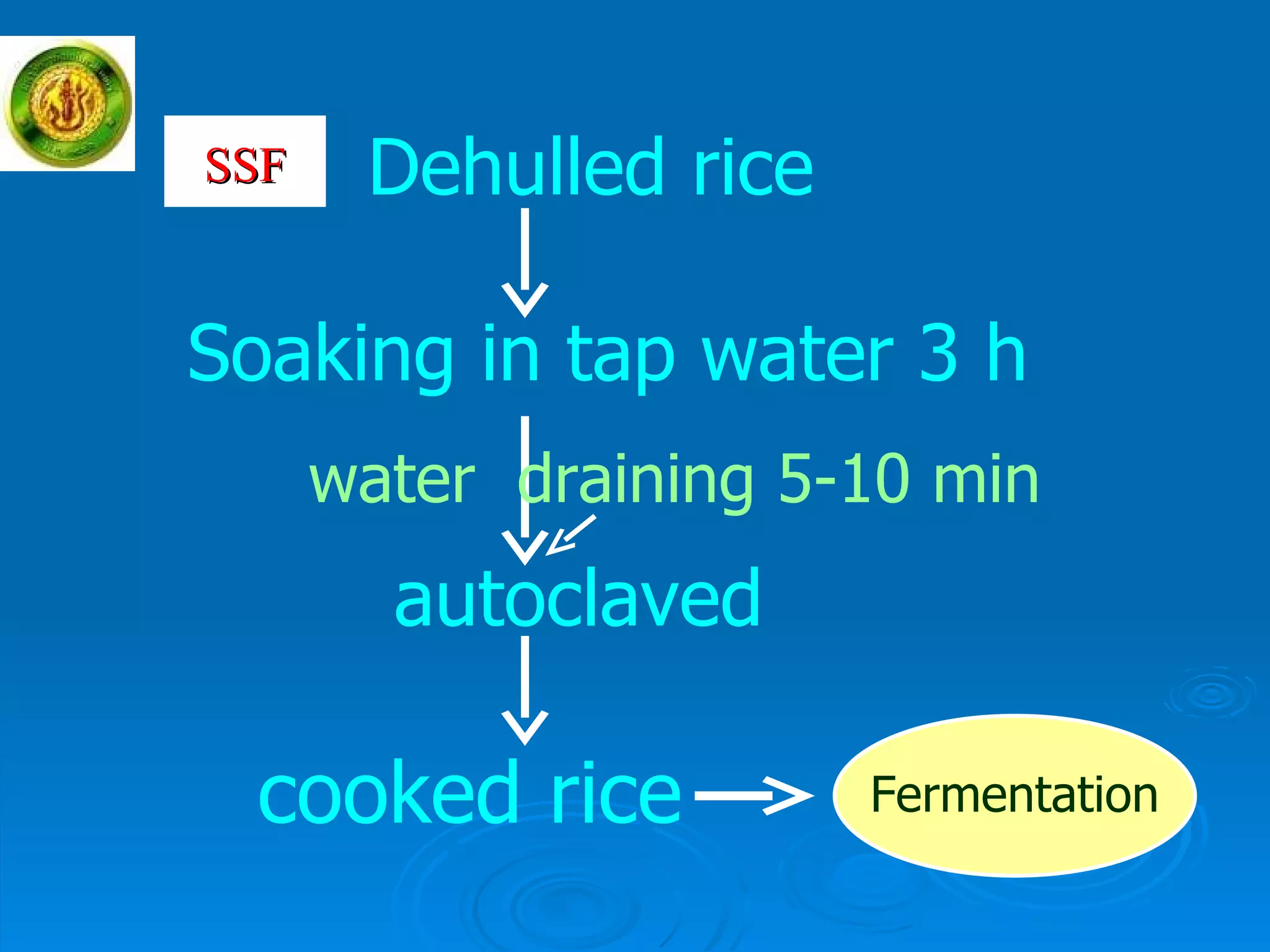
Dehulled rice Soaking in tap water 3 h water  draining 5-10 min autoclaved cooked rice Fermentation SSF
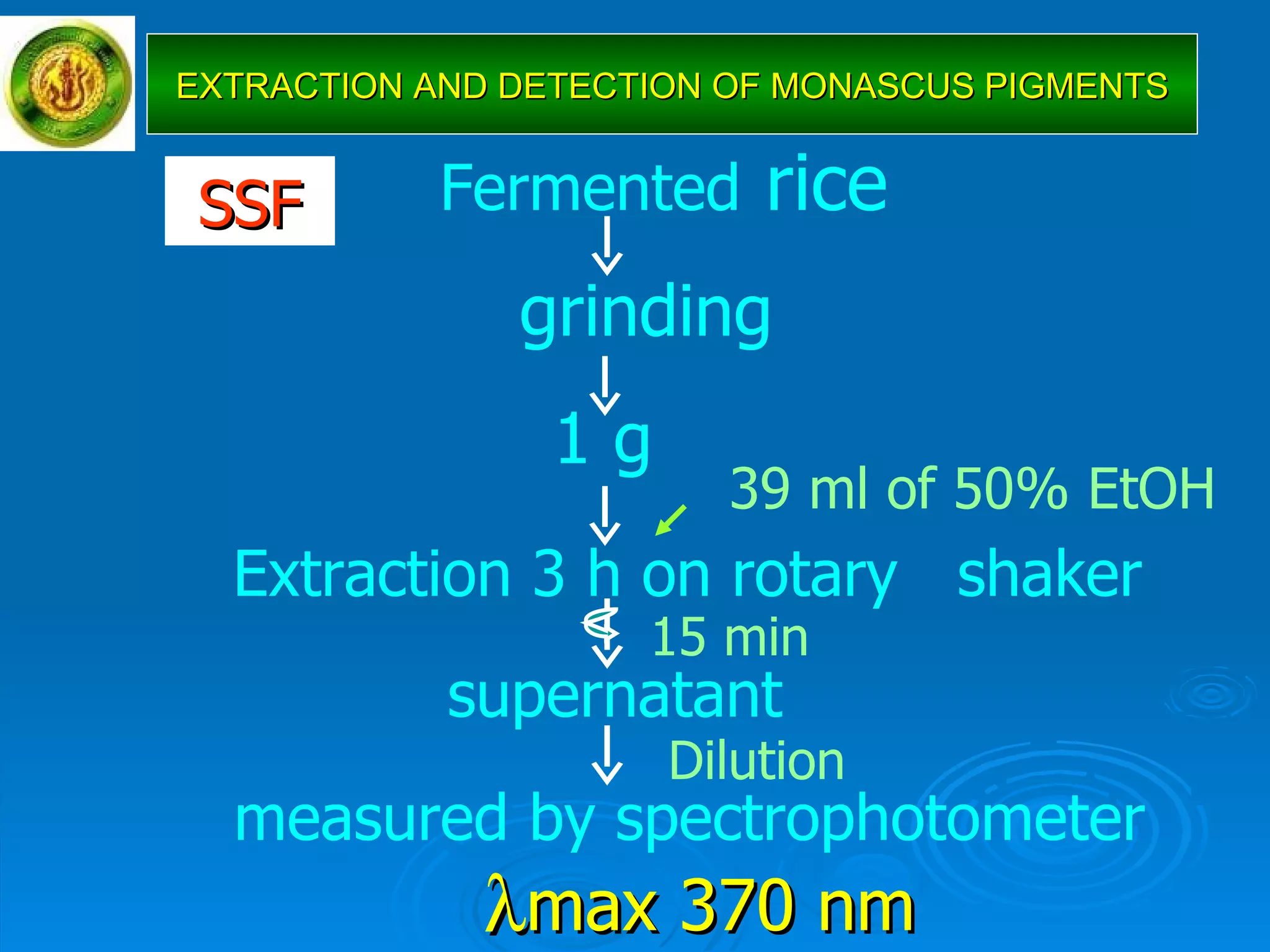
SSF Fermented  rice grinding 1 g 39 ml of 50% EtOH 15 min supernatant measured by spectrophotometer    max 370 nm Dilution Extraction 3 h on rotary  shaker EXTRACTION AND DETECTION OF MONASCUS PIGMENTS
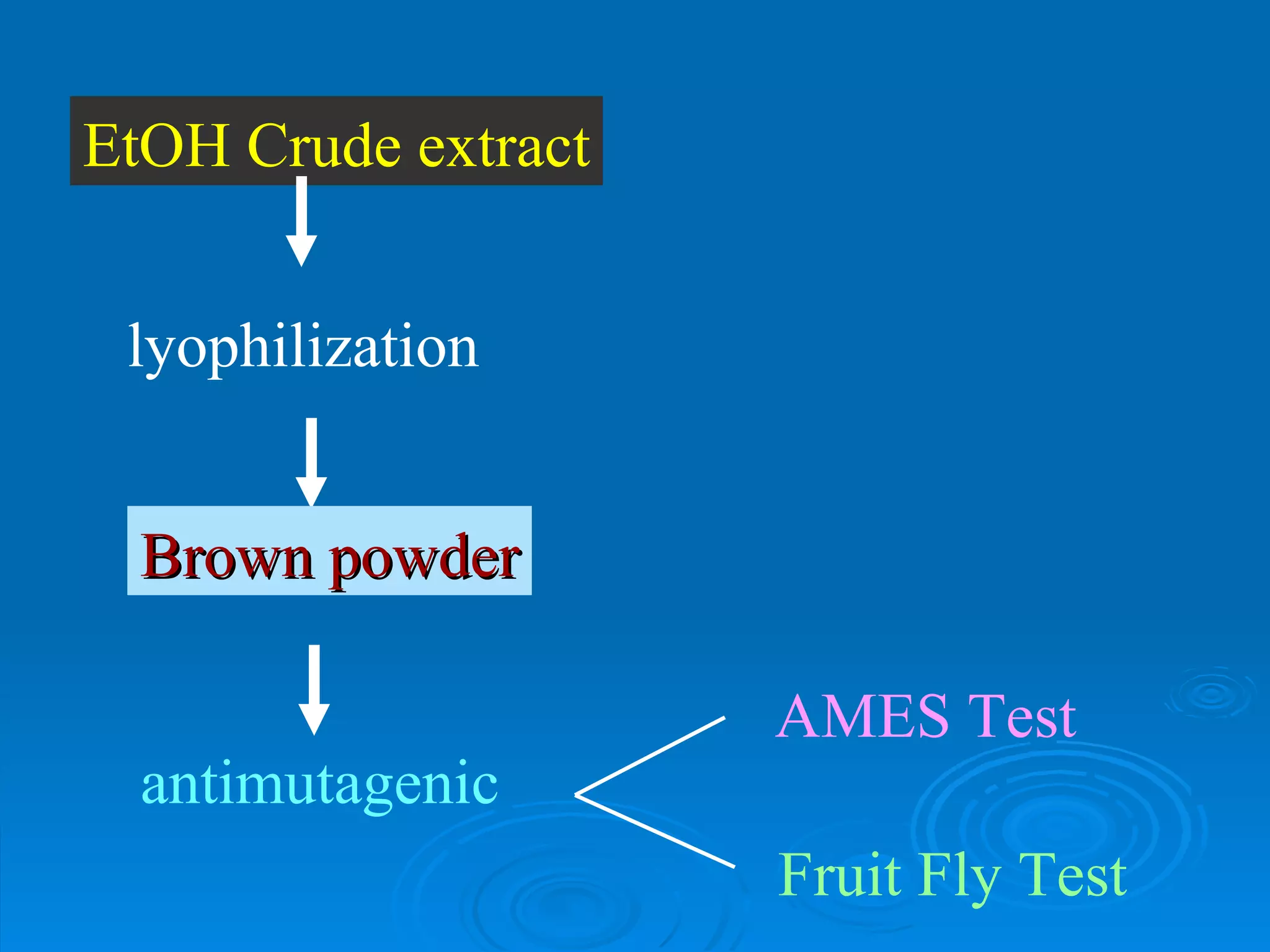
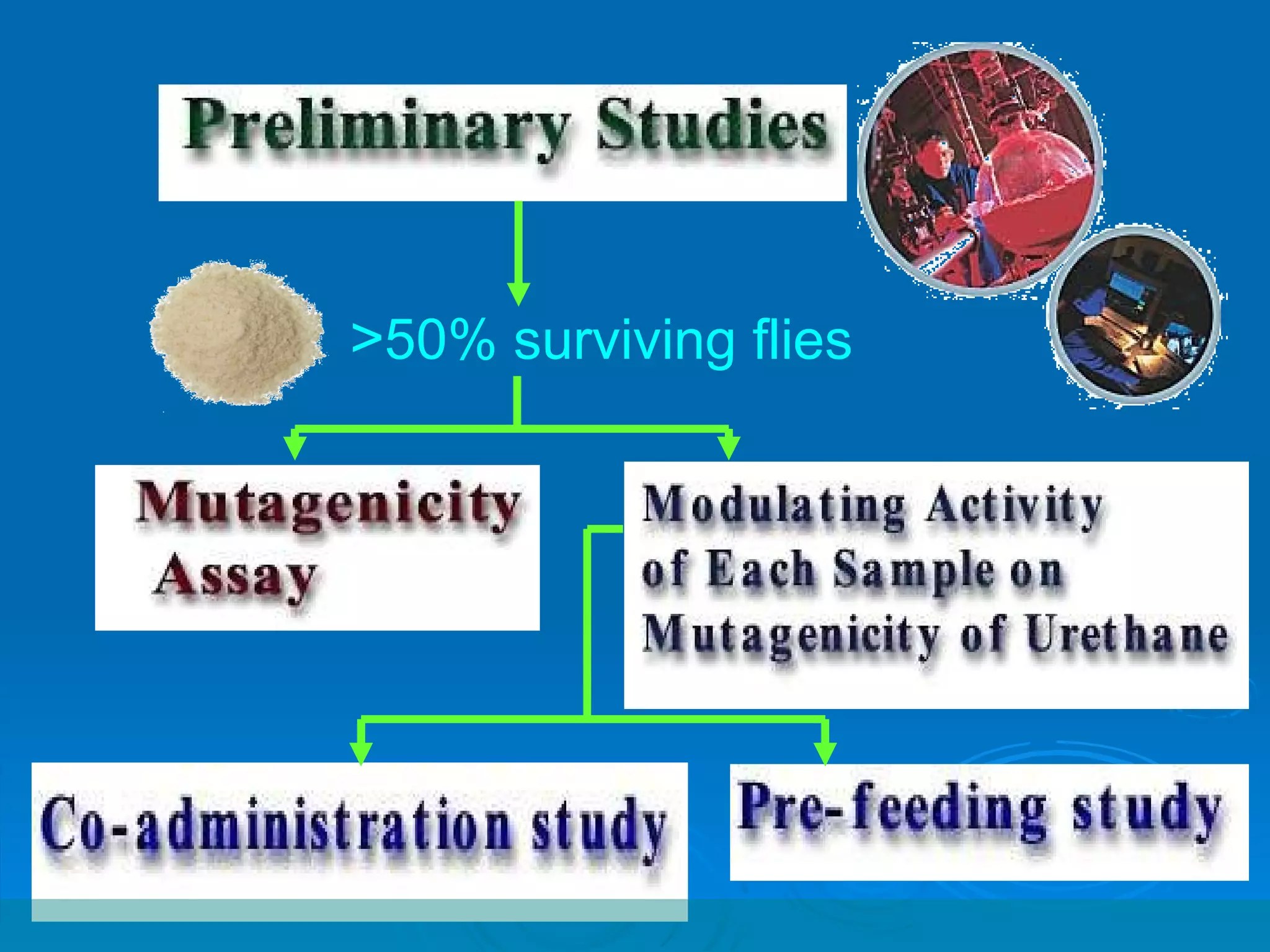
EtOH Crude extract antimutagenic lyophilization Brown powder AMES Test Fruit Fly Test
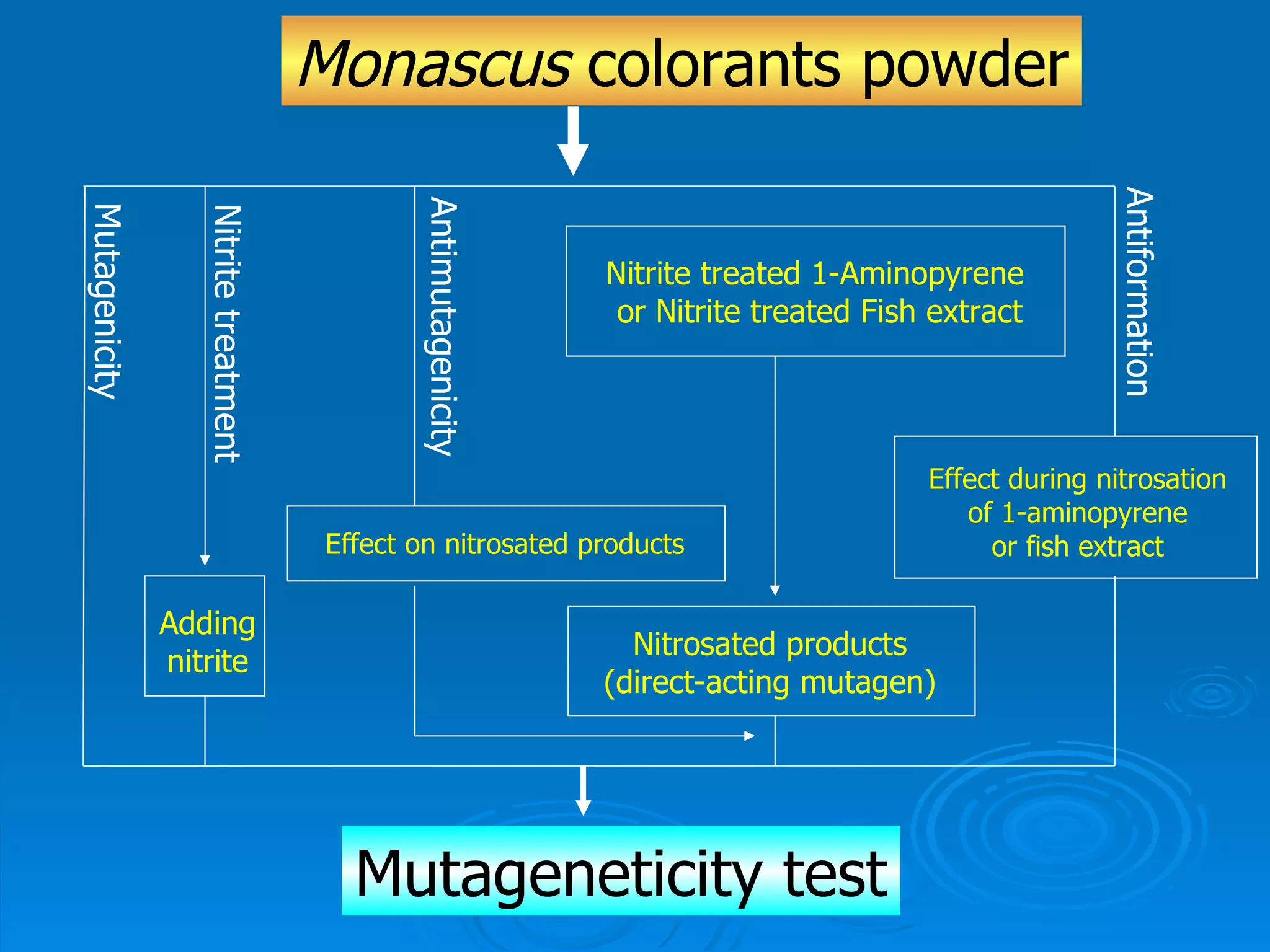
Nitrite treated 1-Aminopyrene  or   Nitrite treated Fish extract Effect during nitrosation of 1-aminopyrene or fish extract Nitrosated products (direct-acting mutagen) Effect on nitrosated   products Adding nitrite Mutageneticity test Antiformation Antimutagenicity Nitrite treatment Mutagenicity Monascus  colorants powder
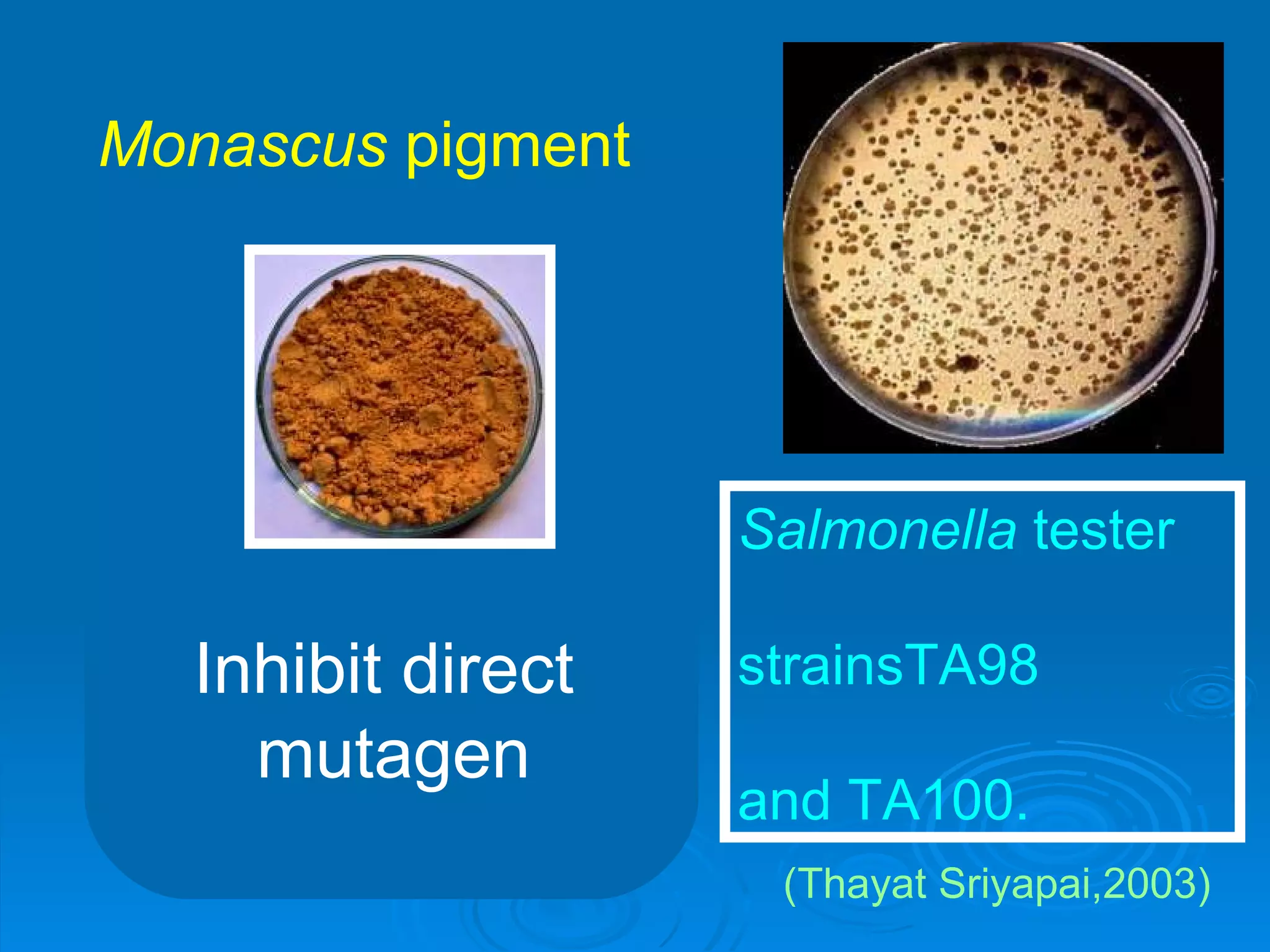
(Thayat Sriyapai,2003) Salmonella  tester  strainsTA98 and TA100.   Inhibit direct  mutagen Monascus  pigment
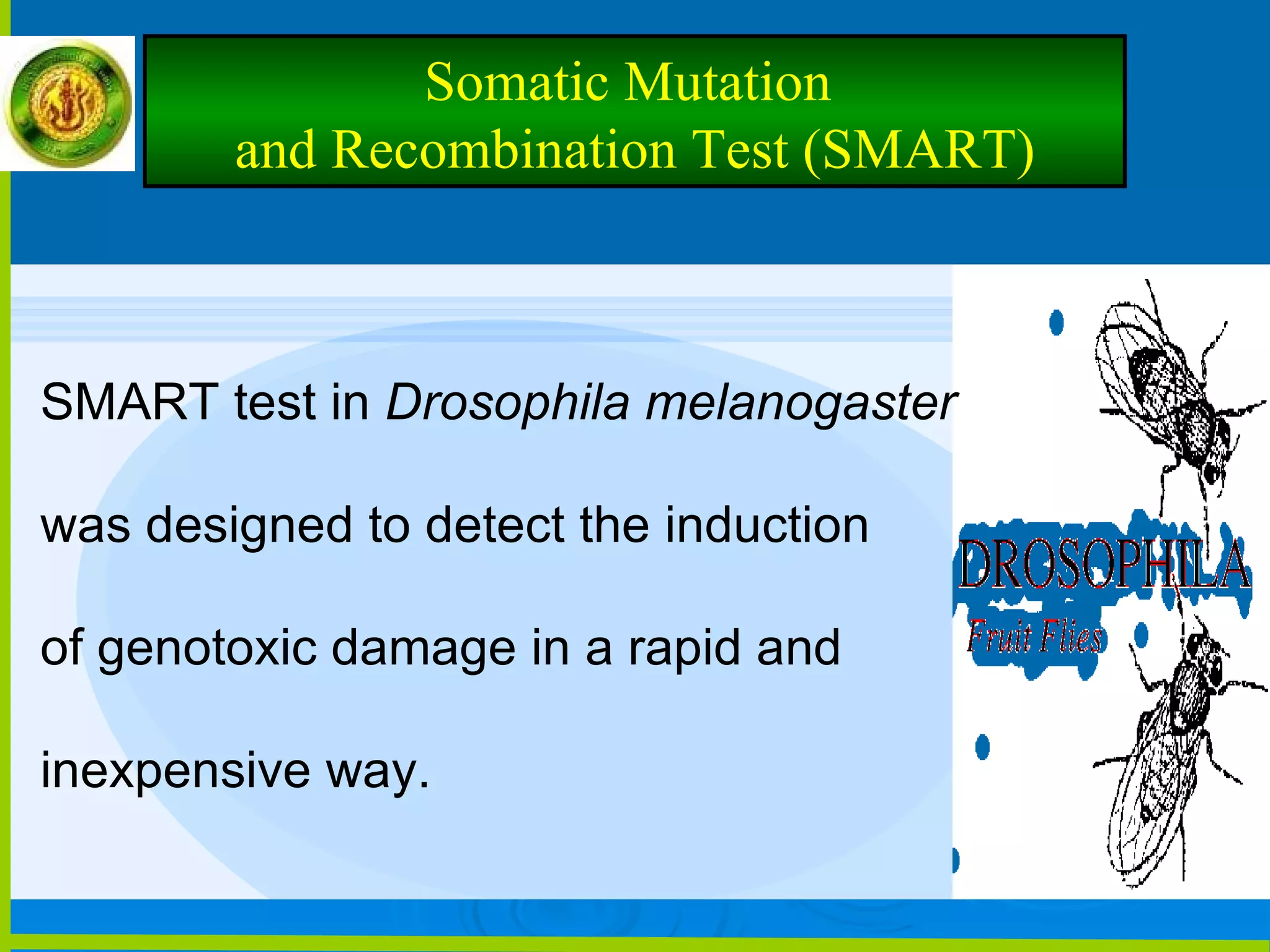
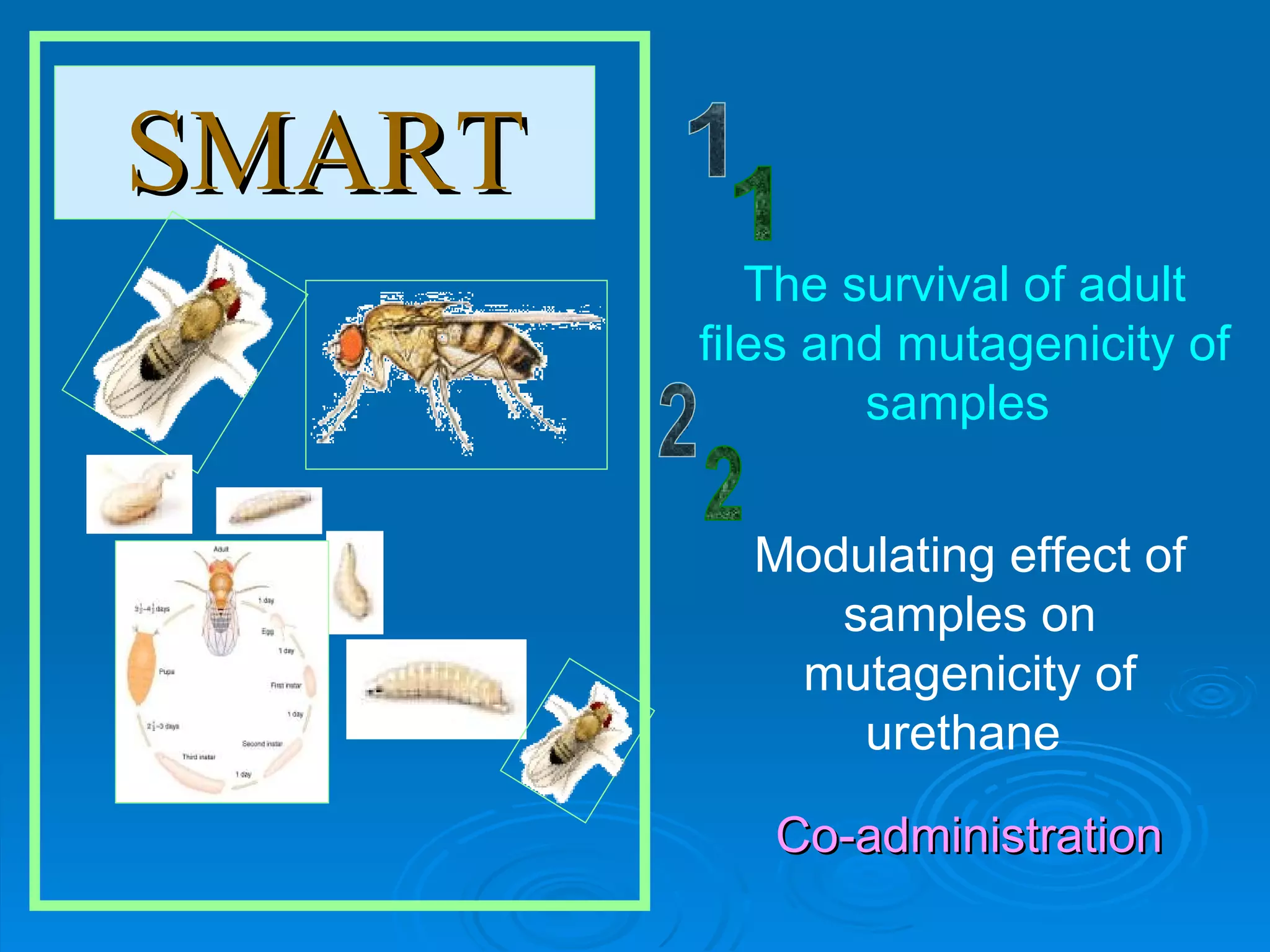
SMART test in  Drosophila melanogaster   was designed to detect the induction of genotoxic damage in a rapid and inexpensive way.  Somatic Mutation  and Recombination Test (SMART)
> 50% surviving flies
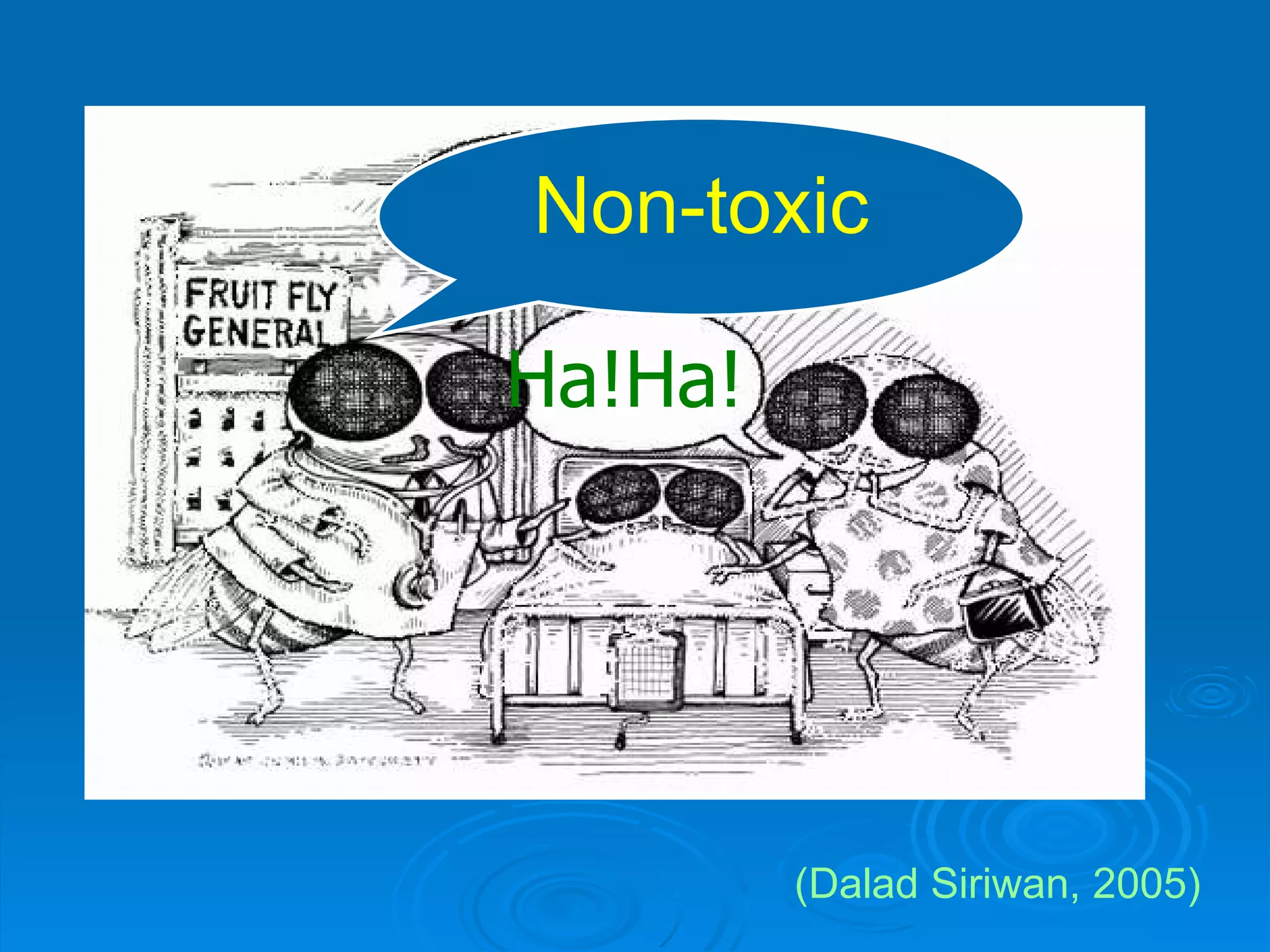
(Dalad Siriwan, 2005)  Non-toxic Oh ! Ha!Ha!
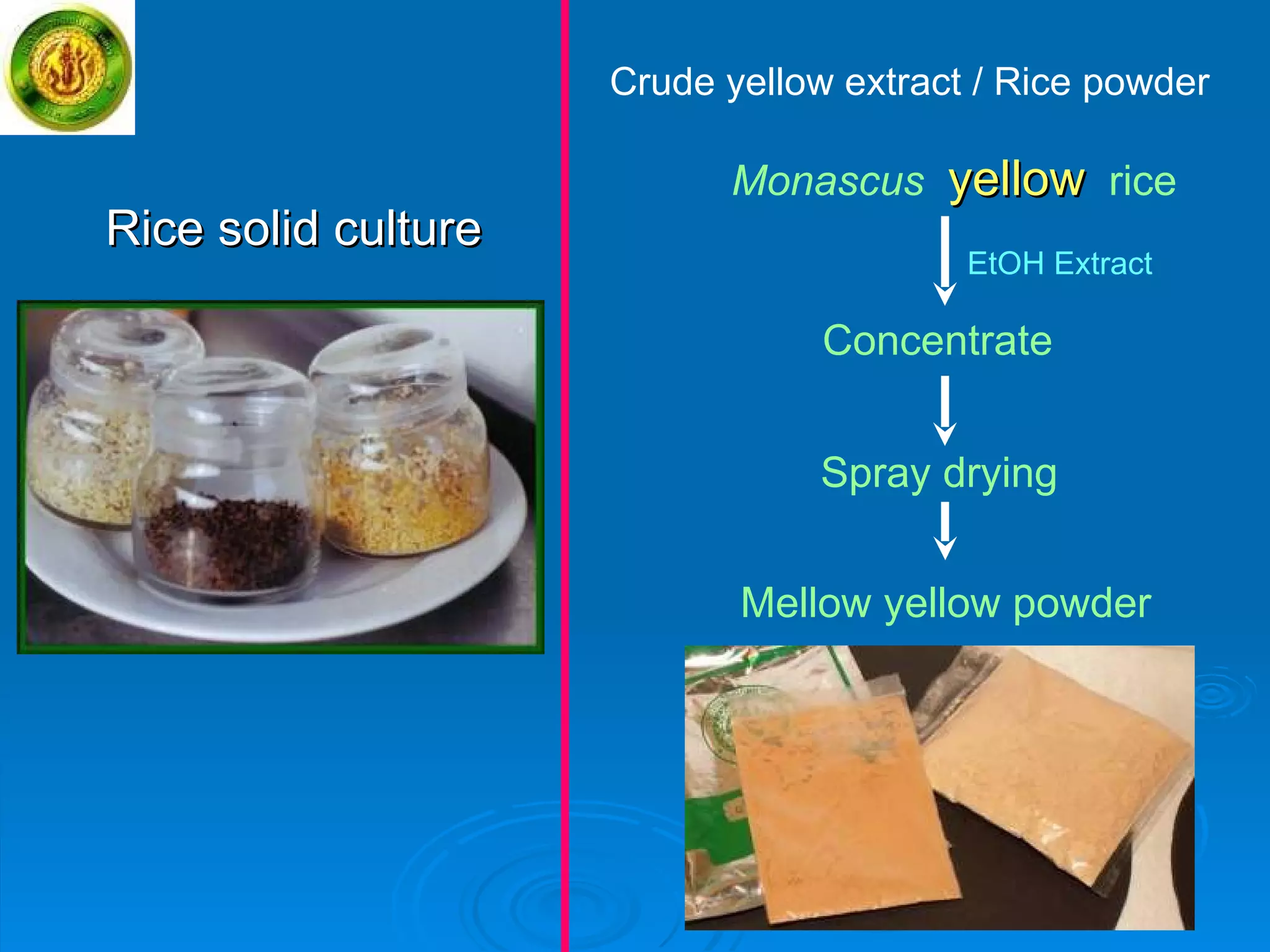
Monascus  yellow   rice EtOH Extract Concentrate Spray drying Mellow yellow powder Rice solid culture Crude yellow extract / Rice powder
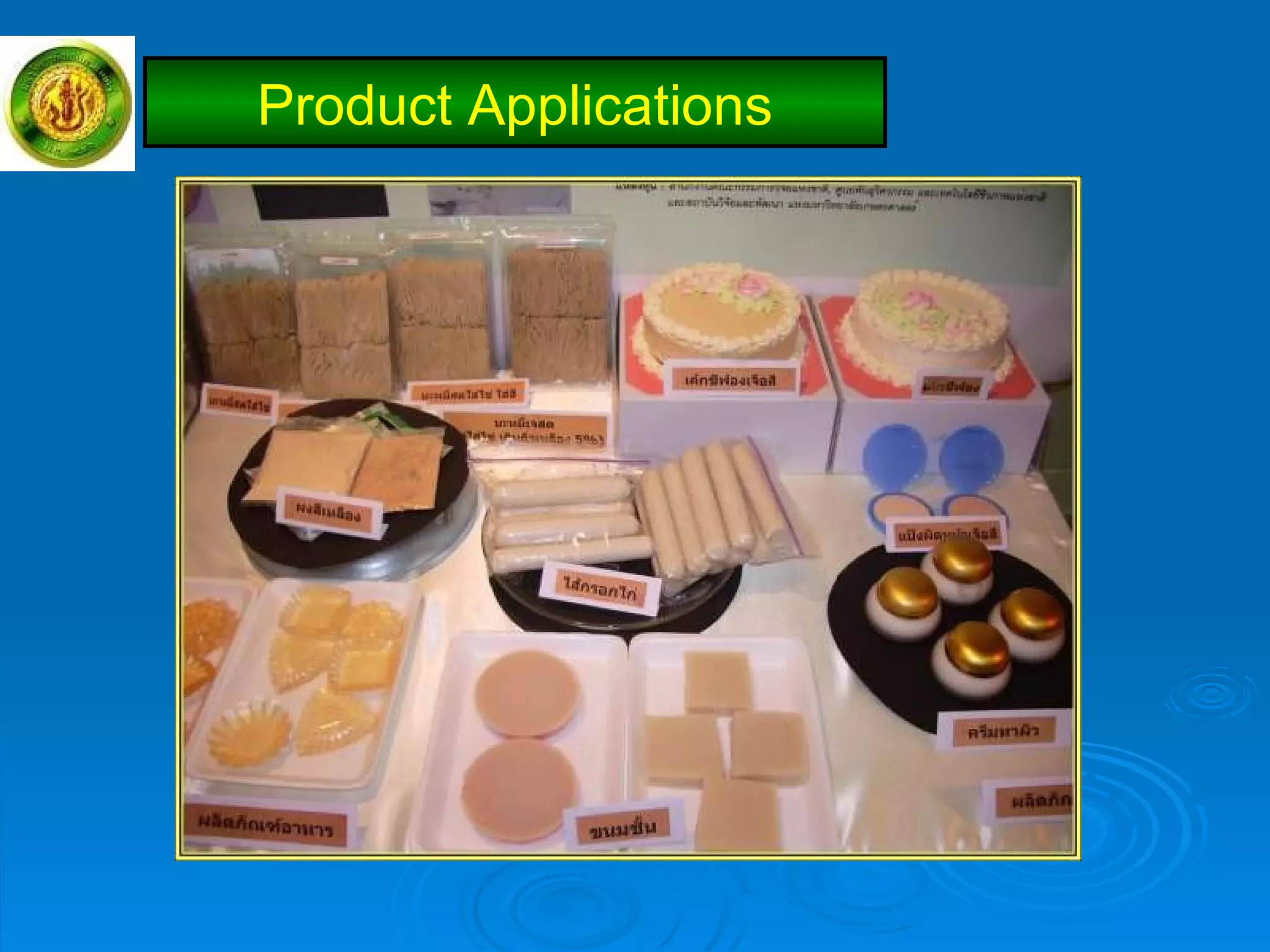
Product Applications
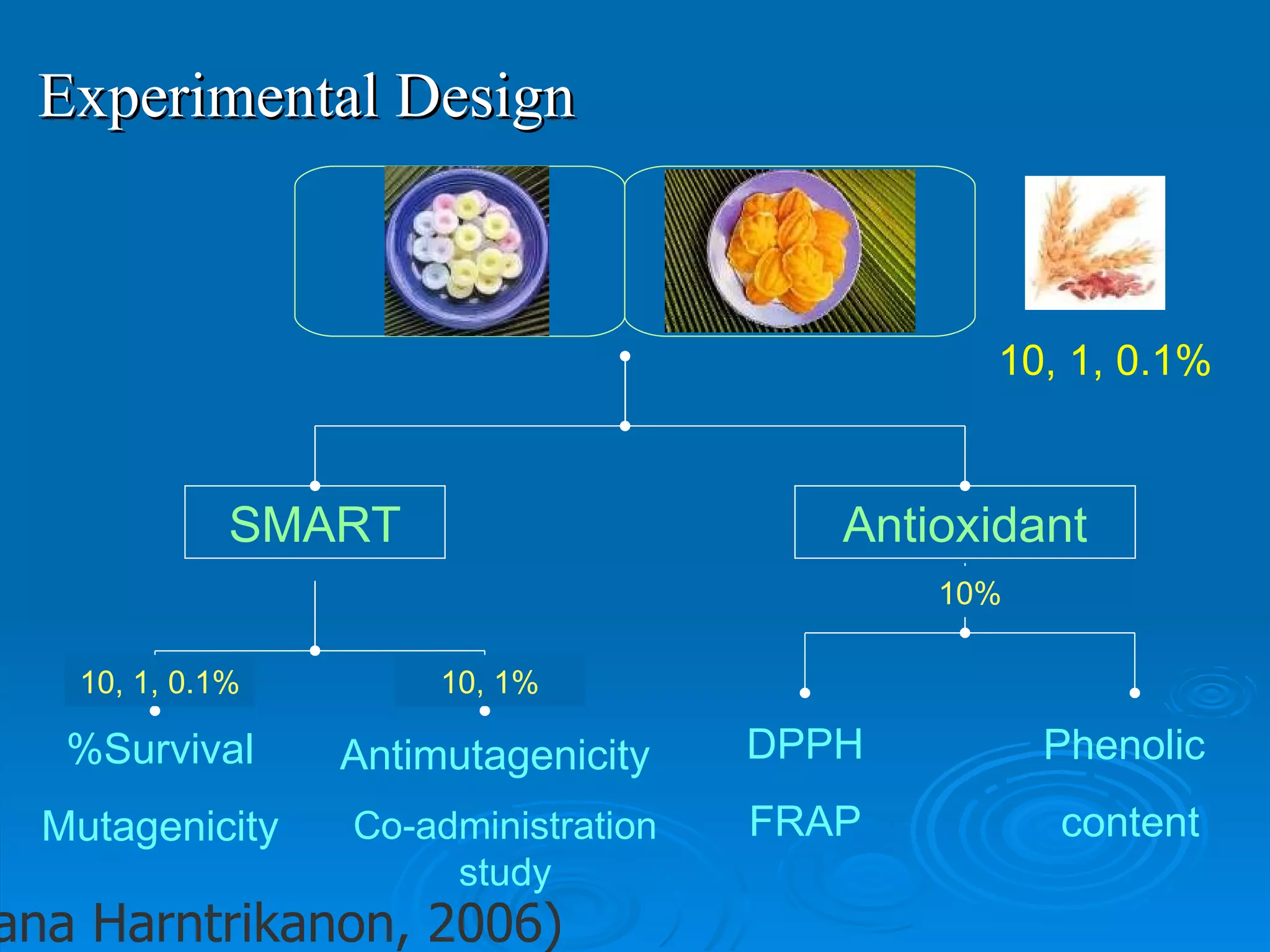
Experimental Design 10, 1, 0.1% Phenolic  content 10, 1, 0.1% 10, 1% 10% Nissana Harntrikanon, 2006) SMART Antioxidant %Survival Mutagenicity Antimutagenicity Co-administration study DPPH FRAP
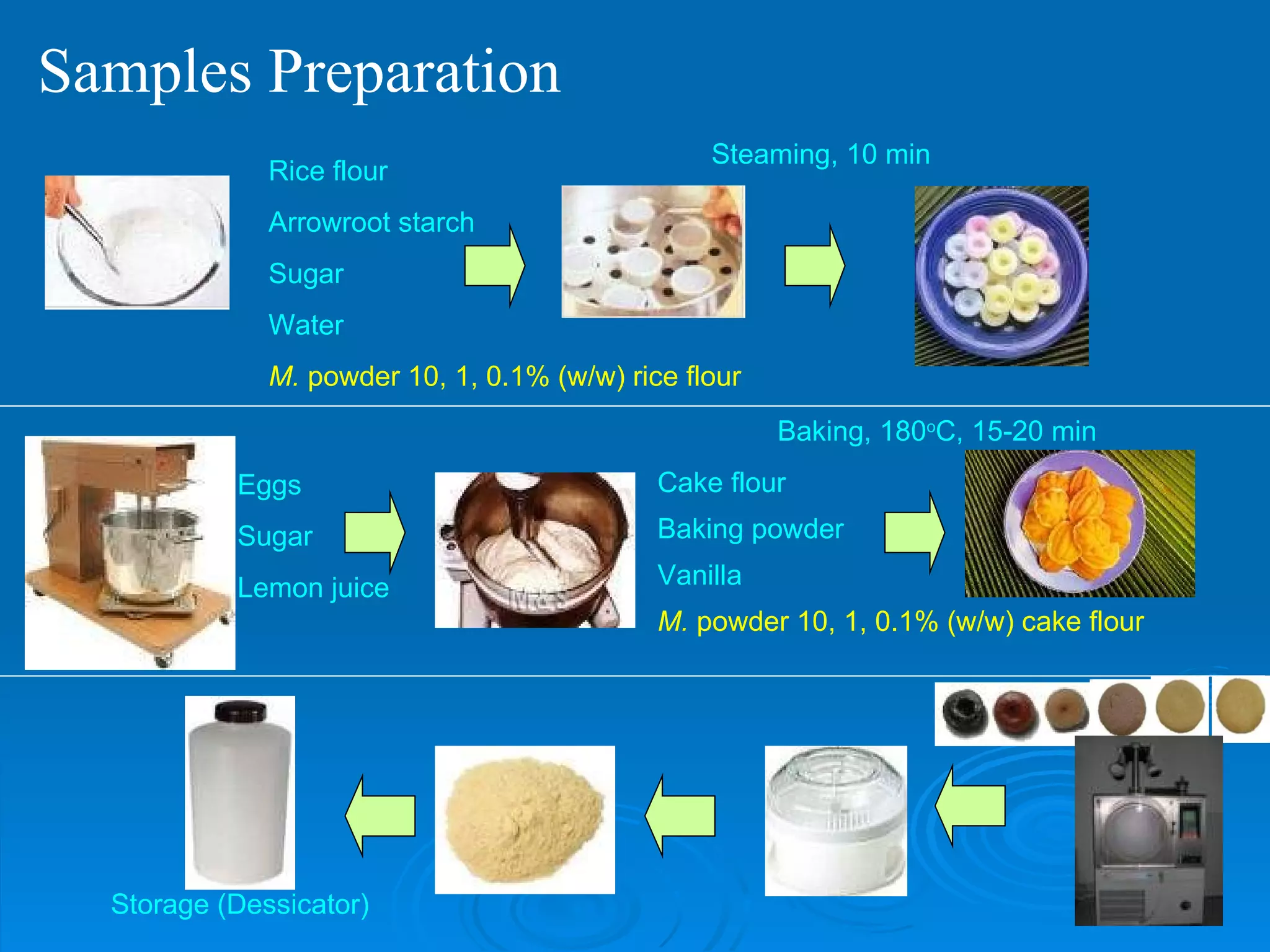
Samples Preparation  Rice flour Arrowroot starch  Sugar  Water  M.  powder 10, 1, 0.1% (w/w) rice flour   Steaming, 10 min  Eggs  Sugar  Lemon juice  Cake flour Baking powder Vanilla M.  powder 10, 1, 0.1% (w/w) cake flour Baking, 180 o C, 15-20 min Storage (Dessicator)
Co-administration SMART The survival of adult files and mutagenicity of samples  1 Modulating effect of samples on mutagenicity of urethane  2
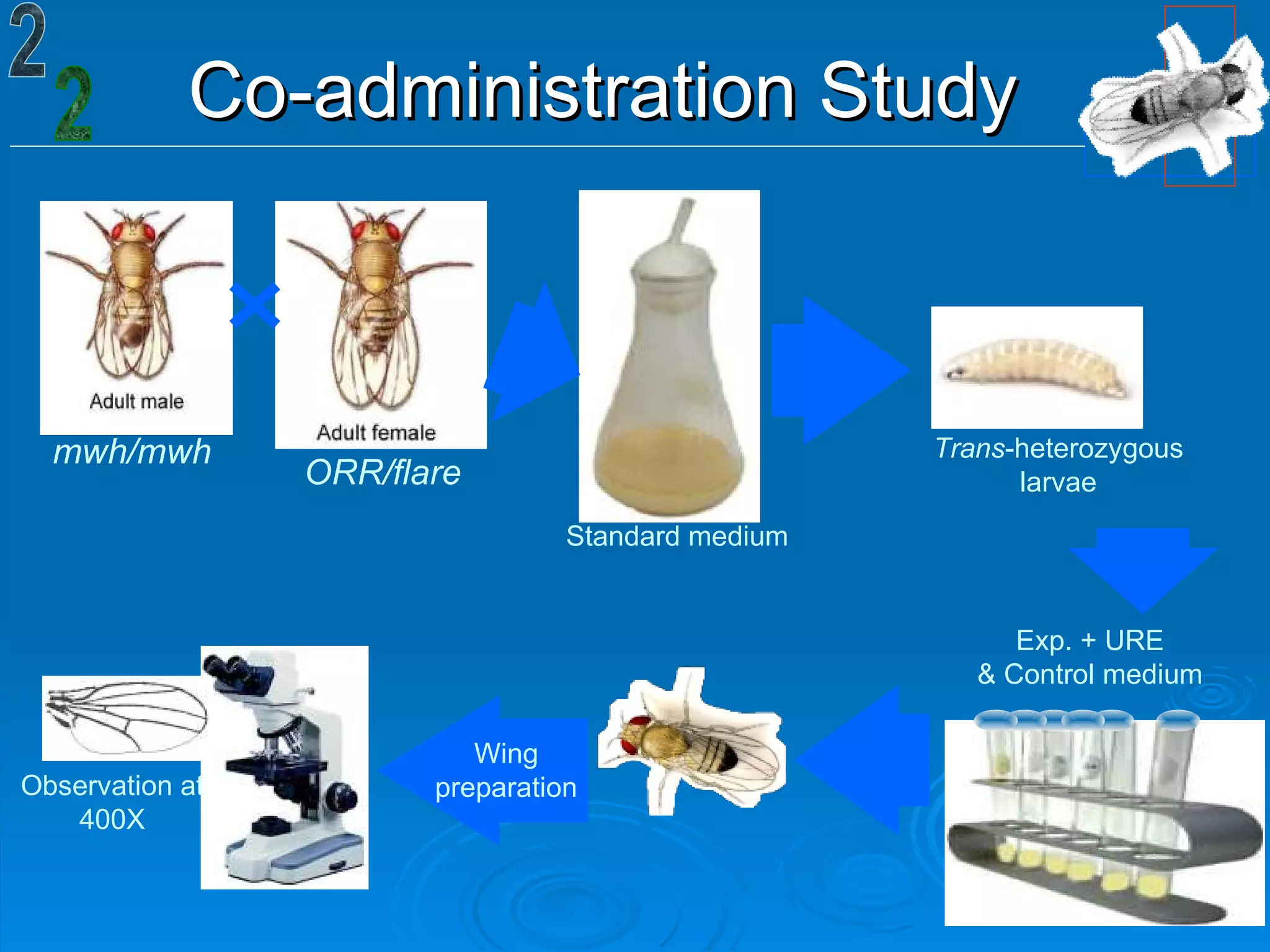
Co-administration Study 2 Wing preparation Observation at 400X mwh/mwh ORR/flare Standard medium Trans -heterozygous larvae Exp. + URE & Control medium
Mutation   Index MI =  Spots per wing induced by URE administrated with sample Spots per wing induced by URE MI of URE = 1 Antimutagenicity > 0.8: negligible  0.6-0.8: weak 0.4-0.6: moderate  < 0.4: strong
Discussion No information  1 prove  Inhibition of CYP-450 Induction of GST   Thai desserts made from  Monascus  rice powder could reduce the mutagenicity of urethane.  Hypothesis 1 Scavenging of urethane
1 Mutagenicity of Samples
All samples were  not mutagenic 1 Mutagenicity of Samples
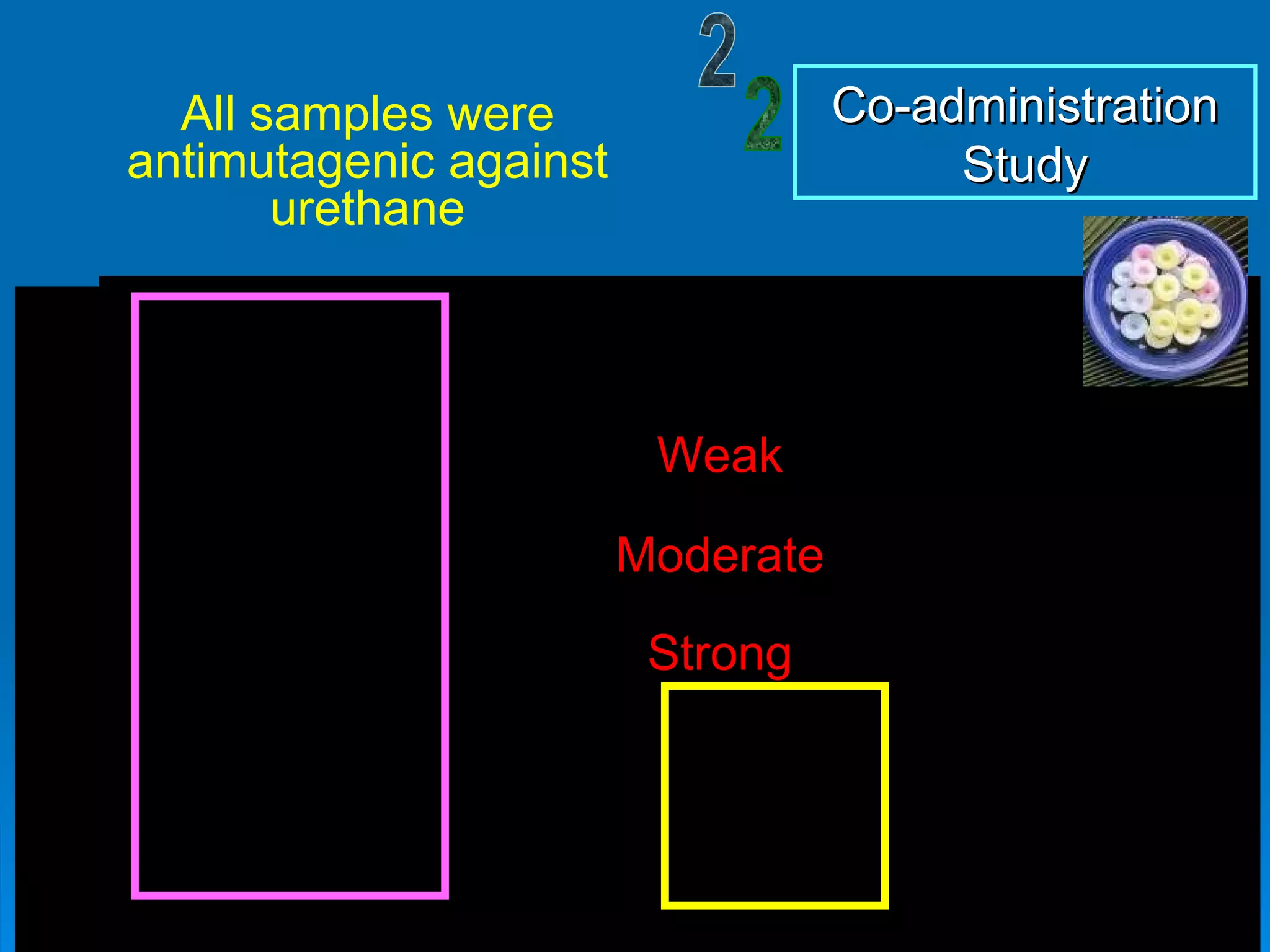
2 Co-administration Study All s amples  were  antimutagenic against urethane Strong Moderate Weak
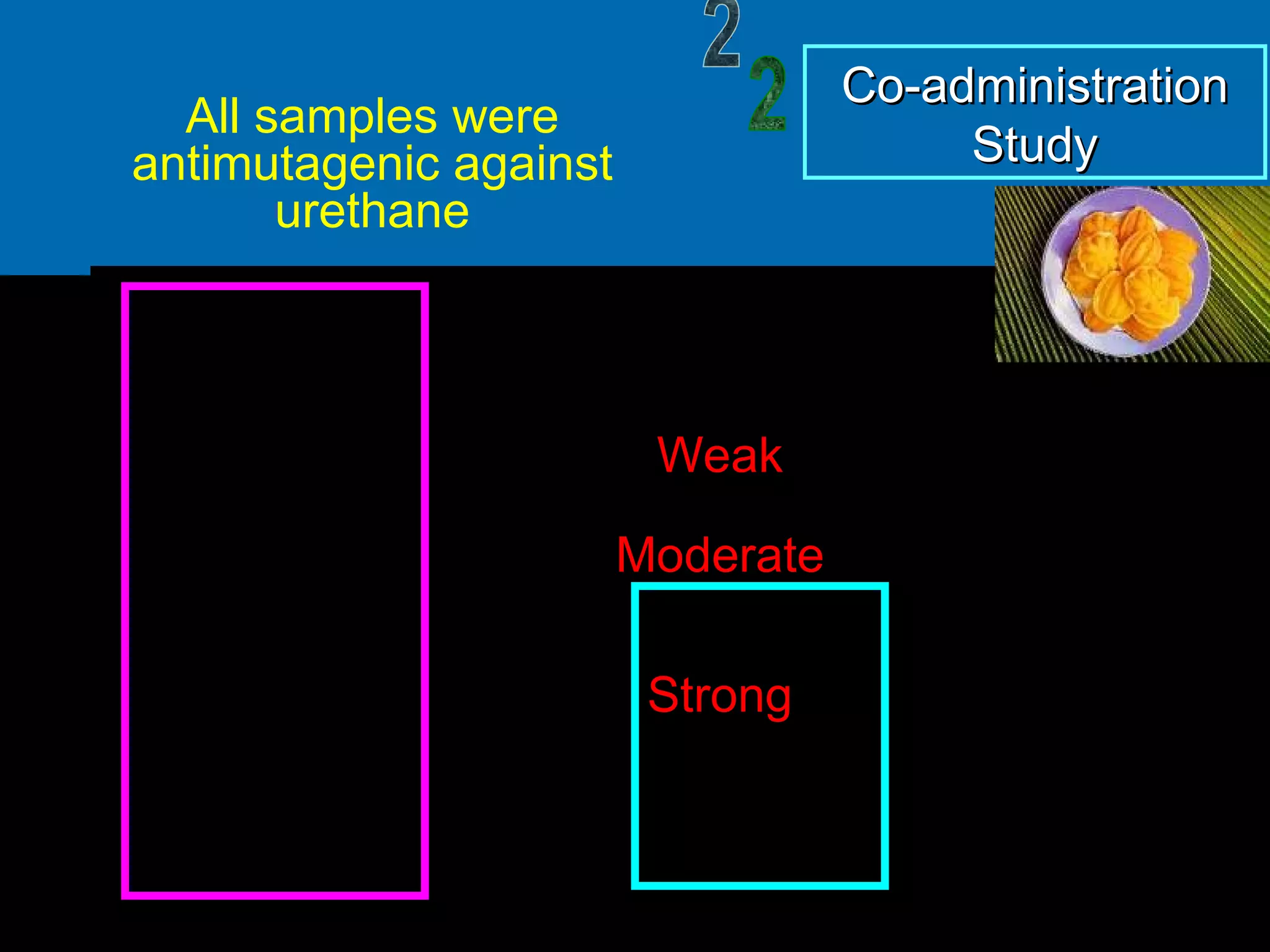
Co-administration Study 2 All s amples  were  antimutagenic against urethane Strong Moderate Weak
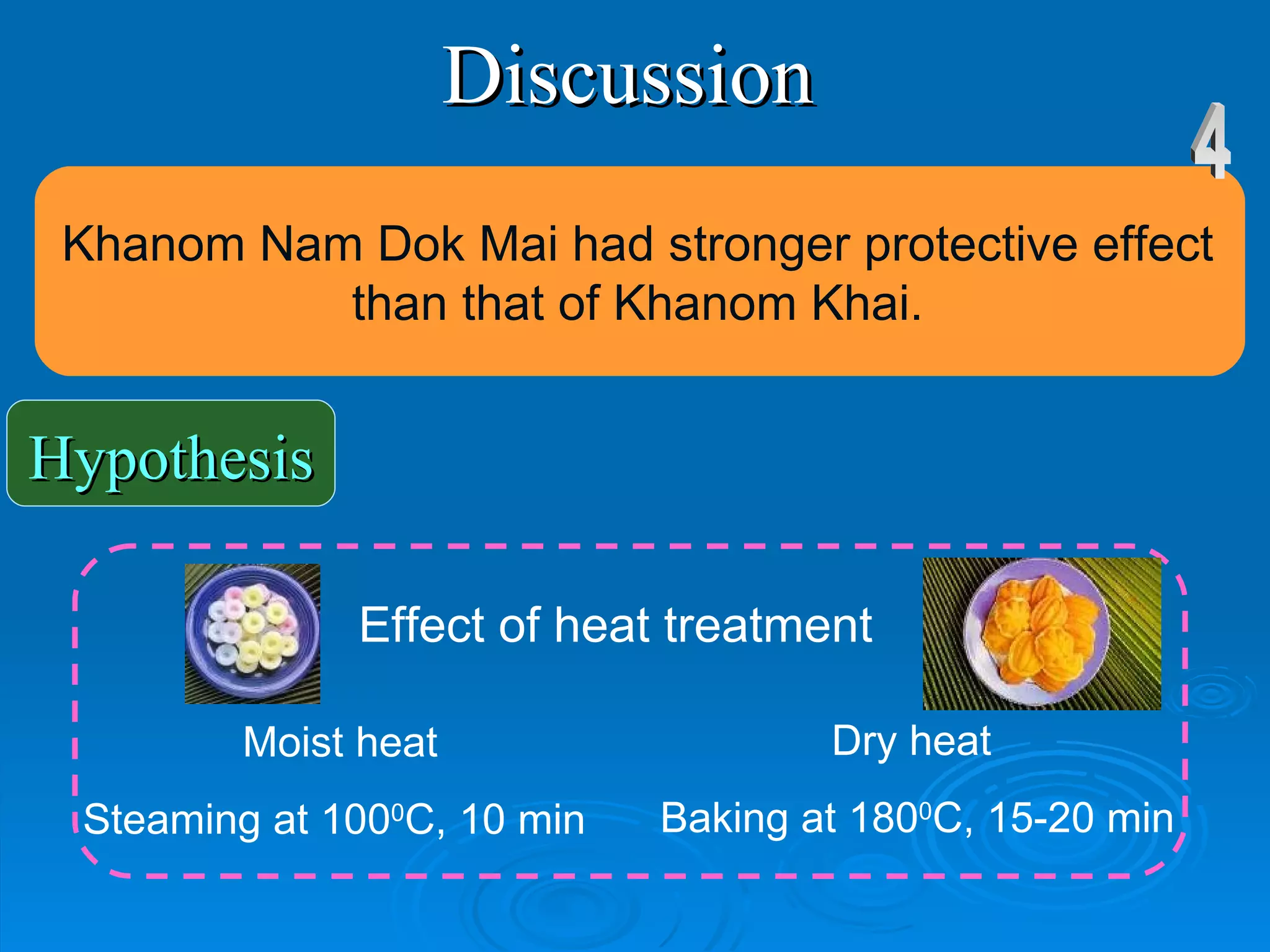
Discussion 4 Moist heat Steaming at 100 0 C, 10 min  Dry heat  Baking at 180 0 C, 15-20 min  Khanom Nam Dok Mai had stronger protective effect than that of Khanom Khai . Hypothesis Effect of heat treatment
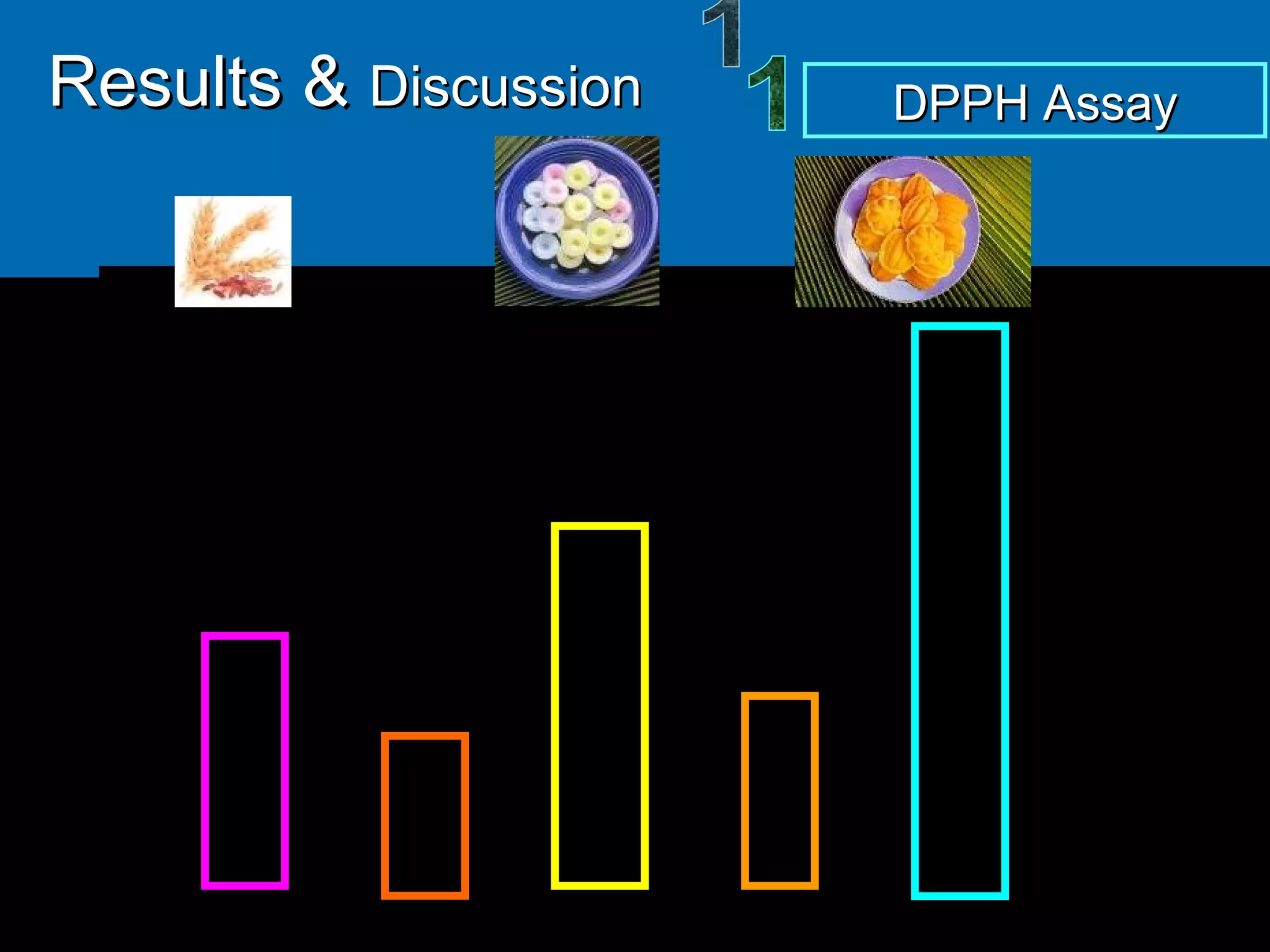
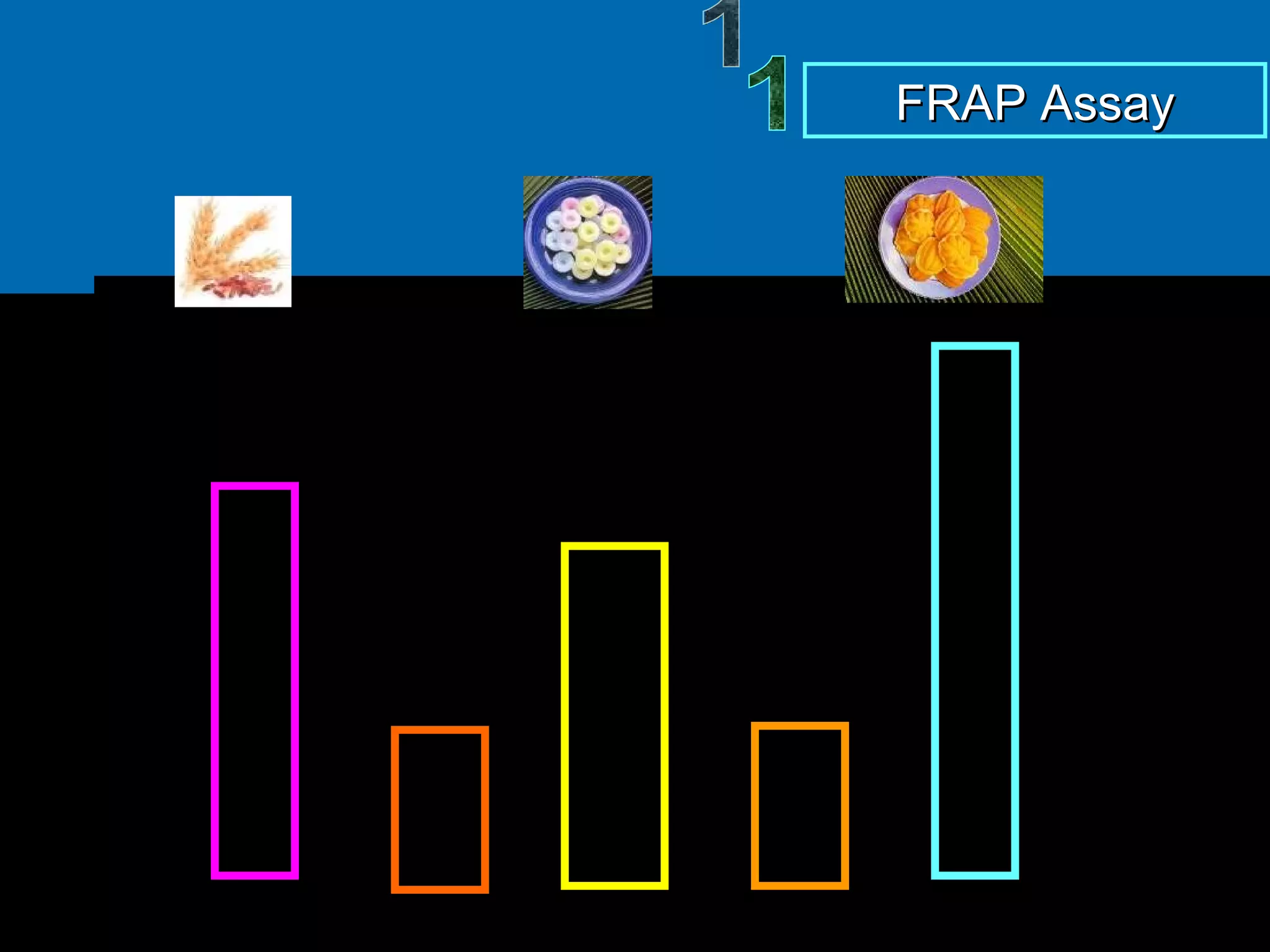
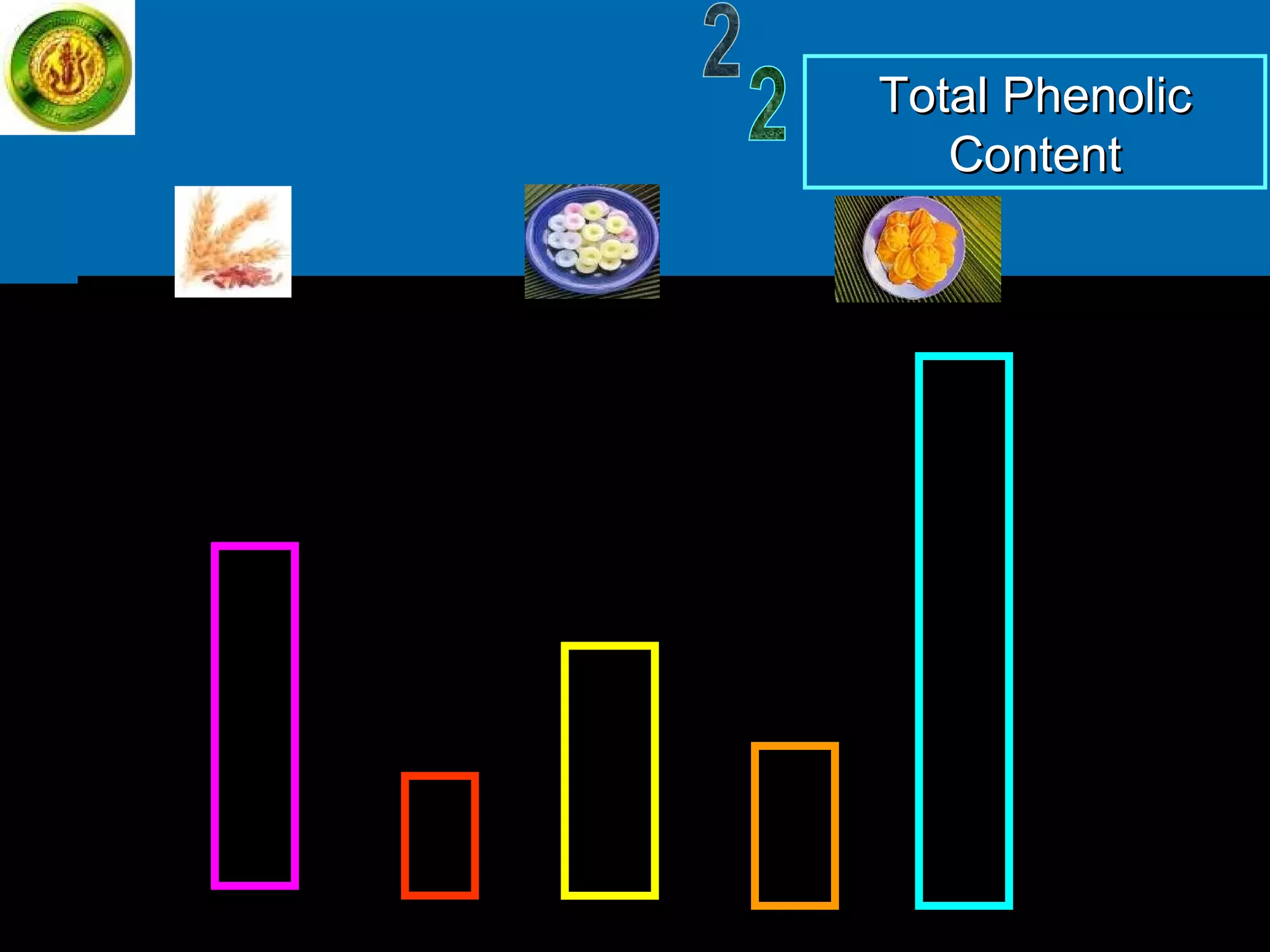
Discussion 1 All types of  Monascus  rice powder themselves had phenolic contents and antioxidant activity.  Hypothesis Antioxidative potential
Discussion 2 prove  Thai desserts made from  Monascus  rice powder remained total phenolic content and antioxidant activity. Hypothesis Some compounds of  Monascus  rice powder were heat stable
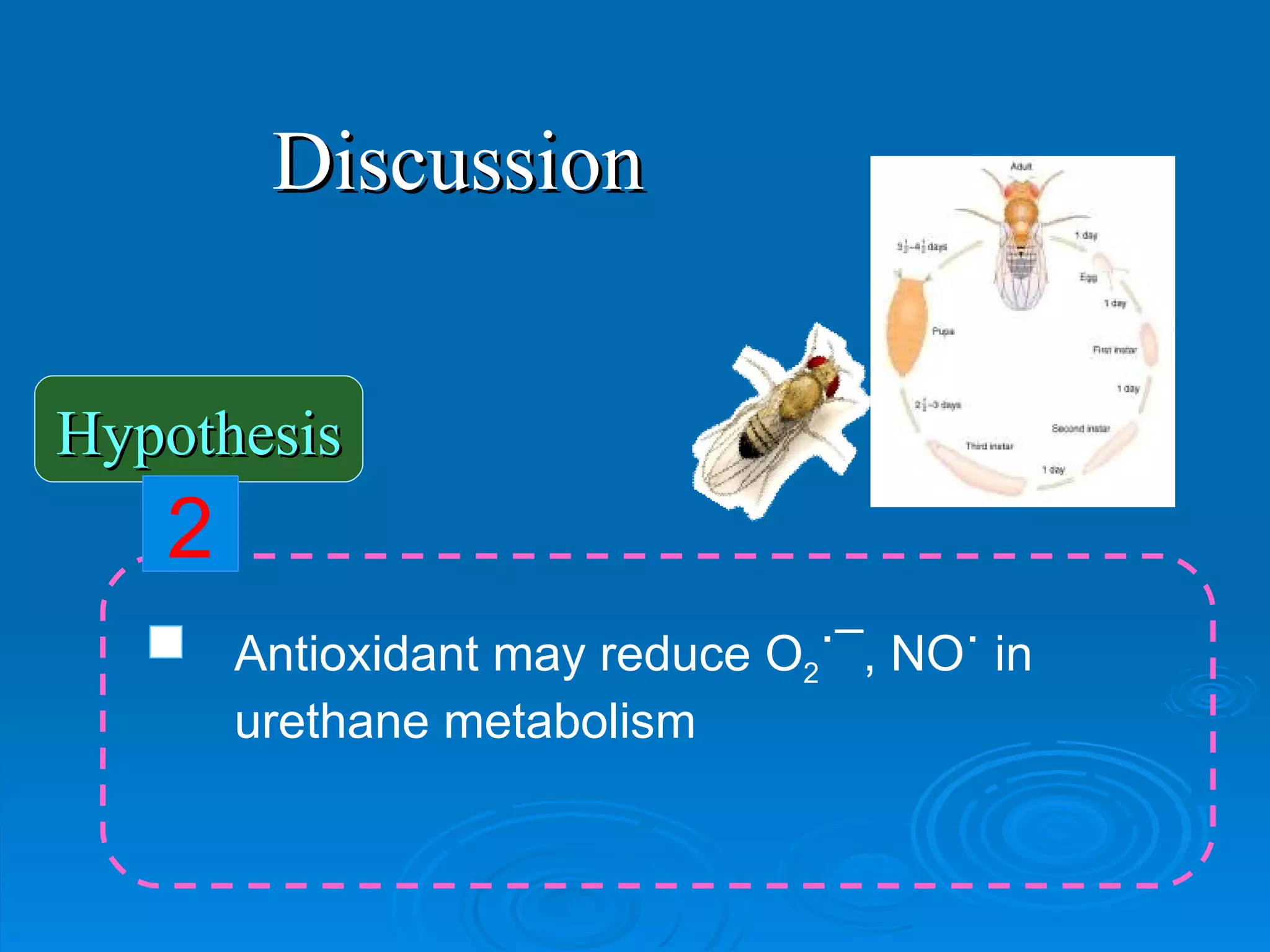
Discussion Hypothesis 2 Antioxidant may reduce  O 2 ˙¯, NO˙  in  urethane metabolism
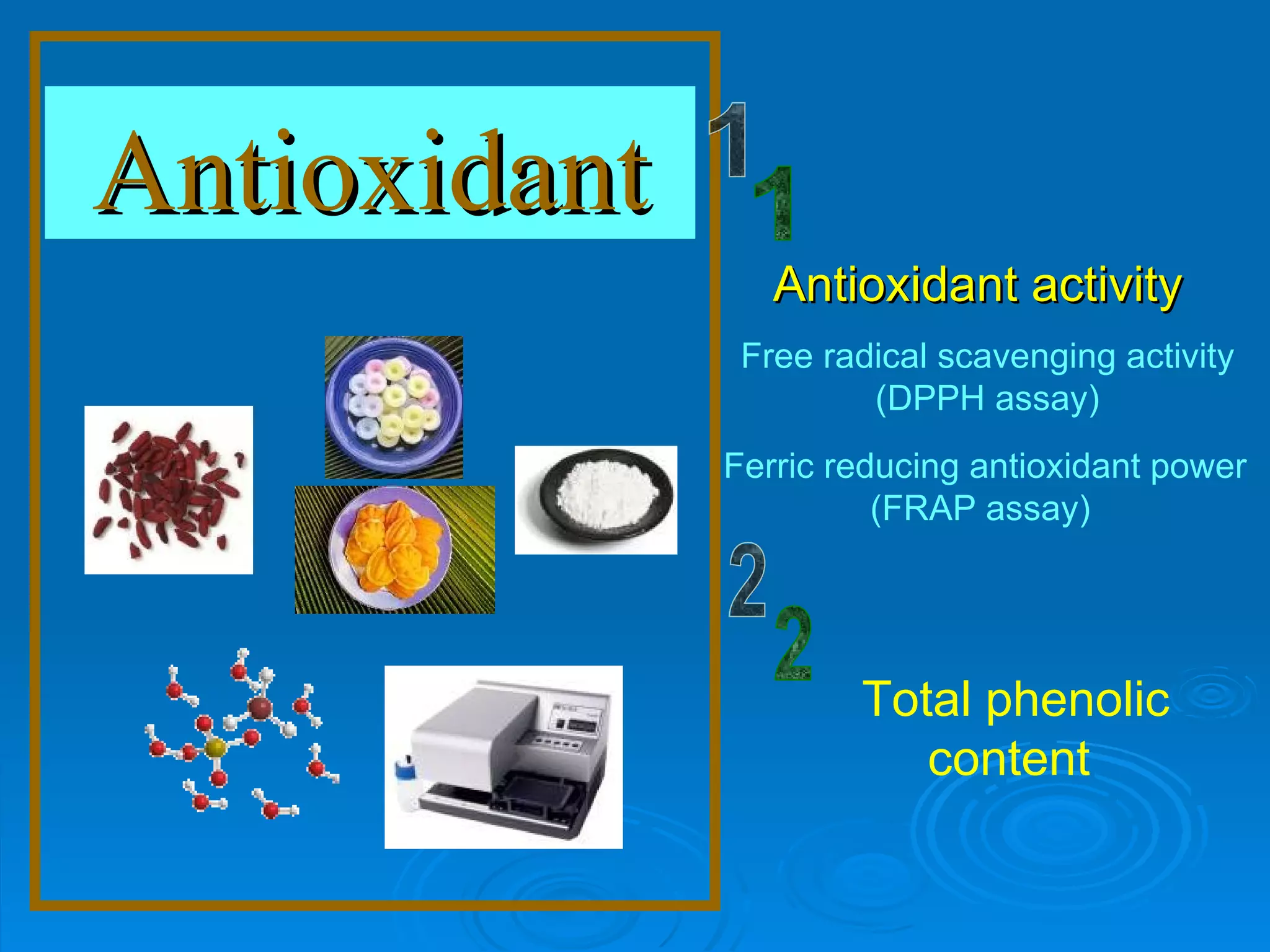
Antioxidant Free radical scavenging activity (DPPH assay) Ferric reducing antioxidant power (FRAP assay)  Antioxidant activity   1 Total phenolic content  2
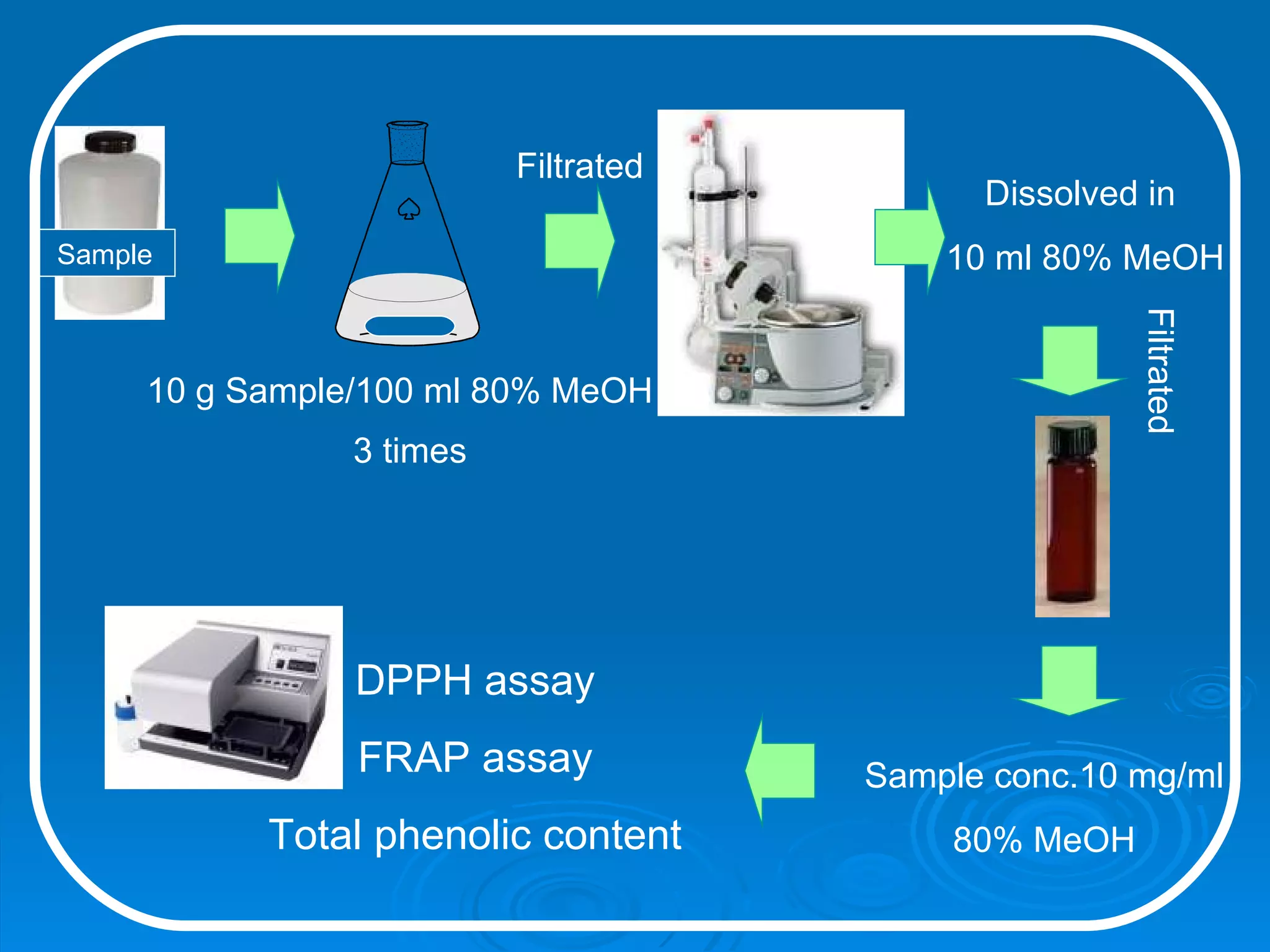
Sample 10 g Sample/100 ml 80% MeOH 3 times Filtrated Sample conc.10 mg/ml 80% MeOH Filtrated Dissolved in  10 ml 80% MeOH DPPH assay FRAP assay Total phenolic content
Results &  Discussion DPPH Assay 1
FRAP Assay 1
Total Phenolic Content 2
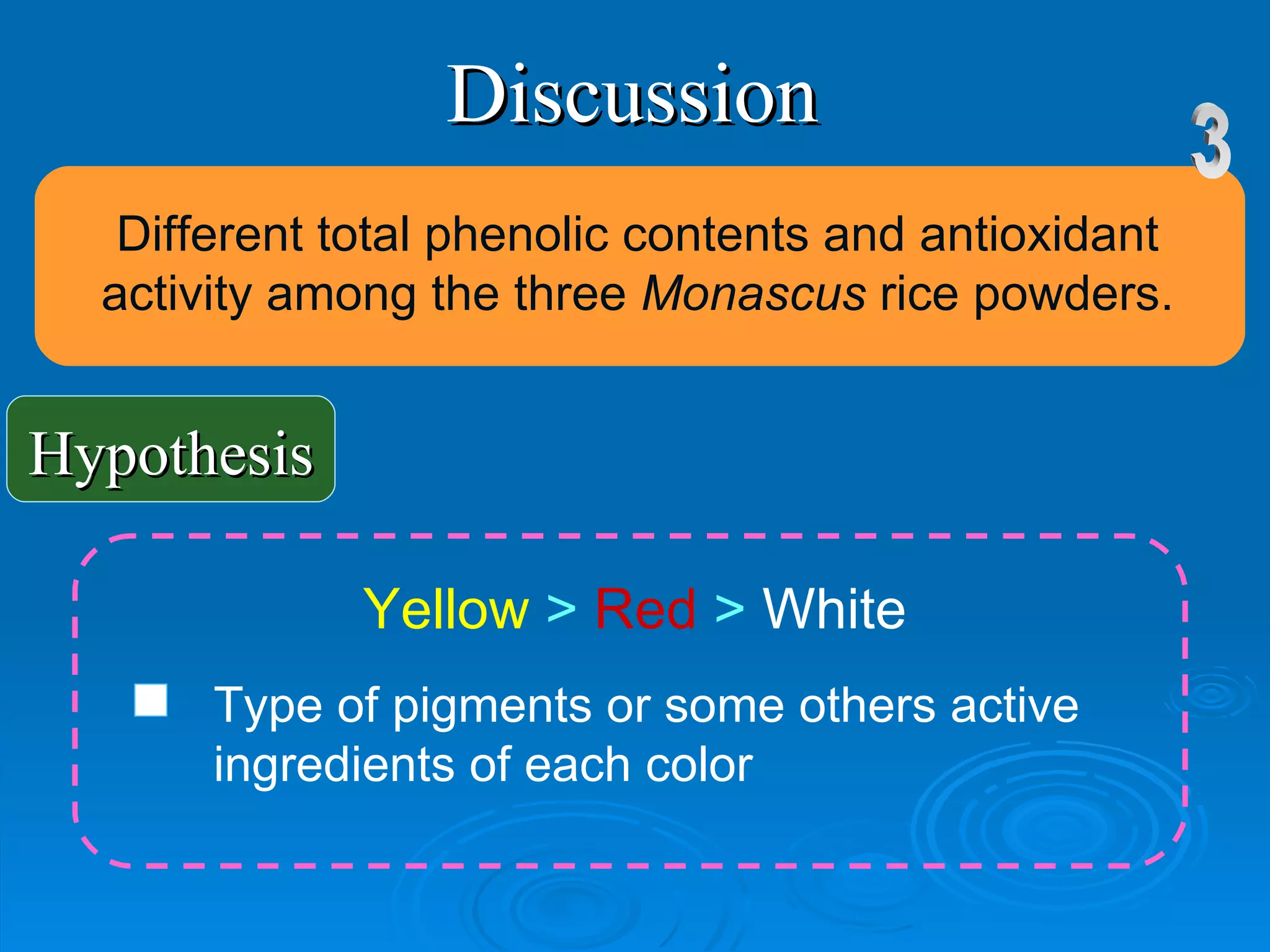
Discussion Yellow   >   Red  >  White 3 Different  total phenolic contents and antioxidant activity  among the three  Monascus  rice powders . Hypothesis Type of pigments or some others active  ingredients of each color
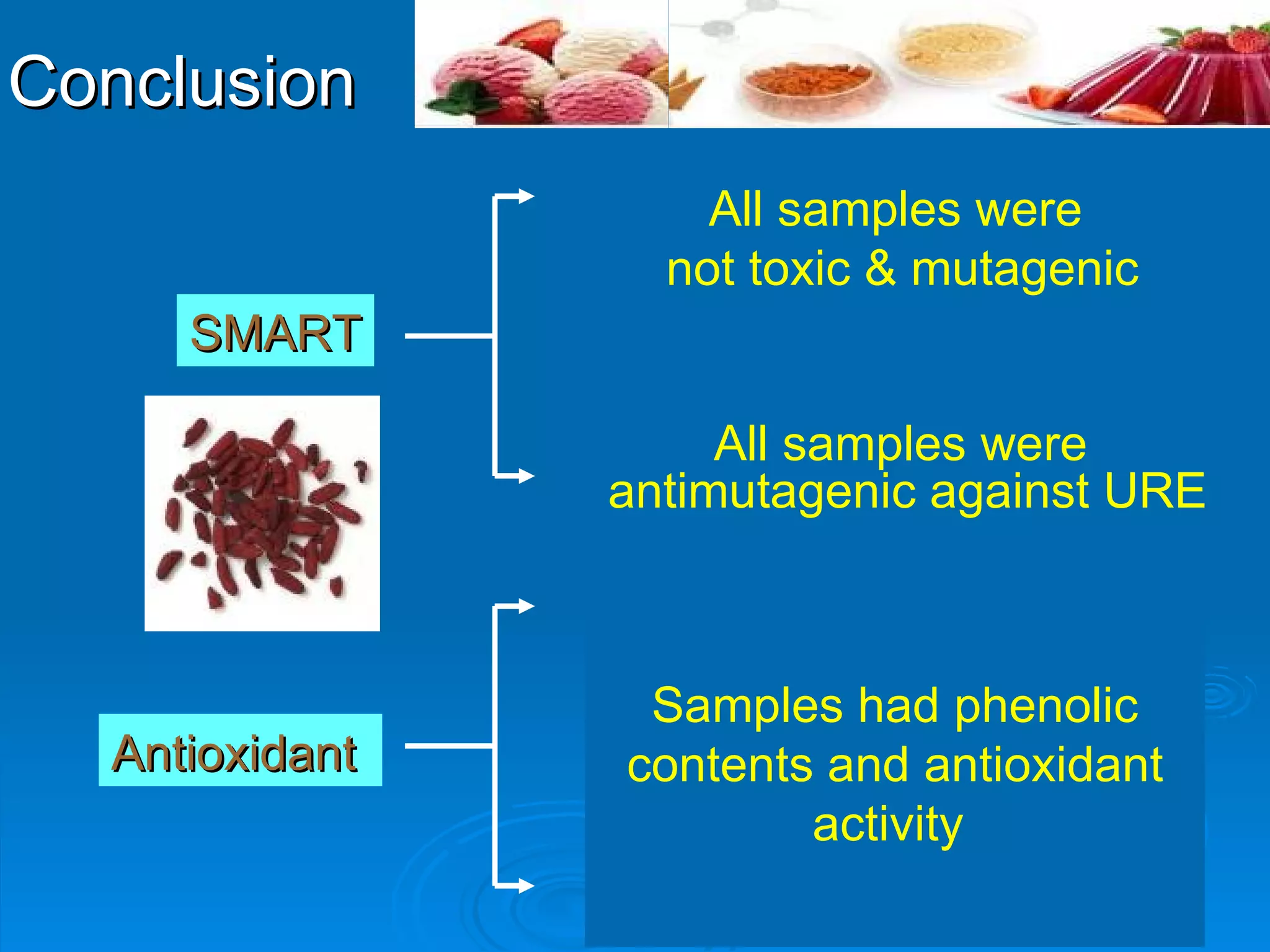
Conclusion SMART Antioxidant  The survival of adult files and mutagenicity of samples   Antimutagenicity All samples were  not toxic & mutagenic All s amples  were   antimutagenic against URE DPPH & FRAP  Total phenolic content  Samples had phenolic contents and antioxidant activity
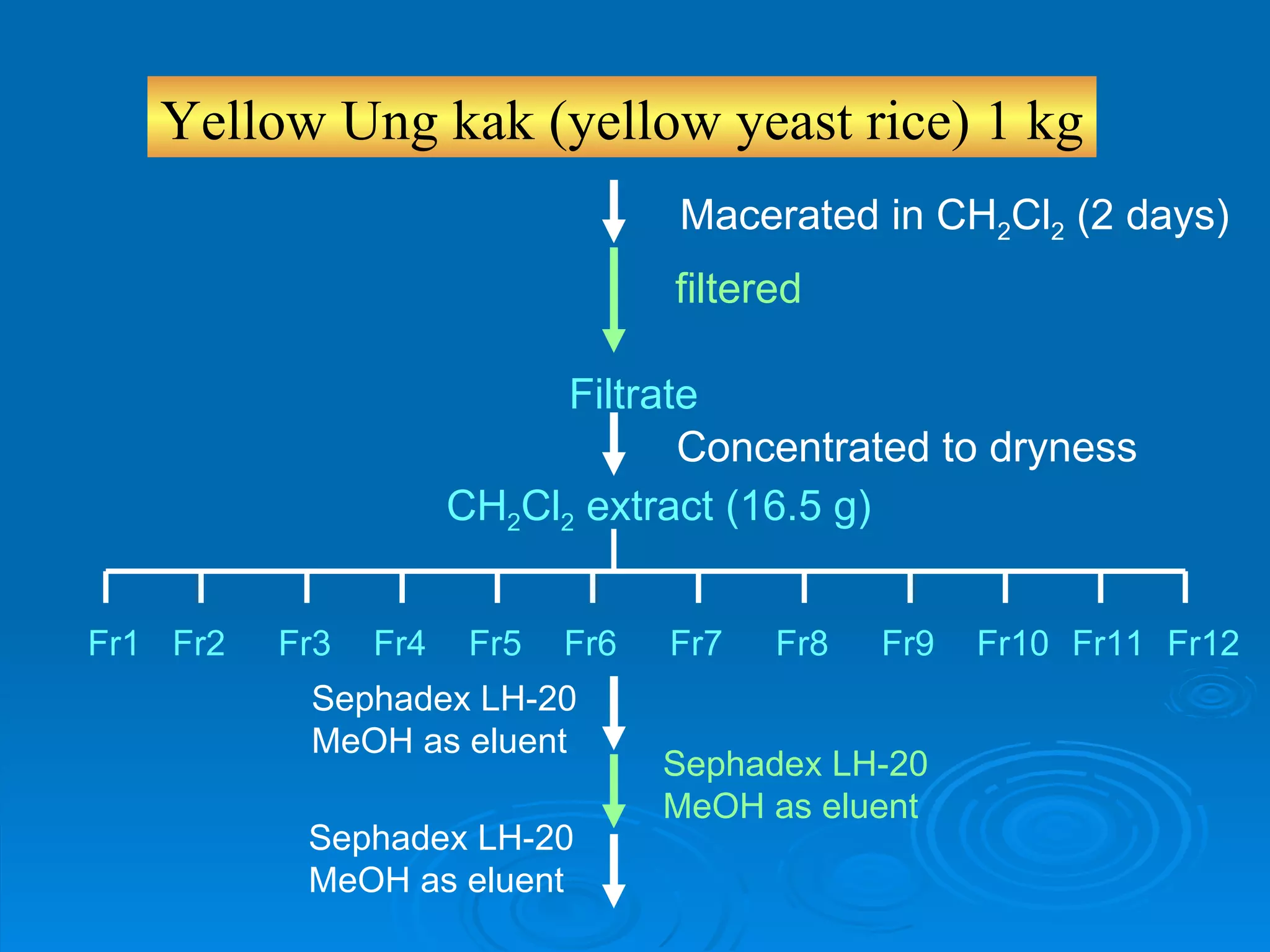
Macerated in CH 2 Cl 2  (2 days) filtered Filtrate Concentrated to dryness CH 2 Cl 2  extract (16.5 g) Fr2 Fr1 Fr4 Fr3 Fr6 Fr5 Fr7 Fr8 Fr10 Fr9 Fr11 Fr12 Sephadex LH-20 MeOH as eluent Sephadex LH-20 MeOH as eluent Sephadex LH-20 MeOH as eluent Yellow Ung kak (yellow yeast rice) 1 kg
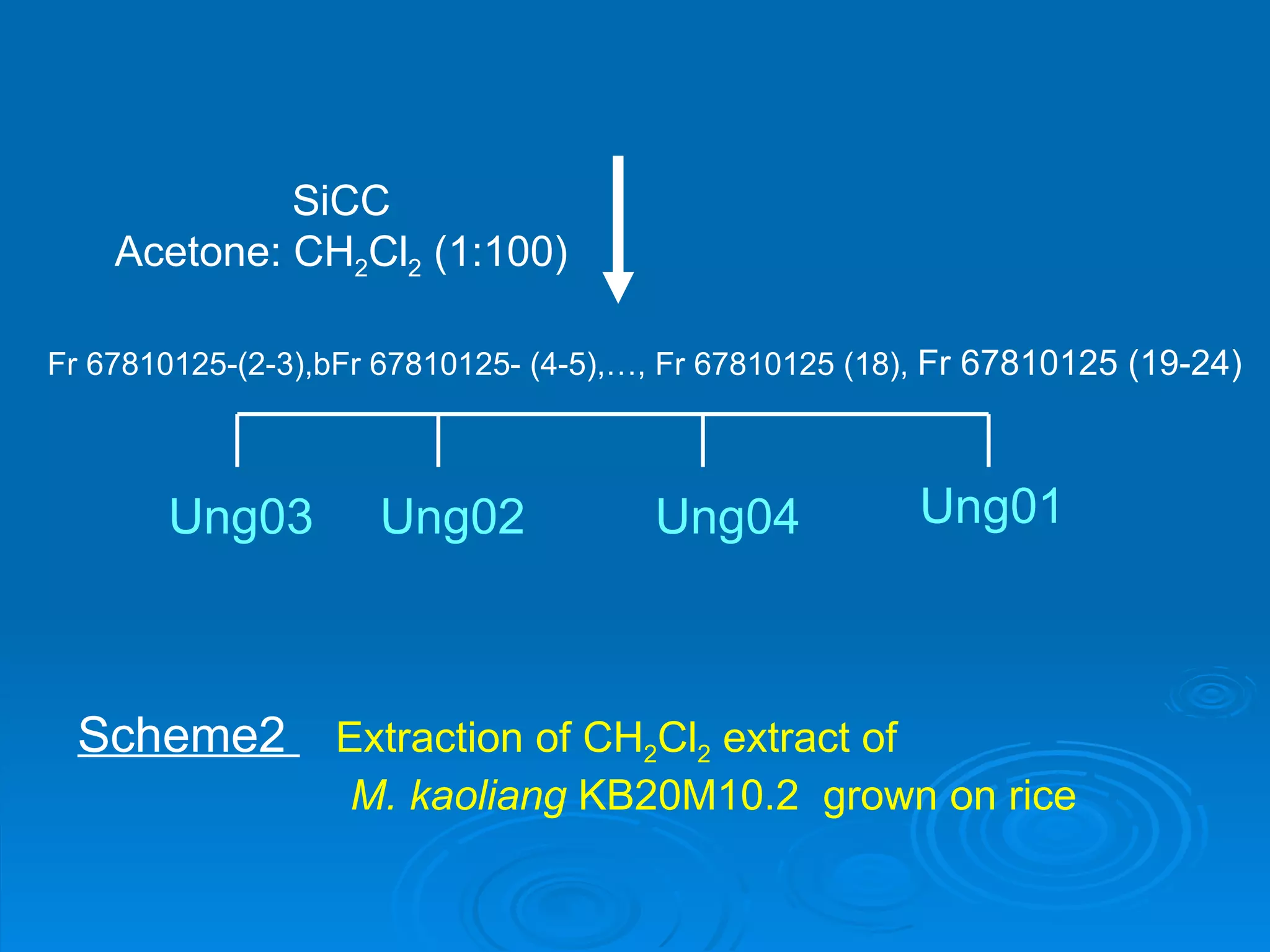
SiCC Acetone: CH 2 Cl 2  (1:100) Fr 67810125-(2-3),bFr 67810125- (4-5),…, Fr 67810125 (18),  Fr 67810125 (19-24)   Ung03 Ung02 Ung04 Ung01 Scheme2  Extraction of CH 2 Cl 2  extract of  M. kaoliang  KB20M10.2  grown on rice
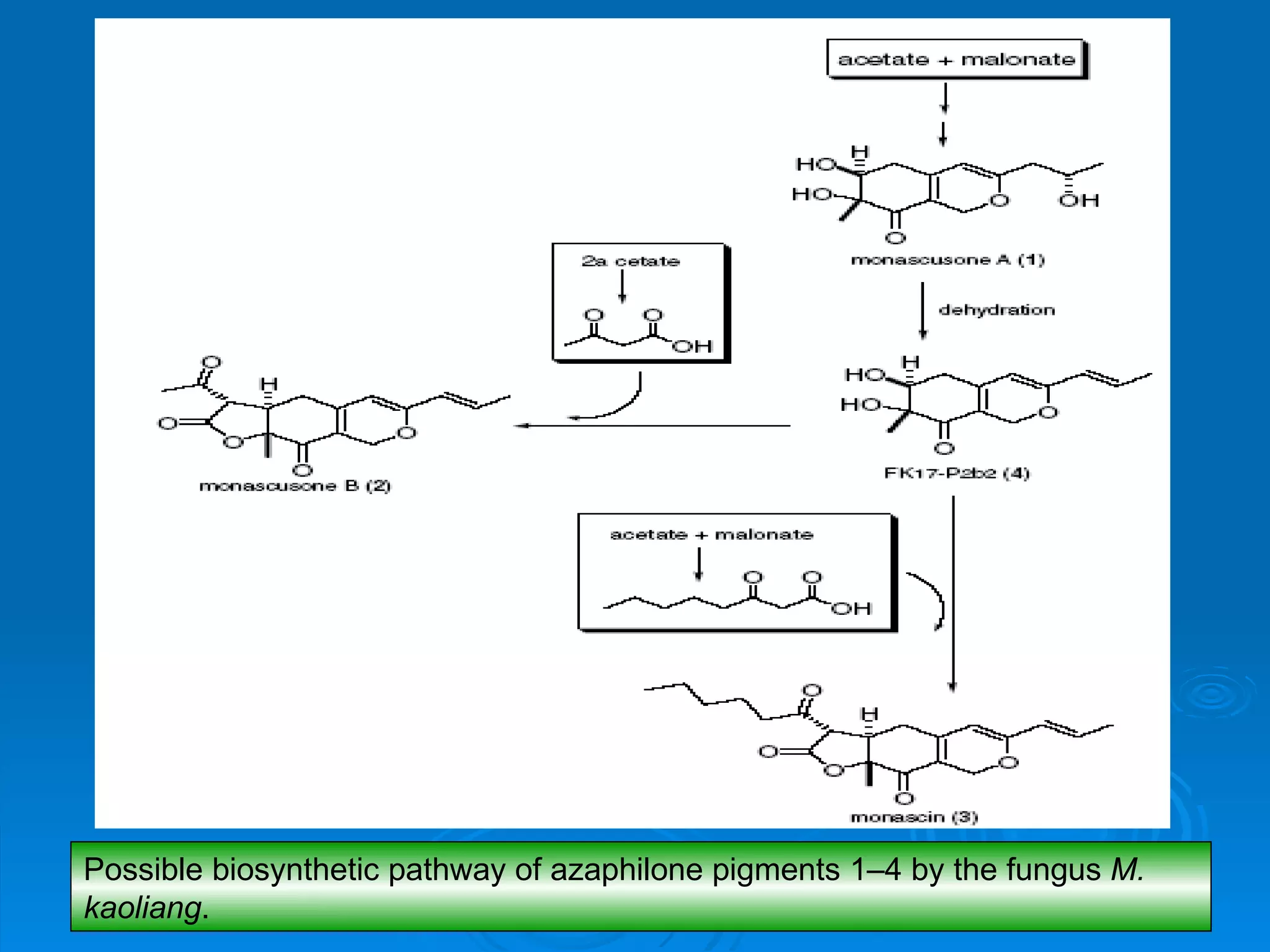
Possible biosynthetic pathway of azaphilone pigments 1–4 by the fungus  M. kaoliang .
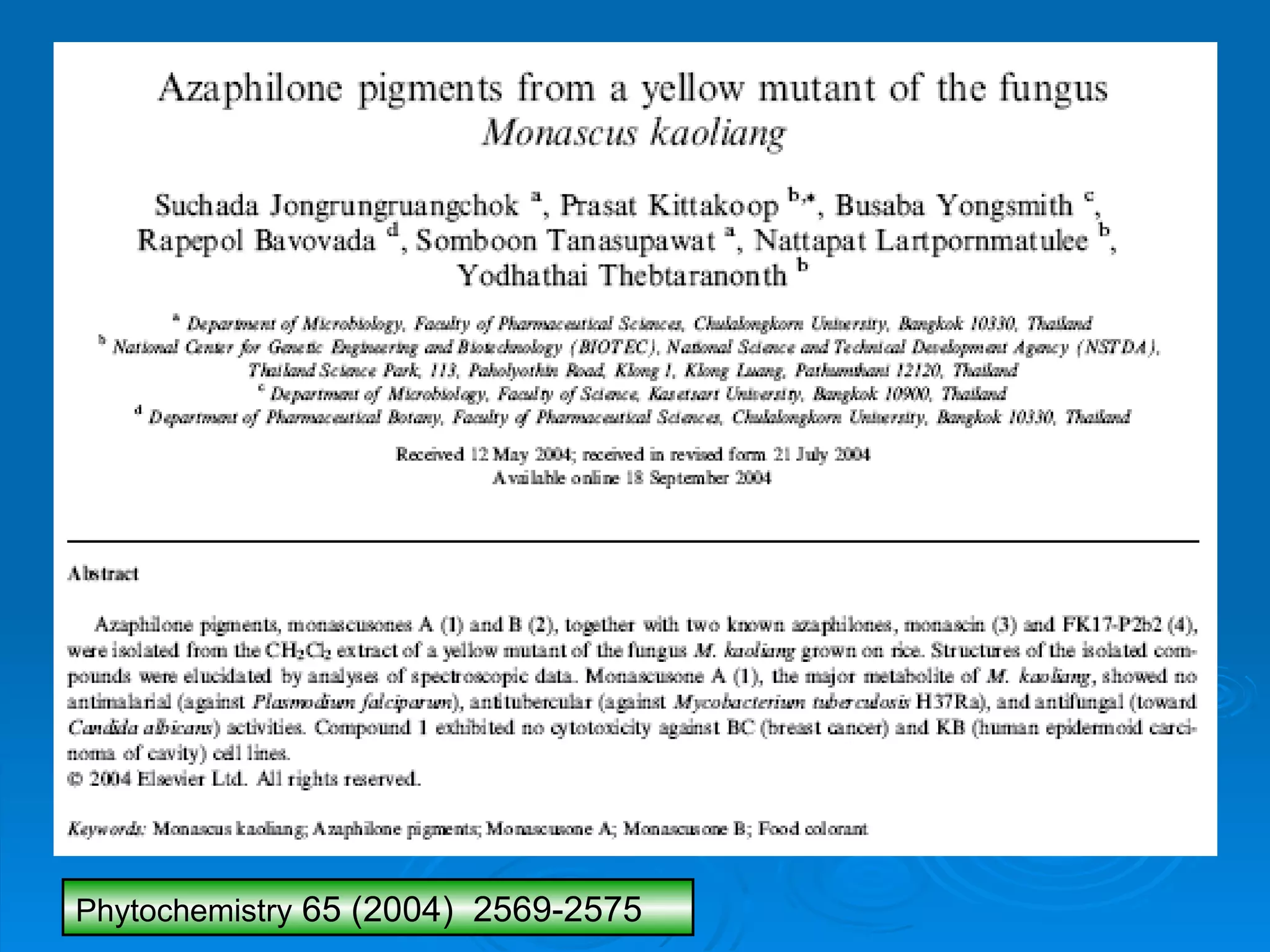
Phytochemistry   65 (2004)  2569-2575
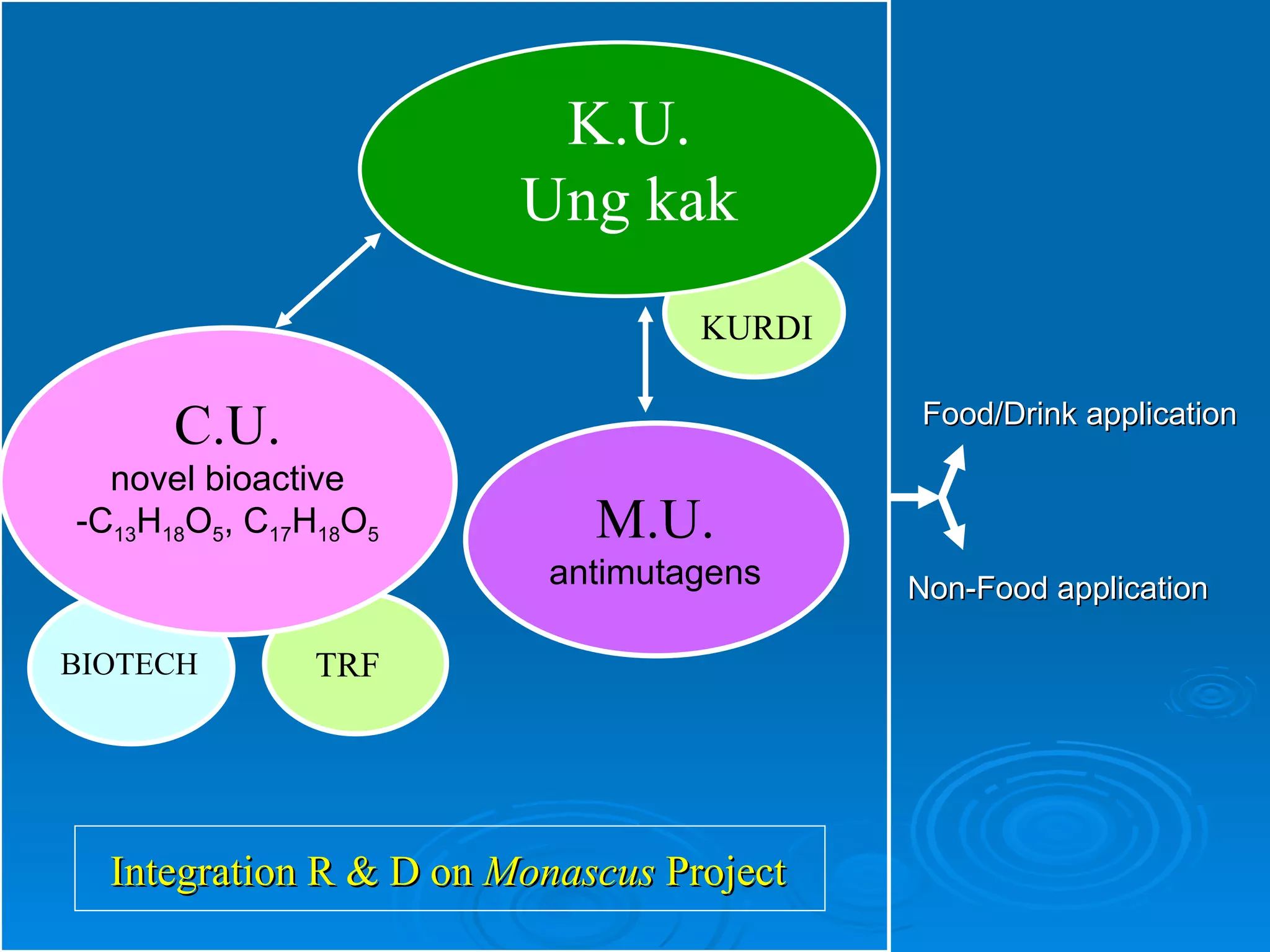
K.U. Ung kak C.U. novel bioactive -C 13 H 18 O 5 , C 17 H 18 O 5 M.U. antimutagens BIOTECH TRF Integration R & D on  Monascus  Project Food/Drink application Non-Food application KURDI
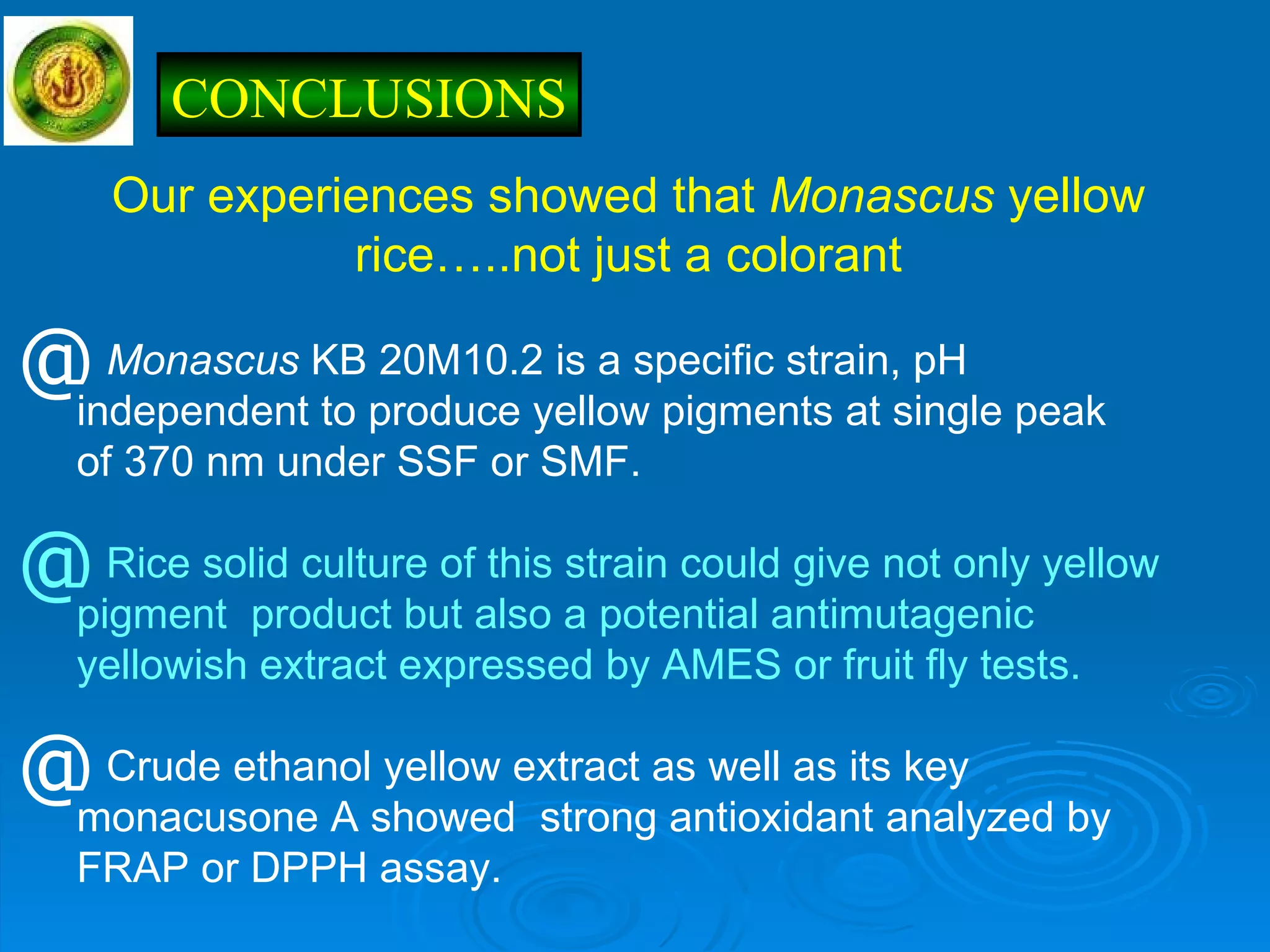
Our experiences showed that  Monascus  yellow rice…..not just a colorant Monascus  KB 20M10.2 is a specific strain, pH  independent to produce yellow pigments at single peak  of 370 nm under SSF or SMF. Rice solid culture of this strain could give not only yellow  pigment  product but also a potential antimutagenic  yellowish extract expressed by AMES or fruit fly tests. Crude ethanol yellow extract as well as its key  monacusone A showed  strong antioxidant analyzed by  FRAP or DPPH assay. CONCLUSIONS
SAWADEE KA

20081217 01 Busaba Value Creation Of New Yellow Pigments Produced By An Unique Mutant Derived From Monascus Kaoliang Kb9

  • 1.
    Busaba Yongsmith a Kaew Kangsadalampai b and Nissana Harntrikanok b a Department of Microbiology, Faculty of Science, Kasetsart University. Bangkok, Thailand b Department of Food and Nutritional Toxicology. Institute of Nutrition. Salaya. Nakornpathom, Thailand Value-creation on New YELLOW Pigments Produced by a Unique Mutant Derived from Monascus kaoliang KB9
  • 2.
    Presentation Outline Genealogyof the yellow isolates Cassava/soybean flour submerged culture Rice Solid Culture Downstreaming of the yellow pigment - crude extract - purified yellow pigment - direct utilization of fermented rice powder Antimutagen / Antioxidant of the yellow products Conclusion
  • 3.
    Monascus spp.Project Raw Materials Downstreaming Technology Production Technology Social Interest Yes/No (1983)
  • 4.
  • 5.
    Monascus kaoliang (KB 9) uv Red mutant (KB 10M16) uv Yellow mutant (KB 20M10.2) SMF SSF Genealogy of the yellow producing isolates
  • 6.
    Features of theyellow isolates
  • 7.
  • 8.
    10 day CYAG25N Wort agar PDA GYP SS MYS Yellow mutant
  • 9.
    SEM GYP medium 10 day
  • 10.
    Main Characteristics of Monascus YELLOW mutant 1.) Producing high yellow pigmentation at single wavelength ( max 370) in spite of medium pH or formula 2.) UVA absorbing pigment producer 3.) High Ext. / Int. pigmentation 4.) Ade - mutant 
  • 11.
    Why Yellow ?@ Yellow is one of three mother colors @ World market of the colors @ Functional properties - as antimutagens - as antioxidant - etc.
  • 12.
  • 13.
  • 14.
  • 15.
    Dehulled rice Soakingin tap water 3 h water draining 5-10 min autoclaved cooked rice Fermentation SSF
  • 16.
    SSF Fermented rice grinding 1 g 39 ml of 50% EtOH 15 min supernatant measured by spectrophotometer  max 370 nm Dilution Extraction 3 h on rotary shaker EXTRACTION AND DETECTION OF MONASCUS PIGMENTS
  • 17.
    EtOH Crude extractantimutagenic lyophilization Brown powder AMES Test Fruit Fly Test
  • 18.
    Nitrite treated 1-Aminopyrene or Nitrite treated Fish extract Effect during nitrosation of 1-aminopyrene or fish extract Nitrosated products (direct-acting mutagen) Effect on nitrosated products Adding nitrite Mutageneticity test Antiformation Antimutagenicity Nitrite treatment Mutagenicity Monascus colorants powder
  • 19.
    (Thayat Sriyapai,2003) Salmonella tester strainsTA98 and TA100. Inhibit direct mutagen Monascus pigment
  • 20.
    SMART test in Drosophila melanogaster was designed to detect the induction of genotoxic damage in a rapid and inexpensive way. Somatic Mutation and Recombination Test (SMART)
  • 21.
  • 22.
    (Dalad Siriwan, 2005) Non-toxic Oh ! Ha!Ha!
  • 23.
    Monascus yellow rice EtOH Extract Concentrate Spray drying Mellow yellow powder Rice solid culture Crude yellow extract / Rice powder
  • 24.
  • 25.
    Experimental Design 10,1, 0.1% Phenolic content 10, 1, 0.1% 10, 1% 10% Nissana Harntrikanon, 2006) SMART Antioxidant %Survival Mutagenicity Antimutagenicity Co-administration study DPPH FRAP
  • 26.
    Samples Preparation Rice flour Arrowroot starch Sugar Water M. powder 10, 1, 0.1% (w/w) rice flour Steaming, 10 min Eggs Sugar Lemon juice Cake flour Baking powder Vanilla M. powder 10, 1, 0.1% (w/w) cake flour Baking, 180 o C, 15-20 min Storage (Dessicator)
  • 27.
    Co-administration SMART Thesurvival of adult files and mutagenicity of samples 1 Modulating effect of samples on mutagenicity of urethane 2
  • 28.
    Co-administration Study 2Wing preparation Observation at 400X mwh/mwh ORR/flare Standard medium Trans -heterozygous larvae Exp. + URE & Control medium
  • 29.
    Mutation Index MI = Spots per wing induced by URE administrated with sample Spots per wing induced by URE MI of URE = 1 Antimutagenicity > 0.8: negligible 0.6-0.8: weak 0.4-0.6: moderate < 0.4: strong
  • 30.
    Discussion No information 1 prove Inhibition of CYP-450 Induction of GST Thai desserts made from Monascus rice powder could reduce the mutagenicity of urethane. Hypothesis 1 Scavenging of urethane
  • 31.
  • 32.
    All samples were not mutagenic 1 Mutagenicity of Samples
  • 33.
    2 Co-administration StudyAll s amples were antimutagenic against urethane Strong Moderate Weak
  • 34.
    Co-administration Study 2All s amples were antimutagenic against urethane Strong Moderate Weak
  • 35.
    Discussion 4 Moistheat Steaming at 100 0 C, 10 min Dry heat Baking at 180 0 C, 15-20 min Khanom Nam Dok Mai had stronger protective effect than that of Khanom Khai . Hypothesis Effect of heat treatment
  • 36.
    Discussion 1 Alltypes of Monascus rice powder themselves had phenolic contents and antioxidant activity. Hypothesis Antioxidative potential
  • 37.
    Discussion 2 prove Thai desserts made from Monascus rice powder remained total phenolic content and antioxidant activity. Hypothesis Some compounds of Monascus rice powder were heat stable
  • 38.
    Discussion Hypothesis 2Antioxidant may reduce O 2 ˙¯, NO˙ in urethane metabolism
  • 39.
    Antioxidant Free radicalscavenging activity (DPPH assay) Ferric reducing antioxidant power (FRAP assay) Antioxidant activity 1 Total phenolic content 2
  • 40.
    Sample 10 gSample/100 ml 80% MeOH 3 times Filtrated Sample conc.10 mg/ml 80% MeOH Filtrated Dissolved in 10 ml 80% MeOH DPPH assay FRAP assay Total phenolic content
  • 41.
    Results & Discussion DPPH Assay 1
  • 42.
  • 43.
  • 44.
    Discussion Yellow > Red > White 3 Different total phenolic contents and antioxidant activity among the three Monascus rice powders . Hypothesis Type of pigments or some others active ingredients of each color
  • 45.
    Conclusion SMART Antioxidant The survival of adult files and mutagenicity of samples Antimutagenicity All samples were not toxic & mutagenic All s amples were antimutagenic against URE DPPH & FRAP Total phenolic content Samples had phenolic contents and antioxidant activity
  • 46.
    Macerated in CH2 Cl 2 (2 days) filtered Filtrate Concentrated to dryness CH 2 Cl 2 extract (16.5 g) Fr2 Fr1 Fr4 Fr3 Fr6 Fr5 Fr7 Fr8 Fr10 Fr9 Fr11 Fr12 Sephadex LH-20 MeOH as eluent Sephadex LH-20 MeOH as eluent Sephadex LH-20 MeOH as eluent Yellow Ung kak (yellow yeast rice) 1 kg
  • 47.
    SiCC Acetone: CH2 Cl 2 (1:100) Fr 67810125-(2-3),bFr 67810125- (4-5),…, Fr 67810125 (18), Fr 67810125 (19-24) Ung03 Ung02 Ung04 Ung01 Scheme2 Extraction of CH 2 Cl 2 extract of M. kaoliang KB20M10.2 grown on rice
  • 48.
    Possible biosynthetic pathwayof azaphilone pigments 1–4 by the fungus M. kaoliang .
  • 49.
    Phytochemistry 65 (2004) 2569-2575
  • 50.
    K.U. Ung kakC.U. novel bioactive -C 13 H 18 O 5 , C 17 H 18 O 5 M.U. antimutagens BIOTECH TRF Integration R & D on Monascus Project Food/Drink application Non-Food application KURDI
  • 51.
    Our experiences showedthat Monascus yellow rice…..not just a colorant Monascus KB 20M10.2 is a specific strain, pH independent to produce yellow pigments at single peak of 370 nm under SSF or SMF. Rice solid culture of this strain could give not only yellow pigment product but also a potential antimutagenic yellowish extract expressed by AMES or fruit fly tests. Crude ethanol yellow extract as well as its key monacusone A showed strong antioxidant analyzed by FRAP or DPPH assay. CONCLUSIONS
  • 52.