Notes: Work and Power H: Review Worksheet 5.1
Work and Power April 6, 2009
Objectives Recognize  the difference between the scientific and ordinary definitions of work. Identify  where work is being performed in a variety of situations. Define and calculate  work and power.
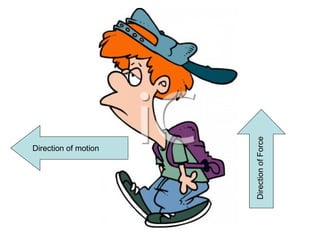
Work Work is the transfer of energy through motion.  In order for work to take place, a force must cause an object to move in the direction of the force.
What’s work? A scientist delivers a speech to an audience of his peers.  A body builder lifts 350 pounds above his head.  A mother carries her baby from room to room.  A father pushes a baby in a carriage.  A woman carries a 20 kg grocery bag to her car?  No No No Yes Yes
There are two factors to keep in mind when deciding when work is being done:  something has to move  the motion must be in the direction of the applied force.
Work is done on the books when they are being lifted, but no work is done on them when they are being held or carried horizontally.
 
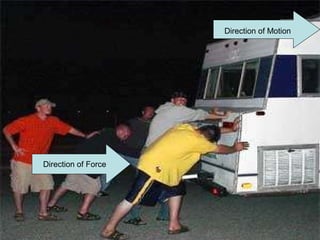
Direction of Force Direction of Motion
Direction of motion Direction of Force
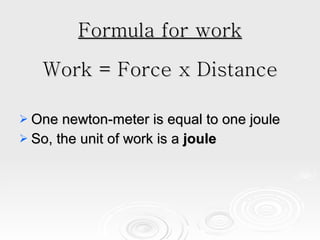
Formula for work Work = Force x Distance One newton-meter is equal to one joule So, the unit of work is a  joule
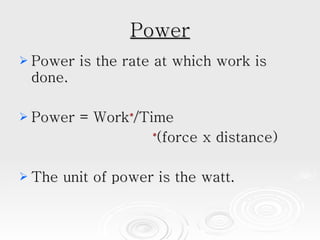
Power Power is the rate at which work is done.  Power = Work * /Time * (force x distance) The unit of power is the watt.
1 horsepower = 550 ft lbs / sec or 746 Watts
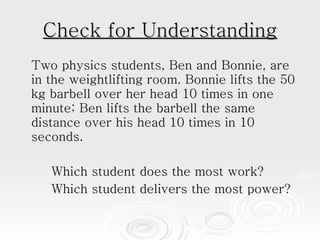
Check for Understanding Two physics students, Ben and Bonnie, are in the weightlifting room. Bonnie lifts the 50 kg barbell over her head 10 times in one minute; Ben lifts the barbell the same distance over his head 10 times in 10 seconds.  Which student does the most work?  Which student delivers the most power?
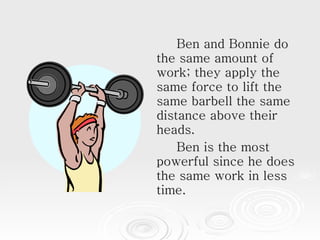
Ben and Bonnie do the same amount of work; they apply the same force to lift the same barbell the same distance above their heads.  Ben is the most powerful since he does the same work in less time.
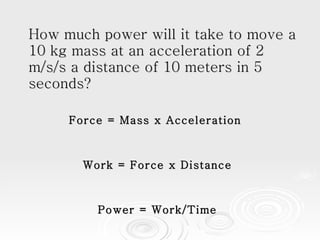
How much power will it take to move a 10 kg mass at an acceleration of 2 m/s/s a distance of 10 meters in 5 seconds?  Force = Mass x Acceleration  Work = Force x Distance Power = Work/Time
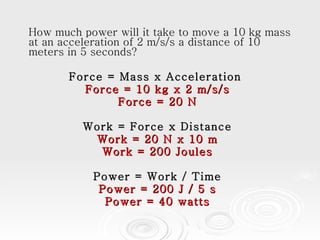
How much power will it take to move a 10 kg mass at an acceleration of 2 m/s/s a distance of 10 meters in 5 seconds?  Force = Mass x Acceleration  Force = 10 kg x 2 m/s/s Force = 20 N Work = Force x Distance Work = 20 N x 10 m Work = 200 Joules Power = Work / Time Power = 200 J / 5 s Power = 40 watts

2008 Work

  • 1.
    Notes: Work andPower H: Review Worksheet 5.1
  • 2.
    Work and PowerApril 6, 2009
  • 3.
    Objectives Recognize the difference between the scientific and ordinary definitions of work. Identify where work is being performed in a variety of situations. Define and calculate work and power.
  • 4.
    Work Work isthe transfer of energy through motion. In order for work to take place, a force must cause an object to move in the direction of the force.
  • 5.
    What’s work? Ascientist delivers a speech to an audience of his peers. A body builder lifts 350 pounds above his head. A mother carries her baby from room to room. A father pushes a baby in a carriage. A woman carries a 20 kg grocery bag to her car? No No No Yes Yes
  • 6.
    There are twofactors to keep in mind when deciding when work is being done: something has to move the motion must be in the direction of the applied force.
  • 7.
    Work is doneon the books when they are being lifted, but no work is done on them when they are being held or carried horizontally.
  • 8.
  • 9.
    Direction of ForceDirection of Motion
  • 10.
    Direction of motionDirection of Force
  • 11.
    Formula for workWork = Force x Distance One newton-meter is equal to one joule So, the unit of work is a joule
  • 12.
    Power Power isthe rate at which work is done. Power = Work * /Time * (force x distance) The unit of power is the watt.
  • 13.
    1 horsepower =550 ft lbs / sec or 746 Watts
  • 14.
    Check for UnderstandingTwo physics students, Ben and Bonnie, are in the weightlifting room. Bonnie lifts the 50 kg barbell over her head 10 times in one minute; Ben lifts the barbell the same distance over his head 10 times in 10 seconds. Which student does the most work? Which student delivers the most power?
  • 15.
    Ben and Bonniedo the same amount of work; they apply the same force to lift the same barbell the same distance above their heads. Ben is the most powerful since he does the same work in less time.
  • 16.
    How much powerwill it take to move a 10 kg mass at an acceleration of 2 m/s/s a distance of 10 meters in 5 seconds? Force = Mass x Acceleration Work = Force x Distance Power = Work/Time
  • 17.
    How much powerwill it take to move a 10 kg mass at an acceleration of 2 m/s/s a distance of 10 meters in 5 seconds? Force = Mass x Acceleration Force = 10 kg x 2 m/s/s Force = 20 N Work = Force x Distance Work = 20 N x 10 m Work = 200 Joules Power = Work / Time Power = 200 J / 5 s Power = 40 watts