Elastic Pressure Transducers 
Presented By: 2007-chem-20
Types of Pressure Measurements 
ď‚§Gauge pressure sensor 
ď‚§Absolute pressure sensor 
ď‚§Vacuum pressure sensor 
ď‚§Sealed pressure sensor 
ď‚§Differential pressure sensor
What are Transducers? 
Transducers are the mechanical, electronic, 
electrical, or electrochemical devices that convert 
one form of energy to the property that cannot be 
measured directly into the other form of energy 
or property that can be measured easily. The 
signal given to the transducer is called as input 
this is the parameter that is to be measured but 
cannot be measured directly. The signal obtained 
from the transducer is called as output, which can 
be measured easily.
Types of Pressure Transducers 
1. Mechanical transducers 
2. Electrical transducers 
Note : 
Elastic pressure transducers are mechanical 
transducers.
Elastic Pressure Transducers 
The elastic pressure transducers are 
the mechanical elements that are used 
for converting one form of energy 
into the other form of energy that can 
be measured easily.
Types of Elastic Pressure 
Transducers 
There are number of mechanical transducers, 
some of the commonly used ones are described 
below: 
1) Bourdon tube pressure transducers 
2) Diaphragm pressure transducers 
3) Bellows pressure transducers
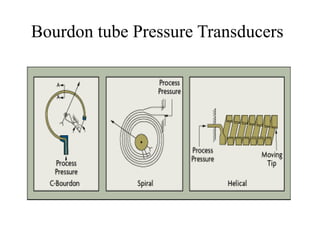
Bourdon tube Pressure Transducers
Advantages: 
ď‚§Low cost 
ď‚§Simple construction 
ď‚§Time-tested in applications 
ď‚§Availability in a wide variety of ranges, 
including very high ranges 
ď‚§Adaptability to transducer designs for 
electronic instruments 
ď‚§High accuracy, especially in relation to 
cost
Disadvantages: 
ď‚§Low spring gradient (i.e. below 50 psig) 
ď‚§Susceptibility to shock and vibrations 
ď‚§Susceptibility to hysteresis
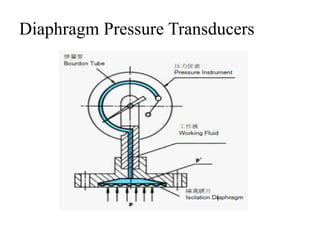
Diaphragm Pressure Transducers
Types of diaphragm pressure 
transducers 
Two types of diaphragm are generally 
used: 
1) Metallic diaphragm gauge 
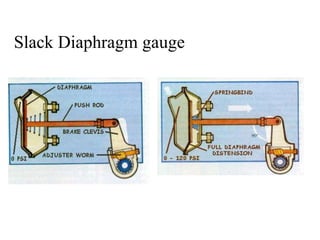
2) Slack diaphragm gauge
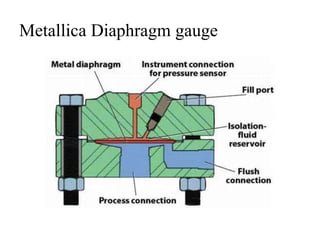
Metallica Diaphragm gauge
Slack Diaphragm gauge
Advantages: 
ď‚§Diaphragm Pressure Transducer cost is 
moderate. 
ď‚§Diaphragm Pressure Transducer possesses 
high over range characteristics. 
ď‚§Diaphragm Pressure Transducers are adaptable 
to absolute and differential pressure 
measurement. 
ď‚§Diaphragm Pressure Transducer has good 
linearity. 
ď‚§Diaphragm Pressure Transducer is small in 
size.
Disadvantages: 
ď‚§Diaphragm Pressure Transducer lack good 
vibration and shock resistance 
ď‚§Diaphragm Pressure Transducers are difficult 
to repair. 
ď‚§Diaphragm Pressure Transducer is limited to 
relatively low pressures
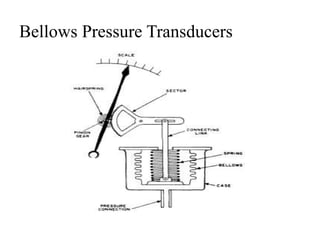
Bellows Pressure Transducers
Advantages: 
ď‚§Moderate cost 
ď‚§Delivery of high force 
ď‚§Adaptability for absolute and 
differential pressure 
ď‚§Good in the low to moderate 
pressure range
Disadvantages: 
ď‚§Ambient temperature compensation needed 
ď‚§Unsuitable for high pressure 
ď‚§Limited availability of metals and work 
hardening of some of them 
ď‚§Unsuitability of its zero and the stiffness 
(therefore it is used in conjunction with (in 
parallel with) a reliable spring of appreciably 
higher stiffness for accurate characterization
References: 
1. S k Singh “Industrial Instrumentation and Control”, 
Tata McGraw HILL company Limited, New DEHLI, 
1987 
2. http;//vmpt.com/transducer.htm 
3. http;//www.brighthub.com/engineering/mechanical/artic 
les/41926.aspx 
4. http;//www.omega.com/literature/transactions/volume3/ 
pressure.heml 
5. http://en.wikipedia.org/wiki/Pressure_measurement

20 presentation

  • 1.
    Elastic Pressure Transducers Presented By: 2007-chem-20
  • 2.
    Types of PressureMeasurements ď‚§Gauge pressure sensor ď‚§Absolute pressure sensor ď‚§Vacuum pressure sensor ď‚§Sealed pressure sensor ď‚§Differential pressure sensor
  • 3.
    What are Transducers? Transducers are the mechanical, electronic, electrical, or electrochemical devices that convert one form of energy to the property that cannot be measured directly into the other form of energy or property that can be measured easily. The signal given to the transducer is called as input this is the parameter that is to be measured but cannot be measured directly. The signal obtained from the transducer is called as output, which can be measured easily.
  • 4.
    Types of PressureTransducers 1. Mechanical transducers 2. Electrical transducers Note : Elastic pressure transducers are mechanical transducers.
  • 5.
    Elastic Pressure Transducers The elastic pressure transducers are the mechanical elements that are used for converting one form of energy into the other form of energy that can be measured easily.
  • 6.
    Types of ElasticPressure Transducers There are number of mechanical transducers, some of the commonly used ones are described below: 1) Bourdon tube pressure transducers 2) Diaphragm pressure transducers 3) Bellows pressure transducers
  • 7.
  • 8.
    Advantages: ď‚§Low cost ď‚§Simple construction ď‚§Time-tested in applications ď‚§Availability in a wide variety of ranges, including very high ranges ď‚§Adaptability to transducer designs for electronic instruments ď‚§High accuracy, especially in relation to cost
  • 9.
    Disadvantages: ď‚§Low springgradient (i.e. below 50 psig) ď‚§Susceptibility to shock and vibrations ď‚§Susceptibility to hysteresis
  • 10.
  • 11.
    Types of diaphragmpressure transducers Two types of diaphragm are generally used: 1) Metallic diaphragm gauge 2) Slack diaphragm gauge
  • 12.
  • 13.
  • 14.
    Advantages: ď‚§Diaphragm PressureTransducer cost is moderate. ď‚§Diaphragm Pressure Transducer possesses high over range characteristics. ď‚§Diaphragm Pressure Transducers are adaptable to absolute and differential pressure measurement. ď‚§Diaphragm Pressure Transducer has good linearity. ď‚§Diaphragm Pressure Transducer is small in size.
  • 15.
    Disadvantages: ď‚§Diaphragm PressureTransducer lack good vibration and shock resistance ď‚§Diaphragm Pressure Transducers are difficult to repair. ď‚§Diaphragm Pressure Transducer is limited to relatively low pressures
  • 16.
  • 17.
    Advantages: ď‚§Moderate cost ď‚§Delivery of high force ď‚§Adaptability for absolute and differential pressure ď‚§Good in the low to moderate pressure range
  • 18.
    Disadvantages: ď‚§Ambient temperaturecompensation needed ď‚§Unsuitable for high pressure ď‚§Limited availability of metals and work hardening of some of them ď‚§Unsuitability of its zero and the stiffness (therefore it is used in conjunction with (in parallel with) a reliable spring of appreciably higher stiffness for accurate characterization
  • 19.
    References: 1. Sk Singh “Industrial Instrumentation and Control”, Tata McGraw HILL company Limited, New DEHLI, 1987 2. http;//vmpt.com/transducer.htm 3. http;//www.brighthub.com/engineering/mechanical/artic les/41926.aspx 4. http;//www.omega.com/literature/transactions/volume3/ pressure.heml 5. http://en.wikipedia.org/wiki/Pressure_measurement