Principles of Marketing
Seventeenth Edition
Chapter 2
Company and Marketing Strategy
Partnering to Build Customer
Engagement, Value, and
Relationships
Copyright © 2018, 2016, 2014 Pearson Education, Inc. All Rights Reserved.
Company-Wide Strategic Planning-
Defining Marketing’s Role
 Strategic planning :
is the process of developing and maintaining
a strategic fit between the organization’s goals
and capabilities, and its changing marketing
opportunities.
Companies usually prepare annual plans,
long-range plans, and strategic plans.
 The annual and long range plans deal with
the company’s current businesses and how to
keep them going.
the strategic plan involves adapting the firm to
take advantage of opportunities in its
constantly changing environment.
The company starts the strategic planning
process by *defining its overall purpose and
mission, *This mission is then turned into
detailed supporting objectives that guide the
entire company. *Next, headquarters decides
what portfolio of businesses and products is
best for the company and how much support to
give each one. *In turn, each business and
product develops detailed marketing and other
departmental plans that support the company-
wide plan.
Company-Wide Strategic Planning
Figure 2.1 Steps in Strategic Planning
Defining a Market-Oriented Mission
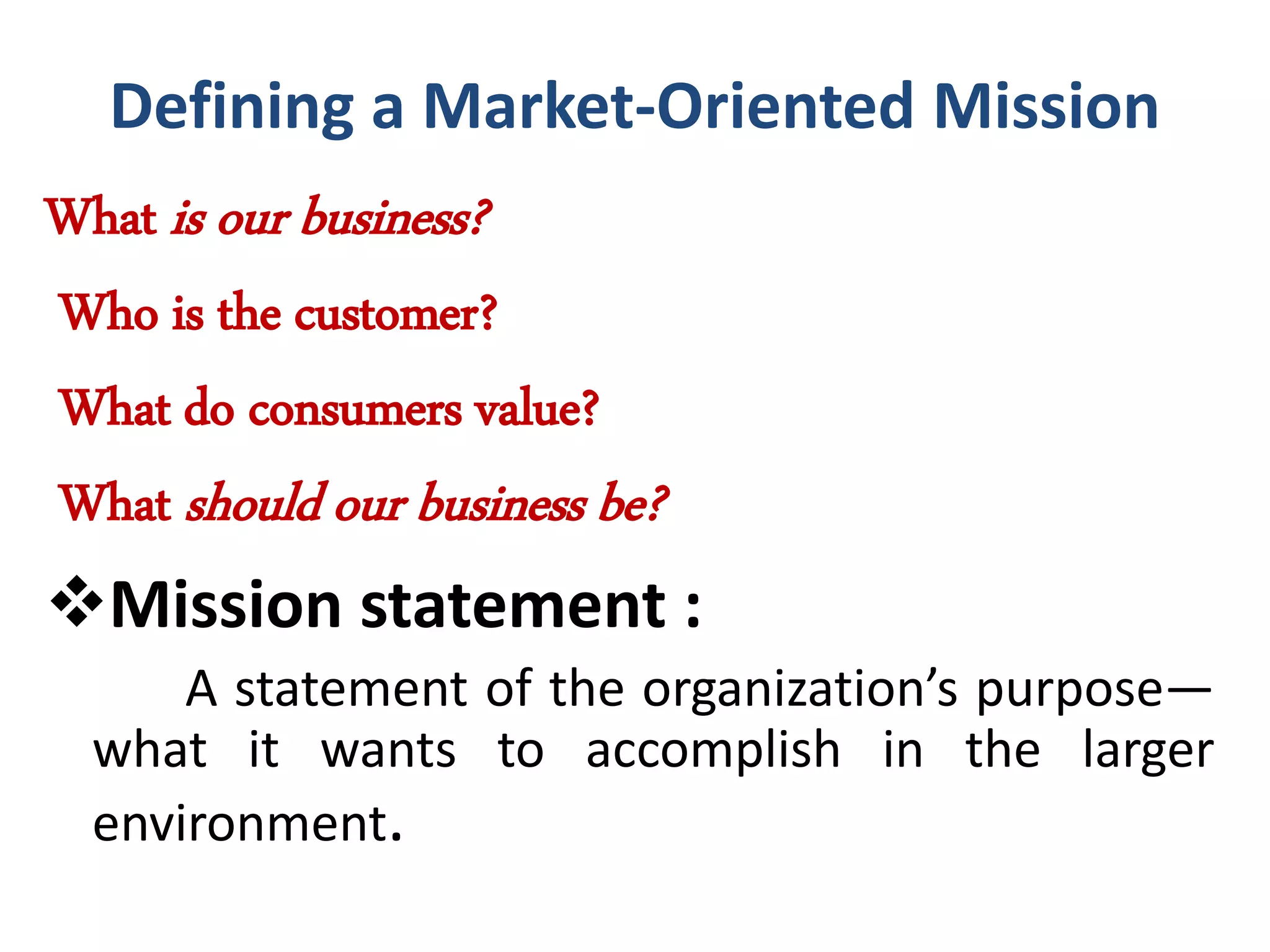
What is our business?
Who is the customer?
What do consumers value?
What should our business be?
Mission statement :
A statement of the organization’s purpose—
what it wants to accomplish in the larger
environment.
Defining a Market-Oriented Mission
• Some companies define their missions myopically in
product or technology terms (“We make and sell
furniture” . But mission statements should be
market oriented and defined in terms of satisfying
basic customer needs. Microsoft’s mission isn’t to
create the best software, technologies, and devices.
It’s to “empower every person and every
organization on the planet to achieve more.”
• Mission statements should emphasize the
company’s strengths and tell forcefully how it
intends to win in the marketplace.
Setting Company Objectives and Goals
• The company needs to turn its broad mission
into detailed supporting objectives for each
level of management. Each manager should
have objectives and be responsible for
reaching them.
Designing the Business Portfolio
Business portfolio :
The collection of businesses and products
that make up the company.
The best business portfolio is the one that
best fits the company’s strengths and
weaknesses to opportunities in the
environment.
 Business portfolio planning involves two
steps:
 First- the company must analyze its current
business portfolio and determine which
businesses should receive more, less, or no
investment.
 Second- it must shape the future portfolio by
developing strategies for growth and
downsizing.
1- Analyzing the Current Business
Portfolio
• The major activity in strategic planning is business
portfolio analysis, whereby management evaluates
the products and businesses that make up the
company.
• The company will want to put strong resources into
its more profitable businesses and phase down or
drop its weaker ones.
• portfolio analysis:
The process by which management evaluates the
products and businesses that make up the
company.
• Management’s first step is to identify the key
businesses that make up the company, called
strategic business units (SBUs).
• An SBU can be a company division, a product
line within a division, or sometimes a single
product or brand.
• The company next assesses the attractiveness
of its various SBUs and decides how much
support each deserves.
The Boston Consulting Group Approach
• The best-known portfolio-planning method
was developed by the Boston Consulting
Group.
• a company classifies all its SBUs according to
the growth-share matrix.
 growth-share matrix:
A portfolio-planning method that evaluates
a company’s SBUs in terms of market growth
rate and relative market share.
Designing The Business Portfolio
Figure 2.2 The BCG
Growth-Share Matrix:
market growth
rate provides a
measure of market
attractiveness: a
measure of the opportunities a market
offers to an organization,
relative market
share serves as a
measure of
company strength
in the market.
The growth-share matrix defines four types of
SBUs:
1. Stars:- Stars are high-growth, high-share
businesses or products. They often need heavy
investments to finance their rapid growth.
Eventually their growth will slow down, and they
will turn into cash cows.
2. Cash cows:- Cash cows are low-growth, high-
share businesses or products. These established
and successful SBUs need less investment to hold
their market share. Thus, they produce a lot of
the cash that the company uses to pay its bills
and support other SBUs that need investment.
3. Question marks :- Question marks are low share
business units in high-growth markets. They
require a lot of cash to hold their share, let alone
increase it. Management has to think hard about
which question marks it should try to build into
stars and which should be phased out.
4. Dogs:- Dogs are low-growth, low-share
businesses and products. They may generate
enough cash to maintain themselves but do not
promise to be large sources of cash.
• Problems with Matrix Approaches :
1. Difficulty in defining SBUs and measuring
market share and growth.
2. Time consuming.
3. Expensive.
4. Focus on current businesses, not future
planning.
2- Developing Strategies for Growth
and Downsizing
 Companies need growth if they are to compete more
effectively, satisfy their stakeholders, and attract top
talent. At the same time, a firm must be careful not to
make growth itself an objective. The company’s
objective must be to manage “profitable growth.”
 Marketing has the main responsibility for achieving
profitable growth for the company. Marketing needs to
identify, evaluate, and select market opportunities and
lay down strategies for capturing them. One useful
device for identifying growth opportunities is the
product/market expansion grid.
 product/market expansion grid :-
A portfolio-planning tool for identifying
company growth opportunities through
market penetration, market development,
product development, or diversification.
• Figure 2.3 The Product/Market Expansion Grid
o Market penetration :-
Company growth by increasing sales of current
products to current market segments without
changing the product.
o Market development :-
Company growth by identifying and developing new
market segments for current company products.
o product development :-
Company growth by offering modified or new
products to current market segments.
o Diversification :-
Company growth through starting up or acquiring
businesses outside the company’s current products
and markets.
Planning Marketing: Partnering to
Build Customer Relationships
• Marketing can’t go it alone in produce engagement
and superior value for customers. In addition to
customer relationship management, marketers must
also practice partner relationship management.
Under the company-wide strategic plan, marketing
must work closely with other departments to form an
effective internal company value chain and with
other companies in the marketing system to create
an external value delivery network that jointly
serves customers.
Planning Marketing: Partnering to Build
Customer Relationships
 Partnering with Other Company Departments
Each company department can be thought of as a
link in the company’s internal value chain. That is, each
department carries out value-creating activities to
design, produce, market, deliver, and support the firm’s
products. The firm’s success depends not only on how
well each department performs its work but also on
how well the various departments coordinate their
activities.
 Value chain :- is a series of internal
departments that carry out value - creating
activities to design, produce, market, deliver,
and support a firm’s products.
 A company’s value chain depends on how
well each group performs its work of adding
customer value and on how the company
coordinates the activities of various functions.
 Partnering with Others in the Marketing System
• In its quest to engage customers and create customer
value, the firm needs to look beyond its own internal
value chain and into the value chains of its suppliers, its
distributors, and, ultimately, its customers—to improve
the performance of the customer value delivery
network.
 Value delivery network :-
A network composed of the company, suppliers,
distributors, and, ultimately, customers who partner
with each other to improve the performance of the
entire system in delivering customer value.
• Competition no longer takes place only between
individual competitors. Rather, it takes place
between the entire value delivery network
created by these competitors.
Ford’s performance against Toyota depends on
the quality of Ford’s overall value delivery
network versus Toyota’s. Even if Ford makes the
best cars, it might lose in the marketplace if
Toyota’s dealer network provides a more
customer- satisfying sales and service experience.
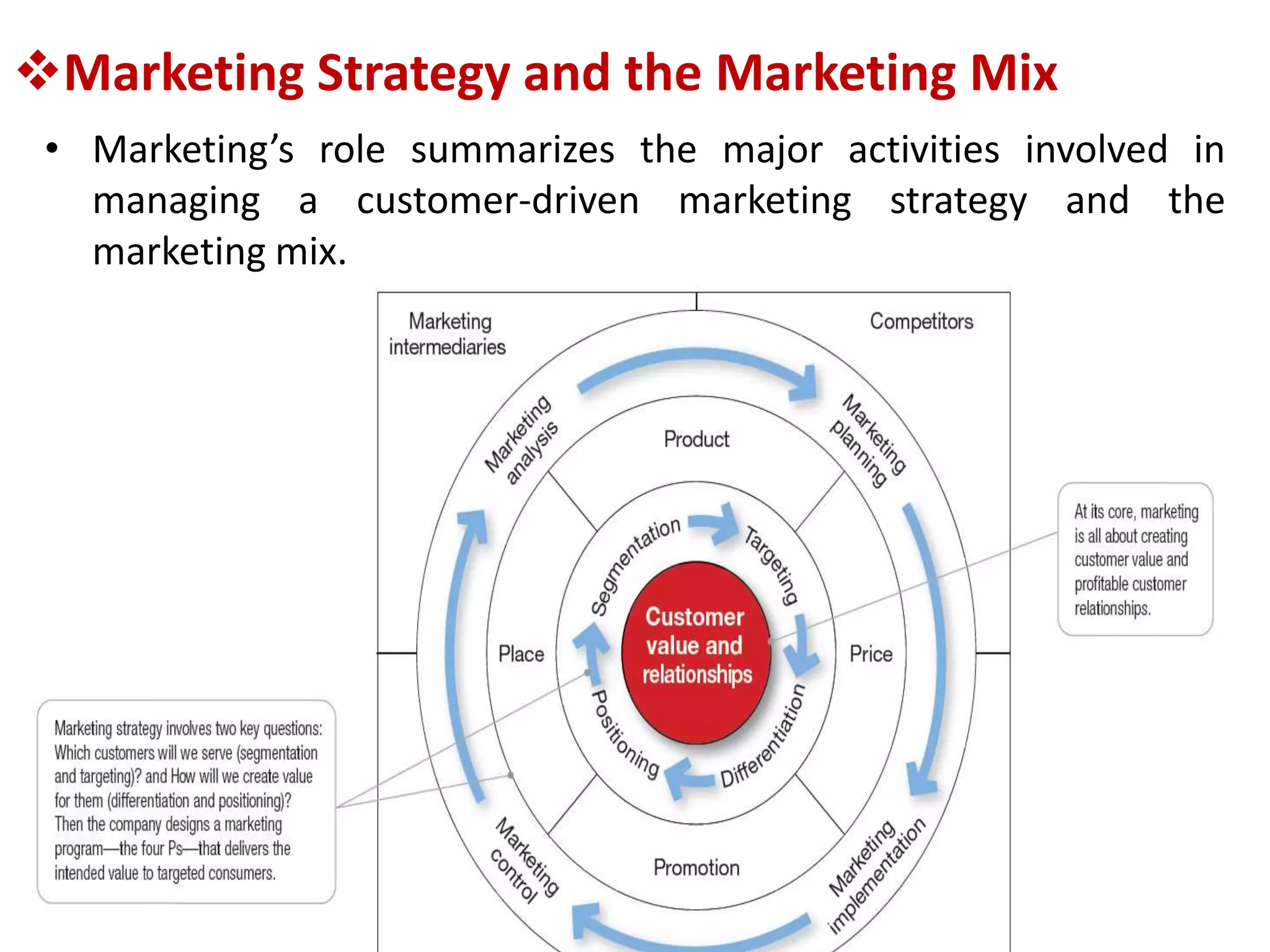
Marketing Strategy and the Marketing Mix
• Marketing’s role summarizes the major activities involved in
managing a customer-driven marketing strategy and the
marketing mix.
• Consumers are in the center. The goal is to
create value for customers and build profitable
customer relationships. Next comes marketing
strategy: The marketing logic by which the
company hopes to create customer value and
achieve profitable customer relationships.
Guided by marketing strategy, the company
designs an integrated marketing mix made up
of factors under its control (the four Ps). To find
the best marketing strategy and mix, the
company engages in marketing analysis,
planning, implementation, and control.
Customer Value–Driven Marketing
Strategy
• Companies know that they cannot profitably
serve all consumers in a given market— at least
not all consumers in the same way. There are too
many different kinds of consumers with too many
different kinds of needs. Most companies are in a
position to serve some segments better than
others. Thus, each company must divide up the
total market, choose the best segments, and
design strategies for profitably serving chosen
segments. This process involves market
segmentation, market targeting, differentiation,
and positioning.
market Segmentation:
The market consists of many types of consumers,
products, and needs. The marketer must determine
which segments offer the best opportunities.
Consumers can be grouped and served in various ways
based on geographic, demographic, psychographic, and
behavioral factors.
o geographic segmentation: Geographic is a marketing
strategy to target products to people who live or shop
in a specific location.
o demographic segmentation : groups customers and
potential customers together by focusing on certain
traits such as age, gender, income, occupation & family
status.
o Psychographic segmentation : breaks down your
customer groups into segments that influence
buying behaviors, such as: beliefs, values,
lifestyle, social status, opinions and activities.
It’s different from behavioral segmentation
because it draws out the motivations behind
behavior, rather than tracking the behavior itself.
o Behavioral segmentation : divides consumers
according to behavior patterns as they interact
with a company. this category of segmentation
studies the behavioral traits of consumers —
their knowledge of, attitude towards, use of,
likes/dislikes of, or response to a product, service,
promotion, or brand
Market segmentation
Dividing a market into distinct groups of buyers
who have different needs, characteristics, or
behaviors and who might require separate
marketing strategies or mixes.
Market segment
A group of consumers who respond in a similar way
to a given set of marketing efforts.
consumers who want the biggest, most comfortable
car regardless of price make up one market segment.
Consumers who care mainly about price and
operating economy make up another segment. It
would be difficult to make one car model that was
the first choice of consumers in both segments.
market Targeting
 After a company has defined its market
segments, it can enter one or many of these
segments. Market targeting involves evaluating
each market segment’s attractiveness and
selecting one or more segments to serve.
 A company should target segments in which it
can profitably generate the greatest customer
value and sustain it over time.
market differentiation and
Positioning
• After a company has decided which market segments
to enter, it must determine:-
1. how to differentiate its market offering for each
targeted segment.
2. what positions it wants to occupy in those
segments.
• A product’s position is the place it occupies
relative to competitors’ products in consumers’
minds.
• Marketers want to develop unique market
positions for their products. If a product is
perceived to be exactly like others on the market,
consumers would have no reason to buy it.
positioning :-
Arranging for a product to occupy a clear,
distinctive, and desirable place relative to
competing products in the minds of target
consumers.
• Marketers plan positions that distinguish their
products from competing brands and give them
the greatest advantage in their target markets.
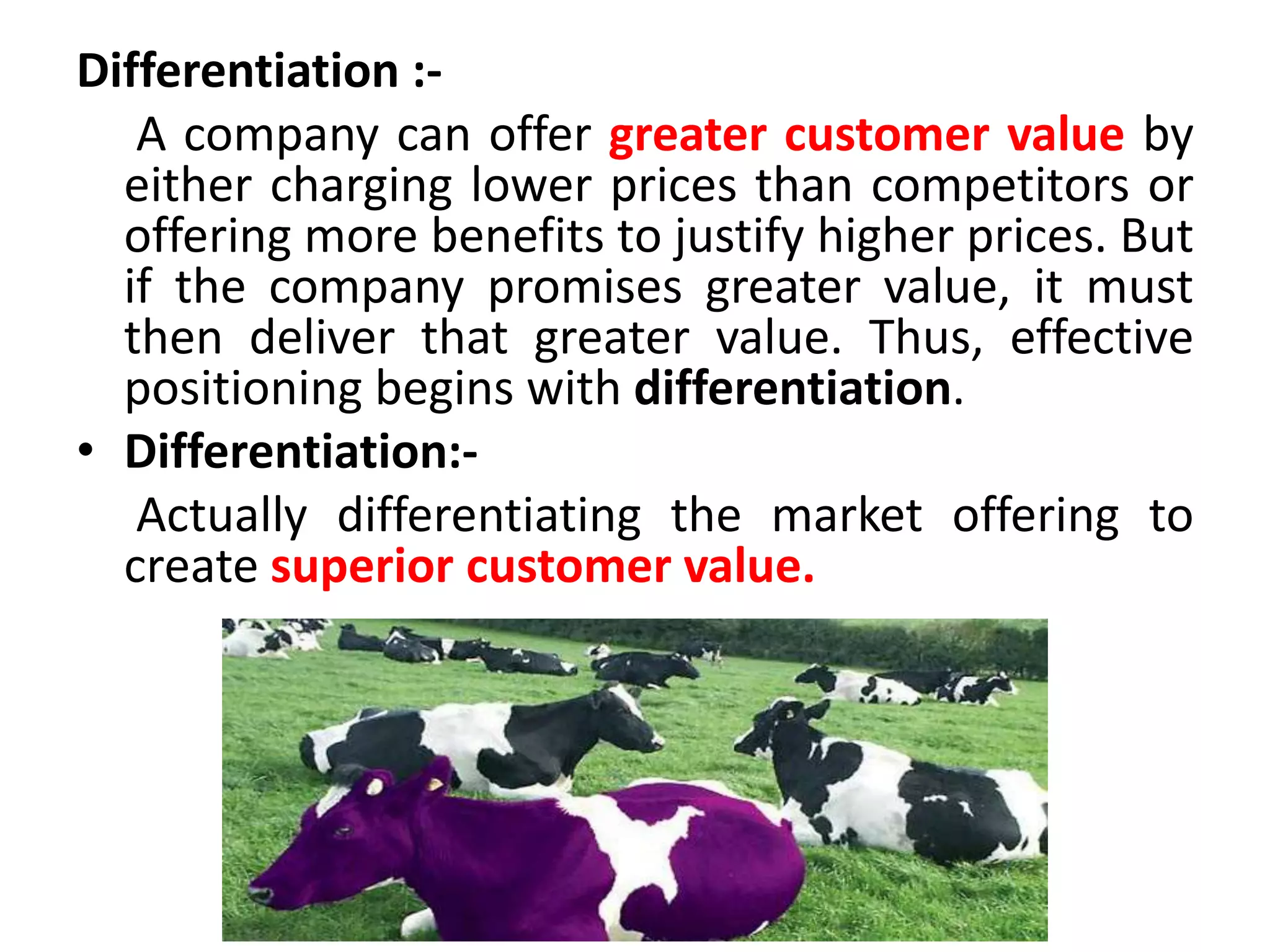
Differentiation :-
A company can offer greater customer value by
either charging lower prices than competitors or
offering more benefits to justify higher prices. But
if the company promises greater value, it must
then deliver that greater value. Thus, effective
positioning begins with differentiation.
• Differentiation:-
Actually differentiating the market offering to
create superior customer value.
Developing an Integrated Marketing
Mix
After determining its overall marketing strategy, the
company is ready to begin planning the details of
the marketing mix,
• Marketing mix:
The set of tactical marketing tools— product, price,
place, and promotion— that the firm blends to
produce the response it wants in the target
market.
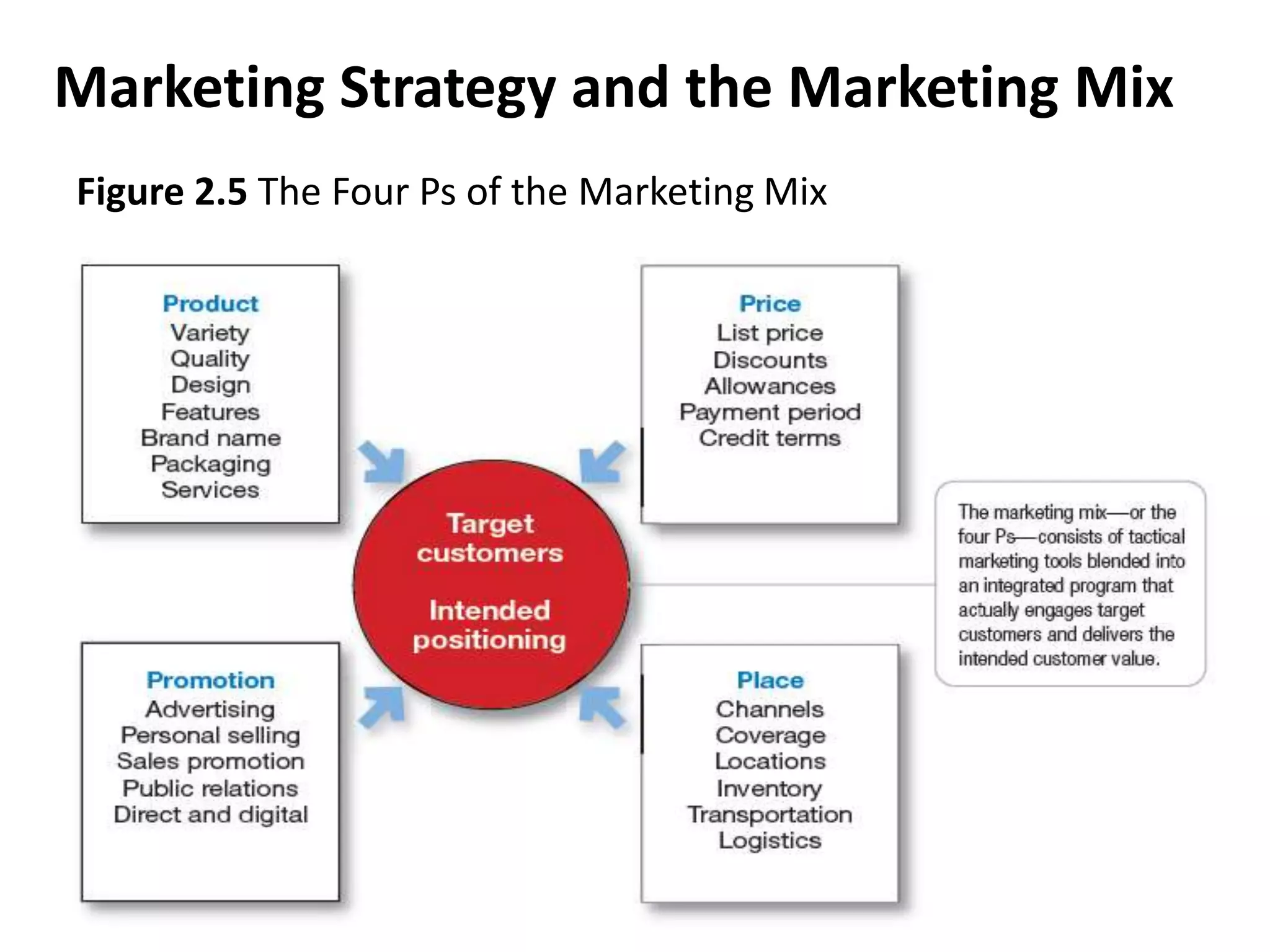
• The marketing mix consists of everything the firm
can do to engage consumers and deliver customer
value.
 Product means the goods-and-services combination
the company offers to the target market.
 Price is the amount of money customers must pay to
obtain the product.
 Place includes company activities that make the
product available to target consumers.
 Promotion refers to activities that communicate the
merits of the product and persuade target customers
to buy it.
 An effective marketing program blends the
marketing mix elements into an integrated
marketing program designed to achieve the
company’s marketing objectives by engaging
consumers and delivering value to them. The
marketing mix constitutes the company’s
tactical tool kit for establishing strong
positioning in target markets.
Marketing Strategy and the Marketing Mix
Figure 2.5 The Four Ps of the Marketing Mix
Managing the Marketing Effort and
Marketing Return on Investment
Managing the Marketing Effort:
Managing the marketing process requires the five marketing
management functions : analysis, planning,
implementation, organization, and control.
• The company first develops company-wide strategic plans
and then translates them into marketing and other plans for
each division, product, and brand. Through implementation
and organization, the company turns the plans into actions.
Control consists of measuring and evaluating the results of
marketing activities and taking corrective action where
needed. Finally, marketing analysis provides the information
and evaluations needed for all the other marketing activities.
Managing the Marketing Effort
Figure 2.6 Analysis, Planning, Implementation, and Control
 marketing Analysis:
• The marketer should conduct a SWOt analysis by which it
evaluates the company’s overall strengths (S), weaknesses
(W), opportunities (O), and threats (T).
• Strengths : include internal capabilities, resources, and
positive situational factors that may help the company
serve its customers and achieve its objectives.
• Weaknesses : include internal limitations and negative
situational factors that may interfere with the company’s
performance.
• Opportunities : are favorable factors or trends in the
external environment that the company may be able to
exploit to its advantage.
• Threats : are unfavorable external factors or trends that
may present challenges to performance.
Managing the Marketing Effort
Figure 2.7 SWOT Analysis: Strengths (S), Weaknesses (W),
Opportunities (O), and Threats (T)
The goal is to match the company’s strengths
to attractive opportunities in the environment
while eliminating or overcoming the
weaknesses and minimizing the threats.
marketing Planning
• Marketing planning involves choosing marketing
strategies that will help the company attain its
overall strategic objectives.
• What does a marketing plan look like?
1. The plan begins with an executive summary that
quickly reviews major assessments, goals, and
recommendations.
2. The main section of the plan presents a detailed
SWOT analysis of the current marketing
situation as well as potential threats and
opportunities.
3- The plan next states major objectives for the
brand and outlines the specifics of a
marketing strategy for achieving them.
A marketing strategy consists of specific
strategies for target markets, positioning, the
marketing mix. It outlines how the company
intends to engage target customers and create
value in order to capture value in return. the
planner explains how each strategy responds
to the threats, opportunities, and critical
issues spelled out earlier in the plan.
4 - Additional sections of the marketing plan lay
out an action program for implementing the
marketing strategy along with the details of a
supporting marketing budget.
5 - The last section outlines the controls that will
be used to monitor progress, measure return
on marketing investment, and take corrective
action.
marketing Implementation :
• Is the process that turning marketing strategies
and plans into marketing actions to accomplish
strategic marketing objectives.
• Many managers think that “doing things right”
(implementation) is as important as, or even
more important than, “doing the right things”
(strategy). The fact is that both are critical to
success, and companies can gain competitive
advantages through effective implementation.
• One firm can have essentially the same
strategy as another yet win in the marketplace
through faster or better execution. Still,
implementation is difficult—it is often easier
to think up good marketing strategies than it is
to carry them out. people at all levels of the
marketing system must work together to
implement marketing strategies and plans.
marketing department organization :-
• The company must design a marketing
organization that can carry out marketing
strategies and plans. If the company is very small,
one person might do all the research, selling,
advertising, customer service, and other
marketing work. As the company expands, a
marketing department emerges to plan and carry
out marketing activities. In large companies, this
department contains many specialists—product
and market managers, sales managers and
salespeople, market researchers, and advertising
and social media experts.
• Modern marketing departments can be arranged in
several ways:-
• functional organization: different marketing activities are
headed by a functional specialist—a sales manager, an
advertising manager, a marketing research manager, a
customer service manager, or a new product manager.
• geographic organization:- A company that sells across the
country or internationally often uses a geographic
organization, assigning sales and marketing people to
specific countries, regions, and districts.
• Companies with many very different products or brands
often create a product management organization.
• For companies that sell one product line to many different
types of markets and customers who have different needs
and preferences, a market or customer management
organization.
marketing Control :-
• Because many surprises occur during the
implementation of marketing strategies and
plans, marketers must practice constant
marketing control.
 marketing control : Measuring and
evaluating the results of marketing strategies
and plans and taking corrective action to
ensure that the objectives are achieved.
Marketing control involves four steps:-
1. Management sets specific marketing goals.
2. measures performance in the marketplace .
3. evaluates the causes of any differences
between expected and actual performance.
4. Finally, management takes corrective action
to close the gaps between goals and
performance.
This may require changing the action
programs or even changing the goals.
• Operating control : involves checking ongoing
performance against the annual plan and
taking corrective action when necessary.
(Its purpose is to ensure that the company
achieves the sales, profits, and other goals set
out in its annual plan).
• Strategic control : involves looking at the
company’s basic strategies are well matched
to its opportunities.
Measuring and Managing Marketing
Return on Investment
• One important marketing performance measure is
marketing return on investment (or marketing
rOI).
• Marketing return on investment (marketing ROi) :-
The net return from a marketing investment
divided by the costs of the marketing investment.
• It measures the profits generated by investments
in marketing activities.
• Marketing investments result in improved
customer value, engagement, and satisfaction,
which in turn increase customer attraction
and retention. This increases individual
customer lifetime values and the firm’s overall
customer equity.
• Increased customer equity, in relation to the
cost of the marketing investments, determines
return on marketing investment.
Measuring and Managing Return on
Marketing Investment (2 of 2)
Figure 2.8 Marketing Return on Investment
Source: Adapted from Roland T. Rust, Katherine N. Lemon, and Valerie A. Zeithaml, “Return on
Marketing: Using Consumer Equity to Focus Marketing Strategy,” Journal of Marketing, January
2004, p. 112. Used with permission.

Principles of Marketing 17e Chapter 2 Company and Marketing Strategy.pptx

  • 1.
    Principles of Marketing SeventeenthEdition Chapter 2 Company and Marketing Strategy Partnering to Build Customer Engagement, Value, and Relationships Copyright © 2018, 2016, 2014 Pearson Education, Inc. All Rights Reserved.
  • 2.
    Company-Wide Strategic Planning- DefiningMarketing’s Role  Strategic planning : is the process of developing and maintaining a strategic fit between the organization’s goals and capabilities, and its changing marketing opportunities.
  • 3.
    Companies usually prepareannual plans, long-range plans, and strategic plans.  The annual and long range plans deal with the company’s current businesses and how to keep them going. the strategic plan involves adapting the firm to take advantage of opportunities in its constantly changing environment.
  • 4.
    The company startsthe strategic planning process by *defining its overall purpose and mission, *This mission is then turned into detailed supporting objectives that guide the entire company. *Next, headquarters decides what portfolio of businesses and products is best for the company and how much support to give each one. *In turn, each business and product develops detailed marketing and other departmental plans that support the company- wide plan.
  • 5.
    Company-Wide Strategic Planning Figure2.1 Steps in Strategic Planning
  • 6.
    Defining a Market-OrientedMission What is our business? Who is the customer? What do consumers value? What should our business be? Mission statement : A statement of the organization’s purpose— what it wants to accomplish in the larger environment.
  • 7.
    Defining a Market-OrientedMission • Some companies define their missions myopically in product or technology terms (“We make and sell furniture” . But mission statements should be market oriented and defined in terms of satisfying basic customer needs. Microsoft’s mission isn’t to create the best software, technologies, and devices. It’s to “empower every person and every organization on the planet to achieve more.” • Mission statements should emphasize the company’s strengths and tell forcefully how it intends to win in the marketplace.
  • 9.
    Setting Company Objectivesand Goals • The company needs to turn its broad mission into detailed supporting objectives for each level of management. Each manager should have objectives and be responsible for reaching them.
  • 10.
    Designing the BusinessPortfolio Business portfolio : The collection of businesses and products that make up the company. The best business portfolio is the one that best fits the company’s strengths and weaknesses to opportunities in the environment.
  • 11.
     Business portfolioplanning involves two steps:  First- the company must analyze its current business portfolio and determine which businesses should receive more, less, or no investment.  Second- it must shape the future portfolio by developing strategies for growth and downsizing.
  • 12.
    1- Analyzing theCurrent Business Portfolio • The major activity in strategic planning is business portfolio analysis, whereby management evaluates the products and businesses that make up the company. • The company will want to put strong resources into its more profitable businesses and phase down or drop its weaker ones. • portfolio analysis: The process by which management evaluates the products and businesses that make up the company.
  • 13.
    • Management’s firststep is to identify the key businesses that make up the company, called strategic business units (SBUs). • An SBU can be a company division, a product line within a division, or sometimes a single product or brand. • The company next assesses the attractiveness of its various SBUs and decides how much support each deserves.
  • 14.
    The Boston ConsultingGroup Approach • The best-known portfolio-planning method was developed by the Boston Consulting Group. • a company classifies all its SBUs according to the growth-share matrix.  growth-share matrix: A portfolio-planning method that evaluates a company’s SBUs in terms of market growth rate and relative market share.
  • 15.
    Designing The BusinessPortfolio Figure 2.2 The BCG Growth-Share Matrix: market growth rate provides a measure of market attractiveness: a measure of the opportunities a market offers to an organization, relative market share serves as a measure of company strength in the market.
  • 16.
    The growth-share matrixdefines four types of SBUs: 1. Stars:- Stars are high-growth, high-share businesses or products. They often need heavy investments to finance their rapid growth. Eventually their growth will slow down, and they will turn into cash cows. 2. Cash cows:- Cash cows are low-growth, high- share businesses or products. These established and successful SBUs need less investment to hold their market share. Thus, they produce a lot of the cash that the company uses to pay its bills and support other SBUs that need investment.
  • 17.
    3. Question marks:- Question marks are low share business units in high-growth markets. They require a lot of cash to hold their share, let alone increase it. Management has to think hard about which question marks it should try to build into stars and which should be phased out. 4. Dogs:- Dogs are low-growth, low-share businesses and products. They may generate enough cash to maintain themselves but do not promise to be large sources of cash.
  • 18.
    • Problems withMatrix Approaches : 1. Difficulty in defining SBUs and measuring market share and growth. 2. Time consuming. 3. Expensive. 4. Focus on current businesses, not future planning.
  • 19.
    2- Developing Strategiesfor Growth and Downsizing  Companies need growth if they are to compete more effectively, satisfy their stakeholders, and attract top talent. At the same time, a firm must be careful not to make growth itself an objective. The company’s objective must be to manage “profitable growth.”  Marketing has the main responsibility for achieving profitable growth for the company. Marketing needs to identify, evaluate, and select market opportunities and lay down strategies for capturing them. One useful device for identifying growth opportunities is the product/market expansion grid.
  • 20.
     product/market expansiongrid :- A portfolio-planning tool for identifying company growth opportunities through market penetration, market development, product development, or diversification.
  • 21.
    • Figure 2.3The Product/Market Expansion Grid
  • 22.
    o Market penetration:- Company growth by increasing sales of current products to current market segments without changing the product. o Market development :- Company growth by identifying and developing new market segments for current company products. o product development :- Company growth by offering modified or new products to current market segments. o Diversification :- Company growth through starting up or acquiring businesses outside the company’s current products and markets.
  • 23.
    Planning Marketing: Partneringto Build Customer Relationships • Marketing can’t go it alone in produce engagement and superior value for customers. In addition to customer relationship management, marketers must also practice partner relationship management. Under the company-wide strategic plan, marketing must work closely with other departments to form an effective internal company value chain and with other companies in the marketing system to create an external value delivery network that jointly serves customers.
  • 24.
    Planning Marketing: Partneringto Build Customer Relationships  Partnering with Other Company Departments Each company department can be thought of as a link in the company’s internal value chain. That is, each department carries out value-creating activities to design, produce, market, deliver, and support the firm’s products. The firm’s success depends not only on how well each department performs its work but also on how well the various departments coordinate their activities.
  • 25.
     Value chain:- is a series of internal departments that carry out value - creating activities to design, produce, market, deliver, and support a firm’s products.  A company’s value chain depends on how well each group performs its work of adding customer value and on how the company coordinates the activities of various functions.
  • 26.
     Partnering withOthers in the Marketing System • In its quest to engage customers and create customer value, the firm needs to look beyond its own internal value chain and into the value chains of its suppliers, its distributors, and, ultimately, its customers—to improve the performance of the customer value delivery network.  Value delivery network :- A network composed of the company, suppliers, distributors, and, ultimately, customers who partner with each other to improve the performance of the entire system in delivering customer value.
  • 27.
    • Competition nolonger takes place only between individual competitors. Rather, it takes place between the entire value delivery network created by these competitors. Ford’s performance against Toyota depends on the quality of Ford’s overall value delivery network versus Toyota’s. Even if Ford makes the best cars, it might lose in the marketplace if Toyota’s dealer network provides a more customer- satisfying sales and service experience.
  • 28.
    Marketing Strategy andthe Marketing Mix • Marketing’s role summarizes the major activities involved in managing a customer-driven marketing strategy and the marketing mix.
  • 29.
    • Consumers arein the center. The goal is to create value for customers and build profitable customer relationships. Next comes marketing strategy: The marketing logic by which the company hopes to create customer value and achieve profitable customer relationships. Guided by marketing strategy, the company designs an integrated marketing mix made up of factors under its control (the four Ps). To find the best marketing strategy and mix, the company engages in marketing analysis, planning, implementation, and control.
  • 30.
    Customer Value–Driven Marketing Strategy •Companies know that they cannot profitably serve all consumers in a given market— at least not all consumers in the same way. There are too many different kinds of consumers with too many different kinds of needs. Most companies are in a position to serve some segments better than others. Thus, each company must divide up the total market, choose the best segments, and design strategies for profitably serving chosen segments. This process involves market segmentation, market targeting, differentiation, and positioning.
  • 31.
    market Segmentation: The marketconsists of many types of consumers, products, and needs. The marketer must determine which segments offer the best opportunities. Consumers can be grouped and served in various ways based on geographic, demographic, psychographic, and behavioral factors. o geographic segmentation: Geographic is a marketing strategy to target products to people who live or shop in a specific location. o demographic segmentation : groups customers and potential customers together by focusing on certain traits such as age, gender, income, occupation & family status.
  • 32.
    o Psychographic segmentation: breaks down your customer groups into segments that influence buying behaviors, such as: beliefs, values, lifestyle, social status, opinions and activities. It’s different from behavioral segmentation because it draws out the motivations behind behavior, rather than tracking the behavior itself. o Behavioral segmentation : divides consumers according to behavior patterns as they interact with a company. this category of segmentation studies the behavioral traits of consumers — their knowledge of, attitude towards, use of, likes/dislikes of, or response to a product, service, promotion, or brand
  • 33.
    Market segmentation Dividing amarket into distinct groups of buyers who have different needs, characteristics, or behaviors and who might require separate marketing strategies or mixes.
  • 34.
    Market segment A groupof consumers who respond in a similar way to a given set of marketing efforts. consumers who want the biggest, most comfortable car regardless of price make up one market segment. Consumers who care mainly about price and operating economy make up another segment. It would be difficult to make one car model that was the first choice of consumers in both segments.
  • 35.
    market Targeting  Aftera company has defined its market segments, it can enter one or many of these segments. Market targeting involves evaluating each market segment’s attractiveness and selecting one or more segments to serve.  A company should target segments in which it can profitably generate the greatest customer value and sustain it over time.
  • 36.
    market differentiation and Positioning •After a company has decided which market segments to enter, it must determine:- 1. how to differentiate its market offering for each targeted segment. 2. what positions it wants to occupy in those segments. • A product’s position is the place it occupies relative to competitors’ products in consumers’ minds. • Marketers want to develop unique market positions for their products. If a product is perceived to be exactly like others on the market, consumers would have no reason to buy it.
  • 37.
    positioning :- Arranging fora product to occupy a clear, distinctive, and desirable place relative to competing products in the minds of target consumers. • Marketers plan positions that distinguish their products from competing brands and give them the greatest advantage in their target markets.
  • 38.
    Differentiation :- A companycan offer greater customer value by either charging lower prices than competitors or offering more benefits to justify higher prices. But if the company promises greater value, it must then deliver that greater value. Thus, effective positioning begins with differentiation. • Differentiation:- Actually differentiating the market offering to create superior customer value.
  • 39.
    Developing an IntegratedMarketing Mix After determining its overall marketing strategy, the company is ready to begin planning the details of the marketing mix, • Marketing mix: The set of tactical marketing tools— product, price, place, and promotion— that the firm blends to produce the response it wants in the target market.
  • 40.
    • The marketingmix consists of everything the firm can do to engage consumers and deliver customer value.  Product means the goods-and-services combination the company offers to the target market.  Price is the amount of money customers must pay to obtain the product.  Place includes company activities that make the product available to target consumers.  Promotion refers to activities that communicate the merits of the product and persuade target customers to buy it.
  • 41.
     An effectivemarketing program blends the marketing mix elements into an integrated marketing program designed to achieve the company’s marketing objectives by engaging consumers and delivering value to them. The marketing mix constitutes the company’s tactical tool kit for establishing strong positioning in target markets.
  • 42.
    Marketing Strategy andthe Marketing Mix Figure 2.5 The Four Ps of the Marketing Mix
  • 43.
    Managing the MarketingEffort and Marketing Return on Investment Managing the Marketing Effort: Managing the marketing process requires the five marketing management functions : analysis, planning, implementation, organization, and control. • The company first develops company-wide strategic plans and then translates them into marketing and other plans for each division, product, and brand. Through implementation and organization, the company turns the plans into actions. Control consists of measuring and evaluating the results of marketing activities and taking corrective action where needed. Finally, marketing analysis provides the information and evaluations needed for all the other marketing activities.
  • 44.
    Managing the MarketingEffort Figure 2.6 Analysis, Planning, Implementation, and Control
  • 45.
     marketing Analysis: •The marketer should conduct a SWOt analysis by which it evaluates the company’s overall strengths (S), weaknesses (W), opportunities (O), and threats (T). • Strengths : include internal capabilities, resources, and positive situational factors that may help the company serve its customers and achieve its objectives. • Weaknesses : include internal limitations and negative situational factors that may interfere with the company’s performance. • Opportunities : are favorable factors or trends in the external environment that the company may be able to exploit to its advantage. • Threats : are unfavorable external factors or trends that may present challenges to performance.
  • 46.
    Managing the MarketingEffort Figure 2.7 SWOT Analysis: Strengths (S), Weaknesses (W), Opportunities (O), and Threats (T)
  • 47.
    The goal isto match the company’s strengths to attractive opportunities in the environment while eliminating or overcoming the weaknesses and minimizing the threats.
  • 48.
    marketing Planning • Marketingplanning involves choosing marketing strategies that will help the company attain its overall strategic objectives. • What does a marketing plan look like? 1. The plan begins with an executive summary that quickly reviews major assessments, goals, and recommendations. 2. The main section of the plan presents a detailed SWOT analysis of the current marketing situation as well as potential threats and opportunities.
  • 49.
    3- The plannext states major objectives for the brand and outlines the specifics of a marketing strategy for achieving them. A marketing strategy consists of specific strategies for target markets, positioning, the marketing mix. It outlines how the company intends to engage target customers and create value in order to capture value in return. the planner explains how each strategy responds to the threats, opportunities, and critical issues spelled out earlier in the plan.
  • 50.
    4 - Additionalsections of the marketing plan lay out an action program for implementing the marketing strategy along with the details of a supporting marketing budget. 5 - The last section outlines the controls that will be used to monitor progress, measure return on marketing investment, and take corrective action.
  • 52.
    marketing Implementation : •Is the process that turning marketing strategies and plans into marketing actions to accomplish strategic marketing objectives. • Many managers think that “doing things right” (implementation) is as important as, or even more important than, “doing the right things” (strategy). The fact is that both are critical to success, and companies can gain competitive advantages through effective implementation.
  • 53.
    • One firmcan have essentially the same strategy as another yet win in the marketplace through faster or better execution. Still, implementation is difficult—it is often easier to think up good marketing strategies than it is to carry them out. people at all levels of the marketing system must work together to implement marketing strategies and plans.
  • 54.
    marketing department organization:- • The company must design a marketing organization that can carry out marketing strategies and plans. If the company is very small, one person might do all the research, selling, advertising, customer service, and other marketing work. As the company expands, a marketing department emerges to plan and carry out marketing activities. In large companies, this department contains many specialists—product and market managers, sales managers and salespeople, market researchers, and advertising and social media experts.
  • 55.
    • Modern marketingdepartments can be arranged in several ways:- • functional organization: different marketing activities are headed by a functional specialist—a sales manager, an advertising manager, a marketing research manager, a customer service manager, or a new product manager. • geographic organization:- A company that sells across the country or internationally often uses a geographic organization, assigning sales and marketing people to specific countries, regions, and districts. • Companies with many very different products or brands often create a product management organization. • For companies that sell one product line to many different types of markets and customers who have different needs and preferences, a market or customer management organization.
  • 56.
    marketing Control :- •Because many surprises occur during the implementation of marketing strategies and plans, marketers must practice constant marketing control.  marketing control : Measuring and evaluating the results of marketing strategies and plans and taking corrective action to ensure that the objectives are achieved.
  • 57.
    Marketing control involvesfour steps:- 1. Management sets specific marketing goals. 2. measures performance in the marketplace . 3. evaluates the causes of any differences between expected and actual performance. 4. Finally, management takes corrective action to close the gaps between goals and performance. This may require changing the action programs or even changing the goals.
  • 58.
    • Operating control: involves checking ongoing performance against the annual plan and taking corrective action when necessary. (Its purpose is to ensure that the company achieves the sales, profits, and other goals set out in its annual plan). • Strategic control : involves looking at the company’s basic strategies are well matched to its opportunities.
  • 59.
    Measuring and ManagingMarketing Return on Investment • One important marketing performance measure is marketing return on investment (or marketing rOI). • Marketing return on investment (marketing ROi) :- The net return from a marketing investment divided by the costs of the marketing investment. • It measures the profits generated by investments in marketing activities.
  • 60.
    • Marketing investmentsresult in improved customer value, engagement, and satisfaction, which in turn increase customer attraction and retention. This increases individual customer lifetime values and the firm’s overall customer equity. • Increased customer equity, in relation to the cost of the marketing investments, determines return on marketing investment.
  • 61.
    Measuring and ManagingReturn on Marketing Investment (2 of 2) Figure 2.8 Marketing Return on Investment Source: Adapted from Roland T. Rust, Katherine N. Lemon, and Valerie A. Zeithaml, “Return on Marketing: Using Consumer Equity to Focus Marketing Strategy,” Journal of Marketing, January 2004, p. 112. Used with permission.

Editor's Notes

  • #2 If this PowerPoint presentation contains mathematical equations, you may need to check that your computer has the following installed: 1) Math Type Plugin 2) Math Player (free versions available) 3) NVDA Reader (free versions available)
  • #6 At the corporate level, the company starts the strategic planning process by defining its overall purpose and mission (see Figure 2.1). This mission is then turned into detailed supporting objectives that guide the entire company. Next, headquarters decides what portfolio of businesses and products is best for the company and how much support to give each one. In turn, each business and product develops detailed marketing and other departmental plans that support the company-wide plan. Thus, marketing planning occurs at the business-unit, product, and market levels. It supports company strategic planning with more detailed plans for specific marketing opportunities.
  • #16 Discussion Question Ask the students to suggest product categories that might fit in each of the BCG quadrants. The best-known portfolio-planning method is the now-classic Boston Consulting Group (BCG) approach. The growth-share matrix defines four types of SBUs. Stars are high-growth, high-share businesses or products requiring heavy investment to finance rapid growth. They will eventually turn into cash cows. Cash cows are low-growth, high-share businesses or products that are established and successful SBUs requiring less investment to maintain market share. Question marks are low-share business units in high-growth markets requiring a lot of cash to hold their share. Dogs are low-growth, low-share businesses and products that may generate enough cash to maintain themselves but do not promise to be large sources of cash.
  • #25 Marketing alone can’t create superior customer value. Under the company-wide strategic plan, marketers must work closely with other departments to form an effective internal company value chain.
  • #43 The many possibilities can be collected into four groups of variables—the four Ps. Figure 2.5 above shows the marketing tools under each P. Product means the goods-and-services combination the company offers to the target market. Price is the amount of money customers must pay to obtain the product. Place includes company activities that make the product available to target consumers. Promotion refers to activities that communicate the merits of the product and persuade target customers to buy it. An effective marketing program blends the marketing mix elements into an integrated marketing program designed to achieve the company’s marketing objectives by delivering value to consumers. The marketing mix constitutes the company’s tactical tool kit for establishing strong positioning in target markets. Some critics think that the four Ps may omit or underemphasize certain important activities. For example, they ask, “Where are services?” or “Where is packaging?” As Figure 2.5 suggests, many marketing activities that might appear to be left out of the marketing mix are included under one of the four Ps. The issue is not whether there should be four, six, or ten Ps so much as what framework is most helpful in designing integrated marketing programs. It is interesting to ask how to make the 4Ps more customer centric. This leads to a redefining of the 4Ps to the 4Cs as follows: Product—Customer solution Price—Customer cost Place—Convenience Promotion—Communication
  • #45 Managing the marketing process requires the four marketing management functions shown in Figure 2.6—analysis, planning, implementation, and control. The company first develops company-wide strategic plans and then translates them into marketing and other plans for each division, product, and brand. Through implementation, the company turns the plans into actions. Control consists of measuring and evaluating the results of marketing activities and taking corrective action where needed. Finally, marketing analysis provides information and evaluations needed for all the other marketing activities.
  • #47 The company should analyze its markets and marketing environment to find attractive opportunities and identify environmental threats. It should analyze company strengths and weaknesses as well as current and possible marketing actions to determine which opportunities it can best pursue. The goal is to match the company’s strengths to attractive opportunities in the environment, while simultaneously eliminating or overcoming the weaknesses and minimizing the threats. Marketing analysis provides inputs to each of the other marketing management functions.