Created by PelegIT, Ltd. – www.pelegit.com, - All Rights Reserved   1
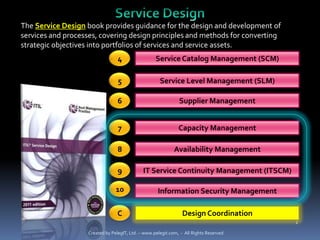
The Service Design book provides guidance for the design and development of
services and processes, covering design principles and methods for converting
strategic objectives into portfolios of services and service assets.
                                  4                 Service Catalog Management (SCM)

                                  5                   Service Level Management (SLM)

                                  6                            Supplier Management


                                  7                            Capacity Management

                                  8                          Availability Management

                                  9           IT Service Continuity Management (ITSCM)

                                 10                  Information Security Management

                                  C                              Design Coordination
                                                                                         2

                    Created by PelegIT, Ltd. – www.pelegit.com, - All Rights Reserved
Every time a new service solution is produced, it
  needs to be checked against the rest of the
Service Portfolio to ensure that it will integrate
    and interface with all other services in
                   production.


           Created by PelegIT, Ltd. – www.pelegit.com, - All Rights Reserved   3
Service Design Package
Business Requirements                                 Organizational Readiness Assessment
Service Applicability                                 User Acceptance Criteria
Service Contracts                                     Service Program
Service Functional Requirements                       Service Transition Plan
Service Level Requirements                            Service Operation Plan
Service Design & Topology                             Service Acceptance Criteria


                    Created by PelegIT, Ltd. – www.pelegit.com, - All Rights Reserved       4
5

Created by PelegIT, Ltd. – www.pelegit.com, - All Rights Reserved
Created by PelegIT, Ltd. – www.pelegit.com, - All Rights Reserved   6
Service Level Agreement (SLA):
                       (ITIL Continual Service Improvement, CSI)


An agreement between an IT service provider and a customer. A SLA describes the IT
service, documents service level targets, and specifies the responsibilities of the IT
service provider and the customer. A single agreement may cover multiple IT services
or multiple customers. (OLA)


                                                                                          7

                      Created by PelegIT, Ltd. – www.pelegit.com, - All Rights Reserved
Operational Level Agreement (OLA):
         (ITIL Service Design, SD & ITIL Continual Service Improvement, CSI)


An agreement between an IT service provider and another part of the same
organization. It supports the IT service provider’s delivery of IT services to customers
and defines the goods and services to be provided and the responsibilities of both
parties. For example their could be an OLA:

•   Between the IT service provider and a procurement department to obtain
    hardware in agreed time frame
•   Between the service desk and a support group to provide incident resolution
    in agreed times


                                                                                         8

                     Created by PelegIT, Ltd. – www.pelegit.com, - All Rights Reserved
Underpinning Contract (UC):
                                     (ITIL Service Design, SD)

A contract between service provider and a third party. The third party provides goods
and services that support delivery of an IT service to the customer. The UC defines
targets and responsibilities that are required to meet agreed service level targets in
one or more SLA’s.


                                                                                         9

                     Created by PelegIT, Ltd. – www.pelegit.com, - All Rights Reserved
Service Catalogue:
                                      (ITIL Service Design, SD)

A written statement of available IT services, default levels, options, prices and
identification of which business processes or customers use them.


                                                                                          10

                      Created by PelegIT, Ltd. – www.pelegit.com, - All Rights Reserved
Service Level Requirements (SLR):
                                     (ITIL Service Design, SD)

Detailed recording of customer’s needs, forming the design criteria for a new or
modified service.


                                                                                         11

                     Created by PelegIT, Ltd. – www.pelegit.com, - All Rights Reserved
Service Level Targets (SLT):
             (ITIL Service Design, SD, Continual Service Improvement, CSI)

A commitment that is documented in a service level agreement (SLA). Service level
targets (SLT) are based on service level requirements (SLR) , and are needed to ensure
that the IT service is able to meet business objectives. They should be SMART, and are
usually based on key performance indicators (KPI).


                                                                                         12

                     Created by PelegIT, Ltd. – www.pelegit.com, - All Rights Reserved
SMART:
             (ITIL Service Design, SD, Continual Service Improvement, CSI)

An acronym for helping to remember that targets in service level agreements and
project plan should be:


                                                                                        13

                    Created by PelegIT, Ltd. – www.pelegit.com, - All Rights Reserved
Capability:
                                  (ITIL Service Design, SD)

The ability of an organization, person, process, application, IT service or other CI to carry
out an activity. Capabilities are assets of an organization. Capabilities represent an
organizations ability to coordinate, control and deploy resources to produce value.


                                                                                           14

                       Created by PelegIT, Ltd. – www.pelegit.com, - All Rights Reserved
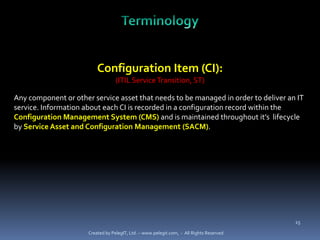
Configuration Item (CI):
                                   (ITIL Service Transition, ST)

Any component or other service asset that needs to be managed in order to deliver an IT
service. Information about each CI is recorded in a configuration record within the
Configuration Management System (CMS) and is maintained throughout it’s lifecycle
by Service Asset and Configuration Management (SACM).


                                                                                          15

                      Created by PelegIT, Ltd. – www.pelegit.com, - All Rights Reserved
Key Performance Indicator (KPI):
          (ITIL Service Design, SD & ITIL Continual Service Improvement (CSI))

A metric that is used to help manage an IT service, process, plan, project or other
activity. Key performance indicators are used to measure the achievement of critical
success factors (CSF) Many metrics may be measured, but only the most important of
these are defined as key performance indicators and used to actively manage and report
on the process, IT service or activity. They should be selected to ensure that efficiency,
effectiveness and cost effectiveness are all managed.


                                                                                           16

                       Created by PelegIT, Ltd. – www.pelegit.com, - All Rights Reserved
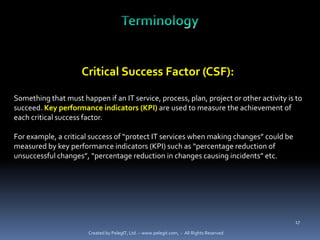
Critical Success Factor (CSF):

Something that must happen if an IT service, process, plan, project or other activity is to
succeed. Key performance indicators (KPI) are used to measure the achievement of
each critical success factor.

For example, a critical success of “protect IT services when making changes” could be
measured by key performance indicators (KPI) such as “percentage reduction of
unsuccessful changes”, “percentage reduction in changes causing incidents” etc.


                                                                                           17

                       Created by PelegIT, Ltd. – www.pelegit.com, - All Rights Reserved
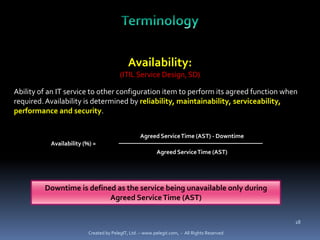
Availability:
                                         (ITIL Service Design, SD)

Ability of an IT service to other configuration item to perform its agreed function when
required. Availability is determined by reliability, maintainability, serviceability,
performance and security.


                                                  Agreed Service Time (AST) - Downtime
           Availability (%) =
                                                          Agreed Service Time (AST)


         Downtime is defined as the service being unavailable only during
                           Agreed Service Time (AST)

                                                                                              18

                          Created by PelegIT, Ltd. – www.pelegit.com, - All Rights Reserved
Maintainability:
                                     (ITIL Service Design, SD)


A measure of how quickly and effectively an IT service or other configuration item can
be restored to normal working order after a failure. Maintainability is often reported as
Mean Time to Restore Service (MTRS).


                                                                                          19

                      Created by PelegIT, Ltd. – www.pelegit.com, - All Rights Reserved
Information Security Management System (ISMS):
                                    (ITIL Service Design, SD)


The framework of policy, processes, functions, standards, guidelines and tools that
ensures an organization can achieve its information security management objectives.


                                                                                         20

                     Created by PelegIT, Ltd. – www.pelegit.com, - All Rights Reserved
Mean Time Between Failures (MTBF):
                                     (ITIL Service Design, SD)


A metric for measuring and reporting reliability. MTBF is the average time that an IT
service or other configuration item can perform it’s agreed function without
interruption.


                                                                                          21

                      Created by PelegIT, Ltd. – www.pelegit.com, - All Rights Reserved
Created by PelegIT, Ltd. – www.pelegit.com, - All Rights Reserved   22
Goal: The primary goal of Service Level Management is to
ensure that an agreed level of IT service is provided for all
current IT services, and that future services are delivered to
agreed achievable targets.


During the design phase SLM performs the following:

•   Designs and plans the SLM processes and Service Level Agreement (SLA)
    structure.
•   Determines the Service Level Requirements (SLR)
•   Negotiates and Agrees upon relevant Service Level Targets (SLT) with customers
    to produce SLA’s
•   Negotiates and agrees upon the support elements required by internal IT groups
    and External Suppliers to produce Operational Level Agreements (OLA = Internal)
    and Underpinning Contracts (UC = External)


                                                                                       23

                   Created by PelegIT, Ltd. – www.pelegit.com, - All Rights Reserved
SLA’s, OLA’s and UC’s
                              Customers


           Service Level Management (SLM)


                                                                     Supplier Management
OLA                                                                             UC


                                    SLA

Internal                                                                       External
Supplier                                                                       Supplier

                                                                                           24

           Created by PelegIT, Ltd. – www.pelegit.com, - All Rights Reserved
SLA Questions

Will the SLA structure allow flexibility in the levels of service to
be delivered to various customers?

Will the SLA structure require much duplication of effort?


Who will sign the SLA?


                                                                                      25

                  Created by PelegIT, Ltd. – www.pelegit.com, - All Rights Reserved
Service Level Agreement Structures

                              Customer 1


                                Service A


Customer Based SLA
                                                                         26

     Created by PelegIT, Ltd. – www.pelegit.com, - All Rights Reserved
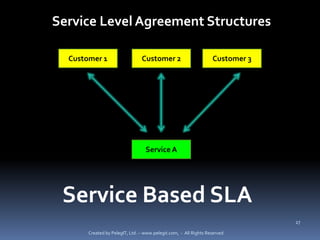
Service Level Agreement Structures

  Customer 1                    Customer 2                        Customer 3


                                  Service A


 Service Based SLA
                                                                               27

       Created by PelegIT, Ltd. – www.pelegit.com, - All Rights Reserved
Service Level Agreement Structures
                                              Corporate Level


                         Customer 1                                          Customer 2


                       Service A             Service B

1. Corporate Level – All generic issues are covered, which are the same for the entire organization.
   (Corporate Security Baseline: passwords, ID Cards etc.)

2. Customer Level – Those issues specific to a customer can be dealt with. (Security Requirements
   of one or more departments within the organization are higher. Financial Department may have
   higher security needs.)

3. Service Level – All issues relevant to a specific service (in relation to customers) can be covered.
   (The e-mail services for a particular department needs encryption and secure back-ups


          Multi-Level Based SLA                                                                     28

                           Created by PelegIT, Ltd. – www.pelegit.com, - All Rights Reserved
SLA is a written agreement between an IT service provider and the IT customers,
defining the key service targets and responsibilities of both parties.


    SLA’s should not be used as a way to hold one side or another for ransom.


  A mutually beneficial agreement should be reached – otherwise the SLA could
  quickly fall into dispute and a “Blame Culture” could develop.


   SLA’s should be used as a tool for teamwork and cooperation between the IT
                       customers and the service provider.


                                                                                        29

                    Created by PelegIT, Ltd. – www.pelegit.com, - All Rights Reserved
OLA is an agreement between the IT service provider and anther part of the same
organization.


OLA should contain targets that underpin those within an SLA to ensure that
targets will not be breached by an failure of supporting activities.


                                                                                      30

                  Created by PelegIT, Ltd. – www.pelegit.com, - All Rights Reserved
When talking about OLA, it is an agreement between the internal support
groups of an institution that supports SLA.

According to the Operational Level Agreement, each internal support group has
certain responsibilities to the other group. The OLA clearly depicts the
performance and relationship of the internal service groups.

The main objective of OLA is to ensure that all the support groups provide the
intended Service Level Agreement.


1. Service Level Agreement focuses on the service part of the agreement, like
uptime of services and performance. On the other hand, Operational Level
Agreement is an agreement in respect to maintenance and other services.

2. The Service Level Agreement is basically a contract between a service
provider and a customer. OLA is an agreement between the internal support
groups of an institution that supports SLA.

                                                                                      31

                  Created by PelegIT, Ltd. – www.pelegit.com, - All Rights Reserved
The agreement between service provider and supplier is critical.


For service provider and supplier the UC should expose risks that need to be
addressed and must be comprehensive and practical, covering a wide variety
of risks, including financial, business reputation, operational, regulatory and
legal.


A comprehensive agreement minimizes the risk of disputes arising from a
difference in expectations.

A good UC should be adaptable and maintainable with a minimum amount of
renegotiation.


                                                                                      32

                  Created by PelegIT, Ltd. – www.pelegit.com, - All Rights Reserved
Created by PelegIT, Ltd. – www.pelegit.com, - All Rights Reserved   33
Goal – Mange suppliers and the services they supply, to
         provide seamless quality of IT services.


            Created by PelegIT, Ltd. – www.pelegit.com, - All Rights Reserved   34
Created by PelegIT, Ltd. – www.pelegit.com, - All Rights Reserved   35
Supplier Service Improvement Plan (SSIP):
                                    (ITIL Service Design, SD)

Used to record all improvement actions and plans agreed between suppliers and service
providers.


                                                                                          36

                      Created by PelegIT, Ltd. – www.pelegit.com, - All Rights Reserved
Supplier Survey Reports:
                                    (ITIL Service Design, SD)

Feedback gathered from all individuals that deal directly with suppliers throughout their
day to day roles. Results are collated and reviewed by Supplier Management to ensure
consistency in quality of service provided by suppliers in all areas.


                                                                                          37

                      Created by PelegIT, Ltd. – www.pelegit.com, - All Rights Reserved
Supplier & Contract Performance Reports:
                                    (ITIL Service Design, SD)

Used as input for the Supplier Contract review meetings to manage the quality of the
service provided by suppliers and partners. This should include information on shared risk
when appropriate.


                                                                                          38

                      Created by PelegIT, Ltd. – www.pelegit.com, - All Rights Reserved
(Supplier & Contract Database - SCD)
  Supplier and Contract Management Information System (SCMIS):
                                    (ITIL Service Design, SD)


A set of tools, data and information that is used to support supplier management. See
also Service Knowledge Management System (SKMS).


                                                                                          39

                      Created by PelegIT, Ltd. – www.pelegit.com, - All Rights Reserved
Co-Sourcing     An informal combination of insourcing and outsourcing, using a number
                 of outsourcing organizations working together to co-source key
                 elements within the lifecycle.


Partnership or   Formal arrangements between two or more organizations to work
Multi-Sourcing   together to design, develop, transition, maintain, operate and or
                 support IT services. The focus here tends to be on strategic partnerships
                 that leverage critical expertise or market opportunities.


  Business       Formal arrangements where an external organization provides and
   Process       manages the other organizations entire business processes or functions
 Outsourcing     in a low cost location. Common examples include: payroll and call
                 centers.


                                                                                       40

                 Created by PelegIT, Ltd. – www.pelegit.com, - All Rights Reserved
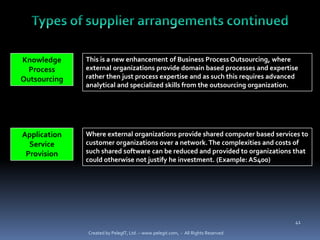
Knowledge     This is a new enhancement of Business Process Outsourcing, where
 Process      external organizations provide domain based processes and expertise
Outsourcing   rather then just process expertise and as such this requires advanced
              analytical and specialized skills from the outsourcing organization.


Application   Where external organizations provide shared computer based services to
  Service     customer organizations over a network. The complexities and costs of
 Provision    such shared software can be reduced and provided to organizations that
              could otherwise not justify he investment. (Example: AS400)


                                                                                  41

              Created by PelegIT, Ltd. – www.pelegit.com, - All Rights Reserved
Created by PelegIT, Ltd. – www.pelegit.com, - All Rights Reserved   42
Goal – Ensure that a service catalogue is produced,
maintained and always accurate information on operational
        services and those ready for deployment.


             Created by PelegIT, Ltd. – www.pelegit.com, - All Rights Reserved   43
Business Service Catalogue
Contains details of all IT services defined in the context of customers, together with
relationships to the business units and the business processes they support. This
information is used to form the customer view of the service catalogue. In cases
where the customer is a IT organization the technical view may be expanded.


Technical Service Catalogue
Contains details of all IT services delivered to the customer. However by
compression the technical service catalogue includes records of relationships that
exist with other supporting services, shared services, components and configuration
items (CI) necessary for deliver of the service to the business.


                    Created by PelegIT, Ltd. – www.pelegit.com, - All Rights Reserved    44
Service Catalogue
                                                                             Business/Customer Service Catalogue View

                 Business                           Business                            Business
                 Process 1                          Process 2                           Process 3


     Service A               Service B                     Service C                  Service D            Service E


                                                Support
     Hardware           Software                                       Network            Mainframe          Data
                                                Services

Technical Supporting Service Catalogue View

                                                        Links to related
                                                          Information


                                Service Asset/Configuration Records

   Key               = Customer facing services                                   = Supporting services
                                                                                                                        45

                             Created by PelegIT, Ltd. – www.pelegit.com, - All Rights Reserved
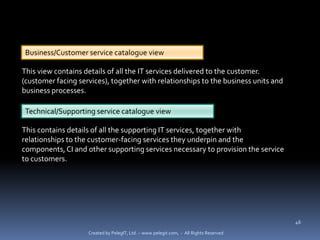
Business/Customer service catalogue view

This view contains details of all the IT services delivered to the customer.
(customer facing services), together with relationships to the business units and
business processes.

 Technical/Supporting service catalogue view

This contains details of all the supporting IT services, together with
relationships to the customer-facing services they underpin and the
components, CI and other supporting services necessary to provision the service
to customers.


                                                                                        46

                    Created by PelegIT, Ltd. – www.pelegit.com, - All Rights Reserved
Service Catalogue
Wholesale Service Catalogue View                                                   Retail Service Catalogue View

    Wholesale            Wholesale                                                  Retail                 Retail
    Customer 1           Customer 2                                               Customer 1             Customer 2


     Service A             Service B                    Service C                  Service D              Service E


                                             Support
     Hardware           Software                                    Network            Mainframe            Data
                                             Services

Supporting Service Catalogue View

                                                     Links to related
                                                       Information


                             Service Asset/Configuration Records

   Key               = Customer facing services                                = Supporting services
                                                                                                                      47

                          Created by PelegIT, Ltd. – www.pelegit.com, - All Rights Reserved
Wholesale customer view

This view contains details of all the IT services delivered to the wholesale
customer.

 Retail customer view

This view contains details of all the IT services delivered to the retail customer.


 Technical/Supporting service catalogue view

This contains details of all the supporting IT services, together with
relationships to the customer-facing services they underpin…


                 Notice Service C is shared.
                                                                                         48

                     Created by PelegIT, Ltd. – www.pelegit.com, - All Rights Reserved
There is no single correct way to structure and deploy a
                    service catalogue.


                                                                                 49

             Created by PelegIT, Ltd. – www.pelegit.com, - All Rights Reserved
Created by PelegIT, Ltd. – www.pelegit.com, - All Rights Reserved   50
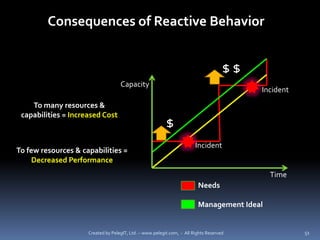
Consequences of Reactive Behavior


                                                                                     $$
                                    Capacity
                                                                                          Incident
    To many resources &
 capabilities = Increased Cost
                                                          $
                                                                        Incident
To few resources & capabilities =
    Decreased Performance
                                                                                            Time
                                                                         Needs

                                                                         Management Ideal


                     Created by PelegIT, Ltd. – www.pelegit.com, - All Rights Reserved               51
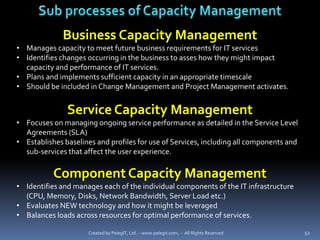
Business Capacity Management
• Manages capacity to meet future business requirements for IT services
• Identifies changes occurring in the business to asses how they might impact
  capacity and performance of IT services.
• Plans and implements sufficient capacity in an appropriate timescale
• Should be included in Change Management and Project Management activates.


               Service Capacity Management
• Focuses on managing ongoing service performance as detailed in the Service Level
  Agreements (SLA)
• Establishes baselines and profiles for use of Services, including all components and
  sub-services that affect the user experience.

           Component Capacity Management
• Identifies and manages each of the individual components of the IT infrastructure
  (CPU, Memory, Disks, Network Bandwidth, Server Load etc.)
• Evaluates NEW technology and how it might be leveraged
• Balances loads across resources for optimal performance of services.

                     Created by PelegIT, Ltd. – www.pelegit.com, - All Rights Reserved   52
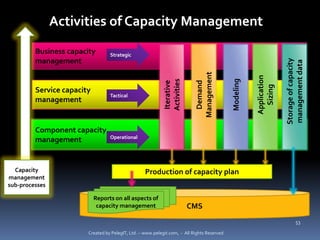
Activities of Capacity Management
         Business capacity        Strategic
         management


                                                                                                                     Storage of capacity
                                                                                                                     management data
                                                                           Management


                                                                                                       Application
                                                                                            Modeling
                                                            Activities

                                                                            Demand
                                                            Iterative


                                                                                                         Sizing
         Service capacity
                                  Tactical
         management


         Component capacity
                                  Operational
         management


  Capacity                                         Production of capacity plan
management
sub-processes

                            Reports on all aspects of
                             capacity management                         CMS
                                                                                                                              53

                        Created by PelegIT, Ltd. – www.pelegit.com, - All Rights Reserved
1. Performance Monitoring - Measuring, monitoring and tuning
   performance of IT infrastructure components
2. Demand Management – Short term reactive implementation of
   strategies considered in Service Strategy to manage current demand.
3. Application Sizing – Determining the hardware or network capacity to
   support new or modified applications and the predicted workload.
4. Modeling – Used to forecast the behavior of the infrastructure under
   certain conditions (e.g. if the number of users is doubled, if a network link
   fails)
5. Tuning – Modifications made for better utilization of the current
   infrastructure
6. Storage of Capacity Management Data
7. Capacity Planning
8. Reporting


                Created by PelegIT, Ltd. – www.pelegit.com, - All Rights Reserved   54
Created by PelegIT, Ltd. – www.pelegit.com, - All Rights Reserved   55
Goal – Ensure the level of service availability delivered in all
services is matched or exceeds the current and future agreed
      needs of the business in a cost effective manner.


               Created by PelegIT, Ltd. – www.pelegit.com, - All Rights Reserved   56
Created by PelegIT, Ltd. – www.pelegit.com, - All Rights Reserved   57
Security
                                                  (ITIL Service Design, SD)

Services, systems and information should be made available to authorized users at the
authorized times (see Information Security Management and Access Management)


              © Crown copyright 2011. Reproduced under license from OGC. - Created by PelegIT, Ltd. – www.pelegit.com, - All Rights Reserved
Reliability
                                                  (ITIL Service Design, SD)

Freedom from operational failures.


              © Crown copyright 2011. Reproduced under license from OGC. - Created by PelegIT, Ltd. – www.pelegit.com, - All Rights Reserved
Resilience
                                                  (ITIL Service Design, SD)

The ability to withstand a failure. (example: redundant components)


              © Crown copyright 2011. Reproduced under license from OGC. - Created by PelegIT, Ltd. – www.pelegit.com, - All Rights Reserved
Maintainability
                                                    (ITIL Service Design, SD)

Internal; The ability of an IT component to be retained in or restored to, an operational
state. This will be affected by the skills, knowledge and availability of IT staff, as well as
various other ITSM tools for detecting and managing disruptions.


                © Crown copyright 2011. Reproduced under license from OGC. - Created by PelegIT, Ltd. – www.pelegit.com, - All Rights Reserved
Serviceability
                                                   (ITIL Service Design, SD)

External; The contractual arrangements made with external suppliers that document
their obligations for supporting the availability of services. Measured by Availability,
Reliability and Maintainability of IT services and components under the control of the
external suppliers.


               © Crown copyright 2011. Reproduced under license from OGC. - Created by PelegIT, Ltd. – www.pelegit.com, - All Rights Reserved
Vital Business Function
                                                   (ITIL Service Design, SD)

The business critical elements of the business process supported by an IT service.
Typically this will be where more effort and investments will be spent to protect these
vital business functions.


               © Crown copyright 2011. Reproduced under license from OGC. - Created by PelegIT, Ltd. – www.pelegit.com, - All Rights Reserved
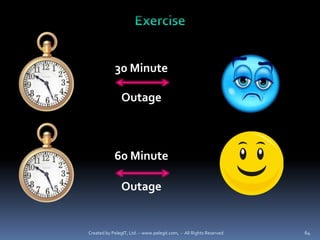
30 Minute

               Outage


            60 Minute

               Outage


Created by PelegIT, Ltd. – www.pelegit.com, - All Rights Reserved   64
1.   30 Minute outage during peak hours, overtime being paid to
     staff, urgent report being required.

2.   60 Minute outage on a weekend, holiday, off-peak hours, when
     the service was not required

3.   30 Minute outage of critical IT services

4.   60 Minute outage of non-critical IT services

5.   30 Minute unplanned outage

6.   60 Minute planned outage (maintannce)


             Created by PelegIT, Ltd. – www.pelegit.com, - All Rights Reserved   65
Mean Time between Failures (MTBF) or Uptime
Average time between the recovery from one incident and the occurrence of the
next incident, this relates to the reliability of the service.

Mean Time to Restore Service (MTRS) or Downtime
Average time taken to restore a CI or IT service after a failure
This is measured from the time when the CI or IT service fails until it is FULLY
restored and is able to deliver normal functionality.

Mean Time Between Service Incidents (MTBSI)
Average time between the occurrence of two consecutive incidents
Sum of MTRS + MTBF

High Ratio of MTBF / MTBSI indicates there are many minor faults.

Low Ratio of MTBF / MTBSI indicates there are many major faults.

                   Created by PelegIT, Ltd. – www.pelegit.com, - All Rights Reserved   66
Created by PelegIT, Ltd. – www.pelegit.com, - All Rights Reserved   67
Goal – Disaster recovery planning


  Created by PelegIT, Ltd. – www.pelegit.com, - All Rights Reserved   68
Created by PelegIT, Ltd. – www.pelegit.com, - All Rights Reserved   69
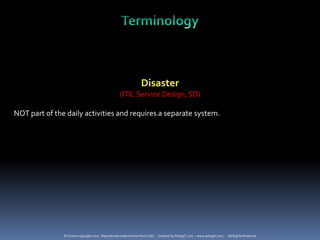
Disaster
                                                   (ITIL Service Design, SD)

NOT part of the daily activities and requires a separate system.


               © Crown copyright 2011. Reproduced under license from OGC. - Created by PelegIT, Ltd. – www.pelegit.com, - All Rights Reserved
Business Continuity Management (BCM)
                                                   (ITIL Service Design, SD)

Strategies and actions to take place to continue Business Processes in the case of a
disaster.


               © Crown copyright 2011. Reproduced under license from OGC. - Created by PelegIT, Ltd. – www.pelegit.com, - All Rights Reserved
Business Impact Analysis(BIA)
                                                   (ITIL Service Design, SD)

Quantifies the impact of loss of IT services would have on the business.


               © Crown copyright 2011. Reproduced under license from OGC. - Created by PelegIT, Ltd. – www.pelegit.com, - All Rights Reserved
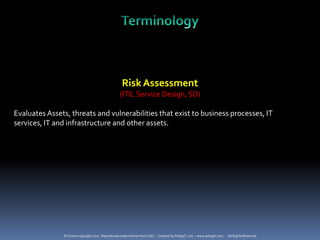
Risk Assessment
                                                   (ITIL Service Design, SD)

Evaluates Assets, threats and vulnerabilities that exist to business processes, IT
services, IT and infrastructure and other assets.


               © Crown copyright 2011. Reproduced under license from OGC. - Created by PelegIT, Ltd. – www.pelegit.com, - All Rights Reserved
Counter Measure
                                                   (ITIL Service Design, SD)

Measures to prevent or recover from a disaster.


               © Crown copyright 2011. Reproduced under license from OGC. - Created by PelegIT, Ltd. – www.pelegit.com, - All Rights Reserved
Manual Workaround
                                                   (ITIL Service Design, SD)

Using Non-IT based solutions to overcome a IT service disruption.


               © Crown copyright 2011. Reproduced under license from OGC. - Created by PelegIT, Ltd. – www.pelegit.com, - All Rights Reserved
Gradual Recovery
                                                   (ITIL Service Design, SD)

Aka Cold Standby or Cold Site (> 72 Hours to recover from a disaster)


               © Crown copyright 2011. Reproduced under license from OGC. - Created by PelegIT, Ltd. – www.pelegit.com, - All Rights Reserved
Intermediate Recovery
                                                  (ITIL Service Design, SD)

Aka Warm Standby or Warm Site (24 - 72 Hours to recover from a disaster)


              © Crown copyright 2011. Reproduced under license from OGC. - Created by PelegIT, Ltd. – www.pelegit.com, - All Rights Reserved
Immediate Recovery
                                                   (ITIL Service Design, SD)

Aka Hot Standby or Hot Site (>24 Hours to recover from a disaster, usually implies 1-2
hours to recover from disaster.)


               © Crown copyright 2011. Reproduced under license from OGC. - Created by PelegIT, Ltd. – www.pelegit.com, - All Rights Reserved
The recovery site should be a minimum of 35 Miles from the
                  organizations main site.


        © Crown copyright 2011. Reproduced under license from OGC. - Created by PelegIT, Ltd. – www.pelegit.com, - All Rights Reserved
Created by PelegIT, Ltd. – www.pelegit.com, - All Rights Reserved   80
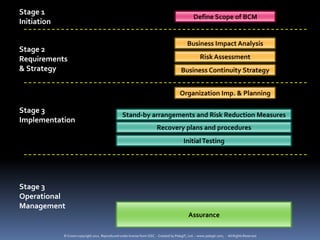
Stage 1
                                                                                                 Define Scope of BCM
Initiation

                                                                                             Business Impact Analysis
Stage 2
Requirements                                                                                          Risk Assessment
& Strategy                                                                               Business Continuity Strategy


                                                                                        Organization Imp. & Planning

Stage 3
                                                   Stand-by arrangements and Risk Reduction Measures
Implementation
                                                                         Recovery plans and procedures
                                                                                           Initial Testing


Stage 3
Operational
Management
                                                                                              Assurance

             © Crown copyright 2011. Reproduced under license from OGC. - Created by PelegIT, Ltd. – www.pelegit.com, - All Rights Reserved
Goal – Security is present and aligned with the business
                                        needs.


             Created by PelegIT, Ltd. – www.pelegit.com, - All Rights Reserved   82
Created by PelegIT, Ltd. – www.pelegit.com, - All Rights Reserved   83
Availability
                                                   (ITIL Service Design, SD)

Ability of an IT service to other configuration item to perform its agreed function when
required. Availability is determined by reliability, maintainability, serviceability,
performance and security.


               © Crown copyright 2011. Reproduced under license from OGC. - Created by PelegIT, Ltd. – www.pelegit.com, - All Rights Reserved
Confidentiality
                                                   (ITIL Service Design, SD)

A security principle that requires that data should only be accessed by authorized people.


               © Crown copyright 2011. Reproduced under license from OGC. - Created by PelegIT, Ltd. – www.pelegit.com, - All Rights Reserved
Integrity
                                                   (ITIL Service Design, SD)

A security principle that ensures data and CI’s are modified only by authorized personnel
and activities. Integrity considers all possible causes of modification, including software
and hardware failures, environmental events and human intervention.


               © Crown copyright 2011. Reproduced under license from OGC. - Created by PelegIT, Ltd. – www.pelegit.com, - All Rights Reserved
Security Baseline
                                                   (ITIL Service Design, SD)

The security level adopted by the IT organization for its own security and from the point
of view of “Good Diligence”
Possible to have multiple baselines


               © Crown copyright 2011. Reproduced under license from OGC. - Created by PelegIT, Ltd. – www.pelegit.com, - All Rights Reserved
Security Incident
                                                   (ITIL Service Design, SD)

Any incident that may interfere with achieving the SLA security requirements;
materialization of a threat


               © Crown copyright 2011. Reproduced under license from OGC. - Created by PelegIT, Ltd. – www.pelegit.com, - All Rights Reserved
Information Security Management (ISM)
                                                   (ITIL Service Design, SD)


The process responsible for ensuring that the confidentiality, integrity and availability
(CIA Triangle) of an organization’s assets, information, data and IT service match the
agreed needs of the business.


               © Crown copyright 2011. Reproduced under license from OGC. - Created by PelegIT, Ltd. – www.pelegit.com, - All Rights Reserved
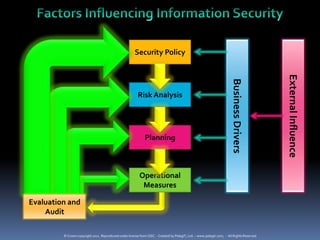
Security Policy


                                                                                                                                          External Influence
                                                                                                                      Business Drivers
                                                         Risk Analysis


                                                              Planning


                                                          Operational
                                                           Measures

Evaluation and
    Audit

         © Crown copyright 2011. Reproduced under license from OGC. - Created by PelegIT, Ltd. – www.pelegit.com, - All Rights Reserved
© Crown copyright 2011. Reproduced under license from OGC. - Created by PelegIT, Ltd. – www.pelegit.com, - All Rights Reserved
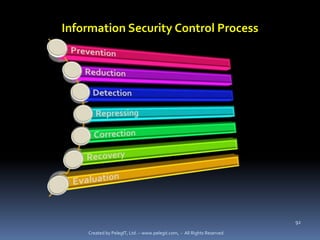
Information Security Control Process


                                                                        92

    Created by PelegIT, Ltd. – www.pelegit.com, - All Rights Reserved
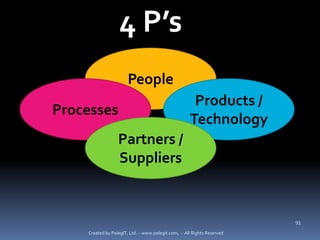
4 P’s
                      People
                                                     Products /
Processes
                                                    Technology
                  Partners /
                  Suppliers


                                                                        93

    Created by PelegIT, Ltd. – www.pelegit.com, - All Rights Reserved
94

Created by PelegIT, Ltd. – www.pelegit.com, - All Rights Reserved

Service Design

  • 1.
    Created by PelegIT,Ltd. – www.pelegit.com, - All Rights Reserved 1
  • 2.
    The Service Designbook provides guidance for the design and development of services and processes, covering design principles and methods for converting strategic objectives into portfolios of services and service assets. 4 Service Catalog Management (SCM) 5 Service Level Management (SLM) 6 Supplier Management 7 Capacity Management 8 Availability Management 9 IT Service Continuity Management (ITSCM) 10 Information Security Management C Design Coordination 2 Created by PelegIT, Ltd. – www.pelegit.com, - All Rights Reserved
  • 3.
    Every time anew service solution is produced, it needs to be checked against the rest of the Service Portfolio to ensure that it will integrate and interface with all other services in production. Created by PelegIT, Ltd. – www.pelegit.com, - All Rights Reserved 3
  • 4.
    Service Design Package BusinessRequirements Organizational Readiness Assessment Service Applicability User Acceptance Criteria Service Contracts Service Program Service Functional Requirements Service Transition Plan Service Level Requirements Service Operation Plan Service Design & Topology Service Acceptance Criteria Created by PelegIT, Ltd. – www.pelegit.com, - All Rights Reserved 4
  • 5.
    5 Created by PelegIT,Ltd. – www.pelegit.com, - All Rights Reserved
  • 6.
    Created by PelegIT,Ltd. – www.pelegit.com, - All Rights Reserved 6
  • 7.
    Service Level Agreement(SLA): (ITIL Continual Service Improvement, CSI) An agreement between an IT service provider and a customer. A SLA describes the IT service, documents service level targets, and specifies the responsibilities of the IT service provider and the customer. A single agreement may cover multiple IT services or multiple customers. (OLA) 7 Created by PelegIT, Ltd. – www.pelegit.com, - All Rights Reserved
  • 8.
    Operational Level Agreement(OLA): (ITIL Service Design, SD & ITIL Continual Service Improvement, CSI) An agreement between an IT service provider and another part of the same organization. It supports the IT service provider’s delivery of IT services to customers and defines the goods and services to be provided and the responsibilities of both parties. For example their could be an OLA: • Between the IT service provider and a procurement department to obtain hardware in agreed time frame • Between the service desk and a support group to provide incident resolution in agreed times 8 Created by PelegIT, Ltd. – www.pelegit.com, - All Rights Reserved
  • 9.
    Underpinning Contract (UC): (ITIL Service Design, SD) A contract between service provider and a third party. The third party provides goods and services that support delivery of an IT service to the customer. The UC defines targets and responsibilities that are required to meet agreed service level targets in one or more SLA’s. 9 Created by PelegIT, Ltd. – www.pelegit.com, - All Rights Reserved
  • 10.
    Service Catalogue: (ITIL Service Design, SD) A written statement of available IT services, default levels, options, prices and identification of which business processes or customers use them. 10 Created by PelegIT, Ltd. – www.pelegit.com, - All Rights Reserved
  • 11.
    Service Level Requirements(SLR): (ITIL Service Design, SD) Detailed recording of customer’s needs, forming the design criteria for a new or modified service. 11 Created by PelegIT, Ltd. – www.pelegit.com, - All Rights Reserved
  • 12.
    Service Level Targets(SLT): (ITIL Service Design, SD, Continual Service Improvement, CSI) A commitment that is documented in a service level agreement (SLA). Service level targets (SLT) are based on service level requirements (SLR) , and are needed to ensure that the IT service is able to meet business objectives. They should be SMART, and are usually based on key performance indicators (KPI). 12 Created by PelegIT, Ltd. – www.pelegit.com, - All Rights Reserved
  • 13.
    SMART: (ITIL Service Design, SD, Continual Service Improvement, CSI) An acronym for helping to remember that targets in service level agreements and project plan should be: 13 Created by PelegIT, Ltd. – www.pelegit.com, - All Rights Reserved
  • 14.
    Capability: (ITIL Service Design, SD) The ability of an organization, person, process, application, IT service or other CI to carry out an activity. Capabilities are assets of an organization. Capabilities represent an organizations ability to coordinate, control and deploy resources to produce value. 14 Created by PelegIT, Ltd. – www.pelegit.com, - All Rights Reserved
  • 15.
    Configuration Item (CI): (ITIL Service Transition, ST) Any component or other service asset that needs to be managed in order to deliver an IT service. Information about each CI is recorded in a configuration record within the Configuration Management System (CMS) and is maintained throughout it’s lifecycle by Service Asset and Configuration Management (SACM). 15 Created by PelegIT, Ltd. – www.pelegit.com, - All Rights Reserved
  • 16.
    Key Performance Indicator(KPI): (ITIL Service Design, SD & ITIL Continual Service Improvement (CSI)) A metric that is used to help manage an IT service, process, plan, project or other activity. Key performance indicators are used to measure the achievement of critical success factors (CSF) Many metrics may be measured, but only the most important of these are defined as key performance indicators and used to actively manage and report on the process, IT service or activity. They should be selected to ensure that efficiency, effectiveness and cost effectiveness are all managed. 16 Created by PelegIT, Ltd. – www.pelegit.com, - All Rights Reserved
  • 17.
    Critical Success Factor(CSF): Something that must happen if an IT service, process, plan, project or other activity is to succeed. Key performance indicators (KPI) are used to measure the achievement of each critical success factor. For example, a critical success of “protect IT services when making changes” could be measured by key performance indicators (KPI) such as “percentage reduction of unsuccessful changes”, “percentage reduction in changes causing incidents” etc. 17 Created by PelegIT, Ltd. – www.pelegit.com, - All Rights Reserved
  • 18.
    Availability: (ITIL Service Design, SD) Ability of an IT service to other configuration item to perform its agreed function when required. Availability is determined by reliability, maintainability, serviceability, performance and security. Agreed Service Time (AST) - Downtime Availability (%) = Agreed Service Time (AST) Downtime is defined as the service being unavailable only during Agreed Service Time (AST) 18 Created by PelegIT, Ltd. – www.pelegit.com, - All Rights Reserved
  • 19.
    Maintainability: (ITIL Service Design, SD) A measure of how quickly and effectively an IT service or other configuration item can be restored to normal working order after a failure. Maintainability is often reported as Mean Time to Restore Service (MTRS). 19 Created by PelegIT, Ltd. – www.pelegit.com, - All Rights Reserved
  • 20.
    Information Security ManagementSystem (ISMS): (ITIL Service Design, SD) The framework of policy, processes, functions, standards, guidelines and tools that ensures an organization can achieve its information security management objectives. 20 Created by PelegIT, Ltd. – www.pelegit.com, - All Rights Reserved
  • 21.
    Mean Time BetweenFailures (MTBF): (ITIL Service Design, SD) A metric for measuring and reporting reliability. MTBF is the average time that an IT service or other configuration item can perform it’s agreed function without interruption. 21 Created by PelegIT, Ltd. – www.pelegit.com, - All Rights Reserved
  • 22.
    Created by PelegIT,Ltd. – www.pelegit.com, - All Rights Reserved 22
  • 23.
    Goal: The primarygoal of Service Level Management is to ensure that an agreed level of IT service is provided for all current IT services, and that future services are delivered to agreed achievable targets. During the design phase SLM performs the following: • Designs and plans the SLM processes and Service Level Agreement (SLA) structure. • Determines the Service Level Requirements (SLR) • Negotiates and Agrees upon relevant Service Level Targets (SLT) with customers to produce SLA’s • Negotiates and agrees upon the support elements required by internal IT groups and External Suppliers to produce Operational Level Agreements (OLA = Internal) and Underpinning Contracts (UC = External) 23 Created by PelegIT, Ltd. – www.pelegit.com, - All Rights Reserved
  • 24.
    SLA’s, OLA’s andUC’s Customers Service Level Management (SLM) Supplier Management OLA UC SLA Internal External Supplier Supplier 24 Created by PelegIT, Ltd. – www.pelegit.com, - All Rights Reserved
  • 25.
    SLA Questions Will theSLA structure allow flexibility in the levels of service to be delivered to various customers? Will the SLA structure require much duplication of effort? Who will sign the SLA? 25 Created by PelegIT, Ltd. – www.pelegit.com, - All Rights Reserved
  • 26.
    Service Level AgreementStructures Customer 1 Service A Customer Based SLA 26 Created by PelegIT, Ltd. – www.pelegit.com, - All Rights Reserved
  • 27.
    Service Level AgreementStructures Customer 1 Customer 2 Customer 3 Service A Service Based SLA 27 Created by PelegIT, Ltd. – www.pelegit.com, - All Rights Reserved
  • 28.
    Service Level AgreementStructures Corporate Level Customer 1 Customer 2 Service A Service B 1. Corporate Level – All generic issues are covered, which are the same for the entire organization. (Corporate Security Baseline: passwords, ID Cards etc.) 2. Customer Level – Those issues specific to a customer can be dealt with. (Security Requirements of one or more departments within the organization are higher. Financial Department may have higher security needs.) 3. Service Level – All issues relevant to a specific service (in relation to customers) can be covered. (The e-mail services for a particular department needs encryption and secure back-ups Multi-Level Based SLA 28 Created by PelegIT, Ltd. – www.pelegit.com, - All Rights Reserved
  • 29.
    SLA is awritten agreement between an IT service provider and the IT customers, defining the key service targets and responsibilities of both parties. SLA’s should not be used as a way to hold one side or another for ransom. A mutually beneficial agreement should be reached – otherwise the SLA could quickly fall into dispute and a “Blame Culture” could develop. SLA’s should be used as a tool for teamwork and cooperation between the IT customers and the service provider. 29 Created by PelegIT, Ltd. – www.pelegit.com, - All Rights Reserved
  • 30.
    OLA is anagreement between the IT service provider and anther part of the same organization. OLA should contain targets that underpin those within an SLA to ensure that targets will not be breached by an failure of supporting activities. 30 Created by PelegIT, Ltd. – www.pelegit.com, - All Rights Reserved
  • 31.
    When talking aboutOLA, it is an agreement between the internal support groups of an institution that supports SLA. According to the Operational Level Agreement, each internal support group has certain responsibilities to the other group. The OLA clearly depicts the performance and relationship of the internal service groups. The main objective of OLA is to ensure that all the support groups provide the intended Service Level Agreement. 1. Service Level Agreement focuses on the service part of the agreement, like uptime of services and performance. On the other hand, Operational Level Agreement is an agreement in respect to maintenance and other services. 2. The Service Level Agreement is basically a contract between a service provider and a customer. OLA is an agreement between the internal support groups of an institution that supports SLA. 31 Created by PelegIT, Ltd. – www.pelegit.com, - All Rights Reserved
  • 32.
    The agreement betweenservice provider and supplier is critical. For service provider and supplier the UC should expose risks that need to be addressed and must be comprehensive and practical, covering a wide variety of risks, including financial, business reputation, operational, regulatory and legal. A comprehensive agreement minimizes the risk of disputes arising from a difference in expectations. A good UC should be adaptable and maintainable with a minimum amount of renegotiation. 32 Created by PelegIT, Ltd. – www.pelegit.com, - All Rights Reserved
  • 33.
    Created by PelegIT,Ltd. – www.pelegit.com, - All Rights Reserved 33
  • 34.
    Goal – Mangesuppliers and the services they supply, to provide seamless quality of IT services. Created by PelegIT, Ltd. – www.pelegit.com, - All Rights Reserved 34
  • 35.
    Created by PelegIT,Ltd. – www.pelegit.com, - All Rights Reserved 35
  • 36.
    Supplier Service ImprovementPlan (SSIP): (ITIL Service Design, SD) Used to record all improvement actions and plans agreed between suppliers and service providers. 36 Created by PelegIT, Ltd. – www.pelegit.com, - All Rights Reserved
  • 37.
    Supplier Survey Reports: (ITIL Service Design, SD) Feedback gathered from all individuals that deal directly with suppliers throughout their day to day roles. Results are collated and reviewed by Supplier Management to ensure consistency in quality of service provided by suppliers in all areas. 37 Created by PelegIT, Ltd. – www.pelegit.com, - All Rights Reserved
  • 38.
    Supplier & ContractPerformance Reports: (ITIL Service Design, SD) Used as input for the Supplier Contract review meetings to manage the quality of the service provided by suppliers and partners. This should include information on shared risk when appropriate. 38 Created by PelegIT, Ltd. – www.pelegit.com, - All Rights Reserved
  • 39.
    (Supplier & ContractDatabase - SCD) Supplier and Contract Management Information System (SCMIS): (ITIL Service Design, SD) A set of tools, data and information that is used to support supplier management. See also Service Knowledge Management System (SKMS). 39 Created by PelegIT, Ltd. – www.pelegit.com, - All Rights Reserved
  • 40.
    Co-Sourcing An informal combination of insourcing and outsourcing, using a number of outsourcing organizations working together to co-source key elements within the lifecycle. Partnership or Formal arrangements between two or more organizations to work Multi-Sourcing together to design, develop, transition, maintain, operate and or support IT services. The focus here tends to be on strategic partnerships that leverage critical expertise or market opportunities. Business Formal arrangements where an external organization provides and Process manages the other organizations entire business processes or functions Outsourcing in a low cost location. Common examples include: payroll and call centers. 40 Created by PelegIT, Ltd. – www.pelegit.com, - All Rights Reserved
  • 41.
    Knowledge This is a new enhancement of Business Process Outsourcing, where Process external organizations provide domain based processes and expertise Outsourcing rather then just process expertise and as such this requires advanced analytical and specialized skills from the outsourcing organization. Application Where external organizations provide shared computer based services to Service customer organizations over a network. The complexities and costs of Provision such shared software can be reduced and provided to organizations that could otherwise not justify he investment. (Example: AS400) 41 Created by PelegIT, Ltd. – www.pelegit.com, - All Rights Reserved
  • 42.
    Created by PelegIT,Ltd. – www.pelegit.com, - All Rights Reserved 42
  • 43.
    Goal – Ensurethat a service catalogue is produced, maintained and always accurate information on operational services and those ready for deployment. Created by PelegIT, Ltd. – www.pelegit.com, - All Rights Reserved 43
  • 44.
    Business Service Catalogue Containsdetails of all IT services defined in the context of customers, together with relationships to the business units and the business processes they support. This information is used to form the customer view of the service catalogue. In cases where the customer is a IT organization the technical view may be expanded. Technical Service Catalogue Contains details of all IT services delivered to the customer. However by compression the technical service catalogue includes records of relationships that exist with other supporting services, shared services, components and configuration items (CI) necessary for deliver of the service to the business. Created by PelegIT, Ltd. – www.pelegit.com, - All Rights Reserved 44
  • 45.
    Service Catalogue Business/Customer Service Catalogue View Business Business Business Process 1 Process 2 Process 3 Service A Service B Service C Service D Service E Support Hardware Software Network Mainframe Data Services Technical Supporting Service Catalogue View Links to related Information Service Asset/Configuration Records Key = Customer facing services = Supporting services 45 Created by PelegIT, Ltd. – www.pelegit.com, - All Rights Reserved
  • 46.
    Business/Customer service catalogueview This view contains details of all the IT services delivered to the customer. (customer facing services), together with relationships to the business units and business processes. Technical/Supporting service catalogue view This contains details of all the supporting IT services, together with relationships to the customer-facing services they underpin and the components, CI and other supporting services necessary to provision the service to customers. 46 Created by PelegIT, Ltd. – www.pelegit.com, - All Rights Reserved
  • 47.
    Service Catalogue Wholesale ServiceCatalogue View Retail Service Catalogue View Wholesale Wholesale Retail Retail Customer 1 Customer 2 Customer 1 Customer 2 Service A Service B Service C Service D Service E Support Hardware Software Network Mainframe Data Services Supporting Service Catalogue View Links to related Information Service Asset/Configuration Records Key = Customer facing services = Supporting services 47 Created by PelegIT, Ltd. – www.pelegit.com, - All Rights Reserved
  • 48.
    Wholesale customer view Thisview contains details of all the IT services delivered to the wholesale customer. Retail customer view This view contains details of all the IT services delivered to the retail customer. Technical/Supporting service catalogue view This contains details of all the supporting IT services, together with relationships to the customer-facing services they underpin… Notice Service C is shared. 48 Created by PelegIT, Ltd. – www.pelegit.com, - All Rights Reserved
  • 49.
    There is nosingle correct way to structure and deploy a service catalogue. 49 Created by PelegIT, Ltd. – www.pelegit.com, - All Rights Reserved
  • 50.
    Created by PelegIT,Ltd. – www.pelegit.com, - All Rights Reserved 50
  • 51.
    Consequences of ReactiveBehavior $$ Capacity Incident To many resources & capabilities = Increased Cost $ Incident To few resources & capabilities = Decreased Performance Time Needs Management Ideal Created by PelegIT, Ltd. – www.pelegit.com, - All Rights Reserved 51
  • 52.
    Business Capacity Management •Manages capacity to meet future business requirements for IT services • Identifies changes occurring in the business to asses how they might impact capacity and performance of IT services. • Plans and implements sufficient capacity in an appropriate timescale • Should be included in Change Management and Project Management activates. Service Capacity Management • Focuses on managing ongoing service performance as detailed in the Service Level Agreements (SLA) • Establishes baselines and profiles for use of Services, including all components and sub-services that affect the user experience. Component Capacity Management • Identifies and manages each of the individual components of the IT infrastructure (CPU, Memory, Disks, Network Bandwidth, Server Load etc.) • Evaluates NEW technology and how it might be leveraged • Balances loads across resources for optimal performance of services. Created by PelegIT, Ltd. – www.pelegit.com, - All Rights Reserved 52
  • 53.
    Activities of CapacityManagement Business capacity Strategic management Storage of capacity management data Management Application Modeling Activities Demand Iterative Sizing Service capacity Tactical management Component capacity Operational management Capacity Production of capacity plan management sub-processes Reports on all aspects of capacity management CMS 53 Created by PelegIT, Ltd. – www.pelegit.com, - All Rights Reserved
  • 54.
    1. Performance Monitoring- Measuring, monitoring and tuning performance of IT infrastructure components 2. Demand Management – Short term reactive implementation of strategies considered in Service Strategy to manage current demand. 3. Application Sizing – Determining the hardware or network capacity to support new or modified applications and the predicted workload. 4. Modeling – Used to forecast the behavior of the infrastructure under certain conditions (e.g. if the number of users is doubled, if a network link fails) 5. Tuning – Modifications made for better utilization of the current infrastructure 6. Storage of Capacity Management Data 7. Capacity Planning 8. Reporting Created by PelegIT, Ltd. – www.pelegit.com, - All Rights Reserved 54
  • 55.
    Created by PelegIT,Ltd. – www.pelegit.com, - All Rights Reserved 55
  • 56.
    Goal – Ensurethe level of service availability delivered in all services is matched or exceeds the current and future agreed needs of the business in a cost effective manner. Created by PelegIT, Ltd. – www.pelegit.com, - All Rights Reserved 56
  • 57.
    Created by PelegIT,Ltd. – www.pelegit.com, - All Rights Reserved 57
  • 58.
    Security (ITIL Service Design, SD) Services, systems and information should be made available to authorized users at the authorized times (see Information Security Management and Access Management) © Crown copyright 2011. Reproduced under license from OGC. - Created by PelegIT, Ltd. – www.pelegit.com, - All Rights Reserved
  • 59.
    Reliability (ITIL Service Design, SD) Freedom from operational failures. © Crown copyright 2011. Reproduced under license from OGC. - Created by PelegIT, Ltd. – www.pelegit.com, - All Rights Reserved
  • 60.
    Resilience (ITIL Service Design, SD) The ability to withstand a failure. (example: redundant components) © Crown copyright 2011. Reproduced under license from OGC. - Created by PelegIT, Ltd. – www.pelegit.com, - All Rights Reserved
  • 61.
    Maintainability (ITIL Service Design, SD) Internal; The ability of an IT component to be retained in or restored to, an operational state. This will be affected by the skills, knowledge and availability of IT staff, as well as various other ITSM tools for detecting and managing disruptions. © Crown copyright 2011. Reproduced under license from OGC. - Created by PelegIT, Ltd. – www.pelegit.com, - All Rights Reserved
  • 62.
    Serviceability (ITIL Service Design, SD) External; The contractual arrangements made with external suppliers that document their obligations for supporting the availability of services. Measured by Availability, Reliability and Maintainability of IT services and components under the control of the external suppliers. © Crown copyright 2011. Reproduced under license from OGC. - Created by PelegIT, Ltd. – www.pelegit.com, - All Rights Reserved
  • 63.
    Vital Business Function (ITIL Service Design, SD) The business critical elements of the business process supported by an IT service. Typically this will be where more effort and investments will be spent to protect these vital business functions. © Crown copyright 2011. Reproduced under license from OGC. - Created by PelegIT, Ltd. – www.pelegit.com, - All Rights Reserved
  • 64.
    30 Minute Outage 60 Minute Outage Created by PelegIT, Ltd. – www.pelegit.com, - All Rights Reserved 64
  • 65.
    1. 30 Minute outage during peak hours, overtime being paid to staff, urgent report being required. 2. 60 Minute outage on a weekend, holiday, off-peak hours, when the service was not required 3. 30 Minute outage of critical IT services 4. 60 Minute outage of non-critical IT services 5. 30 Minute unplanned outage 6. 60 Minute planned outage (maintannce) Created by PelegIT, Ltd. – www.pelegit.com, - All Rights Reserved 65
  • 66.
    Mean Time betweenFailures (MTBF) or Uptime Average time between the recovery from one incident and the occurrence of the next incident, this relates to the reliability of the service. Mean Time to Restore Service (MTRS) or Downtime Average time taken to restore a CI or IT service after a failure This is measured from the time when the CI or IT service fails until it is FULLY restored and is able to deliver normal functionality. Mean Time Between Service Incidents (MTBSI) Average time between the occurrence of two consecutive incidents Sum of MTRS + MTBF High Ratio of MTBF / MTBSI indicates there are many minor faults. Low Ratio of MTBF / MTBSI indicates there are many major faults. Created by PelegIT, Ltd. – www.pelegit.com, - All Rights Reserved 66
  • 67.
    Created by PelegIT,Ltd. – www.pelegit.com, - All Rights Reserved 67
  • 68.
    Goal – Disasterrecovery planning Created by PelegIT, Ltd. – www.pelegit.com, - All Rights Reserved 68
  • 69.
    Created by PelegIT,Ltd. – www.pelegit.com, - All Rights Reserved 69
  • 70.
    Disaster (ITIL Service Design, SD) NOT part of the daily activities and requires a separate system. © Crown copyright 2011. Reproduced under license from OGC. - Created by PelegIT, Ltd. – www.pelegit.com, - All Rights Reserved
  • 71.
    Business Continuity Management(BCM) (ITIL Service Design, SD) Strategies and actions to take place to continue Business Processes in the case of a disaster. © Crown copyright 2011. Reproduced under license from OGC. - Created by PelegIT, Ltd. – www.pelegit.com, - All Rights Reserved
  • 72.
    Business Impact Analysis(BIA) (ITIL Service Design, SD) Quantifies the impact of loss of IT services would have on the business. © Crown copyright 2011. Reproduced under license from OGC. - Created by PelegIT, Ltd. – www.pelegit.com, - All Rights Reserved
  • 73.
    Risk Assessment (ITIL Service Design, SD) Evaluates Assets, threats and vulnerabilities that exist to business processes, IT services, IT and infrastructure and other assets. © Crown copyright 2011. Reproduced under license from OGC. - Created by PelegIT, Ltd. – www.pelegit.com, - All Rights Reserved
  • 74.
    Counter Measure (ITIL Service Design, SD) Measures to prevent or recover from a disaster. © Crown copyright 2011. Reproduced under license from OGC. - Created by PelegIT, Ltd. – www.pelegit.com, - All Rights Reserved
  • 75.
    Manual Workaround (ITIL Service Design, SD) Using Non-IT based solutions to overcome a IT service disruption. © Crown copyright 2011. Reproduced under license from OGC. - Created by PelegIT, Ltd. – www.pelegit.com, - All Rights Reserved
  • 76.
    Gradual Recovery (ITIL Service Design, SD) Aka Cold Standby or Cold Site (> 72 Hours to recover from a disaster) © Crown copyright 2011. Reproduced under license from OGC. - Created by PelegIT, Ltd. – www.pelegit.com, - All Rights Reserved
  • 77.
    Intermediate Recovery (ITIL Service Design, SD) Aka Warm Standby or Warm Site (24 - 72 Hours to recover from a disaster) © Crown copyright 2011. Reproduced under license from OGC. - Created by PelegIT, Ltd. – www.pelegit.com, - All Rights Reserved
  • 78.
    Immediate Recovery (ITIL Service Design, SD) Aka Hot Standby or Hot Site (>24 Hours to recover from a disaster, usually implies 1-2 hours to recover from disaster.) © Crown copyright 2011. Reproduced under license from OGC. - Created by PelegIT, Ltd. – www.pelegit.com, - All Rights Reserved
  • 79.
    The recovery siteshould be a minimum of 35 Miles from the organizations main site. © Crown copyright 2011. Reproduced under license from OGC. - Created by PelegIT, Ltd. – www.pelegit.com, - All Rights Reserved
  • 80.
    Created by PelegIT,Ltd. – www.pelegit.com, - All Rights Reserved 80
  • 81.
    Stage 1 Define Scope of BCM Initiation Business Impact Analysis Stage 2 Requirements Risk Assessment & Strategy Business Continuity Strategy Organization Imp. & Planning Stage 3 Stand-by arrangements and Risk Reduction Measures Implementation Recovery plans and procedures Initial Testing Stage 3 Operational Management Assurance © Crown copyright 2011. Reproduced under license from OGC. - Created by PelegIT, Ltd. – www.pelegit.com, - All Rights Reserved
  • 82.
    Goal – Securityis present and aligned with the business needs. Created by PelegIT, Ltd. – www.pelegit.com, - All Rights Reserved 82
  • 83.
    Created by PelegIT,Ltd. – www.pelegit.com, - All Rights Reserved 83
  • 84.
    Availability (ITIL Service Design, SD) Ability of an IT service to other configuration item to perform its agreed function when required. Availability is determined by reliability, maintainability, serviceability, performance and security. © Crown copyright 2011. Reproduced under license from OGC. - Created by PelegIT, Ltd. – www.pelegit.com, - All Rights Reserved
  • 85.
    Confidentiality (ITIL Service Design, SD) A security principle that requires that data should only be accessed by authorized people. © Crown copyright 2011. Reproduced under license from OGC. - Created by PelegIT, Ltd. – www.pelegit.com, - All Rights Reserved
  • 86.
    Integrity (ITIL Service Design, SD) A security principle that ensures data and CI’s are modified only by authorized personnel and activities. Integrity considers all possible causes of modification, including software and hardware failures, environmental events and human intervention. © Crown copyright 2011. Reproduced under license from OGC. - Created by PelegIT, Ltd. – www.pelegit.com, - All Rights Reserved
  • 87.
    Security Baseline (ITIL Service Design, SD) The security level adopted by the IT organization for its own security and from the point of view of “Good Diligence” Possible to have multiple baselines © Crown copyright 2011. Reproduced under license from OGC. - Created by PelegIT, Ltd. – www.pelegit.com, - All Rights Reserved
  • 88.
    Security Incident (ITIL Service Design, SD) Any incident that may interfere with achieving the SLA security requirements; materialization of a threat © Crown copyright 2011. Reproduced under license from OGC. - Created by PelegIT, Ltd. – www.pelegit.com, - All Rights Reserved
  • 89.
    Information Security Management(ISM) (ITIL Service Design, SD) The process responsible for ensuring that the confidentiality, integrity and availability (CIA Triangle) of an organization’s assets, information, data and IT service match the agreed needs of the business. © Crown copyright 2011. Reproduced under license from OGC. - Created by PelegIT, Ltd. – www.pelegit.com, - All Rights Reserved
  • 90.
    Security Policy External Influence Business Drivers Risk Analysis Planning Operational Measures Evaluation and Audit © Crown copyright 2011. Reproduced under license from OGC. - Created by PelegIT, Ltd. – www.pelegit.com, - All Rights Reserved
  • 91.
    © Crown copyright2011. Reproduced under license from OGC. - Created by PelegIT, Ltd. – www.pelegit.com, - All Rights Reserved
  • 92.
    Information Security ControlProcess 92 Created by PelegIT, Ltd. – www.pelegit.com, - All Rights Reserved
  • 93.
    4 P’s People Products / Processes Technology Partners / Suppliers 93 Created by PelegIT, Ltd. – www.pelegit.com, - All Rights Reserved
  • 94.
    94 Created by PelegIT,Ltd. – www.pelegit.com, - All Rights Reserved