1
Service Management Concept
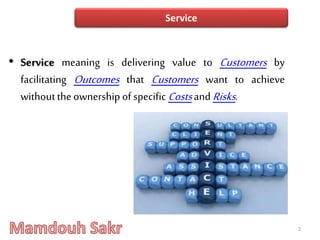
• Service meaning is delivering value to Customers by
facilitating Outcomes that Customers want to achieve
withoutthe ownership of specific Costsand Risks.
2
Service
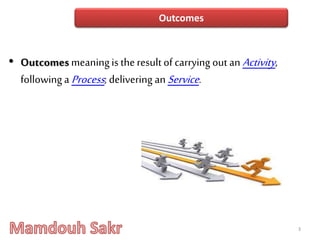
• Outcomes meaningis theresult of carrying out an Activity,
following a Process; delivering anService.
3
Outcomes
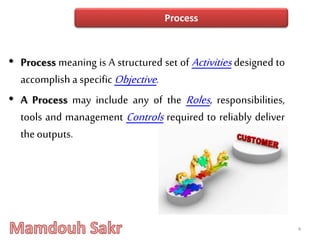
• Process meaning is A structured set of Activities designed to
accomplish a specific Objective.
• A Process may include any of the Roles, responsibilities,
tools and management Controls required to reliably deliver
theoutputs.
4
Process
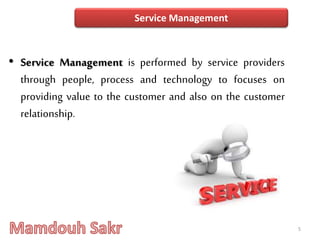
• Service Management is performed by service providers
through people, process and technology to focuses on
providing value to the customer and also on the customer
relationship.
5
Service Management
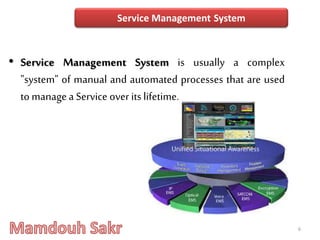
• Service Management System is usually a complex
"system" of manual and automated processes that are used
tomanagea Service over its lifetime.
6
Service Management System
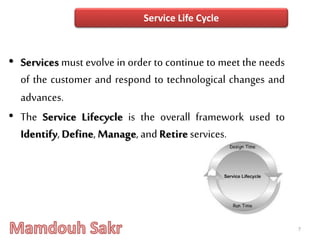
• Services must evolve in order to continue to meet the needs
of the customer and respond to technological changes and
advances.
• The Service Lifecycle is the overall framework used to
Identify,Define,Manage, and Retire services.
7
Service Life Cycle
8
Why Service Management ???
• Technical Organizations spend much of their time with the
following activities:
– Recovering from failures (“incidents”)
– Modifying or replacing technology components to improve their
reliability or functionality by eliminating issues (“problems” and
“errors”) associated with those components
– Carrying out additions, modifications or removals (“changes”)
9
Service Management – Why ???
• This is where SM comes in. An SM approach to Technical
management facilitates tighter Technical/customer alignment by
providing Technologicaland itscustomerswith theabilityto:
– Define Technical deliverables in terms of Services, expressed in the
customers’andusers’language
– Define how those Services will be delivered to the users, in terms of
functionality, availability, capacity, security, support, disaster recovery,
changemanagementandotherdimensionsofmanagingtheservice
– UnderstandthebusinessimpactwhenanServicefails
– PrioritizeTechnicalactivitiesbasedonthatimpact
10
Service Management – Why ???
11
Service Life Cycle
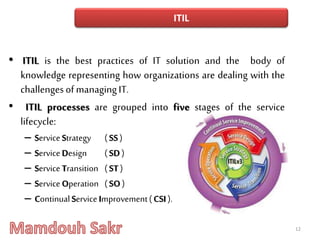
• ITIL is the best practices of IT solution and the body of
knowledge representing how organizations are dealing with the
challengesofmanagingIT.
• ITIL processes are grouped into five stages of the service
lifecycle:
– ServiceStrategy (SS )
– ServiceDesign (SD )
– ServiceTransition (ST )
– ServiceOperation (SO )
– ContinualServiceImprovement(CSI ).
12
ITIL
13
Service Strategy
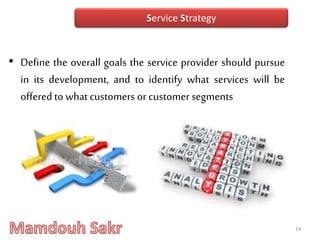
• Define the overall goals the service provider should pursue
in its development, and to identify what services will be
offered to whatcustomers or customer segments
14
Service Strategy
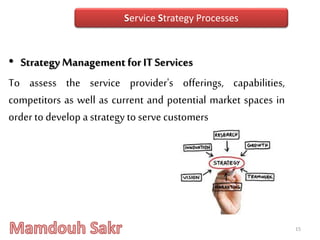
• Strategy Management for IT Services
To assess the service provider's offerings, capabilities,
competitors as well as current and potential market spaces in
order to develop a strategy toserve customers
15
Service Strategy Processes
• Demand Management
To understand, anticipate and influence customer demand for
services.
16
Service Strategy Processes
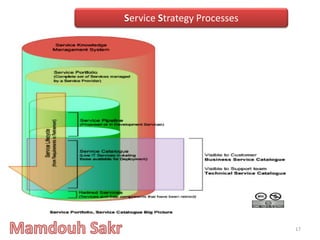
• Service Portfolio Management
To manage the service portfolio and ensures that the service
provider has the right mix of services to meet required business
outcomes at an appropriate level of investment.
17
Service Strategy Processes
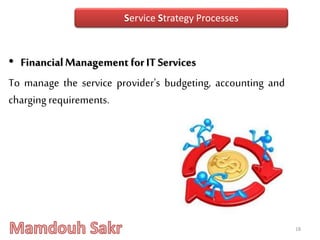
• FinancialManagement forIT Services
To manage the service provider's budgeting, accounting and
chargingrequirements.
18
Service Strategy Processes
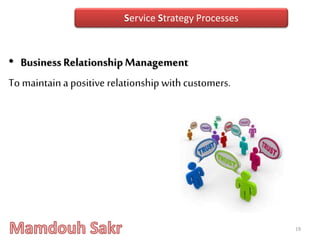
• Business RelationshipManagement
To maintaina positive relationshipwithcustomers.
19
Service Strategy Processes
20
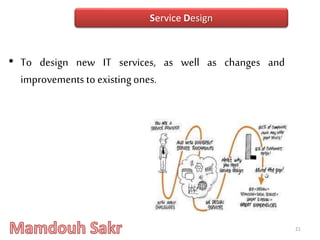
Service Design
• To design new IT services, as well as changes and
improvements to existingones.
21
Service Design
• Design Coordination
To coordinate all service design activities, processes and
resources. And ensures the consistent and effective design of
new or changed IT services.
22
Service Design Processes
• Service Catalogue Management
To ensure that a Service Catalogue is produced and maintained,
containing accurate information on all operational services and
those beingprepared tobe run operationally.
23
Service Design Processes
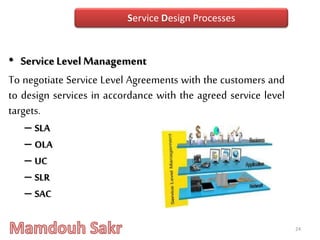
• Service Level Management
To negotiate Service Level Agreements with the customers and
to design services in accordance with the agreed service level
targets.
– SLA
– OLA
– UC
– SLR
– SAC
24
Service Design Processes
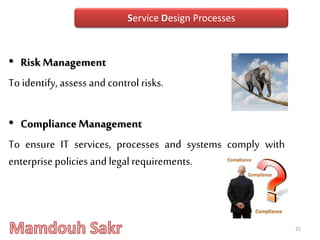
• Risk Management
To identify,assess and control risks.
• ComplianceManagement
To ensure IT services, processes and systems comply with
enterprise policies and legalrequirements.
25
Service Design Processes
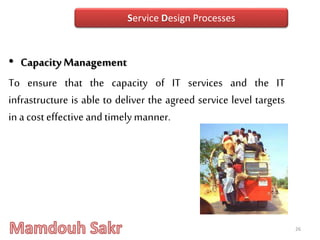
• Capacity Management
To ensure that the capacity of IT services and the IT
infrastructure is able to deliver the agreed service level targets
in a cost effectiveand timelymanner.
26
Service Design Processes
• AvailabilityManagement
To define, analyze, plan, measure and improveall aspects of the
availability of IT services.
• InformationSecurityManagement
To ensure the confidentiality, integrity and availability of an
organization'sinformation,data and IT services.
27
Service Design Processes
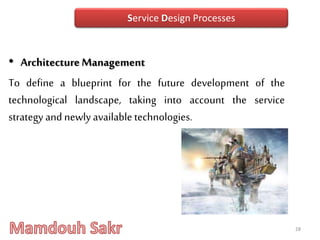
• ArchitectureManagement
To define a blueprint for the future development of the
technological landscape, taking into account the service
strategy and newlyavailable technologies.
28
Service Design Processes
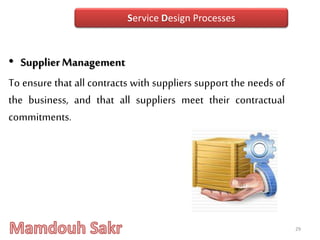
• Supplier Management
To ensure that all contracts with suppliers support the needs of
the business, and that all suppliers meet their contractual
commitments.
29
Service Design Processes
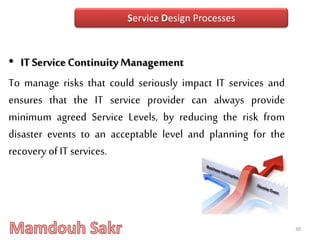
• ITServiceContinuity Management
To manage risks that could seriously impact IT services and
ensures that the IT service provider can always provide
minimum agreed Service Levels, by reducing the risk from
disaster events to an acceptable level and planning for the
recovery of IT services.
30
Service Design Processes
31
Service Transition
• To build and deploy IT services and makes sure that changes
to services and Service Management processes are carried
out in a coordinated way.
32
Service Transition
• Change Management
To control the lifecycle of all Changes through enable beneficial
Changestobe made, with minimumdisruptiontoIT services.
• ChangeEvaluation
To assess major Changes, before those Changes are allowed to
proceed to thenextphase in theirlifecycle.
33
Service Transition Processes
• Project Management (Transition Planningand Support)
To plan and coordinate the resources to deploy a major Release
withinthepredicted cost, timeand quality estimates.
• ApplicationDevelopment
To make available applications and systems which provide the
required functionalityfor IT services.
34
Service Transition Processes
• Release and Deployment Management
To plan, schedule and control the movement of releases to test
and live environments.
• Service Validationand Testing
To ensure that deployed Releases and the resulting services
meet customer expectations, and to verify that IT operations is
ableto support thenew service.
35
Service Transition Processes
• Service Asset and ConfigurationManagement
To maintain information about Configuration Items required to
deliver an IT service, includingtheirrelationships.
• KnowledgeManagement
To gather, analyze, store and share knowledge and information
withinan organization.
36
Service Transition Processes
37
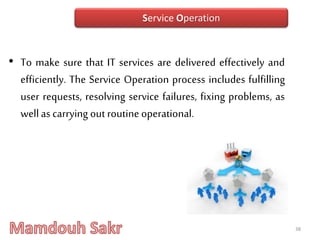
Service Operation
• To make sure that IT services are delivered effectively and
efficiently. The Service Operation process includes fulfilling
user requests, resolving service failures, fixing problems, as
wellas carrying out routine operational.
38
Service Operation
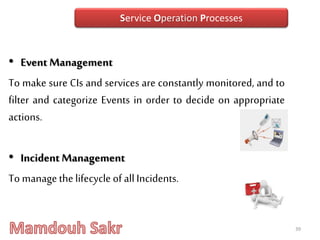
• Event Management
To make sure CIs and services are constantly monitored, and to
filter and categorize Events in order to decide on appropriate
actions.
• IncidentManagement
To managethelifecycle of allIncidents.
39
Service Operation Processes
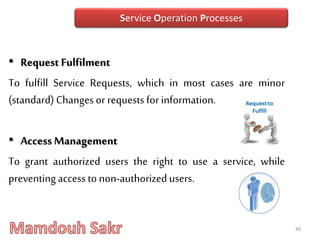
• Request Fulfilment
To fulfill Service Requests, which in most cases are minor
(standard) Changesor requests for information.
• Access Management
To grant authorized users the right to use a service, while
preventing access to non-authorizedusers.
40
Service Operation Processes
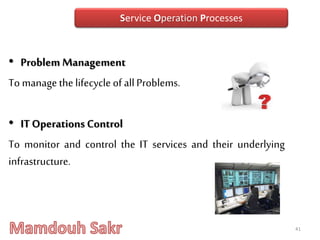
• Problem Management
To managethelifecycle of allProblems.
• ITOperations Control
To monitor and control the IT services and their underlying
infrastructure.
41
Service Operation Processes
• FacilitiesManagement
To manage the physical environment where the IT
infrastructure is located. Facilities Management includes all
aspects of managing the physical environment, for example
power and cooling, building access management, and
environmentalmonitoring.
42
Service Operation Processes
43
Continual Service Improvement
CSI
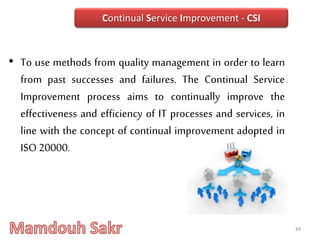
• To use methods from quality management in order to learn
from past successes and failures. The Continual Service
Improvement process aims to continually improve the
effectiveness and efficiency of IT processes and services, in
line with the concept of continual improvement adopted in
ISO 20000.
44
Continual Service Improvement - CSI
• Service Review
To review business services and infrastructure services on a
regular basis.
• Process Evaluation
To evaluate processes on a regular basis.
45
CSI Processes
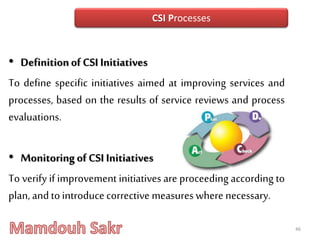
• Definitionof CSI Initiatives
To define specific initiatives aimed at improving services and
processes, based on the results of service reviews and process
evaluations.
• Monitoringof CSI Initiatives
To verify if improvement initiatives are proceeding according to
plan, andtointroduce corrective measures where necessary.
46
CSI Processes
47
Benefitsof using ITIL
• ITIL is proven and used worldwide
• Improved customer satisfaction and relationships
• Better reliabilityand qualityof service
• Optimizationof service deliveryacross the supply chain
– Reducesupport costs by30%
– Increaseincidents fixed atfirst callby20%
– Increasedvaluefrom service portfolio, withreduced costandrisk
• Competitive advantage through value creation and agile
change
48
Benefits
49
Resistance to ITIL Improvement
Initiatives
• No managementcommitment
• ITIL is the objective notwhat itshould achieve
• Plan, Do, Stop......No continualimprovement focus
• IT thinks it doesn't need to understand the business to
make a business case
• Unable to specify the VALUE requiredby the business
• Everything has the highest priority according to the
users
50
Resistance

Awareness session for service management

  • 1.
  • 2.
    • Service meaningis delivering value to Customers by facilitating Outcomes that Customers want to achieve withoutthe ownership of specific Costsand Risks. 2 Service
  • 3.
    • Outcomes meaningistheresult of carrying out an Activity, following a Process; delivering anService. 3 Outcomes
  • 4.
    • Process meaningis A structured set of Activities designed to accomplish a specific Objective. • A Process may include any of the Roles, responsibilities, tools and management Controls required to reliably deliver theoutputs. 4 Process
  • 5.
    • Service Managementis performed by service providers through people, process and technology to focuses on providing value to the customer and also on the customer relationship. 5 Service Management
  • 6.
    • Service ManagementSystem is usually a complex "system" of manual and automated processes that are used tomanagea Service over its lifetime. 6 Service Management System
  • 7.
    • Services mustevolve in order to continue to meet the needs of the customer and respond to technological changes and advances. • The Service Lifecycle is the overall framework used to Identify,Define,Manage, and Retire services. 7 Service Life Cycle
  • 8.
  • 9.
    • Technical Organizationsspend much of their time with the following activities: – Recovering from failures (“incidents”) – Modifying or replacing technology components to improve their reliability or functionality by eliminating issues (“problems” and “errors”) associated with those components – Carrying out additions, modifications or removals (“changes”) 9 Service Management – Why ???
  • 10.
    • This iswhere SM comes in. An SM approach to Technical management facilitates tighter Technical/customer alignment by providing Technologicaland itscustomerswith theabilityto: – Define Technical deliverables in terms of Services, expressed in the customers’andusers’language – Define how those Services will be delivered to the users, in terms of functionality, availability, capacity, security, support, disaster recovery, changemanagementandotherdimensionsofmanagingtheservice – UnderstandthebusinessimpactwhenanServicefails – PrioritizeTechnicalactivitiesbasedonthatimpact 10 Service Management – Why ???
  • 11.
  • 12.
    • ITIL isthe best practices of IT solution and the body of knowledge representing how organizations are dealing with the challengesofmanagingIT. • ITIL processes are grouped into five stages of the service lifecycle: – ServiceStrategy (SS ) – ServiceDesign (SD ) – ServiceTransition (ST ) – ServiceOperation (SO ) – ContinualServiceImprovement(CSI ). 12 ITIL
  • 13.
  • 14.
    • Define theoverall goals the service provider should pursue in its development, and to identify what services will be offered to whatcustomers or customer segments 14 Service Strategy
  • 15.
    • Strategy Managementfor IT Services To assess the service provider's offerings, capabilities, competitors as well as current and potential market spaces in order to develop a strategy toserve customers 15 Service Strategy Processes
  • 16.
    • Demand Management Tounderstand, anticipate and influence customer demand for services. 16 Service Strategy Processes
  • 17.
    • Service PortfolioManagement To manage the service portfolio and ensures that the service provider has the right mix of services to meet required business outcomes at an appropriate level of investment. 17 Service Strategy Processes
  • 18.
    • FinancialManagement forITServices To manage the service provider's budgeting, accounting and chargingrequirements. 18 Service Strategy Processes
  • 19.
    • Business RelationshipManagement Tomaintaina positive relationshipwithcustomers. 19 Service Strategy Processes
  • 20.
  • 21.
    • To designnew IT services, as well as changes and improvements to existingones. 21 Service Design
  • 22.
    • Design Coordination Tocoordinate all service design activities, processes and resources. And ensures the consistent and effective design of new or changed IT services. 22 Service Design Processes
  • 23.
    • Service CatalogueManagement To ensure that a Service Catalogue is produced and maintained, containing accurate information on all operational services and those beingprepared tobe run operationally. 23 Service Design Processes
  • 24.
    • Service LevelManagement To negotiate Service Level Agreements with the customers and to design services in accordance with the agreed service level targets. – SLA – OLA – UC – SLR – SAC 24 Service Design Processes
  • 25.
    • Risk Management Toidentify,assess and control risks. • ComplianceManagement To ensure IT services, processes and systems comply with enterprise policies and legalrequirements. 25 Service Design Processes
  • 26.
    • Capacity Management Toensure that the capacity of IT services and the IT infrastructure is able to deliver the agreed service level targets in a cost effectiveand timelymanner. 26 Service Design Processes
  • 27.
    • AvailabilityManagement To define,analyze, plan, measure and improveall aspects of the availability of IT services. • InformationSecurityManagement To ensure the confidentiality, integrity and availability of an organization'sinformation,data and IT services. 27 Service Design Processes
  • 28.
    • ArchitectureManagement To definea blueprint for the future development of the technological landscape, taking into account the service strategy and newlyavailable technologies. 28 Service Design Processes
  • 29.
    • Supplier Management Toensure that all contracts with suppliers support the needs of the business, and that all suppliers meet their contractual commitments. 29 Service Design Processes
  • 30.
    • ITServiceContinuity Management Tomanage risks that could seriously impact IT services and ensures that the IT service provider can always provide minimum agreed Service Levels, by reducing the risk from disaster events to an acceptable level and planning for the recovery of IT services. 30 Service Design Processes
  • 31.
  • 32.
    • To buildand deploy IT services and makes sure that changes to services and Service Management processes are carried out in a coordinated way. 32 Service Transition
  • 33.
    • Change Management Tocontrol the lifecycle of all Changes through enable beneficial Changestobe made, with minimumdisruptiontoIT services. • ChangeEvaluation To assess major Changes, before those Changes are allowed to proceed to thenextphase in theirlifecycle. 33 Service Transition Processes
  • 34.
    • Project Management(Transition Planningand Support) To plan and coordinate the resources to deploy a major Release withinthepredicted cost, timeand quality estimates. • ApplicationDevelopment To make available applications and systems which provide the required functionalityfor IT services. 34 Service Transition Processes
  • 35.
    • Release andDeployment Management To plan, schedule and control the movement of releases to test and live environments. • Service Validationand Testing To ensure that deployed Releases and the resulting services meet customer expectations, and to verify that IT operations is ableto support thenew service. 35 Service Transition Processes
  • 36.
    • Service Assetand ConfigurationManagement To maintain information about Configuration Items required to deliver an IT service, includingtheirrelationships. • KnowledgeManagement To gather, analyze, store and share knowledge and information withinan organization. 36 Service Transition Processes
  • 37.
  • 38.
    • To makesure that IT services are delivered effectively and efficiently. The Service Operation process includes fulfilling user requests, resolving service failures, fixing problems, as wellas carrying out routine operational. 38 Service Operation
  • 39.
    • Event Management Tomake sure CIs and services are constantly monitored, and to filter and categorize Events in order to decide on appropriate actions. • IncidentManagement To managethelifecycle of allIncidents. 39 Service Operation Processes
  • 40.
    • Request Fulfilment Tofulfill Service Requests, which in most cases are minor (standard) Changesor requests for information. • Access Management To grant authorized users the right to use a service, while preventing access to non-authorizedusers. 40 Service Operation Processes
  • 41.
    • Problem Management Tomanagethelifecycle of allProblems. • ITOperations Control To monitor and control the IT services and their underlying infrastructure. 41 Service Operation Processes
  • 42.
    • FacilitiesManagement To managethe physical environment where the IT infrastructure is located. Facilities Management includes all aspects of managing the physical environment, for example power and cooling, building access management, and environmentalmonitoring. 42 Service Operation Processes
  • 43.
  • 44.
    • To usemethods from quality management in order to learn from past successes and failures. The Continual Service Improvement process aims to continually improve the effectiveness and efficiency of IT processes and services, in line with the concept of continual improvement adopted in ISO 20000. 44 Continual Service Improvement - CSI
  • 45.
    • Service Review Toreview business services and infrastructure services on a regular basis. • Process Evaluation To evaluate processes on a regular basis. 45 CSI Processes
  • 46.
    • Definitionof CSIInitiatives To define specific initiatives aimed at improving services and processes, based on the results of service reviews and process evaluations. • Monitoringof CSI Initiatives To verify if improvement initiatives are proceeding according to plan, andtointroduce corrective measures where necessary. 46 CSI Processes
  • 47.
  • 48.
    • ITIL isproven and used worldwide • Improved customer satisfaction and relationships • Better reliabilityand qualityof service • Optimizationof service deliveryacross the supply chain – Reducesupport costs by30% – Increaseincidents fixed atfirst callby20% – Increasedvaluefrom service portfolio, withreduced costandrisk • Competitive advantage through value creation and agile change 48 Benefits
  • 49.
    49 Resistance to ITILImprovement Initiatives
  • 50.
    • No managementcommitment •ITIL is the objective notwhat itshould achieve • Plan, Do, Stop......No continualimprovement focus • IT thinks it doesn't need to understand the business to make a business case • Unable to specify the VALUE requiredby the business • Everything has the highest priority according to the users 50 Resistance